Tutorial on Robustness of Recommender Systems


             Tutorial on Robustness of Recommender
                            Systems

                                                 Neil Hurley

                                    Complex Adaptive System Laboratory
                                     Computer Science and Informatics
                                         University College Dublin


                                                Clique Strategic Research Cluster
                                                 clique.ucd.ie


                                                October 2011

      RecSys 2011: Tutorial on Recommender Robustness
Tutorial on Robustness of Recommender Systems


Outline

       1 What is Robustness?
               Profile Injection Attacks
               Relevance of Robustness
               Measuring Robustness


      RecSys 2011: Tutorial on Recommender Robustness
Tutorial on Robustness of Recommender Systems


Outline

       1 What is Robustness?
          Profile Injection Attacks
          Relevance of Robustness
          Measuring Robustness
       2 Attack Strategies
          Attacking kNN Algorithms


      RecSys 2011: Tutorial on Recommender Robustness
Tutorial on Robustness of Recommender Systems


Outline

       1 What is Robustness?
          Profile Injection Attacks
          Relevance of Robustness
          Measuring Robustness
       2 Attack Strategies
          Attacking kNN Algorithms
       3 Attack Detection
          PCA-based Attack Detection
          Statistical Attack Detection
          Cost-Benefit Analysis


      RecSys 2011: Tutorial on Recommender Robustness
Tutorial on Robustness of Recommender Systems


Outline

       1 What is Robustness?
          Profile Injection Attacks
          Relevance of Robustness
          Measuring Robustness
       2 Attack Strategies
          Attacking kNN Algorithms
       3 Attack Detection
          PCA-based Attack Detection
          Statistical Attack Detection
          Cost-Benefit Analysis
       4 Robustness of Model-based Algorithms


      RecSys 2011: Tutorial on Recommender Robustness
Tutorial on Robustness of Recommender Systems


Outline

       1 What is Robustness?
            Profile Injection Attacks
            Relevance of Robustness
            Measuring Robustness
       2   Attack Strategies
            Attacking kNN Algorithms
       3   Attack Detection
            PCA-based Attack Detection
            Statistical Attack Detection
            Cost-Benefit Analysis
       4   Robustness of Model-based Algorithms
       5   Attack Resistant Recommendation Algorithms
            Provably Manipulation Resistant Algorithms

      RecSys 2011: Tutorial on Recommender Robustness
Tutorial on Robustness of Recommender Systems


Outline

       1 What is Robustness?
             Profile Injection Attacks
             Relevance of Robustness
             Measuring Robustness
       2   Attack Strategies
             Attacking kNN Algorithms
       3   Attack Detection
             PCA-based Attack Detection
             Statistical Attack Detection
             Cost-Benefit Analysis
       4   Robustness of Model-based Algorithms
       5   Attack Resistant Recommendation Algorithms
             Provably Manipulation Resistant Algorithms
       6   Stability, Trust and Privacy
      RecSys 2011: Tutorial on Recommender Robustness
Tutorial on Robustness of Recommender Systems
  What is Robustness?


Outline

       1 What is Robustness?
             Profile Injection Attacks
             Relevance of Robustness
             Measuring Robustness
       2   Attack Strategies
             Attacking kNN Algorithms
       3   Attack Detection
             PCA-based Attack Detection
             Statistical Attack Detection
             Cost-Benefit Analysis
       4   Robustness of Model-based Algorithms
       5   Attack Resistant Recommendation Algorithms
             Provably Manipulation Resistant Algorithms
       6   Stability, Trust and Privacy
      RecSys 2011: Tutorial on Recommender Robustness
Tutorial on Robustness of Recommender Systems
  What is Robustness?
     Profile Injection Attacks


Outline

       1 What is Robustness?
              Profile Injection Attacks
              Relevance of Robustness
              Measuring Robustness
       2    Attack Strategies
              Attacking kNN Algorithms
       3    Attack Detection
              PCA-based Attack Detection
              Statistical Attack Detection
              Cost-Benefit Analysis
       4    Robustness of Model-based Algorithms
       5    Attack Resistant Recommendation Algorithms
              Provably Manipulation Resistant Algorithms
       6    Stability, Trust and Privacy
      RecSys 2011: Tutorial on Recommender Robustness
Tutorial on Robustness of Recommender Systems
  What is Robustness?
     Profile Injection Attacks


Defining the Problem

              Recommender Systems use personal information about
              end-users to make useful personalised recommendations.
              When ratings are provided explicitly, recommender algorithms
              have been designed on the assumption that the provided
              information is correct.
              However . . .
                      “One can have, some claim, as many electronic per-
                      sonas as one has time and energy to create”
                                                        –Judith Donath (1998) as quoted in Douceur (2002)

              How does the system perform if multiple identities are used to
              try to deliberately bias the recommender output?


      RecSys 2011: Tutorial on Recommender Robustness
Tutorial on Robustness of Recommender Systems
  What is Robustness?
     Profile Injection Attacks


Defining the Problem

              In 2002, John Douceur of Microsoft Research coined the term
              Sybil Attack to refer to an attack against identity on
              peer-to-peer systems in which an individual entity
              masquerades as multiple separate entities
                      “If the local entity has no direct physical knowledge of remote entities, it perceives them only
                      as informational abstractions that we call identities. The system must ensure that distinct
                      identities refer to distinct entities; otherwise, when the local entity selects a subset of identities
                      to redundantly perform a remote operation, it can be duped into selecting a single remote
                      entity multiple times, thereby defeating the redundancy”

              In the same year, the first paper (O’Mahony et al. 2002)
              appeared on the vulnerability of Recommender Systems to
              malicious strategies for “recommendation promotion” – later
              dubbed profile injection attacks.


      RecSys 2011: Tutorial on Recommender Robustness
Tutorial on Robustness of Recommender Systems
  What is Robustness?
     Profile Injection Attacks


Defining the Problem

              Robustness refers to the ability of a system to operate under
              stressful conditions.
              While there are many possible stresses that can be applied to
              Recommender Systems, research on RS robustness has
              focused on performance when the dataset is stressed
              specifically when
                      the dataset is full of noisy, erroneous data;
                      typically, imagined to have been corrupted through a concerted
                      sybil attack, with an aim of biasing the recommender output.


      RecSys 2011: Tutorial on Recommender Robustness
Tutorial on Robustness of Recommender Systems
  What is Robustness?
     Profile Injection Attacks


Robust RS Research

              The goal of robust recommendation is to prevent attackers
              from manipulating an RS through large-scale insertion of false
              user profiles: a profile injection attack


      RecSys 2011: Tutorial on Recommender Robustness
Tutorial on Robustness of Recommender Systems
  What is Robustness?
     Profile Injection Attacks


Robust RS Research

              The goal of robust recommendation is to prevent attackers
              from manipulating an RS through large-scale insertion of false
              user profiles: a profile injection attack
              An attack is a concerted effort to bias the results of a
              recommender system by the insertion of a large number of
              profiles using false identities or sybils.


      RecSys 2011: Tutorial on Recommender Robustness
Tutorial on Robustness of Recommender Systems
  What is Robustness?
     Profile Injection Attacks


Robust RS Research

              The goal of robust recommendation is to prevent attackers
              from manipulating an RS through large-scale insertion of false
              user profiles: a profile injection attack
              An attack is a concerted effort to bias the results of a
              recommender system by the insertion of a large number of
              profiles using false identities or sybils.
              Each identity is referred to as an attack profile.


      RecSys 2011: Tutorial on Recommender Robustness
Tutorial on Robustness of Recommender Systems
  What is Robustness?
     Profile Injection Attacks


Robust RS Research

              The goal of robust recommendation is to prevent attackers
              from manipulating an RS through large-scale insertion of false
              user profiles: a profile injection attack
              An attack is a concerted effort to bias the results of a
              recommender system by the insertion of a large number of
              profiles using false identities or sybils.
              Each identity is referred to as an attack profile.
              Research has concentrated on attacks designed to achieve a
              particular recommendation outcome


      RecSys 2011: Tutorial on Recommender Robustness
Tutorial on Robustness of Recommender Systems
  What is Robustness?
     Profile Injection Attacks


Robust RS Research

              The goal of robust recommendation is to prevent attackers
              from manipulating an RS through large-scale insertion of false
              user profiles: a profile injection attack
              An attack is a concerted effort to bias the results of a
              recommender system by the insertion of a large number of
              profiles using false identities or sybils.
              Each identity is referred to as an attack profile.
              Research has concentrated on attacks designed to achieve a
              particular recommendation outcome
                      A Product Push attack: attempt to secure positive
                      recommendations for an item or items;


      RecSys 2011: Tutorial on Recommender Robustness
Tutorial on Robustness of Recommender Systems
  What is Robustness?
     Profile Injection Attacks


Robust RS Research

              The goal of robust recommendation is to prevent attackers
              from manipulating an RS through large-scale insertion of false
              user profiles: a profile injection attack
              An attack is a concerted effort to bias the results of a
              recommender system by the insertion of a large number of
              profiles using false identities or sybils.
              Each identity is referred to as an attack profile.
              Research has concentrated on attacks designed to achieve a
              particular recommendation outcome
                      A Product Push attack: attempt to secure positive
                      recommendations for an item or items;
                      A Product Nuke attack: attempt to secure negative
                      recommendations for an item or items.


      RecSys 2011: Tutorial on Recommender Robustness
Tutorial on Robustness of Recommender Systems
  What is Robustness?
     Profile Injection Attacks


Robust RS Research

              The goal of robust recommendation is to prevent attackers
              from manipulating an RS through large-scale insertion of false
              user profiles: a profile injection attack
              An attack is a concerted effort to bias the results of a
              recommender system by the insertion of a large number of
              profiles using false identities or sybils.
              Each identity is referred to as an attack profile.
              Research has concentrated on attacks designed to achieve a
              particular recommendation outcome
                      A Product Push attack: attempt to secure positive
                      recommendations for an item or items;
                      A Product Nuke attack: attempt to secure negative
                      recommendations for an item or items.
              We can also think of attacks that aim to simply destroy the
              accuracy of the system.
      RecSys 2011: Tutorial on Recommender Robustness
Tutorial on Robustness of Recommender Systems
  What is Robustness?
     Profile Injection Attacks


Robust RS Research

              We assume that the attacker has no direct access to the
              ratings database – manipulation achieved via the creation of
              false profiles only.


      RecSys 2011: Tutorial on Recommender Robustness
Tutorial on Robustness of Recommender Systems
  What is Robustness?
     Profile Injection Attacks


Robust RS Research

              We assume that the attacker has no direct access to the
              ratings database – manipulation achieved via the creation of
              false profiles only.
              We ignore system-level methods (e.g. Captchas) for
              preventing the generation of false identities or ratings


      RecSys 2011: Tutorial on Recommender Robustness
Tutorial on Robustness of Recommender Systems
  What is Robustness?
     Profile Injection Attacks


Robust RS Research

              We assume that the attacker has no direct access to the
              ratings database – manipulation achieved via the creation of
              false profiles only.
              We ignore system-level methods (e.g. Captchas) for
              preventing the generation of false identities or ratings
                      Focus is on the recommendation algorithm’s ability to resist
                      manipulation either by


      RecSys 2011: Tutorial on Recommender Robustness
Tutorial on Robustness of Recommender Systems
  What is Robustness?
     Profile Injection Attacks


Robust RS Research

              We assume that the attacker has no direct access to the
              ratings database – manipulation achieved via the creation of
              false profiles only.
              We ignore system-level methods (e.g. Captchas) for
              preventing the generation of false identities or ratings
                      Focus is on the recommendation algorithm’s ability to resist
                      manipulation either by
                                Identifying false profiles from their statistical properties and
                                ignoring or lessening their impact on the generation of
                                recommendations;


      RecSys 2011: Tutorial on Recommender Robustness
Tutorial on Robustness of Recommender Systems
  What is Robustness?
     Profile Injection Attacks


Robust RS Research

              We assume that the attacker has no direct access to the
              ratings database – manipulation achieved via the creation of
              false profiles only.
              We ignore system-level methods (e.g. Captchas) for
              preventing the generation of false identities or ratings
                      Focus is on the recommendation algorithm’s ability to resist
                      manipulation either by
                                Identifying false profiles from their statistical properties and
                                ignoring or lessening their impact on the generation of
                                recommendations; or
                                Generating recommendations in a manner that is inherently
                                insensitive to manipulation.


      RecSys 2011: Tutorial on Recommender Robustness
Tutorial on Robustness of Recommender Systems
  What is Robustness?
     Profile Injection Attacks


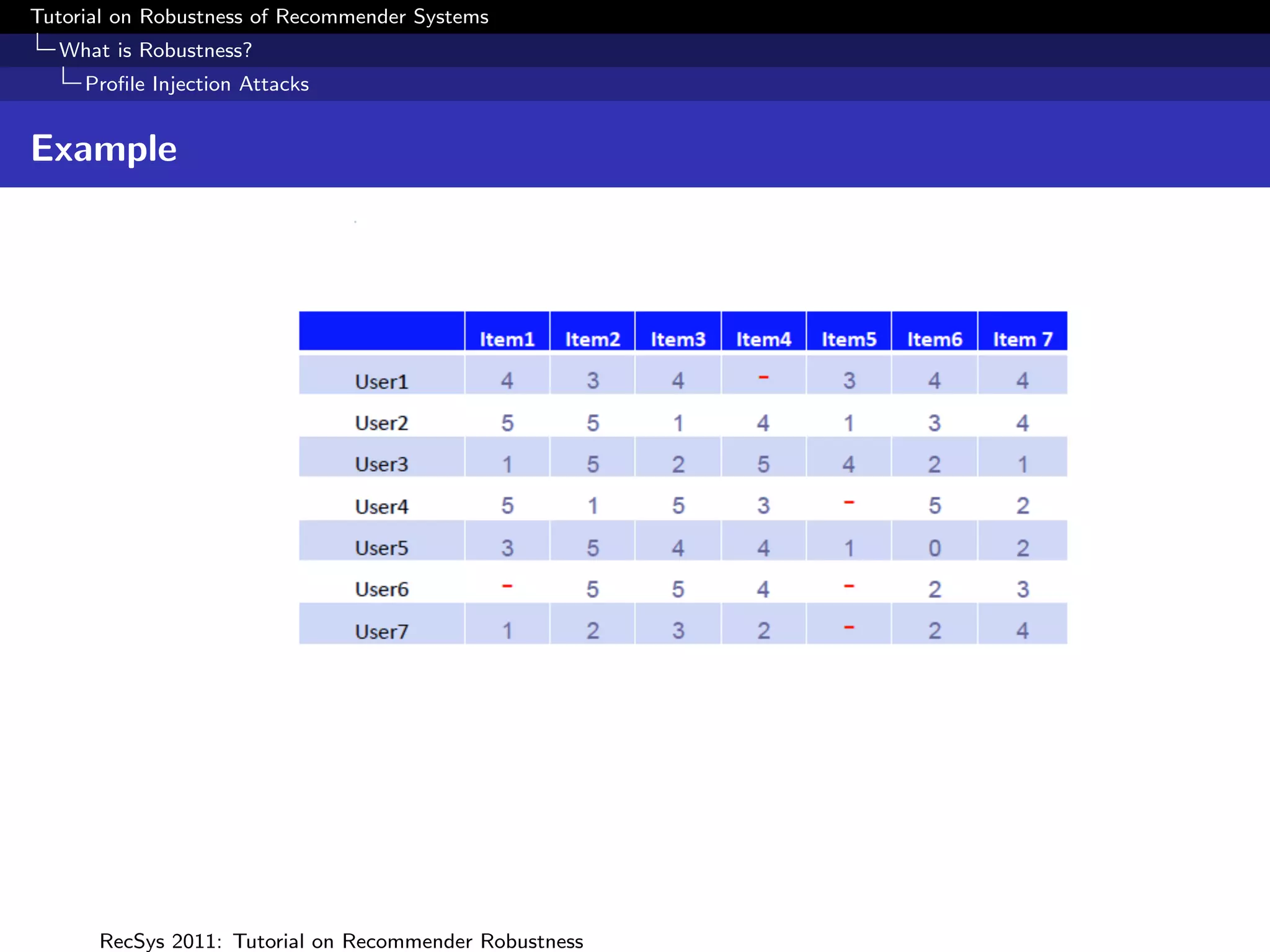
Example


      RecSys 2011: Tutorial on Recommender Robustness
Tutorial on Robustness of Recommender Systems
  What is Robustness?
     Profile Injection Attacks


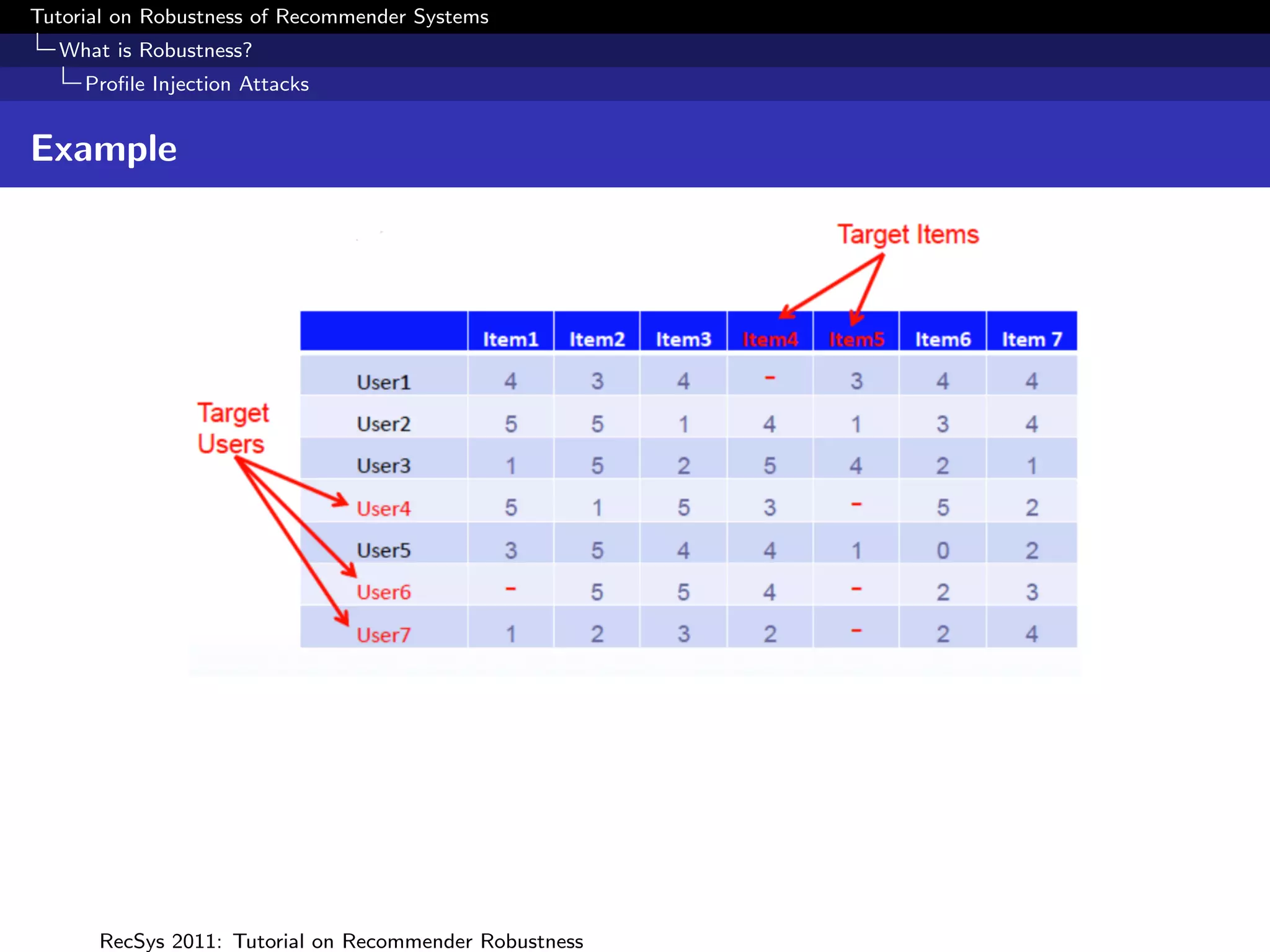
Example


      RecSys 2011: Tutorial on Recommender Robustness
Tutorial on Robustness of Recommender Systems
  What is Robustness?
     Profile Injection Attacks


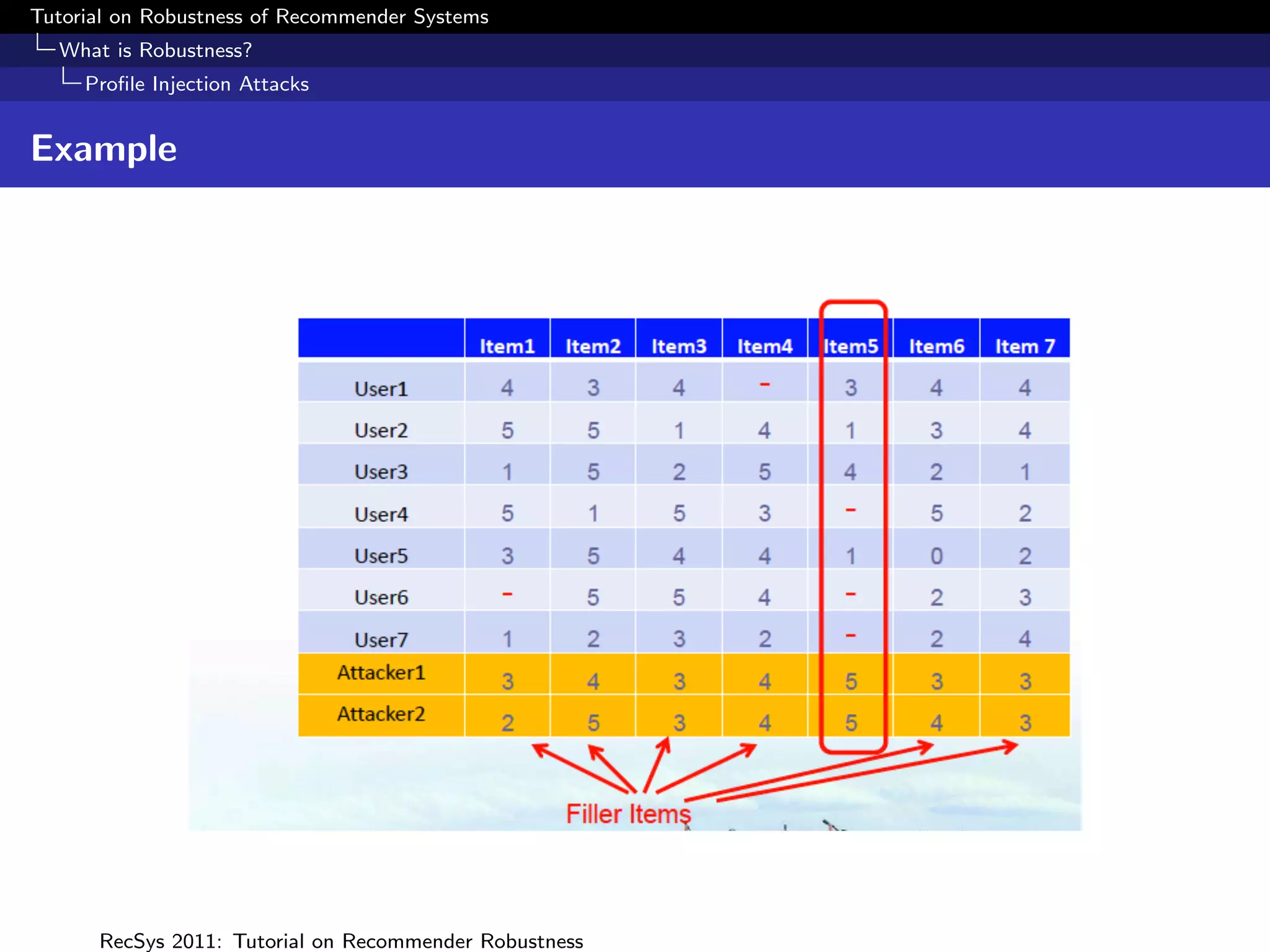
Example


      RecSys 2011: Tutorial on Recommender Robustness
Tutorial on Robustness of Recommender Systems
  What is Robustness?
     Profile Injection Attacks


Threats to Reputation Systems I

      It is interesting to compare the scenario studied in RS research
      with the threats identified for reputation systems in the 2007
      ENISA report (Carrara and Hogben 2007):
          1   Whitewashing attack: reseting a poor reputation by
              rejoining the system with a new identity.
          2   Sybil attack or pseudospoofing: the attacker uses multiple
              identities (sybils) in order to manipulate a reputation score.
          3   Impersonation and reputation theft: acquiring the identity
              of another and stealing her reputation.
          4   Bootstrap issues and related threats: the initial reputation
              of a newcomer may be particularly vulnerable to attack.


      RecSys 2011: Tutorial on Recommender Robustness
Tutorial on Robustness of Recommender Systems
  What is Robustness?
     Profile Injection Attacks


Threats to Reputation Systems II

          5   Extortion: co-ordinated campaigns aimed at blackmail by
              damaging an individual’s reputation for malicious motives.
          6   Denial-of-reputation: attack designed to damage reputation
              and create an opportunity for blackmail in order to have the
              reputation cleaned.
          7   Ballot stuffing and bad mouthing: reporting of a false
              reputation score; the attackers collude to give
              positive/negative feedback, to increase or lower a reputation.
          8   Collusion: multiple users conspire to influence a given
              reputation.
          9   Repudiation of data and transaction: denial that a
              transaction occurred, or denial of the existence of data for
              which individual is responsible.

      RecSys 2011: Tutorial on Recommender Robustness
Tutorial on Robustness of Recommender Systems
  What is Robustness?
     Profile Injection Attacks


Threats to Reputation Systems III

         10   Recommender dishonesty: dishonest reputation scoring.
         11   Privacy threats for voters and reputation owners: for
              example, anonymity improves the accuracy of votes.
         12   Social threats: Discriminatory behaviour, herd behaviour,
              penalisation of innovative, controversial opinions, vocal
              minority effect etc.
         13   Threats to the underlying networks: e.g. denial of service
              attack.
         14   Trust topology threats: e.g.targeting most highly influential
              nodes.
         15   Threats to ratings: exploiting features of metrics used by
              the system to calculate the aggregate reputation rating


      RecSys 2011: Tutorial on Recommender Robustness
Tutorial on Robustness of Recommender Systems
  What is Robustness?
     Profile Injection Attacks


The Recommendation Attack Game

              An attack has an associated context-dependent cost


      RecSys 2011: Tutorial on Recommender Robustness
Tutorial on Robustness of Recommender Systems
  What is Robustness?
     Profile Injection Attacks


The Recommendation Attack Game

              An attack has an associated context-dependent cost
                      real dollar cost if the insertion of a sybil rating requires the
                      purchase of the corresponding item;


      RecSys 2011: Tutorial on Recommender Robustness
Tutorial on Robustness of Recommender Systems
  What is Robustness?
     Profile Injection Attacks


The Recommendation Attack Game

              An attack has an associated context-dependent cost
                      real dollar cost if the insertion of a sybil rating requires the
                      purchase of the corresponding item;
                      time/effort cost;


      RecSys 2011: Tutorial on Recommender Robustness
Tutorial on Robustness of Recommender Systems
  What is Robustness?
     Profile Injection Attacks


The Recommendation Attack Game

              An attack has an associated context-dependent cost
                      real dollar cost if the insertion of a sybil rating requires the
                      purchase of the corresponding item;
                      time/effort cost;
                      risk cost, associated with the likelihood of being detected;


      RecSys 2011: Tutorial on Recommender Robustness
Tutorial on Robustness of Recommender Systems
  What is Robustness?
     Profile Injection Attacks


The Recommendation Attack Game

              An attack has an associated context-dependent cost
                      real dollar cost if the insertion of a sybil rating requires the
                      purchase of the corresponding item;
                      time/effort cost;
                      risk cost, associated with the likelihood of being detected;
              In any case, we may model the cost as proportional to


      RecSys 2011: Tutorial on Recommender Robustness
Tutorial on Robustness of Recommender Systems
  What is Robustness?
     Profile Injection Attacks


The Recommendation Attack Game

              An attack has an associated context-dependent cost
                      real dollar cost if the insertion of a sybil rating requires the
                      purchase of the corresponding item;
                      time/effort cost;
                      risk cost, associated with the likelihood of being detected;
              In any case, we may model the cost as proportional to
                      The number of sybil profiles created ;


      RecSys 2011: Tutorial on Recommender Robustness
Tutorial on Robustness of Recommender Systems
  What is Robustness?
     Profile Injection Attacks


The Recommendation Attack Game

              An attack has an associated context-dependent cost
                      real dollar cost if the insertion of a sybil rating requires the
                      purchase of the corresponding item;
                      time/effort cost;
                      risk cost, associated with the likelihood of being detected;
              In any case, we may model the cost as proportional to
                      The number of sybil profiles created ;
                      the total number of constituent ratings within the sybil profiles.


      RecSys 2011: Tutorial on Recommender Robustness
Tutorial on Robustness of Recommender Systems
  What is Robustness?
     Profile Injection Attacks


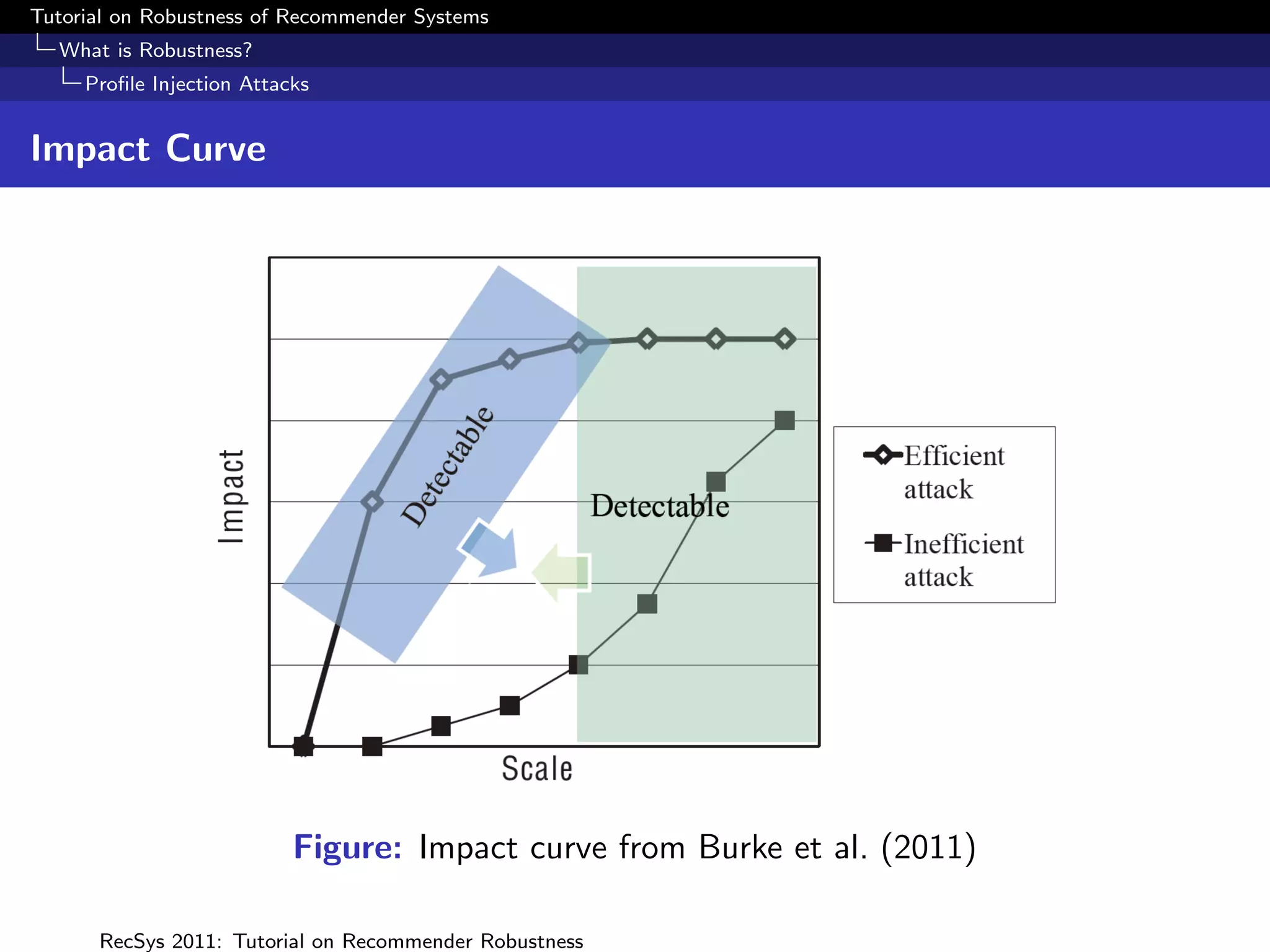
Impact Curve


                           Figure: Impact curve from Burke et al. (2011)

      RecSys 2011: Tutorial on Recommender Robustness
Tutorial on Robustness of Recommender Systems
  What is Robustness?
     Profile Injection Attacks


Notation

              Consider R to be an n × m database of ratings provided by a
              set of n genuine users for m items in a system catalogue.


      RecSys 2011: Tutorial on Recommender Robustness
Tutorial on Robustness of Recommender Systems
  What is Robustness?
     Profile Injection Attacks


Notation


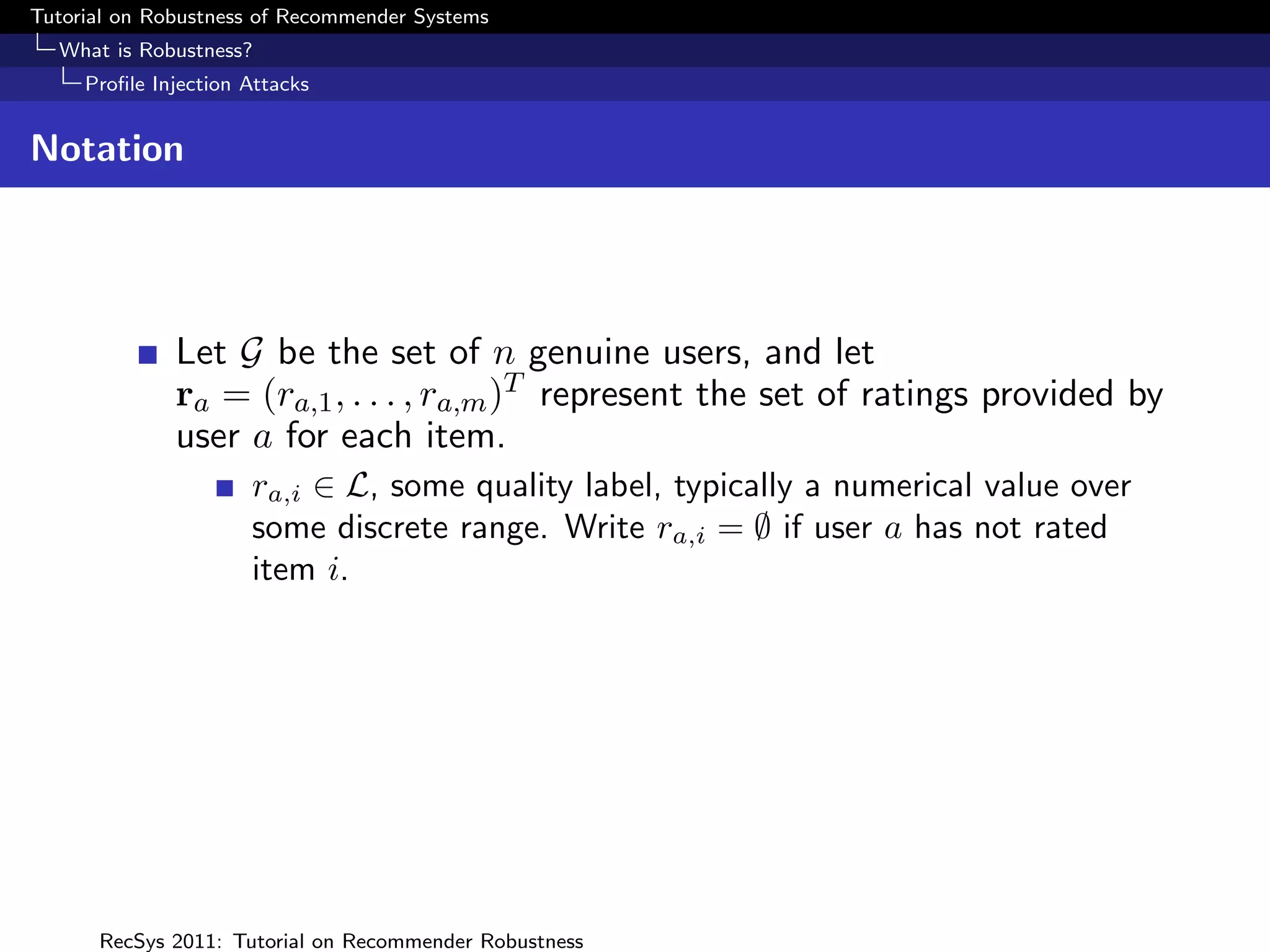
              Let G be the set of n genuine users, and let
              ra = (ra,1 , . . . , ra,m )T represent the set of ratings provided by
              user a for each item.
                      ra,i ∈ L, some quality label, typically a numerical value over
                      some discrete range. Write ra,i = ∅ if user a has not rated
                      item i.


      RecSys 2011: Tutorial on Recommender Robustness
Tutorial on Robustness of Recommender Systems
  What is Robustness?
     Profile Injection Attacks


Notation


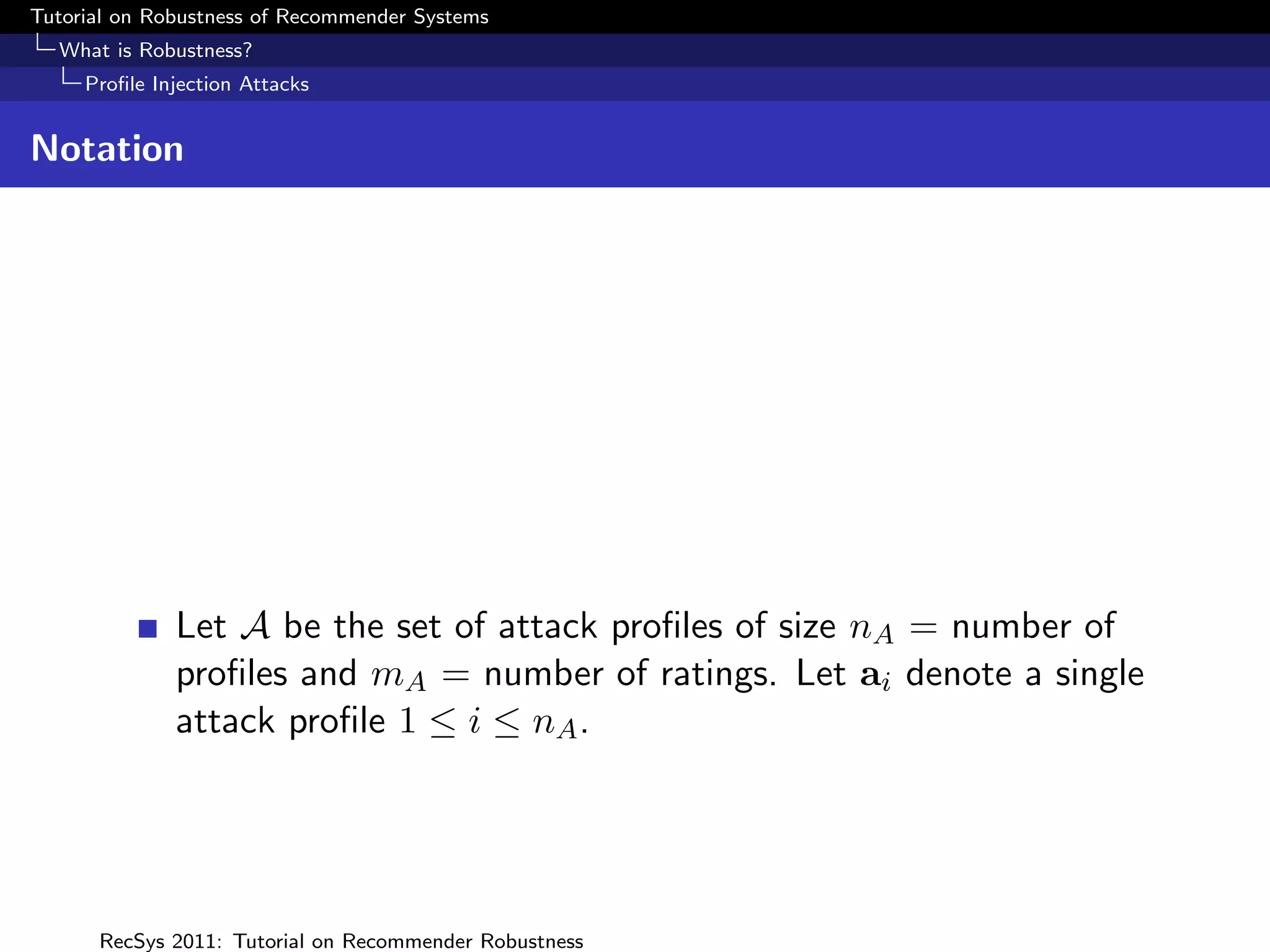
              Let A be the set of attack profiles of size nA = number of
              profiles and mA = number of ratings. Let ai denote a single
              attack profile 1 ≤ i ≤ nA .


      RecSys 2011: Tutorial on Recommender Robustness
Tutorial on Robustness of Recommender Systems
  What is Robustness?
     Profile Injection Attacks


Notation


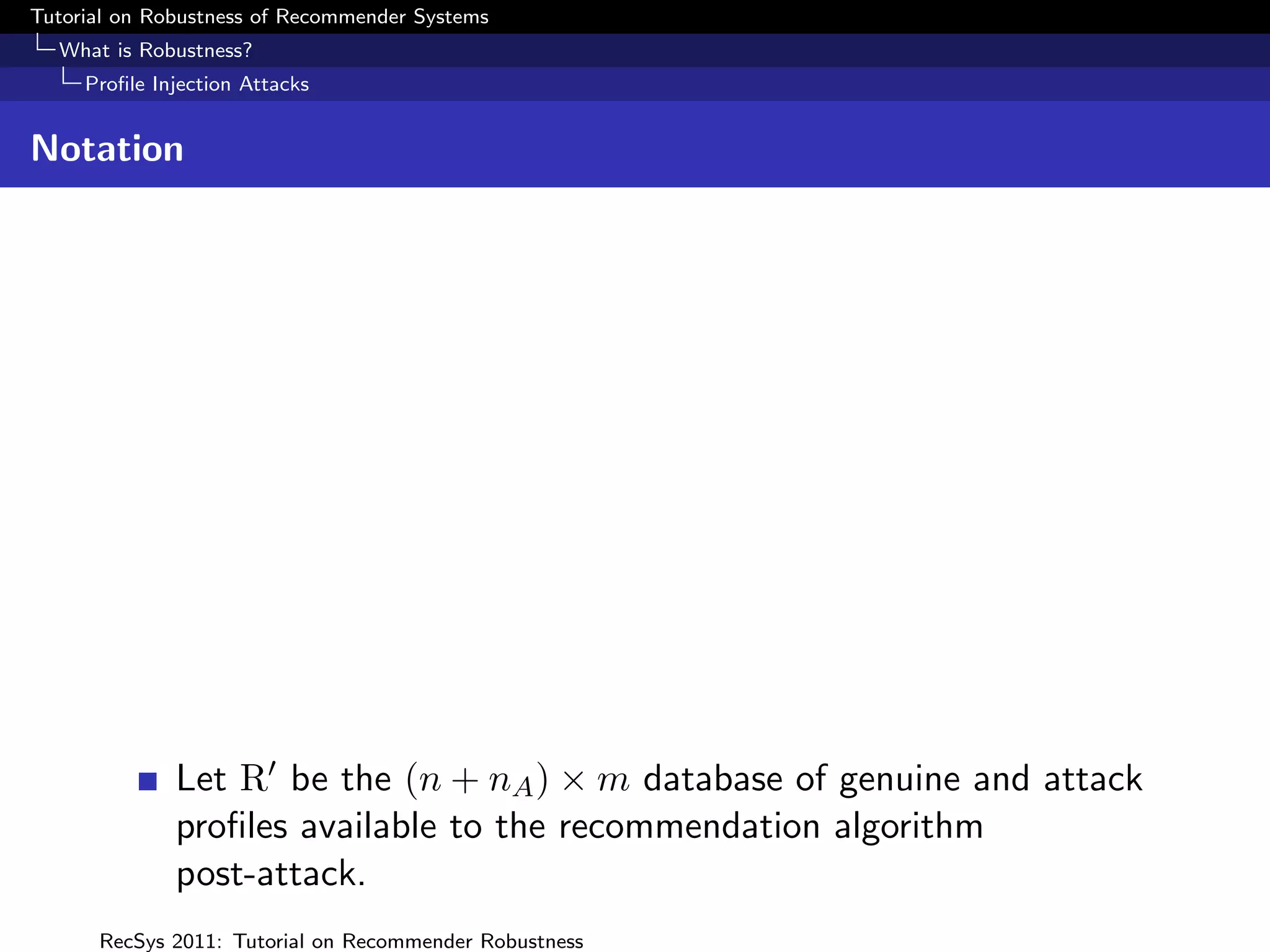
              Let R be the (n + nA ) × m database of genuine and attack
              profiles available to the recommendation algorithm
              post-attack.
      RecSys 2011: Tutorial on Recommender Robustness
Tutorial on Robustness of Recommender Systems
  What is Robustness?
     Profile Injection Attacks


Notation

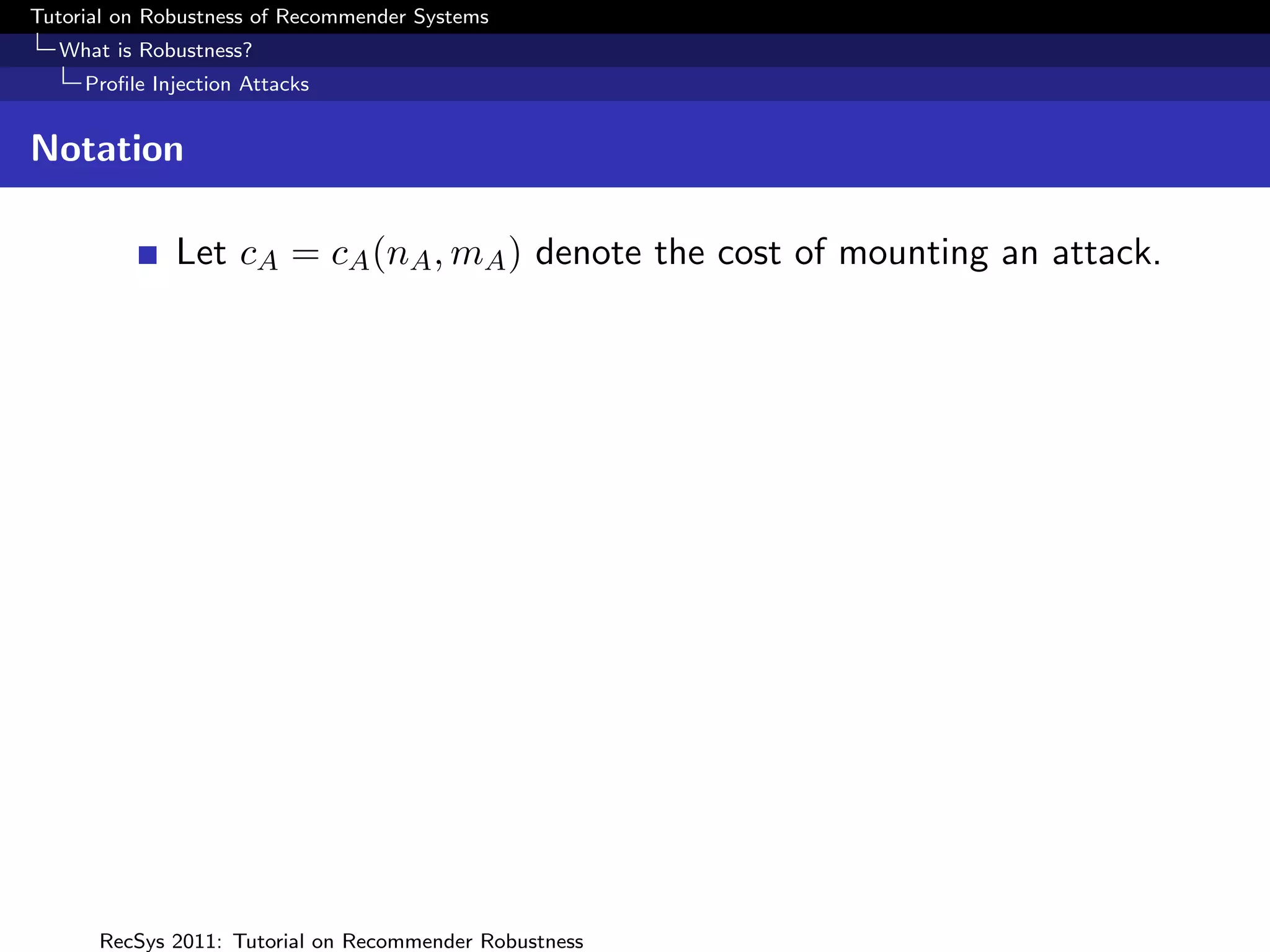
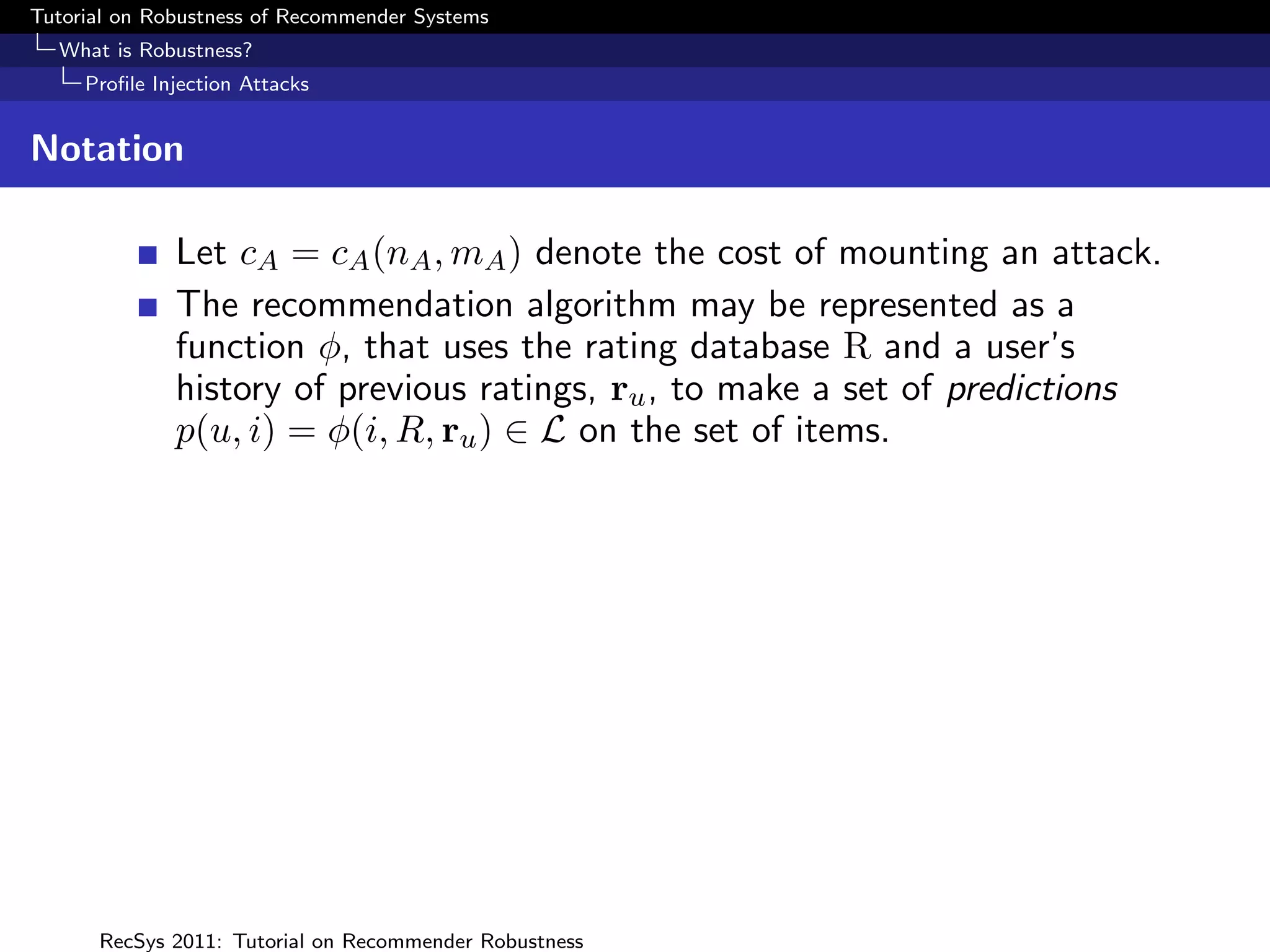
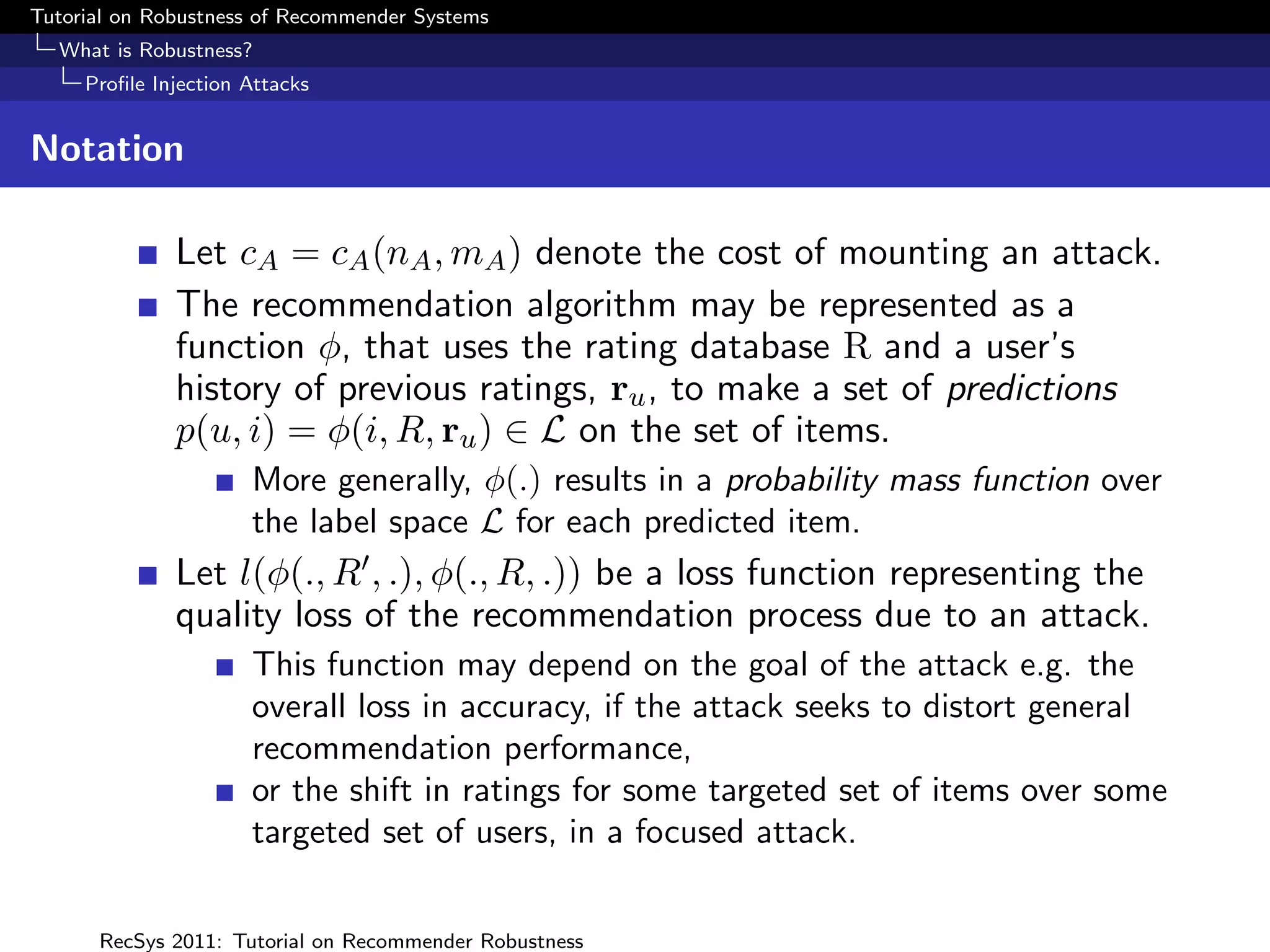
              Let cA = cA (nA , mA ) denote the cost of mounting an attack.


      RecSys 2011: Tutorial on Recommender Robustness
Tutorial on Robustness of Recommender Systems
  What is Robustness?
     Profile Injection Attacks


Notation

              Let cA = cA (nA , mA ) denote the cost of mounting an attack.
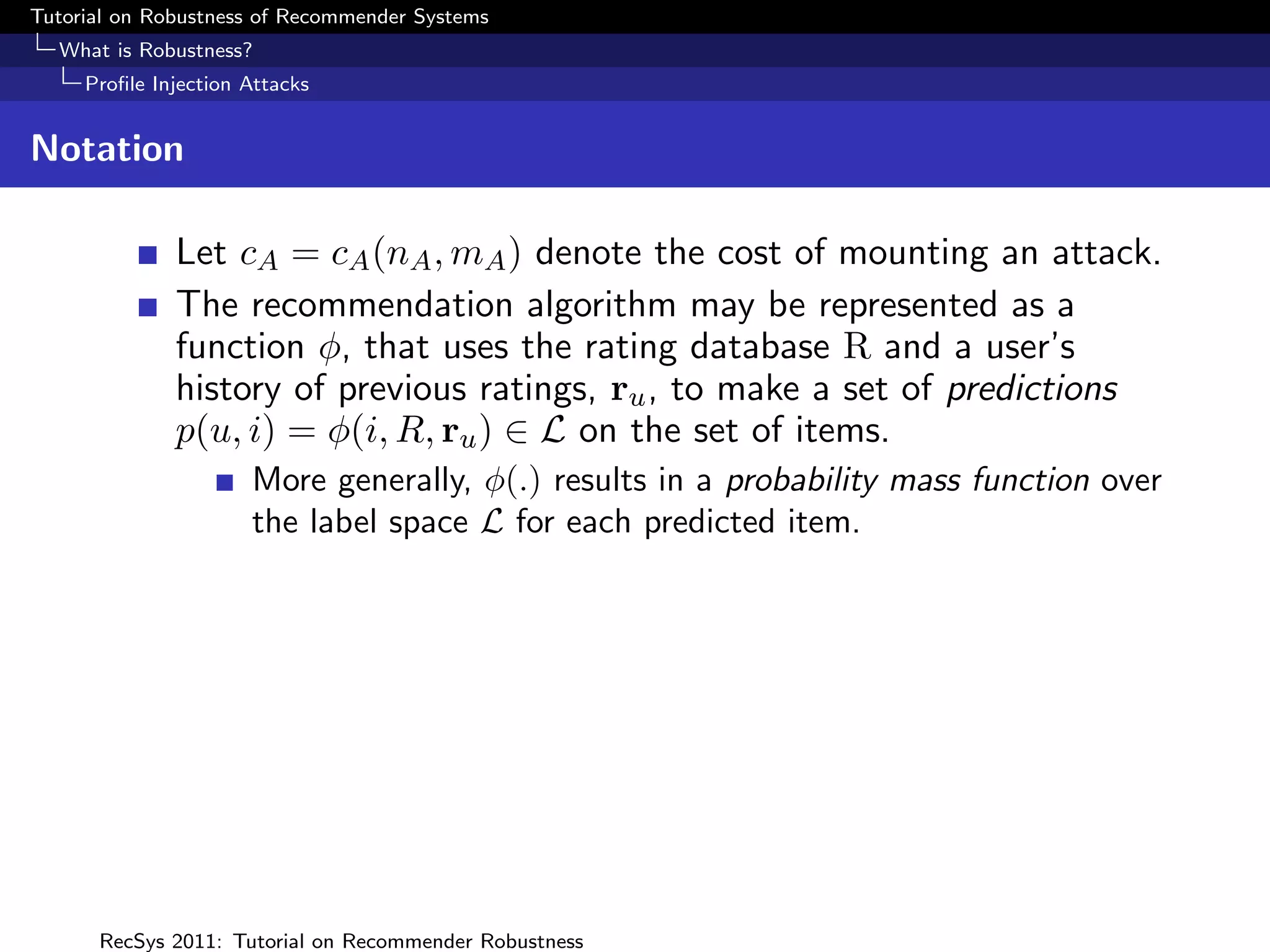
              The recommendation algorithm may be represented as a
              function φ, that uses the rating database R and a user’s
              history of previous ratings, ru , to make a set of predictions
              p(u, i) = φ(i, R, ru ) ∈ L on the set of items.


      RecSys 2011: Tutorial on Recommender Robustness
Tutorial on Robustness of Recommender Systems
  What is Robustness?
     Profile Injection Attacks


Notation

              Let cA = cA (nA , mA ) denote the cost of mounting an attack.
              The recommendation algorithm may be represented as a
              function φ, that uses the rating database R and a user’s
              history of previous ratings, ru , to make a set of predictions
              p(u, i) = φ(i, R, ru ) ∈ L on the set of items.
                      More generally, φ(.) results in a probability mass function over
                      the label space L for each predicted item.


      RecSys 2011: Tutorial on Recommender Robustness
Tutorial on Robustness of Recommender Systems
  What is Robustness?
     Profile Injection Attacks


Notation

              Let cA = cA (nA , mA ) denote the cost of mounting an attack.
              The recommendation algorithm may be represented as a
              function φ, that uses the rating database R and a user’s
              history of previous ratings, ru , to make a set of predictions
              p(u, i) = φ(i, R, ru ) ∈ L on the set of items.
                      More generally, φ(.) results in a probability mass function over
                      the label space L for each predicted item.
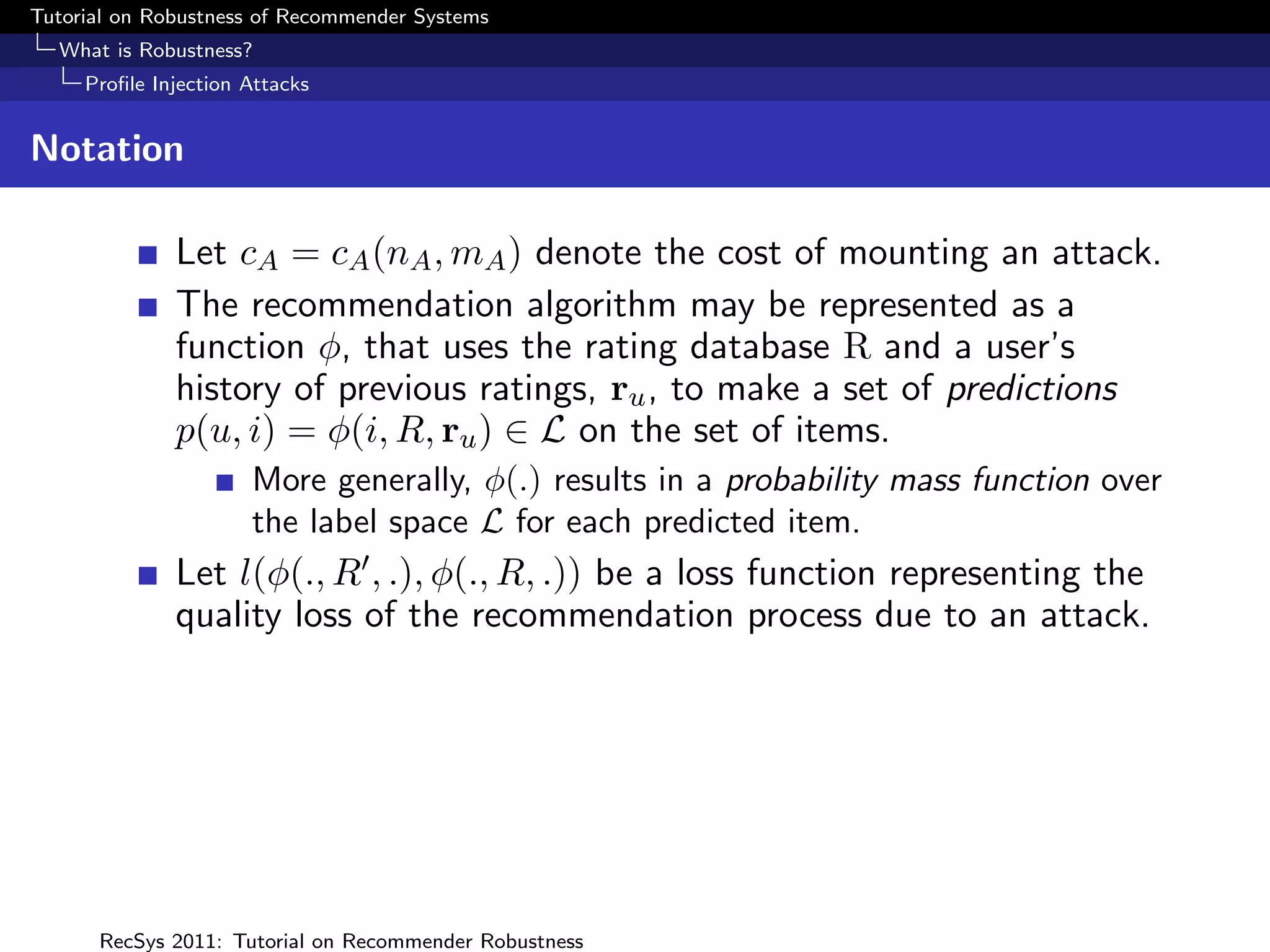
              Let l(φ(., R , .), φ(., R, .)) be a loss function representing the
              quality loss of the recommendation process due to an attack.


      RecSys 2011: Tutorial on Recommender Robustness
Tutorial on Robustness of Recommender Systems
  What is Robustness?
     Profile Injection Attacks


Notation

              Let cA = cA (nA , mA ) denote the cost of mounting an attack.
              The recommendation algorithm may be represented as a
              function φ, that uses the rating database R and a user’s
              history of previous ratings, ru , to make a set of predictions
              p(u, i) = φ(i, R, ru ) ∈ L on the set of items.
                      More generally, φ(.) results in a probability mass function over
                      the label space L for each predicted item.
              Let l(φ(., R , .), φ(., R, .)) be a loss function representing the
              quality loss of the recommendation process due to an attack.
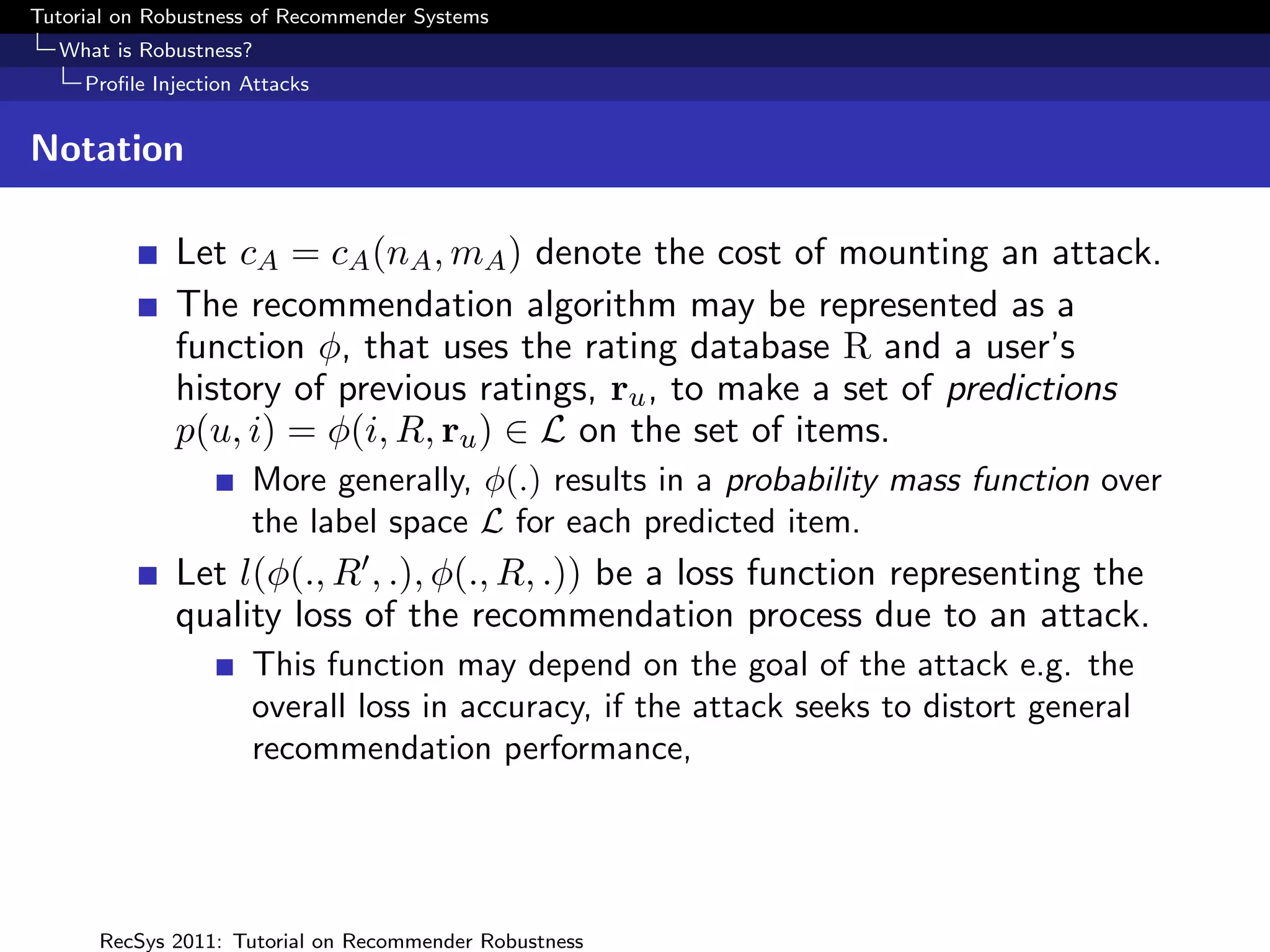
                      This function may depend on the goal of the attack e.g. the
                      overall loss in accuracy, if the attack seeks to distort general
                      recommendation performance,


      RecSys 2011: Tutorial on Recommender Robustness
Tutorial on Robustness of Recommender Systems
  What is Robustness?
     Profile Injection Attacks


Notation

              Let cA = cA (nA , mA ) denote the cost of mounting an attack.
              The recommendation algorithm may be represented as a
              function φ, that uses the rating database R and a user’s
              history of previous ratings, ru , to make a set of predictions
              p(u, i) = φ(i, R, ru ) ∈ L on the set of items.
                      More generally, φ(.) results in a probability mass function over
                      the label space L for each predicted item.
              Let l(φ(., R , .), φ(., R, .)) be a loss function representing the
              quality loss of the recommendation process due to an attack.
                      This function may depend on the goal of the attack e.g. the
                      overall loss in accuracy, if the attack seeks to distort general
                      recommendation performance,
                      or the shift in ratings for some targeted set of items over some
                      targeted set of users, in a focused attack.


      RecSys 2011: Tutorial on Recommender Robustness
Tutorial on Robustness of Recommender Systems
  What is Robustness?
     Profile Injection Attacks


The Recommender Attack Game

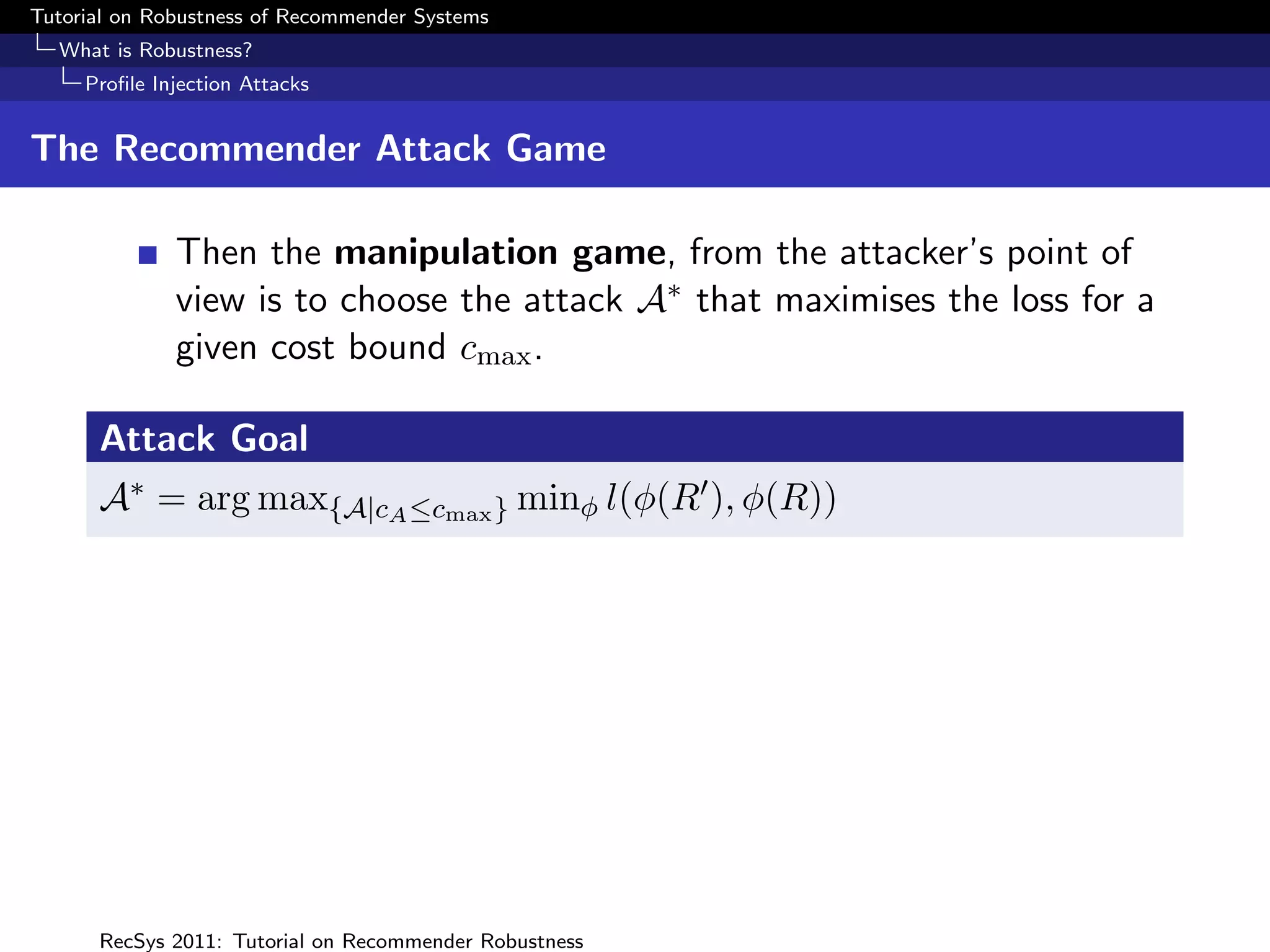
              Then the manipulation game, from the attacker’s point of
              view is to choose the attack A∗ that maximises the loss for a
              given cost bound cmax .

      Attack Goal
      A∗ = arg max{A|cA ≤cmax } minφ l(φ(R ), φ(R))


      RecSys 2011: Tutorial on Recommender Robustness
Tutorial on Robustness of Recommender Systems
  What is Robustness?
     Profile Injection Attacks


The Recommender Attack Game

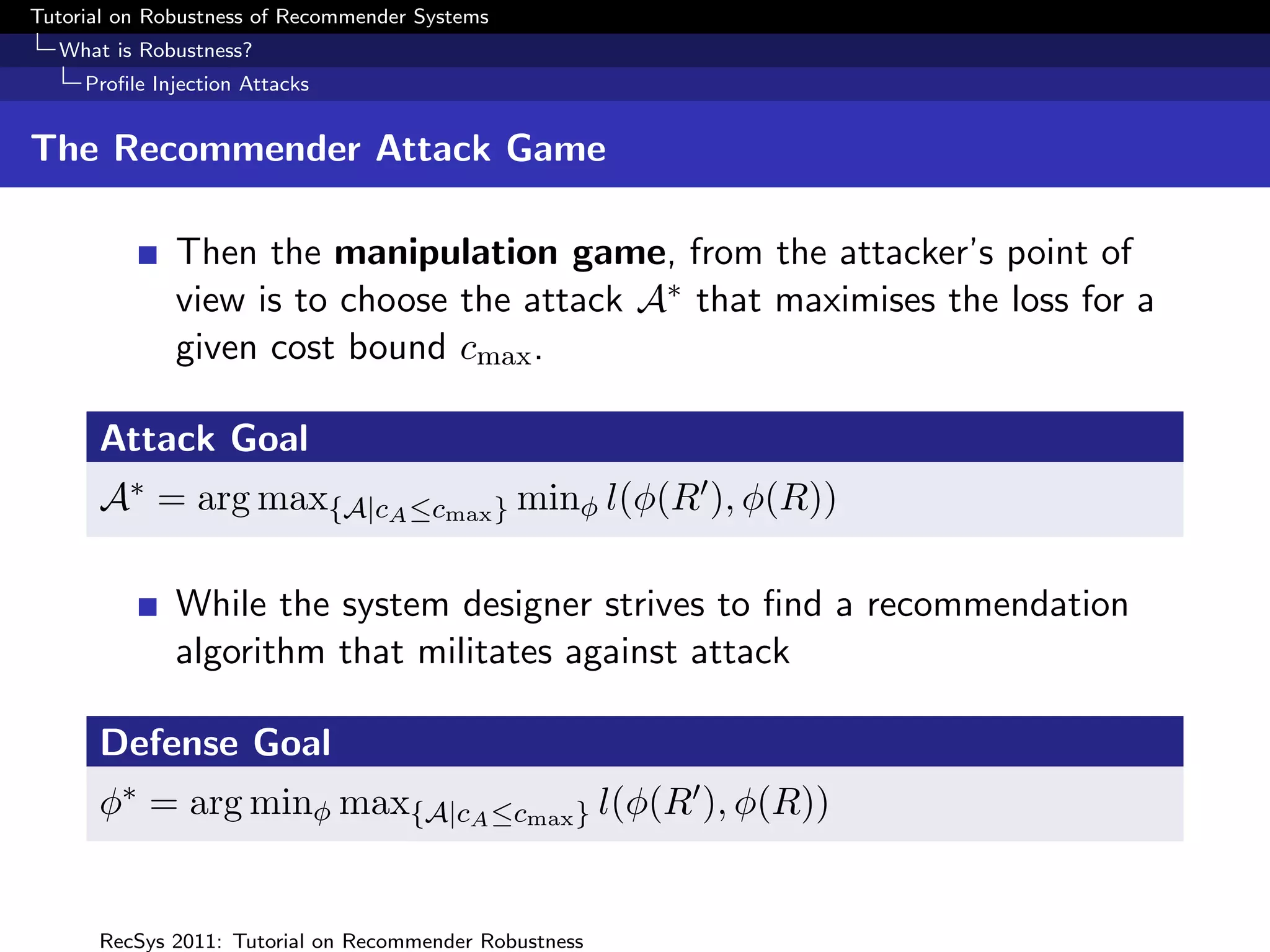
              Then the manipulation game, from the attacker’s point of
              view is to choose the attack A∗ that maximises the loss for a
              given cost bound cmax .

      Attack Goal
      A∗ = arg max{A|cA ≤cmax } minφ l(φ(R ), φ(R))

              While the system designer strives to find a recommendation
              algorithm that militates against attack

      Defense Goal
      φ∗ = arg minφ max{A|cA ≤cmax } l(φ(R ), φ(R))


      RecSys 2011: Tutorial on Recommender Robustness
Tutorial on Robustness of Recommender Systems
  What is Robustness?
     Relevance of Robustness


Outline

       1 What is Robustness?
             Profile Injection Attacks
             Relevance of Robustness
             Measuring Robustness
       2   Attack Strategies
             Attacking kNN Algorithms
       3   Attack Detection
             PCA-based Attack Detection
             Statistical Attack Detection
             Cost-Benefit Analysis
       4   Robustness of Model-based Algorithms
       5   Attack Resistant Recommendation Algorithms
             Provably Manipulation Resistant Algorithms
       6   Stability, Trust and Privacy
      RecSys 2011: Tutorial on Recommender Robustness
Tutorial on Robustness of Recommender Systems
  What is Robustness?
     Relevance of Robustness


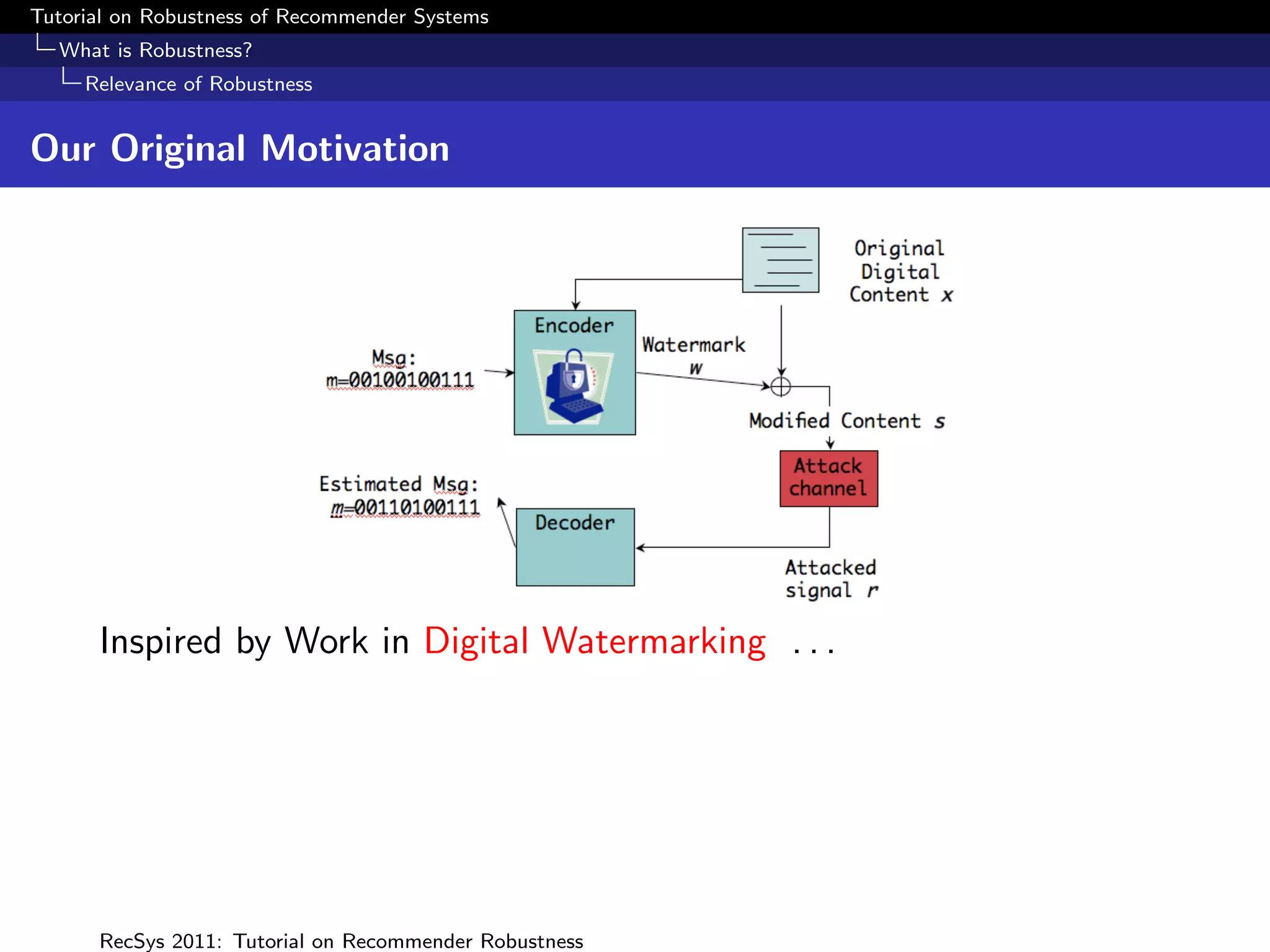
Our Original Motivation


      Inspired by Work in Digital Watermarking . . .


      RecSys 2011: Tutorial on Recommender Robustness
Tutorial on Robustness of Recommender Systems
  What is Robustness?
     Relevance of Robustness


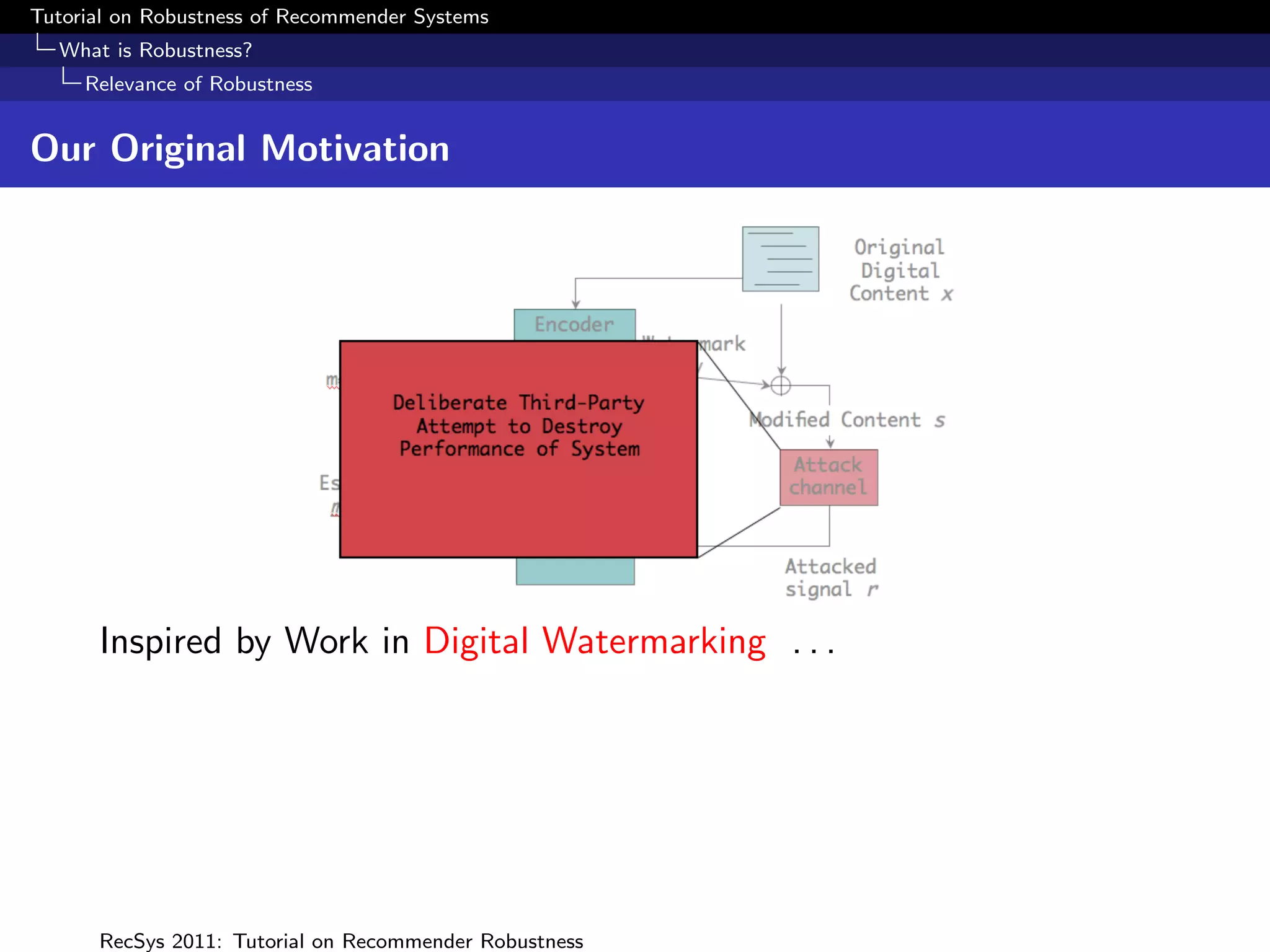
Our Original Motivation


      Inspired by Work in Digital Watermarking . . .


      RecSys 2011: Tutorial on Recommender Robustness
Tutorial on Robustness of Recommender Systems
  What is Robustness?
     Relevance of Robustness


How Realistic Is this Scenario?

      news.bbc.co.uk/2/hi/4741259.stm (2001) “ ... ads for films including Hollow Man and A Knight’s Tale quoted

        praise from a reviewer called David Manning, who was exposed as being invented ...”


      RecSys 2011: Tutorial on Recommender Robustness
Tutorial on Robustness of Recommender Systems
  What is Robustness?
     Relevance of Robustness


How Realistic Is this Scenario?


      http://tinyurl.com/3d6d969 (Sept. 2003) “AuctionBytes conducted a reader survey to find out how serious

        these problems were. According to the survey, 39% of respondents felt that feedback retaliation was a very big

        problem on eBay. Nineteen percent of respondents had received retaliatory feedback within the previous 6

        months, and 16% had been a victim of feedback extortion within the previous 6 months.”


      RecSys 2011: Tutorial on Recommender Robustness
Tutorial on Robustness of Recommender Systems
  What is Robustness?
     Relevance of Robustness


How Realistic Is this Scenario?


      http://tinyurl.com/n3d5lp (June 2009) “Elsevier officials said Monday that it was a mistake for the publishing

        giant’s marketing division to offer $25 Amazon gift cards to anyone who would give a new textbook five stars in a

        review posted on Amazon or Barnes & Noble. While those popular Web sites’ customer reviews have long been

        known to be something less than scientific, and prone to manipulation if an author has friends write on behalf of

        a new work, the idea that a major academic publisher would attempt to pay for good reviews angered some

        professors who received the e-mail pitch..”


      RecSys 2011: Tutorial on Recommender Robustness
Tutorial on Robustness of Recommender Systems
  What is Robustness?
     Relevance of Robustness


How Realistic Is this Scenario?

      http://tinyurl.com/cfmqce (2009) Paul Lamere cites an example of “precision hacking” of a Time Poll.


      RecSys 2011: Tutorial on Recommender Robustness
Tutorial on Robustness of Recommender Systems
  What is Robustness?
     Relevance of Robustness


How Realistic Is this Scenario?


      http://tinyurl.com/mupy7d (2009) Hotel review manipulation


      RecSys 2011: Tutorial on Recommender Robustness
Tutorial on Robustness of Recommender Systems
  What is Robustness?
     Relevance of Robustness


How Realistic Is this Scenario?


      Lang et al. (2010) Social Manipulation in Buzznet “...Hey, I know you don’t know me, but could you do me a

        huge fav and vote for me in this contest? All you have to do is buzz me...”


      RecSys 2011: Tutorial on Recommender Robustness
Tutorial on Robustness of Recommender Systems
  What is Robustness?
     Relevance of Robustness


How Realistic Is this Scenario?


              All examples of types of manipulation attacks on
              recommender systems.
              No hard evidence of automated shilling attacks by sybil
              insertion bots.


      RecSys 2011: Tutorial on Recommender Robustness
Tutorial on Robustness of Recommender Systems
  What is Robustness?
     Measuring Robustness


Outline

       1 What is Robustness?
             Profile Injection Attacks
             Relevance of Robustness
             Measuring Robustness
       2   Attack Strategies
             Attacking kNN Algorithms
       3   Attack Detection
             PCA-based Attack Detection
             Statistical Attack Detection
             Cost-Benefit Analysis
       4   Robustness of Model-based Algorithms
       5   Attack Resistant Recommendation Algorithms
             Provably Manipulation Resistant Algorithms
       6   Stability, Trust and Privacy
      RecSys 2011: Tutorial on Recommender Robustness
Tutorial on Robustness of Recommender Systems
  What is Robustness?
     Measuring Robustness


Simple Measures of Attack Impact
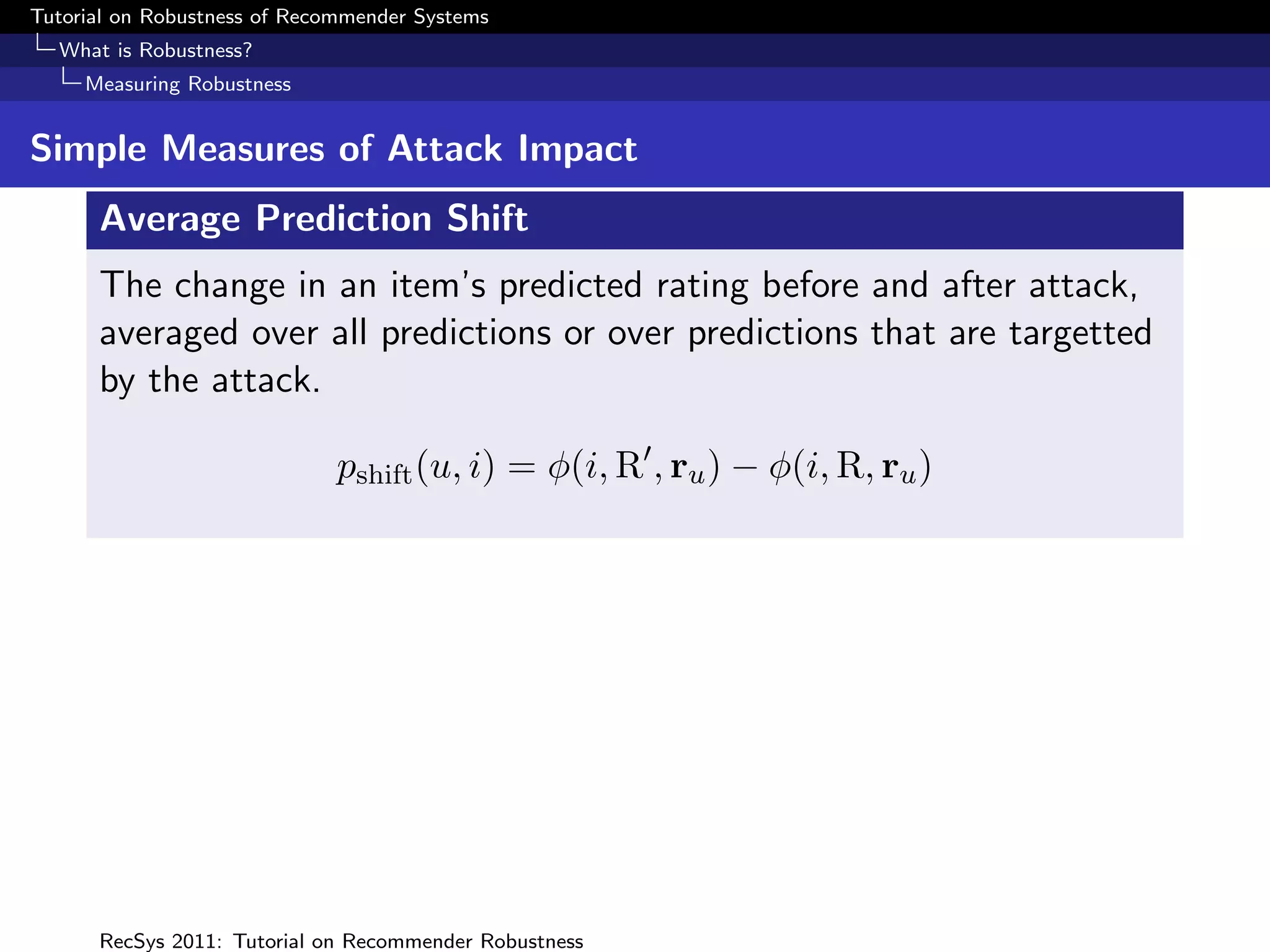
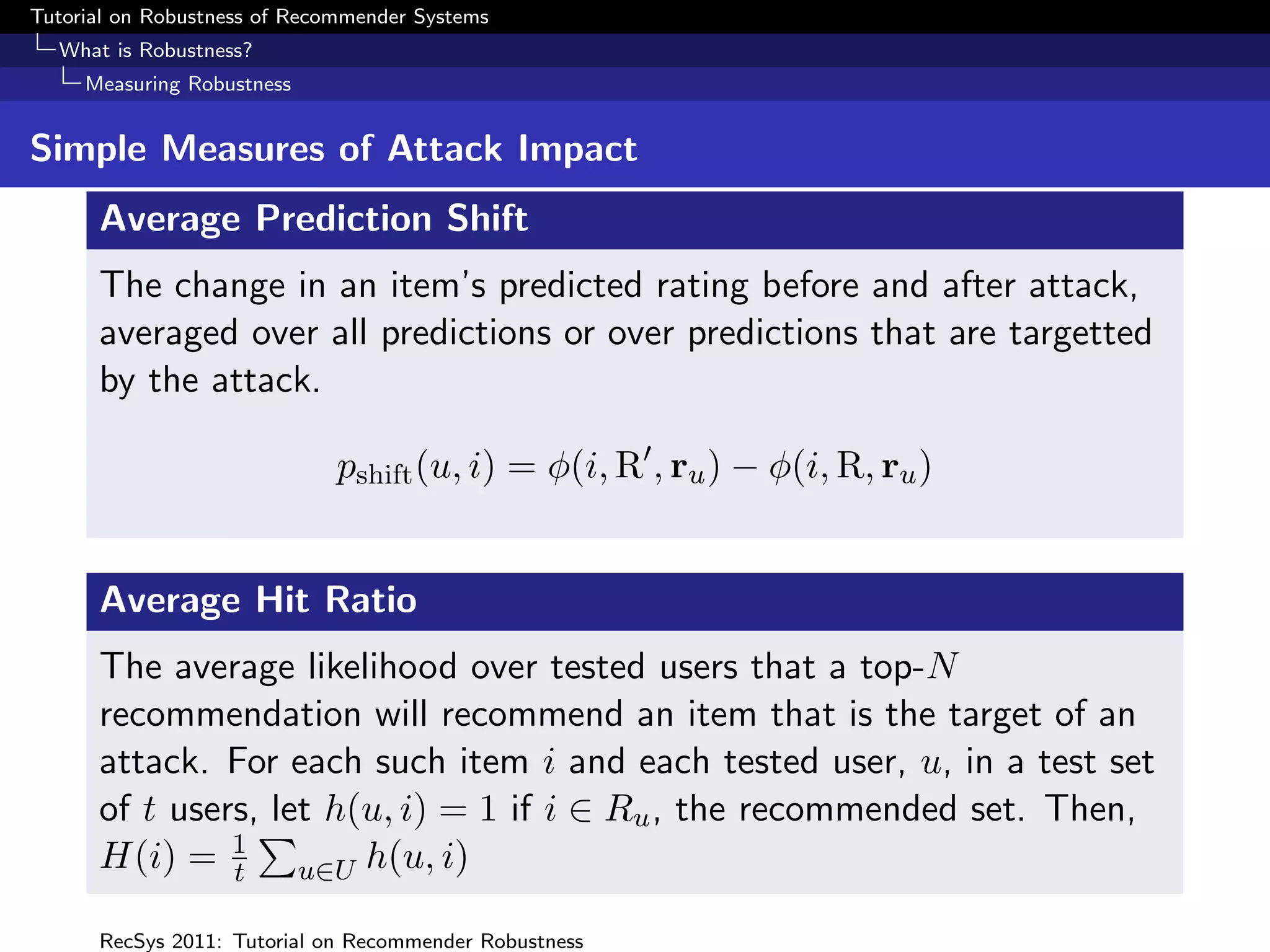
      Average Prediction Shift
      The change in an item’s predicted rating before and after attack,
      averaged over all predictions or over predictions that are targetted
      by the attack.

                              pshift (u, i) = φ(i, R , ru ) − φ(i, R, ru )


      RecSys 2011: Tutorial on Recommender Robustness
Tutorial on Robustness of Recommender Systems
  What is Robustness?
     Measuring Robustness


Simple Measures of Attack Impact
      Average Prediction Shift
      The change in an item’s predicted rating before and after attack,
      averaged over all predictions or over predictions that are targetted
      by the attack.

                              pshift (u, i) = φ(i, R , ru ) − φ(i, R, ru )


      Average Hit Ratio
      The average likelihood over tested users that a top-N
      recommendation will recommend an item that is the target of an
      attack. For each such item i and each tested user, u, in a test set
      of t users, let h(u, i) = 1 if i ∈ Ru , the recommended set. Then,
      H(i) = 1 u∈U h(u, i)
               t

      RecSys 2011: Tutorial on Recommender Robustness
Tutorial on Robustness of Recommender Systems
  What is Robustness?
     Measuring Robustness


Other Measures of Attack Impact

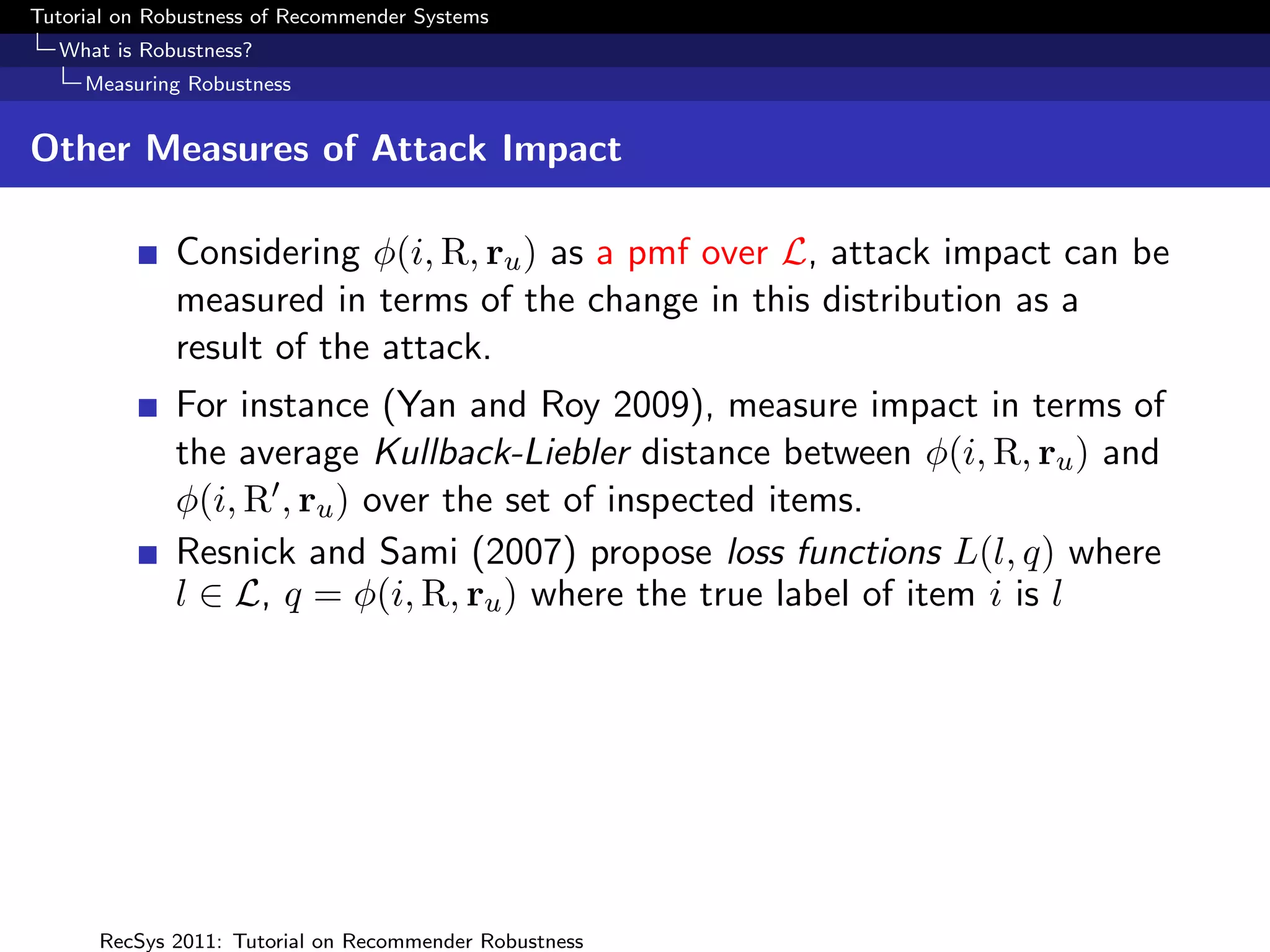
              Considering φ(i, R, ru ) as a pmf over L, attack impact can be
              measured in terms of the change in this distribution as a
              result of the attack.
              For instance (Yan and Roy 2009), measure impact in terms of
              the average Kullback-Liebler distance between φ(i, R, ru ) and
              φ(i, R , ru ) over the set of inspected items.
              Resnick and Sami (2007) propose loss functions L(l, q) where
              l ∈ L, q = φ(i, R, ru ) where the true label of item i is l


      RecSys 2011: Tutorial on Recommender Robustness
Tutorial on Robustness of Recommender Systems
  What is Robustness?
     Measuring Robustness


Other Measures of Attack Impact

              Considering φ(i, R, ru ) as a pmf over L, attack impact can be
              measured in terms of the change in this distribution as a
              result of the attack.
              For instance (Yan and Roy 2009), measure impact in terms of
              the average Kullback-Liebler distance between φ(i, R, ru ) and
              φ(i, R , ru ) over the set of inspected items.
              Resnick and Sami (2007) propose loss functions L(l, q) where
              l ∈ L, q = φ(i, R, ru ) where the true label of item i is l
                     e.g. the quadratic loss over a two rating scale [HI, LO], with
                     q the probability of HI is given by

                                     L(HI, q) = (1 − q)2 ;   L(LO, q) = q 2


      RecSys 2011: Tutorial on Recommender Robustness
Tutorial on Robustness of Recommender Systems
  Attack Strategies


Outline

       1 What is Robustness?
             Profile Injection Attacks
             Relevance of Robustness
             Measuring Robustness
       2   Attack Strategies
             Attacking kNN Algorithms
       3   Attack Detection
             PCA-based Attack Detection
             Statistical Attack Detection
             Cost-Benefit Analysis
       4   Robustness of Model-based Algorithms
       5   Attack Resistant Recommendation Algorithms
             Provably Manipulation Resistant Algorithms
       6   Stability, Trust and Privacy
      RecSys 2011: Tutorial on Recommender Robustness
Tutorial on Robustness of Recommender Systems
  Attack Strategies


Forming Attack Profiles

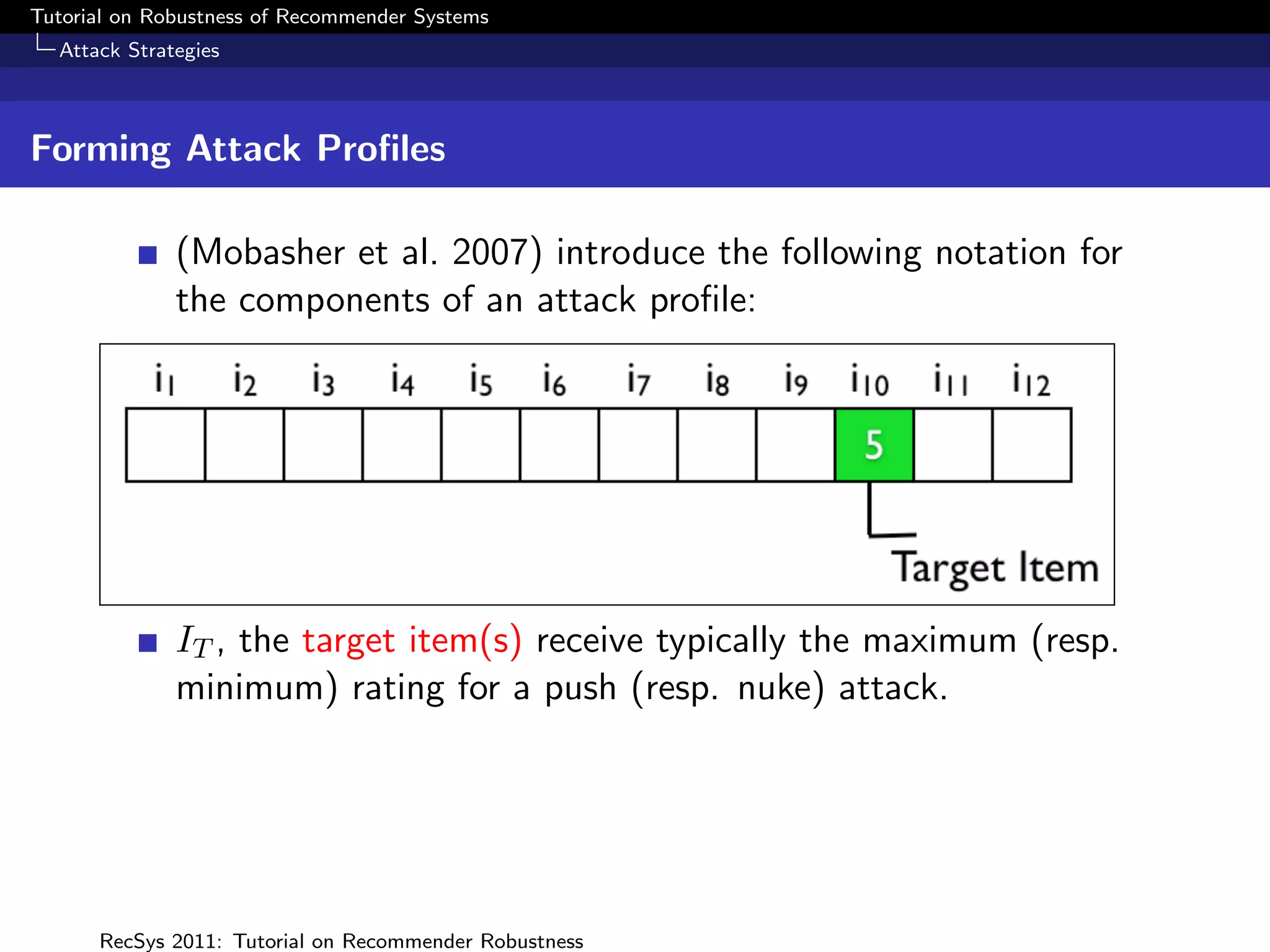
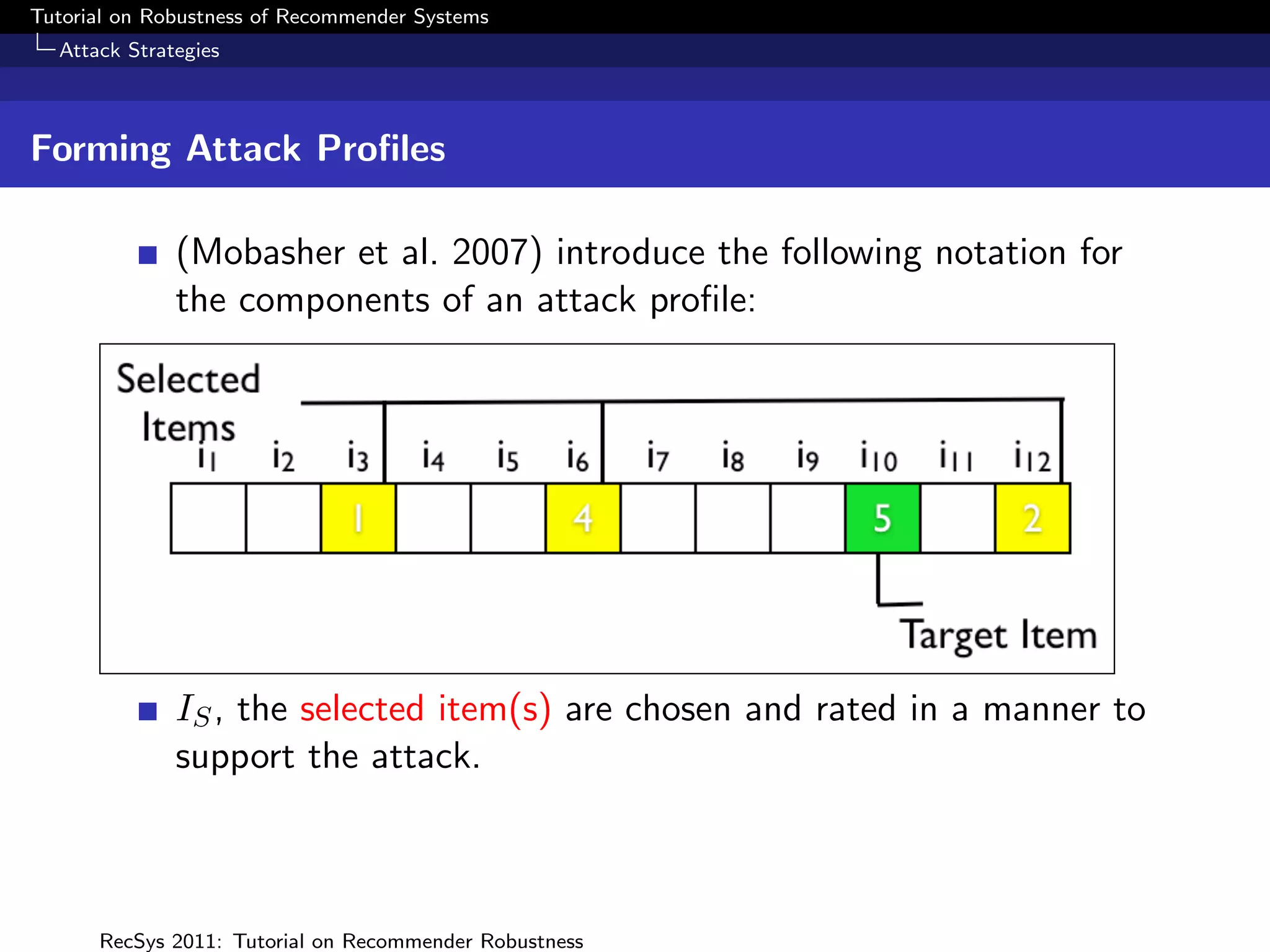
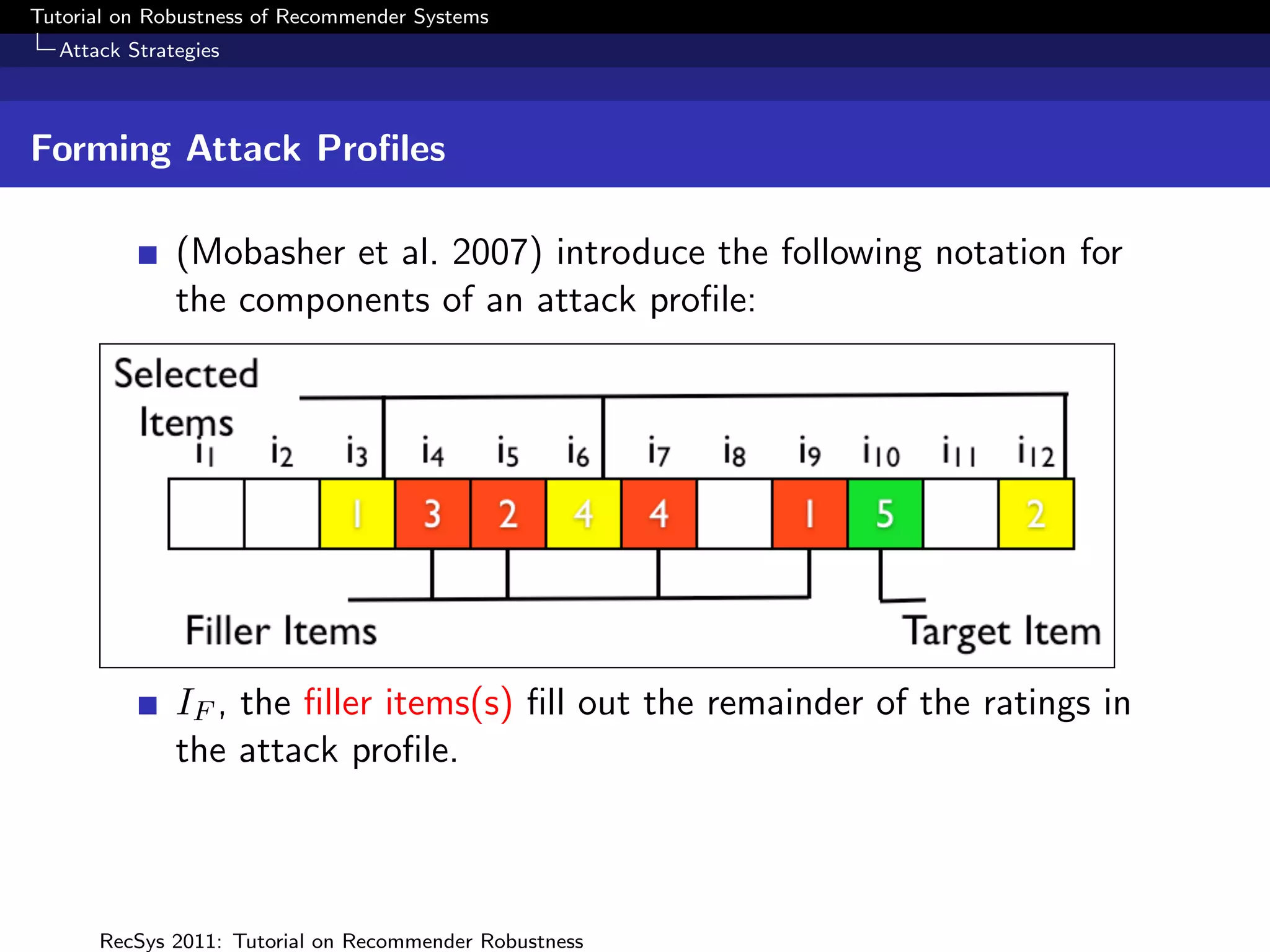
              (Mobasher et al. 2007) introduce the following notation for
              the components of an attack profile:


      RecSys 2011: Tutorial on Recommender Robustness
Tutorial on Robustness of Recommender Systems
  Attack Strategies


Forming Attack Profiles

              (Mobasher et al. 2007) introduce the following notation for
              the components of an attack profile:


              IT , the target item(s) receive typically the maximum (resp.
              minimum) rating for a push (resp. nuke) attack.


      RecSys 2011: Tutorial on Recommender Robustness
Tutorial on Robustness of Recommender Systems
  Attack Strategies


Forming Attack Profiles

              (Mobasher et al. 2007) introduce the following notation for
              the components of an attack profile:


              IS , the selected item(s) are chosen and rated in a manner to
              support the attack.


      RecSys 2011: Tutorial on Recommender Robustness
Tutorial on Robustness of Recommender Systems
  Attack Strategies


Forming Attack Profiles

              (Mobasher et al. 2007) introduce the following notation for
              the components of an attack profile:


              IF , the filler items(s) fill out the remainder of the ratings in
              the attack profile.


      RecSys 2011: Tutorial on Recommender Robustness
Tutorial on Robustness of Recommender Systems
  Attack Strategies


Forming Attack Profiles

              The goal of attack profile creation must be to
                      Effectively support the purpose of the attack – selection of
                      target rating and IS ;


      RecSys 2011: Tutorial on Recommender Robustness
Tutorial on Robustness of Recommender Systems
  Attack Strategies


Forming Attack Profiles

              The goal of attack profile creation must be to
                      Effectively support the purpose of the attack – selection of
                      target rating and IS ;
                      But, remain unobtrusive so as to avoid detection and filtering
                      – selection of the filler items IF .


      RecSys 2011: Tutorial on Recommender Robustness
Tutorial on Robustness of Recommender Systems
  Attack Strategies


Forming Attack Profiles

              The goal of attack profile creation must be to
                      Effectively support the purpose of the attack – selection of
                      target rating and IS ;
                      But, remain unobtrusive so as to avoid detection and filtering
                      – selection of the filler items IF .
              Must also consider what information is available to the
              attacker


      RecSys 2011: Tutorial on Recommender Robustness
Tutorial on Robustness of Recommender Systems
  Attack Strategies


Forming Attack Profiles

              The goal of attack profile creation must be to
                      Effectively support the purpose of the attack – selection of
                      target rating and IS ;
                      But, remain unobtrusive so as to avoid detection and filtering
                      – selection of the filler items IF .
              Must also consider what information is available to the
              attacker
                      Typically assume some knowledge of the statistics of the rating
                      database is available;


      RecSys 2011: Tutorial on Recommender Robustness
Tutorial on Robustness of Recommender Systems
  Attack Strategies


Forming Attack Profiles

              The goal of attack profile creation must be to
                      Effectively support the purpose of the attack – selection of
                      target rating and IS ;
                      But, remain unobtrusive so as to avoid detection and filtering
                      – selection of the filler items IF .
              Must also consider what information is available to the
              attacker
                      Typically assume some knowledge of the statistics of the rating
                      database is available;
                      May also have knowledge of the recommendation algorithm –
                      an informed attack.


      RecSys 2011: Tutorial on Recommender Robustness
Tutorial on Robustness of Recommender Systems
  Attack Strategies


Forming Attack Profiles

              The goal of attack profile creation must be to
                      Effectively support the purpose of the attack – selection of
                      target rating and IS ;
                      But, remain unobtrusive so as to avoid detection and filtering
                      – selection of the filler items IF .
              Must also consider what information is available to the
              attacker
                      Typically assume some knowledge of the statistics of the rating
                      database is available;
                      May also have knowledge of the recommendation algorithm –
                      an informed attack.
              Note Kerkchoff’s principal – avoid “security through
              obscurity”.


      RecSys 2011: Tutorial on Recommender Robustness
Tutorial on Robustness of Recommender Systems
  Attack Strategies
     Attacking kNN Algorithms


Outline

       1 What is Robustness?
             Profile Injection Attacks
             Relevance of Robustness
             Measuring Robustness
       2   Attack Strategies
             Attacking kNN Algorithms
       3   Attack Detection
             PCA-based Attack Detection
             Statistical Attack Detection
             Cost-Benefit Analysis
       4   Robustness of Model-based Algorithms
       5   Attack Resistant Recommendation Algorithms
             Provably Manipulation Resistant Algorithms
       6   Stability, Trust and Privacy
      RecSys 2011: Tutorial on Recommender Robustness
Tutorial on Robustness of Recommender Systems
  Attack Strategies
     Attacking kNN Algorithms


User-based kNN Attack

              The first CF profile insertion attack (O’Mahony et al. 2002),
              was an informed attack that exploited a particular weakness in
              the basic version of Resnick’s user-based kNN algorithm.


      RecSys 2011: Tutorial on Recommender Robustness
Tutorial on Robustness of Recommender Systems
  Attack Strategies
     Attacking kNN Algorithms


User-based kNN Attack

              The first CF profile insertion attack (O’Mahony et al. 2002),
              was an informed attack that exploited a particular weakness in
              the basic version of Resnick’s user-based kNN algorithm.

              User-based CF predicts a rating pa,j for item j, user a as
              follows:


      RecSys 2011: Tutorial on Recommender Robustness
Tutorial on Robustness of Recommender Systems
  Attack Strategies
     Attacking kNN Algorithms


User-based kNN Attack

              The first CF profile insertion attack (O’Mahony et al. 2002),
              was an informed attack that exploited a particular weakness in
              the basic version of Resnick’s user-based kNN algorithm.

              User-based CF predicts a rating pa,j for item j, user a as
              follows:
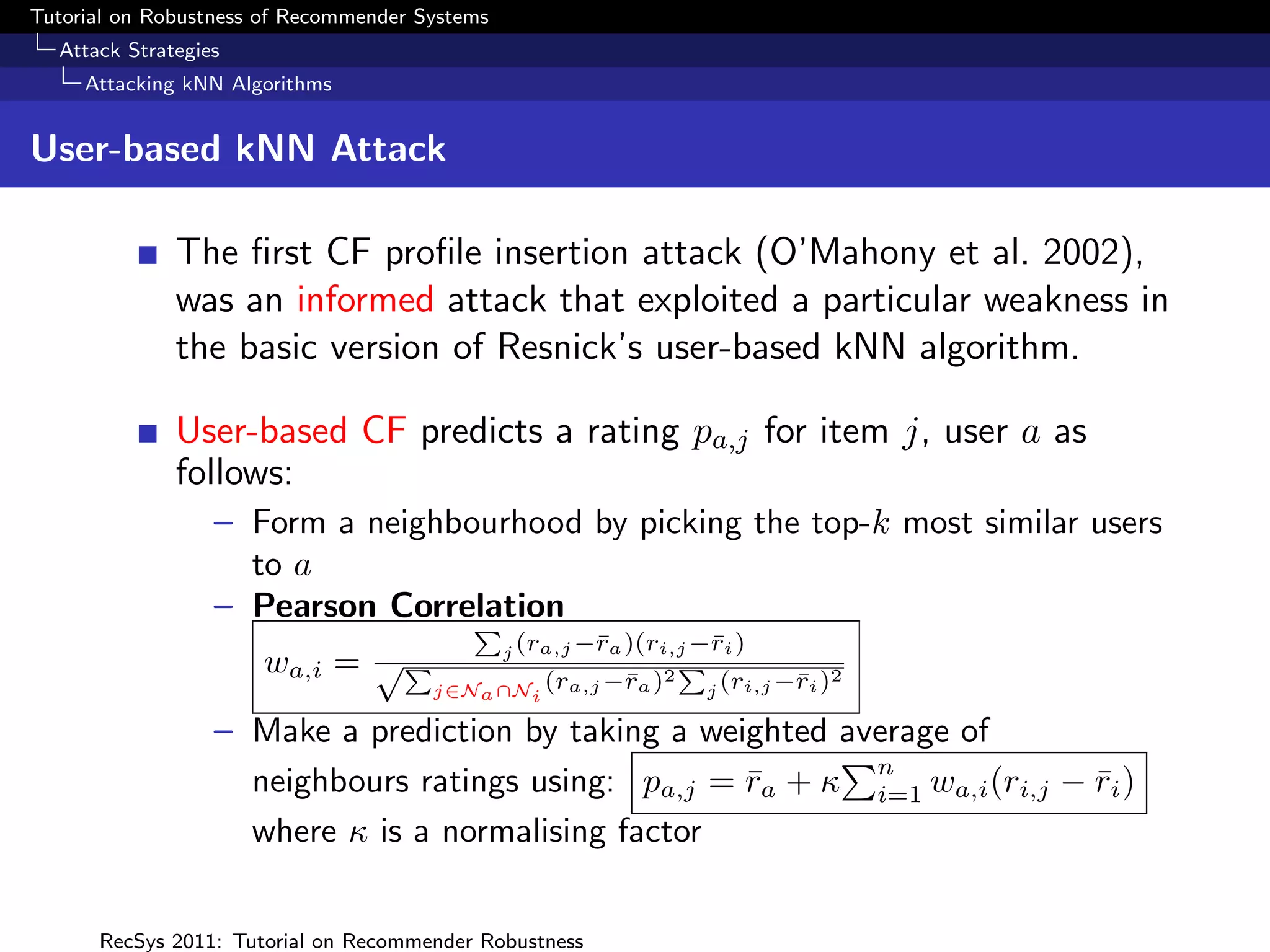
                  – Form a neighbourhood by picking the top-k most similar users
                    to a
                  – Pearson Correlation
                                  P
                                   j (ra,j −¯a )(ri,j −¯i )
                                            r          r
                     wa,i = √P                     2
                                                     P      2
                                       j∈Na ∩Ni (ra,j −¯a )
                                                       r      j (ri,j −¯i )
                                                                       r

                  – Make a prediction by taking a weighted average of
                                                             n
                    neighbours ratings using: pa,j = ra + κ i=1 wa,i (ri,j − ri )
                                                     ¯                       ¯
                    where κ is a normalising factor


      RecSys 2011: Tutorial on Recommender Robustness
Tutorial on Robustness of Recommender Systems
  Attack Strategies
     Attacking kNN Algorithms


User-based kNN Attack

              Correlation calculated over the items which the target user
              and attack profile have in common. A small intersection set
              can lead to high correlations.


      RecSys 2011: Tutorial on Recommender Robustness
Tutorial on Robustness of Recommender Systems
  Attack Strategies
     Attacking kNN Algorithms


User-based kNN Attack

              Correlation calculated over the items which the target user
              and attack profile have in common. A small intersection set
              can lead to high correlations.
              Therefore a small profile of popular items will have a large
              correlation with users who have rated these items


      RecSys 2011: Tutorial on Recommender Robustness
Tutorial on Robustness of Recommender Systems
  Attack Strategies
     Attacking kNN Algorithms


User-based kNN Attack

              Correlation calculated over the items which the target user
              and attack profile have in common. A small intersection set
              can lead to high correlations.
              Therefore a small profile of popular items will have a large
              correlation with users who have rated these items
              Implies a low-cost, effective attack on a large proportion of
              the userbase.


      RecSys 2011: Tutorial on Recommender Robustness
Tutorial on Robustness of Recommender Systems
  Attack Strategies
     Attacking kNN Algorithms


User-based kNN Attack

              Correlation calculated over the items which the target user
              and attack profile have in common. A small intersection set
              can lead to high correlations.
              Therefore a small profile of popular items will have a large
              correlation with users who have rated these items
              Implies a low-cost, effective attack on a large proportion of
              the userbase.
              However, not at all unobtrusive.


      RecSys 2011: Tutorial on Recommender Robustness
Tutorial on Robustness of Recommender Systems
  Attack Strategies
     Attacking kNN Algorithms


Other Attacks Strategies

      Many other attack variants proposed by (Lam and Riedl 2004) and
      (Mobasher et al. 2007). Assuming a push attack – a target item is
      given the maximum rating and the attack profile is filled out as
      follows:
      Random Attack Randomly chosen filler items get randomly
                    drawn rating values.


      RecSys 2011: Tutorial on Recommender Robustness
Tutorial on Robustness of Recommender Systems
  Attack Strategies
     Attacking kNN Algorithms


Other Attacks Strategies

      Many other attack variants proposed by (Lam and Riedl 2004) and
      (Mobasher et al. 2007). Assuming a push attack – a target item is
      given the maximum rating and the attack profile is filled out as
      follows:


      Average Attack Randomly chosen filler items. Ratings drawn
                     from normal distribution with item means set to
                     those of rating database.


      RecSys 2011: Tutorial on Recommender Robustness
Tutorial on Robustness of Recommender Systems
  Attack Strategies
     Attacking kNN Algorithms


Other Attacks Strategies

      Many other attack variants proposed by (Lam and Riedl 2004) and
      (Mobasher et al. 2007). Assuming a push attack – a target item is
      given the maximum rating and the attack profile is filled out as
      follows:


          Probe Attack Filler items filled by starting with a set of seed
                       ratings, querying the recommender system to fill
                       the ratings of the remaining items.


      RecSys 2011: Tutorial on Recommender Robustness
Tutorial on Robustness of Recommender Systems
  Attack Strategies
     Attacking kNN Algorithms


Other Attacks Strategies

      Many other attack variants proposed by (Lam and Riedl 2004) and
      (Mobasher et al. 2007). Assuming a push attack – a target item is
      given the maximum rating and the attack profile is filled out as
      follows:
           Segment Attack Identifying popular items in a particular user
                          segment, these are given maximum rating
                          and remaining filler items are given minimum
                          rating.


      RecSys 2011: Tutorial on Recommender Robustness
Tutorial on Robustness of Recommender Systems
  Attack Strategies
     Attacking kNN Algorithms


Other Attacks Strategies

      Many other attack variants proposed by (Lam and Riedl 2004) and
      (Mobasher et al. 2007). Assuming a push attack – a target item is
      given the maximum rating and the attack profile is filled out as
      follows:


      Bandwagon Attack A set of popular items is given the maximum
                       rating, while remaining filler items are given
                       random ratings.


      RecSys 2011: Tutorial on Recommender Robustness
Tutorial on Robustness of Recommender Systems
  Attack Strategies
     Attacking kNN Algorithms


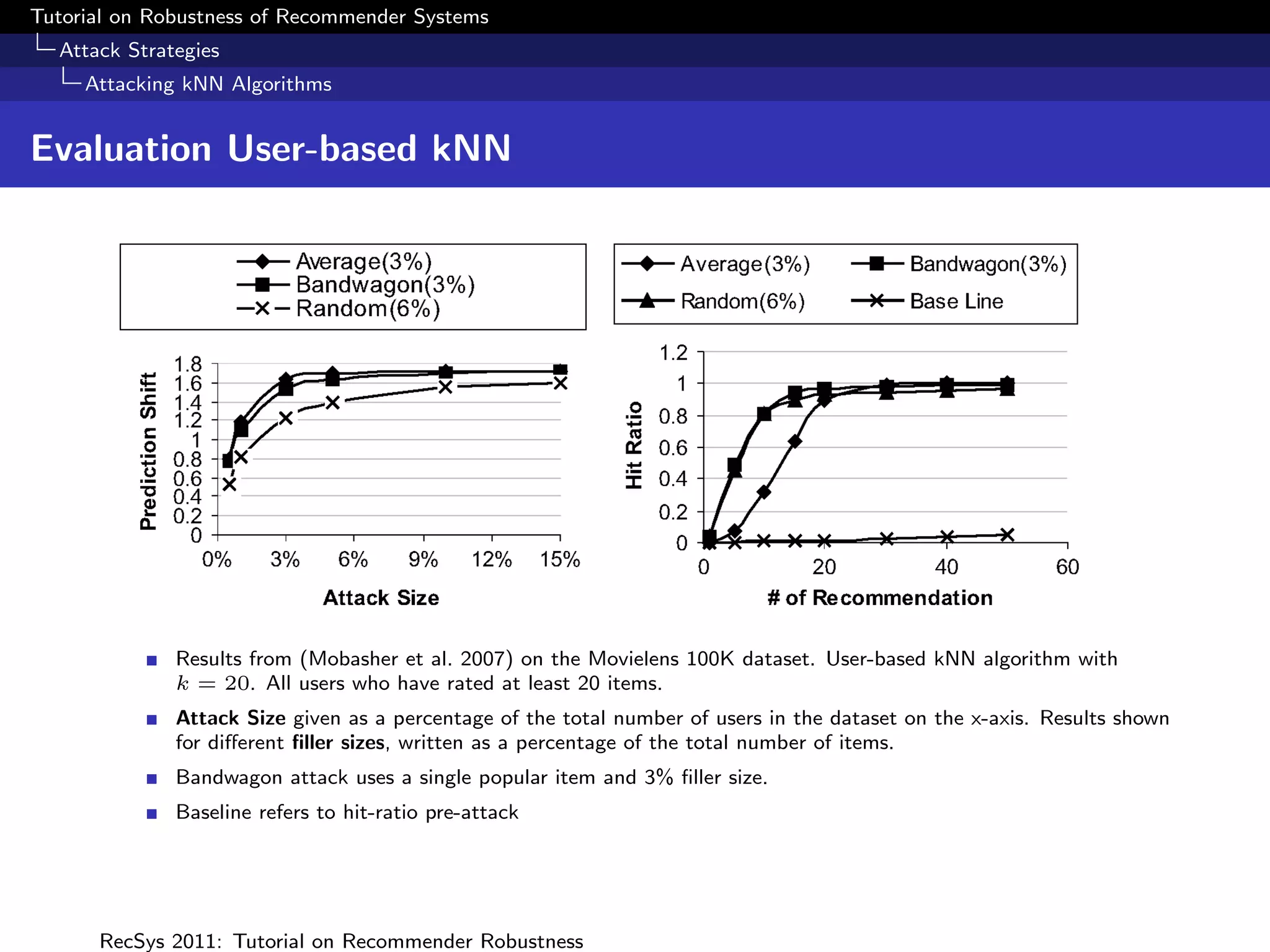
Evaluation User-based kNN
                                        Toward Trustworthy Recommender Systems                •     23:21


        Fig. 8. Comparison of attacks against user-based algorithm, prediction shift (left) and hit ratio
        (right). The baseline in the right panel indicatesMovielens 100K dataset. User-based kNN algorithm with
              Results from (Mobasher et al. 2007) on the the hit ratio results prior to attack.
              k = 20. All users who have rated at least 20 items.

        target item. The fillerasize, in as a percentagenumber total numberof the remaining items shown
             Attack Size given as percentage of the total
             for different filler sizes, written
                                               this case, is the proportionthe dataset on the x-axis. Results
                                                             of the
                                                                    of users in
                                                                                of items.
        that are assigned random ratings based on the overall data distribution across
             Bandwagon attack uses a single popular item and 3% filler size.
        the whole database (see Figure 4). In the case of the MovieLens data, these
        frequently-ratedto hit-ratio pre-attack
             Baseline refers
                              items are predictable box office successes including such titles
        as Star Wars, Return of Jedi, Titanic, etc. The attack profiles consist of high
        ratings given to these popular titles in conjunction with high ratings for the
        pushed movie. Figure 7 shows the effect of filler size on the effectiveness of
      RecSys 2011: Tutorial on Recommender Robustness
Tutorial on Robustness of Recommender Systems
  Attack Strategies
     Attacking kNN Algorithms


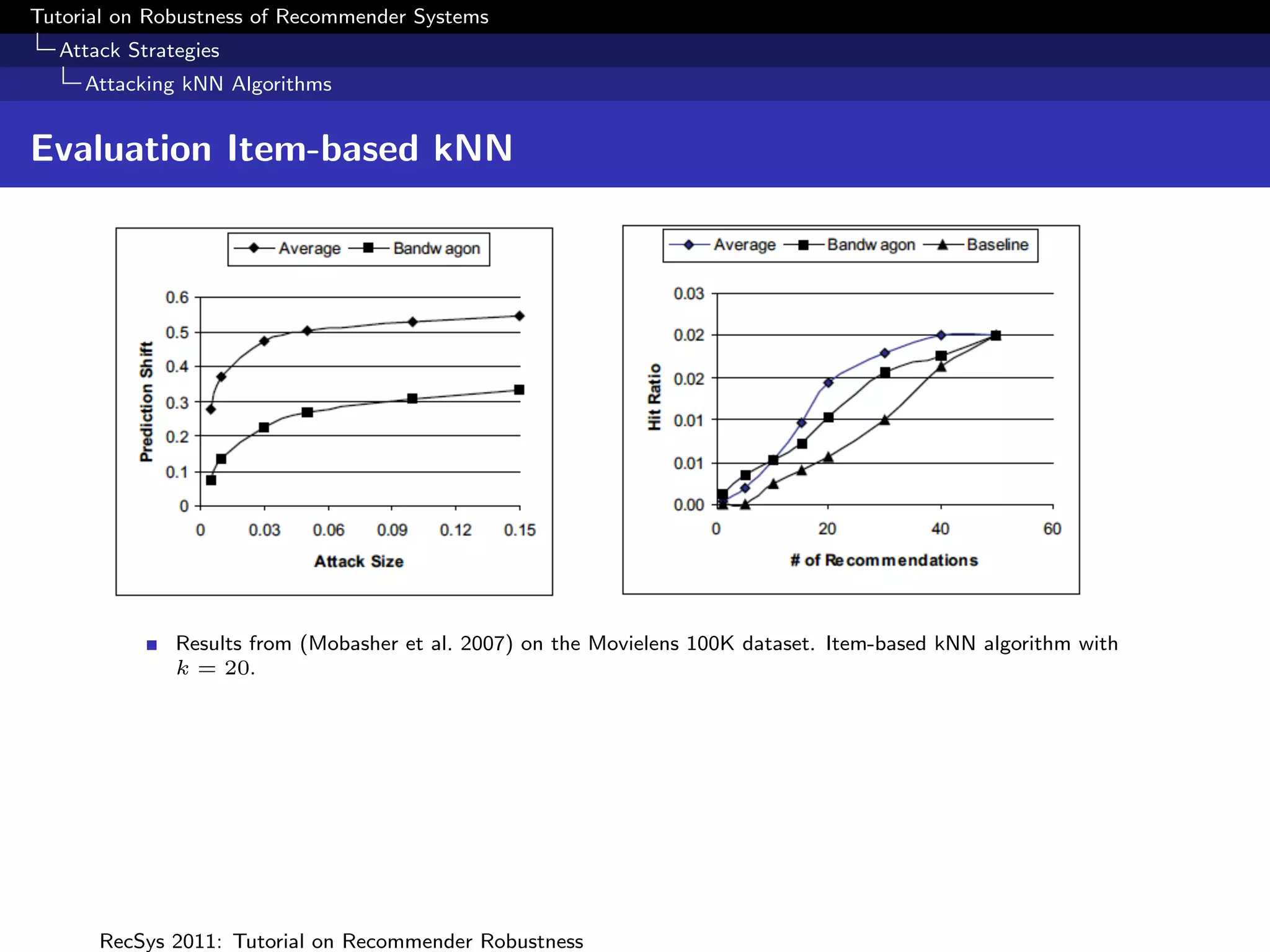
Evaluation Item-based kNN


              Results from (Mobasher et al. 2007) on the Movielens 100K dataset. Item-based kNN algorithm with
              k = 20.


      RecSys 2011: Tutorial on Recommender Robustness
Tutorial on Robustness of Recommender Systems
  Attack Strategies
     Attacking kNN Algorithms


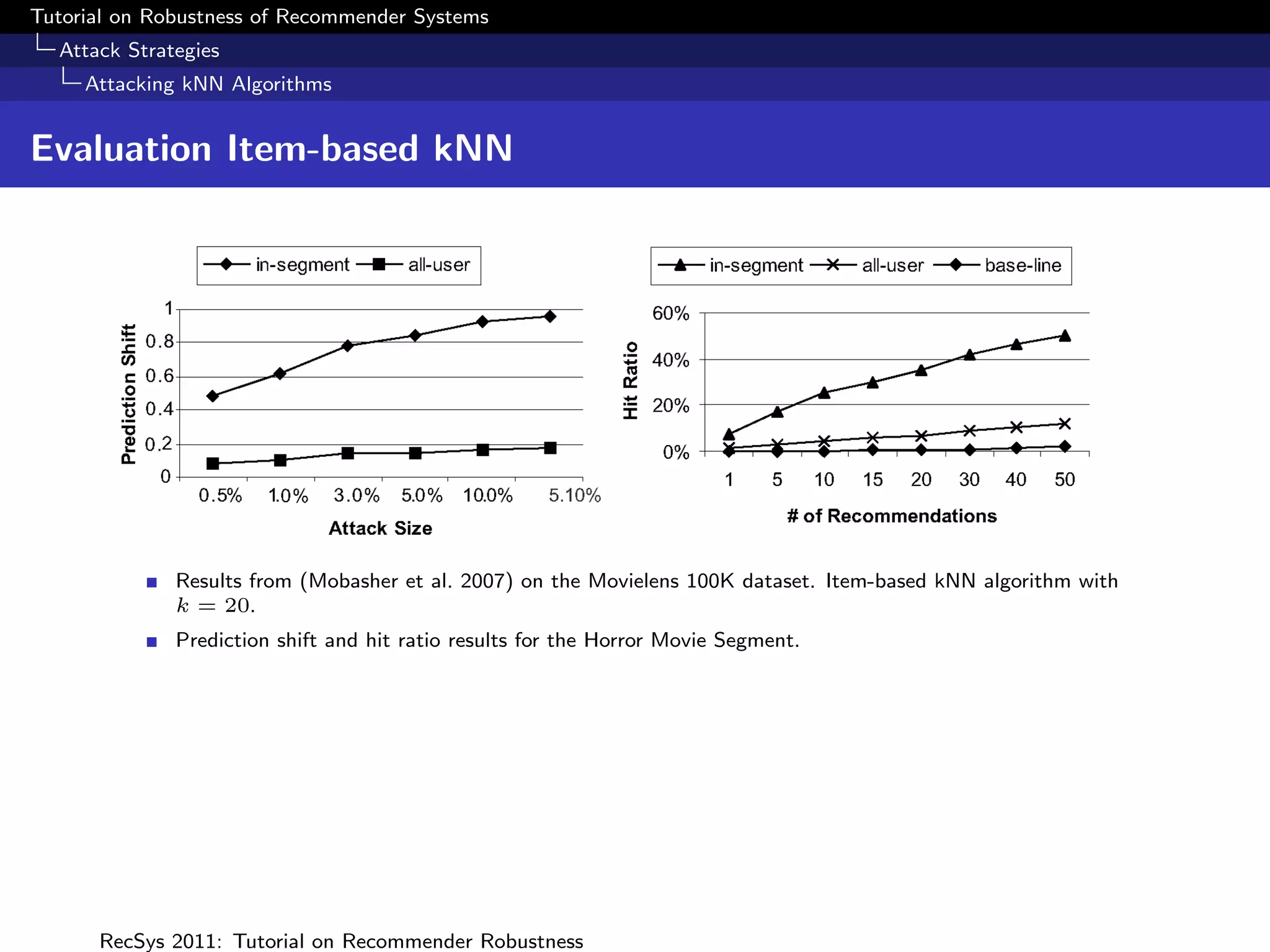
Evaluation Item-based kNN
                                          Toward Trustworthy Recommender Systems          •     23:23


        Fig. 10. Prediction shift and hit 2007) resultsMovielenshorror dataset.segment in kNN item-based
              Results from (Mobasher et al. ratio on the for the 100K movie Item-based the algorithm with
        algorithm. 20.
              k=
              Prediction shift and hit ratio results for the Horror Movie Segment.
        the target item for use as the segment portion of the attack profile IS . In the
        realm of movies, we might imagine selecting movies of a similar genre or movies
        containing the same actors.
           If we evaluate the segmented attack based on its average impact on all users,
        there is nothing remarkable. The attack has an effect but does not approach the
        numbers reached by the average attack. However, we must recall our market
        segment assumption: namely, that recommendations made to in-segment users
        are much more useful to the attacker than recommendations to other users. Our
        focus must therefore be with the “in-segment” users, those users who have rated
      RecSys 2011: Tutorial on Recommender Robustness
Tutorial on Robustness of Recommender Systems
  Attack Detection


Outline

       1 What is Robustness?
             Profile Injection Attacks
             Relevance of Robustness
             Measuring Robustness
       2   Attack Strategies
             Attacking kNN Algorithms
       3   Attack Detection
             PCA-based Attack Detection
             Statistical Attack Detection
             Cost-Benefit Analysis
       4   Robustness of Model-based Algorithms
       5   Attack Resistant Recommendation Algorithms
             Provably Manipulation Resistant Algorithms
       6   Stability, Trust and Privacy
      RecSys 2011: Tutorial on Recommender Robustness
Tutorial on Robustness of Recommender Systems
  Attack Detection


Profile Injection Attacks

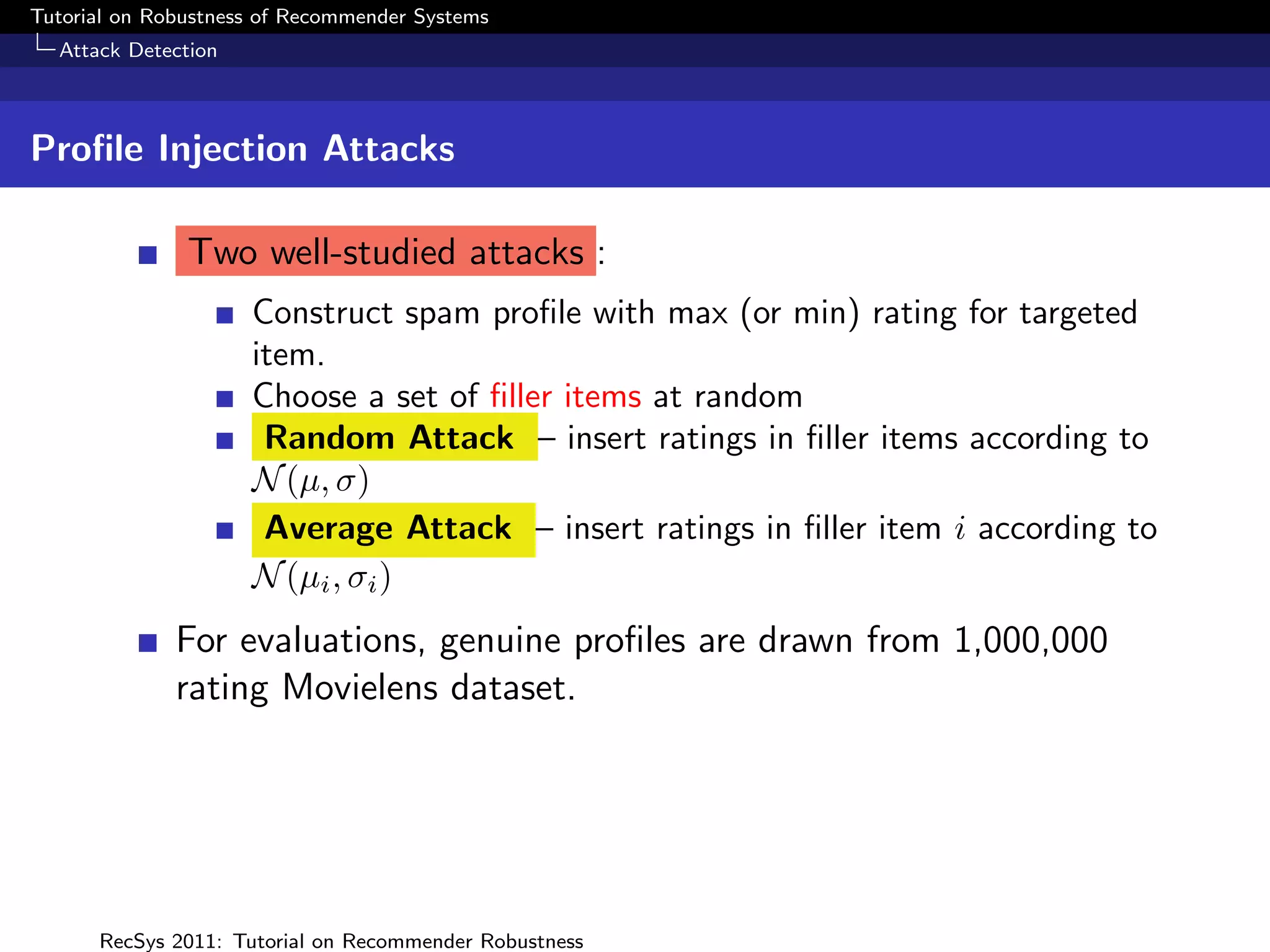
               Two well-studied attacks :
                     Construct spam profile with max (or min) rating for targeted
                     item.
                     Choose a set of filler items at random
                      Random Attack – insert ratings in filler items according to
                     N (µ, σ)
                      Average Attack – insert ratings in filler item i according to
                     N (µi , σi )
              For evaluations, genuine profiles are drawn from 1,000,000
              rating Movielens dataset.


      RecSys 2011: Tutorial on Recommender Robustness
Tutorial on Robustness of Recommender Systems
  Attack Detection


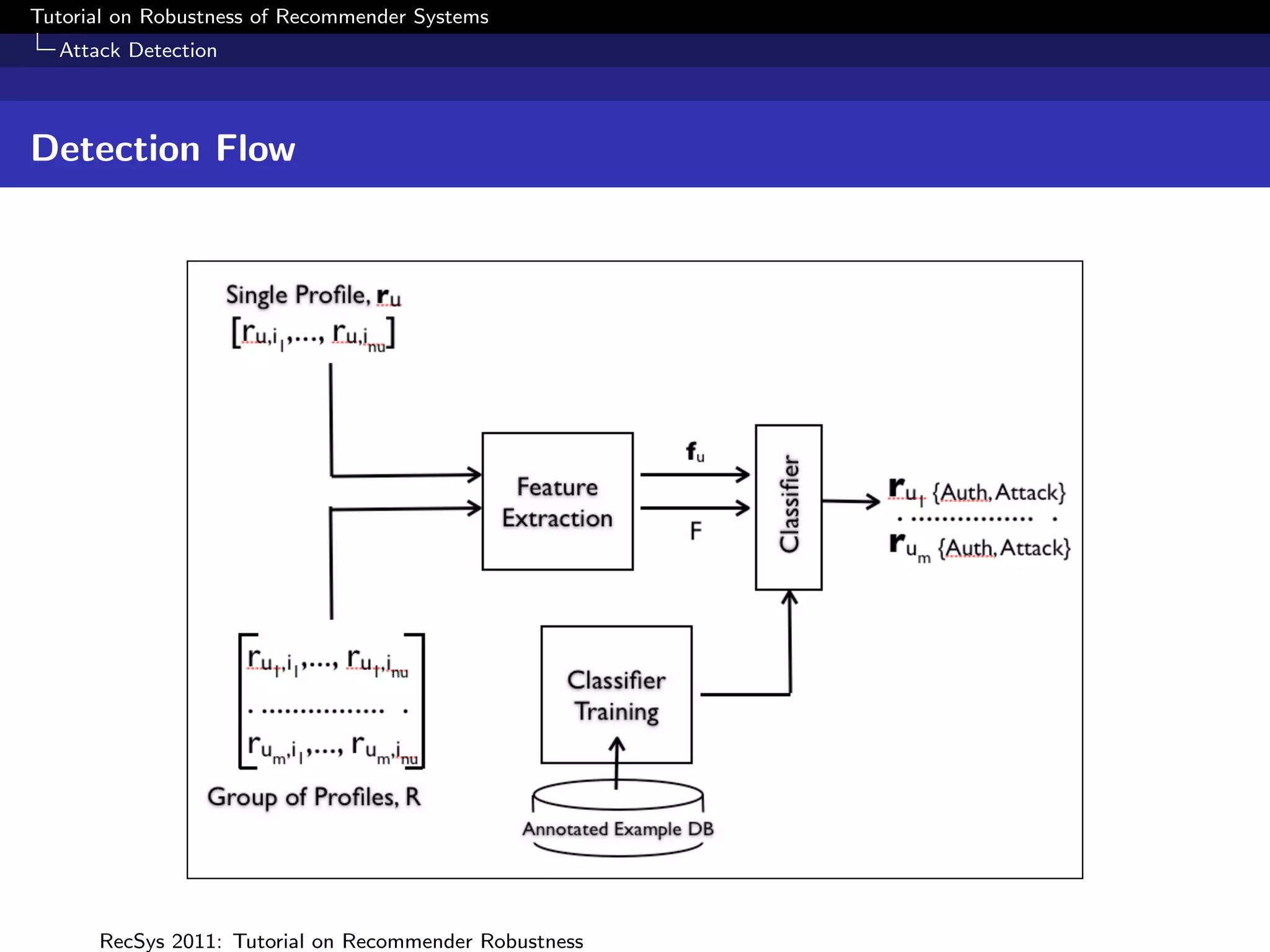
Detection Flow


      RecSys 2011: Tutorial on Recommender Robustness
Tutorial on Robustness of Recommender Systems
  Attack Detection
     PCA-based Attack Detection


Outline

       1 What is Robustness?
             Profile Injection Attacks
             Relevance of Robustness
             Measuring Robustness
       2   Attack Strategies
             Attacking kNN Algorithms
       3   Attack Detection
             PCA-based Attack Detection
             Statistical Attack Detection
             Cost-Benefit Analysis
       4   Robustness of Model-based Algorithms
       5   Attack Resistant Recommendation Algorithms
             Provably Manipulation Resistant Algorithms
       6   Stability, Trust and Privacy
      RecSys 2011: Tutorial on Recommender Robustness
Tutorial on Robustness of Recommender Systems
  Attack Detection
     PCA-based Attack Detection


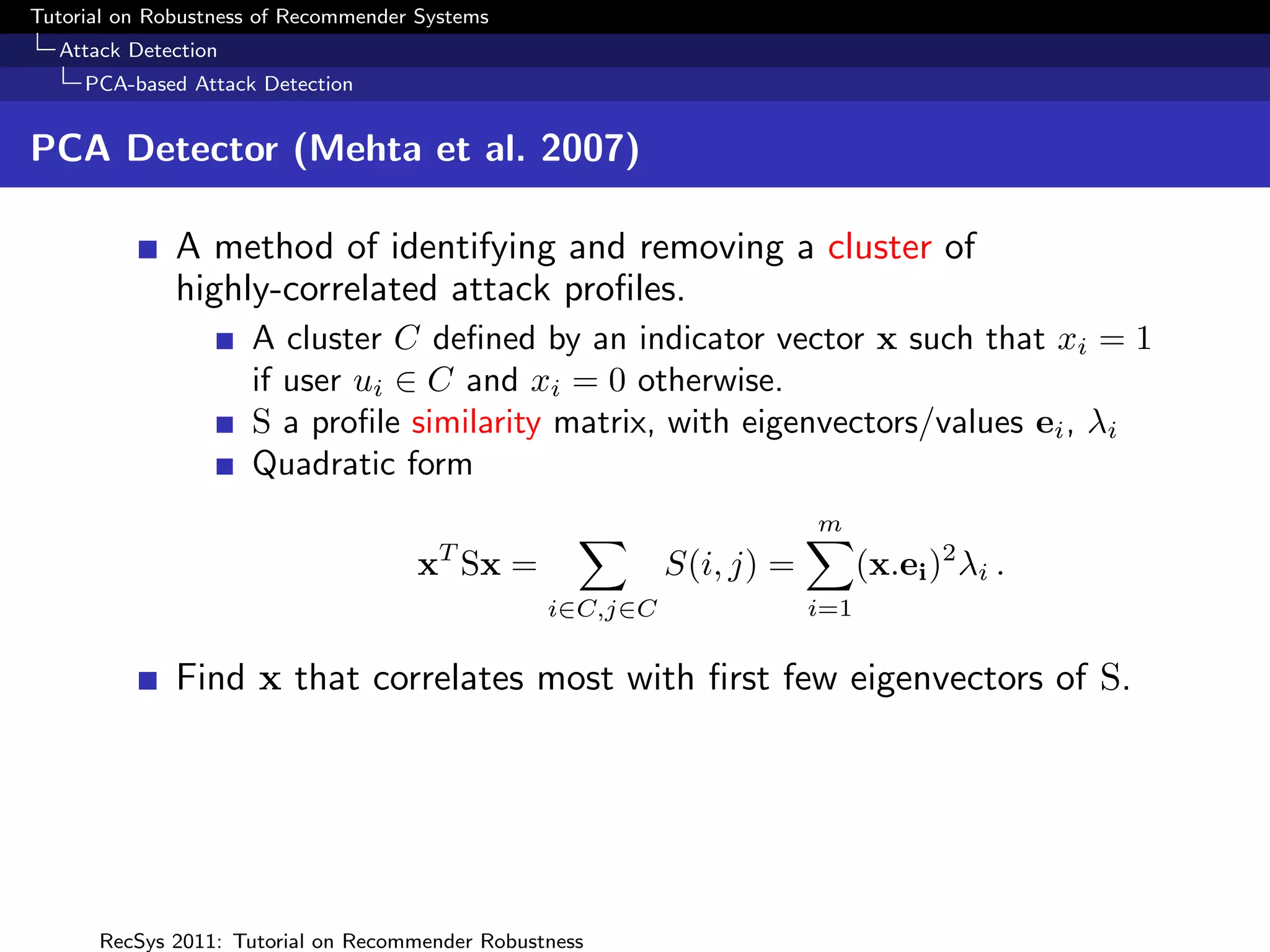
PCA Detector (Mehta et al. 2007)

              A method of identifying and removing a cluster of
              highly-correlated attack profiles.
                     A cluster C defined by an indicator vector x such that xi = 1
                     if user ui ∈ C and xi = 0 otherwise.
                     S a profile similarity matrix, with eigenvectors/values ei , λi
                     Quadratic form
                                                                       m
                                        T
                                     x Sx =                S(i, j) =         (x.ei )2 λi .
                                                 i∈C,j∈C               i=1


              Find x that correlates most with first few eigenvectors of S.


      RecSys 2011: Tutorial on Recommender Robustness
Tutorial on Robustness of Recommender Systems
  Attack Detection
     PCA-based Attack Detection


PCA Detector (Mehta et al. 2007)

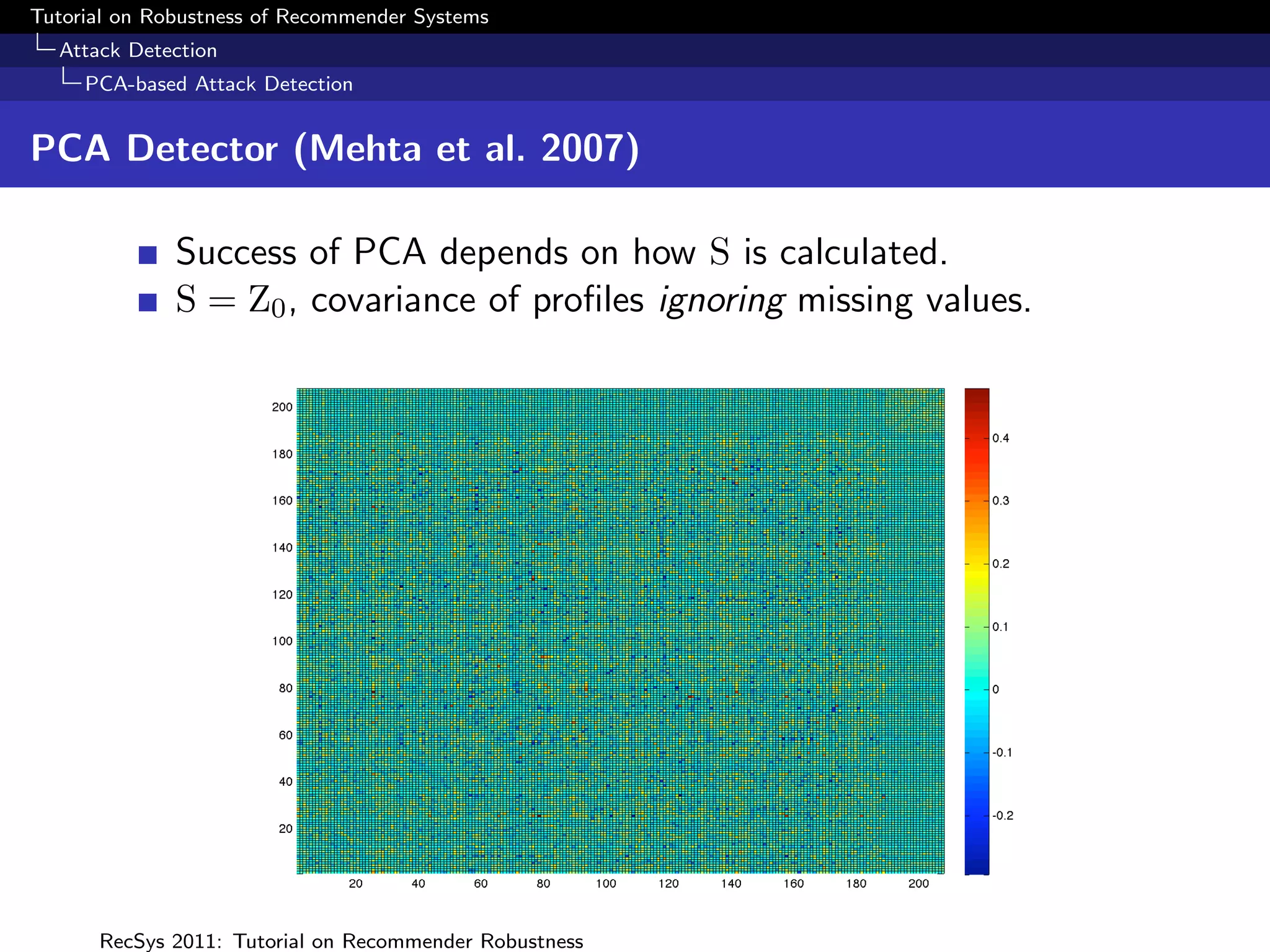
              Success of PCA depends on how S is calculated.
              S = Z0 , covariance of profiles ignoring missing values.


      RecSys 2011: Tutorial on Recommender Robustness
Tutorial on Robustness of Recommender Systems
  Attack Detection
     PCA-based Attack Detection


PCA Detector (Mehta et al. 2007)

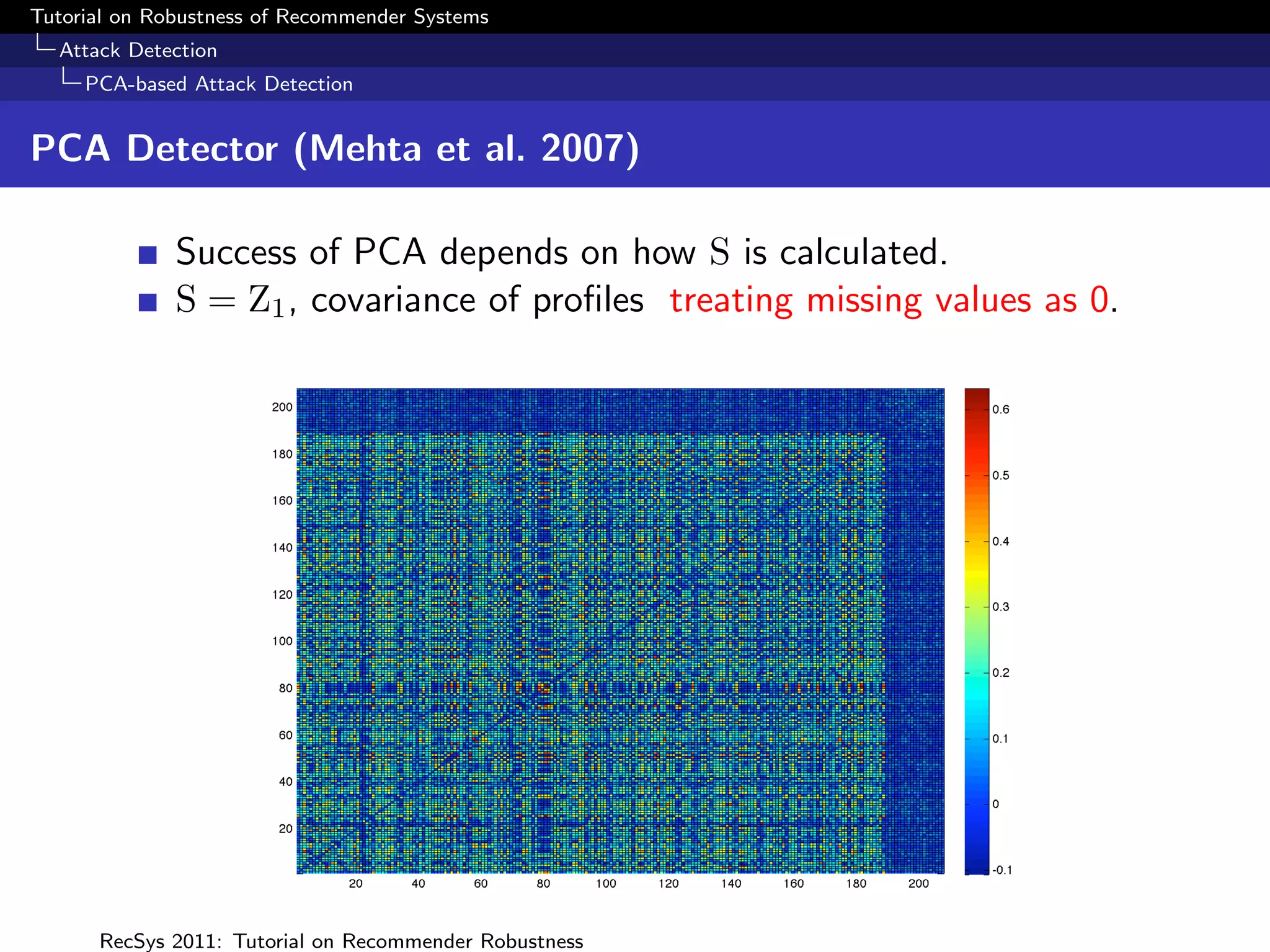
              Success of PCA depends on how S is calculated.
              S = Z1 , covariance of profiles treating missing values as 0.


      RecSys 2011: Tutorial on Recommender Robustness
Tutorial on Robustness of Recommender Systems
  Attack Detection
     PCA-based Attack Detection


PCA Detector (Mehta et al. 2007)

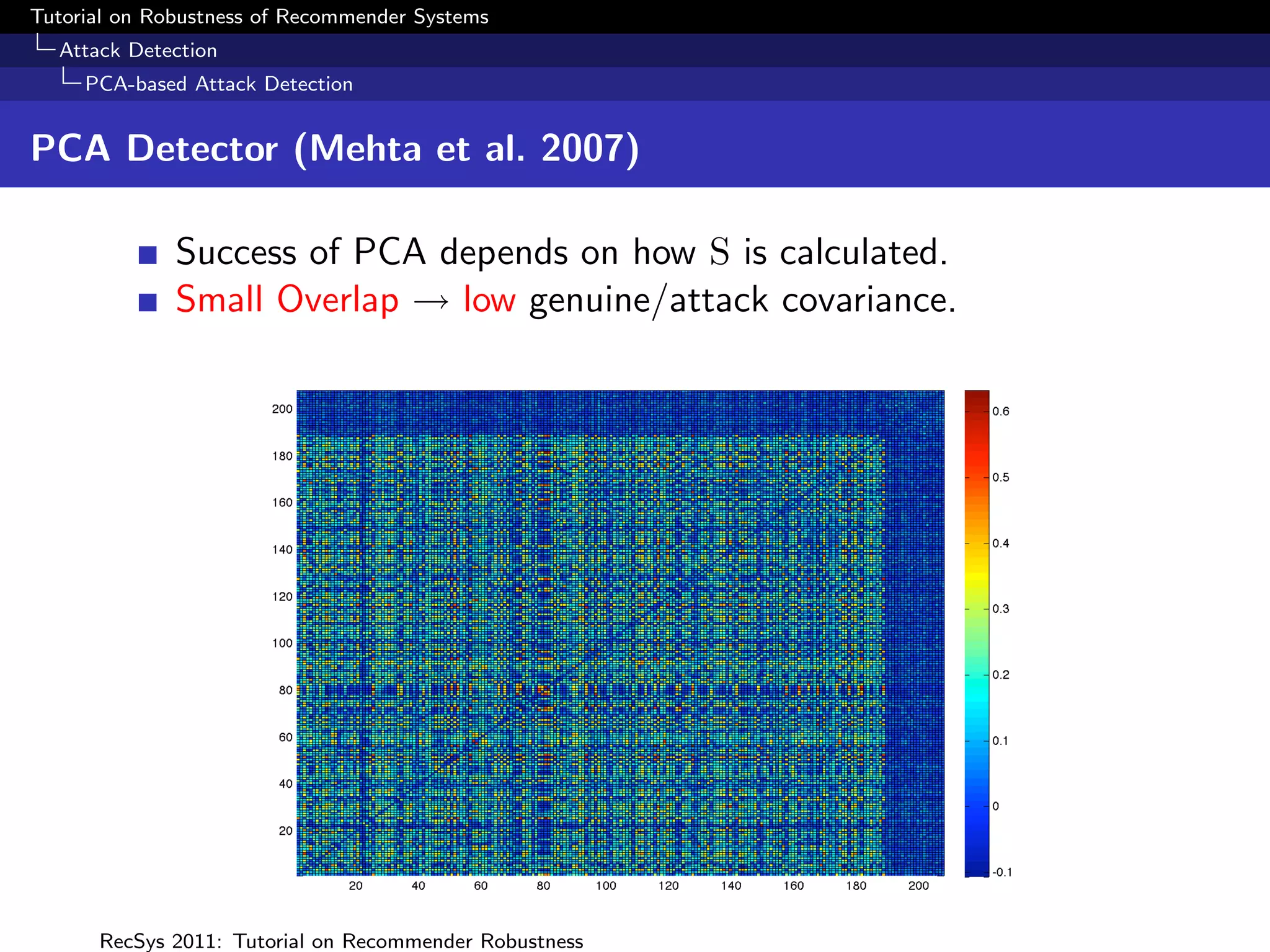
              Success of PCA depends on how S is calculated.
              Small Overlap → low genuine/attack covariance.


      RecSys 2011: Tutorial on Recommender Robustness
Tutorial on Robustness of Recommender Systems
  Attack Detection
     Statistical Attack Detection


Outline

       1 What is Robustness?
              Profile Injection Attacks
              Relevance of Robustness
              Measuring Robustness
       2    Attack Strategies
              Attacking kNN Algorithms
       3    Attack Detection
              PCA-based Attack Detection
              Statistical Attack Detection
              Cost-Benefit Analysis
       4    Robustness of Model-based Algorithms
       5    Attack Resistant Recommendation Algorithms
              Provably Manipulation Resistant Algorithms
       6    Stability, Trust and Privacy
      RecSys 2011: Tutorial on Recommender Robustness
Tutorial on Robustness of Recommender Systems
  Attack Detection
     Statistical Attack Detection


Neyman-Pearson Statistical Detection

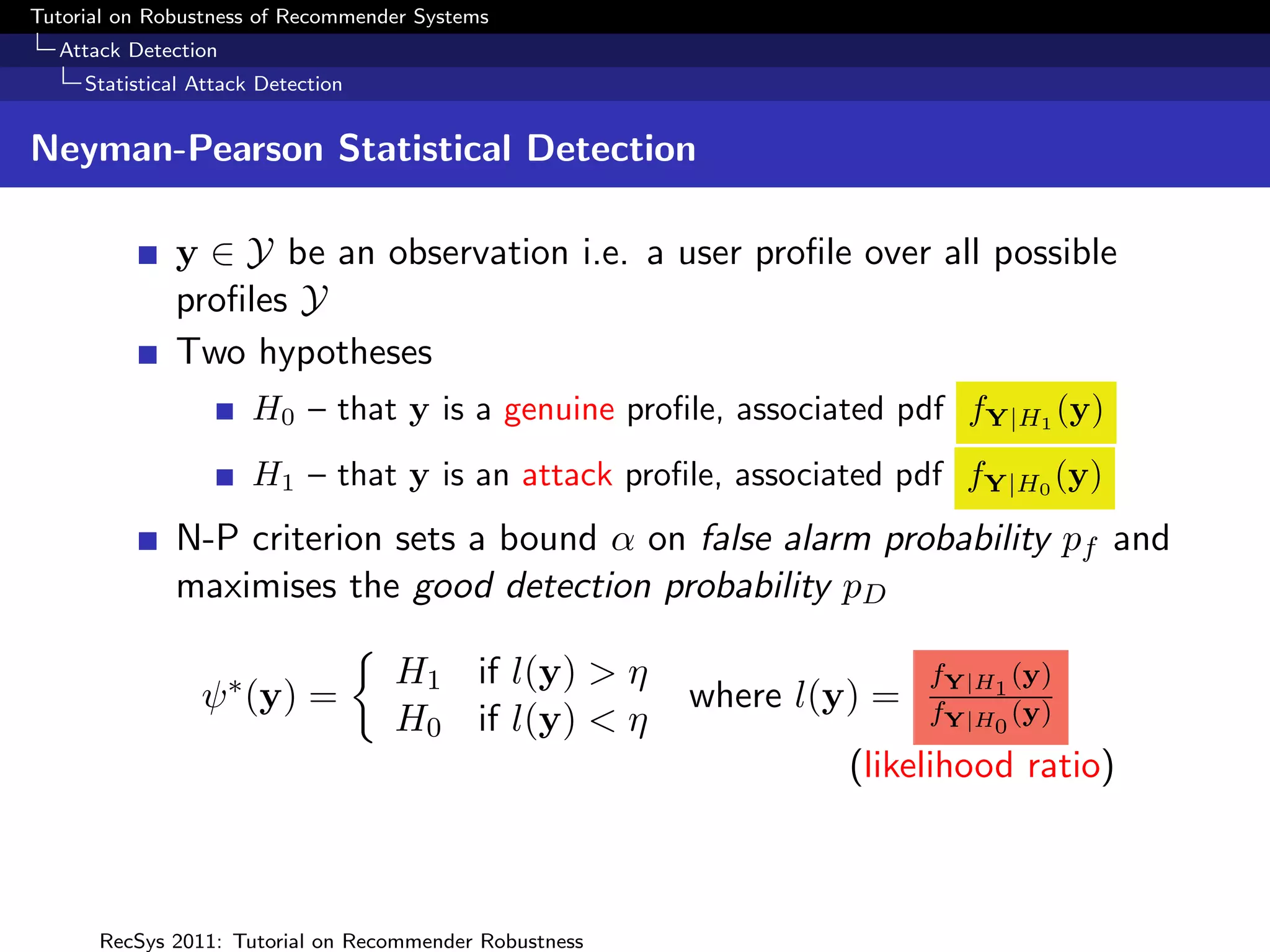
              y ∈ Y be an observation i.e. a user profile over all possible
              profiles Y
              Two hypotheses
                       H0 – that y is a genuine profile, associated pdf fY|H1 (y)
                       H1 – that y is an attack profile, associated pdf fY|H0 (y)
              N-P criterion sets a bound α on false alarm probability pf and
              maximises the good detection probability pD

                                    H1 if l(y) > η                     fY|H1 (y)
                 ψ ∗ (y) =                              where l(y) =   fY|H0 (y)
                                    H0 if l(y) < η
                                                                 (likelihood ratio)


      RecSys 2011: Tutorial on Recommender Robustness
Tutorial on Robustness of Recommender Systems
  Attack Detection
     Statistical Attack Detection


Modelling Attack Profiles

              As attacks follow well-defined construction, easy to construct
              model:
                               m
                                    Pr[Yi = yi ]
                             i=1
                              m
                      =             Pr[Yi = φ]θi (Pr[Yi = yi |Yi = φ]Pr[Yi = φ])1−θi
                             i=1

                                    Which items are rated?


      RecSys 2011: Tutorial on Recommender Robustness
Tutorial on Robustness of Recommender Systems
  Attack Detection
     Statistical Attack Detection


Modelling Attack Profiles

              As attacks follow well-defined construction, easy to construct
              model:
                               m
                                    Pr[Yi = yi ]
                             i=1
                              m
                      =             Pr[Yi = φ]θi (Pr[Yi = yi |Yi = φ]Pr[Yi = φ])1−θi
                             i=1

                                                        What ratings used?


      RecSys 2011: Tutorial on Recommender Robustness
Tutorial on Robustness of Recommender Systems
  Attack Detection
     Statistical Attack Detection


Modelling Attack Profiles

              As attacks follow well-defined construction, easy to construct
              model:
                          m
                               Pr[Yi = yi ]
                         i=1
                          m                                     1                       1           1−θi
                                                θi       yi −   2    − µi        yi +   2    − µi
                  =            Pr[Yi = φ]            Q                      −Q
                                                                σi                      σi
                         i=1


                                    Q(.) = Gaussian Q-function


      RecSys 2011: Tutorial on Recommender Robustness
Tutorial on Robustness of Recommender Systems
  Attack Detection
     Statistical Attack Detection


Modelling Genuine Profiles

              Simple model – identical to attack model except that
              probability of selecting a filler item is estimated as
              pi Pr[Yi = φ] from a dataset of genuine profiles.
              ˆ
                                     m
                                          Pr[Yi = yi ]
                                    i=1
                                     m
                                =         pi θi (Pr[Yi = yi |Yi = φ](1 − pi ))1−θi
                                          ˆ                              ˆ
                                    i=1

              Not a realistic model of genuine ratings – assumes user’s
              ratings are all independent
              But sufficient (almost) to distinguish from attack profiles.


      RecSys 2011: Tutorial on Recommender Robustness
Tutorial on Robustness of Recommender Systems
  Attack Detection
     Statistical Attack Detection


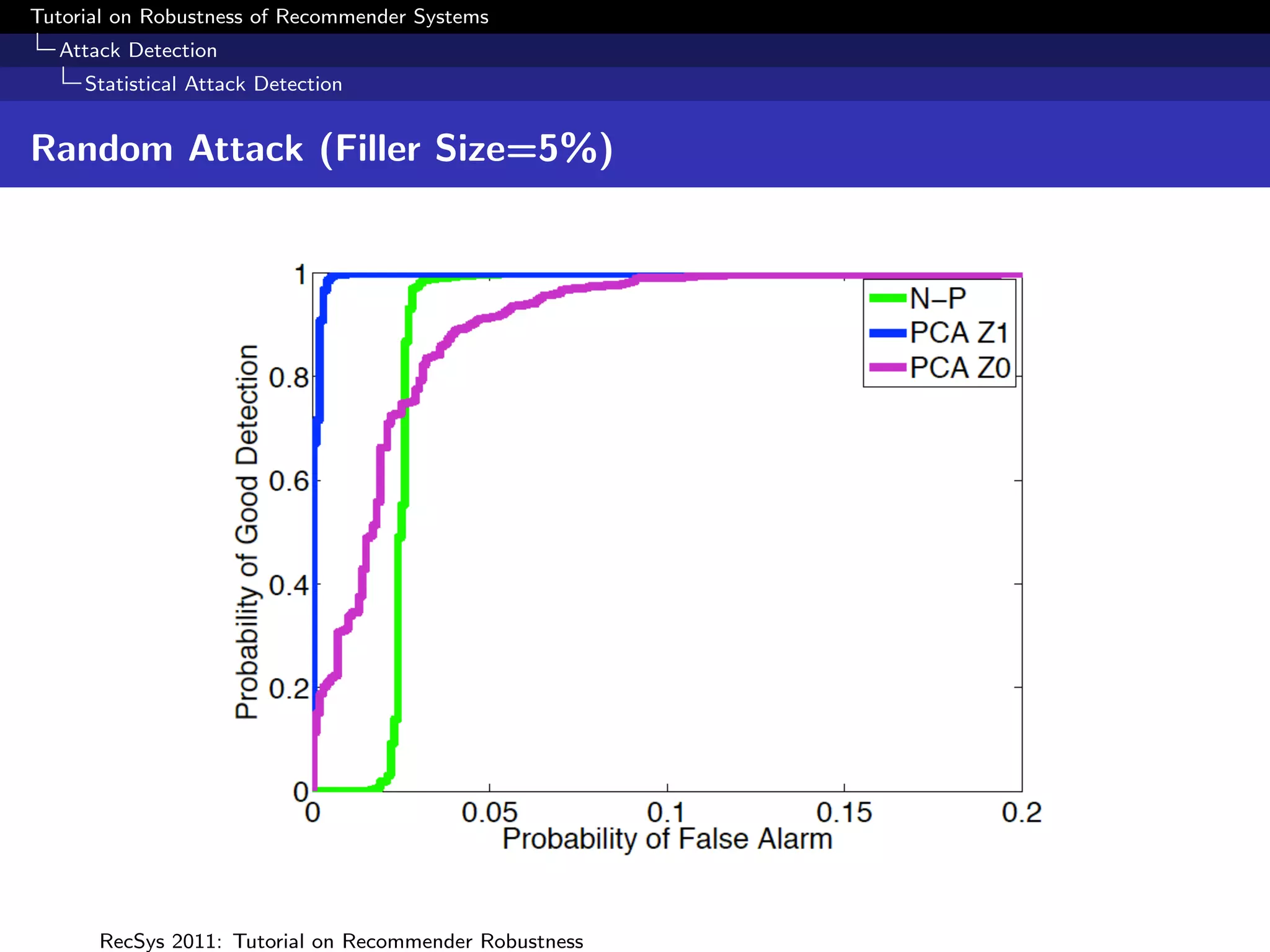
Random Attack (Filler Size=5%)


      RecSys 2011: Tutorial on Recommender Robustness
Tutorial on Robustness of Recommender Systems
  Attack Detection
     Statistical Attack Detection


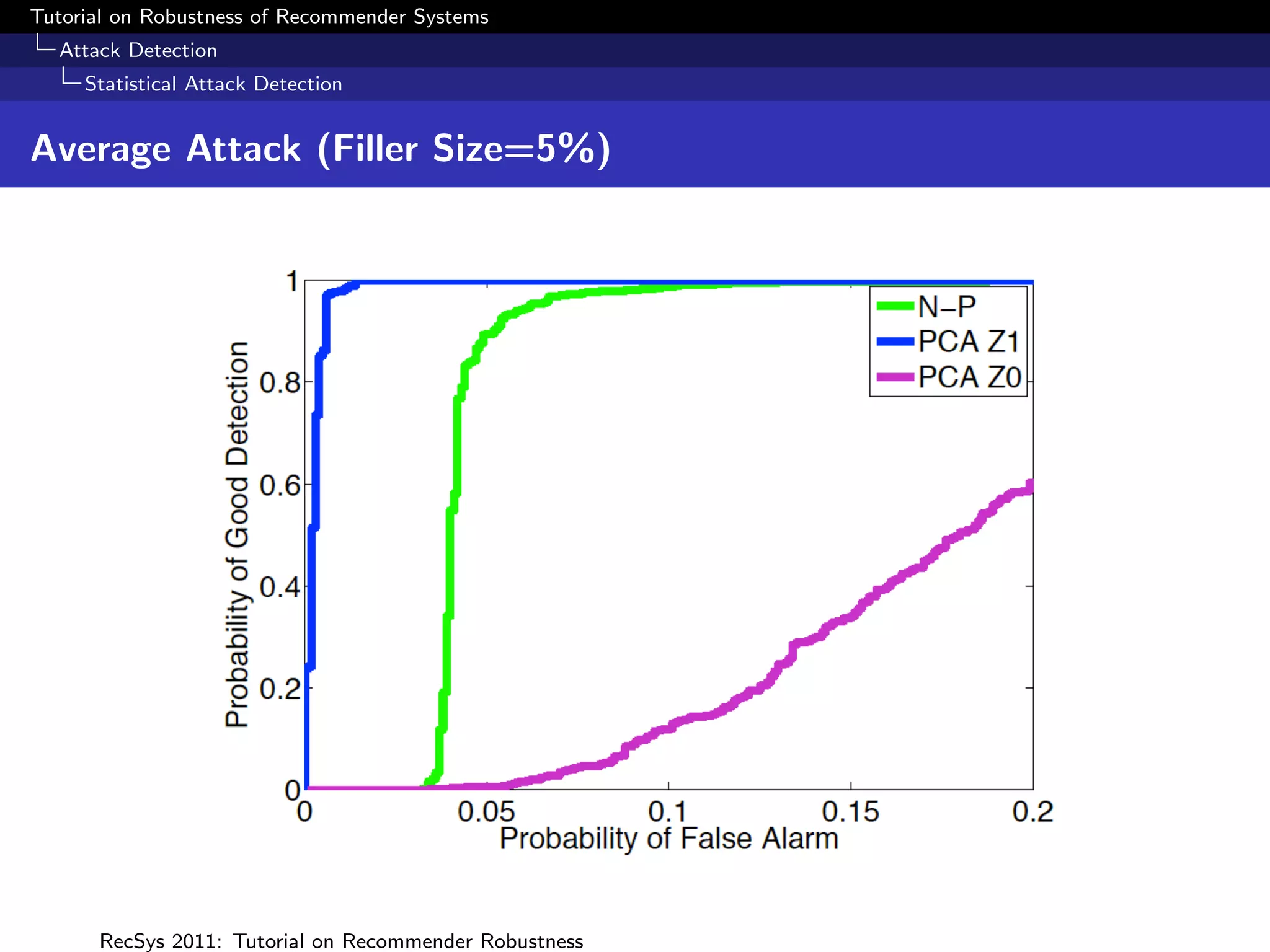
Average Attack (Filler Size=5%)


      RecSys 2011: Tutorial on Recommender Robustness
Tutorial on Robustness of Recommender Systems
  Attack Detection
     Statistical Attack Detection


Lesson Learned

              Filler item selection is key to the success of the standard
              attacks on k-NN user-based algorithm.
                       Low (attack profile / genuine profile) overlap (few common
                       ratings) makes extreme correlations possible – hence attack
                       profiles are unusually influential. (Basis of original attack
                       proposed in O’Mahony et al. (2002).)
                       But also allows for successful detection – also highly
                       perceptible.


      RecSys 2011: Tutorial on Recommender Robustness
Tutorial on Robustness of Recommender Systems
  Attack Detection
     Statistical Attack Detection


Attack Obfuscation

              Several obfuscation strategies evaluated previously (Williams
              et al. 2006).
              Effective obfuscation must try to reduce the statistical
              differences between genuine and attack profiles.


      RecSys 2011: Tutorial on Recommender Robustness
Tutorial on Robustness of Recommender Systems
  Attack Detection
     Statistical Attack Detection


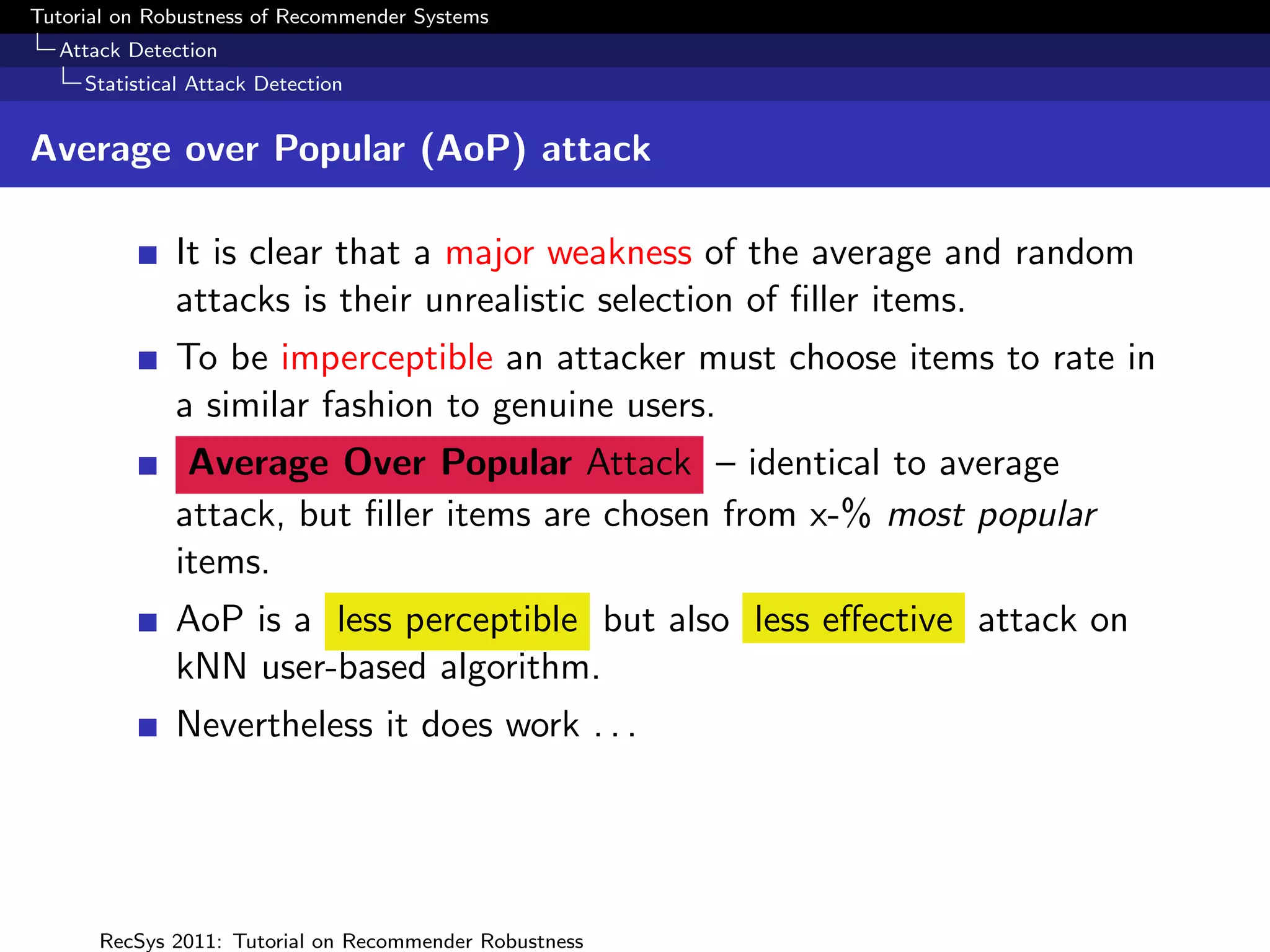
Average over Popular (AoP) attack

              It is clear that a major weakness of the average and random
              attacks is their unrealistic selection of filler items.
              To be imperceptible an attacker must choose items to rate in
              a similar fashion to genuine users.
               Average Over Popular Attack – identical to average
              attack, but filler items are chosen from x-% most popular
              items.
              AoP is a less perceptible but also less effective attack on
              kNN user-based algorithm.
              Nevertheless it does work . . .


      RecSys 2011: Tutorial on Recommender Robustness
Tutorial on Robustness of Recommender Systems
  Attack Detection
     Statistical Attack Detection


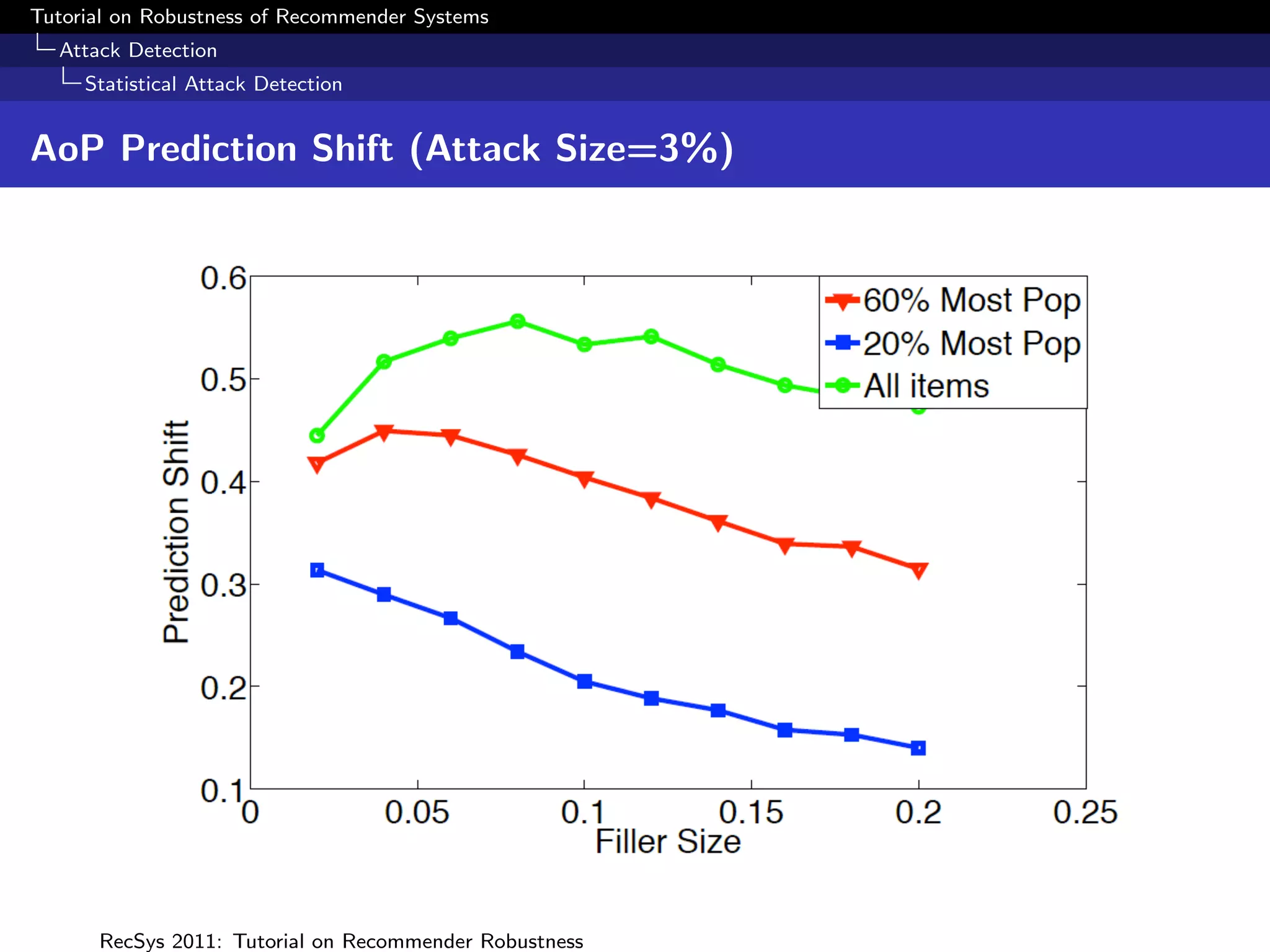
AoP Prediction Shift (Attack Size=3%)


      RecSys 2011: Tutorial on Recommender Robustness
Tutorial on Robustness of Recommender Systems
  Attack Detection
     Statistical Attack Detection


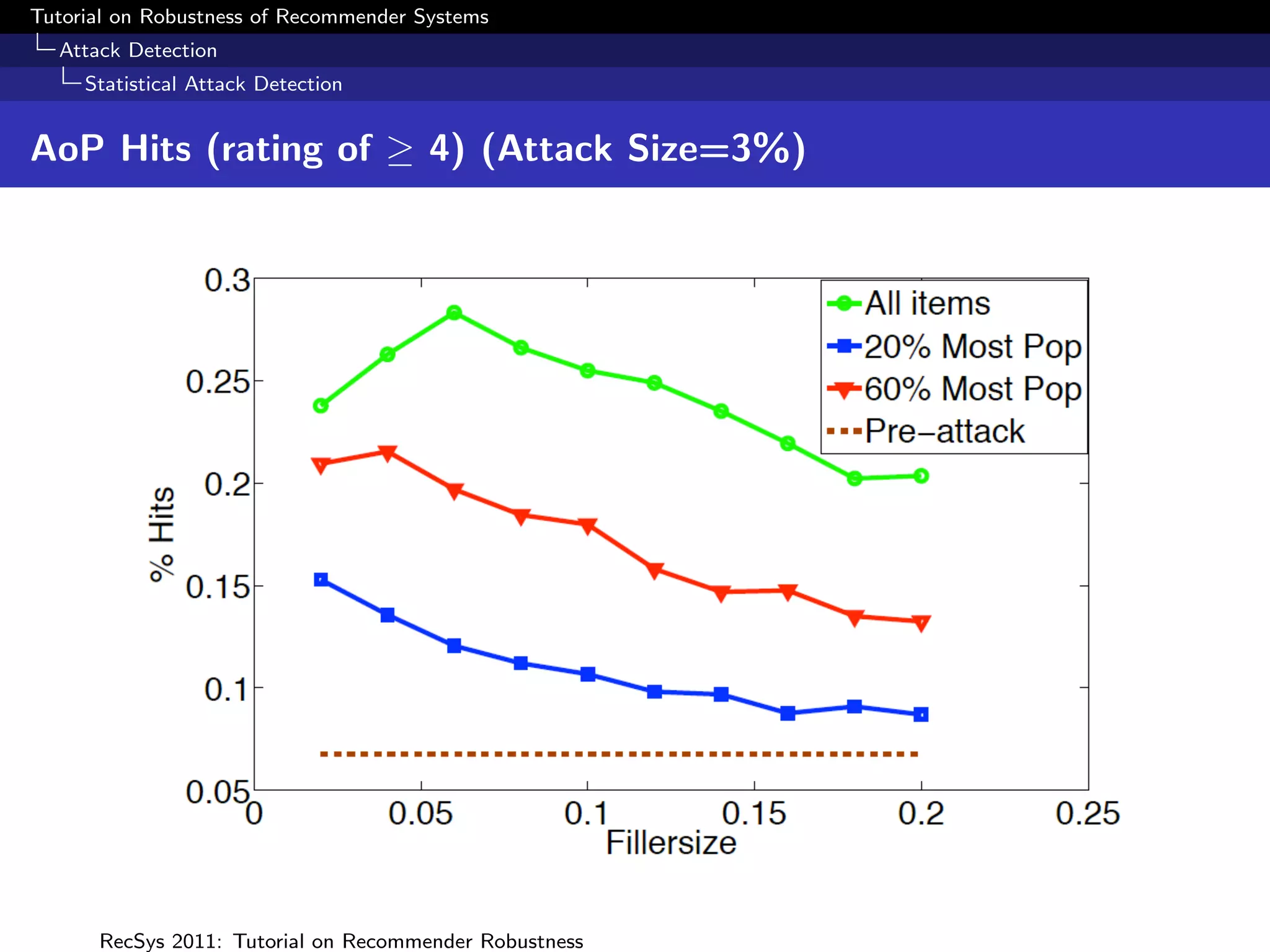
AoP Hits (rating of ≥ 4) (Attack Size=3%)


      RecSys 2011: Tutorial on Recommender Robustness
Tutorial on Robustness of Recommender Systems
  Attack Detection
     Statistical Attack Detection


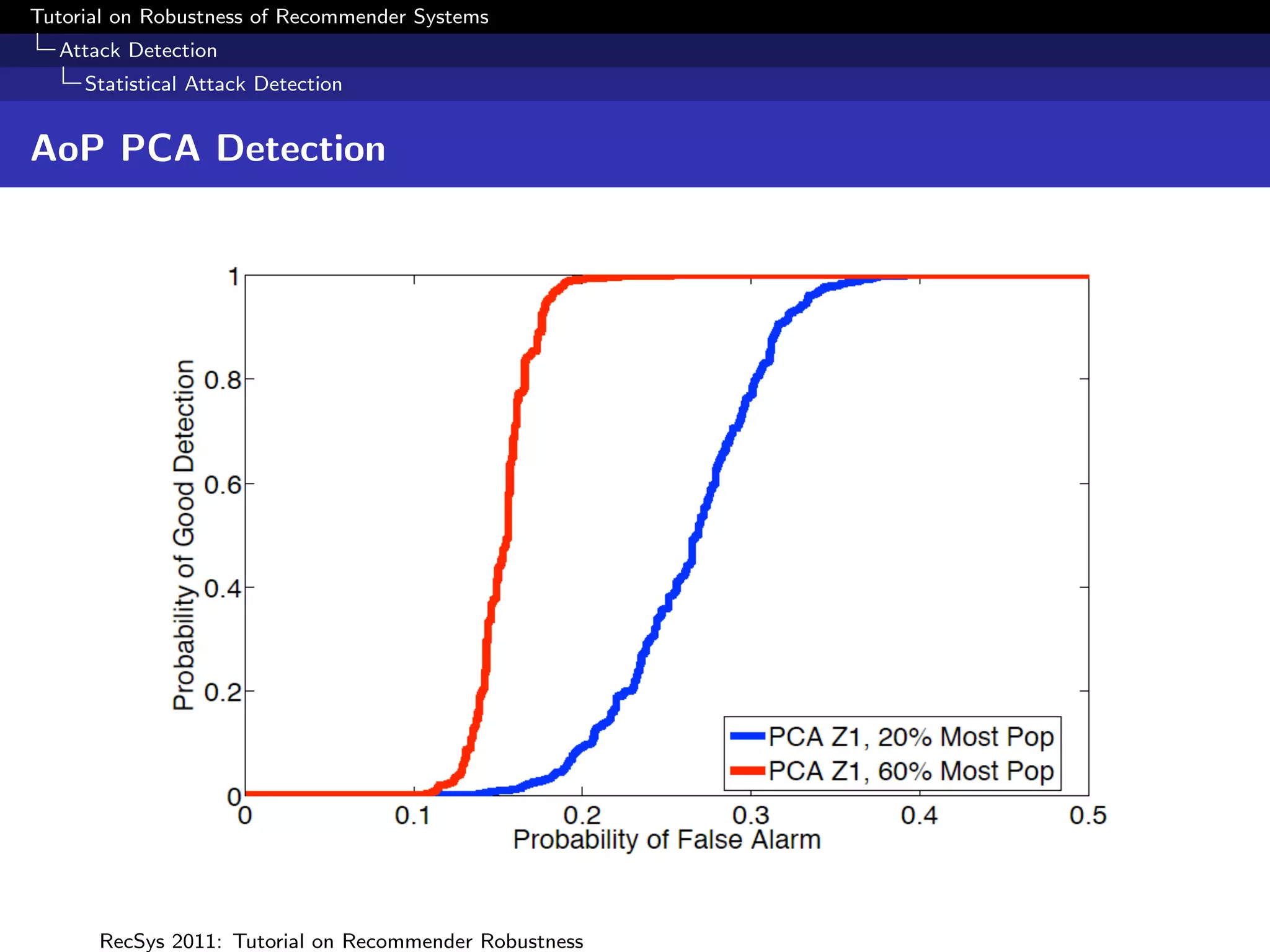
AoP PCA Detection


      RecSys 2011: Tutorial on Recommender Robustness
Tutorial on Robustness of Recommender Systems
  Attack Detection
     Statistical Attack Detection


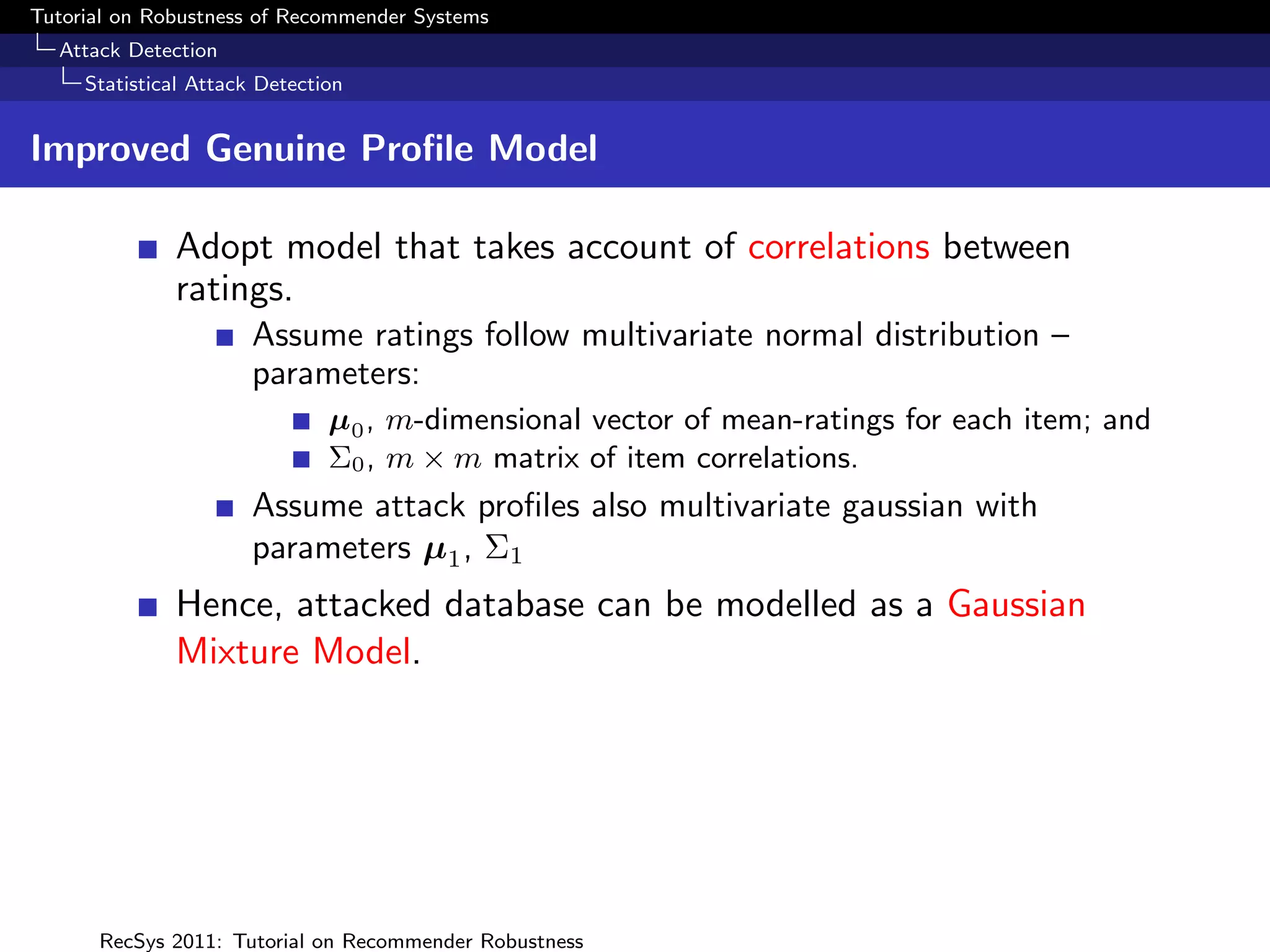
Improved Genuine Profile Model

              Adopt model that takes account of correlations between
              ratings.
                       Assume ratings follow multivariate normal distribution –
                       parameters:
                               µ0 , m-dimensional vector of mean-ratings for each item; and
                               Σ0 , m × m matrix of item correlations.
                       Assume attack profiles also multivariate gaussian with
                       parameters µ1 , Σ1
              Hence, attacked database can be modelled as a Gaussian
              Mixture Model.


      RecSys 2011: Tutorial on Recommender Robustness
Tutorial on Robustness of Recommender Systems
  Attack Detection
     Statistical Attack Detection


Improved Genuine Profile Model

              Difficulty
                       Very high dimensional vectors
                       Missing values
               Factor Model : Assume that the rating matrix can be
              represented by the linear model

                                                YT = AXT + N ,


                       X : n × k matrix, xu,j = extent user u likes category j
                       A : m × k matrix ai,j = extent item i belongs in category j
                       N : independent noise
                       X(i, :) assumed independent normal.
              Expectation maximisation to learn A from dataset ([Canny,
              2002]).
      RecSys 2011: Tutorial on Recommender Robustness
Tutorial on Robustness of Recommender Systems
  Attack Detection
     Statistical Attack Detection


Improved Genuine Profile Model

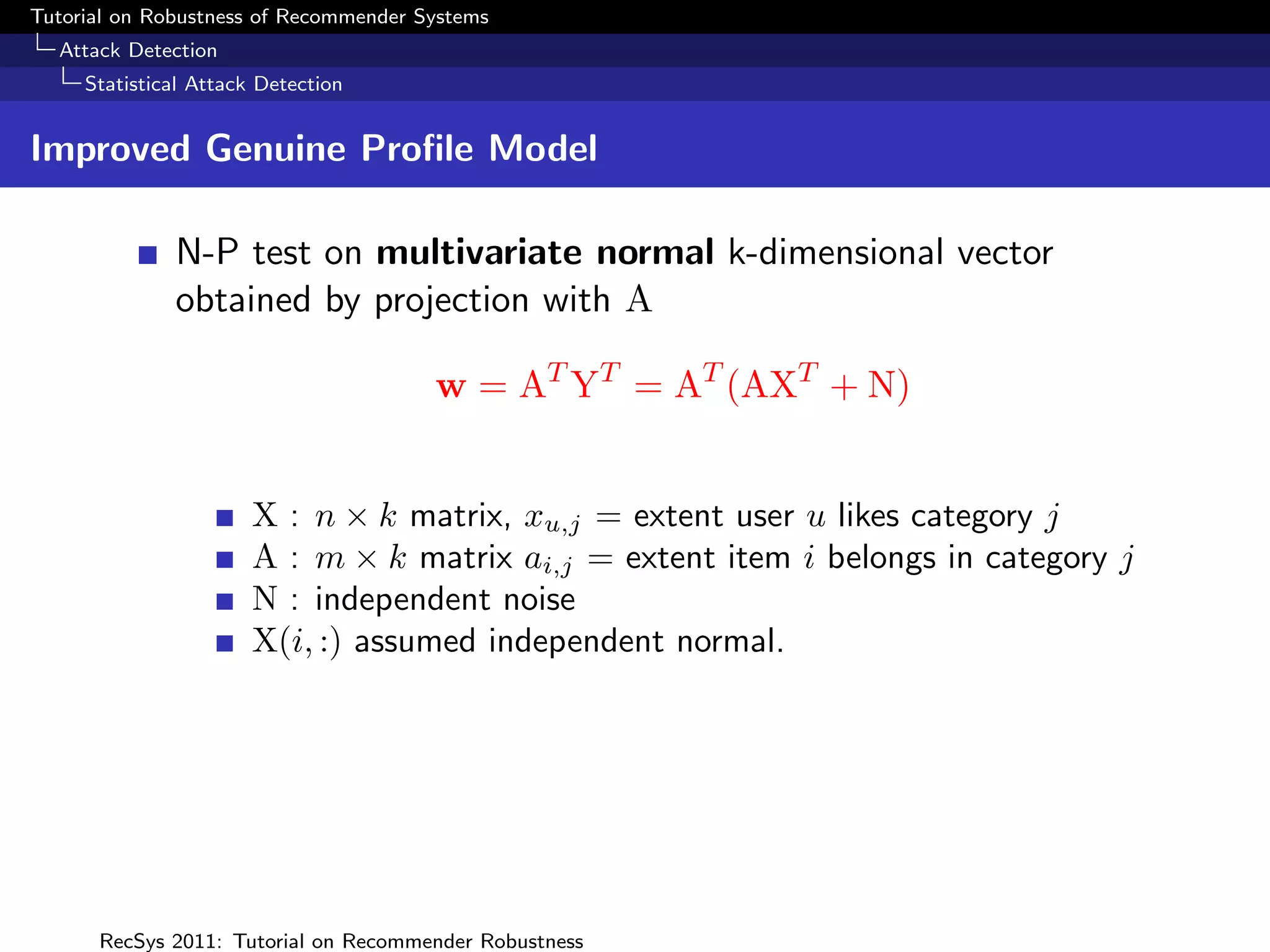
              N-P test on multivariate normal k-dimensional vector
              obtained by projection with A

                                       w = AT YT = AT (AXT + N)


                       X : n × k matrix, xu,j = extent user u likes category j
                       A : m × k matrix ai,j = extent item i belongs in category j
                       N : independent noise
                       X(i, :) assumed independent normal.


      RecSys 2011: Tutorial on Recommender Robustness
Tutorial on Robustness of Recommender Systems
  Attack Detection
     Statistical Attack Detection


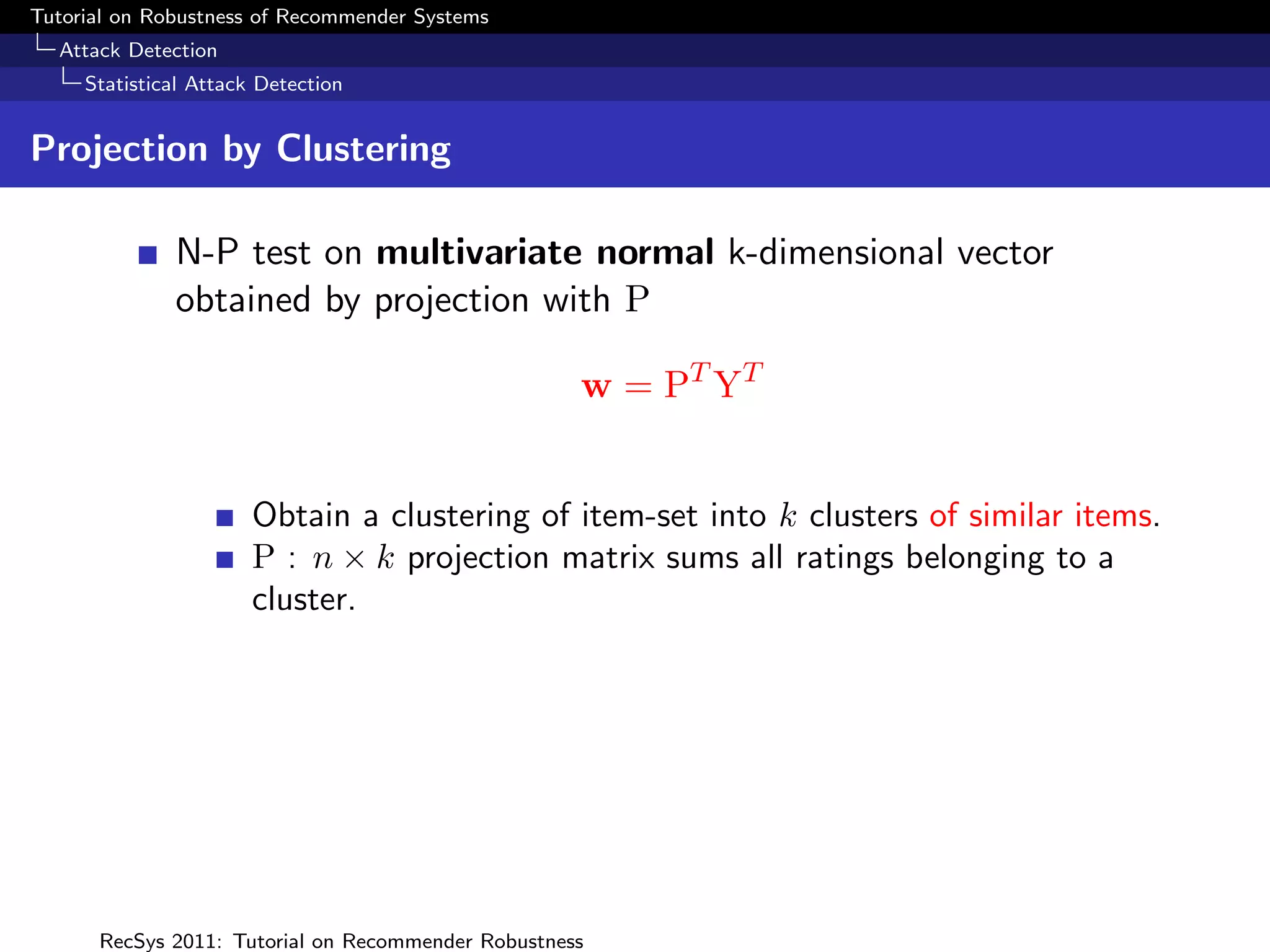
Projection by Clustering

              N-P test on multivariate normal k-dimensional vector
              obtained by projection with P

                                                    w = PT YT


                       Obtain a clustering of item-set into k clusters of similar items.
                       P : n × k projection matrix sums all ratings belonging to a
                       cluster.


      RecSys 2011: Tutorial on Recommender Robustness
Tutorial on Robustness of Recommender Systems
  Attack Detection
     Statistical Attack Detection


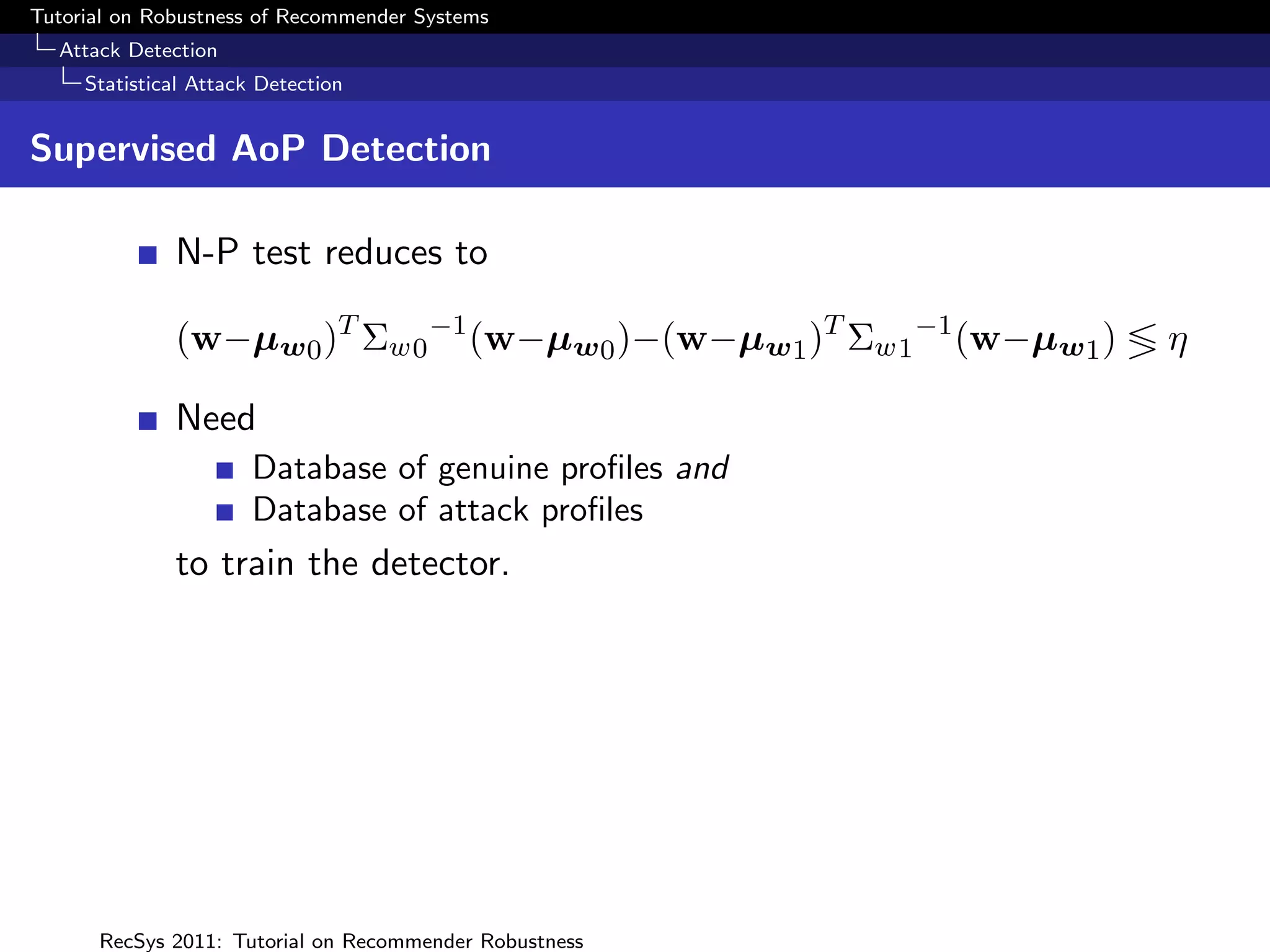
Supervised AoP Detection

              N-P test reduces to

              (w−µw 0 )T Σw0 −1 (w−µw 0 )−(w−µw 1 )T Σw1 −1 (w−µw 1 )   η

              Need
                       Database of genuine profiles and
                       Database of attack profiles
              to train the detector.


      RecSys 2011: Tutorial on Recommender Robustness
Tutorial on Robustness of Recommender Systems
  Attack Detection
     Statistical Attack Detection


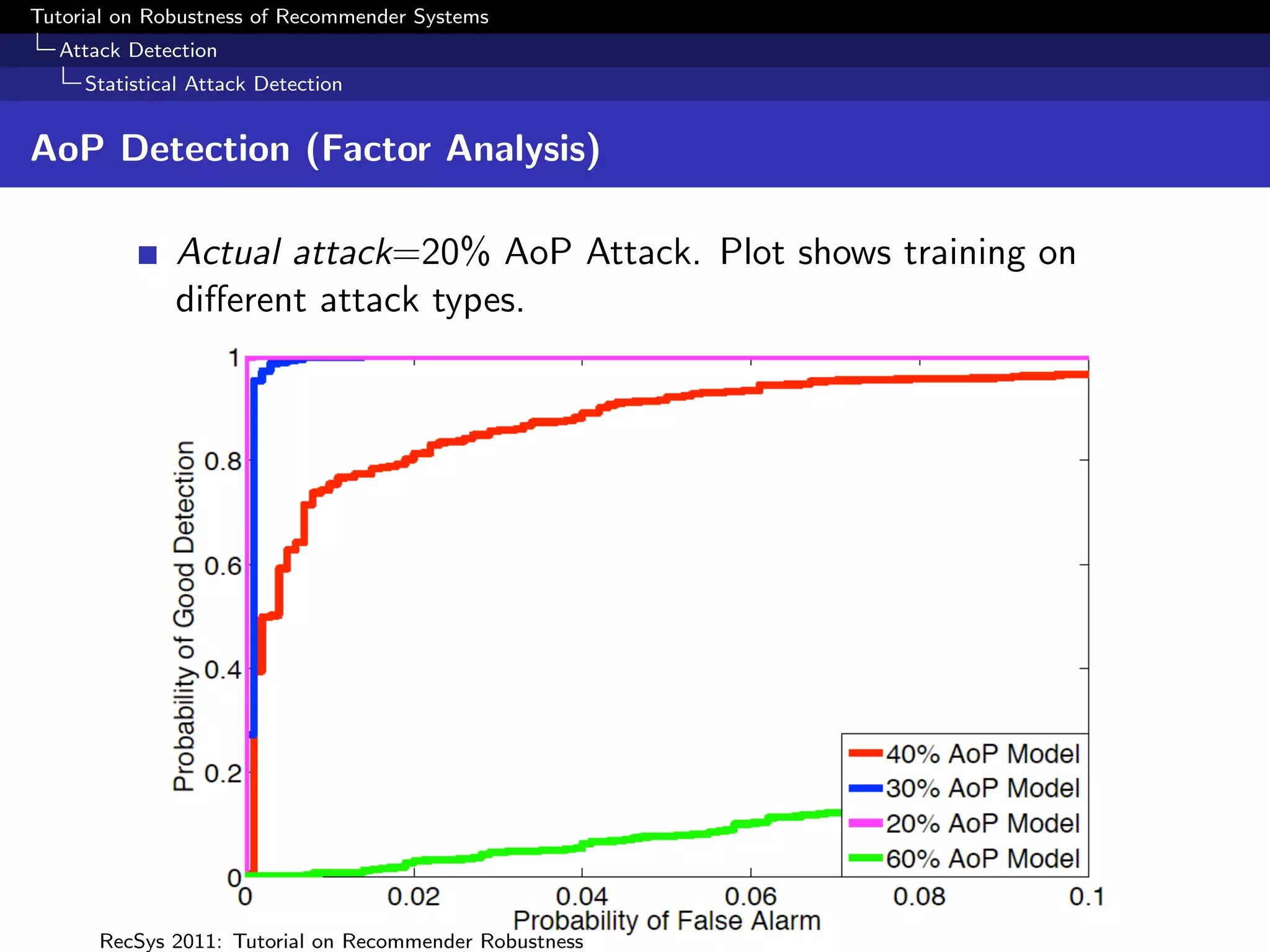
AoP Detection (Factor Analysis)

              Actual attack=20% AoP Attack. Plot shows training on
              different attack types.


      RecSys 2011: Tutorial on Recommender Robustness
Tutorial on Robustness of Recommender Systems
  Attack Detection
     Statistical Attack Detection


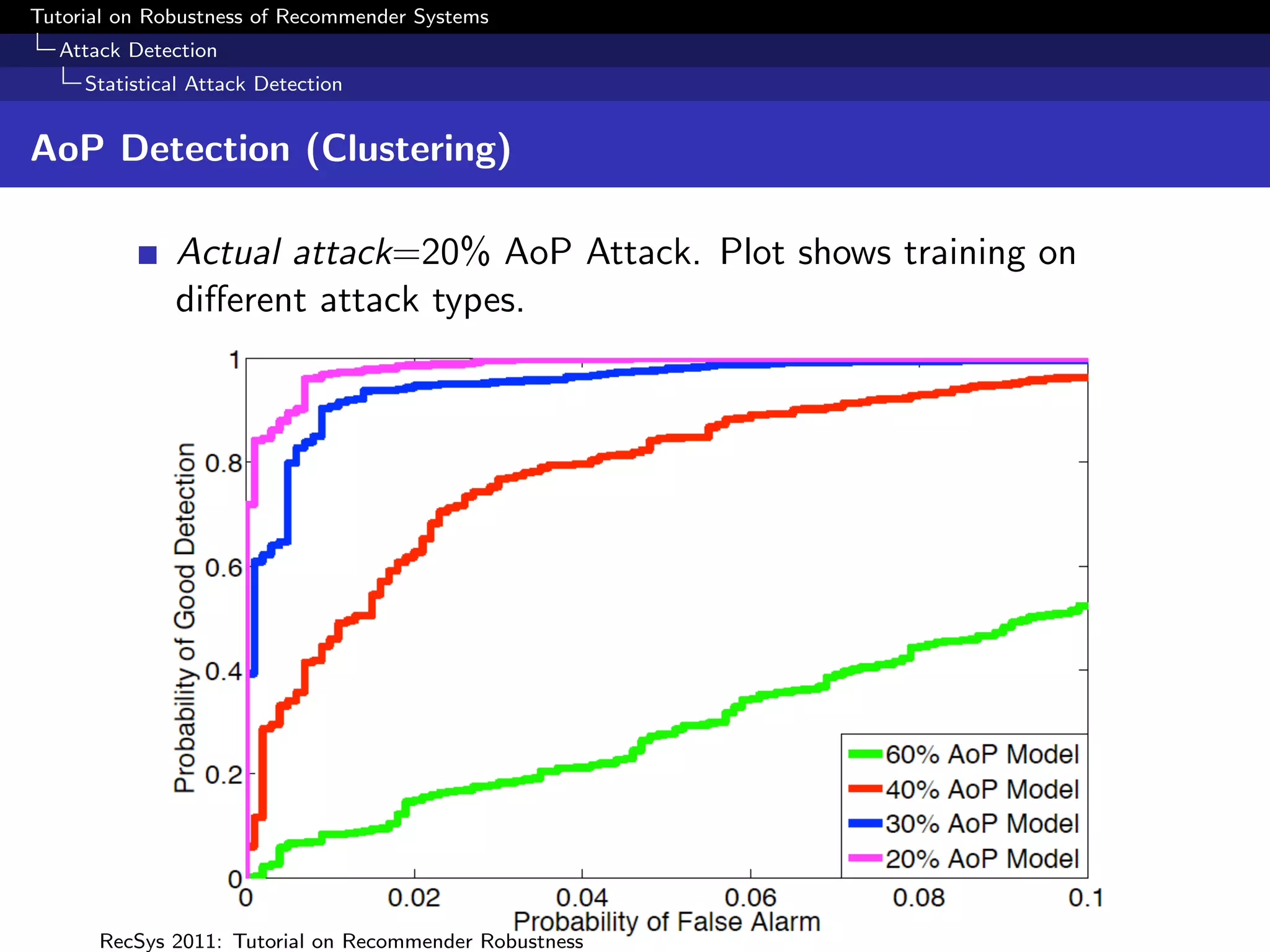
AoP Detection (Clustering)

              Actual attack=20% AoP Attack. Plot shows training on
              different attack types.


      RecSys 2011: Tutorial on Recommender Robustness
Tutorial on Robustness of Recommender Systems
  Attack Detection
     Statistical Attack Detection


Unsupervised AoP Detection

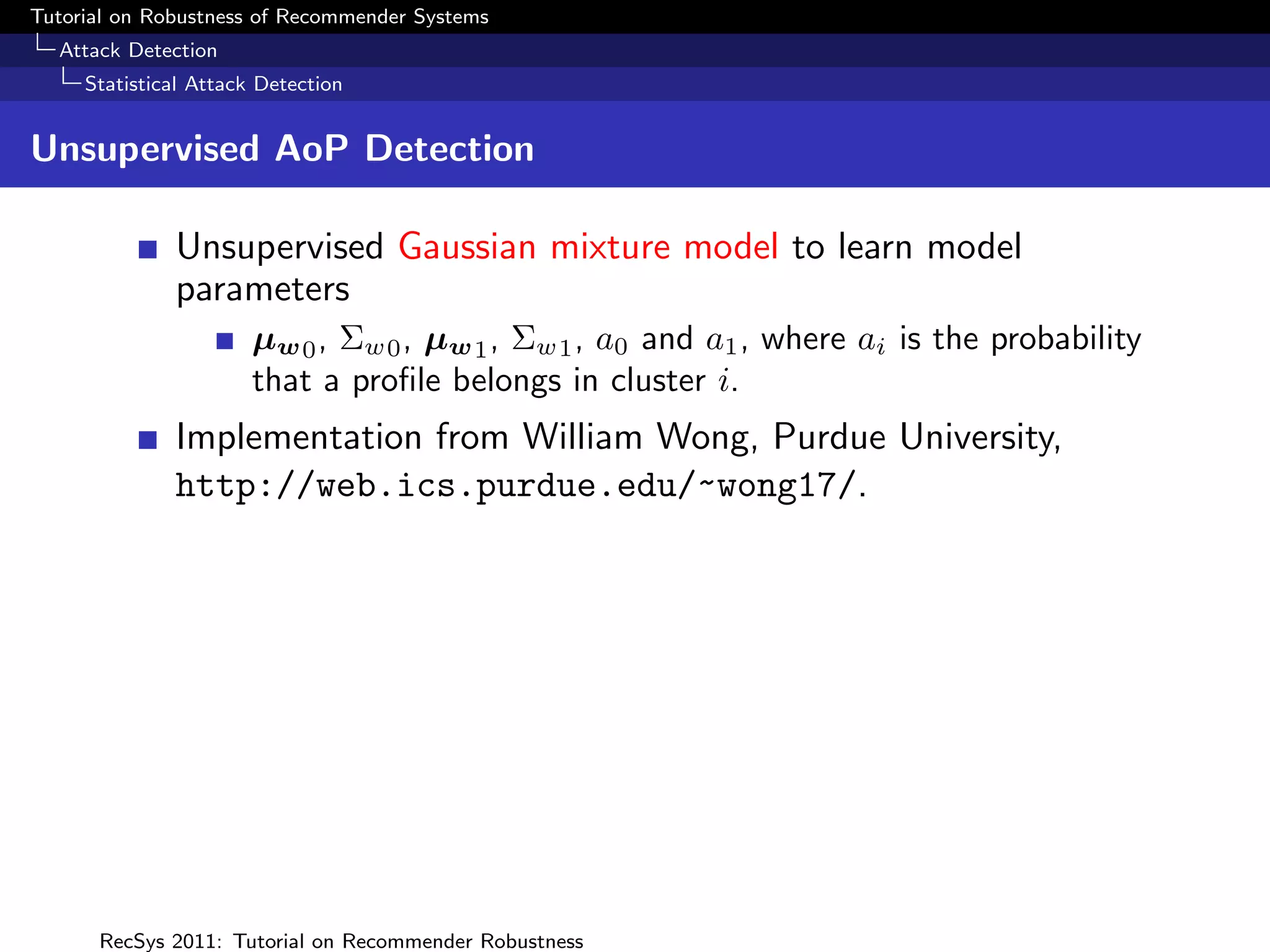
              Unsupervised Gaussian mixture model to learn model
              parameters
                       µw 0 , Σw0 , µw 1 , Σw1 , a0 and a1 , where ai is the probability
                       that a profile belongs in cluster i.
              Implementation from William Wong, Purdue University,
              http://web.ics.purdue.edu/~wong17/.


      RecSys 2011: Tutorial on Recommender Robustness
Tutorial on Robustness of Recommender Systems
  Attack Detection
     Statistical Attack Detection


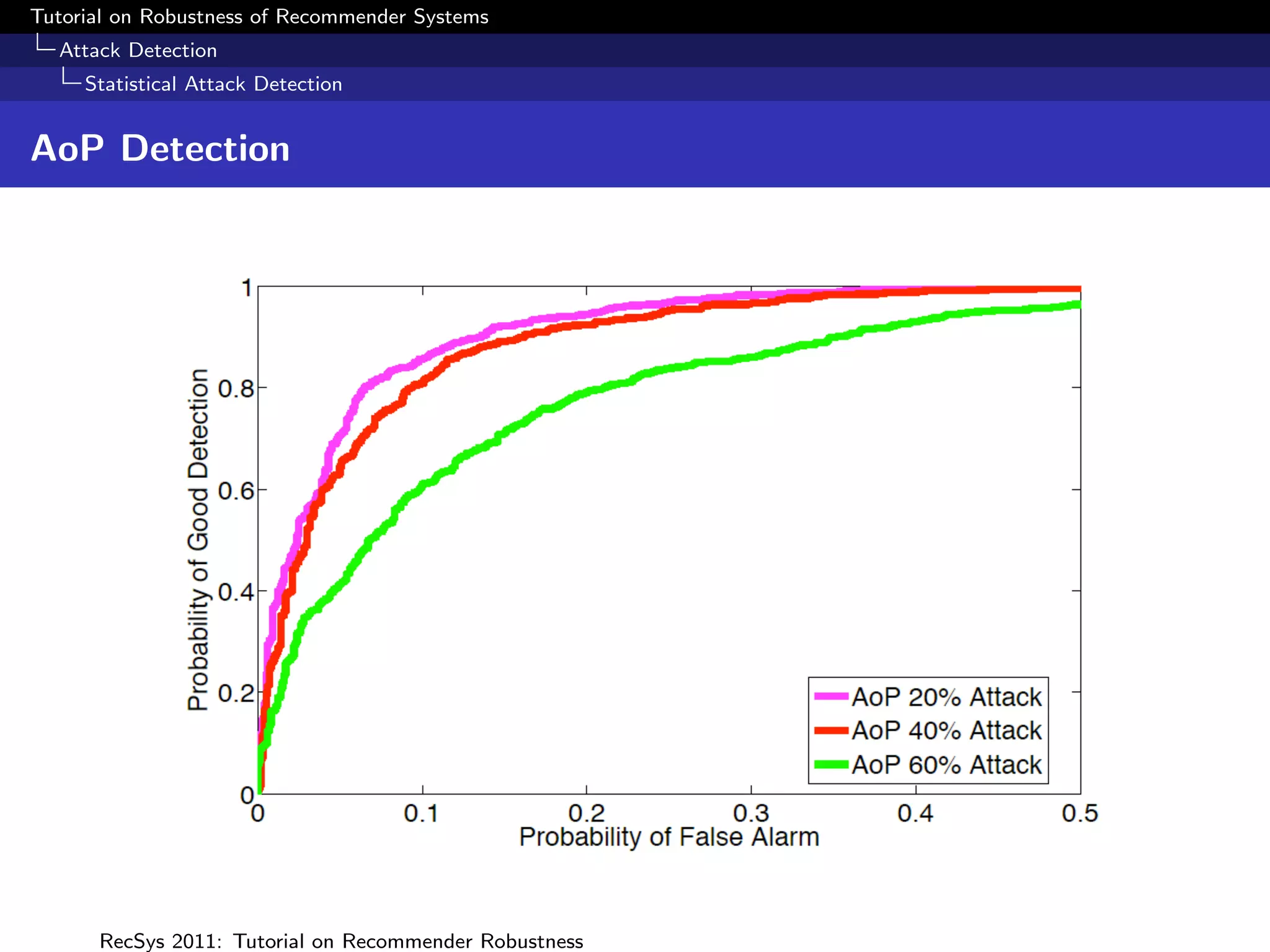
AoP Detection


      RecSys 2011: Tutorial on Recommender Robustness
Tutorial on Robustness of Recommender Systems
  Attack Detection
     Cost-Benefit Analysis


Outline

       1 What is Robustness?
             Profile Injection Attacks
             Relevance of Robustness
             Measuring Robustness
       2   Attack Strategies
             Attacking kNN Algorithms
       3   Attack Detection
             PCA-based Attack Detection
             Statistical Attack Detection
             Cost-Benefit Analysis
       4   Robustness of Model-based Algorithms
       5   Attack Resistant Recommendation Algorithms
             Provably Manipulation Resistant Algorithms
       6   Stability, Trust and Privacy
      RecSys 2011: Tutorial on Recommender Robustness
Tutorial on Robustness of Recommender Systems
  Attack Detection
     Cost-Benefit Analysis


Cost-Benefit Analysis

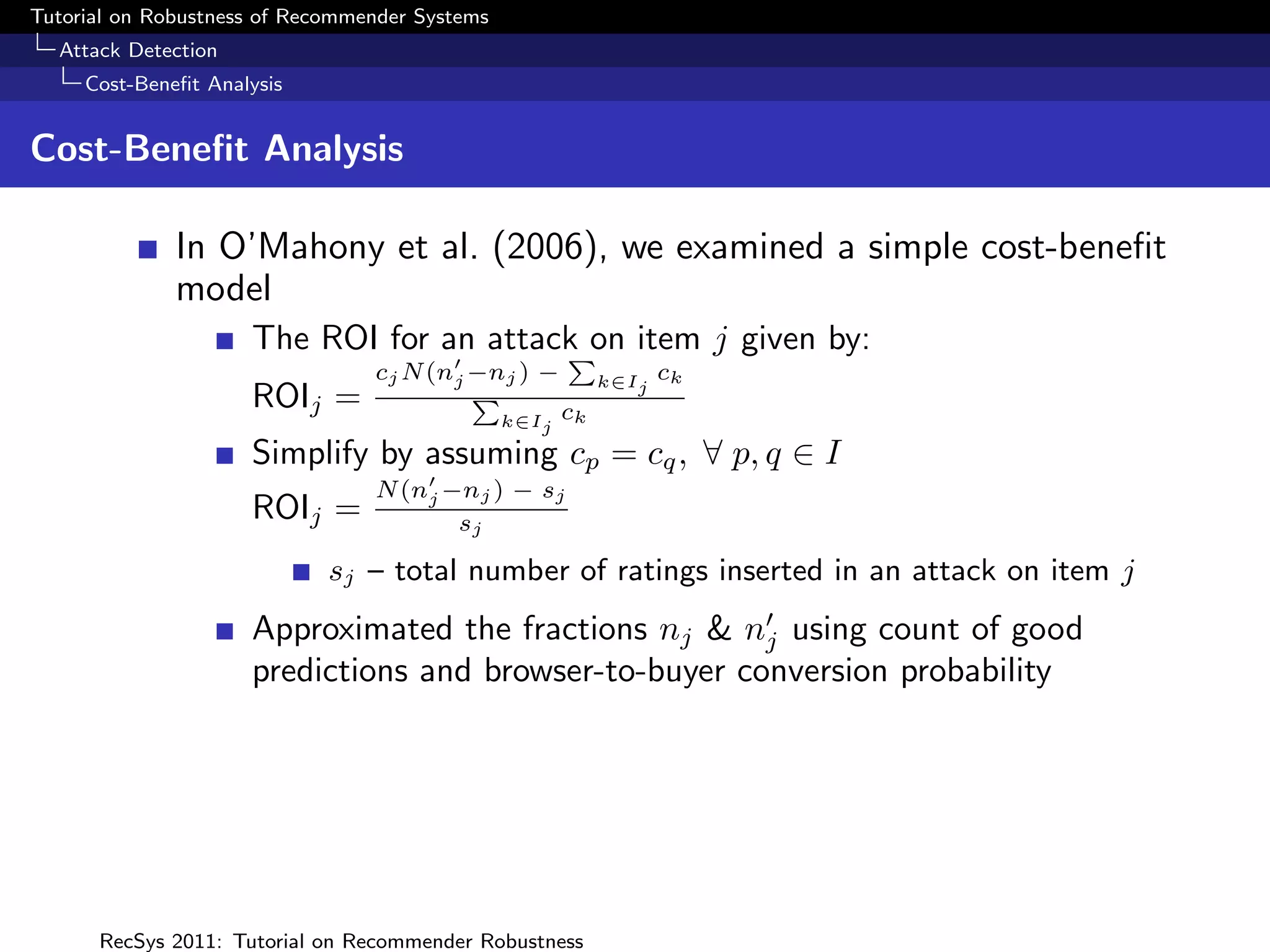
              In O’Mahony et al. (2006), we examined a simple cost-benefit
              model
                     The ROI for an attack on item j given by:
                                         P
                                 cj N (nj −nj ) −           k∈Ij   ck
                     ROIj =               P
                                                       ck
                                                k∈Ij

                     Simplify by assuming cp = cq , ∀ p, q ∈ I
                                 N (nj −nj ) − sj
                     ROIj =             sj

                             sj – total number of ratings inserted in an attack on item j
                     Approximated the fractions nj & nj using count of good
                     predictions and browser-to-buyer conversion probability


      RecSys 2011: Tutorial on Recommender Robustness
Tutorial on Robustness of Recommender Systems
  Attack Detection
     Cost-Benefit Analysis


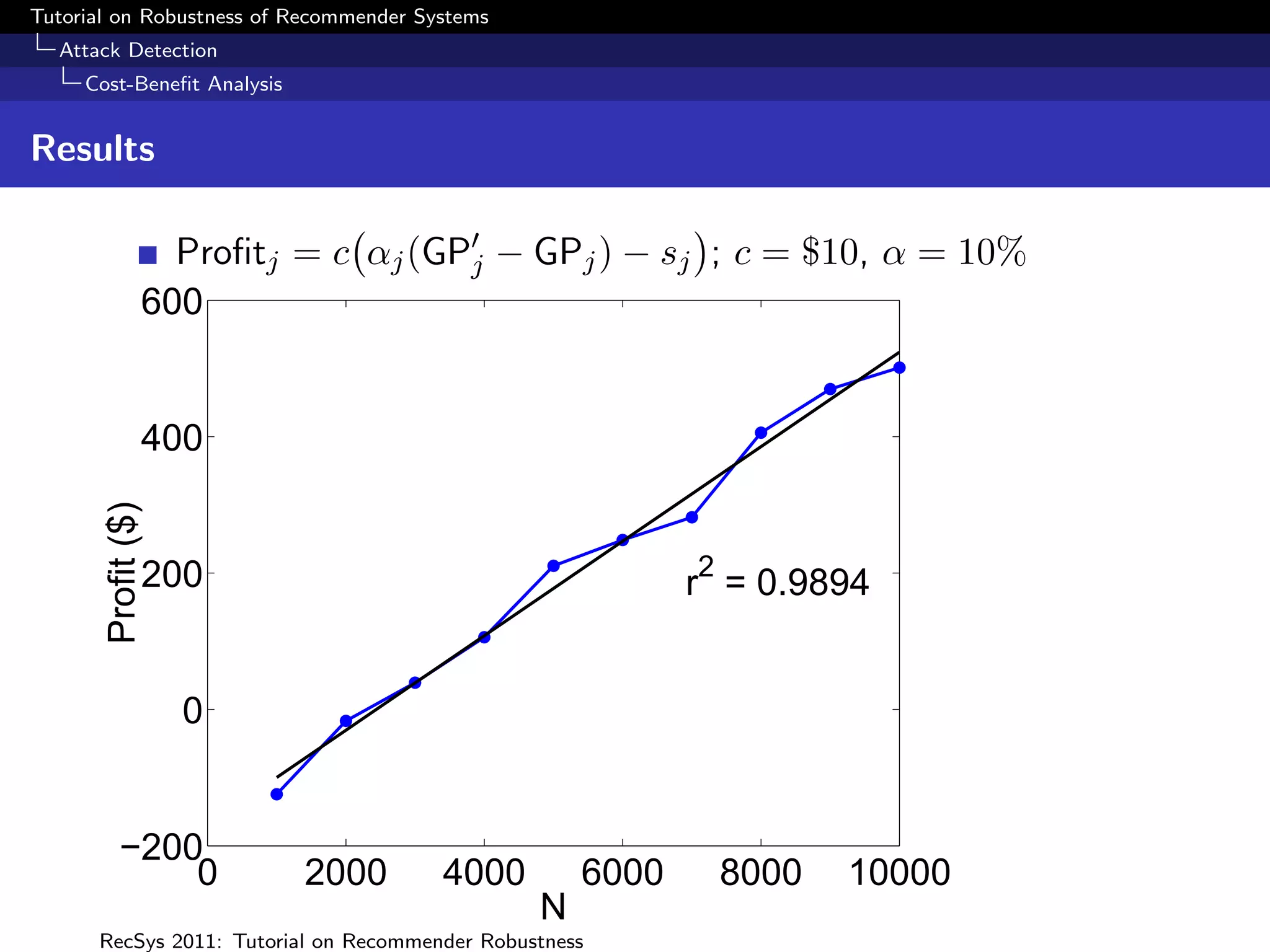
Results

                  Profitj = c αj (GPj − GPj ) − sj ; c = $10, α = 10%
                600


                400
       Profit ($)


                200                                        2
                                                           r = 0.9894


                    0


          −200
              0             2000        4000        6000       8000   10000
                                                N
      RecSys 2011: Tutorial on Recommender Robustness
Tutorial on Robustness of Recommender Systems
  Attack Detection
     Cost-Benefit Analysis


Cost-benefit Analysis

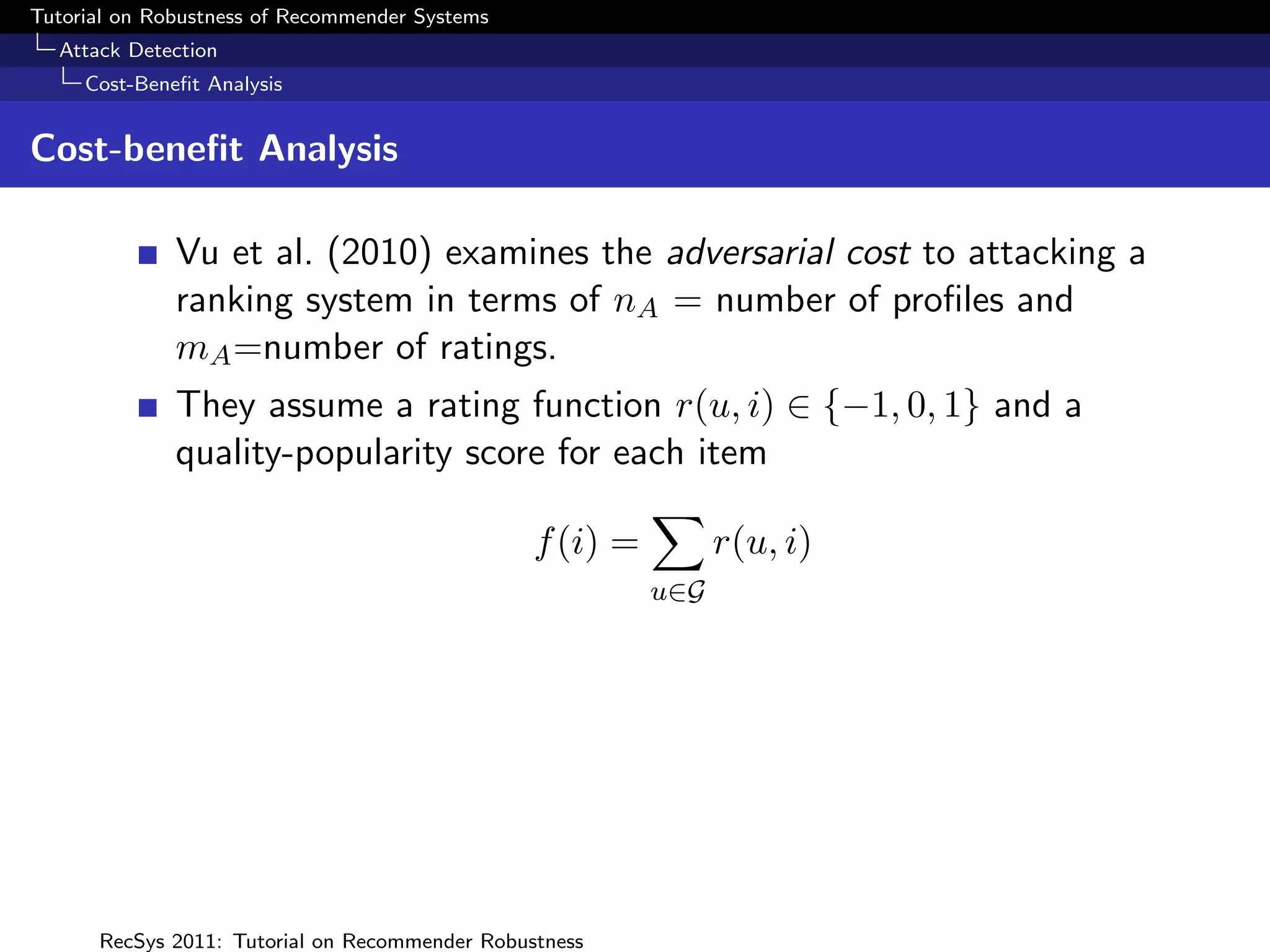
              Vu et al. (2010) examines the adversarial cost to attacking a
              ranking system in terms of nA = number of profiles and
              mA =number of ratings.
              They assume a rating function r(u, i) ∈ {−1, 0, 1} and a
              quality-popularity score for each item

                                                f (i) =         r(u, i)
                                                          u∈G


      RecSys 2011: Tutorial on Recommender Robustness
Tutorial on Robustness of Recommender Systems
  Attack Detection
     Cost-Benefit Analysis


Cost-benefit Analysis

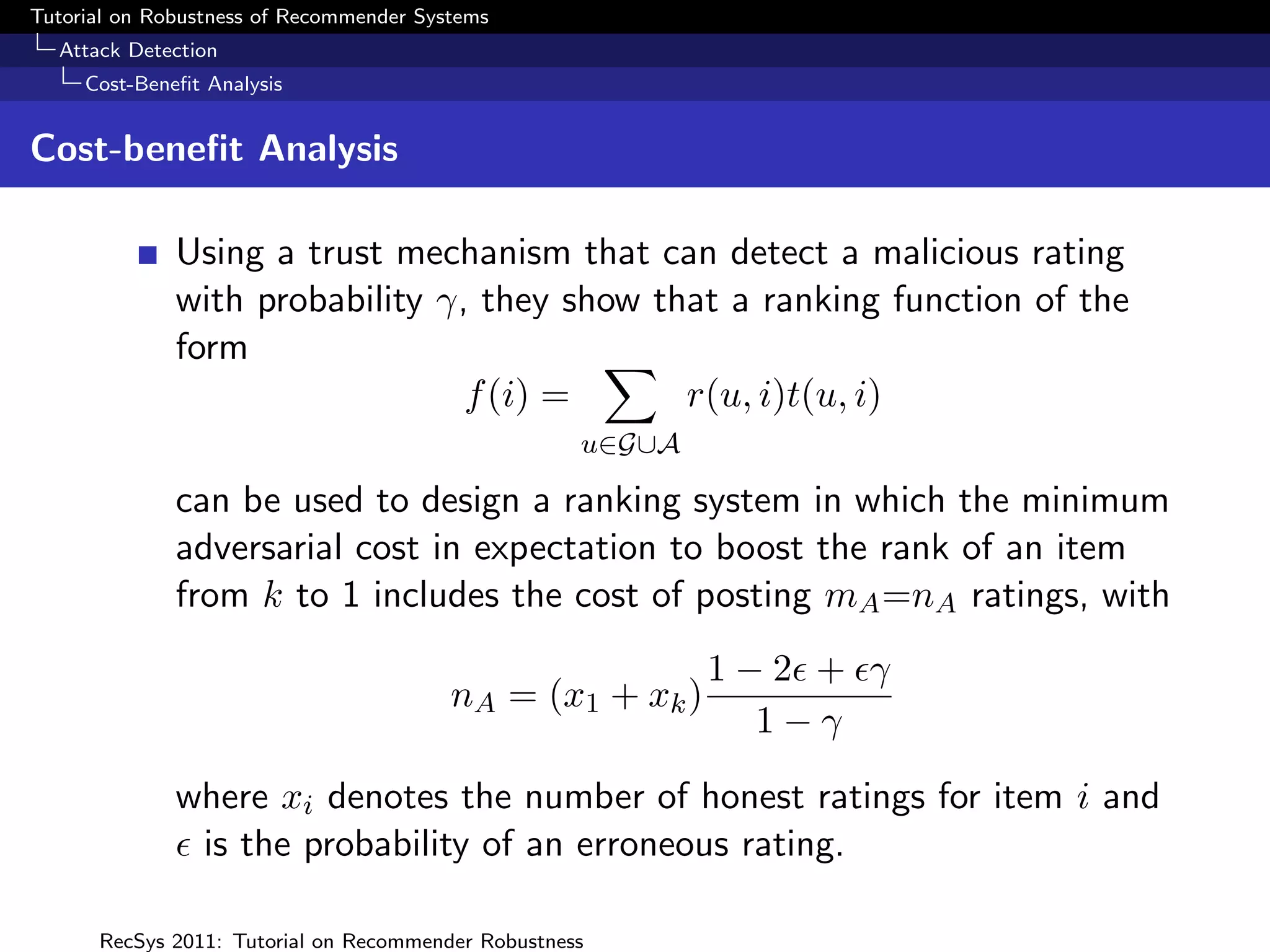
              Using a trust mechanism that can detect a malicious rating
              with probability γ, they show that a ranking function of the
              form
                                 f (i) =      r(u, i)t(u, i)
                                                    u∈G∪A

              can be used to design a ranking system in which the minimum
              adversarial cost in expectation to boost the rank of an item
              from k to 1 includes the cost of posting mA =nA ratings, with
                                                            1−2 + γ
                                         nA = (x1 + xk )
                                                              1−γ
              where xi denotes the number of honest ratings for item i and
               is the probability of an erroneous rating.

      RecSys 2011: Tutorial on Recommender Robustness
Tutorial on Robustness of Recommender Systems
  Robustness of Model-based Algorithms


Outline

       1 What is Robustness?
             Profile Injection Attacks
             Relevance of Robustness
             Measuring Robustness
       2   Attack Strategies
             Attacking kNN Algorithms
       3   Attack Detection
             PCA-based Attack Detection
             Statistical Attack Detection
             Cost-Benefit Analysis
       4   Robustness of Model-based Algorithms
       5   Attack Resistant Recommendation Algorithms
             Provably Manipulation Resistant Algorithms
       6   Stability, Trust and Privacy
      RecSys 2011: Tutorial on Recommender Robustness
Tutorial on Robustness of Recommender Systems
  Robustness of Model-based Algorithms


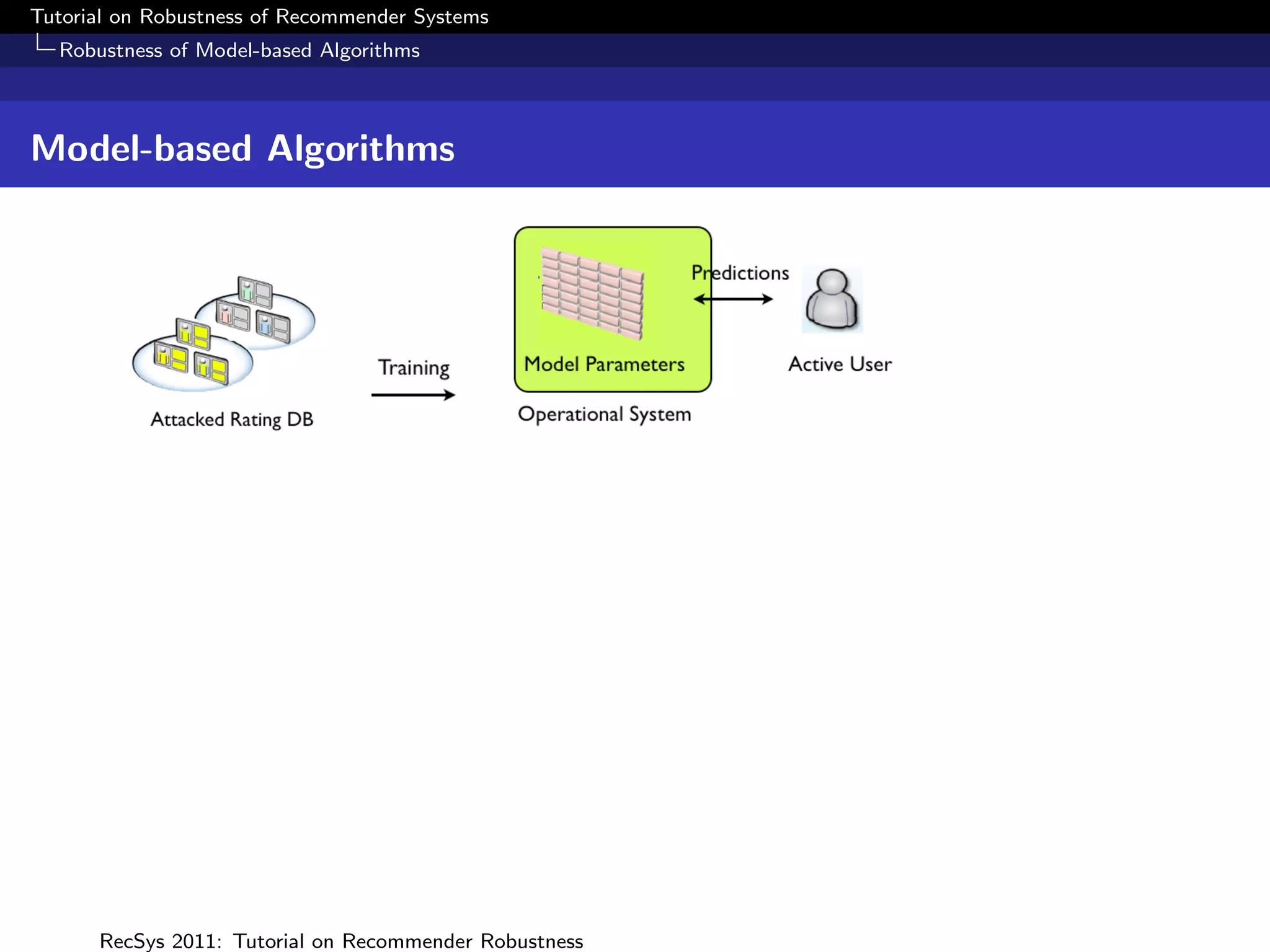
Model-based Algorithms


      RecSys 2011: Tutorial on Recommender Robustness
Tutorial on Robustness of Recommender Systems
  Robustness of Model-based Algorithms


Model-based Algorithms


      RecSys 2011: Tutorial on Recommender Robustness
Tutorial on Robustness of Recommender Systems
  Robustness of Model-based Algorithms


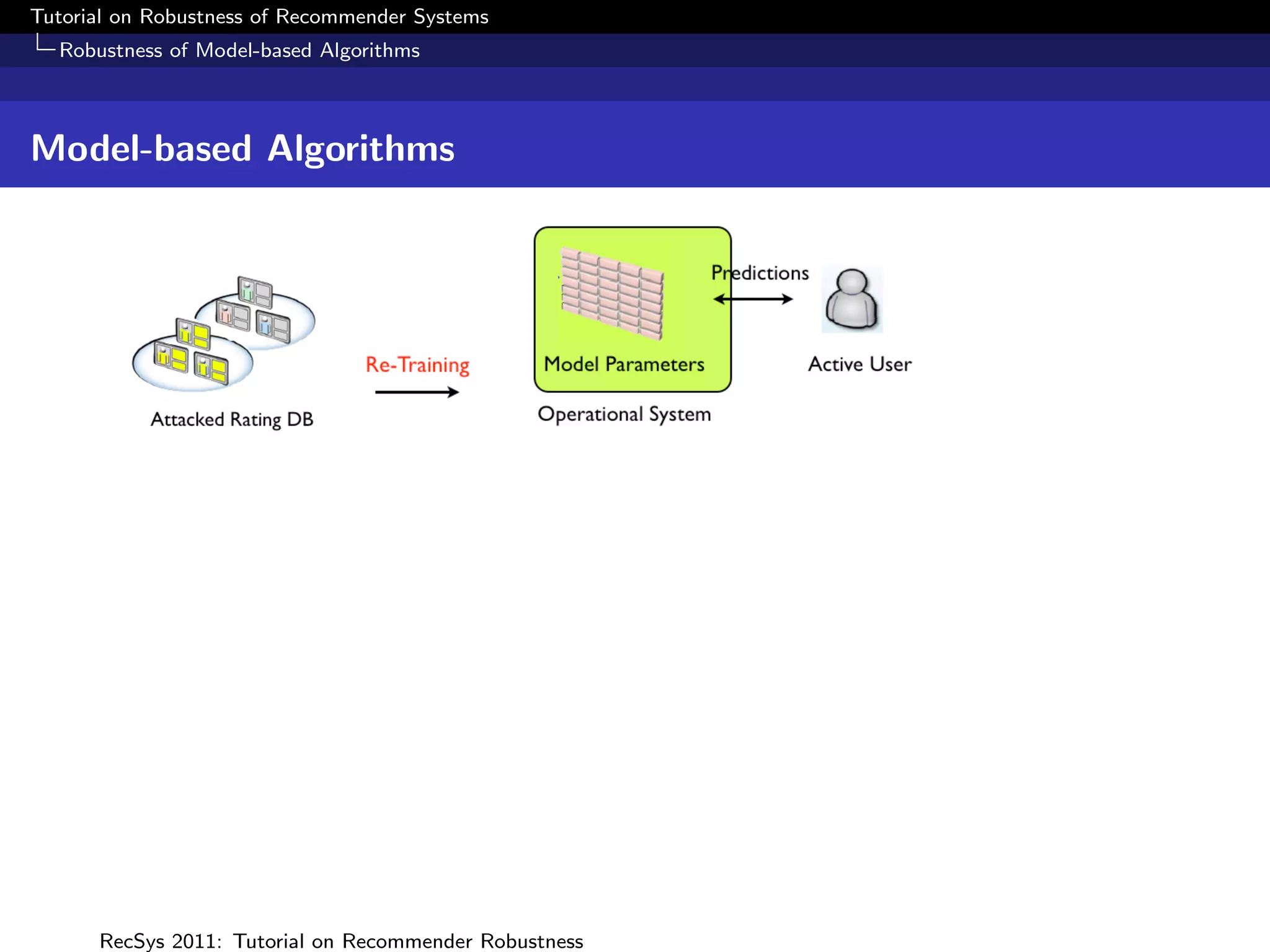
Model-based Algorithms


      RecSys 2011: Tutorial on Recommender Robustness
Tutorial on Robustness of Recommender Systems
  Robustness of Model-based Algorithms


Model-based Algorithms


      RecSys 2011: Tutorial on Recommender Robustness
Tutorial on Robustness of Recommender Systems
  Robustness of Model-based Algorithms


Model-based Algorithms


      RecSys 2011: Tutorial on Recommender Robustness
Tutorial on Robustness of Recommender Systems
  Robustness of Model-based Algorithms


Model-based Algorithms


      RecSys 2011: Tutorial on Recommender Robustness
Tutorial on Robustness of Recommender Systems
  Robustness of Model-based Algorithms


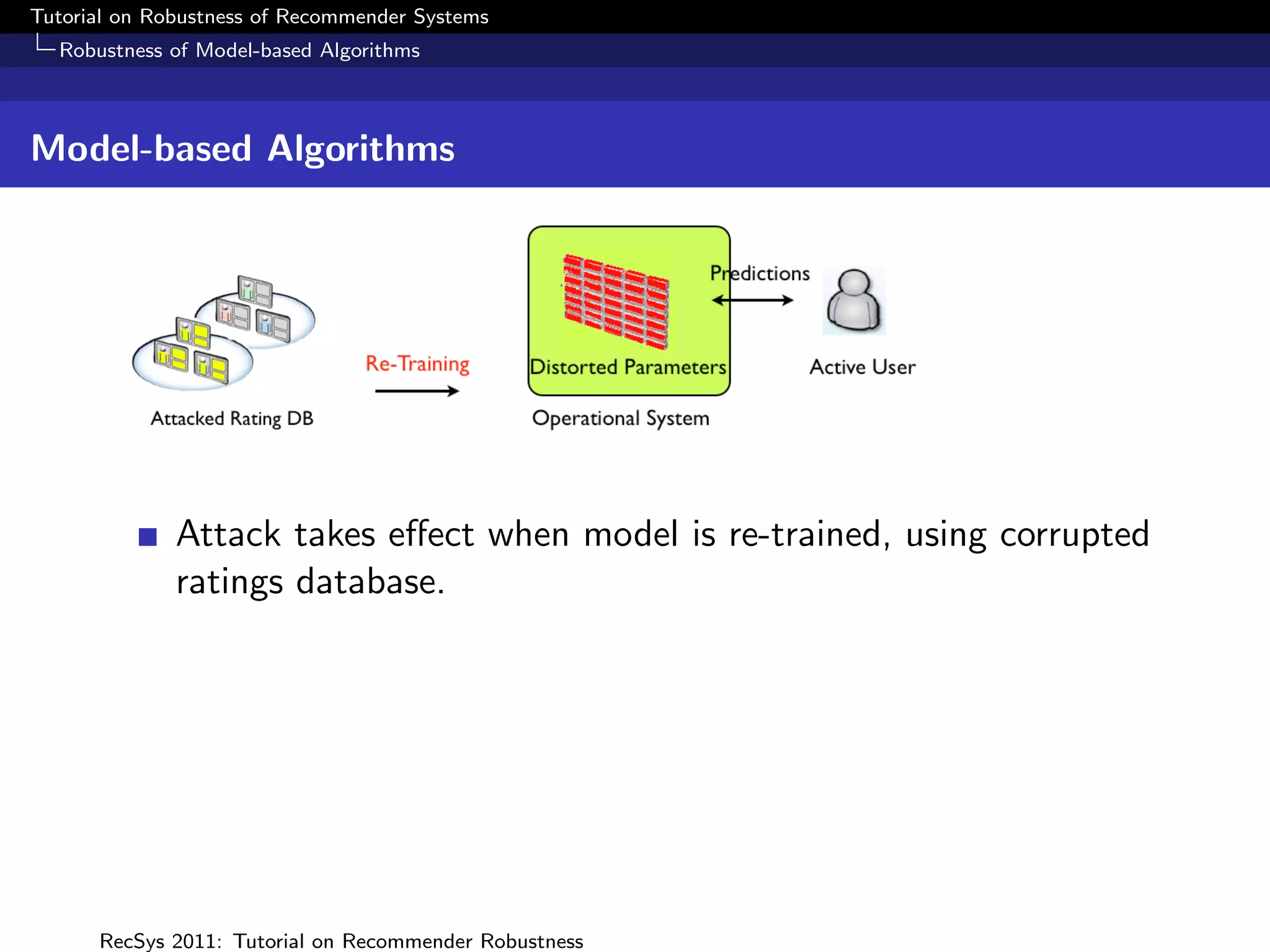
Model-based Algorithms


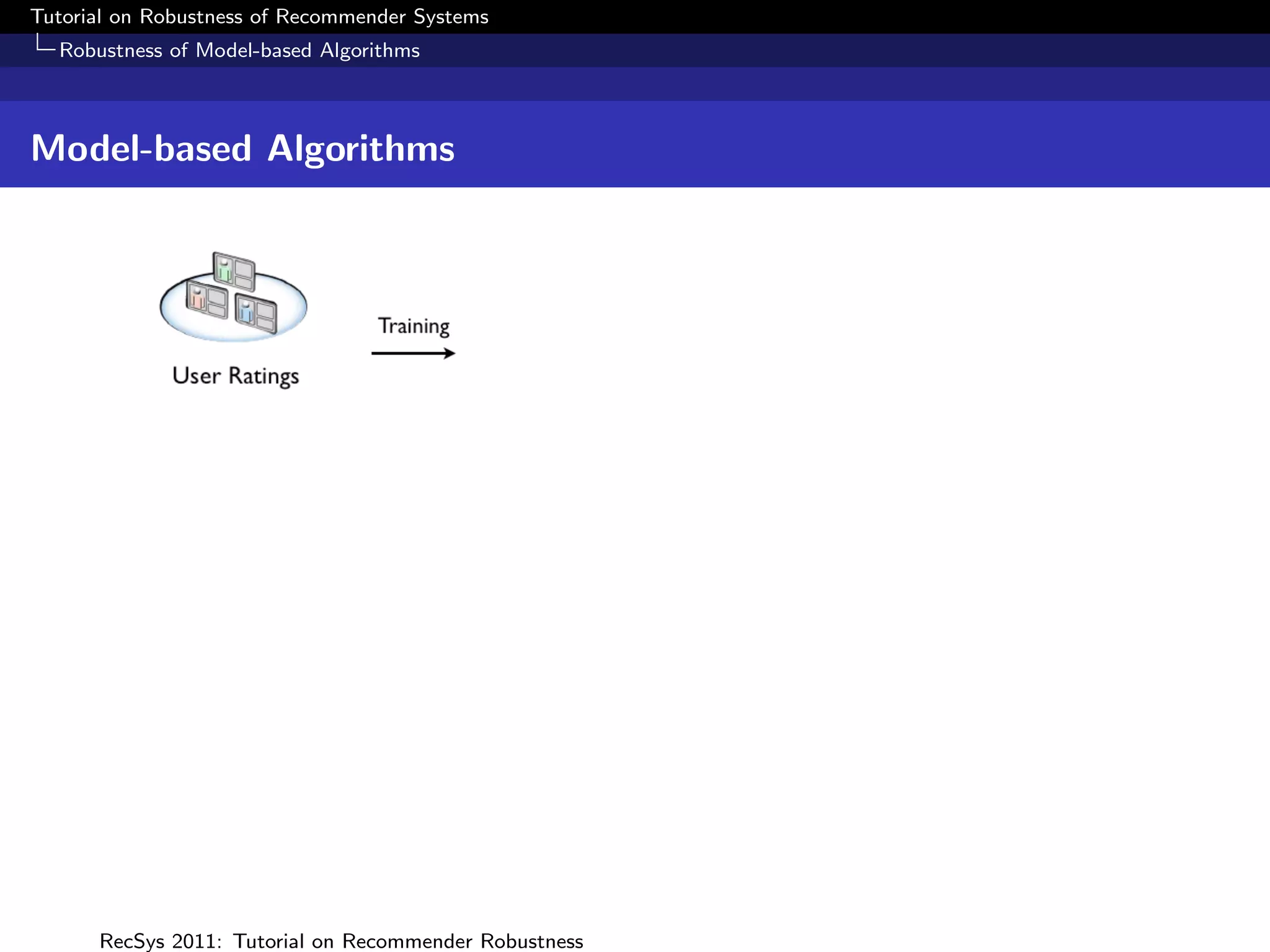
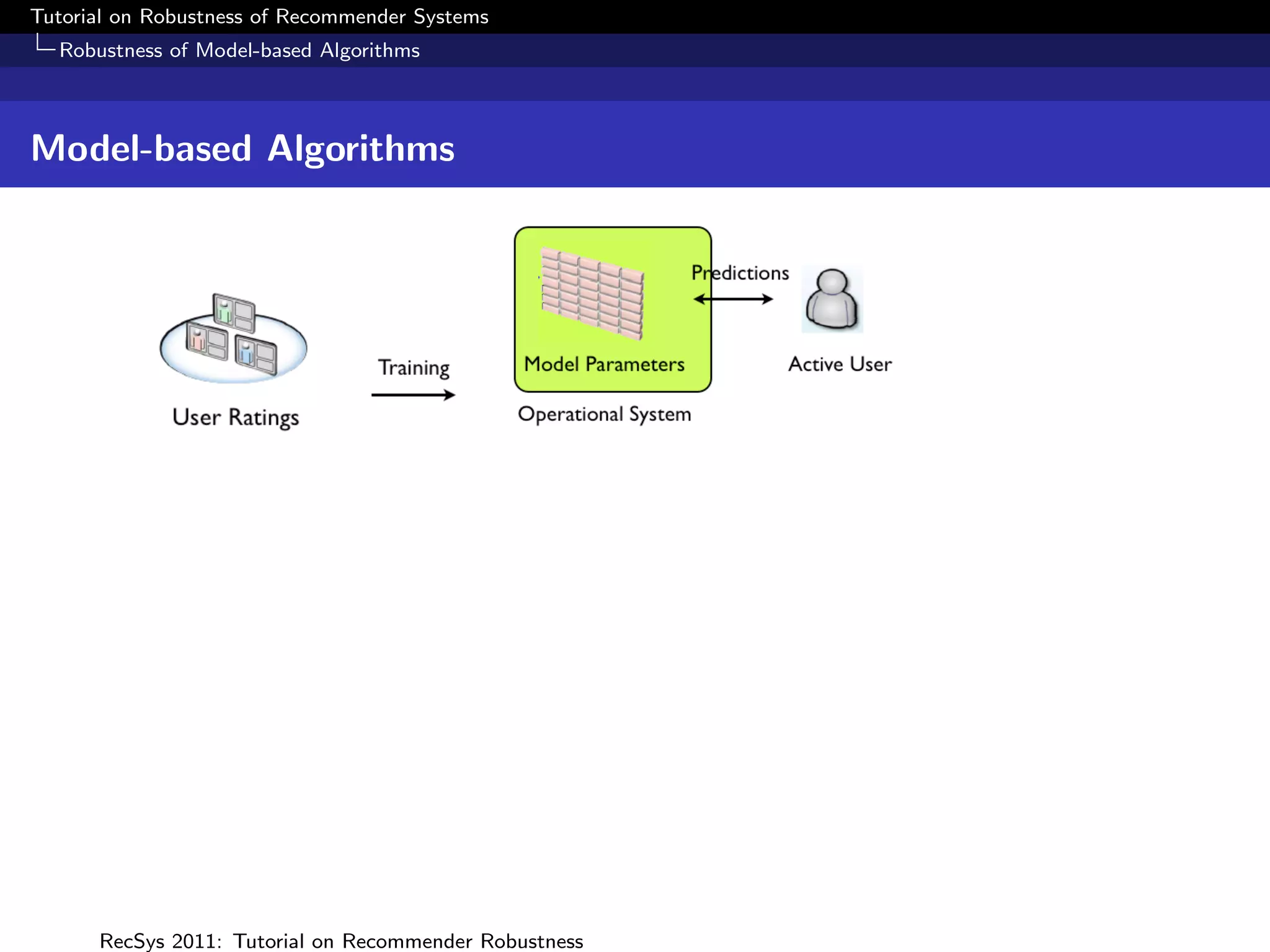
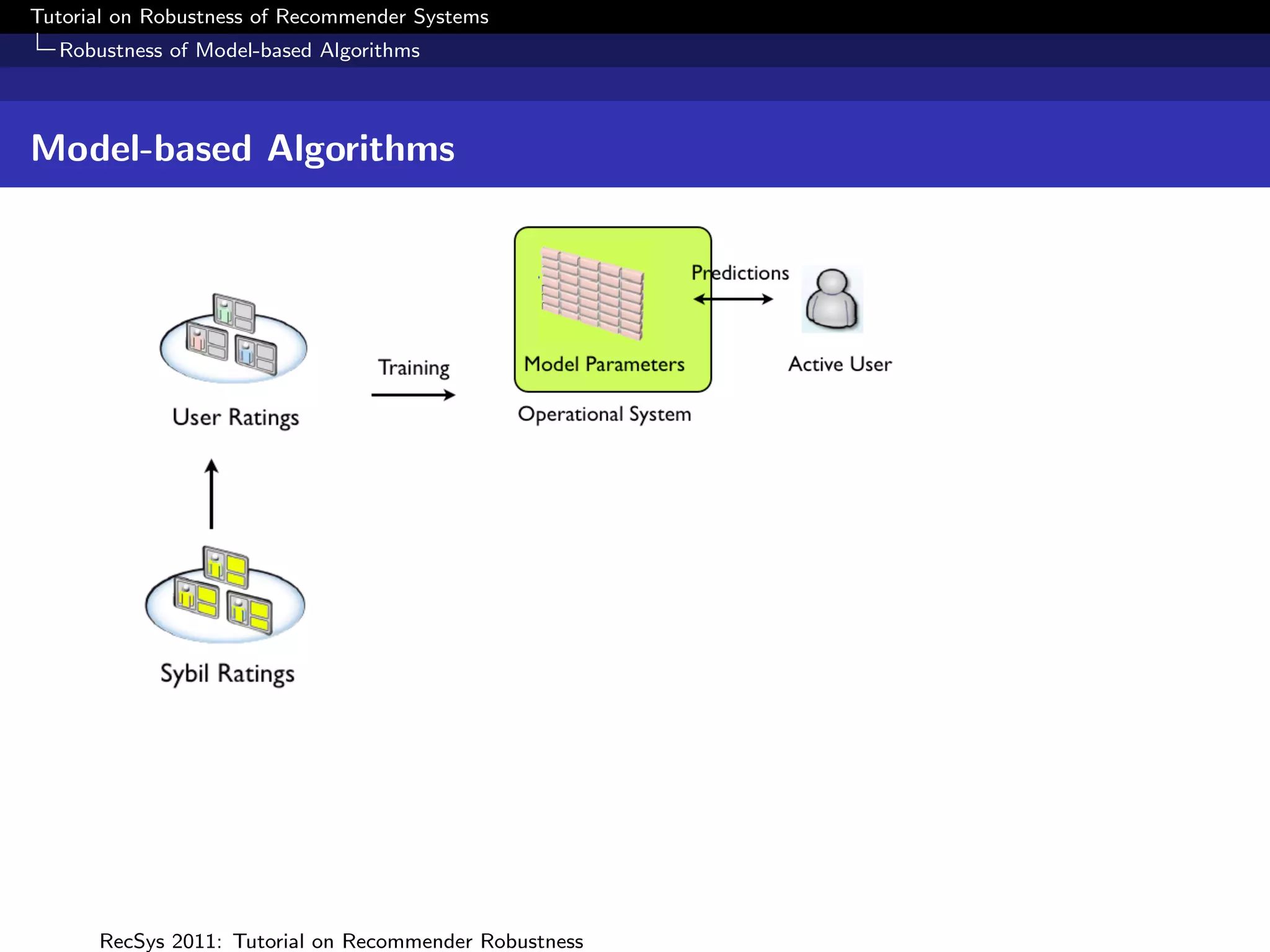
              Attack takes effect when model is re-trained, using corrupted
              ratings database.


      RecSys 2011: Tutorial on Recommender Robustness
Tutorial on Robustness of Recommender Systems
  Robustness of Model-based Algorithms


Manipulation-resistance of Model-based Algorithms

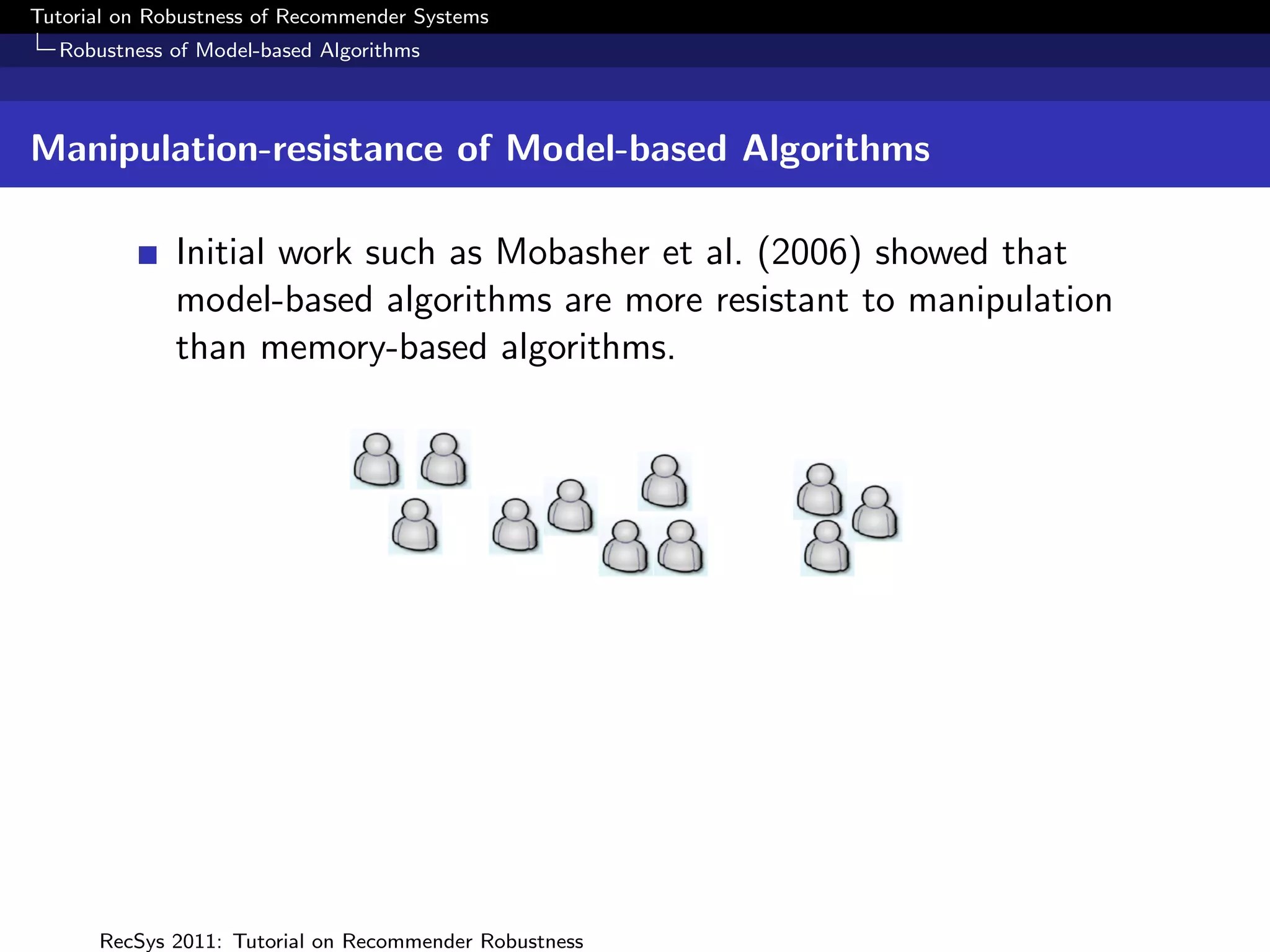
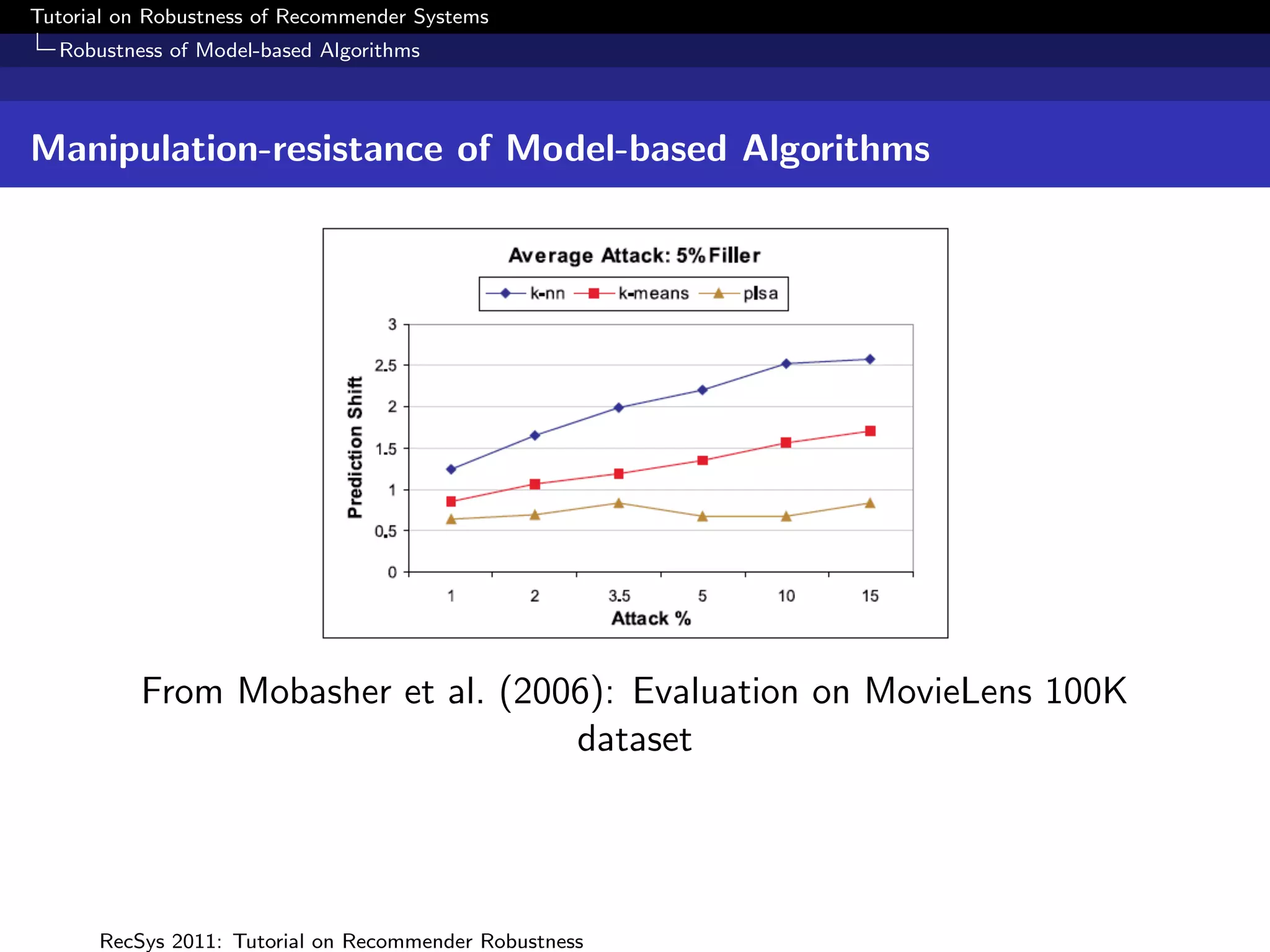
              Initial work such as Mobasher et al. (2006) showed that
              model-based algorithms are more resistant to manipulation
              than memory-based algorithms.


      RecSys 2011: Tutorial on Recommender Robustness
Tutorial on Robustness of Recommender Systems
  Robustness of Model-based Algorithms


Manipulation-resistance of Model-based Algorithms

              Initial work such as Mobasher et al. (2006) showed that
              model-based algorithms are more resistant to manipulation
              than memory-based algorithms.


      RecSys 2011: Tutorial on Recommender Robustness
Tutorial on Robustness of Recommender Systems
  Robustness of Model-based Algorithms


Manipulation-resistance of Model-based Algorithms

              Initial work such as Mobasher et al. (2006) showed that
              model-based algorithms are more resistant to manipulation
              than memory-based algorithms.


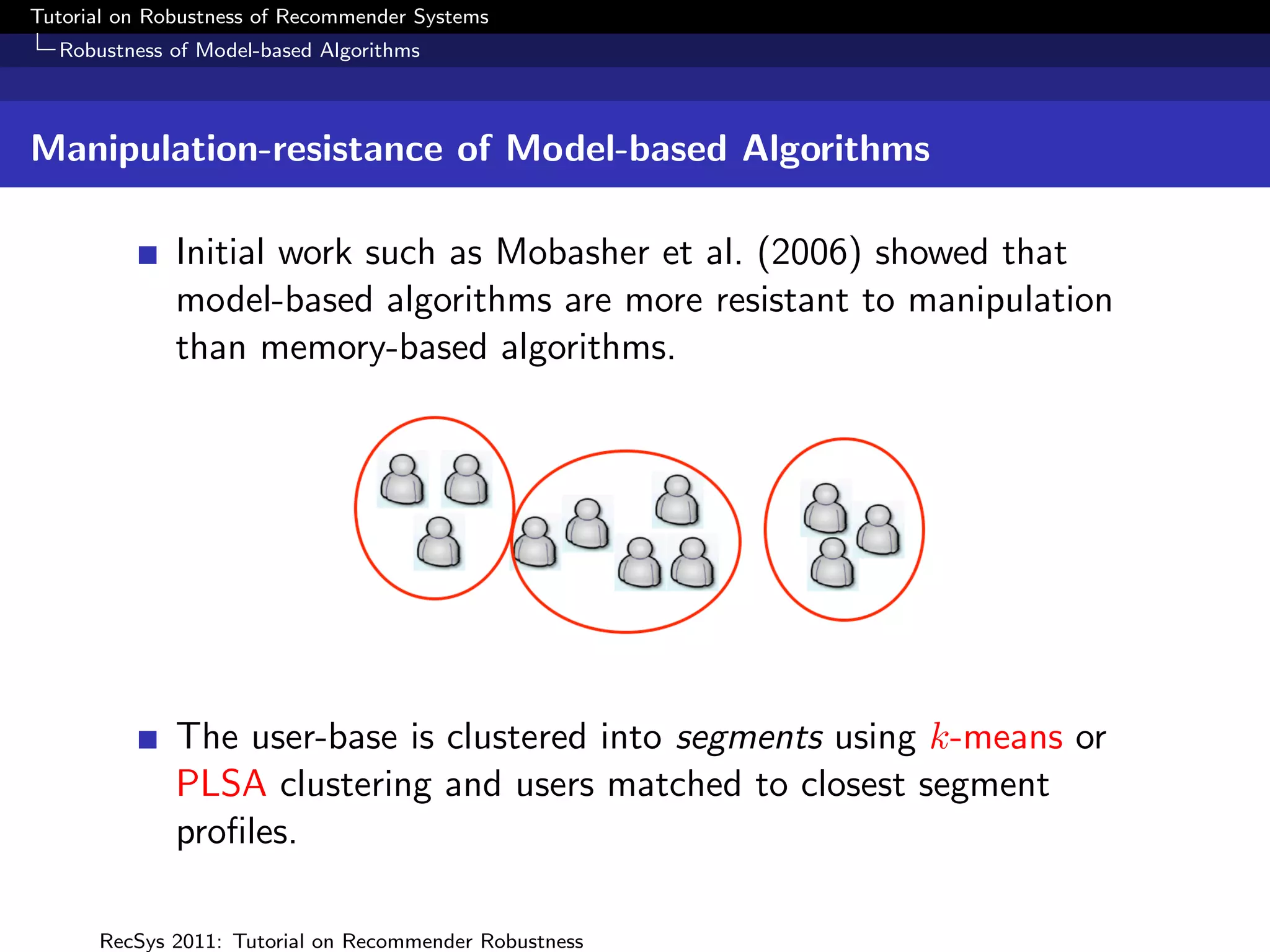
              The user-base is clustered into segments using k-means or
              PLSA clustering and users matched to closest segment
              profiles.

      RecSys 2011: Tutorial on Recommender Robustness
Tutorial on Robustness of Recommender Systems
  Robustness of Model-based Algorithms


Manipulation-resistance of Model-based Algorithms

              Initial work such as Mobasher et al. (2006) showed that
              model-based algorithms are more resistant to manipulation
              than memory-based algorithms.


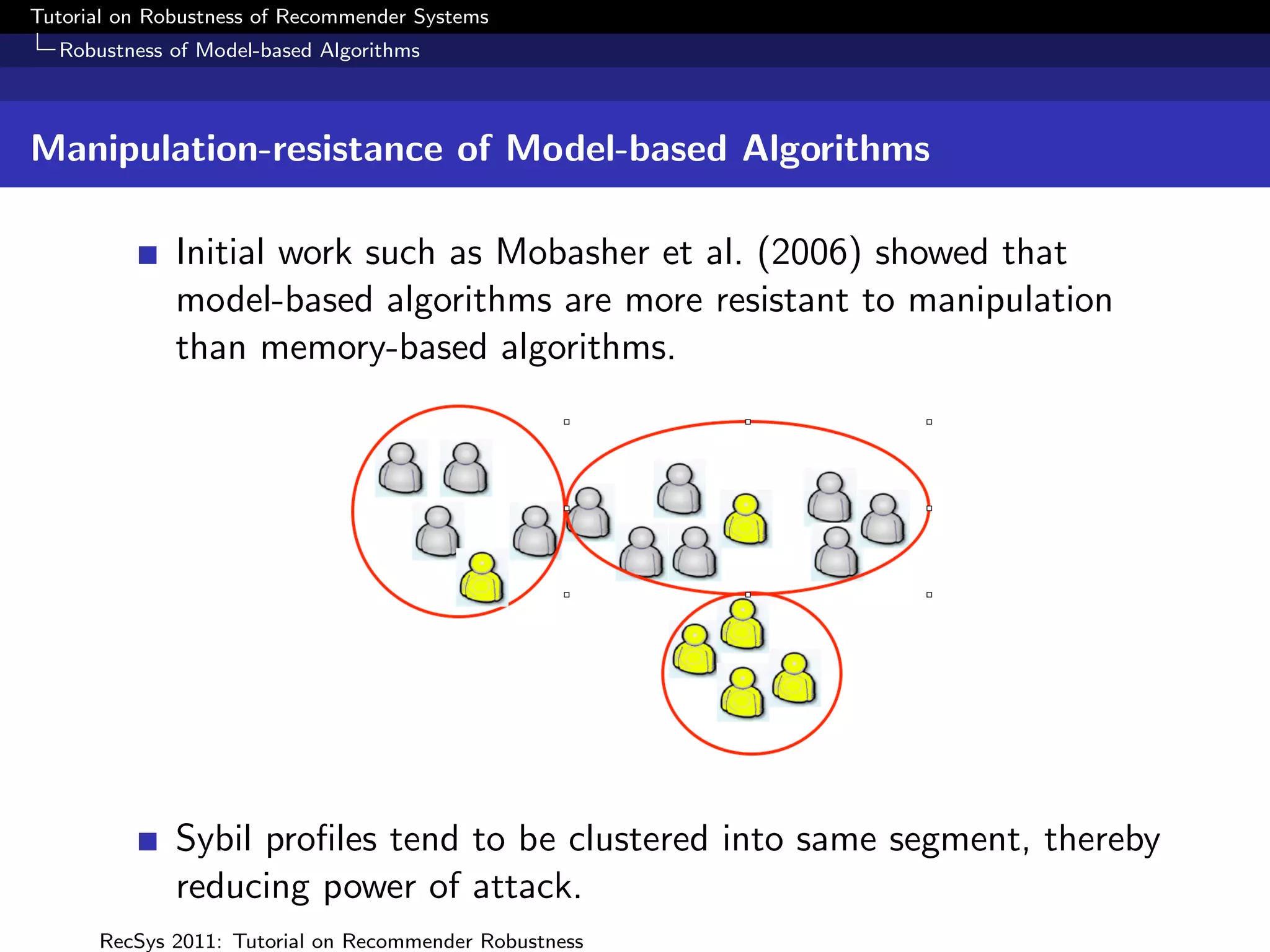
              Sybil profiles tend to be clustered into same segment, thereby
              reducing power of attack.
      RecSys 2011: Tutorial on Recommender Robustness
Tutorial on Robustness of Recommender Systems
  Robustness of Model-based Algorithms


Manipulation-resistance of Model-based Algorithms

              Initial work such as Mobasher et al. (2006) showed that
              model-based algorithms are more resistant to manipulation
              than memory-based algorithms.


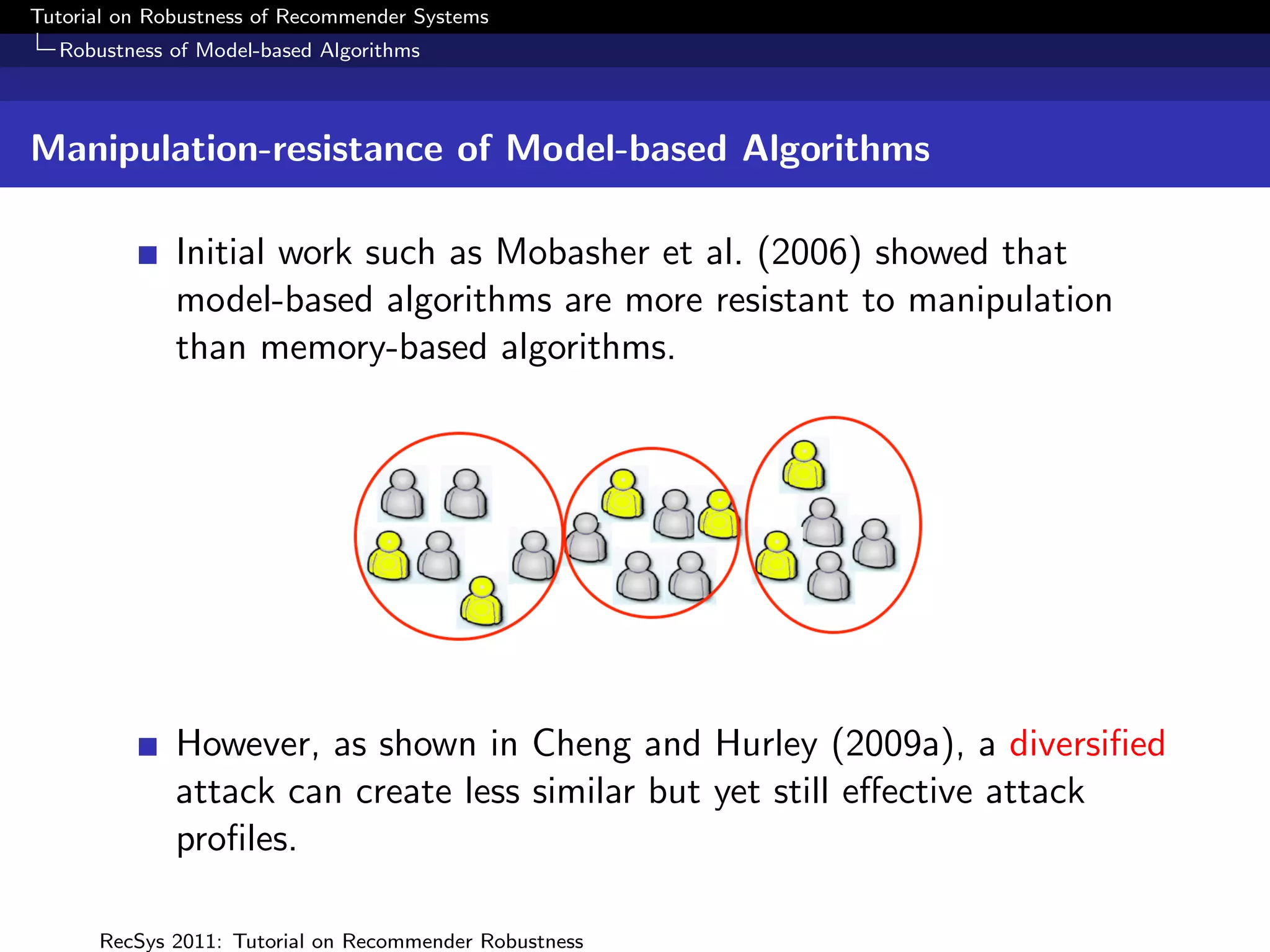
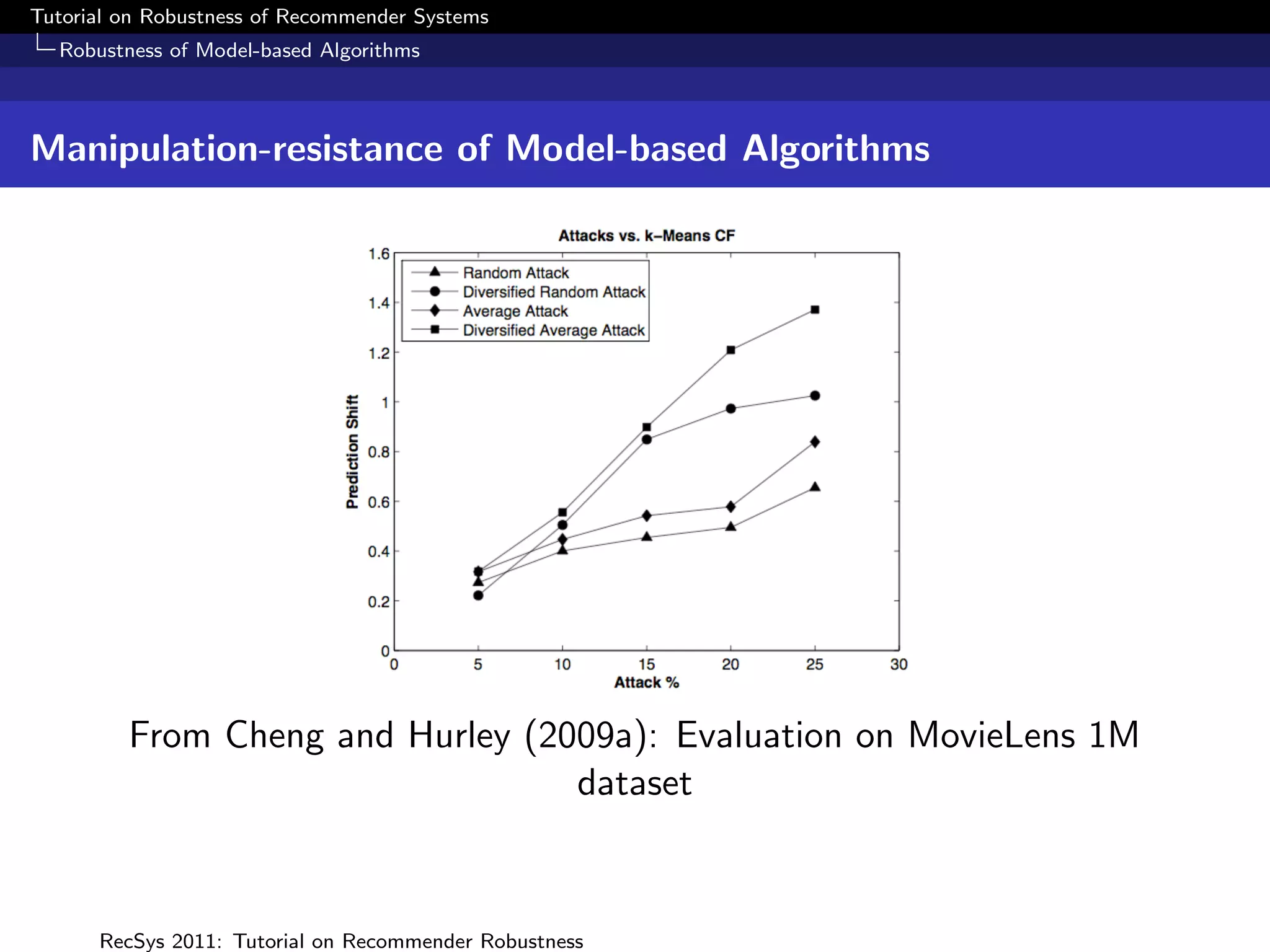
              However, as shown in Cheng and Hurley (2009a), a diversified
              attack can create less similar but yet still effective attack
              profiles.

      RecSys 2011: Tutorial on Recommender Robustness
Tutorial on Robustness of Recommender Systems
  Robustness of Model-based Algorithms


Manipulation-resistance of Model-based Algorithms


          From Mobasher et al. (2006): Evaluation on MovieLens 100K
                                   dataset


      RecSys 2011: Tutorial on Recommender Robustness
Tutorial on Robustness of Recommender Systems
  Robustness of Model-based Algorithms


Manipulation-resistance of Model-based Algorithms


         From Cheng and Hurley (2009a): Evaluation on MovieLens 1M
                                  dataset


      RecSys 2011: Tutorial on Recommender Robustness
Tutorial on Robustness of Recommender Systems
  Robustness of Model-based Algorithms


Manipulation-resistance of Matrix Factorisation


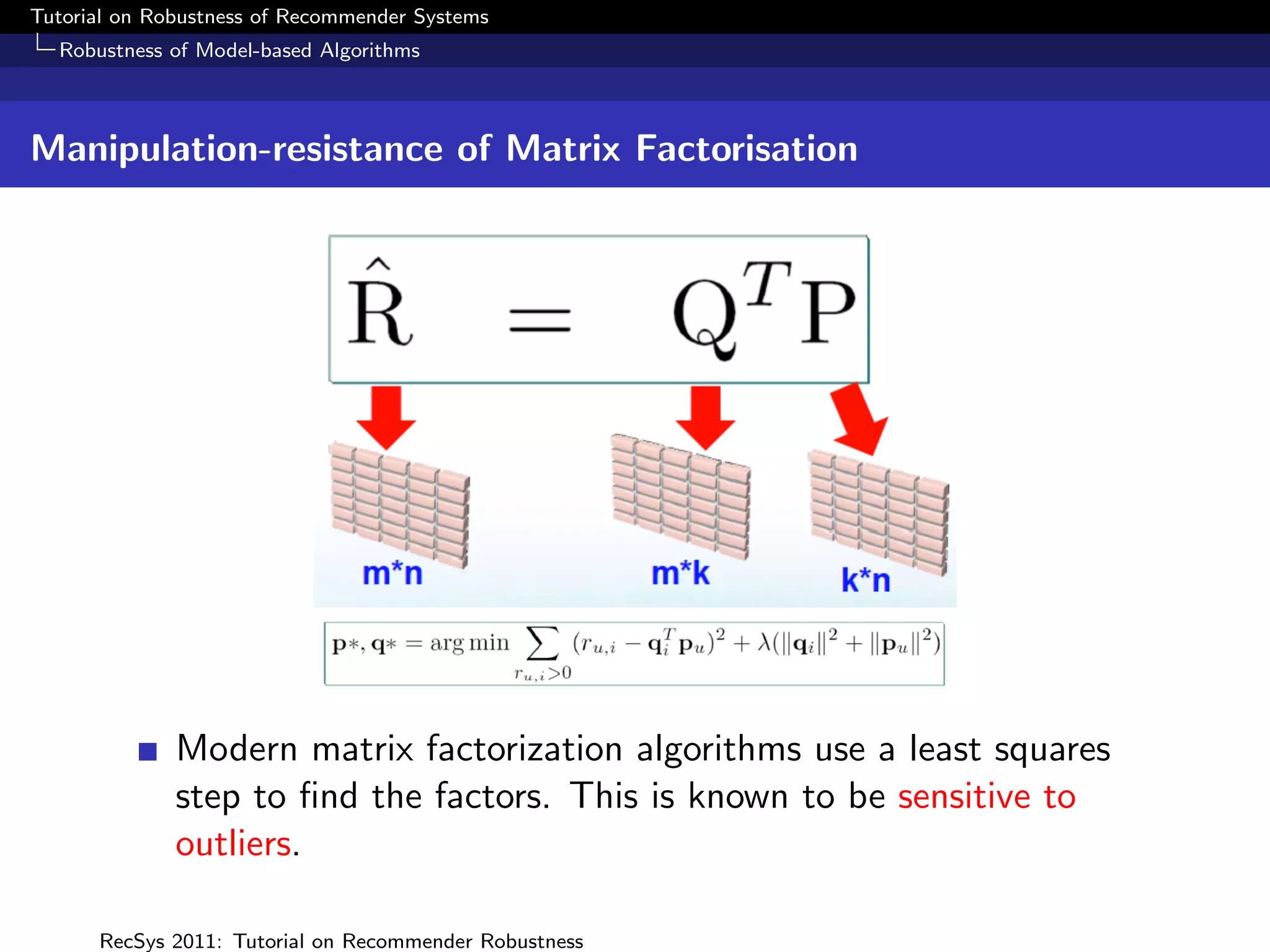
              Modern matrix factorization algorithms use a least squares
              step to find the factors. This is known to be sensitive to
              outliers.

      RecSys 2011: Tutorial on Recommender Robustness
Tutorial on Robustness of Recommender Systems
  Robustness of Model-based Algorithms


Manipulation-resistance of Matrix Factorisation


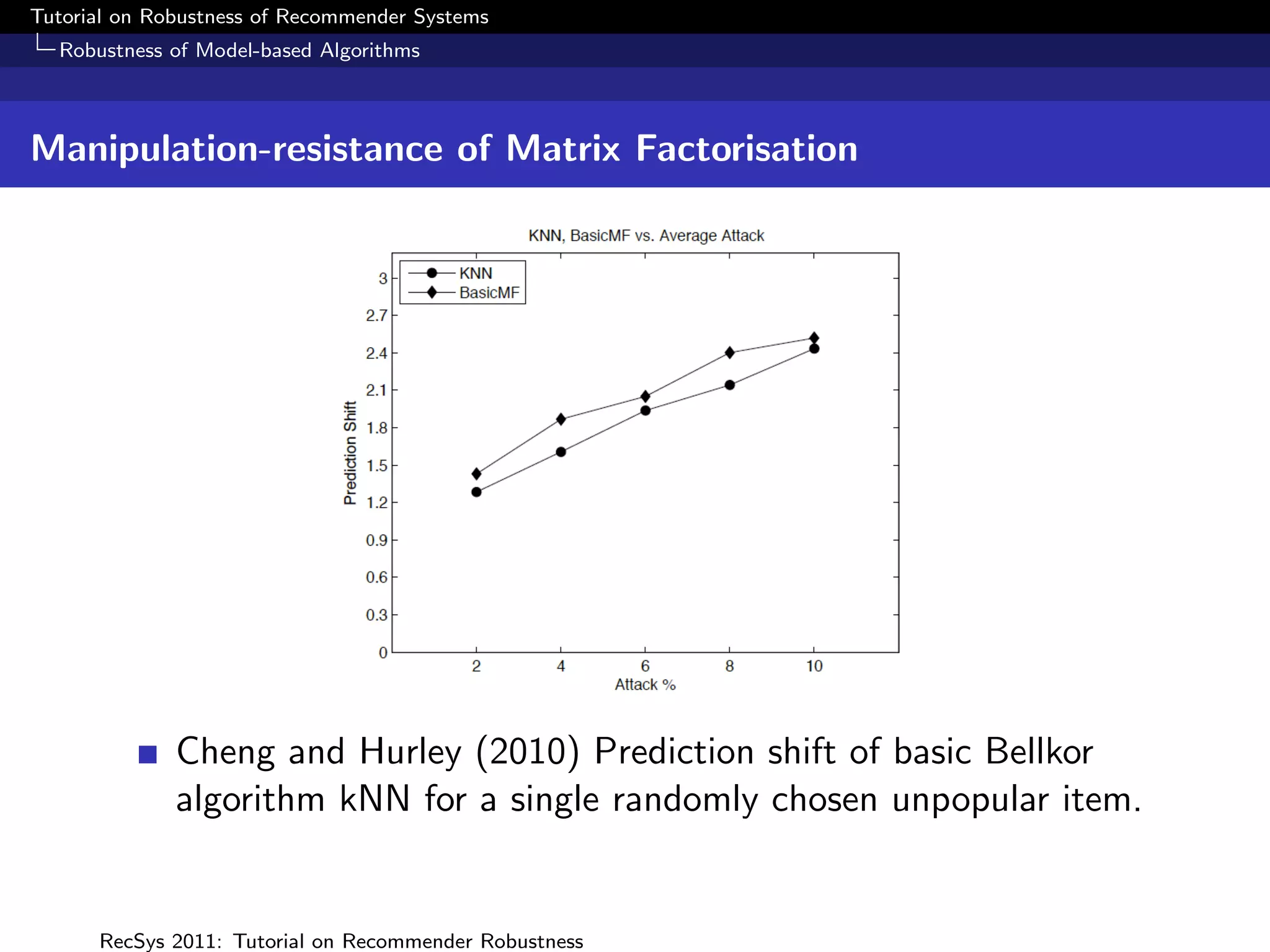
              Cheng and Hurley (2010) Prediction shift of basic Bellkor
              algorithm kNN for a single randomly chosen unpopular item.


      RecSys 2011: Tutorial on Recommender Robustness
Tutorial on Robustness of Recommender Systems
  Robustness of Model-based Algorithms


Summary of Robustness Results on Standard Algorithms

              A number of general attack strategies have been proposed
              that work effectively in particular on memory-based
              algorithms.


      RecSys 2011: Tutorial on Recommender Robustness
Tutorial on Robustness of Recommender Systems
  Robustness of Model-based Algorithms


Summary of Robustness Results on Standard Algorithms

              A number of general attack strategies have been proposed
              that work effectively in particular on memory-based
              algorithms.
              Standard attacks are generally detectable:


      RecSys 2011: Tutorial on Recommender Robustness
Tutorial on Robustness of Recommender Systems
  Robustness of Model-based Algorithms


Summary of Robustness Results on Standard Algorithms

              A number of general attack strategies have been proposed
              that work effectively in particular on memory-based
              algorithms.
              Standard attacks are generally detectable:
                     Cost effectiveness implies that a sybil profile should be
                     unusually influential.
              Special purpose (informed) attacks can be tailored towards
              particular CF algorithms
                     e.g. a high diversity attack proved effective against the
                     k-means clustering algorithm.
              Sybil profiles can be obfuscated to make them less detectable
                     Selection of filler items is Achille’s heal of standard average
                     attack, but also explains its power.
                     Obfuscation reduces the effectiveness of attacks but
                     memory-based algorithms are still vulnerable.
      RecSys 2011: Tutorial on Recommender Robustness
Tutorial on Robustness of Recommender Systems
  Attack Resistant Recommendation Algorithms


Outline

       1 What is Robustness?
             Profile Injection Attacks
             Relevance of Robustness
             Measuring Robustness
       2   Attack Strategies
             Attacking kNN Algorithms
       3   Attack Detection
             PCA-based Attack Detection
             Statistical Attack Detection
             Cost-Benefit Analysis
       4   Robustness of Model-based Algorithms
       5   Attack Resistant Recommendation Algorithms
             Provably Manipulation Resistant Algorithms
       6   Stability, Trust and Privacy
      RecSys 2011: Tutorial on Recommender Robustness
Tutorial on Robustness of Recommender Systems
  Attack Resistant Recommendation Algorithms


VarSelectSVD

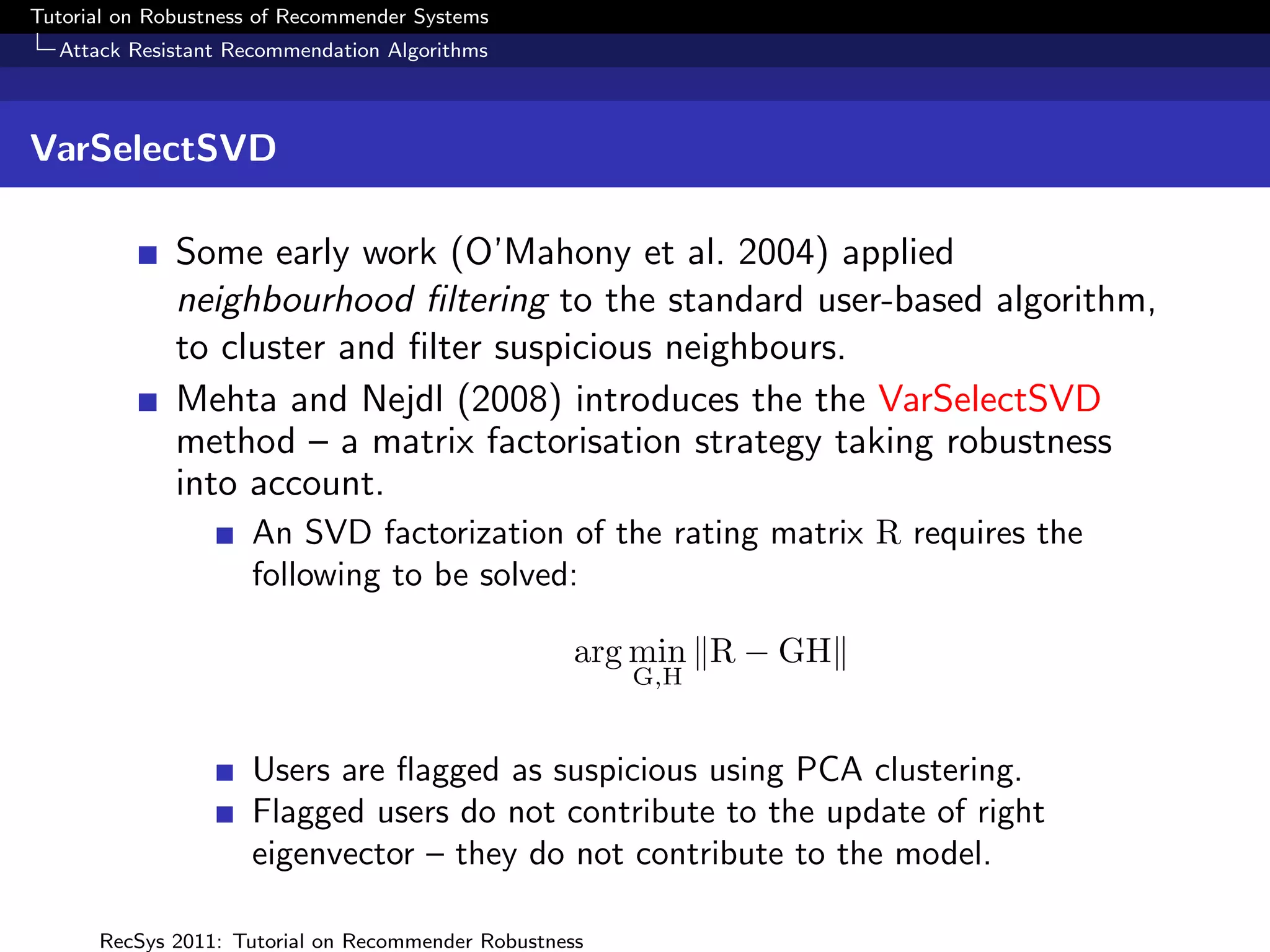
              Some early work (O’Mahony et al. 2004) applied
              neighbourhood filtering to the standard user-based algorithm,
              to cluster and filter suspicious neighbours.


      RecSys 2011: Tutorial on Recommender Robustness
Tutorial on Robustness of Recommender Systems
  Attack Resistant Recommendation Algorithms


VarSelectSVD

              Some early work (O’Mahony et al. 2004) applied
              neighbourhood filtering to the standard user-based algorithm,
              to cluster and filter suspicious neighbours.
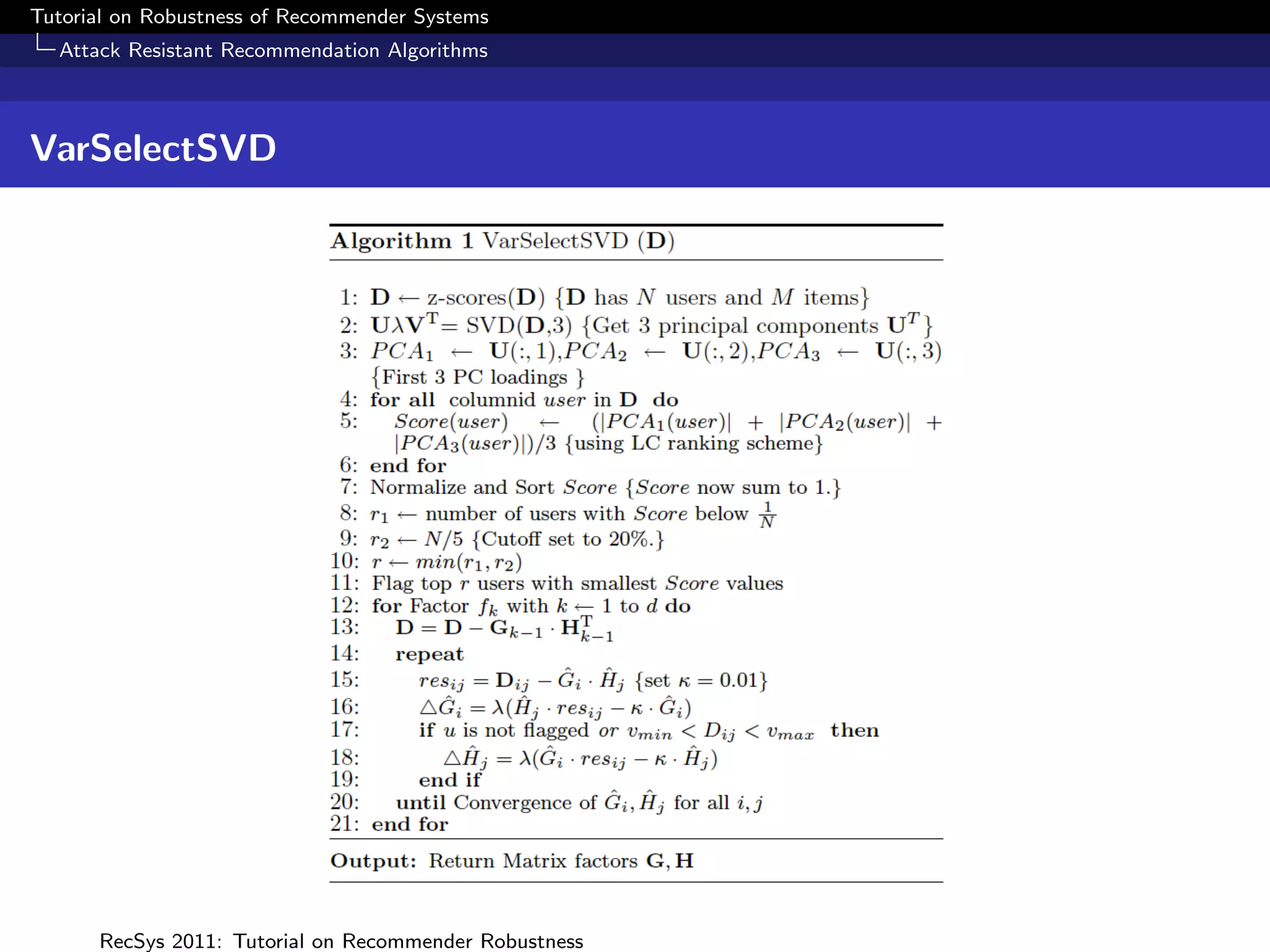
              Mehta and Nejdl (2008) introduces the the VarSelectSVD
              method – a matrix factorisation strategy taking robustness
              into account.


      RecSys 2011: Tutorial on Recommender Robustness
Tutorial on Robustness of Recommender Systems
  Attack Resistant Recommendation Algorithms


VarSelectSVD

              Some early work (O’Mahony et al. 2004) applied
              neighbourhood filtering to the standard user-based algorithm,
              to cluster and filter suspicious neighbours.
              Mehta and Nejdl (2008) introduces the the VarSelectSVD
              method – a matrix factorisation strategy taking robustness
              into account.
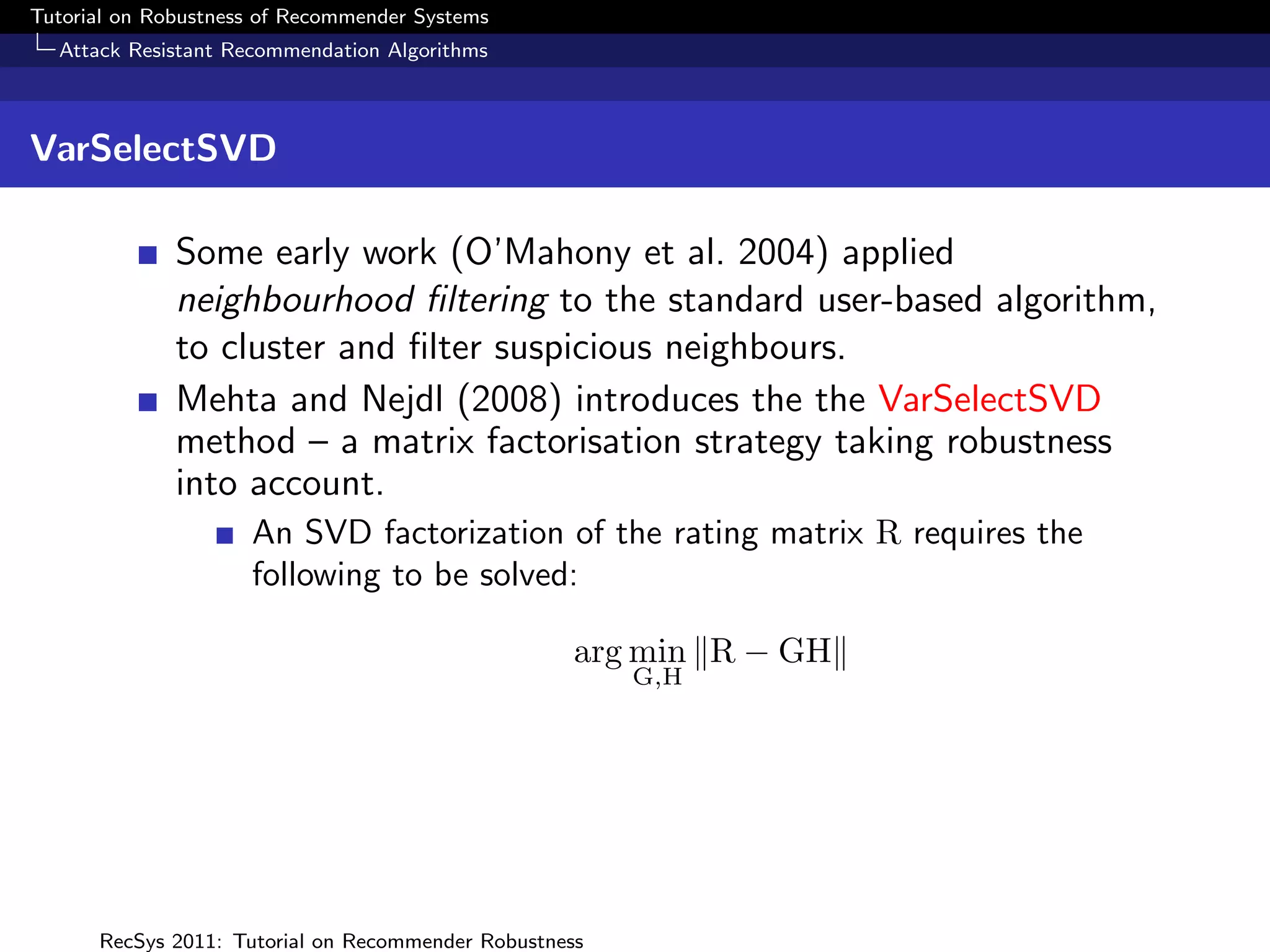
                     An SVD factorization of the rating matrix R requires the
                     following to be solved:

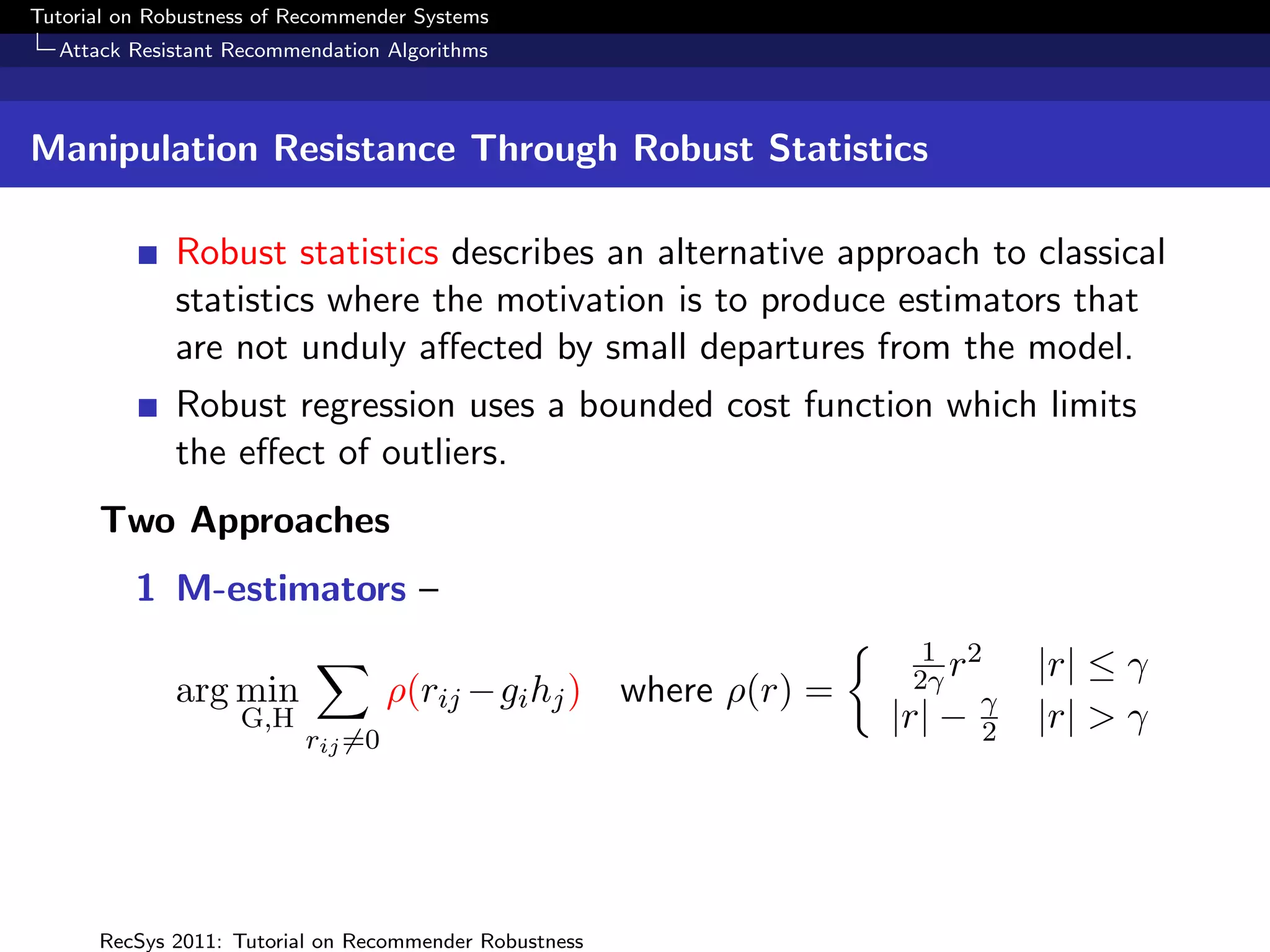
                                                    arg min R − GH
                                                        G,H


      RecSys 2011: Tutorial on Recommender Robustness
Tutorial on Robustness of Recommender Systems
  Attack Resistant Recommendation Algorithms


VarSelectSVD

              Some early work (O’Mahony et al. 2004) applied
              neighbourhood filtering to the standard user-based algorithm,
              to cluster and filter suspicious neighbours.
              Mehta and Nejdl (2008) introduces the the VarSelectSVD
              method – a matrix factorisation strategy taking robustness
              into account.
                     An SVD factorization of the rating matrix R requires the
                     following to be solved:

                                                    arg min R − GH
                                                        G,H


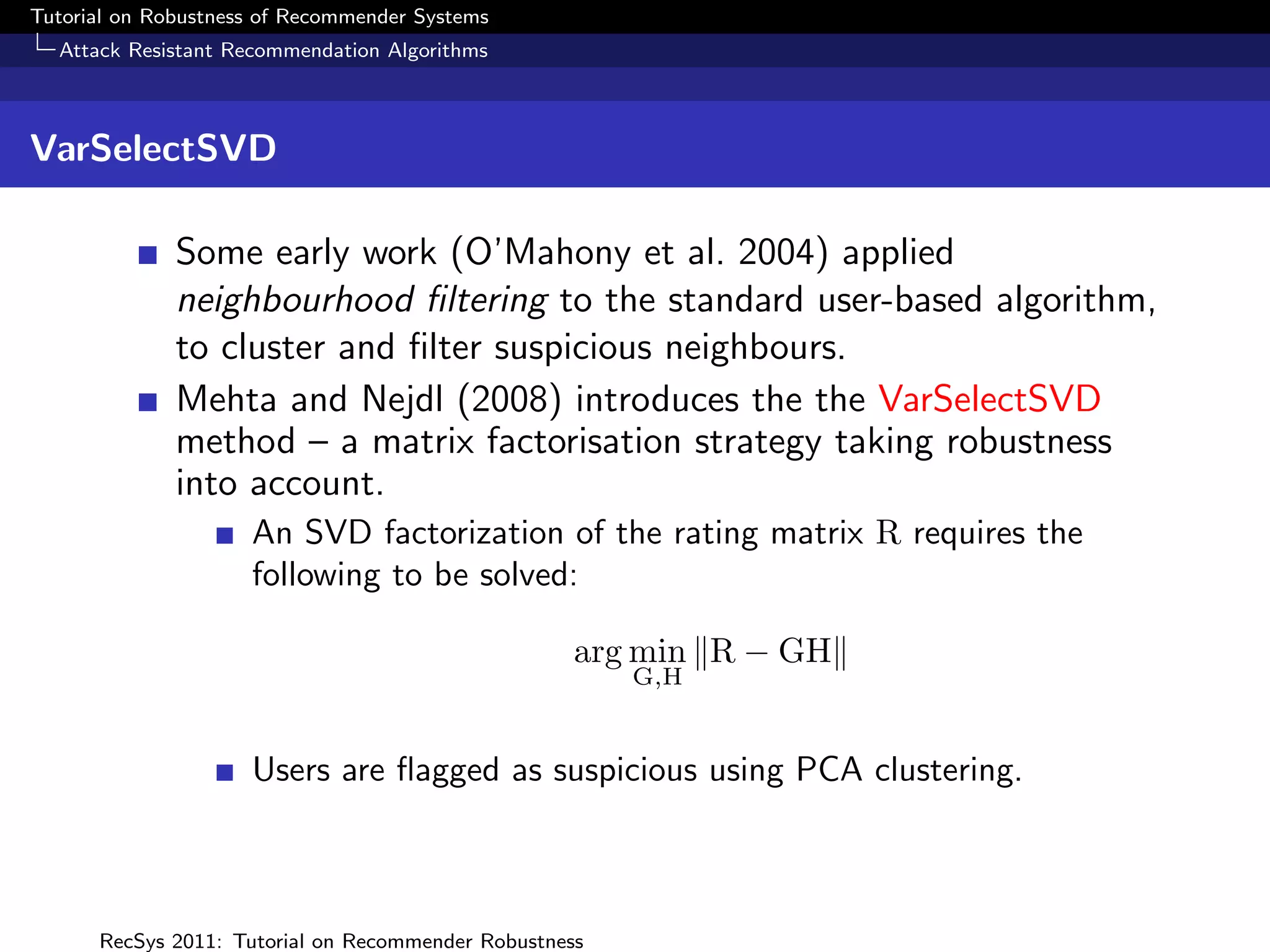
                     Users are flagged as suspicious using PCA clustering.


      RecSys 2011: Tutorial on Recommender Robustness
Tutorial on Robustness of Recommender Systems
  Attack Resistant Recommendation Algorithms


VarSelectSVD

              Some early work (O’Mahony et al. 2004) applied
              neighbourhood filtering to the standard user-based algorithm,
              to cluster and filter suspicious neighbours.
              Mehta and Nejdl (2008) introduces the the VarSelectSVD
              method – a matrix factorisation strategy taking robustness
              into account.
                     An SVD factorization of the rating matrix R requires the
                     following to be solved:

                                                    arg min R − GH
                                                        G,H


                     Users are flagged as suspicious using PCA clustering.
                     Flagged users do not contribute to the update of right
                     eigenvector – they do not contribute to the model.

      RecSys 2011: Tutorial on Recommender Robustness
Tutorial on Robustness of Recommender Systems
  Attack Resistant Recommendation Algorithms


VarSelectSVD


      RecSys 2011: Tutorial on Recommender Robustness
Tutorial on Robustness of Recommender Systems
  Attack Resistant Recommendation Algorithms


VarSelectSVD Results


              MAE, Prediction Shift and Hit Ratio for 5% Average Attack,
              7% Filler on Movielens 1M


      RecSys 2011: Tutorial on Recommender Robustness
Tutorial on Robustness of Recommender Systems
  Attack Resistant Recommendation Algorithms


Manipulation Resistance Through Robust Statistics

              Robust statistics describes an alternative approach to classical
              statistics where the motivation is to produce estimators that
              are not unduly affected by small departures from the model.
              Robust regression uses a bounded cost function which limits
              the effect of outliers.
      Two Approaches


      RecSys 2011: Tutorial on Recommender Robustness
Tutorial on Robustness of Recommender Systems
  Attack Resistant Recommendation Algorithms


Manipulation Resistance Through Robust Statistics

              Robust statistics describes an alternative approach to classical
              statistics where the motivation is to produce estimators that
              are not unduly affected by small departures from the model.
              Robust regression uses a bounded cost function which limits
              the effect of outliers.
      Two Approaches
          1 M-estimators –
                                                                     1 2
                                                                    2γ r     |r| ≤ γ
              arg min               ρ(rij −gi hj ) where ρ(r) =
                    G,H                                           |r| − γ2   |r| > γ
                           rij =0


      RecSys 2011: Tutorial on Recommender Robustness
Tutorial on Robustness of Recommender Systems
  Attack Resistant Recommendation Algorithms


Manipulation Resistance Through Robust Statistics

              Robust statistics describes an alternative approach to classical
              statistics where the motivation is to produce estimators that
              are not unduly affected by small departures from the model.
              Robust regression uses a bounded cost function which limits
              the effect of outliers.
      Two Approaches
          2 Least Trimmed Squares –
                                        h
                         arg min            e2
                                             (i)    where e2 ≤ e2 ≤ · · · ≤ e2
                                                           (1)  (2)          (n)
                                G,H
                                      i=1


      RecSys 2011: Tutorial on Recommender Robustness
Tutorial on Robustness of Recommender Systems
  Attack Resistant Recommendation Algorithms


Robust Statistics Results on Bellkor Method


      RecSys 2011: Tutorial on Recommender Robustness
Tutorial on Robustness of Recommender Systems
  Attack Resistant Recommendation Algorithms
     Provably Manipulation Resistant Algorithms


Outline

       1 What is Robustness?
             Profile Injection Attacks
             Relevance of Robustness
             Measuring Robustness
       2   Attack Strategies
             Attacking kNN Algorithms
       3   Attack Detection
             PCA-based Attack Detection
             Statistical Attack Detection
             Cost-Benefit Analysis
       4   Robustness of Model-based Algorithms
       5   Attack Resistant Recommendation Algorithms
             Provably Manipulation Resistant Algorithms
       6   Stability, Trust and Privacy
      RecSys 2011: Tutorial on Recommender Robustness
Tutorial on Robustness of Recommender Systems
  Attack Resistant Recommendation Algorithms
     Provably Manipulation Resistant Algorithms


The Influence Limiter (Resnick and Sami 2007)

              Output of recommendation system
              qj passes through an
              influence-limiting process to
              produce a modified output qj .
                                          ˜
              qj is a weighted average of qj−1
              ˜                           ˜
              and qj
              The weighting depends on the
              reputation that user j has
              accumulated with respect to the
              target.


      RecSys 2011: Tutorial on Recommender Robustness
Tutorial on Robustness of Recommender Systems
  Attack Resistant Recommendation Algorithms
     Provably Manipulation Resistant Algorithms


The Influence Limiter (Resnick and Sami 2007)

              A scoring function assigns
              reputation to j based on whether
              or not the target actually likes the
              item.
              Tuned so that honest users can
              reach full credibility after O(log n)
              steps.
              The main result states that the
              total impact of n sybils in terms of
              performance reduction is bounded
              by −neλ .


      RecSys 2011: Tutorial on Recommender Robustness
Tutorial on Robustness of Recommender Systems
  Attack Resistant Recommendation Algorithms
     Provably Manipulation Resistant Algorithms


Yan and Roy (2009)’s Manipulation Robust Algorithm

              A class of CF algorithms – which the authors’ call linear CF
              algorithms – is presented in which the manipulation
              distortion is bounded above by
                                                        1 1
                                                        n 1−r   .

              where r is the fraction of the data that is generated by
              manipulators and n is the number of products that have
              already been rated by a user whose future ratings are to be
              predicted.
                      “Suppose a CF system that accepts binary ratings predicts
                      future ratings correctly 80% of the time in the absence of
                      manipulation. If 10% of all ratings are provided by
                      manipulators, according to our bound, the system can maintain
                      a 75% rate of correct predictions by requiring each new user to
                      rate at least 21 products before receiving recommendations.”
      RecSys 2011: Tutorial on Recommender Robustness
Tutorial on Robustness of Recommender Systems
  Attack Resistant Recommendation Algorithms
     Provably Manipulation Resistant Algorithms


Yan and Roy (2009)’s Manipulation Robust Algorithm

              Let r ∈ L be a rating in the label space.
              Let ν be a permutation of the items such that νn is the nth
              item rated by an active user, a.
              Let rn−1 be the active user’s profile after rating n − 1 items.
                   a
              Then a CF algorithm may be described as


      RecSys 2011: Tutorial on Recommender Robustness
Tutorial on Robustness of Recommender Systems
  Attack Resistant Recommendation Algorithms
     Provably Manipulation Resistant Algorithms


Yan and Roy (2009)’s Manipulation Robust Algorithm

              Let r ∈ L be a rating in the label space.
              Let ν be a permutation of the items such that νn is the nth
              item rated by an active user, a.
              Let rn−1 be the active user’s profile after rating n − 1 items.
                   a
              Then a CF algorithm may be described as

                                             P (ra,νn = r|rn−1 , R, ν)
                                                           a


      RecSys 2011: Tutorial on Recommender Robustness
Tutorial on Robustness of Recommender Systems
  Attack Resistant Recommendation Algorithms
     Provably Manipulation Resistant Algorithms


Yan and Roy (2009)’s Manipulation Robust Algorithm

              Let r ∈ L be a rating in the label space.
              Let ν be a permutation of the items such that νn is the nth
              item rated by an active user, a.
              Let rn−1 be the active user’s profile after rating n − 1 items.
                   a
              Then a CF algorithm may be described as

                                             P (ra,νn = r|rn−1 , R, ν)
                                                           a


                      A PMF over the rating that the active user gives for the νn
                      item.


      RecSys 2011: Tutorial on Recommender Robustness
Tutorial on Robustness of Recommender Systems
  Attack Resistant Recommendation Algorithms
     Provably Manipulation Resistant Algorithms


Yan and Roy (2009)’s Manipulation Robust Algorithm

              Let r ∈ L be a rating in the label space.
              Let ν be a permutation of the items such that νn is the nth
              item rated by an active user, a.
              Let rn−1 be the active user’s profile after rating n − 1 items.
                   a
              Then a CF algorithm may be described as

                                             P (ra,νn = r|rn−1 , R, ν)
                                                           a


                      Depending on the active user’s current profile


      RecSys 2011: Tutorial on Recommender Robustness
Tutorial on Robustness of Recommender Systems
  Attack Resistant Recommendation Algorithms
     Provably Manipulation Resistant Algorithms


Yan and Roy (2009)’s Manipulation Robust Algorithm

              Let r ∈ L be a rating in the label space.
              Let ν be a permutation of the items such that νn is the nth
              item rated by an active user, a.
              Let rn−1 be the active user’s profile after rating n − 1 items.
                   a
              Then a CF algorithm may be described as

                                             P (ra,νn = r|rn−1 , R, ν)
                                                           a


                      the training set, R


      RecSys 2011: Tutorial on Recommender Robustness
Tutorial on Robustness of Recommender Systems
  Attack Resistant Recommendation Algorithms
     Provably Manipulation Resistant Algorithms


Yan and Roy (2009)’s Manipulation Robust Algorithm

              Let r ∈ L be a rating in the label space.
              Let ν be a permutation of the items such that νn is the nth
              item rated by an active user, a.
              Let rn−1 be the active user’s profile after rating n − 1 items.
                   a
              Then a CF algorithm may be described as

                                             P (ra,νn = r|rn−1 , R, ν)
                                                           a


                      the order in which the user rates items.

      RecSys 2011: Tutorial on Recommender Robustness
Tutorial on Robustness of Recommender Systems
  Attack Resistant Recommendation Algorithms
     Provably Manipulation Resistant Algorithms


Yan and Roy (2009)’s Manipulation Robust Algorithm

              A probabilistic CF algorithm predicts independently of the
              order ν.
              Let R = (R, Y) be a database divided in proportion (1 − r)
              to r between R and Y.
              Then a linear probabilistic CF algorithm is one in which

                  P (.|rn−1 , (R, Y)) = (1 − r)P (.|rn−1 , R) + rP (.|ra , Y)
                        a                            a
                                                                       n−1


              As the active user rates more and more products, his ratings
                                                                   n−1
              will tend to be distinguished as sampled from P (.|ra , R)
              and hence the influence of P (.|ran−1 , Y) diminishes as n grows.


      RecSys 2011: Tutorial on Recommender Robustness
Tutorial on Robustness of Recommender Systems
  Attack Resistant Recommendation Algorithms
     Provably Manipulation Resistant Algorithms


Yan and Roy (2009)’s Manipulation Robust Algorithm


              The kNN algorithm is not linear and does not satisfy the
              bound
              The Naive Bayes (NB) algorithm is an asymptotically linear
              CF algorithm.
              Kernel Density Estimation (KDE) is a linear CF algorithm.


      RecSys 2011: Tutorial on Recommender Robustness
Tutorial on Robustness of Recommender Systems
  Stability, Trust and Privacy


Outline

       1 What is Robustness?
              Profile Injection Attacks
              Relevance of Robustness
              Measuring Robustness
       2    Attack Strategies
              Attacking kNN Algorithms
       3    Attack Detection
              PCA-based Attack Detection
              Statistical Attack Detection
              Cost-Benefit Analysis
       4    Robustness of Model-based Algorithms
       5    Attack Resistant Recommendation Algorithms
              Provably Manipulation Resistant Algorithms
       6    Stability, Trust and Privacy
      RecSys 2011: Tutorial on Recommender Robustness
Tutorial on Robustness of Recommender Systems
  Stability, Trust and Privacy


Robustness and Related Concepts

              Stability refers to a recommender system’s ability to provide
              consistent recommendations


      RecSys 2011: Tutorial on Recommender Robustness
Tutorial on Robustness of Recommender Systems
  Stability, Trust and Privacy


Robustness and Related Concepts

              Stability refers to a recommender system’s ability to provide
              consistent recommendations
                       in the face of noise in the dataset.


      RecSys 2011: Tutorial on Recommender Robustness
Tutorial on Robustness of Recommender Systems
  Stability, Trust and Privacy


Robustness and Related Concepts

              Stability refers to a recommender system’s ability to provide
              consistent recommendations
                       in the face of noise in the dataset.
                       using different training sample;


      RecSys 2011: Tutorial on Recommender Robustness
Tutorial on Robustness of Recommender Systems
  Stability, Trust and Privacy


Robustness and Related Concepts

              Stability refers to a recommender system’s ability to provide
              consistent recommendations
                       in the face of noise in the dataset.
                       using different training sample;
                       over time, if new ratings ‘agree’ with past ratings
              Adomavicius and Zhang (2010), explores stability from the
              point of view of adding a CF algorithm’s predictions to the
              dataset as new ratings, and measuring the prediction shift
              that is incurred.


      RecSys 2011: Tutorial on Recommender Robustness
Tutorial on Robustness of Recommender Systems
  Stability, Trust and Privacy


Robustness and Related Concepts

              Amatriain et al. (2009) carries out a user study of test re-test
              reliability and shows that inconsistencies negatively impact the
              quality of the predictions.


      RecSys 2011: Tutorial on Recommender Robustness
Tutorial on Robustness of Recommender Systems
  Stability, Trust and Privacy


Robustness and Related Concepts

              Trust has been widely explored in collaborative filtering


      RecSys 2011: Tutorial on Recommender Robustness
Tutorial on Robustness of Recommender Systems
  Stability, Trust and Privacy


Robustness and Related Concepts

              Trust has been widely explored in collaborative filtering
                       . . . avoid manipulation by only using rating of trusted users or
                       build trust based on user behaviour (c.f. the Influence Limiter)


      RecSys 2011: Tutorial on Recommender Robustness
Tutorial on Robustness of Recommender Systems
  Stability, Trust and Privacy


Robustness and Related Concepts

              Trust has been widely explored in collaborative filtering
                       . . . avoid manipulation by only using rating of trusted users or
                       build trust based on user behaviour (c.f. the Influence Limiter)
                       . . . nevertheless systems based on trust are still manipulatable
                       – tinyurl.com/6z6k6kr two fictitious Facebook users
                       successfully made friends with 95 users within two weeks.


      RecSys 2011: Tutorial on Recommender Robustness
Tutorial on Robustness of Recommender Systems
  Stability, Trust and Privacy


Robustness and Related Concepts

              Privacy is an important security concern from the
              point-of-view of the end-user


      RecSys 2011: Tutorial on Recommender Robustness
Tutorial on Robustness of Recommender Systems
  Stability, Trust and Privacy


Robustness and Related Concepts

              Privacy is an important security concern from the
              point-of-view of the end-user
                       In Cheng and Hurley (2009b), we demonstrate that a system
                       architecture to support privacy can provide new opportunities
                       for manipulation attacks.


      RecSys 2011: Tutorial on Recommender Robustness
Tutorial on Robustness of Recommender Systems
  Stability, Trust and Privacy


Robustness and Related Concepts

              Privacy is an important security concern from the
              point-of-view of the end-user
                       In Cheng and Hurley (2009b), we demonstrate that a system
                       architecture to support privacy can provide new opportunities
                       for manipulation attacks.
                       Differential privacy has been studied in the context of
                       recommender systems by a number of researchers. One
                       approach to differential privacy is the use of robust statistics.
                       The connection to manipulation resistance may be worth
                       pursuing.


      RecSys 2011: Tutorial on Recommender Robustness
Tutorial on Robustness of Recommender Systems
  Stability, Trust and Privacy


More complicated shilling scenarios

              We have focused in this tutorial on rating manipulation – the
              creation of sybil profiles and ratings that distort a
              recommendation system’s output.
              However, in the real world, shilling can have a more
              complicated form.
                       e.g. The text of hotel reviews can be used to persuade users to
                       select certain hotels.
                       Wu et al. (2010) has carried out work on identifying suspicious
                       reviews in TripAdvisor.


      RecSys 2011: Tutorial on Recommender Robustness
Tutorial on Robustness of Recommender Systems
  Stability, Trust and Privacy


Conclusion

              We’ve reviewed research that has been carried out in last
              number of years on robustness of RS.
              The conclusions are quite positive from system managers’
              points-of-view:
                       If desired, recommendation algorithms that are largely
                       manipulation-resistant may be adopted.
                       Filtering strategies can effectively find unusual rating patterns.
                       Obfuscating attack profiles to avoid filtering generally results
                       in less effective attacks.
              Good recommendation systems are personalised and hence,
              should be sensitive to the peculiarities of each user’s rating
              behaviour.
              A system designer needs to find the right balance between
              sensitivity to the melting pot of human behaviour and
              avoiding easy manipulation.
      RecSys 2011: Tutorial on Recommender Robustness
Tutorial on Robustness of Recommender Systems
  Stability, Trust and Privacy


                                                Thank You

         My research is sponsored by Science Foundation Ireland under
       grant 08/SRC/I1407: Clique: Graph and Network Analysis Cluster


      RecSys 2011: Tutorial on Recommender Robustness
Tutorial on Robustness of Recommender Systems
  Stability, Trust and Privacy


References I


      Adomavicius, G. and Zhang, J.: 2010, On the stability of
        recommendation algorithms, Proceedings of the fourth ACM
        conference on Recommender systems, RecSys ’10, ACM, New
        York, NY, USA, pp. 47–54.
        URL: http://doi.acm.org/10.1145/1864708.1864722
      Amatriain, X., Pujol, J. M. and Oliver, N.: 2009, I like it . . . I like
       it not: Evaluating user ratings noise in recommender systems,
       Proceedings of the 17th International Conference on User
       Modeling, Adaptation, and Personalization: formerly UM and
       AH, UMAP ’09, Springer-Verlag, Berlin, Heidelberg,
       pp. 247–258.
       URL: http://dx.doi.org/10.1007/978-3-642-02247-0 24


      RecSys 2011: Tutorial on Recommender Robustness
Tutorial on Robustness of Recommender Systems
  Stability, Trust and Privacy


References II

      Burke, R., O’Mahony, M. P. and Hurley, N. J.: 2011, Robust
        collaborative recommendation, in F. Ricci, L. Rokach, B. Shapira
        and P. B. Kantor (eds), Recommender Systems Handbook,
        Springer, pp. 805–835.
      Carrara, E. and Hogben, G.: 2007, Enisa position paper no.
        2,reputation-based systems: a security analysis, Technical report,
        ENISA.
      Cheng, Z. and Hurley, N.: 2009a, Effective diverse and obfuscated
        attacks on model-based recommender systems, in L. D.
        Bergman, A. Tuzhilin, R. D. Burke, A. Felfernig and
        L. Schmidt-Thieme (eds), RecSys, ACM, pp. 141–148.


      RecSys 2011: Tutorial on Recommender Robustness
Tutorial on Robustness of Recommender Systems
  Stability, Trust and Privacy


References III

      Cheng, Z. and Hurley, N.: 2009b, Trading robustness for privacy in
        decentralized recommender systems, in K. Z. Haigh and
        N. Rychtyckyj (eds), IAAI, AAAI.
      Cheng, Z. and Hurley, N.: 2010, Robust collaborative filtering by
        least trimmed squares matrix factorisation, Proceedings of the
        International Conference on Tools in Artificial Intelligence.
      Donath, J.: 1998, Communities in Cyberspace, Routledge, chapter
        Identity and Deception in the Virtual Community.
      Douceur, J.: 2002, The sybil attack, Proceedings of the First
        International Workshop on Peer-to-Peer Systems.
      Lam, S. K. and Riedl, J.: 2004, Shilling recommender systems for
        fun and profit, In Proceedings of the 13th International World
        Wide Web Conference pp. 393–402.

      RecSys 2011: Tutorial on Recommender Robustness
Tutorial on Robustness of Recommender Systems
  Stability, Trust and Privacy


References IV

      Lang, J., Spear, M. and Wu, S. F.: 2010, Social manipulation of
        online recommender systems, Proceedings of the Second
        international conference on Social informatics, SocInfo’10,
        Springer-Verlag, Berlin, Heidelberg, pp. 125–139.
        URL: http://dl.acm.org/citation.cfm?id=1929326.1929336
      Mehta, B., Hofmann, T. and Fankhauser, P.: 2007, Lies and
       propaganda: Detecting spam users in collaborative filtering,
       Proceedings of the 12th international conference on Intelligent
       user interfaces, pp. 14–21.
      Mehta, B. and Nejdl, W.: 2008, Attack resistant collaborative
       filtering, Proceedings of the 31st annual international ACM
       SIGIR conference on Research and development in information
       retrieval, SIGIR ’08, ACM, New York, NY, USA, pp. 75–82.
       URL: http://doi.acm.org/10.1145/1390334.1390350
      RecSys 2011: Tutorial on Recommender Robustness
Tutorial on Robustness of Recommender Systems
  Stability, Trust and Privacy


References V

      Mobasher, B., Burke, R., Bhaumik, R. and Williams, C.: 2007,
       Toward trustworthy recommender systems: An analysis of attack
       models and algorithm robustness, ACM Transactions on Internet
       Technology 7(4).
      Mobasher, B., Burke, R. D. and Sandvig, J. J.: 2006, Model-based
       collaborative filtering as a defense against profile injection
       attacks, AAAI, AAAI Press.
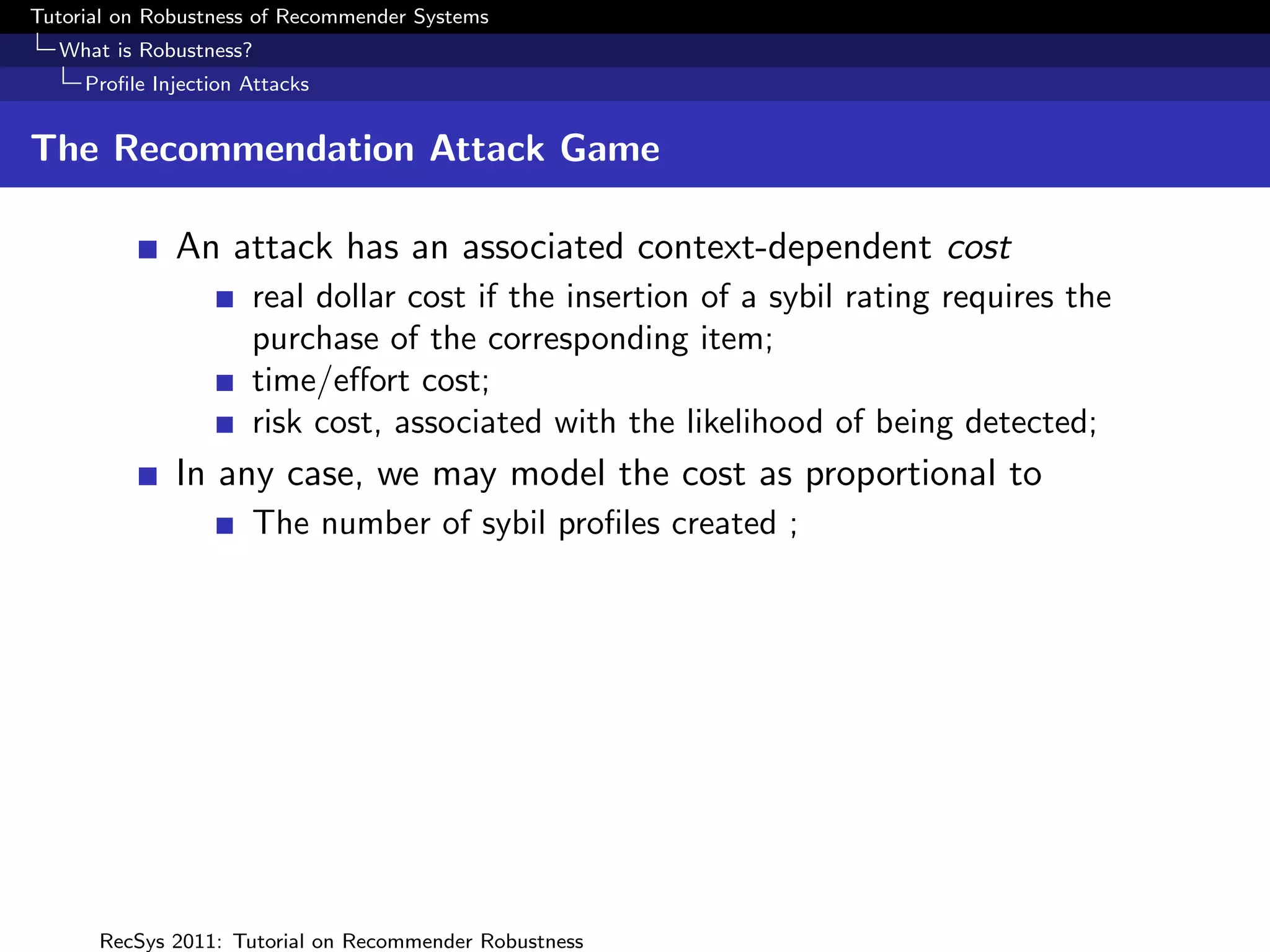
      O’Mahony, M. P., Hurley, N. J. and Silvestre, C. C. M.: 2004, An
        evaluation of neighbourhood formation on the performance of
        collaborative filtering, Artificial Intelligence Review
        21(1), 215–228.


      RecSys 2011: Tutorial on Recommender Robustness
Tutorial on Robustness of Recommender Systems
  Stability, Trust and Privacy


References VI

      O’Mahony, M. P., Hurley, N. J. and Silvestre, G. C. M.: 2002,
        Promoting recommendations: An attack on collaborative
        filtering, in A. Hameurlain, R. Cicchetti and R. Traunm¨ller
                                                               u
        (eds), DEXA, Vol. 2453 of Lecture Notes in Computer Science,
        Springer, pp. 494–503.
      O’Mahony, M. P., Hurley, N. J. and Silvestre, G. C. M.: 2006,
        Attacking recommender systems: The cost of promotion,
        Workshop on Recommender Systems at the 17th European
        Conference on Artificial Intelligence (ECAI’06), 28th–29th, Riva
        del Garda, Italy.


      RecSys 2011: Tutorial on Recommender Robustness
Tutorial on Robustness of Recommender Systems
  Stability, Trust and Privacy


References VII

      Resnick, P. and Sami, R.: 2007, The influence limiter: provably
        manipulation-resistant recommender systems, RecSys ’07:
        Proceedings of the 2007 ACM conference on Recommender
        systems, ACM, New York, NY, USA, pp. 25–32.
      Vu, L.-H., Papaioannou, T. and Aberer, K.: 2010, Impact of trust
        management and information sharing to adversarial cost in
        ranking systems, in M. Nishigaki, A. Jsang, Y. Murayama and
        S. Marsh (eds), Trust Management IV, Vol. 321 of IFIP
        Advances in Information and Communication Technology,
        Springer Boston, pp. 108–124.


      RecSys 2011: Tutorial on Recommender Robustness
Tutorial on Robustness of Recommender Systems
  Stability, Trust and Privacy


References VIII

      Williams, C., Mobasher, B., Burke, R., Bhaumik, R. and Sandvig,
       J.: 2006, Detection of obfuscated attacks in collaborative
       recommender systems, In Proceedings of the 17th European
       Conference on Artificial Intelligence (ECAI’06) .
      Wu, G., Greene, D. and Cunningham, P.: 2010, Merging multiple
       criteria to identify suspicious reviews, in X. Amatriain,
       M. Torrens, P. Resnick and M. Zanker (eds), RecSys, ACM,
       pp. 241–244.
      Yan, X. and Roy, B. V.: 2009, Manipulation robustness of
        collaborative filtering systems, CoRR abs/0903.0064.


      RecSys 2011: Tutorial on Recommender Robustness

Tutorial on Robustness of Recommender Systems

  • 1.
    Tutorial on Robustnessof Recommender Systems Tutorial on Robustness of Recommender Systems Neil Hurley Complex Adaptive System Laboratory Computer Science and Informatics University College Dublin Clique Strategic Research Cluster clique.ucd.ie October 2011 RecSys 2011: Tutorial on Recommender Robustness
  • 2.
    Tutorial on Robustnessof Recommender Systems Outline 1 What is Robustness? Profile Injection Attacks Relevance of Robustness Measuring Robustness RecSys 2011: Tutorial on Recommender Robustness
  • 3.
    Tutorial on Robustnessof Recommender Systems Outline 1 What is Robustness? Profile Injection Attacks Relevance of Robustness Measuring Robustness 2 Attack Strategies Attacking kNN Algorithms RecSys 2011: Tutorial on Recommender Robustness
  • 4.
    Tutorial on Robustnessof Recommender Systems Outline 1 What is Robustness? Profile Injection Attacks Relevance of Robustness Measuring Robustness 2 Attack Strategies Attacking kNN Algorithms 3 Attack Detection PCA-based Attack Detection Statistical Attack Detection Cost-Benefit Analysis RecSys 2011: Tutorial on Recommender Robustness
  • 5.
    Tutorial on Robustnessof Recommender Systems Outline 1 What is Robustness? Profile Injection Attacks Relevance of Robustness Measuring Robustness 2 Attack Strategies Attacking kNN Algorithms 3 Attack Detection PCA-based Attack Detection Statistical Attack Detection Cost-Benefit Analysis 4 Robustness of Model-based Algorithms RecSys 2011: Tutorial on Recommender Robustness
  • 6.
    Tutorial on Robustnessof Recommender Systems Outline 1 What is Robustness? Profile Injection Attacks Relevance of Robustness Measuring Robustness 2 Attack Strategies Attacking kNN Algorithms 3 Attack Detection PCA-based Attack Detection Statistical Attack Detection Cost-Benefit Analysis 4 Robustness of Model-based Algorithms 5 Attack Resistant Recommendation Algorithms Provably Manipulation Resistant Algorithms RecSys 2011: Tutorial on Recommender Robustness
  • 7.
    Tutorial on Robustnessof Recommender Systems Outline 1 What is Robustness? Profile Injection Attacks Relevance of Robustness Measuring Robustness 2 Attack Strategies Attacking kNN Algorithms 3 Attack Detection PCA-based Attack Detection Statistical Attack Detection Cost-Benefit Analysis 4 Robustness of Model-based Algorithms 5 Attack Resistant Recommendation Algorithms Provably Manipulation Resistant Algorithms 6 Stability, Trust and Privacy RecSys 2011: Tutorial on Recommender Robustness
  • 8.
    Tutorial on Robustnessof Recommender Systems What is Robustness? Outline 1 What is Robustness? Profile Injection Attacks Relevance of Robustness Measuring Robustness 2 Attack Strategies Attacking kNN Algorithms 3 Attack Detection PCA-based Attack Detection Statistical Attack Detection Cost-Benefit Analysis 4 Robustness of Model-based Algorithms 5 Attack Resistant Recommendation Algorithms Provably Manipulation Resistant Algorithms 6 Stability, Trust and Privacy RecSys 2011: Tutorial on Recommender Robustness
  • 9.
    Tutorial on Robustnessof Recommender Systems What is Robustness? Profile Injection Attacks Outline 1 What is Robustness? Profile Injection Attacks Relevance of Robustness Measuring Robustness 2 Attack Strategies Attacking kNN Algorithms 3 Attack Detection PCA-based Attack Detection Statistical Attack Detection Cost-Benefit Analysis 4 Robustness of Model-based Algorithms 5 Attack Resistant Recommendation Algorithms Provably Manipulation Resistant Algorithms 6 Stability, Trust and Privacy RecSys 2011: Tutorial on Recommender Robustness
  • 10.
    Tutorial on Robustnessof Recommender Systems What is Robustness? Profile Injection Attacks Defining the Problem Recommender Systems use personal information about end-users to make useful personalised recommendations. When ratings are provided explicitly, recommender algorithms have been designed on the assumption that the provided information is correct. However . . . “One can have, some claim, as many electronic per- sonas as one has time and energy to create” –Judith Donath (1998) as quoted in Douceur (2002) How does the system perform if multiple identities are used to try to deliberately bias the recommender output? RecSys 2011: Tutorial on Recommender Robustness
  • 11.
    Tutorial on Robustnessof Recommender Systems What is Robustness? Profile Injection Attacks Defining the Problem In 2002, John Douceur of Microsoft Research coined the term Sybil Attack to refer to an attack against identity on peer-to-peer systems in which an individual entity masquerades as multiple separate entities “If the local entity has no direct physical knowledge of remote entities, it perceives them only as informational abstractions that we call identities. The system must ensure that distinct identities refer to distinct entities; otherwise, when the local entity selects a subset of identities to redundantly perform a remote operation, it can be duped into selecting a single remote entity multiple times, thereby defeating the redundancy” In the same year, the first paper (O’Mahony et al. 2002) appeared on the vulnerability of Recommender Systems to malicious strategies for “recommendation promotion” – later dubbed profile injection attacks. RecSys 2011: Tutorial on Recommender Robustness
  • 12.
    Tutorial on Robustnessof Recommender Systems What is Robustness? Profile Injection Attacks Defining the Problem Robustness refers to the ability of a system to operate under stressful conditions. While there are many possible stresses that can be applied to Recommender Systems, research on RS robustness has focused on performance when the dataset is stressed specifically when the dataset is full of noisy, erroneous data; typically, imagined to have been corrupted through a concerted sybil attack, with an aim of biasing the recommender output. RecSys 2011: Tutorial on Recommender Robustness
  • 13.
    Tutorial on Robustnessof Recommender Systems What is Robustness? Profile Injection Attacks Robust RS Research The goal of robust recommendation is to prevent attackers from manipulating an RS through large-scale insertion of false user profiles: a profile injection attack RecSys 2011: Tutorial on Recommender Robustness
  • 14.
    Tutorial on Robustnessof Recommender Systems What is Robustness? Profile Injection Attacks Robust RS Research The goal of robust recommendation is to prevent attackers from manipulating an RS through large-scale insertion of false user profiles: a profile injection attack An attack is a concerted effort to bias the results of a recommender system by the insertion of a large number of profiles using false identities or sybils. RecSys 2011: Tutorial on Recommender Robustness
  • 15.
    Tutorial on Robustnessof Recommender Systems What is Robustness? Profile Injection Attacks Robust RS Research The goal of robust recommendation is to prevent attackers from manipulating an RS through large-scale insertion of false user profiles: a profile injection attack An attack is a concerted effort to bias the results of a recommender system by the insertion of a large number of profiles using false identities or sybils. Each identity is referred to as an attack profile. RecSys 2011: Tutorial on Recommender Robustness
  • 16.
    Tutorial on Robustnessof Recommender Systems What is Robustness? Profile Injection Attacks Robust RS Research The goal of robust recommendation is to prevent attackers from manipulating an RS through large-scale insertion of false user profiles: a profile injection attack An attack is a concerted effort to bias the results of a recommender system by the insertion of a large number of profiles using false identities or sybils. Each identity is referred to as an attack profile. Research has concentrated on attacks designed to achieve a particular recommendation outcome RecSys 2011: Tutorial on Recommender Robustness
  • 17.
    Tutorial on Robustnessof Recommender Systems What is Robustness? Profile Injection Attacks Robust RS Research The goal of robust recommendation is to prevent attackers from manipulating an RS through large-scale insertion of false user profiles: a profile injection attack An attack is a concerted effort to bias the results of a recommender system by the insertion of a large number of profiles using false identities or sybils. Each identity is referred to as an attack profile. Research has concentrated on attacks designed to achieve a particular recommendation outcome A Product Push attack: attempt to secure positive recommendations for an item or items; RecSys 2011: Tutorial on Recommender Robustness
  • 18.
    Tutorial on Robustnessof Recommender Systems What is Robustness? Profile Injection Attacks Robust RS Research The goal of robust recommendation is to prevent attackers from manipulating an RS through large-scale insertion of false user profiles: a profile injection attack An attack is a concerted effort to bias the results of a recommender system by the insertion of a large number of profiles using false identities or sybils. Each identity is referred to as an attack profile. Research has concentrated on attacks designed to achieve a particular recommendation outcome A Product Push attack: attempt to secure positive recommendations for an item or items; A Product Nuke attack: attempt to secure negative recommendations for an item or items. RecSys 2011: Tutorial on Recommender Robustness
  • 19.
    Tutorial on Robustnessof Recommender Systems What is Robustness? Profile Injection Attacks Robust RS Research The goal of robust recommendation is to prevent attackers from manipulating an RS through large-scale insertion of false user profiles: a profile injection attack An attack is a concerted effort to bias the results of a recommender system by the insertion of a large number of profiles using false identities or sybils. Each identity is referred to as an attack profile. Research has concentrated on attacks designed to achieve a particular recommendation outcome A Product Push attack: attempt to secure positive recommendations for an item or items; A Product Nuke attack: attempt to secure negative recommendations for an item or items. We can also think of attacks that aim to simply destroy the accuracy of the system. RecSys 2011: Tutorial on Recommender Robustness
  • 20.
    Tutorial on Robustnessof Recommender Systems What is Robustness? Profile Injection Attacks Robust RS Research We assume that the attacker has no direct access to the ratings database – manipulation achieved via the creation of false profiles only. RecSys 2011: Tutorial on Recommender Robustness
  • 21.
    Tutorial on Robustnessof Recommender Systems What is Robustness? Profile Injection Attacks Robust RS Research We assume that the attacker has no direct access to the ratings database – manipulation achieved via the creation of false profiles only. We ignore system-level methods (e.g. Captchas) for preventing the generation of false identities or ratings RecSys 2011: Tutorial on Recommender Robustness
  • 22.
    Tutorial on Robustnessof Recommender Systems What is Robustness? Profile Injection Attacks Robust RS Research We assume that the attacker has no direct access to the ratings database – manipulation achieved via the creation of false profiles only. We ignore system-level methods (e.g. Captchas) for preventing the generation of false identities or ratings Focus is on the recommendation algorithm’s ability to resist manipulation either by RecSys 2011: Tutorial on Recommender Robustness
  • 23.
    Tutorial on Robustnessof Recommender Systems What is Robustness? Profile Injection Attacks Robust RS Research We assume that the attacker has no direct access to the ratings database – manipulation achieved via the creation of false profiles only. We ignore system-level methods (e.g. Captchas) for preventing the generation of false identities or ratings Focus is on the recommendation algorithm’s ability to resist manipulation either by Identifying false profiles from their statistical properties and ignoring or lessening their impact on the generation of recommendations; RecSys 2011: Tutorial on Recommender Robustness
  • 24.
    Tutorial on Robustnessof Recommender Systems What is Robustness? Profile Injection Attacks Robust RS Research We assume that the attacker has no direct access to the ratings database – manipulation achieved via the creation of false profiles only. We ignore system-level methods (e.g. Captchas) for preventing the generation of false identities or ratings Focus is on the recommendation algorithm’s ability to resist manipulation either by Identifying false profiles from their statistical properties and ignoring or lessening their impact on the generation of recommendations; or Generating recommendations in a manner that is inherently insensitive to manipulation. RecSys 2011: Tutorial on Recommender Robustness
  • 25.
    Tutorial on Robustnessof Recommender Systems What is Robustness? Profile Injection Attacks Example RecSys 2011: Tutorial on Recommender Robustness
  • 26.
    Tutorial on Robustnessof Recommender Systems What is Robustness? Profile Injection Attacks Example RecSys 2011: Tutorial on Recommender Robustness
  • 27.
    Tutorial on Robustnessof Recommender Systems What is Robustness? Profile Injection Attacks Example RecSys 2011: Tutorial on Recommender Robustness
  • 28.
    Tutorial on Robustnessof Recommender Systems What is Robustness? Profile Injection Attacks Threats to Reputation Systems I It is interesting to compare the scenario studied in RS research with the threats identified for reputation systems in the 2007 ENISA report (Carrara and Hogben 2007): 1 Whitewashing attack: reseting a poor reputation by rejoining the system with a new identity. 2 Sybil attack or pseudospoofing: the attacker uses multiple identities (sybils) in order to manipulate a reputation score. 3 Impersonation and reputation theft: acquiring the identity of another and stealing her reputation. 4 Bootstrap issues and related threats: the initial reputation of a newcomer may be particularly vulnerable to attack. RecSys 2011: Tutorial on Recommender Robustness
  • 29.
    Tutorial on Robustnessof Recommender Systems What is Robustness? Profile Injection Attacks Threats to Reputation Systems II 5 Extortion: co-ordinated campaigns aimed at blackmail by damaging an individual’s reputation for malicious motives. 6 Denial-of-reputation: attack designed to damage reputation and create an opportunity for blackmail in order to have the reputation cleaned. 7 Ballot stuffing and bad mouthing: reporting of a false reputation score; the attackers collude to give positive/negative feedback, to increase or lower a reputation. 8 Collusion: multiple users conspire to influence a given reputation. 9 Repudiation of data and transaction: denial that a transaction occurred, or denial of the existence of data for which individual is responsible. RecSys 2011: Tutorial on Recommender Robustness
  • 30.
    Tutorial on Robustnessof Recommender Systems What is Robustness? Profile Injection Attacks Threats to Reputation Systems III 10 Recommender dishonesty: dishonest reputation scoring. 11 Privacy threats for voters and reputation owners: for example, anonymity improves the accuracy of votes. 12 Social threats: Discriminatory behaviour, herd behaviour, penalisation of innovative, controversial opinions, vocal minority effect etc. 13 Threats to the underlying networks: e.g. denial of service attack. 14 Trust topology threats: e.g.targeting most highly influential nodes. 15 Threats to ratings: exploiting features of metrics used by the system to calculate the aggregate reputation rating RecSys 2011: Tutorial on Recommender Robustness
  • 31.
    Tutorial on Robustnessof Recommender Systems What is Robustness? Profile Injection Attacks The Recommendation Attack Game An attack has an associated context-dependent cost RecSys 2011: Tutorial on Recommender Robustness
  • 32.
    Tutorial on Robustnessof Recommender Systems What is Robustness? Profile Injection Attacks The Recommendation Attack Game An attack has an associated context-dependent cost real dollar cost if the insertion of a sybil rating requires the purchase of the corresponding item; RecSys 2011: Tutorial on Recommender Robustness
  • 33.
    Tutorial on Robustnessof Recommender Systems What is Robustness? Profile Injection Attacks The Recommendation Attack Game An attack has an associated context-dependent cost real dollar cost if the insertion of a sybil rating requires the purchase of the corresponding item; time/effort cost; RecSys 2011: Tutorial on Recommender Robustness
  • 34.
    Tutorial on Robustnessof Recommender Systems What is Robustness? Profile Injection Attacks The Recommendation Attack Game An attack has an associated context-dependent cost real dollar cost if the insertion of a sybil rating requires the purchase of the corresponding item; time/effort cost; risk cost, associated with the likelihood of being detected; RecSys 2011: Tutorial on Recommender Robustness
  • 35.
    Tutorial on Robustnessof Recommender Systems What is Robustness? Profile Injection Attacks The Recommendation Attack Game An attack has an associated context-dependent cost real dollar cost if the insertion of a sybil rating requires the purchase of the corresponding item; time/effort cost; risk cost, associated with the likelihood of being detected; In any case, we may model the cost as proportional to RecSys 2011: Tutorial on Recommender Robustness
  • 36.
    Tutorial on Robustnessof Recommender Systems What is Robustness? Profile Injection Attacks The Recommendation Attack Game An attack has an associated context-dependent cost real dollar cost if the insertion of a sybil rating requires the purchase of the corresponding item; time/effort cost; risk cost, associated with the likelihood of being detected; In any case, we may model the cost as proportional to The number of sybil profiles created ; RecSys 2011: Tutorial on Recommender Robustness
  • 37.
    Tutorial on Robustnessof Recommender Systems What is Robustness? Profile Injection Attacks The Recommendation Attack Game An attack has an associated context-dependent cost real dollar cost if the insertion of a sybil rating requires the purchase of the corresponding item; time/effort cost; risk cost, associated with the likelihood of being detected; In any case, we may model the cost as proportional to The number of sybil profiles created ; the total number of constituent ratings within the sybil profiles. RecSys 2011: Tutorial on Recommender Robustness
  • 38.
    Tutorial on Robustnessof Recommender Systems What is Robustness? Profile Injection Attacks Impact Curve Figure: Impact curve from Burke et al. (2011) RecSys 2011: Tutorial on Recommender Robustness
  • 39.
    Tutorial on Robustnessof Recommender Systems What is Robustness? Profile Injection Attacks Notation Consider R to be an n × m database of ratings provided by a set of n genuine users for m items in a system catalogue. RecSys 2011: Tutorial on Recommender Robustness
  • 40.
    Tutorial on Robustnessof Recommender Systems What is Robustness? Profile Injection Attacks Notation Let G be the set of n genuine users, and let ra = (ra,1 , . . . , ra,m )T represent the set of ratings provided by user a for each item. ra,i ∈ L, some quality label, typically a numerical value over some discrete range. Write ra,i = ∅ if user a has not rated item i. RecSys 2011: Tutorial on Recommender Robustness
  • 41.
    Tutorial on Robustnessof Recommender Systems What is Robustness? Profile Injection Attacks Notation Let A be the set of attack profiles of size nA = number of profiles and mA = number of ratings. Let ai denote a single attack profile 1 ≤ i ≤ nA . RecSys 2011: Tutorial on Recommender Robustness
  • 42.
    Tutorial on Robustnessof Recommender Systems What is Robustness? Profile Injection Attacks Notation Let R be the (n + nA ) × m database of genuine and attack profiles available to the recommendation algorithm post-attack. RecSys 2011: Tutorial on Recommender Robustness
  • 43.
    Tutorial on Robustnessof Recommender Systems What is Robustness? Profile Injection Attacks Notation Let cA = cA (nA , mA ) denote the cost of mounting an attack. RecSys 2011: Tutorial on Recommender Robustness
  • 44.
    Tutorial on Robustnessof Recommender Systems What is Robustness? Profile Injection Attacks Notation Let cA = cA (nA , mA ) denote the cost of mounting an attack. The recommendation algorithm may be represented as a function φ, that uses the rating database R and a user’s history of previous ratings, ru , to make a set of predictions p(u, i) = φ(i, R, ru ) ∈ L on the set of items. RecSys 2011: Tutorial on Recommender Robustness
  • 45.
    Tutorial on Robustnessof Recommender Systems What is Robustness? Profile Injection Attacks Notation Let cA = cA (nA , mA ) denote the cost of mounting an attack. The recommendation algorithm may be represented as a function φ, that uses the rating database R and a user’s history of previous ratings, ru , to make a set of predictions p(u, i) = φ(i, R, ru ) ∈ L on the set of items. More generally, φ(.) results in a probability mass function over the label space L for each predicted item. RecSys 2011: Tutorial on Recommender Robustness
  • 46.
    Tutorial on Robustnessof Recommender Systems What is Robustness? Profile Injection Attacks Notation Let cA = cA (nA , mA ) denote the cost of mounting an attack. The recommendation algorithm may be represented as a function φ, that uses the rating database R and a user’s history of previous ratings, ru , to make a set of predictions p(u, i) = φ(i, R, ru ) ∈ L on the set of items. More generally, φ(.) results in a probability mass function over the label space L for each predicted item. Let l(φ(., R , .), φ(., R, .)) be a loss function representing the quality loss of the recommendation process due to an attack. RecSys 2011: Tutorial on Recommender Robustness
  • 47.
    Tutorial on Robustnessof Recommender Systems What is Robustness? Profile Injection Attacks Notation Let cA = cA (nA , mA ) denote the cost of mounting an attack. The recommendation algorithm may be represented as a function φ, that uses the rating database R and a user’s history of previous ratings, ru , to make a set of predictions p(u, i) = φ(i, R, ru ) ∈ L on the set of items. More generally, φ(.) results in a probability mass function over the label space L for each predicted item. Let l(φ(., R , .), φ(., R, .)) be a loss function representing the quality loss of the recommendation process due to an attack. This function may depend on the goal of the attack e.g. the overall loss in accuracy, if the attack seeks to distort general recommendation performance, RecSys 2011: Tutorial on Recommender Robustness
  • 48.
    Tutorial on Robustnessof Recommender Systems What is Robustness? Profile Injection Attacks Notation Let cA = cA (nA , mA ) denote the cost of mounting an attack. The recommendation algorithm may be represented as a function φ, that uses the rating database R and a user’s history of previous ratings, ru , to make a set of predictions p(u, i) = φ(i, R, ru ) ∈ L on the set of items. More generally, φ(.) results in a probability mass function over the label space L for each predicted item. Let l(φ(., R , .), φ(., R, .)) be a loss function representing the quality loss of the recommendation process due to an attack. This function may depend on the goal of the attack e.g. the overall loss in accuracy, if the attack seeks to distort general recommendation performance, or the shift in ratings for some targeted set of items over some targeted set of users, in a focused attack. RecSys 2011: Tutorial on Recommender Robustness
  • 49.
    Tutorial on Robustnessof Recommender Systems What is Robustness? Profile Injection Attacks The Recommender Attack Game Then the manipulation game, from the attacker’s point of view is to choose the attack A∗ that maximises the loss for a given cost bound cmax . Attack Goal A∗ = arg max{A|cA ≤cmax } minφ l(φ(R ), φ(R)) RecSys 2011: Tutorial on Recommender Robustness
  • 50.
    Tutorial on Robustnessof Recommender Systems What is Robustness? Profile Injection Attacks The Recommender Attack Game Then the manipulation game, from the attacker’s point of view is to choose the attack A∗ that maximises the loss for a given cost bound cmax . Attack Goal A∗ = arg max{A|cA ≤cmax } minφ l(φ(R ), φ(R)) While the system designer strives to find a recommendation algorithm that militates against attack Defense Goal φ∗ = arg minφ max{A|cA ≤cmax } l(φ(R ), φ(R)) RecSys 2011: Tutorial on Recommender Robustness
  • 51.
    Tutorial on Robustnessof Recommender Systems What is Robustness? Relevance of Robustness Outline 1 What is Robustness? Profile Injection Attacks Relevance of Robustness Measuring Robustness 2 Attack Strategies Attacking kNN Algorithms 3 Attack Detection PCA-based Attack Detection Statistical Attack Detection Cost-Benefit Analysis 4 Robustness of Model-based Algorithms 5 Attack Resistant Recommendation Algorithms Provably Manipulation Resistant Algorithms 6 Stability, Trust and Privacy RecSys 2011: Tutorial on Recommender Robustness
  • 52.
    Tutorial on Robustnessof Recommender Systems What is Robustness? Relevance of Robustness Our Original Motivation Inspired by Work in Digital Watermarking . . . RecSys 2011: Tutorial on Recommender Robustness
  • 53.
    Tutorial on Robustnessof Recommender Systems What is Robustness? Relevance of Robustness Our Original Motivation Inspired by Work in Digital Watermarking . . . RecSys 2011: Tutorial on Recommender Robustness
  • 54.
    Tutorial on Robustnessof Recommender Systems What is Robustness? Relevance of Robustness How Realistic Is this Scenario? news.bbc.co.uk/2/hi/4741259.stm (2001) “ ... ads for films including Hollow Man and A Knight’s Tale quoted praise from a reviewer called David Manning, who was exposed as being invented ...” RecSys 2011: Tutorial on Recommender Robustness
  • 55.
    Tutorial on Robustnessof Recommender Systems What is Robustness? Relevance of Robustness How Realistic Is this Scenario? http://tinyurl.com/3d6d969 (Sept. 2003) “AuctionBytes conducted a reader survey to find out how serious these problems were. According to the survey, 39% of respondents felt that feedback retaliation was a very big problem on eBay. Nineteen percent of respondents had received retaliatory feedback within the previous 6 months, and 16% had been a victim of feedback extortion within the previous 6 months.” RecSys 2011: Tutorial on Recommender Robustness
  • 56.
    Tutorial on Robustnessof Recommender Systems What is Robustness? Relevance of Robustness How Realistic Is this Scenario? http://tinyurl.com/n3d5lp (June 2009) “Elsevier officials said Monday that it was a mistake for the publishing giant’s marketing division to offer $25 Amazon gift cards to anyone who would give a new textbook five stars in a review posted on Amazon or Barnes & Noble. While those popular Web sites’ customer reviews have long been known to be something less than scientific, and prone to manipulation if an author has friends write on behalf of a new work, the idea that a major academic publisher would attempt to pay for good reviews angered some professors who received the e-mail pitch..” RecSys 2011: Tutorial on Recommender Robustness
  • 57.
    Tutorial on Robustnessof Recommender Systems What is Robustness? Relevance of Robustness How Realistic Is this Scenario? http://tinyurl.com/cfmqce (2009) Paul Lamere cites an example of “precision hacking” of a Time Poll. RecSys 2011: Tutorial on Recommender Robustness
  • 58.
    Tutorial on Robustnessof Recommender Systems What is Robustness? Relevance of Robustness How Realistic Is this Scenario? http://tinyurl.com/mupy7d (2009) Hotel review manipulation RecSys 2011: Tutorial on Recommender Robustness
  • 59.
    Tutorial on Robustnessof Recommender Systems What is Robustness? Relevance of Robustness How Realistic Is this Scenario? Lang et al. (2010) Social Manipulation in Buzznet “...Hey, I know you don’t know me, but could you do me a huge fav and vote for me in this contest? All you have to do is buzz me...” RecSys 2011: Tutorial on Recommender Robustness
  • 60.
    Tutorial on Robustnessof Recommender Systems What is Robustness? Relevance of Robustness How Realistic Is this Scenario? All examples of types of manipulation attacks on recommender systems. No hard evidence of automated shilling attacks by sybil insertion bots. RecSys 2011: Tutorial on Recommender Robustness
  • 61.
    Tutorial on Robustnessof Recommender Systems What is Robustness? Measuring Robustness Outline 1 What is Robustness? Profile Injection Attacks Relevance of Robustness Measuring Robustness 2 Attack Strategies Attacking kNN Algorithms 3 Attack Detection PCA-based Attack Detection Statistical Attack Detection Cost-Benefit Analysis 4 Robustness of Model-based Algorithms 5 Attack Resistant Recommendation Algorithms Provably Manipulation Resistant Algorithms 6 Stability, Trust and Privacy RecSys 2011: Tutorial on Recommender Robustness
  • 62.
    Tutorial on Robustnessof Recommender Systems What is Robustness? Measuring Robustness Simple Measures of Attack Impact Average Prediction Shift The change in an item’s predicted rating before and after attack, averaged over all predictions or over predictions that are targetted by the attack. pshift (u, i) = φ(i, R , ru ) − φ(i, R, ru ) RecSys 2011: Tutorial on Recommender Robustness
  • 63.
    Tutorial on Robustnessof Recommender Systems What is Robustness? Measuring Robustness Simple Measures of Attack Impact Average Prediction Shift The change in an item’s predicted rating before and after attack, averaged over all predictions or over predictions that are targetted by the attack. pshift (u, i) = φ(i, R , ru ) − φ(i, R, ru ) Average Hit Ratio The average likelihood over tested users that a top-N recommendation will recommend an item that is the target of an attack. For each such item i and each tested user, u, in a test set of t users, let h(u, i) = 1 if i ∈ Ru , the recommended set. Then, H(i) = 1 u∈U h(u, i) t RecSys 2011: Tutorial on Recommender Robustness
  • 64.
    Tutorial on Robustnessof Recommender Systems What is Robustness? Measuring Robustness Other Measures of Attack Impact Considering φ(i, R, ru ) as a pmf over L, attack impact can be measured in terms of the change in this distribution as a result of the attack. For instance (Yan and Roy 2009), measure impact in terms of the average Kullback-Liebler distance between φ(i, R, ru ) and φ(i, R , ru ) over the set of inspected items. Resnick and Sami (2007) propose loss functions L(l, q) where l ∈ L, q = φ(i, R, ru ) where the true label of item i is l RecSys 2011: Tutorial on Recommender Robustness
  • 65.
    Tutorial on Robustnessof Recommender Systems What is Robustness? Measuring Robustness Other Measures of Attack Impact Considering φ(i, R, ru ) as a pmf over L, attack impact can be measured in terms of the change in this distribution as a result of the attack. For instance (Yan and Roy 2009), measure impact in terms of the average Kullback-Liebler distance between φ(i, R, ru ) and φ(i, R , ru ) over the set of inspected items. Resnick and Sami (2007) propose loss functions L(l, q) where l ∈ L, q = φ(i, R, ru ) where the true label of item i is l e.g. the quadratic loss over a two rating scale [HI, LO], with q the probability of HI is given by L(HI, q) = (1 − q)2 ; L(LO, q) = q 2 RecSys 2011: Tutorial on Recommender Robustness
  • 66.
    Tutorial on Robustnessof Recommender Systems Attack Strategies Outline 1 What is Robustness? Profile Injection Attacks Relevance of Robustness Measuring Robustness 2 Attack Strategies Attacking kNN Algorithms 3 Attack Detection PCA-based Attack Detection Statistical Attack Detection Cost-Benefit Analysis 4 Robustness of Model-based Algorithms 5 Attack Resistant Recommendation Algorithms Provably Manipulation Resistant Algorithms 6 Stability, Trust and Privacy RecSys 2011: Tutorial on Recommender Robustness
  • 67.
    Tutorial on Robustnessof Recommender Systems Attack Strategies Forming Attack Profiles (Mobasher et al. 2007) introduce the following notation for the components of an attack profile: RecSys 2011: Tutorial on Recommender Robustness
  • 68.
    Tutorial on Robustnessof Recommender Systems Attack Strategies Forming Attack Profiles (Mobasher et al. 2007) introduce the following notation for the components of an attack profile: IT , the target item(s) receive typically the maximum (resp. minimum) rating for a push (resp. nuke) attack. RecSys 2011: Tutorial on Recommender Robustness
  • 69.
    Tutorial on Robustnessof Recommender Systems Attack Strategies Forming Attack Profiles (Mobasher et al. 2007) introduce the following notation for the components of an attack profile: IS , the selected item(s) are chosen and rated in a manner to support the attack. RecSys 2011: Tutorial on Recommender Robustness
  • 70.
    Tutorial on Robustnessof Recommender Systems Attack Strategies Forming Attack Profiles (Mobasher et al. 2007) introduce the following notation for the components of an attack profile: IF , the filler items(s) fill out the remainder of the ratings in the attack profile. RecSys 2011: Tutorial on Recommender Robustness
  • 71.
    Tutorial on Robustnessof Recommender Systems Attack Strategies Forming Attack Profiles The goal of attack profile creation must be to Effectively support the purpose of the attack – selection of target rating and IS ; RecSys 2011: Tutorial on Recommender Robustness
  • 72.
    Tutorial on Robustnessof Recommender Systems Attack Strategies Forming Attack Profiles The goal of attack profile creation must be to Effectively support the purpose of the attack – selection of target rating and IS ; But, remain unobtrusive so as to avoid detection and filtering – selection of the filler items IF . RecSys 2011: Tutorial on Recommender Robustness
  • 73.
    Tutorial on Robustnessof Recommender Systems Attack Strategies Forming Attack Profiles The goal of attack profile creation must be to Effectively support the purpose of the attack – selection of target rating and IS ; But, remain unobtrusive so as to avoid detection and filtering – selection of the filler items IF . Must also consider what information is available to the attacker RecSys 2011: Tutorial on Recommender Robustness
  • 74.
    Tutorial on Robustnessof Recommender Systems Attack Strategies Forming Attack Profiles The goal of attack profile creation must be to Effectively support the purpose of the attack – selection of target rating and IS ; But, remain unobtrusive so as to avoid detection and filtering – selection of the filler items IF . Must also consider what information is available to the attacker Typically assume some knowledge of the statistics of the rating database is available; RecSys 2011: Tutorial on Recommender Robustness
  • 75.
    Tutorial on Robustnessof Recommender Systems Attack Strategies Forming Attack Profiles The goal of attack profile creation must be to Effectively support the purpose of the attack – selection of target rating and IS ; But, remain unobtrusive so as to avoid detection and filtering – selection of the filler items IF . Must also consider what information is available to the attacker Typically assume some knowledge of the statistics of the rating database is available; May also have knowledge of the recommendation algorithm – an informed attack. RecSys 2011: Tutorial on Recommender Robustness
  • 76.
    Tutorial on Robustnessof Recommender Systems Attack Strategies Forming Attack Profiles The goal of attack profile creation must be to Effectively support the purpose of the attack – selection of target rating and IS ; But, remain unobtrusive so as to avoid detection and filtering – selection of the filler items IF . Must also consider what information is available to the attacker Typically assume some knowledge of the statistics of the rating database is available; May also have knowledge of the recommendation algorithm – an informed attack. Note Kerkchoff’s principal – avoid “security through obscurity”. RecSys 2011: Tutorial on Recommender Robustness
  • 77.
    Tutorial on Robustnessof Recommender Systems Attack Strategies Attacking kNN Algorithms Outline 1 What is Robustness? Profile Injection Attacks Relevance of Robustness Measuring Robustness 2 Attack Strategies Attacking kNN Algorithms 3 Attack Detection PCA-based Attack Detection Statistical Attack Detection Cost-Benefit Analysis 4 Robustness of Model-based Algorithms 5 Attack Resistant Recommendation Algorithms Provably Manipulation Resistant Algorithms 6 Stability, Trust and Privacy RecSys 2011: Tutorial on Recommender Robustness
  • 78.
    Tutorial on Robustnessof Recommender Systems Attack Strategies Attacking kNN Algorithms User-based kNN Attack The first CF profile insertion attack (O’Mahony et al. 2002), was an informed attack that exploited a particular weakness in the basic version of Resnick’s user-based kNN algorithm. RecSys 2011: Tutorial on Recommender Robustness
  • 79.
    Tutorial on Robustnessof Recommender Systems Attack Strategies Attacking kNN Algorithms User-based kNN Attack The first CF profile insertion attack (O’Mahony et al. 2002), was an informed attack that exploited a particular weakness in the basic version of Resnick’s user-based kNN algorithm. User-based CF predicts a rating pa,j for item j, user a as follows: RecSys 2011: Tutorial on Recommender Robustness
  • 80.
    Tutorial on Robustnessof Recommender Systems Attack Strategies Attacking kNN Algorithms User-based kNN Attack The first CF profile insertion attack (O’Mahony et al. 2002), was an informed attack that exploited a particular weakness in the basic version of Resnick’s user-based kNN algorithm. User-based CF predicts a rating pa,j for item j, user a as follows: – Form a neighbourhood by picking the top-k most similar users to a – Pearson Correlation P j (ra,j −¯a )(ri,j −¯i ) r r wa,i = √P 2 P 2 j∈Na ∩Ni (ra,j −¯a ) r j (ri,j −¯i ) r – Make a prediction by taking a weighted average of n neighbours ratings using: pa,j = ra + κ i=1 wa,i (ri,j − ri ) ¯ ¯ where κ is a normalising factor RecSys 2011: Tutorial on Recommender Robustness
  • 81.
    Tutorial on Robustnessof Recommender Systems Attack Strategies Attacking kNN Algorithms User-based kNN Attack Correlation calculated over the items which the target user and attack profile have in common. A small intersection set can lead to high correlations. RecSys 2011: Tutorial on Recommender Robustness
  • 82.
    Tutorial on Robustnessof Recommender Systems Attack Strategies Attacking kNN Algorithms User-based kNN Attack Correlation calculated over the items which the target user and attack profile have in common. A small intersection set can lead to high correlations. Therefore a small profile of popular items will have a large correlation with users who have rated these items RecSys 2011: Tutorial on Recommender Robustness
  • 83.
    Tutorial on Robustnessof Recommender Systems Attack Strategies Attacking kNN Algorithms User-based kNN Attack Correlation calculated over the items which the target user and attack profile have in common. A small intersection set can lead to high correlations. Therefore a small profile of popular items will have a large correlation with users who have rated these items Implies a low-cost, effective attack on a large proportion of the userbase. RecSys 2011: Tutorial on Recommender Robustness
  • 84.
    Tutorial on Robustnessof Recommender Systems Attack Strategies Attacking kNN Algorithms User-based kNN Attack Correlation calculated over the items which the target user and attack profile have in common. A small intersection set can lead to high correlations. Therefore a small profile of popular items will have a large correlation with users who have rated these items Implies a low-cost, effective attack on a large proportion of the userbase. However, not at all unobtrusive. RecSys 2011: Tutorial on Recommender Robustness
  • 85.
    Tutorial on Robustnessof Recommender Systems Attack Strategies Attacking kNN Algorithms Other Attacks Strategies Many other attack variants proposed by (Lam and Riedl 2004) and (Mobasher et al. 2007). Assuming a push attack – a target item is given the maximum rating and the attack profile is filled out as follows: Random Attack Randomly chosen filler items get randomly drawn rating values. RecSys 2011: Tutorial on Recommender Robustness
  • 86.
    Tutorial on Robustnessof Recommender Systems Attack Strategies Attacking kNN Algorithms Other Attacks Strategies Many other attack variants proposed by (Lam and Riedl 2004) and (Mobasher et al. 2007). Assuming a push attack – a target item is given the maximum rating and the attack profile is filled out as follows: Average Attack Randomly chosen filler items. Ratings drawn from normal distribution with item means set to those of rating database. RecSys 2011: Tutorial on Recommender Robustness
  • 87.
    Tutorial on Robustnessof Recommender Systems Attack Strategies Attacking kNN Algorithms Other Attacks Strategies Many other attack variants proposed by (Lam and Riedl 2004) and (Mobasher et al. 2007). Assuming a push attack – a target item is given the maximum rating and the attack profile is filled out as follows: Probe Attack Filler items filled by starting with a set of seed ratings, querying the recommender system to fill the ratings of the remaining items. RecSys 2011: Tutorial on Recommender Robustness
  • 88.
    Tutorial on Robustnessof Recommender Systems Attack Strategies Attacking kNN Algorithms Other Attacks Strategies Many other attack variants proposed by (Lam and Riedl 2004) and (Mobasher et al. 2007). Assuming a push attack – a target item is given the maximum rating and the attack profile is filled out as follows: Segment Attack Identifying popular items in a particular user segment, these are given maximum rating and remaining filler items are given minimum rating. RecSys 2011: Tutorial on Recommender Robustness
  • 89.
    Tutorial on Robustnessof Recommender Systems Attack Strategies Attacking kNN Algorithms Other Attacks Strategies Many other attack variants proposed by (Lam and Riedl 2004) and (Mobasher et al. 2007). Assuming a push attack – a target item is given the maximum rating and the attack profile is filled out as follows: Bandwagon Attack A set of popular items is given the maximum rating, while remaining filler items are given random ratings. RecSys 2011: Tutorial on Recommender Robustness
  • 90.
    Tutorial on Robustnessof Recommender Systems Attack Strategies Attacking kNN Algorithms Evaluation User-based kNN Toward Trustworthy Recommender Systems • 23:21 Fig. 8. Comparison of attacks against user-based algorithm, prediction shift (left) and hit ratio (right). The baseline in the right panel indicatesMovielens 100K dataset. User-based kNN algorithm with Results from (Mobasher et al. 2007) on the the hit ratio results prior to attack. k = 20. All users who have rated at least 20 items. target item. The fillerasize, in as a percentagenumber total numberof the remaining items shown Attack Size given as percentage of the total for different filler sizes, written this case, is the proportionthe dataset on the x-axis. Results of the of users in of items. that are assigned random ratings based on the overall data distribution across Bandwagon attack uses a single popular item and 3% filler size. the whole database (see Figure 4). In the case of the MovieLens data, these frequently-ratedto hit-ratio pre-attack Baseline refers items are predictable box office successes including such titles as Star Wars, Return of Jedi, Titanic, etc. The attack profiles consist of high ratings given to these popular titles in conjunction with high ratings for the pushed movie. Figure 7 shows the effect of filler size on the effectiveness of RecSys 2011: Tutorial on Recommender Robustness
  • 91.
    Tutorial on Robustnessof Recommender Systems Attack Strategies Attacking kNN Algorithms Evaluation Item-based kNN Results from (Mobasher et al. 2007) on the Movielens 100K dataset. Item-based kNN algorithm with k = 20. RecSys 2011: Tutorial on Recommender Robustness
  • 92.
    Tutorial on Robustnessof Recommender Systems Attack Strategies Attacking kNN Algorithms Evaluation Item-based kNN Toward Trustworthy Recommender Systems • 23:23 Fig. 10. Prediction shift and hit 2007) resultsMovielenshorror dataset.segment in kNN item-based Results from (Mobasher et al. ratio on the for the 100K movie Item-based the algorithm with algorithm. 20. k= Prediction shift and hit ratio results for the Horror Movie Segment. the target item for use as the segment portion of the attack profile IS . In the realm of movies, we might imagine selecting movies of a similar genre or movies containing the same actors. If we evaluate the segmented attack based on its average impact on all users, there is nothing remarkable. The attack has an effect but does not approach the numbers reached by the average attack. However, we must recall our market segment assumption: namely, that recommendations made to in-segment users are much more useful to the attacker than recommendations to other users. Our focus must therefore be with the “in-segment” users, those users who have rated RecSys 2011: Tutorial on Recommender Robustness
  • 93.
    Tutorial on Robustnessof Recommender Systems Attack Detection Outline 1 What is Robustness? Profile Injection Attacks Relevance of Robustness Measuring Robustness 2 Attack Strategies Attacking kNN Algorithms 3 Attack Detection PCA-based Attack Detection Statistical Attack Detection Cost-Benefit Analysis 4 Robustness of Model-based Algorithms 5 Attack Resistant Recommendation Algorithms Provably Manipulation Resistant Algorithms 6 Stability, Trust and Privacy RecSys 2011: Tutorial on Recommender Robustness
  • 94.
    Tutorial on Robustnessof Recommender Systems Attack Detection Profile Injection Attacks Two well-studied attacks : Construct spam profile with max (or min) rating for targeted item. Choose a set of filler items at random Random Attack – insert ratings in filler items according to N (µ, σ) Average Attack – insert ratings in filler item i according to N (µi , σi ) For evaluations, genuine profiles are drawn from 1,000,000 rating Movielens dataset. RecSys 2011: Tutorial on Recommender Robustness
  • 95.
    Tutorial on Robustnessof Recommender Systems Attack Detection Detection Flow RecSys 2011: Tutorial on Recommender Robustness
  • 96.
    Tutorial on Robustnessof Recommender Systems Attack Detection PCA-based Attack Detection Outline 1 What is Robustness? Profile Injection Attacks Relevance of Robustness Measuring Robustness 2 Attack Strategies Attacking kNN Algorithms 3 Attack Detection PCA-based Attack Detection Statistical Attack Detection Cost-Benefit Analysis 4 Robustness of Model-based Algorithms 5 Attack Resistant Recommendation Algorithms Provably Manipulation Resistant Algorithms 6 Stability, Trust and Privacy RecSys 2011: Tutorial on Recommender Robustness
  • 97.
    Tutorial on Robustnessof Recommender Systems Attack Detection PCA-based Attack Detection PCA Detector (Mehta et al. 2007) A method of identifying and removing a cluster of highly-correlated attack profiles. A cluster C defined by an indicator vector x such that xi = 1 if user ui ∈ C and xi = 0 otherwise. S a profile similarity matrix, with eigenvectors/values ei , λi Quadratic form m T x Sx = S(i, j) = (x.ei )2 λi . i∈C,j∈C i=1 Find x that correlates most with first few eigenvectors of S. RecSys 2011: Tutorial on Recommender Robustness
  • 98.
    Tutorial on Robustnessof Recommender Systems Attack Detection PCA-based Attack Detection PCA Detector (Mehta et al. 2007) Success of PCA depends on how S is calculated. S = Z0 , covariance of profiles ignoring missing values. RecSys 2011: Tutorial on Recommender Robustness
  • 99.
    Tutorial on Robustnessof Recommender Systems Attack Detection PCA-based Attack Detection PCA Detector (Mehta et al. 2007) Success of PCA depends on how S is calculated. S = Z1 , covariance of profiles treating missing values as 0. RecSys 2011: Tutorial on Recommender Robustness
  • 100.
    Tutorial on Robustnessof Recommender Systems Attack Detection PCA-based Attack Detection PCA Detector (Mehta et al. 2007) Success of PCA depends on how S is calculated. Small Overlap → low genuine/attack covariance. RecSys 2011: Tutorial on Recommender Robustness
  • 101.
    Tutorial on Robustnessof Recommender Systems Attack Detection Statistical Attack Detection Outline 1 What is Robustness? Profile Injection Attacks Relevance of Robustness Measuring Robustness 2 Attack Strategies Attacking kNN Algorithms 3 Attack Detection PCA-based Attack Detection Statistical Attack Detection Cost-Benefit Analysis 4 Robustness of Model-based Algorithms 5 Attack Resistant Recommendation Algorithms Provably Manipulation Resistant Algorithms 6 Stability, Trust and Privacy RecSys 2011: Tutorial on Recommender Robustness
  • 102.
    Tutorial on Robustnessof Recommender Systems Attack Detection Statistical Attack Detection Neyman-Pearson Statistical Detection y ∈ Y be an observation i.e. a user profile over all possible profiles Y Two hypotheses H0 – that y is a genuine profile, associated pdf fY|H1 (y) H1 – that y is an attack profile, associated pdf fY|H0 (y) N-P criterion sets a bound α on false alarm probability pf and maximises the good detection probability pD H1 if l(y) > η fY|H1 (y) ψ ∗ (y) = where l(y) = fY|H0 (y) H0 if l(y) < η (likelihood ratio) RecSys 2011: Tutorial on Recommender Robustness
  • 103.
    Tutorial on Robustnessof Recommender Systems Attack Detection Statistical Attack Detection Modelling Attack Profiles As attacks follow well-defined construction, easy to construct model: m Pr[Yi = yi ] i=1 m = Pr[Yi = φ]θi (Pr[Yi = yi |Yi = φ]Pr[Yi = φ])1−θi i=1 Which items are rated? RecSys 2011: Tutorial on Recommender Robustness
  • 104.
    Tutorial on Robustnessof Recommender Systems Attack Detection Statistical Attack Detection Modelling Attack Profiles As attacks follow well-defined construction, easy to construct model: m Pr[Yi = yi ] i=1 m = Pr[Yi = φ]θi (Pr[Yi = yi |Yi = φ]Pr[Yi = φ])1−θi i=1 What ratings used? RecSys 2011: Tutorial on Recommender Robustness
  • 105.
    Tutorial on Robustnessof Recommender Systems Attack Detection Statistical Attack Detection Modelling Attack Profiles As attacks follow well-defined construction, easy to construct model: m Pr[Yi = yi ] i=1 m 1 1 1−θi θi yi − 2 − µi yi + 2 − µi = Pr[Yi = φ] Q −Q σi σi i=1 Q(.) = Gaussian Q-function RecSys 2011: Tutorial on Recommender Robustness
  • 106.
    Tutorial on Robustnessof Recommender Systems Attack Detection Statistical Attack Detection Modelling Genuine Profiles Simple model – identical to attack model except that probability of selecting a filler item is estimated as pi Pr[Yi = φ] from a dataset of genuine profiles. ˆ m Pr[Yi = yi ] i=1 m = pi θi (Pr[Yi = yi |Yi = φ](1 − pi ))1−θi ˆ ˆ i=1 Not a realistic model of genuine ratings – assumes user’s ratings are all independent But sufficient (almost) to distinguish from attack profiles. RecSys 2011: Tutorial on Recommender Robustness
  • 107.
    Tutorial on Robustnessof Recommender Systems Attack Detection Statistical Attack Detection Random Attack (Filler Size=5%) RecSys 2011: Tutorial on Recommender Robustness
  • 108.
    Tutorial on Robustnessof Recommender Systems Attack Detection Statistical Attack Detection Average Attack (Filler Size=5%) RecSys 2011: Tutorial on Recommender Robustness
  • 109.
    Tutorial on Robustnessof Recommender Systems Attack Detection Statistical Attack Detection Lesson Learned Filler item selection is key to the success of the standard attacks on k-NN user-based algorithm. Low (attack profile / genuine profile) overlap (few common ratings) makes extreme correlations possible – hence attack profiles are unusually influential. (Basis of original attack proposed in O’Mahony et al. (2002).) But also allows for successful detection – also highly perceptible. RecSys 2011: Tutorial on Recommender Robustness
  • 110.
    Tutorial on Robustnessof Recommender Systems Attack Detection Statistical Attack Detection Attack Obfuscation Several obfuscation strategies evaluated previously (Williams et al. 2006). Effective obfuscation must try to reduce the statistical differences between genuine and attack profiles. RecSys 2011: Tutorial on Recommender Robustness
  • 111.
    Tutorial on Robustnessof Recommender Systems Attack Detection Statistical Attack Detection Average over Popular (AoP) attack It is clear that a major weakness of the average and random attacks is their unrealistic selection of filler items. To be imperceptible an attacker must choose items to rate in a similar fashion to genuine users. Average Over Popular Attack – identical to average attack, but filler items are chosen from x-% most popular items. AoP is a less perceptible but also less effective attack on kNN user-based algorithm. Nevertheless it does work . . . RecSys 2011: Tutorial on Recommender Robustness
  • 112.
    Tutorial on Robustnessof Recommender Systems Attack Detection Statistical Attack Detection AoP Prediction Shift (Attack Size=3%) RecSys 2011: Tutorial on Recommender Robustness
  • 113.
    Tutorial on Robustnessof Recommender Systems Attack Detection Statistical Attack Detection AoP Hits (rating of ≥ 4) (Attack Size=3%) RecSys 2011: Tutorial on Recommender Robustness
  • 114.
    Tutorial on Robustnessof Recommender Systems Attack Detection Statistical Attack Detection AoP PCA Detection RecSys 2011: Tutorial on Recommender Robustness
  • 115.
    Tutorial on Robustnessof Recommender Systems Attack Detection Statistical Attack Detection Improved Genuine Profile Model Adopt model that takes account of correlations between ratings. Assume ratings follow multivariate normal distribution – parameters: µ0 , m-dimensional vector of mean-ratings for each item; and Σ0 , m × m matrix of item correlations. Assume attack profiles also multivariate gaussian with parameters µ1 , Σ1 Hence, attacked database can be modelled as a Gaussian Mixture Model. RecSys 2011: Tutorial on Recommender Robustness
  • 116.
    Tutorial on Robustnessof Recommender Systems Attack Detection Statistical Attack Detection Improved Genuine Profile Model Difficulty Very high dimensional vectors Missing values Factor Model : Assume that the rating matrix can be represented by the linear model YT = AXT + N , X : n × k matrix, xu,j = extent user u likes category j A : m × k matrix ai,j = extent item i belongs in category j N : independent noise X(i, :) assumed independent normal. Expectation maximisation to learn A from dataset ([Canny, 2002]). RecSys 2011: Tutorial on Recommender Robustness
  • 117.
    Tutorial on Robustnessof Recommender Systems Attack Detection Statistical Attack Detection Improved Genuine Profile Model N-P test on multivariate normal k-dimensional vector obtained by projection with A w = AT YT = AT (AXT + N) X : n × k matrix, xu,j = extent user u likes category j A : m × k matrix ai,j = extent item i belongs in category j N : independent noise X(i, :) assumed independent normal. RecSys 2011: Tutorial on Recommender Robustness
  • 118.
    Tutorial on Robustnessof Recommender Systems Attack Detection Statistical Attack Detection Projection by Clustering N-P test on multivariate normal k-dimensional vector obtained by projection with P w = PT YT Obtain a clustering of item-set into k clusters of similar items. P : n × k projection matrix sums all ratings belonging to a cluster. RecSys 2011: Tutorial on Recommender Robustness
  • 119.
    Tutorial on Robustnessof Recommender Systems Attack Detection Statistical Attack Detection Supervised AoP Detection N-P test reduces to (w−µw 0 )T Σw0 −1 (w−µw 0 )−(w−µw 1 )T Σw1 −1 (w−µw 1 ) η Need Database of genuine profiles and Database of attack profiles to train the detector. RecSys 2011: Tutorial on Recommender Robustness
  • 120.
    Tutorial on Robustnessof Recommender Systems Attack Detection Statistical Attack Detection AoP Detection (Factor Analysis) Actual attack=20% AoP Attack. Plot shows training on different attack types. RecSys 2011: Tutorial on Recommender Robustness
  • 121.
    Tutorial on Robustnessof Recommender Systems Attack Detection Statistical Attack Detection AoP Detection (Clustering) Actual attack=20% AoP Attack. Plot shows training on different attack types. RecSys 2011: Tutorial on Recommender Robustness
  • 122.
    Tutorial on Robustnessof Recommender Systems Attack Detection Statistical Attack Detection Unsupervised AoP Detection Unsupervised Gaussian mixture model to learn model parameters µw 0 , Σw0 , µw 1 , Σw1 , a0 and a1 , where ai is the probability that a profile belongs in cluster i. Implementation from William Wong, Purdue University, http://web.ics.purdue.edu/~wong17/. RecSys 2011: Tutorial on Recommender Robustness
  • 123.
    Tutorial on Robustnessof Recommender Systems Attack Detection Statistical Attack Detection AoP Detection RecSys 2011: Tutorial on Recommender Robustness
  • 124.
    Tutorial on Robustnessof Recommender Systems Attack Detection Cost-Benefit Analysis Outline 1 What is Robustness? Profile Injection Attacks Relevance of Robustness Measuring Robustness 2 Attack Strategies Attacking kNN Algorithms 3 Attack Detection PCA-based Attack Detection Statistical Attack Detection Cost-Benefit Analysis 4 Robustness of Model-based Algorithms 5 Attack Resistant Recommendation Algorithms Provably Manipulation Resistant Algorithms 6 Stability, Trust and Privacy RecSys 2011: Tutorial on Recommender Robustness
  • 125.
    Tutorial on Robustnessof Recommender Systems Attack Detection Cost-Benefit Analysis Cost-Benefit Analysis In O’Mahony et al. (2006), we examined a simple cost-benefit model The ROI for an attack on item j given by: P cj N (nj −nj ) − k∈Ij ck ROIj = P ck k∈Ij Simplify by assuming cp = cq , ∀ p, q ∈ I N (nj −nj ) − sj ROIj = sj sj – total number of ratings inserted in an attack on item j Approximated the fractions nj & nj using count of good predictions and browser-to-buyer conversion probability RecSys 2011: Tutorial on Recommender Robustness
  • 126.
    Tutorial on Robustnessof Recommender Systems Attack Detection Cost-Benefit Analysis Results Profitj = c αj (GPj − GPj ) − sj ; c = $10, α = 10% 600 400 Profit ($) 200 2 r = 0.9894 0 −200 0 2000 4000 6000 8000 10000 N RecSys 2011: Tutorial on Recommender Robustness
  • 127.
    Tutorial on Robustnessof Recommender Systems Attack Detection Cost-Benefit Analysis Cost-benefit Analysis Vu et al. (2010) examines the adversarial cost to attacking a ranking system in terms of nA = number of profiles and mA =number of ratings. They assume a rating function r(u, i) ∈ {−1, 0, 1} and a quality-popularity score for each item f (i) = r(u, i) u∈G RecSys 2011: Tutorial on Recommender Robustness
  • 128.
    Tutorial on Robustnessof Recommender Systems Attack Detection Cost-Benefit Analysis Cost-benefit Analysis Using a trust mechanism that can detect a malicious rating with probability γ, they show that a ranking function of the form f (i) = r(u, i)t(u, i) u∈G∪A can be used to design a ranking system in which the minimum adversarial cost in expectation to boost the rank of an item from k to 1 includes the cost of posting mA =nA ratings, with 1−2 + γ nA = (x1 + xk ) 1−γ where xi denotes the number of honest ratings for item i and is the probability of an erroneous rating. RecSys 2011: Tutorial on Recommender Robustness
  • 129.
    Tutorial on Robustnessof Recommender Systems Robustness of Model-based Algorithms Outline 1 What is Robustness? Profile Injection Attacks Relevance of Robustness Measuring Robustness 2 Attack Strategies Attacking kNN Algorithms 3 Attack Detection PCA-based Attack Detection Statistical Attack Detection Cost-Benefit Analysis 4 Robustness of Model-based Algorithms 5 Attack Resistant Recommendation Algorithms Provably Manipulation Resistant Algorithms 6 Stability, Trust and Privacy RecSys 2011: Tutorial on Recommender Robustness
  • 130.
    Tutorial on Robustnessof Recommender Systems Robustness of Model-based Algorithms Model-based Algorithms RecSys 2011: Tutorial on Recommender Robustness
  • 131.
    Tutorial on Robustnessof Recommender Systems Robustness of Model-based Algorithms Model-based Algorithms RecSys 2011: Tutorial on Recommender Robustness
  • 132.
    Tutorial on Robustnessof Recommender Systems Robustness of Model-based Algorithms Model-based Algorithms RecSys 2011: Tutorial on Recommender Robustness
  • 133.
    Tutorial on Robustnessof Recommender Systems Robustness of Model-based Algorithms Model-based Algorithms RecSys 2011: Tutorial on Recommender Robustness
  • 134.
    Tutorial on Robustnessof Recommender Systems Robustness of Model-based Algorithms Model-based Algorithms RecSys 2011: Tutorial on Recommender Robustness
  • 135.
    Tutorial on Robustnessof Recommender Systems Robustness of Model-based Algorithms Model-based Algorithms RecSys 2011: Tutorial on Recommender Robustness
  • 136.
    Tutorial on Robustnessof Recommender Systems Robustness of Model-based Algorithms Model-based Algorithms Attack takes effect when model is re-trained, using corrupted ratings database. RecSys 2011: Tutorial on Recommender Robustness
  • 137.
    Tutorial on Robustnessof Recommender Systems Robustness of Model-based Algorithms Manipulation-resistance of Model-based Algorithms Initial work such as Mobasher et al. (2006) showed that model-based algorithms are more resistant to manipulation than memory-based algorithms. RecSys 2011: Tutorial on Recommender Robustness
  • 138.
    Tutorial on Robustnessof Recommender Systems Robustness of Model-based Algorithms Manipulation-resistance of Model-based Algorithms Initial work such as Mobasher et al. (2006) showed that model-based algorithms are more resistant to manipulation than memory-based algorithms. RecSys 2011: Tutorial on Recommender Robustness
  • 139.
    Tutorial on Robustnessof Recommender Systems Robustness of Model-based Algorithms Manipulation-resistance of Model-based Algorithms Initial work such as Mobasher et al. (2006) showed that model-based algorithms are more resistant to manipulation than memory-based algorithms. The user-base is clustered into segments using k-means or PLSA clustering and users matched to closest segment profiles. RecSys 2011: Tutorial on Recommender Robustness
  • 140.
    Tutorial on Robustnessof Recommender Systems Robustness of Model-based Algorithms Manipulation-resistance of Model-based Algorithms Initial work such as Mobasher et al. (2006) showed that model-based algorithms are more resistant to manipulation than memory-based algorithms. Sybil profiles tend to be clustered into same segment, thereby reducing power of attack. RecSys 2011: Tutorial on Recommender Robustness
  • 141.
    Tutorial on Robustnessof Recommender Systems Robustness of Model-based Algorithms Manipulation-resistance of Model-based Algorithms Initial work such as Mobasher et al. (2006) showed that model-based algorithms are more resistant to manipulation than memory-based algorithms. However, as shown in Cheng and Hurley (2009a), a diversified attack can create less similar but yet still effective attack profiles. RecSys 2011: Tutorial on Recommender Robustness
  • 142.
    Tutorial on Robustnessof Recommender Systems Robustness of Model-based Algorithms Manipulation-resistance of Model-based Algorithms From Mobasher et al. (2006): Evaluation on MovieLens 100K dataset RecSys 2011: Tutorial on Recommender Robustness
  • 143.
    Tutorial on Robustnessof Recommender Systems Robustness of Model-based Algorithms Manipulation-resistance of Model-based Algorithms From Cheng and Hurley (2009a): Evaluation on MovieLens 1M dataset RecSys 2011: Tutorial on Recommender Robustness
  • 144.
    Tutorial on Robustnessof Recommender Systems Robustness of Model-based Algorithms Manipulation-resistance of Matrix Factorisation Modern matrix factorization algorithms use a least squares step to find the factors. This is known to be sensitive to outliers. RecSys 2011: Tutorial on Recommender Robustness
  • 145.
    Tutorial on Robustnessof Recommender Systems Robustness of Model-based Algorithms Manipulation-resistance of Matrix Factorisation Cheng and Hurley (2010) Prediction shift of basic Bellkor algorithm kNN for a single randomly chosen unpopular item. RecSys 2011: Tutorial on Recommender Robustness
  • 146.
    Tutorial on Robustnessof Recommender Systems Robustness of Model-based Algorithms Summary of Robustness Results on Standard Algorithms A number of general attack strategies have been proposed that work effectively in particular on memory-based algorithms. RecSys 2011: Tutorial on Recommender Robustness
  • 147.
    Tutorial on Robustnessof Recommender Systems Robustness of Model-based Algorithms Summary of Robustness Results on Standard Algorithms A number of general attack strategies have been proposed that work effectively in particular on memory-based algorithms. Standard attacks are generally detectable: RecSys 2011: Tutorial on Recommender Robustness
  • 148.
    Tutorial on Robustnessof Recommender Systems Robustness of Model-based Algorithms Summary of Robustness Results on Standard Algorithms A number of general attack strategies have been proposed that work effectively in particular on memory-based algorithms. Standard attacks are generally detectable: Cost effectiveness implies that a sybil profile should be unusually influential. Special purpose (informed) attacks can be tailored towards particular CF algorithms e.g. a high diversity attack proved effective against the k-means clustering algorithm. Sybil profiles can be obfuscated to make them less detectable Selection of filler items is Achille’s heal of standard average attack, but also explains its power. Obfuscation reduces the effectiveness of attacks but memory-based algorithms are still vulnerable. RecSys 2011: Tutorial on Recommender Robustness
  • 149.
    Tutorial on Robustnessof Recommender Systems Attack Resistant Recommendation Algorithms Outline 1 What is Robustness? Profile Injection Attacks Relevance of Robustness Measuring Robustness 2 Attack Strategies Attacking kNN Algorithms 3 Attack Detection PCA-based Attack Detection Statistical Attack Detection Cost-Benefit Analysis 4 Robustness of Model-based Algorithms 5 Attack Resistant Recommendation Algorithms Provably Manipulation Resistant Algorithms 6 Stability, Trust and Privacy RecSys 2011: Tutorial on Recommender Robustness
  • 150.
    Tutorial on Robustnessof Recommender Systems Attack Resistant Recommendation Algorithms VarSelectSVD Some early work (O’Mahony et al. 2004) applied neighbourhood filtering to the standard user-based algorithm, to cluster and filter suspicious neighbours. RecSys 2011: Tutorial on Recommender Robustness
  • 151.
    Tutorial on Robustnessof Recommender Systems Attack Resistant Recommendation Algorithms VarSelectSVD Some early work (O’Mahony et al. 2004) applied neighbourhood filtering to the standard user-based algorithm, to cluster and filter suspicious neighbours. Mehta and Nejdl (2008) introduces the the VarSelectSVD method – a matrix factorisation strategy taking robustness into account. RecSys 2011: Tutorial on Recommender Robustness
  • 152.
    Tutorial on Robustnessof Recommender Systems Attack Resistant Recommendation Algorithms VarSelectSVD Some early work (O’Mahony et al. 2004) applied neighbourhood filtering to the standard user-based algorithm, to cluster and filter suspicious neighbours. Mehta and Nejdl (2008) introduces the the VarSelectSVD method – a matrix factorisation strategy taking robustness into account. An SVD factorization of the rating matrix R requires the following to be solved: arg min R − GH G,H RecSys 2011: Tutorial on Recommender Robustness
  • 153.
    Tutorial on Robustnessof Recommender Systems Attack Resistant Recommendation Algorithms VarSelectSVD Some early work (O’Mahony et al. 2004) applied neighbourhood filtering to the standard user-based algorithm, to cluster and filter suspicious neighbours. Mehta and Nejdl (2008) introduces the the VarSelectSVD method – a matrix factorisation strategy taking robustness into account. An SVD factorization of the rating matrix R requires the following to be solved: arg min R − GH G,H Users are flagged as suspicious using PCA clustering. RecSys 2011: Tutorial on Recommender Robustness
  • 154.
    Tutorial on Robustnessof Recommender Systems Attack Resistant Recommendation Algorithms VarSelectSVD Some early work (O’Mahony et al. 2004) applied neighbourhood filtering to the standard user-based algorithm, to cluster and filter suspicious neighbours. Mehta and Nejdl (2008) introduces the the VarSelectSVD method – a matrix factorisation strategy taking robustness into account. An SVD factorization of the rating matrix R requires the following to be solved: arg min R − GH G,H Users are flagged as suspicious using PCA clustering. Flagged users do not contribute to the update of right eigenvector – they do not contribute to the model. RecSys 2011: Tutorial on Recommender Robustness
  • 155.
    Tutorial on Robustnessof Recommender Systems Attack Resistant Recommendation Algorithms VarSelectSVD RecSys 2011: Tutorial on Recommender Robustness
  • 156.
    Tutorial on Robustnessof Recommender Systems Attack Resistant Recommendation Algorithms VarSelectSVD Results MAE, Prediction Shift and Hit Ratio for 5% Average Attack, 7% Filler on Movielens 1M RecSys 2011: Tutorial on Recommender Robustness
  • 157.
    Tutorial on Robustnessof Recommender Systems Attack Resistant Recommendation Algorithms Manipulation Resistance Through Robust Statistics Robust statistics describes an alternative approach to classical statistics where the motivation is to produce estimators that are not unduly affected by small departures from the model. Robust regression uses a bounded cost function which limits the effect of outliers. Two Approaches RecSys 2011: Tutorial on Recommender Robustness
  • 158.
    Tutorial on Robustnessof Recommender Systems Attack Resistant Recommendation Algorithms Manipulation Resistance Through Robust Statistics Robust statistics describes an alternative approach to classical statistics where the motivation is to produce estimators that are not unduly affected by small departures from the model. Robust regression uses a bounded cost function which limits the effect of outliers. Two Approaches 1 M-estimators – 1 2 2γ r |r| ≤ γ arg min ρ(rij −gi hj ) where ρ(r) = G,H |r| − γ2 |r| > γ rij =0 RecSys 2011: Tutorial on Recommender Robustness
  • 159.
    Tutorial on Robustnessof Recommender Systems Attack Resistant Recommendation Algorithms Manipulation Resistance Through Robust Statistics Robust statistics describes an alternative approach to classical statistics where the motivation is to produce estimators that are not unduly affected by small departures from the model. Robust regression uses a bounded cost function which limits the effect of outliers. Two Approaches 2 Least Trimmed Squares – h arg min e2 (i) where e2 ≤ e2 ≤ · · · ≤ e2 (1) (2) (n) G,H i=1 RecSys 2011: Tutorial on Recommender Robustness
  • 160.
    Tutorial on Robustnessof Recommender Systems Attack Resistant Recommendation Algorithms Robust Statistics Results on Bellkor Method RecSys 2011: Tutorial on Recommender Robustness
  • 161.
    Tutorial on Robustnessof Recommender Systems Attack Resistant Recommendation Algorithms Provably Manipulation Resistant Algorithms Outline 1 What is Robustness? Profile Injection Attacks Relevance of Robustness Measuring Robustness 2 Attack Strategies Attacking kNN Algorithms 3 Attack Detection PCA-based Attack Detection Statistical Attack Detection Cost-Benefit Analysis 4 Robustness of Model-based Algorithms 5 Attack Resistant Recommendation Algorithms Provably Manipulation Resistant Algorithms 6 Stability, Trust and Privacy RecSys 2011: Tutorial on Recommender Robustness
  • 162.
    Tutorial on Robustnessof Recommender Systems Attack Resistant Recommendation Algorithms Provably Manipulation Resistant Algorithms The Influence Limiter (Resnick and Sami 2007) Output of recommendation system qj passes through an influence-limiting process to produce a modified output qj . ˜ qj is a weighted average of qj−1 ˜ ˜ and qj The weighting depends on the reputation that user j has accumulated with respect to the target. RecSys 2011: Tutorial on Recommender Robustness
  • 163.
    Tutorial on Robustnessof Recommender Systems Attack Resistant Recommendation Algorithms Provably Manipulation Resistant Algorithms The Influence Limiter (Resnick and Sami 2007) A scoring function assigns reputation to j based on whether or not the target actually likes the item. Tuned so that honest users can reach full credibility after O(log n) steps. The main result states that the total impact of n sybils in terms of performance reduction is bounded by −neλ . RecSys 2011: Tutorial on Recommender Robustness
  • 164.
    Tutorial on Robustnessof Recommender Systems Attack Resistant Recommendation Algorithms Provably Manipulation Resistant Algorithms Yan and Roy (2009)’s Manipulation Robust Algorithm A class of CF algorithms – which the authors’ call linear CF algorithms – is presented in which the manipulation distortion is bounded above by 1 1 n 1−r . where r is the fraction of the data that is generated by manipulators and n is the number of products that have already been rated by a user whose future ratings are to be predicted. “Suppose a CF system that accepts binary ratings predicts future ratings correctly 80% of the time in the absence of manipulation. If 10% of all ratings are provided by manipulators, according to our bound, the system can maintain a 75% rate of correct predictions by requiring each new user to rate at least 21 products before receiving recommendations.” RecSys 2011: Tutorial on Recommender Robustness
  • 165.
    Tutorial on Robustnessof Recommender Systems Attack Resistant Recommendation Algorithms Provably Manipulation Resistant Algorithms Yan and Roy (2009)’s Manipulation Robust Algorithm Let r ∈ L be a rating in the label space. Let ν be a permutation of the items such that νn is the nth item rated by an active user, a. Let rn−1 be the active user’s profile after rating n − 1 items. a Then a CF algorithm may be described as RecSys 2011: Tutorial on Recommender Robustness
  • 166.
    Tutorial on Robustnessof Recommender Systems Attack Resistant Recommendation Algorithms Provably Manipulation Resistant Algorithms Yan and Roy (2009)’s Manipulation Robust Algorithm Let r ∈ L be a rating in the label space. Let ν be a permutation of the items such that νn is the nth item rated by an active user, a. Let rn−1 be the active user’s profile after rating n − 1 items. a Then a CF algorithm may be described as P (ra,νn = r|rn−1 , R, ν) a RecSys 2011: Tutorial on Recommender Robustness
  • 167.
    Tutorial on Robustnessof Recommender Systems Attack Resistant Recommendation Algorithms Provably Manipulation Resistant Algorithms Yan and Roy (2009)’s Manipulation Robust Algorithm Let r ∈ L be a rating in the label space. Let ν be a permutation of the items such that νn is the nth item rated by an active user, a. Let rn−1 be the active user’s profile after rating n − 1 items. a Then a CF algorithm may be described as P (ra,νn = r|rn−1 , R, ν) a A PMF over the rating that the active user gives for the νn item. RecSys 2011: Tutorial on Recommender Robustness
  • 168.
    Tutorial on Robustnessof Recommender Systems Attack Resistant Recommendation Algorithms Provably Manipulation Resistant Algorithms Yan and Roy (2009)’s Manipulation Robust Algorithm Let r ∈ L be a rating in the label space. Let ν be a permutation of the items such that νn is the nth item rated by an active user, a. Let rn−1 be the active user’s profile after rating n − 1 items. a Then a CF algorithm may be described as P (ra,νn = r|rn−1 , R, ν) a Depending on the active user’s current profile RecSys 2011: Tutorial on Recommender Robustness
  • 169.
    Tutorial on Robustnessof Recommender Systems Attack Resistant Recommendation Algorithms Provably Manipulation Resistant Algorithms Yan and Roy (2009)’s Manipulation Robust Algorithm Let r ∈ L be a rating in the label space. Let ν be a permutation of the items such that νn is the nth item rated by an active user, a. Let rn−1 be the active user’s profile after rating n − 1 items. a Then a CF algorithm may be described as P (ra,νn = r|rn−1 , R, ν) a the training set, R RecSys 2011: Tutorial on Recommender Robustness
  • 170.
    Tutorial on Robustnessof Recommender Systems Attack Resistant Recommendation Algorithms Provably Manipulation Resistant Algorithms Yan and Roy (2009)’s Manipulation Robust Algorithm Let r ∈ L be a rating in the label space. Let ν be a permutation of the items such that νn is the nth item rated by an active user, a. Let rn−1 be the active user’s profile after rating n − 1 items. a Then a CF algorithm may be described as P (ra,νn = r|rn−1 , R, ν) a the order in which the user rates items. RecSys 2011: Tutorial on Recommender Robustness
  • 171.
    Tutorial on Robustnessof Recommender Systems Attack Resistant Recommendation Algorithms Provably Manipulation Resistant Algorithms Yan and Roy (2009)’s Manipulation Robust Algorithm A probabilistic CF algorithm predicts independently of the order ν. Let R = (R, Y) be a database divided in proportion (1 − r) to r between R and Y. Then a linear probabilistic CF algorithm is one in which P (.|rn−1 , (R, Y)) = (1 − r)P (.|rn−1 , R) + rP (.|ra , Y) a a n−1 As the active user rates more and more products, his ratings n−1 will tend to be distinguished as sampled from P (.|ra , R) and hence the influence of P (.|ran−1 , Y) diminishes as n grows. RecSys 2011: Tutorial on Recommender Robustness
  • 172.
    Tutorial on Robustnessof Recommender Systems Attack Resistant Recommendation Algorithms Provably Manipulation Resistant Algorithms Yan and Roy (2009)’s Manipulation Robust Algorithm The kNN algorithm is not linear and does not satisfy the bound The Naive Bayes (NB) algorithm is an asymptotically linear CF algorithm. Kernel Density Estimation (KDE) is a linear CF algorithm. RecSys 2011: Tutorial on Recommender Robustness
  • 173.
    Tutorial on Robustnessof Recommender Systems Stability, Trust and Privacy Outline 1 What is Robustness? Profile Injection Attacks Relevance of Robustness Measuring Robustness 2 Attack Strategies Attacking kNN Algorithms 3 Attack Detection PCA-based Attack Detection Statistical Attack Detection Cost-Benefit Analysis 4 Robustness of Model-based Algorithms 5 Attack Resistant Recommendation Algorithms Provably Manipulation Resistant Algorithms 6 Stability, Trust and Privacy RecSys 2011: Tutorial on Recommender Robustness
  • 174.
    Tutorial on Robustnessof Recommender Systems Stability, Trust and Privacy Robustness and Related Concepts Stability refers to a recommender system’s ability to provide consistent recommendations RecSys 2011: Tutorial on Recommender Robustness
  • 175.
    Tutorial on Robustnessof Recommender Systems Stability, Trust and Privacy Robustness and Related Concepts Stability refers to a recommender system’s ability to provide consistent recommendations in the face of noise in the dataset. RecSys 2011: Tutorial on Recommender Robustness
  • 176.
    Tutorial on Robustnessof Recommender Systems Stability, Trust and Privacy Robustness and Related Concepts Stability refers to a recommender system’s ability to provide consistent recommendations in the face of noise in the dataset. using different training sample; RecSys 2011: Tutorial on Recommender Robustness
  • 177.
    Tutorial on Robustnessof Recommender Systems Stability, Trust and Privacy Robustness and Related Concepts Stability refers to a recommender system’s ability to provide consistent recommendations in the face of noise in the dataset. using different training sample; over time, if new ratings ‘agree’ with past ratings Adomavicius and Zhang (2010), explores stability from the point of view of adding a CF algorithm’s predictions to the dataset as new ratings, and measuring the prediction shift that is incurred. RecSys 2011: Tutorial on Recommender Robustness
  • 178.
    Tutorial on Robustnessof Recommender Systems Stability, Trust and Privacy Robustness and Related Concepts Amatriain et al. (2009) carries out a user study of test re-test reliability and shows that inconsistencies negatively impact the quality of the predictions. RecSys 2011: Tutorial on Recommender Robustness
  • 179.
    Tutorial on Robustnessof Recommender Systems Stability, Trust and Privacy Robustness and Related Concepts Trust has been widely explored in collaborative filtering RecSys 2011: Tutorial on Recommender Robustness
  • 180.
    Tutorial on Robustnessof Recommender Systems Stability, Trust and Privacy Robustness and Related Concepts Trust has been widely explored in collaborative filtering . . . avoid manipulation by only using rating of trusted users or build trust based on user behaviour (c.f. the Influence Limiter) RecSys 2011: Tutorial on Recommender Robustness
  • 181.
    Tutorial on Robustnessof Recommender Systems Stability, Trust and Privacy Robustness and Related Concepts Trust has been widely explored in collaborative filtering . . . avoid manipulation by only using rating of trusted users or build trust based on user behaviour (c.f. the Influence Limiter) . . . nevertheless systems based on trust are still manipulatable – tinyurl.com/6z6k6kr two fictitious Facebook users successfully made friends with 95 users within two weeks. RecSys 2011: Tutorial on Recommender Robustness
  • 182.
    Tutorial on Robustnessof Recommender Systems Stability, Trust and Privacy Robustness and Related Concepts Privacy is an important security concern from the point-of-view of the end-user RecSys 2011: Tutorial on Recommender Robustness
  • 183.
    Tutorial on Robustnessof Recommender Systems Stability, Trust and Privacy Robustness and Related Concepts Privacy is an important security concern from the point-of-view of the end-user In Cheng and Hurley (2009b), we demonstrate that a system architecture to support privacy can provide new opportunities for manipulation attacks. RecSys 2011: Tutorial on Recommender Robustness
  • 184.
    Tutorial on Robustnessof Recommender Systems Stability, Trust and Privacy Robustness and Related Concepts Privacy is an important security concern from the point-of-view of the end-user In Cheng and Hurley (2009b), we demonstrate that a system architecture to support privacy can provide new opportunities for manipulation attacks. Differential privacy has been studied in the context of recommender systems by a number of researchers. One approach to differential privacy is the use of robust statistics. The connection to manipulation resistance may be worth pursuing. RecSys 2011: Tutorial on Recommender Robustness
  • 185.
    Tutorial on Robustnessof Recommender Systems Stability, Trust and Privacy More complicated shilling scenarios We have focused in this tutorial on rating manipulation – the creation of sybil profiles and ratings that distort a recommendation system’s output. However, in the real world, shilling can have a more complicated form. e.g. The text of hotel reviews can be used to persuade users to select certain hotels. Wu et al. (2010) has carried out work on identifying suspicious reviews in TripAdvisor. RecSys 2011: Tutorial on Recommender Robustness
  • 186.
    Tutorial on Robustnessof Recommender Systems Stability, Trust and Privacy Conclusion We’ve reviewed research that has been carried out in last number of years on robustness of RS. The conclusions are quite positive from system managers’ points-of-view: If desired, recommendation algorithms that are largely manipulation-resistant may be adopted. Filtering strategies can effectively find unusual rating patterns. Obfuscating attack profiles to avoid filtering generally results in less effective attacks. Good recommendation systems are personalised and hence, should be sensitive to the peculiarities of each user’s rating behaviour. A system designer needs to find the right balance between sensitivity to the melting pot of human behaviour and avoiding easy manipulation. RecSys 2011: Tutorial on Recommender Robustness
  • 187.
    Tutorial on Robustnessof Recommender Systems Stability, Trust and Privacy Thank You My research is sponsored by Science Foundation Ireland under grant 08/SRC/I1407: Clique: Graph and Network Analysis Cluster RecSys 2011: Tutorial on Recommender Robustness
  • 188.
    Tutorial on Robustnessof Recommender Systems Stability, Trust and Privacy References I Adomavicius, G. and Zhang, J.: 2010, On the stability of recommendation algorithms, Proceedings of the fourth ACM conference on Recommender systems, RecSys ’10, ACM, New York, NY, USA, pp. 47–54. URL: http://doi.acm.org/10.1145/1864708.1864722 Amatriain, X., Pujol, J. M. and Oliver, N.: 2009, I like it . . . I like it not: Evaluating user ratings noise in recommender systems, Proceedings of the 17th International Conference on User Modeling, Adaptation, and Personalization: formerly UM and AH, UMAP ’09, Springer-Verlag, Berlin, Heidelberg, pp. 247–258. URL: http://dx.doi.org/10.1007/978-3-642-02247-0 24 RecSys 2011: Tutorial on Recommender Robustness
  • 189.
    Tutorial on Robustnessof Recommender Systems Stability, Trust and Privacy References II Burke, R., O’Mahony, M. P. and Hurley, N. J.: 2011, Robust collaborative recommendation, in F. Ricci, L. Rokach, B. Shapira and P. B. Kantor (eds), Recommender Systems Handbook, Springer, pp. 805–835. Carrara, E. and Hogben, G.: 2007, Enisa position paper no. 2,reputation-based systems: a security analysis, Technical report, ENISA. Cheng, Z. and Hurley, N.: 2009a, Effective diverse and obfuscated attacks on model-based recommender systems, in L. D. Bergman, A. Tuzhilin, R. D. Burke, A. Felfernig and L. Schmidt-Thieme (eds), RecSys, ACM, pp. 141–148. RecSys 2011: Tutorial on Recommender Robustness
  • 190.
    Tutorial on Robustnessof Recommender Systems Stability, Trust and Privacy References III Cheng, Z. and Hurley, N.: 2009b, Trading robustness for privacy in decentralized recommender systems, in K. Z. Haigh and N. Rychtyckyj (eds), IAAI, AAAI. Cheng, Z. and Hurley, N.: 2010, Robust collaborative filtering by least trimmed squares matrix factorisation, Proceedings of the International Conference on Tools in Artificial Intelligence. Donath, J.: 1998, Communities in Cyberspace, Routledge, chapter Identity and Deception in the Virtual Community. Douceur, J.: 2002, The sybil attack, Proceedings of the First International Workshop on Peer-to-Peer Systems. Lam, S. K. and Riedl, J.: 2004, Shilling recommender systems for fun and profit, In Proceedings of the 13th International World Wide Web Conference pp. 393–402. RecSys 2011: Tutorial on Recommender Robustness
  • 191.
    Tutorial on Robustnessof Recommender Systems Stability, Trust and Privacy References IV Lang, J., Spear, M. and Wu, S. F.: 2010, Social manipulation of online recommender systems, Proceedings of the Second international conference on Social informatics, SocInfo’10, Springer-Verlag, Berlin, Heidelberg, pp. 125–139. URL: http://dl.acm.org/citation.cfm?id=1929326.1929336 Mehta, B., Hofmann, T. and Fankhauser, P.: 2007, Lies and propaganda: Detecting spam users in collaborative filtering, Proceedings of the 12th international conference on Intelligent user interfaces, pp. 14–21. Mehta, B. and Nejdl, W.: 2008, Attack resistant collaborative filtering, Proceedings of the 31st annual international ACM SIGIR conference on Research and development in information retrieval, SIGIR ’08, ACM, New York, NY, USA, pp. 75–82. URL: http://doi.acm.org/10.1145/1390334.1390350 RecSys 2011: Tutorial on Recommender Robustness
  • 192.
    Tutorial on Robustnessof Recommender Systems Stability, Trust and Privacy References V Mobasher, B., Burke, R., Bhaumik, R. and Williams, C.: 2007, Toward trustworthy recommender systems: An analysis of attack models and algorithm robustness, ACM Transactions on Internet Technology 7(4). Mobasher, B., Burke, R. D. and Sandvig, J. J.: 2006, Model-based collaborative filtering as a defense against profile injection attacks, AAAI, AAAI Press. O’Mahony, M. P., Hurley, N. J. and Silvestre, C. C. M.: 2004, An evaluation of neighbourhood formation on the performance of collaborative filtering, Artificial Intelligence Review 21(1), 215–228. RecSys 2011: Tutorial on Recommender Robustness
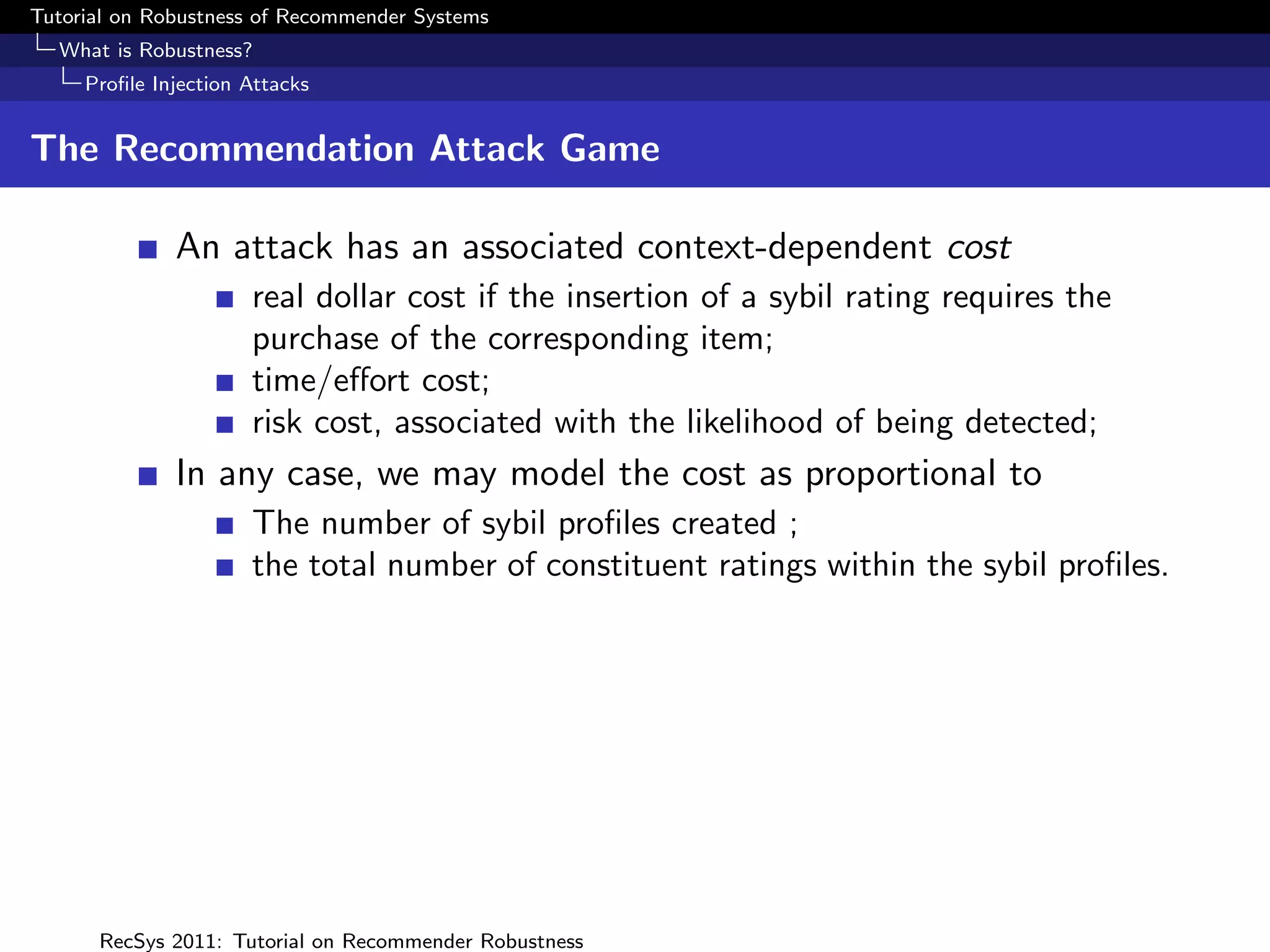
  • 193.
    Tutorial on Robustnessof Recommender Systems Stability, Trust and Privacy References VI O’Mahony, M. P., Hurley, N. J. and Silvestre, G. C. M.: 2002, Promoting recommendations: An attack on collaborative filtering, in A. Hameurlain, R. Cicchetti and R. Traunm¨ller u (eds), DEXA, Vol. 2453 of Lecture Notes in Computer Science, Springer, pp. 494–503. O’Mahony, M. P., Hurley, N. J. and Silvestre, G. C. M.: 2006, Attacking recommender systems: The cost of promotion, Workshop on Recommender Systems at the 17th European Conference on Artificial Intelligence (ECAI’06), 28th–29th, Riva del Garda, Italy. RecSys 2011: Tutorial on Recommender Robustness
  • 194.
    Tutorial on Robustnessof Recommender Systems Stability, Trust and Privacy References VII Resnick, P. and Sami, R.: 2007, The influence limiter: provably manipulation-resistant recommender systems, RecSys ’07: Proceedings of the 2007 ACM conference on Recommender systems, ACM, New York, NY, USA, pp. 25–32. Vu, L.-H., Papaioannou, T. and Aberer, K.: 2010, Impact of trust management and information sharing to adversarial cost in ranking systems, in M. Nishigaki, A. Jsang, Y. Murayama and S. Marsh (eds), Trust Management IV, Vol. 321 of IFIP Advances in Information and Communication Technology, Springer Boston, pp. 108–124. RecSys 2011: Tutorial on Recommender Robustness
  • 195.
    Tutorial on Robustnessof Recommender Systems Stability, Trust and Privacy References VIII Williams, C., Mobasher, B., Burke, R., Bhaumik, R. and Sandvig, J.: 2006, Detection of obfuscated attacks in collaborative recommender systems, In Proceedings of the 17th European Conference on Artificial Intelligence (ECAI’06) . Wu, G., Greene, D. and Cunningham, P.: 2010, Merging multiple criteria to identify suspicious reviews, in X. Amatriain, M. Torrens, P. Resnick and M. Zanker (eds), RecSys, ACM, pp. 241–244. Yan, X. and Roy, B. V.: 2009, Manipulation robustness of collaborative filtering systems, CoRR abs/0903.0064. RecSys 2011: Tutorial on Recommender Robustness