Dental Anatomy
Lecture 2
Numbering Systems , Tooth Parts
Prior by #
A. Permanent Teeth
1- Universal Notation System
Prior by #
A. Permanent Teeth Examples ;
#11: Permanent Maxillary Left Canine.
#29: Permanent Mandibular Right Second Premolar.
#8: Permanent Maxillary Right Central Incisor.
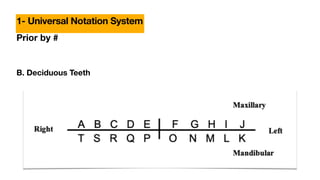
1- Universal Notation System
Prior by #
B. Deciduous Teeth
1- Universal Notation System
Prior by #
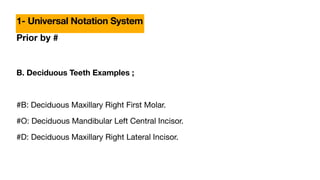
B. Deciduous Teeth Examples ;
#B: Deciduous Maxillary Right First Molar.
#O: Deciduous Mandibular Left Central Incisor.
#D: Deciduous Maxillary Right Lateral Incisor.
1- Universal Notation System
Divided by Quadrants
A. Permanent Teeth
2- Palmer Notation System
Divided by Quadrants
A. Permanent Teeth Examples ;
6 : Permanent Maxillary Right First Molar.
3 : Permanent Mandibular Left Canine.
8 : Permanent Maxillary Left Third Molar.
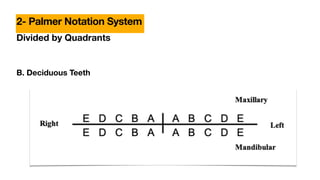
2- Palmer Notation System
Divided by Quadrants
B. Deciduous Teeth
2- Palmer Notation System
Divided by Quadrants
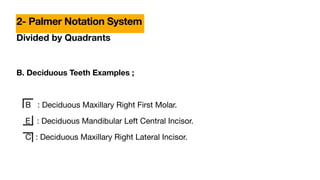
B. Deciduous Teeth Examples ;
B : Deciduous Maxillary Right First Molar.
E : Deciduous Mandibular Left Central Incisor.
C : Deciduous Maxillary Right Lateral Incisor.
2- Palmer Notation System
Two-Digit
A. Permanent Teeth
3- FDI Notation System (Fédération Dentaire Internationale) )
Two-Digit
A. Permanent Teeth Examples ;
16 : Permanent Maxillary Right First Molar.
33 : Permanent Mandibular Left Canine.
28 : Permanent Maxillary Left Third Molar.
3- FDI Notation System (Fédération Dentaire Internationale)
)
Two-Digit
B. Deciduous Teeth
3- FDI Notation System (Fédération Dentaire Internationale) )
Two-Digit
B. Deciduous Teeth Examples ;
54 : Deciduous Maxillary Right First Molar.
71 : Deciduous Mandibular Left Central Incisor.
52 : Deciduous Maxillary Right Lateral Incisor.
3- FDI Notation System (Fédération Dentaire Internationale) )
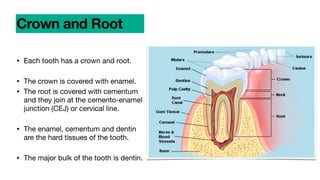
• Each tooth has a crown and root.
• The crown is covered with enamel.
• The root is covered with cementum
and they join at the cemento-enamel
junction (CEJ) or cervical line.
• The enamel, cementum and dentin
are the hard tissues of the tooth.
• The major bulk of the tooth is dentin.
Crown and Root
• Dental pulp: is the soft
tissue of the tooth and
present in the pulp chamber
and pulp canal.
• Pulp chamber: is the part of
dental pulp in the crown.
• Pulp canal: is the part of
dental pulp in the root.
Crown and Root
• Anatomical crown: is the
portion of the tooth which is
covered by enamel.
• Clinical crown: is the portion of
the tooth which is visible in the
mouth.
• In healthy person, the
anatomical crown is larger than
the clinical crown.
Crown
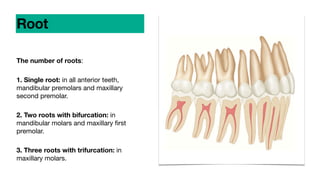
The number of roots:
1. Single root: in all anterior teeth,
mandibular premolars and maxillary
second premolar.
2. Two roots with bifurcation: in
mandibular molars and maxillary
fi
rst
premolar.
3. Three roots with trifurcation: in
maxillary molars.
Root
• The crowns of incisors and
canines have 4 surfaces
and a ridge.
• The crowns of the
premolars and molars
have 5 surfaces.
Surfaces and Ridges
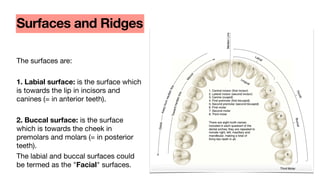
The surfaces are:
1. Labial surface: is the surface which
is towards the lip in incisors and
canines (= in anterior teeth).
2. Buccal surface: is the surface
which is towards the cheek in
premolars and molars (= in posterior
teeth).
The labial and buccal surfaces could
be termed as the "Facial" surfaces.
Surfaces and Ridges
3. Lingual surface: is the surface
which is facing the tongue (all
teeth).
Palatal surface could be term in
maxillary teeth only.
Surfaces and Ridges
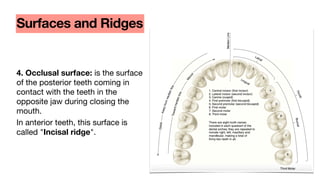
4. Occlusal surface: is the surface
of the posterior teeth coming in
contact with the teeth in the
opposite jaw during closing the
mouth.
In anterior teeth, this surface is
called "Incisal ridge".
Surfaces and Ridges
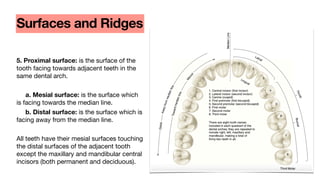
5. Proximal surface: is the surface of the
tooth facing towards adjacent teeth in the
same dental arch.
a. Mesial surface: is the surface which
is facing towards the median line.
b. Distal surface: is the surface which is
facing away from the median line.
All teeth have their mesial surfaces touching
the distal surfaces of the adjacent tooth
except the maxillary and mandibular central
incisors (both permanent and deciduous).
Surfaces and Ridges
the area of the mesial or
distal surface of the tooth
which touches its
neighbor in the arch.
Contact area
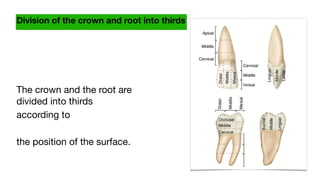
The crown and the root are
divided into thirds
according to
the position of the surface.
Division of the crown and root into thirds
it is formed by the
junction of two surfaces
and gets its name from
these surfaces.
Example: mesio-labial
line angle.
Line Angle
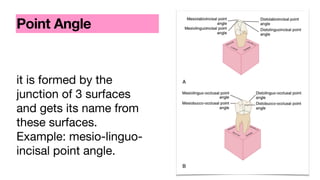
it is formed by the
junction of 3 surfaces
and gets its name from
these surfaces.
Example: mesio-linguo-
incisal point angle.
Point Angle
END

Tutorial, Lecture 2.pdf

  • 1.
  • 2.
    Prior by # A.Permanent Teeth 1- Universal Notation System
  • 3.
    Prior by # A.Permanent Teeth Examples ; #11: Permanent Maxillary Left Canine. #29: Permanent Mandibular Right Second Premolar. #8: Permanent Maxillary Right Central Incisor. 1- Universal Notation System
  • 4.
    Prior by # B.Deciduous Teeth 1- Universal Notation System
  • 5.
    Prior by # B.Deciduous Teeth Examples ; #B: Deciduous Maxillary Right First Molar. #O: Deciduous Mandibular Left Central Incisor. #D: Deciduous Maxillary Right Lateral Incisor. 1- Universal Notation System
  • 6.
    Divided by Quadrants A.Permanent Teeth 2- Palmer Notation System
  • 7.
    Divided by Quadrants A.Permanent Teeth Examples ; 6 : Permanent Maxillary Right First Molar. 3 : Permanent Mandibular Left Canine. 8 : Permanent Maxillary Left Third Molar. 2- Palmer Notation System
  • 8.
    Divided by Quadrants B.Deciduous Teeth 2- Palmer Notation System
  • 9.
    Divided by Quadrants B.Deciduous Teeth Examples ; B : Deciduous Maxillary Right First Molar. E : Deciduous Mandibular Left Central Incisor. C : Deciduous Maxillary Right Lateral Incisor. 2- Palmer Notation System
  • 10.
    Two-Digit A. Permanent Teeth 3-FDI Notation System (Fédération Dentaire Internationale) )
  • 11.
    Two-Digit A. Permanent TeethExamples ; 16 : Permanent Maxillary Right First Molar. 33 : Permanent Mandibular Left Canine. 28 : Permanent Maxillary Left Third Molar. 3- FDI Notation System (Fédération Dentaire Internationale) )
  • 12.
    Two-Digit B. Deciduous Teeth 3-FDI Notation System (Fédération Dentaire Internationale) )
  • 13.
    Two-Digit B. Deciduous TeethExamples ; 54 : Deciduous Maxillary Right First Molar. 71 : Deciduous Mandibular Left Central Incisor. 52 : Deciduous Maxillary Right Lateral Incisor. 3- FDI Notation System (Fédération Dentaire Internationale) )
  • 14.
    • Each toothhas a crown and root. • The crown is covered with enamel. • The root is covered with cementum and they join at the cemento-enamel junction (CEJ) or cervical line. • The enamel, cementum and dentin are the hard tissues of the tooth. • The major bulk of the tooth is dentin. Crown and Root
  • 15.
    • Dental pulp:is the soft tissue of the tooth and present in the pulp chamber and pulp canal. • Pulp chamber: is the part of dental pulp in the crown. • Pulp canal: is the part of dental pulp in the root. Crown and Root
  • 16.
    • Anatomical crown:is the portion of the tooth which is covered by enamel. • Clinical crown: is the portion of the tooth which is visible in the mouth. • In healthy person, the anatomical crown is larger than the clinical crown. Crown
  • 17.
    The number ofroots: 1. Single root: in all anterior teeth, mandibular premolars and maxillary second premolar. 2. Two roots with bifurcation: in mandibular molars and maxillary fi rst premolar. 3. Three roots with trifurcation: in maxillary molars. Root
  • 18.
    • The crownsof incisors and canines have 4 surfaces and a ridge. • The crowns of the premolars and molars have 5 surfaces. Surfaces and Ridges
  • 19.
    The surfaces are: 1.Labial surface: is the surface which is towards the lip in incisors and canines (= in anterior teeth). 2. Buccal surface: is the surface which is towards the cheek in premolars and molars (= in posterior teeth). The labial and buccal surfaces could be termed as the "Facial" surfaces. Surfaces and Ridges
  • 20.
    3. Lingual surface:is the surface which is facing the tongue (all teeth). Palatal surface could be term in maxillary teeth only. Surfaces and Ridges
  • 21.
    4. Occlusal surface:is the surface of the posterior teeth coming in contact with the teeth in the opposite jaw during closing the mouth. In anterior teeth, this surface is called "Incisal ridge". Surfaces and Ridges
  • 22.
    5. Proximal surface:is the surface of the tooth facing towards adjacent teeth in the same dental arch. a. Mesial surface: is the surface which is facing towards the median line. b. Distal surface: is the surface which is facing away from the median line. All teeth have their mesial surfaces touching the distal surfaces of the adjacent tooth except the maxillary and mandibular central incisors (both permanent and deciduous). Surfaces and Ridges
  • 23.
    the area ofthe mesial or distal surface of the tooth which touches its neighbor in the arch. Contact area
  • 24.
    The crown andthe root are divided into thirds according to the position of the surface. Division of the crown and root into thirds
  • 25.
    it is formedby the junction of two surfaces and gets its name from these surfaces. Example: mesio-labial line angle. Line Angle
  • 26.
    it is formedby the junction of 3 surfaces and gets its name from these surfaces. Example: mesio-linguo- incisal point angle. Point Angle
  • 27.