Turkey Mergers & Acquisitions
Technology and Digital
2010-2016
August 2017
About the Authors
Burcu Bıçakçı Ersoy is a management consultant with the Istanbul office of Egon Zehnder. She leads the
Telecommunications practice group globally and Digital practice in Turkey. You can contact her by e-mail at
burcu.bicakci@egonzehnder.com
Aslı Tekinbaş is a researcher with the Istanbul office of Egon Zehnder. You can contact her by email at
asli.tekinbas@egonzehnder.com.
2
Executive Summary
As an executive search and leadership
consulting firm; Egon Zehnder‘s Technology
and Communications Practice Group has a
special focus on interpreting the disruptive
forces of “digital” across industries and its talent
implications. Egon Zehnder emphasizes that a
fundamental element of digital transformation
is about the talent that drives the change; and
digital start-ups are the engine to grow talent in
this space.
Mergers and Acquisitions (M&A) in the
ecosystem of technology and digital companies
is a major source of information demonstrating
how internet businesses are evolving and the
disruption they would create in other industries
over time. In Turkey’s technology and digital
landscape; the transaction sizes still remain to
be low; but the number of transactions increased
significantly in the past 5 years.
This report analyses all the M&A activity in the
technology and digital ecosystem between 2010
and 2016 in Turkey and tries to shed light to the
evolution of the market and the talent landscape
associated with it.
Unfortunately; most of the deals in Turkey are
made with undisclosed amounts; hence the
analysis in this report is based on number of
deals rather than the amount of investment
flowing into deals.
The research revealed that;
•	 Despite the political and economic challenges
Turkey has been going through since 2015
and which got worse in 2016, number of
investments in the technology companies have
significantly increased in 2016. Although we
don’t have the data to report on the amount
of investment; we also estimate that it has
increased from 2015 to 2016.
•	 The investment into the start-ups in Turkey
is in the hands of an increasing number of
angel investors, VCs and Angel Networks.
There is limited interest from Private Equity
funds to the technology companies; and the
Venture Capitals invest very limited funds.
Nevertheless, there is significant consolidation
going on in a few areas (digital marketing
agencies, systems integration, software, call
center and outsourcing).
•	 E-commerce and market place stays ahead of
all the other industries in terms of keeping
the investor focus and the growth potential is
still there. Market place is gaining speed while
e-commerce is slowing down.
•	 Significant brain drain started and majority
of the talent that leaves the country is in
technology industry. Turkish engineers are
highly educated and are in demand from all
around the world. We expect the impact of
this move to be negative in the short term,
but might be positive in the mid-term if the
country goes on a positive trajectory and
such talent comes back more experienced or
decides to invest into technology companies in
Turkey.
3
Deal Statistics
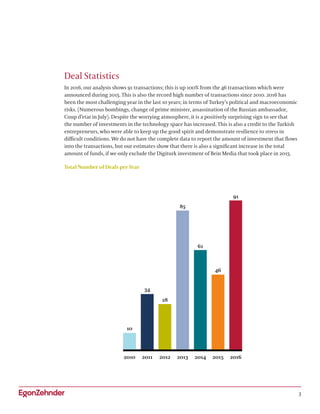
In 2016, our analysis shows 91 transactions; this is up 100% from the 46 transactions which were
announced during 2015. This is also the record high number of transactions since 2010. 2016 has
been the most challenging year in the last 10 years; in terms of Turkey’s political and macroeconomic
risks. (Numerous bombings, change of prime minister, assassination of the Russian ambassador,
Coup d’etat in July). Despite the worrying atmosphere, it is a positively surprising sign to see that
the number of investments in the technology space has increased. This is also a credit to the Turkish
entrepreneurs, who were able to keep up the good spirit and demonstrate resilience to stress in
difficult conditions. We do not have the complete data to report the amount of investment that flows
into the transactions, but our estimates show that there is also a significant increase in the total
amount of funds, if we only exclude the Digiturk investment of Bein Media that took place in 2015.
Total Number of Deals per Year
2010
10
2011
34
2012
28
2013
85
2014
61
2015
46
2016
91
4
Buyer Landscape
In 2016, we have seen an increase in the number
and diversity of active angel investors. Some
of the “usual suspects” of 2015 still continued
their investment activity (such as Nevzat Aydın,
Selçuk Saraç and Sina Afra) while the most active
investor of 2015; Hasan Aslanoba had less share in
2016. Unfortunately, two of the most promising
investments of Hasan Aslanoba; tazedirekt.com
and incir.com decided to close business in 2016
due to the difficult economic conditions. The
new private investors that joined the club mostly
come from serial entrepreneurs but also some
corporate professionals and wealthy family firm
owners. The latter two groups are very important
for creating role models and bringing more funds
and angel investor appetite to the ecosystem
through word of mouth.
The private equity investments stayed low in
2016. Private equity funds prefer investing
into more mature industries rather than start-
up companies; and the more mature part of
technology companies hasn’t been their focus
in 2016. The only PE transaction that took place
was the acquisition of Taxim Capital of Netcad;
an established Engineering and Design software
company.
On the contrary, VCs and Angel Networks have
been more active in 2016 compared to the
years before. ACT Venture Partners, BIC Angels,
Earlybird, Hummingbird, Galata Business Angels,
Aslanoba Capital, StartersHub, Şirket Ortağım are
examples with few investments. Revo Capital was
one of the most active VCs with 6 investments.
V-Count, Peoplise, Digiform, Paraşüt, ACL Teslim
and Cardtek were all investments of Revo Capital
in 2016.
24 out of the 91 transactions in 2016 happened as
an acquisition of a company by another; 11 of the
24 transactions happened between two Turkish
companies and the rest were investments from
foreign companies to Turkish companies. One of
the most important foreign investments of the
year was the acquisition of 48% of the shares of
Netaş by the Chinese ZTE. The origin of countries
investing into Turkish companies varies from USA
to France, China, Japan, South Africa and Italy.
We see a consolidation in marketing agencies for
the past few years; again in 2016 there were few
transactions in this context: Publicis Groupe’s
acquisition of Digitouch and Publicis Yorum,
Related Group’s acquisition of Semanticum,
J.Walter Thompson’s acquisition of Wanda Digital
are examples. Another industry where we start
observing consolidations globally is call center
and outsourcing industry. Turkey is no exception
to this. Comdata’s acquisition of Win Bilgi
İletişim Hizmetleri is an example that supports
this trend. Finally, the traditional industries
such as systems integration, distribution
and value added reseller business models,
telecommunication, software development
houses are subject to consolidation, hence a
considerable amount of transaction happened in
this space.
5
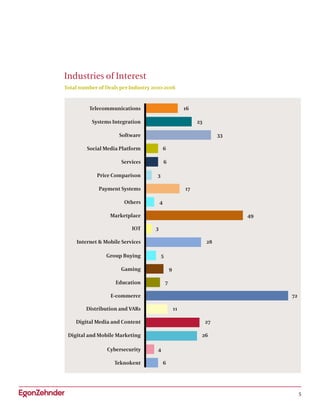
Industries of Interest
Total number of Deals per Industry 2010-2016
Telecommunications 16
Marketplace 49
Services 6
Gaming 9
Digital Media and Content 27
Software 33
Internet  Mobile Services 28
Payment Systems 17
E-commerce 72
Cybersecurity 4
Systems Integration 23
IOT 3
Price Comparison 3
Education 7
Digital and Mobile Marketing 26
Social Media Platform 6
Group Buying 5
Others 4
Distribution and VARs 11
Teknokent 6
Turkish e-commerce has exceeded 30 billion TL in 2016 and continues to grow more than 20%
annually. (Actual growth from 2015 to 2016 has been 24%) This corresponds to 3,5% of all retail
business in Turkey. E-commerce represents around 15% in developed economies like UK; hence there
is still great opportunity in this segment in Turkey. E-commerce and marketplaces, which is a different
version of e-commerce are the two leading categories of concentration for entrepreneurs and
investors; as demonstrated by the graph above. It is important to note that the number of investments
in e-commerce is slowing down while marketplace investments increase. This is the market reaction
to the profitability problems of e-commerce companies as well as the balance sheet risk with regards
to slow moving inventory. Marketplace business models address these problems with no stock on
balance sheet, however profitability of such models can be lower than the standard e-commerce
companies; and the customer experience standardization requires a great process discipline. In the
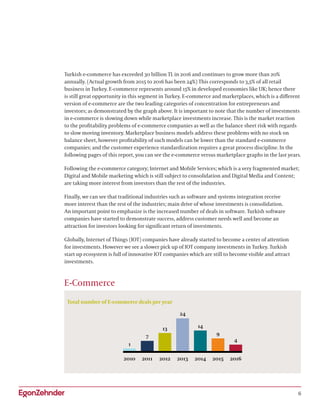
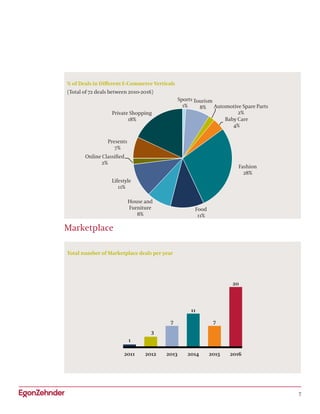
following pages of this report, you can see the e-commerce versus marketplace graphs in the last years.
Following the e-commerce category; Internet and Mobile Services; which is a very fragmented market;
Digital and Mobile marketing which is still subject to consolidation and Digital Media and Content;
are taking more interest from investors than the rest of the industries.
Finally, we can see that traditional industries such as software and systems integration receive
more interest than the rest of the industries; main drive of whose investments is consolidation.
An important point to emphasize is the increased number of deals in software. Turkish software
companies have started to demonstrate success, address customer needs well and become an
attraction for investors looking for significant return of investments.
Globally, Internet of Things (IOT) companies have already started to become a center of attention
for investments. However we see a slower pick up of IOT company investments in Turkey. Turkish
start up ecosystem is full of innovative IOT companies which are still to become visible and attract
investments.
E-Commerce
6
2010
1
2011
7
2012
13
2013
24
2014
14
2015
9
2016
4
Total number of E-commerce deals per year
7
% of Deals in Different E-Commerce Verticals
(Total of 72 deals between 2010-2016)
Total number of Marketplace deals per year
Sports
1%
Tourism
8%
Baby Care
4%
Fashion
28%
Food
11%
Lifestyle
11%
Presents
7%
Private Shopping
18%
Online Classified
2%
House and
Furniture
8%
Automotive Spare Parts
2%
Marketplace
2011 2012 2013 2014 2015 2016
1
3
7 7
11
20
8
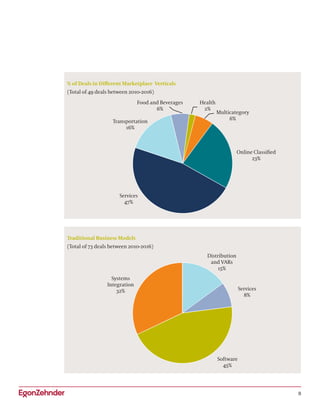
% of Deals in Different Marketplace Verticals
(Total of 49 deals between 2010-2016)
Traditional Business Models
(Total of 73 deals between 2010-2016)
Transportation
16%
Health
2%
Food and Beverages
6%
Multicategory
6%
Online Classified
23%
Services
47%
Distribution
and VARs
15%
Software
45%
Systems
Integration
32% Services
8%
9
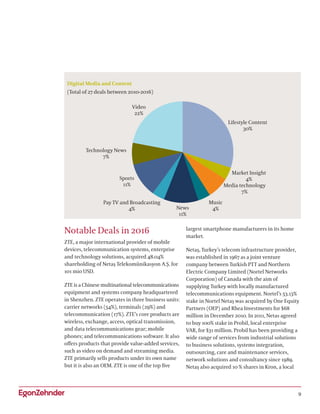
Digital Media and Content
(Total of 27 deals between 2010-2016)
Video
22%
Lifestyle Content
30%
Market Insight
4%
Media technology
7%
Music
4%
Sports
11%
Technology News
7%
Pay TV and Broadcasting
4% News
11%
Notable Deals in 2016
ZTE, a major international provider of mobile
devices, telecommunication systems, enterprise
and technology solutions, acquired 48.04%
shareholding of Netaş Telekomünikasyon A.Ş. for
101 mio USD.
ZTE is a Chinese multinational telecommunications
equipment and systems company headquartered
in Shenzhen. ZTE operates in three business units:
carrier networks (54%), terminals (29%) and
telecommunication (17%). ZTE’s core products are
wireless, exchange, access, optical transmission,
and data telecommunications gear; mobile
phones; and telecommunications software. It also
offers products that provide value-added services,
such as video on demand and streaming media.
ZTE primarily sells products under its own name
but it is also an OEM. ZTE is one of the top five
largest smartphone manufacturers in its home
market.
Netaş, Turkey’s telecom infrastructure provider,
was established in 1967 as a joint venture
company between Turkish PTT and Northern
Electric Company Limited (Nortel Networks
Corporation) of Canada with the aim of
supplying Turkey with locally manufactured
telecommunications equipment. Nortel’s 53.13%
stake in Nortel Netaş was acquired by One Equity
Partners (OEP) and Rhea Investments for $68
million in December 2010. In 2011, Netas agreed
to buy 100% stake in Probil, local enterprise
VAR, for $31 million. Probil has been providing a
wide range of services from industrial solutions
to business solutions, systems integration,
outsourcing, care and maintenance services,
network solutions and consultancy since 1989.
Netaş also acquired 10 % shares in Kron, a local
10
OSS software development company. Kron
Telekomünikasyon Hizmetleri A.Ş. produces
software solutions for national and regional
telecom operators and service providers. Netaş
acquired Group A shares of the company in 2013
in line with the strategic growth goal and the
purpose of offering innovative solutions to its
customers. Having strengthened its capabilities
in the field of systems integration with the
acquisition of Kron, Netaş now provides a wider
range of end-to-end solutions to its customers
in Turkey and in the region. Complementing
its 40 years of experience in the area of
telecommunications and local technology, Netaş
has expertise in the area of wireline and wireless
voice  data communications and optical
infrastructure.
Turkey Talent Landscape
As the world becomes digitalized and
entrepreneurship becomes a viable option as a
career; the talent landscape starts evolving in a
new direction.
•	 New graduates – More and more graduates
from top universities consider joining start-
ups or founding their own companies after
school. Increasingly, there are business
angel networks, incubation centers,
entrepreneurship classes that are getting into
the lives of these young individuals. Seeing the
young billionaires who were not very different
from them when they started their businesses
are inspirational role models for the young
population. This is a sign for a better future of
Turkish start up ecosystem in 5 years from now;
given that funding is made available to boost
this population’s ideas.
•	 Young and innovative digital talent – This is
the most demanded talent in the market; both
from start-ups in every stage and corporate
companies to play key roles in their digital
roles or digital transformation journey.
This group can be described as; 5-15 years
experienced (in digital roles in corporate
structures, pure players or start-ups) digitally
savvy talent with specific domain expertise.
The domain examples are UI/UX, analytics,
marketing, coding, mobility. This talent can
be described with their strong passion for
their domain, style of freedom and casualty,
creativity, hard work, flexibility and low ego.
They change jobs frequently and are priced
above market average. They are self-confident
and would only stick to a role if they feel the
cultural fit to the environment. They are in
the edge of running their own business and
continuing a corporate career; most have
experience in both sides of the table.
•	 Mid-career; experienced corporate executives –
Digitally savvy experienced executives started
to grow a tendency to dive into the world of
digital ventures during a career break or with
an intentional leave from their corporate
careers. While some of these executives
become successful, some end up going back
to corporate careers; since finding capital
is not easy and their lives and families don’t
give them the flexibility to burn money for a
long time. Some members of this group try
to run a start up as a side business to core
responsibilities; however this is generally not
an effective model for creating a successful
venture. Some act as investors but their funds
are limited; hence significant impact doesn’t
come from this group.
•	 Senior; very experienced corporate executives –
These are generally top executives who leave
their positions and have a passion for the
11
world of digital start-ups, are very networked
and credible which gives them the option of
creating a fund or acting as an investor to a
portfolio of companies to diversify risks. This
model resulted in a few successful ventures to
be funded and it is a promising career option
for the executive leading the effort.
•	 Retired executives from senior positions with
board careers – These executives leverage their
extensive network and market credibility
and invest in some of the start-ups as angel
investors or into funds as contributors to
a portfolio. They are great sources to open
doors and accelerate the growth of ventures;
but their involvement in start-up boards
might prove to create some bureaucracy and
inefficiencies.
In 2016, we started to observe a brain drain of
talent in every level. The political and economic
downturn in Turkey that started in 2015 and
worsened in 2016 has been the reason for many
high potential executives to give a fundamental
decision to relocate out of Turkey. Most of the
young and digitally savvy talent is demanded
from western geographies such as UK and
USA while more seasoned executives are more
demanded from Middle East and Far East.
This will for sure have a longer term impact
to the Turkish start up ecosystem. Some of the
talent that migrates from Turkey could have a
positive spill-over effect if they later on invest
in Turkish start-up companies, or if they would
return in a few years with a deeper experience
in entrepreneurship. Without a doubt, Turkey is
going through challenging times for businesses
that are trying to prosper; and talent is still the
scarcest resource as a barrier to growth.
12
Appendix
Definitions and Scope
•	 All deals from media industry that has a relevancy to digital transformation of media has been
included as part of this study. For example transactions involving the ownership change of free to
air TV channels or radio channels are excluded while digital and mobile marketing agencies are
included. Digital and on demand broadcasting platforms such as Digiturk are included.
•	 Definition of e-commerce vs marketplace: If the products visual presentation (i.e. studio); pricing;
invoicing happens through the website, this is considered e-commerce. Platforms/websites; which
facilitate the transaction by providing a platform and not directly invoicing the customer are called
a marketplace
•	 Definition of “Lifestyle”: All personal hobby items such as food, personal care, cinema, books,
weddings, are classified as “lifestyle”
References
•	 http://www.ey.com/Publication/vwLUAssets/MA_2016_Raporu/%24FILE/EY_MA_2016.pdf
•	 https://www2.deloitte.com/content/dam/Deloitte/tr/Documents/technology-media-
telecommunications/TUBISAD-2017-eticaret-sunum.pdf
•	 https://webrazzi.com/2016/06/15/publicis-groupe-turkiyeden-digitouchin-tamamini-satin-aldi/
•	 https://webrazzi.com/2016/03/02/hasan-aslanoba-tazedirekti-neden-kapattigini-anlatti/
•	 http://portal.netcad.com.tr/pages/viewpage.action?pageId=141754571
•	 https://www.prnewswire.com/news-releases/cardtek-joins-forces-with-mv-holding-and-revo-
capital-to-become-a-top-10-global-fintech-player-574600351.html
•	 http://www.fortuneturkey.com/comdata-turkiye-win-bilgi-iletisimi-satin-aliyor-36191
•	 http://ceelegalmatters.com/index.php/turkey/4635-bts-partners-and-gokce-attorney-partnership-
advise-on-revo-capital-investment-in-v-count
•	 https://egirisim.com/2016/07/15/insan-sayma-sistemleri-girisimi-v-count-revo-capitalden-14-
milyon-dolar-yatirim-aldi/
•	 https://www.dunya.com/sirketler/revo-capital039den-2-sirkete-yatirim-haberi-320802
•	 https://www.dunya.com/sirketler/parasut-ribbit-capital-ile-ikinci-tur-yatirimi-kapatti-haberi-277114
•	 https://webrazzi.com/2015/02/25/bulut-tabanli-fatura-yonetim-uygulamasi-parasut-revo-capital-
yatirim/
•	 https://index.co/company/revovc/overview
•	 https://www.etohum.com/blog-tr/acl-teslim-250-bin-dolarlik-tohum-yatirimi-aldi/
•	 http://www.bthaber.com/bilisim-dunyasi/netcad-kuresel-bir-sirket-olma-yolunda-ilerliyor/1/19899
•	 https://www.crunchbase.com/organization/aslanoba-capital
•	 https://www.crunchbase.com/organization/galata-business-angels
•	 http://www.zte.com.cn/global/
•	 http://www.zte.com.cn/global/about/press-center/news/201612ma/1206
•	 http://www.reuters.com/article/zte-netas-telekom-acquisition-idUSL4N1E10WY
•	 http://www.netas.com.tr/en/corporate/
•	 http://www.wpp.com/wpp/investor/financialnews/2016/aug/04/j-walter-thompson-company-
agrees-to-acquire-majority-stake-in-wanda-digital-in-turkey/
•	 http://www.therelated.net/
13
© 2017 Egon Zehnder International, Inc.
All rights reserved.
No part of this publication may be reproduced, stored in a retrieval
system or transmitted in any form or by any means — electronic,
mechanical, photocopying, recording or otherwise — without the prior
permission of Egon Zehnder.
Amsterdam
Athens
Atlanta
Bangalore
Barcelona
Beijing
Berlin
Bogotá
Boston
Bratislava
Brussels
Budapest
Buenos Aires
Calgary
Chicago
Copenhagen
Dallas
Dubai
Düsseldorf
Frankfurt
Geneva
Hamburg
Helsinki
Hong Kong
Houston
Istanbul
Jakarta
Jeddah
Johannesburg
Kuala Lumpur
Lisbon
London
Los Angeles
Luxembourg
Lyon
Madrid
Malmö
Melbourne
Mexico
Miami
Milan
Montreal
Moscow
Mumbai
Munich
New Delhi
New York
Oslo
Palo Alto
Paris
Prague
Rio de Janeiro
Rome
San Francisco
Santiago
São Paulo
Seoul
Shanghai
Singapore
Stockholm
Stuttgart
Sydney
Tel Aviv
Tokyo
Toronto
Vienna
Warsaw
Washington, D.C.
Zurich
Since 1964, Egon Zehnder has been at the forefront of defining great
leadership in the face of changing economic conditions, emerging
opportunities and evolving business goals. With more than 440
consultants in 69 offices and 41 countries around the globe, we work
closely with public and private corporations, family-owned enterprises
and nonprofit and government agencies to provide board advisory
services, CEO and leadership succession planning, executive search
and assessment, and leadership development. For more information
visit www.egonzehnder.com and follow us on LinkedIn, Twitter, and
Instagram.

Turkish Technology Sector M&A report 2017

  • 1.
    Turkey Mergers &Acquisitions Technology and Digital 2010-2016 August 2017 About the Authors Burcu Bıçakçı Ersoy is a management consultant with the Istanbul office of Egon Zehnder. She leads the Telecommunications practice group globally and Digital practice in Turkey. You can contact her by e-mail at burcu.bicakci@egonzehnder.com Aslı Tekinbaş is a researcher with the Istanbul office of Egon Zehnder. You can contact her by email at asli.tekinbas@egonzehnder.com.
  • 2.
    2 Executive Summary As anexecutive search and leadership consulting firm; Egon Zehnder‘s Technology and Communications Practice Group has a special focus on interpreting the disruptive forces of “digital” across industries and its talent implications. Egon Zehnder emphasizes that a fundamental element of digital transformation is about the talent that drives the change; and digital start-ups are the engine to grow talent in this space. Mergers and Acquisitions (M&A) in the ecosystem of technology and digital companies is a major source of information demonstrating how internet businesses are evolving and the disruption they would create in other industries over time. In Turkey’s technology and digital landscape; the transaction sizes still remain to be low; but the number of transactions increased significantly in the past 5 years. This report analyses all the M&A activity in the technology and digital ecosystem between 2010 and 2016 in Turkey and tries to shed light to the evolution of the market and the talent landscape associated with it. Unfortunately; most of the deals in Turkey are made with undisclosed amounts; hence the analysis in this report is based on number of deals rather than the amount of investment flowing into deals. The research revealed that; • Despite the political and economic challenges Turkey has been going through since 2015 and which got worse in 2016, number of investments in the technology companies have significantly increased in 2016. Although we don’t have the data to report on the amount of investment; we also estimate that it has increased from 2015 to 2016. • The investment into the start-ups in Turkey is in the hands of an increasing number of angel investors, VCs and Angel Networks. There is limited interest from Private Equity funds to the technology companies; and the Venture Capitals invest very limited funds. Nevertheless, there is significant consolidation going on in a few areas (digital marketing agencies, systems integration, software, call center and outsourcing). • E-commerce and market place stays ahead of all the other industries in terms of keeping the investor focus and the growth potential is still there. Market place is gaining speed while e-commerce is slowing down. • Significant brain drain started and majority of the talent that leaves the country is in technology industry. Turkish engineers are highly educated and are in demand from all around the world. We expect the impact of this move to be negative in the short term, but might be positive in the mid-term if the country goes on a positive trajectory and such talent comes back more experienced or decides to invest into technology companies in Turkey.
  • 3.
    3 Deal Statistics In 2016,our analysis shows 91 transactions; this is up 100% from the 46 transactions which were announced during 2015. This is also the record high number of transactions since 2010. 2016 has been the most challenging year in the last 10 years; in terms of Turkey’s political and macroeconomic risks. (Numerous bombings, change of prime minister, assassination of the Russian ambassador, Coup d’etat in July). Despite the worrying atmosphere, it is a positively surprising sign to see that the number of investments in the technology space has increased. This is also a credit to the Turkish entrepreneurs, who were able to keep up the good spirit and demonstrate resilience to stress in difficult conditions. We do not have the complete data to report the amount of investment that flows into the transactions, but our estimates show that there is also a significant increase in the total amount of funds, if we only exclude the Digiturk investment of Bein Media that took place in 2015. Total Number of Deals per Year 2010 10 2011 34 2012 28 2013 85 2014 61 2015 46 2016 91
  • 4.
    4 Buyer Landscape In 2016,we have seen an increase in the number and diversity of active angel investors. Some of the “usual suspects” of 2015 still continued their investment activity (such as Nevzat Aydın, Selçuk Saraç and Sina Afra) while the most active investor of 2015; Hasan Aslanoba had less share in 2016. Unfortunately, two of the most promising investments of Hasan Aslanoba; tazedirekt.com and incir.com decided to close business in 2016 due to the difficult economic conditions. The new private investors that joined the club mostly come from serial entrepreneurs but also some corporate professionals and wealthy family firm owners. The latter two groups are very important for creating role models and bringing more funds and angel investor appetite to the ecosystem through word of mouth. The private equity investments stayed low in 2016. Private equity funds prefer investing into more mature industries rather than start- up companies; and the more mature part of technology companies hasn’t been their focus in 2016. The only PE transaction that took place was the acquisition of Taxim Capital of Netcad; an established Engineering and Design software company. On the contrary, VCs and Angel Networks have been more active in 2016 compared to the years before. ACT Venture Partners, BIC Angels, Earlybird, Hummingbird, Galata Business Angels, Aslanoba Capital, StartersHub, Şirket Ortağım are examples with few investments. Revo Capital was one of the most active VCs with 6 investments. V-Count, Peoplise, Digiform, Paraşüt, ACL Teslim and Cardtek were all investments of Revo Capital in 2016. 24 out of the 91 transactions in 2016 happened as an acquisition of a company by another; 11 of the 24 transactions happened between two Turkish companies and the rest were investments from foreign companies to Turkish companies. One of the most important foreign investments of the year was the acquisition of 48% of the shares of Netaş by the Chinese ZTE. The origin of countries investing into Turkish companies varies from USA to France, China, Japan, South Africa and Italy. We see a consolidation in marketing agencies for the past few years; again in 2016 there were few transactions in this context: Publicis Groupe’s acquisition of Digitouch and Publicis Yorum, Related Group’s acquisition of Semanticum, J.Walter Thompson’s acquisition of Wanda Digital are examples. Another industry where we start observing consolidations globally is call center and outsourcing industry. Turkey is no exception to this. Comdata’s acquisition of Win Bilgi İletişim Hizmetleri is an example that supports this trend. Finally, the traditional industries such as systems integration, distribution and value added reseller business models, telecommunication, software development houses are subject to consolidation, hence a considerable amount of transaction happened in this space.
  • 5.
    5 Industries of Interest Totalnumber of Deals per Industry 2010-2016 Telecommunications 16 Marketplace 49 Services 6 Gaming 9 Digital Media and Content 27 Software 33 Internet Mobile Services 28 Payment Systems 17 E-commerce 72 Cybersecurity 4 Systems Integration 23 IOT 3 Price Comparison 3 Education 7 Digital and Mobile Marketing 26 Social Media Platform 6 Group Buying 5 Others 4 Distribution and VARs 11 Teknokent 6
  • 6.
    Turkish e-commerce hasexceeded 30 billion TL in 2016 and continues to grow more than 20% annually. (Actual growth from 2015 to 2016 has been 24%) This corresponds to 3,5% of all retail business in Turkey. E-commerce represents around 15% in developed economies like UK; hence there is still great opportunity in this segment in Turkey. E-commerce and marketplaces, which is a different version of e-commerce are the two leading categories of concentration for entrepreneurs and investors; as demonstrated by the graph above. It is important to note that the number of investments in e-commerce is slowing down while marketplace investments increase. This is the market reaction to the profitability problems of e-commerce companies as well as the balance sheet risk with regards to slow moving inventory. Marketplace business models address these problems with no stock on balance sheet, however profitability of such models can be lower than the standard e-commerce companies; and the customer experience standardization requires a great process discipline. In the following pages of this report, you can see the e-commerce versus marketplace graphs in the last years. Following the e-commerce category; Internet and Mobile Services; which is a very fragmented market; Digital and Mobile marketing which is still subject to consolidation and Digital Media and Content; are taking more interest from investors than the rest of the industries. Finally, we can see that traditional industries such as software and systems integration receive more interest than the rest of the industries; main drive of whose investments is consolidation. An important point to emphasize is the increased number of deals in software. Turkish software companies have started to demonstrate success, address customer needs well and become an attraction for investors looking for significant return of investments. Globally, Internet of Things (IOT) companies have already started to become a center of attention for investments. However we see a slower pick up of IOT company investments in Turkey. Turkish start up ecosystem is full of innovative IOT companies which are still to become visible and attract investments. E-Commerce 6 2010 1 2011 7 2012 13 2013 24 2014 14 2015 9 2016 4 Total number of E-commerce deals per year
  • 7.
    7 % of Dealsin Different E-Commerce Verticals (Total of 72 deals between 2010-2016) Total number of Marketplace deals per year Sports 1% Tourism 8% Baby Care 4% Fashion 28% Food 11% Lifestyle 11% Presents 7% Private Shopping 18% Online Classified 2% House and Furniture 8% Automotive Spare Parts 2% Marketplace 2011 2012 2013 2014 2015 2016 1 3 7 7 11 20
  • 8.
    8 % of Dealsin Different Marketplace Verticals (Total of 49 deals between 2010-2016) Traditional Business Models (Total of 73 deals between 2010-2016) Transportation 16% Health 2% Food and Beverages 6% Multicategory 6% Online Classified 23% Services 47% Distribution and VARs 15% Software 45% Systems Integration 32% Services 8%
  • 9.
    9 Digital Media andContent (Total of 27 deals between 2010-2016) Video 22% Lifestyle Content 30% Market Insight 4% Media technology 7% Music 4% Sports 11% Technology News 7% Pay TV and Broadcasting 4% News 11% Notable Deals in 2016 ZTE, a major international provider of mobile devices, telecommunication systems, enterprise and technology solutions, acquired 48.04% shareholding of Netaş Telekomünikasyon A.Ş. for 101 mio USD. ZTE is a Chinese multinational telecommunications equipment and systems company headquartered in Shenzhen. ZTE operates in three business units: carrier networks (54%), terminals (29%) and telecommunication (17%). ZTE’s core products are wireless, exchange, access, optical transmission, and data telecommunications gear; mobile phones; and telecommunications software. It also offers products that provide value-added services, such as video on demand and streaming media. ZTE primarily sells products under its own name but it is also an OEM. ZTE is one of the top five largest smartphone manufacturers in its home market. Netaş, Turkey’s telecom infrastructure provider, was established in 1967 as a joint venture company between Turkish PTT and Northern Electric Company Limited (Nortel Networks Corporation) of Canada with the aim of supplying Turkey with locally manufactured telecommunications equipment. Nortel’s 53.13% stake in Nortel Netaş was acquired by One Equity Partners (OEP) and Rhea Investments for $68 million in December 2010. In 2011, Netas agreed to buy 100% stake in Probil, local enterprise VAR, for $31 million. Probil has been providing a wide range of services from industrial solutions to business solutions, systems integration, outsourcing, care and maintenance services, network solutions and consultancy since 1989. Netaş also acquired 10 % shares in Kron, a local
  • 10.
    10 OSS software developmentcompany. Kron Telekomünikasyon Hizmetleri A.Ş. produces software solutions for national and regional telecom operators and service providers. Netaş acquired Group A shares of the company in 2013 in line with the strategic growth goal and the purpose of offering innovative solutions to its customers. Having strengthened its capabilities in the field of systems integration with the acquisition of Kron, Netaş now provides a wider range of end-to-end solutions to its customers in Turkey and in the region. Complementing its 40 years of experience in the area of telecommunications and local technology, Netaş has expertise in the area of wireline and wireless voice data communications and optical infrastructure. Turkey Talent Landscape As the world becomes digitalized and entrepreneurship becomes a viable option as a career; the talent landscape starts evolving in a new direction. • New graduates – More and more graduates from top universities consider joining start- ups or founding their own companies after school. Increasingly, there are business angel networks, incubation centers, entrepreneurship classes that are getting into the lives of these young individuals. Seeing the young billionaires who were not very different from them when they started their businesses are inspirational role models for the young population. This is a sign for a better future of Turkish start up ecosystem in 5 years from now; given that funding is made available to boost this population’s ideas. • Young and innovative digital talent – This is the most demanded talent in the market; both from start-ups in every stage and corporate companies to play key roles in their digital roles or digital transformation journey. This group can be described as; 5-15 years experienced (in digital roles in corporate structures, pure players or start-ups) digitally savvy talent with specific domain expertise. The domain examples are UI/UX, analytics, marketing, coding, mobility. This talent can be described with their strong passion for their domain, style of freedom and casualty, creativity, hard work, flexibility and low ego. They change jobs frequently and are priced above market average. They are self-confident and would only stick to a role if they feel the cultural fit to the environment. They are in the edge of running their own business and continuing a corporate career; most have experience in both sides of the table. • Mid-career; experienced corporate executives – Digitally savvy experienced executives started to grow a tendency to dive into the world of digital ventures during a career break or with an intentional leave from their corporate careers. While some of these executives become successful, some end up going back to corporate careers; since finding capital is not easy and their lives and families don’t give them the flexibility to burn money for a long time. Some members of this group try to run a start up as a side business to core responsibilities; however this is generally not an effective model for creating a successful venture. Some act as investors but their funds are limited; hence significant impact doesn’t come from this group. • Senior; very experienced corporate executives – These are generally top executives who leave their positions and have a passion for the
  • 11.
    11 world of digitalstart-ups, are very networked and credible which gives them the option of creating a fund or acting as an investor to a portfolio of companies to diversify risks. This model resulted in a few successful ventures to be funded and it is a promising career option for the executive leading the effort. • Retired executives from senior positions with board careers – These executives leverage their extensive network and market credibility and invest in some of the start-ups as angel investors or into funds as contributors to a portfolio. They are great sources to open doors and accelerate the growth of ventures; but their involvement in start-up boards might prove to create some bureaucracy and inefficiencies. In 2016, we started to observe a brain drain of talent in every level. The political and economic downturn in Turkey that started in 2015 and worsened in 2016 has been the reason for many high potential executives to give a fundamental decision to relocate out of Turkey. Most of the young and digitally savvy talent is demanded from western geographies such as UK and USA while more seasoned executives are more demanded from Middle East and Far East. This will for sure have a longer term impact to the Turkish start up ecosystem. Some of the talent that migrates from Turkey could have a positive spill-over effect if they later on invest in Turkish start-up companies, or if they would return in a few years with a deeper experience in entrepreneurship. Without a doubt, Turkey is going through challenging times for businesses that are trying to prosper; and talent is still the scarcest resource as a barrier to growth.
  • 12.
    12 Appendix Definitions and Scope • All deals from media industry that has a relevancy to digital transformation of media has been included as part of this study. For example transactions involving the ownership change of free to air TV channels or radio channels are excluded while digital and mobile marketing agencies are included. Digital and on demand broadcasting platforms such as Digiturk are included. • Definition of e-commerce vs marketplace: If the products visual presentation (i.e. studio); pricing; invoicing happens through the website, this is considered e-commerce. Platforms/websites; which facilitate the transaction by providing a platform and not directly invoicing the customer are called a marketplace • Definition of “Lifestyle”: All personal hobby items such as food, personal care, cinema, books, weddings, are classified as “lifestyle”
  • 13.
    References • http://www.ey.com/Publication/vwLUAssets/MA_2016_Raporu/%24FILE/EY_MA_2016.pdf • https://www2.deloitte.com/content/dam/Deloitte/tr/Documents/technology-media- telecommunications/TUBISAD-2017-eticaret-sunum.pdf • https://webrazzi.com/2016/06/15/publicis-groupe-turkiyeden-digitouchin-tamamini-satin-aldi/ • https://webrazzi.com/2016/03/02/hasan-aslanoba-tazedirekti-neden-kapattigini-anlatti/ • http://portal.netcad.com.tr/pages/viewpage.action?pageId=141754571 • https://www.prnewswire.com/news-releases/cardtek-joins-forces-with-mv-holding-and-revo- capital-to-become-a-top-10-global-fintech-player-574600351.html • http://www.fortuneturkey.com/comdata-turkiye-win-bilgi-iletisimi-satin-aliyor-36191 • http://ceelegalmatters.com/index.php/turkey/4635-bts-partners-and-gokce-attorney-partnership- advise-on-revo-capital-investment-in-v-count • https://egirisim.com/2016/07/15/insan-sayma-sistemleri-girisimi-v-count-revo-capitalden-14- milyon-dolar-yatirim-aldi/ • https://www.dunya.com/sirketler/revo-capital039den-2-sirkete-yatirim-haberi-320802 • https://www.dunya.com/sirketler/parasut-ribbit-capital-ile-ikinci-tur-yatirimi-kapatti-haberi-277114 • https://webrazzi.com/2015/02/25/bulut-tabanli-fatura-yonetim-uygulamasi-parasut-revo-capital- yatirim/ • https://index.co/company/revovc/overview • https://www.etohum.com/blog-tr/acl-teslim-250-bin-dolarlik-tohum-yatirimi-aldi/ • http://www.bthaber.com/bilisim-dunyasi/netcad-kuresel-bir-sirket-olma-yolunda-ilerliyor/1/19899 • https://www.crunchbase.com/organization/aslanoba-capital • https://www.crunchbase.com/organization/galata-business-angels • http://www.zte.com.cn/global/ • http://www.zte.com.cn/global/about/press-center/news/201612ma/1206 • http://www.reuters.com/article/zte-netas-telekom-acquisition-idUSL4N1E10WY • http://www.netas.com.tr/en/corporate/ • http://www.wpp.com/wpp/investor/financialnews/2016/aug/04/j-walter-thompson-company- agrees-to-acquire-majority-stake-in-wanda-digital-in-turkey/ • http://www.therelated.net/ 13
  • 14.
    © 2017 EgonZehnder International, Inc. All rights reserved. No part of this publication may be reproduced, stored in a retrieval system or transmitted in any form or by any means — electronic, mechanical, photocopying, recording or otherwise — without the prior permission of Egon Zehnder. Amsterdam Athens Atlanta Bangalore Barcelona Beijing Berlin Bogotá Boston Bratislava Brussels Budapest Buenos Aires Calgary Chicago Copenhagen Dallas Dubai Düsseldorf Frankfurt Geneva Hamburg Helsinki Hong Kong Houston Istanbul Jakarta Jeddah Johannesburg Kuala Lumpur Lisbon London Los Angeles Luxembourg Lyon Madrid Malmö Melbourne Mexico Miami Milan Montreal Moscow Mumbai Munich New Delhi New York Oslo Palo Alto Paris Prague Rio de Janeiro Rome San Francisco Santiago São Paulo Seoul Shanghai Singapore Stockholm Stuttgart Sydney Tel Aviv Tokyo Toronto Vienna Warsaw Washington, D.C. Zurich Since 1964, Egon Zehnder has been at the forefront of defining great leadership in the face of changing economic conditions, emerging opportunities and evolving business goals. With more than 440 consultants in 69 offices and 41 countries around the globe, we work closely with public and private corporations, family-owned enterprises and nonprofit and government agencies to provide board advisory services, CEO and leadership succession planning, executive search and assessment, and leadership development. For more information visit www.egonzehnder.com and follow us on LinkedIn, Twitter, and Instagram.