International Ataturk Alatoo University
Turkish Stream
SUBJECT: TURKEY IN WORLD POLITICS
LECTURER: IBRAHIM KONCAK
STUDENT: AIDARBEK CHALBAEV
GROUP: INT-13A
DATE: 08.12.16
History of project
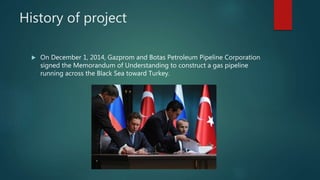
 On December 1, 2014, Gazprom and Botas Petroleum Pipeline Corporation
signed the Memorandum of Understanding to construct a gas pipeline
running across the Black Sea toward Turkey.
 In September 2016, Gazprom received first permits for the TurkStream
project from the Turkish authorities.
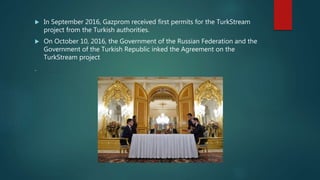
 On October 10, 2016, the Government of the Russian Federation and the
Government of the Turkish Republic inked the Agreement on the
TurkStream project
.
Route of Turkish stream
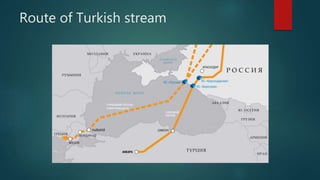
Route Of Turkish Stream
 TurkStream will directly connect the large gas reserves in Russia to the Turkish
gas transportation network, to provide reliable energy supplies for Turkey and
south-east Europe.
 The offshore component of the system will be constructed by PAO Gazprom.
The offshore pipeline will consist of two parallel pipelines running through the
Black Sea. The pipelines will enter the water near Anapa, on the Russian coast,
and come ashore on the Turkish coast some 100 kilometres west of Istanbul,
near the village of Kiyikoy.
 From Kiyikoy, an underground pipeline will be developed connecting
TurkStream to the existing network at Luleburgaz. The route will continue from
there to its end point at the Turkish town of Ipsala, near the Greek border.
Health and Safety
Health & Safety
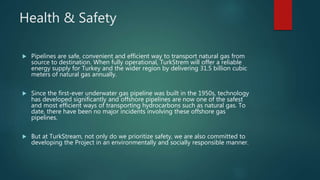
 Pipelines are safe, convenient and efficient way to transport natural gas from
source to destination. When fully operational, TurkStrem will offer a reliable
energy supply for Turkey and the wider region by delivering 31.5 billion cubic
meters of natural gas annually.
 Since the first-ever underwater gas pipeline was built in the 1950s, technology
has developed significantly and offshore pipelines are now one of the safest
and most efficient ways of transporting hydrocarbons such as natural gas. To
date, there have been no major incidents involving these offshore gas
pipelines.
 But at TurkStream, not only do we prioritize safety, we are also committed to
developing the Project in an environmentally and socially responsible manner.
Benefits for Turkey
 TurkStream will lead to direct and indirect
investments that will give an economic
impulse for local communities. The
development of infrastructure in Turkey and
beyond will support the further modernization
of the industry and economy, allowing local
businesses and customers to build on growing
opportunities. Additionally, an annual capacity
of 31.5 bcm means that TurkStream will
further help Turkey boost its geostrategic
importance. As a bridge between East and
West, Turkey is increasingly becoming a key
regional energy hub for the region and will
become a key supply link for south-eastern
Europe via TurkStream.
Thanks for your Attention!

Turkish stream Project

  • 1.
  • 2.
    Turkish Stream SUBJECT: TURKEYIN WORLD POLITICS LECTURER: IBRAHIM KONCAK STUDENT: AIDARBEK CHALBAEV GROUP: INT-13A DATE: 08.12.16
  • 3.
    History of project On December 1, 2014, Gazprom and Botas Petroleum Pipeline Corporation signed the Memorandum of Understanding to construct a gas pipeline running across the Black Sea toward Turkey.
  • 4.
     In September2016, Gazprom received first permits for the TurkStream project from the Turkish authorities.  On October 10, 2016, the Government of the Russian Federation and the Government of the Turkish Republic inked the Agreement on the TurkStream project .
  • 5.
  • 6.
    Route Of TurkishStream  TurkStream will directly connect the large gas reserves in Russia to the Turkish gas transportation network, to provide reliable energy supplies for Turkey and south-east Europe.  The offshore component of the system will be constructed by PAO Gazprom. The offshore pipeline will consist of two parallel pipelines running through the Black Sea. The pipelines will enter the water near Anapa, on the Russian coast, and come ashore on the Turkish coast some 100 kilometres west of Istanbul, near the village of Kiyikoy.  From Kiyikoy, an underground pipeline will be developed connecting TurkStream to the existing network at Luleburgaz. The route will continue from there to its end point at the Turkish town of Ipsala, near the Greek border.
  • 7.
  • 8.
    Health & Safety Pipelines are safe, convenient and efficient way to transport natural gas from source to destination. When fully operational, TurkStrem will offer a reliable energy supply for Turkey and the wider region by delivering 31.5 billion cubic meters of natural gas annually.  Since the first-ever underwater gas pipeline was built in the 1950s, technology has developed significantly and offshore pipelines are now one of the safest and most efficient ways of transporting hydrocarbons such as natural gas. To date, there have been no major incidents involving these offshore gas pipelines.  But at TurkStream, not only do we prioritize safety, we are also committed to developing the Project in an environmentally and socially responsible manner.
  • 9.
    Benefits for Turkey TurkStream will lead to direct and indirect investments that will give an economic impulse for local communities. The development of infrastructure in Turkey and beyond will support the further modernization of the industry and economy, allowing local businesses and customers to build on growing opportunities. Additionally, an annual capacity of 31.5 bcm means that TurkStream will further help Turkey boost its geostrategic importance. As a bridge between East and West, Turkey is increasingly becoming a key regional energy hub for the region and will become a key supply link for south-eastern Europe via TurkStream.
  • 10.
    Thanks for yourAttention!