Assignment No’-1
OIL Trade Pattern of Russia

        Submitted By:-
               Rahul Kumar (22).
OUTLINE
RUSSIA
• RUSSIA CRUDE OIL EXPORT
• TOP THREE EXPORT ROUTES
• PROPOSED PIPELINES
• ESPO PIPELINE
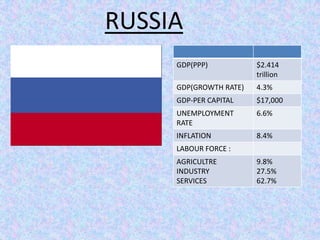
RUSSIA
     GDP(PPP)           $2.414
                        trillion
     GDP(GROWTH RATE)   4.3%
     GDP-PER CAPITAL    $17,000
     UNEMPLOYMENT       6.6%
     RATE
     INFLATION          8.4%
     LABOUR FORCE :
     AGRICULTRE         9.8%
     INDUSTRY           27.5%
     SERVICES           62.7%
Russia in Brief
• Russia holds the world's largest natural gas reserves, the
  second largest coal reserves, and the eighth largest crude oil
  reserves.
• Russia was the largest producer of crude oil in 2009,
  surpassing Saudi Arabia.
• Russia has the largest natural gas reserves in the world and it
  is the second-largest producer of natural gas.
• Russia is one of the top producers and consumers of electric
  power in the world, with more than 220 million kilowatts of
  installed generation capacity.
• Russia’s Transneft currently has a monopoly over Russia’s
  pipeline network.
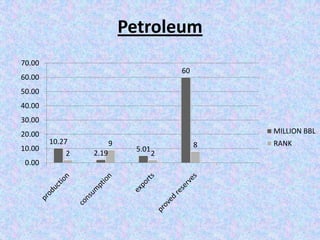
Petroleum
70.00
                                        60
60.00
50.00
40.00
30.00
20.00                                            MILLION BBL
        10.27           9                    8   RANK
10.00                        5.01
             2   2.19               2
 0.00
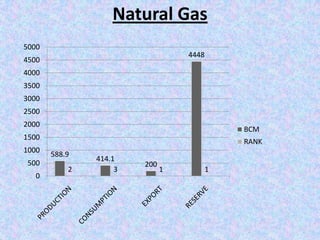
Natural Gas
5000
                                  4448
4500
4000
3500
3000
2500
2000
                                         BCM
1500
                                         RANK
1000
       588.9
               414.1
500                     200
           2        3         1      1
   0
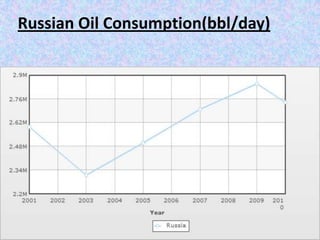
Russian Oil Consumption(bbl/day)
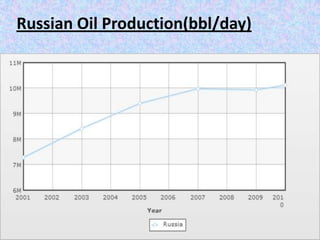
Russian Oil Production(bbl/day)
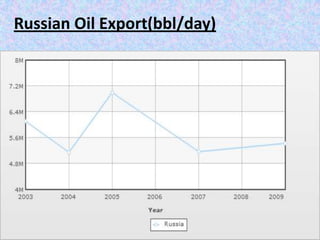
Russian Oil Export(bbl/day)
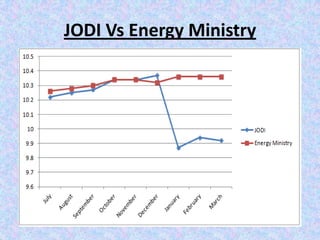
JODI Vs Energy Ministry
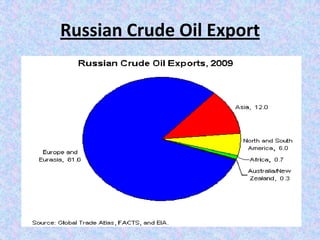
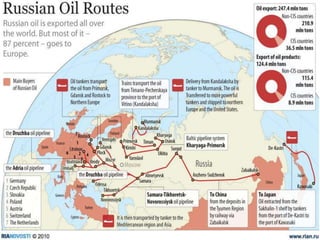
Russian Crude Oil Export
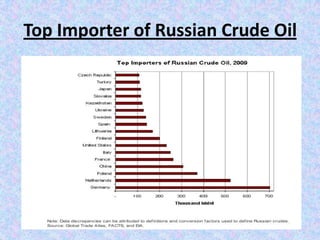
Top Importer of Russian Crude Oil
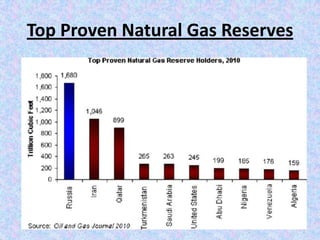
Top Proven Natural Gas Reserves
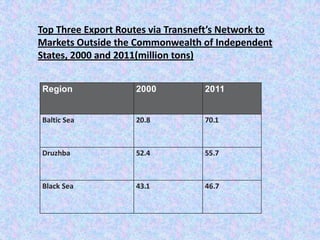
Top Three Export Routes via Transneft’s Network to
Markets Outside the Commonwealth of Independent
States, 2000 and 2011(million tons)


Region              2000           2011


Baltic Sea          20.8           70.1


Druzhba             52.4           55.7


Black Sea           43.1           46.7
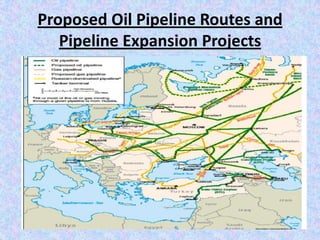
Proposed Oil Pipeline Routes and
   Pipeline Expansion Projects
Proposed Oil Pipeline
Nord Stream
Nord Stream is Russia’s and certainly Europe’s major ongoing project designed to feed
Germany and then from here connect to Belgium, the UK, Denmark, the Netherlands,
France, and the Czech Republic, with Russian gas. It consists of two parallel 48 in. pipelines
across the Baltic Sea, each 1224 km with a capacity of 27.5 billion m3/yr. The pipelines
have certain political significance as they enable Russia to bypass Ukraine and Poland,
while satisfying 25% of the EU’s additional needed gas imports by 2030.


South Stream
Similar to Nord Stream, the South European Pipeline or South Stream is meant to bypass
Ukraine when exporting Russian gas to Europe (Italy and Austria) via the Black Sea. Having
estimated cost of US$ 14.4 - 20 billion, its construction has been delayed from the initially-
planned 2010 to 2012 for completion in December 2015.
The pipeline construction will start in December 2012 (earlier than decided in 2011) with a
designed maximum throughput of 63 billion m3/yr.
Samsun - Ceyhan oil pipeline

Rosneft and Transneft are seeking a major stake (25%) in a planned Turkish pipeline, the
Samsun-Ceyhan oil pipeline, to be built by Turkey’s Calik Holding and Italy’s Eni. Linking
the Turkish ports of Samsun on the Black Sea and Ceyhan on the Mediterranean Sea, its
planned capacity is 50 million tpy to be supplied by Russia (25 - 30 million t) and certain
Caspian oil exporters such as Kazakhstan.


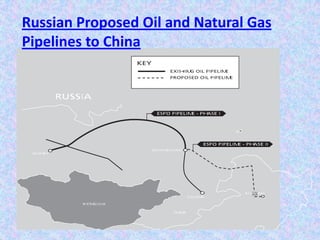
Russian - Chinese gas pipeline

Despite the success in securing piped oil exports to China (Skovorodino-Daqing), the fate
of Russia’s efforts to secure a piped gas export agreement with China is still unclear.
After years of negotiations between Moscow and Beijing, the two sides are yet to agree
on the pricing of gas to be exported via the envisaged pipeline. As per its November
2011 agreement with Turkmenistan, China’s access to Turkmenistan’s gas at a reported
price (US$ 250/1000 m3) significantly lower than that of Russia (by US$ 150) is a major
obstacle. Other obstacles include Beijing’s concerns about over reliance on Russia for
energy and also Russia’s reliability as a gas supplier as evident in its closing down its gas
pipelines to Europe via Belarus and the Ukraine in the recent years.
Russian Proposed Oil and Natural Gas
Pipelines to China
ESPO (Eastern Siberia Pacific Ocean Oil Pipeline)


East Siberia Pacific Ocean (ESPO) is a major undertaking by Russia designed to carry
Russian crude to the Asian-Pacific markets (China, Japan and South Korea) and the US.
The first stage of the 4857 km pipeline, the Taishet-Skovorodino line (2757 km; 48 in.;
US$ 12.27 billion) connecting Russia’s Irkutsk to the Amur Region via Yakutia (30 million
tpy capacity) went online in January 2010. Scheduled to go online in December 2012, its
second stage, the Skovorodino-Kozmino (2100 km; 48 in.), will enable Russia to export a
larger volume of oil (30 million tpy) to the Asian-Pacific countries. Currently, in absence
of this link, oil (15 million tpy) is transported by rail from Skovorodino to Kozmino’s oil
terminal on Russia’s Pacific coast from where the oil is exported to the designated
buyers by oil tankers. ESPO’s completion will help Russia establish itself as a major oil
supplier to the Asia-Pacific economies
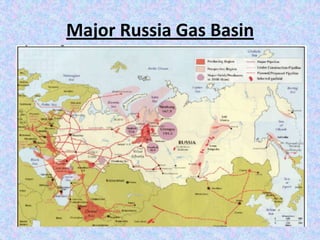
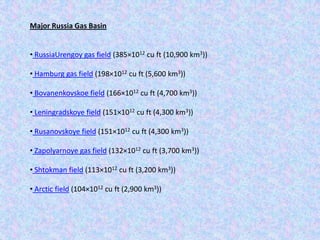
Major Russia Gas Basin


• RussiaUrengoy gas field (385×1012 cu ft (10,900 km3))

• Hamburg gas field (198×1012 cu ft (5,600 km3))

• Bovanenkovskoe field (166×1012 cu ft (4,700 km3))

• Leningradskoye field (151×1012 cu ft (4,300 km3))

• Rusanovskoye field (151×1012 cu ft (4,300 km3))

• Zapolyarnoye gas field (132×1012 cu ft (3,700 km3))

• Shtokman field (113×1012 cu ft (3,200 km3))

• Arctic field (104×1012 cu ft (2,900 km3))
Russia oil trade pattern

Russia oil trade pattern

  • 1.
    Assignment No’-1 OIL TradePattern of Russia Submitted By:- Rahul Kumar (22).
  • 2.
    OUTLINE RUSSIA • RUSSIA CRUDEOIL EXPORT • TOP THREE EXPORT ROUTES • PROPOSED PIPELINES • ESPO PIPELINE
  • 3.
    RUSSIA GDP(PPP) $2.414 trillion GDP(GROWTH RATE) 4.3% GDP-PER CAPITAL $17,000 UNEMPLOYMENT 6.6% RATE INFLATION 8.4% LABOUR FORCE : AGRICULTRE 9.8% INDUSTRY 27.5% SERVICES 62.7%
  • 4.
    Russia in Brief •Russia holds the world's largest natural gas reserves, the second largest coal reserves, and the eighth largest crude oil reserves. • Russia was the largest producer of crude oil in 2009, surpassing Saudi Arabia. • Russia has the largest natural gas reserves in the world and it is the second-largest producer of natural gas. • Russia is one of the top producers and consumers of electric power in the world, with more than 220 million kilowatts of installed generation capacity. • Russia’s Transneft currently has a monopoly over Russia’s pipeline network.
  • 5.
    Petroleum 70.00 60 60.00 50.00 40.00 30.00 20.00 MILLION BBL 10.27 9 8 RANK 10.00 5.01 2 2.19 2 0.00
  • 6.
    Natural Gas 5000 4448 4500 4000 3500 3000 2500 2000 BCM 1500 RANK 1000 588.9 414.1 500 200 2 3 1 1 0
  • 7.
  • 8.
  • 9.
  • 10.
  • 11.
  • 12.
    Top Importer ofRussian Crude Oil
  • 13.
    Top Proven NaturalGas Reserves
  • 14.
    Top Three ExportRoutes via Transneft’s Network to Markets Outside the Commonwealth of Independent States, 2000 and 2011(million tons) Region 2000 2011 Baltic Sea 20.8 70.1 Druzhba 52.4 55.7 Black Sea 43.1 46.7
  • 16.
    Proposed Oil PipelineRoutes and Pipeline Expansion Projects
  • 17.
    Proposed Oil Pipeline NordStream Nord Stream is Russia’s and certainly Europe’s major ongoing project designed to feed Germany and then from here connect to Belgium, the UK, Denmark, the Netherlands, France, and the Czech Republic, with Russian gas. It consists of two parallel 48 in. pipelines across the Baltic Sea, each 1224 km with a capacity of 27.5 billion m3/yr. The pipelines have certain political significance as they enable Russia to bypass Ukraine and Poland, while satisfying 25% of the EU’s additional needed gas imports by 2030. South Stream Similar to Nord Stream, the South European Pipeline or South Stream is meant to bypass Ukraine when exporting Russian gas to Europe (Italy and Austria) via the Black Sea. Having estimated cost of US$ 14.4 - 20 billion, its construction has been delayed from the initially- planned 2010 to 2012 for completion in December 2015. The pipeline construction will start in December 2012 (earlier than decided in 2011) with a designed maximum throughput of 63 billion m3/yr.
  • 18.
    Samsun - Ceyhanoil pipeline Rosneft and Transneft are seeking a major stake (25%) in a planned Turkish pipeline, the Samsun-Ceyhan oil pipeline, to be built by Turkey’s Calik Holding and Italy’s Eni. Linking the Turkish ports of Samsun on the Black Sea and Ceyhan on the Mediterranean Sea, its planned capacity is 50 million tpy to be supplied by Russia (25 - 30 million t) and certain Caspian oil exporters such as Kazakhstan. Russian - Chinese gas pipeline Despite the success in securing piped oil exports to China (Skovorodino-Daqing), the fate of Russia’s efforts to secure a piped gas export agreement with China is still unclear. After years of negotiations between Moscow and Beijing, the two sides are yet to agree on the pricing of gas to be exported via the envisaged pipeline. As per its November 2011 agreement with Turkmenistan, China’s access to Turkmenistan’s gas at a reported price (US$ 250/1000 m3) significantly lower than that of Russia (by US$ 150) is a major obstacle. Other obstacles include Beijing’s concerns about over reliance on Russia for energy and also Russia’s reliability as a gas supplier as evident in its closing down its gas pipelines to Europe via Belarus and the Ukraine in the recent years.
  • 19.
    Russian Proposed Oiland Natural Gas Pipelines to China
  • 20.
    ESPO (Eastern SiberiaPacific Ocean Oil Pipeline) East Siberia Pacific Ocean (ESPO) is a major undertaking by Russia designed to carry Russian crude to the Asian-Pacific markets (China, Japan and South Korea) and the US. The first stage of the 4857 km pipeline, the Taishet-Skovorodino line (2757 km; 48 in.; US$ 12.27 billion) connecting Russia’s Irkutsk to the Amur Region via Yakutia (30 million tpy capacity) went online in January 2010. Scheduled to go online in December 2012, its second stage, the Skovorodino-Kozmino (2100 km; 48 in.), will enable Russia to export a larger volume of oil (30 million tpy) to the Asian-Pacific countries. Currently, in absence of this link, oil (15 million tpy) is transported by rail from Skovorodino to Kozmino’s oil terminal on Russia’s Pacific coast from where the oil is exported to the designated buyers by oil tankers. ESPO’s completion will help Russia establish itself as a major oil supplier to the Asia-Pacific economies
  • 21.
  • 22.
    Major Russia GasBasin • RussiaUrengoy gas field (385×1012 cu ft (10,900 km3)) • Hamburg gas field (198×1012 cu ft (5,600 km3)) • Bovanenkovskoe field (166×1012 cu ft (4,700 km3)) • Leningradskoye field (151×1012 cu ft (4,300 km3)) • Rusanovskoye field (151×1012 cu ft (4,300 km3)) • Zapolyarnoye gas field (132×1012 cu ft (3,700 km3)) • Shtokman field (113×1012 cu ft (3,200 km3)) • Arctic field (104×1012 cu ft (2,900 km3))