Course – TFC
Course Instructor
Dr. Umadevi V
Department of CSE, BMSCE
Webpage:https://sites.google.com/site/drvumadevi/
30 June 2021 CSE, BMSCE 1
Unit-5
Problems That Computers Cannot Solve
The Turing Machine, Programming Techniques for Turing Machines,
Extensions to the Basic Turing Machine, Restricted Turing
Machines, Turing Machines and Computers, Definition of Post’s
Correspondence Problem, A Language That Is Not Recursively
Enumerable, An Undecidable Problem That is RE
Other Undecidable Problems
30 June 2021 CSE, BMSCE 2
Problems That Computers Cannot Solve
□ Specific Problems we cannot solve using a
computer are called “Undecidable”
30 June 2021 CSE, BMSCE 3
Example
30 June 2021 CSE, BMSCE 4
Program to print “Hello
World”
Fermat’s last theorem expressed as a
hello world program
Note: In number theory, Fermat's Last
Theorem states that no three positive integers a
b, and c satisfy the equation an
+ bn
= cn
for any
integer value of n greater than 2.
Hello World Problem: Determine
whether a given C program, with
given input, prints “Hello World”
Example
30 June 2021 CSE, BMSCE 5
Our hello-world problem
□ Is there a program H that could examine any
program P and any input I for P, and tell whether P,
run with I as its input, would print hello, world?
□ The answer is: undecidable!
■ That is, there exists no such program H.
■ We can prove this by contradiction next.
30 June 2021 CSE, BMSCE 6
Hypothetical “Hello, World” Tester
We want to prove that no program H, called hypothetical “Hello, World” tester, as
mentioned previously exists by contradiction using the following steps.
Step 1: assume H exists in a form as shown in Fig. 8.1
Step 2: Transform H into another form H2 in a simple way which can be done by
C programs.
Step 3: prove that H2 does not exist and so that H does not exist, either
30 June 2021 CSE, BMSCE 7
Hypothetical “Hello, World” Tester (Contd…)
Implementation of Step 2 in previous slide
(1) Transform H to H1 in a way as illustrated by Fig. 8.2
(2) Transform H1 to H2 in a way as illustrated by Fig. 8.3
The function of H2 constructed in Step 2 is given any program P as input,
if P prints hello, world as first output, then H2 makes output yes;
if P does not prints hello, world as first output, then H2 prints hello, world
30 June 2021 CSE, BMSCE 8
Hypothetical “Hello, World” Tester (Contd…)
Implementation of Step 3 above (proving H2 does not exist) ---
30 June 2021 CSE, BMSCE 9
Hypothetical “Hello, World” Tester (Contd…)
Implementation of Step 3 above (proving H2 does not exist) ---
30 June 2021 CSE, BMSCE 10
Reducing One Problem to Another
30 June 2021 CSE, BMSCE 11
Propose of the theory of undecidable problems
30 June 2021 CSE, BMSCE 12
The Turing Machine ™
30 June 2021 CSE, BMSCE 13
Turing Machine (TM)
30 June 2021 CSE, BMSCE 14
Turing machine model
30 June 2021 CSE, BMSCE 15
a0
a1
a2
…… an-1
an
B B …..
Control
Unit
Read-Write head
Input Tape
Formal Definition of Turning Machine
P=(Q, ∑ , Γ , δ , q0
, B, F)
□ Q is set of states
□ ∑ is set of input alphabet
□ Γ is set of tape symbols
□ q0
∈ Q , is the start state
□ B is special symbol indicating blank character
□ F is the set of final states
□ δ is a transition function which maps QxΓ to QxΓ x{L, R}
Note: L and R indicate Left or Right direction move
30 June 2021 CSE, BMSCE 16
Question
Design Turing Machine for L= {0n
1n
, n>=1}
Example:
Valid String: 000111
Invalid String:00111
30 June 2021 CSE, BMSCE 17
0 0 0 1 1 1 B
Input
tape
Question
Design Turing Machine for L= {0n
1n
, n>=1}
Example:
Valid String: 000111
Invalid String:00111
□ Approach used –
First replace a 0 from front by X, then keep moving right till you find a 1 and replace this 1 by Y.
Now keep moving left till you find a X. When you find it, move a right, then
follow the same procedure as above.
□ A condition comes when you find a X immediately followed by a Y. At this point we keep moving right and keep
on checking that all 1’s have been converted to Y. If not then string is not accepted. If we reach B then string is
accepted.
30 June 2021 CSE, BMSCE 18
0 0 0 1 1 1 B
Input
tape
Rough Slide to Explain “Designing Turing Machine for L= {0n
1n
, n>=1}”
Approach used –
First replace a 0 from front by X, then keep moving right till you find a 1 and replace this 1 by Y.
Now keep moving left till you find a X. When you find it, move a right, then follow the same procedure as above.
A condition comes when you find a X immediately followed by a Y. At this point we keep moving right and keep on checking that all 1’s
have been converted to Y. If not then string is not accepted. If we reach B then string is accepted.
30 June 2021 CSE, BMSCE 19
0 0 0 1 1 1 B
0 0 0 1 1 1 B
0 0 0 1 1 1 B
Rough Slide to Explain “Designing Turing Machine for L= {0n
1n
, n>=1}”
Approach used –
First replace a 0 from front by X, then keep moving right till you find a 1 and replace this 1 by Y.
Now keep moving left till you find a X. When you find it, move a right, then follow the same procedure as above.
A condition comes when you find a X immediately followed by a Y. At this point we keep moving right and keep on checking that all 1’s
have been converted to Y. If not then string is not accepted. If we reach B then string is accepted.
30 June 2021 CSE, BMSCE 20
X 0 0 Y 1 1 B
X 0 0 Y 1 1 B
X 0 0 Y 1 1 B
Rough Slide to Explain “Design Turing Machine for L= {0n
1n
, n>=1}”
Approach used –
First replace a 0 from front by X, then keep moving right till you find a 1 and replace this 1 by Y.
Now keep moving left till you find a X. When you find it, move a right, then follow the same procedure as above.
A condition comes when you find a X immediately followed by a Y. At this point we keep moving right and keep on checking that all 1’s
have been converted to Y. If not then string is not accepted. If we reach B then string is accepted.
30 June 2021 CSE, BMSCE 21
X X 0 Y Y 1 B
X X 0 Y Y 1 B
X X 0 Y Y 1 B
Rough Slide to Explain “Designing Turing Machine for L= {0n
1n
, n>=1}”
Approach used –
First replace a 0 from front by X, then keep moving right till you find a 1 and replace this 1 by Y.
Now keep moving left till you find a X. When you find it, move a right, then follow the same procedure as above.
A condition comes when you find a X immediately followed by a Y. At this point we keep moving right and keep on checking that all 1’s
have been converted to Y. If not then string is not accepted. If we reach B then string is accepted.
30 June 2021 CSE, BMSCE 22
X X X Y Y Y B
Rough Slide to Explain “Designing Turing Machine for L= {0n
1n
, n>=1}”
Approach used –
First replace a 0 from front by X, then keep moving right till you find a 1 and replace this 1 by Y.
Now keep moving left till you find a X. When you find it, move a right, then follow the same procedure as above.
A condition comes when you find a X immediately followed by a Y. At this point we keep moving right and keep on checking that all 1’s
have been converted to Y. If not then string is not accepted. If we reach B then string is accepted.
30 June 2021 CSE, BMSCE 23
0 0 1 1 1 B Invalid String
Rough Slide to Explain “Designing Turing Machine for L= {0n
1n
, n>=1}”
Approach used –
First replace a 0 from front by X, then keep moving right till you find a 1 and replace this 1 by Y.
Now keep moving left till you find a X. When you find it, move a right, then follow the same procedure as above.
A condition comes when you find a X immediately followed by a Y. At this point we keep moving right and keep on checking that all 1’s
have been converted to Y. If not then string is not accepted. If we reach B then string is accepted.
30 June 2021 CSE, BMSCE 24
X 0 Y 1 1 B Invalid String
Rough to Explain “Designing Turing Machine for L= {0n
1n
, n>=1}”
Approach used –
First replace a 0 from front by X, then keep moving right till you find a 1 and replace this 1 by Y.
Now keep moving left till you find a X. When you find it, move a right, then follow the same procedure as above.
A condition comes when you find a X immediately followed by a Y. At this point we keep moving right and keep on
checking that all 1’s have been converted to Y. If not then string is not accepted. If we reach B then string is
accepted.
30 June 2021 CSE, BMSCE 25
X X Y Y 1 B Invalid String
Design Turing Machine for L= {0n
1n
, n>=1}
30 June 2021 CSE, BMSCE 26
0 0 0 1 1 1 B
Logic
Step-1: Replace 0 by X and move right,
Go to state q1.
q0
q1
(0, X, R)
Design Turing Machine for L= {0n
1n
, n>=1}
30 June 2021 CSE, BMSCE 27
0 0 0 1 1 1 B
Logic
Step-1: Replace 0 by X and move right,
Go to state q1.
X 0 0 Y 1 1 B
Step-2: Replace 0 by 0 and move right,
Remain on same state.
Replace Y by Y and move right, Remain
on same state.
Replace 1 by Y and move left, go to state
q2.
q0
q1
(0, X, R)
(0, 0, R)
(Y, Y, R)
(1, Y,
L)
q2
q0
q1
(0, X, R)
Design Turing Machine for L= {0n
1n
, n>=1}
30 June 2021 CSE, BMSCE 28
(Y, Y, L)
(0, 0, L)
X 0 0 Y 1 1 B
q0
q1
(0, X, R)
(0, 0, R)
(Y, Y, R)
(1, Y,
L)
q2
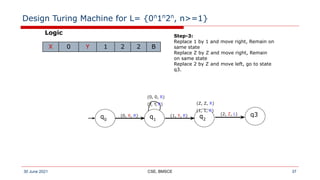
Step-3:
Replace 0 by 0 and move left, Remain on
same state
Replace Y by Y and move left, Remain on
same state
Replace X by X and move right, go to state
q0.
(X, X, R)
Logic
Design Turing Machine for L= {0n
1n
, n>=1}
30 June 2021 CSE, BMSCE 29
(Y, Y, L)
(0, 0, L)
X 0 0 Y 1 1 B
q0
q1
(0, X, R)
(0, 0, R)
(Y, Y, R)
(1, Y,
L)
q2
Step-4:
If symbol is Y replace it by Y and move right
and Go to state q3
Else go to step 1
(X, X, R)
q3
(Y, Y, R)
(Y, Y, R)
Logic
Design Turing Machine for L= {0n
1n
, n>=1}
30 June 2021 CSE, BMSCE 30
(Y, Y, L)
(0, 0, L)
X X X Y Y Y B
q0
q1
(0, X, R)
(0, 0, R)
(Y, Y, R)
(1, Y,
L)
q2
Step-5:
Replace Y by Y and move right, remain on
same state
If symbol is B replace it by B and move right
STRING IS ACCEPTED, GO TO FINAL STATE
q4
(X, X, R)
q3
(Y, Y, R)
(Y, Y, R)
(B, B, R)
q4
Logic
Design Turing Machine for L= {0n
1n
, n>=1}
30 June 2021 CSE, BMSCE 31
(Y, Y, L)
(0, 0, L)
q0
q1
(0, X, R)
(0, 0, R)
(Y, Y, R)
(1, Y,
L)
q2
(X, X, R)
q3
(Y, Y, R)
(Y, Y, R)
(B, B, R)
q4
Transition diagram
Design Turing Machine for L= {0n
1n
, n>=1}
30 June 2021 CSE, BMSCE 32
Formal Definition
M=(Q, ∑ , Γ , δ , q0
, B, F)
Q = {q0
, q1
, q2
, q3
, q4
}
∑ = {0, 1}
Γ = {0, 1, X, Y, B}
q0
= q0
B = B
F = {q4
}
δ Transition table
State
Input tape Symbols
0 1 X Y B
q0
(q1
, X , R) --- --- (q3
, Y , R) --
q1
(q1
, 0 , R) (q2
, Y, L) --- (q1
, Y , R) ---
q2
(q2
, 0 , L) --- (q0
, X,R) (q2
, Y,L) ---
q3
--- --- --- (q3
, Y , R) (q4
,B,R)
q4
--- --- --- --- ---
Transition Diagram
TM for L= {0n
1n
, n>=1} (Contd….)
Rough Slide
30 June 2021 CSE, BMSCE 33
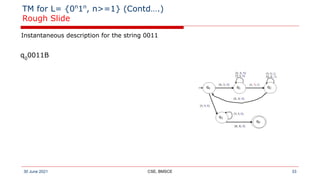
Instantaneous description for the string 0011
q0
0011B
TM for L= {0n
1n
, n>=1} (Contd….)
30 June 2021 CSE, BMSCE 34
Instantaneous description for the string 0011
Question
Design Turing Machine for L= {0n
1n
2n
, n>=1}
Example:
Valid String: 000111222
Invalid String:00111222
Assumption: We will replace 0 by X, 1 by Y and 2 by Z
Approach used –
- First replace a 0 from front by X, then keep moving right till you find a 1 and replace this 1 by Y. Again, keep
moving right till you find a 2, replace it by Z and move left. Now keep moving left till you find a X. When you find it,
move a right, then follow the same procedure as above.
- A condition comes when you find a X immediately followed by a Y. At this point we keep moving right and keep on
checking that all 1’s and 2’s have been converted to Y and Z. If not then string is not accepted. If we reach B and
final state then string is accepted.
30 June 2021 CSE, BMSCE 35
0 0 0 1 1 1 2 2 2 B
Input
tape
Design Turing Machine for L= {0n
1n
2n
, n>=1}
30 June 2021 CSE, BMSCE 36
0 0 1 1 2 2 B
Logic
Step-1: Replace 0 by X and move right,
Go to state q1.
X 0 Y 1 2 2 B
Step-2: Replace 0 by 0 and move right,
Remain on same state
Replace Y by Y and move right, Remain on
same state
Replace 1 by Y and move right, go to
state q2.
q0
q1
(0, X, R)
(0, 0, R)
(Y, Y, R)
(1, Y, R) q2
q0
q1
(0, X, R)
Design Turing Machine for L= {0n
1n
2n
, n>=1}
30 June 2021 CSE, BMSCE 37
Logic Step-3:
Replace 1 by 1 and move right, Remain on
same state
Replace Z by Z and move right, Remain
on same state
Replace 2 by Z and move left, go to state
q3.
q0
q1
(0, X, R)
(0, 0, R)
(Y, Y, R)
(1, Y, R) q2
X 0 Y 1 2 2 B
q3
(Z, Z, R)
(1, 1, R)
(2, Z, L)
Design Turing Machine for L= {0n
1n
2n
, n>=1}
30 June 2021 CSE, BMSCE 38
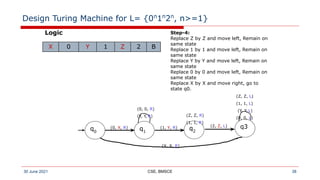
Logic Step-4:
Replace Z by Z and move left, Remain on
same state
Replace 1 by 1 and move left, Remain on
same state
Replace Y by Y and move left, Remain on
same state
Replace 0 by 0 and move left, Remain on
same state
Replace X by X and move right, go to
state q0.
q0
q1
(0, X, R)
(0, 0, R)
(Y, Y, R)
(1, Y, R) q2
X 0 Y 1 Z 2 B
q3
(Z, Z, R)
(1, 1, R)
(2, Z, L)
(Z, Z, L)
(1, 1, L)
(Y, Y, L)
(0, 0, L)
(X, X, R)
Design Turing Machine for L= {0n
1n
2n
, n>=1}
30 June 2021 CSE, BMSCE 39
Logic Step-5:
If symbol is Y replace it by Y and move
right and Go to state q4
Else go to Step-1
q0
q1
(0, X, R)
(0, 0, R)
(Y, Y, R)
(1, Y, R) q2
X X Y Y Z Z B
q3
(Z, Z, R)
(1, 1, R)
(2, Z, L)
(Z, Z, L)
(1, 1, L)
(Y, Y, L)
(0, 0, L)
(X, X, R)
q4
(Y, Y, R)
Design Turing Machine for L= {0n
1n
2n
, n>=1}
30 June 2021 CSE, BMSCE 40
Logic
Step-6:
Replace Y by Y and move right, Remain on same state
If the symbol is Z, replace it by Z and move right and go to
the state q5
Step-7:
Replace Z by Z and move right, Remain on same state
If symbol is B replace it by B and move right, STRING IS
ACCEPTED, GO TO FINAL STATE q6
q0
q1
(0, X, R)
(0, 0, R)
(Y, Y, R)
(1, Y, R) q2
X X Y Y Z Z B
q3
(Z, Z, R)
(1, 1, R)
(2, Z, L)
(Z, Z, L)
(1, 1, L)
(Y, Y, L)
(0, 0, L)
(X, X, R)
q4
(Y, Y, R)
(Y, Y, R)
q4
(B, B, R)
q6
q5
(Z, Z, R)
(Z, Z, R)
Complete design of Turing Machine for L= {0n
1n
2n
, n>=1}
30 June 2021 CSE, BMSCE 41
Formal Definition
M=(Q, ∑ , Γ , δ , q0
, B, F)
Q = {q0
, q1
, q2
, q3
, q4,
q5 ,
q6
}
∑ = {0, 1,2}
Γ = {0, 1, 2, X, Y, Z, B}
q0
= q0
B = B
F = {q6
}
δ Transition table
Sta
te
Input tape Symbols
0 1 2 X Y Z B
q0
(q1
, X , R) --- --- (q4, Y , R) -- --
q1
(q1
, 0 , R) (q2
, Y, R) --- (q1
, Y , R) --- ---
q2
--- (q2
, 1, R) (q3
, Z, L) --- --- (q2
, Z,R) ---
q3
(q3
, 0 , L) (q3
, 1, L) -- (q0
,X,R) (q3
, Y,L) (q3
, Z,L) ---
q4
--- --- --- --- (q4
, Y , R) (q5
, Z , R) ---
q5
--- --- --- --- --- (q5
, Z , R) (q6
,B,R)
q6
--- --- --- --- --- --- ---
Transition
Diagram
Question
Design TM for L={wcwr
, w ∈ (0+1)*}
Valid string: 110c011
30 June 2021 CSE, BMSCE 42
1 1 0 c 0 1 1 B
TM for L={wcwr
, w ∈ (0+1)*}
30 June 2021 CSE, BMSCE 43
q0
q1
(0, X, R)
(c, c, R)
(1, 1, R)
(0, 0, R) (B, B, L)
(X, X, L)
(Y, Y, L)
q2
q3
(0, X, L)
(X, X, R)
(Y, Y, R)
(c, c, L)
(1, 1, L)
(0, 0, L)
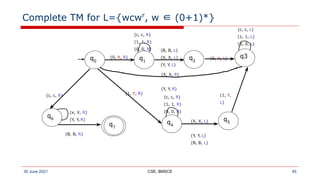
TM for L={wcwr
, w ∈ (0+1)*}
30 June 2021 CSE, BMSCE 44
q0
q1
(0, X, R)
(c, c, R)
(1, 1, R)
(0, 0, R) (B, B, L)
(X, X, L)
(Y, Y, L)
q2
q3
(0, X, L)
(X, X, R)
(Y, Y, R)
q5
(c, c, L)
(1, 1, L)
(0, 0, L)
q4
(X, X, L)
(Y, Y, L)
(B, B, L)
(1, Y,
L)
(c, c, R)
(1, 1, R)
(0, 0, R)
(1, Y, R)
Complete TM for L={wcwr
, w ∈ (0+1)*}
30 June 2021 CSE, BMSCE 45
q0
q1
(0, X, R)
(c, c, R)
(1, 1, R)
(0, 0, R) (B, B, L)
(X, X, L)
(Y, Y, L)
q2
q3
(0, X, L)
(X, X, R)
(Y, Y, R)
(c, c, R)
(x, X, R)
(Y, Y, R)
q6
(B, B, R)
q7
q5
(c, c, L)
(1, 1, L)
(0, 0, L)
q4
(1, Y, R)
(X, X, L)
(Y, Y, L)
(B, B, L)
(1, Y,
L)
(c, c, R)
(1, 1, R)
(0, 0, R)
Question
Design TM which accepts the set of all palindromes over {0, 1}
Example:
Valid Strings:
010
0110
Invalid Strings:
1010
110
30 June 2021 CSE, BMSCE 46
Complete design of TM which accepts the set of all palindromes over {0, 1}
30 June 2021 CSE, BMSCE 47
q0
q1
(0, X, R)
(1, 1, R)
(0, 0, R)
(B, B, L)
(X, X, L)
(Y, Y, L)
q2
q3
(0, X, L)
(X, X, R)
(Y, Y, R)
q6
q5
(1, 1, L)
(0, 0, L)
q4
(1, Y, R)
(X, X, L)
(Y, Y, L)
(B, B, L)
(1, Y,
L)
(1, 1, R)
(0, 0, R)
(X, X, R)
(Y, Y, R)
(X, X, R)
(Y, Y, R)
(X, X, R)
(Y, Y, R)
Question
Design Turing Machine to compute the function, which is called monus or proper
subtraction and is defined by
(m-n) = max (m-n, 0)
Note:
The monus operation is defined as
(m-n) = (m-n) if m ≥ n
(m-n) = 0 if m < n
Example:
If m = 5 , n =2 then (m-n) = (5-2) = 3
If m = 2 , n =5 then (m-n) = (2-5) = 0
30 June 2021 CSE, BMSCE 48
Design TM to compute the function, which is called monus or proper subtraction and is defined by
(m-n) = max (m-n, 0)
To start with the tape consists of 0m
10n
which is terminated by blank symbol.
Example:
m=5 , n=2
Input tape
Output Tape
m=2 , n=5
Input tape
Output Tape
30 June 2021 CSE, BMSCE 49
0 0 0 0 0 1 0 0 B
B B 0 0 0 B B B B
0 0 1 0 0 0 0 0 B
B B B B B B B B B
(5-2)=3
(2-5)=0
Design TM to compute the function, which is called monus or proper subtraction and is defined by
(m-n) = max (m-n, 0)
Rough Slide
To start with the tape consists of 0m
10n
which is terminated by blank symbol.
Example:
m=2 , n=5
Input tape
30 June 2021 CSE, BMSCE 50
0 0 1 0 0 0 0 0 B
B B B B B B B B B (2-5)=0
Output
Tape
Design TM to compute the function, which is called monus or proper subtraction and is defined by
(m-n) = max (m-n, 0)
Rough Slide
To start with the tape consists of 0m
10n
which is terminated by blank symbol.
Example:
m=5 , n=2
Input tape
30 June 2021 CSE, BMSCE 51
0 0 0 0 0 1 0 0 B B B 0 0 0 B B B B (5-2)=3
Output
Tape
Design TM to compute the function, which is called monus or proper subtraction and is defined by
(m-n) = max (m-n, 0)
To start with the tape consists of 0m
10n
which is terminated by blank symbol.
Example: m=5 , n=2
General Approach: The sequence of 0’s is partitioned into first group with m number of 0’s followed
by a 1 and followed by second group with n number of 0’s. The machine finds leftmost 0 and is
replaced by blank B. then move towards right to search for 1. After finding 1, it search's leftmost 0 in
the second group and is replaced by 1 and move towards left to get leftmost 0 in the first group. The
procedure is repeated till one of the following conditions are satisfied:
- When searching for a 0 in second group, if B is encountered it means that n number of 0’s in the
second group are replaced by 1’s and (n+1) in the first group are changed to B’s. Now, the second
group will have (n+1) ones. The machine replaces (n+1) 1’s by one 0 and n B’s and observe that only
(m-n) 0’s exists on the tape.
- In the first group, if the machine can not find a 0 (Since first m 0’s have already been changed to
B’s) it mean that (m<n) and so no 0’s and 1’s should be there on the tape.
30 June 2021 CSE, BMSCE 52
0 0 0 0 0 1 0 0 B
Design TM to compute the function, which is called monus or proper subtraction
and is defined by (m-n) = max (m-n, 0)
Input tape Output Tape
30 June 2021 CSE, BMSCE 53
0 0 0 0 0 1 0 0 B B B B 0 0 0 B B B
(5-2)=3
Logic
0 0 0 0 0 1 0 0 B
Step 1:
In state q0
, if 0 is encountered
- Replace 0 by B, Change state to q1
, Move right.
- Replace 0 by 0, be in same state q1
, Move right. When 1 is
encountered, Change State to q2
, Move Right.
- Replace 1 by 1, be in same state q2
. When leftmost 0 is
encountered replace by 1, change state to q3
, move left. When
B is encountered replace by B, Move left, change state to q4,
go to step 2
-Replace 0 by 0, 1 by 1, be same state q3
. When B is
encountered, replace by B, move right, go to state q0.
Repeat
step 1
In state q0
, if 1 is encountered, go to step 3
q0
q1
(0, B, R)
(0, 0, R)
(1, 1, R) q2
q3
(0, 1, L)
(1, 1, L)
(0, 0, L)
(1, 1, R)
(B, B, R)
Design TM to compute the function, which is called monus or proper subtraction
and is defined by (m-n) = max (m-n, 0)
30 June 2021 CSE, BMSCE 54
Logic
B B B 0 0 1 1 1 B
Step 2:
- Replace 0 by 0, Replace 1 by B, be in same state q4,
Move left.
- If B is encountered replace by 0, move right, go to
final state q6
q0
q1
(0, B, R)
(0, 0, R)
(1, 1, R) q2
q3
(0, 1, L)
(1, 1, L)
(0, 0, L)
(1, 1, R)
(B, B, R)
q4
(B, B, L)
(0, 0, L)
(1, B, L)
q6 (B, 0, R)
Example for (5-2)=3
Design TM to compute the function, which is called monus or proper subtraction
and is defined by (m-n) = max (m-n, 0)
30 June 2021 CSE, BMSCE 55
Input
0 0 1 0 0 0 0 0 B
Step 3:
- Replace 1 by B, Replace 0 by B, be in same state q5,
Move right.
- If B is encountered replace by B, move e right, go to
final state q6
q0
q1
(0, B, R)
(0, 0, R)
(1, 1, R) q2
q3
(0, 1, L)
(1, 1, L)
(0, 0, L)
(1, 1, R)
(B, B, R)
q4
(B, B, L)
(0, 0, L)
(1, B, L)
q6 (B, 0, R)
q5
(1, B, R)
(0, B, R)
(1, B, R)
Example for (2-5)=0
B B 1 1 1 0 0 0 B
(B, B, R)
Complete design of TM to compute the function, which is called monus or proper subtraction and is
defined by (m-n) = max (m-n, 0)
30 June 2021 CSE, BMSCE 56
q0
q1
(0, B, R)
(0, 0, R)
(1, 1, R) q2
q3
(0, 1, L)
(1, 1, L)
(0, 0, L)
(1, 1, R)
(B, B, R)
q4
(B, B, L)
(0, 0, L)
(1, B, L)
q6 (B, 0, R)
q5
(1, B, R)
(0, B, R)
(1, B, R)
(B, B, R)
Multiplication in TM (using Subroutines)
Example:
2x3 = 6
Input Tape:
Output Tape:
30 June 2021 CSE, BMSCE 57
1 1 0 1 1 1 0 B B B B B B B
B B B B B B B 1 1 1 1 1 1 B
Multiplication in TM (using Subroutines)
Rough Slide
Example: 2x3 = 6
Input Tape:
30 June 2021 CSE, BMSCE 58
1 1 0 1 1 1 0 B B B B B B B
Multiplication in TM (using Subroutines)
30 June 2021 CSE, BMSCE 59
1 1 0 1 1 1 0 B B B B B B B B B B B B B B 1 1 1 1 1 1 B
Input Tape Output Tape
Question
Design TM for L={SS, S ∈(a+b)*)
Example:
Valid Strings:
aa
abab
aabaab
Invalid Strings:
ab
aaa
abba
30 June 2021 CSE, BMSCE 60
Complete TM for L={SS, S ∈(a+b)*)
30 June 2021 CSE, BMSCE 61
q0
q4
(a, X, R)
(B, B, R)
q1
q2
(a, X, L)
(X, X, R)
(Y, Y, R)
q5
q3
(b, Y, R)
(b, Y, L)
(a, a, R)
(b, b, R)
(X, X, R)
(Y, Y, R)
(X, X, L)
(Y, Y, L)
(X, X, R)
(Y, Y, R)
(B, B, R)
(a, a, R)
(b, b, R)
(X, X, R)
(Y, Y, R) (a, a, L)
(b, b, L)
(X, X, L)
(Y, Y, L)
Programming Techniques for Turing Machine (TM)
- Storage in the state
- Multipule Tracks
- Subroutines
30 June 2021 CSE, BMSCE 62
Storage in the State
We can use the finite control not only to represent a
position in the program of the Turing machine but to
hold a finite amount of data Figure
30 June 2021 CSE, BMSCE 63
Mutiple Tracks TM and Subroutine TM
Mutiple Tracks TM:
Another useful trick is to think of the tape of a Turing machine as composed of several tracks. Each
track can hold one symbol and the tape alphabet of the TM consists of tuples with one component for
each.
Subroutine TM:
As with programs in general it helps to think of Turing machines as built from a collection of
interacting components or subroutines A Turing machine subroutine is a set of states that perform
some useful process. This set of states includes a start state and another state that temporarily has
no moves and that serves as the return state to pass control to whatever other set of states called
the subroutine. The call of a subroutine occurs whenever there is a transition to its initial state. Since
the TM has no mechanism for remembering a return address that is a state to go to after it finishes,
should our design of a TM call for one subroutine to be called from several states we can make copies
of the subroutine using a new set of states for each copy. The calls are made to the start states of
different copies of the subroutine and each copy returns to a different states.
30 June 2021 CSE, BMSCE 64
Extension of Basic Turing Machine (TM)
- Multitape TM
30 June 2021 CSE, BMSCE 65
Mutitape TM
A multitape TM is as suggested by Fig below. The device has a finite control state and some finite number of tapes Each tape is divided into cells
and each cell can hold any symbol of the finite tape alphabet As in the single tape TM the set of tape symbols includes a blank and has a subset
called the input symbols of which the blank is not a member. The set of states includes an initial state and some accepting states Initially
1. The input a finite sequence of input symbols is placed on the first tape
2. All other cells of all the tapes hold the blank
3. The finite control is in the initial state
4. The head of the first tape is at the left end of the input
5. All other tape heads are at some arbitrary cell Since tapes other than the first tape are completely blank it does not matter where the head is
placed initially all cells of these tapes look the same
30 June 2021 CSE, BMSCE 66
Multitape TUM
Restricted Turing Machine (TM)
- Semi-infinite tape TM
- Multi-stack TM
30 June 2021 CSE, BMSCE 67
Semi-infinite Tape machine
A Turing Machine with a semi-infinite tape has a left end but no right end. The left end is limited with
an end marker.
It is a two-track tape −
□ Upper track − It represents the cells to the right of the initial head position.
□ Lower track − It represents the cells to the left of the initial head position in reverse order.
30 June 2021 CSE, BMSCE 68
Multi-stack Turing Machine
□ Generalizations of the PDAs
□ TMs can accept languages that are not accepted by any PDA with one stack.
□ But PDA with two stacks can accept any language that a TM can accept.
30 June 2021 CSE, BMSCE 69
Multi-stack Turing Machine
□ A k-stack machine is a deterministic PDA with k stacks.
□ It obtains its input from an input source rather than having the input placed
in a tape.
□ It has a finite control, which is in one of a finite set of states.
□ It has a finite stack alphabet, which it uses for all its stacks.
□ A move of a multistack machine is based on:
■ The state of the finite control
■ The input symbol read, which is chosen from the finite input alphabet
■ The top stack symbol on each stack
30 June 2021 CSE, BMSCE 70
Turing Machine and Computers
30 June 2021 CSE, BMSCE 71
Simulating computer by Turing machine
□ Example (1): Increment Operation[ incr(x) ]
□ Step by step operation which shows how the TM can increment x when x=2
30 June 2021 CSE, BMSCE 72
Simulating computer by Turing machine
□ Example (2): Decrement Operation[ decr(x) ]
□ Step by step operation which shows how the TM can decrement x when x=2
30 June 2021 CSE, BMSCE 73
Introduction to Undecidable Problems
- Post Correspondence problem
30 June 2021 CSE, BMSCE 74
Recursive and Recursively Enumerable language
30 June 2021 CSE, BMSCE 75
Decidable, Partially-Decidable and Undecidable language
30 June 2021 CSE, BMSCE 76
Undecidable Problems
30 June 2021 CSE, BMSCE 77
Undecidable problems
□ Some problems take a very long time to solve, so we use
algorithms that give approximate solutions. There are some
problems that a computer can never solve, even the world's
most powerful computer with infinite time.
□ An undecidable problem is one that should give a "yes" or
"no" answer, but yet no algorithm exists that can answer
correctly on all inputs.
30 June 2021 CSE, BMSCE 78
Halting Problem
Alan Turing proved the existence of undecidable problems in 1936 by finding an example,
the now famous "halting problem":
Based on its code and an input, will a particular program ever finish running?
For example, consider this program that counts down:
num ← 10
REPEAT UNTIL (num = 0) {
DISPLAY(num)
num ← num – 1
}
That program will halt, since num eventually becomes 0.
Compare that to this program that counts up:
num ← 1
REPEAT UNTIL (num = 0) {
DISPLAY(num)
num ← num + 1
}
It counts up forever, since num will never equal 0.
Algorithms do exist that can correctly predict that the first program halts and the second program never does.
These are simple programs which don't change based on different inputs.
However, no algorithm exists that can analyze any program's code and determine whether it halts or not.
30 June 2021 CSE, BMSCE 79
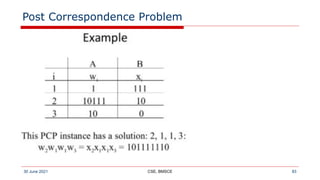
Post Correspondence Problem
□ The Post Correspondence Problem (PCP), introduced by Emil Post in 1946, is
an undecidable decision problem. The PCP problem over an alphabet ∑ is
stated as follows −
□ Given the following two lists, M and N of non-empty strings over ∑ −
M = (x1
, x2
, x3
,………, xn
)
N = (y1
, y2
, y3
,………, yn
)
□ We can say that there is a Post Correspondence Solution, if for some
i1
,i2
,………… ik
, where 1 ≤ ij
≤ n, the condition xi1
…….xik
= yi1
…….yik
satisfies.
30 June 2021 CSE, BMSCE 80
Post Correspondence Problem
Example 1: Find whether the lists
M = (abb, aa, aaa) and
N = (bba, aaa, aa) have a Post Correspondence Solution?
Solution
Here, x2
x1
x3
= ‘aaabbaaa’ and y2
y1
y3
= ‘aaabbaaa’
We can see that x2
x1
x3
= y2
y1
y3
Hence, the solution is i = 2, j = 1, and k = 3
30 June 2021 CSE, BMSCE 81
Post Correspondence Problem
Example 2: Find whether the lists M = (ab, bab, bbaaa) and N = (a, ba, bab)
have a Post Correspondence Solution ?
Solution:
In this case, there is no solution because −
| x2
x1
x3
| ≠ | y2
y1
y3
| (Lengths are not same)
30 June 2021 CSE, BMSCE 82
Post Correspondence Problem
30 June 2021 CSE, BMSCE 83
Post Correspondence Problem (PCP)
30 June 2021 CSE, BMSCE 84
Thanks for Listening
30 June 2021 CSE, BMSCE 85
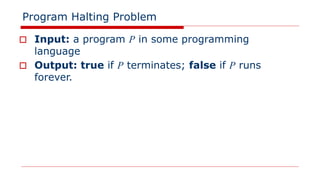
Program Halting Problem
□ Input: a program P in some programming
language
□ Output: true if P terminates; false if P runs
forever.
Examples
halts(“2+2”)
halts(“def f(n):
if n==0: return 1
else: return n * f(n-1)
f(10)”)
halts(“def f(n):
if n==0: return 1
else: return n * f(n-1)
f(10.5)”)
”)
True
True
False
Tougher Example
halts(“
def isPerfectNumber(n): # n is perfect if
factors sum to n
divs = findDivisors(n)
return n == sum(divs)
i = 3
while not isPerfectNumber (i): i = i + 2
print i”) Note: it is unknown where an odd perfect number
exists. (Numbers up to 10300
have been tried
without finding one yet.)
Unknown
turing machine- problems and undecidable problems

  • 1.
    Course – TFC CourseInstructor Dr. Umadevi V Department of CSE, BMSCE Webpage:https://sites.google.com/site/drvumadevi/ 30 June 2021 CSE, BMSCE 1
  • 2.
    Unit-5 Problems That ComputersCannot Solve The Turing Machine, Programming Techniques for Turing Machines, Extensions to the Basic Turing Machine, Restricted Turing Machines, Turing Machines and Computers, Definition of Post’s Correspondence Problem, A Language That Is Not Recursively Enumerable, An Undecidable Problem That is RE Other Undecidable Problems 30 June 2021 CSE, BMSCE 2
  • 3.
    Problems That ComputersCannot Solve □ Specific Problems we cannot solve using a computer are called “Undecidable” 30 June 2021 CSE, BMSCE 3
  • 4.
    Example 30 June 2021CSE, BMSCE 4 Program to print “Hello World” Fermat’s last theorem expressed as a hello world program Note: In number theory, Fermat's Last Theorem states that no three positive integers a b, and c satisfy the equation an + bn = cn for any integer value of n greater than 2. Hello World Problem: Determine whether a given C program, with given input, prints “Hello World”
  • 5.
  • 6.
    Our hello-world problem □Is there a program H that could examine any program P and any input I for P, and tell whether P, run with I as its input, would print hello, world? □ The answer is: undecidable! ■ That is, there exists no such program H. ■ We can prove this by contradiction next. 30 June 2021 CSE, BMSCE 6
  • 7.
    Hypothetical “Hello, World”Tester We want to prove that no program H, called hypothetical “Hello, World” tester, as mentioned previously exists by contradiction using the following steps. Step 1: assume H exists in a form as shown in Fig. 8.1 Step 2: Transform H into another form H2 in a simple way which can be done by C programs. Step 3: prove that H2 does not exist and so that H does not exist, either 30 June 2021 CSE, BMSCE 7
  • 8.
    Hypothetical “Hello, World”Tester (Contd…) Implementation of Step 2 in previous slide (1) Transform H to H1 in a way as illustrated by Fig. 8.2 (2) Transform H1 to H2 in a way as illustrated by Fig. 8.3 The function of H2 constructed in Step 2 is given any program P as input, if P prints hello, world as first output, then H2 makes output yes; if P does not prints hello, world as first output, then H2 prints hello, world 30 June 2021 CSE, BMSCE 8
  • 9.
    Hypothetical “Hello, World”Tester (Contd…) Implementation of Step 3 above (proving H2 does not exist) --- 30 June 2021 CSE, BMSCE 9
  • 10.
    Hypothetical “Hello, World”Tester (Contd…) Implementation of Step 3 above (proving H2 does not exist) --- 30 June 2021 CSE, BMSCE 10
  • 11.
    Reducing One Problemto Another 30 June 2021 CSE, BMSCE 11
  • 12.
    Propose of thetheory of undecidable problems 30 June 2021 CSE, BMSCE 12
  • 13.
    The Turing Machine™ 30 June 2021 CSE, BMSCE 13
  • 14.
    Turing Machine (TM) 30June 2021 CSE, BMSCE 14
  • 15.
    Turing machine model 30June 2021 CSE, BMSCE 15 a0 a1 a2 …… an-1 an B B ….. Control Unit Read-Write head Input Tape
  • 16.
    Formal Definition ofTurning Machine P=(Q, ∑ , Γ , δ , q0 , B, F) □ Q is set of states □ ∑ is set of input alphabet □ Γ is set of tape symbols □ q0 ∈ Q , is the start state □ B is special symbol indicating blank character □ F is the set of final states □ δ is a transition function which maps QxΓ to QxΓ x{L, R} Note: L and R indicate Left or Right direction move 30 June 2021 CSE, BMSCE 16
  • 17.
    Question Design Turing Machinefor L= {0n 1n , n>=1} Example: Valid String: 000111 Invalid String:00111 30 June 2021 CSE, BMSCE 17 0 0 0 1 1 1 B Input tape
  • 18.
    Question Design Turing Machinefor L= {0n 1n , n>=1} Example: Valid String: 000111 Invalid String:00111 □ Approach used – First replace a 0 from front by X, then keep moving right till you find a 1 and replace this 1 by Y. Now keep moving left till you find a X. When you find it, move a right, then follow the same procedure as above. □ A condition comes when you find a X immediately followed by a Y. At this point we keep moving right and keep on checking that all 1’s have been converted to Y. If not then string is not accepted. If we reach B then string is accepted. 30 June 2021 CSE, BMSCE 18 0 0 0 1 1 1 B Input tape
  • 19.
    Rough Slide toExplain “Designing Turing Machine for L= {0n 1n , n>=1}” Approach used – First replace a 0 from front by X, then keep moving right till you find a 1 and replace this 1 by Y. Now keep moving left till you find a X. When you find it, move a right, then follow the same procedure as above. A condition comes when you find a X immediately followed by a Y. At this point we keep moving right and keep on checking that all 1’s have been converted to Y. If not then string is not accepted. If we reach B then string is accepted. 30 June 2021 CSE, BMSCE 19 0 0 0 1 1 1 B 0 0 0 1 1 1 B 0 0 0 1 1 1 B
  • 20.
    Rough Slide toExplain “Designing Turing Machine for L= {0n 1n , n>=1}” Approach used – First replace a 0 from front by X, then keep moving right till you find a 1 and replace this 1 by Y. Now keep moving left till you find a X. When you find it, move a right, then follow the same procedure as above. A condition comes when you find a X immediately followed by a Y. At this point we keep moving right and keep on checking that all 1’s have been converted to Y. If not then string is not accepted. If we reach B then string is accepted. 30 June 2021 CSE, BMSCE 20 X 0 0 Y 1 1 B X 0 0 Y 1 1 B X 0 0 Y 1 1 B
  • 21.
    Rough Slide toExplain “Design Turing Machine for L= {0n 1n , n>=1}” Approach used – First replace a 0 from front by X, then keep moving right till you find a 1 and replace this 1 by Y. Now keep moving left till you find a X. When you find it, move a right, then follow the same procedure as above. A condition comes when you find a X immediately followed by a Y. At this point we keep moving right and keep on checking that all 1’s have been converted to Y. If not then string is not accepted. If we reach B then string is accepted. 30 June 2021 CSE, BMSCE 21 X X 0 Y Y 1 B X X 0 Y Y 1 B X X 0 Y Y 1 B
  • 22.
    Rough Slide toExplain “Designing Turing Machine for L= {0n 1n , n>=1}” Approach used – First replace a 0 from front by X, then keep moving right till you find a 1 and replace this 1 by Y. Now keep moving left till you find a X. When you find it, move a right, then follow the same procedure as above. A condition comes when you find a X immediately followed by a Y. At this point we keep moving right and keep on checking that all 1’s have been converted to Y. If not then string is not accepted. If we reach B then string is accepted. 30 June 2021 CSE, BMSCE 22 X X X Y Y Y B
  • 23.
    Rough Slide toExplain “Designing Turing Machine for L= {0n 1n , n>=1}” Approach used – First replace a 0 from front by X, then keep moving right till you find a 1 and replace this 1 by Y. Now keep moving left till you find a X. When you find it, move a right, then follow the same procedure as above. A condition comes when you find a X immediately followed by a Y. At this point we keep moving right and keep on checking that all 1’s have been converted to Y. If not then string is not accepted. If we reach B then string is accepted. 30 June 2021 CSE, BMSCE 23 0 0 1 1 1 B Invalid String
  • 24.
    Rough Slide toExplain “Designing Turing Machine for L= {0n 1n , n>=1}” Approach used – First replace a 0 from front by X, then keep moving right till you find a 1 and replace this 1 by Y. Now keep moving left till you find a X. When you find it, move a right, then follow the same procedure as above. A condition comes when you find a X immediately followed by a Y. At this point we keep moving right and keep on checking that all 1’s have been converted to Y. If not then string is not accepted. If we reach B then string is accepted. 30 June 2021 CSE, BMSCE 24 X 0 Y 1 1 B Invalid String
  • 25.
    Rough to Explain“Designing Turing Machine for L= {0n 1n , n>=1}” Approach used – First replace a 0 from front by X, then keep moving right till you find a 1 and replace this 1 by Y. Now keep moving left till you find a X. When you find it, move a right, then follow the same procedure as above. A condition comes when you find a X immediately followed by a Y. At this point we keep moving right and keep on checking that all 1’s have been converted to Y. If not then string is not accepted. If we reach B then string is accepted. 30 June 2021 CSE, BMSCE 25 X X Y Y 1 B Invalid String
  • 26.
    Design Turing Machinefor L= {0n 1n , n>=1} 30 June 2021 CSE, BMSCE 26 0 0 0 1 1 1 B Logic Step-1: Replace 0 by X and move right, Go to state q1. q0 q1 (0, X, R)
  • 27.
    Design Turing Machinefor L= {0n 1n , n>=1} 30 June 2021 CSE, BMSCE 27 0 0 0 1 1 1 B Logic Step-1: Replace 0 by X and move right, Go to state q1. X 0 0 Y 1 1 B Step-2: Replace 0 by 0 and move right, Remain on same state. Replace Y by Y and move right, Remain on same state. Replace 1 by Y and move left, go to state q2. q0 q1 (0, X, R) (0, 0, R) (Y, Y, R) (1, Y, L) q2 q0 q1 (0, X, R)
  • 28.
    Design Turing Machinefor L= {0n 1n , n>=1} 30 June 2021 CSE, BMSCE 28 (Y, Y, L) (0, 0, L) X 0 0 Y 1 1 B q0 q1 (0, X, R) (0, 0, R) (Y, Y, R) (1, Y, L) q2 Step-3: Replace 0 by 0 and move left, Remain on same state Replace Y by Y and move left, Remain on same state Replace X by X and move right, go to state q0. (X, X, R) Logic
  • 29.
    Design Turing Machinefor L= {0n 1n , n>=1} 30 June 2021 CSE, BMSCE 29 (Y, Y, L) (0, 0, L) X 0 0 Y 1 1 B q0 q1 (0, X, R) (0, 0, R) (Y, Y, R) (1, Y, L) q2 Step-4: If symbol is Y replace it by Y and move right and Go to state q3 Else go to step 1 (X, X, R) q3 (Y, Y, R) (Y, Y, R) Logic
  • 30.
    Design Turing Machinefor L= {0n 1n , n>=1} 30 June 2021 CSE, BMSCE 30 (Y, Y, L) (0, 0, L) X X X Y Y Y B q0 q1 (0, X, R) (0, 0, R) (Y, Y, R) (1, Y, L) q2 Step-5: Replace Y by Y and move right, remain on same state If symbol is B replace it by B and move right STRING IS ACCEPTED, GO TO FINAL STATE q4 (X, X, R) q3 (Y, Y, R) (Y, Y, R) (B, B, R) q4 Logic
  • 31.
    Design Turing Machinefor L= {0n 1n , n>=1} 30 June 2021 CSE, BMSCE 31 (Y, Y, L) (0, 0, L) q0 q1 (0, X, R) (0, 0, R) (Y, Y, R) (1, Y, L) q2 (X, X, R) q3 (Y, Y, R) (Y, Y, R) (B, B, R) q4 Transition diagram
  • 32.
    Design Turing Machinefor L= {0n 1n , n>=1} 30 June 2021 CSE, BMSCE 32 Formal Definition M=(Q, ∑ , Γ , δ , q0 , B, F) Q = {q0 , q1 , q2 , q3 , q4 } ∑ = {0, 1} Γ = {0, 1, X, Y, B} q0 = q0 B = B F = {q4 } δ Transition table State Input tape Symbols 0 1 X Y B q0 (q1 , X , R) --- --- (q3 , Y , R) -- q1 (q1 , 0 , R) (q2 , Y, L) --- (q1 , Y , R) --- q2 (q2 , 0 , L) --- (q0 , X,R) (q2 , Y,L) --- q3 --- --- --- (q3 , Y , R) (q4 ,B,R) q4 --- --- --- --- --- Transition Diagram
  • 33.
    TM for L={0n 1n , n>=1} (Contd….) Rough Slide 30 June 2021 CSE, BMSCE 33 Instantaneous description for the string 0011 q0 0011B
  • 34.
    TM for L={0n 1n , n>=1} (Contd….) 30 June 2021 CSE, BMSCE 34 Instantaneous description for the string 0011
  • 35.
    Question Design Turing Machinefor L= {0n 1n 2n , n>=1} Example: Valid String: 000111222 Invalid String:00111222 Assumption: We will replace 0 by X, 1 by Y and 2 by Z Approach used – - First replace a 0 from front by X, then keep moving right till you find a 1 and replace this 1 by Y. Again, keep moving right till you find a 2, replace it by Z and move left. Now keep moving left till you find a X. When you find it, move a right, then follow the same procedure as above. - A condition comes when you find a X immediately followed by a Y. At this point we keep moving right and keep on checking that all 1’s and 2’s have been converted to Y and Z. If not then string is not accepted. If we reach B and final state then string is accepted. 30 June 2021 CSE, BMSCE 35 0 0 0 1 1 1 2 2 2 B Input tape
  • 36.
    Design Turing Machinefor L= {0n 1n 2n , n>=1} 30 June 2021 CSE, BMSCE 36 0 0 1 1 2 2 B Logic Step-1: Replace 0 by X and move right, Go to state q1. X 0 Y 1 2 2 B Step-2: Replace 0 by 0 and move right, Remain on same state Replace Y by Y and move right, Remain on same state Replace 1 by Y and move right, go to state q2. q0 q1 (0, X, R) (0, 0, R) (Y, Y, R) (1, Y, R) q2 q0 q1 (0, X, R)
  • 37.
    Design Turing Machinefor L= {0n 1n 2n , n>=1} 30 June 2021 CSE, BMSCE 37 Logic Step-3: Replace 1 by 1 and move right, Remain on same state Replace Z by Z and move right, Remain on same state Replace 2 by Z and move left, go to state q3. q0 q1 (0, X, R) (0, 0, R) (Y, Y, R) (1, Y, R) q2 X 0 Y 1 2 2 B q3 (Z, Z, R) (1, 1, R) (2, Z, L)
  • 38.
    Design Turing Machinefor L= {0n 1n 2n , n>=1} 30 June 2021 CSE, BMSCE 38 Logic Step-4: Replace Z by Z and move left, Remain on same state Replace 1 by 1 and move left, Remain on same state Replace Y by Y and move left, Remain on same state Replace 0 by 0 and move left, Remain on same state Replace X by X and move right, go to state q0. q0 q1 (0, X, R) (0, 0, R) (Y, Y, R) (1, Y, R) q2 X 0 Y 1 Z 2 B q3 (Z, Z, R) (1, 1, R) (2, Z, L) (Z, Z, L) (1, 1, L) (Y, Y, L) (0, 0, L) (X, X, R)
  • 39.
    Design Turing Machinefor L= {0n 1n 2n , n>=1} 30 June 2021 CSE, BMSCE 39 Logic Step-5: If symbol is Y replace it by Y and move right and Go to state q4 Else go to Step-1 q0 q1 (0, X, R) (0, 0, R) (Y, Y, R) (1, Y, R) q2 X X Y Y Z Z B q3 (Z, Z, R) (1, 1, R) (2, Z, L) (Z, Z, L) (1, 1, L) (Y, Y, L) (0, 0, L) (X, X, R) q4 (Y, Y, R)
  • 40.
    Design Turing Machinefor L= {0n 1n 2n , n>=1} 30 June 2021 CSE, BMSCE 40 Logic Step-6: Replace Y by Y and move right, Remain on same state If the symbol is Z, replace it by Z and move right and go to the state q5 Step-7: Replace Z by Z and move right, Remain on same state If symbol is B replace it by B and move right, STRING IS ACCEPTED, GO TO FINAL STATE q6 q0 q1 (0, X, R) (0, 0, R) (Y, Y, R) (1, Y, R) q2 X X Y Y Z Z B q3 (Z, Z, R) (1, 1, R) (2, Z, L) (Z, Z, L) (1, 1, L) (Y, Y, L) (0, 0, L) (X, X, R) q4 (Y, Y, R) (Y, Y, R) q4 (B, B, R) q6 q5 (Z, Z, R) (Z, Z, R)
  • 41.
    Complete design ofTuring Machine for L= {0n 1n 2n , n>=1} 30 June 2021 CSE, BMSCE 41 Formal Definition M=(Q, ∑ , Γ , δ , q0 , B, F) Q = {q0 , q1 , q2 , q3 , q4, q5 , q6 } ∑ = {0, 1,2} Γ = {0, 1, 2, X, Y, Z, B} q0 = q0 B = B F = {q6 } δ Transition table Sta te Input tape Symbols 0 1 2 X Y Z B q0 (q1 , X , R) --- --- (q4, Y , R) -- -- q1 (q1 , 0 , R) (q2 , Y, R) --- (q1 , Y , R) --- --- q2 --- (q2 , 1, R) (q3 , Z, L) --- --- (q2 , Z,R) --- q3 (q3 , 0 , L) (q3 , 1, L) -- (q0 ,X,R) (q3 , Y,L) (q3 , Z,L) --- q4 --- --- --- --- (q4 , Y , R) (q5 , Z , R) --- q5 --- --- --- --- --- (q5 , Z , R) (q6 ,B,R) q6 --- --- --- --- --- --- --- Transition Diagram
  • 42.
    Question Design TM forL={wcwr , w ∈ (0+1)*} Valid string: 110c011 30 June 2021 CSE, BMSCE 42 1 1 0 c 0 1 1 B
  • 43.
    TM for L={wcwr ,w ∈ (0+1)*} 30 June 2021 CSE, BMSCE 43 q0 q1 (0, X, R) (c, c, R) (1, 1, R) (0, 0, R) (B, B, L) (X, X, L) (Y, Y, L) q2 q3 (0, X, L) (X, X, R) (Y, Y, R) (c, c, L) (1, 1, L) (0, 0, L)
  • 44.
    TM for L={wcwr ,w ∈ (0+1)*} 30 June 2021 CSE, BMSCE 44 q0 q1 (0, X, R) (c, c, R) (1, 1, R) (0, 0, R) (B, B, L) (X, X, L) (Y, Y, L) q2 q3 (0, X, L) (X, X, R) (Y, Y, R) q5 (c, c, L) (1, 1, L) (0, 0, L) q4 (X, X, L) (Y, Y, L) (B, B, L) (1, Y, L) (c, c, R) (1, 1, R) (0, 0, R) (1, Y, R)
  • 45.
    Complete TM forL={wcwr , w ∈ (0+1)*} 30 June 2021 CSE, BMSCE 45 q0 q1 (0, X, R) (c, c, R) (1, 1, R) (0, 0, R) (B, B, L) (X, X, L) (Y, Y, L) q2 q3 (0, X, L) (X, X, R) (Y, Y, R) (c, c, R) (x, X, R) (Y, Y, R) q6 (B, B, R) q7 q5 (c, c, L) (1, 1, L) (0, 0, L) q4 (1, Y, R) (X, X, L) (Y, Y, L) (B, B, L) (1, Y, L) (c, c, R) (1, 1, R) (0, 0, R)
  • 46.
    Question Design TM whichaccepts the set of all palindromes over {0, 1} Example: Valid Strings: 010 0110 Invalid Strings: 1010 110 30 June 2021 CSE, BMSCE 46
  • 47.
    Complete design ofTM which accepts the set of all palindromes over {0, 1} 30 June 2021 CSE, BMSCE 47 q0 q1 (0, X, R) (1, 1, R) (0, 0, R) (B, B, L) (X, X, L) (Y, Y, L) q2 q3 (0, X, L) (X, X, R) (Y, Y, R) q6 q5 (1, 1, L) (0, 0, L) q4 (1, Y, R) (X, X, L) (Y, Y, L) (B, B, L) (1, Y, L) (1, 1, R) (0, 0, R) (X, X, R) (Y, Y, R) (X, X, R) (Y, Y, R) (X, X, R) (Y, Y, R)
  • 48.
    Question Design Turing Machineto compute the function, which is called monus or proper subtraction and is defined by (m-n) = max (m-n, 0) Note: The monus operation is defined as (m-n) = (m-n) if m ≥ n (m-n) = 0 if m < n Example: If m = 5 , n =2 then (m-n) = (5-2) = 3 If m = 2 , n =5 then (m-n) = (2-5) = 0 30 June 2021 CSE, BMSCE 48
  • 49.
    Design TM tocompute the function, which is called monus or proper subtraction and is defined by (m-n) = max (m-n, 0) To start with the tape consists of 0m 10n which is terminated by blank symbol. Example: m=5 , n=2 Input tape Output Tape m=2 , n=5 Input tape Output Tape 30 June 2021 CSE, BMSCE 49 0 0 0 0 0 1 0 0 B B B 0 0 0 B B B B 0 0 1 0 0 0 0 0 B B B B B B B B B B (5-2)=3 (2-5)=0
  • 50.
    Design TM tocompute the function, which is called monus or proper subtraction and is defined by (m-n) = max (m-n, 0) Rough Slide To start with the tape consists of 0m 10n which is terminated by blank symbol. Example: m=2 , n=5 Input tape 30 June 2021 CSE, BMSCE 50 0 0 1 0 0 0 0 0 B B B B B B B B B B (2-5)=0 Output Tape
  • 51.
    Design TM tocompute the function, which is called monus or proper subtraction and is defined by (m-n) = max (m-n, 0) Rough Slide To start with the tape consists of 0m 10n which is terminated by blank symbol. Example: m=5 , n=2 Input tape 30 June 2021 CSE, BMSCE 51 0 0 0 0 0 1 0 0 B B B 0 0 0 B B B B (5-2)=3 Output Tape
  • 52.
    Design TM tocompute the function, which is called monus or proper subtraction and is defined by (m-n) = max (m-n, 0) To start with the tape consists of 0m 10n which is terminated by blank symbol. Example: m=5 , n=2 General Approach: The sequence of 0’s is partitioned into first group with m number of 0’s followed by a 1 and followed by second group with n number of 0’s. The machine finds leftmost 0 and is replaced by blank B. then move towards right to search for 1. After finding 1, it search's leftmost 0 in the second group and is replaced by 1 and move towards left to get leftmost 0 in the first group. The procedure is repeated till one of the following conditions are satisfied: - When searching for a 0 in second group, if B is encountered it means that n number of 0’s in the second group are replaced by 1’s and (n+1) in the first group are changed to B’s. Now, the second group will have (n+1) ones. The machine replaces (n+1) 1’s by one 0 and n B’s and observe that only (m-n) 0’s exists on the tape. - In the first group, if the machine can not find a 0 (Since first m 0’s have already been changed to B’s) it mean that (m<n) and so no 0’s and 1’s should be there on the tape. 30 June 2021 CSE, BMSCE 52 0 0 0 0 0 1 0 0 B
  • 53.
    Design TM tocompute the function, which is called monus or proper subtraction and is defined by (m-n) = max (m-n, 0) Input tape Output Tape 30 June 2021 CSE, BMSCE 53 0 0 0 0 0 1 0 0 B B B B 0 0 0 B B B (5-2)=3 Logic 0 0 0 0 0 1 0 0 B Step 1: In state q0 , if 0 is encountered - Replace 0 by B, Change state to q1 , Move right. - Replace 0 by 0, be in same state q1 , Move right. When 1 is encountered, Change State to q2 , Move Right. - Replace 1 by 1, be in same state q2 . When leftmost 0 is encountered replace by 1, change state to q3 , move left. When B is encountered replace by B, Move left, change state to q4, go to step 2 -Replace 0 by 0, 1 by 1, be same state q3 . When B is encountered, replace by B, move right, go to state q0. Repeat step 1 In state q0 , if 1 is encountered, go to step 3 q0 q1 (0, B, R) (0, 0, R) (1, 1, R) q2 q3 (0, 1, L) (1, 1, L) (0, 0, L) (1, 1, R) (B, B, R)
  • 54.
    Design TM tocompute the function, which is called monus or proper subtraction and is defined by (m-n) = max (m-n, 0) 30 June 2021 CSE, BMSCE 54 Logic B B B 0 0 1 1 1 B Step 2: - Replace 0 by 0, Replace 1 by B, be in same state q4, Move left. - If B is encountered replace by 0, move right, go to final state q6 q0 q1 (0, B, R) (0, 0, R) (1, 1, R) q2 q3 (0, 1, L) (1, 1, L) (0, 0, L) (1, 1, R) (B, B, R) q4 (B, B, L) (0, 0, L) (1, B, L) q6 (B, 0, R) Example for (5-2)=3
  • 55.
    Design TM tocompute the function, which is called monus or proper subtraction and is defined by (m-n) = max (m-n, 0) 30 June 2021 CSE, BMSCE 55 Input 0 0 1 0 0 0 0 0 B Step 3: - Replace 1 by B, Replace 0 by B, be in same state q5, Move right. - If B is encountered replace by B, move e right, go to final state q6 q0 q1 (0, B, R) (0, 0, R) (1, 1, R) q2 q3 (0, 1, L) (1, 1, L) (0, 0, L) (1, 1, R) (B, B, R) q4 (B, B, L) (0, 0, L) (1, B, L) q6 (B, 0, R) q5 (1, B, R) (0, B, R) (1, B, R) Example for (2-5)=0 B B 1 1 1 0 0 0 B (B, B, R)
  • 56.
    Complete design ofTM to compute the function, which is called monus or proper subtraction and is defined by (m-n) = max (m-n, 0) 30 June 2021 CSE, BMSCE 56 q0 q1 (0, B, R) (0, 0, R) (1, 1, R) q2 q3 (0, 1, L) (1, 1, L) (0, 0, L) (1, 1, R) (B, B, R) q4 (B, B, L) (0, 0, L) (1, B, L) q6 (B, 0, R) q5 (1, B, R) (0, B, R) (1, B, R) (B, B, R)
  • 57.
    Multiplication in TM(using Subroutines) Example: 2x3 = 6 Input Tape: Output Tape: 30 June 2021 CSE, BMSCE 57 1 1 0 1 1 1 0 B B B B B B B B B B B B B B 1 1 1 1 1 1 B
  • 58.
    Multiplication in TM(using Subroutines) Rough Slide Example: 2x3 = 6 Input Tape: 30 June 2021 CSE, BMSCE 58 1 1 0 1 1 1 0 B B B B B B B
  • 59.
    Multiplication in TM(using Subroutines) 30 June 2021 CSE, BMSCE 59 1 1 0 1 1 1 0 B B B B B B B B B B B B B B 1 1 1 1 1 1 B Input Tape Output Tape
  • 60.
    Question Design TM forL={SS, S ∈(a+b)*) Example: Valid Strings: aa abab aabaab Invalid Strings: ab aaa abba 30 June 2021 CSE, BMSCE 60
  • 61.
    Complete TM forL={SS, S ∈(a+b)*) 30 June 2021 CSE, BMSCE 61 q0 q4 (a, X, R) (B, B, R) q1 q2 (a, X, L) (X, X, R) (Y, Y, R) q5 q3 (b, Y, R) (b, Y, L) (a, a, R) (b, b, R) (X, X, R) (Y, Y, R) (X, X, L) (Y, Y, L) (X, X, R) (Y, Y, R) (B, B, R) (a, a, R) (b, b, R) (X, X, R) (Y, Y, R) (a, a, L) (b, b, L) (X, X, L) (Y, Y, L)
  • 62.
    Programming Techniques forTuring Machine (TM) - Storage in the state - Multipule Tracks - Subroutines 30 June 2021 CSE, BMSCE 62
  • 63.
    Storage in theState We can use the finite control not only to represent a position in the program of the Turing machine but to hold a finite amount of data Figure 30 June 2021 CSE, BMSCE 63
  • 64.
    Mutiple Tracks TMand Subroutine TM Mutiple Tracks TM: Another useful trick is to think of the tape of a Turing machine as composed of several tracks. Each track can hold one symbol and the tape alphabet of the TM consists of tuples with one component for each. Subroutine TM: As with programs in general it helps to think of Turing machines as built from a collection of interacting components or subroutines A Turing machine subroutine is a set of states that perform some useful process. This set of states includes a start state and another state that temporarily has no moves and that serves as the return state to pass control to whatever other set of states called the subroutine. The call of a subroutine occurs whenever there is a transition to its initial state. Since the TM has no mechanism for remembering a return address that is a state to go to after it finishes, should our design of a TM call for one subroutine to be called from several states we can make copies of the subroutine using a new set of states for each copy. The calls are made to the start states of different copies of the subroutine and each copy returns to a different states. 30 June 2021 CSE, BMSCE 64
  • 65.
    Extension of BasicTuring Machine (TM) - Multitape TM 30 June 2021 CSE, BMSCE 65
  • 66.
    Mutitape TM A multitapeTM is as suggested by Fig below. The device has a finite control state and some finite number of tapes Each tape is divided into cells and each cell can hold any symbol of the finite tape alphabet As in the single tape TM the set of tape symbols includes a blank and has a subset called the input symbols of which the blank is not a member. The set of states includes an initial state and some accepting states Initially 1. The input a finite sequence of input symbols is placed on the first tape 2. All other cells of all the tapes hold the blank 3. The finite control is in the initial state 4. The head of the first tape is at the left end of the input 5. All other tape heads are at some arbitrary cell Since tapes other than the first tape are completely blank it does not matter where the head is placed initially all cells of these tapes look the same 30 June 2021 CSE, BMSCE 66 Multitape TUM
  • 67.
    Restricted Turing Machine(TM) - Semi-infinite tape TM - Multi-stack TM 30 June 2021 CSE, BMSCE 67
  • 68.
    Semi-infinite Tape machine ATuring Machine with a semi-infinite tape has a left end but no right end. The left end is limited with an end marker. It is a two-track tape − □ Upper track − It represents the cells to the right of the initial head position. □ Lower track − It represents the cells to the left of the initial head position in reverse order. 30 June 2021 CSE, BMSCE 68
  • 69.
    Multi-stack Turing Machine □Generalizations of the PDAs □ TMs can accept languages that are not accepted by any PDA with one stack. □ But PDA with two stacks can accept any language that a TM can accept. 30 June 2021 CSE, BMSCE 69
  • 70.
    Multi-stack Turing Machine □A k-stack machine is a deterministic PDA with k stacks. □ It obtains its input from an input source rather than having the input placed in a tape. □ It has a finite control, which is in one of a finite set of states. □ It has a finite stack alphabet, which it uses for all its stacks. □ A move of a multistack machine is based on: ■ The state of the finite control ■ The input symbol read, which is chosen from the finite input alphabet ■ The top stack symbol on each stack 30 June 2021 CSE, BMSCE 70
  • 71.
    Turing Machine andComputers 30 June 2021 CSE, BMSCE 71
  • 72.
    Simulating computer byTuring machine □ Example (1): Increment Operation[ incr(x) ] □ Step by step operation which shows how the TM can increment x when x=2 30 June 2021 CSE, BMSCE 72
  • 73.
    Simulating computer byTuring machine □ Example (2): Decrement Operation[ decr(x) ] □ Step by step operation which shows how the TM can decrement x when x=2 30 June 2021 CSE, BMSCE 73
  • 74.
    Introduction to UndecidableProblems - Post Correspondence problem 30 June 2021 CSE, BMSCE 74
  • 75.
    Recursive and RecursivelyEnumerable language 30 June 2021 CSE, BMSCE 75
  • 76.
    Decidable, Partially-Decidable andUndecidable language 30 June 2021 CSE, BMSCE 76
  • 77.
    Undecidable Problems 30 June2021 CSE, BMSCE 77
  • 78.
    Undecidable problems □ Someproblems take a very long time to solve, so we use algorithms that give approximate solutions. There are some problems that a computer can never solve, even the world's most powerful computer with infinite time. □ An undecidable problem is one that should give a "yes" or "no" answer, but yet no algorithm exists that can answer correctly on all inputs. 30 June 2021 CSE, BMSCE 78
  • 79.
    Halting Problem Alan Turingproved the existence of undecidable problems in 1936 by finding an example, the now famous "halting problem": Based on its code and an input, will a particular program ever finish running? For example, consider this program that counts down: num ← 10 REPEAT UNTIL (num = 0) { DISPLAY(num) num ← num – 1 } That program will halt, since num eventually becomes 0. Compare that to this program that counts up: num ← 1 REPEAT UNTIL (num = 0) { DISPLAY(num) num ← num + 1 } It counts up forever, since num will never equal 0. Algorithms do exist that can correctly predict that the first program halts and the second program never does. These are simple programs which don't change based on different inputs. However, no algorithm exists that can analyze any program's code and determine whether it halts or not. 30 June 2021 CSE, BMSCE 79
  • 80.
    Post Correspondence Problem □The Post Correspondence Problem (PCP), introduced by Emil Post in 1946, is an undecidable decision problem. The PCP problem over an alphabet ∑ is stated as follows − □ Given the following two lists, M and N of non-empty strings over ∑ − M = (x1 , x2 , x3 ,………, xn ) N = (y1 , y2 , y3 ,………, yn ) □ We can say that there is a Post Correspondence Solution, if for some i1 ,i2 ,………… ik , where 1 ≤ ij ≤ n, the condition xi1 …….xik = yi1 …….yik satisfies. 30 June 2021 CSE, BMSCE 80
  • 81.
    Post Correspondence Problem Example1: Find whether the lists M = (abb, aa, aaa) and N = (bba, aaa, aa) have a Post Correspondence Solution? Solution Here, x2 x1 x3 = ‘aaabbaaa’ and y2 y1 y3 = ‘aaabbaaa’ We can see that x2 x1 x3 = y2 y1 y3 Hence, the solution is i = 2, j = 1, and k = 3 30 June 2021 CSE, BMSCE 81
  • 82.
    Post Correspondence Problem Example2: Find whether the lists M = (ab, bab, bbaaa) and N = (a, ba, bab) have a Post Correspondence Solution ? Solution: In this case, there is no solution because − | x2 x1 x3 | ≠ | y2 y1 y3 | (Lengths are not same) 30 June 2021 CSE, BMSCE 82
  • 83.
    Post Correspondence Problem 30June 2021 CSE, BMSCE 83
  • 84.
    Post Correspondence Problem(PCP) 30 June 2021 CSE, BMSCE 84
  • 85.
    Thanks for Listening 30June 2021 CSE, BMSCE 85
  • 86.
    Program Halting Problem □Input: a program P in some programming language □ Output: true if P terminates; false if P runs forever.
  • 87.
    Examples halts(“2+2”) halts(“def f(n): if n==0:return 1 else: return n * f(n-1) f(10)”) halts(“def f(n): if n==0: return 1 else: return n * f(n-1) f(10.5)”) ”) True True False
  • 88.
    Tougher Example halts(“ def isPerfectNumber(n):# n is perfect if factors sum to n divs = findDivisors(n) return n == sum(divs) i = 3 while not isPerfectNumber (i): i = i + 2 print i”) Note: it is unknown where an odd perfect number exists. (Numbers up to 10300 have been tried without finding one yet.) Unknown