Effect of tumor microenvironment
on in the head and neck cancer: a
systematic review
AUTHOR-Barbora Peltanova,Martina
Raudenska,and Michal Masarik.
IMPACT FACTOR- 10.679
PRESENTED BY- Rhythm Karir
WHAT IS CANCER-
Cancer is a disease in which some of the body’s cells grow
uncontrollably and spread to other parts of the body.
Cancer can start almost anywhere in the human body, which is
made up of trillions of cells. Normally, human cells grow and
multiply (through a process called cell division) to form new cells as
the body needs them. When cells grow old or become damaged,
they die, and new cells take their place.
Sometimes this orderly process breaks down, and abnormal or
damaged cells grow and multiply when they shouldn’t. These cells
may form tumors, which are lumps of tissue. Tumors can be
cancerous or not cancerous (benign).
INTRODUCTION-
• Head and neck cancer is a group of cancers
that include tumors in several areas above
the collar bone.
• The way the cancer behaves depends on
the site where it has developed.
• As we know there are various types of
cancer but out of them head and neck
cancer are most of the time malignant and
most of time can affect the quality life of
patients. Head and neck cancer consist of
various tumour from the mucosal surfaces
of the larynx , hypopharynx , oral cavity .
• The survival rate still remains low.
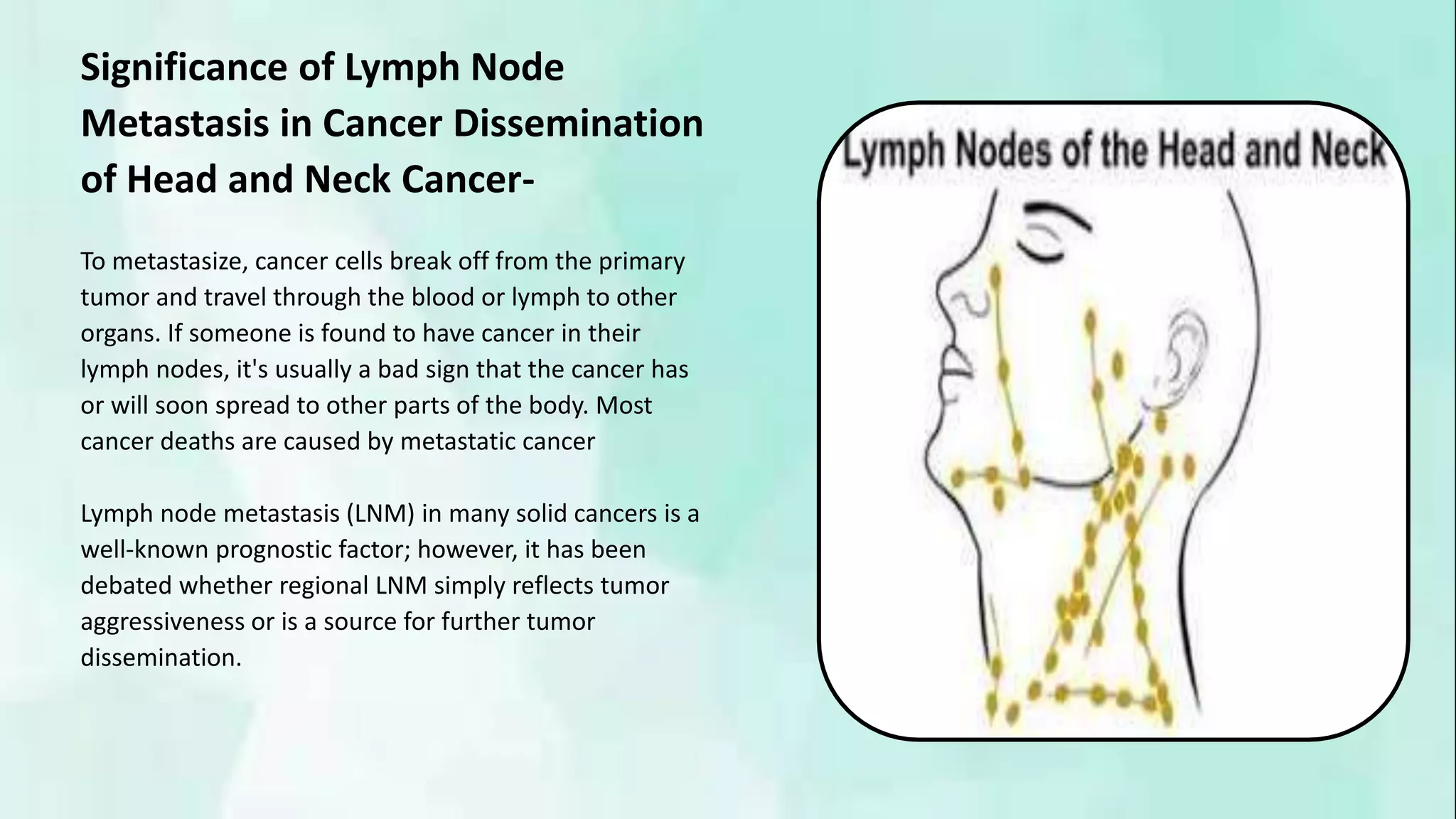
Significance of Lymph Node
Metastasis in Cancer Dissemination
of Head and Neck Cancer-
To metastasize, cancer cells break off from the primary
tumor and travel through the blood or lymph to other
organs. If someone is found to have cancer in their
lymph nodes, it's usually a bad sign that the cancer has
or will soon spread to other parts of the body. Most
cancer deaths are caused by metastatic cancer
Lymph node metastasis (LNM) in many solid cancers is a
well-known prognostic factor; however, it has been
debated whether regional LNM simply reflects tumor
aggressiveness or is a source for further tumor
dissemination.
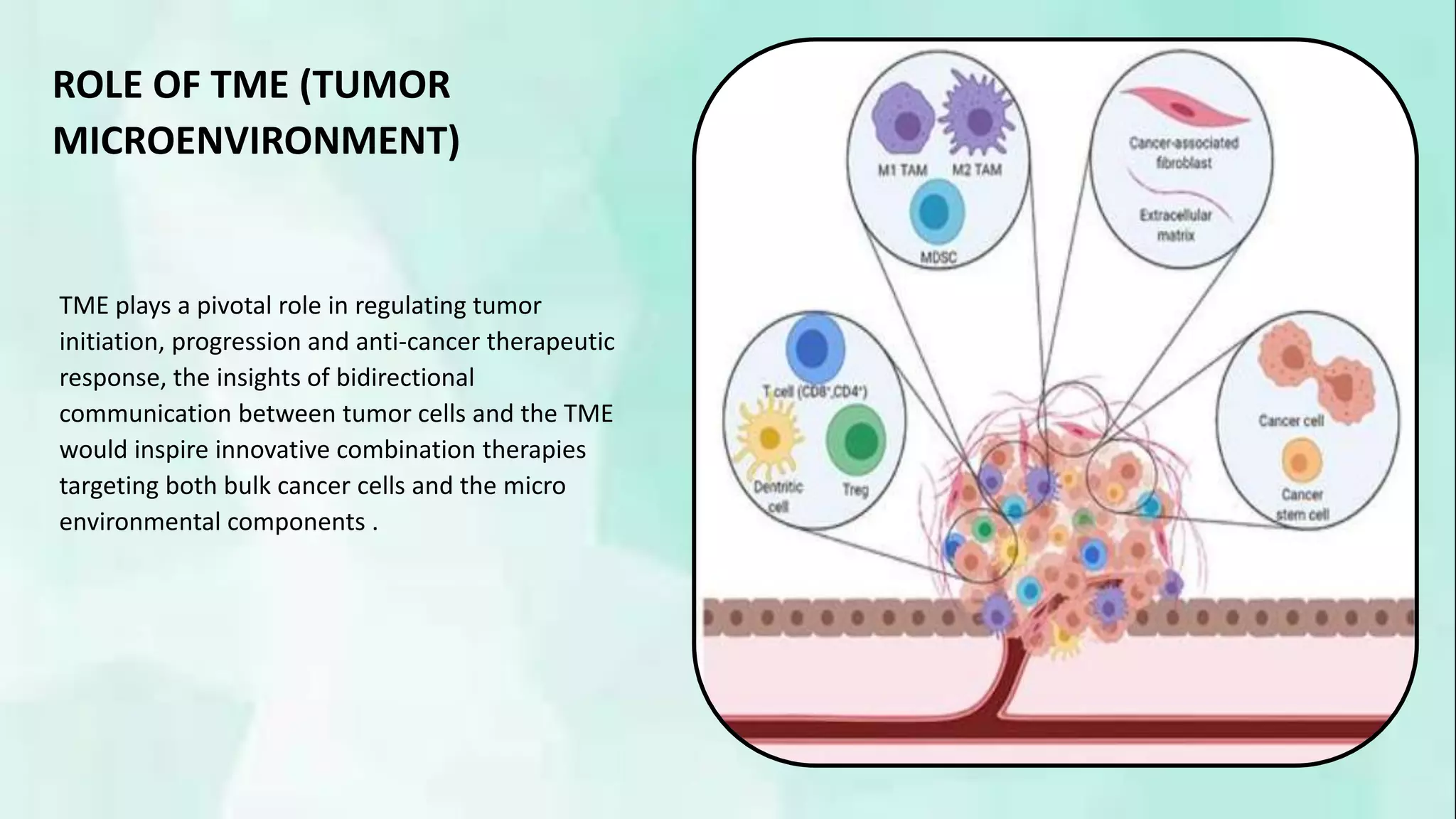
TME plays a pivotal role in regulating tumor
initiation, progression and anti-cancer therapeutic
response, the insights of bidirectional
communication between tumor cells and the TME
would inspire innovative combination therapies
targeting both bulk cancer cells and the micro
environmental components .
ROLE OF TME (TUMOR
MICROENVIRONMENT)
TUMOR MICROENVIRONMENT-
The tumor micro environment (TME) is comprised of many different cell populations The maelstrom component of the tumor
micro environment is composed of multiple different cell types, such as cancer-associated fibroblasts, neutrophils,
macrophages, regulatory T cells, myeloid-derived suppressor cells, natural killer cells, platelets and mast cells.
1. CAFS- The majority of the cells in the tumour stroma are cancer-associated fibroblasts (CAFs), and their primary
job is to maintain a favourable microenvironment.for the expansion and development of malignant cells. CAFs
modify the microenvironment largely through the release of a range of cytokines, both autocrine and paracrine,
and other factors that are essential for the growth of tumour cells, invasion, inflammation, angiogenesis, and
metastasis and resistance to drugs.
2.MACROPHAGES-
• Mono nuclear phagocytes.
• Most important immune cells.
• Macrophages display a great plasticity, M1 and M2 representing the extreme activation states.
• Tumor activated macrophages (TAMS ) represent a major component of the macrophage population
largely contributing to proliferation, invasion and metastasis of tumor cell.
3. NEUTROPHILS-
• Polymorphonuclear leukocytes (PMNs), also referred to as
neutrophils.
• These are crucial effector cells of the innate immune system
and the most prevalent leukocyte population seen in the circulation.
• In analogy to TAMs , a phenotypic duplicity in a form of polarization states
has been observed. These antitumor and protumor phenotypes of
neutrophils have been termed as N1 and N2.
4. MAST CELLS-
Mast cells are the myeloid component of immune system .The tumor promoting function of tumor associated mass cells
include angiogenesis through the production of various factors such as VEGF and fIbroblast growth factor EGF2.
5-PLATELETS-
• Anucleated megakaryocyte fragments in the bone marrow give rise to platelets, often referred to as thrombocytes,which
are another important cellular type that responds to an injury.
• Although various studies have recently begun to concentrate on the function of blood platelets in relation to
cancerogenesis, tumour biology, and inflammation.
• Three different forms of secretory granules—dense granules, lysosomes, and -granules—platelets mediate the tumour
microenvironment.
6-NK CELLS-The ability of natural killer cells (NK cells) to quickly identify and eliminate virus-infected or cancerous cells
makes them essential components of the innate immune system.
6-EXTRACELLULAR MATRIX-
• Non-cellular network of macromolecules, including fibrous structural proteins, glycoproteins, growth
factors and proteogly_x0002_cans that form a structure providing other surrounding cells with physical
and biochemical support.
• Proteins of ECM, such as collagen, elastin, fibronectin,Laminin and tenascin influence cell adhesion and
proliferation as well as provide a structural support along which cells migrate out of and into the TME.
• Increased production of collagen, laminin and elastin also results in elevated stiffness of tumor compared
to surrounding normal tissue.
TME IN PATHOGENESIS OF HNSCC
• Research -Researches have been conducted on mice and on saliva of
many patients with oral lesion.
• Result -HNSCC tissues showed a downregulation of IL-23 and
upregulation of TGF-β.
• Studies showed that premalignant lesions secrete many
proinflammatory mediators, such as CCL5 (also known as RANTES),
monocyte chemoattractant protein 1 (MCP-1),granulocyte-colony
stimulating factor (G-CSF) and prostaglandin-E2 (PGE2) compared to
HNSCC cells,suggesting the premalignant microenvironment to be
more immune stimulatory than the microenvironment of an
established HNSCC.
CONCLUSION-
The emerging evidence of crucial contribution of different stromal components to the regulation of the HNSCC
development implicates a fundamental role of the tumor microenvironment in providing a supportive niche,
thus substantially promoting HNSCC development and metastasis. While the research has previously focused
mainly on altered expression of genes and aberrant genetic and epigenetic mutations in tumor cells, it is
becoming clear that investigation of differences in stromal composition of the HNSCC tumor microenvironment
and their impact on cancer development and progression may help better understand the mechanisms behind
different responses to therapy, thus help define possible targets for clinical intervention.
TUMOR MICROENVIORNMENT IN HEAD AND NECK CANCER.pptx

TUMOR MICROENVIORNMENT IN HEAD AND NECK CANCER.pptx

  • 1.
    Effect of tumormicroenvironment on in the head and neck cancer: a systematic review AUTHOR-Barbora Peltanova,Martina Raudenska,and Michal Masarik. IMPACT FACTOR- 10.679 PRESENTED BY- Rhythm Karir
  • 2.
    WHAT IS CANCER- Canceris a disease in which some of the body’s cells grow uncontrollably and spread to other parts of the body. Cancer can start almost anywhere in the human body, which is made up of trillions of cells. Normally, human cells grow and multiply (through a process called cell division) to form new cells as the body needs them. When cells grow old or become damaged, they die, and new cells take their place. Sometimes this orderly process breaks down, and abnormal or damaged cells grow and multiply when they shouldn’t. These cells may form tumors, which are lumps of tissue. Tumors can be cancerous or not cancerous (benign).
  • 3.
    INTRODUCTION- • Head andneck cancer is a group of cancers that include tumors in several areas above the collar bone. • The way the cancer behaves depends on the site where it has developed. • As we know there are various types of cancer but out of them head and neck cancer are most of the time malignant and most of time can affect the quality life of patients. Head and neck cancer consist of various tumour from the mucosal surfaces of the larynx , hypopharynx , oral cavity . • The survival rate still remains low.
  • 4.
    Significance of LymphNode Metastasis in Cancer Dissemination of Head and Neck Cancer- To metastasize, cancer cells break off from the primary tumor and travel through the blood or lymph to other organs. If someone is found to have cancer in their lymph nodes, it's usually a bad sign that the cancer has or will soon spread to other parts of the body. Most cancer deaths are caused by metastatic cancer Lymph node metastasis (LNM) in many solid cancers is a well-known prognostic factor; however, it has been debated whether regional LNM simply reflects tumor aggressiveness or is a source for further tumor dissemination.
  • 5.
    TME plays apivotal role in regulating tumor initiation, progression and anti-cancer therapeutic response, the insights of bidirectional communication between tumor cells and the TME would inspire innovative combination therapies targeting both bulk cancer cells and the micro environmental components . ROLE OF TME (TUMOR MICROENVIRONMENT)
  • 7.
    TUMOR MICROENVIRONMENT- The tumormicro environment (TME) is comprised of many different cell populations The maelstrom component of the tumor micro environment is composed of multiple different cell types, such as cancer-associated fibroblasts, neutrophils, macrophages, regulatory T cells, myeloid-derived suppressor cells, natural killer cells, platelets and mast cells. 1. CAFS- The majority of the cells in the tumour stroma are cancer-associated fibroblasts (CAFs), and their primary job is to maintain a favourable microenvironment.for the expansion and development of malignant cells. CAFs modify the microenvironment largely through the release of a range of cytokines, both autocrine and paracrine, and other factors that are essential for the growth of tumour cells, invasion, inflammation, angiogenesis, and metastasis and resistance to drugs.
  • 8.
    2.MACROPHAGES- • Mono nuclearphagocytes. • Most important immune cells. • Macrophages display a great plasticity, M1 and M2 representing the extreme activation states. • Tumor activated macrophages (TAMS ) represent a major component of the macrophage population largely contributing to proliferation, invasion and metastasis of tumor cell.
  • 9.
    3. NEUTROPHILS- • Polymorphonuclearleukocytes (PMNs), also referred to as neutrophils. • These are crucial effector cells of the innate immune system and the most prevalent leukocyte population seen in the circulation. • In analogy to TAMs , a phenotypic duplicity in a form of polarization states has been observed. These antitumor and protumor phenotypes of neutrophils have been termed as N1 and N2.
  • 10.
    4. MAST CELLS- Mastcells are the myeloid component of immune system .The tumor promoting function of tumor associated mass cells include angiogenesis through the production of various factors such as VEGF and fIbroblast growth factor EGF2.
  • 11.
    5-PLATELETS- • Anucleated megakaryocytefragments in the bone marrow give rise to platelets, often referred to as thrombocytes,which are another important cellular type that responds to an injury. • Although various studies have recently begun to concentrate on the function of blood platelets in relation to cancerogenesis, tumour biology, and inflammation. • Three different forms of secretory granules—dense granules, lysosomes, and -granules—platelets mediate the tumour microenvironment. 6-NK CELLS-The ability of natural killer cells (NK cells) to quickly identify and eliminate virus-infected or cancerous cells makes them essential components of the innate immune system.
  • 12.
    6-EXTRACELLULAR MATRIX- • Non-cellularnetwork of macromolecules, including fibrous structural proteins, glycoproteins, growth factors and proteogly_x0002_cans that form a structure providing other surrounding cells with physical and biochemical support. • Proteins of ECM, such as collagen, elastin, fibronectin,Laminin and tenascin influence cell adhesion and proliferation as well as provide a structural support along which cells migrate out of and into the TME. • Increased production of collagen, laminin and elastin also results in elevated stiffness of tumor compared to surrounding normal tissue.
  • 13.
    TME IN PATHOGENESISOF HNSCC • Research -Researches have been conducted on mice and on saliva of many patients with oral lesion. • Result -HNSCC tissues showed a downregulation of IL-23 and upregulation of TGF-β. • Studies showed that premalignant lesions secrete many proinflammatory mediators, such as CCL5 (also known as RANTES), monocyte chemoattractant protein 1 (MCP-1),granulocyte-colony stimulating factor (G-CSF) and prostaglandin-E2 (PGE2) compared to HNSCC cells,suggesting the premalignant microenvironment to be more immune stimulatory than the microenvironment of an established HNSCC.
  • 14.
    CONCLUSION- The emerging evidenceof crucial contribution of different stromal components to the regulation of the HNSCC development implicates a fundamental role of the tumor microenvironment in providing a supportive niche, thus substantially promoting HNSCC development and metastasis. While the research has previously focused mainly on altered expression of genes and aberrant genetic and epigenetic mutations in tumor cells, it is becoming clear that investigation of differences in stromal composition of the HNSCC tumor microenvironment and their impact on cancer development and progression may help better understand the mechanisms behind different responses to therapy, thus help define possible targets for clinical intervention.