Maarten Abbink (TU Delft) Beamer Sample April 1, 2014 1 / 16
Sample presentation using Beamer
Delft University of Technology
Maarten Abbink
April 1, 2014
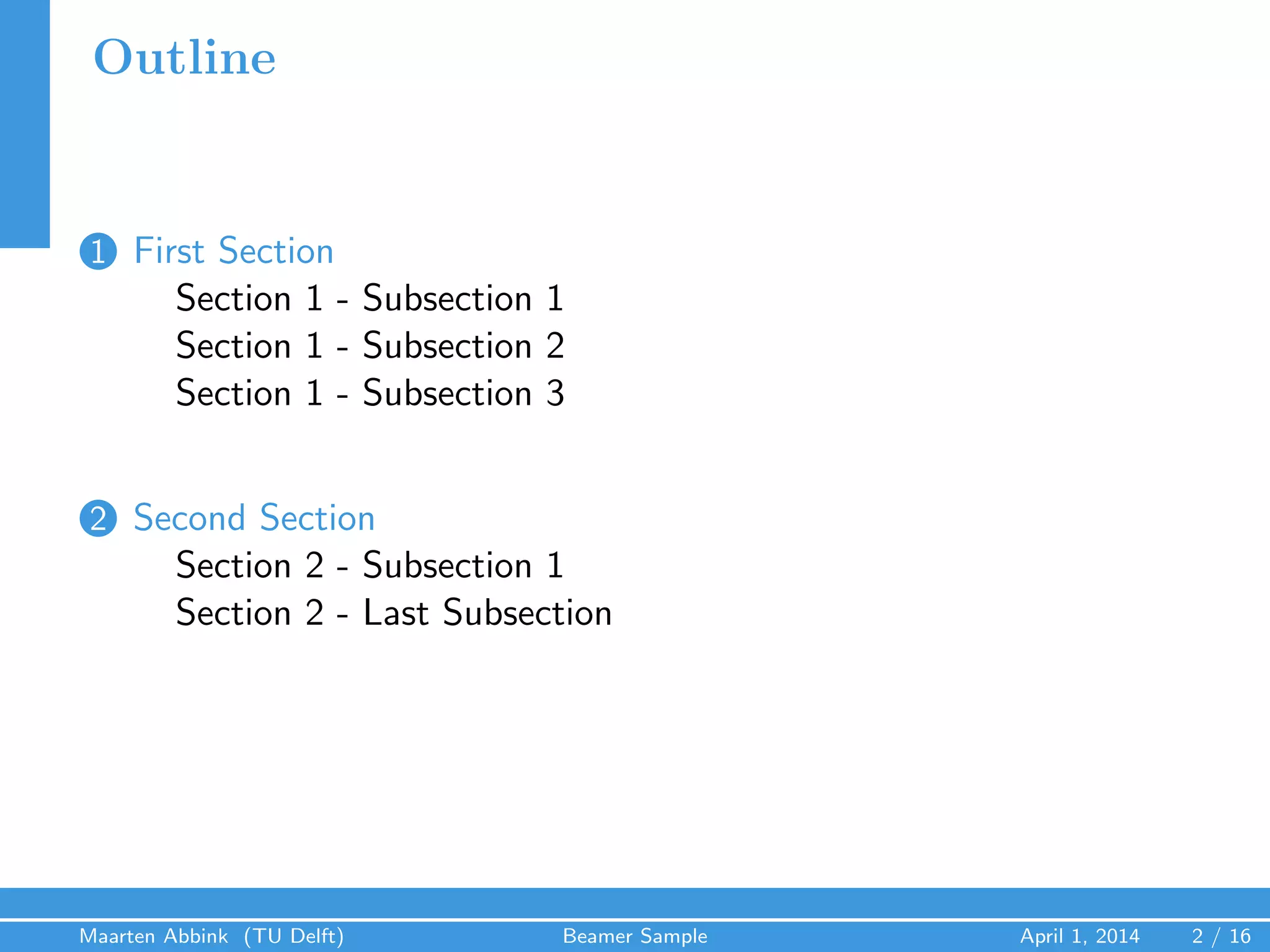
Outline
1 First Section
Section 1 - Subsection 1
Section 1 - Subsection 2
Section 1 - Subsection 3
2 Second Section
Section 2 - Subsection 1
Section 2 - Last Subsection
Maarten Abbink (TU Delft) Beamer Sample April 1, 2014 2 / 16
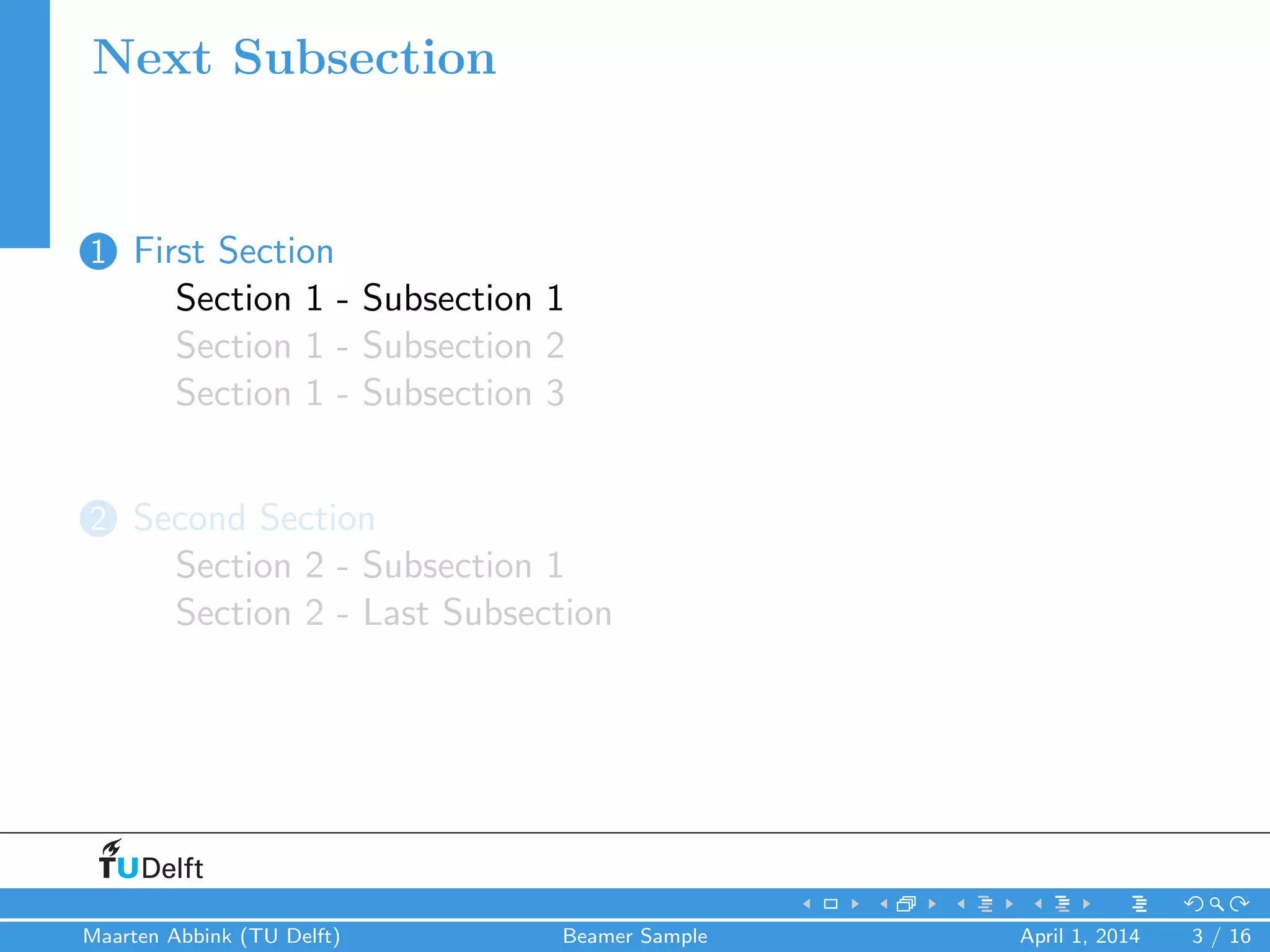
Next Subsection
1 First Section
Section 1 - Subsection 1
Section 1 - Subsection 2
Section 1 - Subsection 3
2 Second Section
Section 2 - Subsection 1
Section 2 - Last Subsection
Maarten Abbink (TU Delft) Beamer Sample April 1, 2014 3 / 16
Section 1 - Subsection 1 - Page 1
Example
0 1 2 3 4 5 6 7 8
n
0
1
2
3
4
5
6u(n)
u(n) = [3, 1, 4]n
Maarten Abbink (TU Delft) Beamer Sample April 1, 2014 4 / 16
Section 1 - Subsection 1 - Page 2
Definition
Let n be a discrete variable, i.e. n ∈ Z. A 1-dimensional periodic
number is a function that depends periodically on n.
u(n) = [u0, u1, . . . , ud−1]n =



u0 if n ≡ 0 (mod d)
u1 if n ≡ 1 (mod d)
...
ud−1 if n ≡ d − 1 (mod d)
d is called the period.
Maarten Abbink (TU Delft) Beamer Sample April 1, 2014 5 / 16
Section 1 - Subsection 1 - Page 3
Example
f (n) = − 1
2, 1
3 n
n2 + 3n − [1, 2]n
=
−1
3n2 + 3n − 2 if n ≡ 0 (mod 2)
−1
2n2 + 3n − 1 if n ≡ 1 (mod 2)
0 1 2 3 4 5 6 7
n
−3
−2
−1
0
1
2
3
4
5f(n)=−1
2
,1
3n
n2
+3n−[1,2]n
−1
2
n2
+ 3n − 1
−1
3
n2
+ 3n − 2
Maarten Abbink (TU Delft) Beamer Sample April 1, 2014 6 / 16
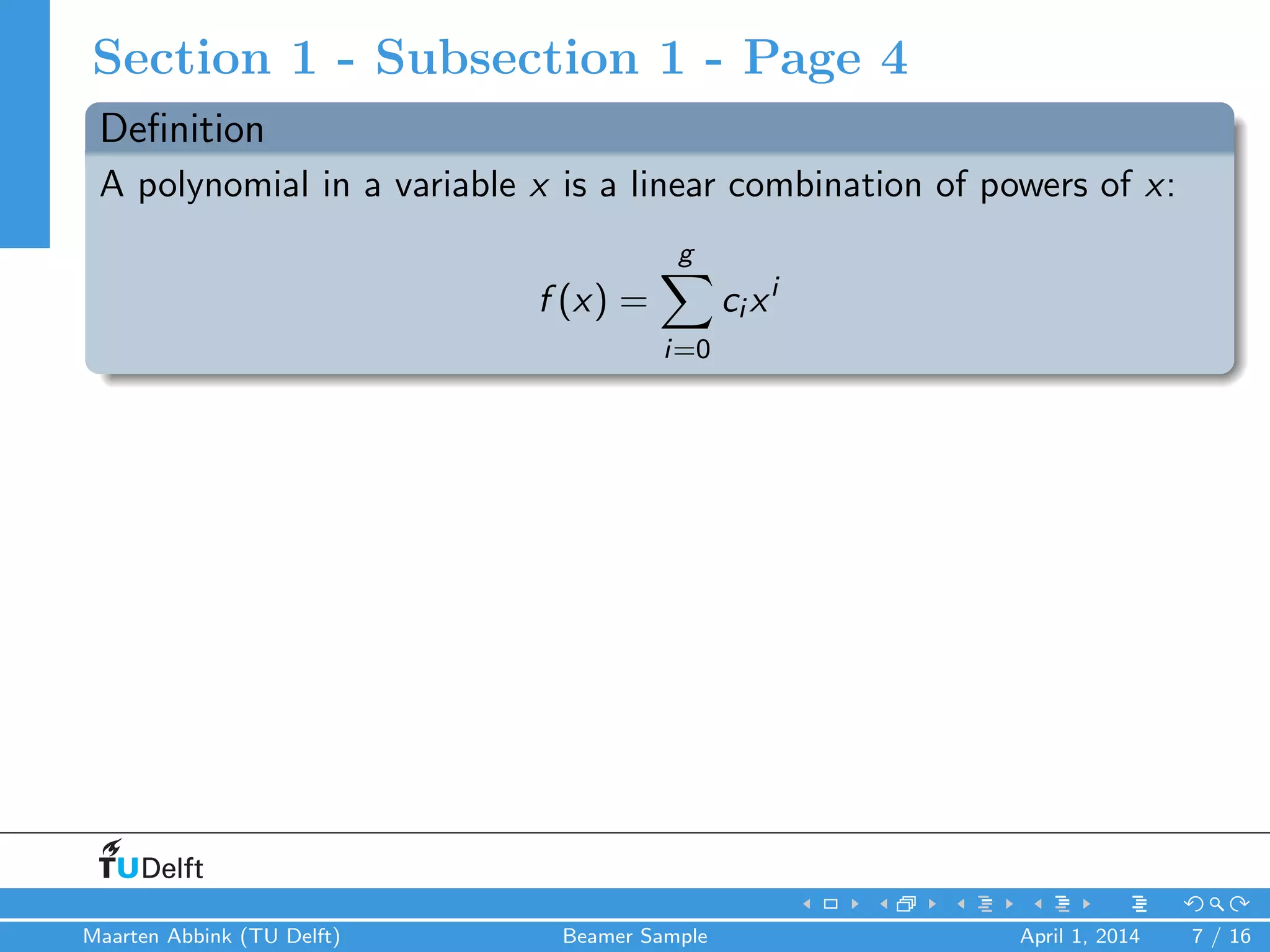
Section 1 - Subsection 1 - Page 4
Definition
A polynomial in a variable x is a linear combination of powers of x:
f (x) =
g
i=0
ci xi
Maarten Abbink (TU Delft) Beamer Sample April 1, 2014 7 / 16
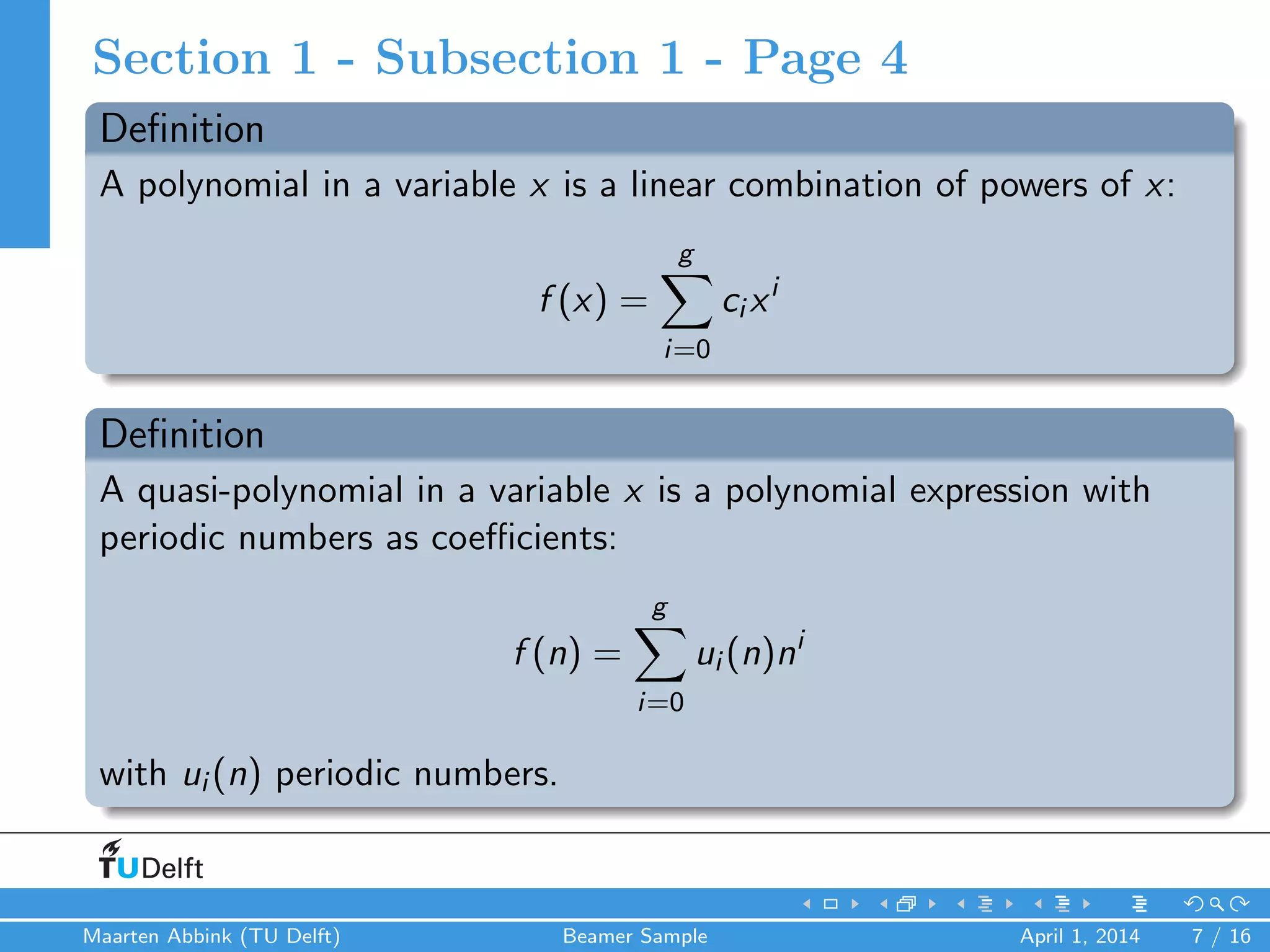
Section 1 - Subsection 1 - Page 4
Definition
A polynomial in a variable x is a linear combination of powers of x:
f (x) =
g
i=0
ci xi
Definition
A quasi-polynomial in a variable x is a polynomial expression with
periodic numbers as coefficients:
f (n) =
g
i=0
ui (n)ni
with ui (n) periodic numbers.
Maarten Abbink (TU Delft) Beamer Sample April 1, 2014 7 / 16
Next Subsection
1 First Section
Section 1 - Subsection 1
Section 1 - Subsection 2
Section 1 - Subsection 3
2 Second Section
Section 2 - Subsection 1
Section 2 - Last Subsection
Maarten Abbink (TU Delft) Beamer Sample April 1, 2014 8 / 16
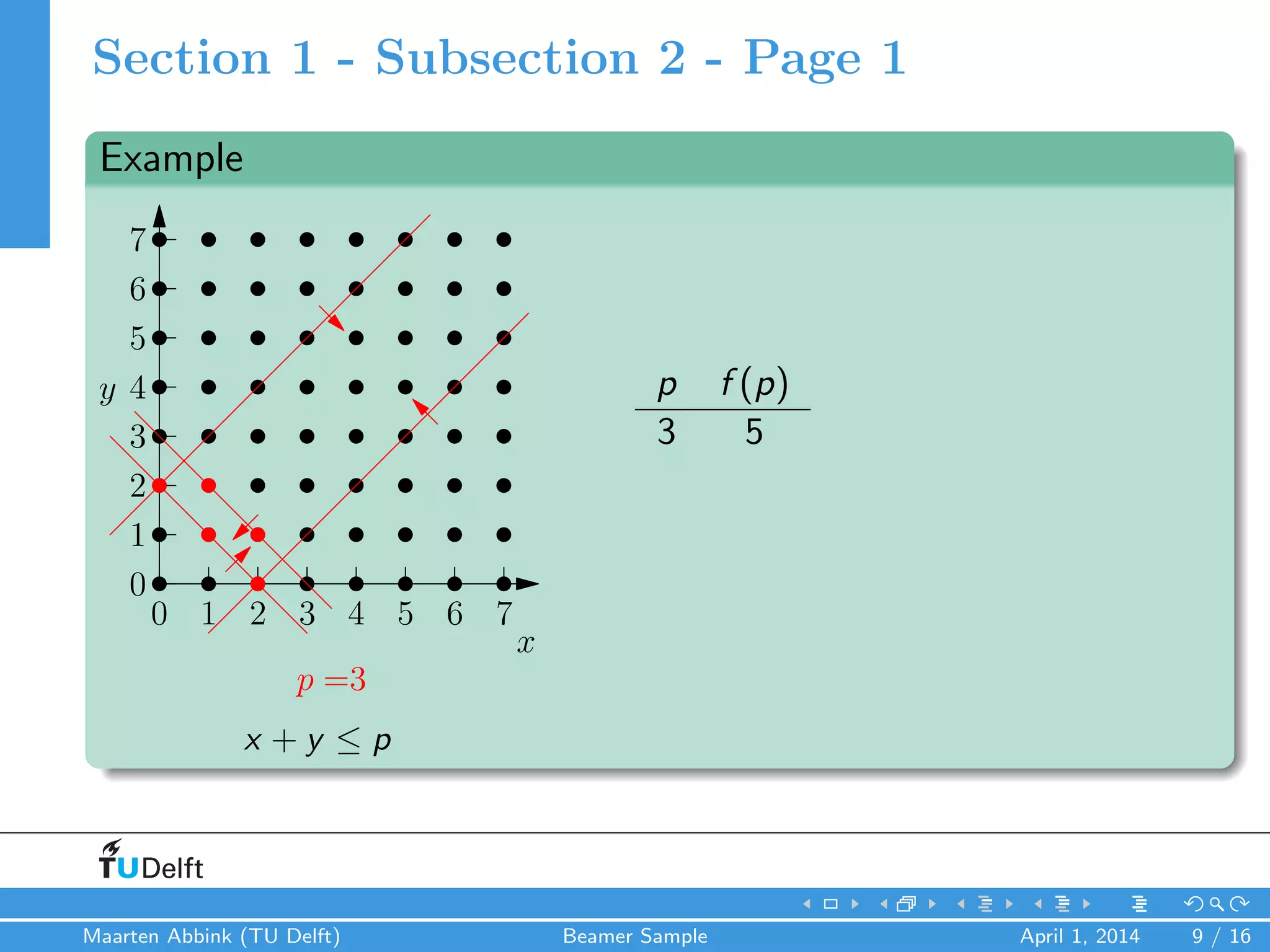
Section 1 - Subsection 2 - Page 1
Example
0 1 2 3 4 5 6 7
x
0
1
2
3
4
5
6
7
y
p =3
x + y ≤ p
p f (p)
3 5
Maarten Abbink (TU Delft) Beamer Sample April 1, 2014 9 / 16
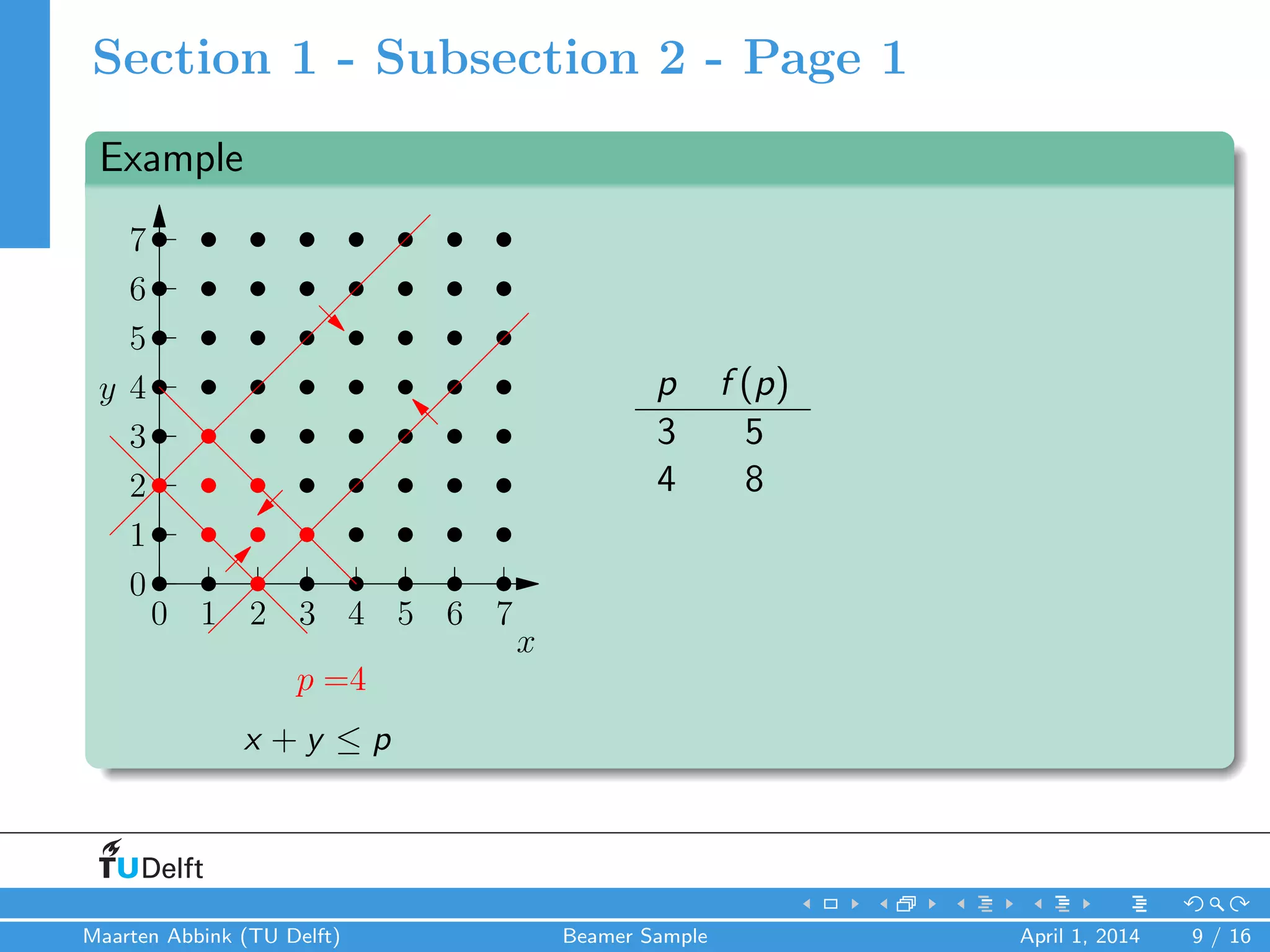
Section 1 - Subsection 2 - Page 1
Example
0 1 2 3 4 5 6 7
x
0
1
2
3
4
5
6
7
y
p =4
x + y ≤ p
p f (p)
3 5
4 8
Maarten Abbink (TU Delft) Beamer Sample April 1, 2014 9 / 16
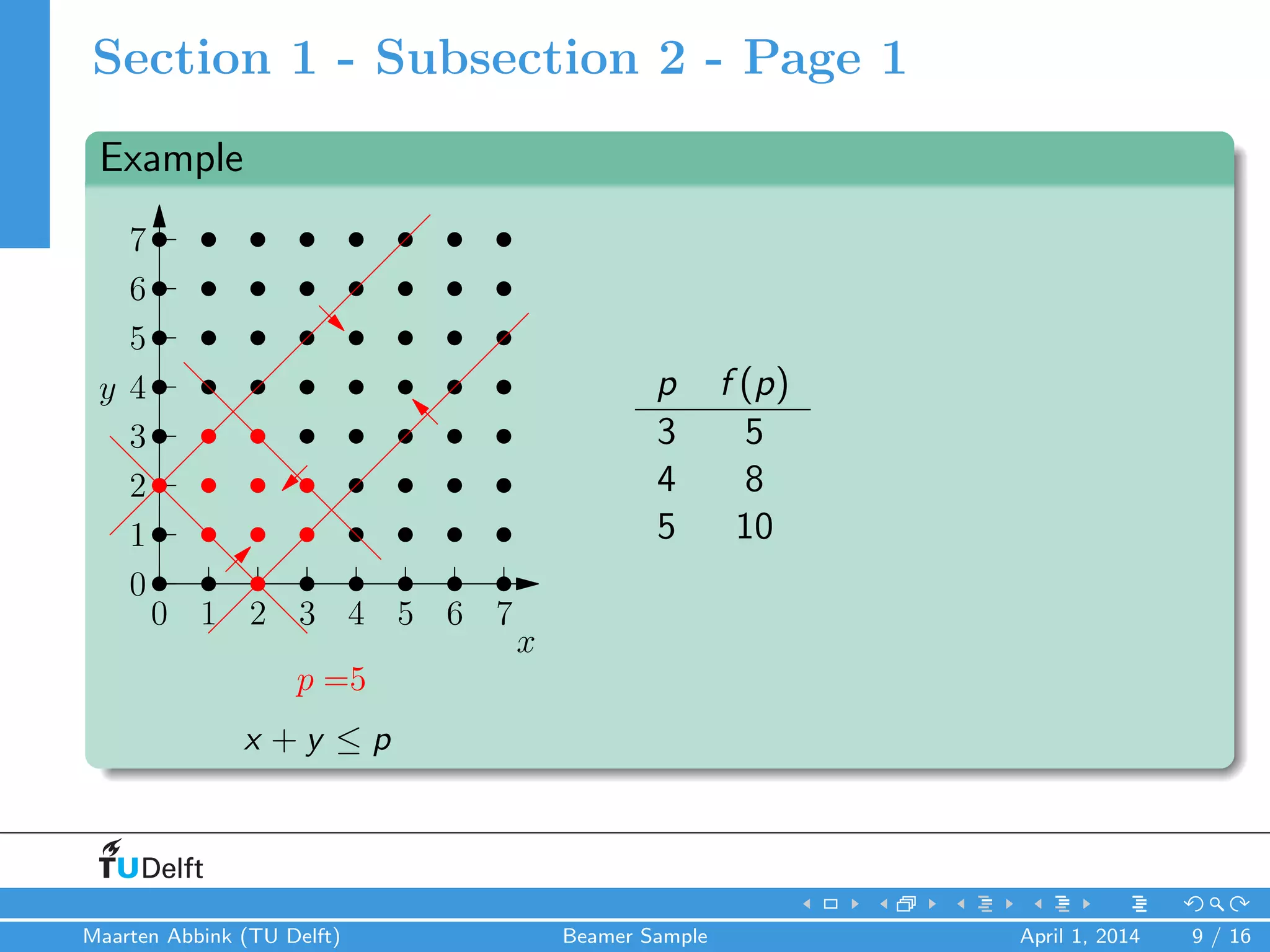
Section 1 - Subsection 2 - Page 1
Example
0 1 2 3 4 5 6 7
x
0
1
2
3
4
5
6
7
y
p =5
x + y ≤ p
p f (p)
3 5
4 8
5 10
Maarten Abbink (TU Delft) Beamer Sample April 1, 2014 9 / 16
Section 1 - Subsection 2 - Page 1
Example
0 1 2 3 4 5 6 7
x
0
1
2
3
4
5
6
7
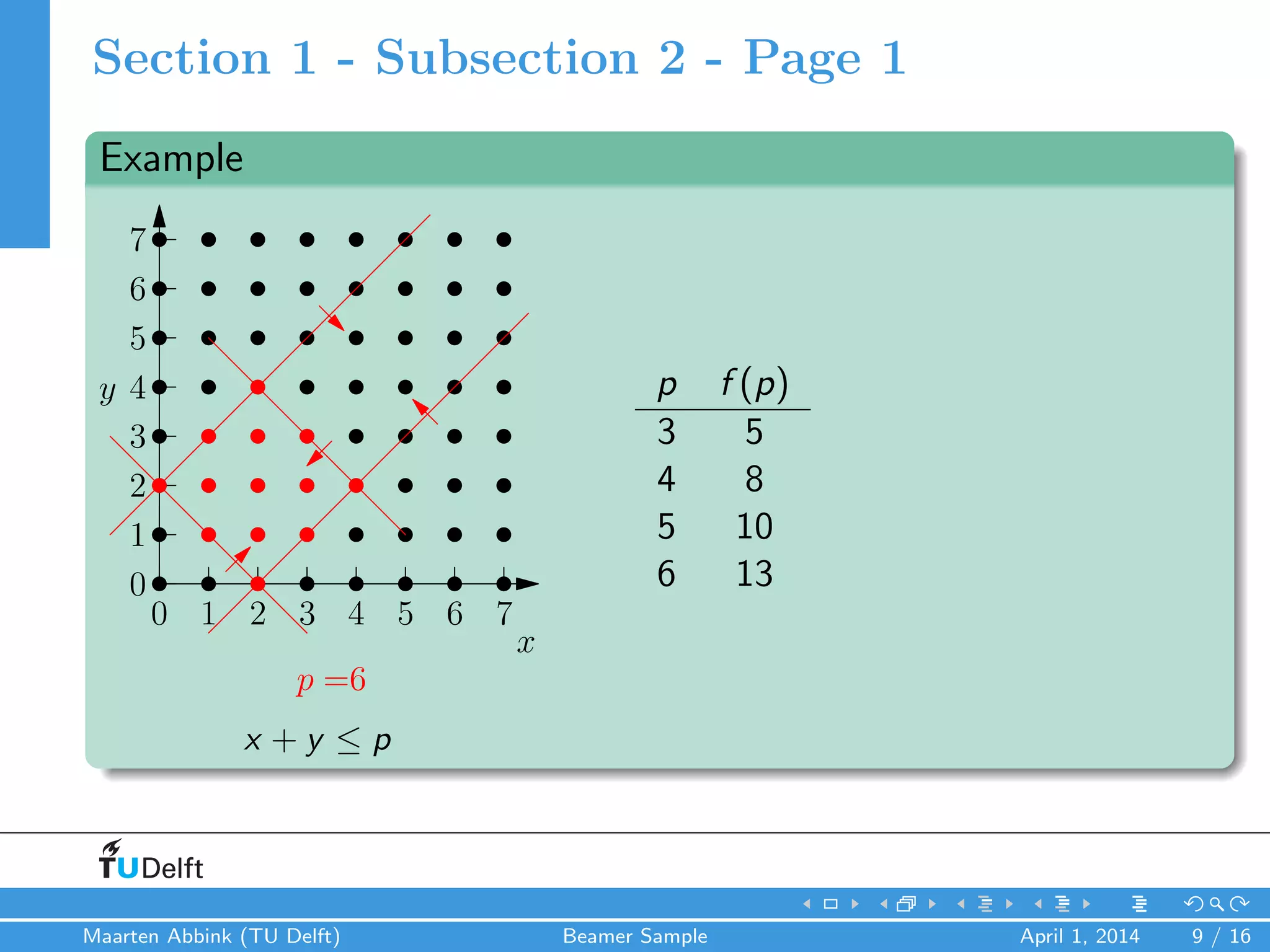
y
p =6
x + y ≤ p
p f (p)
3 5
4 8
5 10
6 13
Maarten Abbink (TU Delft) Beamer Sample April 1, 2014 9 / 16
Section 1 - Subsection 2 - Page 1
Example
0 1 2 3 4 5 6 7
x
0
1
2
3
4
5
6
7
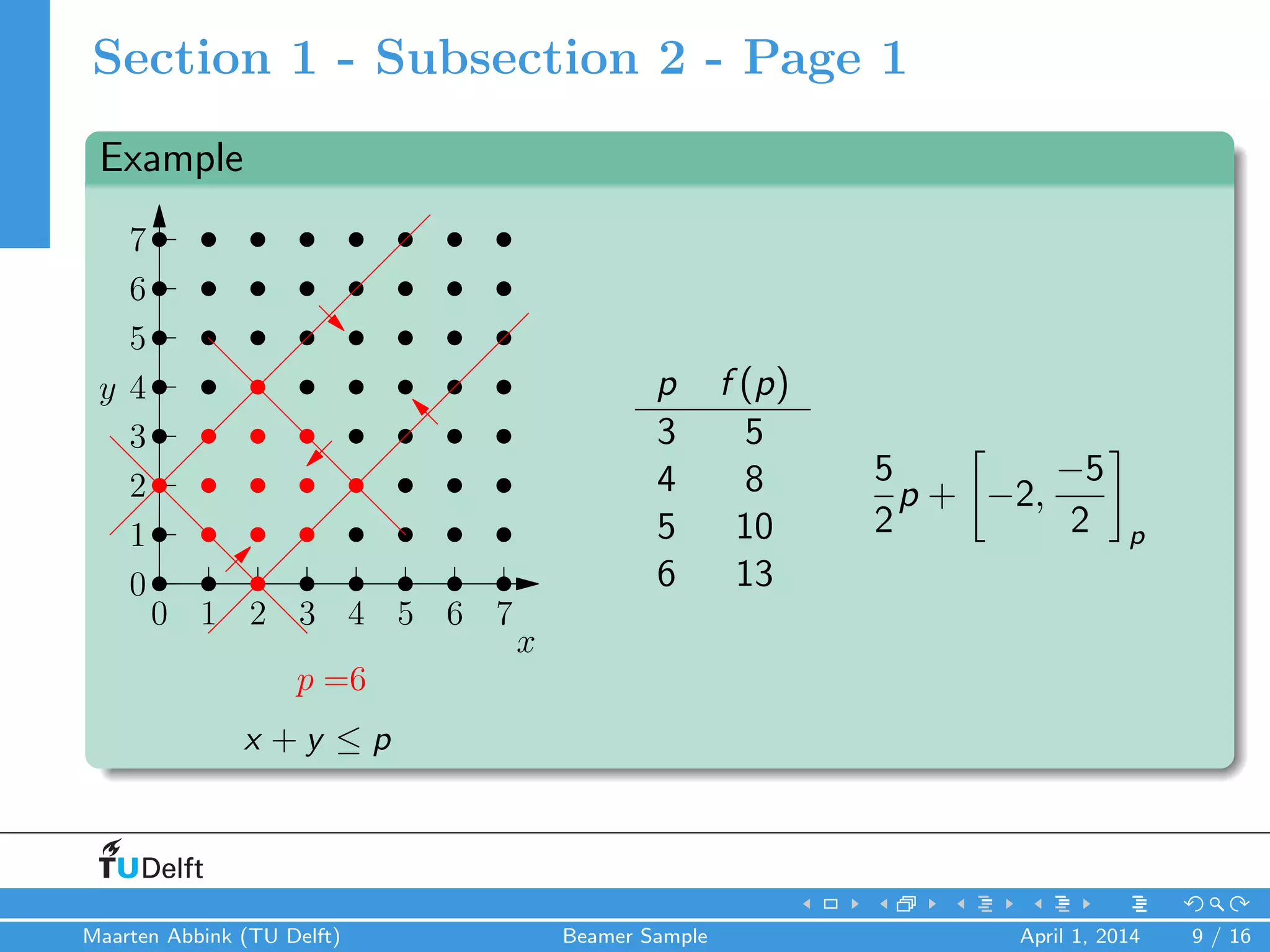
y
p =6
x + y ≤ p
p f (p)
3 5
4 8
5 10
6 13
5
2
p + −2,
−5
2 p
Maarten Abbink (TU Delft) Beamer Sample April 1, 2014 9 / 16
Section 1 - Subsection 2 - Page 2
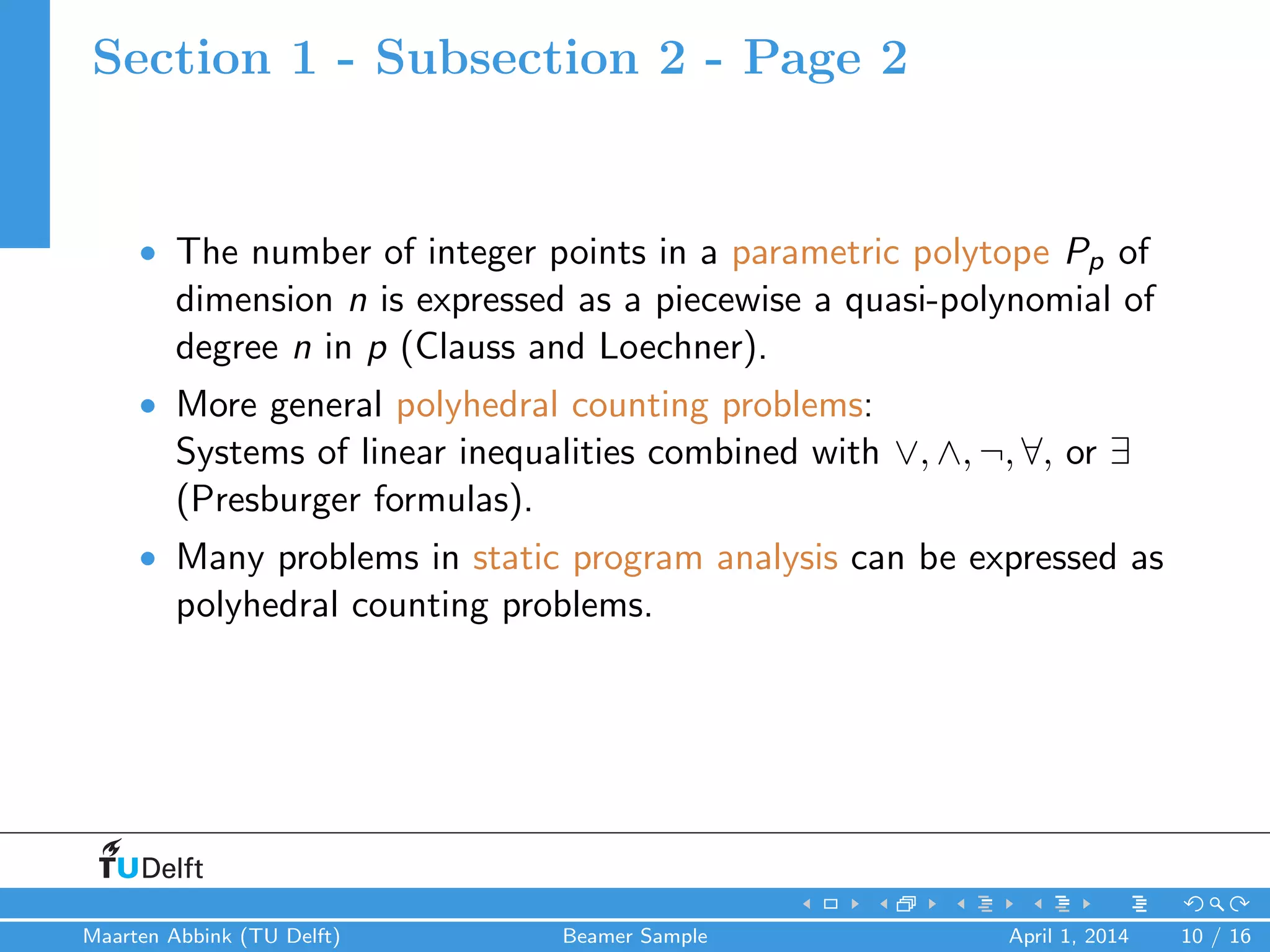
• The number of integer points in a parametric polytope Pp of
dimension n is expressed as a piecewise a quasi-polynomial of
degree n in p (Clauss and Loechner).
Maarten Abbink (TU Delft) Beamer Sample April 1, 2014 10 / 16
Section 1 - Subsection 2 - Page 2
• The number of integer points in a parametric polytope Pp of
dimension n is expressed as a piecewise a quasi-polynomial of
degree n in p (Clauss and Loechner).
• More general polyhedral counting problems:
Systems of linear inequalities combined with ∨, ∧, ¬, ∀, or ∃
(Presburger formulas).
Maarten Abbink (TU Delft) Beamer Sample April 1, 2014 10 / 16
Section 1 - Subsection 2 - Page 2
• The number of integer points in a parametric polytope Pp of
dimension n is expressed as a piecewise a quasi-polynomial of
degree n in p (Clauss and Loechner).
• More general polyhedral counting problems:
Systems of linear inequalities combined with ∨, ∧, ¬, ∀, or ∃
(Presburger formulas).
• Many problems in static program analysis can be expressed as
polyhedral counting problems.
Maarten Abbink (TU Delft) Beamer Sample April 1, 2014 10 / 16
Next Subsection
1 First Section
Section 1 - Subsection 1
Section 1 - Subsection 2
Section 1 - Subsection 3
2 Second Section
Section 2 - Subsection 1
Section 2 - Last Subsection
Maarten Abbink (TU Delft) Beamer Sample April 1, 2014 11 / 16
Section 1 - Subsection 3 - Page 1
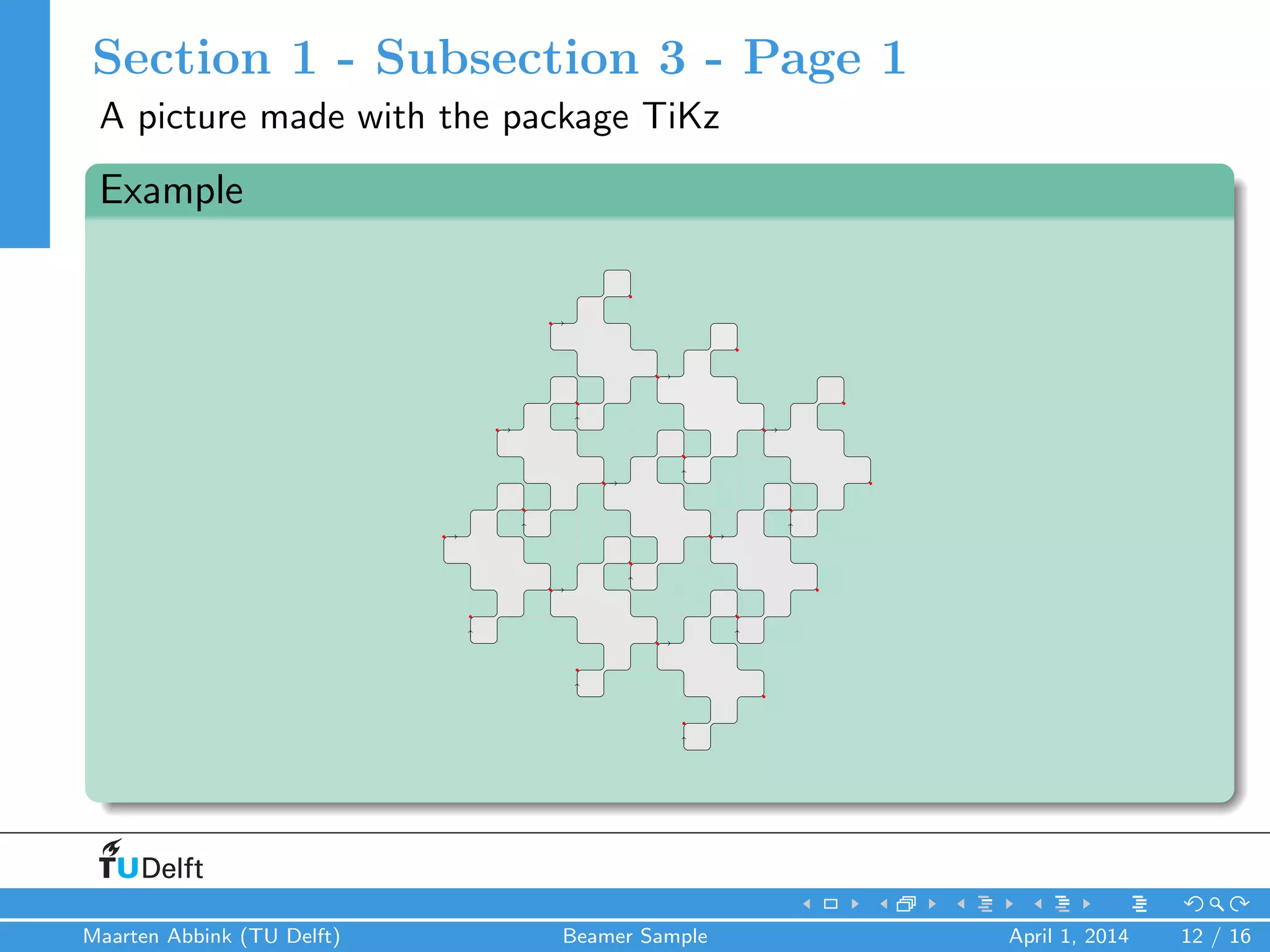
A picture made with the package TiKz
Example
Maarten Abbink (TU Delft) Beamer Sample April 1, 2014 12 / 16
Next Subsection
1 First Section
Section 1 - Subsection 1
Section 1 - Subsection 2
Section 1 - Subsection 3
2 Second Section
Section 2 - Subsection 1
Section 2 - Last Subsection
Maarten Abbink (TU Delft) Beamer Sample April 1, 2014 13 / 16
Section 2 - subsection 1 - page 1
Alertblock
This page gives an example with numbered bullets (enumerate)
in an ”Example” window:
Example
Discrete domain ⇒ evaluate in each point
Not possible for
1 parametric domains
Maarten Abbink (TU Delft) Beamer Sample April 1, 2014 14 / 16
Section 2 - subsection 1 - page 1
Alertblock
This page gives an example with numbered bullets (enumerate)
in an ”Example” window:
Example
Discrete domain ⇒ evaluate in each point
Not possible for
1 parametric domains
2 large domains (NP-complete)
Maarten Abbink (TU Delft) Beamer Sample April 1, 2014 14 / 16
Next Subsection
1 First Section
Section 1 - Subsection 1
Section 1 - Subsection 2
Section 1 - Subsection 3
2 Second Section
Section 2 - Subsection 1
Section 2 - Last Subsection
Maarten Abbink (TU Delft) Beamer Sample April 1, 2014 15 / 16
Last Page
Summary
End of the beamer demo
with a tidy TU Delft lay-out.
Thank you!
Maarten Abbink (TU Delft) Beamer Sample April 1, 2014 16 / 16

TUDelft Beamer

  • 1.
    Maarten Abbink (TUDelft) Beamer Sample April 1, 2014 1 / 16 Sample presentation using Beamer Delft University of Technology Maarten Abbink April 1, 2014
  • 2.
    Outline 1 First Section Section1 - Subsection 1 Section 1 - Subsection 2 Section 1 - Subsection 3 2 Second Section Section 2 - Subsection 1 Section 2 - Last Subsection Maarten Abbink (TU Delft) Beamer Sample April 1, 2014 2 / 16
  • 3.
    Next Subsection 1 FirstSection Section 1 - Subsection 1 Section 1 - Subsection 2 Section 1 - Subsection 3 2 Second Section Section 2 - Subsection 1 Section 2 - Last Subsection Maarten Abbink (TU Delft) Beamer Sample April 1, 2014 3 / 16
  • 4.
    Section 1 -Subsection 1 - Page 1 Example 0 1 2 3 4 5 6 7 8 n 0 1 2 3 4 5 6u(n) u(n) = [3, 1, 4]n Maarten Abbink (TU Delft) Beamer Sample April 1, 2014 4 / 16
  • 5.
    Section 1 -Subsection 1 - Page 2 Definition Let n be a discrete variable, i.e. n ∈ Z. A 1-dimensional periodic number is a function that depends periodically on n. u(n) = [u0, u1, . . . , ud−1]n =    u0 if n ≡ 0 (mod d) u1 if n ≡ 1 (mod d) ... ud−1 if n ≡ d − 1 (mod d) d is called the period. Maarten Abbink (TU Delft) Beamer Sample April 1, 2014 5 / 16
  • 6.
    Section 1 -Subsection 1 - Page 3 Example f (n) = − 1 2, 1 3 n n2 + 3n − [1, 2]n = −1 3n2 + 3n − 2 if n ≡ 0 (mod 2) −1 2n2 + 3n − 1 if n ≡ 1 (mod 2) 0 1 2 3 4 5 6 7 n −3 −2 −1 0 1 2 3 4 5f(n)=−1 2 ,1 3n n2 +3n−[1,2]n −1 2 n2 + 3n − 1 −1 3 n2 + 3n − 2 Maarten Abbink (TU Delft) Beamer Sample April 1, 2014 6 / 16
  • 7.
    Section 1 -Subsection 1 - Page 4 Definition A polynomial in a variable x is a linear combination of powers of x: f (x) = g i=0 ci xi Maarten Abbink (TU Delft) Beamer Sample April 1, 2014 7 / 16
  • 8.
    Section 1 -Subsection 1 - Page 4 Definition A polynomial in a variable x is a linear combination of powers of x: f (x) = g i=0 ci xi Definition A quasi-polynomial in a variable x is a polynomial expression with periodic numbers as coefficients: f (n) = g i=0 ui (n)ni with ui (n) periodic numbers. Maarten Abbink (TU Delft) Beamer Sample April 1, 2014 7 / 16
  • 9.
    Next Subsection 1 FirstSection Section 1 - Subsection 1 Section 1 - Subsection 2 Section 1 - Subsection 3 2 Second Section Section 2 - Subsection 1 Section 2 - Last Subsection Maarten Abbink (TU Delft) Beamer Sample April 1, 2014 8 / 16
  • 10.
    Section 1 -Subsection 2 - Page 1 Example 0 1 2 3 4 5 6 7 x 0 1 2 3 4 5 6 7 y p =3 x + y ≤ p p f (p) 3 5 Maarten Abbink (TU Delft) Beamer Sample April 1, 2014 9 / 16
  • 11.
    Section 1 -Subsection 2 - Page 1 Example 0 1 2 3 4 5 6 7 x 0 1 2 3 4 5 6 7 y p =4 x + y ≤ p p f (p) 3 5 4 8 Maarten Abbink (TU Delft) Beamer Sample April 1, 2014 9 / 16
  • 12.
    Section 1 -Subsection 2 - Page 1 Example 0 1 2 3 4 5 6 7 x 0 1 2 3 4 5 6 7 y p =5 x + y ≤ p p f (p) 3 5 4 8 5 10 Maarten Abbink (TU Delft) Beamer Sample April 1, 2014 9 / 16
  • 13.
    Section 1 -Subsection 2 - Page 1 Example 0 1 2 3 4 5 6 7 x 0 1 2 3 4 5 6 7 y p =6 x + y ≤ p p f (p) 3 5 4 8 5 10 6 13 Maarten Abbink (TU Delft) Beamer Sample April 1, 2014 9 / 16
  • 14.
    Section 1 -Subsection 2 - Page 1 Example 0 1 2 3 4 5 6 7 x 0 1 2 3 4 5 6 7 y p =6 x + y ≤ p p f (p) 3 5 4 8 5 10 6 13 5 2 p + −2, −5 2 p Maarten Abbink (TU Delft) Beamer Sample April 1, 2014 9 / 16
  • 15.
    Section 1 -Subsection 2 - Page 2 • The number of integer points in a parametric polytope Pp of dimension n is expressed as a piecewise a quasi-polynomial of degree n in p (Clauss and Loechner). Maarten Abbink (TU Delft) Beamer Sample April 1, 2014 10 / 16
  • 16.
    Section 1 -Subsection 2 - Page 2 • The number of integer points in a parametric polytope Pp of dimension n is expressed as a piecewise a quasi-polynomial of degree n in p (Clauss and Loechner). • More general polyhedral counting problems: Systems of linear inequalities combined with ∨, ∧, ¬, ∀, or ∃ (Presburger formulas). Maarten Abbink (TU Delft) Beamer Sample April 1, 2014 10 / 16
  • 17.
    Section 1 -Subsection 2 - Page 2 • The number of integer points in a parametric polytope Pp of dimension n is expressed as a piecewise a quasi-polynomial of degree n in p (Clauss and Loechner). • More general polyhedral counting problems: Systems of linear inequalities combined with ∨, ∧, ¬, ∀, or ∃ (Presburger formulas). • Many problems in static program analysis can be expressed as polyhedral counting problems. Maarten Abbink (TU Delft) Beamer Sample April 1, 2014 10 / 16
  • 18.
    Next Subsection 1 FirstSection Section 1 - Subsection 1 Section 1 - Subsection 2 Section 1 - Subsection 3 2 Second Section Section 2 - Subsection 1 Section 2 - Last Subsection Maarten Abbink (TU Delft) Beamer Sample April 1, 2014 11 / 16
  • 19.
    Section 1 -Subsection 3 - Page 1 A picture made with the package TiKz Example Maarten Abbink (TU Delft) Beamer Sample April 1, 2014 12 / 16
  • 20.
    Next Subsection 1 FirstSection Section 1 - Subsection 1 Section 1 - Subsection 2 Section 1 - Subsection 3 2 Second Section Section 2 - Subsection 1 Section 2 - Last Subsection Maarten Abbink (TU Delft) Beamer Sample April 1, 2014 13 / 16
  • 21.
    Section 2 -subsection 1 - page 1 Alertblock This page gives an example with numbered bullets (enumerate) in an ”Example” window: Example Discrete domain ⇒ evaluate in each point Not possible for 1 parametric domains Maarten Abbink (TU Delft) Beamer Sample April 1, 2014 14 / 16
  • 22.
    Section 2 -subsection 1 - page 1 Alertblock This page gives an example with numbered bullets (enumerate) in an ”Example” window: Example Discrete domain ⇒ evaluate in each point Not possible for 1 parametric domains 2 large domains (NP-complete) Maarten Abbink (TU Delft) Beamer Sample April 1, 2014 14 / 16
  • 23.
    Next Subsection 1 FirstSection Section 1 - Subsection 1 Section 1 - Subsection 2 Section 1 - Subsection 3 2 Second Section Section 2 - Subsection 1 Section 2 - Last Subsection Maarten Abbink (TU Delft) Beamer Sample April 1, 2014 15 / 16
  • 24.
    Last Page Summary End ofthe beamer demo with a tidy TU Delft lay-out. Thank you! Maarten Abbink (TU Delft) Beamer Sample April 1, 2014 16 / 16