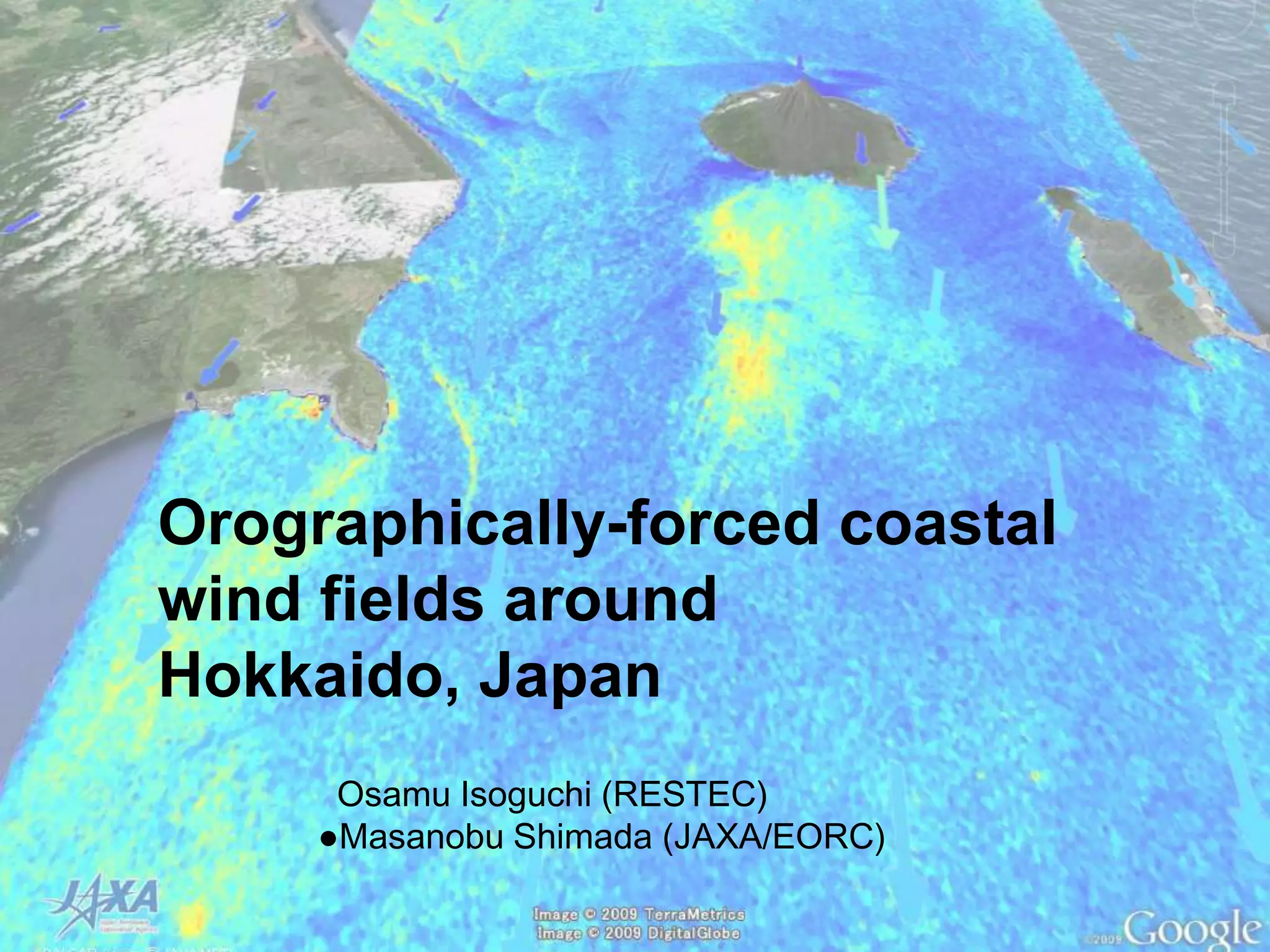
Orographically-forced coastal wind fields around Hokkaido, Japan  Osamu Isoguchi (RESTEC)●Masanobu Shimada (JAXA/EORC)
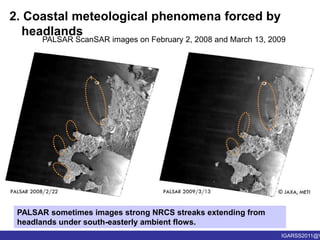
Orographically-forced coastal wind phenomena revealed by SAR wind dataCharacteristic of ocean surface winds in the lee of an isolated islandisoguchi et al. (2011),Characteristics of Ocean Surface Winds in the Lee of an Isolated Island observed by Synthetic Aperture Radar, Mon. Wea. Rev.2.Coastal meteological phenomena forced by headlands
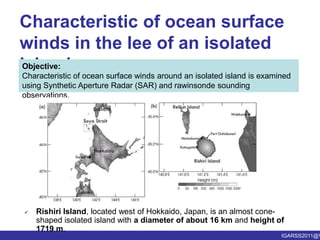
Characteristic of ocean surface winds in the lee of an isolated islandObjective:Characteristic of ocean surface winds around an isolated island is examined using Synthetic Aperture Radar (SAR) and rawinsonde sounding observations. Rishiri Island, located west of Hokkaido, Japan, is an almost cone-shaped isolated island with a diameter of about 16 km and height of 1719 m.1. Characteristic of ocean surface winds in the lee of an isolated islandA Case Study of a Low-level Jet Formed in the Lee of Rishiri Island on 22 May 2009
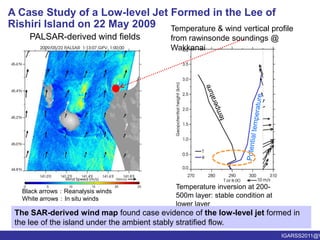
Statistical Characteristics of Atmospheric Island WakesA Case Study of a Low-level Jet Formed in the Lee of Rishiri Island on 22 May 2009 Temperature & wind vertical profile from rawinsonde soundings @ WakkanaiPALSAR-derived wind fieldstemperaturePotential temperatureTemperature inversion at 200-500m layer: stable condition at lower layerBlack arrows:Reanalysis winds      White arrows:In situ windsThe SAR-derived wind map found case evidence of the low-level jet formed in the lee of the island under the ambient stably stratified flow.
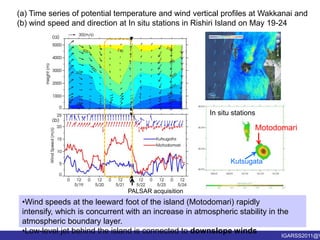
In situ stationsMotodomari Kutsugata(a) Time series of potential temperature and wind vertical profiles at Wakkanai and (b) wind speed and direction at In situ stations in Rishiri Island on May 19-24PALSAR acquisitionWind speeds at the leeward foot of the island (Motodomari) rapidly intensify, which is concurrent with an increase in atmospheric stability in the atmospheric boundary layer.
Low-level jet behind the island is connected to downslope winds1. Characteristic of ocean surface winds in the lee of an isolated islandA Case Study of a Low-level Jet Formed in the Lee of Rishiri Island on 22 May 2009
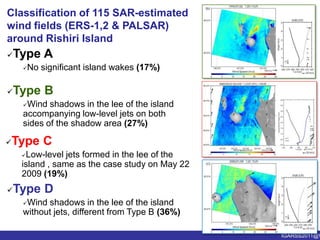
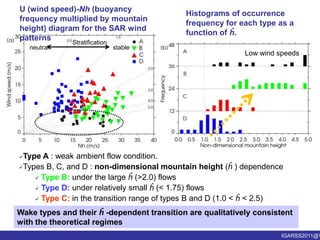
Statistical Characteristics of Atmospheric Island WakesClassification of 115 SAR-estimated wind fields (ERS-1,2 & PALSAR) around Rishiri IslandType A
No significant island wakes (17%)
Type B
Wind shadows in the lee of the island accompanying low-level jets on both sides of the shadow area (27%)
Type C
Low-level jets formed in the lee of the island , same as the case study on May 22 2009 (19%)
Type D
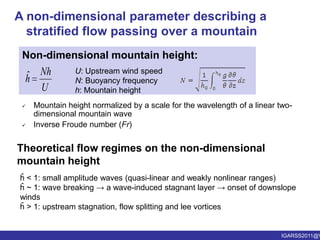
Wind shadows in the lee of the island without jets, different from Type B (36%)A non-dimensional parameter describing a stratifiedflow passing over a mountainNon-dimensional mountain height:U:Upstream wind speedN: Buoyancy frequencyh: Mountain heightMountain height normalized by a scale for the wavelength of a linear two-dimensional mountain wave
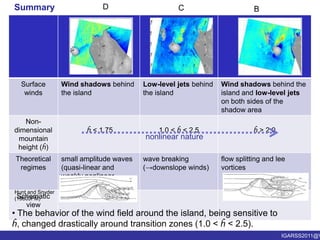
Inverse Froude number (Fr)Theoretical flow regimes on the non-dimensional mountain heightĥ < 1: small amplitude waves (quasi-linear and weakly nonlinear ranges)ĥ ~ 1: wave breaking -> a wave-induced stagnant layer -> onset of downslope windsĥ > 1: upstream stagnation, flow splitting and lee vortices

TU2.T10.3.pptx

  • 1.
    Orographically-forced coastal windfields around Hokkaido, Japan Osamu Isoguchi (RESTEC)●Masanobu Shimada (JAXA/EORC)
  • 2.
    Orographically-forced coastal windphenomena revealed by SAR wind dataCharacteristic of ocean surface winds in the lee of an isolated islandisoguchi et al. (2011),Characteristics of Ocean Surface Winds in the Lee of an Isolated Island observed by Synthetic Aperture Radar, Mon. Wea. Rev.2.Coastal meteological phenomena forced by headlands
  • 3.
    Characteristic of oceansurface winds in the lee of an isolated islandObjective:Characteristic of ocean surface winds around an isolated island is examined using Synthetic Aperture Radar (SAR) and rawinsonde sounding observations. Rishiri Island, located west of Hokkaido, Japan, is an almost cone-shaped isolated island with a diameter of about 16 km and height of 1719 m.1. Characteristic of ocean surface winds in the lee of an isolated islandA Case Study of a Low-level Jet Formed in the Lee of Rishiri Island on 22 May 2009
  • 4.
    Statistical Characteristics ofAtmospheric Island WakesA Case Study of a Low-level Jet Formed in the Lee of Rishiri Island on 22 May 2009 Temperature & wind vertical profile from rawinsonde soundings @ WakkanaiPALSAR-derived wind fieldstemperaturePotential temperatureTemperature inversion at 200-500m layer: stable condition at lower layerBlack arrows:Reanalysis winds White arrows:In situ windsThe SAR-derived wind map found case evidence of the low-level jet formed in the lee of the island under the ambient stably stratified flow.
  • 5.
    In situ stationsMotodomariKutsugata(a) Time series of potential temperature and wind vertical profiles at Wakkanai and (b) wind speed and direction at In situ stations in Rishiri Island on May 19-24PALSAR acquisitionWind speeds at the leeward foot of the island (Motodomari) rapidly intensify, which is concurrent with an increase in atmospheric stability in the atmospheric boundary layer.
  • 6.
    Low-level jet behindthe island is connected to downslope winds1. Characteristic of ocean surface winds in the lee of an isolated islandA Case Study of a Low-level Jet Formed in the Lee of Rishiri Island on 22 May 2009
  • 7.
    Statistical Characteristics ofAtmospheric Island WakesClassification of 115 SAR-estimated wind fields (ERS-1,2 & PALSAR) around Rishiri IslandType A
  • 8.
  • 9.
  • 10.
    Wind shadows inthe lee of the island accompanying low-level jets on both sides of the shadow area (27%)
  • 11.
  • 12.
    Low-level jets formedin the lee of the island , same as the case study on May 22 2009 (19%)
  • 13.
  • 14.
    Wind shadows inthe lee of the island without jets, different from Type B (36%)A non-dimensional parameter describing a stratifiedflow passing over a mountainNon-dimensional mountain height:U:Upstream wind speedN: Buoyancy frequencyh: Mountain heightMountain height normalized by a scale for the wavelength of a linear two-dimensional mountain wave
  • 15.
    Inverse Froude number(Fr)Theoretical flow regimes on the non-dimensional mountain heightĥ < 1: small amplitude waves (quasi-linear and weakly nonlinear ranges)ĥ ~ 1: wave breaking -> a wave-induced stagnant layer -> onset of downslope windsĥ > 1: upstream stagnation, flow splitting and lee vortices