Tsunami
Response
Psychosocial Care Report
Tsunami Response
Psychosocial Care Report
Tsunami Response
Psychosocial Care Report
Published by
BOOKS for CHANGE
139, Richmond Road
Bangalore - 560 025
Phone: 080-25580346
e-mail: bfc@actionaidindia.org
website: www.booksforchange.net
Authors:Authors:Authors:Authors:Authors: Raheela Amirally & Dr David Peat
Researchers:Researchers:Researchers:Researchers:Researchers: Prema Gamage, Madhumita Ray, and Hemalatha Venkataraman.
With special thanks to Unnikrishnan P V, Koy Thompson, Dr Ramani Sudaresan and Sital Kumar.
BBBBBfffff C Production TC Production TC Production TC Production TC Production Team:eam:eam:eam:eam: Shoba Ramachandran, Rajeevan, Gokul and Shailaja
©Copyleft : This publication may be used in any form. Please feel free to quote, translate, distribute
and transmit. Kindly acknowledge the source.
Contents
Foreword iv
Background v
Introduction: Methodology used in collecting information vi
The document format – How to use the document vii
What is psychosocial care? 1
Psychosocial care within the context of ActionAid 4
Language matters 6
Why is psychosocial care in the context of large-scale disasters important? 9
Why is it important to learn from what has been done? 10
What has been done? 12
The Principles: Target the most vulnerable 15
Staffing matters 19
The how part 23
Training 26
Looking toward the future 28
Models to consider: Working towards conceptual clarity 30
Recommendations and Author’s note 36
References 37
Annex: 1. What has been done, a sample of activities 38
2. Self-Reporting Questionnaire (SRQ) 39
3. Example of continuous on-going assessment 42
4. Structured Interview for Community Level Workers 46
5. Sample of recommendations 50
Foreword
The psychosocial care programme gently reminds us what is at the moral core of a human
rights based approach: dignity, and the ability to plan and make choices that are uniquely your
own, and to act on them. As some say: ‘to be what you want to be, to do what you want to do,
and become what you want to become’. In short, to fully realise your own creative potential and
with others shape the future you would value.
Sometimes we forget the moral core in our formulaic approaches to claims, entitlements and services.
And why does psychosocial care take us back to the core? Because disasters and the inevitable
loss, grief and guilt shatters the individual’s abilities to think straight, to plan, to make choices
and act clearly, to relate with others, to play, to have energy and dreams for the future. Everything
that makes you uniquely human, and everything that human rights were designed to protect
and enable. Psychosocial care – particularly the way that it has evolved within ActionAid
International – makes these issues its focus. With psychosocial care approaches you cannot
treat individuals as objects to be quickly organised and mobilised (press-ganged) into seeking
and claiming rights – no matter how important that final objective. You have to slow down,
and treat individuals with the self-esteem and respect that they are uniquely worthy of as
human beings – and then support them in their process of empowerment. You have to draw
together ‘inner healing’, the provision of immediate needs, and the political processes of
seeking rights into one. It is a story that has not been told and needs to be told. This report
and the accompanying country reports are a good start.
Psychosocial care workers need not be on the defensive that they are not doing ‘proper’ human
rights-based work – far from it. As well as addressing the moral core of human rights, the
evolving psychosocial care perspective has sharpened the identification of the most vulnerable
by bringing in an inner, spiritual and psychological dimension, and it brings people back to a
position of inner strength, confidence, and trust, to work with others to claim their rights.
A psychosocial care perspective is also a challenge to those who dumped boats, houses and
other services on people without thought and interaction with those affected people.
We have to ask ourselves the question, ‘are people better able to plan and organise for themselves
and negotiate for those things they need after our intervention, or less able to?’ In short are they
more in control over their lives or less? Has it left people with more dignity or less? For many,
whose bright logos and names adorn boats, houses and annual reports trumpeting their
successes, the answer would have to be ‘less’.
KKKKKoy Toy Toy Toy Toy Thomsonhomsonhomsonhomsonhomson
9 March 2006
iv
On 26th December 2004 the Asian Ocean Tsunami claimed the lives of over 300,000 people
and left many more displaced, homeless, and irrecoverably changing lives.
ActionAid responded to the mammoth disaster with a multi-country emergency programme,
targeting the most vulnerable in coastal regions of India, Sri Lanka, the Maldives, Thailand
and Somalia.
Amidst wide-scale humanitarian relief, medical assistance and food distributions, ActionAid
recognised the essential need for community-based social reconstruction. The need to rebuild
hope, trust and confidence in shattered societies.
Based on experience from previous large-scale disaster responses, ActionAid recognised the
importance of rapidly rebuilding support mechanisms and community-based social structures.
Using the community-based psychosocial care approach, ActionAid has set about empowering
communities through rebuilding hope, confidence and giving people a voice to speed up the
recovery process.
This study aims to understand the processes of establishing and implementing the psychosocial
support programme in three of the five tsunami response countries – the Maldives, India and
Sri Lanka – during the first twelve months since the tsunami.
This report focuses upon the information gathered during the research from respondents who
were specifically asked for their suggestions/opinions concerning strengthening psychosocial
support in disaster situations. The research described in this report documents guiding principles
for psychosocial programmes adopted in the three countries. This report aims to bring conceptual
clarity to psychosocial support interventions and addresses the important questions of ‘how’
and ‘why’, as well as highlighting potential operational challenges. The hope is that this will be
a learning tool to guide psychosocial support implementation for future emergencies.
Background
v
Methodology used in collecting information
The methodology for the research was developed collaboratively in December 2005 with the
researchers. Prema Gamage, Madhumita Ray, and Hemalatha Venkataraman, with assistance
from Sital Kumar, Dr David Peat and Raheela Amirally.
The purpose of the research initiative was to document the processes, practices, and operational
challenges at multiple levels of ActionAid (e.g. international, national, partner and field) during
the first year of psychosocial care implementation. In addition suggestions were gathered for
strengthening the programmes in the individual countries.
The overall methodology included:
✦ Devising set questions for use in interviews and focus group discussions
✦ Developing probes for set questions
✦ Desk reviews (secondary information review)
✦ Designing country specific methodologies
✦ Translations and back translations (to ensure accuracy) of set questions into Tamil, Sihnala,
Hindi and Divehi
✦ Field visits to sampled/representative areas within the country programmes
✦ Selecting key stakeholders at field, partner, hub/Atoll1
/regional, national and international levels
✦ Structured individual interviews with key respondents
✦ Structured focus group discussions
✦ Written responses to set questions (in instances where participation in focus groups was
not possible).
The field visits involved initial introductions of the project and the researcher.
During the translation specific care was taken over words, ‘processes’, ‘practices’ and ‘operational
challenges’; these may not have been easily understood by those working at the field level.
In light of this, it was decided that the following phrases and questions, or their equivalent in the
language of those being interviewed, would be helpful:
✦ What have you done since the start of the psychosocial care programme?
✦ How did you do what you did?
Introduction
1. Geo-political administrative unit; a cluster of islands determined by central government.
vi
✦ What were the facilitating (supporting; enabling) processes (factors) that led you to do what
you have done?
✦ What did you and/or your team do well?
✦ What things (factors) got in the way?
✦ What were the problems and challenges that were faced in your work?
Focus groups ground rules agreed upon included:
✦ Groups must consist of 5–8 people
✦ Every person’s input is valuable participation and is expected
✦ One person should speak at a time
✦ Confidentiality would be maintained.
It must be stated that this documentation of psychosocial work being implemented in the three
countries is simply a sampling and does not represent the entire psychosocial care programme.
The document format – designed for discussion and learning
This document does not purport to summarise the psychosocial support programmes operating
through ActionAid. For a much more complete account of the comprehensive psychosocial
support programmes implemented through ActionAid where the field research took place, please
take time to read the original Tsunami Learning Initiative reports concerning Sri Lanka, India and
the Maldives (Gamage, 2006; Ray, 2006; Venkataraman, 2006).
The function of this document is to highlight what was learned through the experience of
ActionAid’s implementing post-tsunami psychosocial support. The structure is designed specifically
to elicit discussion and learning. During the review of the three Tsunami Learning Initiative
documents, we found that there were themes and issues that emerged, albeit somewhat
subjectively, from the information provided by the field researchers.
Critical Thinking Questions
To highlight these themes, this document provides ‘principles of psychosocial care’ that
seem to apply in all settings. These principles are written in bold text in bullet format with
examples from one or more of the reports provided below the statements.
In addition, issues emerge from the contrasting psychosocial support offered in the three countries.
These issues are explicitly raised through the generation of related questions. The questions are
meant to elicit reflection, discussion and critical thinking about the issues.
Throughout this document, then, text boxes contain either quotes taken from the original Learning
Initiative Reports or questions.
vii
The definition of psychosocial care held by those involved in its training,
provision and monitoring has direct influence on how this ‘care’ is
actually delivered and evaluated.
In Sri Lanka
Psychosocial care is viewed as a relatively new concept. The ActioAid staff adopts a pragmatic,
non-complex and practical understanding of psychosocial care. It begins with the idea that
“everybody needs support – some people need it more than others – it’s not rocket science,
but simply ‘putting a smile back on people’s faces’ – by rebuilding confidence and trust”
(Gamage, 2006, p. 2).
However, this understanding was ‘not shared by all (partner) organisations, and within
ActionAid itself, … a different understanding was shared between the various levels, from
community health workers to the Partner Organisation staff members, to teachers in the
community, District staff and National and International ActionAid staff’ (ibid, p. 6).
The extremely comprehensive variety of supportive actions of those involved in psychosocial
care shows that having a broad and practical definition may be beneficial, in that activities
undertaken are varied, offering practical support in multiple ways.
What is
psychosocial
care?
1
In the Maldives
As in Sri Lanka, the concept of psychosocial care was new. They adopted a very strong
‘community-based’, holistic view of psychosocial care. In contrast to the view of ActionAid
staff in Sri Lanka, psychosocial care was viewed as ‘very technical’ requiring a high level of
training and expertise before ‘any programme can translate into high quality implementation’
(Venkataraman, 2006, p. 6). Although, the Care Society, ActionAid’s partner organisation,
offered varied, creative, comprehensive and practical psychosocial support, their ‘technical’
concept of psychosocial support meant that rather than appreciating the tremendous work
they had accomplished, they felt that their expertise was not up to high standard. In other
words, the view of psychosocial support as ‘technical’ may have led to an under-valuing of
the high standard of support that they actually implemented.
‘The main aim of the psychosocial care programme is bringing the communities together
through combined community activities. Psychosocial Care is something that should come
out of the community. It should involve both emotional support as well as social support.
However, social support can only come out of building the togetherness of the community.
Building support systems within the community, [involves] building support systems within
the families so that they can help each other out and also between the families, involving
the whole community. Other forms of support should be included [to address the]
combination of the emotional, social, economical damage when a disaster occurs.
Psychosocial care is a combination of all of this – emotional and social; and care should be
sustainable (Venkataraman, 2006, p. 9).
ActionAid India
Given their vast past experience in implementing psychosocial support after past large-scale
disasters (e.g., Orissa, Jammu & Kashmir), the concept of psychosocial support is not new,
unlike Sri Lanka and Maldives. In fact, ActionAid India staff have played key roles in providing
psychosocial support training, or training has been implemented using materials and resources
prepared by them.
Over time, ActionAid India’s psychosocial support has largely been integrated within hospital
and mental health structures. This is a natural outcome as the needs of those requiring
support change from most people in a community to the few who are experiencing major,
long-term, mental health issues (i.e., anxiety or depression-based mental illness; post traumatic
stress disorder, (PTSD)). When the Tsunami struck, ActionAid India was able to draw upon
already established services, structures and expertise.
2
Although a definition is not specifically stated in the Tsunami Learning Initiative, India
Report, historically, due to this integration of psychosocial support into hospital-based
services, a ‘clinical’ counselling approach is presented as a major method for
implementation. In other words, psychosocial support is primarily viewed as ‘counselling’.
The medical, clinical model permeates the recruitment process, the stated need for training
in ‘advanced counselling techniques’ and in the establishment of ‘para-counsellors’ to
implement the psychosocial support.
However, they ‘have catered to trauma not merely as a medical problem, …. but something
deeply rooted with the culture, customs and traditions of the society the person lives in’. And
Counselling has to be further strengthened by training ‘on the rights-based approach, and
to look at women and children’s perspectives from a holistic perspective (Ray, 2006,
pp. 11–12).
‘ActionAid will have to at some point of time also involve more qualified people in these
services at hospitals with better payment of salaries as compared to the field counsellors. It
is again emphasized that counsellors at these centres also need not be locals. Although
emphasis on that strategy has its own merits, like developing local capacities, especially that
of women, but more educated people with better communications skills, could enhance
the effectiveness of the strategy particularly in the hospital settings (Ray, 2006, p. 8).
Critical Thinking Questions
Is it possible to integrate different models of psychosocial support (i.e., medical/clinical
with ‘most vulnerable groups’, community-based; participatory, rights-based approach)?
At what point should psychosocial support be returned to established mental
health services?
3
Psychosocial support is provided within a rights-based, community-
participation framework.
While disasters impact upon entire communities, the impact upon the poorest is the
greatest, as the poor have limited access to relief goods and services, with fewer options
of recovery (South Asia Earthquake 2005a, ALNAP, 2005).
Psychosocial care
within the context of
ActionAid
Core elements of psycho-social interventions
✦ Help people understand that they are experiencing normal reactions to
abnormal situations
✦ Empower people through appropriate and scientific knowledge
✦ Understand the consequences of stress and thus reduce its impact
✦ Increase coping strategies and thus reduce trauma
✦ Develop communication and problem solving skills to obtain concrete help
✦ Ensure connections with other survivors and staff of agencies who are providing
relief, health care, shelter, education and economic assistance
✦ Strengthen community initiatives and link available resources and needs of survivors.
(Unnikrisnan, Q&A, February 2005)
4
ActionAid works with the most marginalised and most vulnerable groups in communities. In a
disaster context, this may often be widows, orphans, the elderly, people with disabilities and
female headed-households.
Using a right-based framework, ActionAid seeks out the most vulnerable from within
communities, those whose rights are most violated with relief and recovery phases.
A rights-based approach sets the parameters within which humanitarian work is conducted,
it is grounded in the belief that improvised and marginalised people everywhere have rights
and responsibilities (Champam & Mancini, 2005).
From the onset of the relief phase, empowerment processes can be set in motion. Through
the involvement of people and communities, local organisations can be strengthened,
leadership among marginalised groups can be nurtured, and women can be placed at the
forefront of decision-making; setting in place the changes which can improve people’s lives
through ending the cycle of poverty.
Psychosocial care is a method that involves active participation of community members,
through which multiple factors that amplify people’s sufferings and impact negatively upon
their mental health status are addressed.
ActionAid has the perspective that post-disaster rehabilitation is all about establishing a spectrum
of care. An individual is an integrated whole and has a myriad of needs which require a whole
range of interventions. Further it is important to note that in a disaster, one is not always talking
about the community being restored to its position and condition it was in, prior to the
disaster, but moving a step ahead bringing in social and economic change in the community
(Ray, 2006, p. 6).
Psychosocial care is a comprehensive approach that helps to build hope, confidence
amongst survivors and thus fasten the recovery process. While the focus is on well-
being and mental health, it is equally important to respond to the relief needs like food,
water, shelter, etc. as part of the psycho-social programme (Unnikrisnan, February 2005).
The comprehensive nature of psychosocial support is reflected in the training the Community
Level Workers (CLWs) receive, for example, in the Andaman and Nicobar Islands, training
was targeted at those who had passed their 10th
grade in school. These Young, men and
women were trained in communication skills, personality development, perception and
empathy and stress. The first training concentrated on how to work and build relationships
with children. The trainees were also taught the importance of body language, eye contact,
listening skills and methods of rapport building. Other areas covered were disaster
preparedness and the effects of a disaster on family relations (Ray, 2006, p. 21).
5
Language
matters
(A) barrier ……... to understanding psychosocial care in the Maldives pertains to
linguistics. In Dhivehi, the state of being ‘mentally ill’ and thus requiring psychological
intervention is called Nafsaani. Nafs, as I got to know, literally translates to ‘oneself’
and if one is mentally ill only then does one need psychological assistance
(Venkataraman, 2006, p. 10).
One of the issues faced by all three countries was attempting to find the right level and
vocabulary for communicating the concept of ‘psychosocial care’. To the field researchers
this was first apparent in the translation of set questions for the focus groups.
In some languages, the translation of ‘psychosocial care’ is particularly problematic as shown
in the preceding box. Psychosocial care encompasses the multiple ways to support individuals
and communities as they work through the process of recovery; people’s responses after a
large-scale disaster should be viewed as normal responses to abnormal situations. It is
important that the language used communicates this message and not the message of
‘mental illness’ or damage. In order to address this issue, during the trainer-of-trainer’s
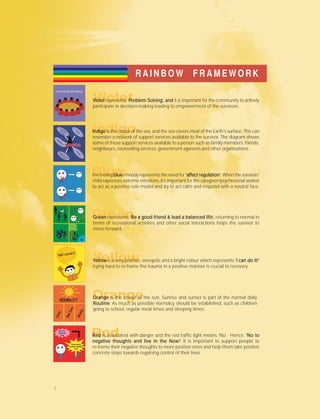
workshop in the Maldives (June 8–11, 2005), the participants generated the Rainbow
Framework which follows This was created as a communication aid for CLWs in the villages.
The hope was that it would be used to explain what ‘psychosocial support’ was in a culturally
contextual manner.
6
Orange
R A I N B O W F R A M E W O R K
VioletVVVVVioletioletioletioletiolet represents ‘Problem Solving’Problem Solving’Problem Solving’Problem Solving’Problem Solving’, and, and, and, and, and it is important for the community to actively
participate in decision-making leading to empowerment of the survivors.
IndigoIndigoIndigoIndigoIndigoIndigo is the colour of the sea, and the sea covers most of the Earth’s surface. This can
resemble a network of support services available to the survivor. The diagram shows
some of these support services available to a person such as family members, friends,
neighbours, counselling services, government agencies and other organisations.
BlueI’m feeling blueblueblueblueblue/moody represents the need for ’affect regulation’’affect regulation’’affect regulation’’affect regulation’’affect regulation’. When the survivor/
child expresses extreme emotions, it’s important for the caregiver/psychosocial worker
to act as a positive role model and try to act calm and respond with a neutral face.
GreenGreenGreenGreenGreenGreen represents ‘Be a good friend & lead a balanced life’‘Be a good friend & lead a balanced life’‘Be a good friend & lead a balanced life’‘Be a good friend & lead a balanced life’‘Be a good friend & lead a balanced life’,,,,, returning to normal in
terms of recreational activities and other social interactions helps the survivor to
move forward.
YellowYYYYYellowellowellowellowellow is a very positive, energetic and a bright colour which represents ‘I can do it!’‘I can do it!’‘I can do it!’‘I can do it!’‘I can do it!’
trying hard to re-frame the trauma in a positive manner is crucial to recovery.
OrangeOrangeOrangeOrangeOrange is the colour of the sun. Sunrise and sunset is part of the normal daily
RoutineRoutineRoutineRoutineRoutine. As much as possible normalcy should be established, such as children
going to school, regular meal times and sleeping times.
RedRedRedRedRedRed is associated with danger and the red traffic light means ‘No’. Hence, ‘No to‘No to‘No to‘No to‘No to
negative thoughts and live in the Now”negative thoughts and live in the Now”negative thoughts and live in the Now”negative thoughts and live in the Now”negative thoughts and live in the Now”..... It is important to support people to
re-frame their negative thoughts to more positive ones and help them take positive
concrete steps towards regaining control of their lives.
7
The research also made apparent the differing designations psychosocial care practitioners
were assigned – in Sri Lanka, ‘Community Care Workers’, in the Maldives, ‘Community Level
Workers’ and in India, ‘Para-counsellors’.
Critical Thinking Questions
Is it necessary to use the term ‘psychosocial support’, particularly in cultures and
languages where ‘psychology’ is not understood, nor established as a field?
Does the designation of ‘field-based psychosocial care practitioners’ have an effect
on the perception of their roles and responsibilities?
Does the designation of ‘field-based psychosocial care practitioners’ have an effect
on the perception of those they serve?
8
Survivors of large-scale disasters find that all dimensions of their lives are affected:
physical, psychological, social and spiritual. Psychosocial care can help people and
communities cope more effectively with each stage of the ensuing adjustment period
and recovery process. The implementation of psychosocial support means that survivors
are more likely to be able to respond adequately to the post-disaster stresses and are
less likely to develop serious mental health problems (adapted from WHO, 2006).
ActionAid’s experience shows that the psychosocial approach contributes a great deal in
preventing long-term mental illness and trauma (Unnikrisnan, February 2005). ActionAid’s
experience shows that the provision of psychosocial care in the initial phases of a disaster
can speed up the rate of recovery of an individual.
Thus psychosocial care facilitating faster recovery of psychological problems becomes an
important component of holistic care (Shekar K et al, 2004, p. 5).
Why is psychosocial
care in the context
of large-scale
disasters important?
9
Why is it
important to
learn from what
has been done?
Reviewing, reflecting and learning from past experiences allows us to
build on our knowledge and improve the way we do things.
To help learn from their experiences, groups review what they are doing and
accomplishing and reflect on them in a critical way. These processes contribute to
learning and when done in a participatory manner, empowerment’ (Chapman & Mancini,
2005, p. 56).
“ActionAid’s experience of psychosocial interventions in Jammu and Kashmir, India has
shown that psychosocial care in isolation from other interventions is not effective. In the
absence of livelihood interventions, people are ‘at a risk of relapsing back into their original
psychological disorder’” (Ray, 2006, p. 8).
Lessons learnt from previous disasters provide a valuable foundation
from where to establish psychosocial care programmes.
ActionAid has an established reputation of ‘pioneering work’ in providing community based
psychosocial care (Ray, 2005). Experiences, resources and staff have been drawn upon in
establishing the tsunami programme, especially in new programme areas of Sri Lanka and
the Maldives.
10
For example, the Care Society staff received initial training in basic psychosocial care in
April 2005 by ActionAid International staff. Material was adapted from this training and
formed into the first module of training for community level workers, which was conducted
May 8–16th
in Baa Eydhafushi.
The previous sections provided the context within which ActionAid’s tsunami psychosocial
care response has been framed. As well, issues were raised concerning differing views
about psychosocial support and its translation in terms of language and cultural context.
The psychosocial support programmes in India, Sri Lanka and the Maldives have accomplished
much. The remainder of this report will focus on these accomplishments. Rather than simply
summarising the three Learning Initiative Reports, based upon the information contained in
these reports, principles or guidelines of psychosocial support gleaned from what has been
accomplished will be presented. Each principle, presented in bold, bullet format, will be illustrated
by a story, idea or concept drawn from the Learning Initiative Reports. It is hoped that by
making these principles explicit, their presentation engenders discussion, provides some
guidance, and that some of the information will be useful for strengthening the already
robust programmes.
11
What has
been done?
The extent of the impact of a disaster upon people’s mental health can be
understood through an initial needs assessment, conducted prior to
psychosocial care provision.
Annex 1 provides a brief sampling of the multiple and multi-level interventions. Again, for further details, please refer
to the Learning Initiative reports.
The tsunami was unprecedented and unexpected; therefore, any response in the Maldives
was reactive and unplanned. However, a needs assessment was initiated immediately
following the tsunami. Discussions were held by ActionAid International staff from Bangladesh
at island level to understand the extent of psychosocial needs both at the individual and
group levels. These surveys were quite broad and ‘vague’, and somewhat on the surface
level (Venkataraman, 2006). To supplement this information, the Care Society aided ActionAid
in gathering information from the Maldivian government on their assessment of the Tsunami
impact. This information led to a report that helped AAI to determine the level and extent of
emergency response to be extended to the Maldives through the local partner organisation.
Psychosocial and livelihood support were identified as the two areas of priority.
Once an assessment of which atolls Care Society would be providing with psychosocial
support (i.e., where other NGOs were not working and where the damage was extensive) a
12
more thorough ‘baseline survey’ was undertaken on those islands. The types of questions
asked were as follows:
✦ Are there people that you consider who are not acting like before?
✦ What kind of cases are there?
✦ Do people/children have fear of going to sea?
✦ Do they talk about the sea?
✦ Whether people had such cases before tsunami or more after the tsunami. Whether
doctors have had more cases after tsunami, etc?
✦ Whether there were psychiatric cases or whether people were asking for sleeping pills
for the sake of headaches?
The information thus gained provided an initial understanding of the types of issues that the
CLWs would be dealing with (Venkataraman, 2006, p. 5).
Needs assessments are continuous processes of refining targeted groups
and services.
Assessment should not be a process that happens once at the beginning of the recovery
period, but should be ongoing, and coordinated among actors, in order to monitor changes
in livelihoods and other material concerns and to ensure input from affected populations
into recovery programming as it progresses (South Asia Earthquake, ALNAP, 2005).
Following initial rapid assessment, more detailed analysis can identify the extent of psychosocial
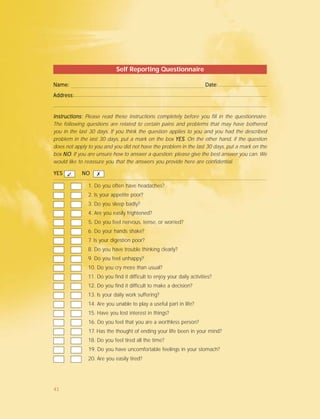
need in a community. Methods include conducting the Self-Reporting Questionnaire (SRQ)
(see Annex 2) which also forms as baseline data, enabling the setting of parameters from
where progress can be measured.
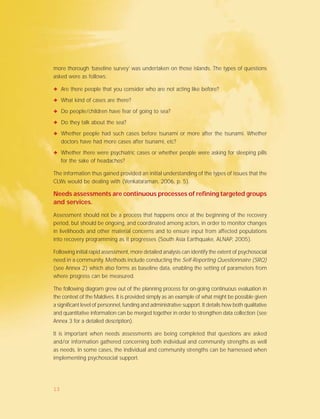
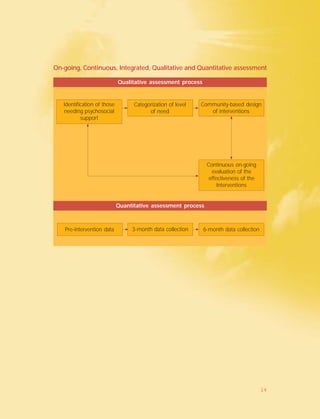
The following diagram grew out of the planning process for on-going continuous evaluation in
the context of the Maldives. It is provided simply as an example of what might be possible given
a significant level of personnel, funding and administrative support. It details how both qualitative
and quantitative information can be merged together in order to strengthen data collection (see
Annex 3 for a detailed description).
It is important when needs assessments are being completed that questions are asked
and/or information gathered concerning both individual and community strengths as well
as needs. In some cases, the individual and community strengths can be harnessed when
implementing psychosocial support.
13
Qualitative assessment process
Quantitative assessment process
Community-based design
of interventions
Continuous on-going
evaluation of the
effectiveness of the
Interventions
Identification of those
needing psychosocial
support
Categorization of level
of need
3-month data collection 6-month data collectionPre-intervention data
On-going, Continuous, Integrated, Qualitative and Quantitative assessment
14
Target
the most
vulnerable
Although disasters impact all members of a community, the poor and
marginalised groups are usually the most vulnerable as their rights are
regularly denied or unrecognised.
Psychosocial care, although supporting the entire community after a
disaster, specifically takes into account that the most vulnerable
groups require the highest level of support.
’Though there is no scientific study to prove that women and children are more vulnerable
to psychological trauma but empirical evidences clearly indicate that children and women in
the face of a disaster are more shaken and often take much more prolonged periods of
recovery and need help’ (Ray, 2006, p. 15).
‘A widow in a traditional Indian household is subject to trauma not merely because
of the loss of a husband, but also the traditional restrictions imposed upon her,
which severely limit her ability to interact with the outside world. All these factors
need to be taken into consideration when psychosocial support is provided to such
a person’ (Ray, 2006, p. 11).
ThePrinciples
15
Through the denial of rights, the poor and marginalised have minimal access to services and
resources in the relief and recovery phases. ‘The extent of mental trauma is directly
proportional to the loss of materials and lives’ (Ray, 2006, p. 15).
In the Andaman & Nicobar Islands, ActionAid India is focusing its work on:
✦ Single and abandoned women
✦ Vulnerable children including orphans and single parent children
✦ People with disabilities.
Kamala is a resident of Panchu Tikri. After the Tsunami she moved to Port Blair, with
her son. Kamala was a widow. News soon came that food was being provided to the
families in her old village in Panchu Tikri, so she returned there and was taken in by
a neighbouring family. She stayed as a guest, but after a few days the family was
reluctant to have an extra mouth to feed and Kamala was made to feel like a burden
and an unwelcome guest. As a former resident of the village Kamala was entitled to
her share of food, which her neighbours were now accepting on her behalf. When
the para counsellor noticed the helpless state of Kamala, she brought it to the notice
of the group in the village. However, the family were adamant; they would no longer
provide shelter or food. Kamala, with no one to turn to, was at the verge of committing
suicide. ActionAid’s para counsellor managed to link up her son with a government
agency and arrange for her to get a temporary shelter. Now with a temporary home,
Kamala was able to access her food ration (Edited from Ray M, 2006, p. 14).
Psychosocial Support takes into account Gender/Cultural Interactions
Those involved in implementing psychosocial support need to be particularly aware of the
gender and cultural factors intermingling, especially in regard to the vulnerable. The example
below illustrates how in the Maldives, gender and cultural factors interact.
The community in the Maldives is ‘male dominated’ which may or may not be
synonymous with patriarchy, but it must be said that women are not part of the
decision-making process. The latter may be understood as a manifestation of a
patriarchal system of functioning. In the initial stages of Care Society’s work, women
project coordinators were not taken seriously by the CBOs. The latter thought that
women couldn’t be in positions of decision-making. As one of the Project coordinators
16
said, “I faced many challenges that had to do with my ‘reputation of being a woman’”.
This was especially so while working with the island communities. The CBOs consist
mainly of men, and hardly if ever, do women constitute part of the PMU or CBO,
especially at the top management level. While most of the CLWs happen to be women,
most of the PMUs are made up of men (Venkataraman, 2006, p. 16).
In India, and Sri Lanka, the interactions of gender with culture were also factors shown to
affect the implementation of psychosocial support. Note that these factors affect all aspects
of psychosocial support – from staffing, to training to implementation.
Psychosocial care is not a stand alone intervention, it is part of an
integrated approach to relief, recovery and development; it supports
and is supported by all aspects of development work.
During the relief phases, symptoms of grief and loss are commonly sighted. As
time progresses people are keen to get back to ‘normal’ by rebuilding their homes,
re-establishing community relationships, sending children back to school, starting work.
‘I am also a tsunami victim. When community care workers met me, I was in depressed
state. However, they gave me encouragements and psychosocial counselling which
helped me to recover from my trauma and thereafter they even found me employment
here and today I am proud to say I am a fully recovered normal person’
(Southern region community care worker, cited in Gamage, 2006, p. 23).
In Sri Lanka, community care workers have supported tsunami widows in starting up their
own businesses, such as poultry farms, ‘‘‘‘‘Now tsunami affected people have recovered fully
and they are in a position to earn their income’ (adapted from, Southern region community
care worker, in Gamage, 2006, p. 23).
As this was a disaster of an unprecedented scale, the tsunami response, (India) ‘needed to
be manifold and address the programme in an integrated fashion. In the meanwhile as the
psychosocial work commended, the personnel for the other areas like livelihood, child
rights, women’s issues were identified and put in place’ (Ray, 2006, p. 15).
However, after a period of time, ‘There was a feeling among many of the personnel that
psychosocial initiatives had become stand-alone and were running parallel to the main
programme’ (Ray, 2006, p. 11).
17
To contrast, in the Andaman’s, ‘There has been a concerted attempt in the islands to develop
an integrated programme and make psychosocial an integral part of the rehabilitation effort.
One of the most noteworthy features of this integration has been the linking up of the
livelihood programme with the psychosocial programme’ (Ray, 2006, p. 13).
This initiation of the livelihood programme and the linkages that were established contributed
to a large extent to the success of the programme. Given the smallness of the Little Andamans
islands, para-counsellors had easy access to people, facilitating daily interactions and gaining
a strong understanding of the needs and problems being faced by people. By the time the
livelihood programme was initiated, there were strong established linkages between the
two programmes and their staff.
The World Bank (2005) found that providing survivors with income-earning
opportunities tied to physical work often seems to help as much as grief counselling
(cited in South Asia Earthquake, Paper 2, ALNAP).
Critical Thinking Questions
What are the advantages/disadvantages of creating new structures versus utilising already
established structures and institutions such as schools and hospitals?
Is the loss of autonomy of the NGOs and/or CLWs significant when psychosocial care
is integrated into established institutions and structures?
Is the gain of power, influence and prestige for the NGOs and/or CLWs a positive
factor arising when psychosocial care is integrated into established institutions
and structures?
What is the impact of disaster response work on local organisations with no prior
experience in the emergency sector?
What can ActionAid do to prevent local organisations from losing focus on their vision
and mission?
18
Form partnerships with local organisations
Recruit experienced staff
There is not one correct way to implement psychosocial care
The psychosocial programmes documented the Tsunami Learning Initiative documents show
great contrast in terms of ActionAid’s local partnerships. In the Maldives, ActionAid’s partner
is Care Society, a small local NGO, who, until the time of the tsunami was the ‘voice of the
disabled’, advocating for services and the development of civil society. Soon after the tsunami
struck, they became heavily involved in relief and recovery work, including psychosocial care
provision. This was a new area for them and required much training, new staffing and new
organisational structures. Due to their strong, established networks and their local knowledge,
the Care Society was in a position, with ActionAid’s support, to offer culturally sensitive
psychosocial support.
In contrast, ActionAid India was already a well-established organisation with long standing
partners and experienced personnel in psychosocial support. Although a ‘gigantic
responsibility’, there was in place a National Coordinator – Psychosocial, who was able to
quickly identify suitable personnel for the programme, develop a short-term plan to carry
out the psychosocial work and design the training modules.
Staffing
Matters
ThePrinciples
19
In Sri Lanka, many and varied partner organisations are involved in psychosocial support.
The ’prominent role that teachers have in the community was recognized by ActionAid
[Sri Lanka]. Due to the high number of children affected by the tsunami, teachers were
identified as important and trained on psychosocial care’ (Gamage, 2006, p. 4).
Community Level Worker selection is a crucial aspect of establishing
the programme; it should be a participatory and transparent process
Ensure that knowledge and experience with ActionAid International and
other similar organisations are utilised
In the Maldives, differences in expectations within senior staff led to inconsistencies in selection
of community level workers. Care Society did not follow a set criterion and instead followed
instincts and personal preferences of the selector. Later, it was observed that communities
tended to prefer people who were older, more mature, educated and who were already well
established individuals within their community (Venkataraman, 2006, p. 6).
Although the selection of community volunteers may vary, depending upon cultural and
social considerations, minimum standards or principles should be followed.
The selection of community volunteers varies, dependent upon cultural and social contexts.
Guiding principles are:
✦ Men and women from within the community, these in many cases will be people who
have been affected from the disaster
✦ People with a nurturing attitude (determined through the structured interview for CLWs,
See Annex 4)
✦ People experienced in working with community organisations
✦ Those not engaged in regular work/employed in a full time job.
The education level of a volunteer should not be a predetermining factor, but rather how
he/she is respected in the community due to past supportive behaviour. An older mother
who is a strong emotional support to her family and neighbours may be an ideal CLW, even
though she has minimal education. A farmer who is a leader amongst his peers may be the
key to implementation of agricultural recovery and development. ActionAid’s policies should
mirror their bias towards the poor, who often have no educational opportunities.
20
Tips towards being an effective Community Level Worker
Dos Don’ts
Remember
✦ CLWs are trained to work with affected people
✦ CLWS are a vital link between people and agencies (NGOs, government) that come
from outside the community
✦ CLWs play a crucial role in the recovery process
✦ CLWs need to provide holistic care rather than simply emotional support.
✓ Visit families regularly
✓ Accept food and drink. This facilitates in
building rapport
✓ Help people get medical care, if needed
✓ Help people in contacting their relatives,
which forms an additional level of support
for them
✓ Provide practical help in terms of handling
compensation issues, securing housing,
education and other social security benefits
✓ Facilitating networking among affected
people
✓ Encourage local community to participant
in and assist with rebuilding efforts
✓ Be non-judgmental and neutral
✗ Make false promises
✗ Make decisions for people
✗ Miss appointments with people
✗ Get upset at people’s behaviour.
People may show signs of anger, or
be very demanding, people may be
uncooperative, or blame you for
causing trouble by visiting regularly
✗ Become overburdened with work
✗ Take sides while working with
families
Tips towards being an effective Community Level Worker
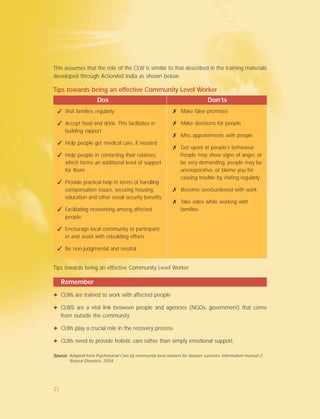
This assumes that the role of the CLW is similar to that described in the training materials
developed through ActionAid India as shown below.
Source:Source:Source:Source:Source: Adapted from Psychosocial Care by community level workers for disaster survivors. Information manual 2.
Natural Disasters, 2004
21
However, if psychosocial support is integrated into existing support networks and personnel
such as hospitals and schools, educational level may be necessitated as a selection factor.
One way to gain insight concerning the skills, values and motivation of perspective
CLWs is through a structured interview. An example of a structured interview based
upon selection criteria guidelines for CLWs is shown in Annex Structured Interview for
Community Level Workers.
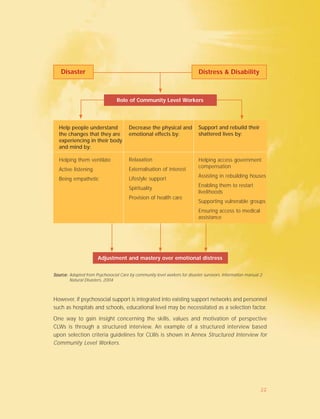
Disaster Distress & Disability
Support and rebuild their
shattered lives by:
Help people understand
the changes that they are
experiencing in their body
and mind by:
Helping them ventilate
Active listening
Being empathetic
Decrease the physical and
emotional effects by:
Adjustment and mastery over emotional distress
Relaxation
Externalisation of interest
Lifestyle support
Spirituality
Provision of health care
Helping access government
compensation
Assisting in rebuilding houses
Enabling them to restart
livelihoods
Supporting vulnerable groups
Ensuring access to medical
assistance
Role of Community Level Workers
Source:Source:Source:Source:Source: Adapted from Psychosocial Care by community level workers for disaster survivors. Information manual 2.
Natural Disasters, 2004
22
Psychosocial care interventions are not standardised; these must be
adapted to local cultural practices and belief systems
Music, dance, art and drama may be used with different groups, depending on which
method or medium group members may most prefer or respond to. For instance,
children have been found to respond best to play and art methods. Life-skills programmes
may be adapted to teach children and youth certain skills relating to emotional coping
and adjustment. These may be creatively done using group games, role-plays, art and
theatre techniques to make learning an enjoyable and enriching experience.
Discussion, relaxation and recreation techniques may also be used as part of the
therapeutic activity. These help establish rapport with the interventionist/therapist
and between group members, providing opportunities for members to engage in
cognitive as well as affective processes of healing. Music and drama are methods that
may be used with adult groups too. For instance, one of the villages in the cyclone
affected Jagatpursingh district of Orissa had a tradition of coming together, playing
the drums and singing. Reviving such traditions and using these as rituals helps the
community re-establish certain routines and parts of their lives that they valued and
rebuild lost identities, thereby facilitating the healing process. Religious practices such
as meditation, communal worship or singing may be used in those communities
The How Part
ThePrinciples
23
Community Level Workers conduct the following activities
Individual Level Family Level Community Level
Visiting people in their Working with children Working with children in
homes or camps and their parents schools, using play and art
Facilitating community
activities, such as sports,
youth and children activities
Source:Source:Source:Source:Source: Extracted from (Venkataraman, 2006, p.10)
Accountability to the poor and vulnerable people and communities we
work with, especially women and girls
ActionAid’s accountability framework, ALPS requires that poor and excluded people take part
directly in all processes of local programme appraisal, analysis, research planning, monitoring,
implementation, research and reviews, including recruiting and appraising frontline staff. Poor
and excluded people have a right to take part in decisions that affect them (ALPS, 2006).
Accountability is related to reported practices and structures. In all three
countries, complex reporting structures were cited as problematic
In India, the various partner agencies reported to the National Coordinator – Tsunami. However,
the National Coordinator – Psychosocial, who reports only to the Country Director, was the
where these might be traditional practices. They are a source of comfort and stability
to individuals and facilitate group bonding and relaxation techniques (Unnikrisnan,
undated paper).
Community level workers need to be culture-sensitive in their methods. For example,
many therapeutic methods are evolved in the West, they are based on western socio-
cultural milieus where values, perceptions and responses may be very different from
other countries, especially those of developing countries and traditional societies
(Unnikrisnan, undated paper).
Psychosocial care is implemented at all levels of a community
(ecological approach)
Psychosocial care happens at various levels; in the Maldives these have been defined as
individual level, family spaces and community level.
24
one initially involved in identifying personnel, short-term planning and training for these partners.
Also, the partners report to Hub Leaders, who report to both Regional Managers and to the
National Coordinator, Tsunami.
While each of these personnel carried out their tasks with all sincerity, there was
some confusion in the thematic versus the administrative role and reporting as well
as the programme design (Ray, 2006, p. 11).
In Sri Lanka, the teacher’s trained in psychosocial support report, of course to their principals
on a day-to-day basis. There was a concern that the new psychosocial support portion of
their responsibilities was in conflict with their role as teacher (i.e., provider of academic
content) to the pupils.
In the Maldives, the CLWs training was carried out and/or facilitated by the Programme
Manager who they also report to. However, on a day-to-day basis, they are supervised by
the Programme Management Units of the Community-based Organisations (CBOs).
Critical Thinking Questions
Should reporting channels be streamlined? Why or why not?
How should those trained in psychosocial support and who work for partner
organisations be supervised?
25
As in any programme, training plays and has played a critical role in the cadre building
in the Tsunami psychosocial programme. One of the biggest achievements of the
programme has been the number of people who have undergone training and their
capacities have been built up to identify, counsel and provide support to the partner
community in the face of the disaster (Ray, 2006, p. 17).
It follows that if psychosocial support takes place at individual, family, and community
levels, and that it is integrated into and supports other forms or development programmes,
then training is required at all levels, for all those who work in relief, recovery and/or
development work.
Training should take place at all levels of field staff (AA, Local
Partners/CBOs, Project Coordinator, Project Managers, CLWs, etc.)
Establish Mechanisms for Systematic Continuous Training, tailored to
the needs of the participant
All AA staff should go through psychosocial care training considering the work context,
which will help them to understand and analyse their own perspectives, strengths
and weaknesses to effectively deal with the public.
Training
ThePrinciples
26
When AA staff is meeting to discuss the progress of its interventions, it is important to
discuss psychosocial care interventions too (Gamage, 2006).
In the Maldives, CLWs and CBOs expressed a need for knowledge about the Tsunami;
why it happened, how it happened, how many people were affected, why some
islands were affected while others were left untouched, etc. In addition, they
mentioned that they had not been debriefed about the Tsunami themselves. The
prevalent belief is that the islanders now called the IDPs (Internally Displaced Persons)
‘bad’ and they had committed some grave sins, and the Tsunami was sent to
punish them (Venkataraman, 2006).
Note:Note:Note:Note:Note: The above comment represents a lack of knowledge on the part of the trainers concerning both the local beliefs
and the knowledge level of the participants concerning the Tsunami. It shows the importance of interacting with
the local participants and assessing their needs either before or during the training.
Programme management staff in the Maldives felt disadvantaged for not having participated
in the initial training programmes for community level workers. This was later rectified,
during refresher courses and it was found to have ‘helped resolve some difficulties between
the CLWs and the programme management units of the community based organisations
(CBOs) (Venkataraman, 2006, p. 12).
There are no experienced people at the community level who could have taken the
lead in implementing the PS care programme. This has raised doubts about whether
the work being done at the community level by the CLWs is ‘correct’. A related issue
is that people who have had some education have moved to other islands for better
job opportunities. An associated problem is the lack of capacity at the level of the
CBOs for immediate supervision and monitoring of the CLWs work. There are no
trained people in programme planning, implementation and monitoring. There has
been no approach to build the capacity of the local people prior to the Care Society’s
intervention – consequently a lack of leadership. In the Care Society as well, there are
few people who have experience and knowledge on community mobilization, working
consistently on programmes, developing training programmes or community
development tools (Venkataraman, 2006, pp. 16–17).
27
Experience gathered through ActionAid’s post-tsunami psychosocial
support clearly identifies the need for disaster preparedness
Government agencies were ill prepared for a large-scale disaster in the Maldives since there
had never been such a disaster in the past and it was not seen as a priority for preparedness.
As the transportation networks and communication within the country was severely
damaged, reports trickled in to government offices in Male from various tsunami
affected islands and atoll offices (Venkataraman, 2006, p. 4).
Experience from past disasters point to the need for greater cross-agency disaster
preparedness at all levels, a key part of which is greater coordination. Although national
authorities are legally responsible for providing and directing/coordinating assistance,
experience from past emergencies has shown that often no specific national structures
exist for this task, or these structures are weak (Wilton Park, 2004). When NGOs are
providing what is the legal responsibility of the government, there is a potential for tensions
between international personnel and government staff. Expectations of what national and
local governments can achieve should therefore be realistic. International agencies also
need to consider how governments can be assisted to cope with managing large inflows
of foreign aid and international personnel in the early stages of an emergency. One option
to consider is seconding experienced staff to government authorities, a strategy which
Looking
Toward the
Future
ThePrinciples
28
proved quite effective during the response to the Indian Ocean Tsunami in India (ALNAPa,
2006, p.11).
When implementing psychosocial support, international minimal
standards should be taken into account
In the Andaman and Nicobar islands, 10th
grade pupils with training were shown to be
able to competently fulfil the duties of ‘para counsellors’. They were able to implement
psychosocial support on the individual and community level. “Today each of the para
counsellors apart from the job of counselling also has an additional responsibility of
child rights, or women’s issues etc.” (Ray, 2006, p. 21). However, in most developed
nations, even the word ‘counsellor’ is restricted to those who have, at minimum, a
Master’s degree in counselling and are registered with a professional body. ‘Counsellors’
are defined as those engaged in a professional therapeutic relationship with clients.
When we conduct psychosocial counselling service, experienced persons in this field
must monitor it. If this counselling is not conducted properly, it may have a negative
effect (Gamage, 2006, p.12).
Critical Thinking Questions
Should alternate designations be considered that reflect both international standards
and more closely adhere to the broader responsibilities of those implementing
psychosocial support (i.e. much more than counselling)?
29
Models to consider:
Working Towards
Conceptual Clarity
Psychosocial support is less about counselling, advice or the right or wrong ways to
behave but instead to empower individuals by helping them to understand their own
internal processes so they can adequately take control of their own situational responses
and decision-making processes (Handicap International, 2006).
Regaining control is a psychosocial ‘anecdote’ to the normal trauma
responses of anxiety (helplessness) and depression (hopelessness)
ActionAid starts with the notion of psychosocial care as a means of empowerment. With
each step within the relief to recovery process, people will require different levels of
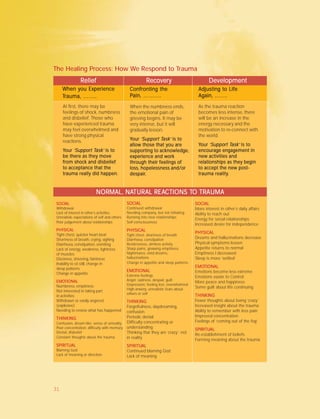
psychosocial support. The diagram below describes The Healing Process. It relates to the
stages of recovery that most individuals go through, over time, to the kind of psychosocial
support that is needed. It is a process without a fixed timetable. Psychosocial support should
help those who have experienced trauma to progress through the process more quickly
than those who do not have adequate support.
This Stages of Recovery Model, although describing individuals, also relates to the ‘Relief,
Recovery and Development’ continuum that emerges as whole communities pass through
these stages.
30
The Healing Process: How We Respond to Trauma
WWWWWhen you Experiencehen you Experiencehen you Experiencehen you Experiencehen you Experience
TTTTTrauma, ……..rauma, ……..rauma, ……..rauma, ……..rauma, ……..
Confronting theConfronting theConfronting theConfronting theConfronting the
PPPPPain, ……….ain, ……….ain, ……….ain, ……….ain, ……….
Adjusting to LifeAdjusting to LifeAdjusting to LifeAdjusting to LifeAdjusting to Life
Again, …….Again, …….Again, …….Again, …….Again, …….
At first, there may be
feelings of shock, numbness
and disbelief. Those who
have experienced trauma
may feel overwhelmed and
have strong physical
reactions.
YYYYYourourourourour ‘Support T‘Support T‘Support T‘Support T‘Support Task’ask’ask’ask’ask’ is tois tois tois tois to
be there as they movebe there as they movebe there as they movebe there as they movebe there as they move
from shock and disbelieffrom shock and disbelieffrom shock and disbelieffrom shock and disbelieffrom shock and disbelief
to acceptance that theto acceptance that theto acceptance that theto acceptance that theto acceptance that the
trauma really did happen.trauma really did happen.trauma really did happen.trauma really did happen.trauma really did happen.
When the numbness ends,
the emotional pain of
grieving begins. It may be
very intense, but it will
gradually lesson.
YYYYYourourourourour ‘Support T‘Support T‘Support T‘Support T‘Support Task’ask’ask’ask’ask’ is tois tois tois tois to
allow those that you areallow those that you areallow those that you areallow those that you areallow those that you are
supporsupporsupporsupporsupporting to acknowledge,ting to acknowledge,ting to acknowledge,ting to acknowledge,ting to acknowledge,
experience and workexperience and workexperience and workexperience and workexperience and work
through their feelings ofthrough their feelings ofthrough their feelings ofthrough their feelings ofthrough their feelings of
loss, hopelessness and/orloss, hopelessness and/orloss, hopelessness and/orloss, hopelessness and/orloss, hopelessness and/or
despairdespairdespairdespairdespair.....
As the trauma reaction
becomes less intense, there
will be an increase in the
energy necessary and the
motivation to re-connect with
the world.
YYYYYourourourourour ‘Support T‘Support T‘Support T‘Support T‘Support Task’ask’ask’ask’ask’ is tois tois tois tois to
encourage engagement inencourage engagement inencourage engagement inencourage engagement inencourage engagement in
new activities andnew activities andnew activities andnew activities andnew activities and
relationships as they begrelationships as they begrelationships as they begrelationships as they begrelationships as they begininininin
to accept the new post-to accept the new post-to accept the new post-to accept the new post-to accept the new post-
trauma realitytrauma realitytrauma realitytrauma realitytrauma reality.....
NORNORNORNORNORMAL, NAMAL, NAMAL, NAMAL, NAMAL, NATUTUTUTUTURRRRRAL RAL RAL RAL RAL REAEAEAEAEACTIONCTIONCTIONCTIONCTIONS TS TS TS TS TO TRO TRO TRO TRO TRAUAUAUAUAUMAMAMAMAMA
ReliefReliefReliefReliefRelief RecoveryRecoveryRecoveryRecoveryRecovery DevelopmentDevelopmentDevelopmentDevelopmentDevelopment
SOCIALSOCIALSOCIALSOCIALSOCIAL
Withdrawal
Lack of interest in other’s activities
Unrealistic expectations of self and others
Poor judgement about relationships
PPPPPHYSICHYSICHYSICHYSICHYSICALALALALAL
Tight chest, quicker heart-beat
Shortness of breath, crying, sighing
Diarrhoea, constipation, vomiting
Lack of energy, weakness, tightness
of muscles
Dizziness, shivering, faintness
Inability to sit still, change in
sleep patterns
Change in appetite
EMOEMOEMOEMOEMOTIONALTIONALTIONALTIONALTIONAL
Numbness, emptiness
Not interested in taking part
in activities
Withdrawn or easily angered
(explosive)
Needing to review what has happened
THTHTHTHTHIIIIINNNNNKIKIKIKIKINGNGNGNGNG
Confusion, dream-like, sense of unreality
Poor concentration, difficulty with memory
Denial, disbelief
Constant thoughts about the trauma
SPSPSPSPSPIIIIIRRRRRITUITUITUITUITUALALALALAL
Blaming God
Lack of meaning or direction
SOCIALSOCIALSOCIALSOCIALSOCIAL
Continued withdrawal
Needing company, but not initiating
Running into new relationships
Self-consciousness
PPPPPHYSICHYSICHYSICHYSICHYSICALALALALAL
Tight chest, shortness of breath
Diarrhoea, constipation
Restlessness, aimless activity
Sharp pains, gnawing emptiness
Nightmares, vivid dreams,
hallucinations
Change in appetite and sleep patterns
EMOEMOEMOEMOEMOTIONALTIONALTIONALTIONALTIONAL
Extreme feelings
Anger, sadness, despair, guilt
Depression, feeling lost, overwhelmed
High-anxiety, unrealistic fears about
others or self
THTHTHTHTHIIIIINNNNNKIKIKIKIKINGNGNGNGNG
Forgetfulness, daydreaming,
confusion
Periodic denial
Difficulty concentrating or
understanding
Thinking that they are ‘crazy’; not
in reality
SPSPSPSPSPIIIIIRRRRRITUITUITUITUITUALALALALAL
Continued blaming God
Lack of meaning
SOCIALSOCIALSOCIALSOCIALSOCIAL
More interest in other’s daily affairs
Ability to reach out
Energy for social relationships
Increased desire for independence
PPPPPHYSICHYSICHYSICHYSICHYSICALALALALAL
Dreams and hallucinations decrease
Physical symptoms lessen
Appetite returns to normal
Emptiness I decreased
Sleep is more ’settled’
EMOEMOEMOEMOEMOTIONALTIONALTIONALTIONALTIONAL
Emotions become less extreme
Emotions easier to Control
More peace and happiness
Some guilt about life continuing
THTHTHTHTHIIIIINNNNNKIKIKIKIKINGNGNGNGNG
Fewer thoughts about being ‘crazy’
Increased insight about the trauma
Ability to remember with less pain
Improved concentration
Feelings of ‘coming out of the fog’
SPSPSPSPSPIIIIIRRRRRITUITUITUITUITUALALALALAL
Re-establishment of beliefs
Forming meaning about the trauma
31
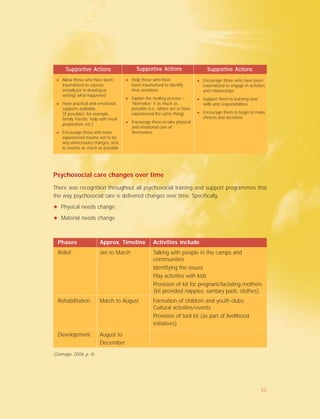
Psychosocial care changes over time
There was recognition throughout all psychosocial training and support programmes that
the way psychosocial care is delivered changes over time. Specifically,
✦ Physical needs change
✦ Material needs change
SupporSupporSupporSupporSupportive Actionstive Actionstive Actionstive Actionstive Actions SupporSupporSupporSupporSupportive Actionstive Actionstive Actionstive Actionstive Actions SupporSupporSupporSupporSupportive Actionstive Actionstive Actionstive Actionstive Actions
✦ Allow those who have been
traumatized to express
verbally(or in drawing or
writing) what happened
✦ Have practical and emotional
supports available
(if possible), for example,
family, friends; help with meal
preparation, etc.)
✦ Encourage those who have
experienced trauma not to be
any unnecessary changes; stick
to routine as much as possible
✦ Help those who have
been traumatised to identify
their emotions
✦ Explain the healing process –
‘Normalize’ it as much as
possible (i.e., others are or have
experienced the same thing)
✦ Encourage them to take physical
and emotional care of
themselves
✦ Encourage those who have been
traumatized to engage in activities
and relationships
✦ Support them in learning new
skills and responsibilities
✦ Encourage them to begin to make
choices and decisions
Phases Approx. Timeline Activities include
Relief Jan to March Talking with people in the camps and
communities
Identifying the issues
Play activities with kids
Provision of kit for pregnant/lactating mothers
(kit provided nappies, sanitary pads, clothes)
Rehabilitation March to August Formation of children and youth clubs
Cultural activities/events
Provision of tool kit (as part of livelihood
initiatives)
Development August to
December
(Gamage, 2006, p. 4)
32
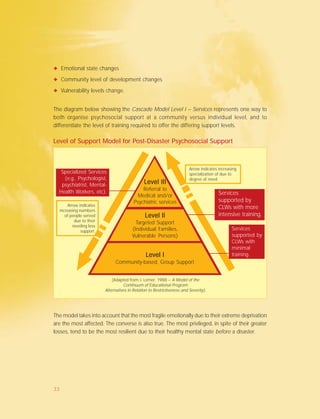
The diagram below showing the Cascade Model Level I – Services represents one way to
both organise psychosocial support at a community versus individual level, and to
differentiate the level of training required to offer the differing support levels.
Level of Support Model for Post-Disaster Psychosocial Support
(Adapted from J. Lerner, 1988 – A Model of the
Continuum of Educational Program
Alternatives in Relation to Restrictiveness and Severity).
Level ILevel ILevel ILevel ILevel IIIIII
Targeted Support
(Individual Families,
Vulnerable Persons)
Level ILevel ILevel ILevel ILevel I
Community-based, Group Support
➟Arrow indicates increasing
specialization of due to
degree of need.
Specialized Services
(e.g., Psychologist,
psychiatrist, Mental-
Health Workers, etc). Services
supported by
CLWs with more
intensive training.
Services
supported by
CLWs with
minimal
training.
Arrow indicates
increasing numbers
of people served
due to their
needing less
support.
Level ILevel ILevel ILevel ILevel IIIIIIIIIII
Referral to
Medical and/or
Psychiatric services
➟
✦ Emotional state changes
✦ Community level of development changes
✦ Vulnerability levels change.
The model takes into account that the most fragile emotionally due to their extreme deprivation
are the most affected. The converse is also true. The most privileged, in spite of their greater
losses, tend to be the most resilient due to their healthy mental state before a disaster.
33
A vulnerable community in the case of a disaster is automatically more affected
considering that the resources available to it both in terms of physical and human
capital are less because of lack of access and control. The most vulnerable
communities are affected more in case of a disaster as for e.g. – their homes are
invariably made of materials like mud and wood, their livelihood is agrarian and
dependent on the vagaries of nature and their access to services like health and
education is completely dependent on the whims of the state. Under these
circumstances the recovery patterns are also slow, as access to their entitlements
are dependent on the state procedures, which are often inaccessible for them
(Ray, 2006, p. 15).
It is important to note that the CLWs are involved in just Level I and Level II psychosocial
support. At some point, those with long-term mental health ‘illnesses’ as a result of a disaster
(e.g., clinical depression, anxiety disorders, and/or PTSD) require the direct or indirect advice
of those in medical settings such as psychiatrists.
Under this model, teachers involved in delivering psychosocial support would be viewed as
having a critical role in Level 1 implementation. The quote below illustrates this.
I am a year 1 teacher, I now teach the children by telling stories and by dancing and
games. Since the children were mentally affected and suffered from trauma I thought
you should not allow them to look at their past and suffering. Therefore, in the class
I used to tell them stories and make them dance and play games. I never use text
books. My tactics helped them; within a very short period these children forgot all
their worries and became the normal children because of the increase in
entertainment I offered to them. Now these children are continuing their studies
very well (Gamage, 2006).
The Cascade Model is an integrative one; it takes neither a medical/psychiatric perspective
nor a purely ‘social support’ perspective. It emphasises the importance of all services, both
informal and formal operating collaboratively in providing psychosocial support to individuals,
families and communities.
34
This only further reiterates ActionAid’s conviction that the answer to the problem of
rehabilitation of traumatised individuals lies in not taking extreme positions of either
the medical or the social model, but in a blending of both. Further there is an element
of linkages of livelihood with the counselling (Ray, 2006, p. 18).
Even in a programme where the thrust is an integrated approach with community-
based rehabilitation as the goal, the services for severely traumatised people cannot
be ruled out. There is a need and role for professional advice that should not be
trivialised, and proper linkages as well as budgetary allocations should be made for
this (Ray, 2006, p. 15).
35
A sample list of recommendations on how to strengthen the psychosocial care programme can
be found in Annex 5. It is hoped that country programme managers and coordinators will
take some time to reflect on these comments and suggestions. A comprehensive list of
recommendations can be found in the individual learning initiative reports.
This document has attempted to set in motion reflection, learning and critical thinking around
how ActionAid conducts psychosocial care programmes. By drawing from the tsunami emergency
response programme the document’s function has been to highlight what was learned through
the design, planning and implementation of the psychosocial care programme in Sri Lanka,
India and the Maldives.
The authors have drawn upon the research conducted to weave together the concurrent issues
and ideas into key principles and themes, presenting them in a way that encourages discussion,
poses questions for thinking and supports a learning process. The overarching aim has been to
share what we do well and highlight areas for strengthening to make ActionAid a global leader
in training others in psychosocial care provision.
Our special thanks, goes to the three researchers Hemalatha, Madhumita and Prema for their
commitment and dedication to this initiative.
Recommendations and Author’s Note
David PDavid PDavid PDavid PDavid Peat, Ph. D.eat, Ph. D.eat, Ph. D.eat, Ph. D.eat, Ph. D.
Chartered Psychologist (AB)
Registered Psychologist (Singapore)
Peat & Associates Ltd, Victoria, Canada
07/03/2006
Raheela AmirallyRaheela AmirallyRaheela AmirallyRaheela AmirallyRaheela Amirally
Shared Learning & Knowledge Coordinator
International Tsunami Response Coordination Team
ActionAid International
36
1. ALNAP & ProVention Consortium (Lessons – a). www.alnap.org., South Asia Earthquake
2005, accessed Feb.10, 2006.
2. ALNAP & ProVention Consortium (Lessons – b). www.alnap.org., South Asia Earthquake
2005, accessed Feb.10, 2006.
3. Gamage, P. Tsunami Learning Initiative, Sri Lanka Report, ActionAid International Tsunami
Response Centre, Colombo, Sri Lanka. Jan. 2006.
4. Handicap International. www.handicap-international.org.uk/page_65.php, accessed
Feb. 10, 2006.
5. J. Chapman & A. Mancini. Critical Webs of Power and Change. Resources pack for planning,
reflection and learning in people-centred advocacy. ActionAid International (Nov. 2005).
6. Lerner, J. (1988). Learning Disabilities: Theories, Diagnosis, and Teaching Strategies. –
Fifth Edition. Houghton Miffline Company: Boston.
7. Ray, M. Tsunami Learning Initiative, India Report, ActionAid International Tsunami Response
Centre, Colombo, Sri Lanka. Jan. 2006.
8. Sekar, K., Sayani, P., Kumar, S., Kumar, K. (2004). Psychosocial care by community level
workers for disaster survivors: Natural Disasters. OSDMA, ActionAid International-India,
NIMHANS: Books for Change.
9. Unnikrisnan, Untitled document, Feb. 2005.
10. Venkataraman, H. Tsunami Learning Initiative, Maldives Report, ActionAid International
Tsunami Response Centre, Colombo, Sri Lanka. Jan. 2006.
11. WHO. www.who.int/hiv/topics/psychosocial/support/en/, accessed Feb. 10, 2006.
12. Wilton Park, cited in ALNAP, 2006.
References
37
This is a brief sample of psychosocial care activities conducted as documented in the country
Tsunami learning initiative reports, A complete comprehensive listing is found in the individual
learning initiative reports.
Annex 1
India
✦ Interaction with the families, groups at the temporary shelters
✦ Child-focused interventions at the school level, family level
✦ Successfully encouraging children to go back to school after the disaster
✦ Providing children with study materials and helping them in their recovery process, by using
recreational mediums
✦ Computer education during vacations
✦ Counselling the women, particularly the widows and in many cases linking them up with
their state entitlements
✦ Identification of 80 people potentially suffering from PTSD cases.
Sri Lanka
✦ Talking with people in the camps and communities to identify issues
✦ Creating a healthy environment for children to play, within relief camps
✦ During the relief phases providing pregnant/lactating mothers tailor-made relief kits, including
items such as nappies, sanitary pads, clothes
✦ Formation of children and youth clubs
✦ Cultural activities/events, marking anniversaries, religious holidays
✦ Working with isolated individuals/aged, retired, disabled – visit them, talk to them, make
them friends, build relationships
✦ Integrated with livelihood initiatives, providing tool kits for business start ups.
The Maldives
✦ Visiting individuals and families in IDP camps
✦ Group activities with children in schools
✦ Community activities, encouraging host and IDP communities to interact through sports,
youth or children activities
✦ Health awareness programmes; parenting and reproductive health.
38
Self-ReporSelf-ReporSelf-ReporSelf-ReporSelf-Reporting Questionnaire (SRQ)ting Questionnaire (SRQ)ting Questionnaire (SRQ)ting Questionnaire (SRQ)ting Questionnaire (SRQ)
Assessing the psychological impact of disasters
In the wake of large-scale disasters (e.g., tsunami, hurricanes, earthquakes, refugee crises),
identifying which individuals are most at risk of becoming or remaining symptomatic is a high
priority. Individuals affected by a disaster exhibit a wide range of reactions. Some may require
support or other services immediately and urgently, others only after a delay, and still others not
at all. Some victims may experience initial relief at being safe; some individuals may go through
a several-week-long or several-month-long ‘trauma’ If people are assessed too early and found
not to be in need of services, it is easy to miss these later reactions. Follow-up several days,
weeks, or months later may identify people in need who were initially passed by. For the most
part, victims are unlikely to seek out assistance on their own. Do not assume that because a
person has not sought out assistance, they do not need assistance. Several approaches to
identifying those in need of services may be used:
Annex 2
✦ By category:By category:By category:By category:By category: Certain groups are especially vulnerable. These include relief workers, victims
who have had a family member die in the disaster, victims who were trapped or entombed
in the course of the disaster, victims who were severely injured in the disaster (including
those still in hospitals) or who continue to experience pain or physical disability, children
aged five to ten, mothers of young children, and victims with a prior history of poor adaptation
at work or at school or of poor coping in previous periods of high stress.
✦ By specific behaviour patterns:By specific behaviour patterns:By specific behaviour patterns:By specific behaviour patterns:By specific behaviour patterns: Those who engage in maladaptive behaviours, such as children
who stay out of school after the disaster or adults who absent themselves from work or who
fail to ‘bounce back’ may be signalling difficulty. Similarly, after the first few days following the
disaster, those presenting with vague ‘medical’ problems such as sleep disturbances, excessive
fatigue, diffused pain, unexplainable headaches or gastrointestinal symptoms may be evidencing
psychological distress. Those expressing suicidal thoughts, or making suicide attempts or other
attempts at self-harm are a high priority. Victims who describe persistent re-experiencing of the
trauma, especially if they report that they feel as if they are re-living it, or who persistently avoid
sights, sounds, or locations associated with the disaster, or who show marked restlessness,
irritability, or hyper vigilance, or who present the appearance of ‘being in a fog’, more than a day
or two after the disaster, are also at risk for ongoing difficulties.
✦ By use of screening instruments:By use of screening instruments:By use of screening instruments:By use of screening instruments:By use of screening instruments: SSSSSymptom checklists can be distributed in schools,ymptom checklists can be distributed in schools,ymptom checklists can be distributed in schools,ymptom checklists can be distributed in schools,ymptom checklists can be distributed in schools,
churches, workplaces, or shelters or refugee camps. Tchurches, workplaces, or shelters or refugee camps. Tchurches, workplaces, or shelters or refugee camps. Tchurches, workplaces, or shelters or refugee camps. Tchurches, workplaces, or shelters or refugee camps. The She She She She Symptom Reporymptom Reporymptom Reporymptom Reporymptom Report Questionnairet Questionnairet Questionnairet Questionnairet Questionnaire
39
(SRQ) has been used in many countries and has proven successful in identifying adults(SRQ) has been used in many countries and has proven successful in identifying adults(SRQ) has been used in many countries and has proven successful in identifying adults(SRQ) has been used in many countries and has proven successful in identifying adults(SRQ) has been used in many countries and has proven successful in identifying adults
and older adolescents in distress.and older adolescents in distress.and older adolescents in distress.and older adolescents in distress.and older adolescents in distress.
✦ By case finding:By case finding:By case finding:By case finding:By case finding: Outreach efforts, including distribution of leaflets, announcements on radio
and television, articles in newspapers, public lectures, and posters in the offices or headquarters
of the relief effort may stimulate self referrals. Teachers, religious leaders, medical workers,
workplace supervisors, and other local residents who may have contact with substantial
numbers of victims should be enlisted to help identify those in distress.
Assessment Instrument-The Self Reporting Questionnaire (SRQ)
The Self Reporting Questionnaire (SRQ) is a measure of general psychological distress developed
by the World Health Organization and intended for use with adults and older adolescents
(ages 15 up). If the person completing the questionnaire does not have at least five years of
schooling, the questions should be read to them. This is permissible in any case.
Interpretation:Interpretation:Interpretation:Interpretation:Interpretation: No universally applicable cut off score can be used under all circumstances. In
most settings, however, five to seven positive responses on items 1–20 (the ‘neurotic’ symptoms)
indicate the presence of significant psychological distress.
TTTTTranslations:ranslations:ranslations:ranslations:ranslations: Translations of the SRQ into Arabic, French, Hindi, Portuguese, Somali, and Spanish
are available, with the World Health Organization. The SRQ has been translated into a number
of other languages, including Afrikaans, Bahasa Malaysia, Bengali, Filipino, Italian, Kiswahili, Njanja
Lusaka, Shona, Siswati, and South Sotho.
40
Self Reporting Questionnaire
Name: Date:Name: Date:Name: Date:Name: Date:Name: Date:
Address:Address:Address:Address:Address:
Instructions:Instructions:Instructions:Instructions:Instructions: Please read these instructions completely before you fill in the questionnaire.
The following questions are related to certain pains and problems that may have bothered
you in the last 30 days. If you think the question applies to you and you had the described
problem in the last 30 days, put a mark on the box YESYESYESYESYES. On the other hand, if the question
does not apply to you and you did not have the problem in the last 30 days, put a mark on the
box NONONONONO. If you are unsure how to answer a question; please give the best answer you can. We
would like to reassure you that the answers you provide here are confidential.
1. Do you often have headaches?
2. Is your appetite poor?
3. Do you sleep badly?
4. Are you easily frightened?
5. Do you feel nervous, tense, or worried?
6. Do your hands shake?
7. Is your digestion poor?
8. Do you have trouble thinking clearly?
9. Do you feel unhappy?
10. Do you cry more than usual?
11. Do you find it difficult to enjoy your daily activities?
12. Do you find it difficult to make a decision?
13. Is your daily work suffering?
14. Are you unable to play a useful part in life?
15. Have you lost interest in things?
16. Do you feel that you are a worthless person?
17. Has the thought of ending your life been in your mind?
18. Do you feel tired all the time?
19. Do you have uncomfortable feelings in your stomach?
20. Are you easily tired?
YESYESYESYESYES NONONONONO✓ ✗
41
Annex 3
Hypothetical Example of Continuous On-Going Assessment
Identification of Those Needing Psychosocial Support
Description
Each atoll is unique in the way it has been affected by the tsunami. For this reason, the target
groups in each of the four atolls vary. In three of the atolls, the Internally Displaced Persons (IDPs)
are the main focus for intervention. In some cases, the entire population of the island has been
removed to another island in the same atoll. In other cases, the IDPs have started living with host
families on the same island that they were living on before the tsunami. They are being moved to
temporary shelters as soon as they become available. Although six months have passed since the
tsunami, none of the IDPs have yet been able to acquire permanent housing.
Two of the displaced populations are still living in relief camps which were formally garment
factories. In those locations, the families are living in small rooms with the partitions being
made of plywood. Most rooms have a minimum of six people living together, and in some
cases, there are as many as 12 people of various ages and both genders. The sanitary conditions
are poor, with, for example, only four toilets per about 10 families. Cooking is done in a large,
poorly equipped communal kitchen, with meals served in rotation. In one camp, due to the lack
of equipment, they are using traditional wood fires, which represent a fire hazard.
Other IDPs are housed in temporary shelters. These shelters consist of two rooms, one toilet,
and one small kitchen; each room is allotted to one family. Each shelter contains about
10–12 people, on the average. In some of the units, there are as many as 20 people.
Initial Information Gathering
Of course, the tsunami was unexpected and, in the Maldives, unplanned for. A natural disaster
of this magnitude had never occurred in the history of the Maldives. This means that, due to
circumstances and lack of time to prepare, initial information gathering was not as systematic or
as comprehensive as it could have been.
However, much information was gathered, beginning in April, 2005. Information gathering was
conducted through both informal and formal methods. Structured interviews were conducted
with island chiefs, teachers and health workers or doctors in two of the atolls. This involved around
20 individuals. In addition, assessments of the psycho-social situation in the islands were assessed
using a Likert Scale questionnaire of 16 items. The Questionnaire gathered information concerning
emotional, social/interactional and cognitive factors of psycho-social functioning.
42
This information gathering process helped to identify issues to be addressed in psycho-social
interventions including:
✦ Fear and anxiety about possible re-occurrence; this was particularly evident with children
and older women
✦ Behavioural difficulties were being exhibited by children, particularly adolescents (e.g., aimless
wandering; fighting)
✦ Basic needs in temporary shelters were not met (e.g., sanitation, electricity, and lack of
living space)
✦ In places where IDPs were living with host families, conflict between the two families was
apparent. Areas of disagreement included how to handle negative interactions amongst children,
and also a lack of acceptance by the host families due to the length of ‘temporary’ stay
✦ Lack of knowledge about their future was expressed by the IDPs, concerning questions such
as when they will be moving to the permanent shelters.
Categorisation of Level of Need
In order for psycho-social support to be distributed in as effective a manner as possible, the
design of intervention approaches will be based upon principles of equity. This means that
there will be a recognition that there are various levels of need and that the greater the level of
need, the greater the level of support to be offered.
For some, the mental health effects of the Tsunami were catastrophic; for others it was a relatively
minor inconvenience, and for still others, little effects were felt. This is the case, even within the
same island. The question then becomes, how to identify: a) those who require the greatest
level of support versus; b) those who could benefit from minimal support versus; c) those who,
due to their lack of need of support, could also be involved in supportive interactions with those
in need.
The characteristics of the people who require the greatest level of support include those who
were displaced in either the same island or to a different island, lost all material possessions,
those who lost family members or close friends, those who exhibit the highest level of anxiety
and/or other indicators of emotional dysfunction and those who lost their livelihood.
Individuals who could benefit from minimal support include those who had minor damage to
their homes, but were not displaced, those who are living in areas near the shore, and those
who show some emotional difficulties.
Individuals who could be involved in interactions with those in need include those who
are living in islands that did not experience effects of the Tsunami, but have displaced
communities living in the island, those who had no damage to property and exhibit no
indicators of emotional difficulties.
43
To categorise the community in this manner, the people in the areas that had been physically
damaged could be assessed further for any socio-emotional difficulties they may be having. The
islands that had been affected the most could be determined by analysing data collected by
National Disaster Management Centre. The socio-economic difficulties faced by the individuals
and families could be assessed by the CLWs using structured interviews and/or checklists.
Community-Based Design of Intervention
Because of the geographical isolation of the islands, even the islands within the same atoll can
have different values and beliefs. The extent to which religion influences the community, people’s
participation in community activities and women’s role in the community, are examples of areas
where each island might differ. When designing interventions, it is important to tailor them to
the unique culture and needs of each community.
A variety of methods could be used to intervene at the individual, family and community level.
These include one-to-one interactions, focus groups, support groups, art and play therapy, and
recreational activities. As the people of the community would know its culture best, the CLWs
would be responsible to design the monthly intervention plan for their respective islands.
Continuous On-going Evaluation
An informal evaluation will be conducted after each intervention, facilitated by the structure of
the reporting form to be filled by the CLWs after conducting any intervention. The CLWs
observations of the participants could add insight concerning their physical, emotional, social/
interactional, cognitive and spiritual health.
All activities also will be evaluated by comparing the objectives with the outcome of the activity,
and deciding on the next steps that needs to be taken.
The evaluations for individual and family interventions include the CLW observing and
documenting the physical, emotional, social/interactional and cognitive factors that may be
influencing psychosocial well-being.
These evaluations will play a dual role of assessing the effectiveness of psychosocial intervention
by the CLWs, as well as to assess the steps the CLWs could take during the next intervention.
Quantitative Assessment/Reporting Process
Quantitative data will be collected to contribute further evidence concerning the impact of the
psychosocial support offered by the Care Society in the communities. This will be done using
two questionnaires. The first, a 16-item Likert scale questionnaire, as mentioned above, was
originally used to assess the psychosocial situation in two atolls (8 communities; N=200). It will
be modified and extended for wide distribution in the Atolls being served by this project. The
44
second questionnaire is a modified version of the General Health Questionnaire (GHQ). It has
been contextualised to the Maldives by The Ministry of Health in collaboration with UNFPA. The
result is a 12-item questionnaire that will be used in the four targeted atolls.
Both of the above questionnaires will be distributed by the CWLs, following an initial, mid- and
post-intervention model. This means that the data collection will take place every three months,
beginning in July, 2005.
The information collecting following both qualitative and quantitative methods will be analysed
and compared so that any conclusions drawn are supported as strongly as possible by the
information gathered.
45
Annex 4
Structured Interview for Community Level Workers
Demographic profile
Name:
Age: Sex:
Professional qualifications/certification/training
Part A
If the person being interviewed completes the questionnaire beforebeforebeforebeforebefore the interview, the answers
can be used as a platform for further probing. It is not recommended that this format be. It is not recommended that this format be. It is not recommended that this format be. It is not recommended that this format be. It is not recommended that this format be
simply used as a questionnaire since its validity would be questionable without it beingsimply used as a questionnaire since its validity would be questionable without it beingsimply used as a questionnaire since its validity would be questionable without it beingsimply used as a questionnaire since its validity would be questionable without it beingsimply used as a questionnaire since its validity would be questionable without it being
parparparparpart of a personal interview process.t of a personal interview process.t of a personal interview process.t of a personal interview process.t of a personal interview process.
Question stems:
1.1.1.1.1. a) According to my colleaguesmy colleaguesmy colleaguesmy colleaguesmy colleagues my strengths are
b) According to my friendsmy friendsmy friendsmy friendsmy friends my strengths are
46
c) I thinkI thinkI thinkI thinkI think my strengths are
Overlaps’ may illustrate consistency across situations and provide some insight concerning the
realism of self-evaluations. Friends described as having deeper insight than colleagues may
show the ability to form relationships while maintaining boundaries.
2.2.2.2.2. a) At work I get along with people who are
b) And don’t get along with people who are
Answers to these questions may provide insight concerning values, preferences, self-awareness,
social competency and adaptability.
3.3.3.3.3. a) My greatest achievementsachievementsachievementsachievementsachievements are
b) And my weaknessesweaknessesweaknessesweaknessesweaknesses are
47
Answers provide further insight concerning self-awareness, vision, and values. May show conflict
or consistency across roles.
4.4.4.4.4. a) When I am angry I
b) When I am happy I
c) When I am stressed I
Provides information about personal coping strategies, ability to get along with others, social
problem-solving and social competency.
5.5.5.5.5. a) The world is a
Answers provide insight concerning ‘world view’ (e.g., realistic, optimistic, pessimistic). There is
nonononono right or wrong response, but rather look for consistency of worldview with behaviours/
reactions shown in previous questions.
48
Part B
Briefly talk about how you would respond to the following situations:
1. You are in charge of a team that is working against a deadline. Your father has just been
diagnosed with a serious medical condition. You are in a dilemma, torn between both
responsibilities. How will you deal with the situation?
2. You are in the midst of rescue and relief operations in a disaster affected area and have been
working around the clock for 20 days. The relief material and replacement personnel expected
on the 21st
day are delayed indefinitely. How will you motivate yourself and your team to
carry on? What strategies will you put in place for yourself and others in terms of self-care?
49
Sample of Recommendations
Annex 5
This is a selected sample of recommendations for psychosocial care. A complete
comprehensive listing is found in the individual learning initiative reports.
MALDIVES
ConceptuallyConceptuallyConceptuallyConceptuallyConceptually
Conveying a ‘standardised’ understanding on what exactly is PS care work needs to happen,
without which PS care may become a medicalised intervention by identifying those who are
severely psychiatrically disabled and trying to refer them to the island medical centres. Though
this latter part should form a part of the CLWs work, the Care Society should make sure it does
not become the only component.
TTTTTrainingrainingrainingrainingraining
More training on PS care for CLWs is required; this may be carried out on monitoring visits.
Another suggestion that was given was that the CLWs might be sent to a neighbouring country
for a six to ten month course. This may not be a wise as it may hinder work on the ground.
(Perhaps ‘formal’ courses could be offered at the ground level through universities, IICRD, etc.)
Monitoring & EvaluationMonitoring & EvaluationMonitoring & EvaluationMonitoring & EvaluationMonitoring & Evaluation
Greater involvement of the CBOs in programme implementation such that the CBOs feel that
they have greater control over the programme and take ownership for the work. Since the
CBOs are legal entities and have their programmes, regardless of the partnership with Care
Society. CBOs don’t feel any ownership towards the programme and currently call it ‘the Care
Society’s programme’.
StaffStaffStaffStaffStaff
There is a very urgent need to build the capacity of programme managers at the Care Society on
PS Care, programme implementation, management and monitoring.
CLCLCLCLCLWWWWW
There need to be a set criteria developed (keeping in mind, country variations) for selecting the
CLWs. Some of the CLWs presently selected from the IDP community are too young, themselves
affected (traumatised) by the disaster that they even don’t want to talk about what they’ve gone
through. Selecting new CLWs should be based on the qualities of those CLWs currently on the
Care Society’s rolls who have proved to be successful in carrying out their tasks.
50
StandardsStandardsStandardsStandardsStandards
ActionAid would be the wiser if it was to create a set criteria and quality standards for the training
programmes on PS care work. This would help in monitoring the work as well as help in recognising
the changes brought about in people’s lives with its PS care programme across countries.
WWWWWithin ActionAidithin ActionAidithin ActionAidithin ActionAidithin ActionAid
ActionAid should invest in Psychosocial Care leadership. This may facilitate institutionalising PS
care work within the organisation.
SRI LANKA
ConceptuallyConceptuallyConceptuallyConceptuallyConceptually
Develop strategies to assure the quality of the Psychosocial care services in the light of
development of the PS care interventions. PS Care learning has to be integrated into construction
of temporary/permanent houses - livelihood designing also. The correlation between PS care
and relief, recovery and development should be the core of knowledge and skills.
TTTTTrainingrainingrainingrainingraining
Training has to follow up regularly to upgrade the knowledge and the skills. In other words, the
consolidation of the learning has to be planned as correct understanding will surely help to deal
issues correctly. (Note: This assumes that there is a ‘correct’ way to offer PS care – there are many
ways based upon principles.) Develop culturally sensitive, locally accepted training modules and
guidelines as early as possible of the interventions.
Monitoring & EvaluationMonitoring & EvaluationMonitoring & EvaluationMonitoring & EvaluationMonitoring & Evaluation
Constant evaluation/monitoring of the training is a need. Then their progress and the services
could be assessed successfully. Classroom training should be accompanied also being on
the job.
StaffStaffStaffStaffStaff
Must give attention to staff training and staff protection. Make them happy so to retain them.
CLCLCLCLCLWWWWW
The consideration has to be given deciding salary and decent living standards when organisations
are recruiting CCWs. The person’s dedication and willingness, sensitivity and understanding of the
cultural contexts should be selection criteria. The person’s personal qualities are also equally important.
StandardsStandardsStandardsStandardsStandards
When designing PS care, consideration has to be given that PS care is not scientific or technical.
It is more to deal with individual’s thoughts and feelings and be empathetic with them and help
them to recover and be normal.
51
WWWWWithin ActionAidithin ActionAidithin ActionAidithin ActionAidithin ActionAid
Conduct an external assessment and redesign the strategies and approach.
INDIA
ConceptuallyConceptuallyConceptuallyConceptuallyConceptually
It is important to understand the need of treating the psychosocial programme as an integrated
whole and not as an individual programme. The long gap between the implementation of the
livelihood programme and the psychosocial programme was often frustrating for the para
counsellors who were aware of problems, but mostly because of the absence of the livelihood
component had no solutions.
StaffStaffStaffStaffStaff
Frequent change of resource persons and supervisors has occasionally hindered programme
implementation.
CLCLCLCLCLWWWWW
The para counsellors expressed the need for greater capacity building support in advanced
counselling to be able to cater to basic needs of PTSD patients. This would be particularly useful
in Hut Bay as one has to take into account the geographical isolation of the area. For severely
affected patients to reach Port Blair can often be difficult. So the enhanced abilities of the para
counsellors will be useful.
WWWWWithin ActionAidithin ActionAidithin ActionAidithin ActionAidithin ActionAid
The administrative responsibilities given to the thematic person has occasionally been an
impediment in his performance. The PO, Psychosocial in Hut Bay clearly mentioned that because
of his administrative duties he was not able to: Provide support to the para counsellors on a
day-to-day basis or to expand the psychosocial work to the Nicobar group of islands, where
death was much more and there were reports of suicidal attempts by traumatised people. The
A&N programme could look into the possibility of providing an administrative support staff.
52
ActionAid International is a
unique partnership of people
who are fighting for a better world
– a world without poverty
For more information,
please visit our web site
www.actionaid.org
SriLanka Office
ActionAid Tsunami Response Centre
9 Queens Terrace
Colombo - 3
Sri Lanka
ActionAid International Office
Post Net Suite # 248
Private Bag X31
Saxonworld 2132
Johannesburg (South Africa)
Tel- +27 (0) 11 880 0008
Fax- +27 (0) 11 880 8082
Designed & Published by
139, Richmond Road, Bangalore–560 0025
Phone: +91-80-25580346, 25321747
Fax: +91-80-25586284
e-mail: bfc@actionaidindia.org
www.booksforchange.net

Tsunami Response-Social Care Report

  • 1.
  • 3.
  • 4.
    Tsunami Response Psychosocial CareReport Published by BOOKS for CHANGE 139, Richmond Road Bangalore - 560 025 Phone: 080-25580346 e-mail: bfc@actionaidindia.org website: www.booksforchange.net Authors:Authors:Authors:Authors:Authors: Raheela Amirally & Dr David Peat Researchers:Researchers:Researchers:Researchers:Researchers: Prema Gamage, Madhumita Ray, and Hemalatha Venkataraman. With special thanks to Unnikrishnan P V, Koy Thompson, Dr Ramani Sudaresan and Sital Kumar. BBBBBfffff C Production TC Production TC Production TC Production TC Production Team:eam:eam:eam:eam: Shoba Ramachandran, Rajeevan, Gokul and Shailaja ©Copyleft : This publication may be used in any form. Please feel free to quote, translate, distribute and transmit. Kindly acknowledge the source.
  • 5.
    Contents Foreword iv Background v Introduction:Methodology used in collecting information vi The document format – How to use the document vii What is psychosocial care? 1 Psychosocial care within the context of ActionAid 4 Language matters 6 Why is psychosocial care in the context of large-scale disasters important? 9 Why is it important to learn from what has been done? 10 What has been done? 12 The Principles: Target the most vulnerable 15 Staffing matters 19 The how part 23 Training 26 Looking toward the future 28 Models to consider: Working towards conceptual clarity 30 Recommendations and Author’s note 36 References 37 Annex: 1. What has been done, a sample of activities 38 2. Self-Reporting Questionnaire (SRQ) 39 3. Example of continuous on-going assessment 42 4. Structured Interview for Community Level Workers 46 5. Sample of recommendations 50
  • 6.
    Foreword The psychosocial careprogramme gently reminds us what is at the moral core of a human rights based approach: dignity, and the ability to plan and make choices that are uniquely your own, and to act on them. As some say: ‘to be what you want to be, to do what you want to do, and become what you want to become’. In short, to fully realise your own creative potential and with others shape the future you would value. Sometimes we forget the moral core in our formulaic approaches to claims, entitlements and services. And why does psychosocial care take us back to the core? Because disasters and the inevitable loss, grief and guilt shatters the individual’s abilities to think straight, to plan, to make choices and act clearly, to relate with others, to play, to have energy and dreams for the future. Everything that makes you uniquely human, and everything that human rights were designed to protect and enable. Psychosocial care – particularly the way that it has evolved within ActionAid International – makes these issues its focus. With psychosocial care approaches you cannot treat individuals as objects to be quickly organised and mobilised (press-ganged) into seeking and claiming rights – no matter how important that final objective. You have to slow down, and treat individuals with the self-esteem and respect that they are uniquely worthy of as human beings – and then support them in their process of empowerment. You have to draw together ‘inner healing’, the provision of immediate needs, and the political processes of seeking rights into one. It is a story that has not been told and needs to be told. This report and the accompanying country reports are a good start. Psychosocial care workers need not be on the defensive that they are not doing ‘proper’ human rights-based work – far from it. As well as addressing the moral core of human rights, the evolving psychosocial care perspective has sharpened the identification of the most vulnerable by bringing in an inner, spiritual and psychological dimension, and it brings people back to a position of inner strength, confidence, and trust, to work with others to claim their rights. A psychosocial care perspective is also a challenge to those who dumped boats, houses and other services on people without thought and interaction with those affected people. We have to ask ourselves the question, ‘are people better able to plan and organise for themselves and negotiate for those things they need after our intervention, or less able to?’ In short are they more in control over their lives or less? Has it left people with more dignity or less? For many, whose bright logos and names adorn boats, houses and annual reports trumpeting their successes, the answer would have to be ‘less’. KKKKKoy Toy Toy Toy Toy Thomsonhomsonhomsonhomsonhomson 9 March 2006 iv
  • 7.
    On 26th December2004 the Asian Ocean Tsunami claimed the lives of over 300,000 people and left many more displaced, homeless, and irrecoverably changing lives. ActionAid responded to the mammoth disaster with a multi-country emergency programme, targeting the most vulnerable in coastal regions of India, Sri Lanka, the Maldives, Thailand and Somalia. Amidst wide-scale humanitarian relief, medical assistance and food distributions, ActionAid recognised the essential need for community-based social reconstruction. The need to rebuild hope, trust and confidence in shattered societies. Based on experience from previous large-scale disaster responses, ActionAid recognised the importance of rapidly rebuilding support mechanisms and community-based social structures. Using the community-based psychosocial care approach, ActionAid has set about empowering communities through rebuilding hope, confidence and giving people a voice to speed up the recovery process. This study aims to understand the processes of establishing and implementing the psychosocial support programme in three of the five tsunami response countries – the Maldives, India and Sri Lanka – during the first twelve months since the tsunami. This report focuses upon the information gathered during the research from respondents who were specifically asked for their suggestions/opinions concerning strengthening psychosocial support in disaster situations. The research described in this report documents guiding principles for psychosocial programmes adopted in the three countries. This report aims to bring conceptual clarity to psychosocial support interventions and addresses the important questions of ‘how’ and ‘why’, as well as highlighting potential operational challenges. The hope is that this will be a learning tool to guide psychosocial support implementation for future emergencies. Background v
  • 8.
    Methodology used incollecting information The methodology for the research was developed collaboratively in December 2005 with the researchers. Prema Gamage, Madhumita Ray, and Hemalatha Venkataraman, with assistance from Sital Kumar, Dr David Peat and Raheela Amirally. The purpose of the research initiative was to document the processes, practices, and operational challenges at multiple levels of ActionAid (e.g. international, national, partner and field) during the first year of psychosocial care implementation. In addition suggestions were gathered for strengthening the programmes in the individual countries. The overall methodology included: ✦ Devising set questions for use in interviews and focus group discussions ✦ Developing probes for set questions ✦ Desk reviews (secondary information review) ✦ Designing country specific methodologies ✦ Translations and back translations (to ensure accuracy) of set questions into Tamil, Sihnala, Hindi and Divehi ✦ Field visits to sampled/representative areas within the country programmes ✦ Selecting key stakeholders at field, partner, hub/Atoll1 /regional, national and international levels ✦ Structured individual interviews with key respondents ✦ Structured focus group discussions ✦ Written responses to set questions (in instances where participation in focus groups was not possible). The field visits involved initial introductions of the project and the researcher. During the translation specific care was taken over words, ‘processes’, ‘practices’ and ‘operational challenges’; these may not have been easily understood by those working at the field level. In light of this, it was decided that the following phrases and questions, or their equivalent in the language of those being interviewed, would be helpful: ✦ What have you done since the start of the psychosocial care programme? ✦ How did you do what you did? Introduction 1. Geo-political administrative unit; a cluster of islands determined by central government. vi
  • 9.
    ✦ What werethe facilitating (supporting; enabling) processes (factors) that led you to do what you have done? ✦ What did you and/or your team do well? ✦ What things (factors) got in the way? ✦ What were the problems and challenges that were faced in your work? Focus groups ground rules agreed upon included: ✦ Groups must consist of 5–8 people ✦ Every person’s input is valuable participation and is expected ✦ One person should speak at a time ✦ Confidentiality would be maintained. It must be stated that this documentation of psychosocial work being implemented in the three countries is simply a sampling and does not represent the entire psychosocial care programme. The document format – designed for discussion and learning This document does not purport to summarise the psychosocial support programmes operating through ActionAid. For a much more complete account of the comprehensive psychosocial support programmes implemented through ActionAid where the field research took place, please take time to read the original Tsunami Learning Initiative reports concerning Sri Lanka, India and the Maldives (Gamage, 2006; Ray, 2006; Venkataraman, 2006). The function of this document is to highlight what was learned through the experience of ActionAid’s implementing post-tsunami psychosocial support. The structure is designed specifically to elicit discussion and learning. During the review of the three Tsunami Learning Initiative documents, we found that there were themes and issues that emerged, albeit somewhat subjectively, from the information provided by the field researchers. Critical Thinking Questions To highlight these themes, this document provides ‘principles of psychosocial care’ that seem to apply in all settings. These principles are written in bold text in bullet format with examples from one or more of the reports provided below the statements. In addition, issues emerge from the contrasting psychosocial support offered in the three countries. These issues are explicitly raised through the generation of related questions. The questions are meant to elicit reflection, discussion and critical thinking about the issues. Throughout this document, then, text boxes contain either quotes taken from the original Learning Initiative Reports or questions. vii
  • 10.
    The definition ofpsychosocial care held by those involved in its training, provision and monitoring has direct influence on how this ‘care’ is actually delivered and evaluated. In Sri Lanka Psychosocial care is viewed as a relatively new concept. The ActioAid staff adopts a pragmatic, non-complex and practical understanding of psychosocial care. It begins with the idea that “everybody needs support – some people need it more than others – it’s not rocket science, but simply ‘putting a smile back on people’s faces’ – by rebuilding confidence and trust” (Gamage, 2006, p. 2). However, this understanding was ‘not shared by all (partner) organisations, and within ActionAid itself, … a different understanding was shared between the various levels, from community health workers to the Partner Organisation staff members, to teachers in the community, District staff and National and International ActionAid staff’ (ibid, p. 6). The extremely comprehensive variety of supportive actions of those involved in psychosocial care shows that having a broad and practical definition may be beneficial, in that activities undertaken are varied, offering practical support in multiple ways. What is psychosocial care? 1
  • 11.
    In the Maldives Asin Sri Lanka, the concept of psychosocial care was new. They adopted a very strong ‘community-based’, holistic view of psychosocial care. In contrast to the view of ActionAid staff in Sri Lanka, psychosocial care was viewed as ‘very technical’ requiring a high level of training and expertise before ‘any programme can translate into high quality implementation’ (Venkataraman, 2006, p. 6). Although, the Care Society, ActionAid’s partner organisation, offered varied, creative, comprehensive and practical psychosocial support, their ‘technical’ concept of psychosocial support meant that rather than appreciating the tremendous work they had accomplished, they felt that their expertise was not up to high standard. In other words, the view of psychosocial support as ‘technical’ may have led to an under-valuing of the high standard of support that they actually implemented. ‘The main aim of the psychosocial care programme is bringing the communities together through combined community activities. Psychosocial Care is something that should come out of the community. It should involve both emotional support as well as social support. However, social support can only come out of building the togetherness of the community. Building support systems within the community, [involves] building support systems within the families so that they can help each other out and also between the families, involving the whole community. Other forms of support should be included [to address the] combination of the emotional, social, economical damage when a disaster occurs. Psychosocial care is a combination of all of this – emotional and social; and care should be sustainable (Venkataraman, 2006, p. 9). ActionAid India Given their vast past experience in implementing psychosocial support after past large-scale disasters (e.g., Orissa, Jammu & Kashmir), the concept of psychosocial support is not new, unlike Sri Lanka and Maldives. In fact, ActionAid India staff have played key roles in providing psychosocial support training, or training has been implemented using materials and resources prepared by them. Over time, ActionAid India’s psychosocial support has largely been integrated within hospital and mental health structures. This is a natural outcome as the needs of those requiring support change from most people in a community to the few who are experiencing major, long-term, mental health issues (i.e., anxiety or depression-based mental illness; post traumatic stress disorder, (PTSD)). When the Tsunami struck, ActionAid India was able to draw upon already established services, structures and expertise. 2
  • 12.
    Although a definitionis not specifically stated in the Tsunami Learning Initiative, India Report, historically, due to this integration of psychosocial support into hospital-based services, a ‘clinical’ counselling approach is presented as a major method for implementation. In other words, psychosocial support is primarily viewed as ‘counselling’. The medical, clinical model permeates the recruitment process, the stated need for training in ‘advanced counselling techniques’ and in the establishment of ‘para-counsellors’ to implement the psychosocial support. However, they ‘have catered to trauma not merely as a medical problem, …. but something deeply rooted with the culture, customs and traditions of the society the person lives in’. And Counselling has to be further strengthened by training ‘on the rights-based approach, and to look at women and children’s perspectives from a holistic perspective (Ray, 2006, pp. 11–12). ‘ActionAid will have to at some point of time also involve more qualified people in these services at hospitals with better payment of salaries as compared to the field counsellors. It is again emphasized that counsellors at these centres also need not be locals. Although emphasis on that strategy has its own merits, like developing local capacities, especially that of women, but more educated people with better communications skills, could enhance the effectiveness of the strategy particularly in the hospital settings (Ray, 2006, p. 8). Critical Thinking Questions Is it possible to integrate different models of psychosocial support (i.e., medical/clinical with ‘most vulnerable groups’, community-based; participatory, rights-based approach)? At what point should psychosocial support be returned to established mental health services? 3
  • 13.
    Psychosocial support isprovided within a rights-based, community- participation framework. While disasters impact upon entire communities, the impact upon the poorest is the greatest, as the poor have limited access to relief goods and services, with fewer options of recovery (South Asia Earthquake 2005a, ALNAP, 2005). Psychosocial care within the context of ActionAid Core elements of psycho-social interventions ✦ Help people understand that they are experiencing normal reactions to abnormal situations ✦ Empower people through appropriate and scientific knowledge ✦ Understand the consequences of stress and thus reduce its impact ✦ Increase coping strategies and thus reduce trauma ✦ Develop communication and problem solving skills to obtain concrete help ✦ Ensure connections with other survivors and staff of agencies who are providing relief, health care, shelter, education and economic assistance ✦ Strengthen community initiatives and link available resources and needs of survivors. (Unnikrisnan, Q&A, February 2005) 4
  • 14.
    ActionAid works withthe most marginalised and most vulnerable groups in communities. In a disaster context, this may often be widows, orphans, the elderly, people with disabilities and female headed-households. Using a right-based framework, ActionAid seeks out the most vulnerable from within communities, those whose rights are most violated with relief and recovery phases. A rights-based approach sets the parameters within which humanitarian work is conducted, it is grounded in the belief that improvised and marginalised people everywhere have rights and responsibilities (Champam & Mancini, 2005). From the onset of the relief phase, empowerment processes can be set in motion. Through the involvement of people and communities, local organisations can be strengthened, leadership among marginalised groups can be nurtured, and women can be placed at the forefront of decision-making; setting in place the changes which can improve people’s lives through ending the cycle of poverty. Psychosocial care is a method that involves active participation of community members, through which multiple factors that amplify people’s sufferings and impact negatively upon their mental health status are addressed. ActionAid has the perspective that post-disaster rehabilitation is all about establishing a spectrum of care. An individual is an integrated whole and has a myriad of needs which require a whole range of interventions. Further it is important to note that in a disaster, one is not always talking about the community being restored to its position and condition it was in, prior to the disaster, but moving a step ahead bringing in social and economic change in the community (Ray, 2006, p. 6). Psychosocial care is a comprehensive approach that helps to build hope, confidence amongst survivors and thus fasten the recovery process. While the focus is on well- being and mental health, it is equally important to respond to the relief needs like food, water, shelter, etc. as part of the psycho-social programme (Unnikrisnan, February 2005). The comprehensive nature of psychosocial support is reflected in the training the Community Level Workers (CLWs) receive, for example, in the Andaman and Nicobar Islands, training was targeted at those who had passed their 10th grade in school. These Young, men and women were trained in communication skills, personality development, perception and empathy and stress. The first training concentrated on how to work and build relationships with children. The trainees were also taught the importance of body language, eye contact, listening skills and methods of rapport building. Other areas covered were disaster preparedness and the effects of a disaster on family relations (Ray, 2006, p. 21). 5
  • 15.
    Language matters (A) barrier ……...to understanding psychosocial care in the Maldives pertains to linguistics. In Dhivehi, the state of being ‘mentally ill’ and thus requiring psychological intervention is called Nafsaani. Nafs, as I got to know, literally translates to ‘oneself’ and if one is mentally ill only then does one need psychological assistance (Venkataraman, 2006, p. 10). One of the issues faced by all three countries was attempting to find the right level and vocabulary for communicating the concept of ‘psychosocial care’. To the field researchers this was first apparent in the translation of set questions for the focus groups. In some languages, the translation of ‘psychosocial care’ is particularly problematic as shown in the preceding box. Psychosocial care encompasses the multiple ways to support individuals and communities as they work through the process of recovery; people’s responses after a large-scale disaster should be viewed as normal responses to abnormal situations. It is important that the language used communicates this message and not the message of ‘mental illness’ or damage. In order to address this issue, during the trainer-of-trainer’s workshop in the Maldives (June 8–11, 2005), the participants generated the Rainbow Framework which follows This was created as a communication aid for CLWs in the villages. The hope was that it would be used to explain what ‘psychosocial support’ was in a culturally contextual manner. 6
  • 16.
    Orange R A IN B O W F R A M E W O R K VioletVVVVVioletioletioletioletiolet represents ‘Problem Solving’Problem Solving’Problem Solving’Problem Solving’Problem Solving’, and, and, and, and, and it is important for the community to actively participate in decision-making leading to empowerment of the survivors. IndigoIndigoIndigoIndigoIndigoIndigo is the colour of the sea, and the sea covers most of the Earth’s surface. This can resemble a network of support services available to the survivor. The diagram shows some of these support services available to a person such as family members, friends, neighbours, counselling services, government agencies and other organisations. BlueI’m feeling blueblueblueblueblue/moody represents the need for ’affect regulation’’affect regulation’’affect regulation’’affect regulation’’affect regulation’. When the survivor/ child expresses extreme emotions, it’s important for the caregiver/psychosocial worker to act as a positive role model and try to act calm and respond with a neutral face. GreenGreenGreenGreenGreenGreen represents ‘Be a good friend & lead a balanced life’‘Be a good friend & lead a balanced life’‘Be a good friend & lead a balanced life’‘Be a good friend & lead a balanced life’‘Be a good friend & lead a balanced life’,,,,, returning to normal in terms of recreational activities and other social interactions helps the survivor to move forward. YellowYYYYYellowellowellowellowellow is a very positive, energetic and a bright colour which represents ‘I can do it!’‘I can do it!’‘I can do it!’‘I can do it!’‘I can do it!’ trying hard to re-frame the trauma in a positive manner is crucial to recovery. OrangeOrangeOrangeOrangeOrange is the colour of the sun. Sunrise and sunset is part of the normal daily RoutineRoutineRoutineRoutineRoutine. As much as possible normalcy should be established, such as children going to school, regular meal times and sleeping times. RedRedRedRedRedRed is associated with danger and the red traffic light means ‘No’. Hence, ‘No to‘No to‘No to‘No to‘No to negative thoughts and live in the Now”negative thoughts and live in the Now”negative thoughts and live in the Now”negative thoughts and live in the Now”negative thoughts and live in the Now”..... It is important to support people to re-frame their negative thoughts to more positive ones and help them take positive concrete steps towards regaining control of their lives. 7
  • 17.
    The research alsomade apparent the differing designations psychosocial care practitioners were assigned – in Sri Lanka, ‘Community Care Workers’, in the Maldives, ‘Community Level Workers’ and in India, ‘Para-counsellors’. Critical Thinking Questions Is it necessary to use the term ‘psychosocial support’, particularly in cultures and languages where ‘psychology’ is not understood, nor established as a field? Does the designation of ‘field-based psychosocial care practitioners’ have an effect on the perception of their roles and responsibilities? Does the designation of ‘field-based psychosocial care practitioners’ have an effect on the perception of those they serve? 8
  • 18.
    Survivors of large-scaledisasters find that all dimensions of their lives are affected: physical, psychological, social and spiritual. Psychosocial care can help people and communities cope more effectively with each stage of the ensuing adjustment period and recovery process. The implementation of psychosocial support means that survivors are more likely to be able to respond adequately to the post-disaster stresses and are less likely to develop serious mental health problems (adapted from WHO, 2006). ActionAid’s experience shows that the psychosocial approach contributes a great deal in preventing long-term mental illness and trauma (Unnikrisnan, February 2005). ActionAid’s experience shows that the provision of psychosocial care in the initial phases of a disaster can speed up the rate of recovery of an individual. Thus psychosocial care facilitating faster recovery of psychological problems becomes an important component of holistic care (Shekar K et al, 2004, p. 5). Why is psychosocial care in the context of large-scale disasters important? 9
  • 19.
    Why is it importantto learn from what has been done? Reviewing, reflecting and learning from past experiences allows us to build on our knowledge and improve the way we do things. To help learn from their experiences, groups review what they are doing and accomplishing and reflect on them in a critical way. These processes contribute to learning and when done in a participatory manner, empowerment’ (Chapman & Mancini, 2005, p. 56). “ActionAid’s experience of psychosocial interventions in Jammu and Kashmir, India has shown that psychosocial care in isolation from other interventions is not effective. In the absence of livelihood interventions, people are ‘at a risk of relapsing back into their original psychological disorder’” (Ray, 2006, p. 8). Lessons learnt from previous disasters provide a valuable foundation from where to establish psychosocial care programmes. ActionAid has an established reputation of ‘pioneering work’ in providing community based psychosocial care (Ray, 2005). Experiences, resources and staff have been drawn upon in establishing the tsunami programme, especially in new programme areas of Sri Lanka and the Maldives. 10
  • 20.
    For example, theCare Society staff received initial training in basic psychosocial care in April 2005 by ActionAid International staff. Material was adapted from this training and formed into the first module of training for community level workers, which was conducted May 8–16th in Baa Eydhafushi. The previous sections provided the context within which ActionAid’s tsunami psychosocial care response has been framed. As well, issues were raised concerning differing views about psychosocial support and its translation in terms of language and cultural context. The psychosocial support programmes in India, Sri Lanka and the Maldives have accomplished much. The remainder of this report will focus on these accomplishments. Rather than simply summarising the three Learning Initiative Reports, based upon the information contained in these reports, principles or guidelines of psychosocial support gleaned from what has been accomplished will be presented. Each principle, presented in bold, bullet format, will be illustrated by a story, idea or concept drawn from the Learning Initiative Reports. It is hoped that by making these principles explicit, their presentation engenders discussion, provides some guidance, and that some of the information will be useful for strengthening the already robust programmes. 11
  • 21.
    What has been done? Theextent of the impact of a disaster upon people’s mental health can be understood through an initial needs assessment, conducted prior to psychosocial care provision. Annex 1 provides a brief sampling of the multiple and multi-level interventions. Again, for further details, please refer to the Learning Initiative reports. The tsunami was unprecedented and unexpected; therefore, any response in the Maldives was reactive and unplanned. However, a needs assessment was initiated immediately following the tsunami. Discussions were held by ActionAid International staff from Bangladesh at island level to understand the extent of psychosocial needs both at the individual and group levels. These surveys were quite broad and ‘vague’, and somewhat on the surface level (Venkataraman, 2006). To supplement this information, the Care Society aided ActionAid in gathering information from the Maldivian government on their assessment of the Tsunami impact. This information led to a report that helped AAI to determine the level and extent of emergency response to be extended to the Maldives through the local partner organisation. Psychosocial and livelihood support were identified as the two areas of priority. Once an assessment of which atolls Care Society would be providing with psychosocial support (i.e., where other NGOs were not working and where the damage was extensive) a 12
  • 22.
    more thorough ‘baselinesurvey’ was undertaken on those islands. The types of questions asked were as follows: ✦ Are there people that you consider who are not acting like before? ✦ What kind of cases are there? ✦ Do people/children have fear of going to sea? ✦ Do they talk about the sea? ✦ Whether people had such cases before tsunami or more after the tsunami. Whether doctors have had more cases after tsunami, etc? ✦ Whether there were psychiatric cases or whether people were asking for sleeping pills for the sake of headaches? The information thus gained provided an initial understanding of the types of issues that the CLWs would be dealing with (Venkataraman, 2006, p. 5). Needs assessments are continuous processes of refining targeted groups and services. Assessment should not be a process that happens once at the beginning of the recovery period, but should be ongoing, and coordinated among actors, in order to monitor changes in livelihoods and other material concerns and to ensure input from affected populations into recovery programming as it progresses (South Asia Earthquake, ALNAP, 2005). Following initial rapid assessment, more detailed analysis can identify the extent of psychosocial need in a community. Methods include conducting the Self-Reporting Questionnaire (SRQ) (see Annex 2) which also forms as baseline data, enabling the setting of parameters from where progress can be measured. The following diagram grew out of the planning process for on-going continuous evaluation in the context of the Maldives. It is provided simply as an example of what might be possible given a significant level of personnel, funding and administrative support. It details how both qualitative and quantitative information can be merged together in order to strengthen data collection (see Annex 3 for a detailed description). It is important when needs assessments are being completed that questions are asked and/or information gathered concerning both individual and community strengths as well as needs. In some cases, the individual and community strengths can be harnessed when implementing psychosocial support. 13
  • 23.
    Qualitative assessment process Quantitativeassessment process Community-based design of interventions Continuous on-going evaluation of the effectiveness of the Interventions Identification of those needing psychosocial support Categorization of level of need 3-month data collection 6-month data collectionPre-intervention data On-going, Continuous, Integrated, Qualitative and Quantitative assessment 14
  • 24.
    Target the most vulnerable Although disastersimpact all members of a community, the poor and marginalised groups are usually the most vulnerable as their rights are regularly denied or unrecognised. Psychosocial care, although supporting the entire community after a disaster, specifically takes into account that the most vulnerable groups require the highest level of support. ’Though there is no scientific study to prove that women and children are more vulnerable to psychological trauma but empirical evidences clearly indicate that children and women in the face of a disaster are more shaken and often take much more prolonged periods of recovery and need help’ (Ray, 2006, p. 15). ‘A widow in a traditional Indian household is subject to trauma not merely because of the loss of a husband, but also the traditional restrictions imposed upon her, which severely limit her ability to interact with the outside world. All these factors need to be taken into consideration when psychosocial support is provided to such a person’ (Ray, 2006, p. 11). ThePrinciples 15
  • 25.
    Through the denialof rights, the poor and marginalised have minimal access to services and resources in the relief and recovery phases. ‘The extent of mental trauma is directly proportional to the loss of materials and lives’ (Ray, 2006, p. 15). In the Andaman & Nicobar Islands, ActionAid India is focusing its work on: ✦ Single and abandoned women ✦ Vulnerable children including orphans and single parent children ✦ People with disabilities. Kamala is a resident of Panchu Tikri. After the Tsunami she moved to Port Blair, with her son. Kamala was a widow. News soon came that food was being provided to the families in her old village in Panchu Tikri, so she returned there and was taken in by a neighbouring family. She stayed as a guest, but after a few days the family was reluctant to have an extra mouth to feed and Kamala was made to feel like a burden and an unwelcome guest. As a former resident of the village Kamala was entitled to her share of food, which her neighbours were now accepting on her behalf. When the para counsellor noticed the helpless state of Kamala, she brought it to the notice of the group in the village. However, the family were adamant; they would no longer provide shelter or food. Kamala, with no one to turn to, was at the verge of committing suicide. ActionAid’s para counsellor managed to link up her son with a government agency and arrange for her to get a temporary shelter. Now with a temporary home, Kamala was able to access her food ration (Edited from Ray M, 2006, p. 14). Psychosocial Support takes into account Gender/Cultural Interactions Those involved in implementing psychosocial support need to be particularly aware of the gender and cultural factors intermingling, especially in regard to the vulnerable. The example below illustrates how in the Maldives, gender and cultural factors interact. The community in the Maldives is ‘male dominated’ which may or may not be synonymous with patriarchy, but it must be said that women are not part of the decision-making process. The latter may be understood as a manifestation of a patriarchal system of functioning. In the initial stages of Care Society’s work, women project coordinators were not taken seriously by the CBOs. The latter thought that women couldn’t be in positions of decision-making. As one of the Project coordinators 16
  • 26.
    said, “I facedmany challenges that had to do with my ‘reputation of being a woman’”. This was especially so while working with the island communities. The CBOs consist mainly of men, and hardly if ever, do women constitute part of the PMU or CBO, especially at the top management level. While most of the CLWs happen to be women, most of the PMUs are made up of men (Venkataraman, 2006, p. 16). In India, and Sri Lanka, the interactions of gender with culture were also factors shown to affect the implementation of psychosocial support. Note that these factors affect all aspects of psychosocial support – from staffing, to training to implementation. Psychosocial care is not a stand alone intervention, it is part of an integrated approach to relief, recovery and development; it supports and is supported by all aspects of development work. During the relief phases, symptoms of grief and loss are commonly sighted. As time progresses people are keen to get back to ‘normal’ by rebuilding their homes, re-establishing community relationships, sending children back to school, starting work. ‘I am also a tsunami victim. When community care workers met me, I was in depressed state. However, they gave me encouragements and psychosocial counselling which helped me to recover from my trauma and thereafter they even found me employment here and today I am proud to say I am a fully recovered normal person’ (Southern region community care worker, cited in Gamage, 2006, p. 23). In Sri Lanka, community care workers have supported tsunami widows in starting up their own businesses, such as poultry farms, ‘‘‘‘‘Now tsunami affected people have recovered fully and they are in a position to earn their income’ (adapted from, Southern region community care worker, in Gamage, 2006, p. 23). As this was a disaster of an unprecedented scale, the tsunami response, (India) ‘needed to be manifold and address the programme in an integrated fashion. In the meanwhile as the psychosocial work commended, the personnel for the other areas like livelihood, child rights, women’s issues were identified and put in place’ (Ray, 2006, p. 15). However, after a period of time, ‘There was a feeling among many of the personnel that psychosocial initiatives had become stand-alone and were running parallel to the main programme’ (Ray, 2006, p. 11). 17
  • 27.
    To contrast, inthe Andaman’s, ‘There has been a concerted attempt in the islands to develop an integrated programme and make psychosocial an integral part of the rehabilitation effort. One of the most noteworthy features of this integration has been the linking up of the livelihood programme with the psychosocial programme’ (Ray, 2006, p. 13). This initiation of the livelihood programme and the linkages that were established contributed to a large extent to the success of the programme. Given the smallness of the Little Andamans islands, para-counsellors had easy access to people, facilitating daily interactions and gaining a strong understanding of the needs and problems being faced by people. By the time the livelihood programme was initiated, there were strong established linkages between the two programmes and their staff. The World Bank (2005) found that providing survivors with income-earning opportunities tied to physical work often seems to help as much as grief counselling (cited in South Asia Earthquake, Paper 2, ALNAP). Critical Thinking Questions What are the advantages/disadvantages of creating new structures versus utilising already established structures and institutions such as schools and hospitals? Is the loss of autonomy of the NGOs and/or CLWs significant when psychosocial care is integrated into established institutions and structures? Is the gain of power, influence and prestige for the NGOs and/or CLWs a positive factor arising when psychosocial care is integrated into established institutions and structures? What is the impact of disaster response work on local organisations with no prior experience in the emergency sector? What can ActionAid do to prevent local organisations from losing focus on their vision and mission? 18
  • 28.
    Form partnerships withlocal organisations Recruit experienced staff There is not one correct way to implement psychosocial care The psychosocial programmes documented the Tsunami Learning Initiative documents show great contrast in terms of ActionAid’s local partnerships. In the Maldives, ActionAid’s partner is Care Society, a small local NGO, who, until the time of the tsunami was the ‘voice of the disabled’, advocating for services and the development of civil society. Soon after the tsunami struck, they became heavily involved in relief and recovery work, including psychosocial care provision. This was a new area for them and required much training, new staffing and new organisational structures. Due to their strong, established networks and their local knowledge, the Care Society was in a position, with ActionAid’s support, to offer culturally sensitive psychosocial support. In contrast, ActionAid India was already a well-established organisation with long standing partners and experienced personnel in psychosocial support. Although a ‘gigantic responsibility’, there was in place a National Coordinator – Psychosocial, who was able to quickly identify suitable personnel for the programme, develop a short-term plan to carry out the psychosocial work and design the training modules. Staffing Matters ThePrinciples 19
  • 29.
    In Sri Lanka,many and varied partner organisations are involved in psychosocial support. The ’prominent role that teachers have in the community was recognized by ActionAid [Sri Lanka]. Due to the high number of children affected by the tsunami, teachers were identified as important and trained on psychosocial care’ (Gamage, 2006, p. 4). Community Level Worker selection is a crucial aspect of establishing the programme; it should be a participatory and transparent process Ensure that knowledge and experience with ActionAid International and other similar organisations are utilised In the Maldives, differences in expectations within senior staff led to inconsistencies in selection of community level workers. Care Society did not follow a set criterion and instead followed instincts and personal preferences of the selector. Later, it was observed that communities tended to prefer people who were older, more mature, educated and who were already well established individuals within their community (Venkataraman, 2006, p. 6). Although the selection of community volunteers may vary, depending upon cultural and social considerations, minimum standards or principles should be followed. The selection of community volunteers varies, dependent upon cultural and social contexts. Guiding principles are: ✦ Men and women from within the community, these in many cases will be people who have been affected from the disaster ✦ People with a nurturing attitude (determined through the structured interview for CLWs, See Annex 4) ✦ People experienced in working with community organisations ✦ Those not engaged in regular work/employed in a full time job. The education level of a volunteer should not be a predetermining factor, but rather how he/she is respected in the community due to past supportive behaviour. An older mother who is a strong emotional support to her family and neighbours may be an ideal CLW, even though she has minimal education. A farmer who is a leader amongst his peers may be the key to implementation of agricultural recovery and development. ActionAid’s policies should mirror their bias towards the poor, who often have no educational opportunities. 20
  • 30.
    Tips towards beingan effective Community Level Worker Dos Don’ts Remember ✦ CLWs are trained to work with affected people ✦ CLWS are a vital link between people and agencies (NGOs, government) that come from outside the community ✦ CLWs play a crucial role in the recovery process ✦ CLWs need to provide holistic care rather than simply emotional support. ✓ Visit families regularly ✓ Accept food and drink. This facilitates in building rapport ✓ Help people get medical care, if needed ✓ Help people in contacting their relatives, which forms an additional level of support for them ✓ Provide practical help in terms of handling compensation issues, securing housing, education and other social security benefits ✓ Facilitating networking among affected people ✓ Encourage local community to participant in and assist with rebuilding efforts ✓ Be non-judgmental and neutral ✗ Make false promises ✗ Make decisions for people ✗ Miss appointments with people ✗ Get upset at people’s behaviour. People may show signs of anger, or be very demanding, people may be uncooperative, or blame you for causing trouble by visiting regularly ✗ Become overburdened with work ✗ Take sides while working with families Tips towards being an effective Community Level Worker This assumes that the role of the CLW is similar to that described in the training materials developed through ActionAid India as shown below. Source:Source:Source:Source:Source: Adapted from Psychosocial Care by community level workers for disaster survivors. Information manual 2. Natural Disasters, 2004 21
  • 31.
    However, if psychosocialsupport is integrated into existing support networks and personnel such as hospitals and schools, educational level may be necessitated as a selection factor. One way to gain insight concerning the skills, values and motivation of perspective CLWs is through a structured interview. An example of a structured interview based upon selection criteria guidelines for CLWs is shown in Annex Structured Interview for Community Level Workers. Disaster Distress & Disability Support and rebuild their shattered lives by: Help people understand the changes that they are experiencing in their body and mind by: Helping them ventilate Active listening Being empathetic Decrease the physical and emotional effects by: Adjustment and mastery over emotional distress Relaxation Externalisation of interest Lifestyle support Spirituality Provision of health care Helping access government compensation Assisting in rebuilding houses Enabling them to restart livelihoods Supporting vulnerable groups Ensuring access to medical assistance Role of Community Level Workers Source:Source:Source:Source:Source: Adapted from Psychosocial Care by community level workers for disaster survivors. Information manual 2. Natural Disasters, 2004 22
  • 32.
    Psychosocial care interventionsare not standardised; these must be adapted to local cultural practices and belief systems Music, dance, art and drama may be used with different groups, depending on which method or medium group members may most prefer or respond to. For instance, children have been found to respond best to play and art methods. Life-skills programmes may be adapted to teach children and youth certain skills relating to emotional coping and adjustment. These may be creatively done using group games, role-plays, art and theatre techniques to make learning an enjoyable and enriching experience. Discussion, relaxation and recreation techniques may also be used as part of the therapeutic activity. These help establish rapport with the interventionist/therapist and between group members, providing opportunities for members to engage in cognitive as well as affective processes of healing. Music and drama are methods that may be used with adult groups too. For instance, one of the villages in the cyclone affected Jagatpursingh district of Orissa had a tradition of coming together, playing the drums and singing. Reviving such traditions and using these as rituals helps the community re-establish certain routines and parts of their lives that they valued and rebuild lost identities, thereby facilitating the healing process. Religious practices such as meditation, communal worship or singing may be used in those communities The How Part ThePrinciples 23
  • 33.
    Community Level Workersconduct the following activities Individual Level Family Level Community Level Visiting people in their Working with children Working with children in homes or camps and their parents schools, using play and art Facilitating community activities, such as sports, youth and children activities Source:Source:Source:Source:Source: Extracted from (Venkataraman, 2006, p.10) Accountability to the poor and vulnerable people and communities we work with, especially women and girls ActionAid’s accountability framework, ALPS requires that poor and excluded people take part directly in all processes of local programme appraisal, analysis, research planning, monitoring, implementation, research and reviews, including recruiting and appraising frontline staff. Poor and excluded people have a right to take part in decisions that affect them (ALPS, 2006). Accountability is related to reported practices and structures. In all three countries, complex reporting structures were cited as problematic In India, the various partner agencies reported to the National Coordinator – Tsunami. However, the National Coordinator – Psychosocial, who reports only to the Country Director, was the where these might be traditional practices. They are a source of comfort and stability to individuals and facilitate group bonding and relaxation techniques (Unnikrisnan, undated paper). Community level workers need to be culture-sensitive in their methods. For example, many therapeutic methods are evolved in the West, they are based on western socio- cultural milieus where values, perceptions and responses may be very different from other countries, especially those of developing countries and traditional societies (Unnikrisnan, undated paper). Psychosocial care is implemented at all levels of a community (ecological approach) Psychosocial care happens at various levels; in the Maldives these have been defined as individual level, family spaces and community level. 24
  • 34.
    one initially involvedin identifying personnel, short-term planning and training for these partners. Also, the partners report to Hub Leaders, who report to both Regional Managers and to the National Coordinator, Tsunami. While each of these personnel carried out their tasks with all sincerity, there was some confusion in the thematic versus the administrative role and reporting as well as the programme design (Ray, 2006, p. 11). In Sri Lanka, the teacher’s trained in psychosocial support report, of course to their principals on a day-to-day basis. There was a concern that the new psychosocial support portion of their responsibilities was in conflict with their role as teacher (i.e., provider of academic content) to the pupils. In the Maldives, the CLWs training was carried out and/or facilitated by the Programme Manager who they also report to. However, on a day-to-day basis, they are supervised by the Programme Management Units of the Community-based Organisations (CBOs). Critical Thinking Questions Should reporting channels be streamlined? Why or why not? How should those trained in psychosocial support and who work for partner organisations be supervised? 25
  • 35.
    As in anyprogramme, training plays and has played a critical role in the cadre building in the Tsunami psychosocial programme. One of the biggest achievements of the programme has been the number of people who have undergone training and their capacities have been built up to identify, counsel and provide support to the partner community in the face of the disaster (Ray, 2006, p. 17). It follows that if psychosocial support takes place at individual, family, and community levels, and that it is integrated into and supports other forms or development programmes, then training is required at all levels, for all those who work in relief, recovery and/or development work. Training should take place at all levels of field staff (AA, Local Partners/CBOs, Project Coordinator, Project Managers, CLWs, etc.) Establish Mechanisms for Systematic Continuous Training, tailored to the needs of the participant All AA staff should go through psychosocial care training considering the work context, which will help them to understand and analyse their own perspectives, strengths and weaknesses to effectively deal with the public. Training ThePrinciples 26
  • 36.
    When AA staffis meeting to discuss the progress of its interventions, it is important to discuss psychosocial care interventions too (Gamage, 2006). In the Maldives, CLWs and CBOs expressed a need for knowledge about the Tsunami; why it happened, how it happened, how many people were affected, why some islands were affected while others were left untouched, etc. In addition, they mentioned that they had not been debriefed about the Tsunami themselves. The prevalent belief is that the islanders now called the IDPs (Internally Displaced Persons) ‘bad’ and they had committed some grave sins, and the Tsunami was sent to punish them (Venkataraman, 2006). Note:Note:Note:Note:Note: The above comment represents a lack of knowledge on the part of the trainers concerning both the local beliefs and the knowledge level of the participants concerning the Tsunami. It shows the importance of interacting with the local participants and assessing their needs either before or during the training. Programme management staff in the Maldives felt disadvantaged for not having participated in the initial training programmes for community level workers. This was later rectified, during refresher courses and it was found to have ‘helped resolve some difficulties between the CLWs and the programme management units of the community based organisations (CBOs) (Venkataraman, 2006, p. 12). There are no experienced people at the community level who could have taken the lead in implementing the PS care programme. This has raised doubts about whether the work being done at the community level by the CLWs is ‘correct’. A related issue is that people who have had some education have moved to other islands for better job opportunities. An associated problem is the lack of capacity at the level of the CBOs for immediate supervision and monitoring of the CLWs work. There are no trained people in programme planning, implementation and monitoring. There has been no approach to build the capacity of the local people prior to the Care Society’s intervention – consequently a lack of leadership. In the Care Society as well, there are few people who have experience and knowledge on community mobilization, working consistently on programmes, developing training programmes or community development tools (Venkataraman, 2006, pp. 16–17). 27
  • 37.
    Experience gathered throughActionAid’s post-tsunami psychosocial support clearly identifies the need for disaster preparedness Government agencies were ill prepared for a large-scale disaster in the Maldives since there had never been such a disaster in the past and it was not seen as a priority for preparedness. As the transportation networks and communication within the country was severely damaged, reports trickled in to government offices in Male from various tsunami affected islands and atoll offices (Venkataraman, 2006, p. 4). Experience from past disasters point to the need for greater cross-agency disaster preparedness at all levels, a key part of which is greater coordination. Although national authorities are legally responsible for providing and directing/coordinating assistance, experience from past emergencies has shown that often no specific national structures exist for this task, or these structures are weak (Wilton Park, 2004). When NGOs are providing what is the legal responsibility of the government, there is a potential for tensions between international personnel and government staff. Expectations of what national and local governments can achieve should therefore be realistic. International agencies also need to consider how governments can be assisted to cope with managing large inflows of foreign aid and international personnel in the early stages of an emergency. One option to consider is seconding experienced staff to government authorities, a strategy which Looking Toward the Future ThePrinciples 28
  • 38.
    proved quite effectiveduring the response to the Indian Ocean Tsunami in India (ALNAPa, 2006, p.11). When implementing psychosocial support, international minimal standards should be taken into account In the Andaman and Nicobar islands, 10th grade pupils with training were shown to be able to competently fulfil the duties of ‘para counsellors’. They were able to implement psychosocial support on the individual and community level. “Today each of the para counsellors apart from the job of counselling also has an additional responsibility of child rights, or women’s issues etc.” (Ray, 2006, p. 21). However, in most developed nations, even the word ‘counsellor’ is restricted to those who have, at minimum, a Master’s degree in counselling and are registered with a professional body. ‘Counsellors’ are defined as those engaged in a professional therapeutic relationship with clients. When we conduct psychosocial counselling service, experienced persons in this field must monitor it. If this counselling is not conducted properly, it may have a negative effect (Gamage, 2006, p.12). Critical Thinking Questions Should alternate designations be considered that reflect both international standards and more closely adhere to the broader responsibilities of those implementing psychosocial support (i.e. much more than counselling)? 29
  • 39.
    Models to consider: WorkingTowards Conceptual Clarity Psychosocial support is less about counselling, advice or the right or wrong ways to behave but instead to empower individuals by helping them to understand their own internal processes so they can adequately take control of their own situational responses and decision-making processes (Handicap International, 2006). Regaining control is a psychosocial ‘anecdote’ to the normal trauma responses of anxiety (helplessness) and depression (hopelessness) ActionAid starts with the notion of psychosocial care as a means of empowerment. With each step within the relief to recovery process, people will require different levels of psychosocial support. The diagram below describes The Healing Process. It relates to the stages of recovery that most individuals go through, over time, to the kind of psychosocial support that is needed. It is a process without a fixed timetable. Psychosocial support should help those who have experienced trauma to progress through the process more quickly than those who do not have adequate support. This Stages of Recovery Model, although describing individuals, also relates to the ‘Relief, Recovery and Development’ continuum that emerges as whole communities pass through these stages. 30
  • 40.
    The Healing Process:How We Respond to Trauma WWWWWhen you Experiencehen you Experiencehen you Experiencehen you Experiencehen you Experience TTTTTrauma, ……..rauma, ……..rauma, ……..rauma, ……..rauma, …….. Confronting theConfronting theConfronting theConfronting theConfronting the PPPPPain, ……….ain, ……….ain, ……….ain, ……….ain, ………. Adjusting to LifeAdjusting to LifeAdjusting to LifeAdjusting to LifeAdjusting to Life Again, …….Again, …….Again, …….Again, …….Again, ……. At first, there may be feelings of shock, numbness and disbelief. Those who have experienced trauma may feel overwhelmed and have strong physical reactions. YYYYYourourourourour ‘Support T‘Support T‘Support T‘Support T‘Support Task’ask’ask’ask’ask’ is tois tois tois tois to be there as they movebe there as they movebe there as they movebe there as they movebe there as they move from shock and disbelieffrom shock and disbelieffrom shock and disbelieffrom shock and disbelieffrom shock and disbelief to acceptance that theto acceptance that theto acceptance that theto acceptance that theto acceptance that the trauma really did happen.trauma really did happen.trauma really did happen.trauma really did happen.trauma really did happen. When the numbness ends, the emotional pain of grieving begins. It may be very intense, but it will gradually lesson. YYYYYourourourourour ‘Support T‘Support T‘Support T‘Support T‘Support Task’ask’ask’ask’ask’ is tois tois tois tois to allow those that you areallow those that you areallow those that you areallow those that you areallow those that you are supporsupporsupporsupporsupporting to acknowledge,ting to acknowledge,ting to acknowledge,ting to acknowledge,ting to acknowledge, experience and workexperience and workexperience and workexperience and workexperience and work through their feelings ofthrough their feelings ofthrough their feelings ofthrough their feelings ofthrough their feelings of loss, hopelessness and/orloss, hopelessness and/orloss, hopelessness and/orloss, hopelessness and/orloss, hopelessness and/or despairdespairdespairdespairdespair..... As the trauma reaction becomes less intense, there will be an increase in the energy necessary and the motivation to re-connect with the world. YYYYYourourourourour ‘Support T‘Support T‘Support T‘Support T‘Support Task’ask’ask’ask’ask’ is tois tois tois tois to encourage engagement inencourage engagement inencourage engagement inencourage engagement inencourage engagement in new activities andnew activities andnew activities andnew activities andnew activities and relationships as they begrelationships as they begrelationships as they begrelationships as they begrelationships as they begininininin to accept the new post-to accept the new post-to accept the new post-to accept the new post-to accept the new post- trauma realitytrauma realitytrauma realitytrauma realitytrauma reality..... NORNORNORNORNORMAL, NAMAL, NAMAL, NAMAL, NAMAL, NATUTUTUTUTURRRRRAL RAL RAL RAL RAL REAEAEAEAEACTIONCTIONCTIONCTIONCTIONS TS TS TS TS TO TRO TRO TRO TRO TRAUAUAUAUAUMAMAMAMAMA ReliefReliefReliefReliefRelief RecoveryRecoveryRecoveryRecoveryRecovery DevelopmentDevelopmentDevelopmentDevelopmentDevelopment SOCIALSOCIALSOCIALSOCIALSOCIAL Withdrawal Lack of interest in other’s activities Unrealistic expectations of self and others Poor judgement about relationships PPPPPHYSICHYSICHYSICHYSICHYSICALALALALAL Tight chest, quicker heart-beat Shortness of breath, crying, sighing Diarrhoea, constipation, vomiting Lack of energy, weakness, tightness of muscles Dizziness, shivering, faintness Inability to sit still, change in sleep patterns Change in appetite EMOEMOEMOEMOEMOTIONALTIONALTIONALTIONALTIONAL Numbness, emptiness Not interested in taking part in activities Withdrawn or easily angered (explosive) Needing to review what has happened THTHTHTHTHIIIIINNNNNKIKIKIKIKINGNGNGNGNG Confusion, dream-like, sense of unreality Poor concentration, difficulty with memory Denial, disbelief Constant thoughts about the trauma SPSPSPSPSPIIIIIRRRRRITUITUITUITUITUALALALALAL Blaming God Lack of meaning or direction SOCIALSOCIALSOCIALSOCIALSOCIAL Continued withdrawal Needing company, but not initiating Running into new relationships Self-consciousness PPPPPHYSICHYSICHYSICHYSICHYSICALALALALAL Tight chest, shortness of breath Diarrhoea, constipation Restlessness, aimless activity Sharp pains, gnawing emptiness Nightmares, vivid dreams, hallucinations Change in appetite and sleep patterns EMOEMOEMOEMOEMOTIONALTIONALTIONALTIONALTIONAL Extreme feelings Anger, sadness, despair, guilt Depression, feeling lost, overwhelmed High-anxiety, unrealistic fears about others or self THTHTHTHTHIIIIINNNNNKIKIKIKIKINGNGNGNGNG Forgetfulness, daydreaming, confusion Periodic denial Difficulty concentrating or understanding Thinking that they are ‘crazy’; not in reality SPSPSPSPSPIIIIIRRRRRITUITUITUITUITUALALALALAL Continued blaming God Lack of meaning SOCIALSOCIALSOCIALSOCIALSOCIAL More interest in other’s daily affairs Ability to reach out Energy for social relationships Increased desire for independence PPPPPHYSICHYSICHYSICHYSICHYSICALALALALAL Dreams and hallucinations decrease Physical symptoms lessen Appetite returns to normal Emptiness I decreased Sleep is more ’settled’ EMOEMOEMOEMOEMOTIONALTIONALTIONALTIONALTIONAL Emotions become less extreme Emotions easier to Control More peace and happiness Some guilt about life continuing THTHTHTHTHIIIIINNNNNKIKIKIKIKINGNGNGNGNG Fewer thoughts about being ‘crazy’ Increased insight about the trauma Ability to remember with less pain Improved concentration Feelings of ‘coming out of the fog’ SPSPSPSPSPIIIIIRRRRRITUITUITUITUITUALALALALAL Re-establishment of beliefs Forming meaning about the trauma 31
  • 41.
    Psychosocial care changesover time There was recognition throughout all psychosocial training and support programmes that the way psychosocial care is delivered changes over time. Specifically, ✦ Physical needs change ✦ Material needs change SupporSupporSupporSupporSupportive Actionstive Actionstive Actionstive Actionstive Actions SupporSupporSupporSupporSupportive Actionstive Actionstive Actionstive Actionstive Actions SupporSupporSupporSupporSupportive Actionstive Actionstive Actionstive Actionstive Actions ✦ Allow those who have been traumatized to express verbally(or in drawing or writing) what happened ✦ Have practical and emotional supports available (if possible), for example, family, friends; help with meal preparation, etc.) ✦ Encourage those who have experienced trauma not to be any unnecessary changes; stick to routine as much as possible ✦ Help those who have been traumatised to identify their emotions ✦ Explain the healing process – ‘Normalize’ it as much as possible (i.e., others are or have experienced the same thing) ✦ Encourage them to take physical and emotional care of themselves ✦ Encourage those who have been traumatized to engage in activities and relationships ✦ Support them in learning new skills and responsibilities ✦ Encourage them to begin to make choices and decisions Phases Approx. Timeline Activities include Relief Jan to March Talking with people in the camps and communities Identifying the issues Play activities with kids Provision of kit for pregnant/lactating mothers (kit provided nappies, sanitary pads, clothes) Rehabilitation March to August Formation of children and youth clubs Cultural activities/events Provision of tool kit (as part of livelihood initiatives) Development August to December (Gamage, 2006, p. 4) 32
  • 42.
    The diagram belowshowing the Cascade Model Level I – Services represents one way to both organise psychosocial support at a community versus individual level, and to differentiate the level of training required to offer the differing support levels. Level of Support Model for Post-Disaster Psychosocial Support (Adapted from J. Lerner, 1988 – A Model of the Continuum of Educational Program Alternatives in Relation to Restrictiveness and Severity). Level ILevel ILevel ILevel ILevel IIIIII Targeted Support (Individual Families, Vulnerable Persons) Level ILevel ILevel ILevel ILevel I Community-based, Group Support ➟Arrow indicates increasing specialization of due to degree of need. Specialized Services (e.g., Psychologist, psychiatrist, Mental- Health Workers, etc). Services supported by CLWs with more intensive training. Services supported by CLWs with minimal training. Arrow indicates increasing numbers of people served due to their needing less support. Level ILevel ILevel ILevel ILevel IIIIIIIIIII Referral to Medical and/or Psychiatric services ➟ ✦ Emotional state changes ✦ Community level of development changes ✦ Vulnerability levels change. The model takes into account that the most fragile emotionally due to their extreme deprivation are the most affected. The converse is also true. The most privileged, in spite of their greater losses, tend to be the most resilient due to their healthy mental state before a disaster. 33
  • 43.
    A vulnerable communityin the case of a disaster is automatically more affected considering that the resources available to it both in terms of physical and human capital are less because of lack of access and control. The most vulnerable communities are affected more in case of a disaster as for e.g. – their homes are invariably made of materials like mud and wood, their livelihood is agrarian and dependent on the vagaries of nature and their access to services like health and education is completely dependent on the whims of the state. Under these circumstances the recovery patterns are also slow, as access to their entitlements are dependent on the state procedures, which are often inaccessible for them (Ray, 2006, p. 15). It is important to note that the CLWs are involved in just Level I and Level II psychosocial support. At some point, those with long-term mental health ‘illnesses’ as a result of a disaster (e.g., clinical depression, anxiety disorders, and/or PTSD) require the direct or indirect advice of those in medical settings such as psychiatrists. Under this model, teachers involved in delivering psychosocial support would be viewed as having a critical role in Level 1 implementation. The quote below illustrates this. I am a year 1 teacher, I now teach the children by telling stories and by dancing and games. Since the children were mentally affected and suffered from trauma I thought you should not allow them to look at their past and suffering. Therefore, in the class I used to tell them stories and make them dance and play games. I never use text books. My tactics helped them; within a very short period these children forgot all their worries and became the normal children because of the increase in entertainment I offered to them. Now these children are continuing their studies very well (Gamage, 2006). The Cascade Model is an integrative one; it takes neither a medical/psychiatric perspective nor a purely ‘social support’ perspective. It emphasises the importance of all services, both informal and formal operating collaboratively in providing psychosocial support to individuals, families and communities. 34
  • 44.
    This only furtherreiterates ActionAid’s conviction that the answer to the problem of rehabilitation of traumatised individuals lies in not taking extreme positions of either the medical or the social model, but in a blending of both. Further there is an element of linkages of livelihood with the counselling (Ray, 2006, p. 18). Even in a programme where the thrust is an integrated approach with community- based rehabilitation as the goal, the services for severely traumatised people cannot be ruled out. There is a need and role for professional advice that should not be trivialised, and proper linkages as well as budgetary allocations should be made for this (Ray, 2006, p. 15). 35
  • 45.
    A sample listof recommendations on how to strengthen the psychosocial care programme can be found in Annex 5. It is hoped that country programme managers and coordinators will take some time to reflect on these comments and suggestions. A comprehensive list of recommendations can be found in the individual learning initiative reports. This document has attempted to set in motion reflection, learning and critical thinking around how ActionAid conducts psychosocial care programmes. By drawing from the tsunami emergency response programme the document’s function has been to highlight what was learned through the design, planning and implementation of the psychosocial care programme in Sri Lanka, India and the Maldives. The authors have drawn upon the research conducted to weave together the concurrent issues and ideas into key principles and themes, presenting them in a way that encourages discussion, poses questions for thinking and supports a learning process. The overarching aim has been to share what we do well and highlight areas for strengthening to make ActionAid a global leader in training others in psychosocial care provision. Our special thanks, goes to the three researchers Hemalatha, Madhumita and Prema for their commitment and dedication to this initiative. Recommendations and Author’s Note David PDavid PDavid PDavid PDavid Peat, Ph. D.eat, Ph. D.eat, Ph. D.eat, Ph. D.eat, Ph. D. Chartered Psychologist (AB) Registered Psychologist (Singapore) Peat & Associates Ltd, Victoria, Canada 07/03/2006 Raheela AmirallyRaheela AmirallyRaheela AmirallyRaheela AmirallyRaheela Amirally Shared Learning & Knowledge Coordinator International Tsunami Response Coordination Team ActionAid International 36
  • 46.
    1. ALNAP &ProVention Consortium (Lessons – a). www.alnap.org., South Asia Earthquake 2005, accessed Feb.10, 2006. 2. ALNAP & ProVention Consortium (Lessons – b). www.alnap.org., South Asia Earthquake 2005, accessed Feb.10, 2006. 3. Gamage, P. Tsunami Learning Initiative, Sri Lanka Report, ActionAid International Tsunami Response Centre, Colombo, Sri Lanka. Jan. 2006. 4. Handicap International. www.handicap-international.org.uk/page_65.php, accessed Feb. 10, 2006. 5. J. Chapman & A. Mancini. Critical Webs of Power and Change. Resources pack for planning, reflection and learning in people-centred advocacy. ActionAid International (Nov. 2005). 6. Lerner, J. (1988). Learning Disabilities: Theories, Diagnosis, and Teaching Strategies. – Fifth Edition. Houghton Miffline Company: Boston. 7. Ray, M. Tsunami Learning Initiative, India Report, ActionAid International Tsunami Response Centre, Colombo, Sri Lanka. Jan. 2006. 8. Sekar, K., Sayani, P., Kumar, S., Kumar, K. (2004). Psychosocial care by community level workers for disaster survivors: Natural Disasters. OSDMA, ActionAid International-India, NIMHANS: Books for Change. 9. Unnikrisnan, Untitled document, Feb. 2005. 10. Venkataraman, H. Tsunami Learning Initiative, Maldives Report, ActionAid International Tsunami Response Centre, Colombo, Sri Lanka. Jan. 2006. 11. WHO. www.who.int/hiv/topics/psychosocial/support/en/, accessed Feb. 10, 2006. 12. Wilton Park, cited in ALNAP, 2006. References 37
  • 47.
    This is abrief sample of psychosocial care activities conducted as documented in the country Tsunami learning initiative reports, A complete comprehensive listing is found in the individual learning initiative reports. Annex 1 India ✦ Interaction with the families, groups at the temporary shelters ✦ Child-focused interventions at the school level, family level ✦ Successfully encouraging children to go back to school after the disaster ✦ Providing children with study materials and helping them in their recovery process, by using recreational mediums ✦ Computer education during vacations ✦ Counselling the women, particularly the widows and in many cases linking them up with their state entitlements ✦ Identification of 80 people potentially suffering from PTSD cases. Sri Lanka ✦ Talking with people in the camps and communities to identify issues ✦ Creating a healthy environment for children to play, within relief camps ✦ During the relief phases providing pregnant/lactating mothers tailor-made relief kits, including items such as nappies, sanitary pads, clothes ✦ Formation of children and youth clubs ✦ Cultural activities/events, marking anniversaries, religious holidays ✦ Working with isolated individuals/aged, retired, disabled – visit them, talk to them, make them friends, build relationships ✦ Integrated with livelihood initiatives, providing tool kits for business start ups. The Maldives ✦ Visiting individuals and families in IDP camps ✦ Group activities with children in schools ✦ Community activities, encouraging host and IDP communities to interact through sports, youth or children activities ✦ Health awareness programmes; parenting and reproductive health. 38
  • 48.
    Self-ReporSelf-ReporSelf-ReporSelf-ReporSelf-Reporting Questionnaire (SRQ)tingQuestionnaire (SRQ)ting Questionnaire (SRQ)ting Questionnaire (SRQ)ting Questionnaire (SRQ) Assessing the psychological impact of disasters In the wake of large-scale disasters (e.g., tsunami, hurricanes, earthquakes, refugee crises), identifying which individuals are most at risk of becoming or remaining symptomatic is a high priority. Individuals affected by a disaster exhibit a wide range of reactions. Some may require support or other services immediately and urgently, others only after a delay, and still others not at all. Some victims may experience initial relief at being safe; some individuals may go through a several-week-long or several-month-long ‘trauma’ If people are assessed too early and found not to be in need of services, it is easy to miss these later reactions. Follow-up several days, weeks, or months later may identify people in need who were initially passed by. For the most part, victims are unlikely to seek out assistance on their own. Do not assume that because a person has not sought out assistance, they do not need assistance. Several approaches to identifying those in need of services may be used: Annex 2 ✦ By category:By category:By category:By category:By category: Certain groups are especially vulnerable. These include relief workers, victims who have had a family member die in the disaster, victims who were trapped or entombed in the course of the disaster, victims who were severely injured in the disaster (including those still in hospitals) or who continue to experience pain or physical disability, children aged five to ten, mothers of young children, and victims with a prior history of poor adaptation at work or at school or of poor coping in previous periods of high stress. ✦ By specific behaviour patterns:By specific behaviour patterns:By specific behaviour patterns:By specific behaviour patterns:By specific behaviour patterns: Those who engage in maladaptive behaviours, such as children who stay out of school after the disaster or adults who absent themselves from work or who fail to ‘bounce back’ may be signalling difficulty. Similarly, after the first few days following the disaster, those presenting with vague ‘medical’ problems such as sleep disturbances, excessive fatigue, diffused pain, unexplainable headaches or gastrointestinal symptoms may be evidencing psychological distress. Those expressing suicidal thoughts, or making suicide attempts or other attempts at self-harm are a high priority. Victims who describe persistent re-experiencing of the trauma, especially if they report that they feel as if they are re-living it, or who persistently avoid sights, sounds, or locations associated with the disaster, or who show marked restlessness, irritability, or hyper vigilance, or who present the appearance of ‘being in a fog’, more than a day or two after the disaster, are also at risk for ongoing difficulties. ✦ By use of screening instruments:By use of screening instruments:By use of screening instruments:By use of screening instruments:By use of screening instruments: SSSSSymptom checklists can be distributed in schools,ymptom checklists can be distributed in schools,ymptom checklists can be distributed in schools,ymptom checklists can be distributed in schools,ymptom checklists can be distributed in schools, churches, workplaces, or shelters or refugee camps. Tchurches, workplaces, or shelters or refugee camps. Tchurches, workplaces, or shelters or refugee camps. Tchurches, workplaces, or shelters or refugee camps. Tchurches, workplaces, or shelters or refugee camps. The She She She She Symptom Reporymptom Reporymptom Reporymptom Reporymptom Report Questionnairet Questionnairet Questionnairet Questionnairet Questionnaire 39
  • 49.
    (SRQ) has beenused in many countries and has proven successful in identifying adults(SRQ) has been used in many countries and has proven successful in identifying adults(SRQ) has been used in many countries and has proven successful in identifying adults(SRQ) has been used in many countries and has proven successful in identifying adults(SRQ) has been used in many countries and has proven successful in identifying adults and older adolescents in distress.and older adolescents in distress.and older adolescents in distress.and older adolescents in distress.and older adolescents in distress. ✦ By case finding:By case finding:By case finding:By case finding:By case finding: Outreach efforts, including distribution of leaflets, announcements on radio and television, articles in newspapers, public lectures, and posters in the offices or headquarters of the relief effort may stimulate self referrals. Teachers, religious leaders, medical workers, workplace supervisors, and other local residents who may have contact with substantial numbers of victims should be enlisted to help identify those in distress. Assessment Instrument-The Self Reporting Questionnaire (SRQ) The Self Reporting Questionnaire (SRQ) is a measure of general psychological distress developed by the World Health Organization and intended for use with adults and older adolescents (ages 15 up). If the person completing the questionnaire does not have at least five years of schooling, the questions should be read to them. This is permissible in any case. Interpretation:Interpretation:Interpretation:Interpretation:Interpretation: No universally applicable cut off score can be used under all circumstances. In most settings, however, five to seven positive responses on items 1–20 (the ‘neurotic’ symptoms) indicate the presence of significant psychological distress. TTTTTranslations:ranslations:ranslations:ranslations:ranslations: Translations of the SRQ into Arabic, French, Hindi, Portuguese, Somali, and Spanish are available, with the World Health Organization. The SRQ has been translated into a number of other languages, including Afrikaans, Bahasa Malaysia, Bengali, Filipino, Italian, Kiswahili, Njanja Lusaka, Shona, Siswati, and South Sotho. 40
  • 50.
    Self Reporting Questionnaire Name:Date:Name: Date:Name: Date:Name: Date:Name: Date: Address:Address:Address:Address:Address: Instructions:Instructions:Instructions:Instructions:Instructions: Please read these instructions completely before you fill in the questionnaire. The following questions are related to certain pains and problems that may have bothered you in the last 30 days. If you think the question applies to you and you had the described problem in the last 30 days, put a mark on the box YESYESYESYESYES. On the other hand, if the question does not apply to you and you did not have the problem in the last 30 days, put a mark on the box NONONONONO. If you are unsure how to answer a question; please give the best answer you can. We would like to reassure you that the answers you provide here are confidential. 1. Do you often have headaches? 2. Is your appetite poor? 3. Do you sleep badly? 4. Are you easily frightened? 5. Do you feel nervous, tense, or worried? 6. Do your hands shake? 7. Is your digestion poor? 8. Do you have trouble thinking clearly? 9. Do you feel unhappy? 10. Do you cry more than usual? 11. Do you find it difficult to enjoy your daily activities? 12. Do you find it difficult to make a decision? 13. Is your daily work suffering? 14. Are you unable to play a useful part in life? 15. Have you lost interest in things? 16. Do you feel that you are a worthless person? 17. Has the thought of ending your life been in your mind? 18. Do you feel tired all the time? 19. Do you have uncomfortable feelings in your stomach? 20. Are you easily tired? YESYESYESYESYES NONONONONO✓ ✗ 41
  • 51.
    Annex 3 Hypothetical Exampleof Continuous On-Going Assessment Identification of Those Needing Psychosocial Support Description Each atoll is unique in the way it has been affected by the tsunami. For this reason, the target groups in each of the four atolls vary. In three of the atolls, the Internally Displaced Persons (IDPs) are the main focus for intervention. In some cases, the entire population of the island has been removed to another island in the same atoll. In other cases, the IDPs have started living with host families on the same island that they were living on before the tsunami. They are being moved to temporary shelters as soon as they become available. Although six months have passed since the tsunami, none of the IDPs have yet been able to acquire permanent housing. Two of the displaced populations are still living in relief camps which were formally garment factories. In those locations, the families are living in small rooms with the partitions being made of plywood. Most rooms have a minimum of six people living together, and in some cases, there are as many as 12 people of various ages and both genders. The sanitary conditions are poor, with, for example, only four toilets per about 10 families. Cooking is done in a large, poorly equipped communal kitchen, with meals served in rotation. In one camp, due to the lack of equipment, they are using traditional wood fires, which represent a fire hazard. Other IDPs are housed in temporary shelters. These shelters consist of two rooms, one toilet, and one small kitchen; each room is allotted to one family. Each shelter contains about 10–12 people, on the average. In some of the units, there are as many as 20 people. Initial Information Gathering Of course, the tsunami was unexpected and, in the Maldives, unplanned for. A natural disaster of this magnitude had never occurred in the history of the Maldives. This means that, due to circumstances and lack of time to prepare, initial information gathering was not as systematic or as comprehensive as it could have been. However, much information was gathered, beginning in April, 2005. Information gathering was conducted through both informal and formal methods. Structured interviews were conducted with island chiefs, teachers and health workers or doctors in two of the atolls. This involved around 20 individuals. In addition, assessments of the psycho-social situation in the islands were assessed using a Likert Scale questionnaire of 16 items. The Questionnaire gathered information concerning emotional, social/interactional and cognitive factors of psycho-social functioning. 42
  • 52.
    This information gatheringprocess helped to identify issues to be addressed in psycho-social interventions including: ✦ Fear and anxiety about possible re-occurrence; this was particularly evident with children and older women ✦ Behavioural difficulties were being exhibited by children, particularly adolescents (e.g., aimless wandering; fighting) ✦ Basic needs in temporary shelters were not met (e.g., sanitation, electricity, and lack of living space) ✦ In places where IDPs were living with host families, conflict between the two families was apparent. Areas of disagreement included how to handle negative interactions amongst children, and also a lack of acceptance by the host families due to the length of ‘temporary’ stay ✦ Lack of knowledge about their future was expressed by the IDPs, concerning questions such as when they will be moving to the permanent shelters. Categorisation of Level of Need In order for psycho-social support to be distributed in as effective a manner as possible, the design of intervention approaches will be based upon principles of equity. This means that there will be a recognition that there are various levels of need and that the greater the level of need, the greater the level of support to be offered. For some, the mental health effects of the Tsunami were catastrophic; for others it was a relatively minor inconvenience, and for still others, little effects were felt. This is the case, even within the same island. The question then becomes, how to identify: a) those who require the greatest level of support versus; b) those who could benefit from minimal support versus; c) those who, due to their lack of need of support, could also be involved in supportive interactions with those in need. The characteristics of the people who require the greatest level of support include those who were displaced in either the same island or to a different island, lost all material possessions, those who lost family members or close friends, those who exhibit the highest level of anxiety and/or other indicators of emotional dysfunction and those who lost their livelihood. Individuals who could benefit from minimal support include those who had minor damage to their homes, but were not displaced, those who are living in areas near the shore, and those who show some emotional difficulties. Individuals who could be involved in interactions with those in need include those who are living in islands that did not experience effects of the Tsunami, but have displaced communities living in the island, those who had no damage to property and exhibit no indicators of emotional difficulties. 43
  • 53.
    To categorise thecommunity in this manner, the people in the areas that had been physically damaged could be assessed further for any socio-emotional difficulties they may be having. The islands that had been affected the most could be determined by analysing data collected by National Disaster Management Centre. The socio-economic difficulties faced by the individuals and families could be assessed by the CLWs using structured interviews and/or checklists. Community-Based Design of Intervention Because of the geographical isolation of the islands, even the islands within the same atoll can have different values and beliefs. The extent to which religion influences the community, people’s participation in community activities and women’s role in the community, are examples of areas where each island might differ. When designing interventions, it is important to tailor them to the unique culture and needs of each community. A variety of methods could be used to intervene at the individual, family and community level. These include one-to-one interactions, focus groups, support groups, art and play therapy, and recreational activities. As the people of the community would know its culture best, the CLWs would be responsible to design the monthly intervention plan for their respective islands. Continuous On-going Evaluation An informal evaluation will be conducted after each intervention, facilitated by the structure of the reporting form to be filled by the CLWs after conducting any intervention. The CLWs observations of the participants could add insight concerning their physical, emotional, social/ interactional, cognitive and spiritual health. All activities also will be evaluated by comparing the objectives with the outcome of the activity, and deciding on the next steps that needs to be taken. The evaluations for individual and family interventions include the CLW observing and documenting the physical, emotional, social/interactional and cognitive factors that may be influencing psychosocial well-being. These evaluations will play a dual role of assessing the effectiveness of psychosocial intervention by the CLWs, as well as to assess the steps the CLWs could take during the next intervention. Quantitative Assessment/Reporting Process Quantitative data will be collected to contribute further evidence concerning the impact of the psychosocial support offered by the Care Society in the communities. This will be done using two questionnaires. The first, a 16-item Likert scale questionnaire, as mentioned above, was originally used to assess the psychosocial situation in two atolls (8 communities; N=200). It will be modified and extended for wide distribution in the Atolls being served by this project. The 44
  • 54.
    second questionnaire isa modified version of the General Health Questionnaire (GHQ). It has been contextualised to the Maldives by The Ministry of Health in collaboration with UNFPA. The result is a 12-item questionnaire that will be used in the four targeted atolls. Both of the above questionnaires will be distributed by the CWLs, following an initial, mid- and post-intervention model. This means that the data collection will take place every three months, beginning in July, 2005. The information collecting following both qualitative and quantitative methods will be analysed and compared so that any conclusions drawn are supported as strongly as possible by the information gathered. 45
  • 55.
    Annex 4 Structured Interviewfor Community Level Workers Demographic profile Name: Age: Sex: Professional qualifications/certification/training Part A If the person being interviewed completes the questionnaire beforebeforebeforebeforebefore the interview, the answers can be used as a platform for further probing. It is not recommended that this format be. It is not recommended that this format be. It is not recommended that this format be. It is not recommended that this format be. It is not recommended that this format be simply used as a questionnaire since its validity would be questionable without it beingsimply used as a questionnaire since its validity would be questionable without it beingsimply used as a questionnaire since its validity would be questionable without it beingsimply used as a questionnaire since its validity would be questionable without it beingsimply used as a questionnaire since its validity would be questionable without it being parparparparpart of a personal interview process.t of a personal interview process.t of a personal interview process.t of a personal interview process.t of a personal interview process. Question stems: 1.1.1.1.1. a) According to my colleaguesmy colleaguesmy colleaguesmy colleaguesmy colleagues my strengths are b) According to my friendsmy friendsmy friendsmy friendsmy friends my strengths are 46
  • 56.
    c) I thinkIthinkI thinkI thinkI think my strengths are Overlaps’ may illustrate consistency across situations and provide some insight concerning the realism of self-evaluations. Friends described as having deeper insight than colleagues may show the ability to form relationships while maintaining boundaries. 2.2.2.2.2. a) At work I get along with people who are b) And don’t get along with people who are Answers to these questions may provide insight concerning values, preferences, self-awareness, social competency and adaptability. 3.3.3.3.3. a) My greatest achievementsachievementsachievementsachievementsachievements are b) And my weaknessesweaknessesweaknessesweaknessesweaknesses are 47
  • 57.
    Answers provide furtherinsight concerning self-awareness, vision, and values. May show conflict or consistency across roles. 4.4.4.4.4. a) When I am angry I b) When I am happy I c) When I am stressed I Provides information about personal coping strategies, ability to get along with others, social problem-solving and social competency. 5.5.5.5.5. a) The world is a Answers provide insight concerning ‘world view’ (e.g., realistic, optimistic, pessimistic). There is nonononono right or wrong response, but rather look for consistency of worldview with behaviours/ reactions shown in previous questions. 48
  • 58.
    Part B Briefly talkabout how you would respond to the following situations: 1. You are in charge of a team that is working against a deadline. Your father has just been diagnosed with a serious medical condition. You are in a dilemma, torn between both responsibilities. How will you deal with the situation? 2. You are in the midst of rescue and relief operations in a disaster affected area and have been working around the clock for 20 days. The relief material and replacement personnel expected on the 21st day are delayed indefinitely. How will you motivate yourself and your team to carry on? What strategies will you put in place for yourself and others in terms of self-care? 49
  • 59.
    Sample of Recommendations Annex5 This is a selected sample of recommendations for psychosocial care. A complete comprehensive listing is found in the individual learning initiative reports. MALDIVES ConceptuallyConceptuallyConceptuallyConceptuallyConceptually Conveying a ‘standardised’ understanding on what exactly is PS care work needs to happen, without which PS care may become a medicalised intervention by identifying those who are severely psychiatrically disabled and trying to refer them to the island medical centres. Though this latter part should form a part of the CLWs work, the Care Society should make sure it does not become the only component. TTTTTrainingrainingrainingrainingraining More training on PS care for CLWs is required; this may be carried out on monitoring visits. Another suggestion that was given was that the CLWs might be sent to a neighbouring country for a six to ten month course. This may not be a wise as it may hinder work on the ground. (Perhaps ‘formal’ courses could be offered at the ground level through universities, IICRD, etc.) Monitoring & EvaluationMonitoring & EvaluationMonitoring & EvaluationMonitoring & EvaluationMonitoring & Evaluation Greater involvement of the CBOs in programme implementation such that the CBOs feel that they have greater control over the programme and take ownership for the work. Since the CBOs are legal entities and have their programmes, regardless of the partnership with Care Society. CBOs don’t feel any ownership towards the programme and currently call it ‘the Care Society’s programme’. StaffStaffStaffStaffStaff There is a very urgent need to build the capacity of programme managers at the Care Society on PS Care, programme implementation, management and monitoring. CLCLCLCLCLWWWWW There need to be a set criteria developed (keeping in mind, country variations) for selecting the CLWs. Some of the CLWs presently selected from the IDP community are too young, themselves affected (traumatised) by the disaster that they even don’t want to talk about what they’ve gone through. Selecting new CLWs should be based on the qualities of those CLWs currently on the Care Society’s rolls who have proved to be successful in carrying out their tasks. 50
  • 60.
    StandardsStandardsStandardsStandardsStandards ActionAid would bethe wiser if it was to create a set criteria and quality standards for the training programmes on PS care work. This would help in monitoring the work as well as help in recognising the changes brought about in people’s lives with its PS care programme across countries. WWWWWithin ActionAidithin ActionAidithin ActionAidithin ActionAidithin ActionAid ActionAid should invest in Psychosocial Care leadership. This may facilitate institutionalising PS care work within the organisation. SRI LANKA ConceptuallyConceptuallyConceptuallyConceptuallyConceptually Develop strategies to assure the quality of the Psychosocial care services in the light of development of the PS care interventions. PS Care learning has to be integrated into construction of temporary/permanent houses - livelihood designing also. The correlation between PS care and relief, recovery and development should be the core of knowledge and skills. TTTTTrainingrainingrainingrainingraining Training has to follow up regularly to upgrade the knowledge and the skills. In other words, the consolidation of the learning has to be planned as correct understanding will surely help to deal issues correctly. (Note: This assumes that there is a ‘correct’ way to offer PS care – there are many ways based upon principles.) Develop culturally sensitive, locally accepted training modules and guidelines as early as possible of the interventions. Monitoring & EvaluationMonitoring & EvaluationMonitoring & EvaluationMonitoring & EvaluationMonitoring & Evaluation Constant evaluation/monitoring of the training is a need. Then their progress and the services could be assessed successfully. Classroom training should be accompanied also being on the job. StaffStaffStaffStaffStaff Must give attention to staff training and staff protection. Make them happy so to retain them. CLCLCLCLCLWWWWW The consideration has to be given deciding salary and decent living standards when organisations are recruiting CCWs. The person’s dedication and willingness, sensitivity and understanding of the cultural contexts should be selection criteria. The person’s personal qualities are also equally important. StandardsStandardsStandardsStandardsStandards When designing PS care, consideration has to be given that PS care is not scientific or technical. It is more to deal with individual’s thoughts and feelings and be empathetic with them and help them to recover and be normal. 51
  • 61.
    WWWWWithin ActionAidithin ActionAidithinActionAidithin ActionAidithin ActionAid Conduct an external assessment and redesign the strategies and approach. INDIA ConceptuallyConceptuallyConceptuallyConceptuallyConceptually It is important to understand the need of treating the psychosocial programme as an integrated whole and not as an individual programme. The long gap between the implementation of the livelihood programme and the psychosocial programme was often frustrating for the para counsellors who were aware of problems, but mostly because of the absence of the livelihood component had no solutions. StaffStaffStaffStaffStaff Frequent change of resource persons and supervisors has occasionally hindered programme implementation. CLCLCLCLCLWWWWW The para counsellors expressed the need for greater capacity building support in advanced counselling to be able to cater to basic needs of PTSD patients. This would be particularly useful in Hut Bay as one has to take into account the geographical isolation of the area. For severely affected patients to reach Port Blair can often be difficult. So the enhanced abilities of the para counsellors will be useful. WWWWWithin ActionAidithin ActionAidithin ActionAidithin ActionAidithin ActionAid The administrative responsibilities given to the thematic person has occasionally been an impediment in his performance. The PO, Psychosocial in Hut Bay clearly mentioned that because of his administrative duties he was not able to: Provide support to the para counsellors on a day-to-day basis or to expand the psychosocial work to the Nicobar group of islands, where death was much more and there were reports of suicidal attempts by traumatised people. The A&N programme could look into the possibility of providing an administrative support staff. 52
  • 64.
    ActionAid International isa unique partnership of people who are fighting for a better world – a world without poverty For more information, please visit our web site www.actionaid.org SriLanka Office ActionAid Tsunami Response Centre 9 Queens Terrace Colombo - 3 Sri Lanka ActionAid International Office Post Net Suite # 248 Private Bag X31 Saxonworld 2132 Johannesburg (South Africa) Tel- +27 (0) 11 880 0008 Fax- +27 (0) 11 880 8082 Designed & Published by 139, Richmond Road, Bangalore–560 0025 Phone: +91-80-25580346, 25321747 Fax: +91-80-25586284 e-mail: bfc@actionaidindia.org www.booksforchange.net