FY16 Refugee Healing
Partnership –
Program Report
Final Report to Virginia Department of Health –
Newcomer Health Program
9/6/2016
1
INTRODUCTION 2
3RD
ANNUAL REFUGEE MENTAL HEALTH COUNCIL SUMMIT 2
LANGUAGE ACCESS CONFERENCE 4
REFUGEE CULTURAL AND LINGUISTIC COMPETENCE FACILITATOR TRAINING 4
QUALIFIED BILINGUAL STAFF TRAINING 5
MENTAL HEALTH INTERPRETER TRAINING 5
PEER SUPPORT FOR ADOLESCENT REFUGEES 6
REFUGEE MENTAL HEALTH ORIENTATION TRAINING 7
COMMUNITY MENTAL HEALTH AWARENESS SESSIONS 8
REFUGEE MENTAL HEALTH ESL PROJECT 8
REGIONAL REFUGEE MENTAL HEALTH COUNCILS 9
QUALIFIED CULTURAL NAVIGATORS CREDENTIAL 10
TRAUMA-INFORMED CROSS-CULTURAL PSYCHO-EDUCATION 10
QUESTION, PERSUADE, AND REFER SUICIDE PREVENTION TRAINING 11
CONTINUING THE DISCUSSION 11
2
Introduction
The Virginia Healing Partnership (formerly Virginia Refugee Mental
Health Initiative) is a statewide initiative focused on addressing
refugee risk factors and strengthening mental health partnerships in
communities where refugees resettle. It is a collaborative effort of the
Department of Behavioral Health and Development Services, the
Virginia Department of Health and its community support partners.
The partnership designs and disseminates programs and activities that:
• Promote positive mental health and cultural adjustment in the
refugee community
• Create linkages between provider communities and the
refugee communities
• Provide opportunities for trauma-informed education at the
community level and culture-informed education at the
provider level.
Read more about the Partnership at www.dbhds.virginia.gov/professionals-and-service-providers/oclc/focus-
areas/refugee-mh or email us at oclc@dbhds.virginia.gov
This report will provide information regarding grant activities completed in the FY16. The report will provide a
narrative overview for each item listed in the Scope of Services outlined in the DBHDS Agreement with the
Virginia Department of Health. The purpose of this contract was to “provide services and training to address
refugee mental health needs”.
3rd Annual Refugee Mental Health Council Summit
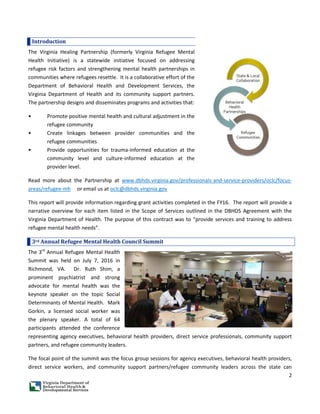
The 3rd
Annual Refugee Mental Health
Summit was held on July 7, 2016 in
Richmond, VA. Dr. Ruth Shim, a
prominent psychiatrist and strong
advocate for mental health was the
keynote speaker on the topic Social
Determinants of Mental Health. Mark
Gorkin, a licensed social worker was
the plenary speaker. A total of 64
participants attended the conference
representing agency executives, behavioral health providers, direct service professionals, community support
partners, and refugee community leaders.
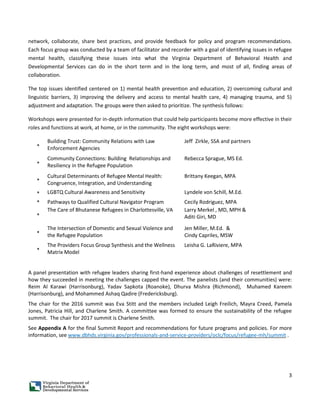
The focal point of the summit was the focus group sessions for agency executives, behavioral health providers,
direct service workers, and community support partners/refugee community leaders across the state can
3
network, collaborate, share best practices, and provide feedback for policy and program recommendations.
Each focus group was conducted by a team of facilitator and recorder with a goal of identifying issues in refugee
mental health, classifying these issues into what the Virginia Department of Behavioral Health and
Developmental Services can do in the short term and in the long term, and most of all, finding areas of
collaboration.
The top issues identified centered on 1) mental health prevention and education, 2) overcoming cultural and
linguistic barriers, 3) improving the delivery and access to mental health care, 4) managing trauma, and 5)
adjustment and adaptation. The groups were then asked to prioritize. The synthesis follows:
Workshops were presented for in-depth information that could help participants become more effective in their
roles and functions at work, at home, or in the community. The eight workshops were:
*
Building Trust: Community Relations with Law
Enforcement Agencies
Jeff Zirkle, SSA and partners
*
Community Connections: Building Relationships and
Resiliency in the Refugee Population
Rebecca Sprague, MS Ed.
*
Cultural Determinants of Refugee Mental Health:
Congruence, Integration, and Understanding
Brittany Keegan, MPA
* LGBTQ Cultural Awareness and Sensitivity Lyndele von Schill, M.Ed.
* Pathways to Qualified Cultural Navigator Program Cecily Rodriguez, MPA
*
The Care of Bhutanese Refugees in Charlottesville, VA Larry Merkel , MD, MPH &
Aditi Giri, MD
*
The Intersection of Domestic and Sexual Violence and
the Refugee Population
Jen Miller, M.Ed. &
Cindy Capriles, MSW
*
The Providers Focus Group Synthesis and the Wellness
Matrix Model
Leisha G. LaRiviere, MPA
A panel presentation with refugee leaders sharing first-hand experience about challenges of resettlement and
how they succeeded in meeting the challenges capped the event. The panelists (and their communities) were:
Reim Al Karawi (Harrisonburg), Yadav Sapkota (Roanoke), Dhurva Mishra (Richmond), Muhamed Kareem
(Harrisonburg), and Mohammed Ashaq Qadire (Fredericksburg).
The chair for the 2016 summit was Eva Stitt and the members included Leigh Freilich, Mayra Creed, Pamela
Jones, Patricia Hill, and Charlene Smith. A committee was formed to ensure the sustainability of the refugee
summit. The chair for 2017 summit is Charlene Smith.
See Appendix A for the final Summit Report and recommendations for future programs and policies. For more
information, see www.dbhds.virginia.gov/professionals-and-service-providers/oclc/focus/refugee-mh/summit .
4
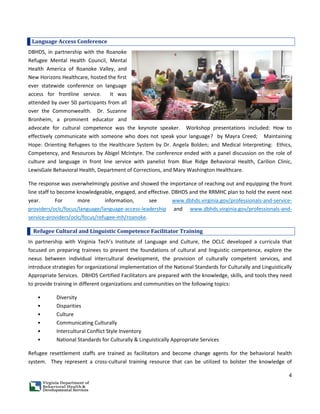
Language Access Conference
DBHDS, in partnership with the Roanoke
Refugee Mental Health Council, Mental
Health America of Roanoke Valley, and
New Horizons Healthcare, hosted the first
ever statewide conference on language
access for frontline service. It was
attended by over 50 participants from all
over the Commonwealth. Dr. Suzanne
Bronheim, a prominent educator and
advocate for cultural competence was the keynote speaker. Workshop presentations included: How to
effectively communicate with someone who does not speak your language? by Mayra Creed; Maintaining
Hope: Orienting Refugees to the Healthcare System by Dr. Angela Bolden; and Medical Interpreting: Ethics,
Competency, and Resources by Abigel McIntyre. The conference ended with a panel discussion on the role of
culture and language in front line service with panelist from Blue Ridge Behavioral Health, Carilion Clinic,
LewisGale Behavioral Health, Department of Corrections, and Mary Washington Healthcare.
The response was overwhelmingly positive and showed the importance of reaching out and equipping the front
line staff to become knowledgeable, engaged, and effective. DBHDS and the RRMHC plan to hold the event next
year. For more information, see www.dbhds.virginia.gov/professionals-and-service-
providers/oclc/focus/language/language-access-leadership and www.dbhds.virginia.gov/professionals-and-
service-providers/oclc/focus/refugee-mh/roanoke.
Refugee Cultural and Linguistic Competence Facilitator Training
In partnership with Virginia Tech’s Institute of Language and Culture, the OCLC developed a curricula that
focused on preparing trainees to present the foundations of cultural and linguistic competence, explore the
nexus between individual intercultural development, the provision of culturally competent services, and
introduce strategies for organizational implementation of the National Standards for Culturally and Linguistically
Appropriate Services. DBHDS Certified Facilitators are prepared with the knowledge, skills, and tools they need
to provide training in different organizations and communities on the following topics:
• Diversity
• Disparities
• Culture
• Communicating Culturally
• Intercultural Conflict Style Inventory
• National Standards for Culturally & Linguistically Appropriate Services
Refugee resettlement staffs are trained as facilitators and become change agents for the behavioral health
system. They represent a cross-cultural training resource that can be utilized to bolster the knowledge of
5
working with refugees in Virginia. They provide training in their regions based on availability. In FY16, 25 new
facilitators were trained to provide cultural competence training across the Commonwealth. From August 2015
to August 2016, fifteen trainings were completed in public and private mental health centers across the state.
For more information, see www.dbhds.virginia.gov/professionals-and-service-
providers/oclc/focus/training/certified-clc-facilitators
Qualified Bilingual Staff Training
Anecdotal reports have been received that mental health providers are unable to provide mental health services
to refugees because of the language barrier. In order to increase capacity and service provision the
interpretation needs of refugees seeking mental health assistance must be improved. Two different trainings
related to interpretation were provided during the grant cycle: Qualified Bilingual Staff (QBS) Model and Mental
Health Interpreter Training (MHiT).
The overall goal for the QBS Model is to establish a system that leverages existing and future work force
linguistic skills that best meet the language needs of refugee service seekers. Qualified Bilingual Staff (QBS)
Model will include key elements to:
• Assess, train, recognize and reward bilingual skills as a separate and distinct competency
• Meet legal, regulatory and accreditation requirements
• Align with organizational mission and meet our business objectives
The QBS Model recognizes and values work force diversity but does not assume that diversity means linguistic
and cultural competency. This training provided appropriate tools and materials tailored to meet the cultural
and linguistic needs of refugees being resettled in Virginia. In FY16, the Partnership trained and tested 94
bilingual staff in more than 16 languages of service. Additionally, the partnership trained 25 additional bilingual
staff as QBB facilitators as a way to expand the capacity of the training program. Since this facilitator training,
QBS training has taken place an additional two times in individual organizations.
For more information see, www.dbhds.virginia.gov/professionals-and-service-
providers/oclc/focus/language/qbs
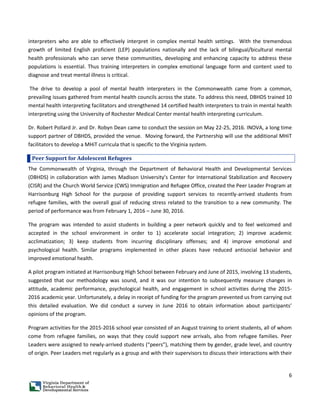
Mental Health Interpreter Training
As an additional way of improving language access for refugees
and thus increasing access and quality service provision, the
Partnership has been expanded to include mental health
interpreter training. The training was offered to professional
medical interpreters only. Its purpose is to improve service
provision in by increasing an organization’s ability to provide
culturally and linguistically appropriate care. The purpose of
the MHiT is to support expand the number of professional
6
interpreters who are able to effectively interpret in complex mental health settings. With the tremendous
growth of limited English proficient (LEP) populations nationally and the lack of bilingual/bicultural mental
health professionals who can serve these communities, developing and enhancing capacity to address these
populations is essential. Thus training interpreters in complex emotional language form and content used to
diagnose and treat mental illness is critical.
The drive to develop a pool of mental health interpreters in the Commonwealth came from a common,
prevailing issues gathered from mental health councils across the state. To address this need, DBHDS trained 10
mental health interpreting facilitators and strengthened 14 certified health interpreters to train in mental health
interpreting using the University of Rochester Medical Center mental health interpreting curriculum.
Dr. Robert Pollard Jr. and Dr. Robyn Dean came to conduct the session on May 22-25, 2016. INOVA, a long time
support partner of DBHDS, provided the venue. Moving forward, the Partnership will use the additional MHiT
facilitators to develop a MHiT curricula that is specific to the Virginia system.
Peer Support for Adolescent Refugees
The Commonwealth of Virginia, through the Department of Behavioral Health and Developmental Services
(DBHDS) in collaboration with James Madison University’s Center for International Stabilization and Recovery
(CISR) and the Church World Service (CWS) Immigration and Refugee Office, created the Peer Leader Program at
Harrisonburg High School for the purpose of providing support services to recently-arrived students from
refugee families, with the overall goal of reducing stress related to the transition to a new community. The
period of performance was from February 1, 2016 – June 30, 2016.
The program was intended to assist students in building a peer network quickly and to feel welcomed and
accepted in the school environment in order to 1) accelerate social integration; 2) improve academic
acclimatization; 3) keep students from incurring disciplinary offenses; and 4) improve emotional and
psychological health. Similar programs implemented in other places have reduced antisocial behavior and
improved emotional health.
A pilot program initiated at Harrisonburg High School between February and June of 2015, involving 13 students,
suggested that our methodology was sound, and it was our intention to subsequently measure changes in
attitude, academic performance, psychological health, and engagement in school activities during the 2015-
2016 academic year. Unfortunately, a delay in receipt of funding for the program prevented us from carrying out
this detailed evaluation. We did conduct a survey in June 2016 to obtain information about participants’
opinions of the program.
Program activities for the 2015-2016 school year consisted of an August training to orient students, all of whom
come from refugee families, on ways that they could support new arrivals, also from refugee families. Peer
Leaders were assigned to newly-arrived students (“peers”), matching them by gender, grade level, and country
of origin. Peer Leaders met regularly as a group and with their supervisors to discuss their interactions with their
7
peers. A second training was conducted on June 4-6, 2016, which included a number of new arrivals and focused
on a continuation of the peer leadership activities during the coming academic year, starting in the fall of 2016.
Origin of Students Number of Students
Iraqi Kurdistan 7
Iraq 16
Congo 8
Eritrea 7
Ethiopia 2
Sudan 1
Total 41
For the full project report, see Appendix B at the end of this document.
Refugee Mental Health Orientation Training
The Refugee Mental Health Orientation Training for Refugee Resettlement Service Providers, developed and
implemented by Virginia Commonwealth University (VCU) School of Social Work (SSW) and in collaboration with
The Women’s Initiative, Charlottesville, and Refugee Community Leaders Council (RCLC) in Richmond, VA, was
delivered on May 16th and 17th at Virginia Tech University’s Richmond Center in Henrico County with assistance
of VT University and DBHDS. The project was funded as a part of the Partnership.
The training intended to develop the following competencies in refugee resettlement service providers:
• Develop an understanding of trauma and its impact on individuals and communities
• Cultivate deeper awareness of common refugee experiences in the context of trauma prior to
migration, during migration, and after resettlement
• Better understand how culture impacts the experience and expression of traumatic stress within
refugee communities
• Increase cross-cultural awareness, sensitivity, and skill at supporting the resiliency of refugees
managing psychosocial distress
• Better understand the importance of healing partnership to better respond to the needs of refugee
communities
• Learn about secondary trauma and develop skills that promote wellness among helping
professionals
The training consisted of eight sessions conducted in 12 hours covering various topics on refugee trauma,
mental health symptoms, cultural understanding of trauma, stress coping, communication skills, community
empowerment and self-care.
A total of twenty five trainees registered and participated in the training for both days. The majority of
participants were case manages and health liaisons of refugee resettlement agencies in various locations
including Arlington, Charlottesville, Fredericksburg, Harrisonburg, Newport News, and Richmond. Nineteen
8
among them completed an evaluation survey after the conclusion of the second day of training. Evaluation
questionnaires consisted of ten quantitative questions and five qualitative (open-ended) questions. The
questions included clarity usefulness, relevance, time management, and applicability of training. Each
quantitative question was assessed on 5 point Likert scale (1=strongly disagree & 5= strongly agree). To read the
full evaluation on this training, see Appendix C at the end of this document.
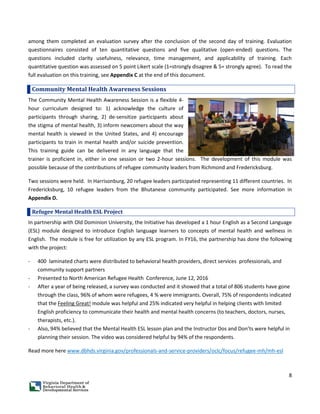
Community Mental Health Awareness Sessions
The Community Mental Health Awareness Session is a flexible 4-
hour curriculum designed to: 1) acknowledge the culture of
participants through sharing, 2) de-sensitize participants about
the stigma of mental health, 3) inform newcomers about the way
mental health is viewed in the United States, and 4) encourage
participants to train in mental health and/or suicide prevention.
This training guide can be delivered in any language that the
trainer is proficient in, either in one session or two 2-hour sessions. The development of this module was
possible because of the contributions of refugee community leaders from Richmond and Fredericksburg.
Two sessions were held. In Harrisonburg, 20 refugee leaders participated representing 11 different countries. In
Fredericksburg, 10 refugee leaders from the Bhutanese community participated. See more information in
Appendix D.
Refugee Mental Health ESL Project
In partnership with Old Dominion University, the Initiative has developed a 1 hour English as a Second Language
(ESL) module designed to introduce English language learners to concepts of mental health and wellness in
English. The module is free for utilization by any ESL program. In FY16, the partnership has done the following
with the project:
- 400 laminated charts were distributed to behavioral health providers, direct services professionals, and
community support partners
- Presented to North American Refugee Health Conference, June 12, 2016
- After a year of being released, a survey was conducted and it showed that a total of 806 students have gone
through the class, 96% of whom were refugees, 4 % were immigrants. Overall, 75% of respondents indicated
that the Feeling Great! module was helpful and 25% indicated very helpful in helping clients with limited
English proficiency to communicate their health and mental health concerns (to teachers, doctors, nurses,
therapists, etc.).
- Also, 94% believed that the Mental Health ESL lesson plan and the Instructor Dos and Don’ts were helpful in
planning their session. The video was considered helpful by 94% of the respondents.
Read more here www.dbhds.virginia.gov/professionals-and-service-providers/oclc/focus/refugee-mh/mh-esl
9
•Advisory body that oversees the
refugee mental health referral system
•Identify and implement strategies that
build capacity for behavioral health
services for refugees,
•Provide input for policy and
programming at the state and local
levels.
Refugee
Mental
Health
Council
•A group of behavioral health
providers that are willing to provide
services to the refugee population
Refugee
Mental Health
Referral
System
Regional Refugee Mental Health Councils
At the center of the Virginia Refugee
Healing Partnership are the Regional
Refugee Mental Health Councils located
around the state. The Councils were
developed to ensure that the goals of the
Virginia Healing Partnership are brought
to the communities where refugees
resettle. The local mental health council is
a collection of community agencies and
individuals who are interested in
strengthening the community’s ability to
support mental wellness among refugees
in the area. The participation of
community organizations, consumers,
family organizations, volunteers, and refugee community leaders that can promote effective service delivery are
valued and embraced.
Councils have two primary focus areas:
1. to support a seamless process for mental health screenings and referrals between area health departments
and area behavioral health providers, and
2. to support the development and implementation of culturally adapted mental health interventions that
address gaps in the service continuum for refugees.
In FY16, the initiative focused on strengthening the
mental health collaborative in Hampton Roads,
Greater Richmond, Fredericksburg, and Roanoke as
well as supporting a mental health referral system
in Charlottesville, and Harrisonburg. The Northern
Virginia Refugee Mental Health Council was
recently organized with a meeting of stakeholders
last August 19th. The next meeting to develop the
organizational framework is scheduled on
September 20th.
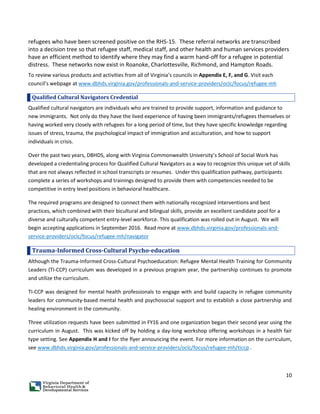
Mental Health Referral Networks -
Five councils have developed mental health
referral networks to clarify and formalize the
pathway and availability of services for
10
refugees who have been screened positive on the RHS-15. These referral networks are transcribed
into a decision tree so that refugee staff, medical staff, and other health and human services providers
have an efficient method to identify where they may find a warm hand-off for a refugee in potential
distress. These networks now exist in Roanoke, Charlottesville, Richmond, and Hampton Roads.
To review various products and activities from all of Virginia’s councils in Appendix E, F, and G. Visit each
council’s webpage at www.dbhds.virginia.gov/professionals-and-service-providers/oclc/focus/refugee-mh
Qualified Cultural Navigators Credential
Qualified cultural navigators are individuals who are trained to provide support, information and guidance to
new immigrants. Not only do they have the lived experience of having been immigrants/refugees themselves or
having worked very closely with refugees for a long period of time, but they have specific knowledge regarding
issues of stress, trauma, the psychological impact of immigration and acculturation, and how to support
individuals in crisis.
Over the past two years, DBHDS, along with Virginia Commonwealth University’s School of Social Work has
developed a credentialing process for Qualified Cultural Navigators as a way to recognize this unique set of skills
that are not always reflected in school transcripts or resumes. Under this qualification pathway, participants
complete a series of workshops and trainings designed to provide them with competencies needed to be
competitive in entry level positions in behavioral healthcare.
The required programs are designed to connect them with nationally recognized interventions and best
practices, which combined with their bicultural and bilingual skills, provide an excellent candidate pool for a
diverse and culturally competent entry-level workforce. This qualification was rolled out in August. We will
begin accepting applications in September 2016. Read more at www.dbhds.virginia.gov/professionals-and-
service-providers/oclc/focus/refugee-mh/navigator
Trauma-Informed Cross-Cultural Psycho-education
Although the Trauma-Informed Cross-Cultural Psychoeducation: Refugee Mental Health Training for Community
Leaders (TI-CCP) curriculum was developed in a previous program year, the partnership continues to promote
and utilize the curriculum.
TI-CCP was designed for mental health professionals to engage with and build capacity in refugee community
leaders for community-based mental health and psychosocial support and to establish a close partnership and
healing environment in the community.
Three utilization requests have been submitted in FY16 and one organization began their second year using the
curriculum in August. This was kicked off by holding a day-long workshop offering workshops in a health fair
type setting. See Appendix H and I for the flyer announcing the event. For more information on the curriculum,
see www.dbhds.virginia.gov/professionals-and-service-providers/oclc/focus/refugee-mh/ticcp .
11
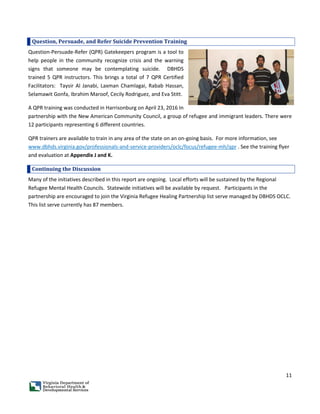
Question, Persuade, and Refer Suicide Prevention Training
Question-Persuade-Refer (QPR) Gatekeepers program is a tool to
help people in the community recognize crisis and the warning
signs that someone may be contemplating suicide. DBHDS
trained 5 QPR instructors. This brings a total of 7 QPR Certified
Facilitators: Taysir Al Janabi, Laxman Chamlagai, Rabab Hassan,
Selamawit Gonfa, Ibrahim Maroof, Cecily Rodriguez, and Eva Stitt.
A QPR training was conducted in Harrisonburg on April 23, 2016 In
partnership with the New American Community Council, a group of refugee and immigrant leaders. There were
12 participants representing 6 different countries.
QPR trainers are available to train in any area of the state on an on-going basis. For more information, see
www.dbhds.virginia.gov/professionals-and-service-providers/oclc/focus/refugee-mh/qpr . See the training flyer
and evaluation at Appendix J and K.
Continuing the Discussion
Many of the initiatives described in this report are ongoing. Local efforts will be sustained by the Regional
Refugee Mental Health Councils. Statewide initiatives will be available by request. Participants in the
partnership are encouraged to join the Virginia Refugee Healing Partnership list serve managed by DBHDS OCLC.
This list serve currently has 87 members.

FY16RHPRep

  • 1.
    FY16 Refugee Healing Partnership– Program Report Final Report to Virginia Department of Health – Newcomer Health Program 9/6/2016
  • 2.
    1 INTRODUCTION 2 3RD ANNUAL REFUGEEMENTAL HEALTH COUNCIL SUMMIT 2 LANGUAGE ACCESS CONFERENCE 4 REFUGEE CULTURAL AND LINGUISTIC COMPETENCE FACILITATOR TRAINING 4 QUALIFIED BILINGUAL STAFF TRAINING 5 MENTAL HEALTH INTERPRETER TRAINING 5 PEER SUPPORT FOR ADOLESCENT REFUGEES 6 REFUGEE MENTAL HEALTH ORIENTATION TRAINING 7 COMMUNITY MENTAL HEALTH AWARENESS SESSIONS 8 REFUGEE MENTAL HEALTH ESL PROJECT 8 REGIONAL REFUGEE MENTAL HEALTH COUNCILS 9 QUALIFIED CULTURAL NAVIGATORS CREDENTIAL 10 TRAUMA-INFORMED CROSS-CULTURAL PSYCHO-EDUCATION 10 QUESTION, PERSUADE, AND REFER SUICIDE PREVENTION TRAINING 11 CONTINUING THE DISCUSSION 11
  • 3.
    2 Introduction The Virginia HealingPartnership (formerly Virginia Refugee Mental Health Initiative) is a statewide initiative focused on addressing refugee risk factors and strengthening mental health partnerships in communities where refugees resettle. It is a collaborative effort of the Department of Behavioral Health and Development Services, the Virginia Department of Health and its community support partners. The partnership designs and disseminates programs and activities that: • Promote positive mental health and cultural adjustment in the refugee community • Create linkages between provider communities and the refugee communities • Provide opportunities for trauma-informed education at the community level and culture-informed education at the provider level. Read more about the Partnership at www.dbhds.virginia.gov/professionals-and-service-providers/oclc/focus- areas/refugee-mh or email us at oclc@dbhds.virginia.gov This report will provide information regarding grant activities completed in the FY16. The report will provide a narrative overview for each item listed in the Scope of Services outlined in the DBHDS Agreement with the Virginia Department of Health. The purpose of this contract was to “provide services and training to address refugee mental health needs”. 3rd Annual Refugee Mental Health Council Summit The 3rd Annual Refugee Mental Health Summit was held on July 7, 2016 in Richmond, VA. Dr. Ruth Shim, a prominent psychiatrist and strong advocate for mental health was the keynote speaker on the topic Social Determinants of Mental Health. Mark Gorkin, a licensed social worker was the plenary speaker. A total of 64 participants attended the conference representing agency executives, behavioral health providers, direct service professionals, community support partners, and refugee community leaders. The focal point of the summit was the focus group sessions for agency executives, behavioral health providers, direct service workers, and community support partners/refugee community leaders across the state can
  • 4.
    3 network, collaborate, sharebest practices, and provide feedback for policy and program recommendations. Each focus group was conducted by a team of facilitator and recorder with a goal of identifying issues in refugee mental health, classifying these issues into what the Virginia Department of Behavioral Health and Developmental Services can do in the short term and in the long term, and most of all, finding areas of collaboration. The top issues identified centered on 1) mental health prevention and education, 2) overcoming cultural and linguistic barriers, 3) improving the delivery and access to mental health care, 4) managing trauma, and 5) adjustment and adaptation. The groups were then asked to prioritize. The synthesis follows: Workshops were presented for in-depth information that could help participants become more effective in their roles and functions at work, at home, or in the community. The eight workshops were: * Building Trust: Community Relations with Law Enforcement Agencies Jeff Zirkle, SSA and partners * Community Connections: Building Relationships and Resiliency in the Refugee Population Rebecca Sprague, MS Ed. * Cultural Determinants of Refugee Mental Health: Congruence, Integration, and Understanding Brittany Keegan, MPA * LGBTQ Cultural Awareness and Sensitivity Lyndele von Schill, M.Ed. * Pathways to Qualified Cultural Navigator Program Cecily Rodriguez, MPA * The Care of Bhutanese Refugees in Charlottesville, VA Larry Merkel , MD, MPH & Aditi Giri, MD * The Intersection of Domestic and Sexual Violence and the Refugee Population Jen Miller, M.Ed. & Cindy Capriles, MSW * The Providers Focus Group Synthesis and the Wellness Matrix Model Leisha G. LaRiviere, MPA A panel presentation with refugee leaders sharing first-hand experience about challenges of resettlement and how they succeeded in meeting the challenges capped the event. The panelists (and their communities) were: Reim Al Karawi (Harrisonburg), Yadav Sapkota (Roanoke), Dhurva Mishra (Richmond), Muhamed Kareem (Harrisonburg), and Mohammed Ashaq Qadire (Fredericksburg). The chair for the 2016 summit was Eva Stitt and the members included Leigh Freilich, Mayra Creed, Pamela Jones, Patricia Hill, and Charlene Smith. A committee was formed to ensure the sustainability of the refugee summit. The chair for 2017 summit is Charlene Smith. See Appendix A for the final Summit Report and recommendations for future programs and policies. For more information, see www.dbhds.virginia.gov/professionals-and-service-providers/oclc/focus/refugee-mh/summit .
  • 5.
    4 Language Access Conference DBHDS,in partnership with the Roanoke Refugee Mental Health Council, Mental Health America of Roanoke Valley, and New Horizons Healthcare, hosted the first ever statewide conference on language access for frontline service. It was attended by over 50 participants from all over the Commonwealth. Dr. Suzanne Bronheim, a prominent educator and advocate for cultural competence was the keynote speaker. Workshop presentations included: How to effectively communicate with someone who does not speak your language? by Mayra Creed; Maintaining Hope: Orienting Refugees to the Healthcare System by Dr. Angela Bolden; and Medical Interpreting: Ethics, Competency, and Resources by Abigel McIntyre. The conference ended with a panel discussion on the role of culture and language in front line service with panelist from Blue Ridge Behavioral Health, Carilion Clinic, LewisGale Behavioral Health, Department of Corrections, and Mary Washington Healthcare. The response was overwhelmingly positive and showed the importance of reaching out and equipping the front line staff to become knowledgeable, engaged, and effective. DBHDS and the RRMHC plan to hold the event next year. For more information, see www.dbhds.virginia.gov/professionals-and-service- providers/oclc/focus/language/language-access-leadership and www.dbhds.virginia.gov/professionals-and- service-providers/oclc/focus/refugee-mh/roanoke. Refugee Cultural and Linguistic Competence Facilitator Training In partnership with Virginia Tech’s Institute of Language and Culture, the OCLC developed a curricula that focused on preparing trainees to present the foundations of cultural and linguistic competence, explore the nexus between individual intercultural development, the provision of culturally competent services, and introduce strategies for organizational implementation of the National Standards for Culturally and Linguistically Appropriate Services. DBHDS Certified Facilitators are prepared with the knowledge, skills, and tools they need to provide training in different organizations and communities on the following topics: • Diversity • Disparities • Culture • Communicating Culturally • Intercultural Conflict Style Inventory • National Standards for Culturally & Linguistically Appropriate Services Refugee resettlement staffs are trained as facilitators and become change agents for the behavioral health system. They represent a cross-cultural training resource that can be utilized to bolster the knowledge of
  • 6.
    5 working with refugeesin Virginia. They provide training in their regions based on availability. In FY16, 25 new facilitators were trained to provide cultural competence training across the Commonwealth. From August 2015 to August 2016, fifteen trainings were completed in public and private mental health centers across the state. For more information, see www.dbhds.virginia.gov/professionals-and-service- providers/oclc/focus/training/certified-clc-facilitators Qualified Bilingual Staff Training Anecdotal reports have been received that mental health providers are unable to provide mental health services to refugees because of the language barrier. In order to increase capacity and service provision the interpretation needs of refugees seeking mental health assistance must be improved. Two different trainings related to interpretation were provided during the grant cycle: Qualified Bilingual Staff (QBS) Model and Mental Health Interpreter Training (MHiT). The overall goal for the QBS Model is to establish a system that leverages existing and future work force linguistic skills that best meet the language needs of refugee service seekers. Qualified Bilingual Staff (QBS) Model will include key elements to: • Assess, train, recognize and reward bilingual skills as a separate and distinct competency • Meet legal, regulatory and accreditation requirements • Align with organizational mission and meet our business objectives The QBS Model recognizes and values work force diversity but does not assume that diversity means linguistic and cultural competency. This training provided appropriate tools and materials tailored to meet the cultural and linguistic needs of refugees being resettled in Virginia. In FY16, the Partnership trained and tested 94 bilingual staff in more than 16 languages of service. Additionally, the partnership trained 25 additional bilingual staff as QBB facilitators as a way to expand the capacity of the training program. Since this facilitator training, QBS training has taken place an additional two times in individual organizations. For more information see, www.dbhds.virginia.gov/professionals-and-service- providers/oclc/focus/language/qbs Mental Health Interpreter Training As an additional way of improving language access for refugees and thus increasing access and quality service provision, the Partnership has been expanded to include mental health interpreter training. The training was offered to professional medical interpreters only. Its purpose is to improve service provision in by increasing an organization’s ability to provide culturally and linguistically appropriate care. The purpose of the MHiT is to support expand the number of professional
  • 7.
    6 interpreters who areable to effectively interpret in complex mental health settings. With the tremendous growth of limited English proficient (LEP) populations nationally and the lack of bilingual/bicultural mental health professionals who can serve these communities, developing and enhancing capacity to address these populations is essential. Thus training interpreters in complex emotional language form and content used to diagnose and treat mental illness is critical. The drive to develop a pool of mental health interpreters in the Commonwealth came from a common, prevailing issues gathered from mental health councils across the state. To address this need, DBHDS trained 10 mental health interpreting facilitators and strengthened 14 certified health interpreters to train in mental health interpreting using the University of Rochester Medical Center mental health interpreting curriculum. Dr. Robert Pollard Jr. and Dr. Robyn Dean came to conduct the session on May 22-25, 2016. INOVA, a long time support partner of DBHDS, provided the venue. Moving forward, the Partnership will use the additional MHiT facilitators to develop a MHiT curricula that is specific to the Virginia system. Peer Support for Adolescent Refugees The Commonwealth of Virginia, through the Department of Behavioral Health and Developmental Services (DBHDS) in collaboration with James Madison University’s Center for International Stabilization and Recovery (CISR) and the Church World Service (CWS) Immigration and Refugee Office, created the Peer Leader Program at Harrisonburg High School for the purpose of providing support services to recently-arrived students from refugee families, with the overall goal of reducing stress related to the transition to a new community. The period of performance was from February 1, 2016 – June 30, 2016. The program was intended to assist students in building a peer network quickly and to feel welcomed and accepted in the school environment in order to 1) accelerate social integration; 2) improve academic acclimatization; 3) keep students from incurring disciplinary offenses; and 4) improve emotional and psychological health. Similar programs implemented in other places have reduced antisocial behavior and improved emotional health. A pilot program initiated at Harrisonburg High School between February and June of 2015, involving 13 students, suggested that our methodology was sound, and it was our intention to subsequently measure changes in attitude, academic performance, psychological health, and engagement in school activities during the 2015- 2016 academic year. Unfortunately, a delay in receipt of funding for the program prevented us from carrying out this detailed evaluation. We did conduct a survey in June 2016 to obtain information about participants’ opinions of the program. Program activities for the 2015-2016 school year consisted of an August training to orient students, all of whom come from refugee families, on ways that they could support new arrivals, also from refugee families. Peer Leaders were assigned to newly-arrived students (“peers”), matching them by gender, grade level, and country of origin. Peer Leaders met regularly as a group and with their supervisors to discuss their interactions with their
  • 8.
    7 peers. A secondtraining was conducted on June 4-6, 2016, which included a number of new arrivals and focused on a continuation of the peer leadership activities during the coming academic year, starting in the fall of 2016. Origin of Students Number of Students Iraqi Kurdistan 7 Iraq 16 Congo 8 Eritrea 7 Ethiopia 2 Sudan 1 Total 41 For the full project report, see Appendix B at the end of this document. Refugee Mental Health Orientation Training The Refugee Mental Health Orientation Training for Refugee Resettlement Service Providers, developed and implemented by Virginia Commonwealth University (VCU) School of Social Work (SSW) and in collaboration with The Women’s Initiative, Charlottesville, and Refugee Community Leaders Council (RCLC) in Richmond, VA, was delivered on May 16th and 17th at Virginia Tech University’s Richmond Center in Henrico County with assistance of VT University and DBHDS. The project was funded as a part of the Partnership. The training intended to develop the following competencies in refugee resettlement service providers: • Develop an understanding of trauma and its impact on individuals and communities • Cultivate deeper awareness of common refugee experiences in the context of trauma prior to migration, during migration, and after resettlement • Better understand how culture impacts the experience and expression of traumatic stress within refugee communities • Increase cross-cultural awareness, sensitivity, and skill at supporting the resiliency of refugees managing psychosocial distress • Better understand the importance of healing partnership to better respond to the needs of refugee communities • Learn about secondary trauma and develop skills that promote wellness among helping professionals The training consisted of eight sessions conducted in 12 hours covering various topics on refugee trauma, mental health symptoms, cultural understanding of trauma, stress coping, communication skills, community empowerment and self-care. A total of twenty five trainees registered and participated in the training for both days. The majority of participants were case manages and health liaisons of refugee resettlement agencies in various locations including Arlington, Charlottesville, Fredericksburg, Harrisonburg, Newport News, and Richmond. Nineteen
  • 9.
    8 among them completedan evaluation survey after the conclusion of the second day of training. Evaluation questionnaires consisted of ten quantitative questions and five qualitative (open-ended) questions. The questions included clarity usefulness, relevance, time management, and applicability of training. Each quantitative question was assessed on 5 point Likert scale (1=strongly disagree & 5= strongly agree). To read the full evaluation on this training, see Appendix C at the end of this document. Community Mental Health Awareness Sessions The Community Mental Health Awareness Session is a flexible 4- hour curriculum designed to: 1) acknowledge the culture of participants through sharing, 2) de-sensitize participants about the stigma of mental health, 3) inform newcomers about the way mental health is viewed in the United States, and 4) encourage participants to train in mental health and/or suicide prevention. This training guide can be delivered in any language that the trainer is proficient in, either in one session or two 2-hour sessions. The development of this module was possible because of the contributions of refugee community leaders from Richmond and Fredericksburg. Two sessions were held. In Harrisonburg, 20 refugee leaders participated representing 11 different countries. In Fredericksburg, 10 refugee leaders from the Bhutanese community participated. See more information in Appendix D. Refugee Mental Health ESL Project In partnership with Old Dominion University, the Initiative has developed a 1 hour English as a Second Language (ESL) module designed to introduce English language learners to concepts of mental health and wellness in English. The module is free for utilization by any ESL program. In FY16, the partnership has done the following with the project: - 400 laminated charts were distributed to behavioral health providers, direct services professionals, and community support partners - Presented to North American Refugee Health Conference, June 12, 2016 - After a year of being released, a survey was conducted and it showed that a total of 806 students have gone through the class, 96% of whom were refugees, 4 % were immigrants. Overall, 75% of respondents indicated that the Feeling Great! module was helpful and 25% indicated very helpful in helping clients with limited English proficiency to communicate their health and mental health concerns (to teachers, doctors, nurses, therapists, etc.). - Also, 94% believed that the Mental Health ESL lesson plan and the Instructor Dos and Don’ts were helpful in planning their session. The video was considered helpful by 94% of the respondents. Read more here www.dbhds.virginia.gov/professionals-and-service-providers/oclc/focus/refugee-mh/mh-esl
  • 10.
    9 •Advisory body thatoversees the refugee mental health referral system •Identify and implement strategies that build capacity for behavioral health services for refugees, •Provide input for policy and programming at the state and local levels. Refugee Mental Health Council •A group of behavioral health providers that are willing to provide services to the refugee population Refugee Mental Health Referral System Regional Refugee Mental Health Councils At the center of the Virginia Refugee Healing Partnership are the Regional Refugee Mental Health Councils located around the state. The Councils were developed to ensure that the goals of the Virginia Healing Partnership are brought to the communities where refugees resettle. The local mental health council is a collection of community agencies and individuals who are interested in strengthening the community’s ability to support mental wellness among refugees in the area. The participation of community organizations, consumers, family organizations, volunteers, and refugee community leaders that can promote effective service delivery are valued and embraced. Councils have two primary focus areas: 1. to support a seamless process for mental health screenings and referrals between area health departments and area behavioral health providers, and 2. to support the development and implementation of culturally adapted mental health interventions that address gaps in the service continuum for refugees. In FY16, the initiative focused on strengthening the mental health collaborative in Hampton Roads, Greater Richmond, Fredericksburg, and Roanoke as well as supporting a mental health referral system in Charlottesville, and Harrisonburg. The Northern Virginia Refugee Mental Health Council was recently organized with a meeting of stakeholders last August 19th. The next meeting to develop the organizational framework is scheduled on September 20th. Mental Health Referral Networks - Five councils have developed mental health referral networks to clarify and formalize the pathway and availability of services for
  • 11.
    10 refugees who havebeen screened positive on the RHS-15. These referral networks are transcribed into a decision tree so that refugee staff, medical staff, and other health and human services providers have an efficient method to identify where they may find a warm hand-off for a refugee in potential distress. These networks now exist in Roanoke, Charlottesville, Richmond, and Hampton Roads. To review various products and activities from all of Virginia’s councils in Appendix E, F, and G. Visit each council’s webpage at www.dbhds.virginia.gov/professionals-and-service-providers/oclc/focus/refugee-mh Qualified Cultural Navigators Credential Qualified cultural navigators are individuals who are trained to provide support, information and guidance to new immigrants. Not only do they have the lived experience of having been immigrants/refugees themselves or having worked very closely with refugees for a long period of time, but they have specific knowledge regarding issues of stress, trauma, the psychological impact of immigration and acculturation, and how to support individuals in crisis. Over the past two years, DBHDS, along with Virginia Commonwealth University’s School of Social Work has developed a credentialing process for Qualified Cultural Navigators as a way to recognize this unique set of skills that are not always reflected in school transcripts or resumes. Under this qualification pathway, participants complete a series of workshops and trainings designed to provide them with competencies needed to be competitive in entry level positions in behavioral healthcare. The required programs are designed to connect them with nationally recognized interventions and best practices, which combined with their bicultural and bilingual skills, provide an excellent candidate pool for a diverse and culturally competent entry-level workforce. This qualification was rolled out in August. We will begin accepting applications in September 2016. Read more at www.dbhds.virginia.gov/professionals-and- service-providers/oclc/focus/refugee-mh/navigator Trauma-Informed Cross-Cultural Psycho-education Although the Trauma-Informed Cross-Cultural Psychoeducation: Refugee Mental Health Training for Community Leaders (TI-CCP) curriculum was developed in a previous program year, the partnership continues to promote and utilize the curriculum. TI-CCP was designed for mental health professionals to engage with and build capacity in refugee community leaders for community-based mental health and psychosocial support and to establish a close partnership and healing environment in the community. Three utilization requests have been submitted in FY16 and one organization began their second year using the curriculum in August. This was kicked off by holding a day-long workshop offering workshops in a health fair type setting. See Appendix H and I for the flyer announcing the event. For more information on the curriculum, see www.dbhds.virginia.gov/professionals-and-service-providers/oclc/focus/refugee-mh/ticcp .
  • 12.
    11 Question, Persuade, andRefer Suicide Prevention Training Question-Persuade-Refer (QPR) Gatekeepers program is a tool to help people in the community recognize crisis and the warning signs that someone may be contemplating suicide. DBHDS trained 5 QPR instructors. This brings a total of 7 QPR Certified Facilitators: Taysir Al Janabi, Laxman Chamlagai, Rabab Hassan, Selamawit Gonfa, Ibrahim Maroof, Cecily Rodriguez, and Eva Stitt. A QPR training was conducted in Harrisonburg on April 23, 2016 In partnership with the New American Community Council, a group of refugee and immigrant leaders. There were 12 participants representing 6 different countries. QPR trainers are available to train in any area of the state on an on-going basis. For more information, see www.dbhds.virginia.gov/professionals-and-service-providers/oclc/focus/refugee-mh/qpr . See the training flyer and evaluation at Appendix J and K. Continuing the Discussion Many of the initiatives described in this report are ongoing. Local efforts will be sustained by the Regional Refugee Mental Health Councils. Statewide initiatives will be available by request. Participants in the partnership are encouraged to join the Virginia Refugee Healing Partnership list serve managed by DBHDS OCLC. This list serve currently has 87 members.