PSYCHOSOCIAL CARE
TECHNIQUES
TOPIC PRESENTATION
Under the supervision of Ms Urmila Bamney
Rimzhim Boruah
MASW in Public Health
Tata Institute of Social Sciences, Guwahati off
campus
CONTENTS
★ Concept of Psychosocial
★ Introduction and definition of
psychosocial care
★ Importance of psychosocial care in
disaster context
★ Need for psychosocial care
★ Principles of Psychosocial care
★ Psychosocial consequences of disaster
★ Psychosocial Interventions
★ Basic Techniques of psychosocial care
★ Illustrations of psychosocial care
techniques
★ Conclusion
★ References
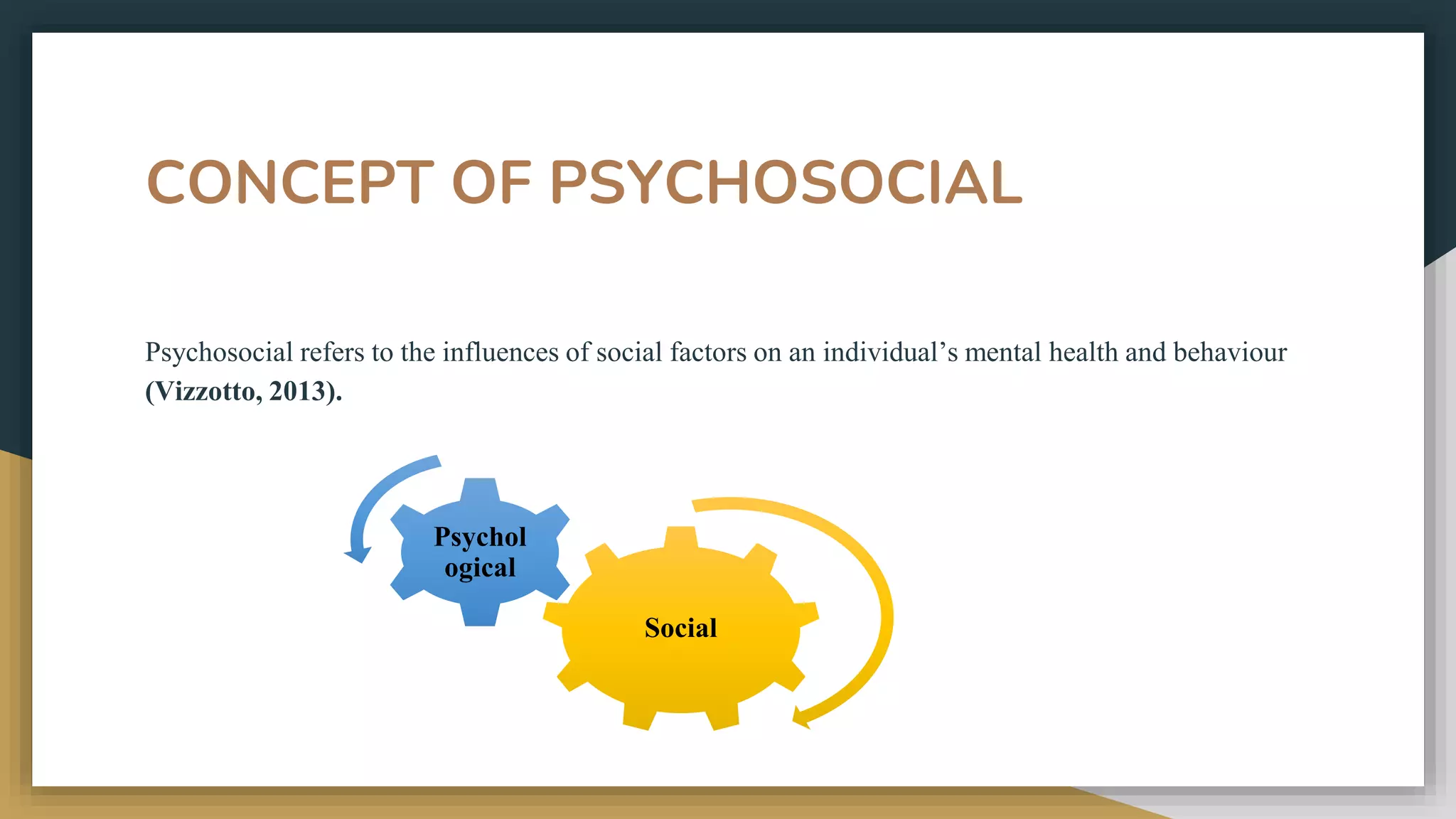
CONCEPT OF PSYCHOSOCIAL
Psychosocial refers to the influences of social factors on an individual’s mental health and behaviour
(Vizzotto, 2013).
Social
Psychol
ogical
INTRODUCTION AND DEFINITION OF
PSYCHOSOCIAL CARE
Psychosocial care is the culturally sensitive provision of psychological, social, and spiritual care
through therapeutic communication (Chen et al., 2017).
According to National Disaster Management Authority, “psychosocial care in the context of
disaster refers to comprehensive interventions aimed at addressing a wide range of psychosocial and
mental health problems arising in the aftermath of disasters (NDMA).
IMPORTANCE OF PSYCHOSOCIAL CARE IN
DISASTER CONTEXT
★ Preventing long-term psychiatric disorders in the disaster affected society;
★ Providing relief from mental suffering and psychological distress;
★ Maintaining mental well-being and equilibrium;
★ Promoting positive mental health
★ Strengthening the social support networks in the affected area;
★ Facilitating the community participation in all activities taken place in mitigation and relief
and rehabilitation phase (WHO, 1991).
NEED FOR PSYCHOSOCIAL CARE
★ Strengthen resilience.
★ Alleviate psychological distress.
★ Mitigate effect of trauma.
★ Re-establish normal development process.
PRINCIPLES OF PSYCHOSOCIAL CARE
★ Ensuring the physical safety of the
survivor.
★ Ensuring confidentiality.
★ Respect the wishes, needs and capacity of
the survivor.
★ Ensuring non discrimination (UN
WOMEN, 2013).
PSYCHOSOCIAL CONSEQUENCES OF
DISASTER
★ Fear, insecurity and anxiety;
★ Loss of protected and familiar environment
★ Sadness and depression
★ Anger and irritability
★ Behavioural problems like disobeying, argumentative, and aggression, lying, stealing;
★ Performance deterioration (immediate and long-term) in academics and other co-curricular
activities;
contd..,
★ Difficulty in relationship/friendship, therefore might suffer from loneliness;
★ Increased risk of substance abuse like, consuming alcohol, drugs, narcotics etc., and
involvement in delinquent activities (for preadolescent and adolescent groups);
★ Subsequent personality disorders.
★ Family disorganization
★ Change of lifestyle and Change in social roles
PSYCHOSOCIAL INTERVENTIONS
Psychosocial First Aid, introduced in mid-Twentieth Century. It is underpinned by five
“essential elements” generated from the available research literature by a consensus conference
of disaster mental health experts convened in 2004 and later summarized in a landmark
publication by Hobfoll and 19 co-authors (Shultz & Forbes, 2014).
It has five elements:
★ Calming
★ A sense of safety
★ A sense of self and community efficacy
★ Connectedness
★ Hope.
BASIC TECHNIQUES OF
PSYCHOSOCIAL CARE
VENTILATION
★ The process involves release of emotions
and feelings.
★ Help release survivors grief, pain, tension
and other emotions.
IMPORTANT THINGS DURING VENTILATION
★ Maintain eye contact.
★ Acknowledge distress.
★ Listening carefully and attentively.
★ Not to be judgemental.
★ Never asking to stop crying
★ Never to interrupt.
EMPATHY
★ Understanding others feelings.
★ Attempts should be made to find the position of the survivor.
★ Should place oneself in Survivor's position.
HOW WILL IT HELP THE SURVIVOR?
★ Help survivor with a sense of relief.
★ Survivors will feel they are being understood.
★ Help to release the emotions.
ACTIVE LISTENING
Problems after a disaster:
★ Lack of privacy in camps
★ Noise and distractions
ROLE AS AN ACTIVE LISTENER
★ Responding occasionally while listening.
★ Maintaining eye contact when the survivor is speaking.
★ Avoiding interruptions.
★ Accepting the survivor’s views and as a person.
★ Empathising with the survivor.
SOCIAL SUPPORT
Social support has been described as “support accessible to an individual
through social ties to other individuals, groups, and the larger community”
(Ozbay et al., 2007).
★ Social support is extremely important in disaster to feel secure and
comfortable.
★ In disaster situation, social support gets disrupted
★ External agencies need to extend emotional support.
★ Provide support through bonding.
EXTERNALIZATION OF INTEREST
Under stressful situations, many individuals withdraw themselves from interests that are part and
parcel of healthy living. In such a situation, the clients are encouraged to resume activities which were
once meaningful to them or the therapist helps them to develop new interests to fill their leisure time
(Grover et al., 2020).
★ Survivor’s engaged in work of their interest will help them to be productive.
★ It will help in the process of recovery.
★ Physical movements help to feel better.
★ Helps the survivors think about something different.
VALUE OF RELAXATION/ RECREATION
Getting back to routines to divert one’s minds is a great way of dealing with the stress that the
emotional reactions would be causing.
More the people engage in activities or recreational activities, the greater will be the normalization of
their life.
It is important to take the mind and let it get involved in non-tense situations and experiences. This
will help the person to recover faster
SPIRITUALITY
Spirituality refers to religious and non-religious ways that people search for a sense of meaning,
purpose, moral frameworks and connection with what they believe is most profound or sacred
(Benson et al., 2015).
★ Survivor’s often ask why god is punishing them?
★ The power helps the survivor to get through the crisis.
★ Reinforcing the spirituality.
★ Practising spiritual beliefs helps in recovery process.
CONCLUSION
To conclude, disaster is the disruption in the normal functioning of life which leads to severe damage
to human life, injuries, destruction of properties, environmental and social disconnectedness. The
seven basic techniques discussed such as ventilation, active listening, empathy, social support,
externalization of interest, relaxation and recreation and spirituality are all important to make the
survivors to get back to their normalcy. These techniques are basic and simple to approach survivors
in the disaster context.
REFERENCES
Benson, P. W., Furman, L. D., Canda, E. R., Moss, B., & Danbolt, T. (2016). Spiritually Sensitive Social Work with
Victims of Natural Disasters and Terrorism. British journal of social work, 46(5), 1372–1393.
https://doi.org/10.1093/bjsw/bcv053
Chen, Cassandra Siyun1; Chan, Sally Wai-Chi2; Chan, Moon Fai3; Yap, Suk Foon4; Wang, Wenru5; Kowitlawakul,
Yanika6*. Nurses’ Perceptions of Psychosocial Care and Barriers to Its Provision: A Qualitative Study. Journal of
Nursing Research: December 2017 - Volume 25 - Issue 6 - p 411-418 doi: 10.1097/JNR.0000000000000185
Grover, S., Avasthi, A., & Jagiwala, M. (2020). Clinical Practice Guidelines for Practice of Supportive Psychotherapy.
Indian journal of psychiatry, 62(Suppl 2), S173–S182. https://doi.org/10.4103/psychiatry.IndianJPsychiatry_768_19
National Institute of Mental Health and Neuro Sciences, & Sekar, K. (2005). Psychosocial Care in Disaster
Management: Facilitation Manual for Trainers of Trainees in Natural Disasters. NIMHANS.
Ozbay, F., Johnson, D. C., Dimoulas, E., Morgan, C. A., Charney, D., & Southwick, S. (2007). Social support and
resilience to stress: from neurobiology to clinical practice. Psychiatry (Edgmont (Pa. : Township)), 4(5), 35–40.
Principles of psychosocial care. (2013.).
https://www.endvawnow.org/en/articles/1566-principles-of-psychosocial-care.html
Psychosocial Care | NDMA, GoI. (n.d.). https://ndma.gov.in/Capacity_Building/Mitigation/Psychosocial-Care
Vizzotto, A.D.B., de Oliveira, A.M., Elkis, H., Cordeiro, Q., Buchain, P.C. (2013). Psychosocial Characteristics. In:
Gellman, M.D., Turner, J.R. (eds) Encyclopedia of Behavioral Medicine. Springer, New York, NY.
https://doi.org/10.1007/978-1-4419-1005-9_918
THANK YOU

Psychosocial care techniques .pptx

  • 1.
    PSYCHOSOCIAL CARE TECHNIQUES TOPIC PRESENTATION Underthe supervision of Ms Urmila Bamney Rimzhim Boruah MASW in Public Health Tata Institute of Social Sciences, Guwahati off campus
  • 2.
    CONTENTS ★ Concept ofPsychosocial ★ Introduction and definition of psychosocial care ★ Importance of psychosocial care in disaster context ★ Need for psychosocial care ★ Principles of Psychosocial care ★ Psychosocial consequences of disaster ★ Psychosocial Interventions ★ Basic Techniques of psychosocial care ★ Illustrations of psychosocial care techniques ★ Conclusion ★ References
  • 3.
    CONCEPT OF PSYCHOSOCIAL Psychosocialrefers to the influences of social factors on an individual’s mental health and behaviour (Vizzotto, 2013). Social Psychol ogical
  • 4.
    INTRODUCTION AND DEFINITIONOF PSYCHOSOCIAL CARE Psychosocial care is the culturally sensitive provision of psychological, social, and spiritual care through therapeutic communication (Chen et al., 2017). According to National Disaster Management Authority, “psychosocial care in the context of disaster refers to comprehensive interventions aimed at addressing a wide range of psychosocial and mental health problems arising in the aftermath of disasters (NDMA).
  • 5.
    IMPORTANCE OF PSYCHOSOCIALCARE IN DISASTER CONTEXT ★ Preventing long-term psychiatric disorders in the disaster affected society; ★ Providing relief from mental suffering and psychological distress; ★ Maintaining mental well-being and equilibrium; ★ Promoting positive mental health ★ Strengthening the social support networks in the affected area; ★ Facilitating the community participation in all activities taken place in mitigation and relief and rehabilitation phase (WHO, 1991).
  • 6.
    NEED FOR PSYCHOSOCIALCARE ★ Strengthen resilience. ★ Alleviate psychological distress. ★ Mitigate effect of trauma. ★ Re-establish normal development process.
  • 7.
    PRINCIPLES OF PSYCHOSOCIALCARE ★ Ensuring the physical safety of the survivor. ★ Ensuring confidentiality. ★ Respect the wishes, needs and capacity of the survivor. ★ Ensuring non discrimination (UN WOMEN, 2013).
  • 8.
    PSYCHOSOCIAL CONSEQUENCES OF DISASTER ★Fear, insecurity and anxiety; ★ Loss of protected and familiar environment ★ Sadness and depression ★ Anger and irritability ★ Behavioural problems like disobeying, argumentative, and aggression, lying, stealing; ★ Performance deterioration (immediate and long-term) in academics and other co-curricular activities;
  • 9.
    contd.., ★ Difficulty inrelationship/friendship, therefore might suffer from loneliness; ★ Increased risk of substance abuse like, consuming alcohol, drugs, narcotics etc., and involvement in delinquent activities (for preadolescent and adolescent groups); ★ Subsequent personality disorders. ★ Family disorganization ★ Change of lifestyle and Change in social roles
  • 10.
    PSYCHOSOCIAL INTERVENTIONS Psychosocial FirstAid, introduced in mid-Twentieth Century. It is underpinned by five “essential elements” generated from the available research literature by a consensus conference of disaster mental health experts convened in 2004 and later summarized in a landmark publication by Hobfoll and 19 co-authors (Shultz & Forbes, 2014). It has five elements: ★ Calming ★ A sense of safety ★ A sense of self and community efficacy ★ Connectedness ★ Hope.
  • 11.
  • 12.
    VENTILATION ★ The processinvolves release of emotions and feelings. ★ Help release survivors grief, pain, tension and other emotions.
  • 13.
    IMPORTANT THINGS DURINGVENTILATION ★ Maintain eye contact. ★ Acknowledge distress. ★ Listening carefully and attentively. ★ Not to be judgemental. ★ Never asking to stop crying ★ Never to interrupt.
  • 14.
    EMPATHY ★ Understanding othersfeelings. ★ Attempts should be made to find the position of the survivor. ★ Should place oneself in Survivor's position.
  • 15.
    HOW WILL ITHELP THE SURVIVOR? ★ Help survivor with a sense of relief. ★ Survivors will feel they are being understood. ★ Help to release the emotions.
  • 16.
    ACTIVE LISTENING Problems aftera disaster: ★ Lack of privacy in camps ★ Noise and distractions
  • 17.
    ROLE AS ANACTIVE LISTENER ★ Responding occasionally while listening. ★ Maintaining eye contact when the survivor is speaking. ★ Avoiding interruptions. ★ Accepting the survivor’s views and as a person. ★ Empathising with the survivor.
  • 18.
    SOCIAL SUPPORT Social supporthas been described as “support accessible to an individual through social ties to other individuals, groups, and the larger community” (Ozbay et al., 2007). ★ Social support is extremely important in disaster to feel secure and comfortable. ★ In disaster situation, social support gets disrupted ★ External agencies need to extend emotional support. ★ Provide support through bonding.
  • 19.
    EXTERNALIZATION OF INTEREST Understressful situations, many individuals withdraw themselves from interests that are part and parcel of healthy living. In such a situation, the clients are encouraged to resume activities which were once meaningful to them or the therapist helps them to develop new interests to fill their leisure time (Grover et al., 2020). ★ Survivor’s engaged in work of their interest will help them to be productive. ★ It will help in the process of recovery. ★ Physical movements help to feel better. ★ Helps the survivors think about something different.
  • 20.
    VALUE OF RELAXATION/RECREATION Getting back to routines to divert one’s minds is a great way of dealing with the stress that the emotional reactions would be causing. More the people engage in activities or recreational activities, the greater will be the normalization of their life. It is important to take the mind and let it get involved in non-tense situations and experiences. This will help the person to recover faster
  • 21.
    SPIRITUALITY Spirituality refers toreligious and non-religious ways that people search for a sense of meaning, purpose, moral frameworks and connection with what they believe is most profound or sacred (Benson et al., 2015). ★ Survivor’s often ask why god is punishing them? ★ The power helps the survivor to get through the crisis. ★ Reinforcing the spirituality. ★ Practising spiritual beliefs helps in recovery process.
  • 22.
    CONCLUSION To conclude, disasteris the disruption in the normal functioning of life which leads to severe damage to human life, injuries, destruction of properties, environmental and social disconnectedness. The seven basic techniques discussed such as ventilation, active listening, empathy, social support, externalization of interest, relaxation and recreation and spirituality are all important to make the survivors to get back to their normalcy. These techniques are basic and simple to approach survivors in the disaster context.
  • 23.
    REFERENCES Benson, P. W.,Furman, L. D., Canda, E. R., Moss, B., & Danbolt, T. (2016). Spiritually Sensitive Social Work with Victims of Natural Disasters and Terrorism. British journal of social work, 46(5), 1372–1393. https://doi.org/10.1093/bjsw/bcv053 Chen, Cassandra Siyun1; Chan, Sally Wai-Chi2; Chan, Moon Fai3; Yap, Suk Foon4; Wang, Wenru5; Kowitlawakul, Yanika6*. Nurses’ Perceptions of Psychosocial Care and Barriers to Its Provision: A Qualitative Study. Journal of Nursing Research: December 2017 - Volume 25 - Issue 6 - p 411-418 doi: 10.1097/JNR.0000000000000185 Grover, S., Avasthi, A., & Jagiwala, M. (2020). Clinical Practice Guidelines for Practice of Supportive Psychotherapy. Indian journal of psychiatry, 62(Suppl 2), S173–S182. https://doi.org/10.4103/psychiatry.IndianJPsychiatry_768_19 National Institute of Mental Health and Neuro Sciences, & Sekar, K. (2005). Psychosocial Care in Disaster Management: Facilitation Manual for Trainers of Trainees in Natural Disasters. NIMHANS.
  • 24.
    Ozbay, F., Johnson,D. C., Dimoulas, E., Morgan, C. A., Charney, D., & Southwick, S. (2007). Social support and resilience to stress: from neurobiology to clinical practice. Psychiatry (Edgmont (Pa. : Township)), 4(5), 35–40. Principles of psychosocial care. (2013.). https://www.endvawnow.org/en/articles/1566-principles-of-psychosocial-care.html Psychosocial Care | NDMA, GoI. (n.d.). https://ndma.gov.in/Capacity_Building/Mitigation/Psychosocial-Care Vizzotto, A.D.B., de Oliveira, A.M., Elkis, H., Cordeiro, Q., Buchain, P.C. (2013). Psychosocial Characteristics. In: Gellman, M.D., Turner, J.R. (eds) Encyclopedia of Behavioral Medicine. Springer, New York, NY. https://doi.org/10.1007/978-1-4419-1005-9_918
  • 25.