Intimate connection to an object, anyone? Roll Tape.
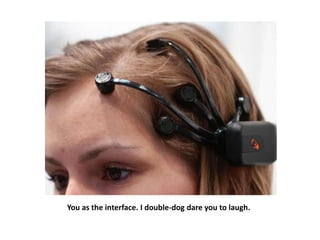
You as the interface. I double-dog dare you to laugh.
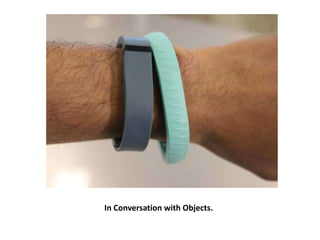
In Conversation with Objects.
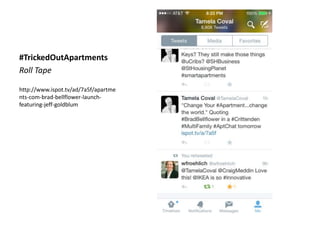
#TrickedOutApartments
Roll Tape
http://www.ispot.tv/ad/7a5f/apartme
nts-com-brad-bellflower-launch-
featuring-jeff-goldblum
I’m Officially Re-naming This Session.
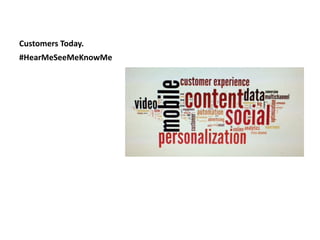
Customers Today.
#HearMeSeeMeKnowMe
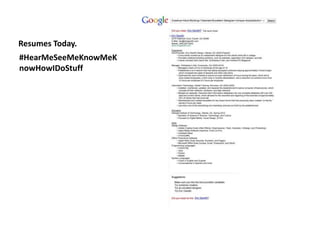
Resumes Today.
#HearMeSeeMeKnowMeK
nowHowIDoStuff
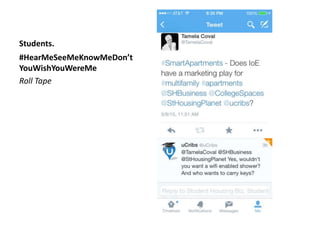
Students.
#HearMeSeeMeKnowMeDon’t
YouWishYouWereMe
Roll Tape
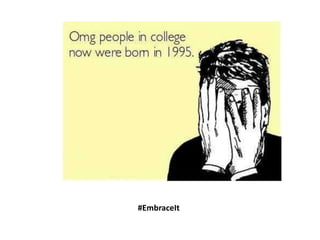
#EmbraceIt
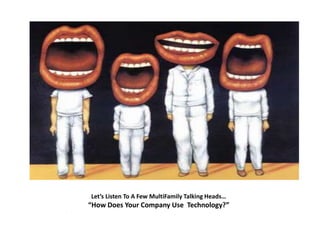
Let’s Listen To A Few MultiFamily Talking Heads…
“How Does Your Company Use Technology?”
.
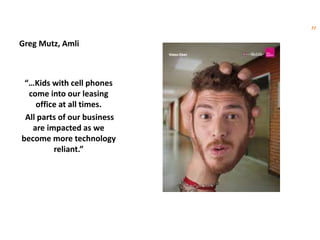
Greg Mutz, Amli
“…Kids with cell phones
come into our leasing
office at all times.
All parts of our business
are impacted as we
become more technology
reliant.”
”
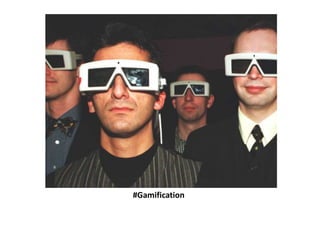
#Gamification
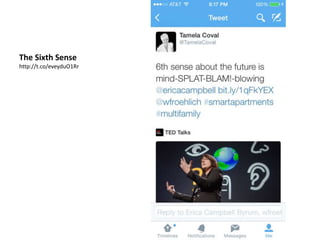
The Sixth Sense
http://t.co/eveyduO1Rr
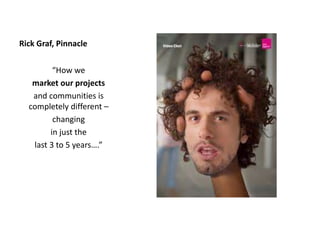
Rick Graf, Pinnacle
“How we
market our projects
and communities is
completely different –
changing
in just the
last 3 to 5 years….”
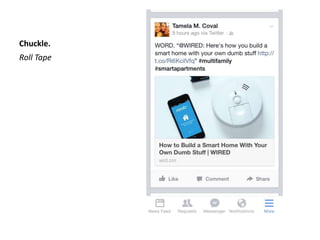
Chuckle.
Roll Tape
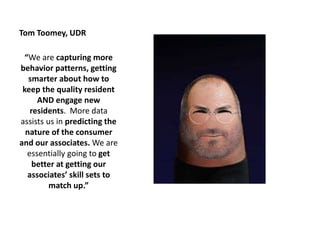
Tom Toomey, UDR
“We are capturing more
behavior patterns, getting
smarter about how to
keep the quality resident
AND engage new
residents. More data
assists us in predicting the
nature of the consumer
and our associates. We are
essentially going to get
better at getting our
associates’ skill sets to
match up.”
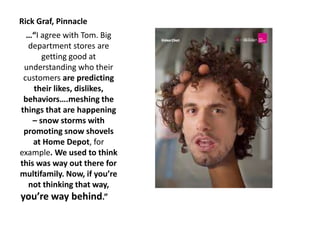
…“I agree with Tom. Big
department stores are
getting good at
understanding who their
customers are predicting
their likes, dislikes,
behaviors….meshing the
things that are happening
– snow storms with
promoting snow shovels
at Home Depot, for
example. We used to think
this was way out there for
multifamily. Now, if you’re
not thinking that way,
you’re way behind.”
Rick Graf, Pinnacle
25Need-to-Know
Facts
Fact
1
Every 2 days we
create as much
information as we did
from the beginning of
time until 2003
[Source]
© 2014 Bernard Marr, Advanced Performance Institute, BWMC Ltd. All rights reserved.
Over 90% of all the
data in the world was
created in the past 2
years.
[Source]
Fact
2
© 2014 Bernard Marr, Advanced Performance Institute, BWMC Ltd. All rights reserved.
Fact
3
It is expected
that by 2020 the
amount of digital
information in
existence will have
grown from 3.2
zettabytes today to
40 zettabytes.
[Source]
© 2014 Bernard Marr, Advanced Performance Institute, BWMC Ltd. All rights reserved.
The total amount of
data being captured
and stored by industry
doubles every 1.2
years
[Source]
Fact
4
© 2014 Bernard Marr, Advanced Performance Institute, BWMC Ltd. All rights reserved.
Fact
5
Every minute
we send 204 million
emails, generate 1,8
million Facebook
likes, send 278
thousand Tweets, and
up-load 200 photos to
Facebook
[Source]
© 2014 Bernard Marr, Advanced Performance Institute, BWMC Ltd. All rights reserved.
Google alone
processes on average
over 40 thousand
search queries per
second, making it
over 3.5 billion in a
single day.
[Source]
Fact
6
© 2014 Bernard Marr, Advanced Performance Institute, BWMC Ltd. All rights reserved.
Fact
7
Around 100 hours of
video are uploaded to
YouTube every minute
and it would take you
around 15 years to
watch every video
uploaded by users in
one day.
[Source]
© 2014 Bernard Marr, Advanced Performance Institute, BWMC Ltd. All rights reserved.
Facebook users
share 30 billion pieces
of content between
them every day.
[Source]
Fact
8
© 2014 Bernard Marr, Advanced Performance Institute, BWMC Ltd. All rights reserved.
Fact
9
If you burned
all of the data created
in just one day onto
DVDs, you could stack
them on top of each
other and reach the
moon – twice.
[Source]
© 2014 Bernard Marr, Advanced Performance Institute, BWMC Ltd. All rights reserved.
AT&T is thought
to hold the world’s
largest volume of data
in one unique
database – its phone
records database is
312 terabytes in size,
and contains almost 2
trillion rows.
[Source]
Fact
10
© 2014 Bernard Marr, Advanced Performance Institute, BWMC Ltd. All rights reserved.
Fact
11
1.570 new
websites spring into
existence every
minute of every day.
[Source]
© 2014 Bernard Marr, Advanced Performance Institute, BWMC Ltd. All rights reserved.
1.9 million
IT jobs will be
created in the US
by 2015 to carry out big data
projects. Each of those will be
supported by 3 new jobs
created outside of IT –
meaning a total of 6 million
new jobs thanks to
big data.
[Source]
Fact
12
© 2014 Bernard Marr, Advanced Performance Institute, BWMC Ltd. All rights reserved.
Fact
13
Today’s data centres
occupy an area of
land equal in size to
almost 6,000 football
fields.
[Source]
© 2014 Bernard Marr, Advanced Performance Institute, BWMC Ltd. All rights reserved.
Between them,
companies monitoring
Twitter to measure
“sentiment” analyze
12 terabytes of tweets
every day.
[Source]
Fact
14
© 2014 Bernard Marr, Advanced Performance Institute, BWMC Ltd. All rights reserved.
Fact
15
The amount of data
transferred over mobile
networks increased by
81% to 1.5 exabytes
(1.5 billion gigabytes) per
month between 2012 and
2014. Video accounts for
53% of that total.
[Source]
© 2014 Bernard Marr, Advanced Performance Institute, BWMC Ltd. All rights reserved.
The NSA is thought to
analyze 1.6% of all
global internet traffic –
around 30 petabytes
(30 million gigabytes)
every day
[Source]
Fact
16
© 2014 Bernard Marr, Advanced Performance Institute, BWMC Ltd. All rights reserved.
Fact
17
The value of the
Hadoop market is
expected to soar from
$2 billion in 2013 to
$50 billion by 2010,
according to market
research firm Allied
Market Research.
[Source]
© 2014 Bernard Marr, Advanced Performance Institute, BWMC Ltd. All rights reserved.
The number
of Bits of information
stored in the digital
universe is thought to
have exceeded the
number of stars in the
physical universe in
2007.
[Source]
Fact
18
© 2014 Bernard Marr, Advanced Performance Institute, BWMC Ltd. All rights reserved.
Fact
19
This year,
there will be over 1.2
billion smart phones in
the world (which are
stuffed full of sensors and
data collection features),
and the growth is
predicted to continue.
[Source]
© 2014 Bernard Marr, Advanced Performance Institute, BWMC Ltd. All rights reserved.
The boom of
the Internet of Things
will mean that the amount
of devices connected to
the Internet will rise from
about 13 billion today to
50 billion by 2020.
[Source]
Fact
20
© 2014 Bernard Marr, Advanced Performance Institute, BWMC Ltd. All rights reserved.
Fact
21
12 million RFID tags
– used to capture data and
track movement of objects in
the physical world – had been
sold in by 2011. By 2021, it is
estimated that number will
have risen to 209 billion as
the Internet of Things takes
off.
[Source]
© 2014 Bernard Marr, Advanced Performance Institute, BWMC Ltd. All rights reserved.
Big data has been
used to predict crimes
before they happen – a
“predictive policing” trial in
California was able to identify
areas where crime will occur
three times more accurately
than existing methods of
forecasting.
[Source]
Fact
22
© 2014 Bernard Marr, Advanced Performance Institute, BWMC Ltd. All rights reserved.
Fact
23
By better integrating
big data analytics into
healthcare, the industry
could save $300bn a year –
that’s the equivalent of
reducing the healthcare
costs of every man, woman
and child
by $1,000 a year.
[Source]
© 2014 Bernard Marr, Advanced Performance Institute, BWMC Ltd. All rights reserved.
Retailers could
increase their profit
margins by more that
60% through the full
exploitation of big
data analytics.
[Source]
Fact
24
© 2014 Bernard Marr, Advanced Performance Institute, BWMC Ltd. All rights reserved.
Fact
25
The big data industry
is expected to grow
from US$10.2 billion in
2013 to about US$54.3
billion by 2017.
[Source]
© 2014 Bernard Marr, Advanced Performance Institute, BWMC Ltd. All rights reserved.
About
This overview was put together by
Bernard Marr,
Founder and CEO of the Advanced Performance Institute.
Bernard Mar is a bestselling business author, keynote speaker, strategic
performance consultant, and analytics, KPI & Big Data guru. He helps
companies with their big data strategies and trains teams to better leverage data
in their companies.
Read Bernard’s blogs:
• LinkedIn Influencer Blog
Connect with Bernard on:
• LinkedIn
• Twitter
• Advanced Performance Institute
© 2014 Bernard Marr, Advanced Performance Institute, BWMC Ltd. All rights reserved.
#SealTheDeal
Imagine The Money.
Roll Tape
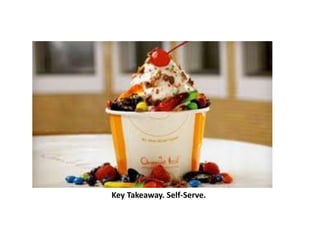
Key Takeaway. Self-Serve.
The Key Takeaway.
If you say this to your seatmate, you may have
questions. If so, please raise your hand. Sometimes
things make much more sense inside of my head.
“…Just remember, if we get caught and
someone asks about this, you’re deaf and
I don’t speak English…”
Tamela Coval
Executive Strategist
CORT, A Berkshire-
Hathaway Company
Tamela.coval@cort.com
@TamelaCoval

#TrickedOutApartments March 2015

  • 4.
    Intimate connection toan object, anyone? Roll Tape.
  • 5.
    You as theinterface. I double-dog dare you to laugh.
  • 6.
  • 7.
  • 8.
  • 9.
  • 10.
  • 11.
  • 12.
  • 13.
    Let’s Listen ToA Few MultiFamily Talking Heads… “How Does Your Company Use Technology?” .
  • 14.
    Greg Mutz, Amli “…Kidswith cell phones come into our leasing office at all times. All parts of our business are impacted as we become more technology reliant.” ”
  • 15.
  • 16.
  • 17.
    Rick Graf, Pinnacle “Howwe market our projects and communities is completely different – changing in just the last 3 to 5 years….”
  • 18.
  • 19.
    Tom Toomey, UDR “Weare capturing more behavior patterns, getting smarter about how to keep the quality resident AND engage new residents. More data assists us in predicting the nature of the consumer and our associates. We are essentially going to get better at getting our associates’ skill sets to match up.”
  • 20.
    …“I agree withTom. Big department stores are getting good at understanding who their customers are predicting their likes, dislikes, behaviors….meshing the things that are happening – snow storms with promoting snow shovels at Home Depot, for example. We used to think this was way out there for multifamily. Now, if you’re not thinking that way, you’re way behind.” Rick Graf, Pinnacle
  • 21.
  • 22.
    Fact 1 Every 2 dayswe create as much information as we did from the beginning of time until 2003 [Source] © 2014 Bernard Marr, Advanced Performance Institute, BWMC Ltd. All rights reserved.
  • 23.
    Over 90% ofall the data in the world was created in the past 2 years. [Source] Fact 2 © 2014 Bernard Marr, Advanced Performance Institute, BWMC Ltd. All rights reserved.
  • 24.
    Fact 3 It is expected thatby 2020 the amount of digital information in existence will have grown from 3.2 zettabytes today to 40 zettabytes. [Source] © 2014 Bernard Marr, Advanced Performance Institute, BWMC Ltd. All rights reserved.
  • 25.
    The total amountof data being captured and stored by industry doubles every 1.2 years [Source] Fact 4 © 2014 Bernard Marr, Advanced Performance Institute, BWMC Ltd. All rights reserved.
  • 26.
    Fact 5 Every minute we send204 million emails, generate 1,8 million Facebook likes, send 278 thousand Tweets, and up-load 200 photos to Facebook [Source] © 2014 Bernard Marr, Advanced Performance Institute, BWMC Ltd. All rights reserved.
  • 27.
    Google alone processes onaverage over 40 thousand search queries per second, making it over 3.5 billion in a single day. [Source] Fact 6 © 2014 Bernard Marr, Advanced Performance Institute, BWMC Ltd. All rights reserved.
  • 28.
    Fact 7 Around 100 hoursof video are uploaded to YouTube every minute and it would take you around 15 years to watch every video uploaded by users in one day. [Source] © 2014 Bernard Marr, Advanced Performance Institute, BWMC Ltd. All rights reserved.
  • 29.
    Facebook users share 30billion pieces of content between them every day. [Source] Fact 8 © 2014 Bernard Marr, Advanced Performance Institute, BWMC Ltd. All rights reserved.
  • 30.
    Fact 9 If you burned allof the data created in just one day onto DVDs, you could stack them on top of each other and reach the moon – twice. [Source] © 2014 Bernard Marr, Advanced Performance Institute, BWMC Ltd. All rights reserved.
  • 31.
    AT&T is thought tohold the world’s largest volume of data in one unique database – its phone records database is 312 terabytes in size, and contains almost 2 trillion rows. [Source] Fact 10 © 2014 Bernard Marr, Advanced Performance Institute, BWMC Ltd. All rights reserved.
  • 32.
    Fact 11 1.570 new websites springinto existence every minute of every day. [Source] © 2014 Bernard Marr, Advanced Performance Institute, BWMC Ltd. All rights reserved.
  • 33.
    1.9 million IT jobswill be created in the US by 2015 to carry out big data projects. Each of those will be supported by 3 new jobs created outside of IT – meaning a total of 6 million new jobs thanks to big data. [Source] Fact 12 © 2014 Bernard Marr, Advanced Performance Institute, BWMC Ltd. All rights reserved.
  • 34.
    Fact 13 Today’s data centres occupyan area of land equal in size to almost 6,000 football fields. [Source] © 2014 Bernard Marr, Advanced Performance Institute, BWMC Ltd. All rights reserved.
  • 35.
    Between them, companies monitoring Twitterto measure “sentiment” analyze 12 terabytes of tweets every day. [Source] Fact 14 © 2014 Bernard Marr, Advanced Performance Institute, BWMC Ltd. All rights reserved.
  • 36.
    Fact 15 The amount ofdata transferred over mobile networks increased by 81% to 1.5 exabytes (1.5 billion gigabytes) per month between 2012 and 2014. Video accounts for 53% of that total. [Source] © 2014 Bernard Marr, Advanced Performance Institute, BWMC Ltd. All rights reserved.
  • 37.
    The NSA isthought to analyze 1.6% of all global internet traffic – around 30 petabytes (30 million gigabytes) every day [Source] Fact 16 © 2014 Bernard Marr, Advanced Performance Institute, BWMC Ltd. All rights reserved.
  • 38.
    Fact 17 The value ofthe Hadoop market is expected to soar from $2 billion in 2013 to $50 billion by 2010, according to market research firm Allied Market Research. [Source] © 2014 Bernard Marr, Advanced Performance Institute, BWMC Ltd. All rights reserved.
  • 39.
    The number of Bitsof information stored in the digital universe is thought to have exceeded the number of stars in the physical universe in 2007. [Source] Fact 18 © 2014 Bernard Marr, Advanced Performance Institute, BWMC Ltd. All rights reserved.
  • 40.
    Fact 19 This year, there willbe over 1.2 billion smart phones in the world (which are stuffed full of sensors and data collection features), and the growth is predicted to continue. [Source] © 2014 Bernard Marr, Advanced Performance Institute, BWMC Ltd. All rights reserved.
  • 41.
    The boom of theInternet of Things will mean that the amount of devices connected to the Internet will rise from about 13 billion today to 50 billion by 2020. [Source] Fact 20 © 2014 Bernard Marr, Advanced Performance Institute, BWMC Ltd. All rights reserved.
  • 42.
    Fact 21 12 million RFIDtags – used to capture data and track movement of objects in the physical world – had been sold in by 2011. By 2021, it is estimated that number will have risen to 209 billion as the Internet of Things takes off. [Source] © 2014 Bernard Marr, Advanced Performance Institute, BWMC Ltd. All rights reserved.
  • 43.
    Big data hasbeen used to predict crimes before they happen – a “predictive policing” trial in California was able to identify areas where crime will occur three times more accurately than existing methods of forecasting. [Source] Fact 22 © 2014 Bernard Marr, Advanced Performance Institute, BWMC Ltd. All rights reserved.
  • 44.
    Fact 23 By better integrating bigdata analytics into healthcare, the industry could save $300bn a year – that’s the equivalent of reducing the healthcare costs of every man, woman and child by $1,000 a year. [Source] © 2014 Bernard Marr, Advanced Performance Institute, BWMC Ltd. All rights reserved.
  • 45.
    Retailers could increase theirprofit margins by more that 60% through the full exploitation of big data analytics. [Source] Fact 24 © 2014 Bernard Marr, Advanced Performance Institute, BWMC Ltd. All rights reserved.
  • 46.
    Fact 25 The big dataindustry is expected to grow from US$10.2 billion in 2013 to about US$54.3 billion by 2017. [Source] © 2014 Bernard Marr, Advanced Performance Institute, BWMC Ltd. All rights reserved.
  • 47.
    About This overview wasput together by Bernard Marr, Founder and CEO of the Advanced Performance Institute. Bernard Mar is a bestselling business author, keynote speaker, strategic performance consultant, and analytics, KPI & Big Data guru. He helps companies with their big data strategies and trains teams to better leverage data in their companies. Read Bernard’s blogs: • LinkedIn Influencer Blog Connect with Bernard on: • LinkedIn • Twitter • Advanced Performance Institute © 2014 Bernard Marr, Advanced Performance Institute, BWMC Ltd. All rights reserved.
  • 48.
  • 49.
  • 50.
  • 51.
    If you saythis to your seatmate, you may have questions. If so, please raise your hand. Sometimes things make much more sense inside of my head. “…Just remember, if we get caught and someone asks about this, you’re deaf and I don’t speak English…”
  • 52.
    Tamela Coval Executive Strategist CORT,A Berkshire- Hathaway Company Tamela.coval@cort.com @TamelaCoval

Editor's Notes

  • #4 Old Business Will Become New The connectivity of things radically shapes people’s lives and expectations. Brands must deliver services that are contextually aware, learn about us, maintain relevance in our lives and meet our evolving needs Change will beget change - Digital innovation does not happen on it’s own nor without consequences. For radical departures from convention, watch for gaps in between ideas, but be we know that hyped developments often struggle to adapt to existing systems and economic reality. These truths are where the need for Open Platform and Data Sharing becomes supremely evident.
  • #5 A shift is coming to a time when objects that act in the physical and digital realms will be the norm, sensing and acting upon their environments and empbodying the concepts of the Internet of Things and Embedded Intelligence. In particular, as we move through time a change in the fundamental nature of objects will affect our use and relationship to our posessions specifically those in the domestic space.
  • #6 The connected consumer is constant. As the global consumer becomes more connected , we don’t care what device they’re using. Care that they are connected. And…are you? The ability to control a computer using only the power of the mind is closer than you might think. Brain-computer interfaces, where computers can read and interpret signals directly from the brain, have already achieved clinical success in allowing quadriplegics, those suffering ‘Locked-in syndrome’ or people who have had a stroke to move their own wheelchairs or even drink coffee from a cup by controlling the action of a robotic arm with their brain waves. In addition, direct brain implants have helped restore partial vision to people who have lost their sight. Recent research has focused on the possibility of using brain-computer interfaces to connect different brains together directly. Researches at Duke University last year reported successfully connecting the brains of two mice over the internet (into what was termed a “brain net”) where mice in different countries were able to cooperate to perform simple tasks to generate a reward. In 2013, scientists at Harvard reported they were able to establish a functional link between the brains of a rat and a human with a non-invasive, computer-to-brain interface. Other research projects have focused on manipulation or directly implanting memories from a computer into the brain. In mid-2013, MIT researches successfully implanted a false memory into the brain of a mouse. In humans, the ability to directly manipulate memories might have an application in treatment of post-traumatic stress disorder, while in the longer term, information may be uploaded into human brains in the manner of a computer file. Source: Global Agenda Council of Emerging Technologies, Annual Meeting
  • #16 http://3dwindowdressing.com/blog/33/new-from-3dwd-digital-services-to-help-you-seal-the-deal As modern communications technology devices have miniaturized, they have become more difficult to interact with…even with the “PHABLET”. As nifty as responsive design and docusigning for documents might be, it’s doubtful that a lease (with 13 separate addenda) signing wiill occur on a smartphone. The lack of space on screen-based displays provides a clear opportunity for screenless displays to fill the gap. Full-sized keyboards can already be projected onto a surface for users to interact with, without concern over whether it will fit into a pocket. Evoking fond memories of the early Star Wars films, holographic images can now be generated in three dimensions; in 2013, MIT’s Media Lab reported a prototype inexpensive holographic color video display with the resolution of a standard TV. So what’s the application to MultiFamily Operations and Technology? Commercial developers and architects are already employing immersive “EXPERIENTIALISM” tools into design and construction, imagine the implications on leasing and pre-leasing to new apartment homes and those ready for a total repositioning. 3D visualization makes for better development projects and cost controls because design flaws can be spotted and fixed in advance. 3D Visualization enables residents and prospective residents to see how they would fit into a space and adapt it to suit their requirements customizing their home selection experience. Visualization might not allow for physical touching an experience, but it can certainly allow for seeing, feeling, smelling, hearing and if you’ve got the right brand of cookies baking in the leasing office…tasting their new apartment home. Screenless display may also be achieved by projecting images directly onto a person’s retina, not only avoiding the need for weighty hardware, but also promising to safeguard privacy by allowing people to interact with computers without others sharing the same view. By January 2014, one start-up company had already raised a substantial sum via Kickstarter with the aim of commercializing a personal gaming and cinema device using retinal display. In the longer term, technology may allow synaptic interfaces that bypass the eye altogether, transmitting “visual” information directly to the brain Until we get to that point, various companies have made significant breakthroughs in the field, including Virtual Reality Headsets like OCULUS VR, Bionic Contact Lenses, and Hologram-like videos without the need for moving parts or glasses.