Tricia Simonds MS, RD, CSCS
ž But use it wisely….
ž Information overload can happen easily
•  Take steps you can today, and other steps
tomorrow!
Copyright © 2010 by Institute for Functional Medicine. All Rights Reserved.
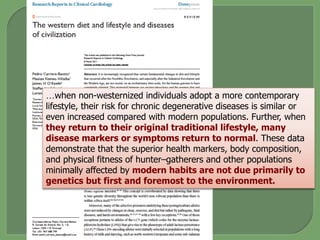
…when non-westernized individuals adopt a more contemporary
lifestyle, their risk for chronic degenerative diseases is similar or
even increased compared with modern populations. Further, when
they return to their original traditional lifestyle, many
disease markers or symptoms return to normal. These data
demonstrate that the superior health markers, body composition,
and physical fitness of hunter–gatherers and other populations
minimally affected by modern habits are not due primarily to
genetics but first and foremost to the environment.
ž What nutrition trade-offs can/do you
make?
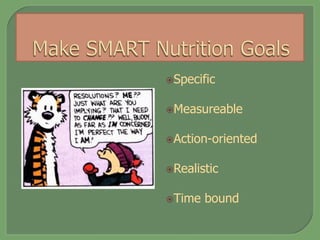
ž Specific
ž Measureable
ž Action-oriented
ž Realistic
ž Time bound
Don’t eat anything your
great-grandmother
wouldn’t recognize as
food.
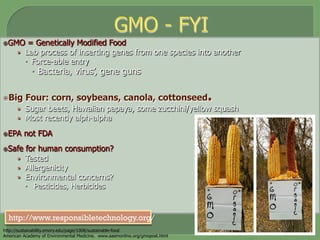
ž GMO = Genetically Modified Food
•  Lab process of inserting genes from one species into another
–  Force-able entry
–  Bacteria, virus’, gene guns
ž Big Four: corn, soybeans, canola, cottonseed.
•  Sugar beets, Hawaiian papaya, some zucchini/yellow squash
•  Most recently alph-alpha
ž EPA not FDA
ž Safe for human consumption?
•  Tested
•  Allergenicity
•  Environmental concerns?
–  Pesticides, Herbicides
http://sustainability.emory.edu/page/1008/sustainable-food
American Academy of Environmental Medicine. www.aaemonline.org/gmopost.html
http://www.responsibletechnology.org/
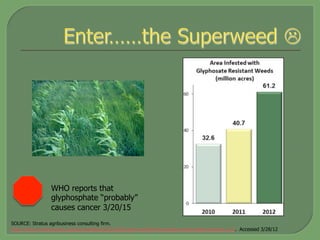
SOURCE: Stratus agribusiness consulting firm.
http://www.motherjones.com/tom-philpott/2013/02/report-spread-monsantos-superweeds-speeds-12-0. Accessed 3/28/12
WHO reports that
glyphosphate “probably”
causes cancer 3/20/15
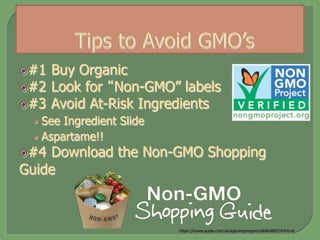
ž #1 Buy Organic
ž #2 Look for “Non-GMO” labels
ž #3 Avoid At-Risk Ingredients
•  See Ingredient Slide
•  Aspartame!!
ž #4 Download the Non-GMO Shopping
Guide
https://itunes.apple.com/us/app/shopnogmo/id646580574?mt=8
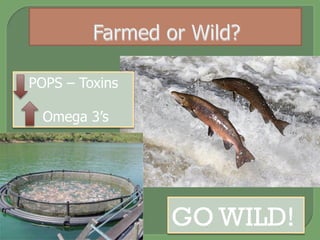
GO WILD!
POPS – Toxins
Omega 3’s
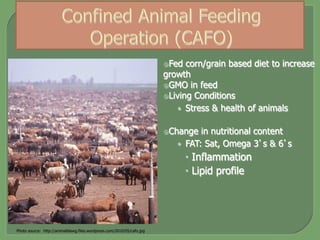
ž Fed corn/grain based diet to increase
growth
ž GMO in feed
ž Living Conditions
•  Stress & health of animals
ž Change in nutritional content
•  FAT: Sat, Omega 3’s & 6’s
–  Inflammation
–  Lipid profile
Photo source: http://animalblawg.files.wordpress.com/2010/05/cafo.jpg
ž Increased reliance on NPK fertilization
•  “skeleton” plants
–  Nutrient content of plant is lower
–  Compromised plant immunity requires more chemical intervention
•  Decreasing soil quality
ž Smaller number of crops
DILUTION EFFECT
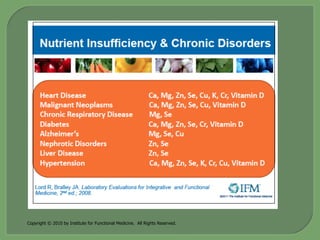
Copyright © 2010 by Institute for Functional Medicine. All Rights Reserved.
Is that
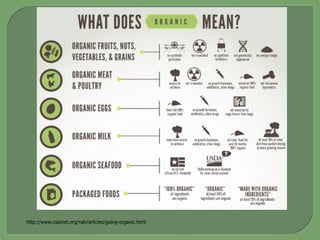
http://www.cspinet.org/nah/articles/going-organic.html
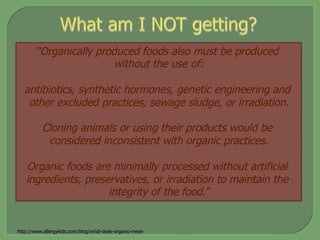
“Organically produced foods also must be produced
without the use of:
antibiotics, synthetic hormones, genetic engineering and
other excluded practices, sewage sludge, or irradiation.
Cloning animals or using their products would be
considered inconsistent with organic practices.
Organic foods are minimally processed without artificial
ingredients, preservatives, or irradiation to maintain the
integrity of the food.”
http://www.allergykids.com/blog/what-does-organic-mean
ž Reduce exposure to potential health risks associated with
pesticides/contaminants
ž To decrease the number of ingredients!
ž Not all organic-labeled products offer added health value.
Buy These when you can:
•  Refer to the Dirty Dozen
•  Meat, poultry, eggs and dairy (rBST free)
•  Non GMO soy & corn
ž 
http://www.ewg.org/foodnews/dirtydozenplus.php
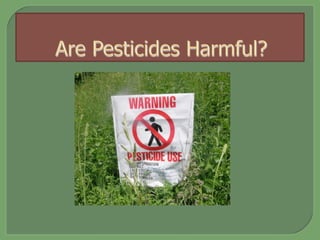
“Major source of exposure to pesticides for infants and children would
be the diet”
Children at greater risk from organophoshate toxicity due to:
§  Developing brain more susceptible to neurotoxicants
§  Dose of pesticides likely larger per body weight
§  Children 6-11 have the highest urinary concentrations of dialkyl
phosphate (DAP) metabolites – pesticide
§  Children have reduced expression of detoxifying enzymes
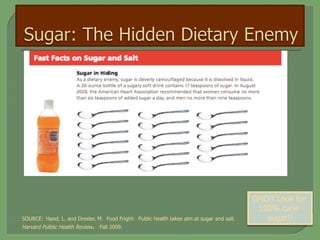
SOURCE: Hand, L. and Drexler, M. Food Fright: Public health takes aim at sugar and salt.
Harvard Pulblic Health Review. Fall 2009.
GMO!! Look for
100% cane
sugar!!
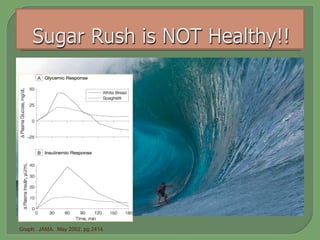
Graph: JAMA. May 2002. pg 2414.
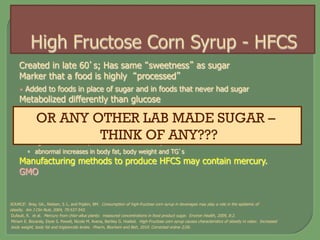
Created in late 60’s; Has same “sweetness” as sugar
Marker that a food is highly “processed”
§  Added to foods in place of sugar and in foods that never had sugar
Metabolized differently than glucose
§  May contribute to increased energy intake and weight gain.
§  NEW research HFCS diet gained sign more weight than table sugar when calories
were constant
§  Long term consumption similar to obesity
§  abnormal increases in body fat, body weight and TG’s
Manufacturing methods to produce HFCS may contain mercury.
GMO
SOURCE: Bray, GA., Nielsen, S J., and Popkin, BM. Consumption of high-fructose corn syrup in beverages may play a role in the epidemic of
obesity. Am J Clin Nutr, 2004, 79:537-543.
Dufault, R. et al. Mercury from chlor-alkai plants: measured concentrations in food product sugar. Environ Health, 2009, 8:2.
Miriam E. Bocarsly, Elyse S. Powell, Nicole M. Avena, Bartley G. Hoebel. High-Fructose corn syrup causes characteristics of obesity in rates: Increased
body weight, body fat and triglyercide levles. Pharm, Biochem and Beh, 2010: Corrected online 2/26.
OR ANY OTHER LAB MADE SUGAR –
THINK OF ANY???
ž If it came from a plant, eat it;
if it was made in a plant,
don’t.
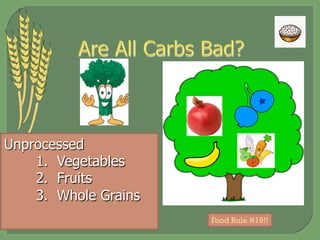
Unprocessed
1. Vegetables
2. Fruits
3. Whole Grains
Food Rule #19!!
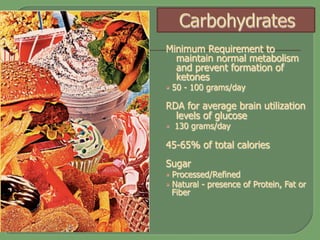
Minimum Requirement to
maintain normal metabolism
and prevent formation of
ketones
§  50 - 100 grams/day
RDA for average brain utilization
levels of glucose
§  130 grams/day
45-65% of total calories
Sugar
§  Processed/Refined
§  Natural - presence of Protein, Fat or
Fiber
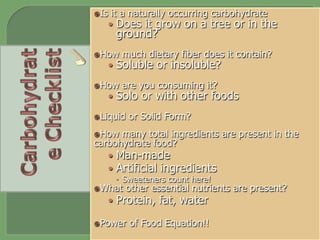
ž Is it a naturally occurring carbohydrate
•  Does it grow on a tree or in the
ground?
ž How much dietary fiber does it contain?
•  Soluble or insoluble?
ž How are you consuming it?
•  Solo or with other foods
ž Liquid or Solid Form?
ž How many total ingredients are present in the
carbohydrate food?
•  Man-made
•  Artificial ingredients
–  Sweeteners count here!
ž What other essential nutrients are present?
•  Protein, fat, water
ž Power of Food Equation!!
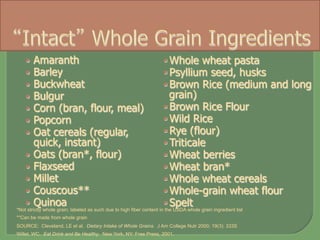
•  Amaranth
•  Barley
•  Buckwheat
•  Bulgur
•  Corn (bran, flour, meal)
•  Popcorn
•  Oat cereals (regular,
quick, instant)
•  Oats (bran*, flour)
•  Flaxseed
•  Millet
•  Couscous**
•  Quinoa
§ Whole wheat pasta
§ Psyllium seed, husks
§ Brown Rice (medium and long
grain)
§ Brown Rice Flour
§ Wild Rice
§ Rye (flour)
§ Triticale
§ Wheat berries
§ Wheat bran*
§ Whole wheat cereals
§ Whole-grain wheat flour
§ Spelt*Not strictly whole grain; labeled as such due to high fiber content in the USDA whole grain ingredient list
**Can be made from whole grain
SOURCE: Cleveland, LE et al. Dietary Intake of Whole Grains. J Am College Nutr 2000; 19(3): 333S
Willet, WC. Eat Drink and Be Healthy. New York, NY: Free Press, 2001.
Eat all the junk food you
want as long as you
cook it yourself.
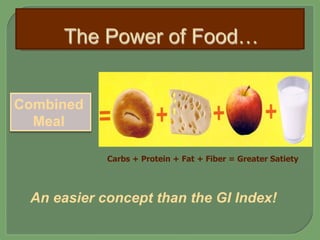
Combined
Meal
An easier concept than the GI Index!
Carbs + Protein + Fat + Fiber = Greater Satiety
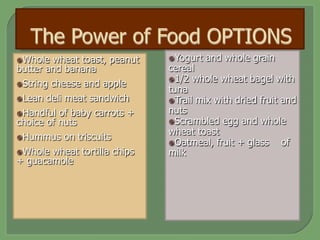
ž Whole wheat toast, peanut
butter and banana
ž String cheese and apple
ž Lean deli meat sandwich
ž Handful of baby carrots +
choice of nuts
ž Hummus on triscuits
ž Whole wheat tortilla chips
+ guacamole
ž Yogurt and whole grain
cereal
ž 1/2 whole wheat bagel with
tuna
ž Trail mix with dried fruit and
nuts
ž Scrambled egg and whole
wheat toast
ž Oatmeal, fruit + glass of
milk
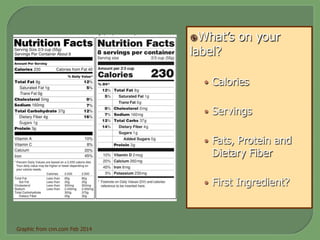
ž What’s on your
label?
•  Calories
•  Servings
•  Fats, Protein and
Dietary Fiber
•  First Ingredient?
Graphic from cnn.com Feb 2014
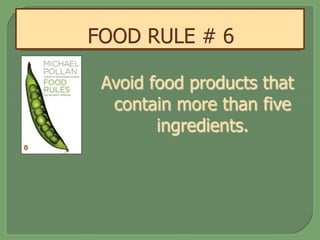
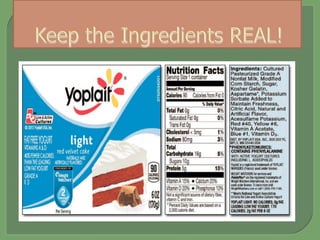
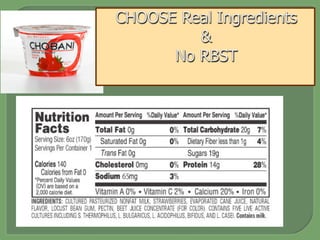
Avoid food products that
contain more than five
ingredients.
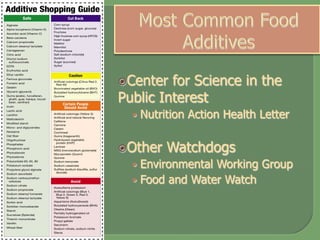
ž Center for Science in the
Public Interest
•  Nutrition Action Health Letter
ž Other Watchdogs
•  Environmental Working Group
•  Food and Water Watch
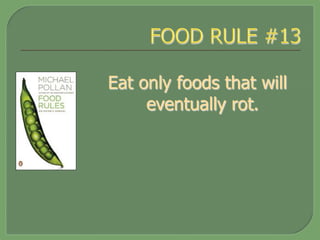
Eat only foods that will
eventually rot.
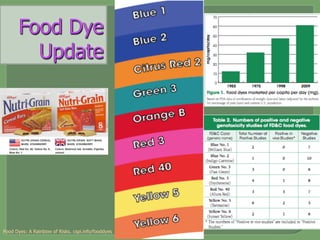
RED #40
Yellow #5
Blue #1
RED #3
Food Dyes: A Rainbow of Risks. cspi.info/fooddyes
http://www.ewg.org/foodscores
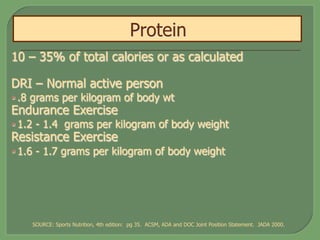
10 – 35% of total calories or as calculated
DRI – Normal active person
§ .8 grams per kilogram of body wt
Endurance Exercise
§ 1.2 - 1.4 grams per kilogram of body weight
Resistance Exercise
§ 1.6 - 1.7 grams per kilogram of body weight
SOURCE: Sports Nutrition, 4th edition: pg 35. ACSM, ADA and DOC Joint Position Statement. JADA 2000.
Less than 20-35% of total calories
§ Minimize consumption of saturated fats (SOURCE!!)
§ Minimize consumption of trans saturated fats
§ Choose naturally occurring plant & fish fats
Our nation’s food supply has decreased levels Omega
3’s resulting in depleted body levels of Omega 3’s.
§ Focus on increasing intake!
§ Buy grass-fed meat, fish, poultry where possible!
§ Buy Omega 3 eggs
SOURCE: Omega 3 Institute. http://dhaomega3.org/ http://www.eatwild.com/
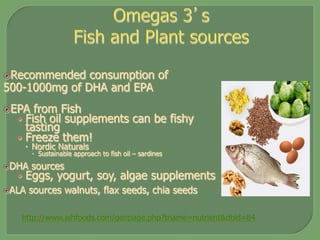
ž Recommended consumption of
500-1000mg of DHA and EPA
ž EPA from Fish
•  Fish oil supplements can be fishy
tasting
•  Freeze them!
–  Nordic Naturals
–  Sustainable approach to fish oil – sardines
ž DHA sources
•  Eggs, yogurt, soy, algae supplements
ž ALA sources walnuts, flax seeds, chia seeds
http://www.whfoods.com/genpage.php?tname=nutrient&dbid=84
Break the rules once in
awhile.
Patricia Simonds MS, RD, CSCS
Emory University
Atlanta, GA
psimond@emory.edu
404-727-1567
Carol M Kelly LD/RD
Emory University Health Service
Atlanta, GA
carol.kelly@emory.edu
404-727-1735
Tricia Simonds - Emory Nutrition application spring 2015

Tricia Simonds - Emory Nutrition application spring 2015

  • 1.
  • 2.
    ž But use itwisely…. ž Information overload can happen easily •  Take steps you can today, and other steps tomorrow!
  • 3.
    Copyright © 2010by Institute for Functional Medicine. All Rights Reserved.
  • 4.
    …when non-westernized individualsadopt a more contemporary lifestyle, their risk for chronic degenerative diseases is similar or even increased compared with modern populations. Further, when they return to their original traditional lifestyle, many disease markers or symptoms return to normal. These data demonstrate that the superior health markers, body composition, and physical fitness of hunter–gatherers and other populations minimally affected by modern habits are not due primarily to genetics but first and foremost to the environment.
  • 7.
  • 8.
  • 9.
    Don’t eat anythingyour great-grandmother wouldn’t recognize as food.
  • 11.
    ž GMO = GeneticallyModified Food •  Lab process of inserting genes from one species into another –  Force-able entry –  Bacteria, virus’, gene guns ž Big Four: corn, soybeans, canola, cottonseed. •  Sugar beets, Hawaiian papaya, some zucchini/yellow squash •  Most recently alph-alpha ž EPA not FDA ž Safe for human consumption? •  Tested •  Allergenicity •  Environmental concerns? –  Pesticides, Herbicides http://sustainability.emory.edu/page/1008/sustainable-food American Academy of Environmental Medicine. www.aaemonline.org/gmopost.html http://www.responsibletechnology.org/
  • 12.
    SOURCE: Stratus agribusinessconsulting firm. http://www.motherjones.com/tom-philpott/2013/02/report-spread-monsantos-superweeds-speeds-12-0. Accessed 3/28/12 WHO reports that glyphosphate “probably” causes cancer 3/20/15
  • 13.
    ž #1 Buy Organic ž #2Look for “Non-GMO” labels ž #3 Avoid At-Risk Ingredients •  See Ingredient Slide •  Aspartame!! ž #4 Download the Non-GMO Shopping Guide https://itunes.apple.com/us/app/shopnogmo/id646580574?mt=8
  • 15.
    GO WILD! POPS –Toxins Omega 3’s
  • 16.
    ž Fed corn/grain baseddiet to increase growth ž GMO in feed ž Living Conditions •  Stress & health of animals ž Change in nutritional content •  FAT: Sat, Omega 3’s & 6’s –  Inflammation –  Lipid profile Photo source: http://animalblawg.files.wordpress.com/2010/05/cafo.jpg
  • 17.
    ž Increased reliance onNPK fertilization •  “skeleton” plants –  Nutrient content of plant is lower –  Compromised plant immunity requires more chemical intervention •  Decreasing soil quality ž Smaller number of crops DILUTION EFFECT
  • 18.
    Copyright © 2010by Institute for Functional Medicine. All Rights Reserved.
  • 19.
  • 20.
  • 21.
    “Organically produced foodsalso must be produced without the use of: antibiotics, synthetic hormones, genetic engineering and other excluded practices, sewage sludge, or irradiation. Cloning animals or using their products would be considered inconsistent with organic practices. Organic foods are minimally processed without artificial ingredients, preservatives, or irradiation to maintain the integrity of the food.” http://www.allergykids.com/blog/what-does-organic-mean
  • 22.
    ž Reduce exposure topotential health risks associated with pesticides/contaminants ž To decrease the number of ingredients! ž Not all organic-labeled products offer added health value. Buy These when you can: •  Refer to the Dirty Dozen •  Meat, poultry, eggs and dairy (rBST free) •  Non GMO soy & corn
  • 23.
  • 25.
    “Major source ofexposure to pesticides for infants and children would be the diet” Children at greater risk from organophoshate toxicity due to: §  Developing brain more susceptible to neurotoxicants §  Dose of pesticides likely larger per body weight §  Children 6-11 have the highest urinary concentrations of dialkyl phosphate (DAP) metabolites – pesticide §  Children have reduced expression of detoxifying enzymes
  • 27.
    SOURCE: Hand, L.and Drexler, M. Food Fright: Public health takes aim at sugar and salt. Harvard Pulblic Health Review. Fall 2009. GMO!! Look for 100% cane sugar!!
  • 28.
    Graph: JAMA. May2002. pg 2414.
  • 29.
    Created in late60’s; Has same “sweetness” as sugar Marker that a food is highly “processed” §  Added to foods in place of sugar and in foods that never had sugar Metabolized differently than glucose §  May contribute to increased energy intake and weight gain. §  NEW research HFCS diet gained sign more weight than table sugar when calories were constant §  Long term consumption similar to obesity §  abnormal increases in body fat, body weight and TG’s Manufacturing methods to produce HFCS may contain mercury. GMO SOURCE: Bray, GA., Nielsen, S J., and Popkin, BM. Consumption of high-fructose corn syrup in beverages may play a role in the epidemic of obesity. Am J Clin Nutr, 2004, 79:537-543. Dufault, R. et al. Mercury from chlor-alkai plants: measured concentrations in food product sugar. Environ Health, 2009, 8:2. Miriam E. Bocarsly, Elyse S. Powell, Nicole M. Avena, Bartley G. Hoebel. High-Fructose corn syrup causes characteristics of obesity in rates: Increased body weight, body fat and triglyercide levles. Pharm, Biochem and Beh, 2010: Corrected online 2/26. OR ANY OTHER LAB MADE SUGAR – THINK OF ANY???
  • 30.
    ž If it camefrom a plant, eat it; if it was made in a plant, don’t.
  • 32.
    Unprocessed 1. Vegetables 2. Fruits 3.Whole Grains Food Rule #19!!
  • 33.
    Minimum Requirement to maintainnormal metabolism and prevent formation of ketones §  50 - 100 grams/day RDA for average brain utilization levels of glucose §  130 grams/day 45-65% of total calories Sugar §  Processed/Refined §  Natural - presence of Protein, Fat or Fiber
  • 34.
    ž Is it anaturally occurring carbohydrate •  Does it grow on a tree or in the ground? ž How much dietary fiber does it contain? •  Soluble or insoluble? ž How are you consuming it? •  Solo or with other foods ž Liquid or Solid Form? ž How many total ingredients are present in the carbohydrate food? •  Man-made •  Artificial ingredients –  Sweeteners count here! ž What other essential nutrients are present? •  Protein, fat, water ž Power of Food Equation!!
  • 35.
    •  Amaranth •  Barley • Buckwheat •  Bulgur •  Corn (bran, flour, meal) •  Popcorn •  Oat cereals (regular, quick, instant) •  Oats (bran*, flour) •  Flaxseed •  Millet •  Couscous** •  Quinoa § Whole wheat pasta § Psyllium seed, husks § Brown Rice (medium and long grain) § Brown Rice Flour § Wild Rice § Rye (flour) § Triticale § Wheat berries § Wheat bran* § Whole wheat cereals § Whole-grain wheat flour § Spelt*Not strictly whole grain; labeled as such due to high fiber content in the USDA whole grain ingredient list **Can be made from whole grain SOURCE: Cleveland, LE et al. Dietary Intake of Whole Grains. J Am College Nutr 2000; 19(3): 333S Willet, WC. Eat Drink and Be Healthy. New York, NY: Free Press, 2001.
  • 36.
    Eat all thejunk food you want as long as you cook it yourself.
  • 37.
    Combined Meal An easier conceptthan the GI Index! Carbs + Protein + Fat + Fiber = Greater Satiety
  • 38.
    ž Whole wheat toast,peanut butter and banana ž String cheese and apple ž Lean deli meat sandwich ž Handful of baby carrots + choice of nuts ž Hummus on triscuits ž Whole wheat tortilla chips + guacamole ž Yogurt and whole grain cereal ž 1/2 whole wheat bagel with tuna ž Trail mix with dried fruit and nuts ž Scrambled egg and whole wheat toast ž Oatmeal, fruit + glass of milk
  • 39.
    ž What’s on your label? • Calories •  Servings •  Fats, Protein and Dietary Fiber •  First Ingredient? Graphic from cnn.com Feb 2014
  • 40.
    Avoid food productsthat contain more than five ingredients.
  • 41.
    ž Center for Sciencein the Public Interest •  Nutrition Action Health Letter ž Other Watchdogs •  Environmental Working Group •  Food and Water Watch
  • 42.
    Eat only foodsthat will eventually rot.
  • 43.
  • 44.
    Food Dyes: ARainbow of Risks. cspi.info/fooddyes
  • 45.
  • 49.
    10 – 35%of total calories or as calculated DRI – Normal active person § .8 grams per kilogram of body wt Endurance Exercise § 1.2 - 1.4 grams per kilogram of body weight Resistance Exercise § 1.6 - 1.7 grams per kilogram of body weight SOURCE: Sports Nutrition, 4th edition: pg 35. ACSM, ADA and DOC Joint Position Statement. JADA 2000.
  • 50.
    Less than 20-35%of total calories § Minimize consumption of saturated fats (SOURCE!!) § Minimize consumption of trans saturated fats § Choose naturally occurring plant & fish fats Our nation’s food supply has decreased levels Omega 3’s resulting in depleted body levels of Omega 3’s. § Focus on increasing intake! § Buy grass-fed meat, fish, poultry where possible! § Buy Omega 3 eggs SOURCE: Omega 3 Institute. http://dhaomega3.org/ http://www.eatwild.com/
  • 51.
    ž Recommended consumption of 500-1000mgof DHA and EPA ž EPA from Fish •  Fish oil supplements can be fishy tasting •  Freeze them! –  Nordic Naturals –  Sustainable approach to fish oil – sardines ž DHA sources •  Eggs, yogurt, soy, algae supplements ž ALA sources walnuts, flax seeds, chia seeds http://www.whfoods.com/genpage.php?tname=nutrient&dbid=84
  • 53.
    Break the rulesonce in awhile.
  • 54.
    Patricia Simonds MS,RD, CSCS Emory University Atlanta, GA psimond@emory.edu 404-727-1567 Carol M Kelly LD/RD Emory University Health Service Atlanta, GA carol.kelly@emory.edu 404-727-1735