Netflix Open Source &
What I have done in a year?
Andrew Spyker
Senior Software Engineer, Netflix
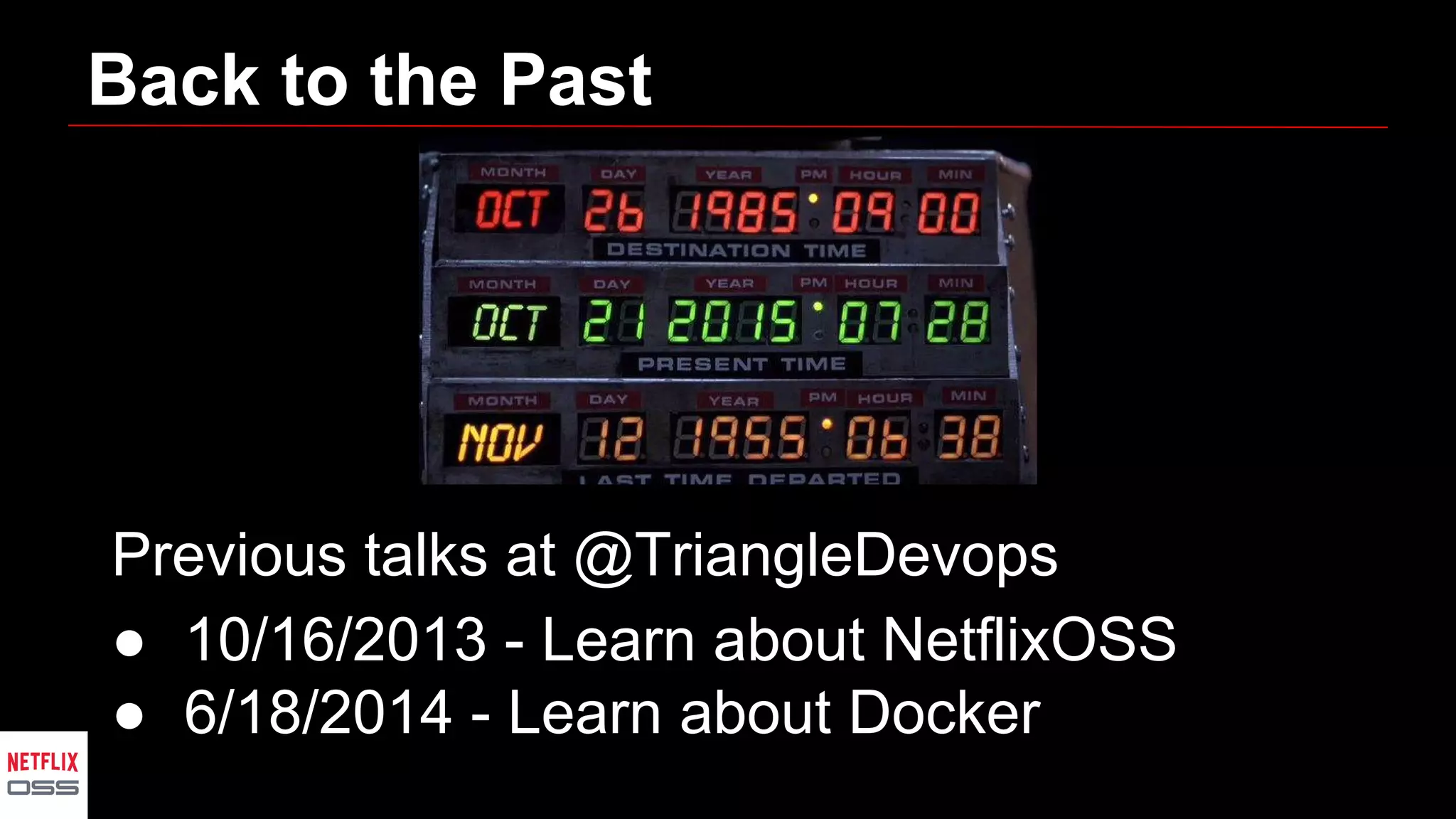
Back to the Past
Previous talks at @TriangleDevops
● 10/16/2013 - Learn about NetflixOSS
● 6/18/2014 - Learn about Docker
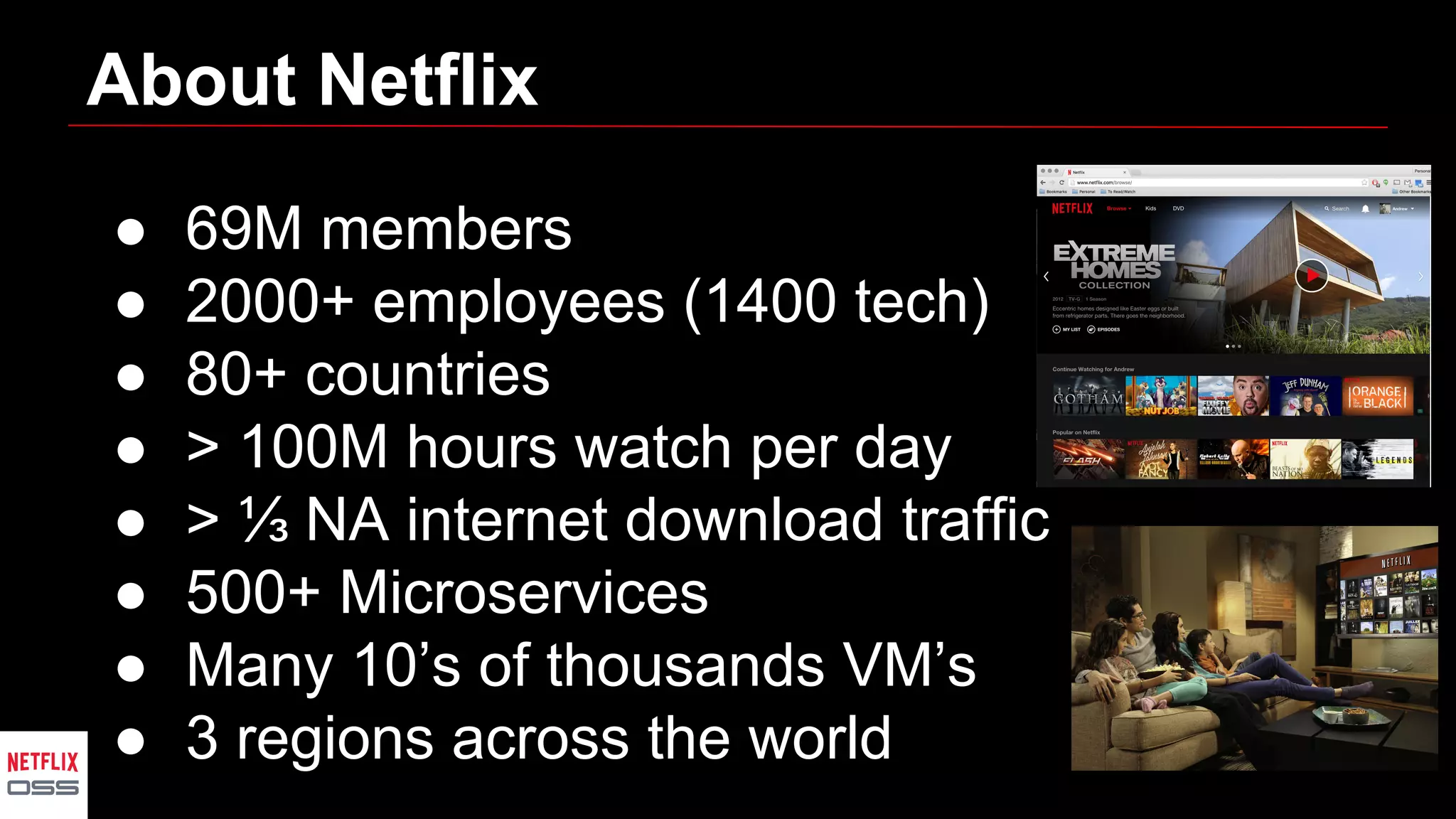
About Netflix
● 69M members
● 2000+ employees (1400 tech)
● 80+ countries
● > 100M hours watch per day
● > ⅓ NA internet download traffic
● 500+ Microservices
● Many 10’s of thousands VM’s
● 3 regions across the world
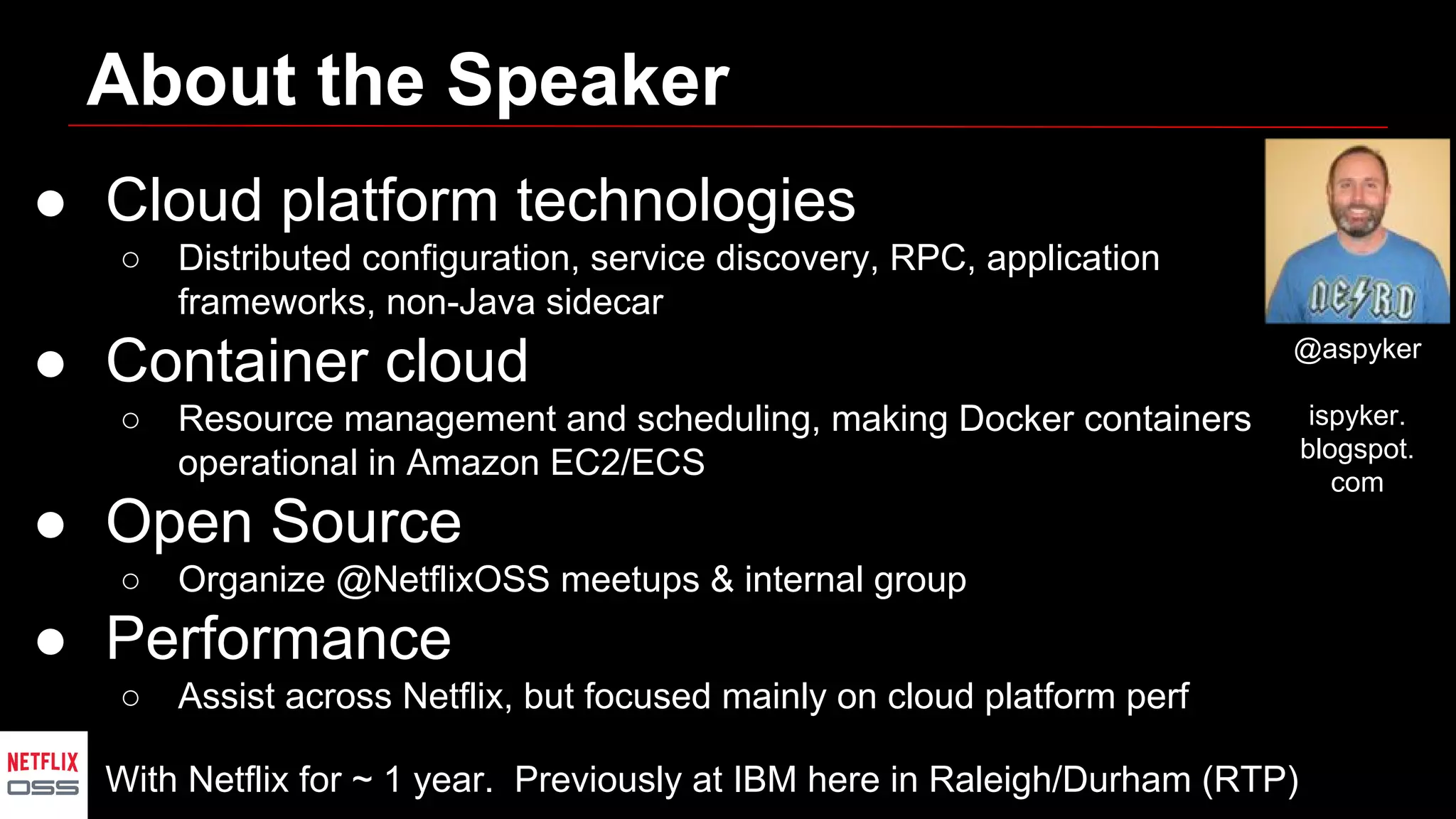
About the Speaker
● Cloud platform technologies
○ Distributed configuration, service discovery, RPC, application
frameworks, non-Java sidecar
● Container cloud
○ Resource management and scheduling, making Docker containers
operational in Amazon EC2/ECS
● Open Source
○ Organize @NetflixOSS meetups & internal group
● Performance
○ Assist across Netflix, but focused mainly on cloud platform perf
With Netflix for ~ 1 year. Previously at IBM here in Raleigh/Durham (RTP)
@aspyker
ispyker.
blogspot.
com
Agenda
● NetflixOSS
Netflix Cloud Architecture
Getting Started
Personal Projects
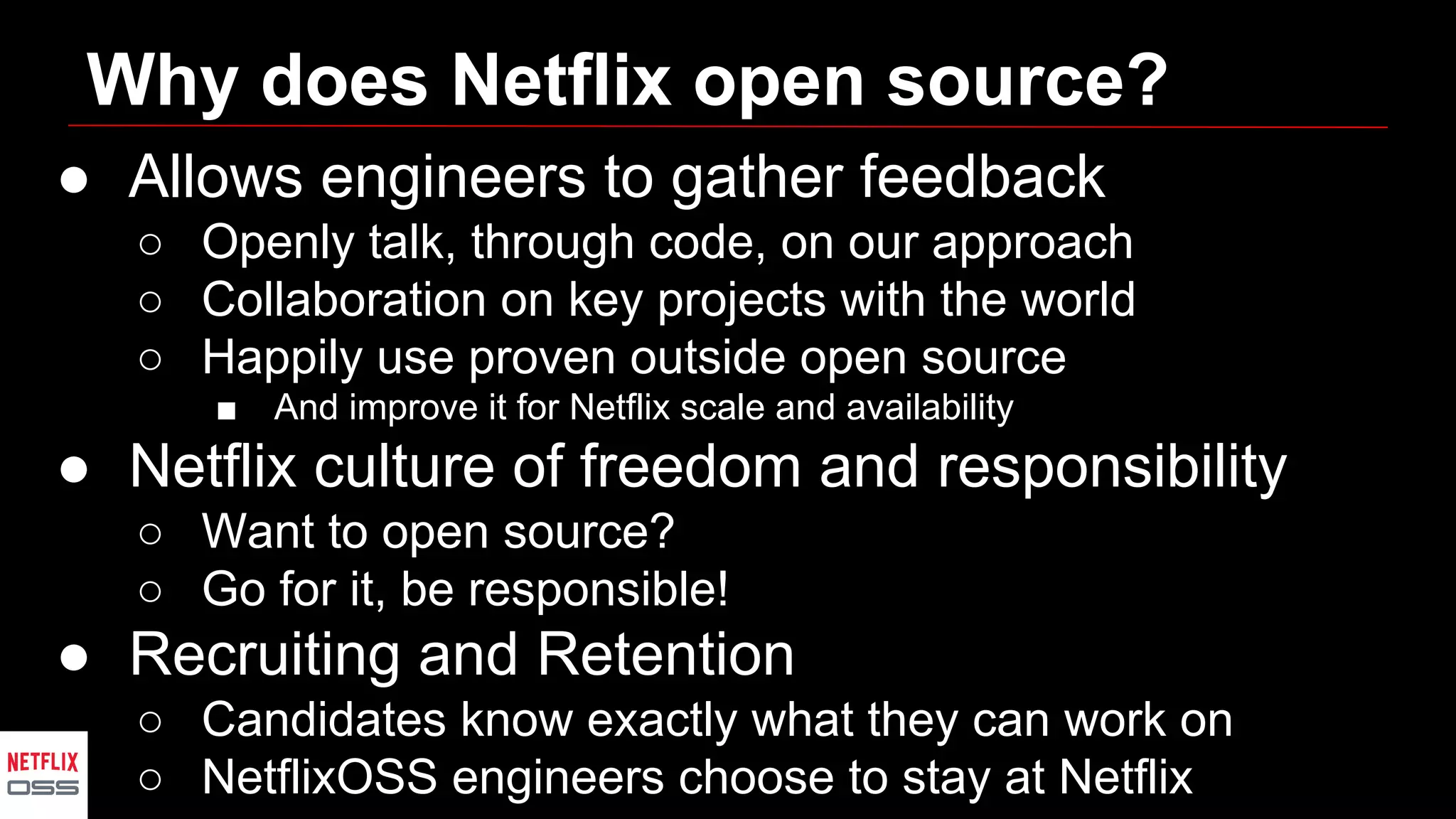
Why does Netflix open source?
● Allows engineers to gather feedback
○ Openly talk, through code, on our approach
○ Collaboration on key projects with the world
○ Happily use proven outside open source
■ And improve it for Netflix scale and availability
● Netflix culture of freedom and responsibility
○ Want to open source?
○ Go for it, be responsible!
● Recruiting and Retention
○ Candidates know exactly what they can work on
○ NetflixOSS engineers choose to stay at Netflix
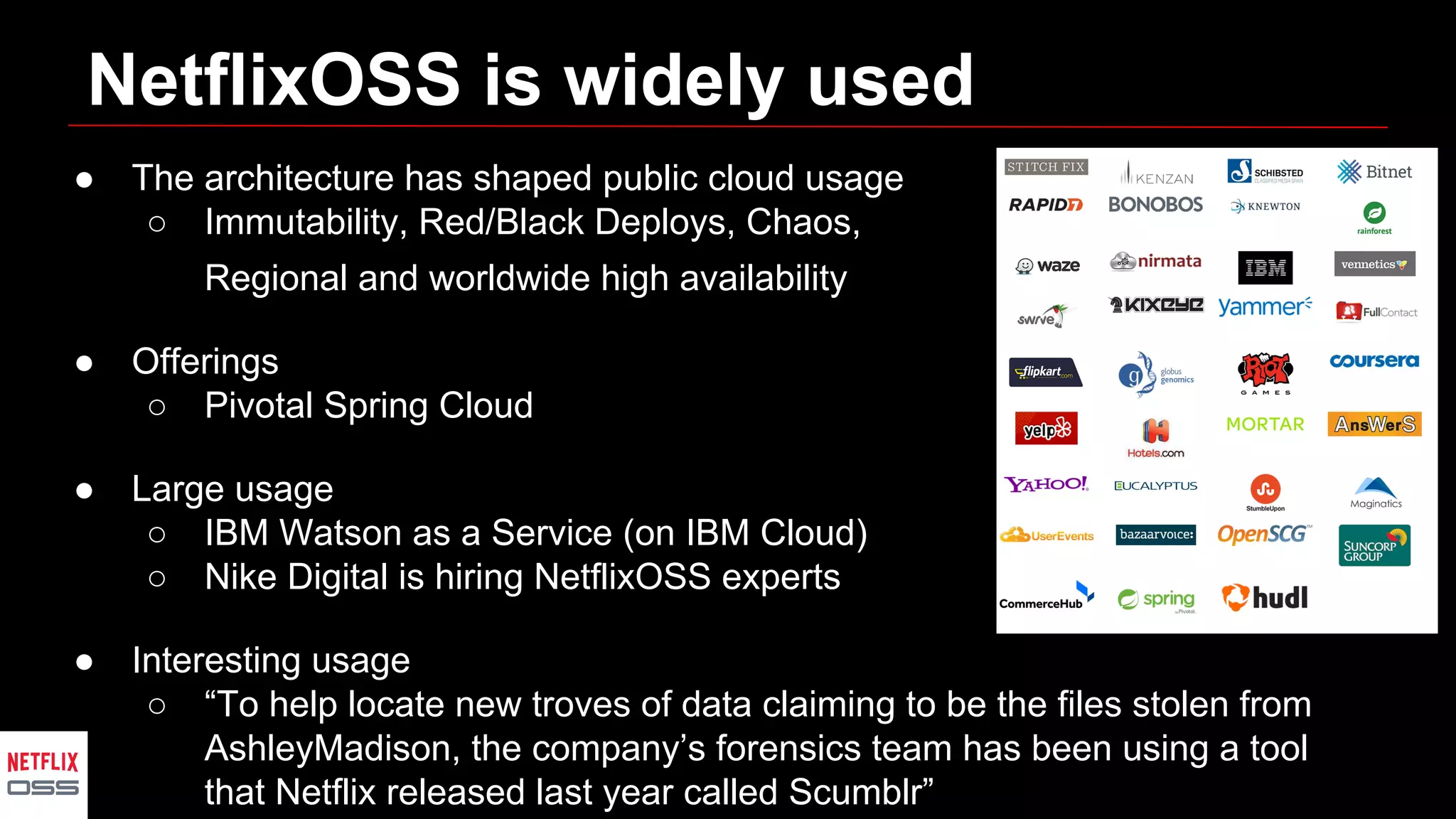
NetflixOSS is widely used
● The architecture has shaped public cloud usage
○ Immutability, Red/Black Deploys, Chaos,
Regional and worldwide high availability
● Offerings
○ Pivotal Spring Cloud
● Large usage
○ IBM Watson as a Service (on IBM Cloud)
○ Nike Digital is hiring NetflixOSS experts
● Interesting usage
○ “To help locate new troves of data claiming to be the files stolen from
AshleyMadison, the company’s forensics team has been using a tool
that Netflix released last year called Scumblr”
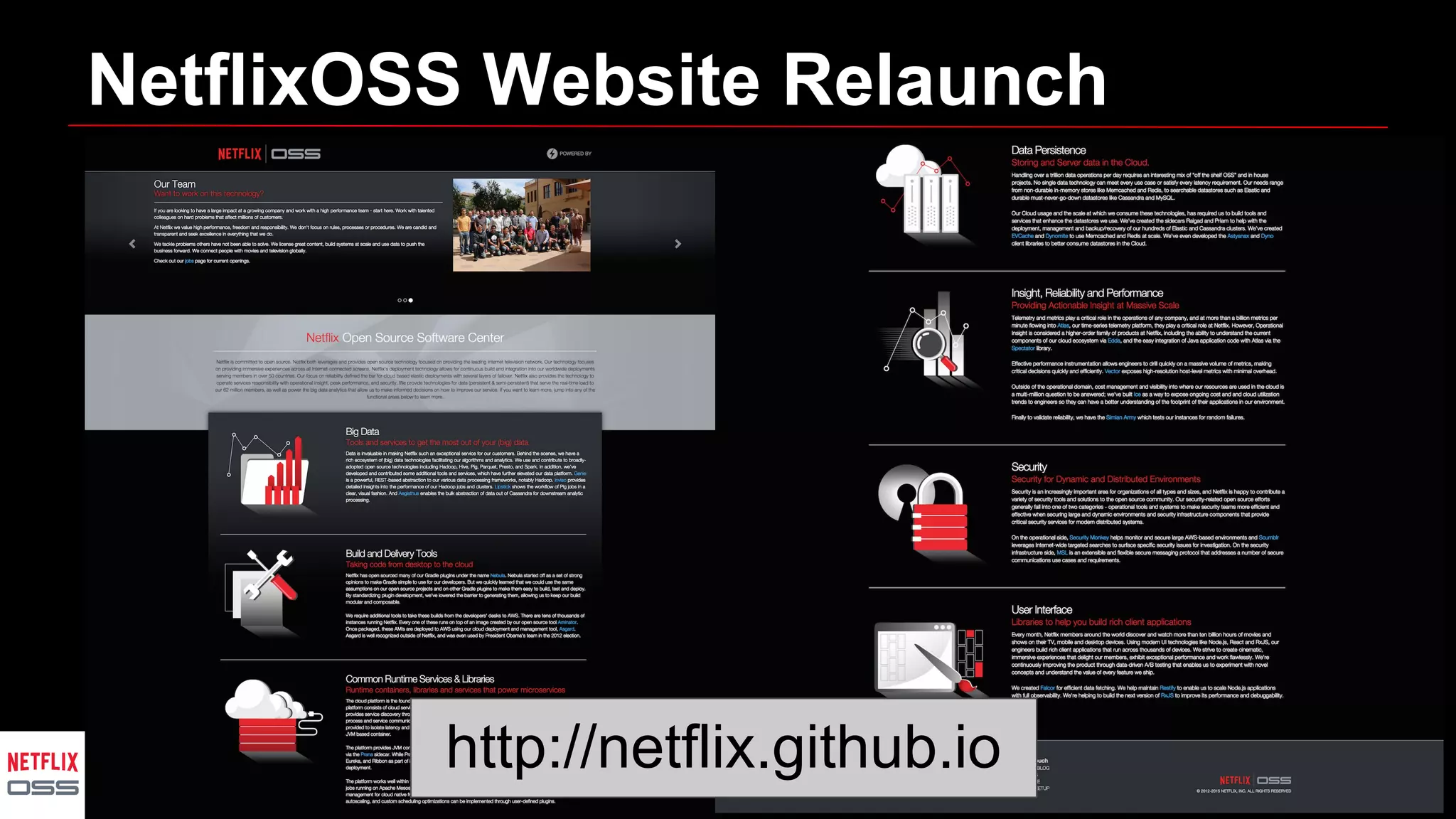
NetflixOSS Website Relaunch
http://netflix.github.io
Key aspects of NetflixOSS website
● Show how the pieces fit together
○ Projects now discussed with each other in context
● OSS categories mirror internal teams
○ No artificial categories, focal points for each area
● Focus on projects that are core to Netflix
○ Projects mentioned are core and strategic
Agenda
NetflixOSS
● Netflix Cloud Architecture
Getting Started
Personal Projects
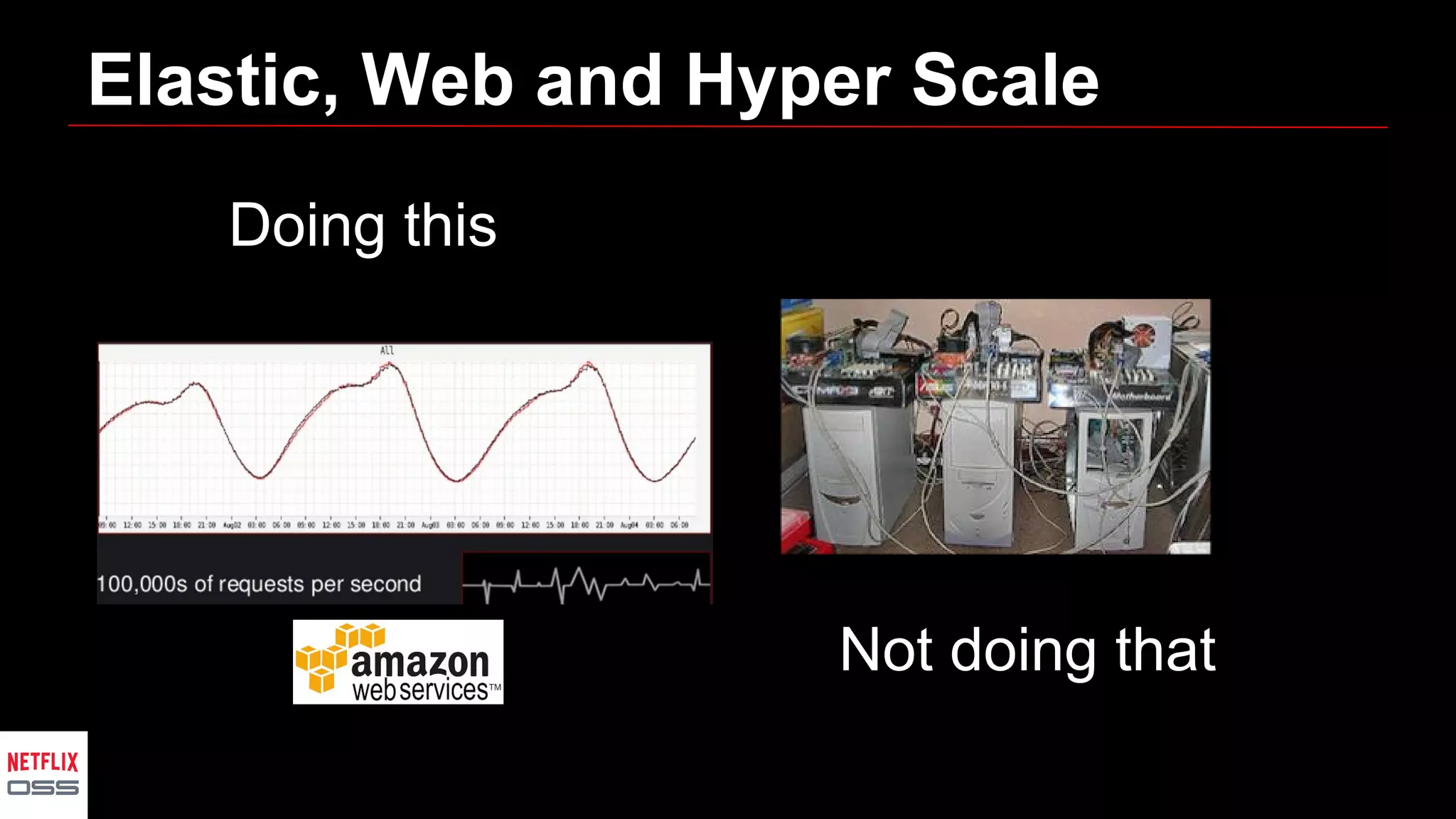
Elastic, Web and Hyper Scale
Doing this
Not doing that
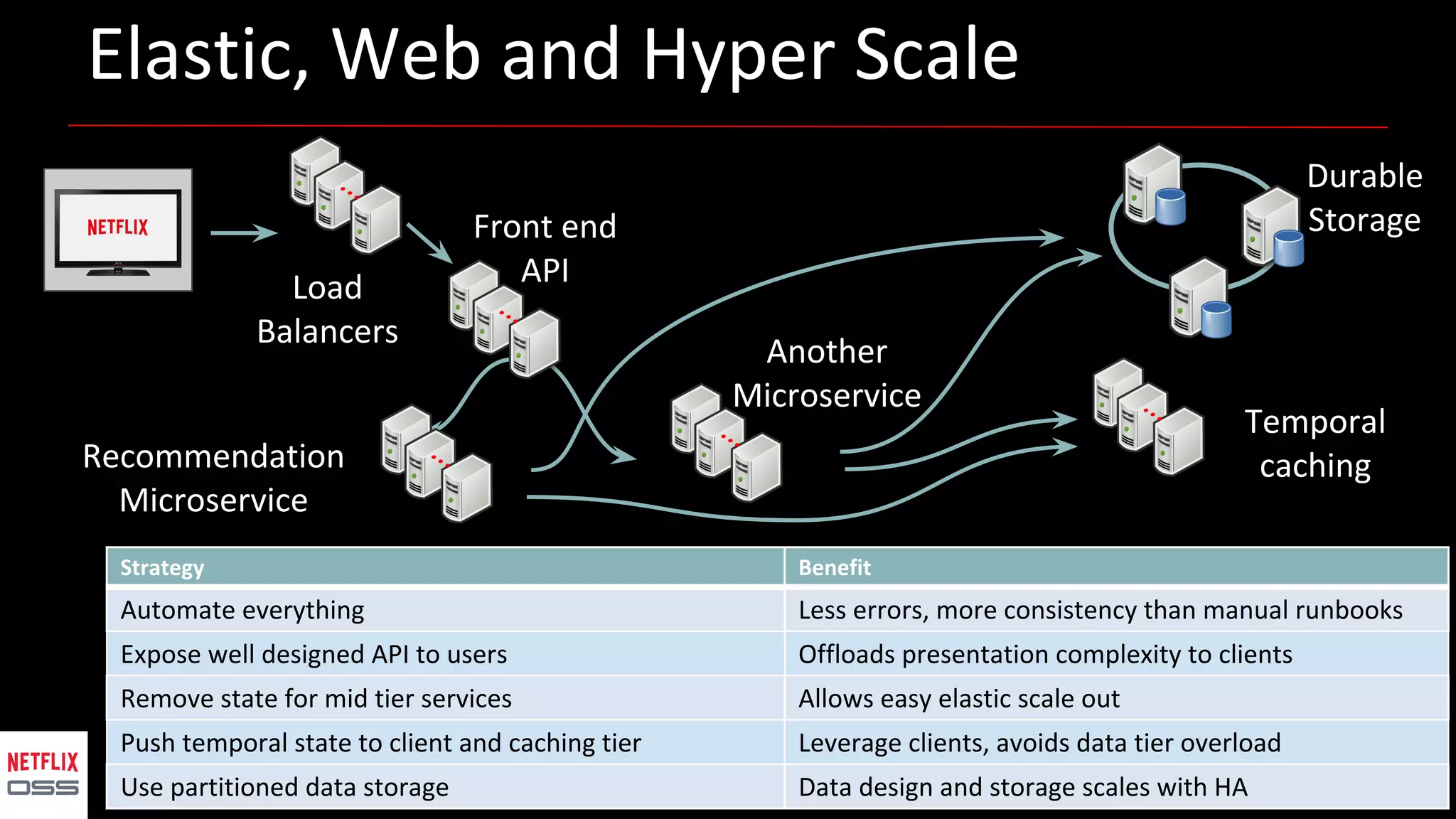
Elastic, Web and Hyper Scale
Front end
API
Another
Microservice
Temporal
caching
Durable
Storage
Load
Balancers
…
Strategy Benefit
Automate everything Less errors, more consistency than manual runbooks
Expose well designed API to users Offloads presentation complexity to clients
Remove state for mid tier services Allows easy elastic scale out
Push temporal state to client and caching tier Leverage clients, avoids data tier overload
Use partitioned data storage Data design and storage scales with HA
…
…
…
…
…
Recommendation
Microservice
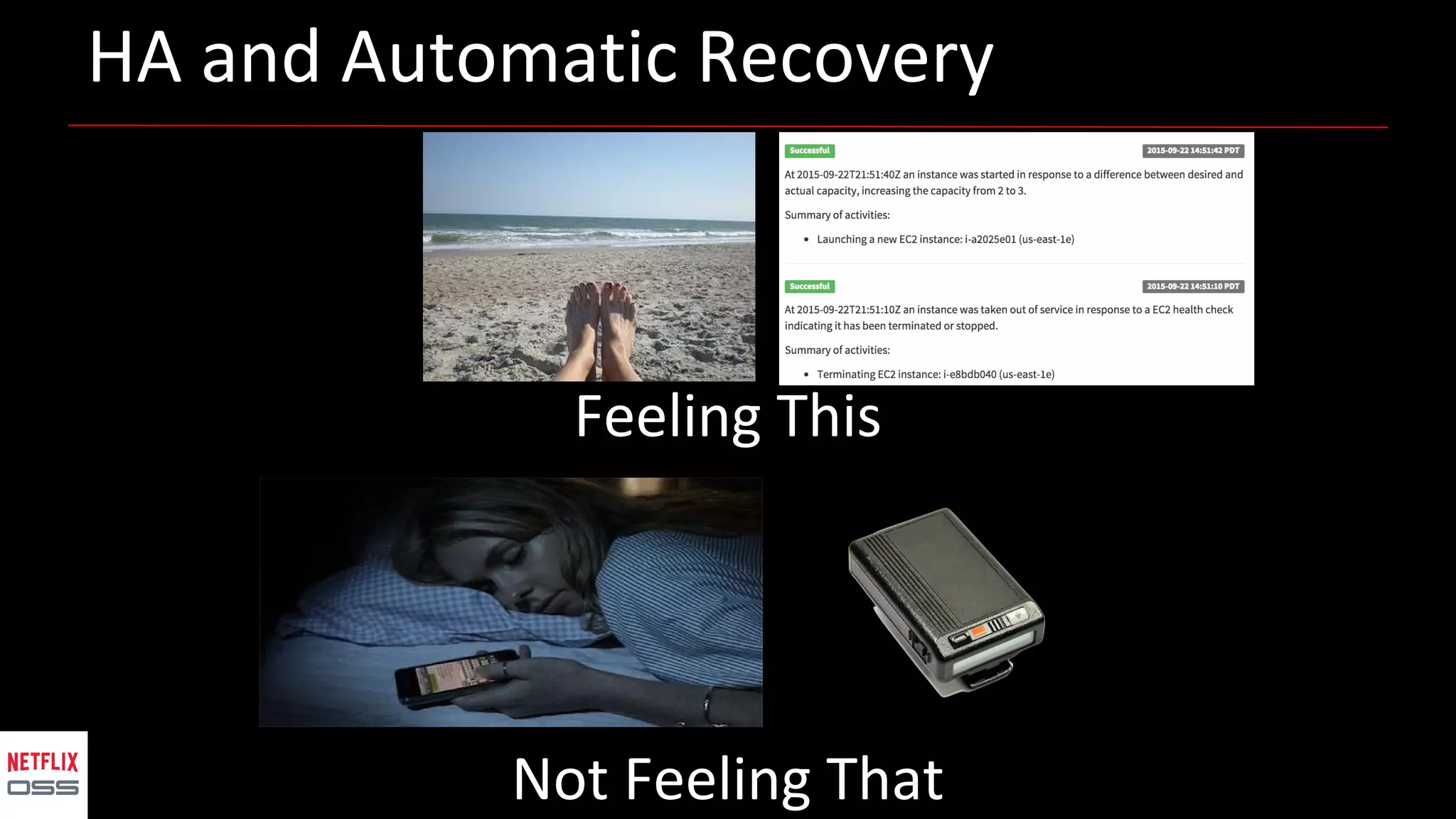
HA and Automatic Recovery
Feeling This
Not Feeling That
Micro service
Implementation
Call microservice #2
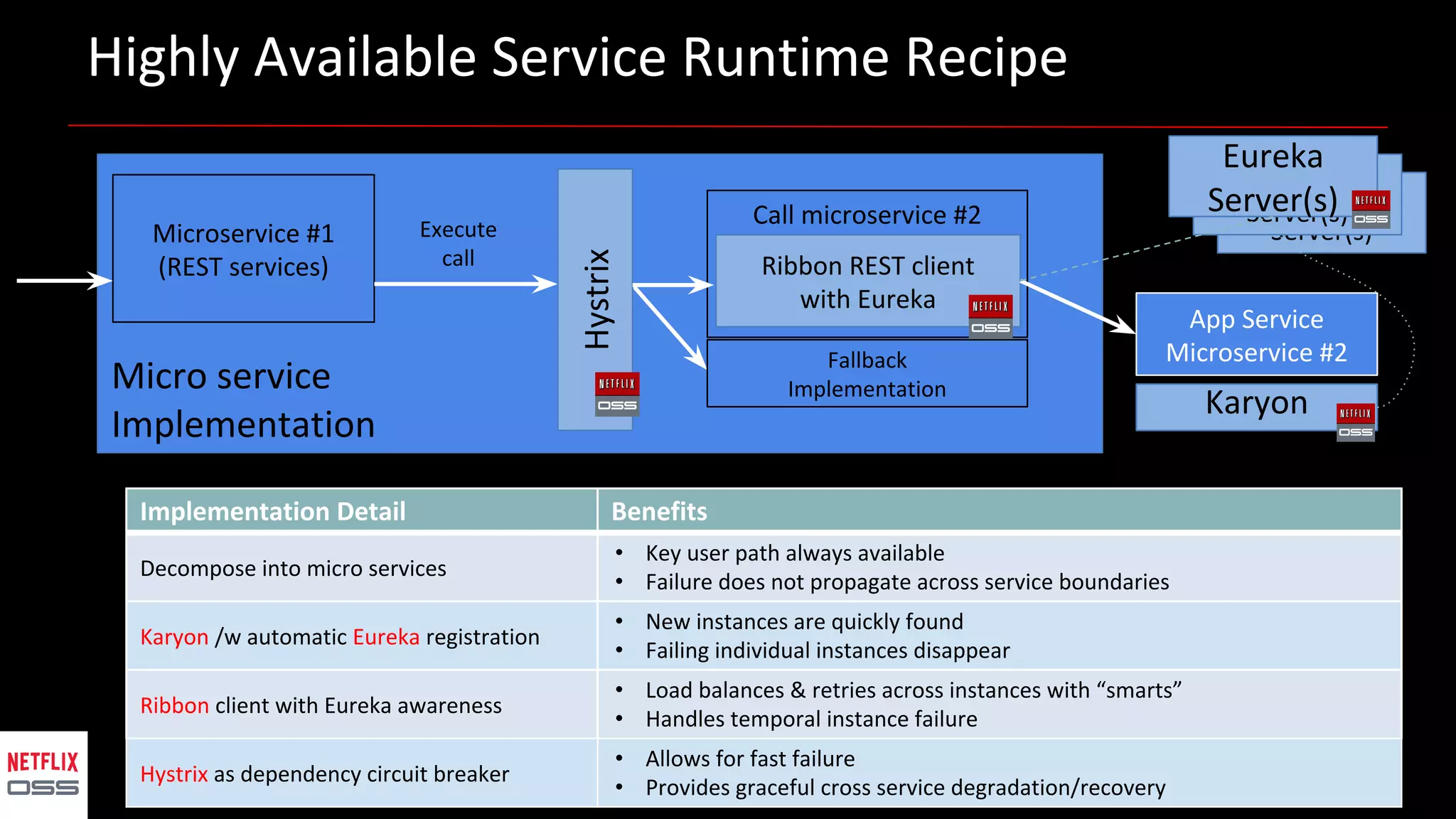
Highly Available Service Runtime Recipe
Ribbon REST client
with Eureka
Microservice #1
(REST services)
App Service
Microservice #2
Execute
call
Hystrix
Eureka
Server(s)
Eureka
Server(s)
Eureka
Server(s)
Karyon
Fallback
Implementation
Implementation Detail Benefits
Decompose into micro services
• Key user path always available
• Failure does not propagate across service boundaries
Karyon /w automatic Eureka registration
• New instances are quickly found
• Failing individual instances disappear
Ribbon client with Eureka awareness
• Load balances & retries across instances with “smarts”
• Handles temporal instance failure
Hystrix as dependency circuit breaker
• Allows for fast failure
• Provides graceful cross service degradation/recovery
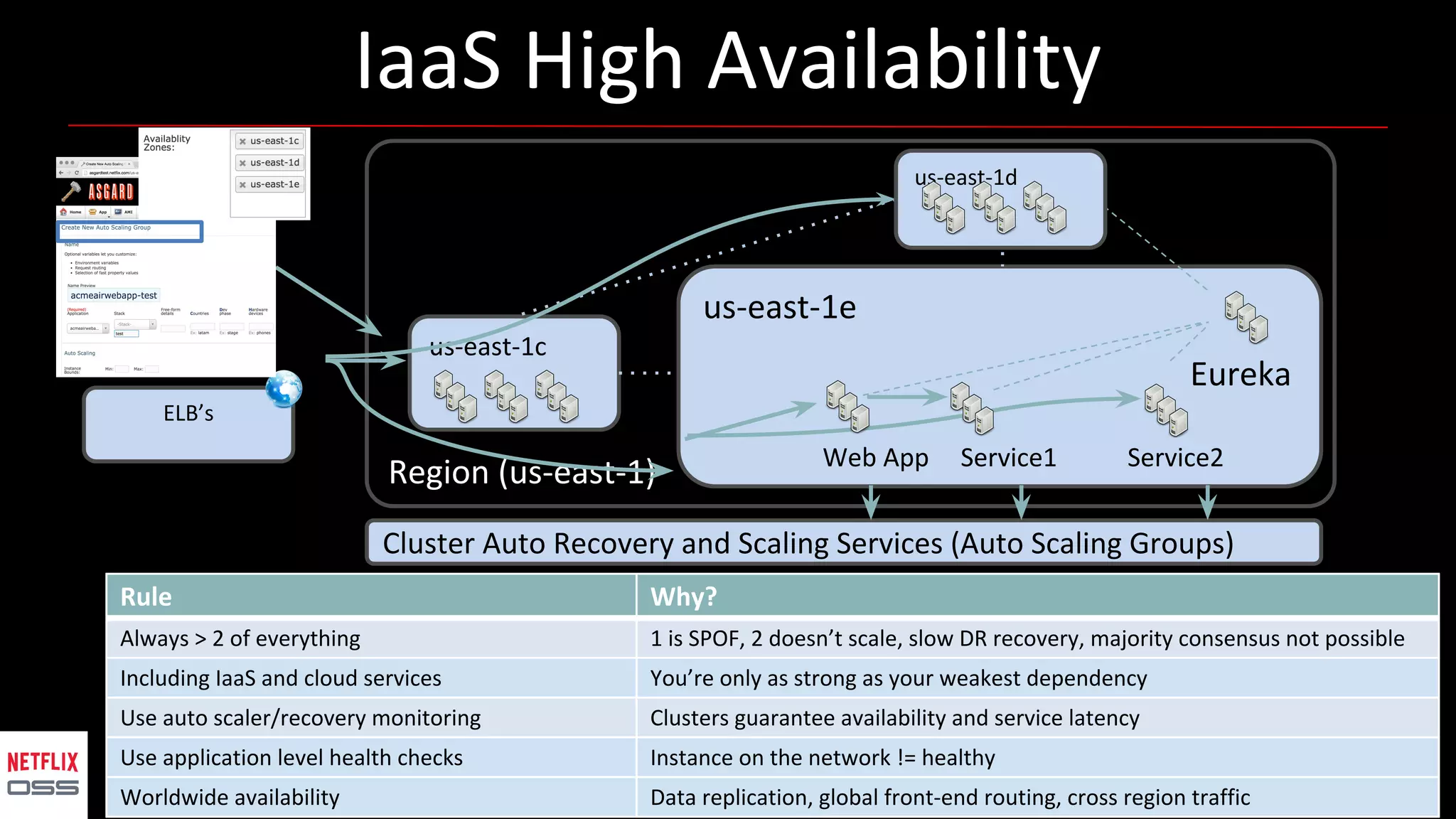
IaaS High Availability
Region (us-east-1)
us-east-1e
us-east-1c
Eureka
Web App Service1 Service2
Cluster Auto Recovery and Scaling Services (Auto Scaling Groups)
…
ELB’s
Rule Why?
Always > 2 of everything 1 is SPOF, 2 doesn’t scale, slow DR recovery, majority consensus not possible
Including IaaS and cloud services You’re only as strong as your weakest dependency
Use auto scaler/recovery monitoring Clusters guarantee availability and service latency
Use application level health checks Instance on the network != healthy
Worldwide availability Data replication, global front-end routing, cross region traffic
us-east-1d
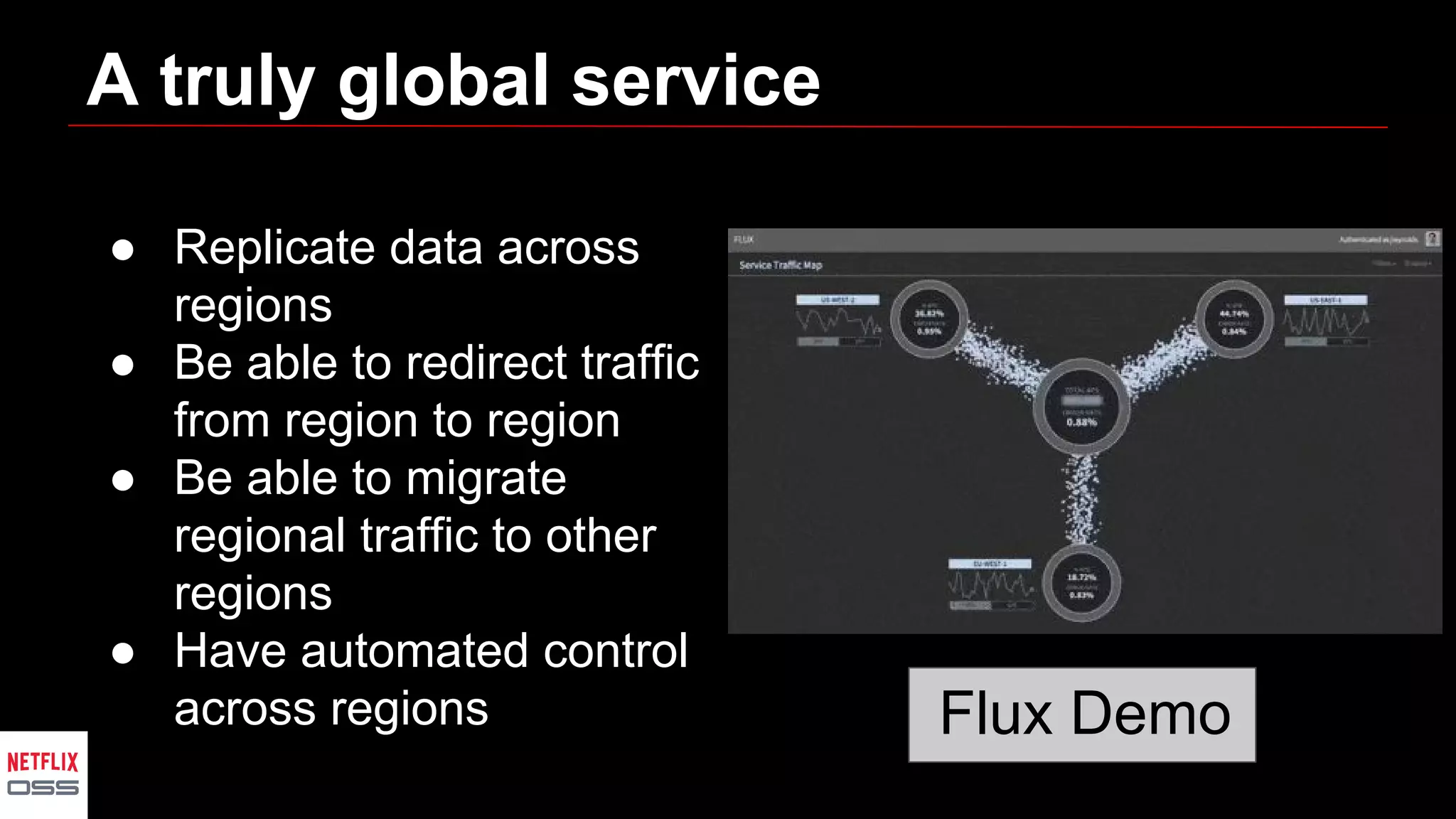
A truly global service
● Replicate data across
regions
● Be able to redirect traffic
from region to region
● Be able to migrate
regional traffic to other
regions
● Have automated control
across regions Flux Demo
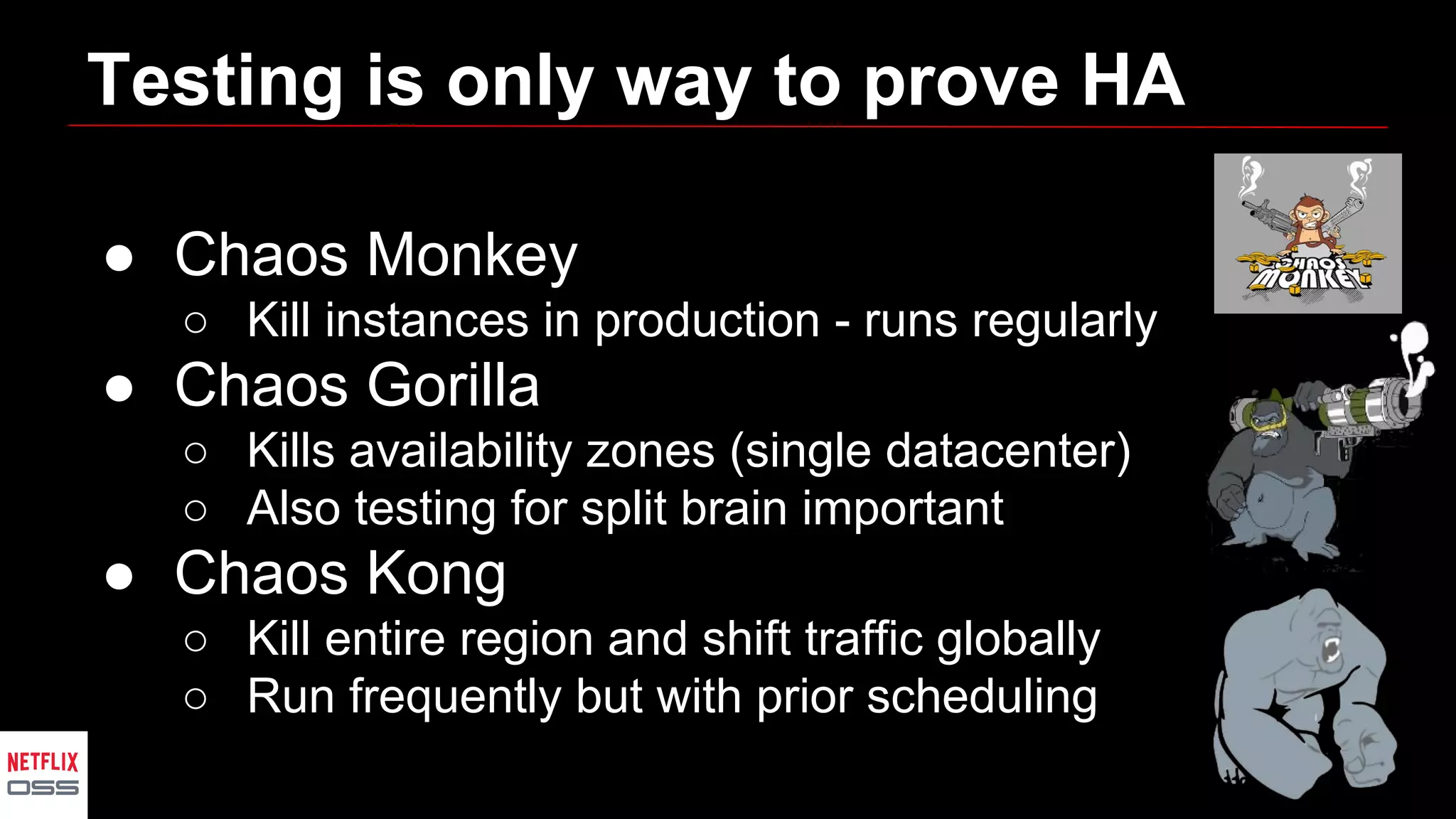
Testing is only way to prove HA
● Chaos Monkey
○ Kill instances in production - runs regularly
● Chaos Gorilla
○ Kills availability zones (single datacenter)
○ Also testing for split brain important
● Chaos Kong
○ Kill entire region and shift traffic globally
○ Run frequently but with prior scheduling
Continuous Delivery
Reading This
Not This
v
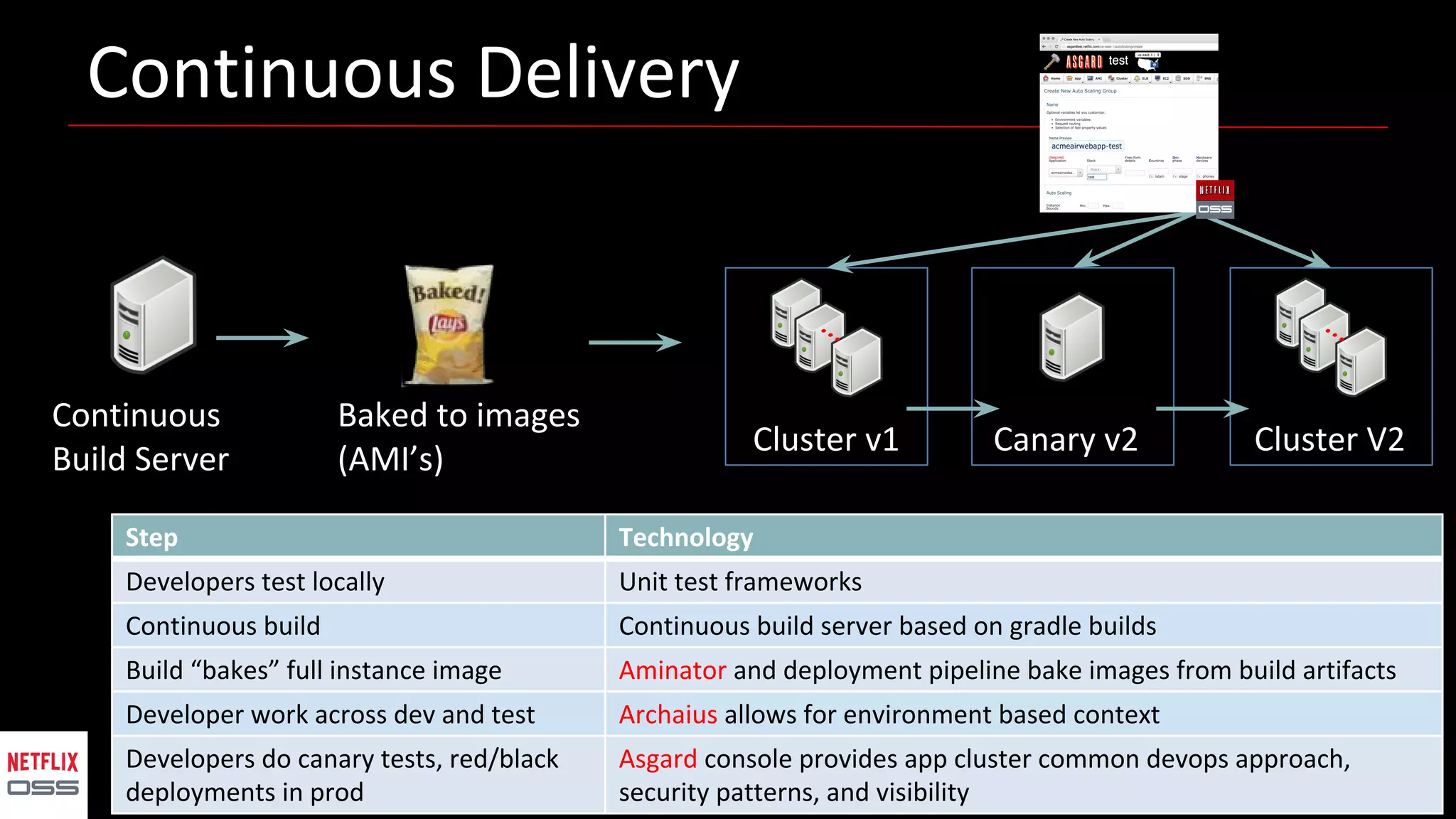
Continuous Delivery
Cluster v1 Canary v2 Cluster V2
Step Technology
Developers test locally Unit test frameworks
Continuous build Continuous build server based on gradle builds
Build “bakes” full instance image Aminator and deployment pipeline bake images from build artifacts
Developer work across dev and test Archaius allows for environment based context
Developers do canary tests, red/black
deployments in prod
Asgard console provides app cluster common devops approach,
security patterns, and visibility
Continuous
Build Server
Baked to images
(AMI’s)
… …
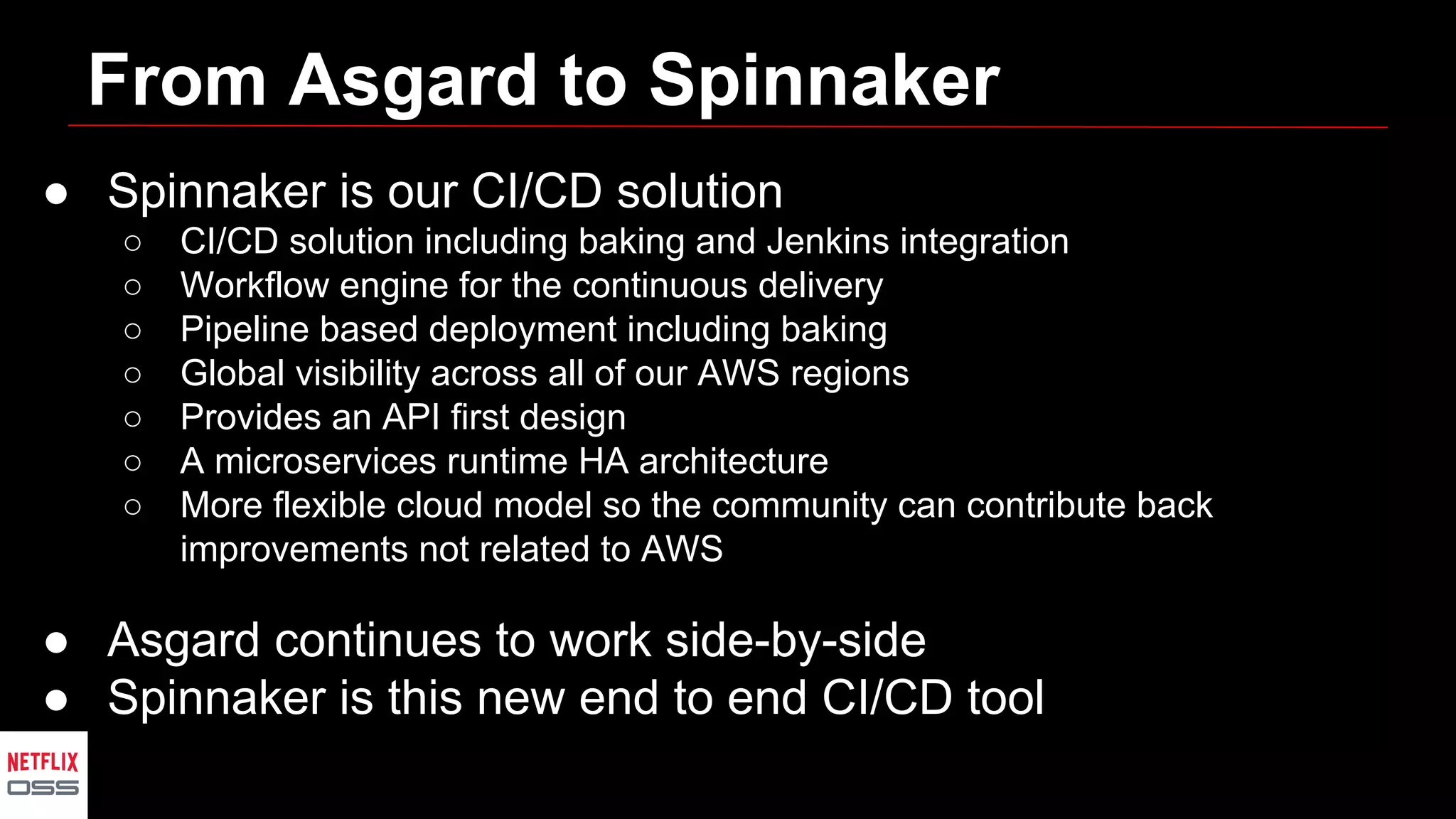
From Asgard to Spinnaker
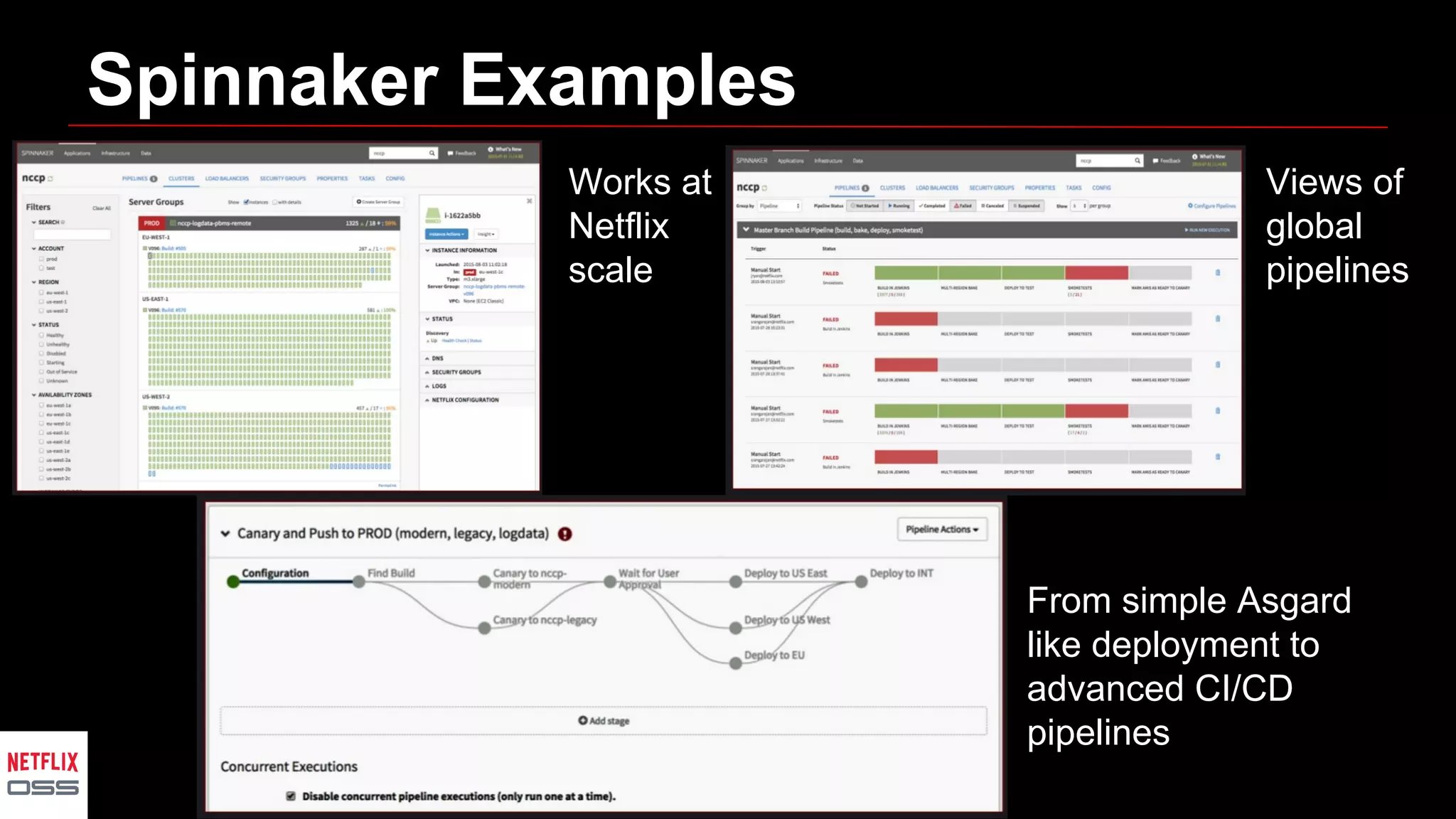
● Spinnaker is our CI/CD solution
○ CI/CD solution including baking and Jenkins integration
○ Workflow engine for the continuous delivery
○ Pipeline based deployment including baking
○ Global visibility across all of our AWS regions
○ Provides an API first design
○ A microservices runtime HA architecture
○ More flexible cloud model so the community can contribute back
improvements not related to AWS
● Asgard continues to work side-by-side
● Spinnaker is this new end to end CI/CD tool
Spinnaker Examples
Works at
Netflix
scale
Views of
global
pipelines
From simple Asgard
like deployment to
advanced CI/CD
pipelines
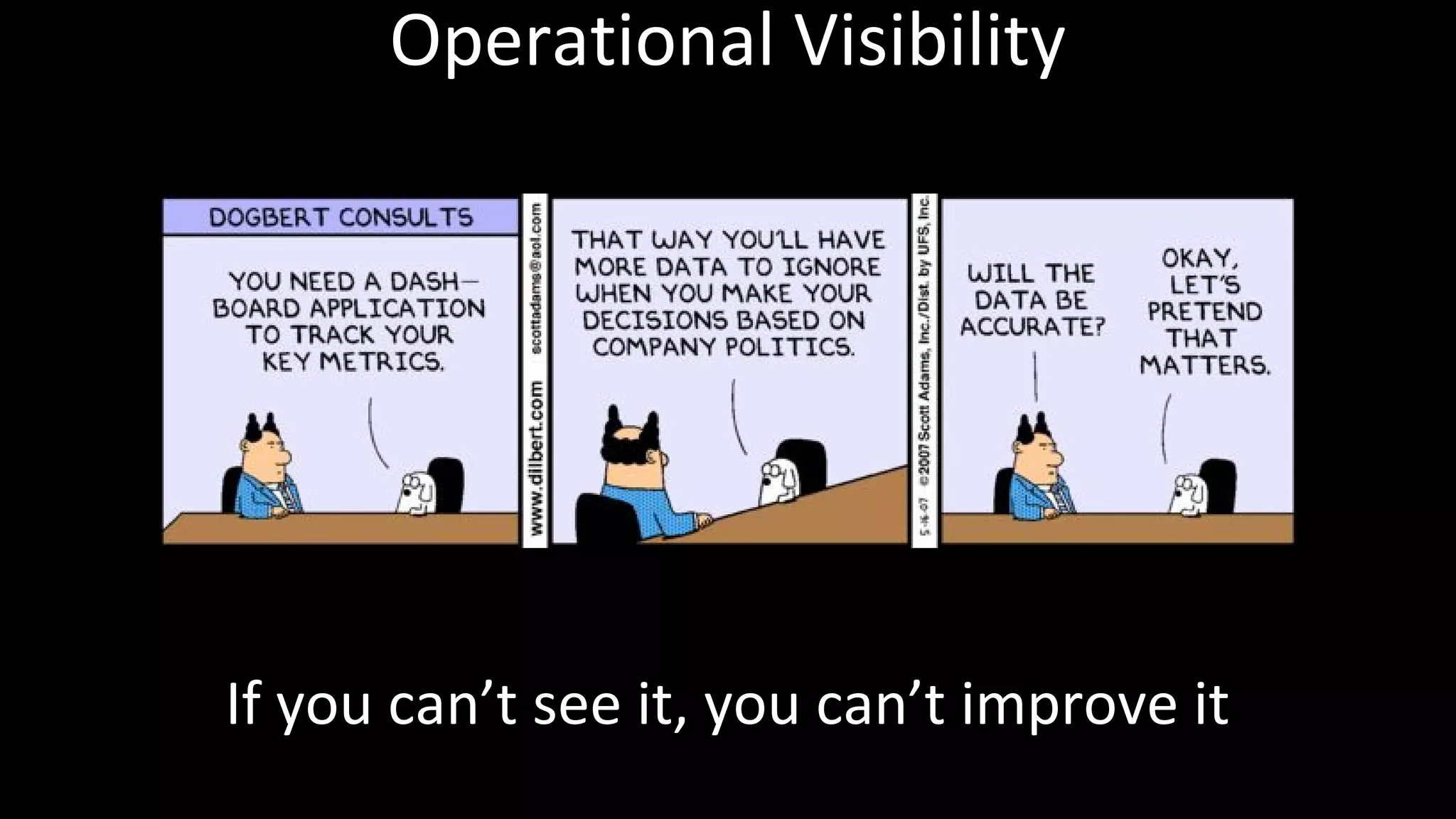
Operational Visibility
If you can’t see it, you can’t improve it
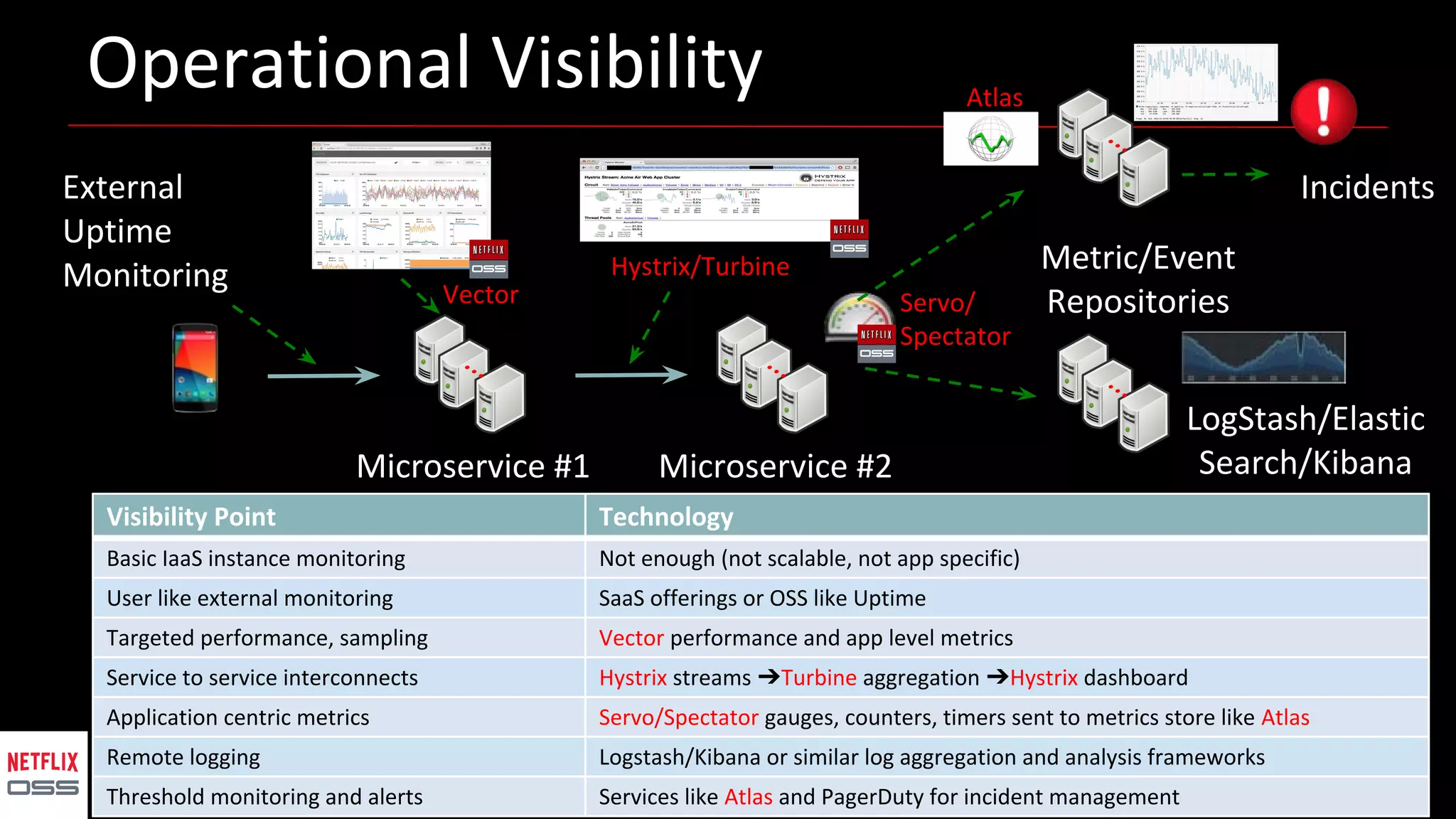
Operational Visibility
Microservice #1 Microservice #2
Visibility Point Technology
Basic IaaS instance monitoring Not enough (not scalable, not app specific)
User like external monitoring SaaS offerings or OSS like Uptime
Targeted performance, sampling Vector performance and app level metrics
Service to service interconnects Hystrix streams ➔Turbine aggregation ➔Hystrix dashboard
Application centric metrics Servo/Spectator gauges, counters, timers sent to metrics store like Atlas
Remote logging Logstash/Kibana or similar log aggregation and analysis frameworks
Threshold monitoring and alerts Services like Atlas and PagerDuty for incident management
Servo/
Spectator
Hystrix/Turbine
External
Uptime
Monitoring Metric/Event
Repositories
LogStash/Elastic
Search/Kibana
Incidents
……
…
…
Atlas
Vector
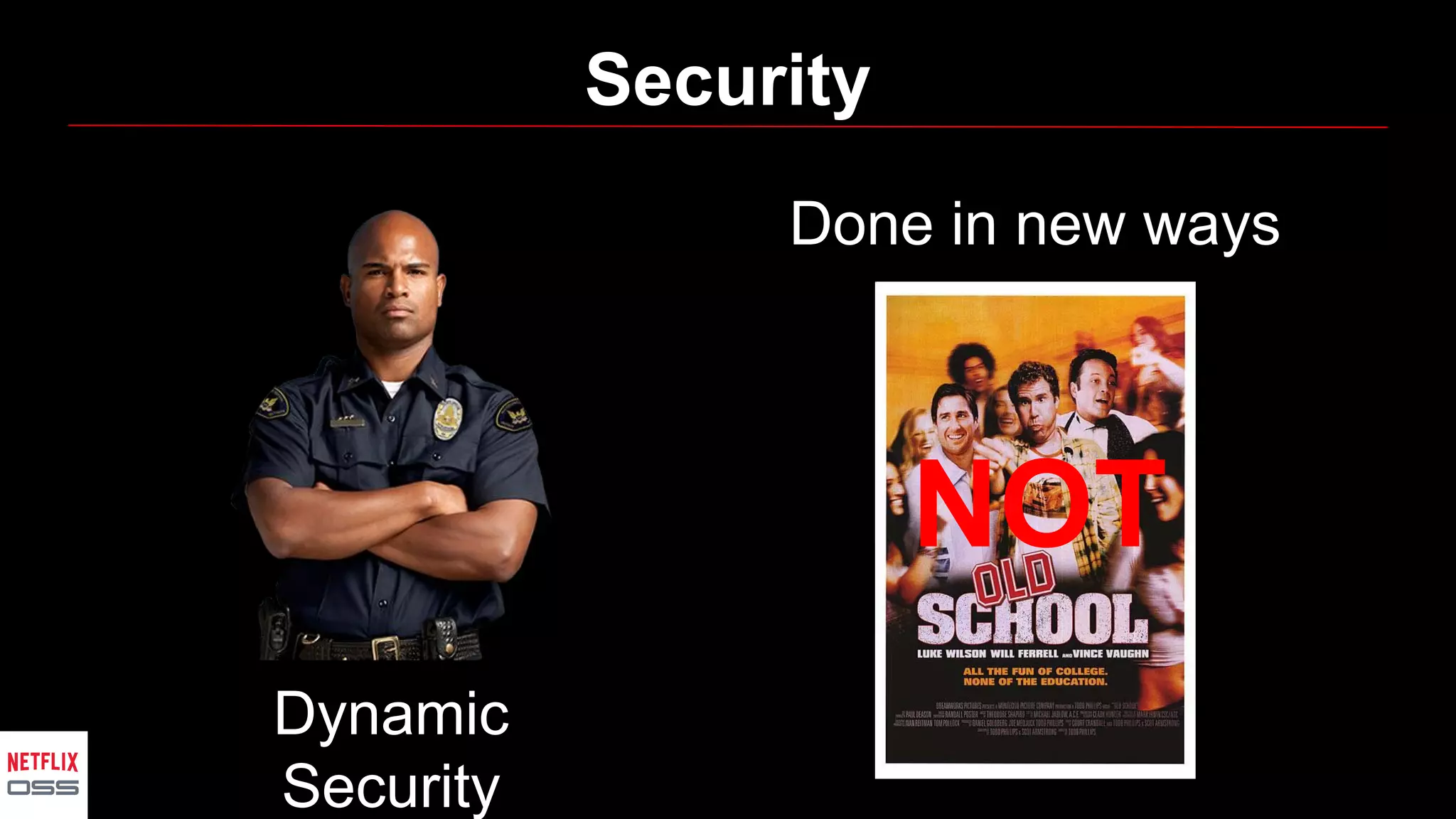
Security
Dynamic
Security
Done in new ways
NOT
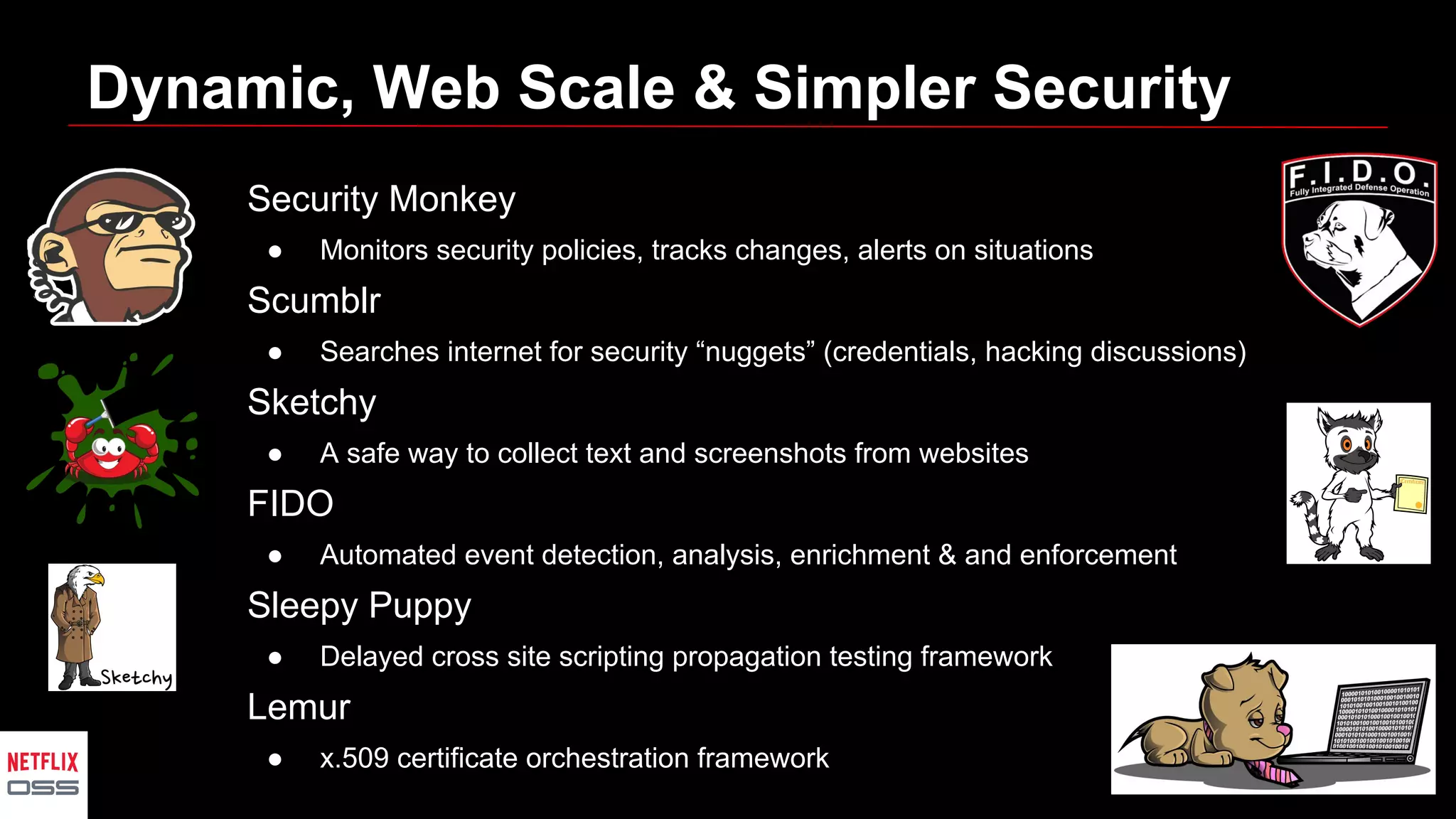
Dynamic, Web Scale & Simpler Security
Security Monkey
● Monitors security policies, tracks changes, alerts on situations
Scumblr
● Searches internet for security “nuggets” (credentials, hacking discussions)
Sketchy
● A safe way to collect text and screenshots from websites
FIDO
● Automated event detection, analysis, enrichment & and enforcement
Sleepy Puppy
● Delayed cross site scripting propagation testing framework
Lemur
● x.509 certificate orchestration framework
What did we not cover?
Over 50 github projects
● NetflixOSS is “Technical indigestion as a service”
Big Data, Data Persistence and UI Engineering
● Big Data tools used well beyond Netflix
● Ephemeral, semi and fully persistent data systems
● Recent addition of UI OSS and Falcor
Agenda
NetflixOSS
Netflix Cloud Architecture
● Getting Started
Personal Projects
How do I get started?
● All of the previous slides shows NetflixOSS components
○ Code: http://netflix.github.io
○ Announcements: http://techblog.netflix.com/
● Want to get running a bit faster?
● ZeroToCloud
○ Workshop for getting started with build/bake/deploy in Amazon EC2
● ZeroToDocker
○ Docker images that containing running Netflix technologies (not production
ready, but easy to understand)
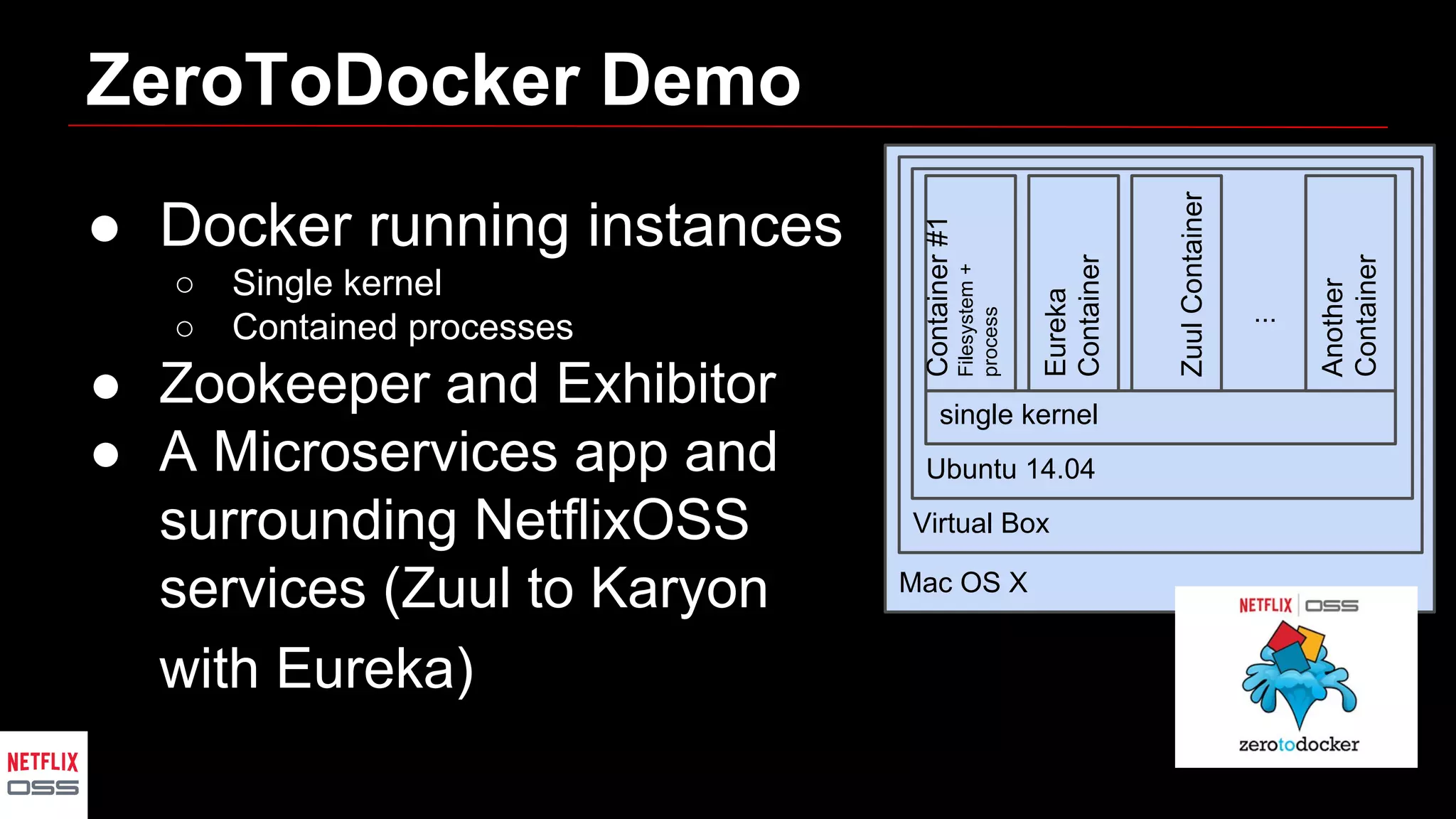
ZeroToDocker Demo
Mac OS X
Virtual Box
Ubuntu 14.04
single kernel
Container#1
Filesystem+
process
Eureka
Container
ZuulContainer
Another
Container
...
● Docker running instances
○ Single kernel
○ Contained processes
● Zookeeper and Exhibitor
● A Microservices app and
surrounding NetflixOSS
services (Zuul to Karyon
with Eureka)
Agenda
NetflixOSS
Netflix Cloud Architecture
Getting Started
● Personal Projects
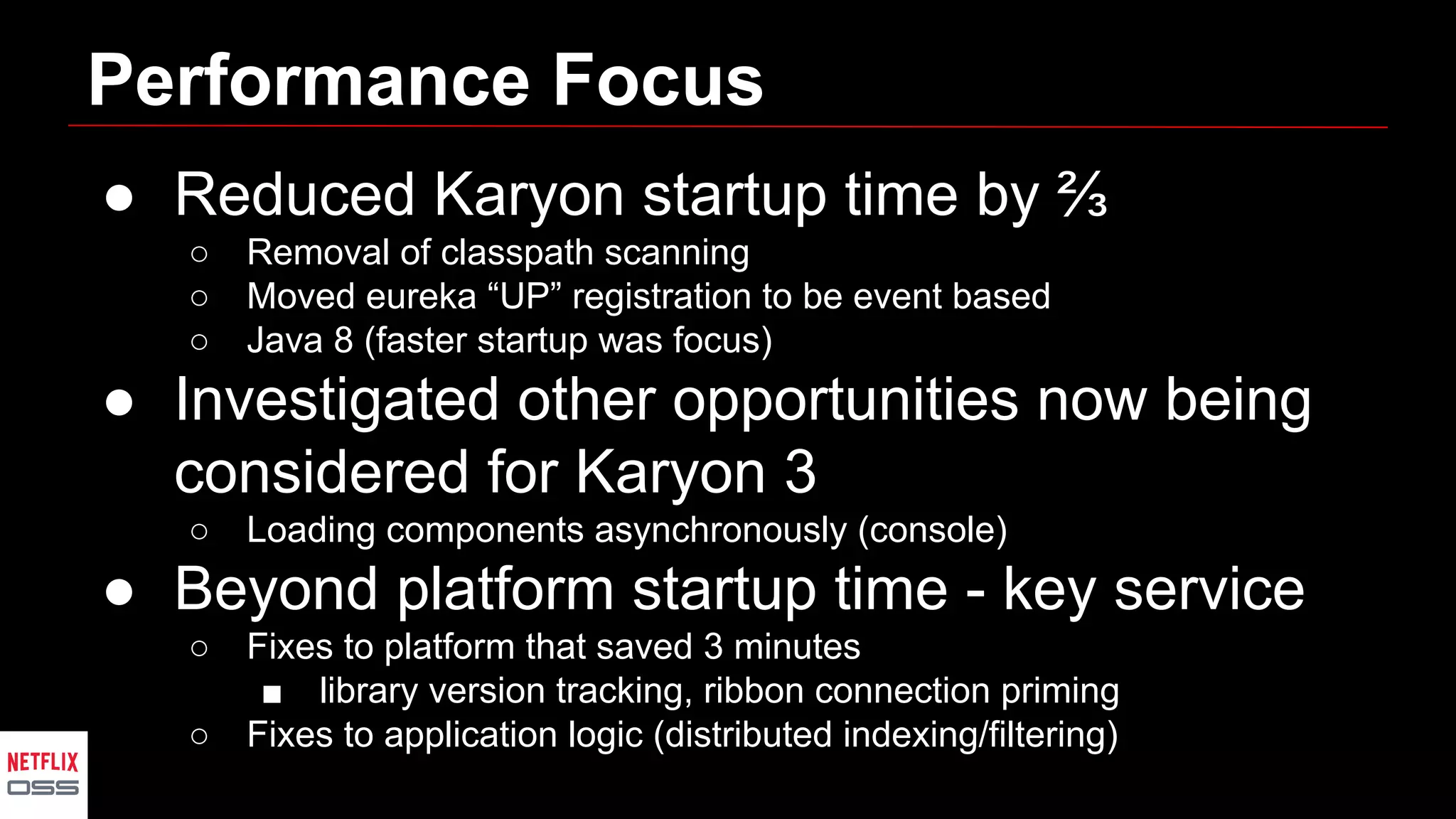
Performance Focus
● Reduced Karyon startup time by ⅔
○ Removal of classpath scanning
○ Moved eureka “UP” registration to be event based
○ Java 8 (faster startup was focus)
● Investigated other opportunities now being
considered for Karyon 3
○ Loading components asynchronously (console)
● Beyond platform startup time - key service
○ Fixes to platform that saved 3 minutes
■ library version tracking, ribbon connection priming
○ Fixes to application logic (distributed indexing/filtering)
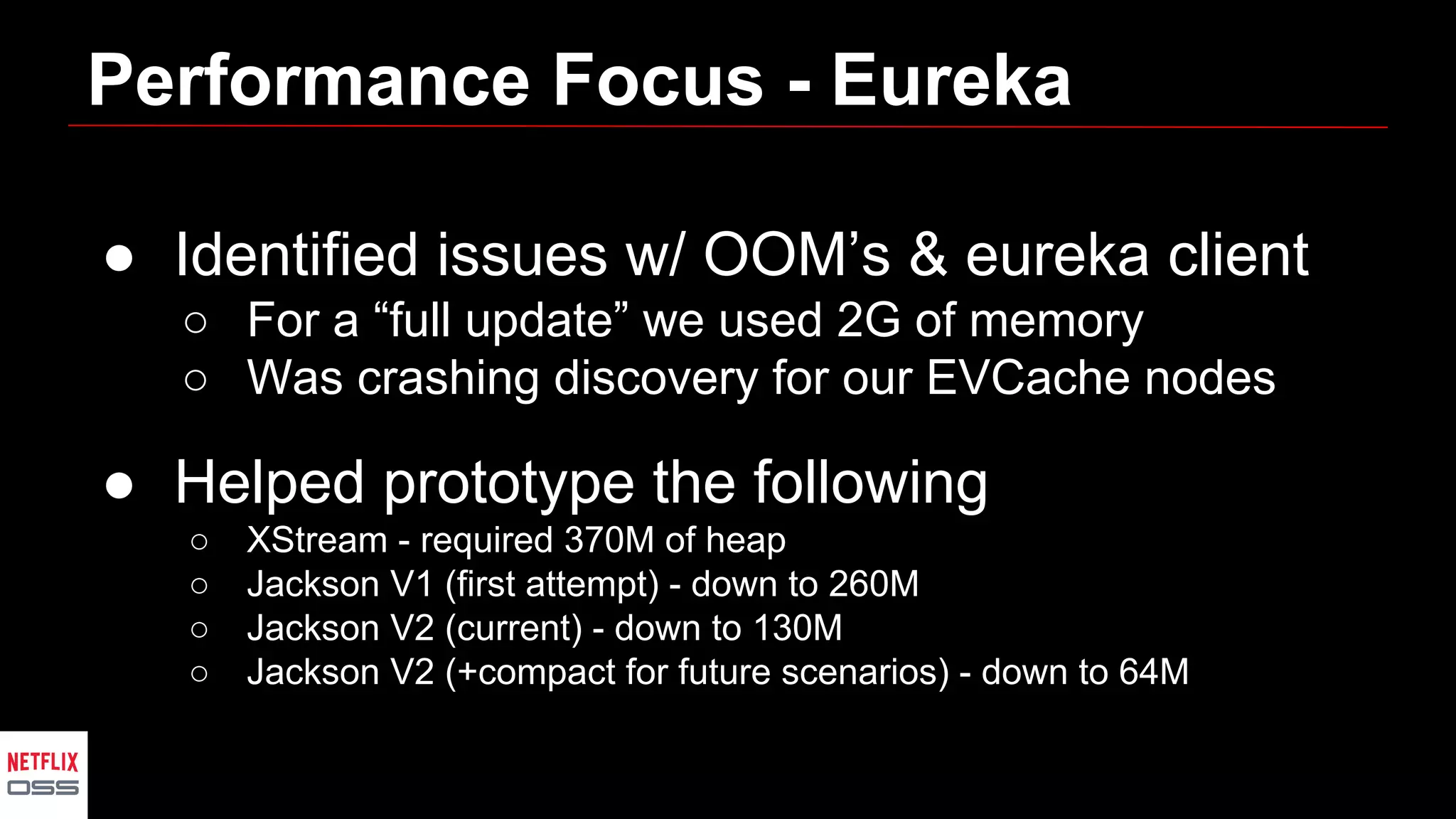
Performance Focus - Eureka
● Identified issues w/ OOM’s & eureka client
○ For a “full update” we used 2G of memory
○ Was crashing discovery for our EVCache nodes
● Helped prototype the following
○ XStream - required 370M of heap
○ Jackson V1 (first attempt) - down to 260M
○ Jackson V2 (current) - down to 130M
○ Jackson V2 (+compact for future scenarios) - down to 64M
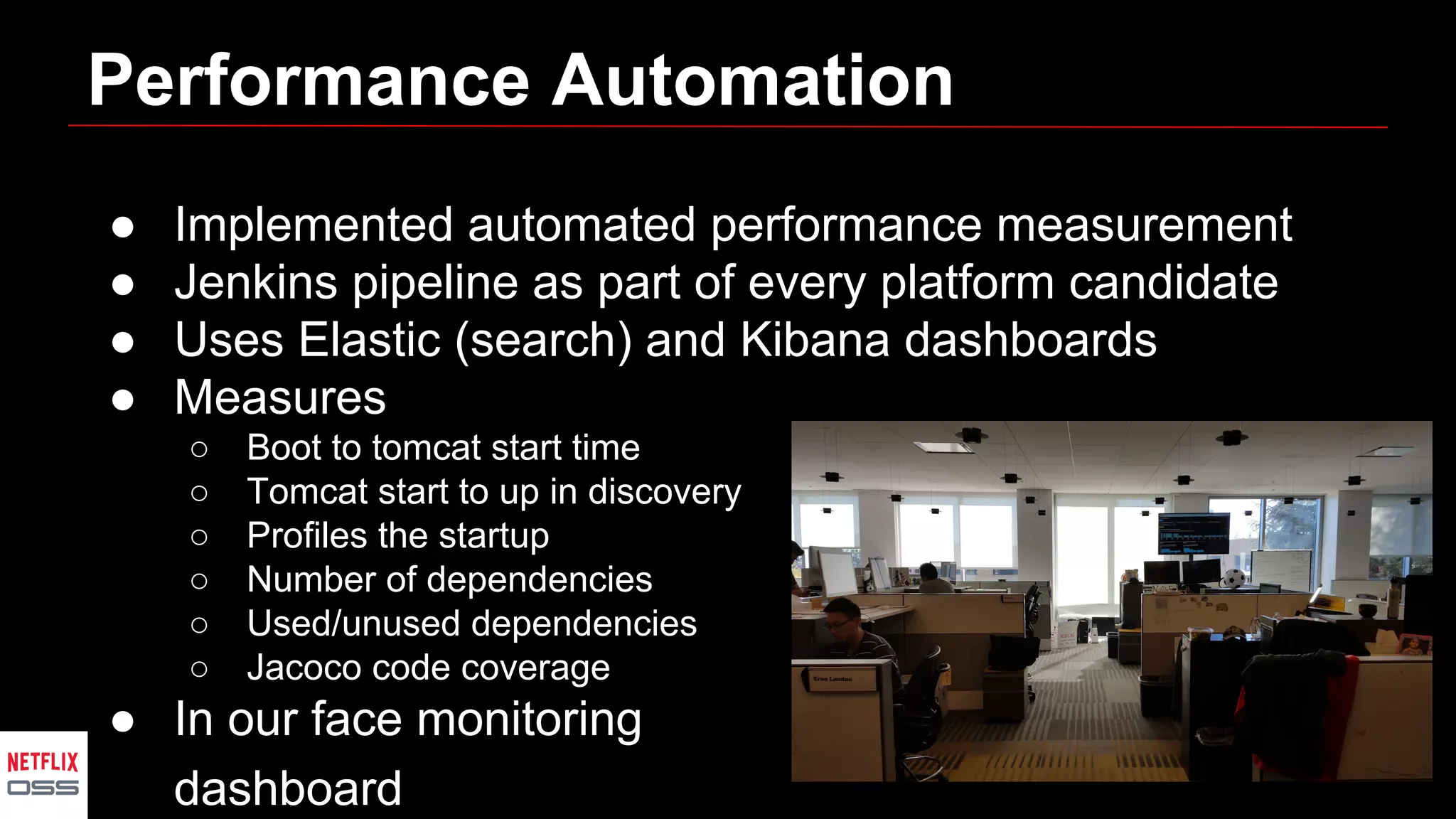
Performance Automation
● Implemented automated performance measurement
● Jenkins pipeline as part of every platform candidate
● Uses Elastic (search) and Kibana dashboards
● Measures
○ Boot to tomcat start time
○ Tomcat start to up in discovery
○ Profiles the startup
○ Number of dependencies
○ Used/unused dependencies
○ Jacoco code coverage
● In our face monitoring
dashboard
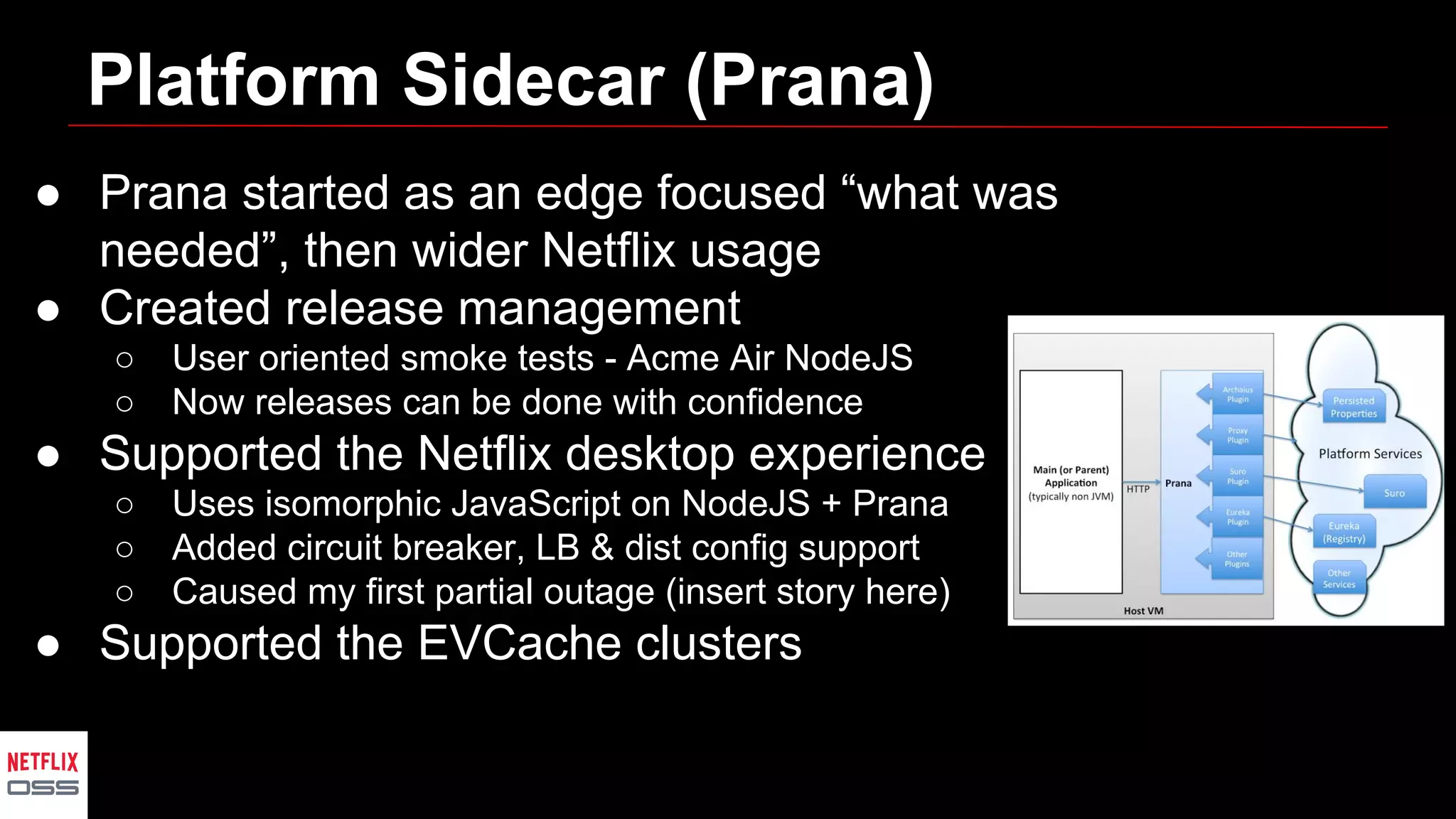
Platform Sidecar (Prana)
● Prana started as an edge focused “what was
needed”, then wider Netflix usage
● Created release management
○ User oriented smoke tests - Acme Air NodeJS
○ Now releases can be done with confidence
● Supported the Netflix desktop experience
○ Uses isomorphic JavaScript on NodeJS + Prana
○ Added circuit breaker, LB & dist config support
○ Caused my first partial outage (insert story here)
● Supported the EVCache clusters
Strategy - Platform Direction
● Helped define some of the platform direction
● Improvements in Eureka to ensure its
continued scalability
● Key improvements needed in Karyon 3
○ Performance improvements (footprint/startup)
○ Focus on mocks needed in dev, unit test, CI envs
○ Ability to narrow features for infrastructural services
○ Rework of Prana to be on same platform base
Open Source
● Led internal & external meetups on OSS
● Web site redesign to help external users
● Implemented ZeroToDocker
○ Implemented the platform focused aspects
○ Helped other teams onboard into ZeroToDocker
● Worked to operationalize prod deployments
○ Separate dev stack, metrics, consistent pipelines
○ Built up teams (existing impl, strategic work)
● Created strategy for going forward
○ Increase leverage of “Mantis” technology for
scheduling and job management
○ Increase leverage of ECS for Docker AWS
integration & resource management
● Working on strategy of non-runtime components
○ Changes to Netflix build/bake/deploy
Container cloud
Questions
?

Triangle Devops Meetup 10/2015

  • 1.
    Netflix Open Source& What I have done in a year? Andrew Spyker Senior Software Engineer, Netflix
  • 2.
    Back to thePast Previous talks at @TriangleDevops ● 10/16/2013 - Learn about NetflixOSS ● 6/18/2014 - Learn about Docker
  • 3.
    About Netflix ● 69Mmembers ● 2000+ employees (1400 tech) ● 80+ countries ● > 100M hours watch per day ● > ⅓ NA internet download traffic ● 500+ Microservices ● Many 10’s of thousands VM’s ● 3 regions across the world
  • 4.
    About the Speaker ●Cloud platform technologies ○ Distributed configuration, service discovery, RPC, application frameworks, non-Java sidecar ● Container cloud ○ Resource management and scheduling, making Docker containers operational in Amazon EC2/ECS ● Open Source ○ Organize @NetflixOSS meetups & internal group ● Performance ○ Assist across Netflix, but focused mainly on cloud platform perf With Netflix for ~ 1 year. Previously at IBM here in Raleigh/Durham (RTP) @aspyker ispyker. blogspot. com
  • 5.
    Agenda ● NetflixOSS Netflix CloudArchitecture Getting Started Personal Projects
  • 6.
    Why does Netflixopen source? ● Allows engineers to gather feedback ○ Openly talk, through code, on our approach ○ Collaboration on key projects with the world ○ Happily use proven outside open source ■ And improve it for Netflix scale and availability ● Netflix culture of freedom and responsibility ○ Want to open source? ○ Go for it, be responsible! ● Recruiting and Retention ○ Candidates know exactly what they can work on ○ NetflixOSS engineers choose to stay at Netflix
  • 7.
    NetflixOSS is widelyused ● The architecture has shaped public cloud usage ○ Immutability, Red/Black Deploys, Chaos, Regional and worldwide high availability ● Offerings ○ Pivotal Spring Cloud ● Large usage ○ IBM Watson as a Service (on IBM Cloud) ○ Nike Digital is hiring NetflixOSS experts ● Interesting usage ○ “To help locate new troves of data claiming to be the files stolen from AshleyMadison, the company’s forensics team has been using a tool that Netflix released last year called Scumblr”
  • 8.
  • 9.
    Key aspects ofNetflixOSS website ● Show how the pieces fit together ○ Projects now discussed with each other in context ● OSS categories mirror internal teams ○ No artificial categories, focal points for each area ● Focus on projects that are core to Netflix ○ Projects mentioned are core and strategic
  • 10.
    Agenda NetflixOSS ● Netflix CloudArchitecture Getting Started Personal Projects
  • 11.
    Elastic, Web andHyper Scale Doing this Not doing that
  • 12.
    Elastic, Web andHyper Scale Front end API Another Microservice Temporal caching Durable Storage Load Balancers … Strategy Benefit Automate everything Less errors, more consistency than manual runbooks Expose well designed API to users Offloads presentation complexity to clients Remove state for mid tier services Allows easy elastic scale out Push temporal state to client and caching tier Leverage clients, avoids data tier overload Use partitioned data storage Data design and storage scales with HA … … … … … Recommendation Microservice
  • 13.
    HA and AutomaticRecovery Feeling This Not Feeling That
  • 14.
    Micro service Implementation Call microservice#2 Highly Available Service Runtime Recipe Ribbon REST client with Eureka Microservice #1 (REST services) App Service Microservice #2 Execute call Hystrix Eureka Server(s) Eureka Server(s) Eureka Server(s) Karyon Fallback Implementation Implementation Detail Benefits Decompose into micro services • Key user path always available • Failure does not propagate across service boundaries Karyon /w automatic Eureka registration • New instances are quickly found • Failing individual instances disappear Ribbon client with Eureka awareness • Load balances & retries across instances with “smarts” • Handles temporal instance failure Hystrix as dependency circuit breaker • Allows for fast failure • Provides graceful cross service degradation/recovery
  • 15.
    IaaS High Availability Region(us-east-1) us-east-1e us-east-1c Eureka Web App Service1 Service2 Cluster Auto Recovery and Scaling Services (Auto Scaling Groups) … ELB’s Rule Why? Always > 2 of everything 1 is SPOF, 2 doesn’t scale, slow DR recovery, majority consensus not possible Including IaaS and cloud services You’re only as strong as your weakest dependency Use auto scaler/recovery monitoring Clusters guarantee availability and service latency Use application level health checks Instance on the network != healthy Worldwide availability Data replication, global front-end routing, cross region traffic us-east-1d
  • 16.
    A truly globalservice ● Replicate data across regions ● Be able to redirect traffic from region to region ● Be able to migrate regional traffic to other regions ● Have automated control across regions Flux Demo
  • 17.
    Testing is onlyway to prove HA ● Chaos Monkey ○ Kill instances in production - runs regularly ● Chaos Gorilla ○ Kills availability zones (single datacenter) ○ Also testing for split brain important ● Chaos Kong ○ Kill entire region and shift traffic globally ○ Run frequently but with prior scheduling
  • 18.
  • 19.
    v Continuous Delivery Cluster v1Canary v2 Cluster V2 Step Technology Developers test locally Unit test frameworks Continuous build Continuous build server based on gradle builds Build “bakes” full instance image Aminator and deployment pipeline bake images from build artifacts Developer work across dev and test Archaius allows for environment based context Developers do canary tests, red/black deployments in prod Asgard console provides app cluster common devops approach, security patterns, and visibility Continuous Build Server Baked to images (AMI’s) … …
  • 20.
    From Asgard toSpinnaker ● Spinnaker is our CI/CD solution ○ CI/CD solution including baking and Jenkins integration ○ Workflow engine for the continuous delivery ○ Pipeline based deployment including baking ○ Global visibility across all of our AWS regions ○ Provides an API first design ○ A microservices runtime HA architecture ○ More flexible cloud model so the community can contribute back improvements not related to AWS ● Asgard continues to work side-by-side ● Spinnaker is this new end to end CI/CD tool
  • 21.
    Spinnaker Examples Works at Netflix scale Viewsof global pipelines From simple Asgard like deployment to advanced CI/CD pipelines
  • 22.
    Operational Visibility If youcan’t see it, you can’t improve it
  • 23.
    Operational Visibility Microservice #1Microservice #2 Visibility Point Technology Basic IaaS instance monitoring Not enough (not scalable, not app specific) User like external monitoring SaaS offerings or OSS like Uptime Targeted performance, sampling Vector performance and app level metrics Service to service interconnects Hystrix streams ➔Turbine aggregation ➔Hystrix dashboard Application centric metrics Servo/Spectator gauges, counters, timers sent to metrics store like Atlas Remote logging Logstash/Kibana or similar log aggregation and analysis frameworks Threshold monitoring and alerts Services like Atlas and PagerDuty for incident management Servo/ Spectator Hystrix/Turbine External Uptime Monitoring Metric/Event Repositories LogStash/Elastic Search/Kibana Incidents …… … … Atlas Vector
  • 24.
  • 25.
    Dynamic, Web Scale& Simpler Security Security Monkey ● Monitors security policies, tracks changes, alerts on situations Scumblr ● Searches internet for security “nuggets” (credentials, hacking discussions) Sketchy ● A safe way to collect text and screenshots from websites FIDO ● Automated event detection, analysis, enrichment & and enforcement Sleepy Puppy ● Delayed cross site scripting propagation testing framework Lemur ● x.509 certificate orchestration framework
  • 26.
    What did wenot cover? Over 50 github projects ● NetflixOSS is “Technical indigestion as a service” Big Data, Data Persistence and UI Engineering ● Big Data tools used well beyond Netflix ● Ephemeral, semi and fully persistent data systems ● Recent addition of UI OSS and Falcor
  • 27.
    Agenda NetflixOSS Netflix Cloud Architecture ●Getting Started Personal Projects
  • 28.
    How do Iget started? ● All of the previous slides shows NetflixOSS components ○ Code: http://netflix.github.io ○ Announcements: http://techblog.netflix.com/ ● Want to get running a bit faster? ● ZeroToCloud ○ Workshop for getting started with build/bake/deploy in Amazon EC2 ● ZeroToDocker ○ Docker images that containing running Netflix technologies (not production ready, but easy to understand)
  • 29.
    ZeroToDocker Demo Mac OSX Virtual Box Ubuntu 14.04 single kernel Container#1 Filesystem+ process Eureka Container ZuulContainer Another Container ... ● Docker running instances ○ Single kernel ○ Contained processes ● Zookeeper and Exhibitor ● A Microservices app and surrounding NetflixOSS services (Zuul to Karyon with Eureka)
  • 30.
  • 31.
    Performance Focus ● ReducedKaryon startup time by ⅔ ○ Removal of classpath scanning ○ Moved eureka “UP” registration to be event based ○ Java 8 (faster startup was focus) ● Investigated other opportunities now being considered for Karyon 3 ○ Loading components asynchronously (console) ● Beyond platform startup time - key service ○ Fixes to platform that saved 3 minutes ■ library version tracking, ribbon connection priming ○ Fixes to application logic (distributed indexing/filtering)
  • 32.
    Performance Focus -Eureka ● Identified issues w/ OOM’s & eureka client ○ For a “full update” we used 2G of memory ○ Was crashing discovery for our EVCache nodes ● Helped prototype the following ○ XStream - required 370M of heap ○ Jackson V1 (first attempt) - down to 260M ○ Jackson V2 (current) - down to 130M ○ Jackson V2 (+compact for future scenarios) - down to 64M
  • 33.
    Performance Automation ● Implementedautomated performance measurement ● Jenkins pipeline as part of every platform candidate ● Uses Elastic (search) and Kibana dashboards ● Measures ○ Boot to tomcat start time ○ Tomcat start to up in discovery ○ Profiles the startup ○ Number of dependencies ○ Used/unused dependencies ○ Jacoco code coverage ● In our face monitoring dashboard
  • 34.
    Platform Sidecar (Prana) ●Prana started as an edge focused “what was needed”, then wider Netflix usage ● Created release management ○ User oriented smoke tests - Acme Air NodeJS ○ Now releases can be done with confidence ● Supported the Netflix desktop experience ○ Uses isomorphic JavaScript on NodeJS + Prana ○ Added circuit breaker, LB & dist config support ○ Caused my first partial outage (insert story here) ● Supported the EVCache clusters
  • 35.
    Strategy - PlatformDirection ● Helped define some of the platform direction ● Improvements in Eureka to ensure its continued scalability ● Key improvements needed in Karyon 3 ○ Performance improvements (footprint/startup) ○ Focus on mocks needed in dev, unit test, CI envs ○ Ability to narrow features for infrastructural services ○ Rework of Prana to be on same platform base
  • 36.
    Open Source ● Ledinternal & external meetups on OSS ● Web site redesign to help external users ● Implemented ZeroToDocker ○ Implemented the platform focused aspects ○ Helped other teams onboard into ZeroToDocker
  • 37.
    ● Worked tooperationalize prod deployments ○ Separate dev stack, metrics, consistent pipelines ○ Built up teams (existing impl, strategic work) ● Created strategy for going forward ○ Increase leverage of “Mantis” technology for scheduling and job management ○ Increase leverage of ECS for Docker AWS integration & resource management ● Working on strategy of non-runtime components ○ Changes to Netflix build/bake/deploy Container cloud
  • 38.