Brian	
  Upshaw	
  bupshaw@ncbaptist.org	
  	
   Page	
  1	


RELATIONAL	
  DISCIPLE-­‐MAKING	
  
WHY?	
  
• Focus:	
  Using	
  a	
  relational	
  model	
  for	
  multiplying	
  disciples.	


• Disciple-­‐making	
  is	
  about:	
  
o Process	
  NOT	
  Program	
  (though	
  programs	
  may	
  be	
  a	
  part	
  of	
  the	
  process)	
  
o Relationships	
  NOT	
  Classes	
  (though	
  classes	
  can	
  be	
  vehicles	
  for	
  relationships)	
  
o Transformation	
  NOT	
  Information	
  (though	
  information	
  is	
  necessary	
  for	
  
transformation)	
  
o Reproduction	
  NOT	
  just	
  Depth	
  (though	
  depth	
  will	
  occur	
  as	
  disciples	
  reproduce)	


• Programs	
  have	
  limitations.	
  In	
  his	
  book,	
  Transforming	
  Discipleship,	
  Greg	
  Ogden	
  observes	
  4	
  
limitations	
  to	
  programs:	
  
o They	
  tend	
  to	
  be	
  information	
  or	
  knowledge-­‐based	
  
o They	
  tend	
  to	
  have	
  one	
  person	
  preparing	
  to	
  teach	
  many	
  instead	
  of	
  all	
  preparing	
  to	
  
participate	
  
o They	
  tend	
  toward	
  a	
  regimentation/synchronization	
  of	
  teaching	
  instead	
  of	
  
customization	
  for	
  the	
  individual	
  disciple	
  
o They	
  tend	
  to	
  have	
  low	
  personal	
  accountability	
  for	
  spiritual	
  growth1	


• Relational	
  models	
  are	
  preferred!	
  Ogden	
  concludes,	
  “Though	
  all	
  approaches	
  to	
  disciple	
  
making	
  will	
  have	
  programmatic	
  elements,	
  such	
  as	
  structure	
  and	
  curriculum	
  (even	
  if	
  it	
  is	
  the	
  
Bible),	
  the	
  growth	
  process	
  of	
  the	
  individual	
  is	
  always	
  preeminent	
  in	
  a	
  relational	
  setting.”2	


• KEY	
  WORD:	
  Intentionality!	
  Relational	
  discipleship	
  requires	
  an	
  intentional	
  focus	
  on	
  
building	
  solid	
  relationships	
  based	
  on	
  love	
  that	
  lead	
  to	
  a	
  focus	
  on	
  the	
  truth	
  for	
  spiritual	
  
growth.	
  Consider	
  Ephesians	
  4:15:	
  “Rather,	
  speaking	
  the	
  truth	
  in	
  love,	
  we	
  are	
  to	
  grow	
  up	
  in	
  
every	
  way	
  into	
  him	
  who	
  is	
  the	
  head,	
  into	
  Christ”	
  (ESV)	
  
o Speaking	
  the	
  truth	
  –	
  Focus	
  on	
  intentionality	
  
o In	
  love	
  –	
  Focus	
  on	
  relationship	
  
o We	
  are	
  to	
  grow	
  up…into	
  Christ	
  –	
  Resulting	
  in	
  discipleship	


• Common	
  ingredients	
  in	
  all	
  biblical	
  models:	
  
o The	
  Word	
  of	
  God	
  
o The	
  Spirit	
  of	
  God	
  
o The	
  Discipler	
  
o The	
  Disciple	


Brian	
  Upshaw	
  bupshaw@ncbaptist.org	
  	
   Page	
  2	


THE	
  METHOD	
  OF	
  JESUS	
  
• How	
  did	
  Jesus	
  make	
  disciples?	
  
o Jesus	
  made	
  disciples	
  a	
  few	
  at	
  a	
  time.	
  
o "He	
  appointed	
  twelve-­‐-­‐designating	
  them	
  apostles-­‐-­‐that	
  they	
  might	
  be	
  with	
  Him	
  and	
  
that	
  He	
  might	
  send	
  them	
  out	
  to	
  preach	
  and	
  to	
  have	
  authority	
  to	
  drive	
  out	
  demons."	
  
Mark	
  3:14-­‐15	
  
• In	
  the	
  passages	
  below	
  from	
  Mark	
  9-­‐13,	
  note:	
  
o The	
  audiences	
  with	
  whom	
  Jesus	
  interacted.	
  
o The	
  setting	
  of	
  the	
  encounters.	
  
o The	
  method	
  of	
  Jesus’	
  teaching.	
  
o The	
  general	
  content	
  of	
  the	
  teaching	
  in	
  the	
  encounters.	
  
! 9:2-­‐12	
  
! 9:14-­‐29	
  
! 9:30-­‐32	
  
! 9:33-­‐37	
  
! 10:1-­‐12	
  
! 10:17-­‐31	
  
! 10:32-­‐34	
  
! 10:35-­‐44	
  
! 11:12-­‐26	
  
! 12:1-­‐40	
  
! 12:41-­‐44	
  
! 13:1-­‐37	


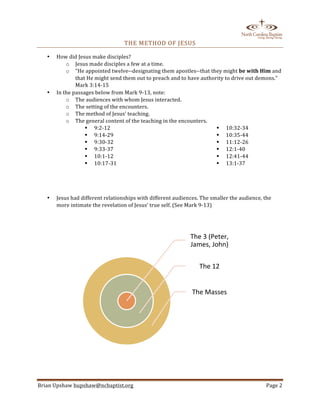
• Jesus	
  had	
  different	
  relationships	
  with	
  different	
  audiences.	
  The	
  smaller	
  the	
  audience,	
  the	
  
more	
  intimate	
  the	
  revelation	
  of	
  Jesus’	
  true	
  self.	
  (See	
  Mark	
  9-­‐13)	


The	
  3	
  (Peter,	
  
James,	
  John)	
  
The	
  12	
  
The	
  Masses	
  
 
Brian	
  Upshaw	
  bupshaw@ncbaptist.org	
  	
   Page	
  3	


REFLECTING	
  THE	
  METHOD	
  OF	
  JESUS	
  
• How	
  do	
  our	
  disciple-­‐making	
  platforms	
  reflect	
  the	
  methods	
  of	
  Jesus?	
  
o Most	
  churches	
  reflect	
  Jesus’	
  method	
  to	
  some	
  degree	
  with	
  respect	
  to:	
  
! The	
  Masses	
  –	
  Pulpit	
  and	
  platform	
  preaching	
  and	
  teaching,	
  large	
  group	
  
teaching	
  and	
  ministries.	
  
! The	
  12	
  –	
  The	
  environments	
  of	
  Sunday	
  School,	
  small	
  groups,	
  discipleship	
  
classes	
  can	
  be	
  applied	
  here.	
  (It	
  should	
  be	
  noted,	
  however,	
  that	
  these	
  
environments	
  in	
  the	
  local	
  church	
  can	
  be	
  focused	
  more	
  on	
  information	
  than	
  
transformation.	
  This	
  illustration	
  speaks	
  more	
  to	
  size	
  of	
  environment	
  than	
  
quality	
  of	
  content)	
  
o Unfortunately,	
  most	
  churches	
  do	
  not	
  reflect	
  Jesus’	
  method	
  in	
  the	
  place	
  where	
  
relationships	
  were	
  most	
  intimate	
  –	
  the	
  3.	
  As	
  we	
  observe	
  the	
  ministry	
  of	
  the	
  apostles	
  
in	
  the	
  Book	
  of	
  Acts,	
  we	
  can	
  note	
  that	
  these	
  3	
  apostles	
  formed	
  the	
  “inner	
  circle”	
  for	
  
Jesus	
  and	
  were	
  the	
  key	
  leaders	
  of	
  the	
  movement:	
  Peter	
  and	
  John	
  were	
  the	
  leaders	
  
and	
  spokesmen	
  for	
  the	
  apostles	
  and	
  the	
  church,	
  and	
  James	
  is	
  the	
  first	
  apostle	
  to	
  be	
  
martyred.	
  (See	
  Acts	
  2:14-­‐41,	
  3:1-­‐4:22,	
  5:1-­‐11,	
  10:1-­‐31,	
  11:1-­‐18,	
  12:1-­‐5,	
  12:6-­‐18)	


The	
  3:	
  
????	
  
The	
  12:	
  
Sunday	
  School/	
  
Small	
  Groups/
Classes	
  
The	
  Masses:	
  
Pulpit,	
  Large	
  
Group	
  
Teaching	
  &	
  
Ministry	
  
 
Brian	
  Upshaw	
  bupshaw@ncbaptist.org	
  	
   Page	
  4	


DISCIPLE-­‐MAKING	
  TRIADS	
  
Disciple-­‐making	
  triads	
  are	
  groups	
  of	
  3	
  people	
  (sometimes	
  4)	
  who	
  meet	
  together	
  for	
  the	
  purpose	
  of	
  
discipleship	
  with	
  the	
  goals	
  of	
  spiritual	
  growth,	
  authentic	
  relationships,	
  and	
  multiplication.	
  
These	
  groups	
  provide	
  a	
  relational	
  discipleship	
  environment	
  akin	
  to	
  Jesus’	
  relationship	
  with	
  Peter,	
  
James,	
  and	
  John.	
  
The	
  discipler	
  should	
  begin	
  the	
  first	
  triad	
  with	
  a	
  goal	
  of	
  multiplication	
  over	
  time.	
  If	
  you	
  are	
  leading	
  in	
  
a	
  church	
  setting,	
  avoid	
  the	
  temptation	
  to	
  promote	
  triads	
  as	
  a	
  program	
  for	
  all	
  and	
  enlisting	
  leaders	
  
who	
  have	
  never	
  experienced	
  this	
  format.	
  The	
  “DNA”	
  of	
  the	
  first	
  triad	
  will	
  reproduce!	
  If	
  the	
  first	
  one	
  
is	
  not	
  focused	
  on	
  the	
  goals	
  of	
  transformation	
  and	
  multiplication	
  none	
  of	
  their	
  “offspring”	
  will	
  be	
  
either.	
  Some	
  exceptions	
  to	
  this	
  would	
  be	
  (1)	
  starting	
  2	
  or	
  3	
  groups	
  using	
  leaders	
  the	
  discipler	
  can	
  
have	
  an	
  on-­‐going	
  accountability	
  relationship	
  with	
  who	
  are	
  debriefed	
  weekly;	
  (2)	
  enlisting	
  a	
  
competent	
  person	
  of	
  the	
  other	
  gender	
  to	
  begin	
  a	
  triad	
  for	
  his/her	
  gender.	
  NOTE:	
  These	
  groups	
  
should	
  consist	
  of	
  the	
  same	
  gender	
  in	
  order	
  to	
  increase	
  accountability	
  and	
  transparency	
  as	
  well	
  as	
  to	
  
avoid	
  ethical	
  pitfalls.	


• Elements	
  of	
  a	
  Triad3	
  
o Truth	
  of	
  God’s	
  Word	
  
o Transparent	
  Relationships	
  (Build	
  a	
  safe-­‐zone	
  over	
  time)	
  
o Mutual	
  Accountability	


• Starting	
  a	
  Triad	
  
o Prayerfully	
  select	
  2	
  people	
  who	
  are	
  “ripe”	
  for	
  discipleship.	
  (Luke	
  6:12-­‐16)	
  
! Be	
  prayerful	
  
! Be	
  discerning	
  –	
  Candidates	
  may	
  not	
  be	
  the	
  “usual	
  suspects”	
  
! Be	
  selective	
  –	
  You	
  select	
  them,	
  they	
  don’t	
  select	
  you	
  
! Be	
  prepared	
  to	
  be	
  accused	
  of	
  “playing	
  favorites”	
  
o Ask	
  them	
  to	
  commit	
  to	
  these	
  expectations:	
  
! Meet	
  weekly	
  for	
  60-­‐90	
  minutes	
  for	
  6-­‐12	
  months	
  
! Study	
  the	
  Bible	
  
! Memorize	
  Scripture	
  
! Pray	
  together	
  
! Witness	
  to	
  the	
  lost	
  
! Share	
  their	
  struggles	
  within	
  the	
  triad	
  
o Ask	
  them	
  to	
  commit	
  to	
  multiplication	
  by	
  leading	
  a	
  new	
  triad	
  when	
  this	
  one	
  is	
  
complete	
  with	
  the	
  same	
  expectations.	
  
o Lead	
  them	
  through	
  a	
  weekly	
  guided	
  Bible	
  study.	
  
! Study	
  a	
  book	
  of	
  the	
  Bible	
  by	
  reading	
  a	
  chapter	
  each	
  week	
  
! Or	
  use	
  an	
  appropriate	
  study	
  guide	
  or	
  method	
  (see	
  resources	
  below)	
  
! Memorize	
  the	
  same	
  Scripture	
  weekly	
  and	
  recite	
  to	
  one	
  another	
  
! NOTE:	
  The	
  Triad	
  model	
  is	
  not	
  dependent	
  upon	
  a	
  specific	
  curriculum	
  guide	
  or	
  
piece	
  of	
  literature.	
  The	
  key	
  is	
  immersion	
  in	
  God’s	
  Word	
  in	
  the	
  context	
  of	
  
transparent	
  relationships	
  characterized	
  by	
  mutual	
  accountability.	


Brian	
  Upshaw	
  bupshaw@ncbaptist.org	
  	
   Page	
  5	


o Ask	
  accountability	
  questions	
  such	
  as:	
  
! What	
  has	
  God	
  taught	
  you	
  this	
  week?	
  
! How	
  has	
  He	
  taught	
  you	
  that?	
  
! Were	
  you	
  able	
  to	
  share	
  the	
  Gospel	
  with	
  anyone?	
  
! Were	
  you	
  faithful	
  to	
  your	
  family	
  this	
  week	
  in	
  thoughts	
  and	
  actions?	
  	
  
! How	
  can	
  we	
  pray	
  for	
  you?	
  
o At	
  the	
  end	
  of	
  the	
  agreed	
  upon	
  time	
  multiply	
  by	
  launching	
  new	
  triads!	
  	
  
! Cast	
  the	
  vision	
  for	
  multiplication	
  weekly.	
  
! Begin	
  praying	
  with	
  them	
  about	
  who	
  they	
  will	
  invite	
  about	
  half-­‐way	
  through	
  
your	
  time	
  together.	
  
! Ask	
  them	
  to	
  bring	
  a	
  list	
  of	
  10	
  people	
  from	
  whom	
  they	
  might	
  select	
  2	
  or	
  3,	
  
three	
  months	
  before	
  you	
  expect	
  to	
  end.	
  
! Pray	
  through	
  the	
  lists	
  until	
  they	
  have	
  prioritized	
  the	
  first	
  5	
  the	
  Spirit	
  has	
  led	
  
them	
  to	
  invite.	
  
! Charge	
  them	
  to	
  make	
  the	
  invitation	
  one	
  month	
  before	
  your	
  triad	
  concludes.	


Brian	
  Upshaw	
  bupshaw@ncbaptist.org	
  	
   Page	
  6	


DISCIPLE-­‐MAKING	
  RESOURCES	
  
• Resources	
  for	
  Specifically	
  Designed	
  for	
  Triads	
  
o More	
  Structure	
  (Workbook	
  Format)	
  	
  
! Discipleship	
  Essentials	
  by	
  Greg	
  Ogden	
  	
  
http://gregogden.com/	
  	
  
o Some	
  Structure	
  (Reading,	
  Bible	
  Study)	
  	
  
! DNA	
  Groups	
  (Discipleship,	
  Nurture,	
  Accountability)	
  –	
  Soma	
  Communities	
  
http://www.gcmcollective.com/article/gospel-­‐dna/	
  	
  
o Less	
  Structure	
  (Bible	
  Reading,	
  Accountability	
  Questions)	
  	
  
! Life	
  Transformation	
  Groups	
  –	
  Cultivating	
  a	
  Life	
  for	
  God,	
  Search	
  and	
  Rescue,	
  
Neil	
  Cole	
  	
  
http://www.cmaresources.org/files/Cultivating-­‐NeilCole-­‐chap8.pdf	


• Other	
  Resources	
  
o LifeWay	
  -­‐	
  http://www.lifeway.com/n/Bible-­‐Study/Discipleship-­‐Groups	
  
o NavPress	
  -­‐	
  http://www.navpress.com/	
  
o Gospel-­‐centered	
  discipleship	
  -­‐	
  http://www.gospelcentereddiscipleship.com/	
  
o GCM	
  Collective	
  -­‐	
  http://www.gcmcollective.com/resources/	
  
o Verge	
  Network	
  -­‐	
  http://www.vergenetwork.org/	
  	
  
o T4T	
  -­‐	
  http://t4tonline.org/	
  
o Downline	
  Ministries	
  -­‐	
  http://www.downlineministries.com	


• Other	
  Books	
  Worth	
  Reading	
  (“Must	
  Reads”	
  are	
  marked	
  with	
  a	
  “*”)	
  
o Chan,	
  Francis.	
  Multiply.	
  (2012)	
  
o Chester,	
  Tim	
  and	
  Steve	
  Timmis.	
  Everyday	
  Church.	
  (2012)	
  
o *Coleman,	
  Robert.	
  The	
  Master	
  Plan	
  of	
  Evangelism.	
  (1963,	
  but	
  updated	
  several	
  times)	
  
o Dodson,	
  Jonathan.	
  Gospel-­‐Centered	
  Discipleship.	
  (2012)	
  
o Gallaty,	
  Robby.	
  Growing	
  Up.	
  (2013)	
  
o *Kalinowski,	
  Caesar.	
  Transformed.	
  (2013)	
  
o Millwood,	
  Randy.	
  To	
  Love	
  and	
  To	
  Cherish	
  from	
  This	
  Day	
  Forward.	
  (2010)	
  
o *Ogden,	
  Greg.	
  Transforming	
  Discipleship.	
  (2003)	
  
o *Putman,	
  Jim	
  and	
  Bobby	
  Harrington	
  with	
  Robert	
  Coleman.	
  DiscipleShift.	
  (2013)	
  
o Smith,	
  Brandon,	
  ed.	
  Make,	
  Mature,	
  Multiply.	
  (2014)	
  
o Smith,	
  Steve	
  and	
  Ying	
  Kai.	
  T4T,	
  A	
  Discipleship	
  Re-­‐Revolution.	
  (2011)	
  
o *Willard,	
  Dallas.	
  The	
  Great	
  Omission.	
  (2006)	
  
o Wright,	
  Christopher.	
  The	
  Mission	
  of	
  God.	
  (2006)	


1	
  Greg	
  Ogden,	
  Transforming	
  Discipleship	
  (Downers	
  Grove,	
  IL:	
  InterVarsity	
  Press,	
  2003),	
  42-­‐46.	
  
2	
  Ibid.,	
  46.	
  
3	
  Greg	
  Ogden,	
  Discipleship	
  Essentials,	
  exp.	
  ed.	
  (Downers	
  Grove,	
  IL:	
  InterVarsity	
  Press,	
  2007),	
  10-­‐11.	
  

Triad Primer Revised Oct 2014

  • 1.
      Brian  Upshaw  bupshaw@ncbaptist.org     Page  1     RELATIONAL  DISCIPLE-­‐MAKING   WHY?   • Focus:  Using  a  relational  model  for  multiplying  disciples.     • Disciple-­‐making  is  about:   o Process  NOT  Program  (though  programs  may  be  a  part  of  the  process)   o Relationships  NOT  Classes  (though  classes  can  be  vehicles  for  relationships)   o Transformation  NOT  Information  (though  information  is  necessary  for   transformation)   o Reproduction  NOT  just  Depth  (though  depth  will  occur  as  disciples  reproduce)     • Programs  have  limitations.  In  his  book,  Transforming  Discipleship,  Greg  Ogden  observes  4   limitations  to  programs:   o They  tend  to  be  information  or  knowledge-­‐based   o They  tend  to  have  one  person  preparing  to  teach  many  instead  of  all  preparing  to   participate   o They  tend  toward  a  regimentation/synchronization  of  teaching  instead  of   customization  for  the  individual  disciple   o They  tend  to  have  low  personal  accountability  for  spiritual  growth1     • Relational  models  are  preferred!  Ogden  concludes,  “Though  all  approaches  to  disciple   making  will  have  programmatic  elements,  such  as  structure  and  curriculum  (even  if  it  is  the   Bible),  the  growth  process  of  the  individual  is  always  preeminent  in  a  relational  setting.”2     • KEY  WORD:  Intentionality!  Relational  discipleship  requires  an  intentional  focus  on   building  solid  relationships  based  on  love  that  lead  to  a  focus  on  the  truth  for  spiritual   growth.  Consider  Ephesians  4:15:  “Rather,  speaking  the  truth  in  love,  we  are  to  grow  up  in   every  way  into  him  who  is  the  head,  into  Christ”  (ESV)   o Speaking  the  truth  –  Focus  on  intentionality   o In  love  –  Focus  on  relationship   o We  are  to  grow  up…into  Christ  –  Resulting  in  discipleship     • Common  ingredients  in  all  biblical  models:   o The  Word  of  God   o The  Spirit  of  God   o The  Discipler   o The  Disciple        
  • 2.
      Brian  Upshaw  bupshaw@ncbaptist.org     Page  2     THE  METHOD  OF  JESUS   • How  did  Jesus  make  disciples?   o Jesus  made  disciples  a  few  at  a  time.   o "He  appointed  twelve-­‐-­‐designating  them  apostles-­‐-­‐that  they  might  be  with  Him  and   that  He  might  send  them  out  to  preach  and  to  have  authority  to  drive  out  demons."   Mark  3:14-­‐15   • In  the  passages  below  from  Mark  9-­‐13,  note:   o The  audiences  with  whom  Jesus  interacted.   o The  setting  of  the  encounters.   o The  method  of  Jesus’  teaching.   o The  general  content  of  the  teaching  in  the  encounters.   ! 9:2-­‐12   ! 9:14-­‐29   ! 9:30-­‐32   ! 9:33-­‐37   ! 10:1-­‐12   ! 10:17-­‐31   ! 10:32-­‐34   ! 10:35-­‐44   ! 11:12-­‐26   ! 12:1-­‐40   ! 12:41-­‐44   ! 13:1-­‐37       • Jesus  had  different  relationships  with  different  audiences.  The  smaller  the  audience,  the   more  intimate  the  revelation  of  Jesus’  true  self.  (See  Mark  9-­‐13)                             The  3  (Peter,   James,  John)   The  12   The  Masses  
  • 3.
      Brian  Upshaw  bupshaw@ncbaptist.org     Page  3     REFLECTING  THE  METHOD  OF  JESUS   • How  do  our  disciple-­‐making  platforms  reflect  the  methods  of  Jesus?   o Most  churches  reflect  Jesus’  method  to  some  degree  with  respect  to:   ! The  Masses  –  Pulpit  and  platform  preaching  and  teaching,  large  group   teaching  and  ministries.   ! The  12  –  The  environments  of  Sunday  School,  small  groups,  discipleship   classes  can  be  applied  here.  (It  should  be  noted,  however,  that  these   environments  in  the  local  church  can  be  focused  more  on  information  than   transformation.  This  illustration  speaks  more  to  size  of  environment  than   quality  of  content)   o Unfortunately,  most  churches  do  not  reflect  Jesus’  method  in  the  place  where   relationships  were  most  intimate  –  the  3.  As  we  observe  the  ministry  of  the  apostles   in  the  Book  of  Acts,  we  can  note  that  these  3  apostles  formed  the  “inner  circle”  for   Jesus  and  were  the  key  leaders  of  the  movement:  Peter  and  John  were  the  leaders   and  spokesmen  for  the  apostles  and  the  church,  and  James  is  the  first  apostle  to  be   martyred.  (See  Acts  2:14-­‐41,  3:1-­‐4:22,  5:1-­‐11,  10:1-­‐31,  11:1-­‐18,  12:1-­‐5,  12:6-­‐18)         The  3:   ????   The  12:   Sunday  School/   Small  Groups/ Classes   The  Masses:   Pulpit,  Large   Group   Teaching  &   Ministry  
  • 4.
      Brian  Upshaw  bupshaw@ncbaptist.org     Page  4     DISCIPLE-­‐MAKING  TRIADS   Disciple-­‐making  triads  are  groups  of  3  people  (sometimes  4)  who  meet  together  for  the  purpose  of   discipleship  with  the  goals  of  spiritual  growth,  authentic  relationships,  and  multiplication.   These  groups  provide  a  relational  discipleship  environment  akin  to  Jesus’  relationship  with  Peter,   James,  and  John.   The  discipler  should  begin  the  first  triad  with  a  goal  of  multiplication  over  time.  If  you  are  leading  in   a  church  setting,  avoid  the  temptation  to  promote  triads  as  a  program  for  all  and  enlisting  leaders   who  have  never  experienced  this  format.  The  “DNA”  of  the  first  triad  will  reproduce!  If  the  first  one   is  not  focused  on  the  goals  of  transformation  and  multiplication  none  of  their  “offspring”  will  be   either.  Some  exceptions  to  this  would  be  (1)  starting  2  or  3  groups  using  leaders  the  discipler  can   have  an  on-­‐going  accountability  relationship  with  who  are  debriefed  weekly;  (2)  enlisting  a   competent  person  of  the  other  gender  to  begin  a  triad  for  his/her  gender.  NOTE:  These  groups   should  consist  of  the  same  gender  in  order  to  increase  accountability  and  transparency  as  well  as  to   avoid  ethical  pitfalls.     • Elements  of  a  Triad3   o Truth  of  God’s  Word   o Transparent  Relationships  (Build  a  safe-­‐zone  over  time)   o Mutual  Accountability     • Starting  a  Triad   o Prayerfully  select  2  people  who  are  “ripe”  for  discipleship.  (Luke  6:12-­‐16)   ! Be  prayerful   ! Be  discerning  –  Candidates  may  not  be  the  “usual  suspects”   ! Be  selective  –  You  select  them,  they  don’t  select  you   ! Be  prepared  to  be  accused  of  “playing  favorites”   o Ask  them  to  commit  to  these  expectations:   ! Meet  weekly  for  60-­‐90  minutes  for  6-­‐12  months   ! Study  the  Bible   ! Memorize  Scripture   ! Pray  together   ! Witness  to  the  lost   ! Share  their  struggles  within  the  triad   o Ask  them  to  commit  to  multiplication  by  leading  a  new  triad  when  this  one  is   complete  with  the  same  expectations.   o Lead  them  through  a  weekly  guided  Bible  study.   ! Study  a  book  of  the  Bible  by  reading  a  chapter  each  week   ! Or  use  an  appropriate  study  guide  or  method  (see  resources  below)   ! Memorize  the  same  Scripture  weekly  and  recite  to  one  another   ! NOTE:  The  Triad  model  is  not  dependent  upon  a  specific  curriculum  guide  or   piece  of  literature.  The  key  is  immersion  in  God’s  Word  in  the  context  of   transparent  relationships  characterized  by  mutual  accountability.      
  • 5.
      Brian  Upshaw  bupshaw@ncbaptist.org     Page  5     o Ask  accountability  questions  such  as:   ! What  has  God  taught  you  this  week?   ! How  has  He  taught  you  that?   ! Were  you  able  to  share  the  Gospel  with  anyone?   ! Were  you  faithful  to  your  family  this  week  in  thoughts  and  actions?     ! How  can  we  pray  for  you?   o At  the  end  of  the  agreed  upon  time  multiply  by  launching  new  triads!     ! Cast  the  vision  for  multiplication  weekly.   ! Begin  praying  with  them  about  who  they  will  invite  about  half-­‐way  through   your  time  together.   ! Ask  them  to  bring  a  list  of  10  people  from  whom  they  might  select  2  or  3,   three  months  before  you  expect  to  end.   ! Pray  through  the  lists  until  they  have  prioritized  the  first  5  the  Spirit  has  led   them  to  invite.   ! Charge  them  to  make  the  invitation  one  month  before  your  triad  concludes.        
  • 6.
      Brian  Upshaw  bupshaw@ncbaptist.org     Page  6     DISCIPLE-­‐MAKING  RESOURCES   • Resources  for  Specifically  Designed  for  Triads   o More  Structure  (Workbook  Format)     ! Discipleship  Essentials  by  Greg  Ogden     http://gregogden.com/     o Some  Structure  (Reading,  Bible  Study)     ! DNA  Groups  (Discipleship,  Nurture,  Accountability)  –  Soma  Communities   http://www.gcmcollective.com/article/gospel-­‐dna/     o Less  Structure  (Bible  Reading,  Accountability  Questions)     ! Life  Transformation  Groups  –  Cultivating  a  Life  for  God,  Search  and  Rescue,   Neil  Cole     http://www.cmaresources.org/files/Cultivating-­‐NeilCole-­‐chap8.pdf       • Other  Resources   o LifeWay  -­‐  http://www.lifeway.com/n/Bible-­‐Study/Discipleship-­‐Groups   o NavPress  -­‐  http://www.navpress.com/   o Gospel-­‐centered  discipleship  -­‐  http://www.gospelcentereddiscipleship.com/   o GCM  Collective  -­‐  http://www.gcmcollective.com/resources/   o Verge  Network  -­‐  http://www.vergenetwork.org/     o T4T  -­‐  http://t4tonline.org/   o Downline  Ministries  -­‐  http://www.downlineministries.com     • Other  Books  Worth  Reading  (“Must  Reads”  are  marked  with  a  “*”)   o Chan,  Francis.  Multiply.  (2012)   o Chester,  Tim  and  Steve  Timmis.  Everyday  Church.  (2012)   o *Coleman,  Robert.  The  Master  Plan  of  Evangelism.  (1963,  but  updated  several  times)   o Dodson,  Jonathan.  Gospel-­‐Centered  Discipleship.  (2012)   o Gallaty,  Robby.  Growing  Up.  (2013)   o *Kalinowski,  Caesar.  Transformed.  (2013)   o Millwood,  Randy.  To  Love  and  To  Cherish  from  This  Day  Forward.  (2010)   o *Ogden,  Greg.  Transforming  Discipleship.  (2003)   o *Putman,  Jim  and  Bobby  Harrington  with  Robert  Coleman.  DiscipleShift.  (2013)   o Smith,  Brandon,  ed.  Make,  Mature,  Multiply.  (2014)   o Smith,  Steve  and  Ying  Kai.  T4T,  A  Discipleship  Re-­‐Revolution.  (2011)   o *Willard,  Dallas.  The  Great  Omission.  (2006)   o Wright,  Christopher.  The  Mission  of  God.  (2006)                                                                                                                               1  Greg  Ogden,  Transforming  Discipleship  (Downers  Grove,  IL:  InterVarsity  Press,  2003),  42-­‐46.   2  Ibid.,  46.   3  Greg  Ogden,  Discipleship  Essentials,  exp.  ed.  (Downers  Grove,  IL:  InterVarsity  Press,  2007),  10-­‐11.