Showcase
trentu.ca
F A L L 2 0 1 5
TRENTU N I V E R S I T Y
ChallengeTheWayYouThink
fifty years of leading-edge resea rch and teaching
the Entrepreneurship Edition
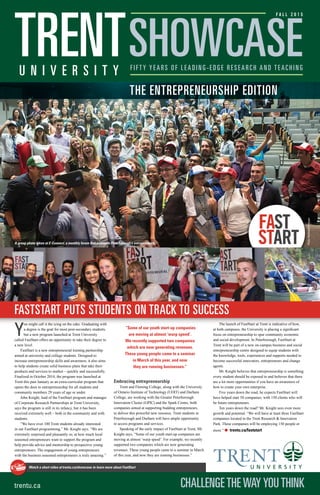
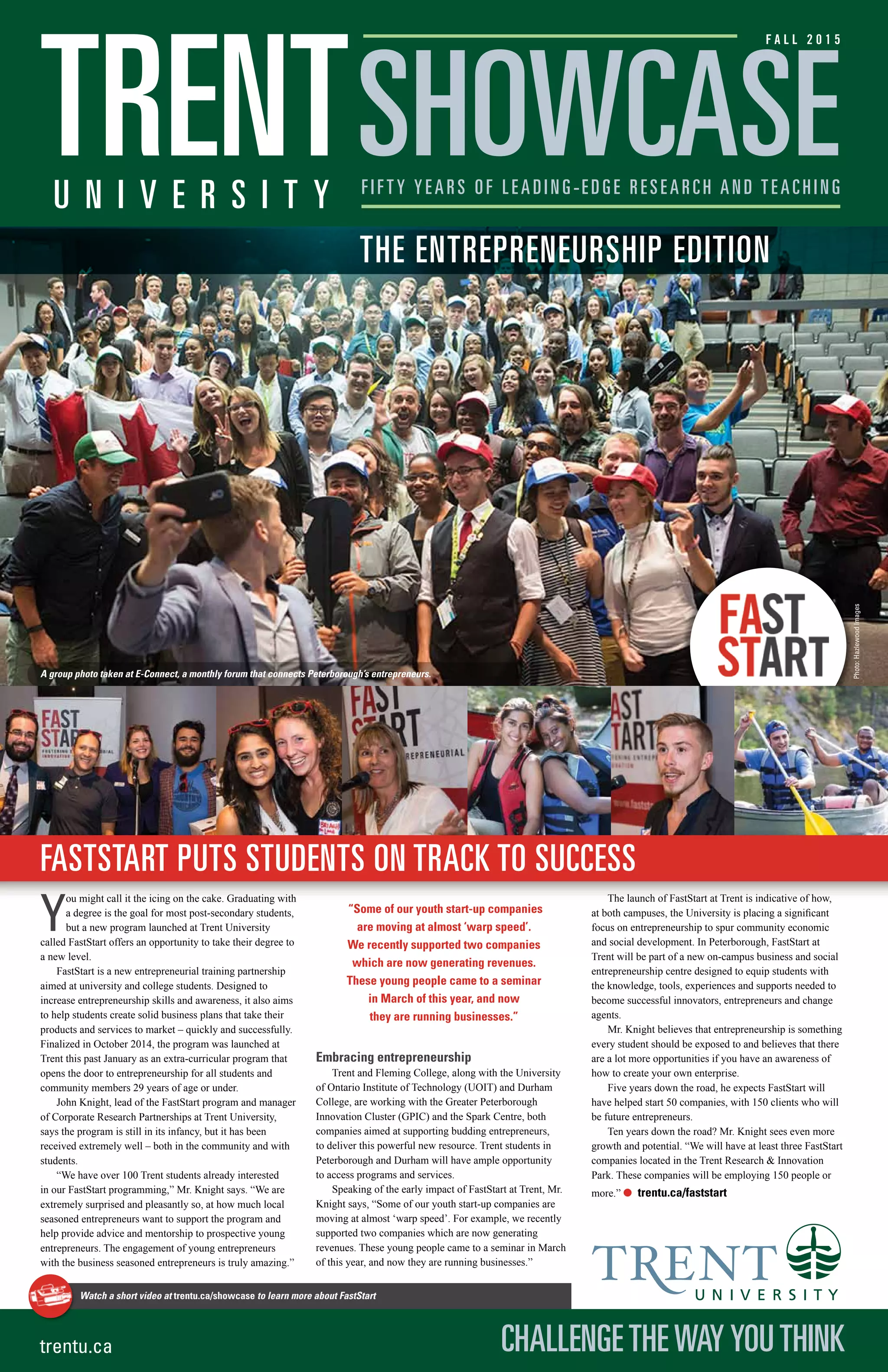
FastStart Puts Students on Track to Success
Y
ou might call it the icing on the cake. Graduating with
a degree is the goal for most post-secondary students,
but a new program launched at Trent University
called FastStart offers an opportunity to take their degree to
a new level.
FastStart is a new entrepreneurial training partnership
aimed at university and college students. Designed to
increase entrepreneurship skills and awareness, it also aims
to help students create solid business plans that take their
products and services to market – quickly and successfully.
Finalized in October 2014, the program was launched at
Trent this past January as an extra-curricular program that
opens the door to entrepreneurship for all students and
community members 29 years of age or under.
John Knight, lead of the FastStart program and manager
of Corporate Research Partnerships at Trent University,
says the program is still in its infancy, but it has been
received extremely well – both in the community and with
students.
“We have over 100 Trent students already interested
in our FastStart programming,” Mr. Knight says. “We are
extremely surprised and pleasantly so, at how much local
seasoned entrepreneurs want to support the program and
help provide advice and mentorship to prospective young
entrepreneurs. The engagement of young entrepreneurs
with the business seasoned entrepreneurs is truly amazing.”
Embracing entrepreneurship
Trent and Fleming College, along with the University
of Ontario Institute of Technology (UOIT) and Durham
College, are working with the Greater Peterborough
Innovation Cluster (GPIC) and the Spark Centre, both
companies aimed at supporting budding entrepreneurs,
to deliver this powerful new resource. Trent students in
Peterborough and Durham will have ample opportunity
to access programs and services.
Speaking of the early impact of FastStart at Trent, Mr.
Knight says, “Some of our youth start-up companies are
moving at almost ‘warp speed’. For example, we recently
supported two companies which are now generating
revenues. These young people came to a seminar in March
of this year, and now they are running businesses.”
The launch of FastStart at Trent is indicative of how,
at both campuses, the University is placing a significant
focus on entrepreneurship to spur community economic
and social development. In Peterborough, FastStart at
Trent will be part of a new on-campus business and social
entrepreneurship centre designed to equip students with
the knowledge, tools, experiences and supports needed to
become successful innovators, entrepreneurs and change
agents.
Mr. Knight believes that entrepreneurship is something
every student should be exposed to and believes that there
are a lot more opportunities if you have an awareness of
how to create your own enterprise.
Five years down the road, he expects FastStart will
have helped start 50 companies, with 150 clients who will
be future entrepreneurs.
Ten years down the road? Mr. Knight sees even more
growth and potential. “We will have at least three FastStart
companies located in the Trent Research & Innovation
Park. These companies will be employing 150 people or
more.” l trentu.ca/faststart
“Some of our youth start-up companies
are moving at almost ‘warp speed’.
We recently supported two companies
which are now generating revenues.
These young people came to a seminar
in March of this year, and now
they are running businesses.”
Photo:HazlewoodImages
Watch a short video at trentu.ca/showcase to learn more about FastStart
A group photo taken at E-Connect, a monthly forum that connects Peterborough’s entrepreneurs.
F
ind ways to focus on your passion. It may sound like unconventional
advice for students in Business Administration, but not so at Trent,
says long-time program professor and entrepreneurship expert Dr.
Ray Dart. He encourages his students to do things that matter.
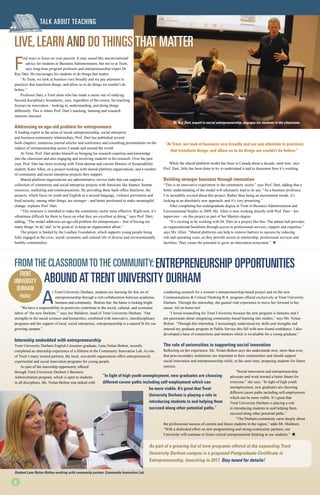
“At Trent, we look at business very broadly and we pay attention to
practices that transform things; and allow us to do things we couldn’t do
before.”
Professor Dart, a Trent alum who has made a career out of studying
beyond disciplinary boundaries, says, regardless of the course, his teaching
focuses on innovation – looking at, understanding, and doing things
differently. This is where Prof. Dart’s teaching, learning and research
interests intersect.
Addressing an age-old problem for entrepreneurs
A leading expert in the areas of social entrepreneurship, social enterprise
and business-community relationships, Prof. Dart has published several
book chapters, numerous journal articles and conference and consulting presentations on the
subject of entrepreneurship across Canada and around the world.
At Trent, Prof. Dart prides himself on bringing his research expertise and knowledge
into the classroom and also engaging and involving students in his research. Over the past
year, Prof. Dart has been working with Trent alumna and current Masters of Sustainability
student, Katie Allen, on a project working with shared platform organizations, and a number
of community and social enterprise projects they support.
Shared platform organizations are administrative service hubs that can support a
collection of community and social enterprise projects with functions like finance, human
resources, marketing and communications. By providing these back-office functions, the
projects, which focus on youth and English as a second language, violence prevention and
food security, among other things, are stronger – and better positioned to make meaningful
change, explains Prof. Dart.
“This structure is intended to make the community sector more effective. Right now, it’s
oftentimes difficult for them to focus on what they are excellent at doing,” says Prof. Dart,
adding, “The model addresses an age-old problem for entrepreneurs – that of having too
many things ‘to do’ and ‘to be good at’ to keep an organization afloat.”
The project is funded by the Laidlaw Foundation, which supports young people being
fully engaged in the civic, social, economic and cultural life of diverse and environmentally
healthy communities.
While the shared platform model has been in Canada about a decade, until now, says
Prof. Dart, little has been done to try to understand it and to document how it’s working.
Building stronger business through innovation
“This is an innovative experiment in the community sector,” says Prof. Dart, adding that a
better understanding of the model will ultimately lead to its use. “As a business professor,
I’m incredibly excited about this project. Rather than being an incremental tweak, it’s
looking at an absolutely new approach, and it’s very promising.”
After completing her undergraduate degree at Trent in Business Administration and
Environmental Studies in 2009, Ms. Allen is now working directly with Prof. Dart – her
supervisor – on this project as part of her Masters degree.
“It’s exciting to be working with Dr. Dart on a project like this. The admin hub provides
an organizational backbone through access to professional services, support and expertise,”
says Ms. Allen. “Shared platforms can help to remove barriers to success by reducing
risk and operating costs, as they provide access to mentorship, professional services and
facilities. They create the potential to grow an innovation ecosystem.” l
Trent
University
Durham
Profile
TALK about teaching
Live,Learnand DoThingsThat Matter
“At Trent, we look at business very broadly and we pay attention to practices
that transform things; and allow us to do things we couldn’t do before.”
Dr. Ray Dart, expert in social entrepreunership, engages his students in the classroom.
A
t Trent University Durham, students are learning the fine art of
entrepreneurship through a rich collaboration between academia,
business and community. Bottom line: the future is looking bright.
“We have a responsibility to positively contribute to the social, cultural, and economic
fabric of ‘the new Durham,’” says Joe Muldoon, head of Trent University Durham. “Our
strengths in the social sciences and humanities, combined with innovative, interdisciplinary
programs and the support of local, social enterprises, entrepreneurship is a natural fit for our
growing campus.”
Internship embedded with entrepreneurship
Trent University Durham English Literature graduate, Lana Nolan-Bolton, recently
completed an internship experience of a lifetime at the Community Innovation Lab. As one
of Trent’s many trusted partners, the local, non-profit organization offers entrepreneurial,
experiential and social innovation programs for young people.
As part of the internship opportunity offered
through Trent University Durham’s Business
Administration program, which is open to students
in all disciplines, Ms. Nolan-Bolton was tasked with
conducting research for a women’s entrepreneurship-based project and on the new
Communications & Critical Thinking B.A. program offered exclusively at Trent University
Durham. Through the internship, she gained vital experience to move her forward in her
career. All on home turf.
“I loved researching for Trent University because the new program is fantastic and I
am passionate about integrating community-based learning into studies,” says Ms. Nolan-
Bolton. “Through this internship, I increasingly understood my skills and strengths and
entered my graduate program in Public Service this fall with new-found confidence. I also
developed a base of connections and mentors which is invaluable for a young graduate.”
The role of universities in supporting social innovation
Reflecting on her experience, Ms. Nolan-Bolton says she understands now, more than ever,
that post-secondary institutions are important to their communities and should support
social innovation and entrepreneurship while, at the same time, preparing students for future
success.
“Social innovation and entrepreneurship
advocate and work toward a better future for
everyone,” she says. “In light of high youth
unemployment, new graduates are choosing
different career paths including self-employment
which can be more viable. It’s great that
Trent University Durham is playing a role
in introducing students to and helping them
succeed along other potential paths.”
“The Durham community cares deeply about
the professional success of current and future students in the region,” adds Mr. Muldoon.
“With a dedicated effort on new programming and strong community partners, our
University will continue to foster critical entrepreneurial thinking in our students.” l
Fromthe Classroomtothe Community:Entrepreneurship Opportunities 		
AboundatTrent University Durham
As part of a growing list of new programs offered at the expanding Trent
University Durham campus is a proposed Postgraduate Certificate in
Entrepreneurship, launching in 2017. Stay tuned for details!
“In light of high youth unemployment, new graduates are choosing
different career paths including self-employment which can
be more viable. It’s great that Trent
University Durham is playing a role in
introducing students to and helping them
succeed along other potential paths.”
2
Student Lana Nolan-Bolton working with community partner, Community Innovation Lab.
3
the world of trent alumni
Today, David Patterson ’66 is one of Bay Street’s
brightest minds and most successful financiers. Long
before his entrepreneurial success, he started out as a kid
from small town Ontario who spent his time devouring
Hardy Boys mysteries borrowed from the storefront library.
It was Trent University that helped shape his life and his
career path. “Trent turned out to be the perfect spot,” he
says.
Graduating with a degree in political studies and
philosophy, Mr. Patterson’s undergraduate years at Trent
proved to be the catalyst that unleashed his extraordinary
curiosity and helped propel him to the summit of the
Canadian financial industry.
A whole new world
“At Trent, I learned how to write, how to think, how to
express myself,” Mr. Patterson recalls. “I also learned how
to process ideas. I had graduated from Smiths Falls and
District Collegiate Institute and then all of a sudden I was
reading the West’s great writers and philosophers. It opened
up a whole new world for me.”
He then put those skills to work when he launched
his Bay Street career as a junior level manager for a trust
company called Canada Permanent. He was soon managing
the head office branch, but the firm had drifted into serious
financial trouble. Interest rates paid on deposits were rising
sharply while the rates earned on five-year mortgages
were fixed.
Mr. Patterson happened to come across a newspaper article
on futures contracts as a means of hedging risks against such
problems. He read everything he could on the subject and put
together a rescue plan for the trust company executive team’s
consideration. Although they later decided to sell the firm to a
bigger rival, his interest in futures was now entrenched.
In the early 1980s, Mr. Patterson joined the corporate
finance department at Bank of Montreal and began to interest
his clients in futures contracts. He moved on to the brokerage
firm Burns Fry to join the fledgling futures desk and by the
end of the decade, his hard work and entrepreneurial spirit had
him launching his own firm, eventually named Northwater
Capital. Northwater developed sophisticated hedging strategies
and products for pension funds and became the largest
company of its kind in Canada – making Mr. Patterson one of
the most successful entrepreneurs to come out of Trent.
Exploring new directions
Now in his sixties, Mr. Patterson has no intention of retiring
and has, in fact, taken Northwater in new directions. These
days, he spends as much as 1,000 hours a year flying to
business meetings across the continent and beyond in order
to coach and assist the leaders of the companies in which he
is invested. Travelling gives him the opportunity to further
feed his curiosity. He keeps upwards of 200 books stored on
his iPad and he reads about everything from new concepts
in psychology to theoretical musings about the origins of
the universe.
“Trent was serious about making us readers and
teaching critical thinking,” he says. Both have clearly been
essential to his remarkable career.
In addition to guiding business leaders and entrepreneurs
toward success, Mr. Patterson also recruits and develops
young talent, including a number of recent graduates from
Trent University. Speaking to the next generation of business
leaders, he has the following advice: “At some point you
recognize it’s not about what you’ve achieved but what you
can give back. I take great satisfaction in helping people
develop their own talents and abilities, recognize and seize
opportunities, and accomplish their goals.” l
The Bridge from Main Streetto Bay Street
Adam Noble and Trent alumna Dr. Andressa
Lacerda ‘08, the minds behind one of the most dynamic
entrepreneurship projects to come out of Trent University in
its 50 year history, make it clear that, although they both have
a set goal for Noble Purification, a water filtration company
based at Trent University, they most certainly don’t have set
roles. Though their titles read president and CEO and COO,
they both know that being successful entrepreneurs means
you wear many hats.
“I was the janitor yesterday and Andressa was the
accountant, that’s what makes a successful company,”
explains Mr. Noble.
Successful is an understatement for these two
entrepreneurs. What started as a science fair project for
Mr. Noble in grade 11, growing algae in a mason jar in his
parent’s sauna, moved to a lab at Trent University working
with Dr. Paul Frost, David Schindler Professor in Aquatic
Science, and has turned into a budding business that has
grown significantly in its two years of operation.
Partnership sparks a new venture
In order for Mr. Noble to take his science fair project to the
next step, he needed to learn how to use a microscope – in
stepped Dr. Lacerda, who was completing her Ph.D. at Trent
in Environmental & Life Sciences at the time. The spark
was immediate. Upon meeting, they both realized they were
onto something bigger. Armed with a passion for science and
vision to change the world, the duo turned to the community
for support.
“The entrepreneurial passion was always there but a
lot of the basic education you might get from a business
administration degree wasn’t something either of us had,”
explains Prof. Lacerda, who came to Trent to study Biology
as an international student from Brazil in 2008. “That’s where
the support we got from both Trent University and the greater
community was essential. I went out into the community to
pull together an advisory board and, because we have such an
awesome community, they said yes.”
To this day, Noble Purification is still using this advisory
board of legal experts, professionals in the banking sector and
retired executives of major companies, for the support to help
the business to evolve further.
Bridging the gap between science and business
As the flagship company to be started out of Trent, one would
imagine that its founders be from a business background. Not
the case for Noble Purification.
“I grew up in a business household, but I always liked
science,” explains Prof. Lacerda. “You often hear that
scientists can’t do business and business can’t do science,
that they are different worlds, but our ability to bridge the
gap between science and business was a huge motivation for
me.” Prof. Lacerda adds that it was the flexibility she was
provided at Trent during her graduate studies that allowed her
to pursue this.
“We are an example that you don’t need an MBA to
be able to run a successful business,” explains Mr. Noble.
“We’ve been able to run our company with the help of our
community and the support of the University. As part of our
interest in helping foster entrepreneurship at Trent, we want
students to know that having the right support is key to any
venture.”
Paying it back...and forward
“We wouldn’t be here without Trent,” Mr. Noble states,
referring to the instrumental role the University, its facilities
and staff have played in his growth as a researcher, and in
their company and its development. Mr. Noble specifically
mentioned the support of Dr. Neil Emery, vice president
Research and International at Trent University, who placed him
in his lab, co-authored a peer review journal article with him
and helped link him to appropriate mentors and advisors at the
University.
With a growing team of five employees, and having
recently expanded their business beyond a Trent lab to a
larger, near-by bio filtration prototype facility, the company is
on the fast track to success and Mr. Noble and Prof. Lacerda
are paying it forward, by reinvesting back into the Trent
community.
“We decided that before we would be paid out of the
company ourselves, we wanted to put money back into Trent,”
explains Mr. Noble, referring to $500,000 and in-kind services
Noble Purifications has invested in Trent through equipment,
mentoring, teaching, and funding of research projects for Trent
grad students.
“Our goal is to push research and student entrepreneurship
forward at Trent University. We plan to grow here – we want to
hire local and have as many Trent students as possible involved
in our research. Investing now makes sense.” l
“You often hear that scientists can’t
do business and business can’t do science,
that they are different worlds, but our ability
to bridge the gap between science and
business was a huge motivation for me.”
Noble Purification, Noble Intentions
	 Trent born business reinvests in the University
David Patterson in his Bay Street office.
Dr. Andressa Lacerda working in
the Noble Purification prototype facility.
Watch a short video at trentu.ca/showcase
to hear more from Dr. Andressa Lacerda about
Noble Purification
$T
he Entrepreneurship course at Trent is more than just
a class. It’s where we were motivated and pushed to
translate ideas to action,” says Sana Virji, a recent
Business Administration graduate and now successful
entrepreneur and business owner.
Ribbet, a business created by Ms. Virji and fellow Trent
student Ribat Chowdhury, which offers coupons, deals
and discounts via apps for iOS and Android, grew from
school project to flourishing start-up, all thanks to Business
Administration 3420 and the $5 Challenge.
From $5 to successful business
The $5 Challenge is a key
component of Professor Cammie
Jaquays’ popular third-year
business class. Each year,
she charges her students with
making as much money as
possible through a start-up
business initiative. They are given
$5 in seed money and five days to
make it all happen.
In 2013, Ms. Virji and Mr. Chowdhury won the
challenge, which is also open to students at Trent and
Fleming College, turning their $5 into $1,500 with the
first generation business card-sized coupon booklet for
students. Last year, the students infused their invention
with technology – a QR code for each coupon – and won
the challenge again. This time, raising $6,300 – the most
money in the challenge’s five-year history at Trent.
Outside the box thinking links creativity and
entrepreneurship
The $5 Challenge is but one of a series of hands-on, real-
time, real-life assignments in Business Administration
3420, where Prof. Jaquays engages her students and
encourages them to think outside-the-box.
Another assignment is the YouInnovate Challenge. Prof.
Jaquays gives the students an everyday household object
and asks them to, within three weeks, create a product, an
accompanying video and a mini business plan to sell that
product.
“Henry Ford said, ‘If I had asked people what they
wanted, they would have said faster horses.’ Using this
example, I encourage the students to go and create
cars – not faster horses,” says Prof. Jaquays, who has
been teaching the course for eight years.
Business plans are only the beginning
At its core, Entrepreneurship 3420, a key course
in the Entrepreneurship Specialization in Trent’s
Business Administration program, explores the questions
“What is an entrepreneur?” and “What does it take to be
one?” and covers issues ranging from the creation and
development of business ideas and models to sociological,
psychological, and economic considerations of the origin
and function of entrepreneurs in business as well as in non-
profit and community settings.
The course takes students beyond the classroom and
into the community – they write business plans as if they
were taking their initiatives to market. And oftentimes, they
do, as demonstrated by the success of Ms. Virji and Mr.
Chowdhury.
Future bright for new entrepreneurs
According to Industry Canada, 98 per cent of businesses in
Canada have one to 99 employees, and so, Prof. Jaquays
says entrepreneurship education is essential. She estimates
that about one-third of her students pursue entrepreneurship
after graduation – and some, even before.
“Our students can do anything they want,” says Prof.
Jaquays. “It’s my job to get them to open up their minds so
that they know they can do it – and give them the resources
and the tools they need to succeed.” l
4
“
matter of course
IdeastoAction:Course Creates
Next Generation of Entrepreneurs
	 	Business Administration 3420: Entrepreneurship
		Professor Cammie Jaquays
E
ntrepreneurship is a high-impact career pathway for students, whether it be
creating a new social enterprise or a new business venture which helps
address unmet needs in our communities or the world at large,” says John
Knight, manager of Corporate Research Partnerships for Trent University.
This is one of the many reasons why Trent University continues to make key
investments in entrepreneurship, most recently with the creation of a Centre for
Social and Business Innovation and Entrepreneurism (CSBIE) which will be housed
in the new Student Centre, a 37,000 sq. ft. facility scheduled to open on Trent’s
Peterborough campus in September 2017.
“This enterprise will build on the successful initiatives and partnerships that
already exist at Trent, such as the FastStart program, the Trent Business Council, The
Cube, the student-run Trent Youth Entrepreneurship Society, and Trent’s involvement
with the Greater Peterborough Innovation Cluster,” Mr. Knight says. “Locating it
in the Student Centre, where students congregate, will attract those who are curious
about starting their own businesses as well as those who have never considered being
entrepreneurs.”
Cultivating student-led initiatives
The CSBIE, hosted by Trent’s Career Centre, will cultivate student-led initiatives and
start-ups by providing experiential, co-curricular and interdisciplinary learning
opportunities, as well as access to mentors, partners and resources. Students will
gain the knowledge, tools, experience, and support to become successful innovators,
entrepreneurs and change agents.
The opportunities for experiential learning are beneficial to all students, even
those who don’t start their own businesses. “There are a lot of learning experiences in
entrepreneurship that are valuable,” says Mr. Knight. “Students learn about financing,
self-motivation, how to manage risk, how to be creative, and how to market.”
Focus on social innovation
A unique aspect of CSBIE will be the focus on social innovation to address pressing
socio-economic issues.
“Because of Trent’s liberal arts background we have a history of involvement in
social causes and social innovation,” Mr. Knight says. “A lot of our graduates work
for social enterprises and non-profits, so it makes sense to help them start their own
social enterprises.”
An investment in solving problems
The $15 million Student Centre will be funded mainly though a student levy which
will cover $10.5 million of the capital costs. The remaining $4.5 million will be
contributed through university sources and philanthropic donations. Mr. Knight
is encouraging friends and alumni of Trent to support entrepreneurism at Trent by
making a donation to the project.
“The Centre for Social and Business Innovation and Entrepreneurism and
its affiliated programming is designed for a low-risk student investigation of the
entrepreneurship option in their career path,” he says. “A large number of students
at Trent have a common passion to find ways of fixing our world’s problems. What
matters is that young people find a way to take action. We truly believe that we can
help Trent students fix the world’s problems, one new enterprise at a time.” l
SolvingtheWorld’s Problems,
	 One New EnterpriseataTime
“A large number of students at Trent have a common passion to find
ways of fixing our world’s problems. What matters is that young people
find a way to take action. We truly believe that we can help Trent
students fix the world’s problems, one new enterprise at a time.”
investing in TRENT
New Centre for Social Business Innovation and Entrepreneurism
	 to create culture of entrepreneurship at Trent
Professor Cammie Jaquays challenges her students
to create a successful business with $5.
With the addition of new accounting courses and a specialization in accounting, as well as plans for a finance specialization
(coming 2017), Trent’s expanding BBA program is better preparing our students for success in today’s competitive business world.
Learn more trentu.ca/businessadmin
Trent alumna Alesia Blackwood ‘96 has high praise for
the support her fledgling tech company, Unlock Math,
has received from The Cube, the business incubator located
in the DNA Building on Trent University’s Peterborough
campus.
The Cube is a technology-focused initiative of the
Greater Peterborough Innovation Cluster (GPIC) that
puts early stage and start-up companies in a nurturing
environment where they have ready access to the expertise,
mentorship, coaching, and networking they need to grow
their businesses. Trent is a core partner of the Innovation
Cluster, along with Fleming College, the Ontario Centre
of Excellence (OCE), and the Peterborough Region Angel
Network (PRAN).
Giving start-ups the support they need, when
they need it
“You don’t know what you need when you’re starting
out,” says Ms. Blackwood, a graduate of the Trent-Queens
concurrent education program, who, with her husband,
Matthew, had the idea of developing an online integrated
math curriculum for struggling students. They were one of
the first clients to be accepted into The Cube.
“At The Cube, you’re surrounded by people with
experience who can look at your business from an outside
perspective,” Ms. Blackwood explains. “You’re connected
to experts who can give you legal advice, access funding
sources, and help with marketing or developing your
website.”
Launched in late 2013, The Cube’s current clients are all
high-growth, high-potential technology enterprises, ranging
from bio-filtration and water management to cancer research,
app development, and sustainable agriculture. They are
assisted by GPIC’s “knowledge partners,” local professionals
who support the growth of these aspiring entrepreneurs and
innovators with advice, guidance, and mentorship.
“We work with high-risk early stage companies who
face failure if they aren’t given the support they need,” says
Martin Yuill, president and CEO of GPIC. “Our goal is to
get entrepreneurs out of the basement, the bedroom, and the
garage, and into an empowering, collaborative space, because
great ideas are not born and developed in isolation. The Cube
offers a supportive environment where entrepreneurs also
benefit from peer mentoring.”
As the only business incubator for technology companies
in the Peterborough region, The Cube fills a gap in the local
job creation spectrum. “We focus on growing globally-
scalable companies who will employ people with science,
technology, engineering, or math backgrounds,” Mr. Yuill
says. “These companies require a very particular skill set and
specific support.”
Partnership benefits both students and clients
Mr. Yuill underlines the value of The Cube’s relationship
with Trent, emphasizing that it goes beyond the provision
of office space. “Trent gives our clients ready access to
academic and intellectual skills, which is important,” he
says, noting that Unlock Math employs graduate students
from Trent’s Mathematics department. “Other clients
benefit from access to Trent facilities like research labs
and advanced equipment.”
He says that Trent’s emphasis on interdisciplinarity,
along with its growing focus on entrepreneurship, makes
it an ideal breeding ground for future clients of The Cube.
“Great ideas come from anywhere and especially from
interdepartmental, interdisciplinary collaboration,” Mr.
Yuill says. “You put an art student together with a computer
science student and suddenly you’ve got something new.
That’s a strength for Trent.”
“Having a facility like The Cube on campus reinforces
Trent’s s commitment to helping their students, by
providing a link between student entrepreneurs and the
academic world and by having a positive impact on the
community in which they are rooted,” Mr. Yuill adds.
From Zerosto Heroes:
The Cube helps nascenttechnology companiesto succeed
“Our goal is to get entrepreneurs out of the basement, the bedroom, and the garage, and into an
empowering, collaborative space, because great ideas are not born and developed in isolation. ”
+ - = <
Alesia Blackwood of Unlock Math working out of The Cube.
“Locating the Centre for Social and Business Innovation and
Entrepreneurship in the new Student Centre, where students
congregate, will attract those who are curious about starting
their own businesses as well as those who have never
considered being entrepreneurs.”
Student Centre view from Founder’s Walk (artist’s rendering, subject to change)
5
A New Crop of Entrepreneurs
Trent partnership providing students sustenance
D
r. Suresh Narine understands the power of cultivating
an entrepreneurial spirit. As a Trent alumnus,
professor in Physics & Astronomy and Chemistry,
and the director of the Trent Centre for Biomaterials
Research (TCBR), he’s surrounded himself with students,
industrial partners and academic collaborators who, like
him, are driven by research that will have a commercial and
environmental impact.
“We deliberately seek students who are motivated by
applied opportunities for their academic work, students
who find motivation by seeing their work impact society,”
explains Professor Narine.
To develop students’ academic and commercial
abilities, they go through a rigorous interview process and
orientation program, are exposed to the centre’s industrial
partners, and are taught early on about the challenges
involved in commercializing a product. Students learn to
prepare research proposals which have economic as well
as scientific justification, are taught to understand the value
of confidentiality, and all students sign a contract which
establishes up front that they will share in the economic
proceeds of any commercialization of their research.
Culture is key…as is the perfect cup of coffee
“If you speak to the students in my lab, they are all excited
and motivated by intellectual property and commercial
application as a measure of their success,” says Prof.
Narine. “Culture is really powerful this way.”
The culture in Prof. Narine’s lab was put on display in
a recent partnership between Materials Science graduate
students, Michael Floros and Michael Tessier. While the
two students’ research focused on
different topics, the collaborative lab
culture at Trent allowed them to merge
their ideas to brew up a unique product
that caffeine craving consumers could
soon be lining up for.
“The Michaels had some kind
of spontaneous combustion together – and excitedly
approached me to approve a project they conceptualized
all on their own,” explains Prof. Narine. “To develop a
series of phase change materials from food lipids which can
effectively regulate the temperature of a cup of coffee.”
The result? Three filed patents, published work in
major academic journals, and a coffee cup that will cool
your coffee to perfect drinking temperature in seconds
and keep it at drinking temperature for nearly four hours.
Professor Narine, the students and their industrial partners
are now seeking to commercialize this invention.
Putting the power in students hands
With over 18 patents coming out of the TCBR alone in the
past five years it’s clear that Prof. Narine is putting the power
in the hands of students – both at the undergraduate and
graduate level - to focus on research that will solve the varied
problems in today’s world.
For example, when one of the commercial partners
involved with the TCBR discovered that a commercially-
generated cocktail of compounds used as waxes were capable
of lowering the crystallization temperature of biodiesel, they
turned to Prof. Narine and his students to figure out which of
the compounds in the mixture was causing this reaction.
A number of undergraduate students, including Bruce
Darling and Mark Baker, two student summer interns, took
up the challenge on this project under the supervision of
more senior students. Both Mr. Darling and Mr. Baker are
now named as inventors on a total of four patents originating
from this research. Not only was the TCBR able to confirm
which compounds were involved, but they were also able
to figure out the mechanisms involved and then vastly
improve on the efficacy of the compounds. This work was a
collaboration between undergraduates Mr. Darling and Mr.
Baker as well as Athira Mohanan’s Ph.D. thesis, research
associates, Dr. Shaojun Li and Dr. Laziz Bouzidi and Prof.
Narine himself.
The group has also been able to design polyurethane
foams made from the byproducts of a vegetable oil refinery
owned and operated by some of the TCBR’s commercial
partners, which has also resulted in four patents being
filed by Ph.D. graduate student Prasanth Pillai, and Drs.
Li, Bouzidi and Narine. This project is also the focus
of significant commercial activity by the centre and its
industrial partners.
“All inventors, including students, share equally on
the proceeds of commercialization which is a wonderful
motivator as it rewards people for their work,” explains
Prof. Narine. “Watching an undergraduate student play an
equal role alongside seasoned academics and researchers in
innovation is tremendously exciting and rewarding.” l
6
J
on Duffy admits there is something satisfying about sinking his teeth into a Trent
tomato. It’s more than just the taste or texture. For Mr. Duffy, a third-year
Sustainable Agriculture and Food Systems student and co-manager of the Trent
Market Garden, it’s knowing that it likely got its start from a seed sown by one of Trent’s
own. It was nurtured by someone he probably knows. It grew on land set aside specifically
for the purpose of producing food for Trent. And – at least to some extent – it’s the result
of a seed planted a few years ago when Trent’s Sustainable Agriculture and Food Systems
program was taking root.
An appetite for sustainability
One year ago, the University announced its students would be taking on a planting exercise
– a bridge between the classroom and the real world – social enterprise in action.
This announcement, coupled with a partnership between Trent University Food
Services, Chartwells and the Sustainable Agriculture and Food Systems program, means
you can now find tomatoes, eggplant, basil, squash, lettuce and a wide variety of ready-to-
eat produce, grown right here on campus and ready to serve at one of Trent’s food service
facilities this fall.
From the one and half acre Trent Market Garden, Chartwells, the operator of on-
campus dining halls and food kiosks, has agreed to buy much of the produce grown. The
food service company also provided seed money for infrastructure at the garden.
Students get their
hands dirty
Reflecting on the
experience, Mr. Duffy says,
“Being involved in this
innovative project has been
an amazing experience.
Being able to play a role in
producing healthy, local food for the Trent community and, at the same time, gain valuable,
hands-on experience has allowed me to apply my academic knowledge to the real world and
is truly invaluable.”
Providing a yield for Trent’s food service facilities is not something Mr. Duffy could
have envisioned in his first year at Trent, but it’s something he’s fully engaged in now.
He laughs at the suggestion that it likely isn’t at all what he would have been doing
between assignments during his University years. He gets some surprising looks when he
shares his stories of planting seeds at home and nurturing them before they can go into the
ground. But it’s not just him, he insists. There’s a big buy-in from many in the Sustainable
Agriculture and Food Systems program at Trent. He hopes it can be a lasting, viable legacy
for Trent and the program.
Mr. Duffy admits that this isn’t a project he could have tackled on his own. A number
of other people, including fellow classmate, Emma MacDonald, co-manager of the Trent
Market Garden, devoted a great deal of time in planning, writing of numerous grant
applications, and working the land throughout the summer.
Mr. Duffy says his time at the Trent Market Garden has inspired him to make use of
his horticultural knowledge after graduation by operating an urban farm or working with
small not-for-profit organizations to help to integrate mini-farms and gardens into urban
environments.
A natural fit
Mark Murdoch, director of Food Services for Trent University, says the students
are learning how demanding farm work can be while also gaining valuable
experience. Part of the program requires students to develop a business plan.
Mr. Murdoch says the farm needed infrastructure to be able to grow food,
the students needed a location for their market garden, and Chartwells wanted to
buy a food product that is locally grown. It was a natural fit. n
The Trent Market Garden and Experimental Farm are part
of the new Trent School of the Environment.
The new school, launched this fall, brings together
vast expertise at Trent to spark and inspire
the next generation of global environmental leaders.
trentu.ca/environment
Jon Duffy
Jon Duffy guides a tour through the Trent Market Garden.
Student Co-Inventors Thrive
at trent university
“We deliberately seek students
who are motivated by applied opportunities
for their academic work, students who find
motivation by seeing their work impact society.”
Meet Dr. Suresh Narine and hear more about how his lab fosters entrepreneurship in a short video trentu.ca/showcase
Professor Narine’s work with his students, collaborators
and commercial partners has once again received
a resounding vote of confidence from his industrial
funders and the Natural Sciences and Engineering
Research Council (NSERC) of Canada: he has recently
been reappointed as a Senior NSERC Industrial
Research Chair (IRC), his third consecutive renewal as
an NSERC IRC.
Dr. Suresh Narine and student co-inventors in the Trent Centre for Biomaterials
Research.
Cameron Ogden discusses the Trent Youth Entrepreneurship Society in a short video at trentu.ca/showcase
graduate studies
7
or Hasham Burhani, straightforward learning is a tad
boring. It’s not nearly as fun, engaging, or addictive as
gaming. For this graduate student, currently enrolled in
Trent’s Applications of Modelling program, the intriguing
concept of gamified learning morphed into his own
business.
Drawing inspiration from his early gamer days he says,
“Important information can be consumed in a much more
fun way with increased retention and recall. That’s why we
remember the rules of Super Mario from our childhoods.”
In 2001, while a student at Trent, Mr. Burhani founded
Evolutis Technologies to create interactive learning
environments for use in and out of the classroom that
stimulate vision, sound and touch at the same time.
Through fun and gaming the user is fully engaged while
retaining maximum information.
“We hope to see our customers playing these games
while waiting for a bus, or on a train heading to university,”
said Mr. Burhani. “In future we would like to team up
with universities to deliver subject specific apps that take
advantage of our innovations.”
Evolutis Technologies is currently producing two
interactive, educational video games designed for mobile
devices that focus on chemistry and biology. The company
plans to complete Atmos this year while working on
Infectus through 2016.
Game comes to life at The Cube
To launch his business, Mr. Burhani set up shop at The
Cube, a technology business incubator located on Trent
University’s Peterborough campus. Through strategic
partnerships with organizations including the Ontario
Centres of Excellence (OCE), The Cube offers access
to top-notch research facilities, academics and mentors.
Among other services, The Cube provides business
management tools, expertise, training and connections to
funding.
The Cube in Peterborough and the Spark Centre in
Durham, a fellow Trent partner, provided office space
and facilitated the company’s participation in the OCE
Discovery innovation-to-commercialization conference.
“They have both been of tremendous help in regards
to giving us opportunities to represent game innovation in
Peterborough,” Mr. Burhani says, adding, “Trent University
has great computer science and business departments
that can provide The Cube with future technologists
and entrepreneurs. The Cube is an important technology
innovation hub in the region due to this strategic
collaboration.”
Mr. Burhani initially graduated from Trent’s Computing
and Information Systems program, specializing in software
engineering. His entrepreneurial vision emerged through
exposure to additional sciences during his studies including
biology, chemistry and psychology.
“It was during these courses where the idea of gamified
learning really dawned on me,” he recalls.
Following graduation from Trent, he worked for a year
as a software developer in Vancouver, before returning in
2013 to pursue is masters degree in Applied Modelling and
Quantitative Methods. In addition to inspiration, he also
values the technological skills he continues to acquire at
Trent.
“My theoretical understanding of programming
paradigms enabled me to pick up new programming
languages very quickly,” stated Mr. Burhani. “The final
software engineering course at Trent was instrumental when
implementing solutions from prototype to finished product.
Trent offered me the perfect mix of theory and practice.” l
Leveling Up:Transforming Gaming into Business Success
“The Cube is an important technology
innovation hub in the region due to this strategic
collaboration.”
“The final software engineering course at Trent
was instrumental when implementing solutions
from prototype to finished product. Trent offered
me the perfect mix of theory and practice.”
I
f you’re a Trent University student on the brink of launching your own business,
the student-run Trent Youth Entrepreneurship Society (TYES) wants to hear your
percolating ideas. TYES provides students of all stripes, whether they’re studying
Anthropology, Chemistry, English Literature or anything in between, with vital resources
andguidance to transform their entrepreneurial dreams into a real-life operation.
Hanging the ‘open’ sign on student businesses
“We are fulfilling the unique need to support all kinds of entrepreneurs and connect students
from different subjects to potential partners and team members,” said Cameron Ogden,
a Business Administration student in his fifth year and president of TYES, one of Trent’s
newest student groups. “Our Business program’s specialization in entrepreneurship, with
a focus on other areas such as marketing, accounting human resources, is strengthened
by our connection to numerous other student groups including the Trent Central Student
Association, the Trent Business Students Association and the Trent Marketing Association.”
The student-run organization offers provides students with the opportunity to participate
in networking events featuring guest speakers and workshops to help students create
business plans and improve their pitching skills. A key component of the group’s mandate
is securing financing to support entrepreneurial students while providing critical resources
essential for job creation and the success of Trent students.
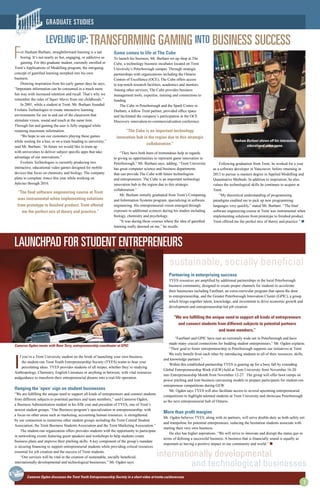
“Our services will be vital in the creation of sustainable, socially beneficial,
internationally developmental and technological businesses,” Mr. Ogden says.
Partnering in enterprising success
TYES resources are amplified by additional partnerships in the local Peterborough
business community, designed to create proper channels for students to accelerate
their businesses including FastStart, an extra-curricular program that opens the door
to entrepreneurship, and the Greater Peterborough Innovation Cluster (GPIC), a group
which brings together talent, knowledge, and investment to drive economic growth and
development and entrepreneurship-led job creation.
“FastStart and GPIC have cast an extremely wide net in Peterborough and have
made many crucial connections for budding student entrepreneurs,” Mr. Ogden explains.
“Their goal to foster entrepreneurship in Peterborough supports our initiatives at Trent.
We truly benefit from each other by introducing students to all of their resources, skills,
and knowledge partners.”
Within this established partnership TYES is gearing up for a busy fall by extending
Global Entrepreneurship Week (GEW) held at Trent University from November 16-20
into Entrepreneurship Month from November 12-27. The group will offer boot camps on
power pitching and lean business canvassing models to prepare participants for student-run
entrepreneur competitions during GEW.
Mr. Ogden says TYES will also facilitate access to several upcoming entrepreneurial
competitions to highlight talented students at Trent University and showcase Peterborough
as the next entrepreneurial hub of Ontario.
More than profit margins
Mr. Ogden believes TYES, along with its partners, will serve double-duty as both safety net
and trampoline for potential entrepreneurs, reducing the hesitation students associate with
starting their very own business.
He also has higher aspirations. “We will strive to innovate and disrupt the status quo in
terms of defining a successful business. A business that is financially sound is equally as
important as having a positive impact in our community and world.” l
“We are fulfilling the unique need to support all kinds of entrepreneurs
and connect students from different subjects to potential partners
and team members,”
Launchpad for Student Entrepreneurs
sustainable, socially beneficial
internationally developmental
and technological businesses
F
	 Hasham Burhani shows off his interactive,
	 educational video game.
Cameron Ogden meets with Rose Terry, entrepreneurship coordinator at GPIC.
Listening to the Sound of Ribbet
T
ake a stroll through downtown Peterborough and you’ll hear it… ribbet, ribbet. What
started as a business challenge for Trent University students Sana Virji and Ribat
Chowdhury, has transformed from an entrepreneurial notion to a money-
making venture. Last fall, the Trent Business Students Association hosted a
challenge that saw students challenged with making as much money as
possible through a start-up business initiative. They were given $5 in seed
money and five days to make it all happen. With their business discount
coupon program, which allows shoppers to save on meals, eyeglasses,
spa treatments and more, Ms. Virji and Mr. Chowdhury, then both fourth-year students, exceeded
the expectations of their professors and classmates. The $5 challenge turned into $6,300 for the
pair, setting an all-time record in the challenge’s history.
King of Quinoa Battles the Dragons
A
fter a health crisis that resulted in the loss of a third of his pancreas,
Trent alumnus Jamie Draves, a graduate from Environmental and
Resource Science and Chemistry, turned to quinoa. This
superfood inspired him to start his own business, and to help others like
him. About six months ago, Trent alumnus Jamie Draves, a graduate
from Environmental and Resource Science and Chemistry, took his
pitch to CBC Television’s Dragon’s Den, looking to introduce quinoa
to his already established Katan Kitchens business, an innovative, health food enterprise that
produces high quality superfoods for the ‘Food for Health’ market, which has emerged as a leader
in the research and development of quinoa in Ontario. His venture – both on television and in
the ground – has begun to bear the fruits of his labour. “We are just now starting to receive crops
from 15 different farmers, tallying more than 150 acres of quinoa,” Mr. Draves said. “We also are
expecting to make some announcements in the next month or two on the outcome of the deal with
Vikram Vij from Dragon’s Den.”
Tech Savvy Seniors
I
n true Trent style, a recent interdisciplinary partnership sees, Cammie
Jaquays, professor in Business Administration, and Kim English,
professor in the Trent/Fleming School of Nursing, teaming up to
address the needs of seniors. Connected Care Communications is a
platform solution provider that incorporates mobile technology with
secure cloud storage to address the needs of seniors. The concept replaces
the outdated paper trail system involved for senior in home care with
new mobile technology that helps seniors with managing everyday health
challenges so they can safely stay at home longer. “We are committed to
empowering seniors in their homes with technology innovations and also for the nursing registries
that provide for them,” Prof. Jaquays says. “Studies show that seniors want to age at home. It’s
critical that we determine how technology can help and how the use of technology affects seniors
and care providers.”
Poutine and Ph.D.’s
I
t’s probably oversimplifying things to say Canadian Studies Ph.D.
candidate Peggy Shaughnessy has a passion for helping people. But
it’s the reason she’s back at Trent and juggling her studies with running
a successful downtown Peterborough business. Owner of the Whistle Stop,
a popular poutinerie and restaurant, Ms. Shaughnessy, who completed her
B.Sc. in Psychology at Trent, before tackling the master’s of Canadian
Studies and Indigenous Studies also at Trent, applies her drive as a passionate
entrepreneur to everything she does. Most recently, that includes heading back to Trent to
continue her work with First Nations communities, and building on her Master’s research, to
develop a social network for those affected by mental health and addiction. “Trent has been a
huge part of my success. This is my passion,” says Ms. Shaugnessy.
Showcase is printed bi-annually by the Marketing &
Communications Office at Trent University. Accessible versions of
this document are available upon request at trentu.ca/accessible.
For media inquiries, please contact the Marketing &
Communications Office at 705-748-1011 x6180.
Distributed in accordance with Canada Post Mail Sales Agreement
#40064326
ChallengeTheWayYouThink
8
A Glimpse intothe Latest Findings
atTrent
meet a TRENT student
What does a Business Administration degree have to do with a love of the
theatre? For Dane Shumak, it is just as important as a great headshot or
dramatic soliloquy.
As a performer, director and entrepreneur, this recent Business Administration
graduate, and co-founder of Cordwainer Productions, can confidently call the shots
both on stage and in the back office. With several successful productions under his
belt already, Mr. Shumak is bringing down the house.
Opening doors in competitive theatrical world
Unsure how to channel his love of theatre into a successful and viable career,
Mr. Shumak came to Trent University in 2011, attracted by small class sizes and
a liberal teaching style. After taking several first-year courses he discovered that
a mind for business could open
many doors in the competitive
theatrical world.
“It’s a unique position, as
not a lot of theatre artists have a
business background, and I think
it allows me to be uniquely and
especially successful,” says Mr.
Shumak, who took advantage of
the flexibility of Trent’s Business
program and combined his
Business degree with a minor
in English – just one of the five
ways students can do business
at Trent. During that pivotal
first year at Trent Mr. Shumak
performed in the Anne Shirley
Theatre Company’s (ASTC)
production of Xanadu. As he further pursued his Business Administration degree
he tried his hand at directing Spring Awakening at the Market Hall Performing Arts
Centre. He’s been hooked on theatre ever since.
Business mind cues director’s vision
“Being a theatre director is a perfect synthesis of art and management,” said
Mr. Shumak. “Every day, I use what I’ve learned in numerous areas including
marketing, negotiation, accounting, budgeting and human resources to ensure
balance in each production and to promote the overall success of my company.”
Following the success of Spring Awakening the undergraduate launched his
own company, Cordwainer Productions, in 2014 with fellow Trent students Bronte
Germain, Ryan Hancock and Justin Hiscox. He feels the Trent community provided
vital encouragement for his theatrical endeavours with funding and support.
“Without the Anne Shirley Theatre Company, Cordwainer Productions would
never have gotten off the ground,” stated Mr. Shumak. “The partnership of the
Trent Central Student Association (TCSA) and other University departments has
been instrumental in developing audiences and involving the Trent community in
the wonderful work we are trying to do.”
Bright lights, big city – productions expand to Toronto
Cordwainer Productions has staged several productions including The Last Five
Years, Dogfight: The Musical and a successful concert series. The company is
currently working a production of the musical American Idiot this fall.
As with many Trent students, Mr. Shumak’s future is his for the taking. While
continuing to work with Cordwainer Productions he is exploring his options in
Toronto and further developing as an artist - an artist armed with an education in
business.
“Entrepreneurship is important to the core of Trent University,” says Mr.
Shumak. “Where there isn’t an opportunity, create one. Don’t be afraid to take
risks. These are things that Trent and my education here have given me the
confidence to do, and I’m so glad to have been given that chance.” l
Scriptinga New Future:
TheArtand Business ofTheatre
“Entrepreneurship is important to the core of Trent University.
Where there isn’t an opportunity, create one. Don’t be afraid to take
risks. These are things that Trent and my education here have given me
the confidence to do, and I’m so glad to have been given that chance.”
Dane Shumak performs in a successful
production of Rent.
More news: trentu.ca/news
Hear how Dane Shumak channeled his love for theatre into a successful
business in a short video trentu.ca/showcase

Trent university showcase fall 2015

  • 1.
    Showcase trentu.ca F A LL 2 0 1 5 TRENTU N I V E R S I T Y ChallengeTheWayYouThink fifty years of leading-edge resea rch and teaching the Entrepreneurship Edition FastStart Puts Students on Track to Success Y ou might call it the icing on the cake. Graduating with a degree is the goal for most post-secondary students, but a new program launched at Trent University called FastStart offers an opportunity to take their degree to a new level. FastStart is a new entrepreneurial training partnership aimed at university and college students. Designed to increase entrepreneurship skills and awareness, it also aims to help students create solid business plans that take their products and services to market – quickly and successfully. Finalized in October 2014, the program was launched at Trent this past January as an extra-curricular program that opens the door to entrepreneurship for all students and community members 29 years of age or under. John Knight, lead of the FastStart program and manager of Corporate Research Partnerships at Trent University, says the program is still in its infancy, but it has been received extremely well – both in the community and with students. “We have over 100 Trent students already interested in our FastStart programming,” Mr. Knight says. “We are extremely surprised and pleasantly so, at how much local seasoned entrepreneurs want to support the program and help provide advice and mentorship to prospective young entrepreneurs. The engagement of young entrepreneurs with the business seasoned entrepreneurs is truly amazing.” Embracing entrepreneurship Trent and Fleming College, along with the University of Ontario Institute of Technology (UOIT) and Durham College, are working with the Greater Peterborough Innovation Cluster (GPIC) and the Spark Centre, both companies aimed at supporting budding entrepreneurs, to deliver this powerful new resource. Trent students in Peterborough and Durham will have ample opportunity to access programs and services. Speaking of the early impact of FastStart at Trent, Mr. Knight says, “Some of our youth start-up companies are moving at almost ‘warp speed’. For example, we recently supported two companies which are now generating revenues. These young people came to a seminar in March of this year, and now they are running businesses.” The launch of FastStart at Trent is indicative of how, at both campuses, the University is placing a significant focus on entrepreneurship to spur community economic and social development. In Peterborough, FastStart at Trent will be part of a new on-campus business and social entrepreneurship centre designed to equip students with the knowledge, tools, experiences and supports needed to become successful innovators, entrepreneurs and change agents. Mr. Knight believes that entrepreneurship is something every student should be exposed to and believes that there are a lot more opportunities if you have an awareness of how to create your own enterprise. Five years down the road, he expects FastStart will have helped start 50 companies, with 150 clients who will be future entrepreneurs. Ten years down the road? Mr. Knight sees even more growth and potential. “We will have at least three FastStart companies located in the Trent Research & Innovation Park. These companies will be employing 150 people or more.” l trentu.ca/faststart “Some of our youth start-up companies are moving at almost ‘warp speed’. We recently supported two companies which are now generating revenues. These young people came to a seminar in March of this year, and now they are running businesses.” Photo:HazlewoodImages Watch a short video at trentu.ca/showcase to learn more about FastStart A group photo taken at E-Connect, a monthly forum that connects Peterborough’s entrepreneurs.
  • 2.
    F ind ways tofocus on your passion. It may sound like unconventional advice for students in Business Administration, but not so at Trent, says long-time program professor and entrepreneurship expert Dr. Ray Dart. He encourages his students to do things that matter. “At Trent, we look at business very broadly and we pay attention to practices that transform things; and allow us to do things we couldn’t do before.” Professor Dart, a Trent alum who has made a career out of studying beyond disciplinary boundaries, says, regardless of the course, his teaching focuses on innovation – looking at, understanding, and doing things differently. This is where Prof. Dart’s teaching, learning and research interests intersect. Addressing an age-old problem for entrepreneurs A leading expert in the areas of social entrepreneurship, social enterprise and business-community relationships, Prof. Dart has published several book chapters, numerous journal articles and conference and consulting presentations on the subject of entrepreneurship across Canada and around the world. At Trent, Prof. Dart prides himself on bringing his research expertise and knowledge into the classroom and also engaging and involving students in his research. Over the past year, Prof. Dart has been working with Trent alumna and current Masters of Sustainability student, Katie Allen, on a project working with shared platform organizations, and a number of community and social enterprise projects they support. Shared platform organizations are administrative service hubs that can support a collection of community and social enterprise projects with functions like finance, human resources, marketing and communications. By providing these back-office functions, the projects, which focus on youth and English as a second language, violence prevention and food security, among other things, are stronger – and better positioned to make meaningful change, explains Prof. Dart. “This structure is intended to make the community sector more effective. Right now, it’s oftentimes difficult for them to focus on what they are excellent at doing,” says Prof. Dart, adding, “The model addresses an age-old problem for entrepreneurs – that of having too many things ‘to do’ and ‘to be good at’ to keep an organization afloat.” The project is funded by the Laidlaw Foundation, which supports young people being fully engaged in the civic, social, economic and cultural life of diverse and environmentally healthy communities. While the shared platform model has been in Canada about a decade, until now, says Prof. Dart, little has been done to try to understand it and to document how it’s working. Building stronger business through innovation “This is an innovative experiment in the community sector,” says Prof. Dart, adding that a better understanding of the model will ultimately lead to its use. “As a business professor, I’m incredibly excited about this project. Rather than being an incremental tweak, it’s looking at an absolutely new approach, and it’s very promising.” After completing her undergraduate degree at Trent in Business Administration and Environmental Studies in 2009, Ms. Allen is now working directly with Prof. Dart – her supervisor – on this project as part of her Masters degree. “It’s exciting to be working with Dr. Dart on a project like this. The admin hub provides an organizational backbone through access to professional services, support and expertise,” says Ms. Allen. “Shared platforms can help to remove barriers to success by reducing risk and operating costs, as they provide access to mentorship, professional services and facilities. They create the potential to grow an innovation ecosystem.” l Trent University Durham Profile TALK about teaching Live,Learnand DoThingsThat Matter “At Trent, we look at business very broadly and we pay attention to practices that transform things; and allow us to do things we couldn’t do before.” Dr. Ray Dart, expert in social entrepreunership, engages his students in the classroom. A t Trent University Durham, students are learning the fine art of entrepreneurship through a rich collaboration between academia, business and community. Bottom line: the future is looking bright. “We have a responsibility to positively contribute to the social, cultural, and economic fabric of ‘the new Durham,’” says Joe Muldoon, head of Trent University Durham. “Our strengths in the social sciences and humanities, combined with innovative, interdisciplinary programs and the support of local, social enterprises, entrepreneurship is a natural fit for our growing campus.” Internship embedded with entrepreneurship Trent University Durham English Literature graduate, Lana Nolan-Bolton, recently completed an internship experience of a lifetime at the Community Innovation Lab. As one of Trent’s many trusted partners, the local, non-profit organization offers entrepreneurial, experiential and social innovation programs for young people. As part of the internship opportunity offered through Trent University Durham’s Business Administration program, which is open to students in all disciplines, Ms. Nolan-Bolton was tasked with conducting research for a women’s entrepreneurship-based project and on the new Communications & Critical Thinking B.A. program offered exclusively at Trent University Durham. Through the internship, she gained vital experience to move her forward in her career. All on home turf. “I loved researching for Trent University because the new program is fantastic and I am passionate about integrating community-based learning into studies,” says Ms. Nolan- Bolton. “Through this internship, I increasingly understood my skills and strengths and entered my graduate program in Public Service this fall with new-found confidence. I also developed a base of connections and mentors which is invaluable for a young graduate.” The role of universities in supporting social innovation Reflecting on her experience, Ms. Nolan-Bolton says she understands now, more than ever, that post-secondary institutions are important to their communities and should support social innovation and entrepreneurship while, at the same time, preparing students for future success. “Social innovation and entrepreneurship advocate and work toward a better future for everyone,” she says. “In light of high youth unemployment, new graduates are choosing different career paths including self-employment which can be more viable. It’s great that Trent University Durham is playing a role in introducing students to and helping them succeed along other potential paths.” “The Durham community cares deeply about the professional success of current and future students in the region,” adds Mr. Muldoon. “With a dedicated effort on new programming and strong community partners, our University will continue to foster critical entrepreneurial thinking in our students.” l Fromthe Classroomtothe Community:Entrepreneurship Opportunities AboundatTrent University Durham As part of a growing list of new programs offered at the expanding Trent University Durham campus is a proposed Postgraduate Certificate in Entrepreneurship, launching in 2017. Stay tuned for details! “In light of high youth unemployment, new graduates are choosing different career paths including self-employment which can be more viable. It’s great that Trent University Durham is playing a role in introducing students to and helping them succeed along other potential paths.” 2 Student Lana Nolan-Bolton working with community partner, Community Innovation Lab.
  • 3.
    3 the world oftrent alumni Today, David Patterson ’66 is one of Bay Street’s brightest minds and most successful financiers. Long before his entrepreneurial success, he started out as a kid from small town Ontario who spent his time devouring Hardy Boys mysteries borrowed from the storefront library. It was Trent University that helped shape his life and his career path. “Trent turned out to be the perfect spot,” he says. Graduating with a degree in political studies and philosophy, Mr. Patterson’s undergraduate years at Trent proved to be the catalyst that unleashed his extraordinary curiosity and helped propel him to the summit of the Canadian financial industry. A whole new world “At Trent, I learned how to write, how to think, how to express myself,” Mr. Patterson recalls. “I also learned how to process ideas. I had graduated from Smiths Falls and District Collegiate Institute and then all of a sudden I was reading the West’s great writers and philosophers. It opened up a whole new world for me.” He then put those skills to work when he launched his Bay Street career as a junior level manager for a trust company called Canada Permanent. He was soon managing the head office branch, but the firm had drifted into serious financial trouble. Interest rates paid on deposits were rising sharply while the rates earned on five-year mortgages were fixed. Mr. Patterson happened to come across a newspaper article on futures contracts as a means of hedging risks against such problems. He read everything he could on the subject and put together a rescue plan for the trust company executive team’s consideration. Although they later decided to sell the firm to a bigger rival, his interest in futures was now entrenched. In the early 1980s, Mr. Patterson joined the corporate finance department at Bank of Montreal and began to interest his clients in futures contracts. He moved on to the brokerage firm Burns Fry to join the fledgling futures desk and by the end of the decade, his hard work and entrepreneurial spirit had him launching his own firm, eventually named Northwater Capital. Northwater developed sophisticated hedging strategies and products for pension funds and became the largest company of its kind in Canada – making Mr. Patterson one of the most successful entrepreneurs to come out of Trent. Exploring new directions Now in his sixties, Mr. Patterson has no intention of retiring and has, in fact, taken Northwater in new directions. These days, he spends as much as 1,000 hours a year flying to business meetings across the continent and beyond in order to coach and assist the leaders of the companies in which he is invested. Travelling gives him the opportunity to further feed his curiosity. He keeps upwards of 200 books stored on his iPad and he reads about everything from new concepts in psychology to theoretical musings about the origins of the universe. “Trent was serious about making us readers and teaching critical thinking,” he says. Both have clearly been essential to his remarkable career. In addition to guiding business leaders and entrepreneurs toward success, Mr. Patterson also recruits and develops young talent, including a number of recent graduates from Trent University. Speaking to the next generation of business leaders, he has the following advice: “At some point you recognize it’s not about what you’ve achieved but what you can give back. I take great satisfaction in helping people develop their own talents and abilities, recognize and seize opportunities, and accomplish their goals.” l The Bridge from Main Streetto Bay Street Adam Noble and Trent alumna Dr. Andressa Lacerda ‘08, the minds behind one of the most dynamic entrepreneurship projects to come out of Trent University in its 50 year history, make it clear that, although they both have a set goal for Noble Purification, a water filtration company based at Trent University, they most certainly don’t have set roles. Though their titles read president and CEO and COO, they both know that being successful entrepreneurs means you wear many hats. “I was the janitor yesterday and Andressa was the accountant, that’s what makes a successful company,” explains Mr. Noble. Successful is an understatement for these two entrepreneurs. What started as a science fair project for Mr. Noble in grade 11, growing algae in a mason jar in his parent’s sauna, moved to a lab at Trent University working with Dr. Paul Frost, David Schindler Professor in Aquatic Science, and has turned into a budding business that has grown significantly in its two years of operation. Partnership sparks a new venture In order for Mr. Noble to take his science fair project to the next step, he needed to learn how to use a microscope – in stepped Dr. Lacerda, who was completing her Ph.D. at Trent in Environmental & Life Sciences at the time. The spark was immediate. Upon meeting, they both realized they were onto something bigger. Armed with a passion for science and vision to change the world, the duo turned to the community for support. “The entrepreneurial passion was always there but a lot of the basic education you might get from a business administration degree wasn’t something either of us had,” explains Prof. Lacerda, who came to Trent to study Biology as an international student from Brazil in 2008. “That’s where the support we got from both Trent University and the greater community was essential. I went out into the community to pull together an advisory board and, because we have such an awesome community, they said yes.” To this day, Noble Purification is still using this advisory board of legal experts, professionals in the banking sector and retired executives of major companies, for the support to help the business to evolve further. Bridging the gap between science and business As the flagship company to be started out of Trent, one would imagine that its founders be from a business background. Not the case for Noble Purification. “I grew up in a business household, but I always liked science,” explains Prof. Lacerda. “You often hear that scientists can’t do business and business can’t do science, that they are different worlds, but our ability to bridge the gap between science and business was a huge motivation for me.” Prof. Lacerda adds that it was the flexibility she was provided at Trent during her graduate studies that allowed her to pursue this. “We are an example that you don’t need an MBA to be able to run a successful business,” explains Mr. Noble. “We’ve been able to run our company with the help of our community and the support of the University. As part of our interest in helping foster entrepreneurship at Trent, we want students to know that having the right support is key to any venture.” Paying it back...and forward “We wouldn’t be here without Trent,” Mr. Noble states, referring to the instrumental role the University, its facilities and staff have played in his growth as a researcher, and in their company and its development. Mr. Noble specifically mentioned the support of Dr. Neil Emery, vice president Research and International at Trent University, who placed him in his lab, co-authored a peer review journal article with him and helped link him to appropriate mentors and advisors at the University. With a growing team of five employees, and having recently expanded their business beyond a Trent lab to a larger, near-by bio filtration prototype facility, the company is on the fast track to success and Mr. Noble and Prof. Lacerda are paying it forward, by reinvesting back into the Trent community. “We decided that before we would be paid out of the company ourselves, we wanted to put money back into Trent,” explains Mr. Noble, referring to $500,000 and in-kind services Noble Purifications has invested in Trent through equipment, mentoring, teaching, and funding of research projects for Trent grad students. “Our goal is to push research and student entrepreneurship forward at Trent University. We plan to grow here – we want to hire local and have as many Trent students as possible involved in our research. Investing now makes sense.” l “You often hear that scientists can’t do business and business can’t do science, that they are different worlds, but our ability to bridge the gap between science and business was a huge motivation for me.” Noble Purification, Noble Intentions Trent born business reinvests in the University David Patterson in his Bay Street office. Dr. Andressa Lacerda working in the Noble Purification prototype facility. Watch a short video at trentu.ca/showcase to hear more from Dr. Andressa Lacerda about Noble Purification
  • 4.
    $T he Entrepreneurship courseat Trent is more than just a class. It’s where we were motivated and pushed to translate ideas to action,” says Sana Virji, a recent Business Administration graduate and now successful entrepreneur and business owner. Ribbet, a business created by Ms. Virji and fellow Trent student Ribat Chowdhury, which offers coupons, deals and discounts via apps for iOS and Android, grew from school project to flourishing start-up, all thanks to Business Administration 3420 and the $5 Challenge. From $5 to successful business The $5 Challenge is a key component of Professor Cammie Jaquays’ popular third-year business class. Each year, she charges her students with making as much money as possible through a start-up business initiative. They are given $5 in seed money and five days to make it all happen. In 2013, Ms. Virji and Mr. Chowdhury won the challenge, which is also open to students at Trent and Fleming College, turning their $5 into $1,500 with the first generation business card-sized coupon booklet for students. Last year, the students infused their invention with technology – a QR code for each coupon – and won the challenge again. This time, raising $6,300 – the most money in the challenge’s five-year history at Trent. Outside the box thinking links creativity and entrepreneurship The $5 Challenge is but one of a series of hands-on, real- time, real-life assignments in Business Administration 3420, where Prof. Jaquays engages her students and encourages them to think outside-the-box. Another assignment is the YouInnovate Challenge. Prof. Jaquays gives the students an everyday household object and asks them to, within three weeks, create a product, an accompanying video and a mini business plan to sell that product. “Henry Ford said, ‘If I had asked people what they wanted, they would have said faster horses.’ Using this example, I encourage the students to go and create cars – not faster horses,” says Prof. Jaquays, who has been teaching the course for eight years. Business plans are only the beginning At its core, Entrepreneurship 3420, a key course in the Entrepreneurship Specialization in Trent’s Business Administration program, explores the questions “What is an entrepreneur?” and “What does it take to be one?” and covers issues ranging from the creation and development of business ideas and models to sociological, psychological, and economic considerations of the origin and function of entrepreneurs in business as well as in non- profit and community settings. The course takes students beyond the classroom and into the community – they write business plans as if they were taking their initiatives to market. And oftentimes, they do, as demonstrated by the success of Ms. Virji and Mr. Chowdhury. Future bright for new entrepreneurs According to Industry Canada, 98 per cent of businesses in Canada have one to 99 employees, and so, Prof. Jaquays says entrepreneurship education is essential. She estimates that about one-third of her students pursue entrepreneurship after graduation – and some, even before. “Our students can do anything they want,” says Prof. Jaquays. “It’s my job to get them to open up their minds so that they know they can do it – and give them the resources and the tools they need to succeed.” l 4 “ matter of course IdeastoAction:Course Creates Next Generation of Entrepreneurs Business Administration 3420: Entrepreneurship Professor Cammie Jaquays E ntrepreneurship is a high-impact career pathway for students, whether it be creating a new social enterprise or a new business venture which helps address unmet needs in our communities or the world at large,” says John Knight, manager of Corporate Research Partnerships for Trent University. This is one of the many reasons why Trent University continues to make key investments in entrepreneurship, most recently with the creation of a Centre for Social and Business Innovation and Entrepreneurism (CSBIE) which will be housed in the new Student Centre, a 37,000 sq. ft. facility scheduled to open on Trent’s Peterborough campus in September 2017. “This enterprise will build on the successful initiatives and partnerships that already exist at Trent, such as the FastStart program, the Trent Business Council, The Cube, the student-run Trent Youth Entrepreneurship Society, and Trent’s involvement with the Greater Peterborough Innovation Cluster,” Mr. Knight says. “Locating it in the Student Centre, where students congregate, will attract those who are curious about starting their own businesses as well as those who have never considered being entrepreneurs.” Cultivating student-led initiatives The CSBIE, hosted by Trent’s Career Centre, will cultivate student-led initiatives and start-ups by providing experiential, co-curricular and interdisciplinary learning opportunities, as well as access to mentors, partners and resources. Students will gain the knowledge, tools, experience, and support to become successful innovators, entrepreneurs and change agents. The opportunities for experiential learning are beneficial to all students, even those who don’t start their own businesses. “There are a lot of learning experiences in entrepreneurship that are valuable,” says Mr. Knight. “Students learn about financing, self-motivation, how to manage risk, how to be creative, and how to market.” Focus on social innovation A unique aspect of CSBIE will be the focus on social innovation to address pressing socio-economic issues. “Because of Trent’s liberal arts background we have a history of involvement in social causes and social innovation,” Mr. Knight says. “A lot of our graduates work for social enterprises and non-profits, so it makes sense to help them start their own social enterprises.” An investment in solving problems The $15 million Student Centre will be funded mainly though a student levy which will cover $10.5 million of the capital costs. The remaining $4.5 million will be contributed through university sources and philanthropic donations. Mr. Knight is encouraging friends and alumni of Trent to support entrepreneurism at Trent by making a donation to the project. “The Centre for Social and Business Innovation and Entrepreneurism and its affiliated programming is designed for a low-risk student investigation of the entrepreneurship option in their career path,” he says. “A large number of students at Trent have a common passion to find ways of fixing our world’s problems. What matters is that young people find a way to take action. We truly believe that we can help Trent students fix the world’s problems, one new enterprise at a time.” l SolvingtheWorld’s Problems, One New EnterpriseataTime “A large number of students at Trent have a common passion to find ways of fixing our world’s problems. What matters is that young people find a way to take action. We truly believe that we can help Trent students fix the world’s problems, one new enterprise at a time.” investing in TRENT New Centre for Social Business Innovation and Entrepreneurism to create culture of entrepreneurship at Trent Professor Cammie Jaquays challenges her students to create a successful business with $5. With the addition of new accounting courses and a specialization in accounting, as well as plans for a finance specialization (coming 2017), Trent’s expanding BBA program is better preparing our students for success in today’s competitive business world. Learn more trentu.ca/businessadmin
  • 5.
    Trent alumna AlesiaBlackwood ‘96 has high praise for the support her fledgling tech company, Unlock Math, has received from The Cube, the business incubator located in the DNA Building on Trent University’s Peterborough campus. The Cube is a technology-focused initiative of the Greater Peterborough Innovation Cluster (GPIC) that puts early stage and start-up companies in a nurturing environment where they have ready access to the expertise, mentorship, coaching, and networking they need to grow their businesses. Trent is a core partner of the Innovation Cluster, along with Fleming College, the Ontario Centre of Excellence (OCE), and the Peterborough Region Angel Network (PRAN). Giving start-ups the support they need, when they need it “You don’t know what you need when you’re starting out,” says Ms. Blackwood, a graduate of the Trent-Queens concurrent education program, who, with her husband, Matthew, had the idea of developing an online integrated math curriculum for struggling students. They were one of the first clients to be accepted into The Cube. “At The Cube, you’re surrounded by people with experience who can look at your business from an outside perspective,” Ms. Blackwood explains. “You’re connected to experts who can give you legal advice, access funding sources, and help with marketing or developing your website.” Launched in late 2013, The Cube’s current clients are all high-growth, high-potential technology enterprises, ranging from bio-filtration and water management to cancer research, app development, and sustainable agriculture. They are assisted by GPIC’s “knowledge partners,” local professionals who support the growth of these aspiring entrepreneurs and innovators with advice, guidance, and mentorship. “We work with high-risk early stage companies who face failure if they aren’t given the support they need,” says Martin Yuill, president and CEO of GPIC. “Our goal is to get entrepreneurs out of the basement, the bedroom, and the garage, and into an empowering, collaborative space, because great ideas are not born and developed in isolation. The Cube offers a supportive environment where entrepreneurs also benefit from peer mentoring.” As the only business incubator for technology companies in the Peterborough region, The Cube fills a gap in the local job creation spectrum. “We focus on growing globally- scalable companies who will employ people with science, technology, engineering, or math backgrounds,” Mr. Yuill says. “These companies require a very particular skill set and specific support.” Partnership benefits both students and clients Mr. Yuill underlines the value of The Cube’s relationship with Trent, emphasizing that it goes beyond the provision of office space. “Trent gives our clients ready access to academic and intellectual skills, which is important,” he says, noting that Unlock Math employs graduate students from Trent’s Mathematics department. “Other clients benefit from access to Trent facilities like research labs and advanced equipment.” He says that Trent’s emphasis on interdisciplinarity, along with its growing focus on entrepreneurship, makes it an ideal breeding ground for future clients of The Cube. “Great ideas come from anywhere and especially from interdepartmental, interdisciplinary collaboration,” Mr. Yuill says. “You put an art student together with a computer science student and suddenly you’ve got something new. That’s a strength for Trent.” “Having a facility like The Cube on campus reinforces Trent’s s commitment to helping their students, by providing a link between student entrepreneurs and the academic world and by having a positive impact on the community in which they are rooted,” Mr. Yuill adds. From Zerosto Heroes: The Cube helps nascenttechnology companiesto succeed “Our goal is to get entrepreneurs out of the basement, the bedroom, and the garage, and into an empowering, collaborative space, because great ideas are not born and developed in isolation. ” + - = < Alesia Blackwood of Unlock Math working out of The Cube. “Locating the Centre for Social and Business Innovation and Entrepreneurship in the new Student Centre, where students congregate, will attract those who are curious about starting their own businesses as well as those who have never considered being entrepreneurs.” Student Centre view from Founder’s Walk (artist’s rendering, subject to change) 5
  • 6.
    A New Cropof Entrepreneurs Trent partnership providing students sustenance D r. Suresh Narine understands the power of cultivating an entrepreneurial spirit. As a Trent alumnus, professor in Physics & Astronomy and Chemistry, and the director of the Trent Centre for Biomaterials Research (TCBR), he’s surrounded himself with students, industrial partners and academic collaborators who, like him, are driven by research that will have a commercial and environmental impact. “We deliberately seek students who are motivated by applied opportunities for their academic work, students who find motivation by seeing their work impact society,” explains Professor Narine. To develop students’ academic and commercial abilities, they go through a rigorous interview process and orientation program, are exposed to the centre’s industrial partners, and are taught early on about the challenges involved in commercializing a product. Students learn to prepare research proposals which have economic as well as scientific justification, are taught to understand the value of confidentiality, and all students sign a contract which establishes up front that they will share in the economic proceeds of any commercialization of their research. Culture is key…as is the perfect cup of coffee “If you speak to the students in my lab, they are all excited and motivated by intellectual property and commercial application as a measure of their success,” says Prof. Narine. “Culture is really powerful this way.” The culture in Prof. Narine’s lab was put on display in a recent partnership between Materials Science graduate students, Michael Floros and Michael Tessier. While the two students’ research focused on different topics, the collaborative lab culture at Trent allowed them to merge their ideas to brew up a unique product that caffeine craving consumers could soon be lining up for. “The Michaels had some kind of spontaneous combustion together – and excitedly approached me to approve a project they conceptualized all on their own,” explains Prof. Narine. “To develop a series of phase change materials from food lipids which can effectively regulate the temperature of a cup of coffee.” The result? Three filed patents, published work in major academic journals, and a coffee cup that will cool your coffee to perfect drinking temperature in seconds and keep it at drinking temperature for nearly four hours. Professor Narine, the students and their industrial partners are now seeking to commercialize this invention. Putting the power in students hands With over 18 patents coming out of the TCBR alone in the past five years it’s clear that Prof. Narine is putting the power in the hands of students – both at the undergraduate and graduate level - to focus on research that will solve the varied problems in today’s world. For example, when one of the commercial partners involved with the TCBR discovered that a commercially- generated cocktail of compounds used as waxes were capable of lowering the crystallization temperature of biodiesel, they turned to Prof. Narine and his students to figure out which of the compounds in the mixture was causing this reaction. A number of undergraduate students, including Bruce Darling and Mark Baker, two student summer interns, took up the challenge on this project under the supervision of more senior students. Both Mr. Darling and Mr. Baker are now named as inventors on a total of four patents originating from this research. Not only was the TCBR able to confirm which compounds were involved, but they were also able to figure out the mechanisms involved and then vastly improve on the efficacy of the compounds. This work was a collaboration between undergraduates Mr. Darling and Mr. Baker as well as Athira Mohanan’s Ph.D. thesis, research associates, Dr. Shaojun Li and Dr. Laziz Bouzidi and Prof. Narine himself. The group has also been able to design polyurethane foams made from the byproducts of a vegetable oil refinery owned and operated by some of the TCBR’s commercial partners, which has also resulted in four patents being filed by Ph.D. graduate student Prasanth Pillai, and Drs. Li, Bouzidi and Narine. This project is also the focus of significant commercial activity by the centre and its industrial partners. “All inventors, including students, share equally on the proceeds of commercialization which is a wonderful motivator as it rewards people for their work,” explains Prof. Narine. “Watching an undergraduate student play an equal role alongside seasoned academics and researchers in innovation is tremendously exciting and rewarding.” l 6 J on Duffy admits there is something satisfying about sinking his teeth into a Trent tomato. It’s more than just the taste or texture. For Mr. Duffy, a third-year Sustainable Agriculture and Food Systems student and co-manager of the Trent Market Garden, it’s knowing that it likely got its start from a seed sown by one of Trent’s own. It was nurtured by someone he probably knows. It grew on land set aside specifically for the purpose of producing food for Trent. And – at least to some extent – it’s the result of a seed planted a few years ago when Trent’s Sustainable Agriculture and Food Systems program was taking root. An appetite for sustainability One year ago, the University announced its students would be taking on a planting exercise – a bridge between the classroom and the real world – social enterprise in action. This announcement, coupled with a partnership between Trent University Food Services, Chartwells and the Sustainable Agriculture and Food Systems program, means you can now find tomatoes, eggplant, basil, squash, lettuce and a wide variety of ready-to- eat produce, grown right here on campus and ready to serve at one of Trent’s food service facilities this fall. From the one and half acre Trent Market Garden, Chartwells, the operator of on- campus dining halls and food kiosks, has agreed to buy much of the produce grown. The food service company also provided seed money for infrastructure at the garden. Students get their hands dirty Reflecting on the experience, Mr. Duffy says, “Being involved in this innovative project has been an amazing experience. Being able to play a role in producing healthy, local food for the Trent community and, at the same time, gain valuable, hands-on experience has allowed me to apply my academic knowledge to the real world and is truly invaluable.” Providing a yield for Trent’s food service facilities is not something Mr. Duffy could have envisioned in his first year at Trent, but it’s something he’s fully engaged in now. He laughs at the suggestion that it likely isn’t at all what he would have been doing between assignments during his University years. He gets some surprising looks when he shares his stories of planting seeds at home and nurturing them before they can go into the ground. But it’s not just him, he insists. There’s a big buy-in from many in the Sustainable Agriculture and Food Systems program at Trent. He hopes it can be a lasting, viable legacy for Trent and the program. Mr. Duffy admits that this isn’t a project he could have tackled on his own. A number of other people, including fellow classmate, Emma MacDonald, co-manager of the Trent Market Garden, devoted a great deal of time in planning, writing of numerous grant applications, and working the land throughout the summer. Mr. Duffy says his time at the Trent Market Garden has inspired him to make use of his horticultural knowledge after graduation by operating an urban farm or working with small not-for-profit organizations to help to integrate mini-farms and gardens into urban environments. A natural fit Mark Murdoch, director of Food Services for Trent University, says the students are learning how demanding farm work can be while also gaining valuable experience. Part of the program requires students to develop a business plan. Mr. Murdoch says the farm needed infrastructure to be able to grow food, the students needed a location for their market garden, and Chartwells wanted to buy a food product that is locally grown. It was a natural fit. n The Trent Market Garden and Experimental Farm are part of the new Trent School of the Environment. The new school, launched this fall, brings together vast expertise at Trent to spark and inspire the next generation of global environmental leaders. trentu.ca/environment Jon Duffy Jon Duffy guides a tour through the Trent Market Garden. Student Co-Inventors Thrive at trent university “We deliberately seek students who are motivated by applied opportunities for their academic work, students who find motivation by seeing their work impact society.” Meet Dr. Suresh Narine and hear more about how his lab fosters entrepreneurship in a short video trentu.ca/showcase Professor Narine’s work with his students, collaborators and commercial partners has once again received a resounding vote of confidence from his industrial funders and the Natural Sciences and Engineering Research Council (NSERC) of Canada: he has recently been reappointed as a Senior NSERC Industrial Research Chair (IRC), his third consecutive renewal as an NSERC IRC. Dr. Suresh Narine and student co-inventors in the Trent Centre for Biomaterials Research.
  • 7.
    Cameron Ogden discussesthe Trent Youth Entrepreneurship Society in a short video at trentu.ca/showcase graduate studies 7 or Hasham Burhani, straightforward learning is a tad boring. It’s not nearly as fun, engaging, or addictive as gaming. For this graduate student, currently enrolled in Trent’s Applications of Modelling program, the intriguing concept of gamified learning morphed into his own business. Drawing inspiration from his early gamer days he says, “Important information can be consumed in a much more fun way with increased retention and recall. That’s why we remember the rules of Super Mario from our childhoods.” In 2001, while a student at Trent, Mr. Burhani founded Evolutis Technologies to create interactive learning environments for use in and out of the classroom that stimulate vision, sound and touch at the same time. Through fun and gaming the user is fully engaged while retaining maximum information. “We hope to see our customers playing these games while waiting for a bus, or on a train heading to university,” said Mr. Burhani. “In future we would like to team up with universities to deliver subject specific apps that take advantage of our innovations.” Evolutis Technologies is currently producing two interactive, educational video games designed for mobile devices that focus on chemistry and biology. The company plans to complete Atmos this year while working on Infectus through 2016. Game comes to life at The Cube To launch his business, Mr. Burhani set up shop at The Cube, a technology business incubator located on Trent University’s Peterborough campus. Through strategic partnerships with organizations including the Ontario Centres of Excellence (OCE), The Cube offers access to top-notch research facilities, academics and mentors. Among other services, The Cube provides business management tools, expertise, training and connections to funding. The Cube in Peterborough and the Spark Centre in Durham, a fellow Trent partner, provided office space and facilitated the company’s participation in the OCE Discovery innovation-to-commercialization conference. “They have both been of tremendous help in regards to giving us opportunities to represent game innovation in Peterborough,” Mr. Burhani says, adding, “Trent University has great computer science and business departments that can provide The Cube with future technologists and entrepreneurs. The Cube is an important technology innovation hub in the region due to this strategic collaboration.” Mr. Burhani initially graduated from Trent’s Computing and Information Systems program, specializing in software engineering. His entrepreneurial vision emerged through exposure to additional sciences during his studies including biology, chemistry and psychology. “It was during these courses where the idea of gamified learning really dawned on me,” he recalls. Following graduation from Trent, he worked for a year as a software developer in Vancouver, before returning in 2013 to pursue is masters degree in Applied Modelling and Quantitative Methods. In addition to inspiration, he also values the technological skills he continues to acquire at Trent. “My theoretical understanding of programming paradigms enabled me to pick up new programming languages very quickly,” stated Mr. Burhani. “The final software engineering course at Trent was instrumental when implementing solutions from prototype to finished product. Trent offered me the perfect mix of theory and practice.” l Leveling Up:Transforming Gaming into Business Success “The Cube is an important technology innovation hub in the region due to this strategic collaboration.” “The final software engineering course at Trent was instrumental when implementing solutions from prototype to finished product. Trent offered me the perfect mix of theory and practice.” I f you’re a Trent University student on the brink of launching your own business, the student-run Trent Youth Entrepreneurship Society (TYES) wants to hear your percolating ideas. TYES provides students of all stripes, whether they’re studying Anthropology, Chemistry, English Literature or anything in between, with vital resources andguidance to transform their entrepreneurial dreams into a real-life operation. Hanging the ‘open’ sign on student businesses “We are fulfilling the unique need to support all kinds of entrepreneurs and connect students from different subjects to potential partners and team members,” said Cameron Ogden, a Business Administration student in his fifth year and president of TYES, one of Trent’s newest student groups. “Our Business program’s specialization in entrepreneurship, with a focus on other areas such as marketing, accounting human resources, is strengthened by our connection to numerous other student groups including the Trent Central Student Association, the Trent Business Students Association and the Trent Marketing Association.” The student-run organization offers provides students with the opportunity to participate in networking events featuring guest speakers and workshops to help students create business plans and improve their pitching skills. A key component of the group’s mandate is securing financing to support entrepreneurial students while providing critical resources essential for job creation and the success of Trent students. “Our services will be vital in the creation of sustainable, socially beneficial, internationally developmental and technological businesses,” Mr. Ogden says. Partnering in enterprising success TYES resources are amplified by additional partnerships in the local Peterborough business community, designed to create proper channels for students to accelerate their businesses including FastStart, an extra-curricular program that opens the door to entrepreneurship, and the Greater Peterborough Innovation Cluster (GPIC), a group which brings together talent, knowledge, and investment to drive economic growth and development and entrepreneurship-led job creation. “FastStart and GPIC have cast an extremely wide net in Peterborough and have made many crucial connections for budding student entrepreneurs,” Mr. Ogden explains. “Their goal to foster entrepreneurship in Peterborough supports our initiatives at Trent. We truly benefit from each other by introducing students to all of their resources, skills, and knowledge partners.” Within this established partnership TYES is gearing up for a busy fall by extending Global Entrepreneurship Week (GEW) held at Trent University from November 16-20 into Entrepreneurship Month from November 12-27. The group will offer boot camps on power pitching and lean business canvassing models to prepare participants for student-run entrepreneur competitions during GEW. Mr. Ogden says TYES will also facilitate access to several upcoming entrepreneurial competitions to highlight talented students at Trent University and showcase Peterborough as the next entrepreneurial hub of Ontario. More than profit margins Mr. Ogden believes TYES, along with its partners, will serve double-duty as both safety net and trampoline for potential entrepreneurs, reducing the hesitation students associate with starting their very own business. He also has higher aspirations. “We will strive to innovate and disrupt the status quo in terms of defining a successful business. A business that is financially sound is equally as important as having a positive impact in our community and world.” l “We are fulfilling the unique need to support all kinds of entrepreneurs and connect students from different subjects to potential partners and team members,” Launchpad for Student Entrepreneurs sustainable, socially beneficial internationally developmental and technological businesses F Hasham Burhani shows off his interactive, educational video game. Cameron Ogden meets with Rose Terry, entrepreneurship coordinator at GPIC.
  • 8.
    Listening to theSound of Ribbet T ake a stroll through downtown Peterborough and you’ll hear it… ribbet, ribbet. What started as a business challenge for Trent University students Sana Virji and Ribat Chowdhury, has transformed from an entrepreneurial notion to a money- making venture. Last fall, the Trent Business Students Association hosted a challenge that saw students challenged with making as much money as possible through a start-up business initiative. They were given $5 in seed money and five days to make it all happen. With their business discount coupon program, which allows shoppers to save on meals, eyeglasses, spa treatments and more, Ms. Virji and Mr. Chowdhury, then both fourth-year students, exceeded the expectations of their professors and classmates. The $5 challenge turned into $6,300 for the pair, setting an all-time record in the challenge’s history. King of Quinoa Battles the Dragons A fter a health crisis that resulted in the loss of a third of his pancreas, Trent alumnus Jamie Draves, a graduate from Environmental and Resource Science and Chemistry, turned to quinoa. This superfood inspired him to start his own business, and to help others like him. About six months ago, Trent alumnus Jamie Draves, a graduate from Environmental and Resource Science and Chemistry, took his pitch to CBC Television’s Dragon’s Den, looking to introduce quinoa to his already established Katan Kitchens business, an innovative, health food enterprise that produces high quality superfoods for the ‘Food for Health’ market, which has emerged as a leader in the research and development of quinoa in Ontario. His venture – both on television and in the ground – has begun to bear the fruits of his labour. “We are just now starting to receive crops from 15 different farmers, tallying more than 150 acres of quinoa,” Mr. Draves said. “We also are expecting to make some announcements in the next month or two on the outcome of the deal with Vikram Vij from Dragon’s Den.” Tech Savvy Seniors I n true Trent style, a recent interdisciplinary partnership sees, Cammie Jaquays, professor in Business Administration, and Kim English, professor in the Trent/Fleming School of Nursing, teaming up to address the needs of seniors. Connected Care Communications is a platform solution provider that incorporates mobile technology with secure cloud storage to address the needs of seniors. The concept replaces the outdated paper trail system involved for senior in home care with new mobile technology that helps seniors with managing everyday health challenges so they can safely stay at home longer. “We are committed to empowering seniors in their homes with technology innovations and also for the nursing registries that provide for them,” Prof. Jaquays says. “Studies show that seniors want to age at home. It’s critical that we determine how technology can help and how the use of technology affects seniors and care providers.” Poutine and Ph.D.’s I t’s probably oversimplifying things to say Canadian Studies Ph.D. candidate Peggy Shaughnessy has a passion for helping people. But it’s the reason she’s back at Trent and juggling her studies with running a successful downtown Peterborough business. Owner of the Whistle Stop, a popular poutinerie and restaurant, Ms. Shaughnessy, who completed her B.Sc. in Psychology at Trent, before tackling the master’s of Canadian Studies and Indigenous Studies also at Trent, applies her drive as a passionate entrepreneur to everything she does. Most recently, that includes heading back to Trent to continue her work with First Nations communities, and building on her Master’s research, to develop a social network for those affected by mental health and addiction. “Trent has been a huge part of my success. This is my passion,” says Ms. Shaugnessy. Showcase is printed bi-annually by the Marketing & Communications Office at Trent University. Accessible versions of this document are available upon request at trentu.ca/accessible. For media inquiries, please contact the Marketing & Communications Office at 705-748-1011 x6180. Distributed in accordance with Canada Post Mail Sales Agreement #40064326 ChallengeTheWayYouThink 8 A Glimpse intothe Latest Findings atTrent meet a TRENT student What does a Business Administration degree have to do with a love of the theatre? For Dane Shumak, it is just as important as a great headshot or dramatic soliloquy. As a performer, director and entrepreneur, this recent Business Administration graduate, and co-founder of Cordwainer Productions, can confidently call the shots both on stage and in the back office. With several successful productions under his belt already, Mr. Shumak is bringing down the house. Opening doors in competitive theatrical world Unsure how to channel his love of theatre into a successful and viable career, Mr. Shumak came to Trent University in 2011, attracted by small class sizes and a liberal teaching style. After taking several first-year courses he discovered that a mind for business could open many doors in the competitive theatrical world. “It’s a unique position, as not a lot of theatre artists have a business background, and I think it allows me to be uniquely and especially successful,” says Mr. Shumak, who took advantage of the flexibility of Trent’s Business program and combined his Business degree with a minor in English – just one of the five ways students can do business at Trent. During that pivotal first year at Trent Mr. Shumak performed in the Anne Shirley Theatre Company’s (ASTC) production of Xanadu. As he further pursued his Business Administration degree he tried his hand at directing Spring Awakening at the Market Hall Performing Arts Centre. He’s been hooked on theatre ever since. Business mind cues director’s vision “Being a theatre director is a perfect synthesis of art and management,” said Mr. Shumak. “Every day, I use what I’ve learned in numerous areas including marketing, negotiation, accounting, budgeting and human resources to ensure balance in each production and to promote the overall success of my company.” Following the success of Spring Awakening the undergraduate launched his own company, Cordwainer Productions, in 2014 with fellow Trent students Bronte Germain, Ryan Hancock and Justin Hiscox. He feels the Trent community provided vital encouragement for his theatrical endeavours with funding and support. “Without the Anne Shirley Theatre Company, Cordwainer Productions would never have gotten off the ground,” stated Mr. Shumak. “The partnership of the Trent Central Student Association (TCSA) and other University departments has been instrumental in developing audiences and involving the Trent community in the wonderful work we are trying to do.” Bright lights, big city – productions expand to Toronto Cordwainer Productions has staged several productions including The Last Five Years, Dogfight: The Musical and a successful concert series. The company is currently working a production of the musical American Idiot this fall. As with many Trent students, Mr. Shumak’s future is his for the taking. While continuing to work with Cordwainer Productions he is exploring his options in Toronto and further developing as an artist - an artist armed with an education in business. “Entrepreneurship is important to the core of Trent University,” says Mr. Shumak. “Where there isn’t an opportunity, create one. Don’t be afraid to take risks. These are things that Trent and my education here have given me the confidence to do, and I’m so glad to have been given that chance.” l Scriptinga New Future: TheArtand Business ofTheatre “Entrepreneurship is important to the core of Trent University. Where there isn’t an opportunity, create one. Don’t be afraid to take risks. These are things that Trent and my education here have given me the confidence to do, and I’m so glad to have been given that chance.” Dane Shumak performs in a successful production of Rent. More news: trentu.ca/news Hear how Dane Shumak channeled his love for theatre into a successful business in a short video trentu.ca/showcase