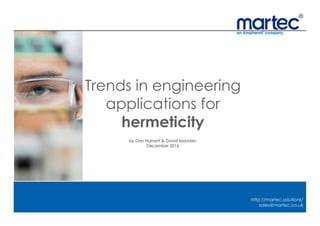
Trends in engineering
applications for
hermeticity
by Dan Harnett & David Marsden
December 2016
http://martec.solutions/
sales@martec.co.uk
Who we are
At Martec, our connectors and penetrators are
used for power and data, at the forefront of
technology, offering the highest performance,
quality and reliability where they are needed
most.
History
Since 1987, we have been designing and man-
ufacturing high-quality precision components
for harsh and demanding environments. Our
products are developed using an application-
focussed approach, building on our extensive
systems and materials expertise, to create
world-class, performance engineered solutions
at the forefront of technology. This is why many
companies continue to trust our penetrators
and interconnectors for a broad range of ap-
plications in sectors such as oil and gas, aero-
space, marine, nuclear and defence.
Complete service
Yet it is not just the quality of our product that
sets us apart, but also our commitment to ser-
vice and exceeding customers’ expectations.
At Martec, as well as supplying a range of the
standard connectors, we can provide a com-
plete interconnection solution from concept to
supply.
We are able to design and develop unique
and unusual connectors in partnership with
engineering teams, in large or small quantities
and we are particularly experienced in one-off
projects.
Having an enviable reputation for being an
extraordinarily dependable partner, you can
rest assured our products will be on time and to
specification.
http://martec.solutions/
sales@martec.co.uk
Hermeticity
Trends in Hermetic
Devices
Recent developments in materials and process-
ing technology have broadened the potential
range of applications for hermetically sealed
devices over a wide variety of performance
engineered systems. Whether the primary de-
sign goal is corrosion resistance, pressure capa-
bility in underwater systems or lightweight and
moisture ingress prevention in avionic systems,
Martec is able to provide an effective custom-
design solution.
The current trends involving high performance
sensors and signal processing electronics are
already incorporating hermetic technology to
ensure stable atmospheres with controlled lev-
els of moisture, and that specific performance
and reliability requirements are achieved and
maintained.
Also, aerospace and defence systems incor-
porate high performance optical assemblies
sealed to avoid contamination of optical path-
ways. In addition these hermetic products en-
able avionic devices to maintain hermeticity
and avoid ingress of moisture, allowing the sys-
tems to achieve and maintain specified perfor-
mance.
These hermetic devices can be found across
a wide spectrum of avionic applications such
as aircraft, missiles and space programs to pro-
vide system integrity and ensure no damage is
caused by the ingress of moisture or contami-
nants. Hermetic devices are also incorporated
within avionic systems such as landing gear,
fuel management, engine condition monitor-
ing including, speed and temperature probes
pressure sensors, turbine temperatures monitor-
ing, blade tip clearance measurement, torque
measurement, filter performance, actuators
and many others.
In Oil & Gas applications increasingly harsh en-
vironments demand higher levels of pressure
sealing and temperature tolerance. The use of
hermetic technology can provide protection
to either electronics or act as a pressure bar-
rier between sensors and electronic packages.
Martec’s hermetic devices have recently been
qualified to 90,000 psi and our feed-throughs
have demonstrated capability to withstand a
fire test at +950°C.
In other applications, vacuum systems and as-
semblies benefit from improved sealing made
possible by hermetic devices to achieve faster
pump down, lower vacuum hold power and
improved base vacuum levels. These devices
can be found in scientific, electronic and semi-
conductor component manufacturing pro-
cesses.
New material developments have provided
new glasses that enable hermetic sealed de-
vices to be produced in a variety of housing
materials, including aluminium, titanium and
super duplex alloys ensuring that specific per-
formance requirements and end user environ-
ments are met. These include galvanic, cor-
rosive, bio-compatibility and reduced system
mass for weight critical applications.
High strength super duplex alloys address spe-
cific industry needs for strong materials in the oil
and gas and subsea applications. For instance,
subsea and oceanographic hermetic devices
require careful material selection to address
the systems material compatibility for corrosion
as well as galvanic differential requirements.
These applications can also benefit from the
high strength super duplex alloys to meet the
systems pressure and fluid containment re-
quirements.
The development of low temperature glasses
allows Martec to design hermetic devices to
a wider range of conductor materials for im-
proved conductivity and non magnetic as-
semblies (e.g. paliney, beryllium copper & mo-
lybdenum). These may be found in medical,
industrial & chemical applications addressing
the specific industry standards and challenging
operating environments.
Through Martec’s research and development,
hermetic devices can now incorporate im-
pedance matched materials to reduce inser-
tion loss through Martec’s patented design
particularly in the case of high speed signals.
Martec’s design capabilities enable complex
designs and meet customer specific require-
ments. Martec’s hermetic designs provide ion-
ization sources for advanced security devices
such as analytical equipment and chemical
trace equipment.
Where space is at a premium, Martec’s her-
metic devices can provide a compact solution
in place of an environmental style device.
Hermeticity
http://martec.solutions/
sales@martec.co.uk
Hermeticity
Introduction
At Martec, the devices we design and manu-
facture incorporate glass, glass ceramic or ce-
ramic materials to achieve high levels of fluid
sealing, or hermeticity within connectors and
glass to metal seals.
Hermetic devices are typically designed for use
in harsh and demanding environments. They
are capable of maintaining fluid separation un-
der high differential pressure and or extremes
of temperature whilst providing means of pass-
ing electrical signals and or power through the
barrier.
The most common example of this is the exclu-
sion of moisture from sensitive electronic sys-
tems.
A hermetic device can also be remarkably
compact and is often specified where avail-
able space is limited. Both internal and external
protrusions of a hermetic device can be signifi-
cantly less than those of an equivalent environ-
mental style connector.
Hermetic connectors are specified for a vari-
ety of environments and can be found across
a wide and diverse range of applications such
as satellites, aircraft, missiles, oil and gas down
hole tools, industrial & medical sensing, naval
to nuclear submarines.
Within the industry glass to metal seals are also
referred to or known as penetrators or feed-
throughs. A feed-throughs is a single piece
component providing direct termination on
both faces whereas a connector requires a
secondary mating half and is used when re-
peated mate and unmate characteristics are
required.
http://martec.solutions/
sales@martec.co.uk
Hermeticity
Technology
A hermetic seal is defined as being air or gas
tight, impermeable to fluids, excluding the pas-
sage of air, oxygen or other gases. The degree
of hermeticity is usually specified as a measure
of leakage, into or out of the enclosed system
where the specified level is usually stated in
conjunction with a specific test method and
condition of use.
One of the primary requirements of hermetic
packaging is to maintain the leak tightness of
an electronics unit by maintaining an imper-
meable barrier between different fluids (usually
water vapour) or vacuum. The leak tightness
of any interconnect device is therefore a key
contributor to the overall leak tightness of the
sub-system enclosure or module.
The hermeticity of a glass or glass ceramic seal
is achieved by both the impermeability of the
materials (i.e. glass & metal) and by the ox-
ide bond formed between the two at elevat-
ed sealing temperatures. One of the benefits
of glass in this application is its ability to form
a strong, well adhered bond to appropriate
metal oxides. Thus, a key enabler for a high
performance glass to metal seal is the ability to
form a well adhered metal oxide on the parent
metal substrate prior to sealing.
Image to the right shows the migration of par-
ticular intermetallic compounds across the in-
terface of a typical glass to metal seal.
As with ingress protection defined by the IP
code[1] there are different levels of hermeticity
or leakage.
Hermeticity is typically defined as the amount
of a substance moving per unit of time through
a given cross section, otherwise known as a
leak, either as a Fine or a Gross leak. For illustra-
tive purposes a leak value can be compared
to an indicative flow of 1cc of air over a period
of time.
As a quick indicative way of converting to a
helium leak rate, divide the above time periods
by three. i.e.; 10-11
cc/sec equates to 1 cc of
helium flow in over 1000 years.
A leak may often be assumed as some kind of
hole, or porous or gas permeable area permit-
ting undesired flow of gas, moisture or other
contaminates.
However, in some cases water vapour migra-
tion through materials can be sufficient to
constitute a significant leak path, particularly in
the case of plastics or elastomers.[2] Irrespec-
tive of the source or unit of measure chosen, a
‘leak’ can cover a range of 10-1 to 10-11;
which
represents 11 orders of magnitude and covers
several different modes of flow. Both gas spe-
cies and mode of flow influence the amount of
gas flowing through a given leak path; helium,
for example is a smaller molecule than air and
will permeate a given leak path more readily,
however water vapour, in spite of a large mo-
lecular size is arguably more invasive due to its
electron charge configuration allowing it to be
readily adsorbed by many materials, includ-
ing both metals and plastics, and to migrate
through solid material barriers.
It is for this reason that a hermetic connector
should be used as part of an overall enclosure
sealing strategy if moisture is to be reliably ex-
cluded.
Leak tests are defined within Mil-Std-883.[3]
The size of the leak is determined by the vol-
ume of gas that passes through the leak per
10-6
	 cc/sec 1cc of air flow in 11.6 days			
10-7
	 cc/sec 1 cc of air flow in 16.5 weeks		
10-8
	 cc/sec 1 cc of air flow in 3.2 years			
10-9
	 cc/sec 1 cc of air flow in 31.8 years	
10-10
	 cc/sec 1 cc of air flow in 318 years	
10-11
	 cc/sec 1 cc of air flow in over 3000 years	
http://martec.solutions/
sales@martec.co.uk
Hermeticity
second under a 1 atmosphere differential pres-
sure. Leaks greater than 1x 10⁻⁵
atm cc/sec
are generally considered gross leaks whereas
those smaller than 1x10⁻⁵
atm cc/sec are con-
sidered fine leaks. In practice gross leaks are
determined, isolated and quantified using liq-
uid bath and bubble detection. As an indica-
tor for gross leaks a dye penetrant test can
also be used. For fine leaks mass spectrometers
are used with Helium gas. Modern mass spec-
trometers are now capable of detecting some
gross leaks.
It is recognised that connectors made from
glass, metals and ceramics are considered her-
metic. However, with all types of connectors
over a length of time they will allow the pas-
sage of moisture and or other gases through
the hermetic barrier as all materials are perme-
able to gases to some degree.
To ensure that your system meets all specified
needs discuss your exact hermetic require-
ments with Martec.
In addition to maintaining hermeticity, Mar-
tec’s connectors and glass to metals seals
can be specifically designed to withstand high
pressures both at ambient and elevated tem-
peratures.
Types of Sealing
There are two categories of glass to metal seals:
compression seals and matched seals. The for-
mer, as the name suggests, have materials of
differing coefficients of thermal expansion nor-
mally arranged such that the outer shell has
the higher value. Cooling from the high glass
forming temperatures necessary to achieve
wetting of the shell surface therefore results in
residual compressive stress in the glass, produc-
ing a robust seal capable of tolerating high
levels of shock and vibration. Due to glass be-
ing extremely strong in compression, such seals
can withstand very high pressures.
When the glass and the metal devices have
the same or similar coefficient of thermal ex-
pansion, the seal derives its strength from the
chemical bond between the glass and the ox-
ide formed on the metal parts. This “matched
seal” can be the weaker of the two glass-to-
metal hermetic seals which is dependent on
material combinations.
Some materials combinations used in the man-
ufacture of matched seals cannot resist large
differential pressures.
http://martec.solutions/
sales@martec.co.uk
Alternative materials for hermetic
sealing
Ceramic glasses (or glass ceramics) are a rel-
atively new class of material discovered by
Corning in the 1950s. A correct thermal pro-
cessing of these materials results in developing
ceramic crystals in a surrounding glassy matrix.
Some versions may be used to provide insulat-
ing glasses with coefficient of thermal expan-
sion matched to a wide variety of materials.
Some ceramic glasses have higher chemical
durability and can resist higher temperatures
than conventional glasses.
Ceramic Seals are often used in high voltage
applications as large stand off or clearance
distances can be achieved by protruding or
self supporting insulators. In general, ceram-
ic materials have a high dielectric constant
and can perform well as electrical insulators,
however some cannot be machined and are
formed by either moulding or pressing powder.
The majority of engineering insulating ceramics
have low thermal expansion coefficients and
do not form ‘wetted’ bonds to most metals.
Metallisation or active brazing is necessary
to form hermetic seals to these materials. The
braze or metallised joint is therefore subject to
cyclic stress if thermal cycling is experienced
by the assembly.
Epoxy - Certain epoxy resins can create a her-
metic bond to copper, brass, or epoxy itself
with similar coefficients of thermal expansion
and are used in the manufacture of hermetic
electrical and fibre optic seals. Epoxy hermetic
seal designs can be used in applications for low
or high vacuum or differential pressures. With
careful design leak rates approaching those of
glass or ceramic seals can be achieved. Epoxy
seals also offer the design flexibility of sealing
either copper alloy wires or pins, instead of the
much less electrically conductive Nickel Iron
pin materials required in glass hermetic seals.
However, epoxy seals have a higher outgas-
sing and permeability rate than glass or met-
al and a more limited operating temperature
range typically +70°C to +125°C (200°C for spe-
cial epoxy).
A typical, sealed avionics LRU will have nu-
merous interconnects, and a lid or removable
panel to facilitate assembly. All will be poten-
tial leak paths and the overall hermeticity of
the package will be the sum total. A number
of sealing methods are available, including, in
approximate order of effectiveness
• fused metal seals (soldered / weld).
Note, that fused metal seals can be designed
to be re-usable, for a limited number of times.
A system can be designed to have elastomer-
ic seals functioning during test / qualification
which are augmented by an EB weld or laser
welded seal at the final stage of production.
• metal rings (solid, c profile) with or without soft
metal plating.
• soft metal seals (e.g. solder / indium)
• elastomeric seals (gaskets / ‘o’ rings / ‘x’ rings)
• Getters ( adsorption material for capture of
gas molecular species).[4] Often used in high
vacuum systems, rare earth getters can be one
time fired electrically to absorb contaminants
such as water vapour. Multiple getter installa-
tions can allow firings to take place at sched-
uled intervals throughout the service life of the
system.
The choice of the seal type and the materials
used is normally determined by the specified
functionality of the part. Any requirement for
long glass will normally preclude a compres-
sion seal design due to the need to avoid axial
stress variations with temperature.
Hermeticity
http://martec.solutions/
sales@martec.co.uk
Benefits
Using hermetic technology can add a number
of benefits to the product.
Hermeticity – A hermetic device, particularly a
connector usually forms part of a system or sub-
system enclosure or housing. As such, it forms
part of the overall environmental control mea-
sures included in the design. The hermetic de-
vice itself is usually one of a number of potential
leak paths into or out of an enclosure, and its
method of attachment may also contribute to
the total leakage, particularly in the case of an
o-ring sealed bulkhead mounted connector.
Water vapour permeability through the o-ring
will constitute an additional leak path. The sum
total of all such leak paths will give the overall
sealing level of the system.
Fluid Separation – It is important to avoid wa-
ter vapour or moisture ingress into electronics
enclosures. Such water vapour will degrade
dielectric materials thereby affecting mod-
ule performance and or degrading reliability.
Even if a sealed module is backfilled with dry
gas (e.g.; Nitrogen) the hermeticity of the en-
closure is important as the permeation of water
vapour is driven by partial pressure differences
i.e.; the overall “leak rate” of water vapour into
the system is a function of the assembly’s her-
meticity and dryness of the interior.[2] Hermetic
connectors are used to ensure overall perme-
ation rates are maintained as low as possible.
A non hermetic device mounted in an unpres-
surised part of an aircraft will contain air at at-
mospheric pressure when the plane is on the
ground. At altitude the decrease in external
pressure will cause a partial evacuation of the
device; on returning to the ground the device
will be refilled with the surrounding air, which
may contain amounts of contaminants, va-
pours, oils, moisture which over a period of time
may damage the electronics within the device.
Pressure Barrier - Both glass and glass ceramic
form exceptionally well adhered bonds with
metal oxides. This ability means that a well
formed glass to metal seal can withstand high
pressure differentials with a very compact seal
length. Devices have been successfully tested
up to 90,000 psi differential, although careful
design of the seal body is required to minimize
deflection under such high loads.
Fire Barrier – Once successful glass wetting to
the metal oxide has been achieved, the bond
formed is remarkably persistent. Even elevat-
ed temperatures, above the glass softening
point do not normally weaken the bond, with
the result that glass to metal seals can provide
an effective barrier at temperatures up to the
working point of the glass, typically 900°C to
1,000°C. The high temperature barrier perfor-
mance depends on both thermal excursion
and pressure differential; requirements should
be discussed with Martec’s design team to en-
sure compliance.
Compact Size - Where space is at a premium,
a hermetic device can also be remarkably
compact and is often specified where avail-
able space is limited. Both internal and external
protrusions of a hermetic device can be signifi-
cantly less than those of an equivalent environ-
mental style connector.
Hermeticity
http://martec.solutions/
sales@martec.co.uk
Hermeticity
http://martec.solutions/
sales@martec.co.uk
Design &
Performance
Consideration
Several factors contribute to the design of
hermetic devices. The functionality required,
in terms of pressure capability and electrical
performance primarily Insulation Resistance
(IR) and dielectric withstand voltage (DWV) or
breakdown voltage (BV) together influence
the insulator sizing, the conductor performance
requirements will influence pin size and other
environmental functionality may influence the
materials used and the method of attachment
to the housing.
Other parameters, such as the need for low
outgassing and minimal trapped volumes in
vacuum applications may determine the posi-
tion and orientation of welded seams.
Depending on applications, other require-
ments, such as creepage and clearance dis-
tances, dielectric constant etc. may also be
relevant. In some cases it may be advanta-
geous to match the body material of the her-
metic connector to that of its housing. Alu-
minium, titanium, stainless steel or high strength
duplex alloys may be specified for this reason,
although sealing to aluminium or titanium al-
loys require specialised glasses and sealing pro-
cesses.
The most commonly used alloys for glass sealed
contacts are nickel / iron alloys such as Alloy 48,
Alloy 52 or Kovar. These materials are matched
to commonly used sealing glasses but their
conductivity is relatively low at about 30% that
of copper.
In applications where high conductivity is re-
quired, copper cored nickel iron alloy contacts
can be used, or seals can be made with berylli-
um copper, paliney or molybdenum although,
in these cases, specialized glasses and sealing
processes are required.
At Martec we can design a complete solu-
tion to ensure system integrity by incorporating
electronic filters within the connector housing
to protect the devices from lighting strike, volt-
age spikes, EMP and EMC compliance.
High integrity interconnects offer low insertion
loss and thereby avoids loss of data or signal.
Several types of interconnect can be optimised
for high integrity data and can be compatible
with various network cables e.g. Cat 5 or Cat
6 or for use on 100BaseTX / 1000BaseT / USB
3. Martec has a patented design to achieve
these.
Standard “data” connector interfaces e.g.;
RJ45 and coaxial (N Type etc.) can be incorpo-
rated together with cable attachment features
to ensure minimal untwisting (of twisted pairs)
and cross talk.
Applications
Glass to metal seals and hermetic connectors
are used across a wide range of electrical and
electronics industries within numerous appli-
cations ranging from sensors, transducers and
electronic systems. They are primarily used to
pass an electrical signal or power through the
hermetic barrier.
Aerospace environments require hermeticity
within avionic style products for applications
such as aircraft, missiles and space. Hermetic
connectors are used to ensure that the avionic
systems integrity is maintained and is not dam-
aged or compromised by the ingress of mois-
ture or contaminants.
Hermetic devices can also be incorporated
within systems such as:
- landing gear,
- fuel management,
- engine condition monitoring including, speed
& temperature probes pressure sensors
- turbine temperatures monitoring,
- blade tip clearance measurement,
- torque measurement,
- filter performance,
- actuators
- and many other avionic systems.
In addition to providing the hermetic solution
Martec can design a complete solution to en-
sure system integrity by incorporating electron-
ic filters within the connector housing to protect
the devices from lighting strike, voltage spikes,
EMP and EMC compliance.
Oil & Gas applications range from wire line
tools to secondary containment seals with typi-
cal requirements being around 30,000 psi and
150°C. The use of hermetic technology within
these applications provide protection to either
electronics or act as pressure barriers between
sensors and the electronic packages. Within
this environment the hermetic barrier not only
offers a pressure barrier but also stops the mi-
gration of fluids and gases passing through.
Martec specialist connectors and penetrators
are specifically designed to meet extreme pres-
sure and temperature through a wide choice
of materials. There have been instances where
the Martec feed-throughs have been tested to
90,000 psi at elevated temperatures.
Oceanology & Subsea interconnects
Working in one of the world’s most treacherous
operating environments, Martec’s specialist
connectors and penetrators have been de-
signed to meet specific environmental require-
ments such as 60,000 psi at 150C, incorporating
materials to accommodate the challenging
operating conditions and to meet industry
standard material expectations, i.e.:
corrosion resistance, hardness and yield
strength.
Examples of material selection may include in-
conel, hastelloy and titanium for the housing
material.
Hermeticity
http://martec.solutions/
sales@martec.co.uk
In an innovative and advancing field, Martec
has been designing superior engineered solu-
tions for the Automotive industry in regards to
safety, performance, reliability and compli-
ance.
Connectors and feed-throughs are used for a
diverse range of applications such as air bags,
pressure sensors, tyre pressure monitors, fluid
condition monitoring and fuel flow rate sensors.
Marine
Martec’s specialist connectors and penetra-
tors have been used on naval vessels, subma-
rines, hull penetrators and marine power plants.
Designed to meet the specific environmental
conditions and functionality; through the de-
sign, materials and coating selection.
Interconnects for Medical applications are
used on equipment such as MRI scanners, sens-
ing, monitoring and analytical equipment. They
are also used as implantable connectors used
within the body. Through understanding the re-
quirements and careful material selection Mar-
tec is able to supply to specific interconnection
needs.
Industrial
Working in one of the world’s most far-reaching
and diverse industries, you will know that supe-
rior engineering solutions are vital in regards
to safety and productivity. Martec’s specialist
connectors, penetrators and interconnection
solutions address requirements for hemeticity,
effective gas and fluid barriers, chemical resis-
tance, shock and vibration. Our products can
be found in a variety of industrial applications
across a wide variety of industries from food to
pharmaceutical including condition monitor-
ing equipment (pressure, vibration, level and
flow) Vacuum applications and process con-
trols.
Scientific & Research
Working at the forefront of technology, in both
a challenging and innovative field Martec’s
hermetic interconnects can be found in wide
range of critical scientific equipment, instru-
mentation and detectors with specifications
and requirements to operate at cryogenic
temperature and or at ultra high vacuums with
fine rates of hermeticity.
Security
At the cutting edge Martec has designed her-
metic interconnect solutions (including ioniza-
tion sources) for advanced security devices,
such as analytical equipment and trace equip-
ment used within the airport and border con-
trol for explosives and drug detection.
Hermeticity
http://martec.solutions/
sales@martec.co.uk
Manufacture
To illustrate the manufacturing process we will
consider the production of a standard con-
nector:
• The piece parts of the connector are, metal
shell (housing), glass preform and pin contacts.
• The glass preform is placed on a carbon jig
and the pin contacts are inserted through the
preform holes and into pre-drilled holes on the
carbon jig. The carbon jig holds the pins in a
specific orientation for a particular connector
plan form. At this stage the pins and glass are
a loose fit.
• The shell housing is then carefully placed over
the jig containing the glass & pin assembly.
• The assembly is then placed on the belt of
the furnace and is subjected to a predefined
process cycle. The parts will see elevated tem-
peratures of up to 1000°C and a reducing at-
mosphere for a predetermined time whilst the
glass undergoes the nucleation and crystalliza-
tion stages.
• Post firing, the connector will then be disas-
sembled from the jig and then plated before
undergoing various tests and inspection stages.
Hermeticity
http://martec.solutions/
sales@martec.co.uk
References
1. IEC Standard 60529
2. Foundation of Vacuum Science and Tech-
nology, Ch 9. Ed. J.M.Lafferty
3. Mil-Std 883 – Test method for micro electron-
ics environmental test methods (1001 – 1034)
4. Foundation of Vacuum Science and Tech-
nology, Ch 5. Ed. J.M.Lafferty
5. http://martec.solutions
Contact us
Martec Limited
St Augustines Business Park
Swalecliffe, Whitstable, Kent
CT5 2QJ, United Kingdom
Tel: +44 (0)1227 793 733
Fax: +44 (0)1227 793 735
Email: sales@martec.ltd.uk
Website: http://martec.solutions/
www.amphenol.co.uk
www.amphenolmao.com

Trends in engineering applications for hermeticity

  • 1.
    Trends in engineering applicationsfor hermeticity by Dan Harnett & David Marsden December 2016 http://martec.solutions/ sales@martec.co.uk
  • 2.
    Who we are AtMartec, our connectors and penetrators are used for power and data, at the forefront of technology, offering the highest performance, quality and reliability where they are needed most. History Since 1987, we have been designing and man- ufacturing high-quality precision components for harsh and demanding environments. Our products are developed using an application- focussed approach, building on our extensive systems and materials expertise, to create world-class, performance engineered solutions at the forefront of technology. This is why many companies continue to trust our penetrators and interconnectors for a broad range of ap- plications in sectors such as oil and gas, aero- space, marine, nuclear and defence. Complete service Yet it is not just the quality of our product that sets us apart, but also our commitment to ser- vice and exceeding customers’ expectations. At Martec, as well as supplying a range of the standard connectors, we can provide a com- plete interconnection solution from concept to supply. We are able to design and develop unique and unusual connectors in partnership with engineering teams, in large or small quantities and we are particularly experienced in one-off projects. Having an enviable reputation for being an extraordinarily dependable partner, you can rest assured our products will be on time and to specification. http://martec.solutions/ sales@martec.co.uk Hermeticity
  • 3.
    Trends in Hermetic Devices Recentdevelopments in materials and process- ing technology have broadened the potential range of applications for hermetically sealed devices over a wide variety of performance engineered systems. Whether the primary de- sign goal is corrosion resistance, pressure capa- bility in underwater systems or lightweight and moisture ingress prevention in avionic systems, Martec is able to provide an effective custom- design solution. The current trends involving high performance sensors and signal processing electronics are already incorporating hermetic technology to ensure stable atmospheres with controlled lev- els of moisture, and that specific performance and reliability requirements are achieved and maintained. Also, aerospace and defence systems incor- porate high performance optical assemblies sealed to avoid contamination of optical path- ways. In addition these hermetic products en- able avionic devices to maintain hermeticity and avoid ingress of moisture, allowing the sys- tems to achieve and maintain specified perfor- mance. These hermetic devices can be found across a wide spectrum of avionic applications such as aircraft, missiles and space programs to pro- vide system integrity and ensure no damage is caused by the ingress of moisture or contami- nants. Hermetic devices are also incorporated within avionic systems such as landing gear, fuel management, engine condition monitor- ing including, speed and temperature probes pressure sensors, turbine temperatures monitor- ing, blade tip clearance measurement, torque measurement, filter performance, actuators and many others. In Oil & Gas applications increasingly harsh en- vironments demand higher levels of pressure sealing and temperature tolerance. The use of hermetic technology can provide protection to either electronics or act as a pressure bar- rier between sensors and electronic packages. Martec’s hermetic devices have recently been qualified to 90,000 psi and our feed-throughs have demonstrated capability to withstand a fire test at +950°C. In other applications, vacuum systems and as- semblies benefit from improved sealing made possible by hermetic devices to achieve faster pump down, lower vacuum hold power and improved base vacuum levels. These devices can be found in scientific, electronic and semi- conductor component manufacturing pro- cesses. New material developments have provided new glasses that enable hermetic sealed de- vices to be produced in a variety of housing materials, including aluminium, titanium and super duplex alloys ensuring that specific per- formance requirements and end user environ- ments are met. These include galvanic, cor- rosive, bio-compatibility and reduced system mass for weight critical applications. High strength super duplex alloys address spe- cific industry needs for strong materials in the oil and gas and subsea applications. For instance, subsea and oceanographic hermetic devices require careful material selection to address the systems material compatibility for corrosion as well as galvanic differential requirements. These applications can also benefit from the high strength super duplex alloys to meet the systems pressure and fluid containment re- quirements. The development of low temperature glasses allows Martec to design hermetic devices to a wider range of conductor materials for im- proved conductivity and non magnetic as- semblies (e.g. paliney, beryllium copper & mo- lybdenum). These may be found in medical, industrial & chemical applications addressing the specific industry standards and challenging operating environments. Through Martec’s research and development, hermetic devices can now incorporate im- pedance matched materials to reduce inser- tion loss through Martec’s patented design particularly in the case of high speed signals. Martec’s design capabilities enable complex designs and meet customer specific require- ments. Martec’s hermetic designs provide ion- ization sources for advanced security devices such as analytical equipment and chemical trace equipment. Where space is at a premium, Martec’s her- metic devices can provide a compact solution in place of an environmental style device. Hermeticity http://martec.solutions/ sales@martec.co.uk
  • 4.
    Hermeticity Introduction At Martec, thedevices we design and manu- facture incorporate glass, glass ceramic or ce- ramic materials to achieve high levels of fluid sealing, or hermeticity within connectors and glass to metal seals. Hermetic devices are typically designed for use in harsh and demanding environments. They are capable of maintaining fluid separation un- der high differential pressure and or extremes of temperature whilst providing means of pass- ing electrical signals and or power through the barrier. The most common example of this is the exclu- sion of moisture from sensitive electronic sys- tems. A hermetic device can also be remarkably compact and is often specified where avail- able space is limited. Both internal and external protrusions of a hermetic device can be signifi- cantly less than those of an equivalent environ- mental style connector. Hermetic connectors are specified for a vari- ety of environments and can be found across a wide and diverse range of applications such as satellites, aircraft, missiles, oil and gas down hole tools, industrial & medical sensing, naval to nuclear submarines. Within the industry glass to metal seals are also referred to or known as penetrators or feed- throughs. A feed-throughs is a single piece component providing direct termination on both faces whereas a connector requires a secondary mating half and is used when re- peated mate and unmate characteristics are required. http://martec.solutions/ sales@martec.co.uk
  • 5.
    Hermeticity Technology A hermetic sealis defined as being air or gas tight, impermeable to fluids, excluding the pas- sage of air, oxygen or other gases. The degree of hermeticity is usually specified as a measure of leakage, into or out of the enclosed system where the specified level is usually stated in conjunction with a specific test method and condition of use. One of the primary requirements of hermetic packaging is to maintain the leak tightness of an electronics unit by maintaining an imper- meable barrier between different fluids (usually water vapour) or vacuum. The leak tightness of any interconnect device is therefore a key contributor to the overall leak tightness of the sub-system enclosure or module. The hermeticity of a glass or glass ceramic seal is achieved by both the impermeability of the materials (i.e. glass & metal) and by the ox- ide bond formed between the two at elevat- ed sealing temperatures. One of the benefits of glass in this application is its ability to form a strong, well adhered bond to appropriate metal oxides. Thus, a key enabler for a high performance glass to metal seal is the ability to form a well adhered metal oxide on the parent metal substrate prior to sealing. Image to the right shows the migration of par- ticular intermetallic compounds across the in- terface of a typical glass to metal seal. As with ingress protection defined by the IP code[1] there are different levels of hermeticity or leakage. Hermeticity is typically defined as the amount of a substance moving per unit of time through a given cross section, otherwise known as a leak, either as a Fine or a Gross leak. For illustra- tive purposes a leak value can be compared to an indicative flow of 1cc of air over a period of time. As a quick indicative way of converting to a helium leak rate, divide the above time periods by three. i.e.; 10-11 cc/sec equates to 1 cc of helium flow in over 1000 years. A leak may often be assumed as some kind of hole, or porous or gas permeable area permit- ting undesired flow of gas, moisture or other contaminates. However, in some cases water vapour migra- tion through materials can be sufficient to constitute a significant leak path, particularly in the case of plastics or elastomers.[2] Irrespec- tive of the source or unit of measure chosen, a ‘leak’ can cover a range of 10-1 to 10-11; which represents 11 orders of magnitude and covers several different modes of flow. Both gas spe- cies and mode of flow influence the amount of gas flowing through a given leak path; helium, for example is a smaller molecule than air and will permeate a given leak path more readily, however water vapour, in spite of a large mo- lecular size is arguably more invasive due to its electron charge configuration allowing it to be readily adsorbed by many materials, includ- ing both metals and plastics, and to migrate through solid material barriers. It is for this reason that a hermetic connector should be used as part of an overall enclosure sealing strategy if moisture is to be reliably ex- cluded. Leak tests are defined within Mil-Std-883.[3] The size of the leak is determined by the vol- ume of gas that passes through the leak per 10-6 cc/sec 1cc of air flow in 11.6 days 10-7 cc/sec 1 cc of air flow in 16.5 weeks 10-8 cc/sec 1 cc of air flow in 3.2 years 10-9 cc/sec 1 cc of air flow in 31.8 years 10-10 cc/sec 1 cc of air flow in 318 years 10-11 cc/sec 1 cc of air flow in over 3000 years http://martec.solutions/ sales@martec.co.uk
  • 6.
    Hermeticity second under a1 atmosphere differential pres- sure. Leaks greater than 1x 10⁻⁵ atm cc/sec are generally considered gross leaks whereas those smaller than 1x10⁻⁵ atm cc/sec are con- sidered fine leaks. In practice gross leaks are determined, isolated and quantified using liq- uid bath and bubble detection. As an indica- tor for gross leaks a dye penetrant test can also be used. For fine leaks mass spectrometers are used with Helium gas. Modern mass spec- trometers are now capable of detecting some gross leaks. It is recognised that connectors made from glass, metals and ceramics are considered her- metic. However, with all types of connectors over a length of time they will allow the pas- sage of moisture and or other gases through the hermetic barrier as all materials are perme- able to gases to some degree. To ensure that your system meets all specified needs discuss your exact hermetic require- ments with Martec. In addition to maintaining hermeticity, Mar- tec’s connectors and glass to metals seals can be specifically designed to withstand high pressures both at ambient and elevated tem- peratures. Types of Sealing There are two categories of glass to metal seals: compression seals and matched seals. The for- mer, as the name suggests, have materials of differing coefficients of thermal expansion nor- mally arranged such that the outer shell has the higher value. Cooling from the high glass forming temperatures necessary to achieve wetting of the shell surface therefore results in residual compressive stress in the glass, produc- ing a robust seal capable of tolerating high levels of shock and vibration. Due to glass be- ing extremely strong in compression, such seals can withstand very high pressures. When the glass and the metal devices have the same or similar coefficient of thermal ex- pansion, the seal derives its strength from the chemical bond between the glass and the ox- ide formed on the metal parts. This “matched seal” can be the weaker of the two glass-to- metal hermetic seals which is dependent on material combinations. Some materials combinations used in the man- ufacture of matched seals cannot resist large differential pressures. http://martec.solutions/ sales@martec.co.uk
  • 7.
    Alternative materials forhermetic sealing Ceramic glasses (or glass ceramics) are a rel- atively new class of material discovered by Corning in the 1950s. A correct thermal pro- cessing of these materials results in developing ceramic crystals in a surrounding glassy matrix. Some versions may be used to provide insulat- ing glasses with coefficient of thermal expan- sion matched to a wide variety of materials. Some ceramic glasses have higher chemical durability and can resist higher temperatures than conventional glasses. Ceramic Seals are often used in high voltage applications as large stand off or clearance distances can be achieved by protruding or self supporting insulators. In general, ceram- ic materials have a high dielectric constant and can perform well as electrical insulators, however some cannot be machined and are formed by either moulding or pressing powder. The majority of engineering insulating ceramics have low thermal expansion coefficients and do not form ‘wetted’ bonds to most metals. Metallisation or active brazing is necessary to form hermetic seals to these materials. The braze or metallised joint is therefore subject to cyclic stress if thermal cycling is experienced by the assembly. Epoxy - Certain epoxy resins can create a her- metic bond to copper, brass, or epoxy itself with similar coefficients of thermal expansion and are used in the manufacture of hermetic electrical and fibre optic seals. Epoxy hermetic seal designs can be used in applications for low or high vacuum or differential pressures. With careful design leak rates approaching those of glass or ceramic seals can be achieved. Epoxy seals also offer the design flexibility of sealing either copper alloy wires or pins, instead of the much less electrically conductive Nickel Iron pin materials required in glass hermetic seals. However, epoxy seals have a higher outgas- sing and permeability rate than glass or met- al and a more limited operating temperature range typically +70°C to +125°C (200°C for spe- cial epoxy). A typical, sealed avionics LRU will have nu- merous interconnects, and a lid or removable panel to facilitate assembly. All will be poten- tial leak paths and the overall hermeticity of the package will be the sum total. A number of sealing methods are available, including, in approximate order of effectiveness • fused metal seals (soldered / weld). Note, that fused metal seals can be designed to be re-usable, for a limited number of times. A system can be designed to have elastomer- ic seals functioning during test / qualification which are augmented by an EB weld or laser welded seal at the final stage of production. • metal rings (solid, c profile) with or without soft metal plating. • soft metal seals (e.g. solder / indium) • elastomeric seals (gaskets / ‘o’ rings / ‘x’ rings) • Getters ( adsorption material for capture of gas molecular species).[4] Often used in high vacuum systems, rare earth getters can be one time fired electrically to absorb contaminants such as water vapour. Multiple getter installa- tions can allow firings to take place at sched- uled intervals throughout the service life of the system. The choice of the seal type and the materials used is normally determined by the specified functionality of the part. Any requirement for long glass will normally preclude a compres- sion seal design due to the need to avoid axial stress variations with temperature. Hermeticity http://martec.solutions/ sales@martec.co.uk
  • 8.
    Benefits Using hermetic technologycan add a number of benefits to the product. Hermeticity – A hermetic device, particularly a connector usually forms part of a system or sub- system enclosure or housing. As such, it forms part of the overall environmental control mea- sures included in the design. The hermetic de- vice itself is usually one of a number of potential leak paths into or out of an enclosure, and its method of attachment may also contribute to the total leakage, particularly in the case of an o-ring sealed bulkhead mounted connector. Water vapour permeability through the o-ring will constitute an additional leak path. The sum total of all such leak paths will give the overall sealing level of the system. Fluid Separation – It is important to avoid wa- ter vapour or moisture ingress into electronics enclosures. Such water vapour will degrade dielectric materials thereby affecting mod- ule performance and or degrading reliability. Even if a sealed module is backfilled with dry gas (e.g.; Nitrogen) the hermeticity of the en- closure is important as the permeation of water vapour is driven by partial pressure differences i.e.; the overall “leak rate” of water vapour into the system is a function of the assembly’s her- meticity and dryness of the interior.[2] Hermetic connectors are used to ensure overall perme- ation rates are maintained as low as possible. A non hermetic device mounted in an unpres- surised part of an aircraft will contain air at at- mospheric pressure when the plane is on the ground. At altitude the decrease in external pressure will cause a partial evacuation of the device; on returning to the ground the device will be refilled with the surrounding air, which may contain amounts of contaminants, va- pours, oils, moisture which over a period of time may damage the electronics within the device. Pressure Barrier - Both glass and glass ceramic form exceptionally well adhered bonds with metal oxides. This ability means that a well formed glass to metal seal can withstand high pressure differentials with a very compact seal length. Devices have been successfully tested up to 90,000 psi differential, although careful design of the seal body is required to minimize deflection under such high loads. Fire Barrier – Once successful glass wetting to the metal oxide has been achieved, the bond formed is remarkably persistent. Even elevat- ed temperatures, above the glass softening point do not normally weaken the bond, with the result that glass to metal seals can provide an effective barrier at temperatures up to the working point of the glass, typically 900°C to 1,000°C. The high temperature barrier perfor- mance depends on both thermal excursion and pressure differential; requirements should be discussed with Martec’s design team to en- sure compliance. Compact Size - Where space is at a premium, a hermetic device can also be remarkably compact and is often specified where avail- able space is limited. Both internal and external protrusions of a hermetic device can be signifi- cantly less than those of an equivalent environ- mental style connector. Hermeticity http://martec.solutions/ sales@martec.co.uk
  • 9.
    Hermeticity http://martec.solutions/ sales@martec.co.uk Design & Performance Consideration Several factorscontribute to the design of hermetic devices. The functionality required, in terms of pressure capability and electrical performance primarily Insulation Resistance (IR) and dielectric withstand voltage (DWV) or breakdown voltage (BV) together influence the insulator sizing, the conductor performance requirements will influence pin size and other environmental functionality may influence the materials used and the method of attachment to the housing. Other parameters, such as the need for low outgassing and minimal trapped volumes in vacuum applications may determine the posi- tion and orientation of welded seams. Depending on applications, other require- ments, such as creepage and clearance dis- tances, dielectric constant etc. may also be relevant. In some cases it may be advanta- geous to match the body material of the her- metic connector to that of its housing. Alu- minium, titanium, stainless steel or high strength duplex alloys may be specified for this reason, although sealing to aluminium or titanium al- loys require specialised glasses and sealing pro- cesses. The most commonly used alloys for glass sealed contacts are nickel / iron alloys such as Alloy 48, Alloy 52 or Kovar. These materials are matched to commonly used sealing glasses but their conductivity is relatively low at about 30% that of copper. In applications where high conductivity is re- quired, copper cored nickel iron alloy contacts can be used, or seals can be made with berylli- um copper, paliney or molybdenum although, in these cases, specialized glasses and sealing processes are required. At Martec we can design a complete solu- tion to ensure system integrity by incorporating electronic filters within the connector housing to protect the devices from lighting strike, volt- age spikes, EMP and EMC compliance. High integrity interconnects offer low insertion loss and thereby avoids loss of data or signal. Several types of interconnect can be optimised for high integrity data and can be compatible with various network cables e.g. Cat 5 or Cat 6 or for use on 100BaseTX / 1000BaseT / USB 3. Martec has a patented design to achieve these. Standard “data” connector interfaces e.g.; RJ45 and coaxial (N Type etc.) can be incorpo- rated together with cable attachment features to ensure minimal untwisting (of twisted pairs) and cross talk.
  • 10.
    Applications Glass to metalseals and hermetic connectors are used across a wide range of electrical and electronics industries within numerous appli- cations ranging from sensors, transducers and electronic systems. They are primarily used to pass an electrical signal or power through the hermetic barrier. Aerospace environments require hermeticity within avionic style products for applications such as aircraft, missiles and space. Hermetic connectors are used to ensure that the avionic systems integrity is maintained and is not dam- aged or compromised by the ingress of mois- ture or contaminants. Hermetic devices can also be incorporated within systems such as: - landing gear, - fuel management, - engine condition monitoring including, speed & temperature probes pressure sensors - turbine temperatures monitoring, - blade tip clearance measurement, - torque measurement, - filter performance, - actuators - and many other avionic systems. In addition to providing the hermetic solution Martec can design a complete solution to en- sure system integrity by incorporating electron- ic filters within the connector housing to protect the devices from lighting strike, voltage spikes, EMP and EMC compliance. Oil & Gas applications range from wire line tools to secondary containment seals with typi- cal requirements being around 30,000 psi and 150°C. The use of hermetic technology within these applications provide protection to either electronics or act as pressure barriers between sensors and the electronic packages. Within this environment the hermetic barrier not only offers a pressure barrier but also stops the mi- gration of fluids and gases passing through. Martec specialist connectors and penetrators are specifically designed to meet extreme pres- sure and temperature through a wide choice of materials. There have been instances where the Martec feed-throughs have been tested to 90,000 psi at elevated temperatures. Oceanology & Subsea interconnects Working in one of the world’s most treacherous operating environments, Martec’s specialist connectors and penetrators have been de- signed to meet specific environmental require- ments such as 60,000 psi at 150C, incorporating materials to accommodate the challenging operating conditions and to meet industry standard material expectations, i.e.: corrosion resistance, hardness and yield strength. Examples of material selection may include in- conel, hastelloy and titanium for the housing material. Hermeticity http://martec.solutions/ sales@martec.co.uk
  • 11.
    In an innovativeand advancing field, Martec has been designing superior engineered solu- tions for the Automotive industry in regards to safety, performance, reliability and compli- ance. Connectors and feed-throughs are used for a diverse range of applications such as air bags, pressure sensors, tyre pressure monitors, fluid condition monitoring and fuel flow rate sensors. Marine Martec’s specialist connectors and penetra- tors have been used on naval vessels, subma- rines, hull penetrators and marine power plants. Designed to meet the specific environmental conditions and functionality; through the de- sign, materials and coating selection. Interconnects for Medical applications are used on equipment such as MRI scanners, sens- ing, monitoring and analytical equipment. They are also used as implantable connectors used within the body. Through understanding the re- quirements and careful material selection Mar- tec is able to supply to specific interconnection needs. Industrial Working in one of the world’s most far-reaching and diverse industries, you will know that supe- rior engineering solutions are vital in regards to safety and productivity. Martec’s specialist connectors, penetrators and interconnection solutions address requirements for hemeticity, effective gas and fluid barriers, chemical resis- tance, shock and vibration. Our products can be found in a variety of industrial applications across a wide variety of industries from food to pharmaceutical including condition monitor- ing equipment (pressure, vibration, level and flow) Vacuum applications and process con- trols. Scientific & Research Working at the forefront of technology, in both a challenging and innovative field Martec’s hermetic interconnects can be found in wide range of critical scientific equipment, instru- mentation and detectors with specifications and requirements to operate at cryogenic temperature and or at ultra high vacuums with fine rates of hermeticity. Security At the cutting edge Martec has designed her- metic interconnect solutions (including ioniza- tion sources) for advanced security devices, such as analytical equipment and trace equip- ment used within the airport and border con- trol for explosives and drug detection. Hermeticity http://martec.solutions/ sales@martec.co.uk
  • 12.
    Manufacture To illustrate themanufacturing process we will consider the production of a standard con- nector: • The piece parts of the connector are, metal shell (housing), glass preform and pin contacts. • The glass preform is placed on a carbon jig and the pin contacts are inserted through the preform holes and into pre-drilled holes on the carbon jig. The carbon jig holds the pins in a specific orientation for a particular connector plan form. At this stage the pins and glass are a loose fit. • The shell housing is then carefully placed over the jig containing the glass & pin assembly. • The assembly is then placed on the belt of the furnace and is subjected to a predefined process cycle. The parts will see elevated tem- peratures of up to 1000°C and a reducing at- mosphere for a predetermined time whilst the glass undergoes the nucleation and crystalliza- tion stages. • Post firing, the connector will then be disas- sembled from the jig and then plated before undergoing various tests and inspection stages. Hermeticity http://martec.solutions/ sales@martec.co.uk References 1. IEC Standard 60529 2. Foundation of Vacuum Science and Tech- nology, Ch 9. Ed. J.M.Lafferty 3. Mil-Std 883 – Test method for micro electron- ics environmental test methods (1001 – 1034) 4. Foundation of Vacuum Science and Tech- nology, Ch 5. Ed. J.M.Lafferty 5. http://martec.solutions Contact us Martec Limited St Augustines Business Park Swalecliffe, Whitstable, Kent CT5 2QJ, United Kingdom Tel: +44 (0)1227 793 733 Fax: +44 (0)1227 793 735 Email: sales@martec.ltd.uk Website: http://martec.solutions/ www.amphenol.co.uk www.amphenolmao.com