Trends In Commutative Algebra First Edition Luchezar L. Avramov
Trends In Commutative Algebra First Edition Luchezar L. Avramov
Trends In Commutative Algebra First Edition Luchezar L. Avramov
Trends In Commutative Algebra First Edition Luchezar L. Avramov
Trends In Commutative Algebra First Edition Luchezar L. Avramov
1.
Trends In CommutativeAlgebra First Edition
Luchezar L. Avramov download
https://ebookultra.com/download/trends-in-commutative-algebra-
first-edition-luchezar-l-avramov/
Explore and download more ebooks or textbooks
at ebookultra.com
2.
We have selectedsome products that you may be interested in
Click the link to download now or visit ebookultra.com
for more options!.
Commutative Algebra 2nd Edition Aron Simis
https://ebookultra.com/download/commutative-algebra-2nd-edition-aron-
simis/
Commutative Algebra Geometric Homological Combinatorial
and Computational Aspects 1st Edition Alberto Corso
https://ebookultra.com/download/commutative-algebra-geometric-
homological-combinatorial-and-computational-aspects-1st-edition-
alberto-corso/
Commutative Algebra and Noncommutative Algebraic Geometry
Volume 1 Expository Articles 1st Edition David Eisenbud
https://ebookultra.com/download/commutative-algebra-and-
noncommutative-algebraic-geometry-volume-1-expository-articles-1st-
edition-david-eisenbud/
Computational Commutative And Non commutative Algebraic
Geometry Svetlana Cojocaru
https://ebookultra.com/download/computational-commutative-and-non-
commutative-algebraic-geometry-svetlana-cojocaru/
3.
A First Coursein Linear Algebra With Concurrent Examples
Hamilton
https://ebookultra.com/download/a-first-course-in-linear-algebra-with-
concurrent-examples-hamilton/
First Course in Abstract Algebra A 3rd Edition Joseph J.
Rotman
https://ebookultra.com/download/first-course-in-abstract-
algebra-a-3rd-edition-joseph-j-rotman/
Abstract Algebra A Gentle Introduction 1st Edition Gary L.
Mullen
https://ebookultra.com/download/abstract-algebra-a-gentle-
introduction-1st-edition-gary-l-mullen/
Global Communication Theories Stakeholders and Trends 2nd
Edition Thomas L. Mcphail
https://ebookultra.com/download/global-communication-theories-
stakeholders-and-trends-2nd-edition-thomas-l-mcphail/
Trends in Bilingual Acquisition Trends in Language
Acquisition Research 1 1st Edition Jasone Cenoz
https://ebookultra.com/download/trends-in-bilingual-acquisition-
trends-in-language-acquisition-research-1-1st-edition-jasone-cenoz/
5.
Trends In CommutativeAlgebra First Edition Luchezar
L. Avramov Digital Instant Download
Author(s): Luchezar L. Avramov, Mark Green, Craig Huneke, Karen E. Smith,
Bernd Sturmfels
ISBN(s): 9789876543217, 0521831954
Edition: First
File Details: PDF, 1.58 MB
Year: 2004
Language: english
6.
This book isbased on expository lectures by six internationally known experts
presented at the 2002 MSRI introductory workshop on commutative algebra.
They focus on the interaction of commutative algebra with other areas of
mathematics, including algebraic geometry, group cohomology and represen-
tation theory, and combinatorics, with all necessary background provided.
Short complementary papers describing work at the research frontier are also
included. The unusual scope and format make the book invaluable reading for
graduate students and researchers interested in commutative algebra and its
various uses.
Mathematical Sciences ResearchInstitute Publications
1 Freed/Uhlenbeck: Instantons and Four-Manifolds, second edition
2 Chern (ed.): Seminar on Nonlinear Partial Differential Equations
3 Lepowsky/Mandelstam/Singer (eds.): Vertex Operators in Mathematics and Physics
4 Kac (ed.): Infinite Dimensional Groups with Applications
5 Blackadar: K-Theory for Operator Algebras, second edition
6 Moore (ed.): Group Representations, Ergodic Theory, Operator Algebras, and
Mathematical Physics
7 Chorin/Majda (eds.): Wave Motion: Theory, Modelling, and Computation
8 Gersten (ed.): Essays in Group Theory
9 Moore/Schochet: Global Analysis on Foliated Spaces
10–11 Drasin/Earle/Gehring/Kra/Marden (eds.): Holomorphic Functions and Moduli
12–13 Ni/Peletier/Serrin (eds.): Nonlinear Diffusion Equations and Their Equilibrium States
14 Goodman/de la Harpe/Jones: Coxeter Graphs and Towers of Algebras
15 Hochster/Huneke/Sally (eds.): Commutative Algebra
16 Ihara/Ribet/Serre (eds.): Galois Groups over Q
17 Concus/Finn/Hoffman (eds.): Geometric Analysis and Computer Graphics
18 Bryant/Chern/Gardner/Goldschmidt/Griffiths: Exterior Differential Systems
19 Alperin (ed.): Arboreal Group Theory
20 Dazord/Weinstein (eds.): Symplectic Geometry, Groupoids, and Integrable Systems
21 Moschovakis (ed.): Logic from Computer Science
22 Ratiu (ed.): The Geometry of Hamiltonian Systems
23 Baumslag/Miller (eds.): Algorithms and Classification in Combinatorial Group Theory
24 Montgomery/Small (eds.): Noncommutative Rings
25 Akbulut/King: Topology of Real Algebraic Sets
26 Judah/Just/Woodin (eds.): Set Theory of the Continuum
27 Carlsson/Cohen/Hsiang/Jones (eds.): Algebraic Topology and Its Applications
28 Clemens/Kollár (eds.): Current Topics in Complex Algebraic Geometry
29 Nowakowski (ed.): Games of No Chance
30 Grove/Petersen (eds.): Comparison Geometry
31 Levy (ed.): Flavors of Geometry
32 Cecil/Chern (eds.): Tight and Taut Submanifolds
33 Axler/McCarthy/Sarason (eds.): Holomorphic Spaces
34 Ball/Milman (eds.): Convex Geometric Analysis
35 Levy (ed.): The Eightfold Way
36 Gavosto/Krantz/McCallum (eds.): Contemporary Issues in Mathematics Education
37 Schneider/Siu (eds.): Several Complex Variables
38 Billera/Björner/Green/Simion/Stanley (eds.): New Perspectives in Geometric
Combinatorics
39 Haskell/Pillay/Steinhorn (eds.): Model Theory, Algebra, and Geometry
40 Bleher/Its (eds.): Random Matrix Models and Their Applications
41 Schneps (ed.): Galois Groups and Fundamental Groups
42 Nowakowski (ed.): More Games of No Chance
43 Montgomery/Schneider (eds.): New Directions in Hopf Algebras
44 Buhler/Stevenhagen (eds.): Algorithmic Number Theory
45 Jensen/Ledet/Yui: Generic Polynomials: Constructive Aspects of the Inverse Galois
Problem
46 Rockmore/Healy (eds.): Modern Signal Processing
47 Uhlmann (ed.): Inside Out: Inverse Problems and Applications
48 Gross/Kotiuga: Electromagnetic Theory and Computation: A Topological Approach
49 Darmon/Zhang (eds.): Heegner Points and Rankin L-Series
50 Bao/Bryant/Chern/Shen (eds.): A Sampler of Riemann–Finsler Geometry
51 Avramov/Green/Huneke/Smith/Sturmfels (eds.): Trends in Commutative Algebra
Volumes 1–4 and 6–27 are published by Springer-Verlag
10.
Trends in
Commutative Algebra
Editedby
Luchezar L. Avramov
University of Nebraska
Mark Green
University of California, Los Angeles
Craig Huneke
University of Kansas
Karen E. Smith
University of Michigan
Bernd Sturmfels
University of California, Berkeley
11.
Series Editor
Luchezar L.Avramov Silvio Levy
University of Nebraska Mathematical Sciences
Research Institute
Mark Green 17 Gauss Way
Univ. of California, Los Angeles Berkeley, CA 94720
United States
Craig Huneke
University of Kansas MSRI Editorial Committee
Hugo Rossi (chair)
Karen E. Smith Alexandre Chorin
University of Michigan Silvio Levy
Jill Mesirov
Bernd Sturmfels Robert Osserman
Univ. of California, Berkeley Peter Sarnak
The Mathematical Sciences Research Institute wishes to acknowledge support by
the National Science Foundation. This material is based upon work supported by
NSF Grant 9810361.
published by the press syndicate of the university of cambridge
The Pitt Building, Trumpington Street, Cambridge, United Kingdom
cambridge university press
The Edinburgh Building, Cambridge CB2 2RU, UK
40 West 20th Street, New York, NY 10011-4211, USA
477 Williamstown Road, Port Melbourne, VIC 3207, Australia
Ruiz de Alarcón 13, 28014 Madrid, Spain
Dock House, The Waterfront, Cape Town 8001, South Africa
http://www.cambridge.org
c Mathematical Sciences Research Institute 2004
First published 2004
Printed in the United States of America
A catalogue record for this book is available from the British Library.
Library of Congress Cataloging in Publication data
Trends in commutative algebra / edited by Luchezar L. Avramov . . . [et al.].
p. cm.
(Mathematical Sciences Research Institute publications ; 51)
Includes bibliographical references and index.
ISBN 0-521-83195-4 (hb)
1. Commutative algebra. I. Avramov, L. L. (Luchezar L.), 1948–
II. Title. III. Series.
QA251.3.T74 2005
5120
.44–dc22 2004022712
ISBN 0 521 83195 4 hardback
12.
Trends in CommutativeAlgebra
MSRI Publications
Volume 51, 2004
Contents
Preface ix
Commutative Algebra in the Cohomology of Groups 1
Dave Benson
Modules and Cohomology over Group Algebras 51
Srikanth Iyengar
An Informal Introduction to Multiplier Ideals 87
Manuel Blickle and Robert Lazarsfeld
Lectures on the Geometry of Syzygies 115
David Eisenbud, with a chapter by Jessica Sidman
Commutative Algebra of n Points in the Plane 153
Mark Haiman, with an appendix by Ezra Miller
Tight Closure Theory and Characteristic p Methods 181
Melvin Hochster, with an appendix by Graham J. Leuschke
Monomial Ideals, Binomial Ideals, Polynomial Ideals 211
Bernard Teissier
Some Facts About Canonical Subalgebra Bases 247
Ana Bravo
vii
14.
Trends in CommutativeAlgebra
MSRI Publications
Volume 51, 2004
Preface
Over the last fifteen years, commutative algebra has experienced a striking
evolution. During this period the outlook of the subject has been altered, new
connections to other areas have been established, and powerful techniques have
been developed. To foster further development a year-long program on com-
mutative algebra was held at MSRI during the 2002–03 academic year, starting
with an introductory workshop on September 9–13, 2002. This workshop concen-
trated on the interplay and growing connections between commutative algebra
and other areas, such as algebraic geometry, the cohomology of groups, and
combinatorics.
Six main speakers each gave a series of three talks during the week: David
Benson, David Eisenbud, Mark Haiman, Melvin Hochster, Rob Lazarsfeld, and
Bernard Teissier. The workshop was very well attended, with more than 120
participants. Every series of main talks was supplemented by a discussion/talk
session presented by a young researcher: Manuel Blickle, Ana Bravo, Srikanth
Iyengar, Graham Leuschke, Ezra Miller, and Jessica Sidman. Each of these
speakers has contributed a paper, or in some cases a combined paper, in this
volume.
David Benson spoke on the cohomology of groups, presenting some of the
many questions which are unanswered and which have a close relationship to
modern commutative algebra. He gave us many convincing reasons for working
in the “graded” commutative case, where signs are introduced when commut-
ing elements of odd degree. Srikanth Iyengar gives background information for
Benson’s notes.
David Eisenbud spoke on a classical subject in commutative algebra: free
resolutions. In his paper with a chapter by Jessica Sidman, he visits this classic
territory with a different perspective, by drawing close ties between graded free
resolutions and the geometry of projective varieties. He leads us through recent
developments, including Mark Green’s proof of the linear syzygy conjecture.
Mark Haiman lectured on the commutative algebra of n points in the plane.
This leads quite rapidly to the geometry of the Hilbert scheme, and to substantial
combinatorial questions (and answers) which can be phrased in terms of common
questions in commutative algebra such as asking about the Cohen–Macaulay
ix
15.
x PREFACE
property forcertain Rees algebras. Ezra Miller writes an appendix about the
Hilbert scheme of n points in the plane.
Mel Hochster gave three lectures on tight closure, telling eleven reasons to
study tight closure. Hochster presents tight closure as a test for ideal membership
which is necessary, but not sufficient, except for certain rings such as regular
rings. Graham Leuschke’s appendix gives examples of computation of tight
closure.
The theory of multiplier ideals has been expanding rapidly in the last few
years and bears a close relationship to commutative algebra, particularly tight
closure. Rob Lazarsfeld and Manuel Blickle present a gentle introduction to this
theory, with emphasis on the important theorems and concepts, applications,
and examples.
Resolution of singularities has long played a crucial role in algebraic geometry
and commutative algebra. Bernard Teissier talked about new ideas for under-
standing resolution coming from the simplest of all polynomials: monomials and
binomials. Toric geometry of course enters into this story in a crucial way. Ana
Bravo provides a summary of results on SAGBI bases which enter into this story.
The editors of this volume, who formed the organizing committee for the year
program, would like to thank the many people who made the year possible,
and thank the speakers for their wonderful contributions. A special thanks to
David Eisenbud, the director of MSRI, without whom none of this would have
been possible. We thank Michael Singer, the acting director of MSRI during the
academic year when the program took place, for his generous help, and for the
loan of Eisenbud to participate in our program. The great staff at MSRI were
unfailingly helpful, friendly and professional. We thank the MSRI editor, Silvio
Levy, for all his work on this volume. Finally, we thank the National Science
Foundation for its support of institutes of mathematics in general, and of MSRI
in particular.
We hope the papers in this volume will be a springboard for further learning
and research for both experts and beginners.
Luchezar Avramov
Mark Green
Craig Huneke
Karen Smith
Bernd Sturmfels
Note: The lectures this volume is based on were videotaped. They are available
on streaming video and for downloading at www.msri.org/publications/video or
www.cambridge.org/0521831954.
16.
Trends in CommutativeAlgebra
MSRI Publications
Volume 51, 2004
Commutative Algebra
in the Cohomology of Groups
DAVE BENSON
Abstract. Commutative algebra is used extensively in the cohomology
of groups. In this series of lectures, I concentrate on finite groups, but I
also discuss the cohomology of finite group schemes, compact Lie groups,
p-compact groups, infinite discrete groups and profinite groups. I describe
the role of various concepts from commutative algebra, including finite gen-
eration, Krull dimension, depth, associated primes, the Cohen–Macaulay
and Gorenstein conditions, local cohomology, Grothendieck’s local duality,
and Castelnuovo–Mumford regularity.
Contents
1. Introduction 2
2. Some Examples 2
3. Group Cohomology 8
4. Finite Generation 12
5. Krull Dimension 15
6. Depth 16
7. Associated Primes and Steenrod Operations 19
8. Associated Primes and Transfer 22
9. Idempotent Modules and Varieties 23
10. Modules with Injective Cohomology 26
11. Duality Theorems 30
12. More Duality Theorems 34
13. Dual Localization 36
14. Quasiregular Sequences 38
Appendix: Two-Groups of Order 64 and Their mod 2 Cohomology 43
Acknowledgements 45
References 45
The author is partly supported by NSF grant DMS-9988110.
1
17.
2 DAVE BENSON
1.Introduction
The purpose of these lectures is to explain how commutative algebra is used in
the cohomology of groups. My interpretation of the word “group” is catholic: the
kinds of groups in which I shall be interested include finite groups, finite group
schemes, compact Lie groups, p-compact groups, infinite discrete groups, and
profinite groups, although later in the lectures I shall concentrate more on the
case of finite groups, where representation theoretic methods are most effective.
In each case, there are finite generation theorems which state that under suitable
conditions, the cohomology ring is a graded commutative Noetherian ring; over
a field k, this means that it is a finitely generated graded commutative k-algebra.
Although graded commutative is not quite the same as commutative, the usual
concepts from commutative algebra apply. These include the maximal/prime
ideal spectrum, Krull dimension, depth, associated primes, the Cohen–Macaulay
and Gorenstein conditions, local cohomology, Grothendieck’s local duality, and
so on. One of the themes of these lectures is that the rings appearing in group co-
homology theory are quite special. Most finitely generated graded commutative
k-algebras are not candidates for the cohomology ring of a finite (or compact Lie,
or virtual duality, or p-adic Lie, or . . . ) group. The most powerful restrictions
come from local cohomology spectral sequences such as the Greenlees spectral
sequence Hs,t
m H∗
(G, k) =
⇒ H−s−t(G, k), which can be viewed as a sort of dual-
ity theorem. We describe how to construct such spectral sequences and obtain
information from them.
The companion article to this one, [Iyengar 2004], explains some of the back-
ground material that may not be familiar to commutative algebraists. A number
of references are made to that article, and for distinctiveness, I write [Sri].
2. Some Examples
For motivation, let us begin with some examples. We defer until the next
section the definition of group cohomology
H∗
(G, k) = Ext∗
kG(k, k)
(or see § 6 of [Sri]). All the examples in this section are for finite groups G over
a field of coefficients k.
(2.1) The first comment is that in the case where k is a field of characteristic
zero or characteristic not dividing the order of G, Maschke’s theorem in represen-
tation theory shows that all kG-modules are projective (see Theorem 3.1 of [Sri]).
So for any kG-modules M and N, and all i > 0, we have Exti
kG(M, N) = 0. In
particular, H∗
(G, k) is just k, situated in degree zero. Given this fact, it makes
sense to look at examples where k has characteristic p dividing |G|.
18.
COMMUTATIVE ALGEBRA INTHE COHOMOLOGY OF GROUPS 3
(2.2) Next, we discuss finite abelian groups. See also § 7.4 of [Sri]. The Künneth
theorem implies that
(2.2.1) H∗
(G1 × G2, k) ∼
= H∗
(G1, k) ⊗k H∗
(G2, k).
So we decompose our finite abelian group as a direct product of cyclic groups of
prime power order. The factors of order coprime to the characteristic may be
thrown away, using (2.1). For a cyclic p-group in characteristic p, there are two
possibilities (Proposition 7.3 of [Sri]). If p = 2 and |G| = 2, then H∗
(G, k) = k[x]
where x has degree one. In all other cases (i.e., p odd, or p = 2 and |G| ≥ 4), we
have H∗
(G, k) = k[x, y]/(x2
) where x has degree one and y has degree two. It
follows that if G is any finite abelian group then H∗
(G, k) is a tensor product of
a polynomial ring and a (possibly trivial) exterior algebra.
(2.2.2) In particular, if G is a finite elementary abelian p-group of rank r (i.e.,
a product of r copies of Z/p) and k is a field of characteristic p, then the coho-
mology ring is as follows. For p = 2, we have
H∗
((Z/2)r
, k) = k[x1, . . . , xr]
with |xi| = 1, while for p odd, we have
H∗
((Z/p)r
, k) = Λ(x1, . . . , xr) ⊗ k[y1, . . . , yr]
with |xi| = 1 and |yi| = 2. In the latter case, the nil radical is generated by
x1, . . . , xr, and in both cases the quotient by the nil radical is a polynomial ring
in r generators.
(2.3) The next comment is that if S is a Sylow p-subgroup of G then a transfer
argument shows that the restriction map from H∗
(G, k) to H∗
(S, k) is injective.
What’s more, the stable element method of Cartan and Eilenberg [1956] identifies
the image of this restriction map. For example, if S E G then H∗
(G, k) =
H∗
(S, k)G/S
, the invariants of G/S acting on the cohomology of S (see § 7.6 of
[Sri]). It follows that really important case is where G is a p-group and k has
characteristic p. Abelian p-groups are discussed in (2.2), so let’s look at some
nonabelian p-groups.
(2.4) Consider the quaternion group of order eight,
(2.4.1) Q8 = hg, h | gh = h−1
g = hg−1
i.
There is an embedding
g 7→ i, h 7→ j, gh 7→ k, g2
= h2
= (gh)2
7→ −1
of Q8 into the unit quaternions (i.e., SU(2)), which form a three dimensional
sphere S3
. So left multiplication gives a free action of Q8 on S3
; in other words,
each nonidentity element of the group has no fixed points on the sphere. The
quotient S3
/Q8 is an orientable three dimensional manifold, whose cohomology
19.
4 DAVE BENSON
thereforesatisfies Poincaré duality. The freeness of the action implies that we
can choose a CW decomposition of S3
into cells permuted freely by Q8. Taking
cellular chains with coefficients in F2, we obtain a complex of free F2Q8-modules
of length four, whose homology consists of one copy of F2 at the beginning and
another copy at the end. Making suitable choices for the cells, this looks as
follows.
0 → F2Q8
g−1
h−1
−
−
−
−
−
→ (F2Q8)2
h−1 hg+1
gh+1 g−1
−
−
−
−
−
−
−
−
−
→ (F2Q8)2 (g−1 h−1)
−
−
−
−
−
−
−
→ F2Q8 → 0
So we can form a Yoneda splice of an infinite number of copies of this sequence
to obtain a free resolution of F2 as an F2Q8-module. The upshot of this is that
we obtain a decomposition for the cohomology ring
H∗
(Q8, F2) = F2[z] ⊗F2
H∗
(S3
/Q8; F2)
(2.4.2)
= F2[x, y, z]/(x2
+ xy + y2
, x2
y + xy2
),
where z is a polynomial generator of degree four and x and y have degree one.
This structure is reflected in the Poincaré series
∞
X
i=0
ti
dim Hi
(Q8, F2) = (1 + 2t + 2t2
+ t3
)/(1 − t4
).
The decomposition (2.4.2) into a polynomial piece and a finite Poincaré duality
piece can be expressed as follows (cf. § 11):
H∗
(Q8, F2) is a Gorenstein ring.
(2.5) We recall that the meanings of Cohen–Macaulay and Gorenstein in this
context are as follows. Let R be a finitely generated graded commutative k-
algebra with R0 = k and Ri = 0 for i 0. Then Noether’s normalization lemma
guarantees the existence of a homogeneous polynomial subring k[x1, . . . , xr] over
which R is finitely generated as a module.
Proposition 2.5.1. If R is of the type described in the previous paragraph, then
the following are equivalent.
(a) There exists a homogeneous polynomial subring k[x1, . . . , xr] ⊆ R such
that R is finitely generated and free as a module over k[x1, . . . , xr].
(b) If k[x1, . . . , xr] ⊆ R is a homogeneous polynomial subring such that R is
finitely generated as a k[x1, . . . , xr]-module then R a free k[x1, . . . , xr]-module.
(c) There exist homogeneous elements of positive degree x1, . . . , xr forming a
regular sequence, and R/(x1, . . . , xr) has finite rank as a k-vector space.
We say that R is Cohen–Macaulay of dimension r if the equivalent conditions of
the above proposition hold.
20.
COMMUTATIVE ALGEBRA INTHE COHOMOLOGY OF GROUPS 5
(2.6) If R is Cohen–Macaulay, and the quotient ring R/(x1, . . . , xr) has a sim-
ple socle, then we say that R is Gorenstein. Whether this condition holds is
independent of the choice of the polynomial subring. Another way to phrase the
condition is that R/(x1, . . . , xr) is injective as a module over itself. This quotient
satisfies Poincaré duality, in the sense that if the socle lies in degree d (d is called
the dualizing degree) and we write
p(t) =
∞
X
i=0
ti
dimk(R/(x1, . . . , xr))i
then
(2.6.1) td
p(1/t) = p(t).
Setting
P(t) =
∞
X
i=0
ti
dimk Ri,
the freeness of R over k[x1, . . . , xr] implies that P(t) is the power series expansion
of the rational function p(t)/
Qr
i=1(1 − t|xi|
). So plugging in equation (2.6.1), we
obtain the functional equation
(2.6.2) P(1/t) = (−t)r
t−a
P(t),
where a = d −
Pr
i=1(|xi| − 1). We say that R is Gorenstein with a-invariant a.
Another way of expressing the Gorenstein condition is as follows. If R (as
above) is Cohen–Macaulay, then the local cohomology Hs,t
m R is only nonzero for
s = r. The graded dual of Hr,∗
m R is called the canonical module, and written
ΩR. To say that R is Gorenstein with a-invariant a is the same as saying that
ΩR is a copy of R shifted so that the identity element lies in degree r − a.
In the case of H∗
(Q8, F2), we can choose the polynomial subring to be k[z].
The ring H∗
(Q8, F2) is a free module over k[z] on six generators, corresponding
to a basis for the graded vector space H∗
(S3
/Q8; F2) ∼
= H∗
(Q8, F2)/(z), which
satisfies Poincaré duality with d = 3. So in this case the a-invariant is 3−(4−1) =
0. We have p(t) = 1 + 2t + 2t2
+ t3
and P(t) = p(t)/(1 − t4
).
(2.7) A similar pattern to the one seen above for Q8 holds for other groups.
Take for example the group GL(3, 2) of 3 × 3 invertible matrices over F2. This
is a finite simple group of order 168. Its cohomology is given by
H∗
(GL(3, 2), F2) = F2[x, y, z]/(x3
+ yz)
where deg x = 2, deg y = deg z = 3. A homogeneous system of parameters
for this ring is given by y and z, and these elements form a regular sequence.
Modulo the ideal generated by y and z, we get F2(x)/(x3
). This is a finite
Poincaré duality ring whose dualizing degree is 4. Again, this means that the
cohomology is a Gorenstein ring with a-invariant 4 − (3 − 1) − (3 − 1) = 0, but it
his own presumption.”“He who gazes too much upon the sun’s orb,
makes himself blind; even thus, I think, does pride blind many, who
want to know too much.” “When God finds a soul that does not
move, He operates within it in His own manner, and puts His hand to
greater things. He takes from this soul the key of His treasures
which He had given to it, so that it might be able to enjoy them; and
gives to this same soul the care of His presence, which entirely
absorbs it.”[247]
5. God’s way of winning souls and raising them towards pure love.
The fruits of full trust.
The next group can be made up of passages descriptive of the
dealings adopted by God with a view to first winning souls as He
finds them, and then raising them above mercenary hope or slavish
fear; and of the childlike fearlessness inspired by perfect trust in
God. As to the winning them, she says: “The selfishness of man is so
contrary to God and rebellious against Him, that God Himself cannot
induce the soul to do His will, except by certain stratagems
(lusinghe): promising it things greater than those left, and giving it,
even in this life, a certain consoling relish (gusto). And this He does,
because He perceives the soul to love things visible so much, that it
would never leave one, unless it saw four.”[248]
And, as to God’s raising of the soul, she propounds the deep
doctrine, which only apparently contradicts the divine method just
enunciated, as to the necessary dimness of the soul’s light with
regard to the intrinsic consequences of its own acts, a dimness
necessary, because alone truly purificatory, for the time that runs
between its conversion, when, since it is still weak, it requires to
see, and its condition of relative purity, when, since it is now strong,
it can safely be again allowed to see.“ If a man were to see that
which, in return for his good deeds, he will have in the life to come,
he would cease to occupy himself with anything but heavenly things.
But God, desiring that faith should have its merit, and that man
should not do good from the motive of selfishness, gives him that
knowledge little by little, though always sufficiently for the degree of
23.
faith of whichthe man is then capable. And God ends by leading him
to so great a light as to things that are above, that faith seems to
have no further place.—On the other hand, if man knew that which
hereafter he will have to suffer if he die in the miserable state of sin,
I feel sure that, for fear of it, he would let himself be killed rather
than commit one single sin. But God, unwilling as He is that man
should avoid doing evil from the motive of fear, does not allow him
to see so terrifying a spectacle, although He shows it in part to such
souls as are so clothed and occupied by His pure love that fear can
no more enter in.”[249]
And as to the full trust of pure love, we have the following: “God
let her hear interiorly: ‘I do not want thee henceforward to turn
thine eyes except towards Love; and here I would have thee stay
and not to move, whatever happens to thee or to others, within or
without’; ‘he who trusts in Me, should not doubt about himself.’”[250]
And this Love gives of itself so fully to those that give themselves
fully to It, that when asked by such souls to impetrate some grace
for them she would say: “I see this tender Love to be so courteously
attentive to these my spiritual children, that I cannot ask of It
anything for them, but can only present them before His face.” In
other cases, as in those of beginners when sick and dying, she
would be “drawn to pray for” a soul, and would “impetrate” some
special “grace for it.” “Lord, give me this soul,” she would at times
pray aloud, “I beg Thee to give it me, for indeed Thou canst do so.”
And “when she was drawn to pray for something, she would be told
in her mind: ‘Command, for love is free to do so.’”[251]
III. The Three Categories and the Two Ways.
The next set of sayings so eminently constitutes the aggregation,
if not the system, of categories under and with which Catherine
habitually sees her types and pictures, and thinks and feels her
experiences of divine things, that it will require careful discrimination
and grouping.
24.
1. The ThreeCategories: “In” Concentration; “Out” Liberation;
“Over,” Elevation.
There is, first, the great category of in, within, down into; that is,
recollection, concentration. “The love which I have within my heart.”
“Since I began to love It, never again has that Love diminished;
indeed It has ever grown to Its own fulness, within my innermost
heart.” Hence she would say to those who dwelt in admiration of her
psycho-physical peculiarities: “If you but had experience (sapeste) of
another thing which I feel within me!” And again,“If we would
esteem (aright) the operations of God, we must attend more to
interior than to exterior things.” And, with regard to the Holy
Eucharist, she would whisper, when seeing at Mass the Priest about
to communicate: “O swiftly, swiftly speed It down to the heart, since
it is the heart’s own food ”; and she would declare, with regard to
her own Communion: “In the same instant in which I had It in my
mouth, I felt It in my heart.”[252]
There is, next, the category of out, outside, outwards; that is,
liberation, ecstasy. “The soul which came out from God pure and full
has a natural instinct to return to God as full and pure (as it came).”
“The soul finds itself bound to a body entirely contrary to its own
nature, and hence expects with desire its separation from the body.”
“God grants the grace, to some persons, of making their bodies into
a Purgatory (already) in this world.” “When God has led the soul on
to its last stage (passo), the soul is so full of desire to depart from
the body to unite itself with God, that its body appears to it a
Purgatory, keeping it far apart from its (true) object.” “The prison, in
which I seem to be, is the world; the chain is the body”; “to noble
(gentili) souls, death is the end of an obscure prison; to the
remainder, it is a trouble,—to such, that is, as have fixed all their
care upon what is but so much dung (fango).” And, whilst
strenuously mortifying the body, she would answer its resistances,
as though so many audible complainings, and say: “If the body is
dying, well, let it die; if the body cannot bear the load, well, leave
the body in the lurch (O soul).”[253]
25.
And all thisimprisonment is felt as equivalent to being outside of
the soul’s true home. “I seem to myself to be in this world like those
who are out of their home, and who have left all their friends and
relations, and who find themselves in a foreign land; and who,
having accomplished the business on which they came, stand ready
to depart and to return home,—home, where they ever are with
heart and mind, having indeed so ardent a love of their country
(patria), that one day spent in getting there would appear to them
to last a year.”[254]
And this feeling of outsideness, seen here with regard to the
relations of the soul to the body and to the world, we find again with
regard to sanctity and the soul. In this latter case also the greater is
felt to be (as it were) entrapped, and contained only very partially
within the lesser; and as though this greater could and did exist, in
its full reality, only outside of the lesser. “I can no more say ‘blessed’
to any saint, taken in himself, because I feel it to be an inappropriate
(deforme) word”; “I see how all the sanctity which the saints have,
is outside of them and all in God.” Indeed she sums this up in the
saying: “I see that anything perfect is entirely outside of the
creature; and that a thing is entirely imperfect, when the creature
can at all contain it.” Hence “the Blessed possess (hanno)
blessedness, and yet they do not possess it. For they possess it, only
in so far as they are annihilated in their own selves and are clothed
with God; and they do not possess it, in so far as they remain (si
trovano) in their particular (proprio) being, so as to be able to say: ‘I
am blessed.’”[255]
There is, in the third place, the category of over, above, upwards;
that is elevation, sublimation. We will begin with cases where it is
conjoined with the previous categories, and will move on into more
and more pure aboveness. “I am so placed and submerged in His
immense love, that I seem as though in the sea entirely under water,
and could on no side touch, see, or feel anything but water.” And “if
the sea were the food of love, there would exist no man nor woman
that would not go and drown himself (affogasse) in it; and he who
26.
was dwelling farfrom this sea, would engage in nothing else but in
walking to get to it and to immerse himself within it.”[256] The soul
here feels the water on every side of it, yet evidently chiefly above
it, for it has had to plunge in, to get under the water.
“Listen to what Fra Jacopone says in one of his Lauds, which
begins, ‘O Love of Poverty.’ He says: ‘That which appears to thee (to
be), is not; so high above is that which is. (True) elevation
(superbia) is in heaven; earthy lowness (umiltà) leads to the soul’s
own destruction.’ He says then: ‘That which appears to thee,’ that is,
all things visible, ‘are not,’ and have not true being in them: ‘so high’
and great ‘is He who is,’ that is, God, in whom is all true being.
‘Elevation is in heaven,’ that is, true loftiness and greatness is in
heaven and not on earth; ‘earthy lowness leads to the soul’s own
destruction,’ that is, affection placed in these created things, which
are low and vile, since they have not in them true being, produces
this result.”—“I feel,” she says in explanation of what and how she
knows, “a first thing above the intellect; and above this thing I feel
another one and a greater; and above this other one, another, still
more great; and so up and up does one thing go above the other,
each thing ever greater (than its predecessors), that I conclude it to
be impossible to express even a spark (scintilla) as to It” (the
highest and greatest of the whole series, God). Here it is interesting
still to trace the influence of the same passage of Jacopone (again
referred to in this place by the Vita), and to see why she introduced
“greatness” alongside of “loftiness” into her previous paraphrase.
[257]
Now this vivid impression of a strong upward movement,
combined with the feeling of being in and under something, gives
the following image, used by her during her last illness: “I can no
longer manage to live on in this life, because I feel as though I were
in it like cork under water.” And this “above,” unlike to “outside,” is
accompanied by the image, not of clothing but of nakedness; the
clothes are left below. “This vehement love said to her, on one
occasion: ‘What art thou thinking of doing? I want thee all for
27.
myself. I wantto strip thee naked, naked. The higher up thou shalt
go, however great a perfection thou mayest have, the higher will I
ever stand above thee, to ruin all thy perfections’”—this, of course,
inasmuch as she is still imperfect and falls short of the higher and
higher perfections to which her soul is being led.[258]
And as to man’s faculties, she says: “As the intellect reaches
higher (supera) than speech, so does love reach higher than
intellect.” And again, as a universal law: “When pure love speaks, it
ever speaks above nature; and all the things which it does and
thinks and feels are always above nature.”[259]
2. The Two Ways: the Negative Way, God’s Transcendence; the
Positive Way, God’s Immanence.
Now these three categories of within and inward, outside and
outward, above and upward position and movement, can lead, and
do actually lead in Catherine’s case, to two separate lines of thought
and feeling. And these lines are each too much a necessary logical
conclusion from the constant working of these categories, and they
are each again far too much, and even apart from these categories,
expressive of two rival but complementary experiences, for either of
them to be able to suppress or even modify the other. Each has its
turn in the rich, free play of Catherine’s life. I will take the negative
line first, and then the positive, so as to finish up with affirmation,
which will thus, as in her actual experience and practice, be all the
deeper and more substantial, because it has passed, and is ever re-
passing, through a process of limitation and purification.
First, then, if grace and God are only within, and only without, and
only above, she will and does experience contradiction and paradox
in all attempts at explaining reality; she will thus find things to be
obscure instead of clear; and she will end by affirming the
unutterableness, the unthinkableness of God, indeed of all reality. “I
see without eyes, I understand without understanding, I feel without
feeling, and I taste without taste.” “When the creature is purified, it
sees the True; and such a sight is not a sight.” “The sight of how it is
28.
God” who sendsthe soul its purifying trials “gives the soul a great
contentment; and yet this contentment does not diminish the pain.”
Still, “pure love cannot suffer; nor can it understand what is meant
by pain or torment.” “The sun, which at first seemed so clear to me,
now seems obscure; what used to seem sweet to me, now seems
bitter: because all beauties and all sweetnesses that have an
admixture of the creature are corrupt and spoilt.” “As to Love, only
this can we understand about It, that It is incomprehensible to the
mind.” “So long as a person can still talk of things divine, and can
relish, understand, remember and desire them, he has not yet come
to port.” For indeed “all that can be said about God is not God, but
only certain smallest fragments which fall from (His) table.”[260]
And yet those experiences of God’s presence as, apparently, in a
special manner within us, and without us, and above us, also lead,
by means of another connection of ideas, to another, to a positive
result. For those experiences can lead us to dwell, not upon the
difference of the “places,” but upon the apparent fact that He is in a
“place” of some sort, in space somewhere, the exact point of which
is still to find; and, by thus bringing home to the mind this
underlying paradox of the whole position, they can help to make the
soul shrink away from this false clarity, and to fall back upon the
deep, dim, true view of God as existing, for our apprehension, in
certain states of soul alone, states which have all along been
symbolized for us by these different “places” and “positions.” And
thus what before was a paradox and mystery qua space, because at
the same time within and without, and because not found by the
soul “within” unless through getting “without” itself, becomes now a
paradox and mystery qua state, because the soul at one and the
same time attains to its own happiness and loses it, indeed attains
happiness only through deliberately sacrificing it. And we thus come
to the great central secret of all life and love, revealed to us in its
fulness in the divine paradox of our Lord’s life and teaching.
God, then, first seems to be in a place, indeed to be a place. “I
see all good to be in one only place, that is God.” “The spirit can find
29.
no place exceptGod, for its repose.”[261]
If God be in a place, we cannot well conceive of Him as other than
outside of and above the soul, which itself, even God being in a
place, will be in a place also. “God has created the soul pure and
full, with a certain God-ward instinct, which brings happiness in its
train (istinto beatifico).” And “the nearer the soul approaches” (is
joined, si accosta) “to God, the more does the instinct attain to its
perfection.” Here the instinct within pushes the soul “onwards,
outwards, upwards.” And the nearer the soul gets to God in front,
outside and above of it, the happier it becomes: because, the more
it satisfies this its instinct, the less it suffers from the distance from
God, and the more does it enjoy His proximity.[262]
This approach is next conceived of as increasingly conveying a
knowledge to the soul of God’s desire for union with it; but such an
approach can only be effected by means of much fight against and
through the intervening ranks of the common enemies of the two
friends; and, as we have already seen, chief amongst these enemies
is the soul’s false self. “The nearer man approaches to (si accosta)
God, the more he knows that God desires to unite Himself with us.”
“Being determined to approach God, I am constrained to be the
enemy of His enemies.”[263]
And then, that “place” in which God was pictured as being, is
found to be a state, a disposition of the soul. Now as long as the
dominant tendency was to think God with clearness, and hence to
picture Him as in space, that same tendency would, naturally
enough, represent this place He was in as outside and above the
soul. For if He is in space, He is pictured as extended, and hence as
stretching further than, and outside of, the soul, which itself also is
conceived as spacially extended; and if He is in a particular part of
space, that part can only, for a geocentric apprehension of the
world, be thought of as the upper part of space. But in proportion as
the picture of physical extension and position gives way to its
prompting cause, and the latter is expressed, as far as possible,
unpictorially and less clearly, but more simply as what it is, viz. a
30.
spiritual intention anddisposition, she is still driven indeed, in order
to retain some clearness of speech, to continue to speak as of a
place and of a spacial movement, but she has now no longer three
categories but only one, viz. within and inwards. For a physical
quantity can be and move in different places and directions in space;
but a spiritual quality can only be experienced within the substance
of the spirit. “God created the soul pure and full, with a certain
beatific instinct of Himself” (i.e. of His actual presence). And hence,
“in proportion as it (again) approaches to the conditions of its
original creation, this beatific instinct ever increasingly discovers
itself and grows stronger and stronger.”[264]
And God being thus not without, nor indeed in space at all, she
can love Him everywhere: indeed the what she is now constitutes
the where she is; in a camp she can love God as dearly as in a
convent, and heaven itself is already within her soul, so that only a
change in the soul’s dispositions could constitute hell for that soul,
even in hell itself. “O Love,” she exclaims, after the scene with the
Friar, who had attempted to prove to her that his state of life
rendered him more free and apt to love God, “who then shall impede
me from loving Thee? Even if I were in the midst of a camp of
soldiers, I could not be impeded from loving Thee.” She had, during
the interview, explained her meaning: “If I believed that your
religious habit would give me but one additional glimpse” (spark,
scintilla) “of love, I would without doubt take it from you by force,
were I not allowed to have it otherwise. That you may be meriting
more than myself, I readily concede, I am not seeking after that; let
those things be yours. But that I cannot love Him as much as you
can do, you will never succeed in making me even understand.” “I
stood so occupied in seeing the work of Love (within my soul), that
if it had thrown me with soul and body into hell, hell itself would
have appeared to me to be nothing but love and consolation.” And,
on another occasion, she says to her disciples: “If, of that which this
heart of mine is feeling, one drop were to fall into hell, hell itself
would become all life eternal”; and she accepts with jubilation this
interpretation of her words, on the part of one of them (no doubt
31.
Vernazza): “Hell existsin every place where there is rebellion against
Love, God; but Life Eternal, in every place where there is union with
that same Love, God.”[265]
And she now cannot but pray to possess all this love,—love being
now pictured as a food, as a light, or as water, bringing life to the
soul. “O tender Love, if I thought that but one glimpse of Thee were
to be wanting to me, truly and indeed I could not live.” “Love, I want
Thee, the whole of Thee.” “Never can love grow quiet, until it has
arrived at its ultimate perfection.” And, in gaining all God, she gains
all other things besides: “O my God, all mine, everything is mine;
because all that belongs to God seems all to belong to me.”[266]
But if she loves all God, she can, on the other hand, love only
Him: how, then, is she to manage to love her neighbour? “Thou
commandest me to love my neighbour,” she complains to her Love,
“and yet I cannot love anything but Thee, nor can I admit anything
else and mix it up with Thee. How, then, shall I act?” And she
received the interior answer: “He who loves me, loves all that I
love.”[267]
But soon her love, as generous as it is strong, becomes uneasy as
to its usual consequences,—the consolations, purely spiritual or
predominantly psychical or even more or less physical, which come
in its train. And even though she is made to understand that at least
the first are necessarily bound up with love, in exact proportion to its
generosity, she is determined, to the last, to love for love itself, and
not for love’s consequences, battling thus to keep her spirituality free
from the slightest, subtlest self-seeking. “This soul said to its Love:
‘Can it really be, O tender Love, that Thou art destined never to be
loved without consolation or the hope of some advantage in heaven
or on earth” accruing to Thy lover?’” “And she received the answer,
that such an union could not exist without a great peace and
contentment of the soul.” And yet she continues to affirm:
“Conscience, in its purity, cannot bear anything but God alone; of all
the rest, it cannot suffer the least trifle.”[268]
32.
And she practicesand illustrates this doctrine in detail. “One day,
after Communion, God gave her so great a consolation that she
remained in ecstasy. When she had returned to her usual state, she
prayed: ‘O Love, I do not wish to follow Thee for the sake of these
delights, but solely from the motive of true love.’” On another similar
occasion she prays: “I do not want that which proceedeth from
Thee; I want Thyself alone, O tender Love.” And again, “on one
occasion, after Communion, there came to her so much odour and
so much sweetness that she seemed to herself to be in Paradise. But
instantly she turned towards her Lord and said: ‘O Love, art Thou
perhaps intending to draw me to Thee by means of these sensible
consolations (sapori)? I want them not; I want nothing except Thee
alone.’”[269]
IV. The Other Worlds.
We have now gone through Catherine’s contemplations and
conceptions as regards the soul’s relations with its true Life and
Love, here and now, on this side the veil. We have, in conclusion, to
try and reproduce and illustrate her teaching as to these relations on
the other side of death.
1. No absolute break in the spirit’s life at the body’s death.
Now here especially is it necessary ever to bear in mind her own
presupposition, which runs throughout and sustains all her doctrine.
For she is sure, beyond ever even raising a question concerning the
point, that her soul and God, her two great realities and experiences,
remain substantially the same behind the veil as before it, and hence
that the most fundamental and universal of the soul’s experiences
here can safely be trusted to obtain there also. Hence, too, only
such points in the Beyond are dwelt on as she can thus
experimentally forecast; but these few points are, on the other hand,
developed with an extraordinary vividness and fearless, rich variety
of illustration. And it is abundantly clear that this assumption of the
essential unity and continuity of the soul’s life here and hereafter, is
33.
itself already adoctrine, and a most important one. We will then
take it as such, and begin with it as the first of her teachings as to
the Beyond.
“This holy soul,” says the highly authoritative prologue to the
Trattato, in close conformity with her constant assumptions and
declarations, “finding herself, whilst still in the flesh, placed in the
Purgatory of God’s burning love,—a love which consumed (burnt,
abbrucciava) and purified her from whatever she had to purify, in
order that, on passing out of this life, she might enter at once into
the immediate presence (cospetto) of her tender Love, God:
understood, by means of this furnace of love, how the souls of the
faithful abide in the place of Purgatory, to purge themselves of every
stain of sin that, in this life, had been left unpurged. And as she,
placed in the loving Purgatory of the divine fire, abode united to the
divine Love, and content with all that It wrought within her, so she
understood it to be with the souls in Purgatory.”[270]
2. Hell.
The details of her doctrine as to the Beyond we can group under
three heads: the unique, momentary experience and solitary,
instantaneous act of the soul, at its passing hence and beginning its
purgation there; the particular dispositions, joys and sufferings of
the soul during the process of purification, as well as the cause and
manner of the cessation of that process; and (generally treated by
her as a simple contrast to this her direct and favourite purgatorial
contemplation) the particular dispositions, sufferings, and
alleviations of lost souls. Since her teachings on the last-named
subject are more of an incidental character, I shall take them first,
and make them serve, as they do with her, as a foil to her doctrine
of the Intermediate State: whilst her conception of Heaven, already
indicated throughout her descriptions of Pure Love, is too much of a
universal implication, and too little a special department of her
teaching, to be capable of presentation here.
As to the cause of Hell, she says: “It is the will’s opposition to the
Will of God which causes guilt; and as long as this evil will continues,
34.
so long doesthe guilt continue. For those, then, who have departed
this life with an evil will there is no remission of the guilt, neither can
there be, because there can be no more change of will.” “In passing
out of this life, the soul is established for good or evil, according to
its deliberate purpose at the time; as it is written, ‘where I shall find
thee,’ that is, at the hour of death, with a will either determined to
sin, or sorry for sin and penitent, ‘there will I judge thee.’” Or, in a
more characteristic form: “There is no doubt that our spirit was
created to love and enjoy: and it is this that it goes seeking in all
things. But it never finds satiety in things of time; and yet it goes on
hoping, on and on, to be at last able to find it. And this experience it
is that helps me to understand what kind of a thing is Hell. For I see
that man, by love, makes himself one single thing with God, and
finds there every good; and, on the other hand, that when he is
bereft of love, he remains full of as many woes as are the blessings
he would have been capable of, had he not been so mad.”[271]
And yet, and this is her own beautiful contribution to the
traditional doctrine on this terrible and mysterious subject, neither
are the sufferings of the lost infinite in amount, nor is their will
entirely malign. And both these alleviations evidently exist from the
first: I can find no trace anywhere in her teaching of a gradual
mitigation of either the punishment or the guilt. Indeed, although
she always teaches the mitigation of the suffering, it is only
occasionally that she teaches the persistence of some moral good.
Thus her ordinary teaching is: “Those who are found, at the moment
of death, with a will determined to sin, have with them an infinite
degree of guilt, and the punishment is without end”; “the sweet
goodness of God sheds the rays of His mercy even into Hell: since
He might most justly have given to the souls there a far greater
punishment than He has.” “At death God exercises His justice, yet
not without mercy; since even in Hell the soul does not suffer as
much as it deserves.” But occasionally she goes further afield, and
insists on the presence there, not only of some mercy in the
punishment, but also of some good in the will. “When we shall have
departed from this life in a state of sin, God will withdraw from us
35.
His goodness, andwill leave us to ourselves, and yet not altogether:
since He wills that in every place His goodness shall be found and
not His justice alone. And if a creature could be found that did not,
to some degree, participate in the divine goodness, that creature
would be, one might say, as malignant as God is good.”[272] There
can be no doubt, as we shall see further on, that this latter is her full
doctrine and is alone entirely consistent with her general principles.
Certain details of her Hell doctrine which appear in immediate
contrast to, or in harmony with, some special points of her
Purgatorial teaching, had better appear in connection with the latter.
3. Purgatory; the initial experience and act.
Let us now take, in all but complete contrast to this doctrine as to
Hell, what she has to say about Purgatory. And here we have first to
deal with the initial experience and act, both of them unique and
momentary, of the soul destined for Purgatory. As to that
experience, only one description has been preserved for us. “Once,
and once only, do the souls (that are still liable to, and capable of,
purgation) perceive the cause of (their) Purgatory that they bear
within themselves,—namely in passing out of this life: then, but
never again after that: otherwise self would come in (vi saria una
proprietà).”[273]
And this unique and momentary experience is straightway
followed by as unique and momentary an act, free and full, on the
part of the experiencing soul. Catherine has described this act in
every kind of mood, and from the various points of view, already
drawn out by us, of her doctrine, so that we have here again a most
impressive and vivid summing-up and pictorial representation of all
her central teaching.
“The soul thus seeing” (its own imperfection) and, “that it cannot,
because of the impediment” (of this imperfection) “attain
(accostarsi) to its end, which is God; and that the impediment
cannot be removed (levato) from it, except by means of Purgatory,
swiftly and of its own accord (volontieri) casts itself into it.”[274] Here
36.
we have thecontinuation of the outward movement: the soul is here
absolutely impeded in that, now immensely swift, movement, and is
brought to a dead stop, as though by something hard on the soul’s
own surface, which acts as a barrier between itself and God; it is
offered the chance of escaping from this intolerable suffering into
the lesser one of dissolving this hard obstacle in the ocean of the
purifying fire: and straightway plunges into the latter.
“If the soul could find another Purgatory above the actual one, it
would, so as more rapidly to remove from itself so important (tanto)
an impediment, instantly cast itself into it, because of the
impetuosity of that love which exists between God and the soul and
tends to conform the soul to God.”[275] Here we have an extension
of the same picturing, interesting because the addition of an
upwards to the outwards introduces a conflict between the image
(which evidently, for the soul’s plunge, requires Purgatory to lie
beneath the soul), and the doctrine (which, taking Purgatory as the
means between earth and heaven, cannot, if any spacial picturing be
retained at all, but place Heaven at the top of the picture, and
Purgatory higher up than the soul which is coming thither from
earth). The deep plunge has become a high jump.
“I see the divine essence to be of such purity, that the soul which
should have within it the least mote (minimo chè) of imperfection,
would rather cast itself into a thousand hells, than find itself with
that imperfection in the presence of God.”[276] Here the sense of
touch, of hardness, of a barrier which is checking motion, has given
way to the sense of sight, of stain, of a painful contrast to an all-
pure Presence; and the whole picture is now devoid of motion. We
thus have a transition to the immanental picturing, with its inward
movement or look.
“The soul which, when separated from the body, does not find
itself in that cleanness (nettezza) in which it was created, seeing in
itself the stain, and that this stain cannot be purged out except by
means of Purgatory, swiftly and of its own accord casts itself in; and
if it did not find this ordination apt to purge that stain, in that very
37.
moment there wouldbe spontaneously generated (si generebbe)
within itself a Hell worse than Purgatory.”[277] Here we have again
reached her immanental conception, where the soul’s concern is with
conditions within itself, and where its joys and sorrows are within.
Its trouble is, in this case, the sense of contrast, between its own
original, still potential, indeed still actual though now only far down,
hidden and buried, true self, and its active, obvious, superficial, false
self. In so far as there is any movement before the plunge, it is an
inward, introspective one; the soul as a whole is, for that previous
moment, not conceived as in motion, but a movement of her self-
observing part or power takes place within her from the surface to
the centre; and only then, after her rapid journey from this her
surface-being to those her fundamental ineradicable requirements,
and after the consequent intolerably painful contrast and conflict
within herself, does she cast herself, with swift wholeheartedness,
with all she is and has, into the purifying place and state.
And, in full harmony with this immanental conception, the greater
suffering which would arise did she abide with this sight of herself
and yet without any moral change is described as springing up
spontaneously within herself. “The soul, seeing Purgatory to have
been ordained for the very purpose of purging away its stains, casts
itself in, and seems to find a great compassion (on the part of God)
in being allowed (able) to do so.” This appears to be only a variety of
the immanental view just given.[278]
4. Purgatory: the subsequent process.
We have finally to give her doctrine as to the particular
dispositions, joys, and sufferings of the soul during the process of its
purgation, and as to the cause and manner of the cessation of that
process.
As to the dispositions, they are generally the same as those which
impelled the soul to put itself in this place or condition. Only
whereas then, during that initial moment, they took the form of a
single act, an initiation of a new condition, now they assume the
38.
shape of acontinuous state. Then the will freely tied itself; now it
gladly though painfully abides by its decision and its consequences.
Then the will found the relief and distraction of full, epoch-making
action; now it has but to will and work out the consequences
involved in that generous, all-inclusive self-determination. The range
and nature of this, its continuous action will thus be largely the very
reserve of those of that momentary act. “The souls that are in
Purgatory are incapable of choosing otherwise than to be in that
place, nor can they any more turn their regard (si voltare) towards
themselves, and say: ‘I have committed such and such sins, for
which I deserve to tarry here’; nor can they say, ‘Would that I had
not done them, that now I might go to Paradise’; nor yet say, ‘That
soul is going out before me’; nor, ‘I shall go out before him.’ They
are so completely satisfied that He should be doing all that pleases
Him, and in the way it pleases Him, that they are incapable of
thinking of themselves.” Indeed they are unable even to see
themselves, at least directly, for “these souls do not see anything,
even themselves in themselves or by means of themselves, but they
(only) see themselves in God.” Indeed we have already seen that to
do, or to be able to do, otherwise, would now “let self come in
(sarebbe una proprietà).”[279]
And the joys and sufferings, and the original, earthly cause of the
latter, are described as follows. “The souls in Purgatory have their
(active) will conformed in all things to the will of God; and hence
they remain there, content as far as regards their will.” “As far as
their will is concerned, these souls cannot find the pain to be pain,
so completely are they satisfied with the ordinance of God, so
entirely is their (active) will one with it in pure charity. On the other
hand, they suffer a torment so extreme, that no tongue could
describe it, no intellect could form the least idea of it, if God had not
made it known by special grace.” And indeed she says: “I shall cease
to marvel at finding that Purgatory is” in its way as “horrible as Hell.
For the one is made for punishing, the other for purging: hence both
are made for sin, sin which itself is so horrible and which requires
that its punishment and purgation should be conformable to its own
39.
horribleness.” For inPurgatory too there still exist certain remains of
imperfect, sinful habits in the will. “The souls in Purgatory think
much more of the opposition which they discover in themselves to
the will of God,” than they do of their pain. And yet, being here with
their actual will fully at one with God’s purifying action (an action
directed against these remains of passive opposition), “I do not
believe it would be possible to find any joy comparable to that of a
soul in Purgatory, except the joy of the Blessed in Paradise.”[280]
Now the sufferings of the soul are represented either as found by
it, under the form of an obstacle to itself, whilst in motion to attain
to God, a motion which in some passages is outward, in others
inward; or as coming to it, whilst spacially at rest. Only in the latter
case is there a further attempt at pictorially elucidating the nature of
the obstacle and the cessation of the suffering. It is fairly clear that
it is the latter set of passages which most fully suits her general
teaching and even imagery. For, as to the imagery: after that one
movement in which the soul determines its own place, we want it to
abide there, without any further motion. And, as to doctrine: more
and more as the soul’s history is unfolded, should God’s action within
it appear as dominating and informing the soul’s action towards God,
and should change of disposition supplant change of place.
First, then, let us take the clearer but less final conception, and
see the soul in movement, in a struggle for outward motion.
“Because the souls that are in Purgatory have an impediment
between God and themselves, and because the instinct which draws
the soul on to its ultimate end is unable as yet to attain to its
fulfilment (perfezione), an extreme fire springs up from thence
(within them), a fire similar to that of Hell.” We have here an
application and continuation of the transcendental imagery, so that
the impediment is outside or on the surface of the soul, and God is
outside and above this again: but the whole picture here, at least as
regards the fire, is obscure and tentative.[281]
Or the soul is still conceived as in movement, but the motion is
downwards from its own surface to its own centre, a centre where
40.
resides its Peace,God Himself. “When a soul approaches more and
more to that state of original purity and innocence in which it had
been created, the instinct of God, bringing happiness in its train
(istinto beatifico), reveals itself and increases on and on, with such
an impetuousness of fire that any obstacle seems intolerable.”[282]
Here we have the immanental picturing, the soul moving down,
under the influence of its instinct for God, to ever fuller masses of
this instinct present within the soul’s own centre. But the extreme
abstractness and confusion of the language, which mixes up motion,
different depths of the soul, and various dispositions of spirit, and
which represents the soul as capable of approaching a state which
has ceased to exist, cast doubts on the authenticity of this passage.
In both these sets where the soul is in motion, we hear only of an
impediment in general and without further description; and, in both
cases, the fire springs up because of this impediment, whereas, as
we shall see, in the self-consistent form of her teaching the Fire,
God, is always present: the impediment simply renders this Fire
painful, and that is all.
And next we can take the soul as spacially stationary, and as in
process of qualitative change. Here we get clear and detailed
pictures, both of what is given to the soul and of what is taken away
from it. The images of the positive gain constitute the beautiful sixth
chapter of the Trattato. But its present elaborate text requires to be
broken up into three or four variants of one and the same simile,
which are probably all authentic. I give them separately.
“If in the whole world there existed but one loaf of bread to satisfy
the hunger of every creature: in such a case, if the creature had not
that one bread, it could not satisfy its hunger, and hence it would
remain in intolerable pain.”[283] Note how, so far, the nature of the
possession of the bread is not specified, it is simply “had”; and how
the pain seems to remain stationary.
“Man having by nature an instinct to eat: if he does not eat, his
hunger increases continually, since his instinct to eat never fails
him.”[284] Here all is clearer: man now takes the place of the
41.
creature in general;the possession is specified as an eating; the
pain is a hunger; and this hunger is an ever-increasing one.
“If in all the world there were but one loaf of bread, and if only
through seeing it could the creature be satisfied: the nearer that
creature were to approach it (without seeing it and yet knowing that
only the said bread could satisfy it), the more ardently would its
natural desire for the bread be aroused within it (si accenderebbe),
—that bread in which all its contentment is centred (consiste).”[285]
Here the image for the nature of the appropriation has been shifted
from the least noble of the senses, taste and touch, to the noblest,
sight: there is still a longing, but it is a longing to see, to exercise
and satiate fully the intellectual faculties. And yet the satiety is
evidently conceived not as extending to these faculties alone, but as
including the whole soul and spirit, since bread would otherwise
cease to be the symbol here, and would have been replaced by light.
Note too the subtle complication introduced by the presentation, in
addition to the idea of an increase of hunger owing to lapse of time,
of the suggestion that the increase is caused by a change in the
spacial relations between the hungering creature and its food, and
by an ever-increasing approach of that creature to this food.
“And if the soul were certain of never seeing the bread, at that
moment it would have within it a perfect Hell, and become like the
damned, who are cut off from all hope of ever seeing God, the true
Bread. The souls in Purgatory, on the other hand, hope to see that
Bread, and to satiate themselves to the full therewith; whence they
suffer hunger as great as will be the degree to which they will
(eventually) satiate themselves with the true Bread, God, our
Love.”[286] Here it is noticeable how the specific troubles of Hell and
Purgatory are directly described, whereas the corresponding joys of
Heaven are only incidentally indicated; and how the full sight is not
preceded by a partial sight, but simply by a longing for this full sight,
so that, if we were to press the application of this image, the soul in
Purgatory would not see God at all. And yet, as we have seen above,
souls there see, though not their particular sins, yet their general
42.
sinful habits; forwhat are the “impediment,” the “imperfection,” the
“stain,” which they go on feeling and seeing, but these habits? And
they see themselves, though not in themselves, yet in God. But, if
so, do they not see God?
The answer will doubtless be that, just as they do not see their
sins any more in their specific particularity, but only feel in
themselves a dull, dead remainder of opposition and imperfection,
so also they do not, after the initial moment of action and till quite
the end of their suffering, see God clearly,—as clearly as they do
when the process is at an end. During one instant at death they had
seen (as in a picture) their sins and God, each in their own utterly
contrasted concrete particularity; and this had been the specific
cause of their piercing pain and swift plunge. And then came the
period of comparative dimness and dulness, a sort of general
subconsciousness, when their habits of sin, and God, were felt
rather than seen, the former as it were in front of the latter, but both
more vaguely, and yet (and this was the unspeakable alleviation)
now in a state of change and transformation. For the former, the
blots and blurrs, and the sense of contrariety are fading gradually
out of the outlook and consciousness; and the latter, the light and
life, the joy and harmony of the soul, and God, are looming clearer,
nearer, and larger, on and on. And even this initial feeling, this
general perception, this semi-sight and growing sight of God, is
blissful beyond expression; for “every little glimpse that can be
gained of God exceeds every pain and every joy that man can
conceive without it.”[287]
The imagery illustrative of what is taken from the soul, and how it
is taken, is two-fold, and follows in the one case a more
transcendental, in the other case a more immanental, conception,
although in each case God is represented as in motion, and the soul
as abiding in the same place and simply changing its qualitative
condition under the influence of that increasing approach of God and
penetration by Him.
43.
The illustration forthe more transcendental view is taken from the
sun’s light and fire’s heat and a covering. It is, as a matter of fact,
made up of three sayings: one more vague and subtle, and two
more clear and vivid, sayings. “The joy of a soul in Purgatory goes
on increasing day by day, owing to the inflowing of God into the
soul, an inflowing which increases in proportion as it consumes the
impediment to its own inflowing.”—God’s action upon the imperfect
soul is as the sun’s action upon “a covered object. The object cannot
respond to the rays of the sun which beat upon it (reverberazione
del sole), not because the sun ceases to shine,—for it shines without
intermission,—but because the covering intervenes (opposizione).
Let the covering be consumed away, and again the object will be
exposed to the sun and will answer to the rays in proportion as the
work of destruction advances.”—Now “Sin is the covering of the soul;
and in Purgatory this covering is gradually consumed by the fire; and
the more it is consumed, the more does the soul correspond and
discover itself to the divine ray. And thus the one (the ray) increases,
and the other (the sin) decreases, till the time (necessary for the
completion of the process) is over.”[288]
It is clear that we have here three parallel passages, each with its
own characteristic image, all illustrative of an identical doctrine:
namely, the persistent sameness of God’s action, viewed in itself,
and of the soul’s reaction, in its essential, central laws, needs, and
aspirations; and the accidental, superficial, intrinsically abnormal,
inhibitory modification effected by sin in that action of God and in
the corresponding reaction of the soul.—The first, dimmer and
deeper saying speaks of an inflowing of God, with her usual
combination of fire-and-water images. We seem here again to have
the ocean of the divine fire, Itself pressing in upon the soul within It,
yet here with pain and oppression, in so far as the soul resists or is
unassimilated to It; and with peace and sustaining power, in so far
as the soul opens out to, and is or becomes similar to, It. We hear
only of an “impediment” in general, perhaps because the influx
which beats against it is imaged as taking place from every side at
once.—The second saying, the most vivid of the three, speaks of
44.
sun-light, and ofhow, whilst this sun-light itself remains one and the
same, its effect differs upon one and the same object, according as
that object is covered or uncovered. Here we get a “covering,” since
the shining is naturally imaged as coming from one side, from
above, only. But here also it is the same sun which, at one time,
does not profit, and, at another time, gives a renewed life to one
and the same object; and it is clear, that either Catherine here
abstracts altogether from the question as to what consumes the
covering, or that she assumes that this consumption is effected by
the sun itself.—The third saying is the least simple, and is indeed
somewhat suspicious in its actual form. Yet here again we have
certainly only one agent, in this case fire, which again, as in the case
of the influx and of the sun-light, remains identical in itself, but
varies in its effects, according as it does or does not meet with an
obstacle. The ray here is a ray primarily of heat and not of light, but
which is felt by the soul at first as painful, destructive flame, and at
last as peaceful, life-giving warmth.
Now, amongst these three parallel sayings, it is that concerning
the inflowing, which leads us gently on to the more immanental
imagery—that of fire and dross. And this image is again given us in a
number of closely parallel variants which now constitute one formally
consecutive paragraph,—the third of Chapter X of the Trattato.
“Gold, when once it has been (fully) purified, can be no further
consumed by the action of fire, however great it be; since fire does
not, strictly speaking, consume gold, but only the dross which the
gold may chance to contain. So also with regard to the soul. God
holds it so long in the furnace, until every imperfection is consumed
away. And when it is (thus) purified, it becomes impassible; so that
if, thus purified, it were to be kept in the fire, it would feel no pain;
rather would such a fire be to it a fire of Divine Love, burning on
without opposition, like the fire of life eternal.”[289] Here the
imperfection lies no more, as a covering, on the surface, nor does
the purifying light or fire simply destroy that covering and then affect
the bare surface; but the imperfection is mixed up with the soul,
throughout the soul’s entire depth, and the purification reaches
45.
correspondingly throughout thesoul’s entire substance. Yet, as with
the covering and the covered object, so here with the dross and the
impure gold, sin is conceived of as a substance alien to that of the
soul. And, so far, God appears distinct from the fire: He applies it, as
does the goldsmith his fire to the gold. But already there is an
indication of some mysterious relation between the fire of Purgatory
and that of Heaven. For if the very point of the description seems, at
first sight, to be the miraculous character of the reward attached,
more or less arbitrarily, to the soul’s perfect purification, a character
indicated by the fact that now not even fire can further hurt the
soul, yet it remains certain that, the more perfect the soul, the more
must it perceive and experience all things according to their real and
intrinsic nature.
Another conclusion to the same simile is: “Even so does the divine
fire act upon the soul: it consumes in the soul every imperfection.
And, when the soul is thus purified, it abides all in God, without any
foreign substance (alcuna cosa) within itself.”[290] Here God and the
fire are clearly one and the same. And the soul does not leave the
fire, nor is any question raised as to what would happen were it to
be put back into it; but the soul remains where it was, in the Fire,
and the Fire remains what it was, God. Only the foreign substance
has been burnt out of the soul, and hence the same Fire that pained
it then, delights it now. Here too, however, God and the soul are two
different substances; and indeed this Fire-and-Gold simile, strictly
speaking, excludes any identification of them.
“The soul, when purified, abides entirely in God; its being is
God.”[291] Here we have the teaching as to the identity of her true
self with God, which we have already found further back. But the
soul’s purification and union with God which there we found
illustrated by the simile, so appropriate to this teaching, of the
absorption of food into the living body, we find indicated here by the
much less apt comparison of the transformation of gold by fire. For
in this latter case, the gold remains a substance distinct from the
fire, whereas the doctrine requires a simile such as a great pure fire
46.
expelling all impurityfrom a small, impure fire, and then itself
continuing to live on, with this small fire absorbed into itself. But we
shall see later on, why, besides the intrinsic difficulty of finding an at
all appropriate simile for so metaphysical a doctrine, the imagery
always becomes so ambiguous at this point. We shall show that a
confluence of antagonistic doctrines, and some consequent
hesitation in the very teaching itself, contribute to keep the images
in this uncertain state. However, the possibly glossorial importation
of this most authentic teaching of hers into this place and simile only
helps to confirm the identity of the Fire with God, and the non-
moving of the soul, throughout this group of texts. For the gold
abides in the fire, as the soul abides in God; and the identification
which is thus established of the painful with the joyous fire, and of
both with God, is what will have suggested the introduction in this
place of the further identification of the soul with God. And it is the
continued abiding of the identical soul, a soul which has not moved
spacially but has changed qualitatively, in the identical fire, God,
which has helped to suggest the insertion in this place of the
doctrine that the soul, in its true essence, is identical with God. God,
in this final identification, would be the gold, the pure gold of the
soul; and this pure gold itself would generate a fire for the
consumption of all impurity, in proportion as such impurity gained
ground within it. And, in proportion as this consumption takes place,
does the fire sink, and leave nothing but the pure gold, the fire’s
cause, essence, and end. In any case, we have here one more most
authentic and emphatic enforcement of the teaching that the place
of Purgatory is really a state; that its painfulness is intrinsic; and that
it is caused by the partial discord between spirit and Spirit, and is
ended by the final complete concord between both.
CHAPTER VII
CATHERINE’S REMAINS AND CULTUS; THE FATE OF HER TWO PRIEST
47.
FRIENDS AND OFHER DOMESTICS; AND THE REMAINING HISTORY OF
ETTORE VERNAZZA
Introductory.
I now propose to attempt, in these last two biographical chapters,
to give, first, an account of the fate of Catherine’s remains and
possessions; and, next, of the vicissitudes in the lives of her
companions and immediate disciples. I shall thus range from the day
of her death on Sunday, September 15, 1510, up to 1551, the year
of the publication of the Vita e Dottrina; indeed, in the instance of
one particular disciple, up to 1587. And I shall do so, partly as a
further contribution to the knowledge of her own character and even
of her doctrine, this finest expression of what she spiritually was,
and of her influence upon her immediate little world; and partly in
preparation for the study of the influence of this entourage back
upon the apprehension and presentation of her figure, upon the
growth of her “Legend,” and upon the contemporary and gradual,
simultaneous and successive, upbuilding of that complex structure,
her “Life.” This latter inquiry is probably too technical to interest the
majority of readers, and will be found relegated to the Appendix at
the end of this volume.
I shall group all the facts, alluded to above, under five heads: her
burial, and the events immediately surrounding it; the different
removals of the remains, and the chief stages of her Official Cultus;
the fate of her two priest friends and advisers, and of her domestics;
the remaining history of her closest friend Ettore Vernazza; and
finally the long career, rich in autobiographical annotations, of
Ettore’s daughter, Catherine’s God-child, Tommasina (Battista)
Vernazza. We shall thus first finish up what is predominantly the
story of things, and of the more external, even although the most
splendid and authoritative, appreciation and authentication of her
holiness; and shall only then go back to what is (almost exclusively)
an interior history of souls, and one which will materially contribute
48.
to our apprehensionof Catherine’s special character and influence
and to a vivid perception of the advantages, strength, limits, and
difficulties of that particular kind of religion and of its attestation and
transmission. Ettore’s and Battista’s stories, however, are so full that
I must give three entire sections to Ettore, and one whole chapter to
Battista.
I. The Burial and the Events immediately surrounding it. September
15 to December 10, 1510.
1. The Burial, September 16.
We have seen how, in the evening of Thursday, September 12, the
already dying Catherine had, in a Codicil, declared that she desired
to be buried wheresoever the priests Jacobo Carenzio and Cattaneo
Marabotto should decide. She died in the early morning of Sunday,
the 15th; and already on the next day, with the rapidity which, in
such matters, continues characteristic of southern countries, the
burial took place.
First, Dons Jacobo Carenzio and Cattaneo Marabotto declared, in a
written document, that “knowing the late Donna Caterinetta to have
ordained that her body should be buried in such a place as they
themselves might ordain: they, in consequence, willed and ordained
that her said body be buried in the Church of the Hospital.”[292] And
next, the funeral took place with a certain amount of pomp: for
authentic copies are still extant of the expenses incurred,—among
other things for wax candles, including three white-wax flambeaux,
amounting in all to over one hundred pounds weight of wax.[293]
The evidently highly emaciated, and hence naturally flexible, body
had been enclosed in a “fine coffin of wood,” and was now, at this
first deposition, put in “a resting-place (deposito) against one of the
walls” of the Church. There can be no doubt that this first resting-
place was not the monument of her husband Giuliano, although the
latter was still visible and readily accessible for a considerable time
after,—certainly up to 1522, and probably down to 1537.[294]
49.
2. Catherine’s possessionsat the time of her death.
And next, on Tuesday the 17th, an Inventory was drawn up of the
things possessed by Catherine at the moment of her death, for the
use of the Hospital “Protectors,” the Trustees and Executors of her
Will. An authentic copy of it is still extant, and furnishes first-hand
evidence for the presence, up to the very last, and amongst the
tangible objects and small possessions in daily use, of memorials
and expressions of the three great stages of her life, and of the (in
part successive and past, in part simultaneous and still present)
layers, or as it were concentric rings, of her character. We thus get a
vivid presentation of that variety in unity and unity in variety, which
is of the very essence of the fully living soul; and we also see how
incapable of being otherwise than caricatured, if expressed in but a
few hyperbolic words, was even her spirit of poverty and of
mortification, in this her last stage, which, in some sense and
degree, still retained and summed up, and in other ways added a
special touch of a large freedom to, all the various previous stages of
her life.
The list gives the things according to the rooms in which they
stood, beginning with her own death-room, and, here, with her own
bed. In this “the room” (camera) there are “a down coverlet” and
“two large mattresses”; “three” (other) “coverlets, one of vermilion
silk” and “two of” some simpler “white” material; “two blankets, one
vermilion, the other white”; “five-and-a-half pairs of sheets”; and “a
pillow”: all this for Catherine’s bed. And these clothes, together with
those of the bed of the “famiglia” (the maid Argentina), constitute,
together with the two bedsteads, absolutely all the chattels present
in this “bedroom” (camera).
“In the” adjoining “room with the blue wall-hangings and the”
intervening “curtain,” there were: “three stuff gowns, one black and
the other Franciscan-colour,” i.e. grey; “two silk gowns”; “two
jackets, one” of which was again “of grey stuff, without a lining”;
seven other garments, “one being of black silk”; a very small amount
of body-linen; “three table-cloths and twenty-one towels”; “two
50.
silver cups andsaucers” and “six silver spoons”; “eight pewter
candlesticks”; “one casserole”; “four wooden basins”; “a kettle”; and
a few other poor odds-and-ends, for kitchen and sick-room use; and
a three-legged table and one or two other articles of simple
furniture.
And finally “a closet” (recamera) is mentioned, with a press in it.
It is noticeable that here, again, no printed book or manuscript of
any kind is mentioned: but it is clear that she herself had, some time
after her Will of March 18, 1509, given away her dearly prized
“Maestà”-triptych to Christoforo di Chiavaro, for this picture nowhere
occurs in this list; and something of the same kind may have
occurred with one or two books.
But if we group these things somewhat differently, we at once get
a vivid conception of the precise, and hence complex, sense in which
she can be said to have died very poor; and we get clear indications
of the three stages of her life. For the silver service is a survival from
her pre-conversion, worldly-wealthy days; the pewter candlesticks,
and the rough, sparse furniture, belong to her directly penitential
first-conversion period and mood; and the soft, warm, gay-coloured
coverlets and apparel of rich material are no doubt predominantly
characteristic of her last years when, largely under Don Marabotto’s
wise advice, she allowed herself a greater freedom in matters of
external mortification, and readily accepted bodily attentions and
comforts, reserving now the fulness of her attention to matters of
interior disposition and purification. She thus attained, by means of
and after all those previous forms of mortification, to a perfected,
evangelical liberty, in which the death to self was, if somewhat
different, yet even more penetrative than before.
In the evening of this day, the Protectors of the Hospital formally
renew their acceptance of the office of Trustees and Executors,
imposed on them by Catherine’s Will of March 18 of the previous
year.[295]
3. Distribution of Catherine’s chattels.
51.
And thirdly, thereare the various sellings, re-sellings, and
distributions of her humble little collection of things, which take
place with the slow multiplicity of steps, dear to all corporations.
Workmen get paid, on November 22, for carrying her property on to
the market-place, for the sale. On the same day Argentina receives
“such things left to her in Catherine’s Will as Catherine had not
herself already given to her maid.” And, on December 10, the
remainder of that property, which had evidently been bought in by
the Hospital on that November day, is finally re-valued, bought, and
divided up by and between the Protectors, who take most of the
large furniture; Marabotto, who buys ten things (a pair of fire-irons,
a wardrobe, and a gilt article amongst them); her brother Lorenzo,
who acquires four things (amongst them “a woman’s work-box?—
capsetina a domina”); and the Rector, Don Carenzio, who becomes
possessed of the down coverlet and of a piece of vermilion cloth.
[296]
Here the absence of all buying by or for Vernazza or a
representative of his is noticeable. He was evidently still far away,
busy in putting his and his dead Saint-friend’s large ideas into
practice; and his three daughters, the eldest of whom was but
thirteen, were being brought up in two Convents.
The fate of Catherine’s little house is too closely bound up with
that of one of her friends for its history to be easily severable from
his. It stands over to the third section.
II. The Different Removals of the Remains, and the Chief Stages of
her Official Cultus.
1. Opening of the “Deposito.” Successive “translations.”
Catherine’s remains were left “for about eighteen months” in their
first resting-place, (deposito) by one of the walls of the “Hospital
Church.” But then “it was found that the spot was damp, owing to a
conduit of water running under the wall. And the resting-place was
broken up, and the coffin was opened: and the holy body was found
52.
Welcome to ourwebsite – the ideal destination for book lovers and
knowledge seekers. With a mission to inspire endlessly, we offer a
vast collection of books, ranging from classic literary works to
specialized publications, self-development books, and children's
literature. Each book is a new journey of discovery, expanding
knowledge and enriching the soul of the reade
Our website is not just a platform for buying books, but a bridge
connecting readers to the timeless values of culture and wisdom. With
an elegant, user-friendly interface and an intelligent search system,
we are committed to providing a quick and convenient shopping
experience. Additionally, our special promotions and home delivery
services ensure that you save time and fully enjoy the joy of reading.
Let us accompany you on the journey of exploring knowledge and
personal growth!
ebookultra.com



![Series Editor
Luchezar L. Avramov Silvio Levy
University of Nebraska Mathematical Sciences
Research Institute
Mark Green 17 Gauss Way
Univ. of California, Los Angeles Berkeley, CA 94720
United States
Craig Huneke
University of Kansas MSRI Editorial Committee
Hugo Rossi (chair)
Karen E. Smith Alexandre Chorin
University of Michigan Silvio Levy
Jill Mesirov
Bernd Sturmfels Robert Osserman
Univ. of California, Berkeley Peter Sarnak
The Mathematical Sciences Research Institute wishes to acknowledge support by
the National Science Foundation. This material is based upon work supported by
NSF Grant 9810361.
published by the press syndicate of the university of cambridge
The Pitt Building, Trumpington Street, Cambridge, United Kingdom
cambridge university press
The Edinburgh Building, Cambridge CB2 2RU, UK
40 West 20th Street, New York, NY 10011-4211, USA
477 Williamstown Road, Port Melbourne, VIC 3207, Australia
Ruiz de Alarcón 13, 28014 Madrid, Spain
Dock House, The Waterfront, Cape Town 8001, South Africa
http://www.cambridge.org
c Mathematical Sciences Research Institute 2004
First published 2004
Printed in the United States of America
A catalogue record for this book is available from the British Library.
Library of Congress Cataloging in Publication data
Trends in commutative algebra / edited by Luchezar L. Avramov . . . [et al.].
p. cm.
(Mathematical Sciences Research Institute publications ; 51)
Includes bibliographical references and index.
ISBN 0-521-83195-4 (hb)
1. Commutative algebra. I. Avramov, L. L. (Luchezar L.), 1948–
II. Title. III. Series.
QA251.3.T74 2005
5120
.44–dc22 2004022712
ISBN 0 521 83195 4 hardback](https://image.slidesharecdn.com/29260-250507080829-2c094980/75/Trends-In-Commutative-Algebra-First-Edition-Luchezar-L-Avramov-11-2048.jpg)




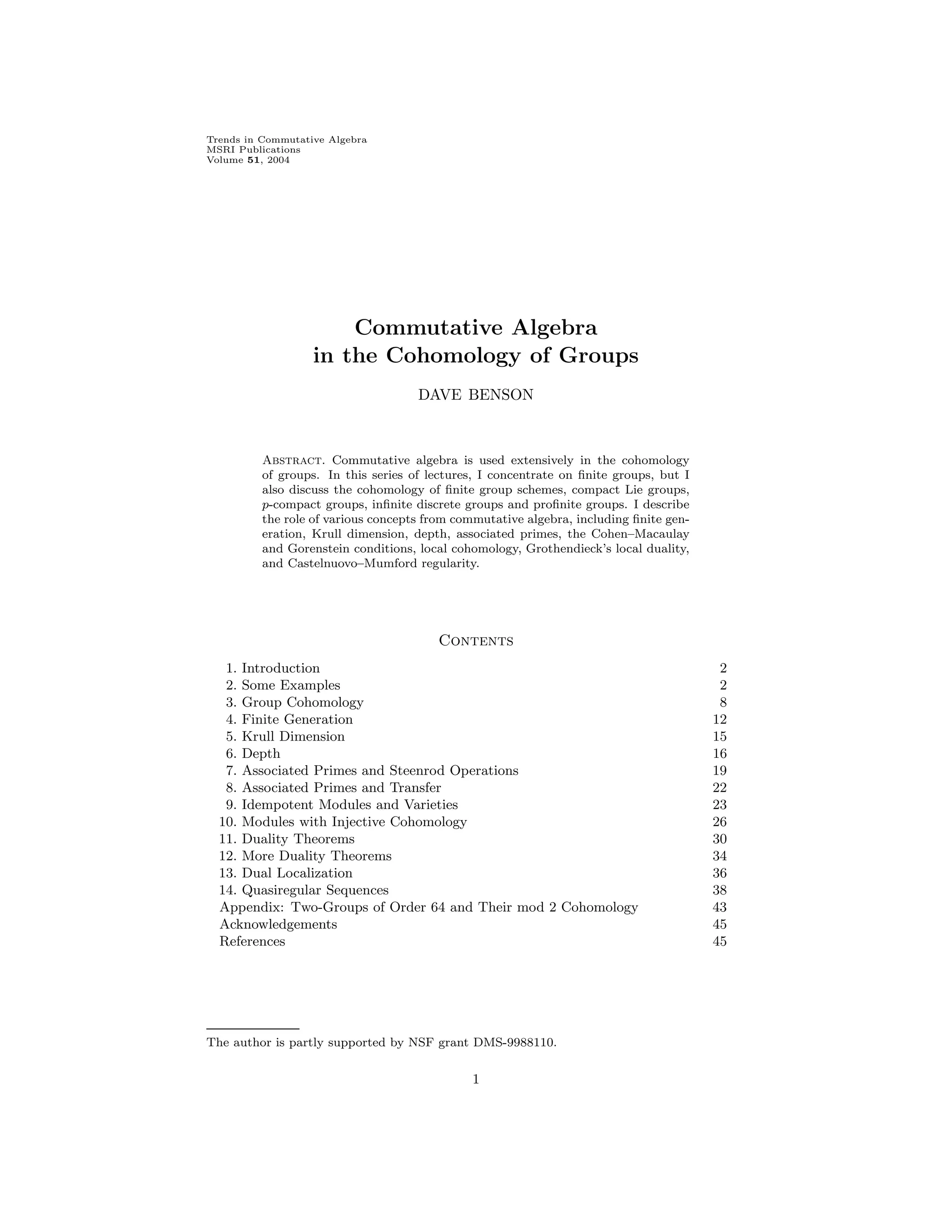
![2 DAVE BENSON
1. Introduction
The purpose of these lectures is to explain how commutative algebra is used in
the cohomology of groups. My interpretation of the word “group” is catholic: the
kinds of groups in which I shall be interested include finite groups, finite group
schemes, compact Lie groups, p-compact groups, infinite discrete groups, and
profinite groups, although later in the lectures I shall concentrate more on the
case of finite groups, where representation theoretic methods are most effective.
In each case, there are finite generation theorems which state that under suitable
conditions, the cohomology ring is a graded commutative Noetherian ring; over
a field k, this means that it is a finitely generated graded commutative k-algebra.
Although graded commutative is not quite the same as commutative, the usual
concepts from commutative algebra apply. These include the maximal/prime
ideal spectrum, Krull dimension, depth, associated primes, the Cohen–Macaulay
and Gorenstein conditions, local cohomology, Grothendieck’s local duality, and
so on. One of the themes of these lectures is that the rings appearing in group co-
homology theory are quite special. Most finitely generated graded commutative
k-algebras are not candidates for the cohomology ring of a finite (or compact Lie,
or virtual duality, or p-adic Lie, or . . . ) group. The most powerful restrictions
come from local cohomology spectral sequences such as the Greenlees spectral
sequence Hs,t
m H∗
(G, k) =
⇒ H−s−t(G, k), which can be viewed as a sort of dual-
ity theorem. We describe how to construct such spectral sequences and obtain
information from them.
The companion article to this one, [Iyengar 2004], explains some of the back-
ground material that may not be familiar to commutative algebraists. A number
of references are made to that article, and for distinctiveness, I write [Sri].
2. Some Examples
For motivation, let us begin with some examples. We defer until the next
section the definition of group cohomology
H∗
(G, k) = Ext∗
kG(k, k)
(or see § 6 of [Sri]). All the examples in this section are for finite groups G over
a field of coefficients k.
(2.1) The first comment is that in the case where k is a field of characteristic
zero or characteristic not dividing the order of G, Maschke’s theorem in represen-
tation theory shows that all kG-modules are projective (see Theorem 3.1 of [Sri]).
So for any kG-modules M and N, and all i > 0, we have Exti
kG(M, N) = 0. In
particular, H∗
(G, k) is just k, situated in degree zero. Given this fact, it makes
sense to look at examples where k has characteristic p dividing |G|.](https://image.slidesharecdn.com/29260-250507080829-2c094980/75/Trends-In-Commutative-Algebra-First-Edition-Luchezar-L-Avramov-17-2048.jpg)
![COMMUTATIVE ALGEBRA IN THE COHOMOLOGY OF GROUPS 3
(2.2) Next, we discuss finite abelian groups. See also § 7.4 of [Sri]. The Künneth
theorem implies that
(2.2.1) H∗
(G1 × G2, k) ∼
= H∗
(G1, k) ⊗k H∗
(G2, k).
So we decompose our finite abelian group as a direct product of cyclic groups of
prime power order. The factors of order coprime to the characteristic may be
thrown away, using (2.1). For a cyclic p-group in characteristic p, there are two
possibilities (Proposition 7.3 of [Sri]). If p = 2 and |G| = 2, then H∗
(G, k) = k[x]
where x has degree one. In all other cases (i.e., p odd, or p = 2 and |G| ≥ 4), we
have H∗
(G, k) = k[x, y]/(x2
) where x has degree one and y has degree two. It
follows that if G is any finite abelian group then H∗
(G, k) is a tensor product of
a polynomial ring and a (possibly trivial) exterior algebra.
(2.2.2) In particular, if G is a finite elementary abelian p-group of rank r (i.e.,
a product of r copies of Z/p) and k is a field of characteristic p, then the coho-
mology ring is as follows. For p = 2, we have
H∗
((Z/2)r
, k) = k[x1, . . . , xr]
with |xi| = 1, while for p odd, we have
H∗
((Z/p)r
, k) = Λ(x1, . . . , xr) ⊗ k[y1, . . . , yr]
with |xi| = 1 and |yi| = 2. In the latter case, the nil radical is generated by
x1, . . . , xr, and in both cases the quotient by the nil radical is a polynomial ring
in r generators.
(2.3) The next comment is that if S is a Sylow p-subgroup of G then a transfer
argument shows that the restriction map from H∗
(G, k) to H∗
(S, k) is injective.
What’s more, the stable element method of Cartan and Eilenberg [1956] identifies
the image of this restriction map. For example, if S E G then H∗
(G, k) =
H∗
(S, k)G/S
, the invariants of G/S acting on the cohomology of S (see § 7.6 of
[Sri]). It follows that really important case is where G is a p-group and k has
characteristic p. Abelian p-groups are discussed in (2.2), so let’s look at some
nonabelian p-groups.
(2.4) Consider the quaternion group of order eight,
(2.4.1) Q8 = hg, h | gh = h−1
g = hg−1
i.
There is an embedding
g 7→ i, h 7→ j, gh 7→ k, g2
= h2
= (gh)2
7→ −1
of Q8 into the unit quaternions (i.e., SU(2)), which form a three dimensional
sphere S3
. So left multiplication gives a free action of Q8 on S3
; in other words,
each nonidentity element of the group has no fixed points on the sphere. The
quotient S3
/Q8 is an orientable three dimensional manifold, whose cohomology](https://image.slidesharecdn.com/29260-250507080829-2c094980/75/Trends-In-Commutative-Algebra-First-Edition-Luchezar-L-Avramov-18-2048.jpg)
![4 DAVE BENSON
therefore satisfies Poincaré duality. The freeness of the action implies that we
can choose a CW decomposition of S3
into cells permuted freely by Q8. Taking
cellular chains with coefficients in F2, we obtain a complex of free F2Q8-modules
of length four, whose homology consists of one copy of F2 at the beginning and
another copy at the end. Making suitable choices for the cells, this looks as
follows.
0 → F2Q8
g−1
h−1
−
−
−
−
−
→ (F2Q8)2
h−1 hg+1
gh+1 g−1
−
−
−
−
−
−
−
−
−
→ (F2Q8)2 (g−1 h−1)
−
−
−
−
−
−
−
→ F2Q8 → 0
So we can form a Yoneda splice of an infinite number of copies of this sequence
to obtain a free resolution of F2 as an F2Q8-module. The upshot of this is that
we obtain a decomposition for the cohomology ring
H∗
(Q8, F2) = F2[z] ⊗F2
H∗
(S3
/Q8; F2)
(2.4.2)
= F2[x, y, z]/(x2
+ xy + y2
, x2
y + xy2
),
where z is a polynomial generator of degree four and x and y have degree one.
This structure is reflected in the Poincaré series
∞
X
i=0
ti
dim Hi
(Q8, F2) = (1 + 2t + 2t2
+ t3
)/(1 − t4
).
The decomposition (2.4.2) into a polynomial piece and a finite Poincaré duality
piece can be expressed as follows (cf. § 11):
H∗
(Q8, F2) is a Gorenstein ring.
(2.5) We recall that the meanings of Cohen–Macaulay and Gorenstein in this
context are as follows. Let R be a finitely generated graded commutative k-
algebra with R0 = k and Ri = 0 for i 0. Then Noether’s normalization lemma
guarantees the existence of a homogeneous polynomial subring k[x1, . . . , xr] over
which R is finitely generated as a module.
Proposition 2.5.1. If R is of the type described in the previous paragraph, then
the following are equivalent.
(a) There exists a homogeneous polynomial subring k[x1, . . . , xr] ⊆ R such
that R is finitely generated and free as a module over k[x1, . . . , xr].
(b) If k[x1, . . . , xr] ⊆ R is a homogeneous polynomial subring such that R is
finitely generated as a k[x1, . . . , xr]-module then R a free k[x1, . . . , xr]-module.
(c) There exist homogeneous elements of positive degree x1, . . . , xr forming a
regular sequence, and R/(x1, . . . , xr) has finite rank as a k-vector space.
We say that R is Cohen–Macaulay of dimension r if the equivalent conditions of
the above proposition hold.](https://image.slidesharecdn.com/29260-250507080829-2c094980/75/Trends-In-Commutative-Algebra-First-Edition-Luchezar-L-Avramov-19-2048.jpg)
![COMMUTATIVE ALGEBRA IN THE COHOMOLOGY OF GROUPS 5
(2.6) If R is Cohen–Macaulay, and the quotient ring R/(x1, . . . , xr) has a sim-
ple socle, then we say that R is Gorenstein. Whether this condition holds is
independent of the choice of the polynomial subring. Another way to phrase the
condition is that R/(x1, . . . , xr) is injective as a module over itself. This quotient
satisfies Poincaré duality, in the sense that if the socle lies in degree d (d is called
the dualizing degree) and we write
p(t) =
∞
X
i=0
ti
dimk(R/(x1, . . . , xr))i
then
(2.6.1) td
p(1/t) = p(t).
Setting
P(t) =
∞
X
i=0
ti
dimk Ri,
the freeness of R over k[x1, . . . , xr] implies that P(t) is the power series expansion
of the rational function p(t)/
Qr
i=1(1 − t|xi|
). So plugging in equation (2.6.1), we
obtain the functional equation
(2.6.2) P(1/t) = (−t)r
t−a
P(t),
where a = d −
Pr
i=1(|xi| − 1). We say that R is Gorenstein with a-invariant a.
Another way of expressing the Gorenstein condition is as follows. If R (as
above) is Cohen–Macaulay, then the local cohomology Hs,t
m R is only nonzero for
s = r. The graded dual of Hr,∗
m R is called the canonical module, and written
ΩR. To say that R is Gorenstein with a-invariant a is the same as saying that
ΩR is a copy of R shifted so that the identity element lies in degree r − a.
In the case of H∗
(Q8, F2), we can choose the polynomial subring to be k[z].
The ring H∗
(Q8, F2) is a free module over k[z] on six generators, corresponding
to a basis for the graded vector space H∗
(S3
/Q8; F2) ∼
= H∗
(Q8, F2)/(z), which
satisfies Poincaré duality with d = 3. So in this case the a-invariant is 3−(4−1) =
0. We have p(t) = 1 + 2t + 2t2
+ t3
and P(t) = p(t)/(1 − t4
).
(2.7) A similar pattern to the one seen above for Q8 holds for other groups.
Take for example the group GL(3, 2) of 3 × 3 invertible matrices over F2. This
is a finite simple group of order 168. Its cohomology is given by
H∗
(GL(3, 2), F2) = F2[x, y, z]/(x3
+ yz)
where deg x = 2, deg y = deg z = 3. A homogeneous system of parameters
for this ring is given by y and z, and these elements form a regular sequence.
Modulo the ideal generated by y and z, we get F2(x)/(x3
). This is a finite
Poincaré duality ring whose dualizing degree is 4. Again, this means that the
cohomology is a Gorenstein ring with a-invariant 4 − (3 − 1) − (3 − 1) = 0, but it](https://image.slidesharecdn.com/29260-250507080829-2c094980/75/Trends-In-Commutative-Algebra-First-Edition-Luchezar-L-Avramov-20-2048.jpg)

![his own presumption.” “He who gazes too much upon the sun’s orb,
makes himself blind; even thus, I think, does pride blind many, who
want to know too much.” “When God finds a soul that does not
move, He operates within it in His own manner, and puts His hand to
greater things. He takes from this soul the key of His treasures
which He had given to it, so that it might be able to enjoy them; and
gives to this same soul the care of His presence, which entirely
absorbs it.”[247]
5. God’s way of winning souls and raising them towards pure love.
The fruits of full trust.
The next group can be made up of passages descriptive of the
dealings adopted by God with a view to first winning souls as He
finds them, and then raising them above mercenary hope or slavish
fear; and of the childlike fearlessness inspired by perfect trust in
God. As to the winning them, she says: “The selfishness of man is so
contrary to God and rebellious against Him, that God Himself cannot
induce the soul to do His will, except by certain stratagems
(lusinghe): promising it things greater than those left, and giving it,
even in this life, a certain consoling relish (gusto). And this He does,
because He perceives the soul to love things visible so much, that it
would never leave one, unless it saw four.”[248]
And, as to God’s raising of the soul, she propounds the deep
doctrine, which only apparently contradicts the divine method just
enunciated, as to the necessary dimness of the soul’s light with
regard to the intrinsic consequences of its own acts, a dimness
necessary, because alone truly purificatory, for the time that runs
between its conversion, when, since it is still weak, it requires to
see, and its condition of relative purity, when, since it is now strong,
it can safely be again allowed to see.“ If a man were to see that
which, in return for his good deeds, he will have in the life to come,
he would cease to occupy himself with anything but heavenly things.
But God, desiring that faith should have its merit, and that man
should not do good from the motive of selfishness, gives him that
knowledge little by little, though always sufficiently for the degree of](https://image.slidesharecdn.com/29260-250507080829-2c094980/75/Trends-In-Commutative-Algebra-First-Edition-Luchezar-L-Avramov-22-2048.jpg)
![faith of which the man is then capable. And God ends by leading him
to so great a light as to things that are above, that faith seems to
have no further place.—On the other hand, if man knew that which
hereafter he will have to suffer if he die in the miserable state of sin,
I feel sure that, for fear of it, he would let himself be killed rather
than commit one single sin. But God, unwilling as He is that man
should avoid doing evil from the motive of fear, does not allow him
to see so terrifying a spectacle, although He shows it in part to such
souls as are so clothed and occupied by His pure love that fear can
no more enter in.”[249]
And as to the full trust of pure love, we have the following: “God
let her hear interiorly: ‘I do not want thee henceforward to turn
thine eyes except towards Love; and here I would have thee stay
and not to move, whatever happens to thee or to others, within or
without’; ‘he who trusts in Me, should not doubt about himself.’”[250]
And this Love gives of itself so fully to those that give themselves
fully to It, that when asked by such souls to impetrate some grace
for them she would say: “I see this tender Love to be so courteously
attentive to these my spiritual children, that I cannot ask of It
anything for them, but can only present them before His face.” In
other cases, as in those of beginners when sick and dying, she
would be “drawn to pray for” a soul, and would “impetrate” some
special “grace for it.” “Lord, give me this soul,” she would at times
pray aloud, “I beg Thee to give it me, for indeed Thou canst do so.”
And “when she was drawn to pray for something, she would be told
in her mind: ‘Command, for love is free to do so.’”[251]
III. The Three Categories and the Two Ways.
The next set of sayings so eminently constitutes the aggregation,
if not the system, of categories under and with which Catherine
habitually sees her types and pictures, and thinks and feels her
experiences of divine things, that it will require careful discrimination
and grouping.](https://image.slidesharecdn.com/29260-250507080829-2c094980/75/Trends-In-Commutative-Algebra-First-Edition-Luchezar-L-Avramov-23-2048.jpg)
![1. The Three Categories: “In” Concentration; “Out” Liberation;
“Over,” Elevation.
There is, first, the great category of in, within, down into; that is,
recollection, concentration. “The love which I have within my heart.”
“Since I began to love It, never again has that Love diminished;
indeed It has ever grown to Its own fulness, within my innermost
heart.” Hence she would say to those who dwelt in admiration of her
psycho-physical peculiarities: “If you but had experience (sapeste) of
another thing which I feel within me!” And again,“If we would
esteem (aright) the operations of God, we must attend more to
interior than to exterior things.” And, with regard to the Holy
Eucharist, she would whisper, when seeing at Mass the Priest about
to communicate: “O swiftly, swiftly speed It down to the heart, since
it is the heart’s own food ”; and she would declare, with regard to
her own Communion: “In the same instant in which I had It in my
mouth, I felt It in my heart.”[252]
There is, next, the category of out, outside, outwards; that is,
liberation, ecstasy. “The soul which came out from God pure and full
has a natural instinct to return to God as full and pure (as it came).”
“The soul finds itself bound to a body entirely contrary to its own
nature, and hence expects with desire its separation from the body.”
“God grants the grace, to some persons, of making their bodies into
a Purgatory (already) in this world.” “When God has led the soul on
to its last stage (passo), the soul is so full of desire to depart from
the body to unite itself with God, that its body appears to it a
Purgatory, keeping it far apart from its (true) object.” “The prison, in
which I seem to be, is the world; the chain is the body”; “to noble
(gentili) souls, death is the end of an obscure prison; to the
remainder, it is a trouble,—to such, that is, as have fixed all their
care upon what is but so much dung (fango).” And, whilst
strenuously mortifying the body, she would answer its resistances,
as though so many audible complainings, and say: “If the body is
dying, well, let it die; if the body cannot bear the load, well, leave
the body in the lurch (O soul).”[253]](https://image.slidesharecdn.com/29260-250507080829-2c094980/75/Trends-In-Commutative-Algebra-First-Edition-Luchezar-L-Avramov-24-2048.jpg)
![And all this imprisonment is felt as equivalent to being outside of
the soul’s true home. “I seem to myself to be in this world like those
who are out of their home, and who have left all their friends and
relations, and who find themselves in a foreign land; and who,
having accomplished the business on which they came, stand ready
to depart and to return home,—home, where they ever are with
heart and mind, having indeed so ardent a love of their country
(patria), that one day spent in getting there would appear to them
to last a year.”[254]
And this feeling of outsideness, seen here with regard to the
relations of the soul to the body and to the world, we find again with
regard to sanctity and the soul. In this latter case also the greater is
felt to be (as it were) entrapped, and contained only very partially
within the lesser; and as though this greater could and did exist, in
its full reality, only outside of the lesser. “I can no more say ‘blessed’
to any saint, taken in himself, because I feel it to be an inappropriate
(deforme) word”; “I see how all the sanctity which the saints have,
is outside of them and all in God.” Indeed she sums this up in the
saying: “I see that anything perfect is entirely outside of the
creature; and that a thing is entirely imperfect, when the creature
can at all contain it.” Hence “the Blessed possess (hanno)
blessedness, and yet they do not possess it. For they possess it, only
in so far as they are annihilated in their own selves and are clothed
with God; and they do not possess it, in so far as they remain (si
trovano) in their particular (proprio) being, so as to be able to say: ‘I
am blessed.’”[255]
There is, in the third place, the category of over, above, upwards;
that is elevation, sublimation. We will begin with cases where it is
conjoined with the previous categories, and will move on into more
and more pure aboveness. “I am so placed and submerged in His
immense love, that I seem as though in the sea entirely under water,
and could on no side touch, see, or feel anything but water.” And “if
the sea were the food of love, there would exist no man nor woman
that would not go and drown himself (affogasse) in it; and he who](https://image.slidesharecdn.com/29260-250507080829-2c094980/75/Trends-In-Commutative-Algebra-First-Edition-Luchezar-L-Avramov-25-2048.jpg)
![was dwelling far from this sea, would engage in nothing else but in
walking to get to it and to immerse himself within it.”[256] The soul
here feels the water on every side of it, yet evidently chiefly above
it, for it has had to plunge in, to get under the water.
“Listen to what Fra Jacopone says in one of his Lauds, which
begins, ‘O Love of Poverty.’ He says: ‘That which appears to thee (to
be), is not; so high above is that which is. (True) elevation
(superbia) is in heaven; earthy lowness (umiltà) leads to the soul’s
own destruction.’ He says then: ‘That which appears to thee,’ that is,
all things visible, ‘are not,’ and have not true being in them: ‘so high’
and great ‘is He who is,’ that is, God, in whom is all true being.
‘Elevation is in heaven,’ that is, true loftiness and greatness is in
heaven and not on earth; ‘earthy lowness leads to the soul’s own
destruction,’ that is, affection placed in these created things, which
are low and vile, since they have not in them true being, produces
this result.”—“I feel,” she says in explanation of what and how she
knows, “a first thing above the intellect; and above this thing I feel
another one and a greater; and above this other one, another, still
more great; and so up and up does one thing go above the other,
each thing ever greater (than its predecessors), that I conclude it to
be impossible to express even a spark (scintilla) as to It” (the
highest and greatest of the whole series, God). Here it is interesting
still to trace the influence of the same passage of Jacopone (again
referred to in this place by the Vita), and to see why she introduced
“greatness” alongside of “loftiness” into her previous paraphrase.
[257]
Now this vivid impression of a strong upward movement,
combined with the feeling of being in and under something, gives
the following image, used by her during her last illness: “I can no
longer manage to live on in this life, because I feel as though I were
in it like cork under water.” And this “above,” unlike to “outside,” is
accompanied by the image, not of clothing but of nakedness; the
clothes are left below. “This vehement love said to her, on one
occasion: ‘What art thou thinking of doing? I want thee all for](https://image.slidesharecdn.com/29260-250507080829-2c094980/75/Trends-In-Commutative-Algebra-First-Edition-Luchezar-L-Avramov-26-2048.jpg)
![myself. I want to strip thee naked, naked. The higher up thou shalt
go, however great a perfection thou mayest have, the higher will I
ever stand above thee, to ruin all thy perfections’”—this, of course,
inasmuch as she is still imperfect and falls short of the higher and
higher perfections to which her soul is being led.[258]
And as to man’s faculties, she says: “As the intellect reaches
higher (supera) than speech, so does love reach higher than
intellect.” And again, as a universal law: “When pure love speaks, it
ever speaks above nature; and all the things which it does and
thinks and feels are always above nature.”[259]
2. The Two Ways: the Negative Way, God’s Transcendence; the
Positive Way, God’s Immanence.
Now these three categories of within and inward, outside and
outward, above and upward position and movement, can lead, and
do actually lead in Catherine’s case, to two separate lines of thought
and feeling. And these lines are each too much a necessary logical
conclusion from the constant working of these categories, and they
are each again far too much, and even apart from these categories,
expressive of two rival but complementary experiences, for either of
them to be able to suppress or even modify the other. Each has its
turn in the rich, free play of Catherine’s life. I will take the negative
line first, and then the positive, so as to finish up with affirmation,
which will thus, as in her actual experience and practice, be all the
deeper and more substantial, because it has passed, and is ever re-
passing, through a process of limitation and purification.
First, then, if grace and God are only within, and only without, and
only above, she will and does experience contradiction and paradox
in all attempts at explaining reality; she will thus find things to be
obscure instead of clear; and she will end by affirming the
unutterableness, the unthinkableness of God, indeed of all reality. “I
see without eyes, I understand without understanding, I feel without
feeling, and I taste without taste.” “When the creature is purified, it
sees the True; and such a sight is not a sight.” “The sight of how it is](https://image.slidesharecdn.com/29260-250507080829-2c094980/75/Trends-In-Commutative-Algebra-First-Edition-Luchezar-L-Avramov-27-2048.jpg)
![God” who sends the soul its purifying trials “gives the soul a great
contentment; and yet this contentment does not diminish the pain.”
Still, “pure love cannot suffer; nor can it understand what is meant
by pain or torment.” “The sun, which at first seemed so clear to me,
now seems obscure; what used to seem sweet to me, now seems
bitter: because all beauties and all sweetnesses that have an
admixture of the creature are corrupt and spoilt.” “As to Love, only
this can we understand about It, that It is incomprehensible to the
mind.” “So long as a person can still talk of things divine, and can
relish, understand, remember and desire them, he has not yet come
to port.” For indeed “all that can be said about God is not God, but
only certain smallest fragments which fall from (His) table.”[260]
And yet those experiences of God’s presence as, apparently, in a
special manner within us, and without us, and above us, also lead,
by means of another connection of ideas, to another, to a positive
result. For those experiences can lead us to dwell, not upon the
difference of the “places,” but upon the apparent fact that He is in a
“place” of some sort, in space somewhere, the exact point of which
is still to find; and, by thus bringing home to the mind this
underlying paradox of the whole position, they can help to make the
soul shrink away from this false clarity, and to fall back upon the
deep, dim, true view of God as existing, for our apprehension, in
certain states of soul alone, states which have all along been
symbolized for us by these different “places” and “positions.” And
thus what before was a paradox and mystery qua space, because at
the same time within and without, and because not found by the
soul “within” unless through getting “without” itself, becomes now a
paradox and mystery qua state, because the soul at one and the
same time attains to its own happiness and loses it, indeed attains
happiness only through deliberately sacrificing it. And we thus come
to the great central secret of all life and love, revealed to us in its
fulness in the divine paradox of our Lord’s life and teaching.
God, then, first seems to be in a place, indeed to be a place. “I
see all good to be in one only place, that is God.” “The spirit can find](https://image.slidesharecdn.com/29260-250507080829-2c094980/75/Trends-In-Commutative-Algebra-First-Edition-Luchezar-L-Avramov-28-2048.jpg)
![no place except God, for its repose.”[261]
If God be in a place, we cannot well conceive of Him as other than
outside of and above the soul, which itself, even God being in a
place, will be in a place also. “God has created the soul pure and
full, with a certain God-ward instinct, which brings happiness in its
train (istinto beatifico).” And “the nearer the soul approaches” (is
joined, si accosta) “to God, the more does the instinct attain to its
perfection.” Here the instinct within pushes the soul “onwards,
outwards, upwards.” And the nearer the soul gets to God in front,
outside and above of it, the happier it becomes: because, the more
it satisfies this its instinct, the less it suffers from the distance from
God, and the more does it enjoy His proximity.[262]
This approach is next conceived of as increasingly conveying a
knowledge to the soul of God’s desire for union with it; but such an
approach can only be effected by means of much fight against and
through the intervening ranks of the common enemies of the two
friends; and, as we have already seen, chief amongst these enemies
is the soul’s false self. “The nearer man approaches to (si accosta)
God, the more he knows that God desires to unite Himself with us.”
“Being determined to approach God, I am constrained to be the
enemy of His enemies.”[263]
And then, that “place” in which God was pictured as being, is
found to be a state, a disposition of the soul. Now as long as the
dominant tendency was to think God with clearness, and hence to
picture Him as in space, that same tendency would, naturally
enough, represent this place He was in as outside and above the
soul. For if He is in space, He is pictured as extended, and hence as
stretching further than, and outside of, the soul, which itself also is
conceived as spacially extended; and if He is in a particular part of
space, that part can only, for a geocentric apprehension of the
world, be thought of as the upper part of space. But in proportion as
the picture of physical extension and position gives way to its
prompting cause, and the latter is expressed, as far as possible,
unpictorially and less clearly, but more simply as what it is, viz. a](https://image.slidesharecdn.com/29260-250507080829-2c094980/75/Trends-In-Commutative-Algebra-First-Edition-Luchezar-L-Avramov-29-2048.jpg)
![spiritual intention and disposition, she is still driven indeed, in order
to retain some clearness of speech, to continue to speak as of a
place and of a spacial movement, but she has now no longer three
categories but only one, viz. within and inwards. For a physical
quantity can be and move in different places and directions in space;
but a spiritual quality can only be experienced within the substance
of the spirit. “God created the soul pure and full, with a certain
beatific instinct of Himself” (i.e. of His actual presence). And hence,
“in proportion as it (again) approaches to the conditions of its
original creation, this beatific instinct ever increasingly discovers
itself and grows stronger and stronger.”[264]
And God being thus not without, nor indeed in space at all, she
can love Him everywhere: indeed the what she is now constitutes
the where she is; in a camp she can love God as dearly as in a
convent, and heaven itself is already within her soul, so that only a
change in the soul’s dispositions could constitute hell for that soul,
even in hell itself. “O Love,” she exclaims, after the scene with the
Friar, who had attempted to prove to her that his state of life
rendered him more free and apt to love God, “who then shall impede
me from loving Thee? Even if I were in the midst of a camp of
soldiers, I could not be impeded from loving Thee.” She had, during
the interview, explained her meaning: “If I believed that your
religious habit would give me but one additional glimpse” (spark,
scintilla) “of love, I would without doubt take it from you by force,
were I not allowed to have it otherwise. That you may be meriting
more than myself, I readily concede, I am not seeking after that; let
those things be yours. But that I cannot love Him as much as you
can do, you will never succeed in making me even understand.” “I
stood so occupied in seeing the work of Love (within my soul), that
if it had thrown me with soul and body into hell, hell itself would
have appeared to me to be nothing but love and consolation.” And,
on another occasion, she says to her disciples: “If, of that which this
heart of mine is feeling, one drop were to fall into hell, hell itself
would become all life eternal”; and she accepts with jubilation this
interpretation of her words, on the part of one of them (no doubt](https://image.slidesharecdn.com/29260-250507080829-2c094980/75/Trends-In-Commutative-Algebra-First-Edition-Luchezar-L-Avramov-30-2048.jpg)
![Vernazza): “Hell exists in every place where there is rebellion against
Love, God; but Life Eternal, in every place where there is union with
that same Love, God.”[265]
And she now cannot but pray to possess all this love,—love being
now pictured as a food, as a light, or as water, bringing life to the
soul. “O tender Love, if I thought that but one glimpse of Thee were
to be wanting to me, truly and indeed I could not live.” “Love, I want
Thee, the whole of Thee.” “Never can love grow quiet, until it has
arrived at its ultimate perfection.” And, in gaining all God, she gains
all other things besides: “O my God, all mine, everything is mine;
because all that belongs to God seems all to belong to me.”[266]
But if she loves all God, she can, on the other hand, love only
Him: how, then, is she to manage to love her neighbour? “Thou
commandest me to love my neighbour,” she complains to her Love,
“and yet I cannot love anything but Thee, nor can I admit anything
else and mix it up with Thee. How, then, shall I act?” And she
received the interior answer: “He who loves me, loves all that I
love.”[267]
But soon her love, as generous as it is strong, becomes uneasy as
to its usual consequences,—the consolations, purely spiritual or
predominantly psychical or even more or less physical, which come
in its train. And even though she is made to understand that at least
the first are necessarily bound up with love, in exact proportion to its
generosity, she is determined, to the last, to love for love itself, and
not for love’s consequences, battling thus to keep her spirituality free
from the slightest, subtlest self-seeking. “This soul said to its Love:
‘Can it really be, O tender Love, that Thou art destined never to be
loved without consolation or the hope of some advantage in heaven
or on earth” accruing to Thy lover?’” “And she received the answer,
that such an union could not exist without a great peace and
contentment of the soul.” And yet she continues to affirm:
“Conscience, in its purity, cannot bear anything but God alone; of all
the rest, it cannot suffer the least trifle.”[268]](https://image.slidesharecdn.com/29260-250507080829-2c094980/75/Trends-In-Commutative-Algebra-First-Edition-Luchezar-L-Avramov-31-2048.jpg)
![And she practices and illustrates this doctrine in detail. “One day,
after Communion, God gave her so great a consolation that she
remained in ecstasy. When she had returned to her usual state, she
prayed: ‘O Love, I do not wish to follow Thee for the sake of these
delights, but solely from the motive of true love.’” On another similar
occasion she prays: “I do not want that which proceedeth from
Thee; I want Thyself alone, O tender Love.” And again, “on one
occasion, after Communion, there came to her so much odour and
so much sweetness that she seemed to herself to be in Paradise. But
instantly she turned towards her Lord and said: ‘O Love, art Thou
perhaps intending to draw me to Thee by means of these sensible
consolations (sapori)? I want them not; I want nothing except Thee
alone.’”[269]
IV. The Other Worlds.
We have now gone through Catherine’s contemplations and
conceptions as regards the soul’s relations with its true Life and
Love, here and now, on this side the veil. We have, in conclusion, to
try and reproduce and illustrate her teaching as to these relations on
the other side of death.
1. No absolute break in the spirit’s life at the body’s death.
Now here especially is it necessary ever to bear in mind her own
presupposition, which runs throughout and sustains all her doctrine.
For she is sure, beyond ever even raising a question concerning the
point, that her soul and God, her two great realities and experiences,
remain substantially the same behind the veil as before it, and hence
that the most fundamental and universal of the soul’s experiences
here can safely be trusted to obtain there also. Hence, too, only
such points in the Beyond are dwelt on as she can thus
experimentally forecast; but these few points are, on the other hand,
developed with an extraordinary vividness and fearless, rich variety
of illustration. And it is abundantly clear that this assumption of the
essential unity and continuity of the soul’s life here and hereafter, is](https://image.slidesharecdn.com/29260-250507080829-2c094980/75/Trends-In-Commutative-Algebra-First-Edition-Luchezar-L-Avramov-32-2048.jpg)
![itself already a doctrine, and a most important one. We will then
take it as such, and begin with it as the first of her teachings as to
the Beyond.
“This holy soul,” says the highly authoritative prologue to the
Trattato, in close conformity with her constant assumptions and
declarations, “finding herself, whilst still in the flesh, placed in the
Purgatory of God’s burning love,—a love which consumed (burnt,
abbrucciava) and purified her from whatever she had to purify, in
order that, on passing out of this life, she might enter at once into
the immediate presence (cospetto) of her tender Love, God:
understood, by means of this furnace of love, how the souls of the
faithful abide in the place of Purgatory, to purge themselves of every
stain of sin that, in this life, had been left unpurged. And as she,
placed in the loving Purgatory of the divine fire, abode united to the
divine Love, and content with all that It wrought within her, so she
understood it to be with the souls in Purgatory.”[270]
2. Hell.
The details of her doctrine as to the Beyond we can group under
three heads: the unique, momentary experience and solitary,
instantaneous act of the soul, at its passing hence and beginning its
purgation there; the particular dispositions, joys and sufferings of
the soul during the process of purification, as well as the cause and
manner of the cessation of that process; and (generally treated by
her as a simple contrast to this her direct and favourite purgatorial
contemplation) the particular dispositions, sufferings, and
alleviations of lost souls. Since her teachings on the last-named
subject are more of an incidental character, I shall take them first,
and make them serve, as they do with her, as a foil to her doctrine
of the Intermediate State: whilst her conception of Heaven, already
indicated throughout her descriptions of Pure Love, is too much of a
universal implication, and too little a special department of her
teaching, to be capable of presentation here.
As to the cause of Hell, she says: “It is the will’s opposition to the
Will of God which causes guilt; and as long as this evil will continues,](https://image.slidesharecdn.com/29260-250507080829-2c094980/75/Trends-In-Commutative-Algebra-First-Edition-Luchezar-L-Avramov-33-2048.jpg)
![so long does the guilt continue. For those, then, who have departed
this life with an evil will there is no remission of the guilt, neither can
there be, because there can be no more change of will.” “In passing
out of this life, the soul is established for good or evil, according to
its deliberate purpose at the time; as it is written, ‘where I shall find
thee,’ that is, at the hour of death, with a will either determined to
sin, or sorry for sin and penitent, ‘there will I judge thee.’” Or, in a
more characteristic form: “There is no doubt that our spirit was
created to love and enjoy: and it is this that it goes seeking in all
things. But it never finds satiety in things of time; and yet it goes on
hoping, on and on, to be at last able to find it. And this experience it
is that helps me to understand what kind of a thing is Hell. For I see
that man, by love, makes himself one single thing with God, and
finds there every good; and, on the other hand, that when he is
bereft of love, he remains full of as many woes as are the blessings
he would have been capable of, had he not been so mad.”[271]
And yet, and this is her own beautiful contribution to the
traditional doctrine on this terrible and mysterious subject, neither
are the sufferings of the lost infinite in amount, nor is their will
entirely malign. And both these alleviations evidently exist from the
first: I can find no trace anywhere in her teaching of a gradual
mitigation of either the punishment or the guilt. Indeed, although
she always teaches the mitigation of the suffering, it is only
occasionally that she teaches the persistence of some moral good.
Thus her ordinary teaching is: “Those who are found, at the moment
of death, with a will determined to sin, have with them an infinite
degree of guilt, and the punishment is without end”; “the sweet
goodness of God sheds the rays of His mercy even into Hell: since
He might most justly have given to the souls there a far greater
punishment than He has.” “At death God exercises His justice, yet
not without mercy; since even in Hell the soul does not suffer as
much as it deserves.” But occasionally she goes further afield, and
insists on the presence there, not only of some mercy in the
punishment, but also of some good in the will. “When we shall have
departed from this life in a state of sin, God will withdraw from us](https://image.slidesharecdn.com/29260-250507080829-2c094980/75/Trends-In-Commutative-Algebra-First-Edition-Luchezar-L-Avramov-34-2048.jpg)
![His goodness, and will leave us to ourselves, and yet not altogether:
since He wills that in every place His goodness shall be found and
not His justice alone. And if a creature could be found that did not,
to some degree, participate in the divine goodness, that creature
would be, one might say, as malignant as God is good.”[272] There
can be no doubt, as we shall see further on, that this latter is her full
doctrine and is alone entirely consistent with her general principles.
Certain details of her Hell doctrine which appear in immediate
contrast to, or in harmony with, some special points of her
Purgatorial teaching, had better appear in connection with the latter.
3. Purgatory; the initial experience and act.
Let us now take, in all but complete contrast to this doctrine as to
Hell, what she has to say about Purgatory. And here we have first to
deal with the initial experience and act, both of them unique and
momentary, of the soul destined for Purgatory. As to that
experience, only one description has been preserved for us. “Once,
and once only, do the souls (that are still liable to, and capable of,
purgation) perceive the cause of (their) Purgatory that they bear
within themselves,—namely in passing out of this life: then, but
never again after that: otherwise self would come in (vi saria una
proprietà).”[273]
And this unique and momentary experience is straightway
followed by as unique and momentary an act, free and full, on the
part of the experiencing soul. Catherine has described this act in
every kind of mood, and from the various points of view, already
drawn out by us, of her doctrine, so that we have here again a most
impressive and vivid summing-up and pictorial representation of all
her central teaching.
“The soul thus seeing” (its own imperfection) and, “that it cannot,
because of the impediment” (of this imperfection) “attain
(accostarsi) to its end, which is God; and that the impediment
cannot be removed (levato) from it, except by means of Purgatory,
swiftly and of its own accord (volontieri) casts itself into it.”[274] Here](https://image.slidesharecdn.com/29260-250507080829-2c094980/75/Trends-In-Commutative-Algebra-First-Edition-Luchezar-L-Avramov-35-2048.jpg)
![we have the continuation of the outward movement: the soul is here
absolutely impeded in that, now immensely swift, movement, and is
brought to a dead stop, as though by something hard on the soul’s
own surface, which acts as a barrier between itself and God; it is
offered the chance of escaping from this intolerable suffering into
the lesser one of dissolving this hard obstacle in the ocean of the
purifying fire: and straightway plunges into the latter.
“If the soul could find another Purgatory above the actual one, it
would, so as more rapidly to remove from itself so important (tanto)
an impediment, instantly cast itself into it, because of the
impetuosity of that love which exists between God and the soul and
tends to conform the soul to God.”[275] Here we have an extension
of the same picturing, interesting because the addition of an
upwards to the outwards introduces a conflict between the image
(which evidently, for the soul’s plunge, requires Purgatory to lie
beneath the soul), and the doctrine (which, taking Purgatory as the
means between earth and heaven, cannot, if any spacial picturing be
retained at all, but place Heaven at the top of the picture, and
Purgatory higher up than the soul which is coming thither from
earth). The deep plunge has become a high jump.
“I see the divine essence to be of such purity, that the soul which
should have within it the least mote (minimo chè) of imperfection,
would rather cast itself into a thousand hells, than find itself with
that imperfection in the presence of God.”[276] Here the sense of
touch, of hardness, of a barrier which is checking motion, has given
way to the sense of sight, of stain, of a painful contrast to an all-
pure Presence; and the whole picture is now devoid of motion. We
thus have a transition to the immanental picturing, with its inward
movement or look.
“The soul which, when separated from the body, does not find
itself in that cleanness (nettezza) in which it was created, seeing in
itself the stain, and that this stain cannot be purged out except by
means of Purgatory, swiftly and of its own accord casts itself in; and
if it did not find this ordination apt to purge that stain, in that very](https://image.slidesharecdn.com/29260-250507080829-2c094980/75/Trends-In-Commutative-Algebra-First-Edition-Luchezar-L-Avramov-36-2048.jpg)
![moment there would be spontaneously generated (si generebbe)
within itself a Hell worse than Purgatory.”[277] Here we have again
reached her immanental conception, where the soul’s concern is with
conditions within itself, and where its joys and sorrows are within.
Its trouble is, in this case, the sense of contrast, between its own
original, still potential, indeed still actual though now only far down,
hidden and buried, true self, and its active, obvious, superficial, false
self. In so far as there is any movement before the plunge, it is an
inward, introspective one; the soul as a whole is, for that previous
moment, not conceived as in motion, but a movement of her self-
observing part or power takes place within her from the surface to
the centre; and only then, after her rapid journey from this her
surface-being to those her fundamental ineradicable requirements,
and after the consequent intolerably painful contrast and conflict
within herself, does she cast herself, with swift wholeheartedness,
with all she is and has, into the purifying place and state.
And, in full harmony with this immanental conception, the greater
suffering which would arise did she abide with this sight of herself
and yet without any moral change is described as springing up
spontaneously within herself. “The soul, seeing Purgatory to have
been ordained for the very purpose of purging away its stains, casts
itself in, and seems to find a great compassion (on the part of God)
in being allowed (able) to do so.” This appears to be only a variety of
the immanental view just given.[278]
4. Purgatory: the subsequent process.
We have finally to give her doctrine as to the particular
dispositions, joys, and sufferings of the soul during the process of its
purgation, and as to the cause and manner of the cessation of that
process.
As to the dispositions, they are generally the same as those which
impelled the soul to put itself in this place or condition. Only
whereas then, during that initial moment, they took the form of a
single act, an initiation of a new condition, now they assume the](https://image.slidesharecdn.com/29260-250507080829-2c094980/75/Trends-In-Commutative-Algebra-First-Edition-Luchezar-L-Avramov-37-2048.jpg)
![shape of a continuous state. Then the will freely tied itself; now it
gladly though painfully abides by its decision and its consequences.
Then the will found the relief and distraction of full, epoch-making
action; now it has but to will and work out the consequences
involved in that generous, all-inclusive self-determination. The range
and nature of this, its continuous action will thus be largely the very
reserve of those of that momentary act. “The souls that are in
Purgatory are incapable of choosing otherwise than to be in that
place, nor can they any more turn their regard (si voltare) towards
themselves, and say: ‘I have committed such and such sins, for
which I deserve to tarry here’; nor can they say, ‘Would that I had
not done them, that now I might go to Paradise’; nor yet say, ‘That
soul is going out before me’; nor, ‘I shall go out before him.’ They
are so completely satisfied that He should be doing all that pleases
Him, and in the way it pleases Him, that they are incapable of
thinking of themselves.” Indeed they are unable even to see
themselves, at least directly, for “these souls do not see anything,
even themselves in themselves or by means of themselves, but they
(only) see themselves in God.” Indeed we have already seen that to
do, or to be able to do, otherwise, would now “let self come in
(sarebbe una proprietà).”[279]
And the joys and sufferings, and the original, earthly cause of the
latter, are described as follows. “The souls in Purgatory have their
(active) will conformed in all things to the will of God; and hence
they remain there, content as far as regards their will.” “As far as
their will is concerned, these souls cannot find the pain to be pain,
so completely are they satisfied with the ordinance of God, so
entirely is their (active) will one with it in pure charity. On the other
hand, they suffer a torment so extreme, that no tongue could
describe it, no intellect could form the least idea of it, if God had not
made it known by special grace.” And indeed she says: “I shall cease
to marvel at finding that Purgatory is” in its way as “horrible as Hell.
For the one is made for punishing, the other for purging: hence both
are made for sin, sin which itself is so horrible and which requires
that its punishment and purgation should be conformable to its own](https://image.slidesharecdn.com/29260-250507080829-2c094980/75/Trends-In-Commutative-Algebra-First-Edition-Luchezar-L-Avramov-38-2048.jpg)
![horribleness.” For in Purgatory too there still exist certain remains of
imperfect, sinful habits in the will. “The souls in Purgatory think
much more of the opposition which they discover in themselves to
the will of God,” than they do of their pain. And yet, being here with
their actual will fully at one with God’s purifying action (an action
directed against these remains of passive opposition), “I do not
believe it would be possible to find any joy comparable to that of a
soul in Purgatory, except the joy of the Blessed in Paradise.”[280]
Now the sufferings of the soul are represented either as found by
it, under the form of an obstacle to itself, whilst in motion to attain
to God, a motion which in some passages is outward, in others
inward; or as coming to it, whilst spacially at rest. Only in the latter
case is there a further attempt at pictorially elucidating the nature of
the obstacle and the cessation of the suffering. It is fairly clear that
it is the latter set of passages which most fully suits her general
teaching and even imagery. For, as to the imagery: after that one
movement in which the soul determines its own place, we want it to
abide there, without any further motion. And, as to doctrine: more
and more as the soul’s history is unfolded, should God’s action within
it appear as dominating and informing the soul’s action towards God,
and should change of disposition supplant change of place.
First, then, let us take the clearer but less final conception, and
see the soul in movement, in a struggle for outward motion.
“Because the souls that are in Purgatory have an impediment
between God and themselves, and because the instinct which draws
the soul on to its ultimate end is unable as yet to attain to its
fulfilment (perfezione), an extreme fire springs up from thence
(within them), a fire similar to that of Hell.” We have here an
application and continuation of the transcendental imagery, so that
the impediment is outside or on the surface of the soul, and God is
outside and above this again: but the whole picture here, at least as
regards the fire, is obscure and tentative.[281]
Or the soul is still conceived as in movement, but the motion is
downwards from its own surface to its own centre, a centre where](https://image.slidesharecdn.com/29260-250507080829-2c094980/75/Trends-In-Commutative-Algebra-First-Edition-Luchezar-L-Avramov-39-2048.jpg)
![resides its Peace, God Himself. “When a soul approaches more and
more to that state of original purity and innocence in which it had
been created, the instinct of God, bringing happiness in its train
(istinto beatifico), reveals itself and increases on and on, with such
an impetuousness of fire that any obstacle seems intolerable.”[282]
Here we have the immanental picturing, the soul moving down,
under the influence of its instinct for God, to ever fuller masses of
this instinct present within the soul’s own centre. But the extreme
abstractness and confusion of the language, which mixes up motion,
different depths of the soul, and various dispositions of spirit, and
which represents the soul as capable of approaching a state which
has ceased to exist, cast doubts on the authenticity of this passage.
In both these sets where the soul is in motion, we hear only of an
impediment in general and without further description; and, in both
cases, the fire springs up because of this impediment, whereas, as
we shall see, in the self-consistent form of her teaching the Fire,
God, is always present: the impediment simply renders this Fire
painful, and that is all.
And next we can take the soul as spacially stationary, and as in
process of qualitative change. Here we get clear and detailed
pictures, both of what is given to the soul and of what is taken away
from it. The images of the positive gain constitute the beautiful sixth
chapter of the Trattato. But its present elaborate text requires to be
broken up into three or four variants of one and the same simile,
which are probably all authentic. I give them separately.
“If in the whole world there existed but one loaf of bread to satisfy
the hunger of every creature: in such a case, if the creature had not
that one bread, it could not satisfy its hunger, and hence it would
remain in intolerable pain.”[283] Note how, so far, the nature of the
possession of the bread is not specified, it is simply “had”; and how
the pain seems to remain stationary.
“Man having by nature an instinct to eat: if he does not eat, his
hunger increases continually, since his instinct to eat never fails
him.”[284] Here all is clearer: man now takes the place of the](https://image.slidesharecdn.com/29260-250507080829-2c094980/75/Trends-In-Commutative-Algebra-First-Edition-Luchezar-L-Avramov-40-2048.jpg)
![creature in general; the possession is specified as an eating; the
pain is a hunger; and this hunger is an ever-increasing one.
“If in all the world there were but one loaf of bread, and if only
through seeing it could the creature be satisfied: the nearer that
creature were to approach it (without seeing it and yet knowing that
only the said bread could satisfy it), the more ardently would its
natural desire for the bread be aroused within it (si accenderebbe),
—that bread in which all its contentment is centred (consiste).”[285]
Here the image for the nature of the appropriation has been shifted
from the least noble of the senses, taste and touch, to the noblest,
sight: there is still a longing, but it is a longing to see, to exercise
and satiate fully the intellectual faculties. And yet the satiety is
evidently conceived not as extending to these faculties alone, but as
including the whole soul and spirit, since bread would otherwise
cease to be the symbol here, and would have been replaced by light.
Note too the subtle complication introduced by the presentation, in
addition to the idea of an increase of hunger owing to lapse of time,
of the suggestion that the increase is caused by a change in the
spacial relations between the hungering creature and its food, and
by an ever-increasing approach of that creature to this food.
“And if the soul were certain of never seeing the bread, at that
moment it would have within it a perfect Hell, and become like the
damned, who are cut off from all hope of ever seeing God, the true
Bread. The souls in Purgatory, on the other hand, hope to see that
Bread, and to satiate themselves to the full therewith; whence they
suffer hunger as great as will be the degree to which they will
(eventually) satiate themselves with the true Bread, God, our
Love.”[286] Here it is noticeable how the specific troubles of Hell and
Purgatory are directly described, whereas the corresponding joys of
Heaven are only incidentally indicated; and how the full sight is not
preceded by a partial sight, but simply by a longing for this full sight,
so that, if we were to press the application of this image, the soul in
Purgatory would not see God at all. And yet, as we have seen above,
souls there see, though not their particular sins, yet their general](https://image.slidesharecdn.com/29260-250507080829-2c094980/75/Trends-In-Commutative-Algebra-First-Edition-Luchezar-L-Avramov-41-2048.jpg)
![sinful habits; for what are the “impediment,” the “imperfection,” the
“stain,” which they go on feeling and seeing, but these habits? And
they see themselves, though not in themselves, yet in God. But, if
so, do they not see God?
The answer will doubtless be that, just as they do not see their
sins any more in their specific particularity, but only feel in
themselves a dull, dead remainder of opposition and imperfection,
so also they do not, after the initial moment of action and till quite
the end of their suffering, see God clearly,—as clearly as they do
when the process is at an end. During one instant at death they had
seen (as in a picture) their sins and God, each in their own utterly
contrasted concrete particularity; and this had been the specific
cause of their piercing pain and swift plunge. And then came the
period of comparative dimness and dulness, a sort of general
subconsciousness, when their habits of sin, and God, were felt
rather than seen, the former as it were in front of the latter, but both
more vaguely, and yet (and this was the unspeakable alleviation)
now in a state of change and transformation. For the former, the
blots and blurrs, and the sense of contrariety are fading gradually
out of the outlook and consciousness; and the latter, the light and
life, the joy and harmony of the soul, and God, are looming clearer,
nearer, and larger, on and on. And even this initial feeling, this
general perception, this semi-sight and growing sight of God, is
blissful beyond expression; for “every little glimpse that can be
gained of God exceeds every pain and every joy that man can
conceive without it.”[287]
The imagery illustrative of what is taken from the soul, and how it
is taken, is two-fold, and follows in the one case a more
transcendental, in the other case a more immanental, conception,
although in each case God is represented as in motion, and the soul
as abiding in the same place and simply changing its qualitative
condition under the influence of that increasing approach of God and
penetration by Him.](https://image.slidesharecdn.com/29260-250507080829-2c094980/75/Trends-In-Commutative-Algebra-First-Edition-Luchezar-L-Avramov-42-2048.jpg)
![The illustration for the more transcendental view is taken from the
sun’s light and fire’s heat and a covering. It is, as a matter of fact,
made up of three sayings: one more vague and subtle, and two
more clear and vivid, sayings. “The joy of a soul in Purgatory goes
on increasing day by day, owing to the inflowing of God into the
soul, an inflowing which increases in proportion as it consumes the
impediment to its own inflowing.”—God’s action upon the imperfect
soul is as the sun’s action upon “a covered object. The object cannot
respond to the rays of the sun which beat upon it (reverberazione
del sole), not because the sun ceases to shine,—for it shines without
intermission,—but because the covering intervenes (opposizione).
Let the covering be consumed away, and again the object will be
exposed to the sun and will answer to the rays in proportion as the
work of destruction advances.”—Now “Sin is the covering of the soul;
and in Purgatory this covering is gradually consumed by the fire; and
the more it is consumed, the more does the soul correspond and
discover itself to the divine ray. And thus the one (the ray) increases,
and the other (the sin) decreases, till the time (necessary for the
completion of the process) is over.”[288]
It is clear that we have here three parallel passages, each with its
own characteristic image, all illustrative of an identical doctrine:
namely, the persistent sameness of God’s action, viewed in itself,
and of the soul’s reaction, in its essential, central laws, needs, and
aspirations; and the accidental, superficial, intrinsically abnormal,
inhibitory modification effected by sin in that action of God and in
the corresponding reaction of the soul.—The first, dimmer and
deeper saying speaks of an inflowing of God, with her usual
combination of fire-and-water images. We seem here again to have
the ocean of the divine fire, Itself pressing in upon the soul within It,
yet here with pain and oppression, in so far as the soul resists or is
unassimilated to It; and with peace and sustaining power, in so far
as the soul opens out to, and is or becomes similar to, It. We hear
only of an “impediment” in general, perhaps because the influx
which beats against it is imaged as taking place from every side at
once.—The second saying, the most vivid of the three, speaks of](https://image.slidesharecdn.com/29260-250507080829-2c094980/75/Trends-In-Commutative-Algebra-First-Edition-Luchezar-L-Avramov-43-2048.jpg)
![sun-light, and of how, whilst this sun-light itself remains one and the
same, its effect differs upon one and the same object, according as
that object is covered or uncovered. Here we get a “covering,” since
the shining is naturally imaged as coming from one side, from
above, only. But here also it is the same sun which, at one time,
does not profit, and, at another time, gives a renewed life to one
and the same object; and it is clear, that either Catherine here
abstracts altogether from the question as to what consumes the
covering, or that she assumes that this consumption is effected by
the sun itself.—The third saying is the least simple, and is indeed
somewhat suspicious in its actual form. Yet here again we have
certainly only one agent, in this case fire, which again, as in the case
of the influx and of the sun-light, remains identical in itself, but
varies in its effects, according as it does or does not meet with an
obstacle. The ray here is a ray primarily of heat and not of light, but
which is felt by the soul at first as painful, destructive flame, and at
last as peaceful, life-giving warmth.
Now, amongst these three parallel sayings, it is that concerning
the inflowing, which leads us gently on to the more immanental
imagery—that of fire and dross. And this image is again given us in a
number of closely parallel variants which now constitute one formally
consecutive paragraph,—the third of Chapter X of the Trattato.
“Gold, when once it has been (fully) purified, can be no further
consumed by the action of fire, however great it be; since fire does
not, strictly speaking, consume gold, but only the dross which the
gold may chance to contain. So also with regard to the soul. God
holds it so long in the furnace, until every imperfection is consumed
away. And when it is (thus) purified, it becomes impassible; so that
if, thus purified, it were to be kept in the fire, it would feel no pain;
rather would such a fire be to it a fire of Divine Love, burning on
without opposition, like the fire of life eternal.”[289] Here the
imperfection lies no more, as a covering, on the surface, nor does
the purifying light or fire simply destroy that covering and then affect
the bare surface; but the imperfection is mixed up with the soul,
throughout the soul’s entire depth, and the purification reaches](https://image.slidesharecdn.com/29260-250507080829-2c094980/75/Trends-In-Commutative-Algebra-First-Edition-Luchezar-L-Avramov-44-2048.jpg)
![correspondingly throughout the soul’s entire substance. Yet, as with
the covering and the covered object, so here with the dross and the
impure gold, sin is conceived of as a substance alien to that of the
soul. And, so far, God appears distinct from the fire: He applies it, as
does the goldsmith his fire to the gold. But already there is an
indication of some mysterious relation between the fire of Purgatory
and that of Heaven. For if the very point of the description seems, at
first sight, to be the miraculous character of the reward attached,
more or less arbitrarily, to the soul’s perfect purification, a character
indicated by the fact that now not even fire can further hurt the
soul, yet it remains certain that, the more perfect the soul, the more
must it perceive and experience all things according to their real and
intrinsic nature.
Another conclusion to the same simile is: “Even so does the divine
fire act upon the soul: it consumes in the soul every imperfection.
And, when the soul is thus purified, it abides all in God, without any
foreign substance (alcuna cosa) within itself.”[290] Here God and the
fire are clearly one and the same. And the soul does not leave the
fire, nor is any question raised as to what would happen were it to
be put back into it; but the soul remains where it was, in the Fire,
and the Fire remains what it was, God. Only the foreign substance
has been burnt out of the soul, and hence the same Fire that pained
it then, delights it now. Here too, however, God and the soul are two
different substances; and indeed this Fire-and-Gold simile, strictly
speaking, excludes any identification of them.
“The soul, when purified, abides entirely in God; its being is
God.”[291] Here we have the teaching as to the identity of her true
self with God, which we have already found further back. But the
soul’s purification and union with God which there we found
illustrated by the simile, so appropriate to this teaching, of the
absorption of food into the living body, we find indicated here by the
much less apt comparison of the transformation of gold by fire. For
in this latter case, the gold remains a substance distinct from the
fire, whereas the doctrine requires a simile such as a great pure fire](https://image.slidesharecdn.com/29260-250507080829-2c094980/75/Trends-In-Commutative-Algebra-First-Edition-Luchezar-L-Avramov-45-2048.jpg)

![to our apprehension of Catherine’s special character and influence
and to a vivid perception of the advantages, strength, limits, and
difficulties of that particular kind of religion and of its attestation and
transmission. Ettore’s and Battista’s stories, however, are so full that
I must give three entire sections to Ettore, and one whole chapter to
Battista.
I. The Burial and the Events immediately surrounding it. September
15 to December 10, 1510.
1. The Burial, September 16.
We have seen how, in the evening of Thursday, September 12, the
already dying Catherine had, in a Codicil, declared that she desired
to be buried wheresoever the priests Jacobo Carenzio and Cattaneo
Marabotto should decide. She died in the early morning of Sunday,
the 15th; and already on the next day, with the rapidity which, in
such matters, continues characteristic of southern countries, the
burial took place.
First, Dons Jacobo Carenzio and Cattaneo Marabotto declared, in a
written document, that “knowing the late Donna Caterinetta to have
ordained that her body should be buried in such a place as they
themselves might ordain: they, in consequence, willed and ordained
that her said body be buried in the Church of the Hospital.”[292] And
next, the funeral took place with a certain amount of pomp: for
authentic copies are still extant of the expenses incurred,—among
other things for wax candles, including three white-wax flambeaux,
amounting in all to over one hundred pounds weight of wax.[293]
The evidently highly emaciated, and hence naturally flexible, body
had been enclosed in a “fine coffin of wood,” and was now, at this
first deposition, put in “a resting-place (deposito) against one of the
walls” of the Church. There can be no doubt that this first resting-
place was not the monument of her husband Giuliano, although the
latter was still visible and readily accessible for a considerable time
after,—certainly up to 1522, and probably down to 1537.[294]](https://image.slidesharecdn.com/29260-250507080829-2c094980/75/Trends-In-Commutative-Algebra-First-Edition-Luchezar-L-Avramov-48-2048.jpg)

![silver cups and saucers” and “six silver spoons”; “eight pewter
candlesticks”; “one casserole”; “four wooden basins”; “a kettle”; and
a few other poor odds-and-ends, for kitchen and sick-room use; and
a three-legged table and one or two other articles of simple
furniture.
And finally “a closet” (recamera) is mentioned, with a press in it.
It is noticeable that here, again, no printed book or manuscript of
any kind is mentioned: but it is clear that she herself had, some time
after her Will of March 18, 1509, given away her dearly prized
“Maestà”-triptych to Christoforo di Chiavaro, for this picture nowhere
occurs in this list; and something of the same kind may have
occurred with one or two books.
But if we group these things somewhat differently, we at once get
a vivid conception of the precise, and hence complex, sense in which
she can be said to have died very poor; and we get clear indications
of the three stages of her life. For the silver service is a survival from
her pre-conversion, worldly-wealthy days; the pewter candlesticks,
and the rough, sparse furniture, belong to her directly penitential
first-conversion period and mood; and the soft, warm, gay-coloured
coverlets and apparel of rich material are no doubt predominantly
characteristic of her last years when, largely under Don Marabotto’s
wise advice, she allowed herself a greater freedom in matters of
external mortification, and readily accepted bodily attentions and
comforts, reserving now the fulness of her attention to matters of
interior disposition and purification. She thus attained, by means of
and after all those previous forms of mortification, to a perfected,
evangelical liberty, in which the death to self was, if somewhat
different, yet even more penetrative than before.
In the evening of this day, the Protectors of the Hospital formally
renew their acceptance of the office of Trustees and Executors,
imposed on them by Catherine’s Will of March 18 of the previous
year.[295]
3. Distribution of Catherine’s chattels.](https://image.slidesharecdn.com/29260-250507080829-2c094980/75/Trends-In-Commutative-Algebra-First-Edition-Luchezar-L-Avramov-50-2048.jpg)
![And thirdly, there are the various sellings, re-sellings, and
distributions of her humble little collection of things, which take
place with the slow multiplicity of steps, dear to all corporations.
Workmen get paid, on November 22, for carrying her property on to
the market-place, for the sale. On the same day Argentina receives
“such things left to her in Catherine’s Will as Catherine had not
herself already given to her maid.” And, on December 10, the
remainder of that property, which had evidently been bought in by
the Hospital on that November day, is finally re-valued, bought, and
divided up by and between the Protectors, who take most of the
large furniture; Marabotto, who buys ten things (a pair of fire-irons,
a wardrobe, and a gilt article amongst them); her brother Lorenzo,
who acquires four things (amongst them “a woman’s work-box?—
capsetina a domina”); and the Rector, Don Carenzio, who becomes
possessed of the down coverlet and of a piece of vermilion cloth.
[296]
Here the absence of all buying by or for Vernazza or a
representative of his is noticeable. He was evidently still far away,
busy in putting his and his dead Saint-friend’s large ideas into
practice; and his three daughters, the eldest of whom was but
thirteen, were being brought up in two Convents.
The fate of Catherine’s little house is too closely bound up with
that of one of her friends for its history to be easily severable from
his. It stands over to the third section.
II. The Different Removals of the Remains, and the Chief Stages of
her Official Cultus.
1. Opening of the “Deposito.” Successive “translations.”
Catherine’s remains were left “for about eighteen months” in their
first resting-place, (deposito) by one of the walls of the “Hospital
Church.” But then “it was found that the spot was damp, owing to a
conduit of water running under the wall. And the resting-place was
broken up, and the coffin was opened: and the holy body was found](https://image.slidesharecdn.com/29260-250507080829-2c094980/75/Trends-In-Commutative-Algebra-First-Edition-Luchezar-L-Avramov-51-2048.jpg)


