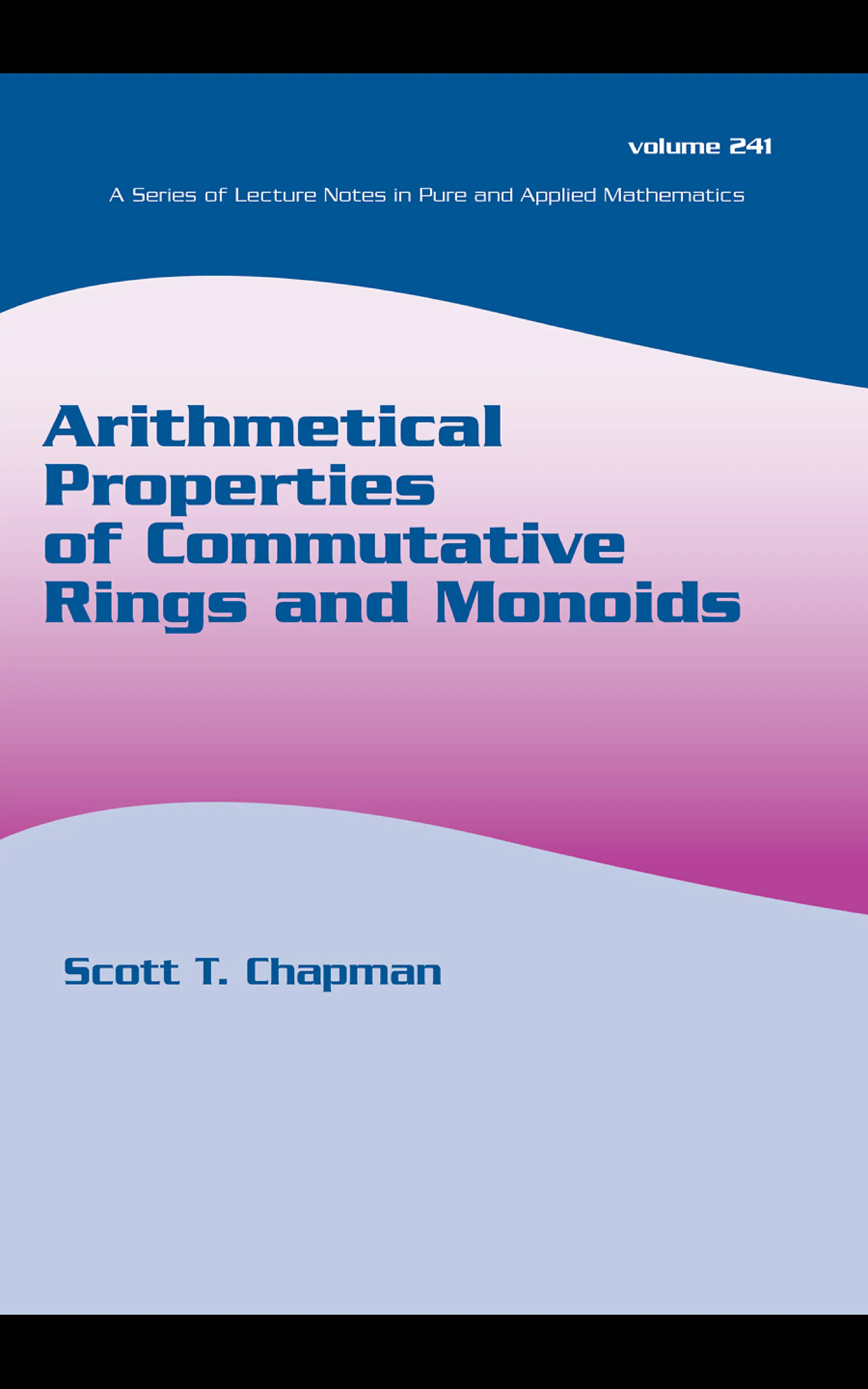
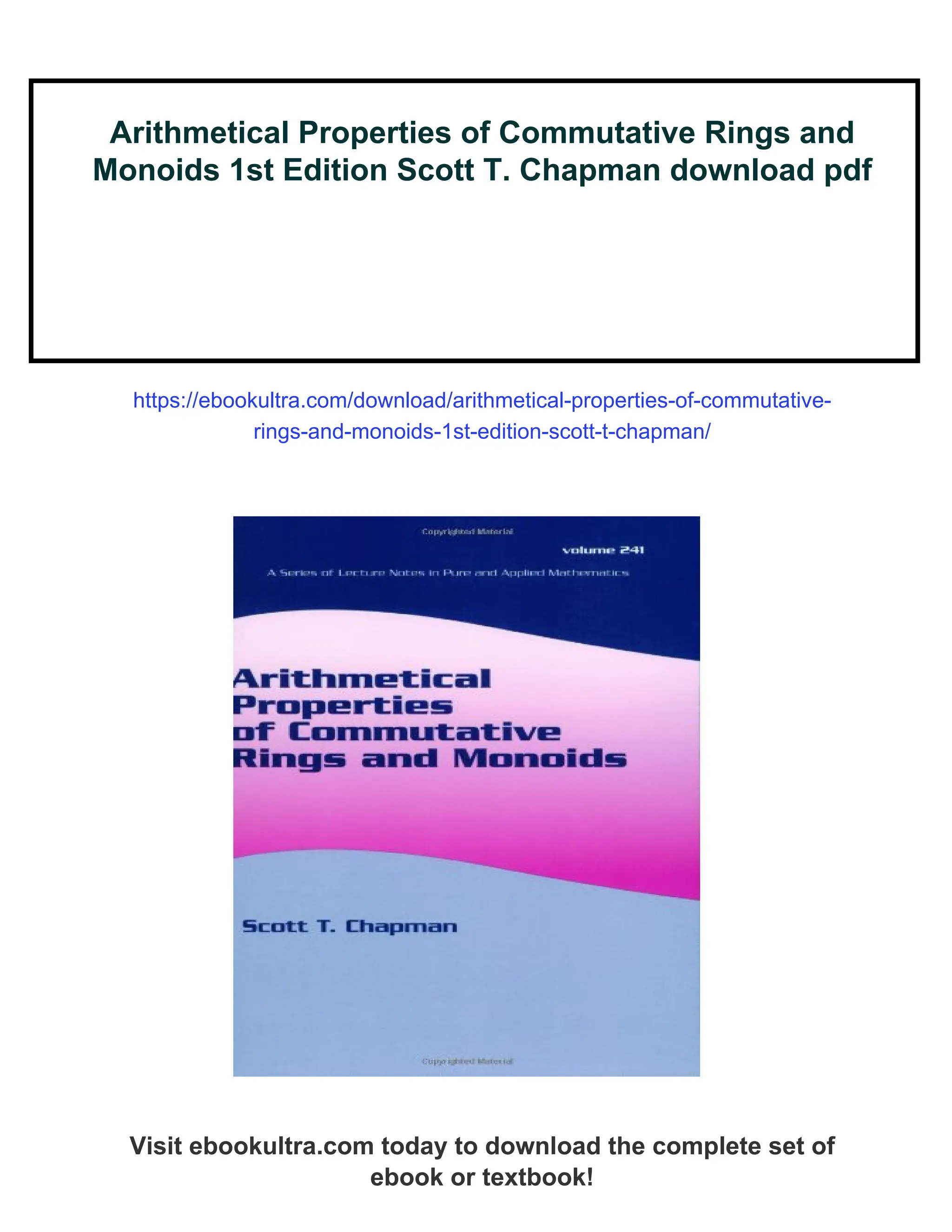
Arithmetical Properties of Commutative Rings and
Monoids 1st Edition Scott T. Chapman download pdf
https://ebookultra.com/download/arithmetical-properties-of-commutative-
rings-and-monoids-1st-edition-scott-t-chapman/
Visit ebookultra.com today to download the complete set of
ebook or textbook!
Here are some recommended products for you. Click the link to
download, or explore more at ebookultra.com
The Separable Galois Theory of Commutative Rings Second
Edition Andy R. Magid
https://ebookultra.com/download/the-separable-galois-theory-of-
commutative-rings-second-edition-andy-r-magid/
Computational Commutative And Non commutative Algebraic
Geometry Svetlana Cojocaru
https://ebookultra.com/download/computational-commutative-and-non-
commutative-algebraic-geometry-svetlana-cojocaru/
Ancient Rings An Illustrated Collector s Guide 1st Edition
T. N. Pollio
https://ebookultra.com/download/ancient-rings-an-illustrated-
collector-s-guide-1st-edition-t-n-pollio/
The geysers of Yellowstone Fifth Edition T. Scott Bryan
https://ebookultra.com/download/the-geysers-of-yellowstone-fifth-
edition-t-scott-bryan/
Bridging Case Conceptualization Assessment and
Intervention 1st Edition Scott T. Meier
https://ebookultra.com/download/bridging-case-conceptualization-
assessment-and-intervention-1st-edition-scott-t-meier/
Measuring Change in Counseling and Psychotherapy 1st
Edition Scott T. Meier
https://ebookultra.com/download/measuring-change-in-counseling-and-
psychotherapy-1st-edition-scott-t-meier/
Algebraic Graph Theory Morphisms Monoids and Matrices 1st
Edition Ulrich Knauer
https://ebookultra.com/download/algebraic-graph-theory-morphisms-
monoids-and-matrices-1st-edition-ulrich-knauer/
Radical Theory of Rings 1st Edition J.W. Gardner
https://ebookultra.com/download/radical-theory-of-rings-1st-edition-j-
w-gardner/
Differentiated Assessment Strategies One Tool Doesn t Fit
All 2nd Edition Carolyn Chapman
https://ebookultra.com/download/differentiated-assessment-strategies-
one-tool-doesn-t-fit-all-2nd-edition-carolyn-chapman/
Arithmetical Properties of Commutative Rings and
Monoids 1st Edition Scott T. Chapman Digital Instant
Download
Author(s): Scott T. Chapman
ISBN(s): 9781420028249, 1420028243
Edition: 1
File Details: PDF, 3.25 MB
Year: 2005
Language: english
Arithmetical Properties
of Commutative Rings
and Monoids
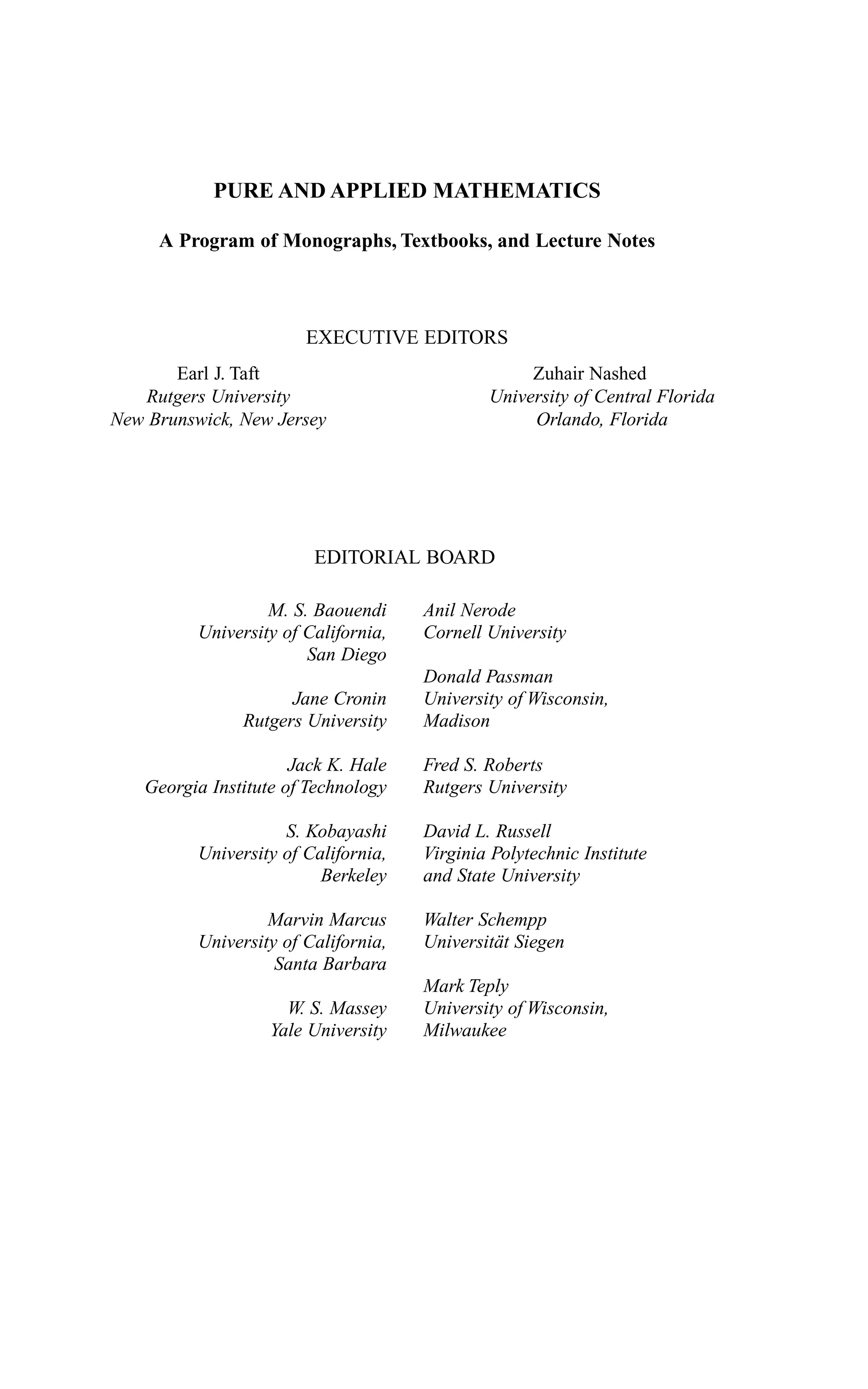
M. S. Baouendi
University of California,
San Diego
Jane Cronin
Rutgers University
Jack K. Hale
Georgia Institute of Technology
S. Kobayashi
University of California,
Berkeley
Marvin Marcus
University of California,
Santa Barbara
W. S. Massey
Yale University
Anil Nerode
Cornell University
Donald Passman
University of Wisconsin,
Madison
Fred S. Roberts
Rutgers University
David L. Russell
Virginia Polytechnic Institute
and State University
Walter Schempp
Universität Siegen
Mark Teply
University of Wisconsin,
Milwaukee
Earl J. Taft
Rutgers University
New Brunswick, New Jersey
Zuhair Nashed
University of Central Florida
Orlando, Florida
PURE AND APPLIED MATHEMATICS
A Program of Monographs, Textbooks, and Lecture Notes
EXECUTIVE EDITORS
EDITORIAL BOARD
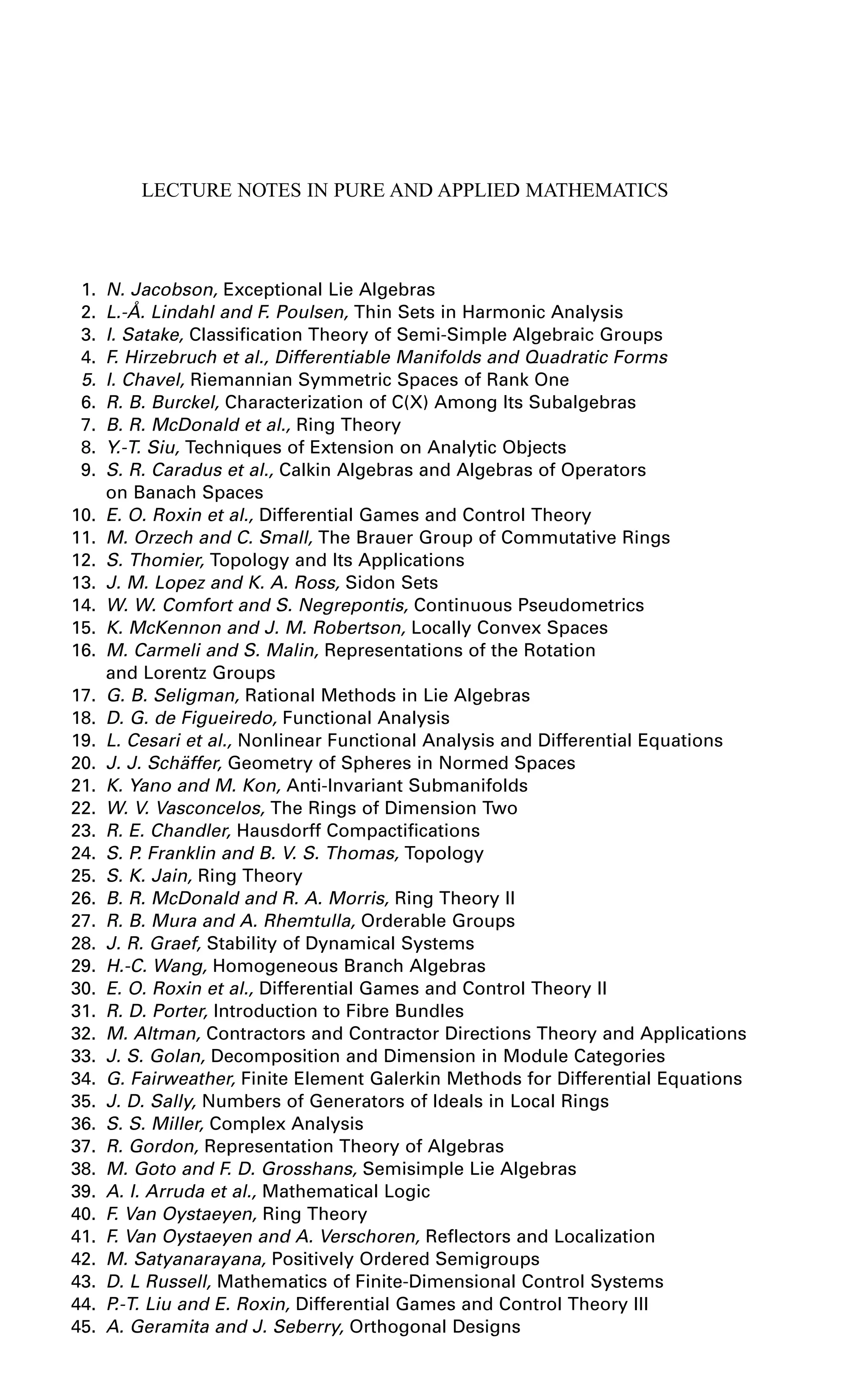
LECTURE NOTES IN PURE AND APPLIED MATHEMATICS
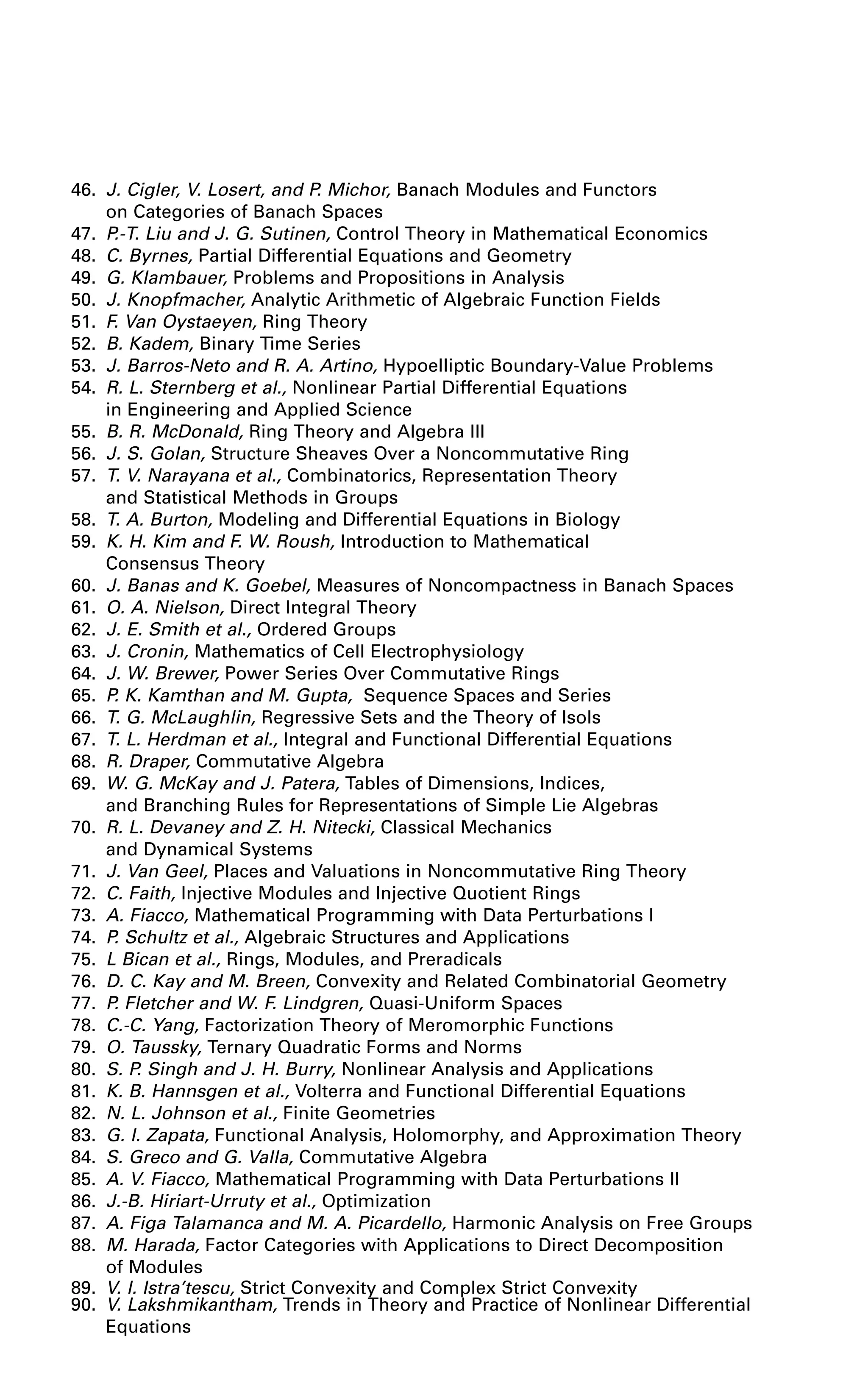
1. N. Jacobson, Exceptional Lie Algebras
2. L.-Å. Lindahl and F. Poulsen, Thin Sets in Harmonic Analysis
3. I. Satake, Classification Theory of Semi-Simple Algebraic Groups
4. F. Hirzebruch et al., Differentiable Manifolds and Quadratic Forms
5. I. Chavel, Riemannian Symmetric Spaces of Rank One
6. R. B. Burckel, Characterization of C(X) Among Its Subalgebras
7. B. R. McDonald et al., Ring Theory
8. Y.-T. Siu, Techniques of Extension on Analytic Objects
9. S. R. Caradus et al., Calkin Algebras and Algebras of Operators
on Banach Spaces
10. E. O. Roxin et al., Differential Games and Control Theory
11. M. Orzech and C. Small, The Brauer Group of Commutative Rings
12. S. Thomier, Topology and Its Applications
13. J. M. Lopez and K. A. Ross, Sidon Sets
14. W. W. Comfort and S. Negrepontis, Continuous Pseudometrics
15. K. McKennon and J. M. Robertson, Locally Convex Spaces
16. M. Carmeli and S. Malin, Representations of the Rotation
and Lorentz Groups
17. G. B. Seligman, Rational Methods in Lie Algebras
18. D. G. de Figueiredo, Functional Analysis
19. L. Cesari et al., Nonlinear Functional Analysis and Differential Equations
20. J. J. Schäffer, Geometry of Spheres in Normed Spaces
21. K. Yano and M. Kon, Anti-Invariant Submanifolds
22. W. V. Vasconcelos, The Rings of Dimension Two
23. R. E. Chandler, Hausdorff Compactifications
24. S. P. Franklin and B. V. S. Thomas, Topology
25. S. K. Jain, Ring Theory
26. B. R. McDonald and R. A. Morris, Ring Theory II
27. R. B. Mura and A. Rhemtulla, Orderable Groups
28. J. R. Graef, Stability of Dynamical Systems
29. H.-C. Wang, Homogeneous Branch Algebras
30. E. O. Roxin et al., Differential Games and Control Theory II
31. R. D. Porter, Introduction to Fibre Bundles
32. M. Altman, Contractors and Contractor Directions Theory and Applications
33. J. S. Golan, Decomposition and Dimension in Module Categories
34. G. Fairweather, Finite Element Galerkin Methods for Differential Equations
35. J. D. Sally, Numbers of Generators of Ideals in Local Rings
36. S. S. Miller, Complex Analysis
37. R. Gordon, Representation Theory of Algebras
38. M. Goto and F. D. Grosshans, Semisimple Lie Algebras
39. A. I. Arruda et al., Mathematical Logic
40. F. Van Oystaeyen, Ring Theory
41. F. Van Oystaeyen and A. Verschoren, Reflectors and Localization
42. M. Satyanarayana, Positively Ordered Semigroups
43. D. L Russell, Mathematics of Finite-Dimensional Control Systems
44. P.-T. Liu and E. Roxin, Differential Games and Control Theory III
45. A. Geramita and J. Seberry, Orthogonal Designs
46. J. Cigler, V. Losert, and P. Michor, Banach Modules and Functors
on Categories of Banach Spaces
47. P.-T. Liu and J. G. Sutinen, Control Theory in Mathematical Economics
48. C. Byrnes, Partial Differential Equations and Geometry
49. G. Klambauer, Problems and Propositions in Analysis
50. J. Knopfmacher, Analytic Arithmetic of Algebraic Function Fields
51. F. Van Oystaeyen, Ring Theory
52. B. Kadem, Binary Time Series
53. J. Barros-Neto and R. A. Artino, Hypoelliptic Boundary-Value Problems
54. R. L. Sternberg et al., Nonlinear Partial Differential Equations
in Engineering and Applied Science
55. B. R. McDonald, Ring Theory and Algebra III
56. J. S. Golan, Structure Sheaves Over a Noncommutative Ring
57. T. V. Narayana et al., Combinatorics, Representation Theory
and Statistical Methods in Groups
58. T. A. Burton, Modeling and Differential Equations in Biology
59. K. H. Kim and F. W. Roush, Introduction to Mathematical
Consensus Theory
60. J. Banas and K. Goebel, Measures of Noncompactness in Banach Spaces
61. O. A. Nielson, Direct Integral Theory
62. J. E. Smith et al., Ordered Groups
63. J. Cronin, Mathematics of Cell Electrophysiology
64. J. W. Brewer, Power Series Over Commutative Rings
65. P. K. Kamthan and M. Gupta, Sequence Spaces and Series
66. T. G. McLaughlin, Regressive Sets and the Theory of Isols
67. T. L. Herdman et al., Integral and Functional Differential Equations
68. R. Draper, Commutative Algebra
69. W. G. McKay and J. Patera, Tables of Dimensions, Indices,
and Branching Rules for Representations of Simple Lie Algebras
70. R. L. Devaney and Z. H. Nitecki, Classical Mechanics
and Dynamical Systems
71. J. Van Geel, Places and Valuations in Noncommutative Ring Theory
72. C. Faith, Injective Modules and Injective Quotient Rings
73. A. Fiacco, Mathematical Programming with Data Perturbations I
74. P. Schultz et al., Algebraic Structures and Applications
75. L Bican et al., Rings, Modules, and Preradicals
76. D. C. Kay and M. Breen, Convexity and Related Combinatorial Geometry
77. P. Fletcher and W. F. Lindgren, Quasi-Uniform Spaces
78. C.-C. Yang, Factorization Theory of Meromorphic Functions
79. O. Taussky, Ternary Quadratic Forms and Norms
80. S. P. Singh and J. H. Burry, Nonlinear Analysis and Applications
81. K. B. Hannsgen et al., Volterra and Functional Differential Equations
82. N. L. Johnson et al., Finite Geometries
83. G. I. Zapata, Functional Analysis, Holomorphy, and Approximation Theory
84. S. Greco and G. Valla, Commutative Algebra
85. A. V. Fiacco, Mathematical Programming with Data Perturbations II
86. J.-B. Hiriart-Urruty et al., Optimization
87. A. Figa Talamanca and M. A. Picardello, Harmonic Analysis on Free Groups
88. M. Harada, Factor Categories with Applications to Direct Decomposition
of Modules
89. V. I. Istra’tescu, Strict Convexity and Complex Strict Convexity
90. V. Lakshmikantham, Trends in Theory and Practice of Nonlinear Differential
Equations
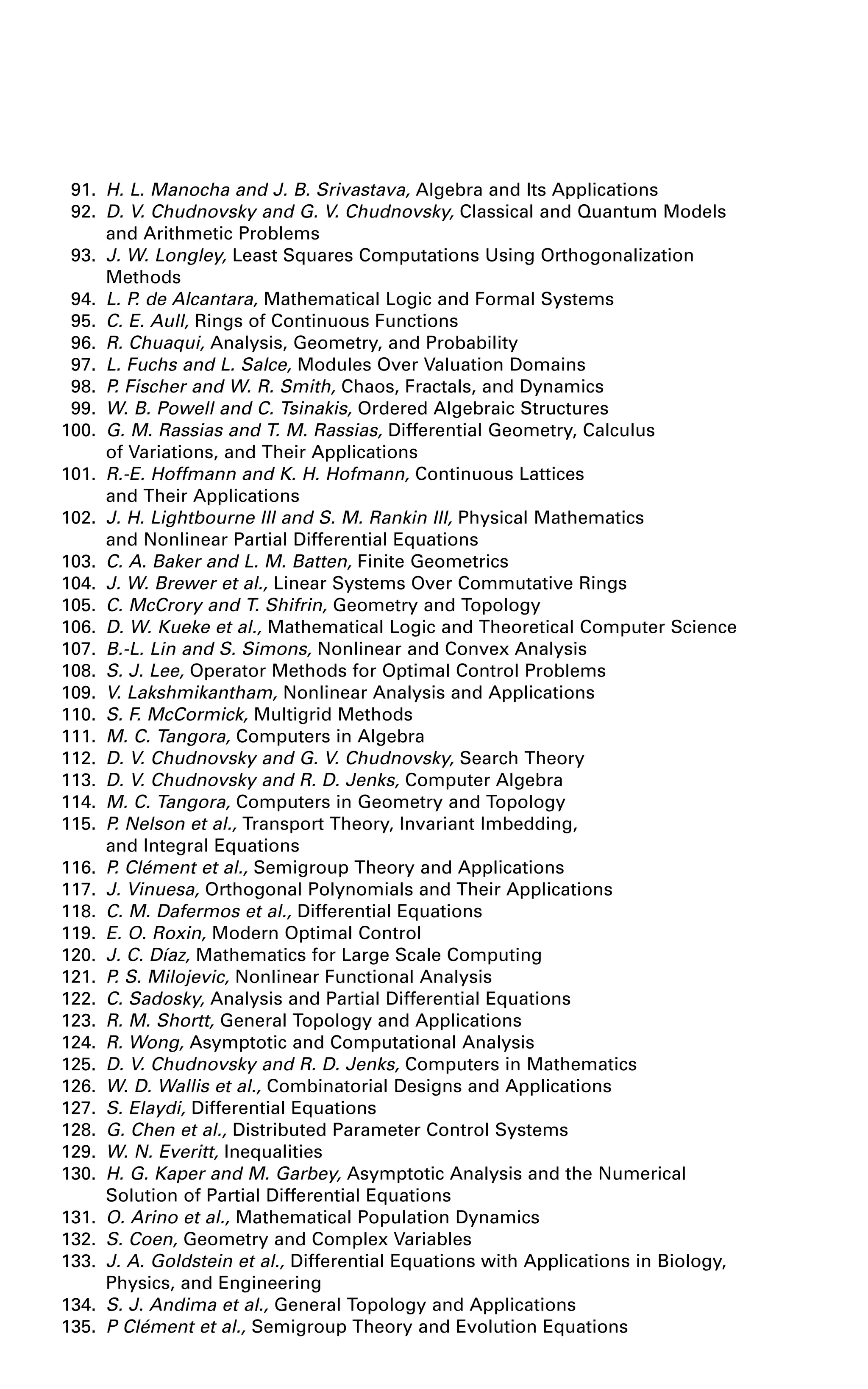
91. H. L. Manocha and J. B. Srivastava, Algebra and Its Applications
92. D. V. Chudnovsky and G. V. Chudnovsky, Classical and Quantum Models
and Arithmetic Problems
93. J. W. Longley, Least Squares Computations Using Orthogonalization
Methods
94. L. P. de Alcantara, Mathematical Logic and Formal Systems
95. C. E. Aull, Rings of Continuous Functions
96. R. Chuaqui, Analysis, Geometry, and Probability
97. L. Fuchs and L. Salce, Modules Over Valuation Domains
98. P. Fischer and W. R. Smith, Chaos, Fractals, and Dynamics
99. W. B. Powell and C. Tsinakis, Ordered Algebraic Structures
100. G. M. Rassias and T. M. Rassias, Differential Geometry, Calculus
of Variations, and Their Applications
101. R.-E. Hoffmann and K. H. Hofmann, Continuous Lattices
and Their Applications
102. J. H. Lightbourne III and S. M. Rankin III, Physical Mathematics
and Nonlinear Partial Differential Equations
103. C. A. Baker and L. M. Batten, Finite Geometrics
104. J. W. Brewer et al., Linear Systems Over Commutative Rings
105. C. McCrory and T. Shifrin, Geometry and Topology
106. D. W. Kueke et al., Mathematical Logic and Theoretical Computer Science
107. B.-L. Lin and S. Simons, Nonlinear and Convex Analysis
108. S. J. Lee, Operator Methods for Optimal Control Problems
109. V. Lakshmikantham, Nonlinear Analysis and Applications
110. S. F. McCormick, Multigrid Methods
111. M. C. Tangora, Computers in Algebra
112. D. V. Chudnovsky and G. V. Chudnovsky, Search Theory
113. D. V. Chudnovsky and R. D. Jenks, Computer Algebra
114. M. C. Tangora, Computers in Geometry and Topology
115. P. Nelson et al., Transport Theory, Invariant Imbedding,
and Integral Equations
116. P. Clément et al., Semigroup Theory and Applications
117. J. Vinuesa, Orthogonal Polynomials and Their Applications
118. C. M. Dafermos et al., Differential Equations
119. E. O. Roxin, Modern Optimal Control
120. J. C. Díaz, Mathematics for Large Scale Computing
121. P. S. Milojevic, Nonlinear Functional Analysis
122. C. Sadosky, Analysis and Partial Differential Equations
123. R. M. Shortt, General Topology and Applications
124. R. Wong, Asymptotic and Computational Analysis
125. D. V. Chudnovsky and R. D. Jenks, Computers in Mathematics
126. W. D. Wallis et al., Combinatorial Designs and Applications
127. S. Elaydi, Differential Equations
128. G. Chen et al., Distributed Parameter Control Systems
129. W. N. Everitt, Inequalities
130. H. G. Kaper and M. Garbey, Asymptotic Analysis and the Numerical
Solution of Partial Differential Equations
131. O. Arino et al., Mathematical Population Dynamics
132. S. Coen, Geometry and Complex Variables
133. J. A. Goldstein et al., Differential Equations with Applications in Biology,
Physics, and Engineering
134. S. J. Andima et al., General Topology and Applications
135. P Clément et al., Semigroup Theory and Evolution Equations
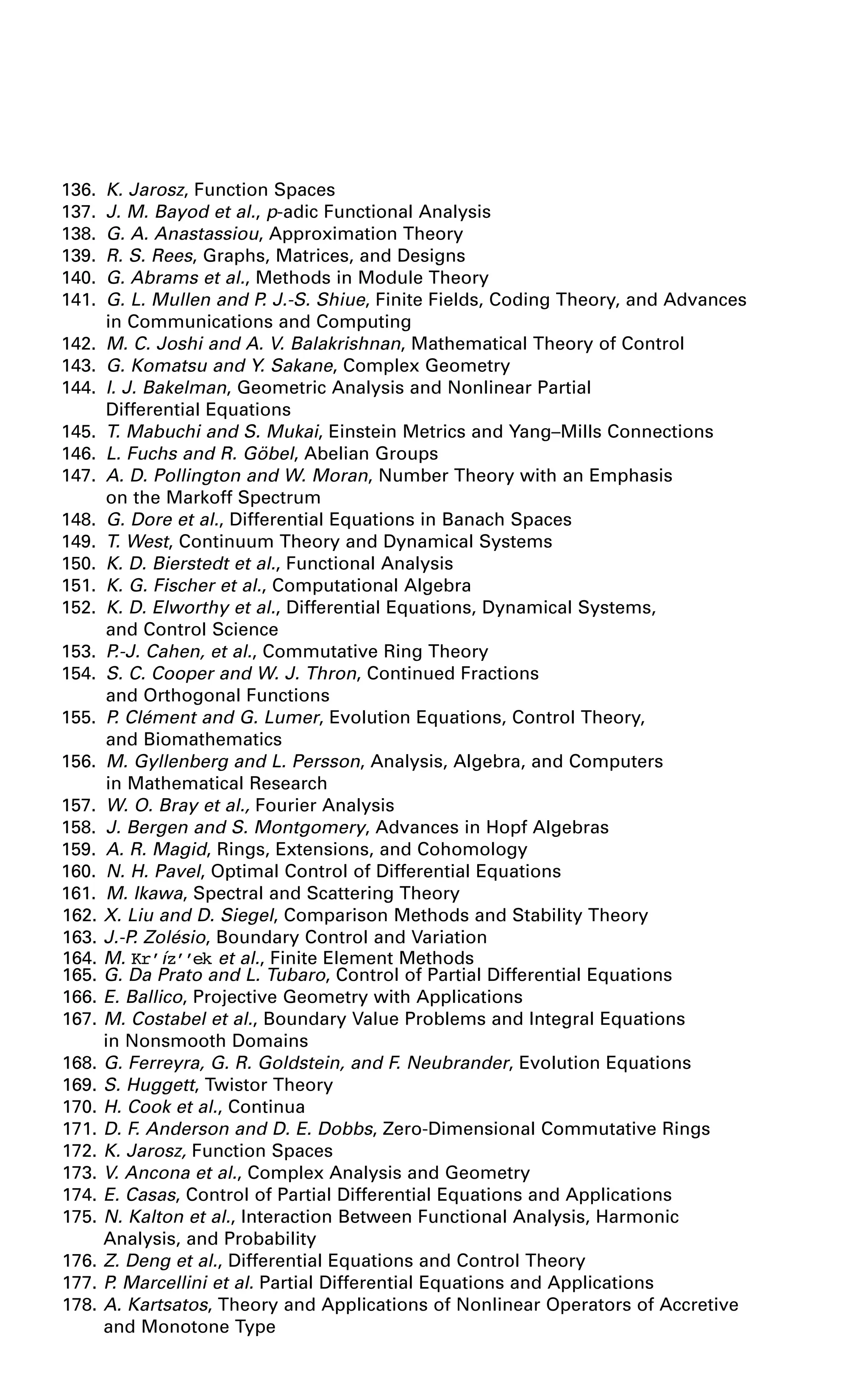
136. K. Jarosz, Function Spaces
137. J. M. Bayod et al., p-adic Functional Analysis
138. G. A. Anastassiou, Approximation Theory
139. R. S. Rees, Graphs, Matrices, and Designs
140. G. Abrams et al., Methods in Module Theory
141. G. L. Mullen and P. J.-S. Shiue, Finite Fields, Coding Theory, and Advances
in Communications and Computing
142. M. C. Joshi and A. V. Balakrishnan, Mathematical Theory of Control
143. G. Komatsu and Y. Sakane, Complex Geometry
144. I. J. Bakelman, Geometric Analysis and Nonlinear Partial
Differential Equations
145. T. Mabuchi and S. Mukai, Einstein Metrics and Yang–Mills Connections
146. L. Fuchs and R. Göbel, Abelian Groups
147. A. D. Pollington and W. Moran, Number Theory with an Emphasis
on the Markoff Spectrum
148. G. Dore et al., Differential Equations in Banach Spaces
149. T. West, Continuum Theory and Dynamical Systems
150. K. D. Bierstedt et al., Functional Analysis
151. K. G. Fischer et al., Computational Algebra
152. K. D. Elworthy et al., Differential Equations, Dynamical Systems,
and Control Science
153. P.-J. Cahen, et al., Commutative Ring Theory
154. S. C. Cooper and W. J. Thron, Continued Fractions
and Orthogonal Functions
155. P. Clément and G. Lumer, Evolution Equations, Control Theory,
and Biomathematics
156. M. Gyllenberg and L. Persson, Analysis, Algebra, and Computers
in Mathematical Research
157. W. O. Bray et al., Fourier Analysis
158. J. Bergen and S. Montgomery, Advances in Hopf Algebras
159. A. R. Magid, Rings, Extensions, and Cohomology
160. N. H. Pavel, Optimal Control of Differential Equations
161. M. Ikawa, Spectral and Scattering Theory
162. X. Liu and D. Siegel, Comparison Methods and Stability Theory
163. J.-P. Zolésio, Boundary Control and Variation
164. M. Kr’íz’’ek et al., Finite Element Methods
165. G. Da Prato and L. Tubaro, Control of Partial Differential Equations
166. E. Ballico, Projective Geometry with Applications
167. M. Costabel et al., Boundary Value Problems and Integral Equations
in Nonsmooth Domains
168. G. Ferreyra, G. R. Goldstein, and F. Neubrander, Evolution Equations
169. S. Huggett, Twistor Theory
170. H. Cook et al., Continua
171. D. F. Anderson and D. E. Dobbs, Zero-Dimensional Commutative Rings
172. K. Jarosz, Function Spaces
173. V. Ancona et al., Complex Analysis and Geometry
174. E. Casas, Control of Partial Differential Equations and Applications
175. N. Kalton et al., Interaction Between Functional Analysis, Harmonic
Analysis, and Probability
176. Z. Deng et al., Differential Equations and Control Theory
177. P. Marcellini et al. Partial Differential Equations and Applications
178. A. Kartsatos, Theory and Applications of Nonlinear Operators of Accretive
and Monotone Type
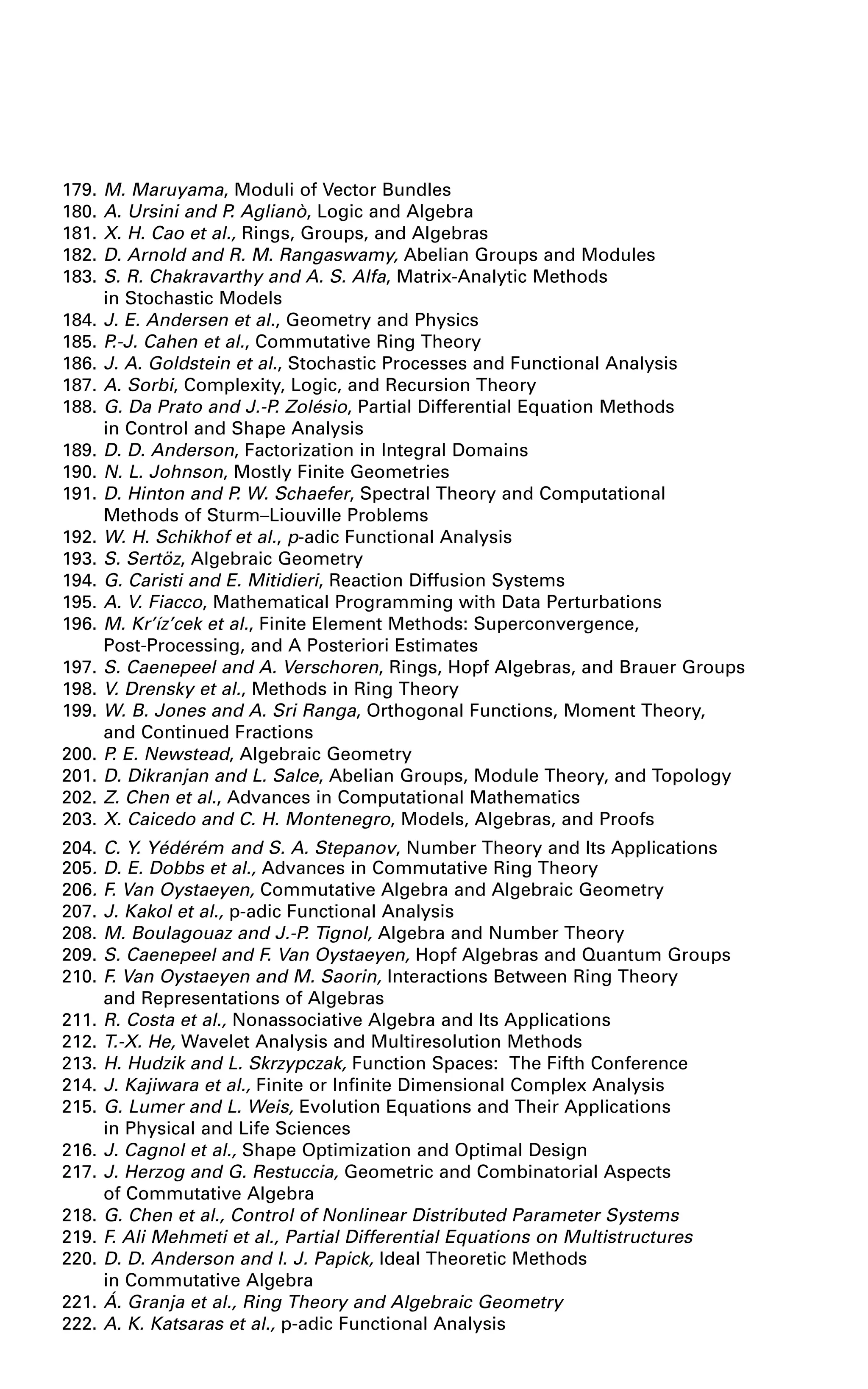
179. M. Maruyama, Moduli of Vector Bundles
180. A. Ursini and P. Aglianò, Logic and Algebra
181. X. H. Cao et al., Rings, Groups, and Algebras
182. D. Arnold and R. M. Rangaswamy, Abelian Groups and Modules
183. S. R. Chakravarthy and A. S. Alfa, Matrix-Analytic Methods
in Stochastic Models
184. J. E. Andersen et al., Geometry and Physics
185. P.-J. Cahen et al., Commutative Ring Theory
186. J. A. Goldstein et al., Stochastic Processes and Functional Analysis
187. A. Sorbi, Complexity, Logic, and Recursion Theory
188. G. Da Prato and J.-P. Zolésio, Partial Differential Equation Methods
in Control and Shape Analysis
189. D. D. Anderson, Factorization in Integral Domains
190. N. L. Johnson, Mostly Finite Geometries
191. D. Hinton and P. W. Schaefer, Spectral Theory and Computational
Methods of Sturm–Liouville Problems
192. W. H. Schikhof et al., p-adic Functional Analysis
193. S. Sertöz, Algebraic Geometry
194. G. Caristi and E. Mitidieri, Reaction Diffusion Systems
195. A. V. Fiacco, Mathematical Programming with Data Perturbations
196. M. Kr’íz’cek et al., Finite Element Methods: Superconvergence,
Post-Processing, and A Posteriori Estimates
197. S. Caenepeel and A. Verschoren, Rings, Hopf Algebras, and Brauer Groups
198. V. Drensky et al., Methods in Ring Theory
199. W. B. Jones and A. Sri Ranga, Orthogonal Functions, Moment Theory,
and Continued Fractions
200. P. E. Newstead, Algebraic Geometry
201. D. Dikranjan and L. Salce, Abelian Groups, Module Theory, and Topology
202. Z. Chen et al., Advances in Computational Mathematics
203. X. Caicedo and C. H. Montenegro, Models, Algebras, and Proofs
204. C. Y. Yédérém and S. A. Stepanov, Number Theory and Its Applications
205. D. E. Dobbs et al., Advances in Commutative Ring Theory
206. F. Van Oystaeyen, Commutative Algebra and Algebraic Geometry
207. J. Kakol et al., p-adic Functional Analysis
208. M. Boulagouaz and J.-P. Tignol, Algebra and Number Theory
209. S. Caenepeel and F. Van Oystaeyen, Hopf Algebras and Quantum Groups
210. F. Van Oystaeyen and M. Saorin, Interactions Between Ring Theory
and Representations of Algebras
211. R. Costa et al., Nonassociative Algebra and Its Applications
212. T.-X. He, Wavelet Analysis and Multiresolution Methods
213. H. Hudzik and L. Skrzypczak, Function Spaces: The Fifth Conference
214. J. Kajiwara et al., Finite or Infinite Dimensional Complex Analysis
215. G. Lumer and L. Weis, Evolution Equations and Their Applications
in Physical and Life Sciences
216. J. Cagnol et al., Shape Optimization and Optimal Design
217. J. Herzog and G. Restuccia, Geometric and Combinatorial Aspects
of Commutative Algebra
218. G. Chen et al., Control of Nonlinear Distributed Parameter Systems
219. F. Ali Mehmeti et al., Partial Differential Equations on Multistructures
220. D. D. Anderson and I. J. Papick, Ideal Theoretic Methods
in Commutative Algebra
221. Á. Granja et al., Ring Theory and Algebraic Geometry
222. A. K. Katsaras et al., p-adic Functional Analysis
223. R. Salvi, The Navier-Stokes Equations
224. F. U. Coelho and H. A. Merklen, Representations of Algebras
225. S. Aizicovici and N. H. Pavel, Differential Equations and Control Theory
226. G. Lyubeznik, Local Cohomology and Its Applications
227. G. Da Prato and L. Tubaro, Stochastic Partial Differential Equations
and Applications
228. W. A. Carnielli et al., Paraconsistency
229. A. Benkirane and A. Touzani, Partial Differential Equations
230. A. Illanes et al., Continuum Theory
231. M. Fontana et al., Commutative Ring Theory and Applications
232. D. Mond and M. J. Saia, Real and Complex Singularities
233. V. Ancona and J. Vaillant, Hyperbolic Differential Operators
and Related Problems
234. G. R. Goldstein et al., Evolution Equations
235. A. Giambruno et al., Polynomial Identities and Combinatorial Methods
236. A. Facchini et al., Rings, Modules, Algebras, and Abelian Groups
237. J. Bergen et al., Hopf Algebras
238. A. C. Krinik and R. J. Swift, Stochastic Processes and Functional Analysis:
A Volume of Recent Advances in Honor of M. M. Rao
239. S. Caenepeel and F. van Oystaeyen, Hopf Algebras in Noncommutative
Geometry and Physics
240. J. Cagnol and J.-P. Zolésio, Control and Boundary Analysis
241. S. T. Chapman, Arithmetical Properties of Commutative Rings
and Monoids
Boca Raton London New York Singapore
Arithmetical
Properties
of Commutative
Rings and Monoids
Scott T. Chapman
Trinity University
San Antonio, Texas, U.S.A.
Published in 2005 by
CRC Press
Taylor & Francis Group
6000 Broken Sound Parkway NW
Boca Raton, FL 33487-2742
© 2005 by Taylor & Francis Group, LLC
CRC Press is an imprint of Taylor & Francis Group
No claim to original U.S. Government works
Printed in the United States of America on acid-free paper
10 9 8 7 6 5 4 3 2 1
International Standard Book Number-10: 0-8247-2327-9 (Hardcover)
International Standard Book Number-13: 978-0-8247-2327-9 (Hardcover)
Library of Congress Card Number 2004061830
This book contains information obtained from authentic and highly regarded sources. Reprinted material is quoted with
permission, and sources are indicated. A wide variety of references are listed. Reasonable efforts have been made to publish
reliable data and information, but the author and the publisher cannot assume responsibility for the validity of all materials
or for the consequences of their use.
No part of this book may be reprinted, reproduced, transmitted, or utilized in any form by any electronic, mechanical, or
other means, now known or hereafter invented, including photocopying, microfilming, and recording, or in any information
storage or retrieval system, without written permission from the publishers.
For permission to photocopy or use material electronically from this work, please access www.copyright.com
(http://www.copyright.com/) or contact the Copyright Clearance Center, Inc. (CCC) 222 Rosewood Drive, Danvers, MA
01923, 978-750-8400. CCC is a not-for-profit organization that provides licenses and registration for a variety of users. For
organizations that have been granted a photocopy license by the CCC, a separate system of payment has been arranged.
Trademark Notice: Product or corporate names may be trademarks or registered trademarks, and are used only for
identification and explanation without intent to infringe.
Library of Congress Cataloging-in-Publication Data
Arithmetic properties of commutative rings and monoids / edited by Scott T. Chapman.
p. cm. — (Lecture notes in pure and applied mathematics v. 240)
Includes bibliographical references and index.
ISBN 0-8247-2327-9 (alk. paper)
1. Commutative rings—Congresses. 2. Monoids—Congresses. I. Chapman, Scott T. II.
Series.
QA251.3.A72 2005
512'.44--dc22 2004061830
Visit the Taylor & Francis Web site at
http://www.taylorandfrancis.com
and the CRC Press Web site at
http://www.crcpress.com
Taylor & Francis Group
is the Academic Division of T&F Informa plc.
Preface
This volume contains the Proceedings of two related meetings which took place
in October 2003. The first event was a one day Mini-Conference on Factorization
Properties of Commutative Rings and Monoids hosted by the Department of Math-
ematics at the University of North Carolina at Chapel Hill. The Mini-Conference
was followed by a regular Special Session on Commutative Rings and Monoids at
the Fall 2003 Southeast Sectional Meeting of the American Mathematical Society.
A major focus of these two meetings was the study of properties related to
nonunique factorizations of elements into irreducible elements in commutative rings
and monoids. Such problems have emerged as an independent area of research only
over the past 30 years. Almost every result obtained in this area since 1970 can be
traced to the following Theorem from a short two page paper by Leonard Carlitz
(Proc. Amer. Math. Soc. 11(1960), 391–392).
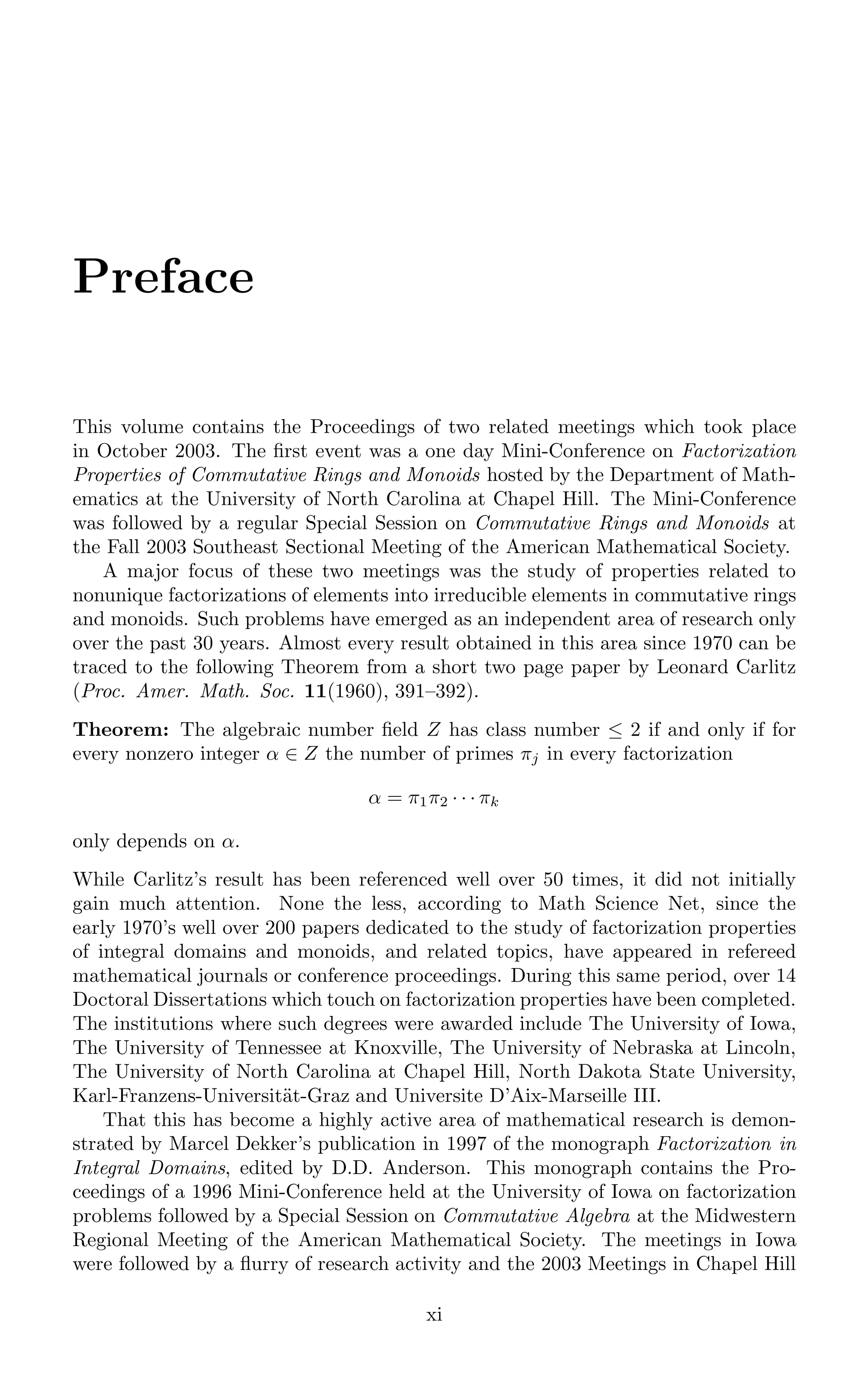
Theorem: The algebraic number field Z has class number ≤ 2 if and only if for
every nonzero integer α ∈ Z the number of primes πj in every factorization
α = π1π2 · · · πk
only depends on α.
While Carlitz’s result has been referenced well over 50 times, it did not initially
gain much attention. None the less, according to Math Science Net, since the
early 1970’s well over 200 papers dedicated to the study of factorization properties
of integral domains and monoids, and related topics, have appeared in refereed
mathematical journals or conference proceedings. During this same period, over 14
Doctoral Dissertations which touch on factorization properties have been completed.
The institutions where such degrees were awarded include The University of Iowa,
The University of Tennessee at Knoxville, The University of Nebraska at Lincoln,
The University of North Carolina at Chapel Hill, North Dakota State University,
Karl-Franzens-Universität-Graz and Universite D’Aix-Marseille III.
That this has become a highly active area of mathematical research is demon-
strated by Marcel Dekker’s publication in 1997 of the monograph Factorization in
Integral Domains, edited by D.D. Anderson. This monograph contains the Pro-
ceedings of a 1996 Mini-Conference held at the University of Iowa on factorization
problems followed by a Special Session on Commutative Algebra at the Midwestern
Regional Meeting of the American Mathematical Society. The meetings in Iowa
were followed by a flurry of research activity and the 2003 Meetings in Chapel Hill
xi
xii Preface
were organized with the intent of allowing some of the leading researchers in this
field to review the major results of this period.
I invited D. D. Anderson (University of Iowa), D. F. Anderson (University of
Tennessee at Knoxville), Jim Coykendall (North Dakota State University), Alfred
Geroldinger (Karl-Franzens-Universität, Graz), Franz Halter-Koch (Karl-Franzens-
Universität, Graz) and Ulrich Krause (Universität Bremen) to deliver 45 minute
addresses at the Mini-Conference. These authors have produced a series of 7 papers
based on these lectures which make up the introductory chapters of this volume.
These chapters demonstrate the diverse approach that many authors have taken in
studying nonunique factorizations. Several are written in a purely monoidal setting,
while several others demonstrate that ring theoretic properties play a key role in how
elements factor. Moreover, these chapters exhibit the broad range of mathematical
techniques necessary to obtain results in this area. Such techniques can range from
purely algebraic and combinatorial, to number theoretic. It is hoped that these
chapters not only offer mathematicians new to this area the opportunity to survey
its current trends and major results, but also offer an up to date introduction
to factorization theory for beginning graduate students. The remaining chapters
in this volume reflect research which is motivated by arithmetical properties of
commutative rings and monoids. This is not restricted to factorization problems,
as aspects of the following topics are all considered: multiplicative ideal theory, the
factorization of ideals and ideal generation problems, integer-valued polynomials,
Prüfer rings and Domains, block monoids and their combinatorial invariants, and
numerical monoids.
The two sessions in Chapel Hill and subsequent Proceedings Volume have gen-
erated a significant amount of interest. The sessions attracted 30 speakers from 6
different countries. This volume features 26 papers from 33 different contributors
from 7 different countries. I wish to take this opportunity to thank all those who
participated in the sessions, and to all those who submitted papers for consideration
to this volume. I am indebted to a large number of referees, who as always will
remain nameless. A special thanks goes to the Department of Mathematics at the
University of North Carolina at Chapel Hill, and in particular to Professor William
W. Smith who was instrumental in planning and organizing this event. I also wish
to thank the Department of Mathematics at Trinity University for their continued
support and help in preparing this manuscript. The organization and preparation
of the finished work would not have been possible without the help and patience
of Denise Wilson, our Departmental Secretary and technical typist. I am of course
indebted to Maria Allegra and her staff at Marcel Dekker for giving me the support
and opportunity to complete this manuscript.
I hope the readers of this volume enjoy its contents as much as I enjoyed putting
it together.
Scott Chapman
San Antonio, Texas
January 14, 2005
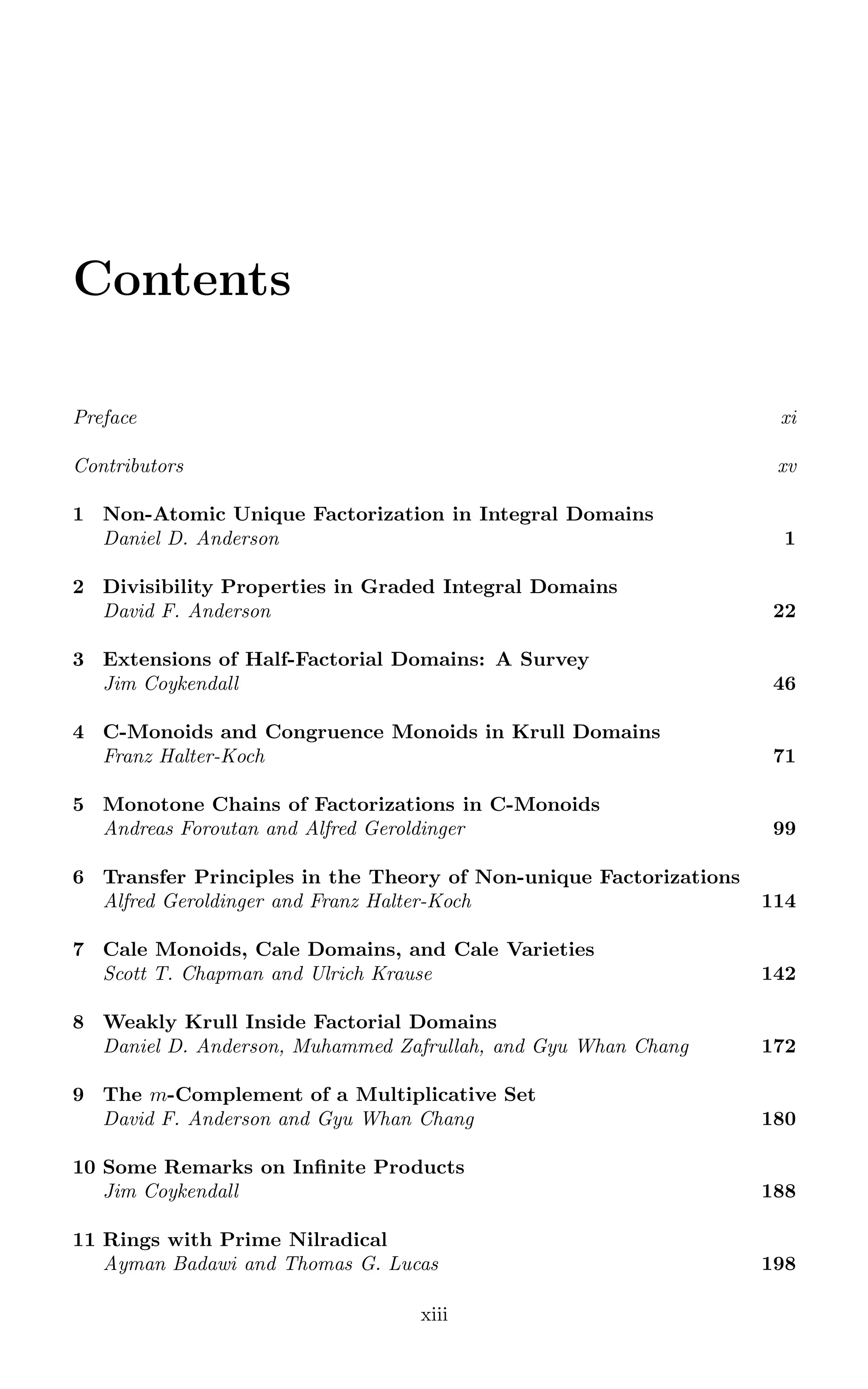
Contents
Preface xi
Contributors xv
1 Non-Atomic Unique Factorization in Integral Domains
Daniel D. Anderson 1
2 Divisibility Properties in Graded Integral Domains
David F. Anderson 22
3 Extensions of Half-Factorial Domains: A Survey
Jim Coykendall 46
4 C-Monoids and Congruence Monoids in Krull Domains
Franz Halter-Koch 71
5 Monotone Chains of Factorizations in C-Monoids
Andreas Foroutan and Alfred Geroldinger 99
6 Transfer Principles in the Theory of Non-unique Factorizations
Alfred Geroldinger and Franz Halter-Koch 114
7 Cale Monoids, Cale Domains, and Cale Varieties
Scott T. Chapman and Ulrich Krause 142
8 Weakly Krull Inside Factorial Domains
Daniel D. Anderson, Muhammed Zafrullah, and Gyu Whan Chang 172
9 The m-Complement of a Multiplicative Set
David F. Anderson and Gyu Whan Chang 180
10 Some Remarks on Infinite Products
Jim Coykendall 188
11 Rings with Prime Nilradical
Ayman Badawi and Thomas G. Lucas 198
xiii
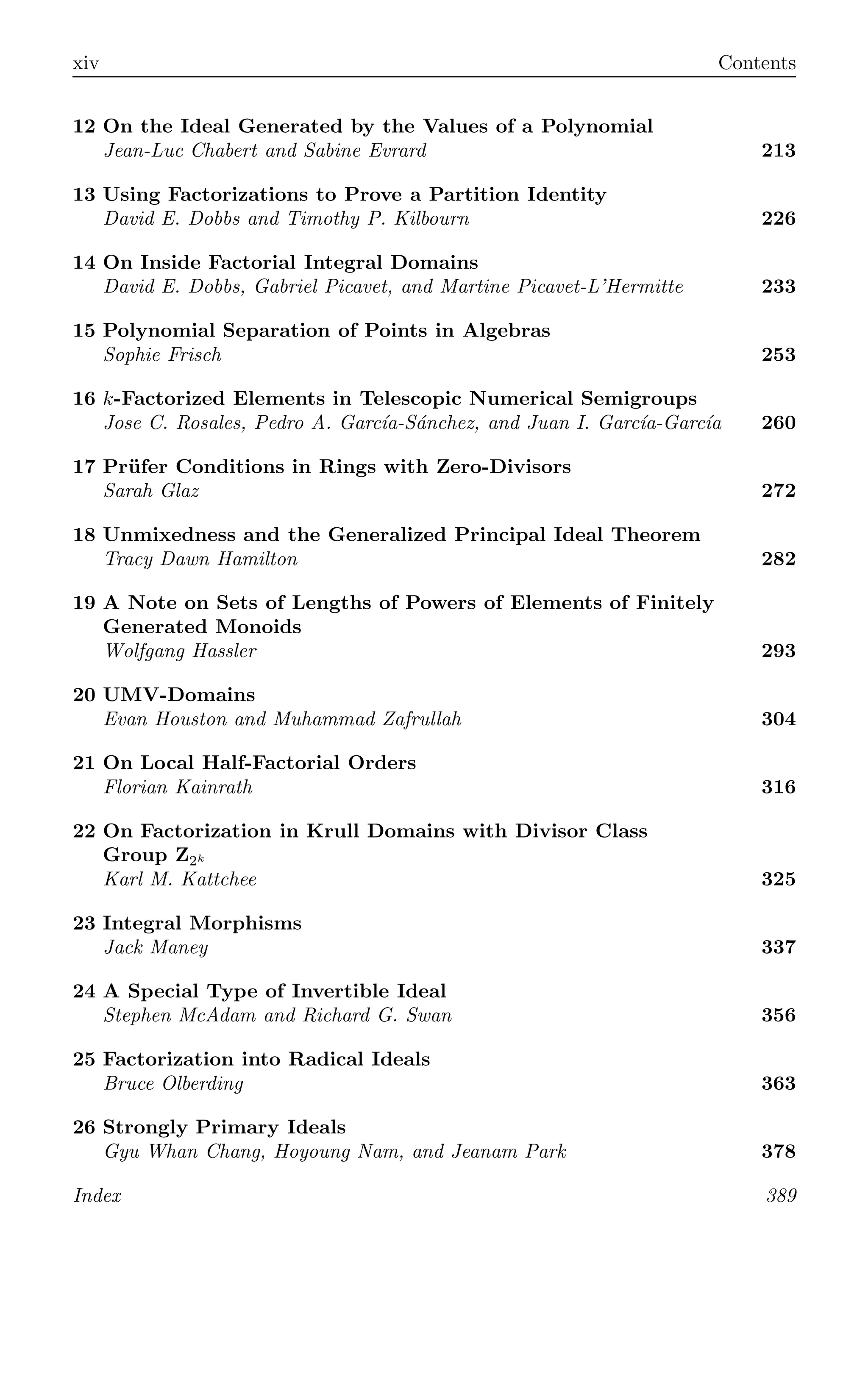
xiv Contents
12 On the Ideal Generated by the Values of a Polynomial
Jean-Luc Chabert and Sabine Evrard 213
13 Using Factorizations to Prove a Partition Identity
David E. Dobbs and Timothy P. Kilbourn 226
14 On Inside Factorial Integral Domains
David E. Dobbs, Gabriel Picavet, and Martine Picavet-L’Hermitte 233
15 Polynomial Separation of Points in Algebras
Sophie Frisch 253
16 k-Factorized Elements in Telescopic Numerical Semigroups
Jose C. Rosales, Pedro A. Garcı́a-Sánchez, and Juan I. Garcı́a-Garcı́a 260
17 Prüfer Conditions in Rings with Zero-Divisors
Sarah Glaz 272
18 Unmixedness and the Generalized Principal Ideal Theorem
Tracy Dawn Hamilton 282
19 A Note on Sets of Lengths of Powers of Elements of Finitely
Generated Monoids
Wolfgang Hassler 293
20 UMV-Domains
Evan Houston and Muhammad Zafrullah 304
21 On Local Half-Factorial Orders
Florian Kainrath 316
22 On Factorization in Krull Domains with Divisor Class
Group Z2k
Karl M. Kattchee 325
23 Integral Morphisms
Jack Maney 337
24 A Special Type of Invertible Ideal
Stephen McAdam and Richard G. Swan 356
25 Factorization into Radical Ideals
Bruce Olberding 363
26 Strongly Primary Ideals
Gyu Whan Chang, Hoyoung Nam, and Jeanam Park 378
Index 389
Contributors
Daniel D. Anderson, Department of Mathematics, University of Iowa, Iowa City,
Iowa, 52242, dan-anderson@uiowa.edu
David F. Anderson, Department of Mathematics, University of Tennessee, Knoxville,
Tennessee 37996-1300, anderson@math.utk.edu
Ayman Badawi, Department of Mathematics and Statistics, American University of
Sharjah, P.O. Box 26666, Sharjah, United Arab Emirates, abadawi@avsharjah.edu
Jean-Luc Chabert, Laboratoire Amiénois de Mathématiques Fondamentale et Ap-
pliquée, CNRS-UMR 6140, Université de Picardie, 33 rue Saint Leu, 80039 Amiens,
France, jean-luc.chabert@u-picardie.fr
Gyu Whan Chang, Department of Mathematics, University of Incheon, Incheon,
402-748 Korea, whan@incheon.ac.kr
Scott T. Chapman, Department of Mathematics, Trinity University, One Trinity
Place, San Antonio, Texas 78212-7200, schapman@trinity.edu
Jim Coykendall, Department of Mathematics, North Dakota State University,Fargo,
North Dakota 58105-5075, Jim.Coykendall@ndsu.nodak.edu
David E. Dobbs, Department of Mathematics, University of Tennessee, Knoxville,
Tennessee 37996-1300, dobbs@math.utk.edu
Sabine Evrard, Laboratoire Amiénois de Mathématiques Fondamentale et Appliquée,
CNRS-UMR 6140, Université de Picardie, 33 rue Saint Leu, 80039 Amiens, France,
sabine.evrard@fnac.net
Andreas Foroutan, Institut für Mathematik, Karl-Franzens-Universität, Heinrich-
strasse 36, 8010 Graz, Austria, a−foroutan444@yahoo.com
Sophie Frisch, Institut für Mathematik, Technische Universität Graz, A-8010 Graz,
Austria, frisch@blah.math.tu-graz.ac.at
Pedro A. Garcı́a-Sánchez, Departamento de Álgebra, Universidad de Granada, Fac-
ultad de Ciencias, Campus Fuentenueva s/n, 18071 Granada, Spain, pedro@ugr.es
xv
xvi Contributors
Juan I. Garcı́a-Garcı́a, Departamento de Álgebra, Facultad de Ciencias, Universidad
de Granada, Campus Fuentenueva s/n, 18071 Granada, Spain, jigg@ugr.es
Alfred Geroldinger, Institut für Mathematik, Karl-Franzens-Universität, Heinrich-
strasse 36, 8010 Graz, Austria, alfred.geroldinger@uni-graz.at
Sarah Glaz, Department of Mathematics, University of Connecticut, Storrs, Con-
necticut 06269, glaz@uconnvm.uconn.edu
Franz Halter-Koch, Institut für Mathematik, Karl-Franzens-Universität, Heinrich-
strasse 36, 8010 Graz, Austria, franz.halterkoch@uni-graz.at
Tracy Dawn Hamilton, Department of Mathematics and Statistics, California State
University Sacramento, 6000 J Street, Sacramento, California 95819,
hamilton@csus.edu
Wolfgang Hassler, Institut für Mathematik, Karl-Franzens Universität Graz, Hein-
richstraße 36/IV, A-8010 Graz, Austria, wolfgang.hassler@uni-graz.at
Evan Houston, University of North Carolina at Charlotte, Department of Mathe-
matics, Charlotte, North Carolina 28223-0001, eghousto@email.uncc.edu
Florian Kainrath, Institut für Mathematik, Karl-Franzens-Universität Graz, Hein-
richstraße 36, A-8010 Graz, Austria, florian.kainrath@uni-graz.at
Karl M. Kattchee, Mathematics Department, University of Wisconsin-La Crosse,
1725 State Street, La Crosse, Wisconsin 54601, kattchee.karl@uwlax.edu
Ulrich Krause, Fachbereich Mathematik/Informatik, Universität Bremen, 28334
Bremen, Germany, krause@math.uni-bremen.de
Timothy P. Kilbourn, Department of Mathematics, University of Illinois at Urbana-
Champaign, Urbana, Illinois 61801-2975, tkilbour@math.uiuc.edu
Thomas G. Lucas, Department of Mathematics and Statistics, University of North
Carolina Charlotte, Charlotte, North Carolina 28223, tglucas@email.uncc.edu
Jack Maney, Department of Mathematics, North Dakota State University, Fargo,
North Dakota 58105-5075, Jack.L.Maney@ndsu.nodak.edu
Stephen McAdam, Department of Mathematics, The University of Texas at Austin,
1 University Station C1200, Austin, Texas 78712-0257, mcadam@math.utexas.edu
Hoyoung Nam, Department of Mathematics, Inha University, Incheon, 402-751,
Korea
Bruce Olberding, Department of Mathematical Sciences, New Mexico State Uni-
versity, Las Cruces, New Mexico 88003-8001, olberdin@NMSU.Edu
Contributors xvii
Jeanam Park, Department of Mathematics, Inha University, Incheon, 402-751, Ko-
rea
Gabriel Picavet, Laboratoire de Mathématiques Pures, Université Blaise Pascal,
63177 Aubière Cedex, France, Gabriel.Picavet@math.univ-bpclermont.fr
Martine Picavet-L’Hermitte, Laboratoire de Mathématiques Pures, Université Blaise
Pascal, 63177 Aubière Cedex, France, Martine.Picavet@math.univ-bpclermont.fr
Jose C. Rosales, Departamento de Álgebra, Universidad de Granada, Facultad de
Ciencias, Campus Fuentenueva s/n, 18071 Granada, Spain, jrosales@ugr.es
Richard G. Swan, Department of Mathematics, The University of Chicago, Chicago,
Illinois 60637, swan@math.uchicago.edu
Muhammed Zafrullah, Department of Mathematics, Idaho State University, Pocatello,
Idaho 83209-8085, mzafrullah@usa.net
Chapter 1
Non-Atomic Unique
Factorization in Integral
Domains
by Daniel D. Anderson
Abstract
UFDs can be characterized by the property that every nonzero nonunit is a
product of principal prime elements or equivalently that every nonzero nonunit
x can be written in the form x = upa1
1 · · · pan
n where u is a unit, p1, . . . , pn are
nonassociate principal primes, and each ai ≥ 1. Each pai
i , in addition to being
a power of a prime, has a number of other properties, each of which is subject
to generalization. We survey various generalizations of (unique) factorization
into prime powers in integral domains.
1 Introduction
Unique factorization domains are of course the integral domains in which every
nonzero nonunit element has a unique factorization (up to order and associates)
into irreducible elements or atoms. Now UFDs can also be characterized by the
property that every nonzero nonunit is a product of principal primes or equivalently
that every nonzero nonunit has the form upa1
1 · · · pan
n where u is a unit, p1, . . . , pn
are nonassociate principal primes, and each ai ≥ 1. Each of the pai
i , in addition
to being a power of a prime, has other properties, each of which is subject to
generalization. For example, each pai
i is primary, each is contained in a unique
maximal t-ideal, and the pai
i are pairwise coprime. The goal of this chapter is to
survey various generalizations of (unique) factorization into prime powers in integral
domains. This follows the thesis of M. Zafrullah that the pai
i are the building blocks
in a UFD. The author would like to thank M. Zafrullah for a number of discussions
of these topics over the past several years.
1
Random documents with unrelated
content Scribd suggests to you:
CHAPTER XIX
A CONFERENCE AND A RESOLVE
O my mind, the risk would be extreme; and I
greatly doubt the wisdom of the step."
"But, William, what other alternative offers
us any hope?"
"I confess I know not, for your last mistake
has greatly aggravated the situation."
I sat up hastily, for seemingly these words were spoken at the
very side of the bunk on which I lay. As I glanced about me I saw
the room was vacant; so I knew the conference thus accidentally
overheard must be taking place in an adjoining apartment. I was
thoroughly awake when Captain Heald's voice spoke again.
"You say a mistake,—what mistake?" he questioned, as though
aggrieved. "I have done no more than simply obey the orders of my
superior officer."
"That may be true," broke in the gentler tones of Lieutenant
Helm, "but of that we are unable to judge, for not one of your
officers has been privileged to see those orders."
"You shall see them now. If I have been remiss in taking you into
my confidence in these grave matters, it has been because of certain
malcontents in the garrison with whom I hesitated to confer."
There was a rustle of paper, and Heald read slowly. I failed to
distinguish the opening words, but as he reached the more
important portion of the document his utterance grew deeper, and I
heard distinctly this sentence:
"Evacuate the post if practicable, and in that event distribute the property belonging
to the United States in the Fort, and in the factory or agency, to the Indians in the
neighborhood."
There was a pause as he concluded. Captain Wells spoke first.
"To my mind, these orders are not positive, and leave much to
your discretion. Who brought the message, and when?"
"A Wyandot named Winnemeg. He reached here on the ninth."
"I have heard the name, and believe him worthy of confidence.
Did you advise with him?"
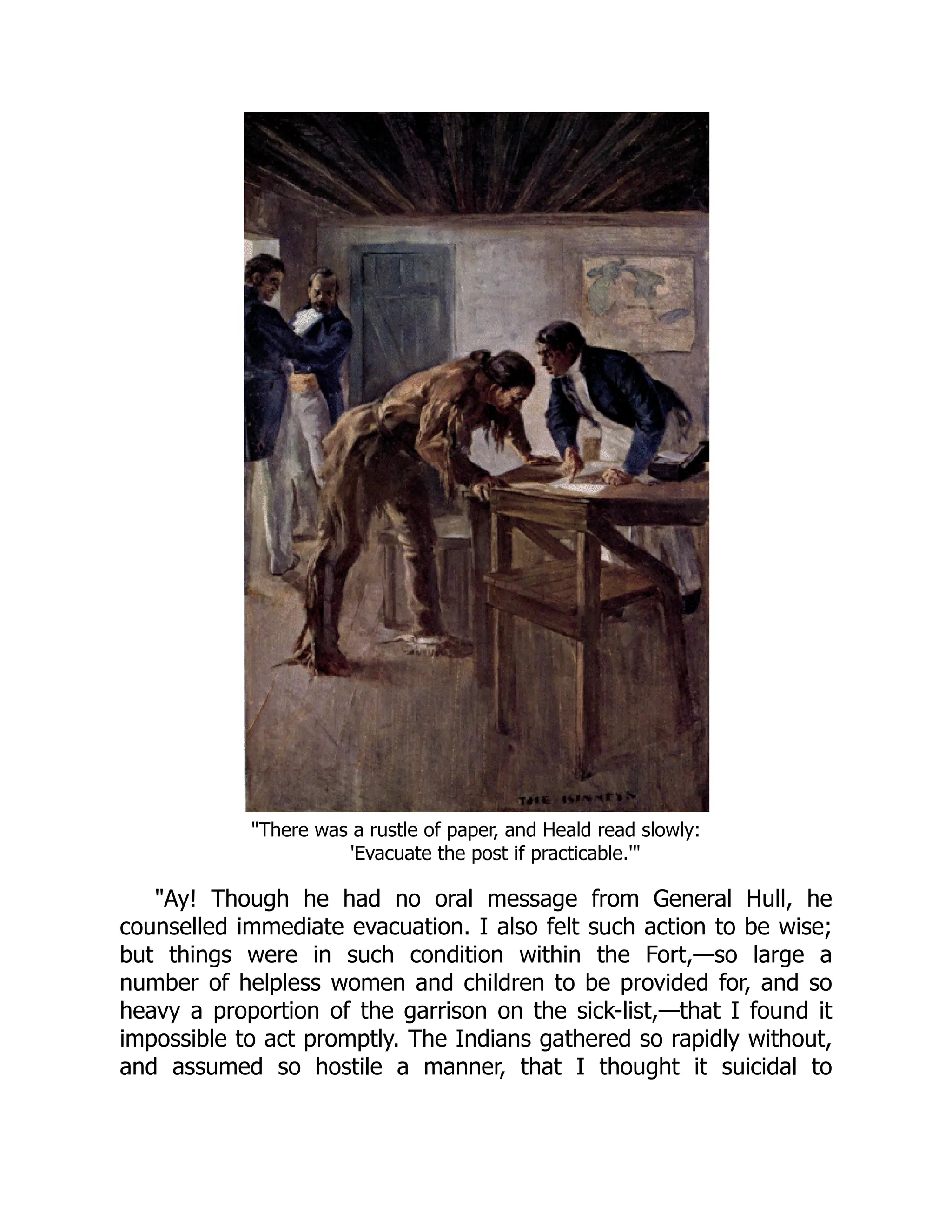
"There was a rustle of paper, and Heald read slowly:
'Evacuate the post if practicable.'"
"Ay! Though he had no oral message from General Hull, he
counselled immediate evacuation. I also felt such action to be wise;
but things were in such condition within the Fort,—so large a
number of helpless women and children to be provided for, and so
heavy a proportion of the garrison on the sick-list,—that I found it
impossible to act promptly. The Indians gathered so rapidly without,
and assumed so hostile a manner, that I thought it suicidal to
attempt a march through the wilderness, encumbered as we should
be, without some positive understanding with their chiefs."
"I can easily comprehend all this, and that you have sought to
act for the best," was Wells's comment; "but I fail to realize how you
hoped to appease those same Indians by the wanton destruction last
night of the liquor thrown into the river. It was done in direct
opposition to the orders you have just read, and is bound to increase
the hatred of the savages. You may be sure they are not ignorant of
the contents of your despatch, and must resent the destruction of
property they consider their own."
"'Twas done upon the advice of two of their leading chiefs."
"Indeed! Which two?"
"Topenebe and Little Sauk."
"The two biggest devils in that whole Pottawattomie camp, and
the head and front of their war-party! Their purpose is clear enough
to my mind, and seamed with treachery. Well, Heald, from my
knowledge of Indian nature I must say that whoever goes forth now
to confer with yonder redskins has a desperate mission; but if you
are still determined upon such a conference, I will take my chances
with you. 'Tis given unto man but once to die."
"No, William," replied Captain Heald, with more firmness. "It is
your part to remain here in protection of your niece, my wife; and if
my own officers refuse to volunteer in this service, I shall go forth
alone to meet the chiefs. It is my duty as commandant."
"Two of your officers are here," said Wells, "and they can
probably answer for themselves. Ensign Ronan is not present."
"He is acting as officer of the day," returned Heald, somewhat
stiffly, "and is therefore not eligible for such service. Perhaps one of
the officers here present possesses courage enough for the
venture?"
Apparently neither cared to express himself, after such an
insinuation. At last one, whose voice I recognized as that of Surgeon
Van Voorhis, gave utterance to his refusal.
"As the only medical officer of the garrison, I feel justified in
declining to go upon so desperate an expedition," he said gravely. "It
would expose not only my own life to unnecessary peril, but the lives
of many others as well."
"And what say you, Lieutenant Helm? Have you also personal
scruples?"
I could detect a tremor in the younger officer's voice, as he
answered promptly.
"Captain Heald has before this seen me in time of danger," he
said quietly, "and can have no reason for ascribing cowardice to me.
But I will frankly say this, sir, and with all respect to my commanding
officer, I believe such conference as now proposed with the hostile
Indians yonder, at this late day, to be perfectly useless, and that
every hour's delay since the receipt of orders to evacuate the post
has only tended to increase our danger and lessen our hope of
escape. I feel now that our only chance of safety lies in defending
this stockade against attack until a rescue party from the East can
reach us. I have a young wife among the women of this garrison; to
her I owe allegiance, as well as to the flag I serve. Feeling as I do,
Captain Heald, as a soldier I will obey any command you give, and
will go forth upon this mission if ordered to do so, either in your
company or alone; but I cannot volunteer for such service. I believe
it to be foolhardy, and that whoever undertakes it goes forth to
almost certain death."
"Then I shall go alone," said Heald, sternly; "nor do I look
forward to any such disastrous ending to so open a mission of
peace."
"Wait," broke in Wells, impulsively. "I have a final suggestion to
make, if you are resolved to go. There rode in my party hither a
rattle-brained gallant, bearing a French commission, who ought to
prove sufficiently reckless to lend you his companionship. Faith! but I
think it may well suit the fellow. Be sides, if he wore his French
uniform it might have weight with the reds."
"Who is he?" asked Heald, doubtfully. "I seem not to have
memory of him."
"He calls himself Captain Villiers de Croix, and holds commission
in the Emperor's Guard."
Scarcely were the words spoken when I was on my feet, all
vestige of sleep gone from my eyes. De Croix was hardly a friend of
mine, since late developments, but he had been my comrade for
many a league of hard forest travel, and I was unwilling to have him
carelessly sacrificed in a venture regarding the danger of which he
knew nothing. Besides, I counted on his sword to aid in the defence
of Mademoiselle. I understood thoroughly the desperate chances of
Indian treachery that lay before such a commission as was now
proposed. It was rash in the extreme; and only the terrors of our
position could sanction such an experiment. The savages that
hemmed us in were already in an ugly mood, and fully conscious of
their power. To go forth to them, unarmed and uninvited, as Captain
Heald coolly proposed doing, was to walk open-eyed into a trap
which treachery might snap shut at any time. It was not my purpose
to halt De Croix, nor to stand between him and any adventure he
might choose to undertake; but I could at least warn him, in a
friendly spirit, of the imminent danger such a thing involved.
With this thought in mind, I ran hastily across the open parade
into the officers' mess-hall, hoping I might find him loitering there.
To my hasty glance, the place appeared deserted; and I drew back,
wondering where to turn next in search. As I hesitated on the
threshold, the low voice of Mademoiselle fell upon my ear; and at
that moment she emerged from behind the curtain which divided the
officers' quarters.
"May I hope you are seeking me?" she asked, graciously; "for it
has been most lonely here all day, even Captain de Croix seems to
have forgotten my existence."
"It was De Croix I sought," I answered, somewhat nettled by her
prompt reference to him; "and doubtless you are well able to give
me trace of him."
She studied me keenly, marking an angry note in my voice that I
sought vainly to disguise.
"Forever a quarrel?" she said, regretfully. "Do you know, Master
Wayland, I had thought better of you. Surely it is not your nature to
be a brawler, and always seeking opportunity to show the strong
hand! What has Captain de Croix done now to make you seek him
so vengefully?"
"'Tis not in quarrel," I explained,—I fear with ill grace, for her
words in his defence were little inclined to mollify me. "You may
indeed have so poor conception of me as to misinterpret my coming;
yet in truth I seek De Croix in friendship, hoping that I may by a
chance word serve him."
"Indeed! what danger threatens, that he needs to be warned
against?"
I hesitated; for, now that my blood had somewhat cooled, my
mission seemed a bit foolish.
"I insist upon knowing," she continued haughtily, her eyes full
upon mine, "or I shall believe you sought him for hostile purpose,
and would deceive me by fair words."
"Mademoiselle," I answered gravely, "you do me wrong. Only a
few moments ago I chanced to overhear a discussion, by the officers
of this Fort, regarding a commission to go forth and hold council
with the Indians. Captain Heald is determined upon such a course;
but none will volunteer to accompany him, because of the grave
danger of savage treachery. The Frenchman's name was mentioned
as one reckless enough to join with such a party; and I sought to
warn him ere he accepted blindly. He is hardly a friend of mine,—yet
it seems no more than fair that he should know the full measure of
his peril before saying 'yes.'"
She came impulsively forward, with quickly extended hand, her
face aglow.
"You are indeed a true heart, John Wayland, and have shamed
me rightly. I know well the deceit and treachery of Indian nature,
and can understand the peril such a party would run. Promise me
that you will prevent Captain de Croix from becoming one of them."
"I?" I exclaimed in perplexed surprise; "I can do no more than
warn him."
"But you must do more!" she cried imperatively. "He will surely
go if asked. A warning such as you propose would only stir his
blood. I beg you to use your wits a little, so that he may know
nothing of it."
I looked at her, deeply hurt by the interest so openly displayed.
"You are wondrously aroused for the Frenchman's safety,
Mademoiselle!"
"Yes, though not as you may fancy. Captain de Croix came here
for my sake, even though no word of mine gave him reason for
doing so. For this reason I could never forgive myself if harm befell
him on such a journey. 'Twould be as if I had lured him to his death.
So 'tis for my sake, not his, that I ask the favor."
I leaned against the log wall and thought quickly, her anxious
eyes never leaving my face. There came into my mind a conviction
that the girl really loved him; and this made the struggle harder for
me to serve him. Nor did I see clearly how it could well be done,
save through a sacrifice of myself, such as I had never intended.
"Surely," she urged, "your wits will conceive some way in which it
may be done?"
"Yes," I answered, eager now to hide my own feeling from her;
"'tis not hopeless. You desire that he be kept within the Fort,
ignorant of this commission?"
"I do; 'tis the only way."
"Very well, it shall be done, Mademoiselle. No, I need no thanks
from you. Only do this simple thing, which, I am sure, you will find
no hardship,—keep Captain de Croix from any possible contact with
others for an hour. Your eyes will prove sufficient, no doubt, to
enchain him that long; if not, use other measures."
"But what will you do?"
"That does not count. 'Tis the result, not the means, that must
content you. I have my plan, and it will work; but I cannot stay here
longer to discuss it. Only do your part well, and I pledge you the
safety of De Croix."
I left her standing there, the light of questioning still in her eyes;
but I wished mainly to be safely away, where I might hide my own
sudden heart-ache in the energy of action.
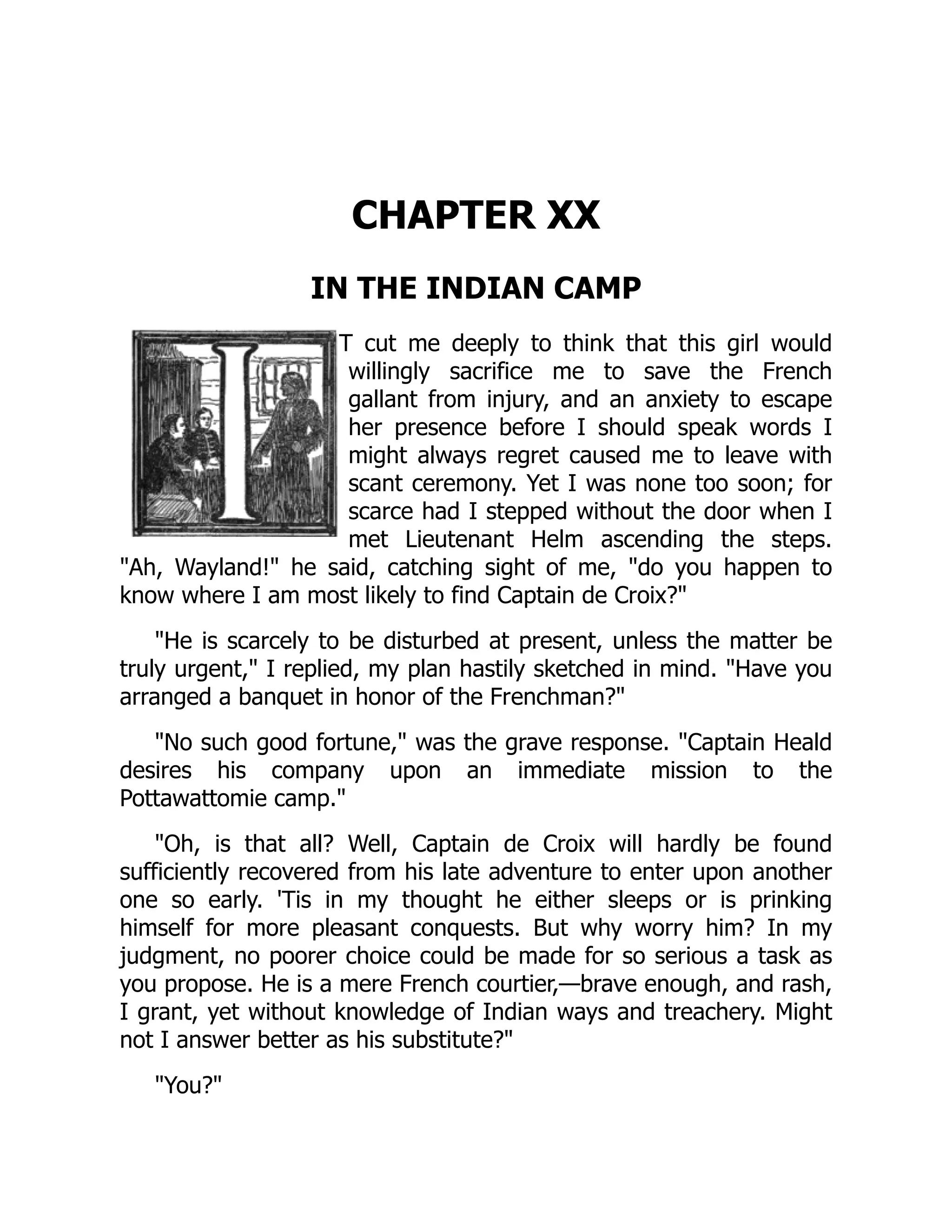
CHAPTER XX
IN THE INDIAN CAMP
T cut me deeply to think that this girl would
willingly sacrifice me to save the French
gallant from injury, and an anxiety to escape
her presence before I should speak words I
might always regret caused me to leave with
scant ceremony. Yet I was none too soon; for
scarce had I stepped without the door when I
met Lieutenant Helm ascending the steps.
"Ah, Wayland!" he said, catching sight of me, "do you happen to
know where I am most likely to find Captain de Croix?"
"He is scarcely to be disturbed at present, unless the matter be
truly urgent," I replied, my plan hastily sketched in mind. "Have you
arranged a banquet in honor of the Frenchman?"
"No such good fortune," was the grave response. "Captain Heald
desires his company upon an immediate mission to the
Pottawattomie camp."
"Oh, is that all? Well, Captain de Croix will hardly be found
sufficiently recovered from his late adventure to enter upon another
one so early. 'Tis in my thought he either sleeps or is prinking
himself for more pleasant conquests. But why worry him? In my
judgment, no poorer choice could be made for so serious a task as
you propose. He is a mere French courtier,—brave enough, and rash,
I grant, yet without knowledge of Indian ways and treachery. Might
not I answer better as his substitute?"
"You?"
"Ay! and why not? I am frontier-bred, long trained in woodcraft
and savage ways, and surely far better fitted for such a task than is
this petted darling of the courts. Were it a flirtation, now, the post
might be truly his."
"'Tis true, you would be my choice; but do you realize the peril
involved?"
"Fully, my friend, yet scarce think it so desperate as you imagine.
It is my judgment the savages yonder are seeking bigger game than
so small a party would afford, and will therefore allow us to go free.
However, if it should prove otherwise," and I spoke the words with a
sore heart as I recalled what had just occurred, "I am a lone man in
the world, and to such an one death is not so terrible, even at Indian
hands. Come, I will go with you to confer with Captain Heald, and
offer him my services. He can do no more than refuse."
Helm offered no further objection, doubtless feeling it useless in
my venturesome mood; and we crossed the parade together without
speaking.
Captain Wells was the first to see me as we entered, and some
instinct told him instantly of my purpose.
"Ah, Wayland, my boy! I have been troubled lest you might
chance to hear of our plight, and jump in. Come now, lad! 'twas not
you we sent after, nor can we use you in so grave a matter."
"And pray, why not?" I questioned, a little touched by this
evidence of kindness, yet firmly determined to keep my pledge to
Mademoiselle. "I am a better man for such deeds than the
Frenchman, and am eager to go."
"So this is not your Captain de Croix?" said Captain Heald, eying
me curiously. "Saint George! but he is a big fellow,—the same who
made the race last night, or I mistake greatly. And what is this man's
name?"
"It is John Wayland," I answered, anxious to impress him
favorably; "a frontiersman of the Maumee country, and fairly skilled
in Indian ways. I have come to volunteer my services to go with
you."
"You are anxious to die? have the spirit of a Jesuit, perchance,
and are ambitious of martyrdom?"
"Not unusually so, sir, but I think the danger overrated by these
gentlemen. At least, I am ready and willing to go."
"And so you shall, lad!" cried the old soldier, striking a hand upon
his knee. "You are of the race of the long rifles; I know your kind
well. Not another word, William! here is a man worth any twenty of
your French beaux strutting with a sword. Now we start at once, and
shall have this matter settled speedily."
The earliest haze of the fast-descending twilight was hovering
over the level plain as we two went forth. In the west, the red tinge
of the sun, which had just disappeared below the horizon, lingered
well up in the sky. Against it we could see, clearly outlined in inky
blackness, the distant Indian wigwams; while to the eastward the
crimson light was reflected in fantastic glow upon the heaving
surface of the lake. For a moment we paused, standing upon the
slope of the mound on which the Fort was built, and gazed about us.
There was little movement to arrest the eye. The dull, dreary level of
shore and prairie was deserted; what the more distant mounds of
sand or the overhanging river banks might hide of savage watchers,
we could only conjecture. Seemingly the mass of Indian life, which
only the day before had overflowed that vacant space, had vanished
as if by some sorcerer's magic. To me, this unexpected silence and
dreary barrenness were astounding; I gazed about me fairly
bewildered, almost dreaming for the moment that our foes had lifted
the long siege and departed while I slept. Heald no doubt read the
thought in my eyes, for he laid a kindly hand upon my sleeve and
pointed westward.
"They are all yonder, lad, at the camp,—in council, like enough.
Mark you, Wayland, how much farther to the south the limit of their
camp extends than when the sun sank last night? Saint George! they
must have added all of fifty wigwams to their village! They gather
like crows about a dead body. It has an ugly look."
"Yet 'tis strange they leave the Fort unguarded, so that the
garrison may come and go unhindered. 'Tis not the usual practice of
Indian warfare."
"Unguarded? Faith! the hundreds of miles of wilderness between
us and our nearest neighbor are sufficient guard. But dream not, my
lad, that we are unobserved; doubtless fifty pair of skulking eyes are
even now upon us, marking every move. I venture we travel no
more than a hundred yards from the gate before our way is barred.
Note how peaceful the stockade appears! But for the closed gates,
one would never dream it the centre of hostile attack. Upon my
word, even love-making has not deserted its log-walls!"
I lifted my eyes where he pointed, and even at that distance, and
through the gathering gloom, I knew it was De Croix and
Mademoiselle who overhung those eastern palisades in proximity so
close. The sight was as fire to my blood, and with teeth clinched to
keep back the mad utterance of a curse, I strode beside Captain
Heald silently down the declivity to the deserted plain below.
It is my nature to be somewhat chary of speech, and to feel
deeply and long; but if I doubted it before, I knew now, in this
moment of keen and bitter disappointment, that my heart was with
that careless girl up yonder, who had sent me forth into grave peril
apparently without thought, and who cared so little even now that
she never lifted her eyes from the sparkling water to trace our
onward progress. Anger, disappointment, disgust at her duplicity, her
cruel abuse of power, swept over and mastered me at the moment
when I realized more deeply than ever my own love for her, and my
utter helplessness to oppose her slightest whim. No Indian thongs
could bind me half so tightly as the false smiles of Toinette.
Plunged into this whirlpool of thought, I moved steadily forward
at Captain Heald's shoulder, unconscious of what might be taking
place about us, and for the moment indifferent to the result of our
venture. But this feeling was not for long. Scarcely had our progress
taken us across the front of the deserted agency building, and
beyond the ken of the sentinels in the Fort, when a single warrior
rose before us as from the ground, and blocked the path. He was a
short, sturdy savage, bare to the waist save for a chain of teeth
which dangled with sinister gleam about his brawny throat, and,
from the wide sweep of his shoulders, evidently possessed of
prodigious strength. He held a gun extended in front of him, and
made a gesture of warning impossible to misapprehend.
"What seeks the White Chief?" he questioned bluntly. "Does he
come for peace or war?"
The query came with such grave abruptness that Heald hesitated
in reply.
"Never since I have been at Dearborn have I sought war," he
replied at last. "Little Sauk knows this well. We travel now that we
may have council of peace with the chiefs of the Pottawattomies.
See!" and he held up both empty hands before the Indian's eyes,
"we are both unarmed, because of our trust in the good faith of your
people."
Little Sauk uttered a low grunt of disapproval, and made no
motion to lower his threatening rifle.
"Ugh! You talk strong! Did any Pottawattomie send to White Chief
to come to council?"
"No," admitted Heald. "We come because it is the wish of the
Great Father of the white men down by the sea that we talk
together of the wrongs of the red men, and make proposals of
peace between us. There is no cause for these rumors of war, and
the Great Father has heard that the Pottawattomies are dissatisfied,
and it has made him sad."
The Indian looked from one to the other of us in the growing
darkness, and made a gesture of contempt.
"The real Great White Father wears a red coat, and is friend to
the Pottawattomie," he said with dignity. "He no lie, no shut Indian
out of Fort, no steal furs, no throw rum in river. Who this man, White
Chief? He no soldier,—he long-knife."
"Yes, he is a frontiersman, and came to the Fort yesterday with
Wau-me-nuk, bringing word of greeting from the Great Father to the
Pottawattomies. He goes now with me to council. May we pass on to
your camp?"
For a moment Little Sauk did not answer, stepping closer in order
that he might better scan my features. Apparently satisfied by the
keen scrutiny, he turned his broad back upon us and strode off with
contemptuous dignity.
"Come," he said shortly; and without further word we followed
across that dim plain and through the thickening darkness.
The Indian's step was noiseless, and his figure cast the merest
shadow; but as we moved onward others constantly joined us,
stalking out of the black night like so many phantoms, gliding silently
in their noiseless moccasins across the soft grass, until fully a dozen
spectral forms hedged our pathway and kept step to every
movement. It was a weird procession, through the shifting night-
shadows; and although I could catch but fleeting glimpses of those
savage faces and half-naked forms, the knowledge of their presence,
and our own helplessness if they proved treacherous, caused my
heart to throb till I could hear it in the painful silence like the beat of
a drum. Now and then a guttural voice challenged from the
darkness, to be instantly answered by those in advance, and another
savage glided within our narrowed vision, scanned us with cruel and
curious eyes, and fell in with the same silent, tiger-like tread of his
fellows.
It was not long that we were compelled to march thus, the
gathering warriors pressing us closer at each step; and it was well it
proved so soon ended, for the grim mockery set my nerves on edge.
Yet the change was hardly for the better. Just before reaching the
spot where the river forked sharply to the southward, we came to
the upper edge of the wigwams, and into a bit of light from their
scattered fires. There rushed out upon us a wild horde of excited
savages, warriors and squaws, who pushed us about in sheer
delirium, and even struck viciously at us across the shoulders of our
indifferent guard, so that it was only by setting my teeth that I held
back from grappling with the demons. But Heald, older in years and
of cooler blood, laid restraining hands upon my arm.
"'Tis but the riff-raff," he muttered warningly. "The chiefs will hold
them back from doing us serious harm."
As he spoke, Little Sauk uttered a gruff order, and the grim
warriors on our flank drove back the jeering, scowling crowd, with
fierce Indian cursing and blows of their guns, until the way had been
cleared for our advance. We moved on for two hundred yards or
more, the maddened and vengeful mob menacing us just beyond
reach of the strong arms, and howling in their anger until I doubted
not their voices reached the distant Fort.
We came to a great wigwam of deer-skin, much larger than any I
had ever seen, with many grotesque figures of animals sketched in
red and yellow paint upon the outside, and clearly revealed by the
blazing fire without. A medicine-man of the tribe, hideous with
pigment and high upstanding hair, sat beating a wooden drum
before the entrance, and chanting wildly to a ferocious-looking horde
of naked savages, many bleeding from self-inflicted wounds, who
danced around the blaze, the leaping figures in the red glare making
the scene truly demoniacal. Little Sauk strode through the midst of
them, unheeding the uproar, and flung aside the flap of the tent.
"White Chief and Long Knife wait here," he said sternly. "Come
back pretty soon."
There was nothing to be seen within, excepting some skins flung
carelessly upon the short trodden grass. We sat down silently upon
these, gazing out through the narrow opening at the blazing fire and
the numerous moving figures constantly crowding closer about the
entrance, both of us too deeply immersed in thought to care for
speech.
The black shadows upon the tepee cover told me that guards
had been posted to keep back the rabble from intrusion, and once I
saw signs of a brief struggle in front when the swarm had grown too
inquisitive and were forced back with scant ceremony. The weird
dance and incantation continued; and although I knew but little of
the customs of the Pottawattomies, there was a cruel savagery and
ferocity about it which I felt held but little promise of peace.
"'Tis the war-dance," whispered Heald in my ear, "and bodes ill
for our purpose. See! the red wampum is in the fellow's hand."
As I bent forward to catch the gleam of it in the flames, a new
figure suddenly flitted past our narrow vista, between us and the
wild circle of dancers. It was a woman, attired in fanciful Indian
dress; but surely no Pottawattomie squaw ever possessed so
graceful a carriage, or bore so clear a face.
"Captain!" I ejaculated eagerly. "Did you see that white woman
there, with the long skirt and red hair?"
"Ay!" he answered as though he scarce had faith in his own eyes.
"I marked not the color of her hair, but I saw the lass, and, by Saint
George! she looked to me like old Roger Matherson's daughter."
CHAPTER XXI
A COUNCIL OF CHIEFS
WAS on my feet in an instant, forgetful of
everything excepting my duty to this girl
whom I had come so far to find, and who now
was plainly a prisoner in Indian hands. At the
entrance of the tepee, a scowling warrior
pushed me roughly back, pretending not to
understand my eager words of expostulation,
and, by significant gesture, threatening to
brain me with his gun-stock if I persisted. A slight return of reason
alone kept me from striking the fellow down and striding over his
prostrate body. While I stood struggling with this temptation,
Captain Heald grasped me firmly.
"Are you mad, Wayland?" he muttered, dragging me back into
the dark interior of the tepee. "For God's sake, don't anger these
fellows! Think of all the helpless lives depending on the success of
our errand here! What is the girl to you?"
"I will wait," I answered, calmed by his earnestness, and
ashamed of my boyish impetuosity; "but I am here at Dearborn
seeking this young woman, whom I had supposed rather to be a
young child. Her father was my father's dearest friend, and wrote us
from his death-bed asking our protection for her."
"You are Major Wayland's son,—I remember the circumstances
now, and that I endorsed such a letter. 'Tis most strange. This girl
disappeared from Dearborn some days ago. Mrs. Heald heard the
matter discussed among the ladies of the garrison, and then all
supposed her to be at John Kinzie's in company with Josette La
Framboise; yet I would almost have sworn I saw her again, and not
two hours ago, within the Fort. By Saint George! the glimpse I got
just now makes me doubt my own eyesight. She was ever an odd
creature,—but what can bring her here, walking so freely about in
this camp of vengeful savages?"
I could not answer him; the mystery was beyond my clearing.
Only, if this was the Elsa Matherson for whom I had sought so long,
surely God had in some way led me on to find her; nor should any
peril turn my quest aside.
I had hardly time for this resolve, ere the flap of the tepee was
held back by a dark hand, and in grimly impressive silence warrior
after warrior, plumed, painted, and gaudily bedecked with savage
ornaments, stalked solemnly within, circled about us without sign of
greeting, and seated themselves cross-legged upon the bare ground.
The uplifted door-skin permitted the red flames from without to play
freely over their stern, impassive faces, and shone back upon us
from their glittering eyes. It was an impressive scene, their stoical
demeanor breathing the deep solemnity of the vast woods and
plains amid which their savage lives were passed; nor could one fail
to feel the deep gravity with which they gathered in this council of
life or death. To them it was evident that the meeting was of most
serious portent.
I saw only two faces that I recognized in that red ring,—
Topenebe and Little Sauk. I knew, however, it was probable there
were some great chiefs among that company; and I marked
especially two, one with long white hair, and a tall, slender, rather
young fellow, having two wide streaks of yellow down either cheek.
The Indians sat motionless, gazing intently at us; and I swept the
entire dark circle of scowling faces, vainly endeavoring to find one
hopeful glance, one friendly eye. Open hatred, undisguised distrust,
implacable enmity, were stamped on every feature. Whatever our
plea might be, I felt convinced that the chiefs were here only to
carry out their own purposes and make mock of every offering of
peace.
After several moments of this painful silence, the chief with the
long white hair deliberately lighted a large pipe drawn from his belt.
It was curiously and grotesquely fashioned, the huge bowl carved to
resemble the head of a bear. He drew from the stem a single thick
volume of smoke, breathed it out into the air, and solemnly passed
the pipe to the warrior seated upon his right. With slow deliberation,
the symbol moved around the impassive and emotionless circle,
passing from one red hand to another, until it finally came back to
him who had first lighted it. Without so much as a word being
uttered, he gravely offered it to Captain Heald. I heard, and
understood, the quick sigh of relief with which my companion
grasped it; he drew a breath of the tobacco, and I followed his
example, handing back the smoking pipe to the white-haired chief
without rising, amid the same impressive silence.
The Indian leader spoke for the first time, his voice deep and
guttural.
"The Pottawattomies have met in council with the White Chief
and the Long Knife," he said soberly, "and have smoked together the
peace-pipe. For what have the white men come to disturb Gomo and
his warriors?"
I gazed at him with new interest. No name of savage chief was
wider known along the border in those days, none more justly
feared by the settlers. He was a tall, spare, austere man, his long
coarse hair whitened by years, but with no stoop in his figure. His
eyes, small and keen, blazed with a strange ferocity, as I have seen
those of wild-cats in the dark; while his flesh was drawn so closely
against his prominent cheek-bones as to leave an impression of
ghastliness, as of a corpse suddenly returned by some miracle to
life. With dabs of paint across the forehead, and thin lips drawn in a
narrow line of cruelty, his face formed a picture to be long
remembered with a shudder.
Welcome to our website – the ideal destination for book lovers and
knowledge seekers. With a mission to inspire endlessly, we offer a
vast collection of books, ranging from classic literary works to
specialized publications, self-development books, and children's
literature. Each book is a new journey of discovery, expanding
knowledge and enriching the soul of the reade
Our website is not just a platform for buying books, but a bridge
connecting readers to the timeless values of culture and wisdom. With
an elegant, user-friendly interface and an intelligent search system,
we are committed to providing a quick and convenient shopping
experience. Additionally, our special promotions and home delivery
services ensure that you save time and fully enjoy the joy of reading.
Let us accompany you on the journey of exploring knowledge and
personal growth!
ebookultra.com

Arithmetical Properties of Commutative Rings and Monoids 1st Edition Scott T. Chapman

  • 1.
    Arithmetical Properties ofCommutative Rings and Monoids 1st Edition Scott T. Chapman download pdf https://ebookultra.com/download/arithmetical-properties-of-commutative- rings-and-monoids-1st-edition-scott-t-chapman/ Visit ebookultra.com today to download the complete set of ebook or textbook!

  • 2.
    Here are somerecommended products for you. Click the link to download, or explore more at ebookultra.com The Separable Galois Theory of Commutative Rings Second Edition Andy R. Magid https://ebookultra.com/download/the-separable-galois-theory-of- commutative-rings-second-edition-andy-r-magid/ Computational Commutative And Non commutative Algebraic Geometry Svetlana Cojocaru https://ebookultra.com/download/computational-commutative-and-non- commutative-algebraic-geometry-svetlana-cojocaru/ Ancient Rings An Illustrated Collector s Guide 1st Edition T. N. Pollio https://ebookultra.com/download/ancient-rings-an-illustrated- collector-s-guide-1st-edition-t-n-pollio/ The geysers of Yellowstone Fifth Edition T. Scott Bryan https://ebookultra.com/download/the-geysers-of-yellowstone-fifth- edition-t-scott-bryan/
  • 3.
    Bridging Case ConceptualizationAssessment and Intervention 1st Edition Scott T. Meier https://ebookultra.com/download/bridging-case-conceptualization- assessment-and-intervention-1st-edition-scott-t-meier/ Measuring Change in Counseling and Psychotherapy 1st Edition Scott T. Meier https://ebookultra.com/download/measuring-change-in-counseling-and- psychotherapy-1st-edition-scott-t-meier/ Algebraic Graph Theory Morphisms Monoids and Matrices 1st Edition Ulrich Knauer https://ebookultra.com/download/algebraic-graph-theory-morphisms- monoids-and-matrices-1st-edition-ulrich-knauer/ Radical Theory of Rings 1st Edition J.W. Gardner https://ebookultra.com/download/radical-theory-of-rings-1st-edition-j- w-gardner/ Differentiated Assessment Strategies One Tool Doesn t Fit All 2nd Edition Carolyn Chapman https://ebookultra.com/download/differentiated-assessment-strategies- one-tool-doesn-t-fit-all-2nd-edition-carolyn-chapman/
  • 5.
    Arithmetical Properties ofCommutative Rings and Monoids 1st Edition Scott T. Chapman Digital Instant Download Author(s): Scott T. Chapman ISBN(s): 9781420028249, 1420028243 Edition: 1 File Details: PDF, 3.25 MB Year: 2005 Language: english
  • 7.
  • 8.
    M. S. Baouendi Universityof California, San Diego Jane Cronin Rutgers University Jack K. Hale Georgia Institute of Technology S. Kobayashi University of California, Berkeley Marvin Marcus University of California, Santa Barbara W. S. Massey Yale University Anil Nerode Cornell University Donald Passman University of Wisconsin, Madison Fred S. Roberts Rutgers University David L. Russell Virginia Polytechnic Institute and State University Walter Schempp Universität Siegen Mark Teply University of Wisconsin, Milwaukee Earl J. Taft Rutgers University New Brunswick, New Jersey Zuhair Nashed University of Central Florida Orlando, Florida PURE AND APPLIED MATHEMATICS A Program of Monographs, Textbooks, and Lecture Notes EXECUTIVE EDITORS EDITORIAL BOARD
  • 9.
    LECTURE NOTES INPURE AND APPLIED MATHEMATICS 1. N. Jacobson, Exceptional Lie Algebras 2. L.-Å. Lindahl and F. Poulsen, Thin Sets in Harmonic Analysis 3. I. Satake, Classification Theory of Semi-Simple Algebraic Groups 4. F. Hirzebruch et al., Differentiable Manifolds and Quadratic Forms 5. I. Chavel, Riemannian Symmetric Spaces of Rank One 6. R. B. Burckel, Characterization of C(X) Among Its Subalgebras 7. B. R. McDonald et al., Ring Theory 8. Y.-T. Siu, Techniques of Extension on Analytic Objects 9. S. R. Caradus et al., Calkin Algebras and Algebras of Operators on Banach Spaces 10. E. O. Roxin et al., Differential Games and Control Theory 11. M. Orzech and C. Small, The Brauer Group of Commutative Rings 12. S. Thomier, Topology and Its Applications 13. J. M. Lopez and K. A. Ross, Sidon Sets 14. W. W. Comfort and S. Negrepontis, Continuous Pseudometrics 15. K. McKennon and J. M. Robertson, Locally Convex Spaces 16. M. Carmeli and S. Malin, Representations of the Rotation and Lorentz Groups 17. G. B. Seligman, Rational Methods in Lie Algebras 18. D. G. de Figueiredo, Functional Analysis 19. L. Cesari et al., Nonlinear Functional Analysis and Differential Equations 20. J. J. Schäffer, Geometry of Spheres in Normed Spaces 21. K. Yano and M. Kon, Anti-Invariant Submanifolds 22. W. V. Vasconcelos, The Rings of Dimension Two 23. R. E. Chandler, Hausdorff Compactifications 24. S. P. Franklin and B. V. S. Thomas, Topology 25. S. K. Jain, Ring Theory 26. B. R. McDonald and R. A. Morris, Ring Theory II 27. R. B. Mura and A. Rhemtulla, Orderable Groups 28. J. R. Graef, Stability of Dynamical Systems 29. H.-C. Wang, Homogeneous Branch Algebras 30. E. O. Roxin et al., Differential Games and Control Theory II 31. R. D. Porter, Introduction to Fibre Bundles 32. M. Altman, Contractors and Contractor Directions Theory and Applications 33. J. S. Golan, Decomposition and Dimension in Module Categories 34. G. Fairweather, Finite Element Galerkin Methods for Differential Equations 35. J. D. Sally, Numbers of Generators of Ideals in Local Rings 36. S. S. Miller, Complex Analysis 37. R. Gordon, Representation Theory of Algebras 38. M. Goto and F. D. Grosshans, Semisimple Lie Algebras 39. A. I. Arruda et al., Mathematical Logic 40. F. Van Oystaeyen, Ring Theory 41. F. Van Oystaeyen and A. Verschoren, Reflectors and Localization 42. M. Satyanarayana, Positively Ordered Semigroups 43. D. L Russell, Mathematics of Finite-Dimensional Control Systems 44. P.-T. Liu and E. Roxin, Differential Games and Control Theory III 45. A. Geramita and J. Seberry, Orthogonal Designs
  • 10.
    46. J. Cigler,V. Losert, and P. Michor, Banach Modules and Functors on Categories of Banach Spaces 47. P.-T. Liu and J. G. Sutinen, Control Theory in Mathematical Economics 48. C. Byrnes, Partial Differential Equations and Geometry 49. G. Klambauer, Problems and Propositions in Analysis 50. J. Knopfmacher, Analytic Arithmetic of Algebraic Function Fields 51. F. Van Oystaeyen, Ring Theory 52. B. Kadem, Binary Time Series 53. J. Barros-Neto and R. A. Artino, Hypoelliptic Boundary-Value Problems 54. R. L. Sternberg et al., Nonlinear Partial Differential Equations in Engineering and Applied Science 55. B. R. McDonald, Ring Theory and Algebra III 56. J. S. Golan, Structure Sheaves Over a Noncommutative Ring 57. T. V. Narayana et al., Combinatorics, Representation Theory and Statistical Methods in Groups 58. T. A. Burton, Modeling and Differential Equations in Biology 59. K. H. Kim and F. W. Roush, Introduction to Mathematical Consensus Theory 60. J. Banas and K. Goebel, Measures of Noncompactness in Banach Spaces 61. O. A. Nielson, Direct Integral Theory 62. J. E. Smith et al., Ordered Groups 63. J. Cronin, Mathematics of Cell Electrophysiology 64. J. W. Brewer, Power Series Over Commutative Rings 65. P. K. Kamthan and M. Gupta, Sequence Spaces and Series 66. T. G. McLaughlin, Regressive Sets and the Theory of Isols 67. T. L. Herdman et al., Integral and Functional Differential Equations 68. R. Draper, Commutative Algebra 69. W. G. McKay and J. Patera, Tables of Dimensions, Indices, and Branching Rules for Representations of Simple Lie Algebras 70. R. L. Devaney and Z. H. Nitecki, Classical Mechanics and Dynamical Systems 71. J. Van Geel, Places and Valuations in Noncommutative Ring Theory 72. C. Faith, Injective Modules and Injective Quotient Rings 73. A. Fiacco, Mathematical Programming with Data Perturbations I 74. P. Schultz et al., Algebraic Structures and Applications 75. L Bican et al., Rings, Modules, and Preradicals 76. D. C. Kay and M. Breen, Convexity and Related Combinatorial Geometry 77. P. Fletcher and W. F. Lindgren, Quasi-Uniform Spaces 78. C.-C. Yang, Factorization Theory of Meromorphic Functions 79. O. Taussky, Ternary Quadratic Forms and Norms 80. S. P. Singh and J. H. Burry, Nonlinear Analysis and Applications 81. K. B. Hannsgen et al., Volterra and Functional Differential Equations 82. N. L. Johnson et al., Finite Geometries 83. G. I. Zapata, Functional Analysis, Holomorphy, and Approximation Theory 84. S. Greco and G. Valla, Commutative Algebra 85. A. V. Fiacco, Mathematical Programming with Data Perturbations II 86. J.-B. Hiriart-Urruty et al., Optimization 87. A. Figa Talamanca and M. A. Picardello, Harmonic Analysis on Free Groups 88. M. Harada, Factor Categories with Applications to Direct Decomposition of Modules 89. V. I. Istra’tescu, Strict Convexity and Complex Strict Convexity 90. V. Lakshmikantham, Trends in Theory and Practice of Nonlinear Differential Equations
  • 11.
    91. H. L.Manocha and J. B. Srivastava, Algebra and Its Applications 92. D. V. Chudnovsky and G. V. Chudnovsky, Classical and Quantum Models and Arithmetic Problems 93. J. W. Longley, Least Squares Computations Using Orthogonalization Methods 94. L. P. de Alcantara, Mathematical Logic and Formal Systems 95. C. E. Aull, Rings of Continuous Functions 96. R. Chuaqui, Analysis, Geometry, and Probability 97. L. Fuchs and L. Salce, Modules Over Valuation Domains 98. P. Fischer and W. R. Smith, Chaos, Fractals, and Dynamics 99. W. B. Powell and C. Tsinakis, Ordered Algebraic Structures 100. G. M. Rassias and T. M. Rassias, Differential Geometry, Calculus of Variations, and Their Applications 101. R.-E. Hoffmann and K. H. Hofmann, Continuous Lattices and Their Applications 102. J. H. Lightbourne III and S. M. Rankin III, Physical Mathematics and Nonlinear Partial Differential Equations 103. C. A. Baker and L. M. Batten, Finite Geometrics 104. J. W. Brewer et al., Linear Systems Over Commutative Rings 105. C. McCrory and T. Shifrin, Geometry and Topology 106. D. W. Kueke et al., Mathematical Logic and Theoretical Computer Science 107. B.-L. Lin and S. Simons, Nonlinear and Convex Analysis 108. S. J. Lee, Operator Methods for Optimal Control Problems 109. V. Lakshmikantham, Nonlinear Analysis and Applications 110. S. F. McCormick, Multigrid Methods 111. M. C. Tangora, Computers in Algebra 112. D. V. Chudnovsky and G. V. Chudnovsky, Search Theory 113. D. V. Chudnovsky and R. D. Jenks, Computer Algebra 114. M. C. Tangora, Computers in Geometry and Topology 115. P. Nelson et al., Transport Theory, Invariant Imbedding, and Integral Equations 116. P. Clément et al., Semigroup Theory and Applications 117. J. Vinuesa, Orthogonal Polynomials and Their Applications 118. C. M. Dafermos et al., Differential Equations 119. E. O. Roxin, Modern Optimal Control 120. J. C. Díaz, Mathematics for Large Scale Computing 121. P. S. Milojevic, Nonlinear Functional Analysis 122. C. Sadosky, Analysis and Partial Differential Equations 123. R. M. Shortt, General Topology and Applications 124. R. Wong, Asymptotic and Computational Analysis 125. D. V. Chudnovsky and R. D. Jenks, Computers in Mathematics 126. W. D. Wallis et al., Combinatorial Designs and Applications 127. S. Elaydi, Differential Equations 128. G. Chen et al., Distributed Parameter Control Systems 129. W. N. Everitt, Inequalities 130. H. G. Kaper and M. Garbey, Asymptotic Analysis and the Numerical Solution of Partial Differential Equations 131. O. Arino et al., Mathematical Population Dynamics 132. S. Coen, Geometry and Complex Variables 133. J. A. Goldstein et al., Differential Equations with Applications in Biology, Physics, and Engineering 134. S. J. Andima et al., General Topology and Applications 135. P Clément et al., Semigroup Theory and Evolution Equations
  • 12.
    136. K. Jarosz,Function Spaces 137. J. M. Bayod et al., p-adic Functional Analysis 138. G. A. Anastassiou, Approximation Theory 139. R. S. Rees, Graphs, Matrices, and Designs 140. G. Abrams et al., Methods in Module Theory 141. G. L. Mullen and P. J.-S. Shiue, Finite Fields, Coding Theory, and Advances in Communications and Computing 142. M. C. Joshi and A. V. Balakrishnan, Mathematical Theory of Control 143. G. Komatsu and Y. Sakane, Complex Geometry 144. I. J. Bakelman, Geometric Analysis and Nonlinear Partial Differential Equations 145. T. Mabuchi and S. Mukai, Einstein Metrics and Yang–Mills Connections 146. L. Fuchs and R. Göbel, Abelian Groups 147. A. D. Pollington and W. Moran, Number Theory with an Emphasis on the Markoff Spectrum 148. G. Dore et al., Differential Equations in Banach Spaces 149. T. West, Continuum Theory and Dynamical Systems 150. K. D. Bierstedt et al., Functional Analysis 151. K. G. Fischer et al., Computational Algebra 152. K. D. Elworthy et al., Differential Equations, Dynamical Systems, and Control Science 153. P.-J. Cahen, et al., Commutative Ring Theory 154. S. C. Cooper and W. J. Thron, Continued Fractions and Orthogonal Functions 155. P. Clément and G. Lumer, Evolution Equations, Control Theory, and Biomathematics 156. M. Gyllenberg and L. Persson, Analysis, Algebra, and Computers in Mathematical Research 157. W. O. Bray et al., Fourier Analysis 158. J. Bergen and S. Montgomery, Advances in Hopf Algebras 159. A. R. Magid, Rings, Extensions, and Cohomology 160. N. H. Pavel, Optimal Control of Differential Equations 161. M. Ikawa, Spectral and Scattering Theory 162. X. Liu and D. Siegel, Comparison Methods and Stability Theory 163. J.-P. Zolésio, Boundary Control and Variation 164. M. Kr’íz’’ek et al., Finite Element Methods 165. G. Da Prato and L. Tubaro, Control of Partial Differential Equations 166. E. Ballico, Projective Geometry with Applications 167. M. Costabel et al., Boundary Value Problems and Integral Equations in Nonsmooth Domains 168. G. Ferreyra, G. R. Goldstein, and F. Neubrander, Evolution Equations 169. S. Huggett, Twistor Theory 170. H. Cook et al., Continua 171. D. F. Anderson and D. E. Dobbs, Zero-Dimensional Commutative Rings 172. K. Jarosz, Function Spaces 173. V. Ancona et al., Complex Analysis and Geometry 174. E. Casas, Control of Partial Differential Equations and Applications 175. N. Kalton et al., Interaction Between Functional Analysis, Harmonic Analysis, and Probability 176. Z. Deng et al., Differential Equations and Control Theory 177. P. Marcellini et al. Partial Differential Equations and Applications 178. A. Kartsatos, Theory and Applications of Nonlinear Operators of Accretive and Monotone Type
  • 13.
    179. M. Maruyama,Moduli of Vector Bundles 180. A. Ursini and P. Aglianò, Logic and Algebra 181. X. H. Cao et al., Rings, Groups, and Algebras 182. D. Arnold and R. M. Rangaswamy, Abelian Groups and Modules 183. S. R. Chakravarthy and A. S. Alfa, Matrix-Analytic Methods in Stochastic Models 184. J. E. Andersen et al., Geometry and Physics 185. P.-J. Cahen et al., Commutative Ring Theory 186. J. A. Goldstein et al., Stochastic Processes and Functional Analysis 187. A. Sorbi, Complexity, Logic, and Recursion Theory 188. G. Da Prato and J.-P. Zolésio, Partial Differential Equation Methods in Control and Shape Analysis 189. D. D. Anderson, Factorization in Integral Domains 190. N. L. Johnson, Mostly Finite Geometries 191. D. Hinton and P. W. Schaefer, Spectral Theory and Computational Methods of Sturm–Liouville Problems 192. W. H. Schikhof et al., p-adic Functional Analysis 193. S. Sertöz, Algebraic Geometry 194. G. Caristi and E. Mitidieri, Reaction Diffusion Systems 195. A. V. Fiacco, Mathematical Programming with Data Perturbations 196. M. Kr’íz’cek et al., Finite Element Methods: Superconvergence, Post-Processing, and A Posteriori Estimates 197. S. Caenepeel and A. Verschoren, Rings, Hopf Algebras, and Brauer Groups 198. V. Drensky et al., Methods in Ring Theory 199. W. B. Jones and A. Sri Ranga, Orthogonal Functions, Moment Theory, and Continued Fractions 200. P. E. Newstead, Algebraic Geometry 201. D. Dikranjan and L. Salce, Abelian Groups, Module Theory, and Topology 202. Z. Chen et al., Advances in Computational Mathematics 203. X. Caicedo and C. H. Montenegro, Models, Algebras, and Proofs 204. C. Y. Yédérém and S. A. Stepanov, Number Theory and Its Applications 205. D. E. Dobbs et al., Advances in Commutative Ring Theory 206. F. Van Oystaeyen, Commutative Algebra and Algebraic Geometry 207. J. Kakol et al., p-adic Functional Analysis 208. M. Boulagouaz and J.-P. Tignol, Algebra and Number Theory 209. S. Caenepeel and F. Van Oystaeyen, Hopf Algebras and Quantum Groups 210. F. Van Oystaeyen and M. Saorin, Interactions Between Ring Theory and Representations of Algebras 211. R. Costa et al., Nonassociative Algebra and Its Applications 212. T.-X. He, Wavelet Analysis and Multiresolution Methods 213. H. Hudzik and L. Skrzypczak, Function Spaces: The Fifth Conference 214. J. Kajiwara et al., Finite or Infinite Dimensional Complex Analysis 215. G. Lumer and L. Weis, Evolution Equations and Their Applications in Physical and Life Sciences 216. J. Cagnol et al., Shape Optimization and Optimal Design 217. J. Herzog and G. Restuccia, Geometric and Combinatorial Aspects of Commutative Algebra 218. G. Chen et al., Control of Nonlinear Distributed Parameter Systems 219. F. Ali Mehmeti et al., Partial Differential Equations on Multistructures 220. D. D. Anderson and I. J. Papick, Ideal Theoretic Methods in Commutative Algebra 221. Á. Granja et al., Ring Theory and Algebraic Geometry 222. A. K. Katsaras et al., p-adic Functional Analysis
  • 14.
    223. R. Salvi,The Navier-Stokes Equations 224. F. U. Coelho and H. A. Merklen, Representations of Algebras 225. S. Aizicovici and N. H. Pavel, Differential Equations and Control Theory 226. G. Lyubeznik, Local Cohomology and Its Applications 227. G. Da Prato and L. Tubaro, Stochastic Partial Differential Equations and Applications 228. W. A. Carnielli et al., Paraconsistency 229. A. Benkirane and A. Touzani, Partial Differential Equations 230. A. Illanes et al., Continuum Theory 231. M. Fontana et al., Commutative Ring Theory and Applications 232. D. Mond and M. J. Saia, Real and Complex Singularities 233. V. Ancona and J. Vaillant, Hyperbolic Differential Operators and Related Problems 234. G. R. Goldstein et al., Evolution Equations 235. A. Giambruno et al., Polynomial Identities and Combinatorial Methods 236. A. Facchini et al., Rings, Modules, Algebras, and Abelian Groups 237. J. Bergen et al., Hopf Algebras 238. A. C. Krinik and R. J. Swift, Stochastic Processes and Functional Analysis: A Volume of Recent Advances in Honor of M. M. Rao 239. S. Caenepeel and F. van Oystaeyen, Hopf Algebras in Noncommutative Geometry and Physics 240. J. Cagnol and J.-P. Zolésio, Control and Boundary Analysis 241. S. T. Chapman, Arithmetical Properties of Commutative Rings and Monoids
  • 15.
    Boca Raton LondonNew York Singapore Arithmetical Properties of Commutative Rings and Monoids Scott T. Chapman Trinity University San Antonio, Texas, U.S.A.

  • 16.
    Published in 2005by CRC Press Taylor & Francis Group 6000 Broken Sound Parkway NW Boca Raton, FL 33487-2742 © 2005 by Taylor & Francis Group, LLC CRC Press is an imprint of Taylor & Francis Group No claim to original U.S. Government works Printed in the United States of America on acid-free paper 10 9 8 7 6 5 4 3 2 1 International Standard Book Number-10: 0-8247-2327-9 (Hardcover) International Standard Book Number-13: 978-0-8247-2327-9 (Hardcover) Library of Congress Card Number 2004061830 This book contains information obtained from authentic and highly regarded sources. Reprinted material is quoted with permission, and sources are indicated. A wide variety of references are listed. Reasonable efforts have been made to publish reliable data and information, but the author and the publisher cannot assume responsibility for the validity of all materials or for the consequences of their use. No part of this book may be reprinted, reproduced, transmitted, or utilized in any form by any electronic, mechanical, or other means, now known or hereafter invented, including photocopying, microfilming, and recording, or in any information storage or retrieval system, without written permission from the publishers. For permission to photocopy or use material electronically from this work, please access www.copyright.com (http://www.copyright.com/) or contact the Copyright Clearance Center, Inc. (CCC) 222 Rosewood Drive, Danvers, MA 01923, 978-750-8400. CCC is a not-for-profit organization that provides licenses and registration for a variety of users. For organizations that have been granted a photocopy license by the CCC, a separate system of payment has been arranged. Trademark Notice: Product or corporate names may be trademarks or registered trademarks, and are used only for identification and explanation without intent to infringe. Library of Congress Cataloging-in-Publication Data Arithmetic properties of commutative rings and monoids / edited by Scott T. Chapman. p. cm. — (Lecture notes in pure and applied mathematics v. 240) Includes bibliographical references and index. ISBN 0-8247-2327-9 (alk. paper) 1. Commutative rings—Congresses. 2. Monoids—Congresses. I. Chapman, Scott T. II. Series. QA251.3.A72 2005 512'.44--dc22 2004061830 Visit the Taylor & Francis Web site at http://www.taylorandfrancis.com and the CRC Press Web site at http://www.crcpress.com Taylor & Francis Group is the Academic Division of T&F Informa plc.
  • 17.
    Preface This volume containsthe Proceedings of two related meetings which took place in October 2003. The first event was a one day Mini-Conference on Factorization Properties of Commutative Rings and Monoids hosted by the Department of Math- ematics at the University of North Carolina at Chapel Hill. The Mini-Conference was followed by a regular Special Session on Commutative Rings and Monoids at the Fall 2003 Southeast Sectional Meeting of the American Mathematical Society. A major focus of these two meetings was the study of properties related to nonunique factorizations of elements into irreducible elements in commutative rings and monoids. Such problems have emerged as an independent area of research only over the past 30 years. Almost every result obtained in this area since 1970 can be traced to the following Theorem from a short two page paper by Leonard Carlitz (Proc. Amer. Math. Soc. 11(1960), 391–392). Theorem: The algebraic number field Z has class number ≤ 2 if and only if for every nonzero integer α ∈ Z the number of primes πj in every factorization α = π1π2 · · · πk only depends on α. While Carlitz’s result has been referenced well over 50 times, it did not initially gain much attention. None the less, according to Math Science Net, since the early 1970’s well over 200 papers dedicated to the study of factorization properties of integral domains and monoids, and related topics, have appeared in refereed mathematical journals or conference proceedings. During this same period, over 14 Doctoral Dissertations which touch on factorization properties have been completed. The institutions where such degrees were awarded include The University of Iowa, The University of Tennessee at Knoxville, The University of Nebraska at Lincoln, The University of North Carolina at Chapel Hill, North Dakota State University, Karl-Franzens-Universität-Graz and Universite D’Aix-Marseille III. That this has become a highly active area of mathematical research is demon- strated by Marcel Dekker’s publication in 1997 of the monograph Factorization in Integral Domains, edited by D.D. Anderson. This monograph contains the Pro- ceedings of a 1996 Mini-Conference held at the University of Iowa on factorization problems followed by a Special Session on Commutative Algebra at the Midwestern Regional Meeting of the American Mathematical Society. The meetings in Iowa were followed by a flurry of research activity and the 2003 Meetings in Chapel Hill xi
  • 18.
    xii Preface were organizedwith the intent of allowing some of the leading researchers in this field to review the major results of this period. I invited D. D. Anderson (University of Iowa), D. F. Anderson (University of Tennessee at Knoxville), Jim Coykendall (North Dakota State University), Alfred Geroldinger (Karl-Franzens-Universität, Graz), Franz Halter-Koch (Karl-Franzens- Universität, Graz) and Ulrich Krause (Universität Bremen) to deliver 45 minute addresses at the Mini-Conference. These authors have produced a series of 7 papers based on these lectures which make up the introductory chapters of this volume. These chapters demonstrate the diverse approach that many authors have taken in studying nonunique factorizations. Several are written in a purely monoidal setting, while several others demonstrate that ring theoretic properties play a key role in how elements factor. Moreover, these chapters exhibit the broad range of mathematical techniques necessary to obtain results in this area. Such techniques can range from purely algebraic and combinatorial, to number theoretic. It is hoped that these chapters not only offer mathematicians new to this area the opportunity to survey its current trends and major results, but also offer an up to date introduction to factorization theory for beginning graduate students. The remaining chapters in this volume reflect research which is motivated by arithmetical properties of commutative rings and monoids. This is not restricted to factorization problems, as aspects of the following topics are all considered: multiplicative ideal theory, the factorization of ideals and ideal generation problems, integer-valued polynomials, Prüfer rings and Domains, block monoids and their combinatorial invariants, and numerical monoids. The two sessions in Chapel Hill and subsequent Proceedings Volume have gen- erated a significant amount of interest. The sessions attracted 30 speakers from 6 different countries. This volume features 26 papers from 33 different contributors from 7 different countries. I wish to take this opportunity to thank all those who participated in the sessions, and to all those who submitted papers for consideration to this volume. I am indebted to a large number of referees, who as always will remain nameless. A special thanks goes to the Department of Mathematics at the University of North Carolina at Chapel Hill, and in particular to Professor William W. Smith who was instrumental in planning and organizing this event. I also wish to thank the Department of Mathematics at Trinity University for their continued support and help in preparing this manuscript. The organization and preparation of the finished work would not have been possible without the help and patience of Denise Wilson, our Departmental Secretary and technical typist. I am of course indebted to Maria Allegra and her staff at Marcel Dekker for giving me the support and opportunity to complete this manuscript. I hope the readers of this volume enjoy its contents as much as I enjoyed putting it together. Scott Chapman San Antonio, Texas January 14, 2005
  • 19.
    Contents Preface xi Contributors xv 1Non-Atomic Unique Factorization in Integral Domains Daniel D. Anderson 1 2 Divisibility Properties in Graded Integral Domains David F. Anderson 22 3 Extensions of Half-Factorial Domains: A Survey Jim Coykendall 46 4 C-Monoids and Congruence Monoids in Krull Domains Franz Halter-Koch 71 5 Monotone Chains of Factorizations in C-Monoids Andreas Foroutan and Alfred Geroldinger 99 6 Transfer Principles in the Theory of Non-unique Factorizations Alfred Geroldinger and Franz Halter-Koch 114 7 Cale Monoids, Cale Domains, and Cale Varieties Scott T. Chapman and Ulrich Krause 142 8 Weakly Krull Inside Factorial Domains Daniel D. Anderson, Muhammed Zafrullah, and Gyu Whan Chang 172 9 The m-Complement of a Multiplicative Set David F. Anderson and Gyu Whan Chang 180 10 Some Remarks on Infinite Products Jim Coykendall 188 11 Rings with Prime Nilradical Ayman Badawi and Thomas G. Lucas 198 xiii
  • 20.
    xiv Contents 12 Onthe Ideal Generated by the Values of a Polynomial Jean-Luc Chabert and Sabine Evrard 213 13 Using Factorizations to Prove a Partition Identity David E. Dobbs and Timothy P. Kilbourn 226 14 On Inside Factorial Integral Domains David E. Dobbs, Gabriel Picavet, and Martine Picavet-L’Hermitte 233 15 Polynomial Separation of Points in Algebras Sophie Frisch 253 16 k-Factorized Elements in Telescopic Numerical Semigroups Jose C. Rosales, Pedro A. Garcı́a-Sánchez, and Juan I. Garcı́a-Garcı́a 260 17 Prüfer Conditions in Rings with Zero-Divisors Sarah Glaz 272 18 Unmixedness and the Generalized Principal Ideal Theorem Tracy Dawn Hamilton 282 19 A Note on Sets of Lengths of Powers of Elements of Finitely Generated Monoids Wolfgang Hassler 293 20 UMV-Domains Evan Houston and Muhammad Zafrullah 304 21 On Local Half-Factorial Orders Florian Kainrath 316 22 On Factorization in Krull Domains with Divisor Class Group Z2k Karl M. Kattchee 325 23 Integral Morphisms Jack Maney 337 24 A Special Type of Invertible Ideal Stephen McAdam and Richard G. Swan 356 25 Factorization into Radical Ideals Bruce Olberding 363 26 Strongly Primary Ideals Gyu Whan Chang, Hoyoung Nam, and Jeanam Park 378 Index 389
  • 21.
    Contributors Daniel D. Anderson,Department of Mathematics, University of Iowa, Iowa City, Iowa, 52242, dan-anderson@uiowa.edu David F. Anderson, Department of Mathematics, University of Tennessee, Knoxville, Tennessee 37996-1300, anderson@math.utk.edu Ayman Badawi, Department of Mathematics and Statistics, American University of Sharjah, P.O. Box 26666, Sharjah, United Arab Emirates, abadawi@avsharjah.edu Jean-Luc Chabert, Laboratoire Amiénois de Mathématiques Fondamentale et Ap- pliquée, CNRS-UMR 6140, Université de Picardie, 33 rue Saint Leu, 80039 Amiens, France, jean-luc.chabert@u-picardie.fr Gyu Whan Chang, Department of Mathematics, University of Incheon, Incheon, 402-748 Korea, whan@incheon.ac.kr Scott T. Chapman, Department of Mathematics, Trinity University, One Trinity Place, San Antonio, Texas 78212-7200, schapman@trinity.edu Jim Coykendall, Department of Mathematics, North Dakota State University,Fargo, North Dakota 58105-5075, Jim.Coykendall@ndsu.nodak.edu David E. Dobbs, Department of Mathematics, University of Tennessee, Knoxville, Tennessee 37996-1300, dobbs@math.utk.edu Sabine Evrard, Laboratoire Amiénois de Mathématiques Fondamentale et Appliquée, CNRS-UMR 6140, Université de Picardie, 33 rue Saint Leu, 80039 Amiens, France, sabine.evrard@fnac.net Andreas Foroutan, Institut für Mathematik, Karl-Franzens-Universität, Heinrich- strasse 36, 8010 Graz, Austria, a−foroutan444@yahoo.com Sophie Frisch, Institut für Mathematik, Technische Universität Graz, A-8010 Graz, Austria, frisch@blah.math.tu-graz.ac.at Pedro A. Garcı́a-Sánchez, Departamento de Álgebra, Universidad de Granada, Fac- ultad de Ciencias, Campus Fuentenueva s/n, 18071 Granada, Spain, pedro@ugr.es xv
  • 22.
    xvi Contributors Juan I.Garcı́a-Garcı́a, Departamento de Álgebra, Facultad de Ciencias, Universidad de Granada, Campus Fuentenueva s/n, 18071 Granada, Spain, jigg@ugr.es Alfred Geroldinger, Institut für Mathematik, Karl-Franzens-Universität, Heinrich- strasse 36, 8010 Graz, Austria, alfred.geroldinger@uni-graz.at Sarah Glaz, Department of Mathematics, University of Connecticut, Storrs, Con- necticut 06269, glaz@uconnvm.uconn.edu Franz Halter-Koch, Institut für Mathematik, Karl-Franzens-Universität, Heinrich- strasse 36, 8010 Graz, Austria, franz.halterkoch@uni-graz.at Tracy Dawn Hamilton, Department of Mathematics and Statistics, California State University Sacramento, 6000 J Street, Sacramento, California 95819, hamilton@csus.edu Wolfgang Hassler, Institut für Mathematik, Karl-Franzens Universität Graz, Hein- richstraße 36/IV, A-8010 Graz, Austria, wolfgang.hassler@uni-graz.at Evan Houston, University of North Carolina at Charlotte, Department of Mathe- matics, Charlotte, North Carolina 28223-0001, eghousto@email.uncc.edu Florian Kainrath, Institut für Mathematik, Karl-Franzens-Universität Graz, Hein- richstraße 36, A-8010 Graz, Austria, florian.kainrath@uni-graz.at Karl M. Kattchee, Mathematics Department, University of Wisconsin-La Crosse, 1725 State Street, La Crosse, Wisconsin 54601, kattchee.karl@uwlax.edu Ulrich Krause, Fachbereich Mathematik/Informatik, Universität Bremen, 28334 Bremen, Germany, krause@math.uni-bremen.de Timothy P. Kilbourn, Department of Mathematics, University of Illinois at Urbana- Champaign, Urbana, Illinois 61801-2975, tkilbour@math.uiuc.edu Thomas G. Lucas, Department of Mathematics and Statistics, University of North Carolina Charlotte, Charlotte, North Carolina 28223, tglucas@email.uncc.edu Jack Maney, Department of Mathematics, North Dakota State University, Fargo, North Dakota 58105-5075, Jack.L.Maney@ndsu.nodak.edu Stephen McAdam, Department of Mathematics, The University of Texas at Austin, 1 University Station C1200, Austin, Texas 78712-0257, mcadam@math.utexas.edu Hoyoung Nam, Department of Mathematics, Inha University, Incheon, 402-751, Korea Bruce Olberding, Department of Mathematical Sciences, New Mexico State Uni- versity, Las Cruces, New Mexico 88003-8001, olberdin@NMSU.Edu
  • 23.
    Contributors xvii Jeanam Park,Department of Mathematics, Inha University, Incheon, 402-751, Ko- rea Gabriel Picavet, Laboratoire de Mathématiques Pures, Université Blaise Pascal, 63177 Aubière Cedex, France, Gabriel.Picavet@math.univ-bpclermont.fr Martine Picavet-L’Hermitte, Laboratoire de Mathématiques Pures, Université Blaise Pascal, 63177 Aubière Cedex, France, Martine.Picavet@math.univ-bpclermont.fr Jose C. Rosales, Departamento de Álgebra, Universidad de Granada, Facultad de Ciencias, Campus Fuentenueva s/n, 18071 Granada, Spain, jrosales@ugr.es Richard G. Swan, Department of Mathematics, The University of Chicago, Chicago, Illinois 60637, swan@math.uchicago.edu Muhammed Zafrullah, Department of Mathematics, Idaho State University, Pocatello, Idaho 83209-8085, mzafrullah@usa.net
  • 25.
    Chapter 1 Non-Atomic Unique Factorizationin Integral Domains by Daniel D. Anderson Abstract UFDs can be characterized by the property that every nonzero nonunit is a product of principal prime elements or equivalently that every nonzero nonunit x can be written in the form x = upa1 1 · · · pan n where u is a unit, p1, . . . , pn are nonassociate principal primes, and each ai ≥ 1. Each pai i , in addition to being a power of a prime, has a number of other properties, each of which is subject to generalization. We survey various generalizations of (unique) factorization into prime powers in integral domains. 1 Introduction Unique factorization domains are of course the integral domains in which every nonzero nonunit element has a unique factorization (up to order and associates) into irreducible elements or atoms. Now UFDs can also be characterized by the property that every nonzero nonunit is a product of principal primes or equivalently that every nonzero nonunit has the form upa1 1 · · · pan n where u is a unit, p1, . . . , pn are nonassociate principal primes, and each ai ≥ 1. Each of the pai i , in addition to being a power of a prime, has other properties, each of which is subject to generalization. For example, each pai i is primary, each is contained in a unique maximal t-ideal, and the pai i are pairwise coprime. The goal of this chapter is to survey various generalizations of (unique) factorization into prime powers in integral domains. This follows the thesis of M. Zafrullah that the pai i are the building blocks in a UFD. The author would like to thank M. Zafrullah for a number of discussions of these topics over the past several years. 1
  • 26.
    Random documents withunrelated content Scribd suggests to you:
  • 27.
    CHAPTER XIX A CONFERENCEAND A RESOLVE O my mind, the risk would be extreme; and I greatly doubt the wisdom of the step." "But, William, what other alternative offers us any hope?" "I confess I know not, for your last mistake has greatly aggravated the situation." I sat up hastily, for seemingly these words were spoken at the very side of the bunk on which I lay. As I glanced about me I saw the room was vacant; so I knew the conference thus accidentally overheard must be taking place in an adjoining apartment. I was thoroughly awake when Captain Heald's voice spoke again. "You say a mistake,—what mistake?" he questioned, as though aggrieved. "I have done no more than simply obey the orders of my superior officer." "That may be true," broke in the gentler tones of Lieutenant Helm, "but of that we are unable to judge, for not one of your officers has been privileged to see those orders." "You shall see them now. If I have been remiss in taking you into my confidence in these grave matters, it has been because of certain malcontents in the garrison with whom I hesitated to confer." There was a rustle of paper, and Heald read slowly. I failed to distinguish the opening words, but as he reached the more
  • 28.
    important portion ofthe document his utterance grew deeper, and I heard distinctly this sentence: "Evacuate the post if practicable, and in that event distribute the property belonging to the United States in the Fort, and in the factory or agency, to the Indians in the neighborhood." There was a pause as he concluded. Captain Wells spoke first. "To my mind, these orders are not positive, and leave much to your discretion. Who brought the message, and when?" "A Wyandot named Winnemeg. He reached here on the ninth." "I have heard the name, and believe him worthy of confidence. Did you advise with him?"
  • 29.
    "There was arustle of paper, and Heald read slowly: 'Evacuate the post if practicable.'" "Ay! Though he had no oral message from General Hull, he counselled immediate evacuation. I also felt such action to be wise; but things were in such condition within the Fort,—so large a number of helpless women and children to be provided for, and so heavy a proportion of the garrison on the sick-list,—that I found it impossible to act promptly. The Indians gathered so rapidly without, and assumed so hostile a manner, that I thought it suicidal to
  • 30.
    attempt a marchthrough the wilderness, encumbered as we should be, without some positive understanding with their chiefs." "I can easily comprehend all this, and that you have sought to act for the best," was Wells's comment; "but I fail to realize how you hoped to appease those same Indians by the wanton destruction last night of the liquor thrown into the river. It was done in direct opposition to the orders you have just read, and is bound to increase the hatred of the savages. You may be sure they are not ignorant of the contents of your despatch, and must resent the destruction of property they consider their own." "'Twas done upon the advice of two of their leading chiefs." "Indeed! Which two?" "Topenebe and Little Sauk." "The two biggest devils in that whole Pottawattomie camp, and the head and front of their war-party! Their purpose is clear enough to my mind, and seamed with treachery. Well, Heald, from my knowledge of Indian nature I must say that whoever goes forth now to confer with yonder redskins has a desperate mission; but if you are still determined upon such a conference, I will take my chances with you. 'Tis given unto man but once to die." "No, William," replied Captain Heald, with more firmness. "It is your part to remain here in protection of your niece, my wife; and if my own officers refuse to volunteer in this service, I shall go forth alone to meet the chiefs. It is my duty as commandant." "Two of your officers are here," said Wells, "and they can probably answer for themselves. Ensign Ronan is not present." "He is acting as officer of the day," returned Heald, somewhat stiffly, "and is therefore not eligible for such service. Perhaps one of the officers here present possesses courage enough for the venture?"
  • 31.
    Apparently neither caredto express himself, after such an insinuation. At last one, whose voice I recognized as that of Surgeon Van Voorhis, gave utterance to his refusal. "As the only medical officer of the garrison, I feel justified in declining to go upon so desperate an expedition," he said gravely. "It would expose not only my own life to unnecessary peril, but the lives of many others as well." "And what say you, Lieutenant Helm? Have you also personal scruples?" I could detect a tremor in the younger officer's voice, as he answered promptly. "Captain Heald has before this seen me in time of danger," he said quietly, "and can have no reason for ascribing cowardice to me. But I will frankly say this, sir, and with all respect to my commanding officer, I believe such conference as now proposed with the hostile Indians yonder, at this late day, to be perfectly useless, and that every hour's delay since the receipt of orders to evacuate the post has only tended to increase our danger and lessen our hope of escape. I feel now that our only chance of safety lies in defending this stockade against attack until a rescue party from the East can reach us. I have a young wife among the women of this garrison; to her I owe allegiance, as well as to the flag I serve. Feeling as I do, Captain Heald, as a soldier I will obey any command you give, and will go forth upon this mission if ordered to do so, either in your company or alone; but I cannot volunteer for such service. I believe it to be foolhardy, and that whoever undertakes it goes forth to almost certain death." "Then I shall go alone," said Heald, sternly; "nor do I look forward to any such disastrous ending to so open a mission of peace." "Wait," broke in Wells, impulsively. "I have a final suggestion to make, if you are resolved to go. There rode in my party hither a
  • 32.
    rattle-brained gallant, bearinga French commission, who ought to prove sufficiently reckless to lend you his companionship. Faith! but I think it may well suit the fellow. Be sides, if he wore his French uniform it might have weight with the reds." "Who is he?" asked Heald, doubtfully. "I seem not to have memory of him." "He calls himself Captain Villiers de Croix, and holds commission in the Emperor's Guard." Scarcely were the words spoken when I was on my feet, all vestige of sleep gone from my eyes. De Croix was hardly a friend of mine, since late developments, but he had been my comrade for many a league of hard forest travel, and I was unwilling to have him carelessly sacrificed in a venture regarding the danger of which he knew nothing. Besides, I counted on his sword to aid in the defence of Mademoiselle. I understood thoroughly the desperate chances of Indian treachery that lay before such a commission as was now proposed. It was rash in the extreme; and only the terrors of our position could sanction such an experiment. The savages that hemmed us in were already in an ugly mood, and fully conscious of their power. To go forth to them, unarmed and uninvited, as Captain Heald coolly proposed doing, was to walk open-eyed into a trap which treachery might snap shut at any time. It was not my purpose to halt De Croix, nor to stand between him and any adventure he might choose to undertake; but I could at least warn him, in a friendly spirit, of the imminent danger such a thing involved. With this thought in mind, I ran hastily across the open parade into the officers' mess-hall, hoping I might find him loitering there. To my hasty glance, the place appeared deserted; and I drew back, wondering where to turn next in search. As I hesitated on the threshold, the low voice of Mademoiselle fell upon my ear; and at that moment she emerged from behind the curtain which divided the officers' quarters.
  • 33.
    "May I hopeyou are seeking me?" she asked, graciously; "for it has been most lonely here all day, even Captain de Croix seems to have forgotten my existence." "It was De Croix I sought," I answered, somewhat nettled by her prompt reference to him; "and doubtless you are well able to give me trace of him." She studied me keenly, marking an angry note in my voice that I sought vainly to disguise. "Forever a quarrel?" she said, regretfully. "Do you know, Master Wayland, I had thought better of you. Surely it is not your nature to be a brawler, and always seeking opportunity to show the strong hand! What has Captain de Croix done now to make you seek him so vengefully?" "'Tis not in quarrel," I explained,—I fear with ill grace, for her words in his defence were little inclined to mollify me. "You may indeed have so poor conception of me as to misinterpret my coming; yet in truth I seek De Croix in friendship, hoping that I may by a chance word serve him." "Indeed! what danger threatens, that he needs to be warned against?" I hesitated; for, now that my blood had somewhat cooled, my mission seemed a bit foolish. "I insist upon knowing," she continued haughtily, her eyes full upon mine, "or I shall believe you sought him for hostile purpose, and would deceive me by fair words." "Mademoiselle," I answered gravely, "you do me wrong. Only a few moments ago I chanced to overhear a discussion, by the officers of this Fort, regarding a commission to go forth and hold council with the Indians. Captain Heald is determined upon such a course; but none will volunteer to accompany him, because of the grave danger of savage treachery. The Frenchman's name was mentioned
  • 34.
    as one recklessenough to join with such a party; and I sought to warn him ere he accepted blindly. He is hardly a friend of mine,—yet it seems no more than fair that he should know the full measure of his peril before saying 'yes.'" She came impulsively forward, with quickly extended hand, her face aglow. "You are indeed a true heart, John Wayland, and have shamed me rightly. I know well the deceit and treachery of Indian nature, and can understand the peril such a party would run. Promise me that you will prevent Captain de Croix from becoming one of them." "I?" I exclaimed in perplexed surprise; "I can do no more than warn him." "But you must do more!" she cried imperatively. "He will surely go if asked. A warning such as you propose would only stir his blood. I beg you to use your wits a little, so that he may know nothing of it." I looked at her, deeply hurt by the interest so openly displayed. "You are wondrously aroused for the Frenchman's safety, Mademoiselle!" "Yes, though not as you may fancy. Captain de Croix came here for my sake, even though no word of mine gave him reason for doing so. For this reason I could never forgive myself if harm befell him on such a journey. 'Twould be as if I had lured him to his death. So 'tis for my sake, not his, that I ask the favor." I leaned against the log wall and thought quickly, her anxious eyes never leaving my face. There came into my mind a conviction that the girl really loved him; and this made the struggle harder for me to serve him. Nor did I see clearly how it could well be done, save through a sacrifice of myself, such as I had never intended.
  • 35.
    "Surely," she urged,"your wits will conceive some way in which it may be done?" "Yes," I answered, eager now to hide my own feeling from her; "'tis not hopeless. You desire that he be kept within the Fort, ignorant of this commission?" "I do; 'tis the only way." "Very well, it shall be done, Mademoiselle. No, I need no thanks from you. Only do this simple thing, which, I am sure, you will find no hardship,—keep Captain de Croix from any possible contact with others for an hour. Your eyes will prove sufficient, no doubt, to enchain him that long; if not, use other measures." "But what will you do?" "That does not count. 'Tis the result, not the means, that must content you. I have my plan, and it will work; but I cannot stay here longer to discuss it. Only do your part well, and I pledge you the safety of De Croix." I left her standing there, the light of questioning still in her eyes; but I wished mainly to be safely away, where I might hide my own sudden heart-ache in the energy of action.
  • 36.
    CHAPTER XX IN THEINDIAN CAMP T cut me deeply to think that this girl would willingly sacrifice me to save the French gallant from injury, and an anxiety to escape her presence before I should speak words I might always regret caused me to leave with scant ceremony. Yet I was none too soon; for scarce had I stepped without the door when I met Lieutenant Helm ascending the steps. "Ah, Wayland!" he said, catching sight of me, "do you happen to know where I am most likely to find Captain de Croix?" "He is scarcely to be disturbed at present, unless the matter be truly urgent," I replied, my plan hastily sketched in mind. "Have you arranged a banquet in honor of the Frenchman?" "No such good fortune," was the grave response. "Captain Heald desires his company upon an immediate mission to the Pottawattomie camp." "Oh, is that all? Well, Captain de Croix will hardly be found sufficiently recovered from his late adventure to enter upon another one so early. 'Tis in my thought he either sleeps or is prinking himself for more pleasant conquests. But why worry him? In my judgment, no poorer choice could be made for so serious a task as you propose. He is a mere French courtier,—brave enough, and rash, I grant, yet without knowledge of Indian ways and treachery. Might not I answer better as his substitute?" "You?"
  • 37.
    "Ay! and whynot? I am frontier-bred, long trained in woodcraft and savage ways, and surely far better fitted for such a task than is this petted darling of the courts. Were it a flirtation, now, the post might be truly his." "'Tis true, you would be my choice; but do you realize the peril involved?" "Fully, my friend, yet scarce think it so desperate as you imagine. It is my judgment the savages yonder are seeking bigger game than so small a party would afford, and will therefore allow us to go free. However, if it should prove otherwise," and I spoke the words with a sore heart as I recalled what had just occurred, "I am a lone man in the world, and to such an one death is not so terrible, even at Indian hands. Come, I will go with you to confer with Captain Heald, and offer him my services. He can do no more than refuse." Helm offered no further objection, doubtless feeling it useless in my venturesome mood; and we crossed the parade together without speaking. Captain Wells was the first to see me as we entered, and some instinct told him instantly of my purpose. "Ah, Wayland, my boy! I have been troubled lest you might chance to hear of our plight, and jump in. Come now, lad! 'twas not you we sent after, nor can we use you in so grave a matter." "And pray, why not?" I questioned, a little touched by this evidence of kindness, yet firmly determined to keep my pledge to Mademoiselle. "I am a better man for such deeds than the Frenchman, and am eager to go." "So this is not your Captain de Croix?" said Captain Heald, eying me curiously. "Saint George! but he is a big fellow,—the same who made the race last night, or I mistake greatly. And what is this man's name?"
  • 38.
    "It is JohnWayland," I answered, anxious to impress him favorably; "a frontiersman of the Maumee country, and fairly skilled in Indian ways. I have come to volunteer my services to go with you." "You are anxious to die? have the spirit of a Jesuit, perchance, and are ambitious of martyrdom?" "Not unusually so, sir, but I think the danger overrated by these gentlemen. At least, I am ready and willing to go." "And so you shall, lad!" cried the old soldier, striking a hand upon his knee. "You are of the race of the long rifles; I know your kind well. Not another word, William! here is a man worth any twenty of your French beaux strutting with a sword. Now we start at once, and shall have this matter settled speedily." The earliest haze of the fast-descending twilight was hovering over the level plain as we two went forth. In the west, the red tinge of the sun, which had just disappeared below the horizon, lingered well up in the sky. Against it we could see, clearly outlined in inky blackness, the distant Indian wigwams; while to the eastward the crimson light was reflected in fantastic glow upon the heaving surface of the lake. For a moment we paused, standing upon the slope of the mound on which the Fort was built, and gazed about us. There was little movement to arrest the eye. The dull, dreary level of shore and prairie was deserted; what the more distant mounds of sand or the overhanging river banks might hide of savage watchers, we could only conjecture. Seemingly the mass of Indian life, which only the day before had overflowed that vacant space, had vanished as if by some sorcerer's magic. To me, this unexpected silence and dreary barrenness were astounding; I gazed about me fairly bewildered, almost dreaming for the moment that our foes had lifted the long siege and departed while I slept. Heald no doubt read the thought in my eyes, for he laid a kindly hand upon my sleeve and pointed westward.
  • 39.
    "They are allyonder, lad, at the camp,—in council, like enough. Mark you, Wayland, how much farther to the south the limit of their camp extends than when the sun sank last night? Saint George! they must have added all of fifty wigwams to their village! They gather like crows about a dead body. It has an ugly look." "Yet 'tis strange they leave the Fort unguarded, so that the garrison may come and go unhindered. 'Tis not the usual practice of Indian warfare." "Unguarded? Faith! the hundreds of miles of wilderness between us and our nearest neighbor are sufficient guard. But dream not, my lad, that we are unobserved; doubtless fifty pair of skulking eyes are even now upon us, marking every move. I venture we travel no more than a hundred yards from the gate before our way is barred. Note how peaceful the stockade appears! But for the closed gates, one would never dream it the centre of hostile attack. Upon my word, even love-making has not deserted its log-walls!" I lifted my eyes where he pointed, and even at that distance, and through the gathering gloom, I knew it was De Croix and Mademoiselle who overhung those eastern palisades in proximity so close. The sight was as fire to my blood, and with teeth clinched to keep back the mad utterance of a curse, I strode beside Captain Heald silently down the declivity to the deserted plain below. It is my nature to be somewhat chary of speech, and to feel deeply and long; but if I doubted it before, I knew now, in this moment of keen and bitter disappointment, that my heart was with that careless girl up yonder, who had sent me forth into grave peril apparently without thought, and who cared so little even now that she never lifted her eyes from the sparkling water to trace our onward progress. Anger, disappointment, disgust at her duplicity, her cruel abuse of power, swept over and mastered me at the moment when I realized more deeply than ever my own love for her, and my utter helplessness to oppose her slightest whim. No Indian thongs could bind me half so tightly as the false smiles of Toinette.
  • 40.
    Plunged into thiswhirlpool of thought, I moved steadily forward at Captain Heald's shoulder, unconscious of what might be taking place about us, and for the moment indifferent to the result of our venture. But this feeling was not for long. Scarcely had our progress taken us across the front of the deserted agency building, and beyond the ken of the sentinels in the Fort, when a single warrior rose before us as from the ground, and blocked the path. He was a short, sturdy savage, bare to the waist save for a chain of teeth which dangled with sinister gleam about his brawny throat, and, from the wide sweep of his shoulders, evidently possessed of prodigious strength. He held a gun extended in front of him, and made a gesture of warning impossible to misapprehend. "What seeks the White Chief?" he questioned bluntly. "Does he come for peace or war?" The query came with such grave abruptness that Heald hesitated in reply. "Never since I have been at Dearborn have I sought war," he replied at last. "Little Sauk knows this well. We travel now that we may have council of peace with the chiefs of the Pottawattomies. See!" and he held up both empty hands before the Indian's eyes, "we are both unarmed, because of our trust in the good faith of your people." Little Sauk uttered a low grunt of disapproval, and made no motion to lower his threatening rifle. "Ugh! You talk strong! Did any Pottawattomie send to White Chief to come to council?" "No," admitted Heald. "We come because it is the wish of the Great Father of the white men down by the sea that we talk together of the wrongs of the red men, and make proposals of peace between us. There is no cause for these rumors of war, and the Great Father has heard that the Pottawattomies are dissatisfied, and it has made him sad."
  • 41.
    The Indian lookedfrom one to the other of us in the growing darkness, and made a gesture of contempt. "The real Great White Father wears a red coat, and is friend to the Pottawattomie," he said with dignity. "He no lie, no shut Indian out of Fort, no steal furs, no throw rum in river. Who this man, White Chief? He no soldier,—he long-knife." "Yes, he is a frontiersman, and came to the Fort yesterday with Wau-me-nuk, bringing word of greeting from the Great Father to the Pottawattomies. He goes now with me to council. May we pass on to your camp?" For a moment Little Sauk did not answer, stepping closer in order that he might better scan my features. Apparently satisfied by the keen scrutiny, he turned his broad back upon us and strode off with contemptuous dignity. "Come," he said shortly; and without further word we followed across that dim plain and through the thickening darkness. The Indian's step was noiseless, and his figure cast the merest shadow; but as we moved onward others constantly joined us, stalking out of the black night like so many phantoms, gliding silently in their noiseless moccasins across the soft grass, until fully a dozen spectral forms hedged our pathway and kept step to every movement. It was a weird procession, through the shifting night- shadows; and although I could catch but fleeting glimpses of those savage faces and half-naked forms, the knowledge of their presence, and our own helplessness if they proved treacherous, caused my heart to throb till I could hear it in the painful silence like the beat of a drum. Now and then a guttural voice challenged from the darkness, to be instantly answered by those in advance, and another savage glided within our narrowed vision, scanned us with cruel and curious eyes, and fell in with the same silent, tiger-like tread of his fellows.
  • 42.
    It was notlong that we were compelled to march thus, the gathering warriors pressing us closer at each step; and it was well it proved so soon ended, for the grim mockery set my nerves on edge. Yet the change was hardly for the better. Just before reaching the spot where the river forked sharply to the southward, we came to the upper edge of the wigwams, and into a bit of light from their scattered fires. There rushed out upon us a wild horde of excited savages, warriors and squaws, who pushed us about in sheer delirium, and even struck viciously at us across the shoulders of our indifferent guard, so that it was only by setting my teeth that I held back from grappling with the demons. But Heald, older in years and of cooler blood, laid restraining hands upon my arm. "'Tis but the riff-raff," he muttered warningly. "The chiefs will hold them back from doing us serious harm." As he spoke, Little Sauk uttered a gruff order, and the grim warriors on our flank drove back the jeering, scowling crowd, with fierce Indian cursing and blows of their guns, until the way had been cleared for our advance. We moved on for two hundred yards or more, the maddened and vengeful mob menacing us just beyond reach of the strong arms, and howling in their anger until I doubted not their voices reached the distant Fort. We came to a great wigwam of deer-skin, much larger than any I had ever seen, with many grotesque figures of animals sketched in red and yellow paint upon the outside, and clearly revealed by the blazing fire without. A medicine-man of the tribe, hideous with pigment and high upstanding hair, sat beating a wooden drum before the entrance, and chanting wildly to a ferocious-looking horde of naked savages, many bleeding from self-inflicted wounds, who danced around the blaze, the leaping figures in the red glare making the scene truly demoniacal. Little Sauk strode through the midst of them, unheeding the uproar, and flung aside the flap of the tent. "White Chief and Long Knife wait here," he said sternly. "Come back pretty soon."
  • 43.
    There was nothingto be seen within, excepting some skins flung carelessly upon the short trodden grass. We sat down silently upon these, gazing out through the narrow opening at the blazing fire and the numerous moving figures constantly crowding closer about the entrance, both of us too deeply immersed in thought to care for speech. The black shadows upon the tepee cover told me that guards had been posted to keep back the rabble from intrusion, and once I saw signs of a brief struggle in front when the swarm had grown too inquisitive and were forced back with scant ceremony. The weird dance and incantation continued; and although I knew but little of the customs of the Pottawattomies, there was a cruel savagery and ferocity about it which I felt held but little promise of peace. "'Tis the war-dance," whispered Heald in my ear, "and bodes ill for our purpose. See! the red wampum is in the fellow's hand." As I bent forward to catch the gleam of it in the flames, a new figure suddenly flitted past our narrow vista, between us and the wild circle of dancers. It was a woman, attired in fanciful Indian dress; but surely no Pottawattomie squaw ever possessed so graceful a carriage, or bore so clear a face. "Captain!" I ejaculated eagerly. "Did you see that white woman there, with the long skirt and red hair?" "Ay!" he answered as though he scarce had faith in his own eyes. "I marked not the color of her hair, but I saw the lass, and, by Saint George! she looked to me like old Roger Matherson's daughter."
  • 44.
    CHAPTER XXI A COUNCILOF CHIEFS WAS on my feet in an instant, forgetful of everything excepting my duty to this girl whom I had come so far to find, and who now was plainly a prisoner in Indian hands. At the entrance of the tepee, a scowling warrior pushed me roughly back, pretending not to understand my eager words of expostulation, and, by significant gesture, threatening to brain me with his gun-stock if I persisted. A slight return of reason alone kept me from striking the fellow down and striding over his prostrate body. While I stood struggling with this temptation, Captain Heald grasped me firmly. "Are you mad, Wayland?" he muttered, dragging me back into the dark interior of the tepee. "For God's sake, don't anger these fellows! Think of all the helpless lives depending on the success of our errand here! What is the girl to you?" "I will wait," I answered, calmed by his earnestness, and ashamed of my boyish impetuosity; "but I am here at Dearborn seeking this young woman, whom I had supposed rather to be a young child. Her father was my father's dearest friend, and wrote us from his death-bed asking our protection for her." "You are Major Wayland's son,—I remember the circumstances now, and that I endorsed such a letter. 'Tis most strange. This girl disappeared from Dearborn some days ago. Mrs. Heald heard the matter discussed among the ladies of the garrison, and then all supposed her to be at John Kinzie's in company with Josette La
  • 45.
    Framboise; yet Iwould almost have sworn I saw her again, and not two hours ago, within the Fort. By Saint George! the glimpse I got just now makes me doubt my own eyesight. She was ever an odd creature,—but what can bring her here, walking so freely about in this camp of vengeful savages?" I could not answer him; the mystery was beyond my clearing. Only, if this was the Elsa Matherson for whom I had sought so long, surely God had in some way led me on to find her; nor should any peril turn my quest aside. I had hardly time for this resolve, ere the flap of the tepee was held back by a dark hand, and in grimly impressive silence warrior after warrior, plumed, painted, and gaudily bedecked with savage ornaments, stalked solemnly within, circled about us without sign of greeting, and seated themselves cross-legged upon the bare ground. The uplifted door-skin permitted the red flames from without to play freely over their stern, impassive faces, and shone back upon us from their glittering eyes. It was an impressive scene, their stoical demeanor breathing the deep solemnity of the vast woods and plains amid which their savage lives were passed; nor could one fail to feel the deep gravity with which they gathered in this council of life or death. To them it was evident that the meeting was of most serious portent. I saw only two faces that I recognized in that red ring,— Topenebe and Little Sauk. I knew, however, it was probable there were some great chiefs among that company; and I marked especially two, one with long white hair, and a tall, slender, rather young fellow, having two wide streaks of yellow down either cheek. The Indians sat motionless, gazing intently at us; and I swept the entire dark circle of scowling faces, vainly endeavoring to find one hopeful glance, one friendly eye. Open hatred, undisguised distrust, implacable enmity, were stamped on every feature. Whatever our plea might be, I felt convinced that the chiefs were here only to
  • 46.
    carry out theirown purposes and make mock of every offering of peace. After several moments of this painful silence, the chief with the long white hair deliberately lighted a large pipe drawn from his belt. It was curiously and grotesquely fashioned, the huge bowl carved to resemble the head of a bear. He drew from the stem a single thick volume of smoke, breathed it out into the air, and solemnly passed the pipe to the warrior seated upon his right. With slow deliberation, the symbol moved around the impassive and emotionless circle, passing from one red hand to another, until it finally came back to him who had first lighted it. Without so much as a word being uttered, he gravely offered it to Captain Heald. I heard, and understood, the quick sigh of relief with which my companion grasped it; he drew a breath of the tobacco, and I followed his example, handing back the smoking pipe to the white-haired chief without rising, amid the same impressive silence. The Indian leader spoke for the first time, his voice deep and guttural. "The Pottawattomies have met in council with the White Chief and the Long Knife," he said soberly, "and have smoked together the peace-pipe. For what have the white men come to disturb Gomo and his warriors?" I gazed at him with new interest. No name of savage chief was wider known along the border in those days, none more justly feared by the settlers. He was a tall, spare, austere man, his long coarse hair whitened by years, but with no stoop in his figure. His eyes, small and keen, blazed with a strange ferocity, as I have seen those of wild-cats in the dark; while his flesh was drawn so closely against his prominent cheek-bones as to leave an impression of ghastliness, as of a corpse suddenly returned by some miracle to life. With dabs of paint across the forehead, and thin lips drawn in a narrow line of cruelty, his face formed a picture to be long remembered with a shudder.
  • 47.
    Welcome to ourwebsite – the ideal destination for book lovers and knowledge seekers. With a mission to inspire endlessly, we offer a vast collection of books, ranging from classic literary works to specialized publications, self-development books, and children's literature. Each book is a new journey of discovery, expanding knowledge and enriching the soul of the reade Our website is not just a platform for buying books, but a bridge connecting readers to the timeless values of culture and wisdom. With an elegant, user-friendly interface and an intelligent search system, we are committed to providing a quick and convenient shopping experience. Additionally, our special promotions and home delivery services ensure that you save time and fully enjoy the joy of reading. Let us accompany you on the journey of exploring knowledge and personal growth! ebookultra.com