Topics in Graph Automorphisms and Reconstruction 2nd Edition Josef Lauri
Topics in Graph Automorphisms and Reconstruction 2nd Edition Josef Lauri
Topics in Graph Automorphisms and Reconstruction 2nd Edition Josef Lauri
Topics in Graph Automorphisms and Reconstruction 2nd Edition Josef Lauri
Topics in Graph Automorphisms and Reconstruction 2nd Edition Josef Lauri
1.
Visit https://ebookultra.com todownload the full version and
explore more ebooks
Topics in Graph Automorphisms and Reconstruction
2nd Edition Josef Lauri
_____ Click the link below to download _____
https://ebookultra.com/download/topics-in-graph-
automorphisms-and-reconstruction-2nd-edition-josef-
lauri/
Explore and download more ebooks at ebookultra.com
2.
Here are somesuggested products you might be interested in.
Click the link to download
Topics in Structural Graph Theory 1st Edition Lowell W.
Beineke
https://ebookultra.com/download/topics-in-structural-graph-theory-1st-
edition-lowell-w-beineke/
Gastroenterology and nutrition neonatology questions and
controversies 2nd Edition Josef Neu
https://ebookultra.com/download/gastroenterology-and-nutrition-
neonatology-questions-and-controversies-2nd-edition-josef-neu/
Key Topics in Clinical Research and Statistics Key Topics
Series BIOS 1st Edition J.E. Smith
https://ebookultra.com/download/key-topics-in-clinical-research-and-
statistics-key-topics-series-bios-1st-edition-j-e-smith/
Free Radicals in ENT Pathology 1st Edition Josef Miller
https://ebookultra.com/download/free-radicals-in-ent-pathology-1st-
edition-josef-miller/
3.
Spectrochemical Analysis byAtomic Absorption and Emission
Lauri H. J. Lajunen
https://ebookultra.com/download/spectrochemical-analysis-by-atomic-
absorption-and-emission-lauri-h-j-lajunen/
Topics in Stoic Philosophy Katerina Ierodiakonou
https://ebookultra.com/download/topics-in-stoic-philosophy-katerina-
ierodiakonou/
Antiemetic Therapy 1st Edition Josef Donnerer
https://ebookultra.com/download/antiemetic-therapy-1st-edition-josef-
donnerer/
Topics in Ellipsis 1st Edition Kyle Johnson
https://ebookultra.com/download/topics-in-ellipsis-1st-edition-kyle-
johnson/
Advances in materials science for environmental and energy
technologies III 1st Edition Josef Matyas
https://ebookultra.com/download/advances-in-materials-science-for-
environmental-and-energy-technologies-iii-1st-edition-josef-matyas/
5.
Topics in GraphAutomorphisms and Reconstruction 2nd
Edition Josef Lauri Digital Instant Download
Author(s): Josef Lauri, Raffaele Scapellato
ISBN(s): 9781316610442, 1316610446
Edition: 2
File Details: PDF, 1.63 MB
Year: 2016
Language: english
8.
LONDON MATHEMATICAL SOCIETYLECTURE NOTE SERIES
Managing Editor: Professor M. Reid, Mathematics Institute,
University of Warwick, Coventry CV4 7AL, United Kingdom
The titles below are available from booksellers, or from Cambridge University Press at
http://www.cambridge.org/mathematics
312 Foundations of computational mathematics, Minneapolis 2002, F. CUCKER et al. (eds)
313 Transcendental aspects of algebraic cycles, S. MÜLLER-STACH & C. PETERS (eds)
314 Spectral generalizations of line graphs, D. CVETKOVIĆ, P. ROWLINSON & S. SIMIĆ
315 Structured ring spectra, A. BAKER & B. RICHTER (eds)
316 Linear logic in computer science, T. EHRHARD, P. RUET, J.-Y. GIRARD & P. SCOTT (eds)
317 Advances in elliptic curve cryptography, I.F. BLAKE, G. SEROUSSI & N.P. SMART (eds)
318 Perturbation of the boundary in boundary-value problems of partial differential equations, D. HENRY
319 Double affine Hecke algebras, I. CHEREDNIK
320 L-functions and Galois representations, D. BURNS, K. BUZZARD & J. NEKOVÁŘ (eds)
321 Surveys in modern mathematics, V. PRASOLOV & Y. ILYASHENKO (eds)
322 Recent perspectives in random matrix theory and number theory, F. MEZZADRI & N.C. SNAITH (eds)
323 Poisson geometry, deformation quantisation and group representations, S. GUTT et al (eds)
324 Singularities and computer algebra, C. LOSSEN & G. PFISTER (eds)
325 Lectures on the Ricci flow, P. TOPPING
326 Modular representations of finite groups of Lie type, J.E. HUMPHREYS
327 Surveys in combinatorics 2005, B.S. WEBB (ed)
328 Fundamentals of hyperbolic manifolds, R. CANARY, D. EPSTEIN & A. MARDEN (eds)
329 Spaces of Kleinian groups, Y. MINSKY, M. SAKUMA & C. SERIES (eds)
330 Noncommutative localization in algebra and topology, A. RANICKI (ed)
331 Foundations of computational mathematics, Santander 2005, L. M PARDO, A. PINKUS, E. SÜLI &
M.J. TODD (eds)
332 Handbook of tilting theory, L. ANGELERI HÜGEL, D. HAPPEL & H. KRAUSE (eds)
333 Synthetic differential geometry (2nd Edition), A. KOCK
334 The Navier–Stokes equations, N. RILEY & P. DRAZIN
335 Lectures on the combinatorics of free probability, A. NICA & R. SPEICHER
336 Integral closure of ideals, rings, and modules, I. SWANSON & C. HUNEKE
337 Methods in Banach space theory, J.M.F. CASTILLO & W.B. JOHNSON (eds)
338 Surveys in geometry and number theory, N. YOUNG (ed)
339 Groups St Andrews 2005 I, C.M. CAMPBELL, M.R. QUICK, E.F. ROBERTSON & G.C. SMITH (eds)
340 Groups St Andrews 2005 II, C.M. CAMPBELL, M.R. QUICK, E.F. ROBERTSON & G.C. SMITH (eds)
341 Ranks of elliptic curves and random matrix theory, J.B. CONREY, D.W. FARMER, F. MEZZADRI &
N.C. SNAITH (eds)
342 Elliptic cohomology, H.R. MILLER & D.C. RAVENEL (eds)
343 Algebraic cycles and motives I, J. NAGEL & C. PETERS (eds)
344 Algebraic cycles and motives II, J. NAGEL & C. PETERS (eds)
345 Algebraic and analytic geometry, A. NEEMAN
346 Surveys in combinatorics, A. HILTON & J. TALBOT (eds)
347 Surveys in contemporary mathematics, N. YOUNG & Y. CHOI (eds)
348 Transcendental dynamics and complex analysis, P.J. RIPPON & G.M. STALLARD (eds)
349 Model theory with applications to algebra and analysis I, Z. CHATZIDAKIS, D. MACPHERSON, A. PILLAY
& A. WILKIE (eds)
350 Model theory with applications to algebra and analysis II, Z. CHATZIDAKIS, D. MACPHERSON,
A. PILLAY & A. WILKIE (eds)
351 Finite von Neumann algebras and masas, A.M. SINCLAIR & R.R. SMITH
352 Number theory and polynomials, J. MCKEE & C. SMYTH (eds)
353 Trends in stochastic analysis, J. BLATH, P. MÖRTERS & M. SCHEUTZOW (eds)
354 Groups and analysis, K. TENT (ed)
355 Non-equilibrium statistical mechanics and turbulence, J. CARDY, G. FALKOVICH & K. GAWEDZKI
356 Elliptic curves and big Galois representations, D. DELBOURGO
357 Algebraic theory of differential equations, M.A. H. MACCALLUM & A.V. MIKHAILOV (eds)
358 Geometric and cohomological methods in group theory, M.R. BRIDSON, P.H. KROPHOLLER &
I.J. LEARY (eds)
359 Moduli spaces and vector bundles, L. BRAMBILA-PAZ, S.B. BRADLOW, O. GARCÍA-PRADA &
S. RAMANAN (eds)
360 Zariski geometries, B. ZILBER
361 Words: notes on verbal width in groups, D. SEGAL
362 Differential tensor algebras and their module categories, R. BAUTISTA, L. SALMERÓN & R. ZUAZUA
363 Foundations of computational mathematics, Hong Kong 2008, F. CUCKER, A. PINKUS & M.J. TODD (eds)
364 Partial differential equations and fluid mechanics, J.C. ROBINSON & J.L. RODRIGO (eds)
365 Surveys in combinatorics 2009, S. HUCZYNSKA, J.D. MITCHELL & C.M. RONEY-DOUGAL (eds)
366 Highly oscillatory problems, B. ENGQUIST, A. FOKAS, E. HAIRER & A. ISERLES (eds)
367 Random matrices: high dimensional phenomena, G. BLOWER
368 Geometry of Riemann surfaces, F.P. GARDINER, G. GONZÁLEZ-DIEZ & C. KOUROUNIOTIS (eds)
369 Epidemics and rumours in complex networks, M. DRAIEF & L. MASSOULIÉ
370 Theory of p-adic distributions, S. ALBEVERIO, A.YU. KHRENNIKOV & V.M. SHELKOVICH
371 Conformal fractals, F. PRZYTYCKI & M. URBAŃSKI
372 Moonshine: the first quarter century and beyond, J. LEPOWSKY, J. MCKAY & M.P. TUITE (eds)
9.
373 Smoothness, regularityand complete intersection, J. MAJADAS & A.G. RODICIO
374 Geometric analysis of hyperbolic differential equations: an introduction, S. ALINHAC
375 Triangulated categories, T. HOLM, P. JØRGENSEN & R. ROUQUIER (eds)
376 Permutation patterns, S. LINTON, N. RUŠKUC & V. VATTER (eds)
377 An introduction to Galois cohomology and its applications, G. BERHUY
378 Probability and mathematical genetics, N.H. BINGHAM & C. M. GOLDIE (eds)
379 Finite and algorithmic model theory, J. ESPARZA, C. MICHAUX & C. STEINHORN (eds)
380 Real and complex singularities, M. MANOEL, M.C. ROMERO FUSTER & C.T. C WALL (eds)
381 Symmetries and integrability of difference equations, D. LEVI, P. OLVER, Z. THOMOVA &
P. WINTERNITZ (eds)
382 Forcing with random variables and proof complexity, J. KRAJÍČEK
383 Motivic integration and its interactions with model theory and non-Archimedean geometry I, R. CLUCKERS,
J. NICAISE & J. SEBAG (eds)
384 Motivic integration and its interactions with model theory and non-Archimedean geometry II, R. CLUCKERS,
J. NICAISE & J. SEBAG (eds)
385 Entropy of hidden Markov processes and connections to dynamical systems, B. MARCUS, K. PETERSEN &
T. WEISSMAN (eds)
386 Independence-friendly logic, A.L. MANN, G. SANDU & M. SEVENSTER
387 Groups St Andrews 2009 in Bath I, C.M. CAMPBELL et al. (eds)
388 Groups St Andrews 2009 in Bath II, C.M. CAMPBELL et al. (eds)
389 Random fields on the sphere, D. MARINUCCI & G. PECCATI
390 Localization in periodic potentials, D.E. PELINOVSKY
391 Fusion systems in algebra and topology, M. ASCHBACHER, R. KESSAR & B. OLIVER
392 Surveys in combinatorics 2011, R. CHAPMAN (ed)
393 Non-abelian fundamental groups and Iwasawa theory, J. COATES et al. (eds)
394 Variational problems in differential geometry, R. BIELAWSKI, K. HOUSTON & M. SPEIGHT (eds)
395 How groups grow, A. MANN
396 Arithmetic differential operators over the p-adic integers, C.C. RALPH & S.R. SIMANCA
397 Hyperbolic geometry and applications in quantum chaos and cosmology, J. BOLTE & F. STEINER (eds)
398 Mathematical models in contact mechanics, M. SOFONEA & A. MATEI
399 Circuit double cover of graphs, C.-Q. ZHANG
400 Dense sphere packings: a blueprint for formal proofs, T. HALES
401 A double Hall algebra approach to affine quantum Schur–Weyl theory, B. DENG, J. DU & Q. FU
402 Mathematical aspects of fluid mechanics, J.C. ROBINSON, J. L. RODRIGO & W. SADOWSKI (eds)
403 Foundations of computational mathematics, Budapest 2011, F. CUCKER, T. KRICK, A. PINKUS &
A. SZANTO (eds)
404 Operator methods for boundary value problems, S. HASSI, H.S. V. DE SNOO & F.H. SZAFRANIEC (eds)
405 Torsors, étale homotopy and applications to rational points, A.N. SKOROBOGATOV (ed)
406 Appalachian set theory, J. CUMMINGS & E. SCHIMMERLING (eds)
407 The maximal subgroups of the low-dimensional finite classical groups, J.N. BRAY, D.F. HOLT &
C.M. RONEY-DOUGAL
408 Complexity science: the Warwick master’s course, R. BALL, V. KOLOKOLTSOV & R.S. MACKAY (eds)
409 Surveys in combinatorics 2013, S.R. BLACKBURN, S. GERKE & M. WILDON (eds)
410 Representation theory and harmonic analysis of wreath products of finite groups,
T. CECCHERINI-SILBERSTEIN, F. SCARABOTTI & F. TOLLI
411 Moduli spaces, L. BRAMBILA-PAZ, O. GARCÍA-PRADA, P. NEWSTEAD & R.P. THOMAS (eds)
412 Automorphisms and equivalence relations in topological dynamics, D.B. ELLIS & R. ELLIS
413 Optimal transportation, Y. OLLIVIER, H. PAJOT & C. VILLANI (eds)
414 Automorphic forms and Galois representations I, F. DIAMOND, P.L. KASSAEI & M. KIM (eds)
415 Automorphic forms and Galois representations II, F. DIAMOND, P.L. KASSAEI & M. KIM (eds)
416 Reversibility in dynamics and group theory, A.G. O’FARRELL & I. SHORT
417 Recent advances in algebraic geometry, C.D. HACON, M. MUSTAŢĂ & M. POPA (eds)
418 The Bloch–Kato conjecture for the Riemann zeta function, J. COATES, A. RAGHURAM, A. SAIKIA &
R. SUJATHA (eds)
419 The Cauchy problem for non-Lipschitz semi-linear parabolic partial differential equations, J.C. MEYER &
D.J. NEEDHAM
420 Arithmetic and geometry, L. DIEULEFAIT et al (eds)
421 O-minimality and Diophantine geometry, G.O. JONES & A.J. WILKIE (eds)
422 Groups St Andrews 2013, C.M. CAMPBELL et al (eds)
423 Inequalities for graph eigenvalues, Z. STANIĆ
424 Surveys in combinatorics 2015, A. CZUMAJ et al. (eds)
425 Geometry, topology and dynamics in negative curvature, C.S. ARAVINDA, F.T. FARRELL & J.-F. LAFONT
(eds)
426 Lectures on the theory of water waves, T. BRIDGES, M. GROVES & D. NICHOLLS (eds)
427 Recent advances in Hodge theory, M. KERR & G. PEARLSTEIN (eds)
428 Geometry in a Fréchet context, C.T.J. DODSON, G. GALANIS & E. VASSILIOU
429 Sheaves and functions modulo p, L. TAELMAN
430 Recent progress in the theory of the Euler and NavierStokes equations, J.C. ROBINSON, J.L. RODRIGO,
W. SADOWSKI & A. VIDAL-LÓPEZ (eds)
431 Harmonic and subharmonic function theory on the real hyperbolic ball, M. STOLL
432 Topics in graph automorphisms and reconstruction (2nd Edition), J. LAURI & R. SCAPELLATO
433 Regular and irregular holonomic D-modules, M. KASHIWARA & P. SCHAPIRA
434 Analytic semigroups and semilinear initial boundary value problems (2nd Edition), K. TAIRA
435 Graded rings and graded Grothendieck groups, R. HAZRAT
10.
London Mathematical SocietyLecture Note Series: 432
Topics in Graph Automorphisms
and Reconstruction
Second Edition
JOSEF LAURI
University of Malta
RAFFAELE SCAPELLATO
Politecnico di Milano
11.
University Printing House,Cambridge CB2 8BS, United Kingdom
Cambridge University Press is part of the University of Cambridge.
It furthers the University’s mission by disseminating knowledge in the pursuit of
education, learning, and research at the highest international levels of excellence.
www.cambridge.org
Information on this title: www.cambridge.org/9781316610442
c
Josef Lauri and Raffaele Scapellato 2016
This publication is in copyright. Subject to statutory exception
and to the provisions of relevant collective licensing agreements,
no reproduction of any part may take place without the written
permission of Cambridge University Press.
First published 2016
Printed in the United Kingdom by Clays, St Ives plc
A catalogue record for this publication is available from the British Library.
Library of Congress Cataloguing-in-Publication Data
Names: Lauri, Josef, 1955– | Scapellato, Raffaele, 1955–
Title: Topics in graph automorphisms and reconstruction /
Josef Lauri and Raffaele Scapellato.
Description: 2nd edition. | Cambridge : Cambridge University Press, 2016. |
Series: London Mathematical Society lecture note series; 432 |
Includes bibliographical references and index.
Identifiers: LCCN 2016014849 | ISBN 9781316610442 (pbk. : alk. paper)
Subjects: LCSH: Graph theory. | Automorphisms. | Reconstruction (Graph theory)
Classification: LCC QA166.L39 2016 | DDC 511/.5–dc23
LC record available at https://lccn.loc.gov/2016014849
ISBN 978-1-316-61044-2 Paperback
Cambridge University Press has no responsibility for the persistence or accuracy of
URLs for external or third-party Internet websites referred to in this publication
and does not guarantee that any content on such websites is, or will remain,
accurate or appropriate.
London Mathematical SocietyLecture Note Series: 432
Topics in Graph Automorphisms
and Reconstruction
JOSEF LAURI
University of Malta
RAFFAELE SCAPELLATO
Politecnico di Milano
15.
Contents
Preface to theSecond Edition page xi
Preface to the First Edition xiii
1 Graphs and Groups: Preliminaries 1
1.1 Graphs and digraphs 1
1.2 Groups 3
1.3 Graphs and groups 7
1.4 Edge-automorphisms and line-graphs 10
1.5 A word on issues of computational complexity 13
1.6 Exercises 15
1.7 Notes and guide to references 17
2 Various Types of Graph Symmetry 18
2.1 Transitivity 18
2.2 Asymmetric graphs 25
2.3 Graph symmetries and the spectrum 29
2.4 Simple eigenvalues 31
2.5 Higher symmetry conditions 32
2.6 Exercises 35
2.7 Notes and guide to references 38
3 Cayley Graphs 39
3.1 Cayley colour graphs 39
3.2 Frucht’s and Bouwer’s Theorems 42
3.3 Cayley graphs and digraphs 44
3.4 The Doyle-Holt Graph 47
3.5 Non-Cayley vertex-transitive graphs 48
3.6 Coset graphs and Sabidussi’s Theorem 49
3.7 Double coset graphs and semisymmetric graphs 51
vii
16.
viii Contents
3.8 Hamiltonicity53
3.9 Characters of abelian groups and Cayley graphs 55
3.10 Growth rates 56
3.11 Exercises 58
3.12 Notes and guide to references 62
4 Orbital Graphs and Strongly Regular Graphs 64
4.1 Definitions and basic properties 64
4.2 Rank 3 groups 68
4.3 Strongly regular graphs 69
4.4 The Integrality Condition 70
4.5 Moore graphs 73
4.6 Exercises 75
4.7 Notes and guide to references 77
5 Graphical Regular Representations and Pseudosimilarity 79
5.1 Elementary results 79
5.2 Abelian groups 80
5.3 Pseudosimilarity 81
5.4 Some basic results 82
5.5 Several pairs of pseudosimilar vertices 84
5.6 Several pairs of pseudosimilar edges 85
5.7 Large sets of mutually pseudosimilar vertices 86
5.8 Exercises 88
5.9 Notes and guide to references 91
6 Products of Graphs 92
6.1 General products of graphs 93
6.2 Direct product 95
6.3 Cartesian product 97
6.4 More products 99
6.5 Stability and two-fold automorphisms 102
6.6 Additional remarks on graph products 105
6.7 Exercises 105
6.8 Notes and guide to references 108
7 Special Classes of Vertex-Transitive Graphs and Digraphs 109
7.1 Generalised Petersen graphs 110
7.2 Kneser graphs and odd graphs 114
7.3 Metacirculant graphs 115
7.4 The quasi-Cayley graphs and digraphs 117
7.5 Generalised Cayley graphs 119
17.
Contents ix
7.6 Exercises120
7.7 Notes and guide to references 122
8 The Reconstruction Conjectures 123
8.1 Definitions 124
8.2 Some basic results 126
8.3 Maximal planar graphs 132
8.4 Digraphs and degree-associated reconstruction 136
8.5 Exercises 138
8.6 Notes and guide to references 139
9 Reconstructing from Subdecks 140
9.1 The endvertex-deck 140
9.2 Reconstruction numbers 141
9.3 The characteristic polynomial deck 144
9.4 Exercises 147
9.5 Notes and guide to references 147
10 Counting Arguments in Vertex-Reconstruction 149
10.1 Kocay’s Lemma 149
10.2 Counting spanning subgraphs 151
10.3 The characteristic and the chromatic polynomials 154
10.4 Exercises 155
10.5 Notes and guide to references 156
11 Counting Arguments in Edge-Reconstruction 157
11.1 Definitions and notation 157
11.2 Homomorphisms of structures 159
11.3 Lovász’ and Nash-Williams’ Theorems 163
11.4 Extensions 166
11.5 Exercises 168
11.6 Notes and guide to references 169
References 171
List of Notations 185
Index of Terms and Definitions 187
19.
Preface to theSecond Edition
In this second edition of our book we have tried to maintain the same structure
as the first edition, namely a text which, although not providing an exhaustive
coverage of graph symmetries and reconstruction, provides a detailed cover-
age of some particular areas (generally motivated by our own research inter-
est), which is not a haphazard collection of results but which presents a clear
pathway through this thick forest. And our aim remains that of producing
a text which can relatively quickly guide the reader to the point of being
able to understand and carry out research in the topics which we
cover.
Among the additions in this edition we point out the use of the free com-
puter programs GAP, GRAPE and Sage to construct and investigate some well-
known graphs, including examples with properties like being semisymmetric,
a topic which was treated in the first edition but for which examples are not
easy to construct ‘by hand’. We have also updated some chapters with new
results, improved the presentation and proofs of others, and introduced short
treatments of topics such as character theory of abelian groups and their Cay-
ley graphs to emphasise the connection between graph theory and other areas
of mathematics.
We have corrected a number of errors which we found in the first edition,
and for this we would like to thank colleagues who have pointed out several of
them, particularly Bill Kocay, Virgilio Pannone and Alex Scott.
A special thanks goes to Russell Mizzi for help with overhauling Chapter
6, where we also introduce the new idea of two-fold isomorphisms, and to
Leonard Soicher and Matan Zif-Av for several helpful tips regarding the use of
GAP and GRAPE.
The second author would like to thank the Politecnico di Milano for giving
him the opportunity, by means of a sabbatical, to focus on the work needed
xi
20.
xii Preface tothe Second Edition
to complete the current edition of this book. He also thanks the University of
Malta for its kind hospitality during this sabbatical.
The authors will maintain a list of corrections and addenda at http://staff.um
.edu.mt/josef.lauri.
Josef Lauri
Raffaele Scapellato
21.
Preface to theFirst Edition
This book arose out of lectures given by the first author to Masters students at
the University of Malta and by the second author at the Università Cattolica di
Brescia.
This book is not intended to be an exhaustive coverage of graph theory.
There are many excellent texts that do this, some of which are mentioned in the
References. Rather, the intention is to provide the reader with a more in-depth
coverage of some particular areas of graph theory. The choice of these areas has
been largely governed by the research interests of the authors, and the flavour
of the topics covered is predominantly algebraic, with emphasis on symmetry
properties of graphs. Thus, standard topics such as the automorphism group of
a graph, Frucht’s Theorem, Cayley graphs and coset graphs, and orbital graphs
are presented early on because they provide the background for most of the
work presented in later chapters. Here, more specialised topics are tackled,
such as graphical regular representations, pseudosimilarity, graph products,
Hamiltonicity of Cayley graphs and special types of vertex-transitive graphs,
including a brief treatment of the difficult topic of classifying vertex-transitive
graphs. The last four chapters are devoted to the Reconstruction Problem, and
even here greater emphasis is given to those results that are of a more algebraic
character and involve the symmetry of graphs. A special chapter is devoted to
graph products. Such operations are often used to provide new examples from
existing ones but are seldom studied for their intrinsic value.
Throughout we have tried to present results and proofs, many of which are
not usually found in textbooks but have to be looked for in journal papers.
Also, we have tried, where possible, to give a treatment of some of these topics
that is different from the standard published material (for example, the chapter
on graph products and much of the work on reconstruction).
xiii
22.
xiv Preface tothe First Edition
Although the prerequisites for reading this book are quite modest (exposure
to a first course in graph theory and some discrete mathematics, and elemen-
tary knowledge about permutation groups and some linear algebra), it was our
intention when preparing this book that a student who has mastered its con-
tents would be in a good position to understand the current state of research in
most of the specialised topics covered, would be able to read with profit journal
papers in these areas, and would hopefully have his or her interest sufficiently
aroused to consider carrying out research in one of these areas of graph theory.
We would finally like to thank Professor Caroline Series for showing an
interest in this book when it was still in an early draft form and the staff
at Cambridge University Press for their help and encouragement, especially
Roger Astley, Senior Editor, Mathematical Sciences, and, for technical help
with L
ATEX, Alison Woollatt, who, with a short style file, solved problems that
would have baffled us for ages. Thanks are also due to Elise Oranges, who
edited this book thoroughly and pointed out several corrections.
The first author would also like to thank the Academic Work Resources Fund
Committee and the Computing Services Centre of the University of Malta,
the first for some financial help while writing this book and the second for
technical assistance. He also thanks his M.Sc. students at the University of
Malta, who worked through draft chapters of this book and whose comments
and criticism helped to improve the final product.
Josef Lauri
Raffaele Scapellato
23.
1
Graphs and Groups:Preliminaries
1.1 Graphs and digraphs
In these chapters a graph G = (V(G), E(G)) will consist of two disjoint sets:
a nonempty set V = V(G) whose elements will be called vertices and a set
E = E(G) whose elements, called edges, will be unordered pairs of distinct
elements of V. Unless explicitly stated otherwise, the set of vertices will always
be finite. An edge, {u, v}, u, v ∈ V, is also denoted by uv. Sometimes E is
allowed to be a multiset, that is, the same edge can be repeated more than once
in E. Such edges are called multiple edges. Also, edges uu consisting of a pair
of repeated vertices are sometimes allowed; such edges are called loops. But
unless otherwise stated, it will always be assumed that a graph does not have
loops or multiple edges. The complement of the graph G, denoted by G, has the
same vertex-set as G, but two distinct vertices are adjacent in the complement
if and only if they are not adjacent in G.
The degree of a vertex v, denoted by deg(v), is the number of edges in E(G)
to which v belongs. A vertex of degree k is sometimes said to be a k-vertex.
Two vertices belonging to the same edge are said to be adjacent, while a vertex
and an edge to which it belongs are said to be incident. A loop incident to a
vertex v contributes a value of 2 to deg(v). A graph is said to be regular if
all of its vertices have the same degree. A regular graph with degree equal to
3 is sometimes called cubic. The minimum and maximum degrees of G are
denoted by δ = δ(G) and = (G), respectively.
In general, given any two sets A, B, then A−B will denote their set-theoretical
difference, that is, the set consisting of all of the elements that are in A but not
in B. Also, a set containing k elements is often said to be a k-set.
If S is a set of vertices of a graph G, then G−S will denote the graph obtained
by removing S from V(G) and removing from E(G) all edges incident to some
vertex in S. If F is a set of edges of G, then G − F will denote the graph whose
1
24.
2 Graphs andGroups: Preliminaries
vertex-set is V(G) and whose edge-set is E(G) − F. If S = {u} and F = {e},
we shall, for short, denote G − S and G − F by G − u and G − e, respectively.
If S is a subset of the vertices of G, then G[S] will denote the subgraph of G
induced by S, that is, the subgraph consisting of the vertices in S and all of the
edges joining pairs of vertices from S.
An important modification of the foregoing definition of a graph gives what
is called a directed graph, or digraph for short. In a digraph D = (V(D), A(D))
the set A = A(D) consists of ordered pairs of vertices from V = V(D) and its
elements are called arcs. Again, an arc (u, v) is sometimes denoted by uv when
it is clear from the context whether we are referring to an arc or an edge. The
arc uv is said to be incident to v and incident from u; the vertex u is said to be
adjacent to v whereas v is adjacent from u. The number of arcs incident from a
vertex v is called its out-degree, denoted by degout(v), while the number of arcs
incident to v is called its in-degree and is denoted by degin(v). A digraph is said
to be regular if all of its vertices have the same out-degree or, equivalently, the
same in-degree. Sometimes, when we need to emphasise the fact that a graph
is not directed, we say that it is undirected.
The number of vertices of a graph G or digraph D is called its order and is
generally denoted by n = n(G) or n = n(D), while the number of edges or
arcs is called its size and is denoted by m = m(G) or m = m(D).
A sequence of distinct vertices of a graph, v1, v2, . . . , vk+1, and edges e1, e2,
. . . , ek such that each edge ei = vivi+1 is called a path. If we allow v1 and
vk+1, and only those, to be the same vertex, then we get what is called a
cycle.
The length of a path or a cycle in G is the number of edges in the path or
cycle. A path of length k is denoted by Pk+1 while a cycle of length k is denoted
by Ck. The distance between two vertices u, v in a connected graph G, denoted
by d(u, v), is the length of the shortest path joining u and v. The diameter of G
is the maximum value attained by d(u, v) as u, v run over V(G), and the girth
is the length of the shortest cycle.
In these definitions, if we are dealing with a digraph and the ei = vivi+1
are arcs, then the path or cycle is called a directed path or directed cycle,
respectively.
Given a digraph D, the underlying graph of D is the graph obtained from
D by considering each pair in A(D) to be an unordered pair. Given a graph G,
the digraph
←
→
G is obtained from G by replacing each edge in E(G) by a pair
of oppositely directed arcs. This way, a graph can always be seen as a special
case of a digraph.
We adopt the usual convention of representing graphs and digraphs by draw-
ings in which each vertex is shown by a dot, each edge by a curve joining the
25.
1.2 Groups 3
correspondingpair of dots and each arc (u, v) by a curve with an arrowhead
pointing in the direction from u to v.
A number of definitions on graphs and digraphs will be given as they are
required. However, several standard graph theoretic terms will be used but not
defined in these chapters; these can be found in any of the references [257] or
[259].
1.2 Groups
A permutation group will be a pair (, Y) where Y is a finite set and is a
subgroup of the symmetric group SY, that is, the group of all permutations of
Y. The stabiliser of an element y ∈ Y under the action of is denoted by y
while the orbit of y is denoted by (y). The Orbit-Stabiliser Theorem states
that, for any element y ∈ Y,
|| = |(y)| · |y|.
If the elements of Y are all in one orbit, then (, Y) is said to be a transitive
permutation group and is said to act transitively on Y. The permutation group
is said to act regularly on Y if it acts transitively and the stabiliser of any
element of Y is trivial. By the Orbit-Stabiliser Theorem, this is equivalent to
saying that acts transitively on Y and || = |Y|. Also, acts regularly on Y
is equivalent to saying that, for any y1, y2 ∈ Y, there exists exactly one α ∈
such that α(y1) = y2.
One important regular action of a permutation group arises as follows. Let
be any group, let Y = and, for any α ∈ , let λα be the permutation
of Y defined by λα(β) = αβ. Let L() be the set of all permutations λα for
all α ∈ . Then (L(), Y) defines a permutation group acting regularly on Y.
This is called the left regular representation of the group on itself. One can
similarly consider the right regular representation of the group on itself, and
this is denoted by (R(), Y).
The following is an important generalisation of the previous definitions. If
is a group and H ≤ , let Y = /H be the set of left cosets of H in . For any
α ∈ , let λH
α be a permutation on Y defined by λH
α (βH) = αβH. Let LH()
be the set of all λH
α for all α ∈ . Then (LH(), Y) defines a permutation
group that reduces to the left regular representation of if H = {1}.
Two permutation groups (1, Y1), (2, Y2) are said to be equivalent, denoted
by (1, Y1) ≡ (2, Y2), if there exists a bijective isomorphism φ : 1 → 2
and a bijection f : Y1 → Y2 such that, for all y ∈ Y1 and for all α ∈ 1,
f(α(x)) = φ(α)(f(x)).
26.
4 Graphs andGroups: Preliminaries
Figure 1.1. Aut(G), Aut(H) are isomorphic but not equivalent
In this case we also say that the action of 1 on Y1 is equivalent to the action
of 2 on Y2, and sometimes we denote this simply by 1 = 2, when the two
sets on which the groups are acting is clear from the context.
Figure 1.1 shows a simple example of two graphs whose automorphism
groups (to be defined later in this chapter) are isomorphic as abstract groups
but clearly not equivalent as permutation groups since the sets (of vertices) on
which they act are not equal. (See also Exercise 1.7.)
Note in particular that, if (1, Y1) ≡ (2, Y2), then apart from 1 2 as
abstract groups, and |Y1| = |Y2|, the cycle structure of the permutations of 1
on Y1 must be the same as those of 2 on Y2. However, the converse is not
true; that is, 1 and 2 could be isomorphic and the cycle structures of their
respective actions could be the same, but (1, Y1) might not be equivalent to
(2, Y2) (see Exercise 1.9).
If (, Y) is a permutation group acting on Y and Y is a union of orbits of Y,
then we can talk about the action of restricted to Y , that is, the permutation
group (, Y ) where, for α ∈ and y ∈ Y , α(y ) is the same as in (, Y).
When Y is a union of orbits we also say that it is invariant under the action
of because in this case α(y ) ∈ Y for all α ∈ and y ∈ Y . Also, ( , Y )
is said to be a subpermutation group of (, Y) if ≤ and Y is a union of
orbits of acting on Y.
The following is a useful well-known result on permutation groups whose
proof is not difficult and is left as an exercise (see Exercise 1.10).
Theorem 1.1 Let (, Y) be a permutation group acting transitively on Y. Let
y ∈ Y, let H = y be the stabiliser of y and let W be /H, the set of left cosets
of H in . Then (, Y) is equivalent to (LH(), W).
If (, Y) is not transitive, and O is the orbit containing y, then (LH(), W)
is equivalent to the action of on Y restricted to O.
In the context of groups and graphs we shall need the very important idea of
a group acting on pairs of elements of a set. Thus, let (, Y) be a permutation
27.
1.2 Groups 5
groupacting on the set Y. By (, Y × Y) we shall mean the action on ordered
pairs of Y induced by as follows: If α ∈ and x, y ∈ Y, then
α((x, y)) = (α(x), α(y)).
Similarly, by (,
Y
2
) we shall mean the action on unordered pairs of distinct
elements of Y induced by
α({x, y}) = {α(x), α(y)}.
These ideas will be developed further in a later chapter.
In later chapters we shall also need the notions of k-transitivity and primitiv-
ity of a permutation group. In order to study permutation groups in more detail
one has to dig deeper into the concept of transitivity. Suppose, for example,
that Y is the set {1, 2, 3, 4, 5} and is the group generated by the permutation
α = (1 2 3 4 5). Then clearly the permutation group (, Y) is transitive because
for any i, j ∈ Y there is some power of α which maps i into j. But there is no
power of α which, say, simultaneously maps 1 into 5 and 2 into 3. That is, not
every ordered pair of distinct elements of Y can be mapped by a permutation
in into any other given ordered pair of distinct elements. We therefore say
that the permutation group (G, Y) is not 2-transitive.
More generally, a permutation group (, Y) is said to be k-transitive if, given
any two k-tuples (x1, x2, . . . , xk) and (y1, y2, . . . , yk) of distinct elements of Y,
then there is an α ∈ such that
(α(x1), α(x2), . . . , α(xk)) = (y1, y2, . . . , yk).
Thus, a transitive permutation group is 1-transitive. Also, (, Y) is said to be
k-homogeneous if, for any two k-subsets A, B of Y, there is an α ∈ such that
α(A) = B, where α(A) = {α(a) : a ∈ A}.
Finally, let (, Y) be transitive and suppose that R is an equivalence relation
on Y, and let the equivalence classes of Y under R be Y1, Y2, . . . , Yr. Then
(, Y) is said to be compatible with R if, for any α ∈ and any equiv-
alence class Yi, the set α(Yi) is also an equivalence class. For example, if
Y = {1, 2, 3, 4} and is the group generated by the permutation (1 2 3 4), then
(, Y) is compatible with the relation whose equivalence classes are {1, 3} and
{2, 4}.
Any permutation group is clearly compatible with the trivial equivalence
relations on Y, namely, those in which either all of Y is an equivalence class or
when each singleton set is an equivalence class. If these are the only equiva-
lence relations with which (, Y) is compatible, then the permutation group is
said to be primitive. Otherwise it is imprimitive.
28.
6 Graphs andGroups: Preliminaries
If (, Y) is imprimitive and R is a nontrivial equivalence relation on Y with
which the permutation group is compatible, then the equivalence classes of
R are called imprimitivity blocks and their set Y/R is an imprimitivity block
system for the permutation group (, Y).
It is an easy exercise (see Exercise 1.14) to show that a 2-transitive permu-
tation group is primitive.
We shall also need some elementary ideas on the presentation of a group in
terms of generators and relations.
Let be a group and let X ⊆ . A word in X is a product of a finite number
of terms, each of which is an element of X or an inverse of an element of X.
The set X is said to generate if every element in can be written as a word
in X; in this case the elements of X are said to be generators of . A relation
in X is an equality between two words in X. By taking inverses, any relation
can be written in the form w = 1, where w is some word in X.
If X generates and every relation in can be deduced from one of the
relations w1 = 1, w2 = 1, . . . in X, then we write
= X|w1 = 1, w2 = 1, . . . .
This is called a presentation of in terms of generators and relations. The
group is said to be finitely generated (respectively, finitely related) if |X|
(respectively, the number of relations) is finite; it is called finitely presented,
or we say that it has a finite presentation, if it is both finitely generated and
finitely related.
It is clear that every finite group has a finite presentation (although the con-
verse is false). Simply take X = and, as relations, take all expressions of the
form αiαj = αk for all αi, αj ∈ . In other words, the multiplication table of
serves as the defining relations.
It is well to point out that removing relations from a presentation of a group
in general gives a larger group, the extreme case being that of the free group
which has only generators and no relations.
The simplest free group is the infinite cyclic group that has the presentation
α
with just one generator and no defining relation, whereas the cyclic group of
order n has the presentation
α|αn
= 1 ;
this group is denoted by Zn.
The group with presentation
α, β
29.
1.3 Graphs andgroups 7
is the infinite free group on two elements. The dihedral group of degree n is
denoted by Dn. It has order 2n and also has a presentation with two generators:
α, β|α2
= 1, βn
= 1, α−1
βα = β−1
.
Determining a group from a given presentation is not an easy problem. The
reader who doubts this can try to show that the presentations
α, β : αβ2
= β3
α, βα2
= α3
β
and
α, β, γ : α3
= β3
= γ 3
= 1, αγ = γ α−1
, αβα−1
= βγβ−1
both give the trivial group. We shall of course make a very simple use of stan-
dard group presentations where these difficulties do not arise. The book [159]
is a standard reference for advanced work on group presentations.
The reader is referred to [147, 222] for any terms and concepts on group
theory that are used but not defined in these chapters and, in particular, to [49,
62] for more information on permutation groups.
1.3 Graphs and groups
Let G, G be two graphs. A bijection α : V(G) → V(G ) is called an isomor-
phism if
{u, v} ∈ E(G) ⇔ {α(u), α(v)} ∈ E(G ).
The graphs G, G are, in this case, said to be isomorphic, and this is denoted by
G G . Similarly, if D, D are digraphs, then a bijection α : V(D) → V(D ) is
called an isomorphism if
(u, v) ∈ A(D) ⇔ (α(u), α(v)) ∈ A(D ),
and in this case the digraphs D, D are also said to be isomorphic, and again
this is denoted by D D .
If the two graphs, or digraphs, in this definition are the same, then α is said
to be an automorphism of G or of D. The set of automorphisms of a graph or a
digraph is a group under composition of functions, and it is denoted by Aut(G)
or Aut(D).
Note that an automorphism α of G is an element of SV(G), although it is its
induced action on E(G) that determines whether α is an automorphism. This
fact, although clear from the definition of automorphism, is worth emphasising
when beginning to study automorphisms of graphs.
30.
8 Graphs andGroups: Preliminaries
Figure 1.2. No automorphism permutes the edges as (12 23 34)
For example, for the graph in Figure 1.2, the permutation of edges given by
(12 23 34) is not induced by any permutation of the vertex-set {1, 2, 3, 4}.
The only automorphisms for this graph are the identity and the permutation
(14)(23), which induces the permutation (12 34)(23) of the edges in the graph.
The question of edge permutations not induced by vertex permutations will
be considered in some more detail later in this chapter.
The process of obtaining a permutation group from a digraph can be reversed
in a very natural manner. Suppose that (, Y) is a group of permutations acting
on a set Y. Let A be a union of orbits of (, Y×Y). Clearly, the digraph D whose
vertex-set is Y and whose arc-set is A has as a subgroup of its automorphism
group. It might, however, happen that Aut(G) is larger than . Moreover, if the
pairs in A are such that, for every (u, v) ∈ A, (v, u) is also in A, then replacing
every opposite pair of arcs of D by a single edge gives a graph G such that
⊆ Aut(G).
This and other ways of constructing graphs or digraphs admitting a given
group of permutations will be studied in more detail in Chapter 4.
Certain facts about automorphisms of graphs and digraphs are very easy to
prove and are therefore left as exercises:
(i) Aut(G) = Aut(G);
(ii) Aut(G) = SV(G) if and only if G or G is Kn, the complete graph on n
vertices;
(iii) Aut(Cn) = Dn.
Also, let α be an automorphism of G and u, v vertices of G. Then,
(iv) deg(u) = deg(α(u));
(v) G − u G − α(u);
(vi) d(u, v) = d(α(u), α(v)), where d(u, v) is the distance between u and v.
Also, if u is a vertex in a digraph D and α is an automorphism of D, then
(vii) degin(u) = degin(α(u)) and degout(u) = degout(α(u)).
If u and v are vertices in a graph G and there is an automorphism α of G
such that α(u) = v, then u and v are said to be similar. If G − u G − v, then
u and v are said to be removal-similar. Property (v) tells us that if two vertices
are similar, then they are removal-similar. The converse of this is, however,
31.
1.3 Graphs andgroups 9
false, as can be seen from the graph shown in Figure 1.3. Here, the vertices
u, v are removal-similar but not similar. Such vertices are called pseudosimi-
lar. Similar, removal-similar and pseudosimilar edges are analogously defined:
Two edges ab, cd of G are similar if there is an automorphism α of G such
that α(a)α(b) = cd. We shall be studying pseudosimilarity in more detail in
Chapter 5.
Sometimes we ask questions of this type: how many graphs (possibly of
some fixed order n) are there? The answer to this question depends heavily on
how we consider two graphs to be different.
In general, if the order of a graph G is n, we can think of its vertices as
being labelled with the integers {1, 2, . . . , n}. Two graphs G and H of order n
so labelled are called identical or equal as labelled graphs (written G = H) if
ij ∈ E(G) ⇔ ij ∈ E(H).
(Compare this definition with that of isomorphic graphs.) Obviously, identical
graphs are isomorphic, but the converse is not true. For example, the graphs in
Figure 1.4 are isomorphic but not identical.
Counting nonisomorphic graphs is, in general, much more difficult than
counting nonidentical graphs. For example, there are four nonisomorphic graphs
on three vertices but eight nonidentical ones. These are shown in Figures 1.5
and 1.6, respectively.
Figure 1.3. A pair of pseudosimilar vertices
Figure 1.4. Isomorphic but nonidentical graphs
Figure 1.5. The four nonisomorphic graphs of order 3
32.
10 Graphs andGroups: Preliminaries
Figure 1.6. The eight nonidentical graphs of order 3
Counting nonisomorphic graphs involves consideration of group symme-
tries. For more on this the reader is referred to [103].
1.4 Edge-automorphisms and line-graphs
Although we shall be dealing mostly with Aut(G) and its realisation as the
permutation group (Aut(G), V(G)), let us briefly look at other related groups
associated with G. In this section we shall assume that G is a nontrivial graph,
that is, its edge-set is nonempty.
An edge-automorphism of a graph G is a bijection θ on E(G) such that two
edges e, f are adjacent in G if and only if θ(e), θ(f) are also adjacent in G. The
set of all edge-automorphisms of G is a group under composition of functions,
and it is denoted by Aut1(G).
The concept of edge-automorphisms can perhaps be best understood within
the context of line-graphs. The line-graph L(G) of a graph G is defined as
the graph whose vertex-set is E(G) and in which two vertices are adjacent if
and only if the corresponding edges are adjacent in G. An automorphism of
L(G) is clearly an edge-automorphism of G and (Aut1(G), E(G)) is equivalent
to (Aut(L(G), V(L(G))). In this section we shall give the exact relationship
between Aut1(G) and Aut(G), that is, between the automorphism groups of G
and L(G).
As we described earlier, any automorphism α of G naturally induces a bijec-
tion α̂ on E(G) defined by α̂(uv) = α(u)α(v). It is an important (and easy to
33.
1.4 Edge-automorphisms andline-graphs 11
verify) property of α̂ that two edges e1, e2 are adjacent if and only if α̂(e1), α̂(e2)
are adjacent, that is, if and only if α̂ is an edge-automorphism. For this reason
α̂ is called an induced edge-automorphism of G.
The set of all induced edge-automorphisms of G is denoted by Aut∗
(G),
and it is easy to check that this is a subgroup of Aut1(G) under composition
of functions. Now, it seems natural to expect that Aut(G) and Aut∗
(G) are iso-
morphic. However, it can happen that two different automorphisms of G induce
the same edge-automorphism. For example, let G = K2. Then |Aut(G)| = 2
but |Aut∗(G)| = 1. Also, suppose that G contains isolated vertices. Then any
automorphism of G that permutes the isolated vertices and leaves all of the oth-
ers fixed induces the trivial edge-automorphism. The following theorem says
that these are basically the only situations when Aut(G) Aut∗
(G).
Theorem 1.2 Let G be a nontrivial graph. Then Aut(G) Aut∗(G) if and only
if G has at most one isolated vertex and K2 is not a component.
Proof Clearly, the mapping α → α̂ is a homomorphism from Aut(G) onto
Aut∗(G) because α̂.β̂(uv) = α.β(u)α.β(v) =
αβ(uv). We must therefore show
that the kernel of this mapping is trivial if and only if G has at most one isolated
vertex and K2 is not a component.
Suppose first that G has two isolated vertices u, v or K2 as a component
with vertices u, v. Then the permutation α that transposes u and v and fixes all
of the other vertices is a nontrivial automorphism of G, but α̂ is the identity.
Therefore the kernel is not trivial.
Conversely, suppose that G does not contain K2 as a component nor its com-
plement. If Aut(G) is trivial, then so is Aut∗(G). Therefore, let α be a nontrivial
element of Aut(G), and let α(u) = v = u. Then deg(u) = deg(v) = 0 (other-
wise u, v would be a pair of isolated vertices). We consider two cases.
Case 1: u, v adjacent. Let e be the edge uv. Then deg(u) = deg(v) 1
(otherwise the two vertices u, v would form a component K2). Therefore, there
exists an edge f = e incident to u (but not to v, since the graph is simple). But
α̂(f) must be incident to v (since α(u) = v), that is, α̂(f) = f, and hence α̂ is
not trivial.
Case 2: u, v not adjacent. Let e be an edge incident to u. Again, e is not
incident to v but α̂(e) is. Therefore α̂ is again nontrivial.
The next natural question to ask is whether there can be edge-automorphisms
of G that are not induced by automorphisms, that is, whether Aut∗(G) can be a
strict subgroup of Aut1(G). This situation can very well happen, although, as
we shall see, such cases are quite rare.
34.
12 Graphs andGroups: Preliminaries
Figure 1.7. Graphs with edge-isomorphisms not induced by isomorphisms
Before proceeding let us first extend the idea of edge-automorphisms on
the edge-set of a graph to that of edge-isomorphisms between edge-sets of
different graphs.
Let G, G be two nontrivial graphs. A bijection θ : E(G) → E(G ) is an
edge-isomorphism if
e, f adjacent in G ⇔ θ(e), θ(f) adjacent in G .
Two graphs are said to be edge-isomorphic if there is an edge-isomorphism
between their edge-sets.
The graphs W1, W2 in Figure 1.7 are edge-isomorphic, although they are
not isomorphic. That is, there is an edge-isomorphism between their edge-
sets that cannot be induced by an isomorphism between their vertex-sets. This
means that their line-graphs are isomorphic even though the two graphs are not
themselves isomorphic.
Also, each of the graphs W3, W4, W5 in the same figure has edge-
automorphisms that are not induced by automorphisms. That is, the group
Aut∗
(Wi) is a strict subgroup of Aut1(Wi). In other words, Aut(L(Wi)) is larger
than Aut(Wi).
The following theorem of Whitney [258] says that these are essentially the
only cases when edge-isomorphisms that are not induced by isomorphisms can
arise. We give the statement of the theorem without proof, which, although
not deep or difficult, would lengthen this introductory chapter without adding
significant new insights.
Theorem 1.3 (Whitney) Let G, G be connected graphs different from the five
graphs in Figure 1.7. Let θ : E(G) → E(G ) be an edge-isomorphism. Then θ
is induced by an isomorphism from G to G .
35.
1.5 A wordon issues of computational complexity 13
Whitney’s Theorem and Theorem 1.2 together therefore give the following
corollary.
Corollary 1.4 Let G be a nontrivial graph. Then Aut1(G) = Aut∗(G) if and
only if both of these conditions hold:
(i) not both W1, W2 are components of G;
(ii) none of Wi, i = 3, 4, 5 is components of G.
Moreover, Aut1(G) Aut(G) (that is, Aut(L(G)) Aut(G)) if and only if (i)
and (ii) hold and G has at most one isolated vertex and K2 is not a component
of G.
1.5 A word on issues of computational complexity
Although in this book we shall not concern ourselves with issues of computa-
tional complexity, it is perhaps worthwhile to say a few words in this regard
here in order to put matters into a better perspective. A student reading the def-
initions of isomorphic graphs and automorphisms might think that it is an easy
matter to determine in general whether two given graphs are isomorphic or to
compute the automorphism group of a graph. In fact, this is far from being the
case, and these problems are very hard to crack in practice, at least as far as
present knowledge goes.
In general, one considers that an efficient algorithm exists for finding a solu-
tion to a problem (for example, finding a nontrivial automorphism of a given
graph) if there is a general algorithm such that the number of operations that
it takes to solve the problem is a polynomial function of the size of the input
(say, the number of vertices in the graph); one says that the algorithm solves
the problem in polynomial time.
Of course, several terms in the previous sentence need exact definitions, but
we shall here take an intuitive approach and refer the reader to [36] or [82] for
the exact details on computational complexity.
Those problems for which an efficient (polynomial-time) algorithm exists
form the class denoted by P (which stands for ‘polynomial’). However, there
are several problems for which it is not known whether an efficient algorithm
does exist. In order to tackle this question of computational intractibility, two
important ideas have been developed.
Firstly, the class NP (which stands for ‘nondeterministic polynomial’) is
defined. Roughly (again we refer the reader to the textbooks cited earlier for
the exact details) this class contains all of those problems for which, given a
candidate solution, one can verify in polynomial time that it is in fact a correct
36.
14 Graphs andGroups: Preliminaries
solution. For example, the problem of determining whether a graph has a non-
trivial automorphism is in NP, since, given such a permutation of the vertices,
it is easy to determine in polynomial time that it is an automorphism.
Now the main question in computational complexity is whether P = NP
(clearly P ⊆ NP), and to tackle this question another important idea is intro-
duced. Given two problems A and B, one says that A is (polynomially) reducible
to B if, given an algorithm for solving B, it can be transformed in polynomial
time into an algorithm for solving A. Reducibility therefore introduces a hier-
archy between problems for, if A is reducible to B, then, in a sense, A cannot
be more difficult to solve (computationally) than B. In particular, if there is an
efficient algorithm for solving B, then there is also an efficient algorithm for
solving A.
Now, the question of reducibility took on special significance by the discov-
ery that in the class NP there are problems, called NP-complete, to which any
other problem in NP is reducible. In other words, if an efficient algorithm can
be found for any NP-complete problem, then all problems in NP would have
an efficient algorithm to solve them, and P would be equal to NP.
Now, it is not known whether the problem of determining if two graphs are
isomorphic, which lies clearly in NP, is NP-complete. In fact, if it turns out
that P is not equal to NP, then there is evidence to suggest that the problem of
graph isomorphism might lie strictly between the classes P and NP.
What all this means in practice is that, as far as present knowledge goes, no
general algorithm can determine in a guaranteed reasonable time whether two
graphs are isomorphic, or whether a given graph has a nontrivial automorphism
(these two problems are closely related [126]). It is known that for special types
of graphs (for example, trees, planar graphs and graphs with bounded degree)
an efficient algorithm does exist.
Computer packages can also help one to solve these problems, certainly
more efficiently than an attempt ‘by hand’ for large graphs, although their time
performance is not guaranteed (by what we said earlier). For example, the soft-
ware package MathematicaTM has a combinatorics extension that, amongst
other things, finds graph automorphisms and isomorphisms. A more specialised
package, and one that is freely available from
www.combinatorialmath.org.ca/gg/index.html
is Groups Graphs [131], developed by Bill Kocay. This package contains
several combinatorial routines related to graphs, digraphs, combinatorial designs
and their automorphism groups and also embeddings of graphs on some sur-
faces and a graph isomorphism algorithm. It is easy to use, and it has a pleasant
graphical user interface. It is also very useful simply for drawing diagrams of
37.
1.6 Exercises 15
graphs.Although originally written for MacintoshTM computers, a version for
the unix-based Haiku operating system is in preparation, and this version will
contain several new features.
An important computer algebra package, which is also freely available, is
the system GAP [243]. This package performs very sophisticated routines in
discrete abstract algebra, in particular routines on permutation groups. It incor-
porates a number of extensions, one of which, GRAPE [235], deals specifically
with graphs, including their automorphisms and isomorphisms.
The computer package Sage [227] is an open-source competitor to systems
like MapleTM, MathematicaTM and MatlabTM. It incorporates several open-
source mathematical software like GAP and R, and it can be run via Sage-
MathCloud without the need of installing the system on one’s computer. It has
an excellent library of functions for doing graph theory. In this book we shall
present some constructions using GAP and Sage.
Finally, it should be mentioned that it is generally accepted that the best
package to tackle graph isomorphisms is nauty [181], developed by Brendan
McKay. In fact, the system GRAPE invokes nauty when computing automor-
phisms or isomorphisms.
1.6 Exercises
1.1 Draw all twenty nonidentical graphs with vertex-set {1, 2, 3, 4} that have three
edges. How many of them are nonisomorphic? In general, how many nonidentical
graphs on n vertices and m edges are there? How many are there on n vertices?
1.2 Let G be the graph in Figure 1.8. How many nonidentical labellings does G have
using the labels {1, 2, . . . , 6} on its vertices?
In general, how many nonidentical labellings does a graph G on n vertices
have using the labels {1, 2, . . . , n} on its vertices?
1.3 Show that if G is self-complementary (that is, G G), then n ≡ 0 mod 4 or
n ≡ 1 mod 4. Determine all self-complementary graphs on five vertices.
1.4 A well-known result due to Cayley says that the number of nonidentical trees on
n vertices is nn−2. Verify this for n = 4. Look up one of the several proofs of this
result.
Figure 1.8. How many distinct labellings does this graph have?
38.
16 Graphs andGroups: Preliminaries
The points 1, 2, . . . , n are drawn in a plane. A random tree is drawn joining
these points, with all possible spanning trees being equally likely. Let pn be the
probability that 1 is an endvertex of the tree. Show that limn→∞ pn = 1/e.
1.5 Find a graph with a pair of pseudosimilar edges.
1.6 Let Y = {1, 2, 3, 4} and let be the group acting on Y generated by the permu-
tation (1 2 3 4). Construct a digraph D whose vertex-set is Y and whose arc-set is
the orbit of the arc (1, 2) under the action of the permutation group (, Y × Y).
Is the whole of Aut(D)? Can a graph be obtained by taking the orbit of some
other arc or a union of orbits? Will always be the whole of Aut(D)?
1.7 Let P be a rectangular plate and Q a plate in the form of a rhombus. Show that
the groups of symmetry of P and Q are isomorphic as abstract groups but not
equivalent considered as permutation groups of the four vertices of P and Q.
Show that the same situation arises with the following two graphs: the cycle
on four vertices with an extra multiple edge and the complete graph K4 with an
edge deleted.
1.8 Show that the dihedral group Dn can be presented as
α, β|α2 = β2 = (αβ)n = 1 .
1.9 Let 1 be the abelian group defined by the presentation
α, β, γ |α3 = β3 = γ 3 = 1, [α, β] = [α, γ ] = [β, γ ] = 1 ,
where [α, β] = α−1β−1αβ is the commutator of α and β, and let 2 be the group
defined by the presentation
α, β, γ |α3 = β3 = γ 3 = 1, [β, α] = γ , [α, γ ] = [β, γ ] = 1 .
Show that although 1 and 2 are not isomorphic as abstract groups, and there-
fore the two permutation groups (L(1), 1) and (L(2), 2) are not equivalent,
still the cycle structures of the permutations of L(1) acting on 1 are the same
as those of the permutations of L(2) acting on 2.
Give an example of two permutation groups whose permutations have the
same cycle structures and which are isomorphic as abstract groups but are still
not equivalent as permutation groups.
1.10 Prove Theorem 1.1.
1.11 This exercise is intended to illustrate Theorem 1.1. Consider the action of the
alternating group A4 on the set X = {1, 2, 3, 4}. Let H be the stabiliser of the
element 1 under this action. Confirm that the left action of A4 on the left cosets
of H is equivalent to the action of A4 on X.
1.12 Let be a group of permutations acting on a set Y and let y, x be two elements of
Y that are in the same orbit under this action. Let α, β ∈ be two permutations
such that α(y) = β(y) = x. Prove that αy = βy.
Prove also that if x is in the same orbit as y and γ is a permutation such that
γ (y) = x and γ y = αy, then x = x.
1.13 Show that if the abelian permutation group acts transitively on Y, then its action
on Y is regular.
1.14 (a) Show that a 2-transitive permutation group is primitive.
(b) Show that if Aut(G), for a graph G, is 2-transitive, then either G or its com-
plement is a complete graph.
39.
1.7 Notes andguide to references 17
(c) Suppose that the transitive permutation group (, Y), with |Y| finite, is imprim-
itive. Show that the blocks of an imprimitivity block system have equal size.
1.15 Let G be a vertex-transitive graph whose automorphism group acts impri-
mitively on V(G). Show that the subgraphs of G induced by the blocks of an
imprimitivity block system are all isomorphic.
Suppose that each such subgraph is replaced by its complement, leaving the
other edges intact. Let G be the resulting graph. Show that Aut(G ) = Aut(G).
1.16 The Petersen graph can be defined as follows. Let N = {1, 2, 3, 4, 5}, and let the
vertices of the graph be all subsets of N of size 2 in which two vertices are adja-
cent if the corresponding subsets are disjoint. Use this definition and GAP (with
GRAPE) to construct the Petersen graph and to verify some of its properties.
1.7 Notes and guide to references
One of the standard texts on graph theory has, for many years, been [97]. More
recent books that give an excellent coverage of the subject are [28, 61, 257,
259]. The last reference is a short introduction that is quite sufficient back-
ground for this book. Biggs’ book [24] is the standard text on algebraic graph
theory, but the more recent [90] is also an excellent and up-to-date textbook on
the subject. The book [94] contains a number of recent and specialised survey
papers on various aspects of algebraic graph theory, particularly those dealing
with graph symmetries. A proof of Whitney’s Theorem can be found in [22].
We shall need only the most elementary notions of group theory. The text
[147] gives ample coverage for our purposes, while [222] provides a more
complete treatment. Two excellent books devoted entirely to permutation
groups are [49, 62]. Most of the results and definitions on permutation groups
that we have given here and others that we shall need can be found in the first
few chapters of these two books.
For a full discussion of the terms on computational complexity that were
introduced earlier rather intuitively, the reader is referred to the standard text-
book [82] or the more recent [36]. The book [126] and the references it cites
are suggested for those who are interested in the computational complexity of
the graph isomorphism problem. Those who are particularly interested in some
of the powerful algebraic techniques used to tackle this problem should look
at the papers [106, 155]. For practical computations on a computer with per-
mutation groups and graph automorphisms and isomorphisms in particular, the
systems [131, 181, 235, 243] are recommended.
40.
2
Various Types ofGraph Symmetry
We shall see in this chapter that most graphs are asymmetric, that is, their
automorphism group is trivial; in other words, it consists only of the identity
permutation. The least number of vertices that an asymmetric graph can have
is six, and the graph shown in Figure 2.1 is the smallest such graph in the sense
that any other asymmetric graph on six vertices has more edges.
As is to be expected, however, the most interesting relationships between
groups and graphs arise when the graphs have a very high degree of symmetry,
that is, a large automorphism group. One way to make more precise the idea
of a large automorphism group is to require that it at least be transitive on the
vertex-set or the edge-set of the graph.
The weakest forms of symmetry to ask of a graph involve vertex-transitivity
and edge-transitivity, which we define in the next section.
2.1 Transitivity
Recall the definition of similar vertices from the previous chapter. We say that
a graph G is vertex-transitive if any two vertices of G are similar, that is, if, for
any u, v ∈ V(G), there is an automorphism α of G such that α(u) = v. In other
words, G is vertex-transitive if all of the vertices of G are in the same orbit of
the permutation group (Aut(G), V(G)).
Figure 2.1. The smallest asymmetric graph
18
41.
2.1 Transitivity 19
Figure2.2. A vertex-transitive graph that is not edge-transitive
One can define edge-transitivity analogously. A graph G is edge-transitive
if, given any two edges {a, b} and {c, d}, there exists an automorphism α such
that α{a, b} = {c, d}, that is, {α(a), α(b)} = {c, d}. In other words, G is edge-
transitive if any two of its edges are similar under the action of the permutation
group (Aut∗(G), E(G)), that is, if the edges of G are all in one orbit under this
action.
Note that very often the word ‘transitive’ is used to refer to a graph, and in
this case it is taken to mean ‘vertex-transitive’.
Vertex-transitivity does not imply edge-transitivity, nor does the converse
implication hold. Figure 2.2 shows a graph that is vertex-transitive but not
edge-transitive.
The complete bipartite graph Kp,q with p = q is a simple example of a graph
that is edge-transitive but not vertex-transitive. The following well-known
result does give a description of edge-transitive graphs that are not vertex-
transitive.
Theorem 2.1 Let G be a graph without isolated vertices and let H be a sub-
group of Aut(G). Suppose that the action induced by H is transitive on the
edges of G but not on its vertices. Then G is bipartite and the action of H on
V(G) has two orbits that form the bipartition of V(G).
Proof Let {u, v} be an edge of G. Let V1, V2 be the orbits under the action of
H containing u and v, respectively. (We are not excluding, for the moment, the
possibility that V1 = V2.) Let x be any other vertex of G. Since G does not
have isolated vertices, there exists a vertex y adjacent to x; that is, {x, y} is an
edge of G. But G is edge-transitive under the action of H; therefore the two
edges are similar under this action. Hence x is similar to at least one of u or v,
that is, x is in V1 or V2. Therefore V1 ∪ V2 = V(G).
Now, V1, V2 must be disjoint; otherwise (since orbits form a partition) they
are equal, and this would mean that the vertices of G are all in one orbit, giving
that G is vertex-transitive under the action of H. Hence we now have that the
action of H on V(G) has exactly two orbits, V1, V2.
42.
20 Various Typesof Graph Symmetry
Now let a, b be in the same orbit, say V1. It then follows that a, b are not
adjacent. For suppose otherwise. Then the edge {u, v} is similar to the edge
{a, b} under the action of H; therefore the vertex v is similar to one of a or b
under this action, giving that v (which is in the orbit V2) is also in the orbit V1,
which contains a and b. But this is impossible since V1 ∩ V2 = ∅.
Hence, as required, we have that no two vertices from the same orbit can be
adjacent.
Corollary 2.2 If a graph G without isolated vertices is edge-transitive but not
vertex-transitive, then it is bipartite and the action of Aut(G) on V(G) has two
orbits that form the bipartition of V(G).
Proof Take H = Aut(G) in the previous theorem.
2.1.1 Semisymmetric graphs
The typical example of edge-transitive but not vertex-transitive graphs given
earlier is the complete bipartite graph with a different number of vertices in
the bipartition. These graphs are trivially not vertex-transitive because their
vertices have different degrees. Although regular graphs do exist that are edge-
transitive but not vertex-transitive, it is quite difficult to construct them. Such
graphs are now called semisymmetric graphs and they were first studied by
Folkman [77], who constructed the smallest possible semisymmetric graph
having twenty vertices.1 One construction of the Folkman Graph is described
in Exercise 2.5.
Here we shall describe another well-known semisymmetric graph, the Gray
Graph.2 For a long time nobody could find a smaller cubic semisymmetric
graph, and eventually it was formally proved in [160] that it is the smallest
cubic semisymmetric graph. We shall see a more systematic way of describing
it in subsequent chapters. Here we follow Bouwer’s construction in [33].
Consider a cycle on 54 vertices numbered consecutively from 0 to 53. To
form the Gray Graph G add the following edges to this cycle:
{1, 42}, {2, 15}, {3, 28}, {4, 33}, {5, 44}, {6, 53}, {7, 48}, {8, 21}, {9, 32},
{10, 45}, {11, 24}, {12, 41}, {13, 20}, {14, 31}, {16, 35}, {17, 40}, {18, 49},
{19, 0}, {22, 51}, {23, 30}, {25, 38}, {26, 43}, {27, 52}, {29, 36}, {34, 47},
1 More information about this graph, called the Folkman Graph, can be found on the MathWorld
page http://mathworld. wolfram.com/FolkmanGraph.html
2 The Gray Graph is also featured on MathWorld at http://mathworld.wolfram.com/Gray
Graph.html
43.
2.1 Transitivity 21
{37,50}, {39, 46}.
It is tedious but not difficult to check that the permutations
α = (2 0 43)(3 53 43)(4 6 44)(7 45 33)(8 10 32)(11 31 21)
= (12 14 20)(15 19 41)(16 18 40)(22 24 30)(25 29 51)
= (26 28 52)(34 48 46)(35 49 39)(36 50 38)
and
β = (1 7 11 37 15 53 9 25 35)(2 6 10 38 16 0 8 24 36)
= (3 5 45 39 17 19 24 23 29)(4 44 46 40 18 20 22 30 28)
= (12 50 14 52 32 26 34 42 48)(13 51 31 27 33 43 47 41 49)
are automorphisms of G.
Note that the automorphism α fixes the vertex 1 and permutes cyclically its
neighbours 2, 42 and 0. Thus, in order to show that the graph is edge-transitive
it is sufficient to show that any odd-numbered vertex can be mapped into 1 by
an automorphism of G. This can be done by appropriate products of α and β.
For example, α4β maps vertex 53 to vertex 1.
However, the graph is not vertex-transitive because from an odd-numbered
vertex it is possible to have three different paths of length 4 joining the vertex
to some other common vertex (for example, vertex 1 to vertex 5), but this is
not possible from an even-numbered vertex.
Another way to show that the Gray Graph is not vertex-transitive is to con-
sider the distance sequences of its vertices [166]. The distance sequence of a
vertex v is the vector (a0, a1, . . . , ar) where ai is the number of vertices at dis-
tance i from v. In the case of the Gray Graph, the distance sequences of the
vertices in the two colour classes are (1, 3, 6, 12, 12, 12, 8) and (1, 3, 6, 12, 16,
12, 4), respectively, therefore these vertices cannot be in the same orbit under
the automorphism group of the graph.
Although the Sage package has the Gray Graph already implemented, it is
easy and instructive to show how to construct it following the specification
given earlier. First one creates the vertex-set which will be the list of numbers
from 1 to 54. Sage, like many computer languages such as Python, starts its
lists from 0. Therefore a list of length n produced by the command range(55)
would contain the numbers from 0 to 54. To start the list from 1 we have to
define the list of vertices as
vertices := range(1,55);
44.
22 Various Typesof Graph Symmetry
The graph is then constructed first using the command DiGraph so that
we do not need to repeat every pair of adjacent vertices twice. This com-
mands basically takes two parameters. The first parameter is the vertex-set
of the graph to be constructed, and the second parameter is a boolean function
(defined with the lambda construct) of two variables which compares all pos-
sible pairs of the vertex-set and an edge is drawn between any pair of vertices
for which the function returns True.
dgray := DiGraph([vertices, lambda i, j:
(i == mod[j + 1, 54]) or
(i == 53 and j == 54) or
(i == 1 and j == 42) or
(i == 2 and j == 15) or
(i == 3 and j == 28) or
(i == 4 and j == 33) or
(i == 5 and j == 44) or
(i == 6 and j == 53) or
(i == 7 and j == 48) or
(i == 8 and j == 21) or
(i == 9 and j == 32) or
(i == 10 and j == 45) or
(i == 11 and j == 24) or
(i == 12 and j == 41) or
(i == 13 and j == 20) or
(i == 14 and j == 31) or
(i == 16 and j == 35) or
(i == 17 and j == 40) or
(i == 18 and j == 49) or
(i == 19 and j == 54 or
(i == 22 and j == 51) or
(i == 23 and j == 30) or
(i == 25 and j == 38) or
(i == 26 and j == 43) or
(i == 27 and j == 52) or
(i == 29 and j == 36) or
(i == 34 and j == 47) or
(i == 37 and j == 50) or
(i == 39 and j == 46) ] )
This digraph is then changed into an undirected graph with the following
command which changes every arc into an edge.
45.
2.1 Transitivity 23
gray= dgray.to_undirected()
It is then easy to check that the aforementioned properties of the Gray Graph
hold. For example, in order to check whether it is vertex-transitive we use the
command
gray.is_vertex_transitive()
which returns False. The command
gray.is_edge_transitive()
returns True, as expected, while the command
gray.is_regular()
also returns True, confirming that the graph is semisymmetric. In fact, we
could have reached the same conclusion with the command
gray.is_semi_symmetric()
which also returns True.
Finally, one can check whether the graph constructed earlier is isomorphic
to Sage’s inbuilt ‘GrayGraph’ using the command
graphs.GrayGraph.is_isomorphic(gray)
which, again, returns True.
We shall have more to say about the Gray Graph in a later chapter when we
shall describe it in a more algebraic fashion.
Exercises 2.2 and 2.5 show that any semisymmetric graph must have even
order and its degree must be less than |V(G)|/2.
2.1.2 Arc-transitive and 1
2 -arc-transitive graphs
A stronger form of transitivity than either vertex- or edge-transitivity based
on the edge-set of G can also be defined. If G has the property that, for any
two edges {a, b}, {c, d}, there is an automorphism α such that α(a) = c and
α(b) = d and also an automorphism β such that β(a) = d and β(b) = c, then
G is said to be arc-transitive.
We shall now derive a result of Tutte that gives a restriction on the degree
of the vertices of a graph that is vertex-transitive and edge-transitive but not
arc-transitive.
One can think of arc-transitivity as follows. Given any graph G, construct the
directed graph
←
→
G obtained from G by replacing each edge {a, b} by the pair of
46.
24 Various Typesof Graph Symmetry
arcs (a, b) and (b, a). Then clearly Aut(G) = Aut(
←
→
G ) and any automorphism
α of G induces the natural action on arcs given by
(a, b) → (α(a), α(b)).
Then G is arc-transitive precisely if, given any two arcs in
←
→
G , there is an
automorphism of
←
→
G mapping one arc into the other.
This is a stronger form of transitivity than both vertex- and edge-transitivity
because now, given any two edges on each of which an orientation is imposed,
there is an automorphism mapping one edge into the other and preserving the
given orientations. In fact, an arc-transitive graph is both vertex-transitive and
edge-transitive.
Lemma 2.3 Let H be a subgroup of Aut(G) such that, under the action of H, G
is vertex-transitive and edge-transitive but not arc-transitive. Let t be an arc of
←
→
G and let D be the subdigraph of
←
→
G whose vertex-set is V(
←
→
G ) and whose
arc-set is the orbit of t under the action of H. Then
(i) for every edge {a, b} of G, D contains exactly one of the arcs (a, b) or
(b, a);
(ii) H ≤ Aut(D);
(iii) D is vertex-transitive.
Proof (i) Let t = (s1, s2). Because G is edge-transitive under the action of H,
there is an α ∈ H such that α{s1, s2} = {a, b}. Therefore certainly one of (a, b)
or (b, a) is an arc of D. Suppose that both are arcs of D. Then there is some
β ∈ H such that β((a, b)) = (b, a). But given any edge {c, d} of G there is, by
edge-transitivity, a γ ∈ H such that γ ((a, b)) equals (c, d) or (d, c). Suppose,
without loss of generality, that γ ((a, b)) = (c, d). But then γβ((a, b)) = (d, c).
Therefore, for any edge {c, d} of G, both arcs (c, d) and (d, c) are in the same
orbit, that is, the action of H on G is arc-transitive, a contradiction.
(ii) This follows because the arc-set of D is a full orbit of the permutation
group (H, V(G) × V(G)).
(iii) This follows because (H, V(G)) is transitive, V(D) = V(G) and H ≤
Aut(D).
If we let H = Aut(G) in this lemma, then, in view of (i), if G is a vertex-
transitive and edge-transitive graph that is not arc-transitive, it follows that the
arc-set of
←
→
G is naturally partitioned into two orbits of equal size under the
action of Aut(G), and none of the two orbits contains both an arc (a, b) and its
inverse (b, a). In view of this, a graph that is vertex-transitive, edge-transitive
but not arc-transitive is said to be 1
2 -arc-transitive.
47.
2.2 Asymmetric graphs25
Figure 2.3. Relationship between different types of transitivity
The relationship between these forms of transitivity is shown in Figure 2.3,
where a line leading down from one property to another means that the first
implies the second.
Although 1
2 -arc-transitive graphs are not easy to find, they do exist (an exam-
ple will be given in Chapter 3). The following well-known theorem of Tutte
tells us that such a graph must have even degree.
Theorem 2.4 (Tutte) Let H be a subgroup of Aut(G) such that, under the
action of H, G is vertex-transitive and edge-transitive but not arc-transitive.
Then the degree of G is even. In particular, a 1
2 -arc-transitive graph has even
degree.
Proof Let D be as in the previous lemma. By the third part of this lemma, all
vertices of D have the same out-degree, say k. Now, k·|V(D)| = |A(D)| and, by
the first part of the lemma, |A(D)| = |E(G)|. But if the common degree of the
vertices of G is d, then, by the Handshaking Lemma, |E(G)| = d · |V(G)|/2 =
d · |V(D)|/2. Therefore d = 2k, that is, d is even.
2.2 Asymmetric graphs
Although we shall be mostly interested in graphs with nontrivial automorphism
groups, let us briefly consider asymmetric graphs. Let P be a graph theoretic
property such as ‘planar’ or ‘vertex-transitive’. Let rn denote the proportion of
48.
26 Various Typesof Graph Symmetry
labelled graphs on n vertices that have property P. If limn→∞ rn = 1, then we
say that almost every (a.e.) graph has property P.
We have already said that almost every graph is asymmetric. We shall soon
prove a stronger result that will be used in a later chapter when we consider
the Reconstruction Problem.
The following probability space is often set up when studying random graphs.
Let G(n, p) be the set of all labelled graphs on the set of vertices {1, 2, . . . , n}
where, for each pair i, j,
P(ij is an edge) = p
and
P(ij is not an edge) = 1 − p
independently. Therefore a graph with m edges in G(n, p) has probability pm
q(n
2)−m
, where q = 1 − p. We shall need only this space when the probability
p = 1
2 . In this case, each graph G in G(n, 1
2 ) has probability (1
2 )(n
2), which
is, of course, equal to the probability of choosing G randomly from amongst
all 2(n
2) labelled graphs on n vertices when all are equally likely to be chosen.
Therefore, to show that a.e. graph has a particular property P one has to show
that the probability that G ∈ G(n, 1
2 ) has property P tends to 1 as n tends to
infinity.
Now, let k be fixed. We say that a graph G has property Ak if all induced
subgraphs of G on n − k vertices are mutually nonisomorphic. In other words,
G has property Ak means that, if X, Y are two distinct k-subsets of V(G), then
G − X G − Y. It is easy to show (Exercise 2.5) that if G has property Ak+1,
then it also has property Ak and that if it has property A1, then it is asymmetric.
We shall show that, for any fixed k, a.e. graph has property Ak.
Lemma 2.5 Let W ⊆ V, |W| = t, |V| = n, and let ρ : W → V be an injective
function that is not the identity. Let g = g(ρ) be the number of elements w ∈ W
such that ρ(w) = w. Then there is a set Iρ of pairs of (distinct) elements of W,
containing at least 2g(t − 2)/6 pairs, such that Iρ ∩ ρ(Iρ) = ∅.
Proof Consider those pairs v, w ∈ W such that at least one is moved. (All pairs
are taken to contain distinct elements.) There are g(t − g) +
g
2
such pairs. For
all but at most g/2 of these pairs, {v, w} = {ρ(v), ρ(w)} (the exceptions are
when ρ(v) = w and ρ(w) = v). Let Eρ be the set of all such pairs. Then
|Eρ| ≥ g(t − g) +
g
2
− g/2 = g(t − g/2 − 1) ≥ g(t/2 − 1).
49.
2.2 Asymmetric graphs27
Define a graph Hρ with vertex-set the pairs in Eρ and such that each pair
{v, w} is adjacent to the pair {ρ(v), ρ(w)}. In Hρ, all degrees are at most 2.
Degrees equal to 1 could arise because {ρ(v), ρ(w)} could contain an element
not in W, and so the pair would not be in Eρ. Degrees equal to 2 could arise
because {v, w} could be adjacent to both {ρ(v), ρ(w)} and {ρ−1(v), ρ−1(w)}.
Therefore the components of Hρ are isolated vertices, paths or cycles. Let Iρ
be a set of independent (that is, mutually not adjacent) vertices in Hρ. There-
fore, for any pair {v, w} ∈ Iρ, {ρ(v), ρ(w)} is not in Iρ.
Now, all isolated vertices in Hρ are independent, at least half of the vertices
on a path are independent and at least one third of the vertices on a cycle are
independent, the extreme case here being a triangle. Therefore
|Iρ| ≥ |Eρ|/3 ≥ 2g(t − 2)/6,
as required.
Corollary 2.6 Let G ∈ G(n, 1
2 ), W ⊂ V = V(G) and |W| = t. Let ρ : W → V
be an injective function that is not the identity. Let g = g(ρ) be the number of
elements w ∈ W such that ρ(w) = w. Let Sρ be the event
‘ρ gives an isomorphism from G[W] to G[ρ(W)]’.
Then
P(Sρ) ≤
1
2
2g(t−2)/6
.
Proof Let Iρ be the set constructed in the previous lemma. Now, for a given
pair {v, w} ∈ Iρ, the event
‘{v, w} and {ρ(v), ρ(w)} are both edges or nonedges’
has probability 1/2. These events, as they range over all pairs {v, w} ∈ Iρ, are
mutually independent because they involve distinct pairs. But Sρ requires all
these events simultaneously. Therefore, by independence,
P(Sρ) ≤
1
2
|Iρ|
≤
1
2
2g(t−2)/6
,
as required.
The result of this corollary is the crux of the proof of the following theo-
rem: There are too many independent correct ‘hits’ required for ρ to be an
isomorphism, and the probability therefore becomes small as n increases.
50.
28 Various Typesof Graph Symmetry
Theorem 2.7 (Korshunov; Müller; Bollobás) Let k be a fixed nonnegative
integer and let G ∈ G(n, 1
2 ). Let pn denote the probability that
∃W ⊆ V(G) = V = {1, 2, . . . , n},
with |W| = n − k and such that
∃ρ : W → V, ρ = id, ρ is an isomorphism from G[W] to G[ρ(W)].
Then, limn→∞ pn = 0.
Hence, a.e. graph has property Ak.
Proof Pick a particular W ⊂ V with |W| = n − k. This can be done in
n
n−k
ways, and
n
n − k
=
n(n − 1) . . . (n − k + 1)
k!
nk
.
Let t = n − k. Let ρ : W → V be injective and not the identity, and let
g = g(ρ) be the number of vertices of W that are moved by ρ. Let Sρ be the
event defined in the previous corollary.
Now, for a given value of g between 1 and t, how many functions ρ are there
such that g(ρ) = g? Such a function is determined by the set {w : ρ(w) = w}
and by the values it takes on this set. Therefore, there are less than n2g such ρ.
Therefore, for a given fixed W, the probability of a nontrivial isomorphism is
given by
ρ=id
P(Sρ) =
t
g=1
ρ:g(ρ)=g
P(Sρ)
≤
t
g=1
n2g
1
2
2g(t−2)/6
=
t
g=1
n2
2(2−t)/3
g
t
g=1
41/3
n2
2−t/3
g
.
If relating, i.e.,cognition, is established on basis of inter-relation in
brain tissue, if every mental connecting means a connecting of brain
fibres, we might, indeed, determine the number of thoughts, but we
could not tell what the thoughts were. So if mental disturbance
always means bodily disturbance, we can still tell nothing more
about the nature of each emotion than we knew before. We must
first know fear, anger, etc., as experiences in consciousness before
we can correlate them with corporeal acts.
Is now this necessarily subjective method peculiarly limited as to
feeling? Can we know feeling directly as psychic act or only indirectly
through accompaniments? Mr. James Ward (vide article on
Psychology in the Encyclopædia Britannica, p. 49, cf. p. 71) remarks
that feelings cannot be known as objects of direct reflection, we can
only know of them by their effects on the chain of presentation. The
reason for this is, that feeling is not presentation, and “what is not
presented cannot be re-presented.” “How can that which was not
originally a cognition become such by being reproduced?”
It cannot. But do we need to identify the known with knowing, in
order that it may be known? Must feeling be made into a cognition
to be cognized? It is obvious enough that no feeling can be revived
into a representation of itself, but no more can any cognition or any
mental activity. Revival or recurrence of consciousness can never
constitute consciousness of consciousness which is an order apart. If
cognition is only presentation and re-presentation of objects, we can
never attain any apprehension of consciousness, any cognition of a
cognition or of a feeling or of a volition, for they are all equally in
this sense subjective acts. Re-presentation at any degree is never by
itself sense of re-presentation or knowledge of the presentation.
Of course, the doctrine of relativity applies to introspection as to
all cognition, and subject qua subject is as unknowable as object
qua object. We do not know feeling in itself, nor anything else in
itself, the subjective like the objective ding an sich is beyond our
ken. Yet kinds of consciousness are as directly apprehended and
discriminated as kinds of things, but the knowing is, as such, distinct
from the known even when knowing is known. Here the act knowing
is not the act known and is different in value. The object known is
53.
not, at leastfrom the purely psychological point of view, ever to be
confounded with the knowing, to be incorporated into cognition by
virtue of being cognized. Feeling, then, seems to be as directly
known by introspection and reflection as any other process. It is not
a hypothetical cause brought in by the intellect to explain certain
mental phenomena, but it is as distinctly and directly apprehended
as cognition or volition.
The distinction between having a feeling and knowing a feeling is
a very real one, though common phraseology confuses them. We
say of a brave man, he never knew fear; by which we mean he
never feared, never experienced fear, and not that he was ignorant
of fear. Again, in like manner, we say sometimes of a very healthy
person, he never knew what pain was, meaning he never felt pain.
These expressions convey a truth in that they emphasize that
necessity of experience in the exercise of the subjective method
upon which we have already commented, but still they obscure a
distinction which must be apparent to scientific analysis. We cannot
know feeling except through realization, yet the knowing is not the
realization. Being aware of the pain and the feeling pain are distinct
acts of consciousness. All feeling, pain and pleasure, is direct
consciousness, but knowledge of it is reflex, is consciousness of
consciousness. The cognition of the pain as an object, a fact of
consciousness, is surely a distinct act from the pain in
consciousness, from the fact itself. The pain disturbance is one thing
and the introspective act by which it is cognized quite another.
These two acts are not always associated, though they are
commonly regarded as inseparable. It is a common postulate that if
you have a pain you will know it, or notice it. If we feel pained, we
always know it. This seemingly true statement comes of a
confounding of terms. If I have a pain, I must, indeed, be aware of
it, know it, in the sense that it must be in consciousness; but this
makes, aware of pain, and knowing pain, such very general phrases
as to equal experience of pain or having pain. But there is no
knowledge in pain itself, nor pain in the knowing act per se. The
knowing the pain must be different from the pain itself, and is not
always a necessary sequent. We may experience pain without
54.
cognizing it assuch. When drowsy in bed I may feel pain of my foot
being “asleep,” but not know it as a mental fact. We may believe,
indeed, that pain often rises and subsides in consciousness without
our being cognizant of it, but, of course, in the nature of the case
there is no direct proof, for proof implies cognizance of fact. Pain as
mental fact, an object for consciousness, not an experience in
consciousness, is what is properly meant by knowing pain.
Consciousness-of-pain as knowledge of it is not always involved by
pain-in-consciousness as experience of it. Consciousness of pain by
its double meaning as cognizance of pain and experience of pain
leads easily to obscurity of thought upon this subject. But experience
does not, if we may trust the general law of evolution from simple to
complex, at the first contain consciousness of experience. This latter
element is but gradually built up into experience, though in the end
they are so permanently united in developed ego life that it is
difficult to perceive their distinctness and independence. That pain
and pleasure are cognized as facts of consciousness seems to us
clear, but this does not deny that for us, at least, they may be
cognizable only in fusion with other elements, as with sensation or
volition. But whether known only with other elements or not,
pleasure-pain is equally known only by direct introspection. I know
directly and immediately pain and pleasure when I experience them,
though they always occur bound up with some sensation. It may be
that I never experience mere pain but some kind of pain, as a
pricking pain, burning pain, etc., and that I always recall pain by its
sensation tone, that I cannot isolate it by any act of attention. (E. B.
Titchener, Philosophical Review, vol. iii., p. 431.) However I know
that I have pain as well as I know that I have a pricking or burning
sensation. “Did you feel the prick?” “Yes.” “Was it painful or
pleasurable?” “Pleasurable”; such a common colloquy implies as
direct consciousness of the pleasure-pain as of the sensation. That I
can at once discriminate a sensation as either pleasurable or painful
certainly shows a direct awareness of pleasure-pain.
If pure pleasure-pain is primitive consciousness (see chap. ii.), it
must be most rare phenomenon in such an advanced consciousness
as that of the human adult: and it is not surprising that one should
55.
search for itin vain. But in any case it could not yield to attention.
Attention as cognition views its object in relation, in a milieu; it can
reproduce only by fastening upon something to reproduce by, but
pure pleasure-pain has nothing connected with it. Again, attention as
volition cannot reproduce mere pleasure-pain which is not volitional
in its origin and growth like sensing, perceiving, or ideating. We
merely “suffer” pain. Both pleasure and pain in themselves are
purely passive; willing cannot directly affect them, and they are not,
like cognitions, modes of volition, or effortful activities. For man to
have a primitive consciousness by exercise of will would be quite as
difficult as to turn himself into a protozoön.
Further, would not attention as introspective alertness to discover
such a fact of consciousness as pure pleasure-pain denote that
consciousness is thereby raised far above the level at which such a
phenomenon can occur? In general also constant introspective
attention tends to defeat itself. A continual intentness and watching
for a given psychic phenomenon is a state which, the more intense
and persistent it is, tends to bar out the particular state watched for,
and, indeed, all other states than itself. If attention as act engrosses,
it defeats itself.
If, however, undifferentiated pleasure-pain should at any time
occur in human consciousness, might we become immediately and
spontaneously aware of it? By its very nature it may escape
conscious attentive investigation, but may there not be a direct and
simple awareness or apperception of it? We might suppose that one
man tells another, “I was very sick, and in state of coma I had pain,
merely pain, not any kind of pain or pain anywhere, but just pain,
that was all the consciousness I had.” Such an expression is
intelligible, and may be a fact. However, it is in the phenomena of
lapse and rise of consciousness that we see evidences that
undifferentiated feeling probably occurs, and that sometimes in high
psychisms. In the following chapter we discuss then this point as a
matter of judgment of tendencies, rather than on basis of direct
evidence of introspection, though this is not barred out.
56.
CHAPTER II
ON PRIMITIVECONSCIOUSNESS
Science views the world as an assemblage of objects having mutual
relations. In this cosmos of interacting elements certain objects
become endowed with mental powers by which they accomplish self-
conservation. Just what these objects are and how they attain mental
quality is beyond our direct investigation. However, assuming
consciousness as a purely biological function, as a mode for securing
favourable reactions, we can discuss the probable course of its
evolution under the law of self-conservation. Mind, like all other vital
function, must originate in some very simple and elementary form as
demanded at some critical moment for the preservation of the
organism. It is tolerably obvious that this could not be any objective
consciousness, any cognitive act, like pure sensation, for this has no
immediate value for life. It was not as awareness of object or in any
discriminating activity that mind originated, for mere apprehension
would not serve the being more than the property of reflection the
mirror. The demand of the organism is for that which will accomplish
immediate movement to the place of safety. The stone pressed upon
by a heavy weight does not react at once to secure itself, but is
crushed out of its identity; but the organism reacts at once through
pain. It is certainly more consonant with the general law of evolution
that mind start thus in pure subjective act rather than in mere
objective acts, like bits of presentation or a manifold of sense. We
shall now endeavour to elucidate this conception of pure pain as
primitive mind, first from the general point of view of the law of self-
conservation, and secondly from particular inductive considerations.
It is very difficult to conceive what this bare undifferentiated pain as
original conscious act was, it being so foreign to our own mental acts.
57.
Our psychoses havea certain connection one with the other, and a
connection which is cognized as such, so that the whole of mental life
is pervaded by an ego-sense. But primitive consciousness must have
been by intermittent and isolated flashes. The primitive pain,
moreover, was not a pain in any particular kind, but wholly
undifferentiated or bare pain. There was no sense of the painful, but
only pure pain. Nor was there any consciousness of the pain, any
knowledge or apperception of it. The pain stands alone and entirely
by itself, and constituting by itself a genus.
Now to assert that this general pain exists, is not, of course,
realism. The pain is a particular act, though it is wholly without
particular quality. It is not a pain as one of a kind distinct from other
kinds, but it is comparable to a formless, unorganized mass of
protoplasm which has in it potency of future development. Pain may
exist as such, but not a consciousness or a feeling. It is meaningless
to say that the first psychosis may have been a consciousness in
general form which was neither a feeling, a will, or a cognition, but
the undifferentiated basis of these, nor can a feeling per se exist. The
expressions, painful consciousness, and painful feeling are deceptive;
there is no consciousness which pains, but consciousness is the pain,
and the feeling is not pleasurable or painful, but is the pleasure or
pain. “Feeling,” as I have said (Mind, vol. xiii., p. 244), “has no
independent being apart from the attributes which in common usage
are attached to it, nor is there any general act of consciousness with
which these properties are to be connected.”
Further, the law of conservation requires us to associate with this
primitive act of blind, formless pain the will act of struggle and effort
which is as simple and undifferentiated as the feeling. And these two
we must mark as the original elements of all mental life.
Strenuousness through and by pain is primal and is simplest force
which can conduce to self-preservation. It is thus that active beings
with a value in and for themselves are constituted. The earliest
conscious response to outward things is purely central and has no
cognitive value. The first consciousness was a flash of pain, of small
intensity, yet sufficient to awaken struggle and preserve life.
58.
Pleasure, then, wehave excluded from playing any rôle in
absolutely primitive consciousness. Pleasure and pain could not both
be primitive functions, and of the two pain is fundamental in that the
earliest function of consciousness must be purely monitory. Pain alone
fulfils primitive demands, and secures struggle which ends in the
abatement of pain through change of environment or otherwise. Pain
lessens, but pleasure does not come, but unconsciousness instead, for
no continuous organic psychic life is yet evolved. As long as pain
continues there is effort and self-conserving action; when pain ceases,
consciousness ceases, because the need for it is gone. Each fit of pain
subsides into unconsciousness as struggle succeeds, and there is no
room for even the pleasure of relief, which, indeed, must be
accounted a tolerably late feeling. As far as the lowest organisms have
a conscious life it is a pain life, but they have a Nirvana in a real
unconsciousness. The evolution of pleasure must be accounted a
distinct problem.
The law of evolution is, that origin of function and all progressive
modification arise at critical stages. Thus it is in painful circumstances
that the origin of mind is to be traced, and the important steps in its
development have been achieved in severest struggle and acutest
pain at critical periods. Pleasure is not then the original stimulant of
will, but is a secondary form. Pleasure has an obvious utility which is
far from the absolutely primitive. The pleasure-mode early enters,
however, to sharpen by contrast the pain-mode, and it is only by their
interaction that any high grade of psychic life could be built up. The
development of pleasure cannot be from pain, but as a polar opposite
to it. We cannot bring the development of mind into a perfectly
continuous evolution from a single germ, as is the case in biological
evolution. In a sense we may say that pleasure and pain are
complementary, like positive and negative electricity, but the
comparison cannot be pressed. We cannot, indeed, carry it so far as
to believe either absolutely essential to the other. We mention, then,
the evolution of pleasure as a problem which is yet to be dealt with in
full. However, that it is not original element in mind is easily seen from
this. As we ascend the grades of psychic life the pleasure-pain gamut
59.
lengthens, and aswe descend, it shortens, with pleasure always as
the intermediate factor. Thus, if we can represent it by a line,
Pain Pleasure Pain
───────────┼───────────┼───────────
any single element which can affect psychic life, as temperature,
moves through a highest pain intensity, an intermediate region, then
to pain again as effects in a range from a very high temperature to
very low, or vice versâ. Now, this gamut in a human being, from the
intensest agony from heat to the greatest suffering from cold, consists
of very many notes, but the step to unconsciousness is always at one
end of the scale. In lower psychic life it shortens, but always at the
intermediate points where pain merges into pleasure and pleasure
into pain, and thus in the lowest form the original element of
consciousness as feeling is seen when only the two extremes remain,
namely, primitive consciousness as pain reaction. As the step from
feeling—consciousness to unconsciousness is through a pain, this
certainly points to pain as the original feeling, and the first element of
consciousness. We must suppose then that the first organism which
attained consciousness felt pain, that if this came from temperature,
for example, that intense heat and intense cold would both produce a
pain one and the same in nature, bare pain, not sensation of heat or
cold. And this pain-consciousness response came at first only at the
application of these critical temperatures, all other degrees not
bringing any response. If consciousness like other functions originated
as an infinitesimal germ at some crisis in life, it must have been with
pain. The pleasure function, unlike the pain, does not originate in life
and death crises.
That pleasure is secondary is also suggested by this, that pleasure
is mainly connected with such late formations as the special senses,
whereas pain is prominent with earlier functions. Thus we have
pleasures of taste, but visceral pleasure is scarcely noticeable, though
visceral pain, as colic, may be very acute. Wild animals, which feed
often under fear of interruption or in extreme hunger, bolt their food
without tasting, and so miss taste pleasure, and this seems to be the
type of primitive feeding.
60.
The origin ofpleasure is then, I think, to be traced as an
intermediary feeling between pain as produced by excess, and pain
from lack as differentiated form. Pain as original and undifferentiated
is the same whether resulting from excess or lack, but it is only after
it has differentiated so far as to be in two modes that pleasure can
enter as a mediate form of feeling and become a directing force to
advantageous action. The primitive pleasure-pain gamut was this:
Lack Pain Pure Pleasure Excess Pain
──────────────┼──────────────┼──────────────
A general survey from the point of view of self-conservation leads
us then to regard the original psychic state as a pain-effort form.
There is first a purely undifferentiated sense of pain and closely
consequent a purely undifferentiated nisus. There is neither sense of
objectivity in general, nor in any special mode, nor is there feeling of
pleasure. And the study of what seem to be the earliest forms of
mental life in the child and in the lower animals points toward this
conclusion. Preyer, in his studies on the mind of the child, expresses
his conviction that the feelings “are the first of all psychical events to
appear with definiteness,” and that at first in no manifold forms. He
adds, “The first period of human life belongs to the least agreeable,
inasmuch as not only the number of enjoyments is small, but the
capacity for enjoyment is small likewise, and the unpleasant feelings
predominate until sleep interrupts them” (Mind of the Child, Part I.,
New York, 1888, p. 143, cf. p. 185). Since in the embryology of the
mind as in that of the body the individual repeats in condensed
manner the evolution of life, we judge that these observations point
toward the genesis of consciousness in a single feeling state, pure
undifferentiated pain. The earliest consciousness we can discover
seems to approach this type. The close observer of very young infants
must feel that the meagre psychic life they may have consists mainly
of intermittent pains interrupted by comparatively long periods of
unconsciousness in sleep. Of course, the earliest psychic life of the
infant is not absolutely primitive both on account of heredity and on
account of pre-natal experience; but in its general form it, no doubt,
reverts toward the original status of mind. This original state, to which
that of a very young infant is akin, was merely pain, which knew not
61.
itself nor itsrelation to other states, nor its relation to the external
world, but was a wholly central subjective fact, and so was expressed
only in wild and blind general movements. The very lowest types of
psychic life which we can interpret seems to feel and nothing more.
They do not feel at anything, and do not feel because they know, nor
do they have definite kinds of feeling.
Pure feeling as bare pain and as undifferentiated pleasure is
certainly far removed from our ordinary conscious experience, yet it
may sometimes appear in a survival form, especially in sluggish
states, in waking from sleep, and in recovering from anæsthetics. We
are sometimes awakened by a dull pain which was evidently in its
inception mere bare pain without differentiation. But in all such cases
the pure pain or pure pleasure is but momentary, and is quickly
swallowed up in a flood of manifold sensations. Many objects by many
modes of sense at once invade and possess consciousness, and the
early indefinite mode vanishes so quickly that we very rarely have
time to note it by reflective consciousness.
But it is not merely in exceptional states of developed
consciousness that we may trace the elementary form of feeling, but
we may believe it to be fundamental to consciousness in general. It is
natural for us who are so pervaded and dominated by sense of
objectivity to see in it the causal element in mentality; feeling and will
seem consequent to it, and we apprehend and feel accordingly. But
the order of evolution was not from knowledge in any form to feeling,
but the reverse, and we may suspect that in the completest analysis
consciousness will still be found to obey its original law. If the rise of
knowledge was at the instance of feeling, it is certainly unlikely that a
fundamental order should be more than apparently reversed.
The order of consciousness is really the reverse of the order
conceived by the objectifying consciousness, and this is a point where
cognition by its very nature as objective may be said to obscure itself.
To apprehend is to bring into relation, and the relation is very easily
attributed to what is purely unrelated, to pure subjectivity. Thus here
in the interpretation of merely subjective facts knowledge tends to
stand in its own way. It is only objectively that the objectifying can
appear causative of feeling; subjectively sense of object must always
62.
be taken assubsequent to a pleasure-pain psychosis. The object
communicates or causes the feeling, but the subjective order is as
such of necessity the opposite; the object does not come in view;
there is no relating, until feeling has incited to it, and gradually the
mind reaches out to an objective order from the purely central fact. In
every psychical reaction there must be the purely central disturbance
before the rebound to the actuality occasioning the disturbance. I
must feel before I can discriminate or have any sense of the
communication of the feeling. This means that when external objects
are brought into relation with a wholly unanticipating consciousness,
the first element in psychosis is always pure pleasure or pure pain.
Thus, on a cold, dark day a sudden rush of sunlight on a blindfold
man causes pleasure, then feeling warm, and then sense of warming
object. The glow of pleasure and the pang of pain merely as such is in
all cases precedent to any objective reference. Pure centrality of
response, I thus take to be the initial element of all psychosis,
primitive or developed. The first tendency in every consciousness is
pure pain-pleasure, complete subjectivity which, however, in higher
consciousness is so quickly lost through practically consentaneous
differentiation that all traces of it seem wholly extinguished. Pure
subjectivity must be pronounced the most evanescent of all characters
in developed minds and yet the most constant. It is the inevitable
precedent in every sensation and in every perception. We always
experience pleasure or pain before the pleasurable or painful. A bright
colour gives pleasure before we see it, and this pleasure incites to the
seeing it. But so fully has the objective order been wrought into
consciousness as a mode of interpretation that the great majority on
reading the preceding sentence will mentally at first attribute sense of
objectivity from the expression “bright colour gives pleasure,” as if
there were pleasure at colour, a colour-pleasure, whereas is meant
pleasure and nothing more,—bare, undifferentiated pleasure.
The objective statement, however true, is no measure of subjective
fact, but this twisting of subjective fact to correspond with objective
order is so embedded in language and common thought that it will
perhaps always remain the form of ordinary thinking, like common-
sense realism and geocentric appearance. The expressions, it pleased
63.
me, it painedme, and the common modes of speech in general, are
fundamentally misleading. Pleasure and pain bring their objects, not
objects pleasures and pains. Pleasure per se does not come for and in
consciousness from the object,—though this is objective order—but
the object for and in consciousness comes from the pleasure. Pleasure
and pain always precede any cognizance of the thing, and it is only
the combination of the two elements that constitutes pleasure or pain
of or at a thing. The primitive element, the original feeling movement,
also excludes subject as real object; both the “it” and “me” are not
yet apparent; there is not yet identification of experience with subject
or object, and in fact no sense of experience at all. The psychologist
must retain common expressions, however, but, like the astronomer
who retains such phrases as the sun rises, the sun sets, he must
reverse common interpretation and correct natural error.
Guided by this principle we note an obvious error in the
interpretation of child consciousness. If a bright-coloured object is
passed before the eyes of a young infant we may conclude from its
expression that a pleasure-consciousness is awakened, but we are
probably quite at fault if we conceive it to have a consciousness of
bright, and that this consciousness preceded and gave rise to pleasure
and gave it a quale as pleasure-brightness. Sense of pleasure-object is
manifested by appropriative activities, but in the very young, where
these activities are lacking, the response to object is best regarded
not as in any wise sense of object, nor even any kind of sensation,
but as a pure subjectivity of pleasure. Of course the same remarks
apply to the pain side of the child’s experience.
The purely subjective experience, while it becomes more and more
evanescent factor as mind develops, yet always maintains its place as
the initial point and vanishing-point of every psychosis. Every
psychosis beyond the most primitive must be accounted a feeling-will-
knowing group. These psychic forces exist in a correlated union
generally comparable with the correlated activity of physical forces like
electricity and heat. Each psychosis repeats in itself, in tendency form
at least, the essential stages in the evolution of consciousness. Every
psychosis rises from the pure pleasure-pain as the lowest level of
mentality like a wave, and like a wave falls back into it again. Every
64.
wave of consciousness,whether it rises slowly or rapidly, whether it
subsides gradually or violently, rises from pure subjectivity and comes
back to it again. This absolutely simple feeling phase is accomplished
so rapidly in ordinary human consciousness as to be rarely
perceptible, but in lower consciousness it often exists as mood, as
more or less permanent psychosis. The Brahmans attain artificially a
subjectivity akin to this through their expertness in mental control and
manipulation. They succeed in reducing and keeping consciousness in
some very simple type, and their Nirvana may be considered as a
state of pure subjectivity on the pleasure side. They, of course, cannot
really attain this state or, at least, keep it, for pleasure is at bottom
relative, yet they come to something approaching it. Pain at its height
just before unconsciousness is reached, is always of the pure
subjective type. In slow torture pain increases to a maximum intensity
in pure pain, beyond which there is a gradual loss of intensity and
consciousness in general, till ultimate failure of all consciousness.
From the maximum intensity on to the end, consciousness is entirely
subjective. Pleasure at its maximum attains only comparative
subjectivity. Such facts tend toward a theory of mind which makes its
original and fundamental act purely central; mind starts as in a germ
which pushes outward till it penetrates space and time, but not in any
reverse motion a pushing inward of a series of presentation forms.
We shall now notice certain of Mr. James Ward’s statements on
primordial mind—in the article Psychology, Encyclopædia Britannica—
in which he controverts feeling as original and simplest unit in
mentality. Mr. Ward regards “the simplest form of psychical life” as
involving “qualitatively distinguishable presentations which are the
occasions of the feeling.” Presentation is primitive and initial in all
consciousness, and cognition—feeling—will is the order for all mind.
We always act as we are pleased or pained with the “changes in our
sensations, thoughts, or circumstances” of which we are aware. Some
presentation form is, throughout all our experience, the precursor and
cause of feeling, and feeling can never be said to exist in a pure state
as bare pleasure and pain totally without cognitive value.
On the contrary, I conclude from general considerations and from
special indications in our own minds that pure pain is the original
65.
element, and thatpure pleasure and pain are fundamental in all mind.
Pure feeling arises from objects, indeed, but is still wholly unknowing
of object and without qualitative aspect. Pure feeling is the constant
incentive to all knowing and will activity. To say that I am pleased with
a thing is to transform objective order into subjective fact. Pleasures
and pains certainly come from things but this does not invariably
rouse cognition of them as so coming, or of object as causative agent.
The governing and essential fact of mind is always pure feeling,
which, by reason of its perfect centrality, necessarily and naturally
tends to elude observation. Every act of consciousness begins and
ends with pure feeling, but mind, as far as it minds itself, is most apt
to see only culminating phases rather than the obscure and inner
forces which constituted long outgrown stages. The prominent facts of
late consciousness are always very complex. Cognition as revealer
unites with the known and inevitably, but strongly tends to regard
itself as the determining and causative agent, whereas by its essence
and function it is secondary. Cognition does not create its object,
except in the view of a transcendental philosophy.
Mr. Ward asserts that phenomena of pleasure and pain involve
change in consciousness with consciousness of change whereby we
are pleased or pained. A changing presentation continuum is
impressed upon mind, and it is by awareness of these changes that
feelings are caused. This is certainly a complex mode to be assigned
to all consciousness. This asserts that primarily consciousness merely
happens in presentation form as determined from without, but I take
it that the evolution of faculty is always acquirement, not mind
determined, but mind determining, achieving its own growth in blind
struggle. Mind is wholly an inward growth, not a series of givens; and
presentations are accomplished not merely in it but by it. The
fundamental principle is that while objects do determine conscious
functions, it is only through self-conservative interest, through
pleasure and pain reacting to them. All sensations, intuitions,
presentations, are at bottom achievements as forced by law of
struggle for existence. They do, indeed, seem to come of necessity
and spontaneously to adult human consciousness, but developed
faculty by virtue of being such does not have to attain beginnings.
66.
But we notealso this, that while all consciousness is change in the
sense of being dynamic, of being an activity, this does not include
consciousness of change. Consciousness as a changing factor is very
distinct from consciousness of that change, and does not necessarily
include or imply it. That the forms of activity which we group under
the general term consciousness have their existence wholly in
movement and change is true, but this does not necessitate that the
changing elements should be aware of the change as such. Different
things may be felt and known, but this does not always result in being
known as different. This brings in comparison, consciousness of
relation, which is certainly beyond primitive consciousness. In early
mind we conceive that new elements are continually taking the place
of the old, that change is incessant, yet without sense of the change.
So far as the earliest consciousness is spasmodic and intermittent,
appearing in isolated flashes, we cannot speak even of change in
consciousness, much less of consciousness of change, for there is no
continuous thread, no integration, consequently change is not in
consciousness from a consciousness to a consciousness, but the only
change is from a consciousness to unconsciousness. In the whole life
of some organisms we may believe that only three or four pains or
pleasures occur, entirely subjective and undifferentiated, and this
collection of consciousnesses where state does not follow and
influence state, where there is no complexity, is scarcely to be termed
a consciousness which changes, much less that is aware of change. It
is not improbable that even with civilized and educated men mind
may sometimes lapse so far that changes occur with no awareness of
change. In such sluggish conditions as when half asleep we may
experience succession of consciousnesses without noting succession,
each phase standing alone in itself and by itself. While consciousness
is maintained as consciousness—that is, a continuance of conscious
states—by the change, it is obviously not necessary to this that there
should be awareness of change. Here as elsewhere we must keep
clear of the mistake of making consciousness more than a general
term for a group of phenomena. Consciousness as such has no reality
or existence, but merely denominates a sum of consciousnesses. The
phrase, change of consciousness, and similar expressions easily
67.
convey the impressionthat consciousness is a changing something.
But we know that consciousness does not exist as a general indefinite
something which changes or has other properties, but is merely a
name for certain activities and functions.
The formula of Mr. Ward’s hardly applies to developed
consciousness, much less to undeveloped. Consciousness even in man
cannot be regarded as a something which changes in sensation and
presentation forms as pure givens, determined with immediate
completeness from without, and these changes perceived, and
pleasure and pain result. On the contrary the immediateness and
spontaneity of presentation forms in our ordinary adult human
consciousness are in appearance only; they stand first before us
because they have reached a dominance through heredity and
education, but still the latent and inward order is always from feeling
to knowledge and not vice versâ. The accomplishment of presentation
is usually so marvellously rapid in perceptive beings, and acts upon
such slight incentive that it is only under very rare conditions of
regression, or when developing a new sense or new form of sense
that we see that the moving element in mentality is pure feeling.
Thus, for example, in being awakened from sound sleep by a bright
light suddenly brought into the room, the order of consciousness is,
pure feeling of pain, sensation of light, perception of lighted object,
and not the reverse; whenever we can catch consciousness gradually
awakening we can always identify this order. The lighted lamp,
objectively speaking, certainly caused the feeling of discomfort with
which consciousness began, and this feeling roused the mind to both
sensation of light and perception of lamp. I, of course, have a feeling
as to the visible object only after seeing it, but this is altogether
distinct from the feeling which incites to the seeing. A vague,
undifferentiated pain or pleasure is always initiative, but pure
pleasure-pain is often so low in intensity that it does not start any
cognitive act.
In a general way the influence of feeling and emotion upon
cognitive act in higher psychical life is acknowledged by common
observation. The wish is father to the thought—we see what we want
to see. What we observe depends upon prepossession, interest, and
68.
the whole pleasure-paintone. The mind must be determined to
cognitive act by interest of some kind, and even for advanced
consciousness with all its strength of inherited aptitude total loss of
interest ultimately leads to loss of perceptive power. The impetus of all
previous cognitive effort will carry on cognition, of any high order, at
least, but a comparatively short time. Blot feeling out of life and all
nature would soon become a dumb show and quickly fade into
nothingness. Absolute passionless receptivity is impossible under the
conditions of reality, and pure presentation forms never come as
antecedent and causative to feeling. We have constantly to bear in
mind that in the nature of the case the simplest elements and
fundamental laws are hidden and certainly far from conspicuous in
highly developed mind, which is an intricate nexus of feeling, will, and
cognition constantly acting and reacting on each other.
As a general statement, then, impliedly as to mind in general, and
implicitly as to the developed human mind, the proposition that
consciousness is fundamentally aware of changes in itself as the basis
and cause of all feeling is an assertion which may well be questioned.
Certain it is that being “pleased or pained with the change” is not
feeling in general, but a particular kind of feeling, namely, feeling of
variety and novelty. Further, to be pleased with a thing for itself alone
is not to be referred to pleasure or pain “with the change.” There is
intrinsic pleasurableness and painfulness which does not come under
the head of pleasure or pain of change. From both an a priori point of
view of the law of self-conservation, and also from a brief survey of
certain forms in comparative and human psychology, we incline
towards accepting pure pain as the original consciousness which is
very soon differentiated into excess and lack pain with evolution of
pure pleasure. Will exists throughout as incited by feeling. Much,
indeed, is to be done before this theory of the nature of mind is either
fully elucidated or proved; but I believe that the assumption of mind
as life function leads toward such a theory. Sensationalism and
intuitionalism are both mistaken as to the origin and essence of
mentality. Consciousness is not at bottom any mode of cognition,
either as more or less freely accomplished by a “mind,” or as more or
less mechanical impression from “things,” but it is primitively and
69.
fundamentally pain andpleasure as serving the organism in the
struggle for existence. It is strange that evolutionary psychologists
have so generally missed this point of view, and maintain
sensationalism.
Comte, indeed, acutely remarks (Positive Philosophy, vol. 1, p. 463)
that “daily experience shows that the affections, the propensities, the
passions, are the great springs of human life; and that, so far from
resulting from intelligence, their spontaneous and independent
impulse is indispensable to the first awakening and continuous
development of the various intellectual faculties.” He here assumes
the introspection which he elsewhere denies as psychological method,
and enunciates an important principle which he never carried out.
Horwicz has made a survey of feeling as fundamental aspect of mind,
but his discussion is physiological.
Our conclusions have been founded on general considerations and
on the phenomena of growth of mind in general and particular.
Another line of evidence would be decadent mind. Mental powers
should decline and vanish in the reverse of the general order in which
they arose; the order of disappearance should be the reverse of
appearance, and if pain-pleasure be primitive, we should expect to
find it both the first conscious element in infancy and the last in old
age. The last stage of senility seems sensitive only to organic
pleasures and pains. Further, old age does not so much seek pleasure
as guard against pains, and this fact is in line with our treatment of
pain as prior to pleasure and more fundamental than it. We may
consider it likely that conscious life in the individual begins with a pain
and ends with a pain. Senile psychology on this and other points is
worthy of far more attention than it has received, for it is on the
whole more accessible and trustworthy than infant psychology.
With regard to Mr. H. R. Marshall’s remarks (Philosophical Review,
vol. 1, p. 632), it is sufficient to say that I lay no great emphasis on
either pain or pleasure being the first fact of consciousness; but my
main contention is that the primitive facts of consciousness are of the
pain-pleasure type. While I have noticed some considerations as
implying pain to be the first consciousness phenomenon, yet I am
satisfied that pain and pleasure are correlative and complementary,
70.
each implying theother. Further, I do not regard pain as “primal
sense,” but as primal fact. Pain is not in any wise a sense, and sense
of pain can only mean capacity for pain, or actual pain experience.
Again, I do not, as Mr. Marshall implies, regard pain as the
differentiating basis of subsequent evolution, but rather as mere prius
and impetus, and hence I do not look for pain-pleasure to disappear
with mental evolution, nor yet to mark divisions in “sensational
phenomena”; but it will ever remain in representative forms, at least,
as increasingly complex stimulant of all mental life.
The objection urged by Höffding and others to the primitive nature
of pure feeling is that we sense before we feel pain or pleasure; thus
we have the sensation of touch before we feel the pain from contact
with a hot stove; we feel the pin, then the pricking sensation, then
the pain. This precedence has been measured by Beau and others.
But what is the significance of these well-recognised facts? Do they
show that pain-pleasure originates always in sensation? What is the
origin of tactile power? How and why was the first tactile effort made,
if not at impulse of some pain-pleasure? When conscious life was at
pre-tactile stage—before it had learned to touch—it had no pain from
touch, but it had pain. We can scarcely deny that a pre-tactile stage
exists, that all sensation was originally a sensing—an exertive act, that
it did not come, but was attained; for all the growth of sensitive
power in the race proceeds thus at present, and the law of present
psychic development in this regard seems general. But it is pain-
pleasure which forces all action; here is the impulse which brings
exertion whether as sensing or otherwise. A doctrine of spontaneity is
against the general law of development by struggle. It is certainly true
that, standing with my back to the stove and inadvertently coming in
contact, I, without any previous pain-pleasure impulse and without
exertion, have sense of touch, then pain. But this spontaneity is not
original factor; it is the result of inherited powers. When tactility has
become a well-developed power and is handed down to descendants,
then contact with things is immediately and spontaneously realized in
the form of touch, which contact would originally have been
unnoticed. That is, the severest condition—a red hot stove—would
impress the lowest psychism only in terms of mere pain, and so result
71.
in general reactionsof minimum service. The early psychism which is
just in process of achieving sense of touch would have pain, and then
with effort touch the object and thus attain some more special
reaction of more particular service. But the tactile, like all sensing
activity is anticipatory, it is a finder, an interpreter. Suppose I bring a
very fine needle toward your eye, you may see it and avoid it; but
suppose your eyes are shut the eye comes in contact with the needle,
and you have sensation of touch; but you are sound asleep, then
pricking sensation may wake you as needle proceeds deeper, but in
profoundest sleep undefined pain may be the first consciousness to
result. Now the needle might be so small as to be seen with great
difficulty by the waking man, or invisible, or to be touched with great
difficulty; but this stage of exertive action for the sense is only
relative, and in the history of mind the very grossest forms were at
one time only dimly seen by intensest effort, and lower still, touched
only by intensest effort. Seeing originated in looking, and passive
touch in active touch, as moved by interest or direct pleasure-pain.
Now pain is not in the mere sight or touch, but is suggested by them.
The whole order—seeing, touching, feeling prick, feeling pain—is the
reverse of evolution order. The rational mode, then, of interpreting the
origin of any sense, whether tactile, visual or other, is not by
receptivity, but through struggle at critical stage when great pain is
actual or imminent. Thus, if the conditions of life required the
development of a special sense of magnetism, it would surely arise by
strongest effort, as, indeed, all progress in special sensitiveness is
now being accomplished. Thus, the anticipatory and premonitory
function of sense does not make it original, rather the contrary; it is
guide and significant of pain-pleasure.
It is obvious that the cognitive tendency once established becomes
an instinct of objectivity and governs the whole mentality. This is
obviously the case with man. He does not exist in that sluggishness
and semi-consciousness where pain-pleasure must arise as primitive
impulse, but by habit and instinct he is passively and actively
cognitive. The eye is continually seeing things spontaneously, the
hand touching, but as to some very small object we have to exert
effort to see or touch, and this was undoubtedly the mode by which
72.
all seeing andtouching arose. It is because generations of ancestors
actively sensed, that we automatically sense; the tendency has
become ingrained in mind. So it is that man is predominantly sensing,
is continually and naturally awake to objective conditions, is constantly
anticipatory, and so normally senses before he feels pain-pleasure.
However, a man in a “brown study,” inadvertently touching a hot
stove, has pain, then warmth, then touch sensation, and actively
realizes these. So in deep slumber mentality often begins with pain-
pleasure. At bottom the reason we have pain from a sensing is
because we had originally pain-impulse to that sensing, and the pain
therewith. Thus tactility, arising as effortful sensing, was produced by
pain from thing to be touched, to be sensed in its experimental value.
By innumerable painful experiences with hot things, the hot thing is
tactilily appreciated; and as touching is actively pursued by organism
on the alert, the associated pain is more and more quickly realized
from given object. In origin pain was felt from the hot thing in
contact, before either sense of warmth or contact was sensed; it was
this pain that forced to sensing and development of cognition, which,
however, ultimately became habit, and things were constantly
appreciated and anticipated. Thus the touch-warmth-pain order is
established. Sense is significant of pain-pleasure, but the pain-
pleasure came not at first from the sensing, but the contrary; sensing
was determined by it, and became correlated with it, and became sign
of it. The progress is from initial subjectivity to an instinctive constant
objectivity. This objectivity is reflected in all objective expression as
language; “the heat was painful,” “it hurt”; the “it” being tactual thing,
etc., etc. However, if we look for primitive consciousness, we must
find it only in primitive organisms in their primitive stage, and in man
most rarely only as tendency in profound relapse. We must mark this,
that cognition is not to be evolved out of feeling, but at instance of
feeling as impelling the knowing effort or volition.
We may suppose that primitive consciousness still exists in the
lowest types of life, but it may also be the sub-consciousness in the
higher types. Viewed biologically, what is sub-consciousness?
The earliest living aggregations attain but a very slight degree of
common life, and very slowly do the cells, under the pressure of
73.
serviceability in thestruggle for existence, give up their independency
and become interdependent, each thereby giving up some functioning
to be done for it by others, and in turn functioning for others. Thus it
is but slowly that a stomach is specialised, the cells in general in the
organism long retaining and exercising some digestive function, which
is properly termed sub-digestion. In this way a soup bath gives
nourishment. If psychic function specializes gradually like other
functions, we shall have in the same way a sub-form here, a sub-
consciousness which stands for lower centres, and not for the whole
organism as such. The wider, higher, and more specialized psychic
centre does not at once extinguish the lower.
Now what is a high organism but an involved series of combinations
of combinations? With every new integration a higher plane is
achieved, and the vital process has a wider functioning: but the
physical or psychical activity so far as it does not pass over into the
service of the new and higher whole remains as sub-function. With
every new stage in evolution the integrating psychic factors only
partially lose themselves in effecting a common psychism for the new
whole, a sub-consciousness and a sub-sub-consciousness, etc., are
still carried on in survival. In man, physiologically speaking, it is the
brain consciousness which is general. But we need not suppose this to
extinguish all the lower ganglionic consciousness from which and by
which it arose. If psychic function be correlative with other function,
we must expect in man a vast amount of survival sub-mentality which,
while not the mind of the man, is yet mind in the man. The individual
knows necessarily only the general consciousness, for this only is his
consciousness and constitutes his individuality, yet the doctrine of
evolution would call for a vast deal of undiscoverable simple
consciousness which never rises to the level of the whole organism’s
consciousness. A cell or a group of cells may be in pain and yet there
be no pain in the individual’s consciousness, and so unknown to this
general consciousness.
We have intimated that primitive consciousness may occur in a sub-
conscious way in the highest organisms. But can this sub-
consciousness ever be more than mere survival in its nature? or may
it play essential part as basis of higher manifestations? If the
74.
integration of mentalityis like other integration,—e.g. material which
is based on molecular and atomic activity—it will be bound up in the
activity of psychic units, which can be none other than sub-
consciousness. That is, any common or general consciousness when
looked at from below, and analytically is the dynamic organic whole of
elements; it is a product of activities which are on another plane from
itself. Roughly illustrated, I may say that my finger feels pain before I
do. We conceive that at a certain intensity a sub-consciousness tends
to rouse a general consciousness, and for a time maintain it; and
losing intensity, the general consciousness disappears leaving only the
sub-consciousness, which may long outlast the general form.
Sub-consciousness, whether as survival or basal, is put beyond our
direct observation, but it remains a necessary biological and
psychological hypothesis. Here is exemplified for psychosis that law of
the aggregation of units in hierarchical order, that wheel within wheel
structure of the universe, upon which I have touched in Mind, ix. pp.
272-3.
75.
CHAPTER III
THEORIES OFPLEASURE-PAIN
The bearing of our studies on a theory of the conditions of
pleasure-pain is obvious. If we consider pure feeling as the primary,
fundamental, and conditioning mentality, it stands before all other
mentality, and cannot be interpreted as conditioned. Pain as primum
mobile is not intrinsically dependent on any other psychosis. Hence
we run counter to the Herbartian School, which maintains that
psychism exists from the first for itself as intellectual ideational
activity, and that pleasure-pain is but reflex of the efficiency and
ease, or the inefficiency and difficulty of this activity. The checking of
the current of ideas may give a pain, but our exposition has been
that pain arose before ideas or presentations of any kind, and long
before any interference could be felt as pain.
Again, if we say “all pain comes from tension” (Mind, xii. p. 6), we
have to ask, Tension of what? If we say tension of sensation or
ideation, this is Herbartianism merely. How also can tension be felt
as painful, except through sensation of tension, which is a feeling of
intense sensation—obviously a late psychosis? And certainly pain is
more than a general consciousness fatigue. And further stress and
strain result in pain, because we imply these as painful activities by
the very notion of the words. A stress or strain is assumedly painful
activity, but this is not explanation. But apart from this, if the
organism felt pain merely as direct result of struggling and straining,
it would cease activity; activity and evolution would stop. It may be
that by tension is not meant a mode of consciousness, but of
nervous or muscular activity; but as we are now considering
psychosis only as conditioning pure feeling, we leave this aspect for
76.
discussion till alittle later. But on the psychical side, that all pain is a
by-product of over-intense consciousness, intellectual or volitional,
that the origin and development of pain is in a mental intensity
which has gone beyond a certain point, this seems, on general
evolutionary grounds, unlikely. Here, indeed, is merely a very
particular and rather late mode of pain. And may not pains
themselves attain an intensity which is itself painful? It must be
acknowledged, however, that the whole doctrine as to consciousness
intensity, its nature, reactions, laws, and measurements is very
obscure.
Again, as to the theory that pleasure-pain is reflex of quantity of
consciousness, that pleasure results from mental expansion, pain
from mental contraction, this must, like the intensity theory, be
considered as putting a late and special form as covering all forms.
Mentality here exists for itself, and conscious self-development—a
very late mode—is presupposed. The promotion of large complete
free consciousness, the sense of progress and of unimpeded mental
activity, certainly conveys high joys to certain choice natures, but
they do not touch the vast majority of even human minds, much less
animal. With the stolid an expanding consciousness is painful.
Consciousness only as conscious of itself, and as self-developing,
reaches a pleasure or pain as a felt furtherance or hindrance of its
own expansion.
All reflex theories take us above the realm of simple consciousness
acting directly for life, and this is the very form which seems
commonest, and which appears to be full of passing pleasures and
pains. That consciousness does react on itself in late phases is plain,
but if consciousness, like other functions, has developed from the
extremely simple to the extremely complex, this self-reaction cannot
be regarded as primitive. Not till consciousness becomes integrated
as a manifold organism do pleasure and pain become prominent as
reflexes. We are not now looking for the functional value of pleasure
and pain in mind itself as an independent whole; but regarding its
functional quality and that of all mentality in life values, and here the
functional meaning of such reflexes is secondary. In mind, as organic
continuous whole, pleasure-pain is both resultant and excitant; it
77.
stands related toan antecedent state and it is stimulant to following
states. Its function is excitant and it is the starting point of all other
mentality, both originally and in the later manifestation. The having
pleasure-pain is what starts both motor and cognitive volition.
It has, indeed, been maintained that while pleasure-pain is not a
product or concomitant of some psychosis, as sensation, it is itself a
sensation, a definite mode of sensibility. I have a pain sense just as I
have a temperature sense, I feel pain in the same way as I feel
warm, and by the analogous sensory nerves. With reference to this
theory we must ask, since sensation is correspondent to modes of
objects, to what mode is pain correspondent? Sense responds to
modes of object, as light, and sonorous vibrations; but pain is not
based on any such mode of objects. If pain were, there would have
been long since a department of physics, which would have treated
that basis just as it treats light, heat, sound, etc. But we all know
that an object is not painful or pleasing in the same way that it is
warm or cold, heavy or light. I do not say the stone feels heavy and
painful, but I do say the stone feels painfully heavy, that is feeling
pain is not a state of awareness. Further, having pain or pleasure is
not by any sensing effort. I do not try to feel pain as I try to see the
light of a star or feel the warm spot in a bar of iron. To be sure, the
doctor asks his patient, “do you feel any pain?” and after a
moment’s delay the answer may be, “yes,” but this is not in the
nature of a sensing effort, but merely an attentiveness to bodily
conditions as affecting mental state, not an objective attention but
an analytical self-attention. Still further, a neural basis for pleasure-
pain is altogether likely, but even if these nerves were found to be
generally distributed over the body, this would not prove sensation,
but merely that pleasure-pain is functional throughout the organism,
diffusive organic consciousness. If pleasure-pain is primitive, and
neurality and mentality correlate, the earliest nerve structure—
ganglion—was a pleasure-pain organ. However, the sensory motor
predominance is so early and complete that the current theory, as
the more objective, is the natural physiologic interpretation.
Again, it has been maintained that pleasure-pain is not a definite
state of consciousness, but a quality like intensity, a modus which
78.
must belong toall states. But if we assign pleasure-pain to such a
category as intensity we must define just what we mean by this
category. Is intensity a mere objective quality which we as observers
assign to all psychosis, just as we do to electrical or luminous
phenomena? or is it inherent element, an actual constituent, of
every psychosis? If a man is angry and becomes more angry,
intensity is increased; but we may conceive that he simply is more
angry without being aware of this change of intensity, that is without
every change of intensity being noted by consciousness. As
introspection avers, it often happens that a man is both unconscious
of his anger and unconscious of its increase. As I have frequently
had occasion to note, simple natures are wholly unconscious of their
emotions and of their intensity variations. That is, as matter of fact,
intensity of feeling is not feeling of intensity. If you feel warm you
feel differently than when you feel warmer, but this is no more than
saying that when the iron is hot it is in a different state than when it
is hotter. Intensity means the same in both cases. Consciousness,
primitively, at least, is not self-awareness of its own changes in
intensity. The feeling warm and the feeling warmer occur simply as
facts which are subjectively unrelated and unmeasured by the
consciousness which has the varying intensities. I strike a cow hard
—result, intense pain; harder, more intense pain; this is correlative
with, I strike iron, intense tremor; harder, more intense tremor. The
cow experiences more intense pain, but does not consciously
measure it off as such. I can say, “I feel hotter than I did,” but the
cow does not appreciate and express its own sense of its
experience. The language fallacy leads us astray. By our very use of
terms, warm and warmer, and by our discussion of the matter, we
imply a consciousness of intensity which is far from being primitive
or general. It would probably be an overestimate to say that the
intensity of one in a thousand psychoses makes itself felt as such in
consciousness.
That consciousness is not always conscious of its own intensity is
then shown by direct introspection. And in general we must observe
that every psychosis has its own intensity, which intensity may or
may not be noted by a consciousness of intensity. If there come a
79.
consciousness of intensity,this consciousness has its own intensity,
which may be noted by a new consciousness, whose intensity may in
like manner be noted by a new consciousness, etc., ad infinitum.
That is, a consciousness is never its own intensity, and intensity is
never a consciousness, such as pain or pleasure, but is mere
comparative objective quality.
Again, consciousness has almost from the first different degrees of
activity, but it would be most unlikely that so complex an act as
consciousness conscious of its own intensity should be primitive and
early. Also, if consciousness develops as life factor it must be
immediate utility which determines its early forms. Hence on this
general principle of biologic evolution it is most unlikely that
primitive organisms will both have consciousnesses and
consciousness of their intensity, for of what direct and vital value is
this intensity-consciousness as psychic mode? On the other hand it is
obviously desirable that psychoses should early differentiate intensity
as objective quality, i.e., without self-awareness of it, should have
different degrees of a psychosis to meet different degrees of
requirement; thus to fear strongly or weakly according to necessity
of the case. To have fear set at one pitch for all cases is perhaps
absolutely primitive, but differentiation is early. But to fear more or
less, i.e., at different intensities, is not to have intensity as subjective
element, an actual psychosis constituent appreciated as such, which
is very late evolution since the demand for it is late. In thus defining
the category of intensity we have plainly isolated it from the
pleasure-pain category. We know pleasure or pain as act of
consciousness just as we know volition or sensation. Pain and
pleasure are definite facts like seeing or touching or willing, and are
so recognised by common consciousness. One or the other may be
involved in all experience, but this does not make them general
qualities like intensity. Pain is a consciousness, intensity is not a
consciousness. This is the immediate value of the terms, the very
names convey distinctness of category. I have a pain, I do not have
an intensity; I am in pain, I am not in intensity. My pain is intense,
but I cannot say my intensity is painful. We experience pain and
pleasure, but we never experience intensity.
80.
Welcome to ourwebsite – the ideal destination for book lovers and
knowledge seekers. With a mission to inspire endlessly, we offer a
vast collection of books, ranging from classic literary works to
specialized publications, self-development books, and children's
literature. Each book is a new journey of discovery, expanding
knowledge and enriching the soul of the reade
Our website is not just a platform for buying books, but a bridge
connecting readers to the timeless values of culture and wisdom. With
an elegant, user-friendly interface and an intelligent search system,
we are committed to providing a quick and convenient shopping
experience. Additionally, our special promotions and home delivery
services ensure that you save time and fully enjoy the joy of reading.
Let us accompany you on the journey of exploring knowledge and
personal growth!
ebookultra.com





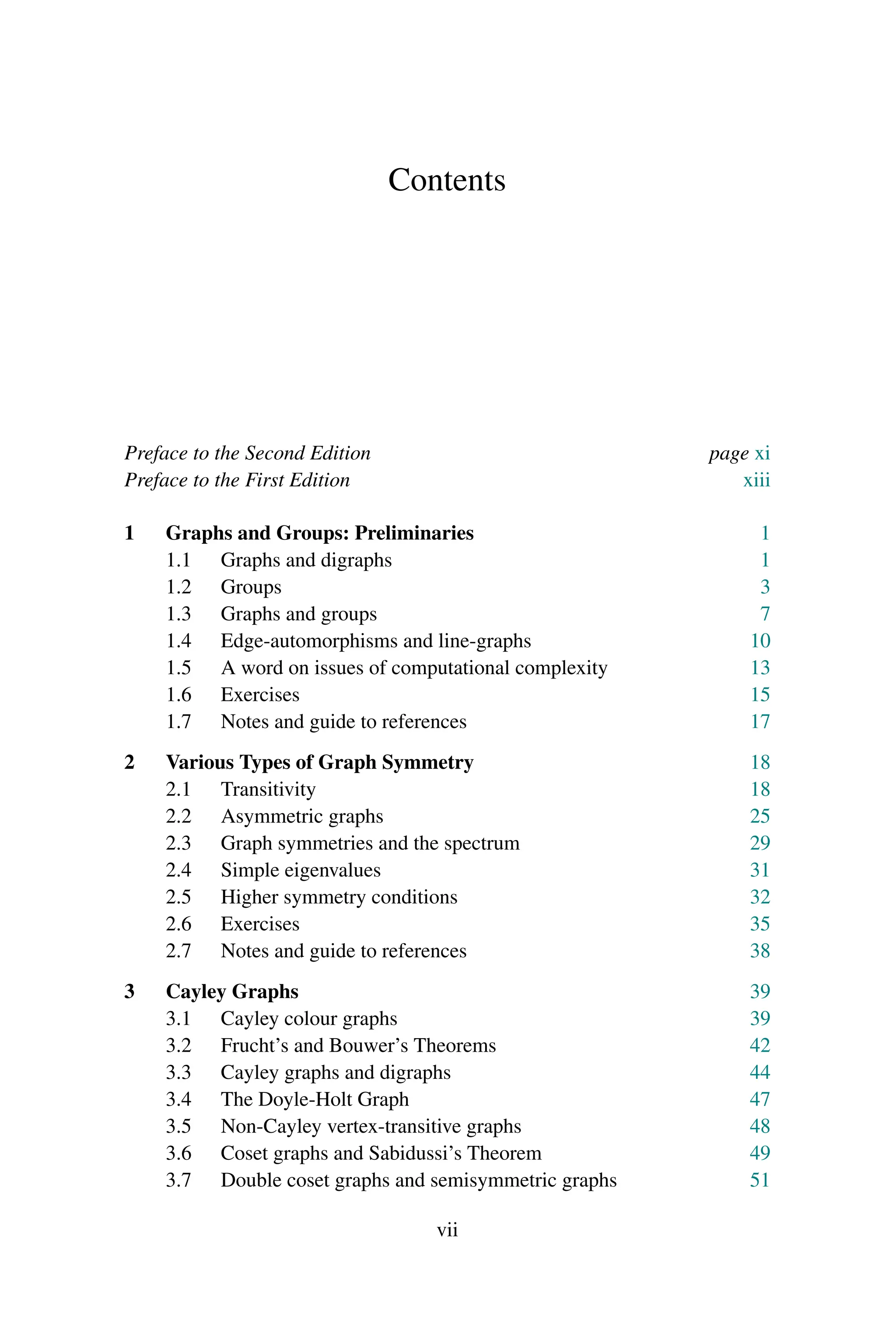
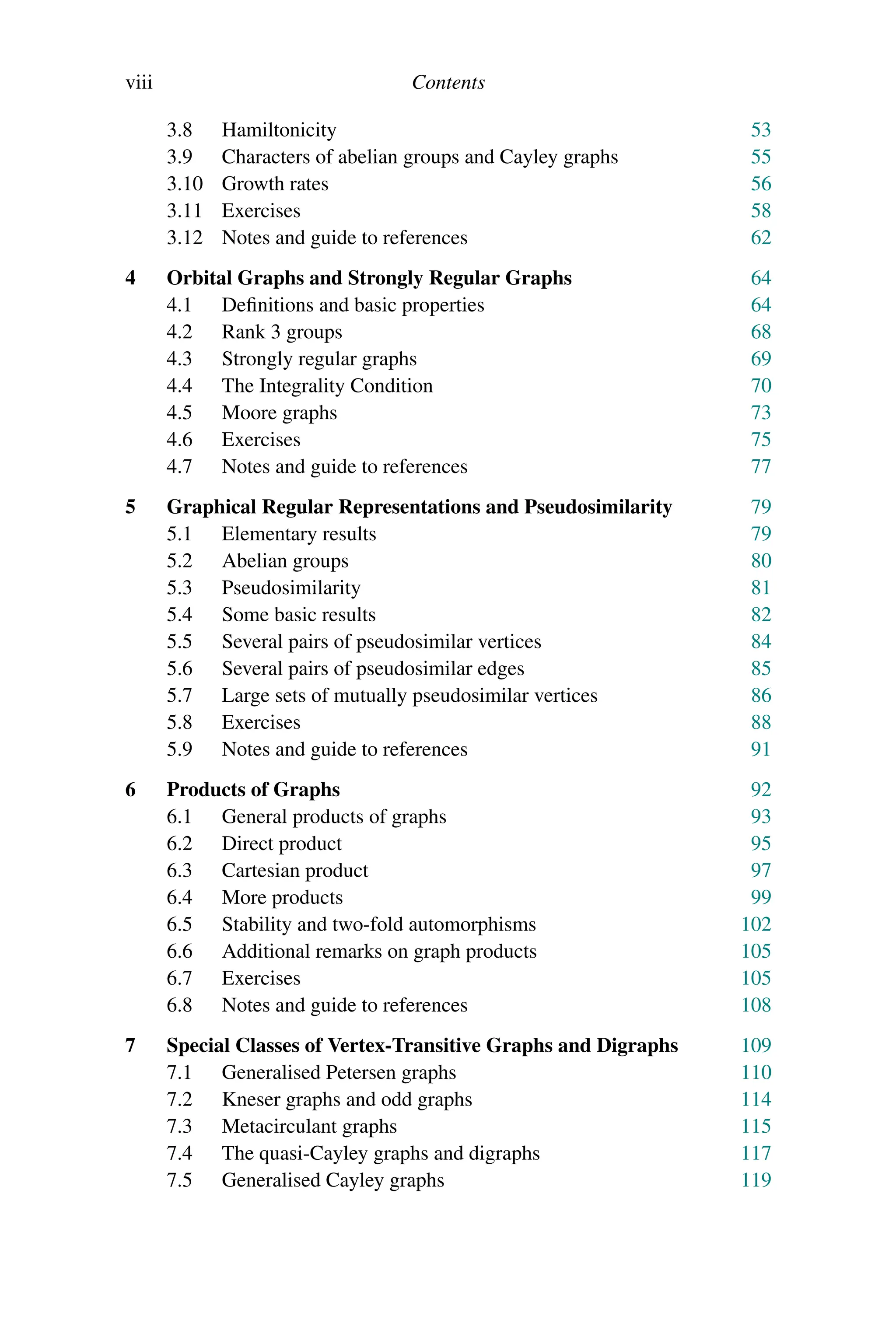
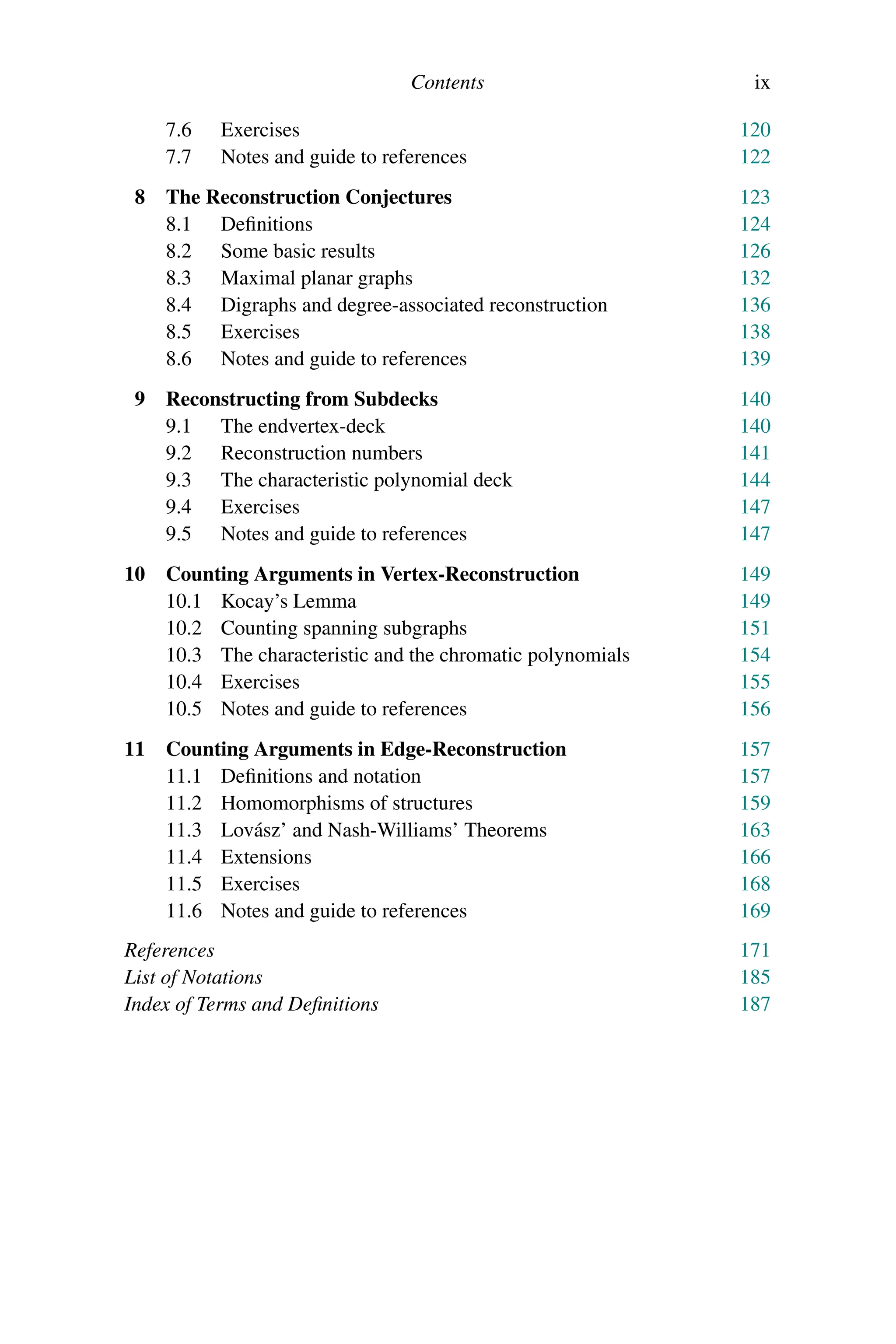

![2 Graphs and Groups: Preliminaries
vertex-set is V(G) and whose edge-set is E(G) − F. If S = {u} and F = {e},
we shall, for short, denote G − S and G − F by G − u and G − e, respectively.
If S is a subset of the vertices of G, then G[S] will denote the subgraph of G
induced by S, that is, the subgraph consisting of the vertices in S and all of the
edges joining pairs of vertices from S.
An important modification of the foregoing definition of a graph gives what
is called a directed graph, or digraph for short. In a digraph D = (V(D), A(D))
the set A = A(D) consists of ordered pairs of vertices from V = V(D) and its
elements are called arcs. Again, an arc (u, v) is sometimes denoted by uv when
it is clear from the context whether we are referring to an arc or an edge. The
arc uv is said to be incident to v and incident from u; the vertex u is said to be
adjacent to v whereas v is adjacent from u. The number of arcs incident from a
vertex v is called its out-degree, denoted by degout(v), while the number of arcs
incident to v is called its in-degree and is denoted by degin(v). A digraph is said
to be regular if all of its vertices have the same out-degree or, equivalently, the
same in-degree. Sometimes, when we need to emphasise the fact that a graph
is not directed, we say that it is undirected.
The number of vertices of a graph G or digraph D is called its order and is
generally denoted by n = n(G) or n = n(D), while the number of edges or
arcs is called its size and is denoted by m = m(G) or m = m(D).
A sequence of distinct vertices of a graph, v1, v2, . . . , vk+1, and edges e1, e2,
. . . , ek such that each edge ei = vivi+1 is called a path. If we allow v1 and
vk+1, and only those, to be the same vertex, then we get what is called a
cycle.
The length of a path or a cycle in G is the number of edges in the path or
cycle. A path of length k is denoted by Pk+1 while a cycle of length k is denoted
by Ck. The distance between two vertices u, v in a connected graph G, denoted
by d(u, v), is the length of the shortest path joining u and v. The diameter of G
is the maximum value attained by d(u, v) as u, v run over V(G), and the girth
is the length of the shortest cycle.
In these definitions, if we are dealing with a digraph and the ei = vivi+1
are arcs, then the path or cycle is called a directed path or directed cycle,
respectively.
Given a digraph D, the underlying graph of D is the graph obtained from
D by considering each pair in A(D) to be an unordered pair. Given a graph G,
the digraph
←
→
G is obtained from G by replacing each edge in E(G) by a pair
of oppositely directed arcs. This way, a graph can always be seen as a special
case of a digraph.
We adopt the usual convention of representing graphs and digraphs by draw-
ings in which each vertex is shown by a dot, each edge by a curve joining the](https://image.slidesharecdn.com/85668-250224195714-51cb9982/75/Topics-in-Graph-Automorphisms-and-Reconstruction-2nd-Edition-Josef-Lauri-24-2048.jpg)
![1.2 Groups 3
corresponding pair of dots and each arc (u, v) by a curve with an arrowhead
pointing in the direction from u to v.
A number of definitions on graphs and digraphs will be given as they are
required. However, several standard graph theoretic terms will be used but not
defined in these chapters; these can be found in any of the references [257] or
[259].
1.2 Groups
A permutation group will be a pair (, Y) where Y is a finite set and is a
subgroup of the symmetric group SY, that is, the group of all permutations of
Y. The stabiliser of an element y ∈ Y under the action of is denoted by y
while the orbit of y is denoted by (y). The Orbit-Stabiliser Theorem states
that, for any element y ∈ Y,
|| = |(y)| · |y|.
If the elements of Y are all in one orbit, then (, Y) is said to be a transitive
permutation group and is said to act transitively on Y. The permutation group
is said to act regularly on Y if it acts transitively and the stabiliser of any
element of Y is trivial. By the Orbit-Stabiliser Theorem, this is equivalent to
saying that acts transitively on Y and || = |Y|. Also, acts regularly on Y
is equivalent to saying that, for any y1, y2 ∈ Y, there exists exactly one α ∈
such that α(y1) = y2.
One important regular action of a permutation group arises as follows. Let
be any group, let Y = and, for any α ∈ , let λα be the permutation
of Y defined by λα(β) = αβ. Let L() be the set of all permutations λα for
all α ∈ . Then (L(), Y) defines a permutation group acting regularly on Y.
This is called the left regular representation of the group on itself. One can
similarly consider the right regular representation of the group on itself, and
this is denoted by (R(), Y).
The following is an important generalisation of the previous definitions. If
is a group and H ≤ , let Y = /H be the set of left cosets of H in . For any
α ∈ , let λH
α be a permutation on Y defined by λH
α (βH) = αβH. Let LH()
be the set of all λH
α for all α ∈ . Then (LH(), Y) defines a permutation
group that reduces to the left regular representation of if H = {1}.
Two permutation groups (1, Y1), (2, Y2) are said to be equivalent, denoted
by (1, Y1) ≡ (2, Y2), if there exists a bijective isomorphism φ : 1 → 2
and a bijection f : Y1 → Y2 such that, for all y ∈ Y1 and for all α ∈ 1,
f(α(x)) = φ(α)(f(x)).](https://image.slidesharecdn.com/85668-250224195714-51cb9982/75/Topics-in-Graph-Automorphisms-and-Reconstruction-2nd-Edition-Josef-Lauri-25-2048.jpg)
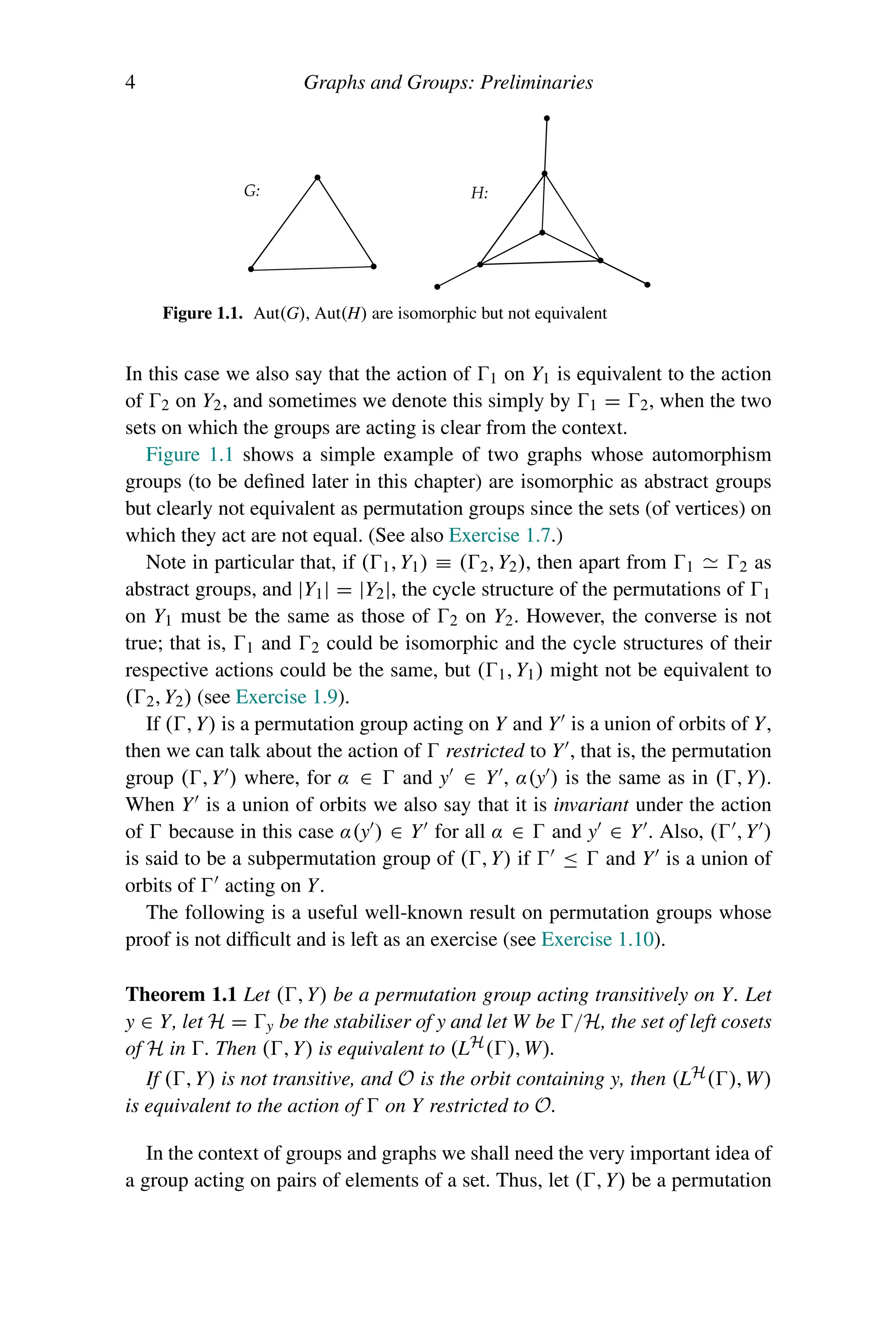
![1.3 Graphs and groups 7
is the infinite free group on two elements. The dihedral group of degree n is
denoted by Dn. It has order 2n and also has a presentation with two generators:
α, β|α2
= 1, βn
= 1, α−1
βα = β−1
.
Determining a group from a given presentation is not an easy problem. The
reader who doubts this can try to show that the presentations
α, β : αβ2
= β3
α, βα2
= α3
β
and
α, β, γ : α3
= β3
= γ 3
= 1, αγ = γ α−1
, αβα−1
= βγβ−1
both give the trivial group. We shall of course make a very simple use of stan-
dard group presentations where these difficulties do not arise. The book [159]
is a standard reference for advanced work on group presentations.
The reader is referred to [147, 222] for any terms and concepts on group
theory that are used but not defined in these chapters and, in particular, to [49,
62] for more information on permutation groups.
1.3 Graphs and groups
Let G, G be two graphs. A bijection α : V(G) → V(G ) is called an isomor-
phism if
{u, v} ∈ E(G) ⇔ {α(u), α(v)} ∈ E(G ).
The graphs G, G are, in this case, said to be isomorphic, and this is denoted by
G G . Similarly, if D, D are digraphs, then a bijection α : V(D) → V(D ) is
called an isomorphism if
(u, v) ∈ A(D) ⇔ (α(u), α(v)) ∈ A(D ),
and in this case the digraphs D, D are also said to be isomorphic, and again
this is denoted by D D .
If the two graphs, or digraphs, in this definition are the same, then α is said
to be an automorphism of G or of D. The set of automorphisms of a graph or a
digraph is a group under composition of functions, and it is denoted by Aut(G)
or Aut(D).
Note that an automorphism α of G is an element of SV(G), although it is its
induced action on E(G) that determines whether α is an automorphism. This
fact, although clear from the definition of automorphism, is worth emphasising
when beginning to study automorphisms of graphs.](https://image.slidesharecdn.com/85668-250224195714-51cb9982/75/Topics-in-Graph-Automorphisms-and-Reconstruction-2nd-Edition-Josef-Lauri-29-2048.jpg)
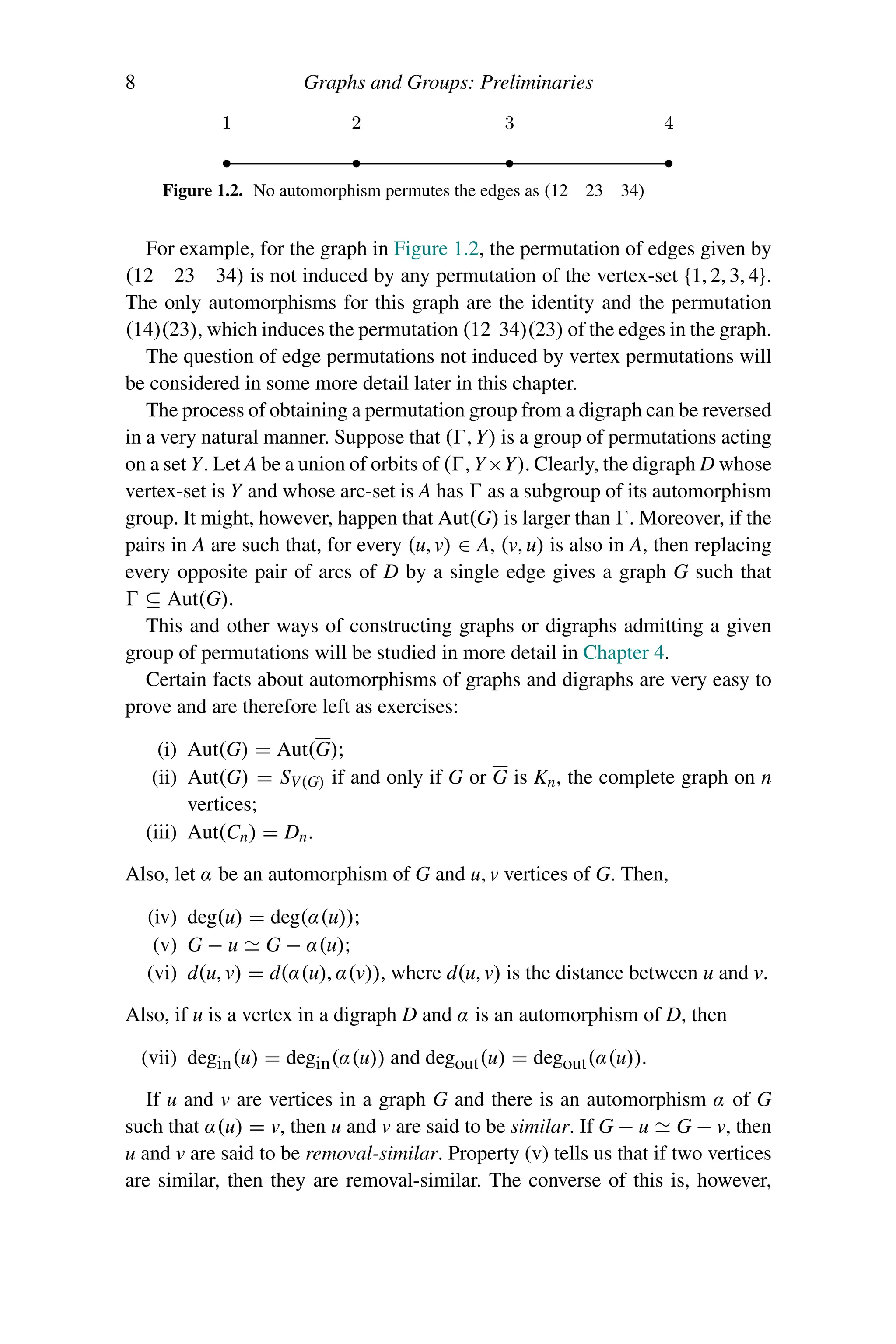
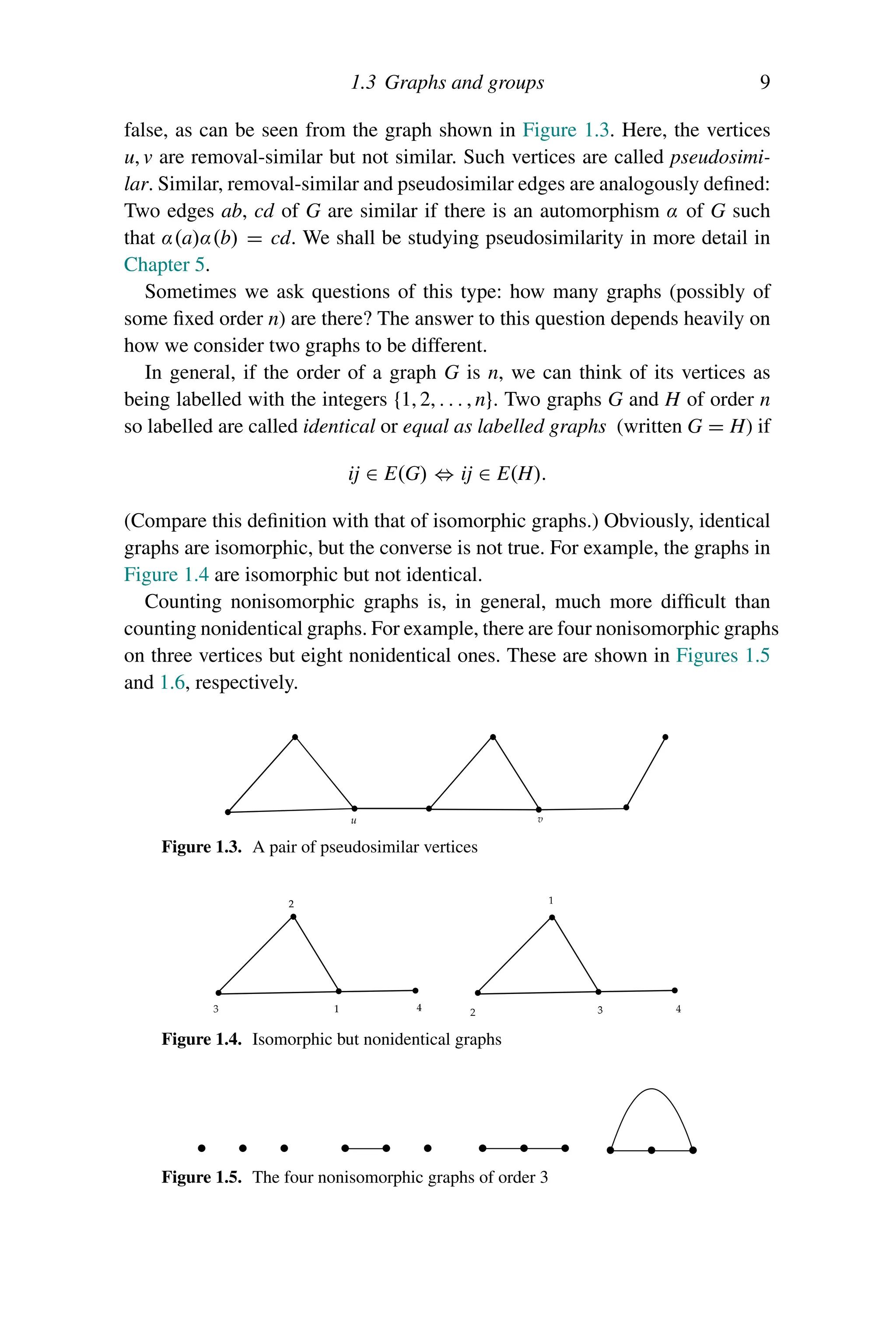
![10 Graphs and Groups: Preliminaries
Figure 1.6. The eight nonidentical graphs of order 3
Counting nonisomorphic graphs involves consideration of group symme-
tries. For more on this the reader is referred to [103].
1.4 Edge-automorphisms and line-graphs
Although we shall be dealing mostly with Aut(G) and its realisation as the
permutation group (Aut(G), V(G)), let us briefly look at other related groups
associated with G. In this section we shall assume that G is a nontrivial graph,
that is, its edge-set is nonempty.
An edge-automorphism of a graph G is a bijection θ on E(G) such that two
edges e, f are adjacent in G if and only if θ(e), θ(f) are also adjacent in G. The
set of all edge-automorphisms of G is a group under composition of functions,
and it is denoted by Aut1(G).
The concept of edge-automorphisms can perhaps be best understood within
the context of line-graphs. The line-graph L(G) of a graph G is defined as
the graph whose vertex-set is E(G) and in which two vertices are adjacent if
and only if the corresponding edges are adjacent in G. An automorphism of
L(G) is clearly an edge-automorphism of G and (Aut1(G), E(G)) is equivalent
to (Aut(L(G), V(L(G))). In this section we shall give the exact relationship
between Aut1(G) and Aut(G), that is, between the automorphism groups of G
and L(G).
As we described earlier, any automorphism α of G naturally induces a bijec-
tion α̂ on E(G) defined by α̂(uv) = α(u)α(v). It is an important (and easy to](https://image.slidesharecdn.com/85668-250224195714-51cb9982/75/Topics-in-Graph-Automorphisms-and-Reconstruction-2nd-Edition-Josef-Lauri-32-2048.jpg)
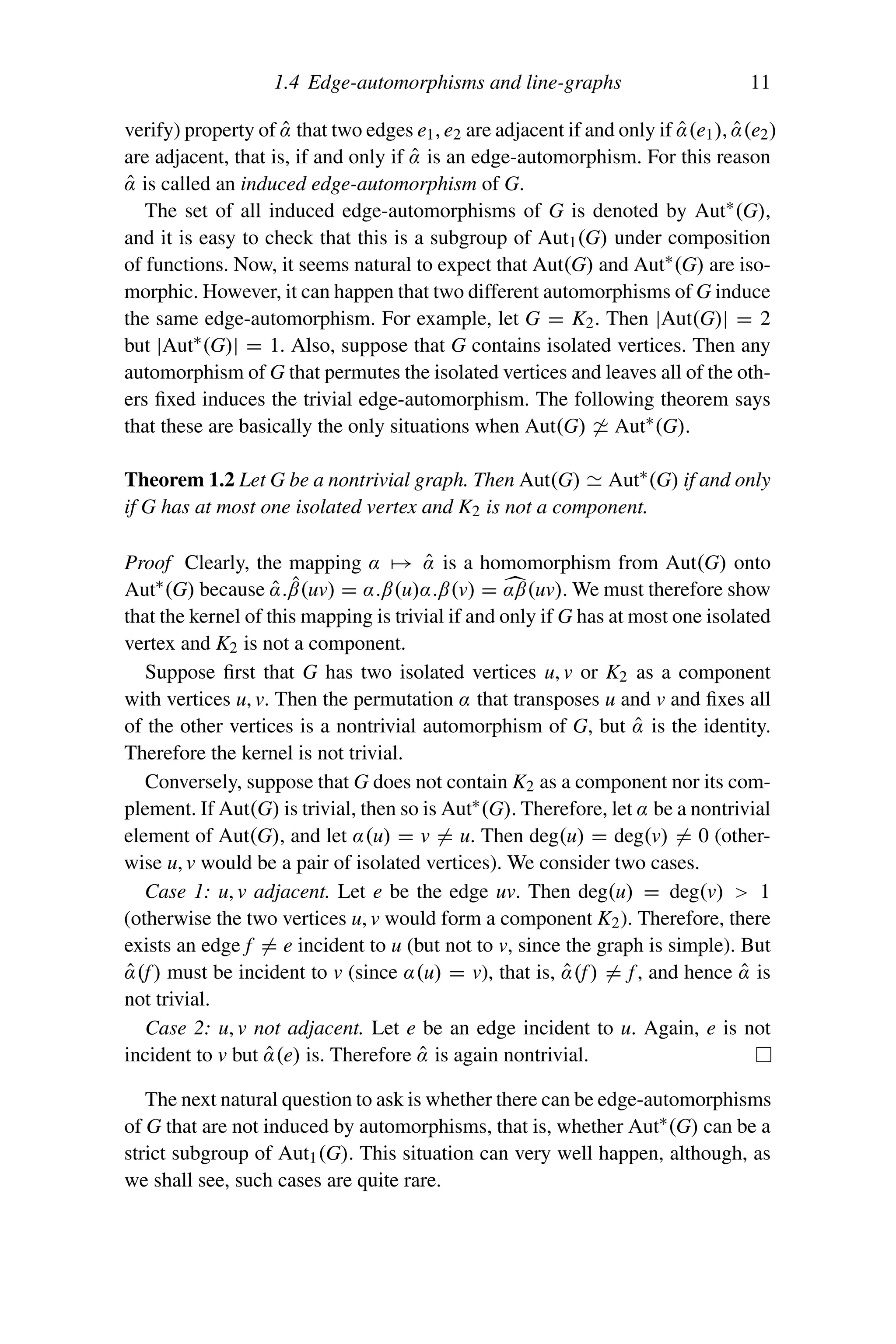
![12 Graphs and Groups: Preliminaries
Figure 1.7. Graphs with edge-isomorphisms not induced by isomorphisms
Before proceeding let us first extend the idea of edge-automorphisms on
the edge-set of a graph to that of edge-isomorphisms between edge-sets of
different graphs.
Let G, G be two nontrivial graphs. A bijection θ : E(G) → E(G ) is an
edge-isomorphism if
e, f adjacent in G ⇔ θ(e), θ(f) adjacent in G .
Two graphs are said to be edge-isomorphic if there is an edge-isomorphism
between their edge-sets.
The graphs W1, W2 in Figure 1.7 are edge-isomorphic, although they are
not isomorphic. That is, there is an edge-isomorphism between their edge-
sets that cannot be induced by an isomorphism between their vertex-sets. This
means that their line-graphs are isomorphic even though the two graphs are not
themselves isomorphic.
Also, each of the graphs W3, W4, W5 in the same figure has edge-
automorphisms that are not induced by automorphisms. That is, the group
Aut∗
(Wi) is a strict subgroup of Aut1(Wi). In other words, Aut(L(Wi)) is larger
than Aut(Wi).
The following theorem of Whitney [258] says that these are essentially the
only cases when edge-isomorphisms that are not induced by isomorphisms can
arise. We give the statement of the theorem without proof, which, although
not deep or difficult, would lengthen this introductory chapter without adding
significant new insights.
Theorem 1.3 (Whitney) Let G, G be connected graphs different from the five
graphs in Figure 1.7. Let θ : E(G) → E(G ) be an edge-isomorphism. Then θ
is induced by an isomorphism from G to G .](https://image.slidesharecdn.com/85668-250224195714-51cb9982/75/Topics-in-Graph-Automorphisms-and-Reconstruction-2nd-Edition-Josef-Lauri-34-2048.jpg)
![1.5 A word on issues of computational complexity 13
Whitney’s Theorem and Theorem 1.2 together therefore give the following
corollary.
Corollary 1.4 Let G be a nontrivial graph. Then Aut1(G) = Aut∗(G) if and
only if both of these conditions hold:
(i) not both W1, W2 are components of G;
(ii) none of Wi, i = 3, 4, 5 is components of G.
Moreover, Aut1(G) Aut(G) (that is, Aut(L(G)) Aut(G)) if and only if (i)
and (ii) hold and G has at most one isolated vertex and K2 is not a component
of G.
1.5 A word on issues of computational complexity
Although in this book we shall not concern ourselves with issues of computa-
tional complexity, it is perhaps worthwhile to say a few words in this regard
here in order to put matters into a better perspective. A student reading the def-
initions of isomorphic graphs and automorphisms might think that it is an easy
matter to determine in general whether two given graphs are isomorphic or to
compute the automorphism group of a graph. In fact, this is far from being the
case, and these problems are very hard to crack in practice, at least as far as
present knowledge goes.
In general, one considers that an efficient algorithm exists for finding a solu-
tion to a problem (for example, finding a nontrivial automorphism of a given
graph) if there is a general algorithm such that the number of operations that
it takes to solve the problem is a polynomial function of the size of the input
(say, the number of vertices in the graph); one says that the algorithm solves
the problem in polynomial time.
Of course, several terms in the previous sentence need exact definitions, but
we shall here take an intuitive approach and refer the reader to [36] or [82] for
the exact details on computational complexity.
Those problems for which an efficient (polynomial-time) algorithm exists
form the class denoted by P (which stands for ‘polynomial’). However, there
are several problems for which it is not known whether an efficient algorithm
does exist. In order to tackle this question of computational intractibility, two
important ideas have been developed.
Firstly, the class NP (which stands for ‘nondeterministic polynomial’) is
defined. Roughly (again we refer the reader to the textbooks cited earlier for
the exact details) this class contains all of those problems for which, given a
candidate solution, one can verify in polynomial time that it is in fact a correct](https://image.slidesharecdn.com/85668-250224195714-51cb9982/75/Topics-in-Graph-Automorphisms-and-Reconstruction-2nd-Edition-Josef-Lauri-35-2048.jpg)
![14 Graphs and Groups: Preliminaries
solution. For example, the problem of determining whether a graph has a non-
trivial automorphism is in NP, since, given such a permutation of the vertices,
it is easy to determine in polynomial time that it is an automorphism.
Now the main question in computational complexity is whether P = NP
(clearly P ⊆ NP), and to tackle this question another important idea is intro-
duced. Given two problems A and B, one says that A is (polynomially) reducible
to B if, given an algorithm for solving B, it can be transformed in polynomial
time into an algorithm for solving A. Reducibility therefore introduces a hier-
archy between problems for, if A is reducible to B, then, in a sense, A cannot
be more difficult to solve (computationally) than B. In particular, if there is an
efficient algorithm for solving B, then there is also an efficient algorithm for
solving A.
Now, the question of reducibility took on special significance by the discov-
ery that in the class NP there are problems, called NP-complete, to which any
other problem in NP is reducible. In other words, if an efficient algorithm can
be found for any NP-complete problem, then all problems in NP would have
an efficient algorithm to solve them, and P would be equal to NP.
Now, it is not known whether the problem of determining if two graphs are
isomorphic, which lies clearly in NP, is NP-complete. In fact, if it turns out
that P is not equal to NP, then there is evidence to suggest that the problem of
graph isomorphism might lie strictly between the classes P and NP.
What all this means in practice is that, as far as present knowledge goes, no
general algorithm can determine in a guaranteed reasonable time whether two
graphs are isomorphic, or whether a given graph has a nontrivial automorphism
(these two problems are closely related [126]). It is known that for special types
of graphs (for example, trees, planar graphs and graphs with bounded degree)
an efficient algorithm does exist.
Computer packages can also help one to solve these problems, certainly
more efficiently than an attempt ‘by hand’ for large graphs, although their time
performance is not guaranteed (by what we said earlier). For example, the soft-
ware package MathematicaTM has a combinatorics extension that, amongst
other things, finds graph automorphisms and isomorphisms. A more specialised
package, and one that is freely available from
www.combinatorialmath.org.ca/gg/index.html
is Groups Graphs [131], developed by Bill Kocay. This package contains
several combinatorial routines related to graphs, digraphs, combinatorial designs
and their automorphism groups and also embeddings of graphs on some sur-
faces and a graph isomorphism algorithm. It is easy to use, and it has a pleasant
graphical user interface. It is also very useful simply for drawing diagrams of](https://image.slidesharecdn.com/85668-250224195714-51cb9982/75/Topics-in-Graph-Automorphisms-and-Reconstruction-2nd-Edition-Josef-Lauri-36-2048.jpg)
![1.6 Exercises 15
graphs. Although originally written for MacintoshTM computers, a version for
the unix-based Haiku operating system is in preparation, and this version will
contain several new features.
An important computer algebra package, which is also freely available, is
the system GAP [243]. This package performs very sophisticated routines in
discrete abstract algebra, in particular routines on permutation groups. It incor-
porates a number of extensions, one of which, GRAPE [235], deals specifically
with graphs, including their automorphisms and isomorphisms.
The computer package Sage [227] is an open-source competitor to systems
like MapleTM, MathematicaTM and MatlabTM. It incorporates several open-
source mathematical software like GAP and R, and it can be run via Sage-
MathCloud without the need of installing the system on one’s computer. It has
an excellent library of functions for doing graph theory. In this book we shall
present some constructions using GAP and Sage.
Finally, it should be mentioned that it is generally accepted that the best
package to tackle graph isomorphisms is nauty [181], developed by Brendan
McKay. In fact, the system GRAPE invokes nauty when computing automor-
phisms or isomorphisms.
1.6 Exercises
1.1 Draw all twenty nonidentical graphs with vertex-set {1, 2, 3, 4} that have three
edges. How many of them are nonisomorphic? In general, how many nonidentical
graphs on n vertices and m edges are there? How many are there on n vertices?
1.2 Let G be the graph in Figure 1.8. How many nonidentical labellings does G have
using the labels {1, 2, . . . , 6} on its vertices?
In general, how many nonidentical labellings does a graph G on n vertices
have using the labels {1, 2, . . . , n} on its vertices?
1.3 Show that if G is self-complementary (that is, G G), then n ≡ 0 mod 4 or
n ≡ 1 mod 4. Determine all self-complementary graphs on five vertices.
1.4 A well-known result due to Cayley says that the number of nonidentical trees on
n vertices is nn−2. Verify this for n = 4. Look up one of the several proofs of this
result.
Figure 1.8. How many distinct labellings does this graph have?](https://image.slidesharecdn.com/85668-250224195714-51cb9982/75/Topics-in-Graph-Automorphisms-and-Reconstruction-2nd-Edition-Josef-Lauri-37-2048.jpg)
![16 Graphs and Groups: Preliminaries
The points 1, 2, . . . , n are drawn in a plane. A random tree is drawn joining
these points, with all possible spanning trees being equally likely. Let pn be the
probability that 1 is an endvertex of the tree. Show that limn→∞ pn = 1/e.
1.5 Find a graph with a pair of pseudosimilar edges.
1.6 Let Y = {1, 2, 3, 4} and let be the group acting on Y generated by the permu-
tation (1 2 3 4). Construct a digraph D whose vertex-set is Y and whose arc-set is
the orbit of the arc (1, 2) under the action of the permutation group (, Y × Y).
Is the whole of Aut(D)? Can a graph be obtained by taking the orbit of some
other arc or a union of orbits? Will always be the whole of Aut(D)?
1.7 Let P be a rectangular plate and Q a plate in the form of a rhombus. Show that
the groups of symmetry of P and Q are isomorphic as abstract groups but not
equivalent considered as permutation groups of the four vertices of P and Q.
Show that the same situation arises with the following two graphs: the cycle
on four vertices with an extra multiple edge and the complete graph K4 with an
edge deleted.
1.8 Show that the dihedral group Dn can be presented as
α, β|α2 = β2 = (αβ)n = 1 .
1.9 Let 1 be the abelian group defined by the presentation
α, β, γ |α3 = β3 = γ 3 = 1, [α, β] = [α, γ ] = [β, γ ] = 1 ,
where [α, β] = α−1β−1αβ is the commutator of α and β, and let 2 be the group
defined by the presentation
α, β, γ |α3 = β3 = γ 3 = 1, [β, α] = γ , [α, γ ] = [β, γ ] = 1 .
Show that although 1 and 2 are not isomorphic as abstract groups, and there-
fore the two permutation groups (L(1), 1) and (L(2), 2) are not equivalent,
still the cycle structures of the permutations of L(1) acting on 1 are the same
as those of the permutations of L(2) acting on 2.
Give an example of two permutation groups whose permutations have the
same cycle structures and which are isomorphic as abstract groups but are still
not equivalent as permutation groups.
1.10 Prove Theorem 1.1.
1.11 This exercise is intended to illustrate Theorem 1.1. Consider the action of the
alternating group A4 on the set X = {1, 2, 3, 4}. Let H be the stabiliser of the
element 1 under this action. Confirm that the left action of A4 on the left cosets
of H is equivalent to the action of A4 on X.
1.12 Let be a group of permutations acting on a set Y and let y, x be two elements of
Y that are in the same orbit under this action. Let α, β ∈ be two permutations
such that α(y) = β(y) = x. Prove that αy = βy.
Prove also that if x is in the same orbit as y and γ is a permutation such that
γ (y) = x and γ y = αy, then x = x.
1.13 Show that if the abelian permutation group acts transitively on Y, then its action
on Y is regular.
1.14 (a) Show that a 2-transitive permutation group is primitive.
(b) Show that if Aut(G), for a graph G, is 2-transitive, then either G or its com-
plement is a complete graph.](https://image.slidesharecdn.com/85668-250224195714-51cb9982/75/Topics-in-Graph-Automorphisms-and-Reconstruction-2nd-Edition-Josef-Lauri-38-2048.jpg)
![1.7 Notes and guide to references 17
(c) Suppose that the transitive permutation group (, Y), with |Y| finite, is imprim-
itive. Show that the blocks of an imprimitivity block system have equal size.
1.15 Let G be a vertex-transitive graph whose automorphism group acts impri-
mitively on V(G). Show that the subgraphs of G induced by the blocks of an
imprimitivity block system are all isomorphic.
Suppose that each such subgraph is replaced by its complement, leaving the
other edges intact. Let G be the resulting graph. Show that Aut(G ) = Aut(G).
1.16 The Petersen graph can be defined as follows. Let N = {1, 2, 3, 4, 5}, and let the
vertices of the graph be all subsets of N of size 2 in which two vertices are adja-
cent if the corresponding subsets are disjoint. Use this definition and GAP (with
GRAPE) to construct the Petersen graph and to verify some of its properties.
1.7 Notes and guide to references
One of the standard texts on graph theory has, for many years, been [97]. More
recent books that give an excellent coverage of the subject are [28, 61, 257,
259]. The last reference is a short introduction that is quite sufficient back-
ground for this book. Biggs’ book [24] is the standard text on algebraic graph
theory, but the more recent [90] is also an excellent and up-to-date textbook on
the subject. The book [94] contains a number of recent and specialised survey
papers on various aspects of algebraic graph theory, particularly those dealing
with graph symmetries. A proof of Whitney’s Theorem can be found in [22].
We shall need only the most elementary notions of group theory. The text
[147] gives ample coverage for our purposes, while [222] provides a more
complete treatment. Two excellent books devoted entirely to permutation
groups are [49, 62]. Most of the results and definitions on permutation groups
that we have given here and others that we shall need can be found in the first
few chapters of these two books.
For a full discussion of the terms on computational complexity that were
introduced earlier rather intuitively, the reader is referred to the standard text-
book [82] or the more recent [36]. The book [126] and the references it cites
are suggested for those who are interested in the computational complexity of
the graph isomorphism problem. Those who are particularly interested in some
of the powerful algebraic techniques used to tackle this problem should look
at the papers [106, 155]. For practical computations on a computer with per-
mutation groups and graph automorphisms and isomorphisms in particular, the
systems [131, 181, 235, 243] are recommended.](https://image.slidesharecdn.com/85668-250224195714-51cb9982/75/Topics-in-Graph-Automorphisms-and-Reconstruction-2nd-Edition-Josef-Lauri-39-2048.jpg)
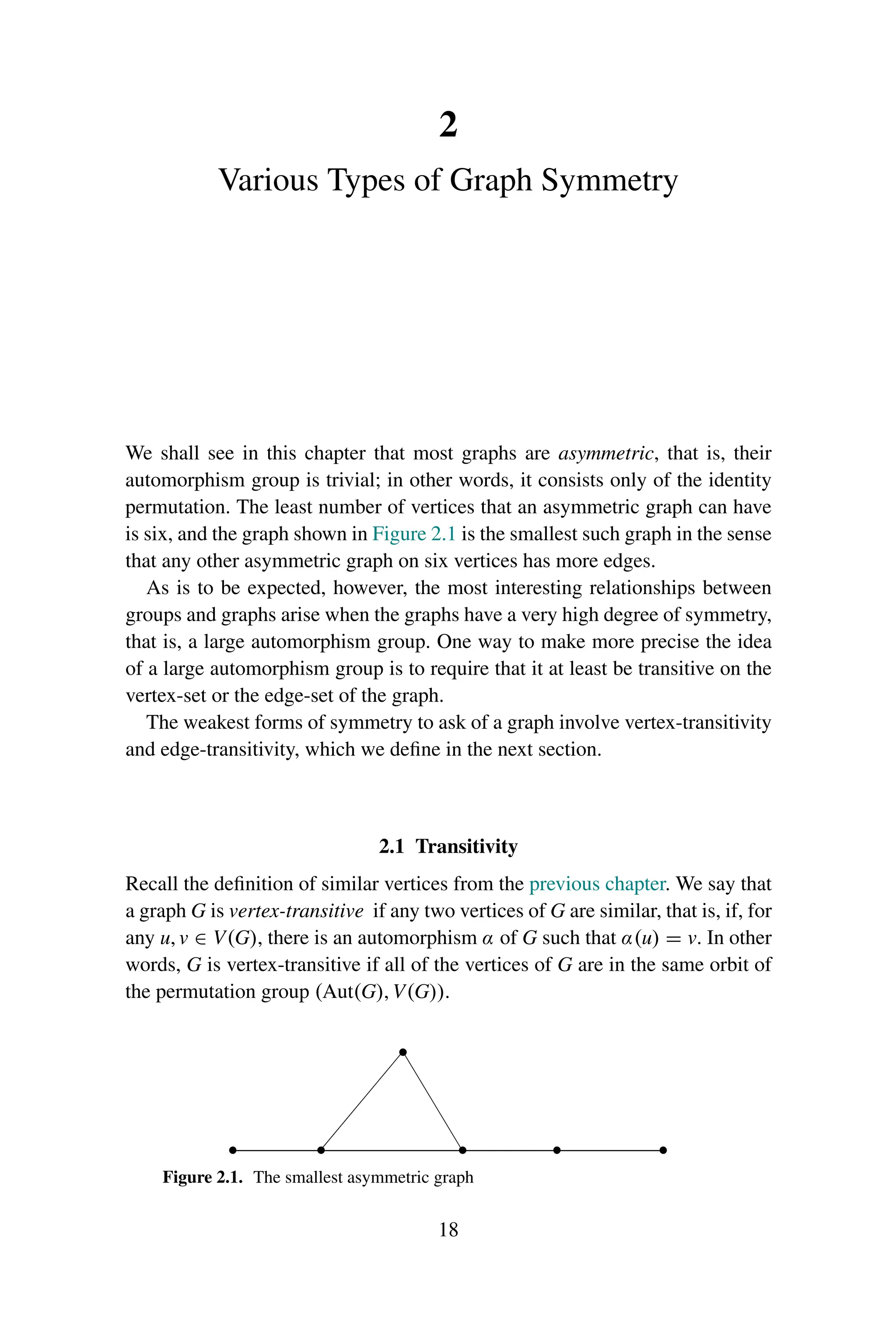
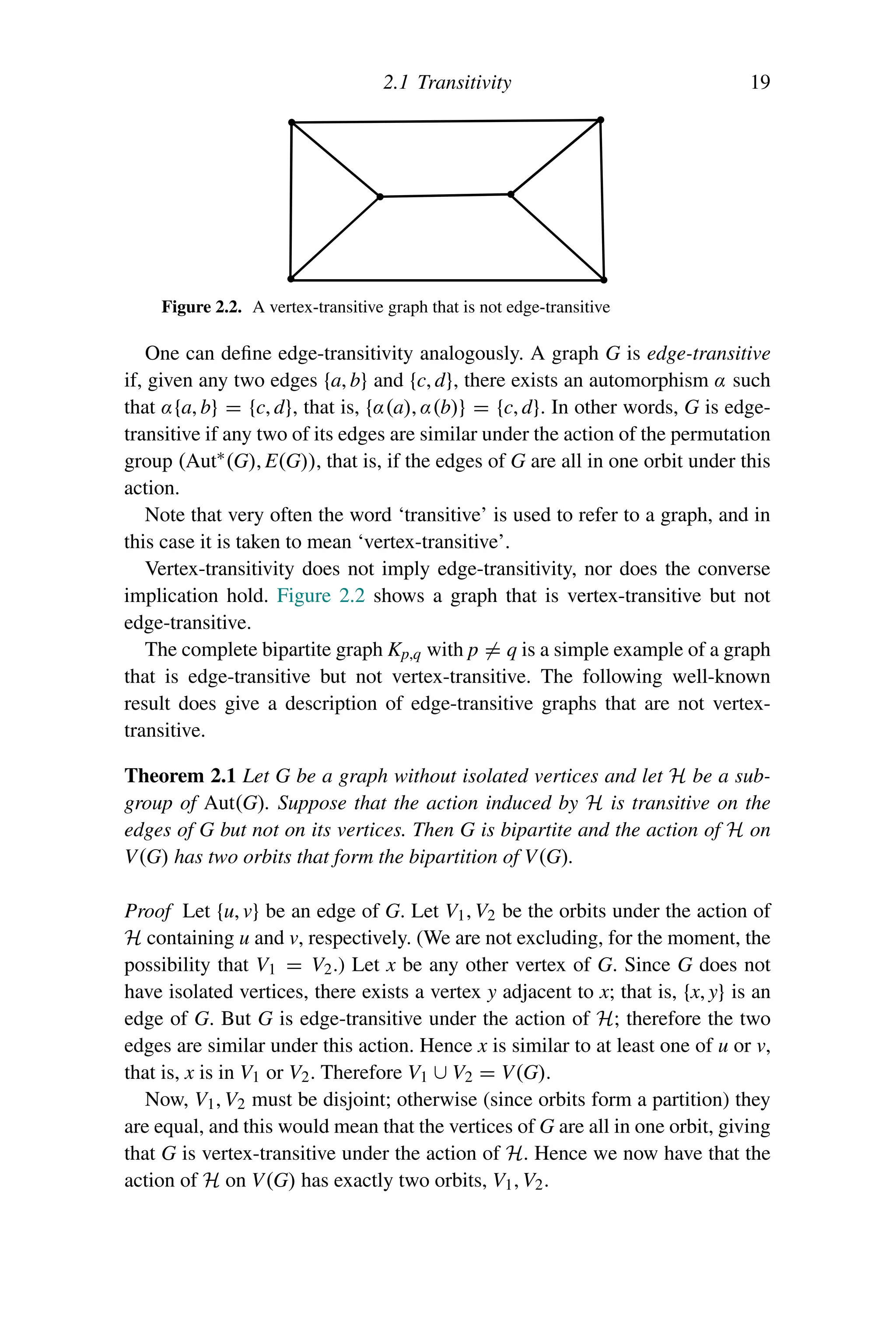
![20 Various Types of Graph Symmetry
Now let a, b be in the same orbit, say V1. It then follows that a, b are not
adjacent. For suppose otherwise. Then the edge {u, v} is similar to the edge
{a, b} under the action of H; therefore the vertex v is similar to one of a or b
under this action, giving that v (which is in the orbit V2) is also in the orbit V1,
which contains a and b. But this is impossible since V1 ∩ V2 = ∅.
Hence, as required, we have that no two vertices from the same orbit can be
adjacent.
Corollary 2.2 If a graph G without isolated vertices is edge-transitive but not
vertex-transitive, then it is bipartite and the action of Aut(G) on V(G) has two
orbits that form the bipartition of V(G).
Proof Take H = Aut(G) in the previous theorem.
2.1.1 Semisymmetric graphs
The typical example of edge-transitive but not vertex-transitive graphs given
earlier is the complete bipartite graph with a different number of vertices in
the bipartition. These graphs are trivially not vertex-transitive because their
vertices have different degrees. Although regular graphs do exist that are edge-
transitive but not vertex-transitive, it is quite difficult to construct them. Such
graphs are now called semisymmetric graphs and they were first studied by
Folkman [77], who constructed the smallest possible semisymmetric graph
having twenty vertices.1 One construction of the Folkman Graph is described
in Exercise 2.5.
Here we shall describe another well-known semisymmetric graph, the Gray
Graph.2 For a long time nobody could find a smaller cubic semisymmetric
graph, and eventually it was formally proved in [160] that it is the smallest
cubic semisymmetric graph. We shall see a more systematic way of describing
it in subsequent chapters. Here we follow Bouwer’s construction in [33].
Consider a cycle on 54 vertices numbered consecutively from 0 to 53. To
form the Gray Graph G add the following edges to this cycle:
{1, 42}, {2, 15}, {3, 28}, {4, 33}, {5, 44}, {6, 53}, {7, 48}, {8, 21}, {9, 32},
{10, 45}, {11, 24}, {12, 41}, {13, 20}, {14, 31}, {16, 35}, {17, 40}, {18, 49},
{19, 0}, {22, 51}, {23, 30}, {25, 38}, {26, 43}, {27, 52}, {29, 36}, {34, 47},
1 More information about this graph, called the Folkman Graph, can be found on the MathWorld
page http://mathworld. wolfram.com/FolkmanGraph.html
2 The Gray Graph is also featured on MathWorld at http://mathworld.wolfram.com/Gray
Graph.html](https://image.slidesharecdn.com/85668-250224195714-51cb9982/75/Topics-in-Graph-Automorphisms-and-Reconstruction-2nd-Edition-Josef-Lauri-42-2048.jpg)
![2.1 Transitivity 21
{37, 50}, {39, 46}.
It is tedious but not difficult to check that the permutations
α = (2 0 43)(3 53 43)(4 6 44)(7 45 33)(8 10 32)(11 31 21)
= (12 14 20)(15 19 41)(16 18 40)(22 24 30)(25 29 51)
= (26 28 52)(34 48 46)(35 49 39)(36 50 38)
and
β = (1 7 11 37 15 53 9 25 35)(2 6 10 38 16 0 8 24 36)
= (3 5 45 39 17 19 24 23 29)(4 44 46 40 18 20 22 30 28)
= (12 50 14 52 32 26 34 42 48)(13 51 31 27 33 43 47 41 49)
are automorphisms of G.
Note that the automorphism α fixes the vertex 1 and permutes cyclically its
neighbours 2, 42 and 0. Thus, in order to show that the graph is edge-transitive
it is sufficient to show that any odd-numbered vertex can be mapped into 1 by
an automorphism of G. This can be done by appropriate products of α and β.
For example, α4β maps vertex 53 to vertex 1.
However, the graph is not vertex-transitive because from an odd-numbered
vertex it is possible to have three different paths of length 4 joining the vertex
to some other common vertex (for example, vertex 1 to vertex 5), but this is
not possible from an even-numbered vertex.
Another way to show that the Gray Graph is not vertex-transitive is to con-
sider the distance sequences of its vertices [166]. The distance sequence of a
vertex v is the vector (a0, a1, . . . , ar) where ai is the number of vertices at dis-
tance i from v. In the case of the Gray Graph, the distance sequences of the
vertices in the two colour classes are (1, 3, 6, 12, 12, 12, 8) and (1, 3, 6, 12, 16,
12, 4), respectively, therefore these vertices cannot be in the same orbit under
the automorphism group of the graph.
Although the Sage package has the Gray Graph already implemented, it is
easy and instructive to show how to construct it following the specification
given earlier. First one creates the vertex-set which will be the list of numbers
from 1 to 54. Sage, like many computer languages such as Python, starts its
lists from 0. Therefore a list of length n produced by the command range(55)
would contain the numbers from 0 to 54. To start the list from 1 we have to
define the list of vertices as
vertices := range(1,55);](https://image.slidesharecdn.com/85668-250224195714-51cb9982/75/Topics-in-Graph-Automorphisms-and-Reconstruction-2nd-Edition-Josef-Lauri-43-2048.jpg)
![22 Various Types of Graph Symmetry
The graph is then constructed first using the command DiGraph so that
we do not need to repeat every pair of adjacent vertices twice. This com-
mands basically takes two parameters. The first parameter is the vertex-set
of the graph to be constructed, and the second parameter is a boolean function
(defined with the lambda construct) of two variables which compares all pos-
sible pairs of the vertex-set and an edge is drawn between any pair of vertices
for which the function returns True.
dgray := DiGraph([vertices, lambda i, j:
(i == mod[j + 1, 54]) or
(i == 53 and j == 54) or
(i == 1 and j == 42) or
(i == 2 and j == 15) or
(i == 3 and j == 28) or
(i == 4 and j == 33) or
(i == 5 and j == 44) or
(i == 6 and j == 53) or
(i == 7 and j == 48) or
(i == 8 and j == 21) or
(i == 9 and j == 32) or
(i == 10 and j == 45) or
(i == 11 and j == 24) or
(i == 12 and j == 41) or
(i == 13 and j == 20) or
(i == 14 and j == 31) or
(i == 16 and j == 35) or
(i == 17 and j == 40) or
(i == 18 and j == 49) or
(i == 19 and j == 54 or
(i == 22 and j == 51) or
(i == 23 and j == 30) or
(i == 25 and j == 38) or
(i == 26 and j == 43) or
(i == 27 and j == 52) or
(i == 29 and j == 36) or
(i == 34 and j == 47) or
(i == 37 and j == 50) or
(i == 39 and j == 46) ] )
This digraph is then changed into an undirected graph with the following
command which changes every arc into an edge.](https://image.slidesharecdn.com/85668-250224195714-51cb9982/75/Topics-in-Graph-Automorphisms-and-Reconstruction-2nd-Edition-Josef-Lauri-44-2048.jpg)
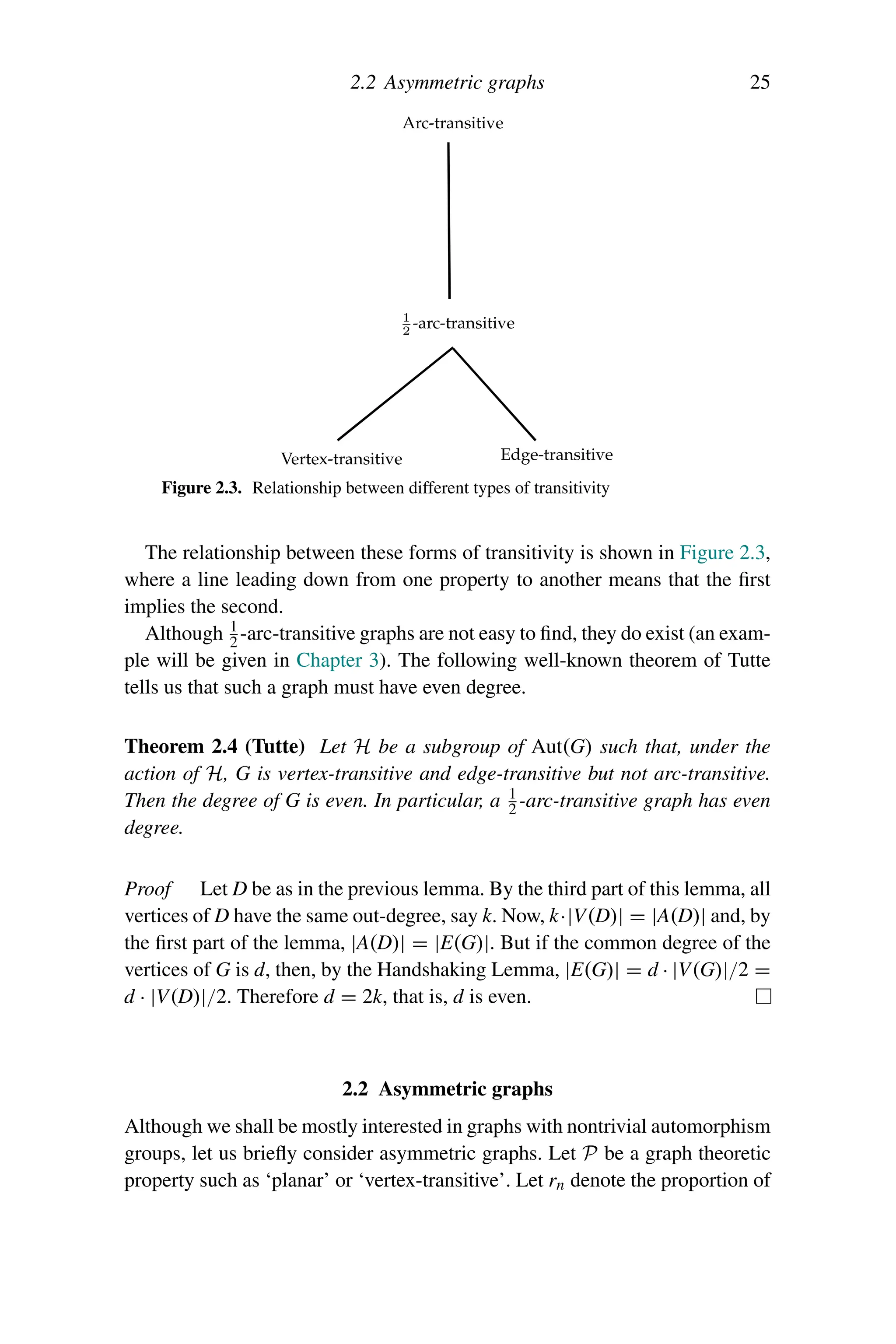
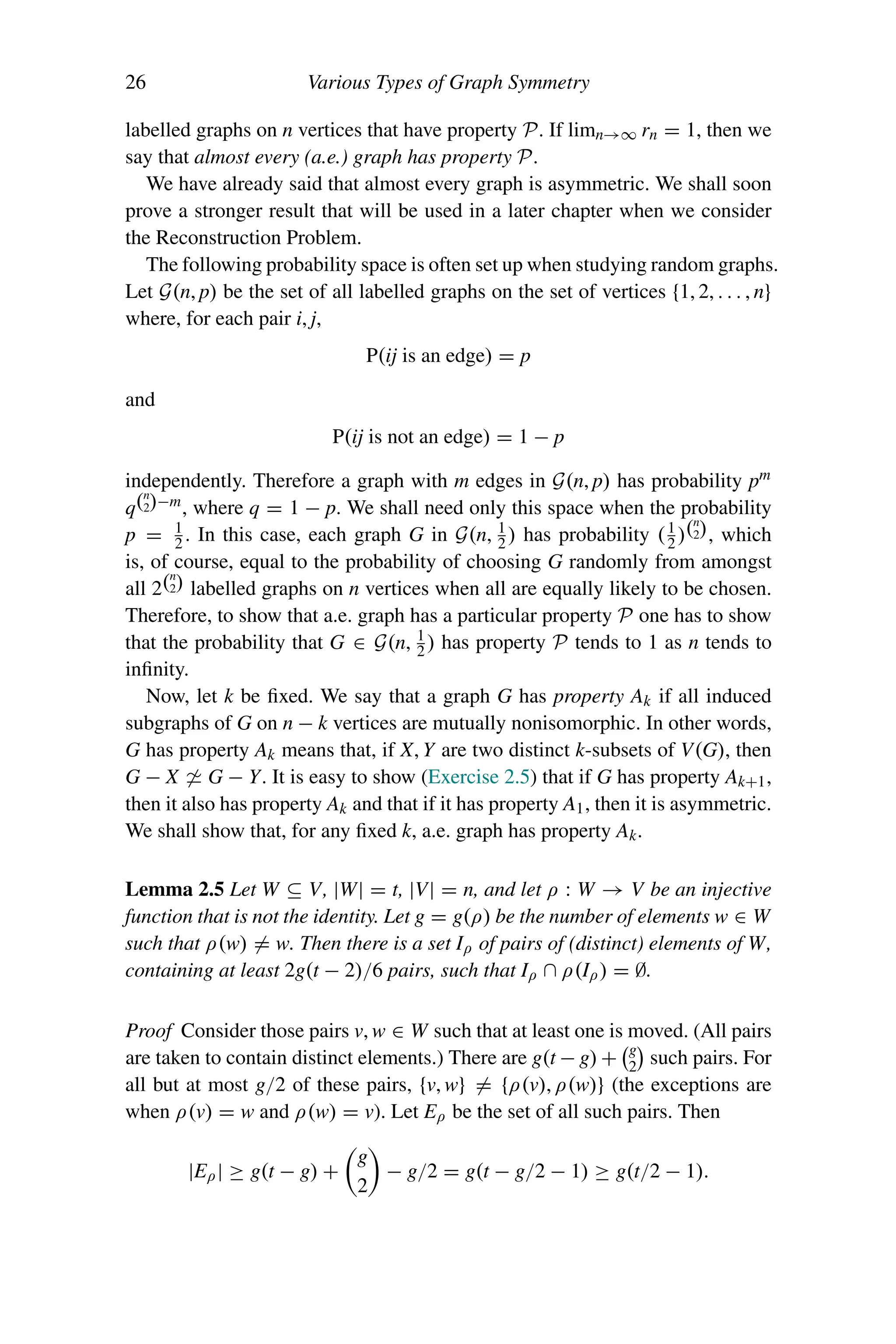
![2.2 Asymmetric graphs 27
Define a graph Hρ with vertex-set the pairs in Eρ and such that each pair
{v, w} is adjacent to the pair {ρ(v), ρ(w)}. In Hρ, all degrees are at most 2.
Degrees equal to 1 could arise because {ρ(v), ρ(w)} could contain an element
not in W, and so the pair would not be in Eρ. Degrees equal to 2 could arise
because {v, w} could be adjacent to both {ρ(v), ρ(w)} and {ρ−1(v), ρ−1(w)}.
Therefore the components of Hρ are isolated vertices, paths or cycles. Let Iρ
be a set of independent (that is, mutually not adjacent) vertices in Hρ. There-
fore, for any pair {v, w} ∈ Iρ, {ρ(v), ρ(w)} is not in Iρ.
Now, all isolated vertices in Hρ are independent, at least half of the vertices
on a path are independent and at least one third of the vertices on a cycle are
independent, the extreme case here being a triangle. Therefore
|Iρ| ≥ |Eρ|/3 ≥ 2g(t − 2)/6,
as required.
Corollary 2.6 Let G ∈ G(n, 1
2 ), W ⊂ V = V(G) and |W| = t. Let ρ : W → V
be an injective function that is not the identity. Let g = g(ρ) be the number of
elements w ∈ W such that ρ(w) = w. Let Sρ be the event
‘ρ gives an isomorphism from G[W] to G[ρ(W)]’.
Then
P(Sρ) ≤
1
2
2g(t−2)/6
.
Proof Let Iρ be the set constructed in the previous lemma. Now, for a given
pair {v, w} ∈ Iρ, the event
‘{v, w} and {ρ(v), ρ(w)} are both edges or nonedges’
has probability 1/2. These events, as they range over all pairs {v, w} ∈ Iρ, are
mutually independent because they involve distinct pairs. But Sρ requires all
these events simultaneously. Therefore, by independence,
P(Sρ) ≤
1
2
|Iρ|
≤
1
2
2g(t−2)/6
,
as required.
The result of this corollary is the crux of the proof of the following theo-
rem: There are too many independent correct ‘hits’ required for ρ to be an
isomorphism, and the probability therefore becomes small as n increases.](https://image.slidesharecdn.com/85668-250224195714-51cb9982/75/Topics-in-Graph-Automorphisms-and-Reconstruction-2nd-Edition-Josef-Lauri-49-2048.jpg)
![28 Various Types of Graph Symmetry
Theorem 2.7 (Korshunov; Müller; Bollobás) Let k be a fixed nonnegative
integer and let G ∈ G(n, 1
2 ). Let pn denote the probability that
∃W ⊆ V(G) = V = {1, 2, . . . , n},
with |W| = n − k and such that
∃ρ : W → V, ρ = id, ρ is an isomorphism from G[W] to G[ρ(W)].
Then, limn→∞ pn = 0.
Hence, a.e. graph has property Ak.
Proof Pick a particular W ⊂ V with |W| = n − k. This can be done in
n
n−k
ways, and
n
n − k
=
n(n − 1) . . . (n − k + 1)
k!
nk
.
Let t = n − k. Let ρ : W → V be injective and not the identity, and let
g = g(ρ) be the number of vertices of W that are moved by ρ. Let Sρ be the
event defined in the previous corollary.
Now, for a given value of g between 1 and t, how many functions ρ are there
such that g(ρ) = g? Such a function is determined by the set {w : ρ(w) = w}
and by the values it takes on this set. Therefore, there are less than n2g such ρ.
Therefore, for a given fixed W, the probability of a nontrivial isomorphism is
given by
ρ=id
P(Sρ) =
t
g=1
ρ:g(ρ)=g
P(Sρ)
≤
t
g=1
n2g
1
2
2g(t−2)/6
=
t
g=1
n2
2(2−t)/3
g
t
g=1
41/3
n2
2−t/3
g
.](https://image.slidesharecdn.com/85668-250224195714-51cb9982/75/Topics-in-Graph-Automorphisms-and-Reconstruction-2nd-Edition-Josef-Lauri-50-2048.jpg)