Visit https://ebookultra.com to download the full version and
browse more ebooks or textbooks
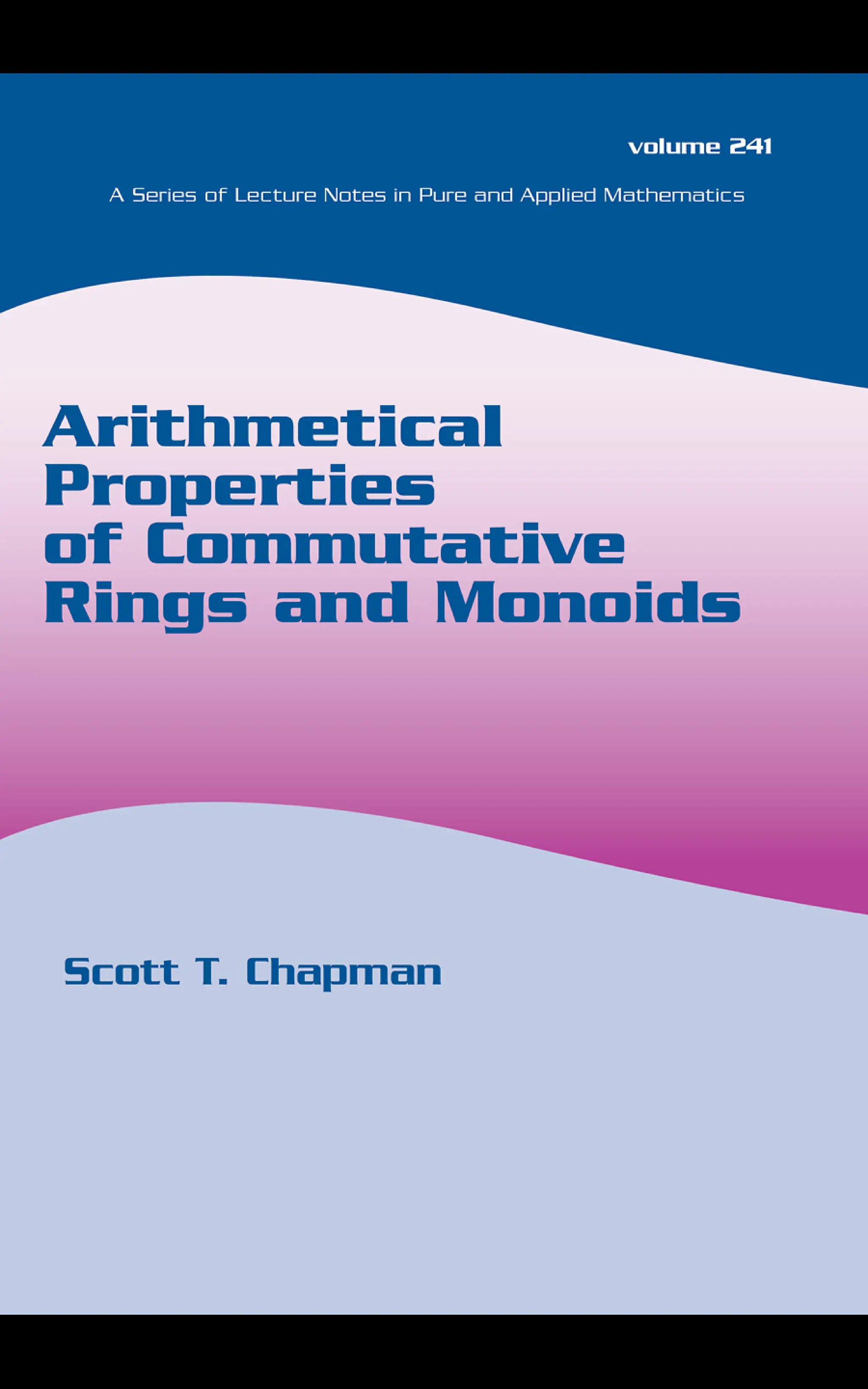
Arithmetical Properties of Commutative Rings and
Monoids 1st Edition Scott T. Chapman

_____ Press the link below to begin your download _____
https://ebookultra.com/download/arithmetical-properties-of-
commutative-rings-and-monoids-1st-edition-scott-t-chapman/
Access ebookultra.com now to download high-quality
ebooks or textbooks
Here are some recommended products for you. Click the link to
download, or explore more at ebookultra.com
The Separable Galois Theory of Commutative Rings Second
Edition Andy R. Magid
https://ebookultra.com/download/the-separable-galois-theory-of-
commutative-rings-second-edition-andy-r-magid/
Computational Commutative And Non commutative Algebraic
Geometry Svetlana Cojocaru
https://ebookultra.com/download/computational-commutative-and-non-
commutative-algebraic-geometry-svetlana-cojocaru/
Ancient Rings An Illustrated Collector s Guide 1st Edition
T. N. Pollio
https://ebookultra.com/download/ancient-rings-an-illustrated-
collector-s-guide-1st-edition-t-n-pollio/
The geysers of Yellowstone Fifth Edition T. Scott Bryan
https://ebookultra.com/download/the-geysers-of-yellowstone-fifth-
edition-t-scott-bryan/
Bridging Case Conceptualization Assessment and
Intervention 1st Edition Scott T. Meier
https://ebookultra.com/download/bridging-case-conceptualization-
assessment-and-intervention-1st-edition-scott-t-meier/
Measuring Change in Counseling and Psychotherapy 1st
Edition Scott T. Meier
https://ebookultra.com/download/measuring-change-in-counseling-and-
psychotherapy-1st-edition-scott-t-meier/
Algebraic Graph Theory Morphisms Monoids and Matrices 1st
Edition Ulrich Knauer
https://ebookultra.com/download/algebraic-graph-theory-morphisms-
monoids-and-matrices-1st-edition-ulrich-knauer/
Radical Theory of Rings 1st Edition J.W. Gardner
https://ebookultra.com/download/radical-theory-of-rings-1st-edition-j-
w-gardner/
Differentiated Assessment Strategies One Tool Doesn t Fit
All 2nd Edition Carolyn Chapman
https://ebookultra.com/download/differentiated-assessment-strategies-
one-tool-doesn-t-fit-all-2nd-edition-carolyn-chapman/
Arithmetical Properties of Commutative Rings and
Monoids 1st Edition Scott T. Chapman Digital Instant
Download
Author(s): Scott T. Chapman
ISBN(s): 9781420028249, 1420028243
Edition: 1
File Details: PDF, 3.25 MB
Year: 2005
Language: english
Arithmetical Properties
of Commutative Rings
and Monoids
M. S. Baouendi
University of California,
San Diego
Jane Cronin
Rutgers University
Jack K. Hale
Georgia Institute of Technology
S. Kobayashi
University of California,
Berkeley
Marvin Marcus
University of California,
Santa Barbara
W. S. Massey
Yale University
Anil Nerode
Cornell University
Donald Passman
University of Wisconsin,
Madison
Fred S. Roberts
Rutgers University
David L. Russell
Virginia Polytechnic Institute
and State University
Walter Schempp
Universität Siegen
Mark Teply
University of Wisconsin,
Milwaukee
Earl J. Taft
Rutgers University
New Brunswick, New Jersey
Zuhair Nashed
University of Central Florida
Orlando, Florida
PURE AND APPLIED MATHEMATICS
A Program of Monographs, Textbooks, and Lecture Notes
EXECUTIVE EDITORS
EDITORIAL BOARD
LECTURE NOTES IN PURE AND APPLIED MATHEMATICS
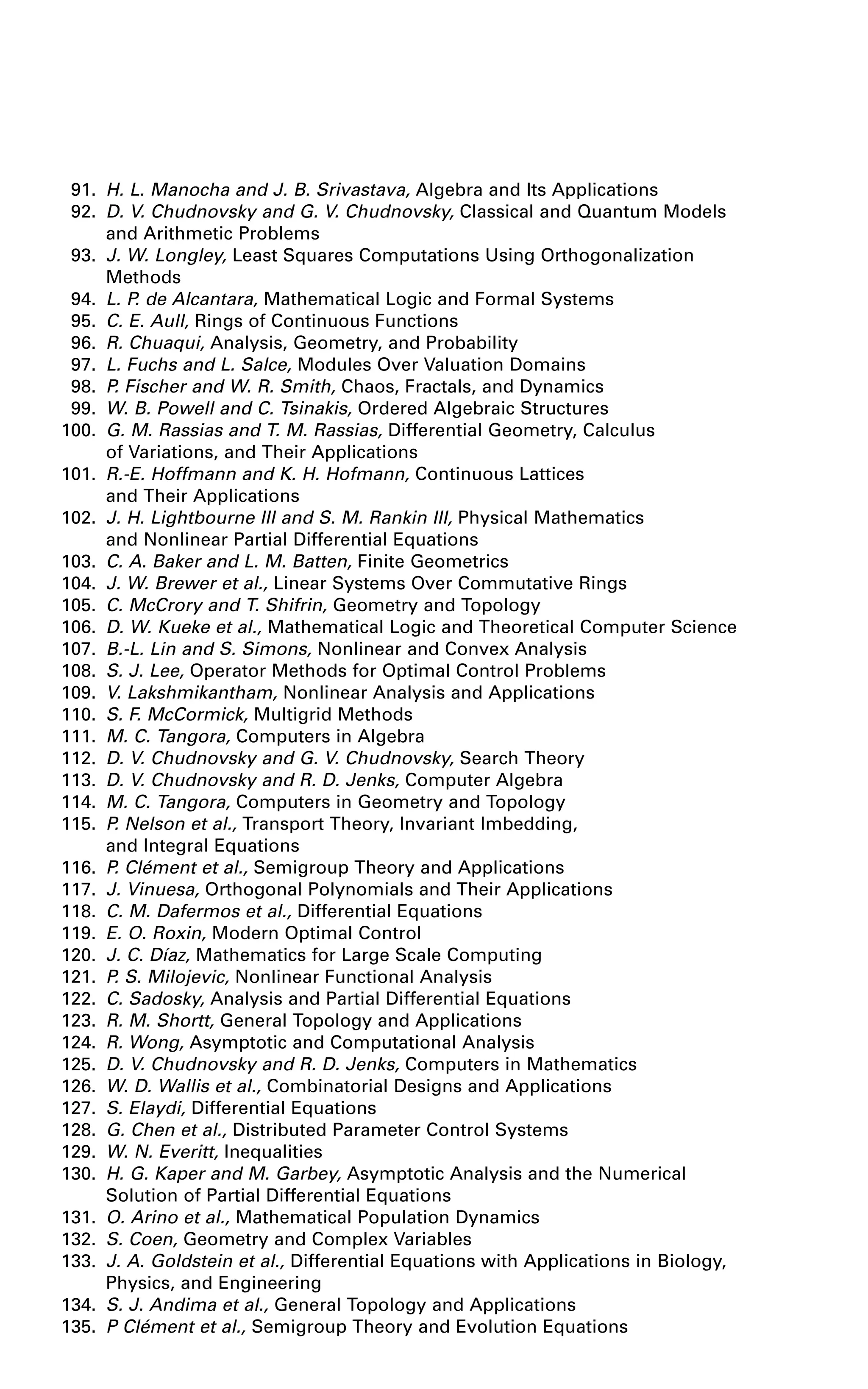
1. N. Jacobson, Exceptional Lie Algebras
2. L.-Å. Lindahl and F. Poulsen, Thin Sets in Harmonic Analysis
3. I. Satake, Classification Theory of Semi-Simple Algebraic Groups
4. F. Hirzebruch et al., Differentiable Manifolds and Quadratic Forms
5. I. Chavel, Riemannian Symmetric Spaces of Rank One
6. R. B. Burckel, Characterization of C(X) Among Its Subalgebras
7. B. R. McDonald et al., Ring Theory
8. Y.-T. Siu, Techniques of Extension on Analytic Objects
9. S. R. Caradus et al., Calkin Algebras and Algebras of Operators
on Banach Spaces
10. E. O. Roxin et al., Differential Games and Control Theory
11. M. Orzech and C. Small, The Brauer Group of Commutative Rings
12. S. Thomier, Topology and Its Applications
13. J. M. Lopez and K. A. Ross, Sidon Sets
14. W. W. Comfort and S. Negrepontis, Continuous Pseudometrics
15. K. McKennon and J. M. Robertson, Locally Convex Spaces
16. M. Carmeli and S. Malin, Representations of the Rotation
and Lorentz Groups
17. G. B. Seligman, Rational Methods in Lie Algebras
18. D. G. de Figueiredo, Functional Analysis
19. L. Cesari et al., Nonlinear Functional Analysis and Differential Equations
20. J. J. Schäffer, Geometry of Spheres in Normed Spaces
21. K. Yano and M. Kon, Anti-Invariant Submanifolds
22. W. V. Vasconcelos, The Rings of Dimension Two
23. R. E. Chandler, Hausdorff Compactifications
24. S. P. Franklin and B. V. S. Thomas, Topology
25. S. K. Jain, Ring Theory
26. B. R. McDonald and R. A. Morris, Ring Theory II
27. R. B. Mura and A. Rhemtulla, Orderable Groups
28. J. R. Graef, Stability of Dynamical Systems
29. H.-C. Wang, Homogeneous Branch Algebras
30. E. O. Roxin et al., Differential Games and Control Theory II
31. R. D. Porter, Introduction to Fibre Bundles
32. M. Altman, Contractors and Contractor Directions Theory and Applications
33. J. S. Golan, Decomposition and Dimension in Module Categories
34. G. Fairweather, Finite Element Galerkin Methods for Differential Equations
35. J. D. Sally, Numbers of Generators of Ideals in Local Rings
36. S. S. Miller, Complex Analysis
37. R. Gordon, Representation Theory of Algebras
38. M. Goto and F. D. Grosshans, Semisimple Lie Algebras
39. A. I. Arruda et al., Mathematical Logic
40. F. Van Oystaeyen, Ring Theory
41. F. Van Oystaeyen and A. Verschoren, Reflectors and Localization
42. M. Satyanarayana, Positively Ordered Semigroups
43. D. L Russell, Mathematics of Finite-Dimensional Control Systems
44. P.-T. Liu and E. Roxin, Differential Games and Control Theory III
45. A. Geramita and J. Seberry, Orthogonal Designs
46. J. Cigler, V. Losert, and P. Michor, Banach Modules and Functors
on Categories of Banach Spaces
47. P.-T. Liu and J. G. Sutinen, Control Theory in Mathematical Economics
48. C. Byrnes, Partial Differential Equations and Geometry
49. G. Klambauer, Problems and Propositions in Analysis
50. J. Knopfmacher, Analytic Arithmetic of Algebraic Function Fields
51. F. Van Oystaeyen, Ring Theory
52. B. Kadem, Binary Time Series
53. J. Barros-Neto and R. A. Artino, Hypoelliptic Boundary-Value Problems
54. R. L. Sternberg et al., Nonlinear Partial Differential Equations
in Engineering and Applied Science
55. B. R. McDonald, Ring Theory and Algebra III
56. J. S. Golan, Structure Sheaves Over a Noncommutative Ring
57. T. V. Narayana et al., Combinatorics, Representation Theory
and Statistical Methods in Groups
58. T. A. Burton, Modeling and Differential Equations in Biology
59. K. H. Kim and F. W. Roush, Introduction to Mathematical
Consensus Theory
60. J. Banas and K. Goebel, Measures of Noncompactness in Banach Spaces
61. O. A. Nielson, Direct Integral Theory
62. J. E. Smith et al., Ordered Groups
63. J. Cronin, Mathematics of Cell Electrophysiology
64. J. W. Brewer, Power Series Over Commutative Rings
65. P. K. Kamthan and M. Gupta, Sequence Spaces and Series
66. T. G. McLaughlin, Regressive Sets and the Theory of Isols
67. T. L. Herdman et al., Integral and Functional Differential Equations
68. R. Draper, Commutative Algebra
69. W. G. McKay and J. Patera, Tables of Dimensions, Indices,
and Branching Rules for Representations of Simple Lie Algebras
70. R. L. Devaney and Z. H. Nitecki, Classical Mechanics
and Dynamical Systems
71. J. Van Geel, Places and Valuations in Noncommutative Ring Theory
72. C. Faith, Injective Modules and Injective Quotient Rings
73. A. Fiacco, Mathematical Programming with Data Perturbations I
74. P. Schultz et al., Algebraic Structures and Applications
75. L Bican et al., Rings, Modules, and Preradicals
76. D. C. Kay and M. Breen, Convexity and Related Combinatorial Geometry
77. P. Fletcher and W. F. Lindgren, Quasi-Uniform Spaces
78. C.-C. Yang, Factorization Theory of Meromorphic Functions
79. O. Taussky, Ternary Quadratic Forms and Norms
80. S. P. Singh and J. H. Burry, Nonlinear Analysis and Applications
81. K. B. Hannsgen et al., Volterra and Functional Differential Equations
82. N. L. Johnson et al., Finite Geometries
83. G. I. Zapata, Functional Analysis, Holomorphy, and Approximation Theory
84. S. Greco and G. Valla, Commutative Algebra
85. A. V. Fiacco, Mathematical Programming with Data Perturbations II
86. J.-B. Hiriart-Urruty et al., Optimization
87. A. Figa Talamanca and M. A. Picardello, Harmonic Analysis on Free Groups
88. M. Harada, Factor Categories with Applications to Direct Decomposition
of Modules
89. V. I. Istra’tescu, Strict Convexity and Complex Strict Convexity
90. V. Lakshmikantham, Trends in Theory and Practice of Nonlinear Differential
Equations
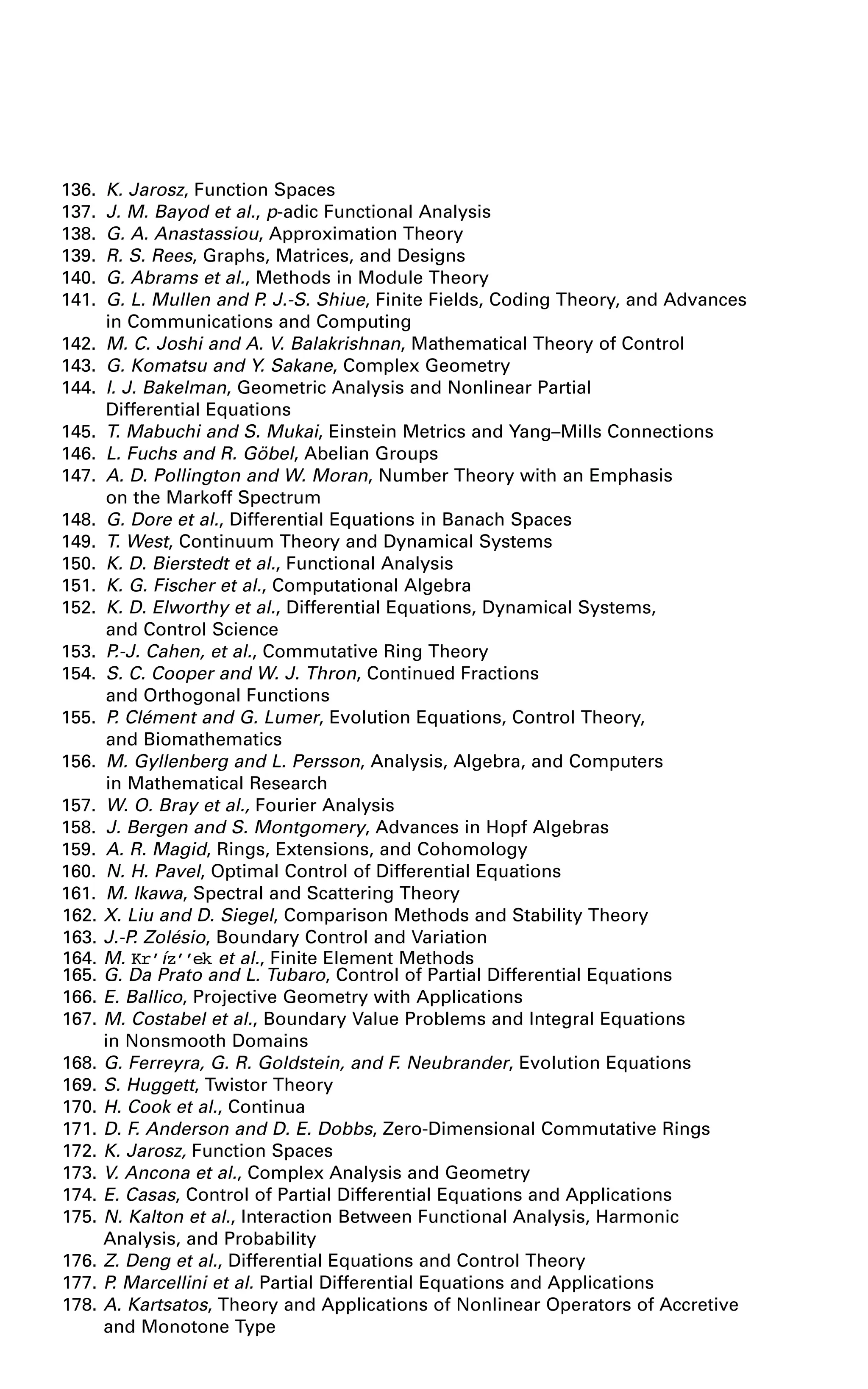
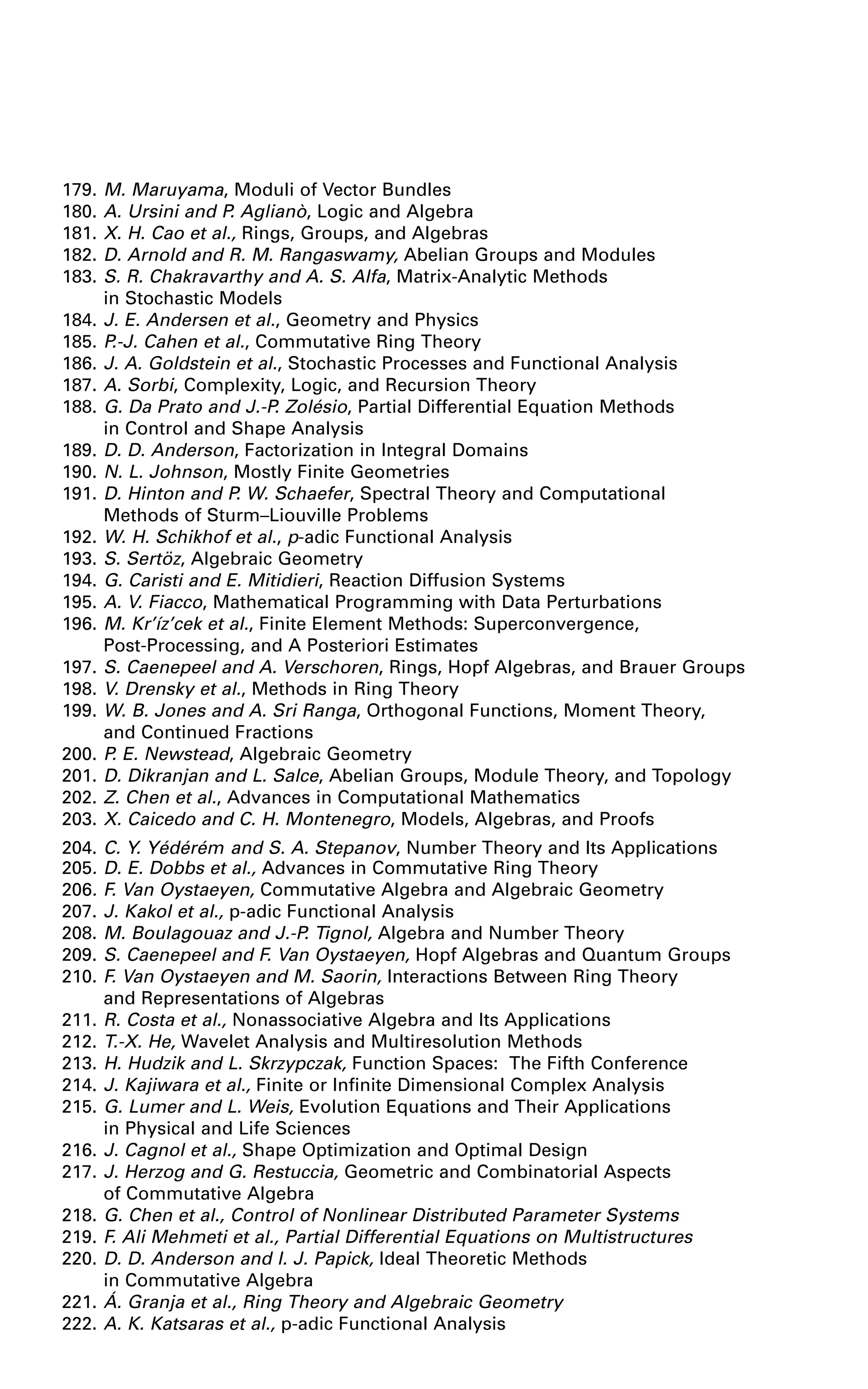
91. H. L. Manocha and J. B. Srivastava, Algebra and Its Applications
92. D. V. Chudnovsky and G. V. Chudnovsky, Classical and Quantum Models
and Arithmetic Problems
93. J. W. Longley, Least Squares Computations Using Orthogonalization
Methods
94. L. P. de Alcantara, Mathematical Logic and Formal Systems
95. C. E. Aull, Rings of Continuous Functions
96. R. Chuaqui, Analysis, Geometry, and Probability
97. L. Fuchs and L. Salce, Modules Over Valuation Domains
98. P. Fischer and W. R. Smith, Chaos, Fractals, and Dynamics
99. W. B. Powell and C. Tsinakis, Ordered Algebraic Structures
100. G. M. Rassias and T. M. Rassias, Differential Geometry, Calculus
of Variations, and Their Applications
101. R.-E. Hoffmann and K. H. Hofmann, Continuous Lattices
and Their Applications
102. J. H. Lightbourne III and S. M. Rankin III, Physical Mathematics
and Nonlinear Partial Differential Equations
103. C. A. Baker and L. M. Batten, Finite Geometrics
104. J. W. Brewer et al., Linear Systems Over Commutative Rings
105. C. McCrory and T. Shifrin, Geometry and Topology
106. D. W. Kueke et al., Mathematical Logic and Theoretical Computer Science
107. B.-L. Lin and S. Simons, Nonlinear and Convex Analysis
108. S. J. Lee, Operator Methods for Optimal Control Problems
109. V. Lakshmikantham, Nonlinear Analysis and Applications
110. S. F. McCormick, Multigrid Methods
111. M. C. Tangora, Computers in Algebra
112. D. V. Chudnovsky and G. V. Chudnovsky, Search Theory
113. D. V. Chudnovsky and R. D. Jenks, Computer Algebra
114. M. C. Tangora, Computers in Geometry and Topology
115. P. Nelson et al., Transport Theory, Invariant Imbedding,
and Integral Equations
116. P. Clément et al., Semigroup Theory and Applications
117. J. Vinuesa, Orthogonal Polynomials and Their Applications
118. C. M. Dafermos et al., Differential Equations
119. E. O. Roxin, Modern Optimal Control
120. J. C. Díaz, Mathematics for Large Scale Computing
121. P. S. Milojevic, Nonlinear Functional Analysis
122. C. Sadosky, Analysis and Partial Differential Equations
123. R. M. Shortt, General Topology and Applications
124. R. Wong, Asymptotic and Computational Analysis
125. D. V. Chudnovsky and R. D. Jenks, Computers in Mathematics
126. W. D. Wallis et al., Combinatorial Designs and Applications
127. S. Elaydi, Differential Equations
128. G. Chen et al., Distributed Parameter Control Systems
129. W. N. Everitt, Inequalities
130. H. G. Kaper and M. Garbey, Asymptotic Analysis and the Numerical
Solution of Partial Differential Equations
131. O. Arino et al., Mathematical Population Dynamics
132. S. Coen, Geometry and Complex Variables
133. J. A. Goldstein et al., Differential Equations with Applications in Biology,
Physics, and Engineering
134. S. J. Andima et al., General Topology and Applications
135. P Clément et al., Semigroup Theory and Evolution Equations
136. K. Jarosz, Function Spaces
137. J. M. Bayod et al., p-adic Functional Analysis
138. G. A. Anastassiou, Approximation Theory
139. R. S. Rees, Graphs, Matrices, and Designs
140. G. Abrams et al., Methods in Module Theory
141. G. L. Mullen and P. J.-S. Shiue, Finite Fields, Coding Theory, and Advances
in Communications and Computing
142. M. C. Joshi and A. V. Balakrishnan, Mathematical Theory of Control
143. G. Komatsu and Y. Sakane, Complex Geometry
144. I. J. Bakelman, Geometric Analysis and Nonlinear Partial
Differential Equations
145. T. Mabuchi and S. Mukai, Einstein Metrics and Yang–Mills Connections
146. L. Fuchs and R. Göbel, Abelian Groups
147. A. D. Pollington and W. Moran, Number Theory with an Emphasis
on the Markoff Spectrum
148. G. Dore et al., Differential Equations in Banach Spaces
149. T. West, Continuum Theory and Dynamical Systems
150. K. D. Bierstedt et al., Functional Analysis
151. K. G. Fischer et al., Computational Algebra
152. K. D. Elworthy et al., Differential Equations, Dynamical Systems,
and Control Science
153. P.-J. Cahen, et al., Commutative Ring Theory
154. S. C. Cooper and W. J. Thron, Continued Fractions
and Orthogonal Functions
155. P. Clément and G. Lumer, Evolution Equations, Control Theory,
and Biomathematics
156. M. Gyllenberg and L. Persson, Analysis, Algebra, and Computers
in Mathematical Research
157. W. O. Bray et al., Fourier Analysis
158. J. Bergen and S. Montgomery, Advances in Hopf Algebras
159. A. R. Magid, Rings, Extensions, and Cohomology
160. N. H. Pavel, Optimal Control of Differential Equations
161. M. Ikawa, Spectral and Scattering Theory
162. X. Liu and D. Siegel, Comparison Methods and Stability Theory
163. J.-P. Zolésio, Boundary Control and Variation
164. M. Kr’íz’’ek et al., Finite Element Methods
165. G. Da Prato and L. Tubaro, Control of Partial Differential Equations
166. E. Ballico, Projective Geometry with Applications
167. M. Costabel et al., Boundary Value Problems and Integral Equations
in Nonsmooth Domains
168. G. Ferreyra, G. R. Goldstein, and F. Neubrander, Evolution Equations
169. S. Huggett, Twistor Theory
170. H. Cook et al., Continua
171. D. F. Anderson and D. E. Dobbs, Zero-Dimensional Commutative Rings
172. K. Jarosz, Function Spaces
173. V. Ancona et al., Complex Analysis and Geometry
174. E. Casas, Control of Partial Differential Equations and Applications
175. N. Kalton et al., Interaction Between Functional Analysis, Harmonic
Analysis, and Probability
176. Z. Deng et al., Differential Equations and Control Theory
177. P. Marcellini et al. Partial Differential Equations and Applications
178. A. Kartsatos, Theory and Applications of Nonlinear Operators of Accretive
and Monotone Type
179. M. Maruyama, Moduli of Vector Bundles
180. A. Ursini and P. Aglianò, Logic and Algebra
181. X. H. Cao et al., Rings, Groups, and Algebras
182. D. Arnold and R. M. Rangaswamy, Abelian Groups and Modules
183. S. R. Chakravarthy and A. S. Alfa, Matrix-Analytic Methods
in Stochastic Models
184. J. E. Andersen et al., Geometry and Physics
185. P.-J. Cahen et al., Commutative Ring Theory
186. J. A. Goldstein et al., Stochastic Processes and Functional Analysis
187. A. Sorbi, Complexity, Logic, and Recursion Theory
188. G. Da Prato and J.-P. Zolésio, Partial Differential Equation Methods
in Control and Shape Analysis
189. D. D. Anderson, Factorization in Integral Domains
190. N. L. Johnson, Mostly Finite Geometries
191. D. Hinton and P. W. Schaefer, Spectral Theory and Computational
Methods of Sturm–Liouville Problems
192. W. H. Schikhof et al., p-adic Functional Analysis
193. S. Sertöz, Algebraic Geometry
194. G. Caristi and E. Mitidieri, Reaction Diffusion Systems
195. A. V. Fiacco, Mathematical Programming with Data Perturbations
196. M. Kr’íz’cek et al., Finite Element Methods: Superconvergence,
Post-Processing, and A Posteriori Estimates
197. S. Caenepeel and A. Verschoren, Rings, Hopf Algebras, and Brauer Groups
198. V. Drensky et al., Methods in Ring Theory
199. W. B. Jones and A. Sri Ranga, Orthogonal Functions, Moment Theory,
and Continued Fractions
200. P. E. Newstead, Algebraic Geometry
201. D. Dikranjan and L. Salce, Abelian Groups, Module Theory, and Topology
202. Z. Chen et al., Advances in Computational Mathematics
203. X. Caicedo and C. H. Montenegro, Models, Algebras, and Proofs
204. C. Y. Yédérém and S. A. Stepanov, Number Theory and Its Applications
205. D. E. Dobbs et al., Advances in Commutative Ring Theory
206. F. Van Oystaeyen, Commutative Algebra and Algebraic Geometry
207. J. Kakol et al., p-adic Functional Analysis
208. M. Boulagouaz and J.-P. Tignol, Algebra and Number Theory
209. S. Caenepeel and F. Van Oystaeyen, Hopf Algebras and Quantum Groups
210. F. Van Oystaeyen and M. Saorin, Interactions Between Ring Theory
and Representations of Algebras
211. R. Costa et al., Nonassociative Algebra and Its Applications
212. T.-X. He, Wavelet Analysis and Multiresolution Methods
213. H. Hudzik and L. Skrzypczak, Function Spaces: The Fifth Conference
214. J. Kajiwara et al., Finite or Infinite Dimensional Complex Analysis
215. G. Lumer and L. Weis, Evolution Equations and Their Applications
in Physical and Life Sciences
216. J. Cagnol et al., Shape Optimization and Optimal Design
217. J. Herzog and G. Restuccia, Geometric and Combinatorial Aspects
of Commutative Algebra
218. G. Chen et al., Control of Nonlinear Distributed Parameter Systems
219. F. Ali Mehmeti et al., Partial Differential Equations on Multistructures
220. D. D. Anderson and I. J. Papick, Ideal Theoretic Methods
in Commutative Algebra
221. Á. Granja et al., Ring Theory and Algebraic Geometry
222. A. K. Katsaras et al., p-adic Functional Analysis
223. R. Salvi, The Navier-Stokes Equations
224. F. U. Coelho and H. A. Merklen, Representations of Algebras
225. S. Aizicovici and N. H. Pavel, Differential Equations and Control Theory
226. G. Lyubeznik, Local Cohomology and Its Applications
227. G. Da Prato and L. Tubaro, Stochastic Partial Differential Equations
and Applications
228. W. A. Carnielli et al., Paraconsistency
229. A. Benkirane and A. Touzani, Partial Differential Equations
230. A. Illanes et al., Continuum Theory
231. M. Fontana et al., Commutative Ring Theory and Applications
232. D. Mond and M. J. Saia, Real and Complex Singularities
233. V. Ancona and J. Vaillant, Hyperbolic Differential Operators
and Related Problems
234. G. R. Goldstein et al., Evolution Equations
235. A. Giambruno et al., Polynomial Identities and Combinatorial Methods
236. A. Facchini et al., Rings, Modules, Algebras, and Abelian Groups
237. J. Bergen et al., Hopf Algebras
238. A. C. Krinik and R. J. Swift, Stochastic Processes and Functional Analysis:
A Volume of Recent Advances in Honor of M. M. Rao
239. S. Caenepeel and F. van Oystaeyen, Hopf Algebras in Noncommutative
Geometry and Physics
240. J. Cagnol and J.-P. Zolésio, Control and Boundary Analysis
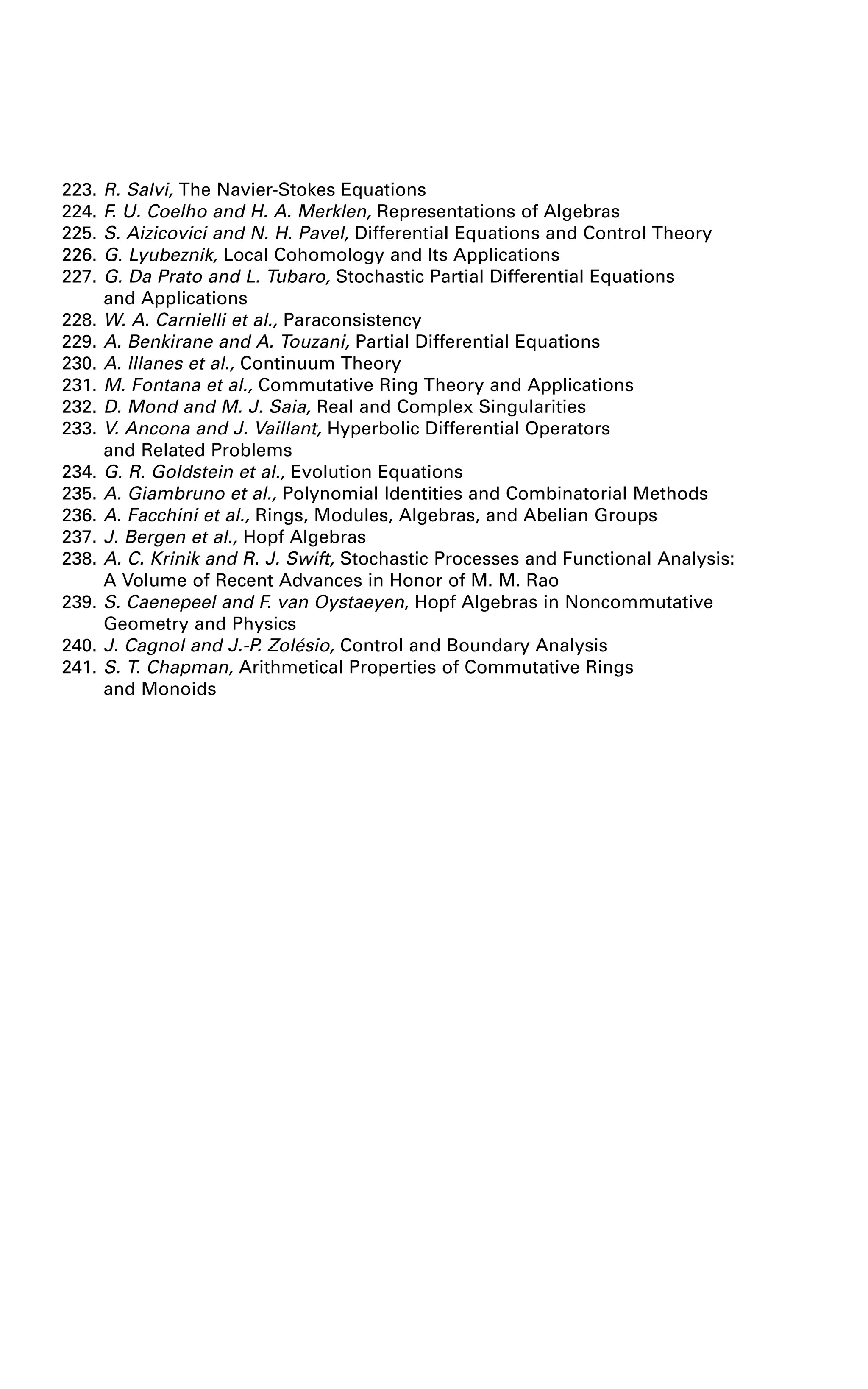
241. S. T. Chapman, Arithmetical Properties of Commutative Rings
and Monoids
Boca Raton London New York Singapore
Arithmetical
Properties
of Commutative
Rings and Monoids
Scott T. Chapman
Trinity University
San Antonio, Texas, U.S.A.
Published in 2005 by
CRC Press
Taylor & Francis Group
6000 Broken Sound Parkway NW
Boca Raton, FL 33487-2742
© 2005 by Taylor & Francis Group, LLC
CRC Press is an imprint of Taylor & Francis Group
No claim to original U.S. Government works
Printed in the United States of America on acid-free paper
10 9 8 7 6 5 4 3 2 1
International Standard Book Number-10: 0-8247-2327-9 (Hardcover)
International Standard Book Number-13: 978-0-8247-2327-9 (Hardcover)
Library of Congress Card Number 2004061830
This book contains information obtained from authentic and highly regarded sources. Reprinted material is quoted with
permission, and sources are indicated. A wide variety of references are listed. Reasonable efforts have been made to publish
reliable data and information, but the author and the publisher cannot assume responsibility for the validity of all materials
or for the consequences of their use.
No part of this book may be reprinted, reproduced, transmitted, or utilized in any form by any electronic, mechanical, or
other means, now known or hereafter invented, including photocopying, microfilming, and recording, or in any information
storage or retrieval system, without written permission from the publishers.
For permission to photocopy or use material electronically from this work, please access www.copyright.com
(http://www.copyright.com/) or contact the Copyright Clearance Center, Inc. (CCC) 222 Rosewood Drive, Danvers, MA
01923, 978-750-8400. CCC is a not-for-profit organization that provides licenses and registration for a variety of users. For
organizations that have been granted a photocopy license by the CCC, a separate system of payment has been arranged.
Trademark Notice: Product or corporate names may be trademarks or registered trademarks, and are used only for
identification and explanation without intent to infringe.
Library of Congress Cataloging-in-Publication Data
Arithmetic properties of commutative rings and monoids / edited by Scott T. Chapman.
p. cm. — (Lecture notes in pure and applied mathematics v. 240)
Includes bibliographical references and index.
ISBN 0-8247-2327-9 (alk. paper)
1. Commutative rings—Congresses. 2. Monoids—Congresses. I. Chapman, Scott T. II.
Series.
QA251.3.A72 2005
512'.44--dc22 2004061830
Visit the Taylor & Francis Web site at
http://www.taylorandfrancis.com
and the CRC Press Web site at
http://www.crcpress.com
Taylor & Francis Group
is the Academic Division of T&F Informa plc.
Preface
This volume contains the Proceedings of two related meetings which took place
in October 2003. The first event was a one day Mini-Conference on Factorization
Properties of Commutative Rings and Monoids hosted by the Department of Math-
ematics at the University of North Carolina at Chapel Hill. The Mini-Conference
was followed by a regular Special Session on Commutative Rings and Monoids at
the Fall 2003 Southeast Sectional Meeting of the American Mathematical Society.
A major focus of these two meetings was the study of properties related to
nonunique factorizations of elements into irreducible elements in commutative rings
and monoids. Such problems have emerged as an independent area of research only
over the past 30 years. Almost every result obtained in this area since 1970 can be
traced to the following Theorem from a short two page paper by Leonard Carlitz
(Proc. Amer. Math. Soc. 11(1960), 391–392).
Theorem: The algebraic number field Z has class number ≤ 2 if and only if for
every nonzero integer α ∈ Z the number of primes πj in every factorization
α = π1π2 · · · πk
only depends on α.
While Carlitz’s result has been referenced well over 50 times, it did not initially
gain much attention. None the less, according to Math Science Net, since the
early 1970’s well over 200 papers dedicated to the study of factorization properties
of integral domains and monoids, and related topics, have appeared in refereed
mathematical journals or conference proceedings. During this same period, over 14
Doctoral Dissertations which touch on factorization properties have been completed.
The institutions where such degrees were awarded include The University of Iowa,
The University of Tennessee at Knoxville, The University of Nebraska at Lincoln,
The University of North Carolina at Chapel Hill, North Dakota State University,
Karl-Franzens-Universität-Graz and Universite D’Aix-Marseille III.
That this has become a highly active area of mathematical research is demon-
strated by Marcel Dekker’s publication in 1997 of the monograph Factorization in
Integral Domains, edited by D.D. Anderson. This monograph contains the Pro-
ceedings of a 1996 Mini-Conference held at the University of Iowa on factorization
problems followed by a Special Session on Commutative Algebra at the Midwestern
Regional Meeting of the American Mathematical Society. The meetings in Iowa
were followed by a flurry of research activity and the 2003 Meetings in Chapel Hill
xi
xii Preface
were organized with the intent of allowing some of the leading researchers in this
field to review the major results of this period.
I invited D. D. Anderson (University of Iowa), D. F. Anderson (University of
Tennessee at Knoxville), Jim Coykendall (North Dakota State University), Alfred
Geroldinger (Karl-Franzens-Universität, Graz), Franz Halter-Koch (Karl-Franzens-
Universität, Graz) and Ulrich Krause (Universität Bremen) to deliver 45 minute
addresses at the Mini-Conference. These authors have produced a series of 7 papers
based on these lectures which make up the introductory chapters of this volume.
These chapters demonstrate the diverse approach that many authors have taken in
studying nonunique factorizations. Several are written in a purely monoidal setting,
while several others demonstrate that ring theoretic properties play a key role in how
elements factor. Moreover, these chapters exhibit the broad range of mathematical
techniques necessary to obtain results in this area. Such techniques can range from
purely algebraic and combinatorial, to number theoretic. It is hoped that these
chapters not only offer mathematicians new to this area the opportunity to survey
its current trends and major results, but also offer an up to date introduction
to factorization theory for beginning graduate students. The remaining chapters
in this volume reflect research which is motivated by arithmetical properties of
commutative rings and monoids. This is not restricted to factorization problems,
as aspects of the following topics are all considered: multiplicative ideal theory, the
factorization of ideals and ideal generation problems, integer-valued polynomials,
Prüfer rings and Domains, block monoids and their combinatorial invariants, and
numerical monoids.
The two sessions in Chapel Hill and subsequent Proceedings Volume have gen-
erated a significant amount of interest. The sessions attracted 30 speakers from 6
different countries. This volume features 26 papers from 33 different contributors
from 7 different countries. I wish to take this opportunity to thank all those who
participated in the sessions, and to all those who submitted papers for consideration
to this volume. I am indebted to a large number of referees, who as always will
remain nameless. A special thanks goes to the Department of Mathematics at the
University of North Carolina at Chapel Hill, and in particular to Professor William
W. Smith who was instrumental in planning and organizing this event. I also wish
to thank the Department of Mathematics at Trinity University for their continued
support and help in preparing this manuscript. The organization and preparation
of the finished work would not have been possible without the help and patience
of Denise Wilson, our Departmental Secretary and technical typist. I am of course
indebted to Maria Allegra and her staff at Marcel Dekker for giving me the support
and opportunity to complete this manuscript.
I hope the readers of this volume enjoy its contents as much as I enjoyed putting
it together.
Scott Chapman
San Antonio, Texas
January 14, 2005
Contents
Preface xi
Contributors xv
1 Non-Atomic Unique Factorization in Integral Domains
Daniel D. Anderson 1
2 Divisibility Properties in Graded Integral Domains
David F. Anderson 22
3 Extensions of Half-Factorial Domains: A Survey
Jim Coykendall 46
4 C-Monoids and Congruence Monoids in Krull Domains
Franz Halter-Koch 71
5 Monotone Chains of Factorizations in C-Monoids
Andreas Foroutan and Alfred Geroldinger 99
6 Transfer Principles in the Theory of Non-unique Factorizations
Alfred Geroldinger and Franz Halter-Koch 114
7 Cale Monoids, Cale Domains, and Cale Varieties
Scott T. Chapman and Ulrich Krause 142
8 Weakly Krull Inside Factorial Domains
Daniel D. Anderson, Muhammed Zafrullah, and Gyu Whan Chang 172
9 The m-Complement of a Multiplicative Set
David F. Anderson and Gyu Whan Chang 180
10 Some Remarks on Infinite Products
Jim Coykendall 188
11 Rings with Prime Nilradical
Ayman Badawi and Thomas G. Lucas 198
xiii
xiv Contents
12 On the Ideal Generated by the Values of a Polynomial
Jean-Luc Chabert and Sabine Evrard 213
13 Using Factorizations to Prove a Partition Identity
David E. Dobbs and Timothy P. Kilbourn 226
14 On Inside Factorial Integral Domains
David E. Dobbs, Gabriel Picavet, and Martine Picavet-L’Hermitte 233
15 Polynomial Separation of Points in Algebras
Sophie Frisch 253
16 k-Factorized Elements in Telescopic Numerical Semigroups
Jose C. Rosales, Pedro A. Garcı́a-Sánchez, and Juan I. Garcı́a-Garcı́a 260
17 Prüfer Conditions in Rings with Zero-Divisors
Sarah Glaz 272
18 Unmixedness and the Generalized Principal Ideal Theorem
Tracy Dawn Hamilton 282
19 A Note on Sets of Lengths of Powers of Elements of Finitely
Generated Monoids
Wolfgang Hassler 293
20 UMV-Domains
Evan Houston and Muhammad Zafrullah 304
21 On Local Half-Factorial Orders
Florian Kainrath 316
22 On Factorization in Krull Domains with Divisor Class
Group Z2k
Karl M. Kattchee 325
23 Integral Morphisms
Jack Maney 337
24 A Special Type of Invertible Ideal
Stephen McAdam and Richard G. Swan 356
25 Factorization into Radical Ideals
Bruce Olberding 363
26 Strongly Primary Ideals
Gyu Whan Chang, Hoyoung Nam, and Jeanam Park 378
Index 389
Exploring the Variety of Random
Documents with Different Content
'If you do not find the farm comfortable,' said Wantley, breaking
what had begun to be an oppressive silence, 'I hope you will return
here for awhile. There won't be a soul in London yet.'
'Excepting my old friend, Mr. Julius Gumberg,' objected Downing. 'I
believe he has not been out of town for years, and I sometimes
think that in this, at any rate, he has proved himself wiser than some
of his fellows.'
'Mr. Julius Gumberg,' said the other, smiling, 'has always seemed to
me, since I first had the honour of his acquaintance, to be the ideal
Epicurean—the man who has mastered the art of selecting his
pleasures.'
'True!' cried Downing abruptly. 'But you must admit that not the
least of his pleasures has always been that of benefiting his friends.'
'But that, after all, is only a refined form of self-indulgence,' objected
Wantley, who had never been in a position so to indulge himself.
An amused smile broke over the other's stern mouth and jaw. 'That
theory embodies the ethical nihilism of the old Utilitarians. Of course
you are not serious; if you were, your position would be akin to that
of the Persian mystics who teach the utter renunciation of self, the
sinking of the ego in the divine whole. But then,' added Downing,
fixing his eyes on his companion, and speaking as if to himself—'but
then comes the question, What is renunciation? The Persian
philosopher would give an answer very different from that offered by
the Christian.'
'Renunciation is surely the carrying out of the ascetic ideal—
something more actively painful than the mere doing without.'
Wantley spoke diffidently.
'Undoubtedly that is what the Christian means by the word, but is
there not the higher degree of perfection involved in the French
saint's dictum?' Downing stopped short; then, with very fair, albeit
old-fashioned, accent, he uttered the phrase, 'Rien demander et rien
refuser. Of course, the greatest difference between the point of view
held by the Persian sages and, say, the old monkish theologians is
that concerning human love.'
Wantley leaned forward; he threw his cigarette out of the window.
'Ah,' he said, 'that interests me! My own father became a Roman
Catholic, an act on his part, by the way, of supreme renunciation. I
myself can see no possible hope of finality anywhere else; but I
think that, as regards human love, I should be Persian rather than
monkish.' He added, smiling a little: 'I suppose the Persian theory of
love is summed up by FitzGerald;' and diffidently he quoted the most
famous of the quatrains, lingering over the beautiful words, for, as
he uttered them, he applied them, quite consciously, to himself and
Cecily Wake. What wilderness with her but would be Paradise?
Her face rose up before him as he had seen it for a moment the day
before, when, coming suddenly upon her in the little wood, her
honest childish eyes had shone out welcome.
Downing looked at him thoughtfully. 'Ah, no; the Persian mystic of
to-day would by no means assent to such simplicity of outlook. Jami
rather than Omar summed up the national philosophy. The
translation is not comparable, but, still, 'twill serve to explain to you
the Persian belief that renunciation of self may be acquired through
the medium of a merely human love;' and he repeated the lines:
'Though in this world a hundred tasks thou tryest,
'Tis love alone which from thyself will save thee;
Even from earthly love thy face avert not,
Since to the real it may serve to raise thee.'
'That,' cried Wantley eagerly, 'absolutely satisfies me, and strikes me
as being the highest truth!'
Downing again smiled—a quick, humorous smile. 'No doubt,' he said
rather dryly, 'so thought the student who, seeking a great sage in
order to be shown the way of spiritual perfection, received for
answer: "If your steps have not yet trod the pathway of love, go
hence, seek love, and, having met it, then return to me." The theory
that true love, even if ill-bestowed, partakes of the Divine, is an
essential part of the Sufi philosophy.'
'And yet,' objected Wantley, 'there are times when love, even if well
bestowed, may have to be withdrawn, lest it should injure the
creature beloved.'
'So I should once have said,' answered Downing, leaning forward
and straightening himself in his chair; 'but now I am inclined to think
that that theory has been responsible for much wrong and pain. I
myself, as a young man, was greatly injured by holding for a time
this very view. I was attracted to a married woman, who soon
obtained over me an extraordinary and wholly pure influence. But
you know what the world is like; I cannot suppose that in these
matters it has altered since my day. It came to my knowledge that
our friendship was arousing a certain amount of comment, and so,
after much painful thought and discussion with myself, I made up
my mind—wrongly, as I now believe—to withdraw myself from the
connection.' He added with a certain effort: 'To this determination—
come to, I can assure you and myself, from the highest motives—I
trace, in looking back, some unhappiness to her, and to me the utter
shipwreck of what were then my worldly chances. My withdrawal
from this lady's influence brought me into contact with another and
a very evil personality. Now, had I been then, as I now am, a
student of Persian philosophy, I might be——'
Downing stopped speaking abruptly. As he threw himself back, his
great powerful figure seemed to collapse. Wantley looked at him,
surprised and greatly touched by the confidence.
'I will tell you,' resumed Downing, after a long pause, 'of another
Persian belief, to which I now fully adhere. The sages say that as
God is, of course, wholly lacking in bukhl—that is, stinginess or
meanness—it is impossible for him to withhold from any man the
thing for which he strives with sufficient earnestness; and this,' he
added, looking at his companion, 'I have myself found to be true. If
a man devotes all his energies to the pursuit of spiritual knowledge,
he becomes in time——'
'Automatically holy,' suggested Wantley, smiling.
'And capable,' concluded Downing, 'of accomplishing what we call
miracles.'
'But to such a one surely human love would be denied, even in
Persia?'
'Undoubtedly, yes. But the man who has striven successfully on a
lower plane, whose object has been to compass worldly power and
the defeat of his enemies—to him human love is not only not
denied, but may, as we have seen, bring him nearer to the Divine.'
'But meanwhile,' objected Wantley, 'love, and especially the pursuit
of the beloved, must surely stay his ambition, and even interfere
with his success?'
'Only inasmuch as it may render him more sensitive to physical
danger and less defiant of death.'
The young man had expected a very different answer. 'Yes,' he said
tentatively; 'you mean that a soldier, if a lover, is less inclined to
display reckless bravery than those among his comrades who have
not the same motive for self-preservation?'
'No, no!' exclaimed Downing impatiently; 'I do not mean that at all!
All history is there to prove the contrary. I was not thinking of
straightforward death in any shape, but of treachery, of
assassination. The man who loves'—he hesitated, his voice softened,
altered in quality—'above all, the man who knows himself to be
beloved, is more alive, more sensitive to the fear of annihilation,
than he who only lives to accomplish certain objects. The knowledge
that this is so might well make a man pause—during the brief
moments when pausing is possible—and it has undoubtedly led
many a one to put deliberately from himself all thought of love.'
Wantley looked at him with some curiosity, wondering whether his
words had a personal application.
'Now, take my own case,' continued Downing gravely. 'I am in quite
perpetual danger of assassination, and in this one matter, at any
rate, I am a fatalist. But should I have the right to ask a woman to
share, not only the actual risk, but also the mental strain? I once
should have said no; I now say yes.'
Wantley was too surprised to speak.
There was a pause, then Downing spoke again, but in a different
tone: 'Oddly enough, the first time was the most nearly successful.
In fact, the person who had me drugged—perhaps I should say
poisoned—succeeded in his object, which was to obtain a paper
which I had on my person. Papers, letters, documents of every kind,
are associated in my mind with mischief, and I always get rid of
them as soon as possible. Mr. Gumberg has boxes full of papers I
have sent him at intervals from Persia. I have arranged with him that
if anything happens to me they are to be sent off to the Foreign
Office. Once there'—he threw his head back and laughed grimly
—'they would probably never be looked at again. In no case have I
ever about me any papers or letters; everything of the kind is locked
away.'
'Yes; but you have to carry a key,' objected Wantley.
'There you have me! I do carry a key. One is driven to trust either a
human being or a lock. I prefer the lock.'
Wantley, as he left the Beach Room, felt decidedly more cheerful.
The conversation had interested and amused him. Above all, he had
been moved by the recital of Downing's early romance, and he
wondered idly who the lady in question could have been, whether
she was still living, and whether Downing ever had news of her.
During the whole of their talk there had been no word, no hint, of
the existence of the other's wife, who, as Wantley, by a mere chance
word uttered in his presence in the house where he had recently
been staying, happened to know, was even now in England, the
honoured guest of one of his uncle's old fellow-workers.
He said to himself that there was a fascination about Downing, a
something which might even now make him beloved by the type of
woman—Wantley imagined the meek, affectionate, and intensely
feminine type of woman—who is attracted by that air of physical
strength which is so often allied, in Englishmen, to mental power. He
felt that the man he had just left, sitting solitary, had in his nature
the capacity of enjoying ideal love and companionship, and the
young man, regarding himself as so blessed, regretted that this good
thing had been denied to the man who had spoken of it with so
much comprehension.
Slowly making his way upwards from the shore, Wantley turned
aside, and lingered a few moments on the second of the three
terraces. Here, in this still, remote place, on this natural ledge of the
cliff, guarded by a stone balustrade which terminated at intervals
with fantastic urns, now gay with geranium blossoms, gaining
intensity of colour by the background of blue sky and bluer waters,
he had only the day before, for a delicious hour, read aloud to Cecily
Wake.
From his father Wantley had inherited, and as a boy acquired, an
exceptional love and knowledge of old English poetry, and, giving
but grudging and unwilling praise to modern verse, he had been
whimsically pleased to discover that to the girl Chaucer and La
Fontaine were more familiar names than Browning and Tennyson, of
whose works, indeed, she had been ignorant till she went to the
Settlement, where, however, Philip Hammond had soon made her
feel terribly ashamed of her ignorance.
Standing there, his thoughts of Cecily, of Downing, of Persian
mysticism, chasing one another through his mind, Wantley suddenly
remembered Miss Theresa Wake, doubtless still sitting solitary in her
hooded chair.
II
Cecily's aunt, whom he himself already secretly regarded with the
not altogether uncritical eye of a relation, was to Wantley a new and
amusing variety of old lady. Miss Theresa Wake had the appearance,
common to so many women of her generation, of having been
petrified in early middle age. A brown hair front lent spurious youth
to the thin, delicate face, and her slight, elegant figure was only now
becoming bent. It was impossible to imagine her young, but equally
difficult to believe that she would ever grow really old.
The young man who aspired to the honour of becoming in due
course her kinsman, found a constant source of amusement in the
fact that her sincere, unaffected piety was joined to a keen, almost
morbid, interest in any worldly matter affecting her acquaintances.
When with Miss Wake it was positively difficult for a sympathetic
person to keep from mentioning people, and so, 'I think we shall
have David Winfrith here in a few minutes,' he said, when, having
sought her out, he was anxious to make amends for his neglect.
'Penelope and your niece will probably bring him back. My cousin is
very anxious that he should meet Sir George Downing, who is
leaving soon.'
'Leaving soon? He will be greatly missed.'
The remark was uttered primly, and yet, as Wantley felt, with some
significance. The phrase diverted him, it seemed so absurdly
inappropriate; for Downing had stood, and that to a singular degree,
apart from the ordinary life of the villa.
But the old spinster lady was pursuing her own line of thought. 'I
suppose,' she said hesitatingly, 'that the Settlement would not be
affected should Penelope marry again? Of course, I am interested in
the matter on account of my niece.'
Wantley looked at her, surprised. 'I don't see why it should make the
slightest difference, the more so that David Winfrith has of late years
taken a great part in the management of the Melancthon Settlement
—in fact, the place has been the great tie between them. I should
not care myself to spend the money of a man to whom my wife had
once been married, but I am sure Winfrith will feel no such scruple,
and the possession of the Robinson fortune might make years of
difference to him in attaining what is, I suppose, his supreme
ambition. After all, and of course you must not think that I am for a
moment comparing the two men, where would Dizzy have been
without Mrs. Lewis?'
'But what would Mr. Winfrith have to do with it?' inquired Miss Wake.
'Was he a friend of Penelope's husband? How could he influence the
disposal of the Robinson fortune?'
It was Wantley's turn to look, and to be, astonished. 'I understood
we were speaking of Penelope's marrying again,' he said quickly,
'and I thought that you, like myself, had come to the conclusion that
she would in time make up her mind to marry Winfrith. He's been
devoted to her ever since she can remember. Why, they were once
actually engaged, and I should never be surprised any time, any
moment—to-day, for instance—were she to tell us that they were to
be married.'
The old lady remained silent, but he realized that her silence was not
one of consent. 'Surely you were thinking of David Winfrith?' he
repeated. 'There has never been, in a serious sense, anyone else.'
A little colour came to Miss Wake's thin, wrinkled cheeks, and she
began to look very uncomfortable. 'I was thinking of someone very
different,' she said at last, 'but you have made me feel that I was
quite wrong.'
An odious suspicion darted into the young man's mind. He suddenly
felt both angry and disgusted. After all this constant dwelling on
other people and their affairs must often lead to ridiculous and
painful mistakes, to unwarrantable suspicions. 'You surely cannot
mean——' he began rather sternly, and waited for her to speak.
'I was thinking of Sir George Downing,' she answered, meeting his
perturbed look with one of calm confidence. 'Surely, Lord Wantley,
now that I have suggested the idea, you must admit that they are
greatly interested in one another? At no time of my life have I seen
much of lovers; but, though I have not wished in any way to watch
Penelope and this gentleman, and though I have, of course, said
nothing to my niece Cecily, it has seemed to me quite dear that
there is an attachment. In fact'—she spoke with growing courage,
emboldened by his silence—'I have no doubt about my cousin's
feelings. Would not the marriage be a suitable one? Of course there
must be a certain difference of age between them, but she seems,
indeed I am sure she is, so very devoted to him.'
'I confess the thought of such a thing never occurred to me.'
Wantley spoke slowly, unwillingly; and even while he uttered the
words there came to him, as in an unbroken, confirmatory chain, the
memory of little incidents, words spoken by Penelope, others left
unsaid, her altered manner to himself—much unwelcomed evidence
that Miss Wake had been perhaps clear-sighted when they had all
been blind. He felt a sudden pang of pity for his cousin, a feeling as
if he had suddenly seen, through an open door, a sight not meant
for his eyes. For a moment he deliberated as to whether he should
tell Miss Wake of the one fact which made impossible any happy
ending to what she believed was true of the relations between Mrs.
Robinson and Sir George Downing.
'I think I ought to tell you,' he said at length, 'that a marriage
between them is out of the question. Sir George Downing has a wife
living. They are separated, but not divorced.' There was a painful
moment of silence; then he added hastily: 'I know that my cousin is
fully aware of the fact.'
Then, to his relief, Miss Wake spoke as he would have had her
speak. 'If that is so,' she cried,' I have been utterly mistaken, and I
beg your and Penelope's pardon. It is easy to make mistakes of the
kind. You see, I have lived so long out of the world.'
There was a note of appeal in the thin, high voice.
'But indeed,' said Wantley quickly, 'my cousin is very unconventional,
and your mistake was a natural one. I myself, had I not known the
circumstances, would probably have come to the same conclusion.'
Their eyes met, and for a brief moment unguarded glances gave the
lie to their spoken words.
CHAPTER X
'On ne choisit pas la femme que l'on doit aimer.'
I
The Rectory at Shagisham had the great charm of situation. In his
study old Mr. Winfrith stood on the same level as the top of his
church steeple, and his windows commanded wide views of the
valley where lay the scattered houses composing his cure, of the low
hills beyond, and of the sea. The best had been done that could be
done with the steep, wind-swept garden, and the square, low
rooms, which had seen little, if any, alteration in forty years, opened
out upon a lawn kept green with constant watering.
To Cecily the old-fashioned house, with its curious air of austere,
unfeminine refinement, was very interesting. She had never seen a
country clergyman at home, and her imagination had formed a
picture of Winfrith's father very different from the small, delicate-
looking old man who welcomed her and Mrs. Robinson with great
warmth of manner, while Winfrith himself showed almost boyish
pleasure at the unexpected visit. 'They must be very lonely here
sometimes,' was Cecily's unspoken thought, as the old clergyman
ushered her with some ceremony into the drawing-room, which had
the curious unlived-in look so often seen in a room associated, to
those still living, with a dead woman's presence.
Before passing out on to the lawn Mr. Winfrith directed Cecily's
attention to a portrait which hung over the mantelpiece. It was that
of a brilliant-looking girl, dressed more or less gipsy-fashion, the
colouring of her red cheeks, so bright as to give the impression that
the sitter had rouged, being daringly repeated in a scarf twisted
round her dark hair. 'David's mother,' he said proudly. 'Do you not
think there is a great likeness between them?'
Cecily looked doubtfully at the picture. 'Of course he is not nearly so
handsome'—Mr. Winfrith spoke rather plaintively—' but I assure you
he is really very like her. This portrait was painted before our
marriage. Lord Wantley—I mean Mrs. Robinson's father—thought it
one of the best ever painted by the artist'—Mr. Winfrith looked
puzzled—' I forget his name, though at one time I knew him quite
well. I'm sure you would know it, for he's a great man. He was often
at Monk's Eype, and painted Lady Wantley several times. But this
was one of his early efforts, and I myself'—the old man lowered his
voice, fearing lest the stricture should be overheard by his other
guest—' much prefer his earlier manner.' And then he led her out
into the garden, and handed her over to the care of his son, while
he himself turned eagerly, confidingly, to Penelope.
David Winfrith at Shagisham, waiting on his old father, acting as
courteous host to his own and that dear father's guest, seemed a
very different person from the man who acted as mentor to the
Melancthon Settlement.
Only the most unemotional, and, intellectually speaking, limited,
human being is totally unaffected by environment. Winfrith, when at
home, not only appeared another person to his London self, but he
behaved, and even felt, differently. At Shagisham he came under the
only influence to which he had ever consciously submitted himself—
that of his simple and spiritually minded father, a man so much older
than himself that he seemed a survival from a long-past generation.
Another cause, one known fully to very few beside himself, made
him a different man when at home. There, at Shagisham, he never
forgot certain facts connected with the early life of his parents—facts
made known to him in a letter written by his mother before her
death, and handed to him by his father when they had returned,
forlornly enough, from her funeral. And after the boy—he was
sixteen at the time—had read and burnt the letter, he had looked at
the lovely valley, the beautiful old church, and the pretty rectory,
with altered, alien eyes.
Had Winfrith followed his instinct he would never have come there
again, but he had forced himself to keep this feeling hidden from his
father, and many times, both when at college and, later, through his
working year, he took long journeys in order to spend a few brief
hours with the old man.
But he had no love for the place where he had spent his lonely
childhood, and he did not like Shagisham any the better when he
perceived that he had become in the opinion of the neighbourhood
which had once looked askance at Mr. Winfrith and his only child, an
important personage, able to influence the fate of lowly folk seeking
a job, and that of younger sons of the great folk, bound, with less
excuse, on the same errand.
Walking beside Penelope's young friend, he took pains to make
himself pleasant, and, happily inspired, he at last observed: 'And so
you have made friends with Lord Wantley? He's a very good fellow,
and there's much more in him than Mrs. Robinson is ever willing to
admit. He might be very useful to the Settlement.' Cecily said to
herself that she had perhaps misjudged her companion, and she
determined that she would henceforth listen to his criticisms of her
schemes with more submission.
But what mattered to David Winfrith the young girl's good opinion?
Penelope's unexpected coming had put him in charity with all the
world.
Certain men are instinctive monogamists. For this man the world
held no woman but she whom he still thought of as Penelope
Wantley. There had been times when he would willingly have let his
fancy stray, but, unfortunately for himself, his fancy had ever refused
to stray.
Of late years he had been often thrown with beautiful and clever
women, some of whom had doubtless felt for him that passing,
momentary attraction which to certain kinds of natures holds out so
great an allurement. But Winfrith, in these matters, was wholly apart
from most of those who composed the world in which he had to
spend a certain portion of his time.
Even now, while making conversation with Cecily Wake, he was
longing to hear what Penelope could be saying that appeared to
interest his father so much. Mrs. Robinson had taken the arm of the
little old clergyman; they had turned from the wide lawn and steep
garden beyond, and were looking at the house, Penelope talking, the
other listening silently. 'No doubt,' said Winfrith to himself, 'they are
only discussing what sort of creeper ought to be added to the west
wall this autumn!'
At last he and his father changed partners, and when the latter,
taking charge of Cecily, had led her off to the sloping kitchen-
garden, where stood the well, the boring of which had been the old
man's one extravagance since he had first come to Shagisham,
unnumbered years before, Mrs. Robinson said abruptly: 'Whenever I
see your father, David, I can't help wishing that you were more like
him! He is so much broader and more kindly than you are—in fact,
there seems very little of him in you at all——'
'If you are so devoted to him,' he said, smiling, but rather nettled, 'I
wish you would come and see him oftener. You know how fond he is
of you.' He added, but in a tone which destroyed the sentiment
conveyed in the phrase: 'In that one matter, at any rate, you must
admit that he and I are very much alike!'
Something in the way he said the words displeased Mrs. Robinson.
To her Winfrith's deep, voiceless affection was as much her own, to
do what she willed with, as were any one of her rare physical
attributes. The thought of this deep feeling lessening in depth or in
extent was even now intolerable; and, while giving herself every
licence, and arrogating every right to go her own way, it incensed
her that he should, even to herself, allude lightly to his attachment.
She answered obliquely, eager to punish him for the lightest
deviation from his usual allegiance.
'I know I ought to come oftener,' she said coolly, 'but then, of
course, you yourself hitherto have always been the magnet—not, to
be sure, a very powerful magnet, for 'tis a long time since I've been
here.'
Winfrith reddened. Try as he would—and as a younger man he had
often tried—he could not cure himself of blushing when moved or
angered. His mother, to the very end of her life, had been proud of a
beautiful complexion.
'I was just telling your father'—she gave him a strange sideway
glance—'the story of the traveller who, crossing the border of a
strange country, came upon a magnificent building which seemed
familiar, though he knew it to be impossible that he had ever seen it
before. Then suddenly he realized that it was one of the castles he
had built in Spain! Now, there, David,' said Mrs. Robinson, pointing
with her parasol to the old-fashioned house before them, 'is the only
castle I ever built in Spain, and I never come here without
wondering what sort of dwelling I should have found it.' As he made
no answer, she turned and drew nearer to him, exclaiming as she did
so: 'Ah, que j'étais heureuse, dans ces bons jours où nous étions si
malheureux!'
French was to Winfrith not so much a language as a vocabulary for
the fashioning of treaties and protocols, a collection of counters on
whose painfully considered, often tortuous combinations the fate of
men and nations constantly depended. It may be doubted therefore,
whether, if uttered by any other voice, he would have understood
the significance of the odd phrase in which his companion summed
up the later philosophy of so many women's lives. As it was, its
meaning found its way straight to his heart. He turned and looked at
his companion fixedly—a long, searching look. He opened his lips
——
But Penelope had said enough—had said, indeed, more than she had
meant to say, and produced a far stronger effect than she had
intended to produce.
Mentally and physically she drew back, and as she moved away, not
very far, but still so as to be no longer almost touching him, 'You
owe my visit to-day,' she cried quickly, and rather nervously, 'to the
fact that Sir George Downing, the man they call Persian Downing, is
anxious to make your acquaintance. He and Ludovic have made
friends, and I think Ludovic wants to bring him over to see you.'
'Do you mean that Sir George Downing is actually staying with you?'
he asked, with some astonishment. 'I had no idea that any of you
knew him.'
'We met him abroad, and he has just been staying a few days at
Monk's Eype. He wanted to finish an important paper or report, and
we had the Beach Room arranged as a study for him. But he is
rather peculiar, and he fancies he could work better in complete
solitude, and so, on our way back from here, Cecily and I are going
to see if we can get him lodgings at Kingpole Farm. But, David, he
really is most anxious to meet you. He says you are the only man in
the new Government who knows anything about Persia; one of the
chapters in your book seems to have impressed him very much, and
he wants to talk to you about it.'
As she spoke her eyes dropped. She avoided looking at his face. The
bait was a gross one, but then the hand which held it was so
delicate, so trusted, and so loved.
'A friend of Wantley's?' he repeated. 'I wish I had known that
before.'
'I don't think the acquaintance has been a long one, but they seem
to get on very well together.' The words were uttered hurriedly.
Penelope was beginning to feel deeply ashamed of the part she was
playing.
Winfrith went on, with some eagerness: 'How extraordinary that
Persian Downing should find his way down here! He is one of the
few people whom I have always wished to meet.'
Her task was becoming almost too easy, and with some
perverseness she remarked coldly: 'And yet I believe your present
chief—I mean Lord Rashleigh—refused to see him when he was in
London?'
'Refused is not quite the word. Of course, such a man as Downing
has the faults of his qualities. He arrived in town on a Tuesday, I
believe; he requested an interview on the Wednesday; and then,
while the chief was humming and hawing, and consulting the people
who were up on the whole matter, and who could have told him
what to say and how far he could go in meeting Downing—who, of
course, has come back to England with his head packed full of
schemes and projects—the man suddenly disappeared, leaving no
address! Rashleigh was very much put out, the more so that, as you
doubtless know, our people distrust Downing.'
Penelope was looking down, digging the point of her parasol into the
soft turf at their feet. 'There was some story, wasn't there, when Sir
George Downing was a young man? Some woman was mixed up
with it. What was the truth of it all?'
He hesitated, then answered unwillingly: 'The draft of an important
paper disappeared, and was practically traced from Downing's
possession to that of a Russian woman with whom he was known to
have been on friendly terms. But it's admitted now that he was very
harshly treated over the whole affair. I believe he had actually met
the lady at a F.O. reception! He may have been a fool—probably he
was a fool—but even at the time no one suspected him of having
been anything else. The woman simply and very cleverly stole the
paper in question.'
'I am sure he ought to be very much obliged to you for this kind
version of what took place.'
'Well,' he said good-humouredly, 'I happen to have taken some
trouble to find out the truth, and I'm sorry if the story isn't
sensational enough to please you. But the consequences were
serious enough for Downing. He was treated with great severity, and
finally went on to America. It was there, at Washington, that he
became acquainted with my uncle, and, oddly enough, I have in my
possession some of the letters written by him when first in Persia. I
shall now have the opportunity of giving them back to him.'
'And out there—in Persia, I mean—did you never come across him?'
'Unfortunately, I just missed him. No one here understands the sort
of position he has made for himself—and indeed, for us—out there.
It was the one country, till he came on the scene, where we were
not only lacking in influence, but so lacking in prestige that we were
being perpetually outwitted. Downing, as I reminded Rashleigh the
other day, has always been pulling our chestnuts out of the fire. Of
course, you can't expect such a man to have the virtues of a
Sunday-school teacher.'
Penelope still kept her eyes averted from Winfrith's face, still
ruthlessly dug holes in her old friend's turf.
'And when in Persia, in Teheran, what sort of life does he lead
there?' She tried to speak indifferently, but her heart was beating
fast and irregularly.
But Winfrith, seeing nothing, answered willingly enough: 'Oh, a most
extraordinary sort of life. One of amazing solitariness. He has always
refused to mix with the social life of the Legations. Perhaps that's
why he acquired such an influence elsewhere. Of course, I heard a
great deal about him, and I'll tell you what impressed me most of
the various things I learned. They say that no man—not even out
there—has had his life attempted so often, and in such various ways,
as has Persian Downing. All sorts of people, native and foreign, have
an interest in his disappearance.'
Penelope's hand trembled. The colour left her cheek.
'How does he escape?' she asked. 'Has he any special way of
guarding himself from attack?'
'If he has, no one knows what it is. He has never asked for official
protection, but it seems that from that point of view his G.C.B. has
been quite useful, for now there's a sort of idea that his body and
soul possess a British official value, which before they lacked. He's
been "minted" so to speak.'
But Mrs. Robinson hardly heard him. She was following her own
trend of thought. There was a question she longed, yet feared, to
ask, and though desperately ashamed at what she was about to do,
she made up her mind that she could not let pass this rare, this
unique, opportunity of learning what she craved to know. 'I suppose
that he really has lived alone?' she asked insistently. And then,
seeing that she must speak yet more plainly: 'I suppose—I mean,
was there anything against his private character, out there, in
Teheran?'
A look of annoyance crossed Winfrith's face. He was old-fashioned
enough to consider such questions unseemly, especially when asked
by a woman. 'Certainly not,' he replied rather stiffly. 'I heard no
whisper of such a thing. Had there been anything of the kind, I
should, of course, have heard it. Teheran is full of petty gossip, as
are all those sorts of places.'
As they turned to meet old Mr. Winfrith and Cecily Wake, Penelope
thought, with mingled feelings of relief and pain, of how easy it had
all been, and yet how painful—at moments, how agonizing—to
herself.
The father and son were loth to let them go, and even after the old
man had parted from his guests David Winfrith walked on by the
side of the low cart, leading the pony down the steep, stone-strewn
hill which led to the village, set, as is so often the way in Dorset, in
an oasis of trees. As they rounded a sharp corner and came in sight
of a large house standing within high walls, surrounded on three
sides by elms, but on one side bare and very near to the lonely road,
he suddenly said 'Good-bye,' and, turning on his heel, did not stay a
moment to gaze after them, as Cecily, looking round, had thought he
would.
II
Penelope checked the pony's inclination to gallop along the short,
smooth piece of road which lay before them, and, when actually
passing the large house which stood at the beginning of the village,
she almost brought him to a standstill.
Cecily then saw that the blinds, bright red in colour, of the long row
of upper windows—in fact, all those that could be seen above the
high wall—were drawn down.
'Look well at that place,' said her companion suddenly, 'and I will tell
you why David Winfrith never willingly passes by here when he is
staying at Shagisham.'
Till that moment Mrs. Robinson had had no intention of telling Cecily
anything about this place, or of Winfrith's connection with its solitary
occupant, but she wished to escape from her own thoughts, to
forget for a moment certain passages in a conversation, the memory
of which distressed and shamed her.
To attain this end she went further on the road of betrayal, telling
that which should not have been told. 'It's a very curious story,' she
said, 'and David will never know that I have told it to you.'
As she spoke she shook the reins more loosely through her hand,
and gave the pony his head.
'I must begin by telling you that Mrs. Winfrith, David's mother, was
much younger than her husband, and in every way utterly unlike
him. Before her marriage she had been something of a beauty, a
spoilt, headstrong girl, engaged to some man of whom her people
had not approved, and who finally jilted her. She came down here on
a visit, met Mr. Winfrith, flirted with him, and finally married him. For
a time all seemed to go very well: they had no children, and as he
was very indulgent she often went away and stayed with her own
people, who were rich and of the world worldly. It was from one of
them, by the way—from a brother of hers, a diplomatist—that David
got his nice little fortune. But at the time I am telling you of there
was no thought of David. Not long after Mr. and Mrs. Winfrith's
marriage, another couple came to Shagisham, and took Shagisham
House, the place we have just passed. Their name was Mason, and
they were very well off. But soon it became known that the wife was
practically insane—in fact, that she had to have nurses and keepers.
One of her crazes was that of having everything about her red; the
furniture was all upholstered in bright-red silk, the woodwork was all
painted red, and people even said she slept in red linen sheets! Mrs.
Winfrith became quite intimate with these people. She was there
constantly, and she was supposed to have a soothing effect on Mrs.
Mason. In time—in fact, in a very short time—she showed her
sympathy with the husband in the most practical manner, for one
day they both disappeared from Shagisham together.'
'Together?' repeated Cecily, bewildered. 'How do you mean?'
'I mean'—Penelope was looking straight before her, urging the pony
to go yet faster, although they were beginning to mount the
interminable hill leading to Kingpole Farm—'I mean that Mrs.
Winfrith ran away from her husband, and that Mr. Mason left his
mad wife to take care of herself. Of course, as an actual fact, there
were plenty of people to look after her, and I don't suppose she ever
understood what had taken place. But you can imagine how the
affair affected the neighbourhood, and the kind of insulting pity
which was lavished on Mr. Winfrith. My father, who at that time only
knew him slightly, tried to induce him to leave Shagisham, and even
offered to get him another living. But he refused to stir, and so he
and Mrs. Mason both stayed on here, while Mrs. Winfrith and Mr.
Mason were heard of at intervals as being in Italy, apparently quite
happy in each other's society, and quite unrepentant.'
'Poor Mr. Winfrith!' said Cecily slowly. But she was thinking of David,
not of the placid old man who seemed so proud of his flowers and of
his garden.
'Yes, indeed, poor Mr. Winfrith! But in a way the worst for him was
yet to come. One winter day a lawyer's clerk came down to
Shagisham House to tell the housekeeper and Mrs. Mason's
attendants that their master was dead. He had died of typhoid fever
at Pisa, leaving no will, and having made no arrangements either for
his own wife, or for the lady who, in Italy, had of course passed as
his wife. Well, Mr. Winfrith started off that same night for Pisa, and
about a fortnight later he brought Mrs. Winfrith back to Shagisham.'
Penelope waited awhile, but Cecily made no comment.
'For a time,' Mrs. Robinson went on, 'I believe they lived like lepers.
The farmers made it an excuse to drop coming to church, and only
one woman belonging to their own class ever went near them.'
'I know who that was,' said Cecily, breaking her long silence—'at
least, I think it must have been your mother.'
'Yes,' said Penelope, 'yes, it was my mother. How clever of you to
guess! Mamma used to go and see her regularly. And one day,
finding how unhappy the poor woman seemed to be, she asked my
father to allow her to ask her to come and stay at Monk's Eype. Very
characteristically, as I think, he let mamma have her way in the
matter; but during Mrs. Winfrith's visit he himself went away,
otherwise people might have thought that he had condoned her
behaviour.'
She paused for a moment.
'Something so strange happened during that first stay of Mrs.
Winfrith's at Monk's Eype. Mamma found out, or rather Mrs. Winfrith
confided to her, that she had fallen in love, rather late in the day,
with Mr. Winfrith, and that she could not bear the gentle, cold,
distant way in which he treated her. Then mamma did what I have
always thought was a very brave thing. She went over to
Shagisham, all by herself, and spoke to him, telling him that if he
had really forgiven his wife he ought to treat her differently.'
'And then?' asked Cecily.
'And then'—Penelope very shortly ended the story—'she—mamma, I
mean—persuaded him to go away for six months with Mrs. Winfrith.
They spent the time in America, where her brother was living as
attaché to the British Legation. After that they came home, and
about five years before I made my appearance, David was born.'
'And Mrs. Mason?' asked Cecily.
'Mrs. Mason has lived on all these years in the house we passed just
now. I have myself seen her several times peeping out of one of the
windows. She has a thin, rather clever-looking face, and long grey
curls. She was probably out just now, for she takes a drive every
afternoon; but she never leaves her closed carriage, and, though she
can walk quite well, they have to carry her out to it. She is intensely
interested in weddings and funerals, and, on the very rare occasions
when there is anything of the sort going on at Shagisham, her
carriage is always drawn up close to the gate of the churchyard. She
was there the day Mrs. Winfrith was buried. My father, who came
down from London to be present, was very much shocked, and
thought someone ought to have told the coachman to drive on; but
of course no one liked to do it, and so Mrs. Mason saw the last of
the woman who had been her rival.'
CHAPTER XI
'Est-ce qu'une vie de femme se raconte? elle se sent, elle passe, elle
apparait.'—Sainte Beuve.
I
That Sir George Downing should spend the last days of his sojourn
in Dorset at Kingpole Farm, a seventeenth-century homestead,
where, according to local tradition, Charles II. had spent a night in
hiding during his hurried flight after the Battle of Worcester, had
been Mrs. Robinson's wish and suggestion. He had welcomed the
idea of leaving Monk's Eype with an eagerness which had pained
her, though in her heart she was aware that she had thus devised a
way out of what had become to them both a most difficult and false
situation.
Very soon after Downing's arrival at Monk's Eype Penelope had
become acutely conscious of the mistake she had made in asking
him to come there. After painful moments spent with him—moments
often of embarrassed silence—she had divined, with beating heart
and flushed cheek, why all seemed to go ill between them during
this time of waiting and of suspense, which she had actually believed
would prove a prolongation of the halcyon, dream-like days that had
followed their first meeting.
This beautiful, intelligent woman, with her strange half-knowledge of
the realities of human life, and the less strange ignorances, which
she kept closely hidden from those about her, had often received,
especially in her 'Perdita' days, confidences which had inspired her
with a deep distaste of those ignoble shifts and ruses which perforce
so often surround a passion not in itself ignoble, or in any real sense
impure.
She had been glad to assure herself that in this case—that of her
own relation to Downing—nothing of the kind need sully the
beginnings of what she believed with all her heart would be a noble
and lifelong love-story. Accordingly, there had been a tacit pact as to
the reserve and restraint which should govern their relations the one
to the other during the few weeks of Downing's stay in England.
When the time came they would leave together openly, and with a
certain measured dignity, but till then they would be friends, merely
friends, not lovers.
But Mrs. Robinson had not considered it essential, or indeed
desirable, that there should be no meeting in the interval, and she
had seen no reason why her friend's schemes should not have what
slender help was possible from the exercise of her woman's wits.
Hence she had planned the meeting with David Winfrith; hence she
had asked Downing to become one of her guests at Monk's Eype,
and after some demur he had reluctantly obeyed.
During the days that had immediately followed his coming, days
which saw Downing avoiding rather than seeking his hostess's
presence, Penelope often pondered over the words, the first he had
uttered when they had found themselves alone: 'I feel like a thief—
nay, like a murderer—here!' Extravagant, foolish words, uttered by
one whose restraint and wisdom had held for her from the first a
curious fascination.
Alas! She knew now how ill-advised she had been to bring him to
Monk's Eype, to place him in sharp juxtaposition with her mother,
with her cousin Wantley, even with such a girl as Cecily Wake. The
very simplicity of the life led by Mrs. Robinson's little circle of
unworldly, simple-minded guests made intimate talk between herself
and Downing difficult, the more so that feminine instinct kept few
her visits to the Beach Room.
Now and again, however, a softened glance from the powerful lined
face, a muttered word expressive of deep measureless feeling, the
feel of his hand grasping hers, would suddenly seem to prove that
everything was indeed as she wished it to be between them, and for
a few hours she would feel, if not content, at least at peace.
But even then there was always the haunting thought that some
extraneous circumstance—sometimes she wondered if it could have
been any foolish, careless word said by Wantley—had modified the
close intimacy of their relation.
II
There had been a week of this strain and strange chill between
them, when one night Penelope, feeling intolerably sore and full of
vague misgivings, suddenly determined to seek Downing out in the
Beach Room. It fell about in this wise. After the quiet evening had at
last come to an end, she went upstairs with Cecily and old Miss
Wake, dismissed Motey, and then returned to the studio, hoping he
would come to her there.
But an hour wore itself away, and he did not come.
Mrs. Robinson went out on to the moonlit terrace, and for awhile
paced up and down, watching the lights in the villa being put out
one by one. She knew that her old nurse would not go to sleep till
she, Penelope, were safe in bed; and she felt, though she could not
see them, Mrs. Mote's eyes peering down at her, watching this
impatient walking up and down in the bright moonlight. But what
would once have so keenly annoyed her no longer had power to
touch her. She even smiled when the candle in Mrs. Mote's room was
extinguished, and the blind carefully and ostentatiously drawn down.
She knew well that the old woman would sit behind it, waiting
impatiently, full of suspicious anger, till she saw her mistress return
from the place whither she was now bound.
As she went down the steps leading to the shore, Penelope, her eyes
cast down, pitied herself with the frank self-pity of a child deprived
of some longed-for happiness; she had so looked forward to these
days with Downing, spent in this beloved place, which she was
about to give up, perhaps never to see again, for his sake.
At last, when standing on the strip of dry sand heaped above the
wet, glittering expanse stretching out to the dark sea, Penelope
came upon the circle of bright light, warring with the moonlit shore
below, thrown by Downing's lamp through the window of the Beach
Room.
The sight affected her curiously. For a moment she felt as if she
must turn back; after all, he was engaged upon matters of great
moment, perhaps of even greater moment to himself than the
question of their relation the one to the other. She suddenly felt
ashamed of disturbing him at his work—real work which she knew
must be done before he went back to town.
But the window, through which streamed out the shaft of greenish-
white light, was wide open, and soon Downing heard, mingling with
the surge of the sea, the sound, the unmistakable dragging sound,
of a woman's long clinging skirt.
He got up, opened the door, and, coming out took her in his arms
and drew her silently back with him into the Beach Room. Then,
bending down, his lips met and trembled on hers, and Penelope, her
resentment gone, felt her eyes fill with tears.
A kiss, so trifling a gift on the part of some women as to be scarcely
worth the moments lost in the giving and receiving, is with other
women, indeed with many other women, the forerunner of complete
surrender.
In her thirty years of life two men only had kissed Penelope Wantley
—the one Winfrith, the other Downing.
To-night there came to her with amazing clearness the vision of a
garden, ill-cared for, deserted, but oh! how beautiful, stretching
behind a Savoy inn in the mountainous country about Pol les
Thermes. There she and Downing, drawn—driven—to one another
by a trembling, irresistible impulse, had kissed for the first time, and
for a moment, then as now, she had lain in his arms, looking up at
him with piteous, questioning eyes. How long ago that morning
seemed, and yet how few had been the kisses in between!
Suddenly she felt him loosen his grip of her shoulders; and he held
her away from himself, at arms' length, as deliberately, in the tone of
one who has a right to an answer, he asked her a certain question
regarding herself and Melancthon Robinson.
She was pained and startled, reluctant to tell that which she had
always kept secret, and which she believed—so little are we aware
that most things concerning us are known to all our world—had
never been suspected. But she admitted his right to question her,
and found time to whisper to her secret self, 'My answer must surely
make him glad'; and so, her eyes lowering before his piercing,
insistent gaze, she told him the truth.
But, as he heard her, Downing relaxed his hold on her, and with
something like a groan he said: 'Why did I not know this before?
Why should I have had to wait till now to learn such a thing from
you?' And as she, surprised and distressed, hesitated, not knowing
what to say, he to her amazement turned away, and in a
preoccupied tone, even with a smile, said suddenly: 'Go. Go now, my
dear. It is too late for you to be down here. I have work to finish to-
night.' Then he opened the door, and, with no further word or
gesture of affection, shut her out in what seemed for the moment
utter darkness.
But as she slowly began groping her way up the steps, sick at heart,
bewildered by the strangeness, by the coldness, of his manner, the
door of the Beach Room again opened, and she heard him calling
her back with a hoarse, eager cry.
Welcome to our website – the ideal destination for book lovers and
knowledge seekers. With a mission to inspire endlessly, we offer a
vast collection of books, ranging from classic literary works to
specialized publications, self-development books, and children's
literature. Each book is a new journey of discovery, expanding
knowledge and enriching the soul of the reade
Our website is not just a platform for buying books, but a bridge
connecting readers to the timeless values of culture and wisdom. With
an elegant, user-friendly interface and an intelligent search system,
we are committed to providing a quick and convenient shopping
experience. Additionally, our special promotions and home delivery
services ensure that you save time and fully enjoy the joy of reading.
Let us accompany you on the journey of exploring knowledge and
personal growth!
ebookultra.com

Arithmetical Properties of Commutative Rings and Monoids 1st Edition Scott T. Chapman

  • 1.
    Visit https://ebookultra.com todownload the full version and browse more ebooks or textbooks Arithmetical Properties of Commutative Rings and Monoids 1st Edition Scott T. Chapman _____ Press the link below to begin your download _____ https://ebookultra.com/download/arithmetical-properties-of- commutative-rings-and-monoids-1st-edition-scott-t-chapman/ Access ebookultra.com now to download high-quality ebooks or textbooks

  • 2.
    Here are somerecommended products for you. Click the link to download, or explore more at ebookultra.com The Separable Galois Theory of Commutative Rings Second Edition Andy R. Magid https://ebookultra.com/download/the-separable-galois-theory-of- commutative-rings-second-edition-andy-r-magid/ Computational Commutative And Non commutative Algebraic Geometry Svetlana Cojocaru https://ebookultra.com/download/computational-commutative-and-non- commutative-algebraic-geometry-svetlana-cojocaru/ Ancient Rings An Illustrated Collector s Guide 1st Edition T. N. Pollio https://ebookultra.com/download/ancient-rings-an-illustrated- collector-s-guide-1st-edition-t-n-pollio/ The geysers of Yellowstone Fifth Edition T. Scott Bryan https://ebookultra.com/download/the-geysers-of-yellowstone-fifth- edition-t-scott-bryan/
  • 3.
    Bridging Case ConceptualizationAssessment and Intervention 1st Edition Scott T. Meier https://ebookultra.com/download/bridging-case-conceptualization- assessment-and-intervention-1st-edition-scott-t-meier/ Measuring Change in Counseling and Psychotherapy 1st Edition Scott T. Meier https://ebookultra.com/download/measuring-change-in-counseling-and- psychotherapy-1st-edition-scott-t-meier/ Algebraic Graph Theory Morphisms Monoids and Matrices 1st Edition Ulrich Knauer https://ebookultra.com/download/algebraic-graph-theory-morphisms- monoids-and-matrices-1st-edition-ulrich-knauer/ Radical Theory of Rings 1st Edition J.W. Gardner https://ebookultra.com/download/radical-theory-of-rings-1st-edition-j- w-gardner/ Differentiated Assessment Strategies One Tool Doesn t Fit All 2nd Edition Carolyn Chapman https://ebookultra.com/download/differentiated-assessment-strategies- one-tool-doesn-t-fit-all-2nd-edition-carolyn-chapman/
  • 5.
    Arithmetical Properties ofCommutative Rings and Monoids 1st Edition Scott T. Chapman Digital Instant Download Author(s): Scott T. Chapman ISBN(s): 9781420028249, 1420028243 Edition: 1 File Details: PDF, 3.25 MB Year: 2005 Language: english
  • 7.
  • 8.
    M. S. Baouendi Universityof California, San Diego Jane Cronin Rutgers University Jack K. Hale Georgia Institute of Technology S. Kobayashi University of California, Berkeley Marvin Marcus University of California, Santa Barbara W. S. Massey Yale University Anil Nerode Cornell University Donald Passman University of Wisconsin, Madison Fred S. Roberts Rutgers University David L. Russell Virginia Polytechnic Institute and State University Walter Schempp Universität Siegen Mark Teply University of Wisconsin, Milwaukee Earl J. Taft Rutgers University New Brunswick, New Jersey Zuhair Nashed University of Central Florida Orlando, Florida PURE AND APPLIED MATHEMATICS A Program of Monographs, Textbooks, and Lecture Notes EXECUTIVE EDITORS EDITORIAL BOARD
  • 9.
    LECTURE NOTES INPURE AND APPLIED MATHEMATICS 1. N. Jacobson, Exceptional Lie Algebras 2. L.-Å. Lindahl and F. Poulsen, Thin Sets in Harmonic Analysis 3. I. Satake, Classification Theory of Semi-Simple Algebraic Groups 4. F. Hirzebruch et al., Differentiable Manifolds and Quadratic Forms 5. I. Chavel, Riemannian Symmetric Spaces of Rank One 6. R. B. Burckel, Characterization of C(X) Among Its Subalgebras 7. B. R. McDonald et al., Ring Theory 8. Y.-T. Siu, Techniques of Extension on Analytic Objects 9. S. R. Caradus et al., Calkin Algebras and Algebras of Operators on Banach Spaces 10. E. O. Roxin et al., Differential Games and Control Theory 11. M. Orzech and C. Small, The Brauer Group of Commutative Rings 12. S. Thomier, Topology and Its Applications 13. J. M. Lopez and K. A. Ross, Sidon Sets 14. W. W. Comfort and S. Negrepontis, Continuous Pseudometrics 15. K. McKennon and J. M. Robertson, Locally Convex Spaces 16. M. Carmeli and S. Malin, Representations of the Rotation and Lorentz Groups 17. G. B. Seligman, Rational Methods in Lie Algebras 18. D. G. de Figueiredo, Functional Analysis 19. L. Cesari et al., Nonlinear Functional Analysis and Differential Equations 20. J. J. Schäffer, Geometry of Spheres in Normed Spaces 21. K. Yano and M. Kon, Anti-Invariant Submanifolds 22. W. V. Vasconcelos, The Rings of Dimension Two 23. R. E. Chandler, Hausdorff Compactifications 24. S. P. Franklin and B. V. S. Thomas, Topology 25. S. K. Jain, Ring Theory 26. B. R. McDonald and R. A. Morris, Ring Theory II 27. R. B. Mura and A. Rhemtulla, Orderable Groups 28. J. R. Graef, Stability of Dynamical Systems 29. H.-C. Wang, Homogeneous Branch Algebras 30. E. O. Roxin et al., Differential Games and Control Theory II 31. R. D. Porter, Introduction to Fibre Bundles 32. M. Altman, Contractors and Contractor Directions Theory and Applications 33. J. S. Golan, Decomposition and Dimension in Module Categories 34. G. Fairweather, Finite Element Galerkin Methods for Differential Equations 35. J. D. Sally, Numbers of Generators of Ideals in Local Rings 36. S. S. Miller, Complex Analysis 37. R. Gordon, Representation Theory of Algebras 38. M. Goto and F. D. Grosshans, Semisimple Lie Algebras 39. A. I. Arruda et al., Mathematical Logic 40. F. Van Oystaeyen, Ring Theory 41. F. Van Oystaeyen and A. Verschoren, Reflectors and Localization 42. M. Satyanarayana, Positively Ordered Semigroups 43. D. L Russell, Mathematics of Finite-Dimensional Control Systems 44. P.-T. Liu and E. Roxin, Differential Games and Control Theory III 45. A. Geramita and J. Seberry, Orthogonal Designs
  • 10.
    46. J. Cigler,V. Losert, and P. Michor, Banach Modules and Functors on Categories of Banach Spaces 47. P.-T. Liu and J. G. Sutinen, Control Theory in Mathematical Economics 48. C. Byrnes, Partial Differential Equations and Geometry 49. G. Klambauer, Problems and Propositions in Analysis 50. J. Knopfmacher, Analytic Arithmetic of Algebraic Function Fields 51. F. Van Oystaeyen, Ring Theory 52. B. Kadem, Binary Time Series 53. J. Barros-Neto and R. A. Artino, Hypoelliptic Boundary-Value Problems 54. R. L. Sternberg et al., Nonlinear Partial Differential Equations in Engineering and Applied Science 55. B. R. McDonald, Ring Theory and Algebra III 56. J. S. Golan, Structure Sheaves Over a Noncommutative Ring 57. T. V. Narayana et al., Combinatorics, Representation Theory and Statistical Methods in Groups 58. T. A. Burton, Modeling and Differential Equations in Biology 59. K. H. Kim and F. W. Roush, Introduction to Mathematical Consensus Theory 60. J. Banas and K. Goebel, Measures of Noncompactness in Banach Spaces 61. O. A. Nielson, Direct Integral Theory 62. J. E. Smith et al., Ordered Groups 63. J. Cronin, Mathematics of Cell Electrophysiology 64. J. W. Brewer, Power Series Over Commutative Rings 65. P. K. Kamthan and M. Gupta, Sequence Spaces and Series 66. T. G. McLaughlin, Regressive Sets and the Theory of Isols 67. T. L. Herdman et al., Integral and Functional Differential Equations 68. R. Draper, Commutative Algebra 69. W. G. McKay and J. Patera, Tables of Dimensions, Indices, and Branching Rules for Representations of Simple Lie Algebras 70. R. L. Devaney and Z. H. Nitecki, Classical Mechanics and Dynamical Systems 71. J. Van Geel, Places and Valuations in Noncommutative Ring Theory 72. C. Faith, Injective Modules and Injective Quotient Rings 73. A. Fiacco, Mathematical Programming with Data Perturbations I 74. P. Schultz et al., Algebraic Structures and Applications 75. L Bican et al., Rings, Modules, and Preradicals 76. D. C. Kay and M. Breen, Convexity and Related Combinatorial Geometry 77. P. Fletcher and W. F. Lindgren, Quasi-Uniform Spaces 78. C.-C. Yang, Factorization Theory of Meromorphic Functions 79. O. Taussky, Ternary Quadratic Forms and Norms 80. S. P. Singh and J. H. Burry, Nonlinear Analysis and Applications 81. K. B. Hannsgen et al., Volterra and Functional Differential Equations 82. N. L. Johnson et al., Finite Geometries 83. G. I. Zapata, Functional Analysis, Holomorphy, and Approximation Theory 84. S. Greco and G. Valla, Commutative Algebra 85. A. V. Fiacco, Mathematical Programming with Data Perturbations II 86. J.-B. Hiriart-Urruty et al., Optimization 87. A. Figa Talamanca and M. A. Picardello, Harmonic Analysis on Free Groups 88. M. Harada, Factor Categories with Applications to Direct Decomposition of Modules 89. V. I. Istra’tescu, Strict Convexity and Complex Strict Convexity 90. V. Lakshmikantham, Trends in Theory and Practice of Nonlinear Differential Equations
  • 11.
    91. H. L.Manocha and J. B. Srivastava, Algebra and Its Applications 92. D. V. Chudnovsky and G. V. Chudnovsky, Classical and Quantum Models and Arithmetic Problems 93. J. W. Longley, Least Squares Computations Using Orthogonalization Methods 94. L. P. de Alcantara, Mathematical Logic and Formal Systems 95. C. E. Aull, Rings of Continuous Functions 96. R. Chuaqui, Analysis, Geometry, and Probability 97. L. Fuchs and L. Salce, Modules Over Valuation Domains 98. P. Fischer and W. R. Smith, Chaos, Fractals, and Dynamics 99. W. B. Powell and C. Tsinakis, Ordered Algebraic Structures 100. G. M. Rassias and T. M. Rassias, Differential Geometry, Calculus of Variations, and Their Applications 101. R.-E. Hoffmann and K. H. Hofmann, Continuous Lattices and Their Applications 102. J. H. Lightbourne III and S. M. Rankin III, Physical Mathematics and Nonlinear Partial Differential Equations 103. C. A. Baker and L. M. Batten, Finite Geometrics 104. J. W. Brewer et al., Linear Systems Over Commutative Rings 105. C. McCrory and T. Shifrin, Geometry and Topology 106. D. W. Kueke et al., Mathematical Logic and Theoretical Computer Science 107. B.-L. Lin and S. Simons, Nonlinear and Convex Analysis 108. S. J. Lee, Operator Methods for Optimal Control Problems 109. V. Lakshmikantham, Nonlinear Analysis and Applications 110. S. F. McCormick, Multigrid Methods 111. M. C. Tangora, Computers in Algebra 112. D. V. Chudnovsky and G. V. Chudnovsky, Search Theory 113. D. V. Chudnovsky and R. D. Jenks, Computer Algebra 114. M. C. Tangora, Computers in Geometry and Topology 115. P. Nelson et al., Transport Theory, Invariant Imbedding, and Integral Equations 116. P. Clément et al., Semigroup Theory and Applications 117. J. Vinuesa, Orthogonal Polynomials and Their Applications 118. C. M. Dafermos et al., Differential Equations 119. E. O. Roxin, Modern Optimal Control 120. J. C. Díaz, Mathematics for Large Scale Computing 121. P. S. Milojevic, Nonlinear Functional Analysis 122. C. Sadosky, Analysis and Partial Differential Equations 123. R. M. Shortt, General Topology and Applications 124. R. Wong, Asymptotic and Computational Analysis 125. D. V. Chudnovsky and R. D. Jenks, Computers in Mathematics 126. W. D. Wallis et al., Combinatorial Designs and Applications 127. S. Elaydi, Differential Equations 128. G. Chen et al., Distributed Parameter Control Systems 129. W. N. Everitt, Inequalities 130. H. G. Kaper and M. Garbey, Asymptotic Analysis and the Numerical Solution of Partial Differential Equations 131. O. Arino et al., Mathematical Population Dynamics 132. S. Coen, Geometry and Complex Variables 133. J. A. Goldstein et al., Differential Equations with Applications in Biology, Physics, and Engineering 134. S. J. Andima et al., General Topology and Applications 135. P Clément et al., Semigroup Theory and Evolution Equations
  • 12.
    136. K. Jarosz,Function Spaces 137. J. M. Bayod et al., p-adic Functional Analysis 138. G. A. Anastassiou, Approximation Theory 139. R. S. Rees, Graphs, Matrices, and Designs 140. G. Abrams et al., Methods in Module Theory 141. G. L. Mullen and P. J.-S. Shiue, Finite Fields, Coding Theory, and Advances in Communications and Computing 142. M. C. Joshi and A. V. Balakrishnan, Mathematical Theory of Control 143. G. Komatsu and Y. Sakane, Complex Geometry 144. I. J. Bakelman, Geometric Analysis and Nonlinear Partial Differential Equations 145. T. Mabuchi and S. Mukai, Einstein Metrics and Yang–Mills Connections 146. L. Fuchs and R. Göbel, Abelian Groups 147. A. D. Pollington and W. Moran, Number Theory with an Emphasis on the Markoff Spectrum 148. G. Dore et al., Differential Equations in Banach Spaces 149. T. West, Continuum Theory and Dynamical Systems 150. K. D. Bierstedt et al., Functional Analysis 151. K. G. Fischer et al., Computational Algebra 152. K. D. Elworthy et al., Differential Equations, Dynamical Systems, and Control Science 153. P.-J. Cahen, et al., Commutative Ring Theory 154. S. C. Cooper and W. J. Thron, Continued Fractions and Orthogonal Functions 155. P. Clément and G. Lumer, Evolution Equations, Control Theory, and Biomathematics 156. M. Gyllenberg and L. Persson, Analysis, Algebra, and Computers in Mathematical Research 157. W. O. Bray et al., Fourier Analysis 158. J. Bergen and S. Montgomery, Advances in Hopf Algebras 159. A. R. Magid, Rings, Extensions, and Cohomology 160. N. H. Pavel, Optimal Control of Differential Equations 161. M. Ikawa, Spectral and Scattering Theory 162. X. Liu and D. Siegel, Comparison Methods and Stability Theory 163. J.-P. Zolésio, Boundary Control and Variation 164. M. Kr’íz’’ek et al., Finite Element Methods 165. G. Da Prato and L. Tubaro, Control of Partial Differential Equations 166. E. Ballico, Projective Geometry with Applications 167. M. Costabel et al., Boundary Value Problems and Integral Equations in Nonsmooth Domains 168. G. Ferreyra, G. R. Goldstein, and F. Neubrander, Evolution Equations 169. S. Huggett, Twistor Theory 170. H. Cook et al., Continua 171. D. F. Anderson and D. E. Dobbs, Zero-Dimensional Commutative Rings 172. K. Jarosz, Function Spaces 173. V. Ancona et al., Complex Analysis and Geometry 174. E. Casas, Control of Partial Differential Equations and Applications 175. N. Kalton et al., Interaction Between Functional Analysis, Harmonic Analysis, and Probability 176. Z. Deng et al., Differential Equations and Control Theory 177. P. Marcellini et al. Partial Differential Equations and Applications 178. A. Kartsatos, Theory and Applications of Nonlinear Operators of Accretive and Monotone Type
  • 13.
    179. M. Maruyama,Moduli of Vector Bundles 180. A. Ursini and P. Aglianò, Logic and Algebra 181. X. H. Cao et al., Rings, Groups, and Algebras 182. D. Arnold and R. M. Rangaswamy, Abelian Groups and Modules 183. S. R. Chakravarthy and A. S. Alfa, Matrix-Analytic Methods in Stochastic Models 184. J. E. Andersen et al., Geometry and Physics 185. P.-J. Cahen et al., Commutative Ring Theory 186. J. A. Goldstein et al., Stochastic Processes and Functional Analysis 187. A. Sorbi, Complexity, Logic, and Recursion Theory 188. G. Da Prato and J.-P. Zolésio, Partial Differential Equation Methods in Control and Shape Analysis 189. D. D. Anderson, Factorization in Integral Domains 190. N. L. Johnson, Mostly Finite Geometries 191. D. Hinton and P. W. Schaefer, Spectral Theory and Computational Methods of Sturm–Liouville Problems 192. W. H. Schikhof et al., p-adic Functional Analysis 193. S. Sertöz, Algebraic Geometry 194. G. Caristi and E. Mitidieri, Reaction Diffusion Systems 195. A. V. Fiacco, Mathematical Programming with Data Perturbations 196. M. Kr’íz’cek et al., Finite Element Methods: Superconvergence, Post-Processing, and A Posteriori Estimates 197. S. Caenepeel and A. Verschoren, Rings, Hopf Algebras, and Brauer Groups 198. V. Drensky et al., Methods in Ring Theory 199. W. B. Jones and A. Sri Ranga, Orthogonal Functions, Moment Theory, and Continued Fractions 200. P. E. Newstead, Algebraic Geometry 201. D. Dikranjan and L. Salce, Abelian Groups, Module Theory, and Topology 202. Z. Chen et al., Advances in Computational Mathematics 203. X. Caicedo and C. H. Montenegro, Models, Algebras, and Proofs 204. C. Y. Yédérém and S. A. Stepanov, Number Theory and Its Applications 205. D. E. Dobbs et al., Advances in Commutative Ring Theory 206. F. Van Oystaeyen, Commutative Algebra and Algebraic Geometry 207. J. Kakol et al., p-adic Functional Analysis 208. M. Boulagouaz and J.-P. Tignol, Algebra and Number Theory 209. S. Caenepeel and F. Van Oystaeyen, Hopf Algebras and Quantum Groups 210. F. Van Oystaeyen and M. Saorin, Interactions Between Ring Theory and Representations of Algebras 211. R. Costa et al., Nonassociative Algebra and Its Applications 212. T.-X. He, Wavelet Analysis and Multiresolution Methods 213. H. Hudzik and L. Skrzypczak, Function Spaces: The Fifth Conference 214. J. Kajiwara et al., Finite or Infinite Dimensional Complex Analysis 215. G. Lumer and L. Weis, Evolution Equations and Their Applications in Physical and Life Sciences 216. J. Cagnol et al., Shape Optimization and Optimal Design 217. J. Herzog and G. Restuccia, Geometric and Combinatorial Aspects of Commutative Algebra 218. G. Chen et al., Control of Nonlinear Distributed Parameter Systems 219. F. Ali Mehmeti et al., Partial Differential Equations on Multistructures 220. D. D. Anderson and I. J. Papick, Ideal Theoretic Methods in Commutative Algebra 221. Á. Granja et al., Ring Theory and Algebraic Geometry 222. A. K. Katsaras et al., p-adic Functional Analysis
  • 14.
    223. R. Salvi,The Navier-Stokes Equations 224. F. U. Coelho and H. A. Merklen, Representations of Algebras 225. S. Aizicovici and N. H. Pavel, Differential Equations and Control Theory 226. G. Lyubeznik, Local Cohomology and Its Applications 227. G. Da Prato and L. Tubaro, Stochastic Partial Differential Equations and Applications 228. W. A. Carnielli et al., Paraconsistency 229. A. Benkirane and A. Touzani, Partial Differential Equations 230. A. Illanes et al., Continuum Theory 231. M. Fontana et al., Commutative Ring Theory and Applications 232. D. Mond and M. J. Saia, Real and Complex Singularities 233. V. Ancona and J. Vaillant, Hyperbolic Differential Operators and Related Problems 234. G. R. Goldstein et al., Evolution Equations 235. A. Giambruno et al., Polynomial Identities and Combinatorial Methods 236. A. Facchini et al., Rings, Modules, Algebras, and Abelian Groups 237. J. Bergen et al., Hopf Algebras 238. A. C. Krinik and R. J. Swift, Stochastic Processes and Functional Analysis: A Volume of Recent Advances in Honor of M. M. Rao 239. S. Caenepeel and F. van Oystaeyen, Hopf Algebras in Noncommutative Geometry and Physics 240. J. Cagnol and J.-P. Zolésio, Control and Boundary Analysis 241. S. T. Chapman, Arithmetical Properties of Commutative Rings and Monoids
  • 15.
    Boca Raton LondonNew York Singapore Arithmetical Properties of Commutative Rings and Monoids Scott T. Chapman Trinity University San Antonio, Texas, U.S.A.
  • 16.
    Published in 2005by CRC Press Taylor & Francis Group 6000 Broken Sound Parkway NW Boca Raton, FL 33487-2742 © 2005 by Taylor & Francis Group, LLC CRC Press is an imprint of Taylor & Francis Group No claim to original U.S. Government works Printed in the United States of America on acid-free paper 10 9 8 7 6 5 4 3 2 1 International Standard Book Number-10: 0-8247-2327-9 (Hardcover) International Standard Book Number-13: 978-0-8247-2327-9 (Hardcover) Library of Congress Card Number 2004061830 This book contains information obtained from authentic and highly regarded sources. Reprinted material is quoted with permission, and sources are indicated. A wide variety of references are listed. Reasonable efforts have been made to publish reliable data and information, but the author and the publisher cannot assume responsibility for the validity of all materials or for the consequences of their use. No part of this book may be reprinted, reproduced, transmitted, or utilized in any form by any electronic, mechanical, or other means, now known or hereafter invented, including photocopying, microfilming, and recording, or in any information storage or retrieval system, without written permission from the publishers. For permission to photocopy or use material electronically from this work, please access www.copyright.com (http://www.copyright.com/) or contact the Copyright Clearance Center, Inc. (CCC) 222 Rosewood Drive, Danvers, MA 01923, 978-750-8400. CCC is a not-for-profit organization that provides licenses and registration for a variety of users. For organizations that have been granted a photocopy license by the CCC, a separate system of payment has been arranged. Trademark Notice: Product or corporate names may be trademarks or registered trademarks, and are used only for identification and explanation without intent to infringe. Library of Congress Cataloging-in-Publication Data Arithmetic properties of commutative rings and monoids / edited by Scott T. Chapman. p. cm. — (Lecture notes in pure and applied mathematics v. 240) Includes bibliographical references and index. ISBN 0-8247-2327-9 (alk. paper) 1. Commutative rings—Congresses. 2. Monoids—Congresses. I. Chapman, Scott T. II. Series. QA251.3.A72 2005 512'.44--dc22 2004061830 Visit the Taylor & Francis Web site at http://www.taylorandfrancis.com and the CRC Press Web site at http://www.crcpress.com Taylor & Francis Group is the Academic Division of T&F Informa plc.
  • 17.
    Preface This volume containsthe Proceedings of two related meetings which took place in October 2003. The first event was a one day Mini-Conference on Factorization Properties of Commutative Rings and Monoids hosted by the Department of Math- ematics at the University of North Carolina at Chapel Hill. The Mini-Conference was followed by a regular Special Session on Commutative Rings and Monoids at the Fall 2003 Southeast Sectional Meeting of the American Mathematical Society. A major focus of these two meetings was the study of properties related to nonunique factorizations of elements into irreducible elements in commutative rings and monoids. Such problems have emerged as an independent area of research only over the past 30 years. Almost every result obtained in this area since 1970 can be traced to the following Theorem from a short two page paper by Leonard Carlitz (Proc. Amer. Math. Soc. 11(1960), 391–392). Theorem: The algebraic number field Z has class number ≤ 2 if and only if for every nonzero integer α ∈ Z the number of primes πj in every factorization α = π1π2 · · · πk only depends on α. While Carlitz’s result has been referenced well over 50 times, it did not initially gain much attention. None the less, according to Math Science Net, since the early 1970’s well over 200 papers dedicated to the study of factorization properties of integral domains and monoids, and related topics, have appeared in refereed mathematical journals or conference proceedings. During this same period, over 14 Doctoral Dissertations which touch on factorization properties have been completed. The institutions where such degrees were awarded include The University of Iowa, The University of Tennessee at Knoxville, The University of Nebraska at Lincoln, The University of North Carolina at Chapel Hill, North Dakota State University, Karl-Franzens-Universität-Graz and Universite D’Aix-Marseille III. That this has become a highly active area of mathematical research is demon- strated by Marcel Dekker’s publication in 1997 of the monograph Factorization in Integral Domains, edited by D.D. Anderson. This monograph contains the Pro- ceedings of a 1996 Mini-Conference held at the University of Iowa on factorization problems followed by a Special Session on Commutative Algebra at the Midwestern Regional Meeting of the American Mathematical Society. The meetings in Iowa were followed by a flurry of research activity and the 2003 Meetings in Chapel Hill xi
  • 18.
    xii Preface were organizedwith the intent of allowing some of the leading researchers in this field to review the major results of this period. I invited D. D. Anderson (University of Iowa), D. F. Anderson (University of Tennessee at Knoxville), Jim Coykendall (North Dakota State University), Alfred Geroldinger (Karl-Franzens-Universität, Graz), Franz Halter-Koch (Karl-Franzens- Universität, Graz) and Ulrich Krause (Universität Bremen) to deliver 45 minute addresses at the Mini-Conference. These authors have produced a series of 7 papers based on these lectures which make up the introductory chapters of this volume. These chapters demonstrate the diverse approach that many authors have taken in studying nonunique factorizations. Several are written in a purely monoidal setting, while several others demonstrate that ring theoretic properties play a key role in how elements factor. Moreover, these chapters exhibit the broad range of mathematical techniques necessary to obtain results in this area. Such techniques can range from purely algebraic and combinatorial, to number theoretic. It is hoped that these chapters not only offer mathematicians new to this area the opportunity to survey its current trends and major results, but also offer an up to date introduction to factorization theory for beginning graduate students. The remaining chapters in this volume reflect research which is motivated by arithmetical properties of commutative rings and monoids. This is not restricted to factorization problems, as aspects of the following topics are all considered: multiplicative ideal theory, the factorization of ideals and ideal generation problems, integer-valued polynomials, Prüfer rings and Domains, block monoids and their combinatorial invariants, and numerical monoids. The two sessions in Chapel Hill and subsequent Proceedings Volume have gen- erated a significant amount of interest. The sessions attracted 30 speakers from 6 different countries. This volume features 26 papers from 33 different contributors from 7 different countries. I wish to take this opportunity to thank all those who participated in the sessions, and to all those who submitted papers for consideration to this volume. I am indebted to a large number of referees, who as always will remain nameless. A special thanks goes to the Department of Mathematics at the University of North Carolina at Chapel Hill, and in particular to Professor William W. Smith who was instrumental in planning and organizing this event. I also wish to thank the Department of Mathematics at Trinity University for their continued support and help in preparing this manuscript. The organization and preparation of the finished work would not have been possible without the help and patience of Denise Wilson, our Departmental Secretary and technical typist. I am of course indebted to Maria Allegra and her staff at Marcel Dekker for giving me the support and opportunity to complete this manuscript. I hope the readers of this volume enjoy its contents as much as I enjoyed putting it together. Scott Chapman San Antonio, Texas January 14, 2005
  • 19.
    Contents Preface xi Contributors xv 1Non-Atomic Unique Factorization in Integral Domains Daniel D. Anderson 1 2 Divisibility Properties in Graded Integral Domains David F. Anderson 22 3 Extensions of Half-Factorial Domains: A Survey Jim Coykendall 46 4 C-Monoids and Congruence Monoids in Krull Domains Franz Halter-Koch 71 5 Monotone Chains of Factorizations in C-Monoids Andreas Foroutan and Alfred Geroldinger 99 6 Transfer Principles in the Theory of Non-unique Factorizations Alfred Geroldinger and Franz Halter-Koch 114 7 Cale Monoids, Cale Domains, and Cale Varieties Scott T. Chapman and Ulrich Krause 142 8 Weakly Krull Inside Factorial Domains Daniel D. Anderson, Muhammed Zafrullah, and Gyu Whan Chang 172 9 The m-Complement of a Multiplicative Set David F. Anderson and Gyu Whan Chang 180 10 Some Remarks on Infinite Products Jim Coykendall 188 11 Rings with Prime Nilradical Ayman Badawi and Thomas G. Lucas 198 xiii
  • 20.
    xiv Contents 12 Onthe Ideal Generated by the Values of a Polynomial Jean-Luc Chabert and Sabine Evrard 213 13 Using Factorizations to Prove a Partition Identity David E. Dobbs and Timothy P. Kilbourn 226 14 On Inside Factorial Integral Domains David E. Dobbs, Gabriel Picavet, and Martine Picavet-L’Hermitte 233 15 Polynomial Separation of Points in Algebras Sophie Frisch 253 16 k-Factorized Elements in Telescopic Numerical Semigroups Jose C. Rosales, Pedro A. Garcı́a-Sánchez, and Juan I. Garcı́a-Garcı́a 260 17 Prüfer Conditions in Rings with Zero-Divisors Sarah Glaz 272 18 Unmixedness and the Generalized Principal Ideal Theorem Tracy Dawn Hamilton 282 19 A Note on Sets of Lengths of Powers of Elements of Finitely Generated Monoids Wolfgang Hassler 293 20 UMV-Domains Evan Houston and Muhammad Zafrullah 304 21 On Local Half-Factorial Orders Florian Kainrath 316 22 On Factorization in Krull Domains with Divisor Class Group Z2k Karl M. Kattchee 325 23 Integral Morphisms Jack Maney 337 24 A Special Type of Invertible Ideal Stephen McAdam and Richard G. Swan 356 25 Factorization into Radical Ideals Bruce Olberding 363 26 Strongly Primary Ideals Gyu Whan Chang, Hoyoung Nam, and Jeanam Park 378 Index 389
  • 21.
    Exploring the Varietyof Random Documents with Different Content
  • 22.
    'If you donot find the farm comfortable,' said Wantley, breaking what had begun to be an oppressive silence, 'I hope you will return here for awhile. There won't be a soul in London yet.' 'Excepting my old friend, Mr. Julius Gumberg,' objected Downing. 'I believe he has not been out of town for years, and I sometimes think that in this, at any rate, he has proved himself wiser than some of his fellows.' 'Mr. Julius Gumberg,' said the other, smiling, 'has always seemed to me, since I first had the honour of his acquaintance, to be the ideal Epicurean—the man who has mastered the art of selecting his pleasures.' 'True!' cried Downing abruptly. 'But you must admit that not the least of his pleasures has always been that of benefiting his friends.' 'But that, after all, is only a refined form of self-indulgence,' objected Wantley, who had never been in a position so to indulge himself. An amused smile broke over the other's stern mouth and jaw. 'That theory embodies the ethical nihilism of the old Utilitarians. Of course you are not serious; if you were, your position would be akin to that of the Persian mystics who teach the utter renunciation of self, the sinking of the ego in the divine whole. But then,' added Downing, fixing his eyes on his companion, and speaking as if to himself—'but then comes the question, What is renunciation? The Persian philosopher would give an answer very different from that offered by the Christian.' 'Renunciation is surely the carrying out of the ascetic ideal— something more actively painful than the mere doing without.' Wantley spoke diffidently. 'Undoubtedly that is what the Christian means by the word, but is there not the higher degree of perfection involved in the French saint's dictum?' Downing stopped short; then, with very fair, albeit old-fashioned, accent, he uttered the phrase, 'Rien demander et rien
  • 23.
    refuser. Of course,the greatest difference between the point of view held by the Persian sages and, say, the old monkish theologians is that concerning human love.' Wantley leaned forward; he threw his cigarette out of the window. 'Ah,' he said, 'that interests me! My own father became a Roman Catholic, an act on his part, by the way, of supreme renunciation. I myself can see no possible hope of finality anywhere else; but I think that, as regards human love, I should be Persian rather than monkish.' He added, smiling a little: 'I suppose the Persian theory of love is summed up by FitzGerald;' and diffidently he quoted the most famous of the quatrains, lingering over the beautiful words, for, as he uttered them, he applied them, quite consciously, to himself and Cecily Wake. What wilderness with her but would be Paradise? Her face rose up before him as he had seen it for a moment the day before, when, coming suddenly upon her in the little wood, her honest childish eyes had shone out welcome. Downing looked at him thoughtfully. 'Ah, no; the Persian mystic of to-day would by no means assent to such simplicity of outlook. Jami rather than Omar summed up the national philosophy. The translation is not comparable, but, still, 'twill serve to explain to you the Persian belief that renunciation of self may be acquired through the medium of a merely human love;' and he repeated the lines:
  • 24.
    'Though in thisworld a hundred tasks thou tryest, 'Tis love alone which from thyself will save thee; Even from earthly love thy face avert not, Since to the real it may serve to raise thee.' 'That,' cried Wantley eagerly, 'absolutely satisfies me, and strikes me as being the highest truth!' Downing again smiled—a quick, humorous smile. 'No doubt,' he said rather dryly, 'so thought the student who, seeking a great sage in order to be shown the way of spiritual perfection, received for answer: "If your steps have not yet trod the pathway of love, go hence, seek love, and, having met it, then return to me." The theory that true love, even if ill-bestowed, partakes of the Divine, is an essential part of the Sufi philosophy.' 'And yet,' objected Wantley, 'there are times when love, even if well bestowed, may have to be withdrawn, lest it should injure the creature beloved.' 'So I should once have said,' answered Downing, leaning forward and straightening himself in his chair; 'but now I am inclined to think that that theory has been responsible for much wrong and pain. I myself, as a young man, was greatly injured by holding for a time this very view. I was attracted to a married woman, who soon obtained over me an extraordinary and wholly pure influence. But you know what the world is like; I cannot suppose that in these matters it has altered since my day. It came to my knowledge that our friendship was arousing a certain amount of comment, and so, after much painful thought and discussion with myself, I made up my mind—wrongly, as I now believe—to withdraw myself from the connection.' He added with a certain effort: 'To this determination— come to, I can assure you and myself, from the highest motives—I trace, in looking back, some unhappiness to her, and to me the utter shipwreck of what were then my worldly chances. My withdrawal
  • 25.
    from this lady'sinfluence brought me into contact with another and a very evil personality. Now, had I been then, as I now am, a student of Persian philosophy, I might be——' Downing stopped speaking abruptly. As he threw himself back, his great powerful figure seemed to collapse. Wantley looked at him, surprised and greatly touched by the confidence. 'I will tell you,' resumed Downing, after a long pause, 'of another Persian belief, to which I now fully adhere. The sages say that as God is, of course, wholly lacking in bukhl—that is, stinginess or meanness—it is impossible for him to withhold from any man the thing for which he strives with sufficient earnestness; and this,' he added, looking at his companion, 'I have myself found to be true. If a man devotes all his energies to the pursuit of spiritual knowledge, he becomes in time——' 'Automatically holy,' suggested Wantley, smiling. 'And capable,' concluded Downing, 'of accomplishing what we call miracles.' 'But to such a one surely human love would be denied, even in Persia?' 'Undoubtedly, yes. But the man who has striven successfully on a lower plane, whose object has been to compass worldly power and the defeat of his enemies—to him human love is not only not denied, but may, as we have seen, bring him nearer to the Divine.' 'But meanwhile,' objected Wantley, 'love, and especially the pursuit of the beloved, must surely stay his ambition, and even interfere with his success?' 'Only inasmuch as it may render him more sensitive to physical danger and less defiant of death.' The young man had expected a very different answer. 'Yes,' he said tentatively; 'you mean that a soldier, if a lover, is less inclined to
  • 26.
    display reckless braverythan those among his comrades who have not the same motive for self-preservation?' 'No, no!' exclaimed Downing impatiently; 'I do not mean that at all! All history is there to prove the contrary. I was not thinking of straightforward death in any shape, but of treachery, of assassination. The man who loves'—he hesitated, his voice softened, altered in quality—'above all, the man who knows himself to be beloved, is more alive, more sensitive to the fear of annihilation, than he who only lives to accomplish certain objects. The knowledge that this is so might well make a man pause—during the brief moments when pausing is possible—and it has undoubtedly led many a one to put deliberately from himself all thought of love.' Wantley looked at him with some curiosity, wondering whether his words had a personal application. 'Now, take my own case,' continued Downing gravely. 'I am in quite perpetual danger of assassination, and in this one matter, at any rate, I am a fatalist. But should I have the right to ask a woman to share, not only the actual risk, but also the mental strain? I once should have said no; I now say yes.' Wantley was too surprised to speak. There was a pause, then Downing spoke again, but in a different tone: 'Oddly enough, the first time was the most nearly successful. In fact, the person who had me drugged—perhaps I should say poisoned—succeeded in his object, which was to obtain a paper which I had on my person. Papers, letters, documents of every kind, are associated in my mind with mischief, and I always get rid of them as soon as possible. Mr. Gumberg has boxes full of papers I have sent him at intervals from Persia. I have arranged with him that if anything happens to me they are to be sent off to the Foreign Office. Once there'—he threw his head back and laughed grimly —'they would probably never be looked at again. In no case have I
  • 27.
    ever about meany papers or letters; everything of the kind is locked away.' 'Yes; but you have to carry a key,' objected Wantley. 'There you have me! I do carry a key. One is driven to trust either a human being or a lock. I prefer the lock.' Wantley, as he left the Beach Room, felt decidedly more cheerful. The conversation had interested and amused him. Above all, he had been moved by the recital of Downing's early romance, and he wondered idly who the lady in question could have been, whether she was still living, and whether Downing ever had news of her. During the whole of their talk there had been no word, no hint, of the existence of the other's wife, who, as Wantley, by a mere chance word uttered in his presence in the house where he had recently been staying, happened to know, was even now in England, the honoured guest of one of his uncle's old fellow-workers. He said to himself that there was a fascination about Downing, a something which might even now make him beloved by the type of woman—Wantley imagined the meek, affectionate, and intensely feminine type of woman—who is attracted by that air of physical strength which is so often allied, in Englishmen, to mental power. He felt that the man he had just left, sitting solitary, had in his nature the capacity of enjoying ideal love and companionship, and the young man, regarding himself as so blessed, regretted that this good thing had been denied to the man who had spoken of it with so much comprehension. Slowly making his way upwards from the shore, Wantley turned aside, and lingered a few moments on the second of the three terraces. Here, in this still, remote place, on this natural ledge of the cliff, guarded by a stone balustrade which terminated at intervals with fantastic urns, now gay with geranium blossoms, gaining
  • 28.
    intensity of colourby the background of blue sky and bluer waters, he had only the day before, for a delicious hour, read aloud to Cecily Wake. From his father Wantley had inherited, and as a boy acquired, an exceptional love and knowledge of old English poetry, and, giving but grudging and unwilling praise to modern verse, he had been whimsically pleased to discover that to the girl Chaucer and La Fontaine were more familiar names than Browning and Tennyson, of whose works, indeed, she had been ignorant till she went to the Settlement, where, however, Philip Hammond had soon made her feel terribly ashamed of her ignorance. Standing there, his thoughts of Cecily, of Downing, of Persian mysticism, chasing one another through his mind, Wantley suddenly remembered Miss Theresa Wake, doubtless still sitting solitary in her hooded chair. II Cecily's aunt, whom he himself already secretly regarded with the not altogether uncritical eye of a relation, was to Wantley a new and amusing variety of old lady. Miss Theresa Wake had the appearance, common to so many women of her generation, of having been petrified in early middle age. A brown hair front lent spurious youth to the thin, delicate face, and her slight, elegant figure was only now becoming bent. It was impossible to imagine her young, but equally difficult to believe that she would ever grow really old. The young man who aspired to the honour of becoming in due course her kinsman, found a constant source of amusement in the fact that her sincere, unaffected piety was joined to a keen, almost morbid, interest in any worldly matter affecting her acquaintances. When with Miss Wake it was positively difficult for a sympathetic person to keep from mentioning people, and so, 'I think we shall have David Winfrith here in a few minutes,' he said, when, having
  • 29.
    sought her out,he was anxious to make amends for his neglect. 'Penelope and your niece will probably bring him back. My cousin is very anxious that he should meet Sir George Downing, who is leaving soon.' 'Leaving soon? He will be greatly missed.' The remark was uttered primly, and yet, as Wantley felt, with some significance. The phrase diverted him, it seemed so absurdly inappropriate; for Downing had stood, and that to a singular degree, apart from the ordinary life of the villa. But the old spinster lady was pursuing her own line of thought. 'I suppose,' she said hesitatingly, 'that the Settlement would not be affected should Penelope marry again? Of course, I am interested in the matter on account of my niece.' Wantley looked at her, surprised. 'I don't see why it should make the slightest difference, the more so that David Winfrith has of late years taken a great part in the management of the Melancthon Settlement —in fact, the place has been the great tie between them. I should not care myself to spend the money of a man to whom my wife had once been married, but I am sure Winfrith will feel no such scruple, and the possession of the Robinson fortune might make years of difference to him in attaining what is, I suppose, his supreme ambition. After all, and of course you must not think that I am for a moment comparing the two men, where would Dizzy have been without Mrs. Lewis?' 'But what would Mr. Winfrith have to do with it?' inquired Miss Wake. 'Was he a friend of Penelope's husband? How could he influence the disposal of the Robinson fortune?' It was Wantley's turn to look, and to be, astonished. 'I understood we were speaking of Penelope's marrying again,' he said quickly, 'and I thought that you, like myself, had come to the conclusion that she would in time make up her mind to marry Winfrith. He's been devoted to her ever since she can remember. Why, they were once
  • 30.
    actually engaged, andI should never be surprised any time, any moment—to-day, for instance—were she to tell us that they were to be married.' The old lady remained silent, but he realized that her silence was not one of consent. 'Surely you were thinking of David Winfrith?' he repeated. 'There has never been, in a serious sense, anyone else.' A little colour came to Miss Wake's thin, wrinkled cheeks, and she began to look very uncomfortable. 'I was thinking of someone very different,' she said at last, 'but you have made me feel that I was quite wrong.' An odious suspicion darted into the young man's mind. He suddenly felt both angry and disgusted. After all this constant dwelling on other people and their affairs must often lead to ridiculous and painful mistakes, to unwarrantable suspicions. 'You surely cannot mean——' he began rather sternly, and waited for her to speak. 'I was thinking of Sir George Downing,' she answered, meeting his perturbed look with one of calm confidence. 'Surely, Lord Wantley, now that I have suggested the idea, you must admit that they are greatly interested in one another? At no time of my life have I seen much of lovers; but, though I have not wished in any way to watch Penelope and this gentleman, and though I have, of course, said nothing to my niece Cecily, it has seemed to me quite dear that there is an attachment. In fact'—she spoke with growing courage, emboldened by his silence—'I have no doubt about my cousin's feelings. Would not the marriage be a suitable one? Of course there must be a certain difference of age between them, but she seems, indeed I am sure she is, so very devoted to him.' 'I confess the thought of such a thing never occurred to me.' Wantley spoke slowly, unwillingly; and even while he uttered the words there came to him, as in an unbroken, confirmatory chain, the memory of little incidents, words spoken by Penelope, others left unsaid, her altered manner to himself—much unwelcomed evidence
  • 31.
    that Miss Wakehad been perhaps clear-sighted when they had all been blind. He felt a sudden pang of pity for his cousin, a feeling as if he had suddenly seen, through an open door, a sight not meant for his eyes. For a moment he deliberated as to whether he should tell Miss Wake of the one fact which made impossible any happy ending to what she believed was true of the relations between Mrs. Robinson and Sir George Downing. 'I think I ought to tell you,' he said at length, 'that a marriage between them is out of the question. Sir George Downing has a wife living. They are separated, but not divorced.' There was a painful moment of silence; then he added hastily: 'I know that my cousin is fully aware of the fact.' Then, to his relief, Miss Wake spoke as he would have had her speak. 'If that is so,' she cried,' I have been utterly mistaken, and I beg your and Penelope's pardon. It is easy to make mistakes of the kind. You see, I have lived so long out of the world.' There was a note of appeal in the thin, high voice. 'But indeed,' said Wantley quickly, 'my cousin is very unconventional, and your mistake was a natural one. I myself, had I not known the circumstances, would probably have come to the same conclusion.' Their eyes met, and for a brief moment unguarded glances gave the lie to their spoken words.
  • 32.
    CHAPTER X 'On nechoisit pas la femme que l'on doit aimer.' I The Rectory at Shagisham had the great charm of situation. In his study old Mr. Winfrith stood on the same level as the top of his church steeple, and his windows commanded wide views of the valley where lay the scattered houses composing his cure, of the low hills beyond, and of the sea. The best had been done that could be done with the steep, wind-swept garden, and the square, low rooms, which had seen little, if any, alteration in forty years, opened out upon a lawn kept green with constant watering. To Cecily the old-fashioned house, with its curious air of austere, unfeminine refinement, was very interesting. She had never seen a country clergyman at home, and her imagination had formed a picture of Winfrith's father very different from the small, delicate- looking old man who welcomed her and Mrs. Robinson with great warmth of manner, while Winfrith himself showed almost boyish pleasure at the unexpected visit. 'They must be very lonely here sometimes,' was Cecily's unspoken thought, as the old clergyman ushered her with some ceremony into the drawing-room, which had the curious unlived-in look so often seen in a room associated, to those still living, with a dead woman's presence. Before passing out on to the lawn Mr. Winfrith directed Cecily's attention to a portrait which hung over the mantelpiece. It was that of a brilliant-looking girl, dressed more or less gipsy-fashion, the colouring of her red cheeks, so bright as to give the impression that the sitter had rouged, being daringly repeated in a scarf twisted
  • 33.
    round her darkhair. 'David's mother,' he said proudly. 'Do you not think there is a great likeness between them?' Cecily looked doubtfully at the picture. 'Of course he is not nearly so handsome'—Mr. Winfrith spoke rather plaintively—' but I assure you he is really very like her. This portrait was painted before our marriage. Lord Wantley—I mean Mrs. Robinson's father—thought it one of the best ever painted by the artist'—Mr. Winfrith looked puzzled—' I forget his name, though at one time I knew him quite well. I'm sure you would know it, for he's a great man. He was often at Monk's Eype, and painted Lady Wantley several times. But this was one of his early efforts, and I myself'—the old man lowered his voice, fearing lest the stricture should be overheard by his other guest—' much prefer his earlier manner.' And then he led her out into the garden, and handed her over to the care of his son, while he himself turned eagerly, confidingly, to Penelope. David Winfrith at Shagisham, waiting on his old father, acting as courteous host to his own and that dear father's guest, seemed a very different person from the man who acted as mentor to the Melancthon Settlement. Only the most unemotional, and, intellectually speaking, limited, human being is totally unaffected by environment. Winfrith, when at home, not only appeared another person to his London self, but he behaved, and even felt, differently. At Shagisham he came under the only influence to which he had ever consciously submitted himself— that of his simple and spiritually minded father, a man so much older than himself that he seemed a survival from a long-past generation. Another cause, one known fully to very few beside himself, made him a different man when at home. There, at Shagisham, he never forgot certain facts connected with the early life of his parents—facts made known to him in a letter written by his mother before her death, and handed to him by his father when they had returned, forlornly enough, from her funeral. And after the boy—he was sixteen at the time—had read and burnt the letter, he had looked at
  • 34.
    the lovely valley,the beautiful old church, and the pretty rectory, with altered, alien eyes. Had Winfrith followed his instinct he would never have come there again, but he had forced himself to keep this feeling hidden from his father, and many times, both when at college and, later, through his working year, he took long journeys in order to spend a few brief hours with the old man. But he had no love for the place where he had spent his lonely childhood, and he did not like Shagisham any the better when he perceived that he had become in the opinion of the neighbourhood which had once looked askance at Mr. Winfrith and his only child, an important personage, able to influence the fate of lowly folk seeking a job, and that of younger sons of the great folk, bound, with less excuse, on the same errand. Walking beside Penelope's young friend, he took pains to make himself pleasant, and, happily inspired, he at last observed: 'And so you have made friends with Lord Wantley? He's a very good fellow, and there's much more in him than Mrs. Robinson is ever willing to admit. He might be very useful to the Settlement.' Cecily said to herself that she had perhaps misjudged her companion, and she determined that she would henceforth listen to his criticisms of her schemes with more submission. But what mattered to David Winfrith the young girl's good opinion? Penelope's unexpected coming had put him in charity with all the world. Certain men are instinctive monogamists. For this man the world held no woman but she whom he still thought of as Penelope Wantley. There had been times when he would willingly have let his fancy stray, but, unfortunately for himself, his fancy had ever refused to stray. Of late years he had been often thrown with beautiful and clever women, some of whom had doubtless felt for him that passing,
  • 35.
    momentary attraction whichto certain kinds of natures holds out so great an allurement. But Winfrith, in these matters, was wholly apart from most of those who composed the world in which he had to spend a certain portion of his time. Even now, while making conversation with Cecily Wake, he was longing to hear what Penelope could be saying that appeared to interest his father so much. Mrs. Robinson had taken the arm of the little old clergyman; they had turned from the wide lawn and steep garden beyond, and were looking at the house, Penelope talking, the other listening silently. 'No doubt,' said Winfrith to himself, 'they are only discussing what sort of creeper ought to be added to the west wall this autumn!' At last he and his father changed partners, and when the latter, taking charge of Cecily, had led her off to the sloping kitchen- garden, where stood the well, the boring of which had been the old man's one extravagance since he had first come to Shagisham, unnumbered years before, Mrs. Robinson said abruptly: 'Whenever I see your father, David, I can't help wishing that you were more like him! He is so much broader and more kindly than you are—in fact, there seems very little of him in you at all——' 'If you are so devoted to him,' he said, smiling, but rather nettled, 'I wish you would come and see him oftener. You know how fond he is of you.' He added, but in a tone which destroyed the sentiment conveyed in the phrase: 'In that one matter, at any rate, you must admit that he and I are very much alike!' Something in the way he said the words displeased Mrs. Robinson. To her Winfrith's deep, voiceless affection was as much her own, to do what she willed with, as were any one of her rare physical attributes. The thought of this deep feeling lessening in depth or in extent was even now intolerable; and, while giving herself every licence, and arrogating every right to go her own way, it incensed her that he should, even to herself, allude lightly to his attachment.
  • 36.
    She answered obliquely,eager to punish him for the lightest deviation from his usual allegiance. 'I know I ought to come oftener,' she said coolly, 'but then, of course, you yourself hitherto have always been the magnet—not, to be sure, a very powerful magnet, for 'tis a long time since I've been here.' Winfrith reddened. Try as he would—and as a younger man he had often tried—he could not cure himself of blushing when moved or angered. His mother, to the very end of her life, had been proud of a beautiful complexion. 'I was just telling your father'—she gave him a strange sideway glance—'the story of the traveller who, crossing the border of a strange country, came upon a magnificent building which seemed familiar, though he knew it to be impossible that he had ever seen it before. Then suddenly he realized that it was one of the castles he had built in Spain! Now, there, David,' said Mrs. Robinson, pointing with her parasol to the old-fashioned house before them, 'is the only castle I ever built in Spain, and I never come here without wondering what sort of dwelling I should have found it.' As he made no answer, she turned and drew nearer to him, exclaiming as she did so: 'Ah, que j'étais heureuse, dans ces bons jours où nous étions si malheureux!' French was to Winfrith not so much a language as a vocabulary for the fashioning of treaties and protocols, a collection of counters on whose painfully considered, often tortuous combinations the fate of men and nations constantly depended. It may be doubted therefore, whether, if uttered by any other voice, he would have understood the significance of the odd phrase in which his companion summed up the later philosophy of so many women's lives. As it was, its meaning found its way straight to his heart. He turned and looked at his companion fixedly—a long, searching look. He opened his lips ——
  • 37.
    But Penelope hadsaid enough—had said, indeed, more than she had meant to say, and produced a far stronger effect than she had intended to produce. Mentally and physically she drew back, and as she moved away, not very far, but still so as to be no longer almost touching him, 'You owe my visit to-day,' she cried quickly, and rather nervously, 'to the fact that Sir George Downing, the man they call Persian Downing, is anxious to make your acquaintance. He and Ludovic have made friends, and I think Ludovic wants to bring him over to see you.' 'Do you mean that Sir George Downing is actually staying with you?' he asked, with some astonishment. 'I had no idea that any of you knew him.' 'We met him abroad, and he has just been staying a few days at Monk's Eype. He wanted to finish an important paper or report, and we had the Beach Room arranged as a study for him. But he is rather peculiar, and he fancies he could work better in complete solitude, and so, on our way back from here, Cecily and I are going to see if we can get him lodgings at Kingpole Farm. But, David, he really is most anxious to meet you. He says you are the only man in the new Government who knows anything about Persia; one of the chapters in your book seems to have impressed him very much, and he wants to talk to you about it.' As she spoke her eyes dropped. She avoided looking at his face. The bait was a gross one, but then the hand which held it was so delicate, so trusted, and so loved. 'A friend of Wantley's?' he repeated. 'I wish I had known that before.' 'I don't think the acquaintance has been a long one, but they seem to get on very well together.' The words were uttered hurriedly. Penelope was beginning to feel deeply ashamed of the part she was playing.
  • 38.
    Winfrith went on,with some eagerness: 'How extraordinary that Persian Downing should find his way down here! He is one of the few people whom I have always wished to meet.' Her task was becoming almost too easy, and with some perverseness she remarked coldly: 'And yet I believe your present chief—I mean Lord Rashleigh—refused to see him when he was in London?' 'Refused is not quite the word. Of course, such a man as Downing has the faults of his qualities. He arrived in town on a Tuesday, I believe; he requested an interview on the Wednesday; and then, while the chief was humming and hawing, and consulting the people who were up on the whole matter, and who could have told him what to say and how far he could go in meeting Downing—who, of course, has come back to England with his head packed full of schemes and projects—the man suddenly disappeared, leaving no address! Rashleigh was very much put out, the more so that, as you doubtless know, our people distrust Downing.' Penelope was looking down, digging the point of her parasol into the soft turf at their feet. 'There was some story, wasn't there, when Sir George Downing was a young man? Some woman was mixed up with it. What was the truth of it all?' He hesitated, then answered unwillingly: 'The draft of an important paper disappeared, and was practically traced from Downing's possession to that of a Russian woman with whom he was known to have been on friendly terms. But it's admitted now that he was very harshly treated over the whole affair. I believe he had actually met the lady at a F.O. reception! He may have been a fool—probably he was a fool—but even at the time no one suspected him of having been anything else. The woman simply and very cleverly stole the paper in question.' 'I am sure he ought to be very much obliged to you for this kind version of what took place.'
  • 39.
    'Well,' he saidgood-humouredly, 'I happen to have taken some trouble to find out the truth, and I'm sorry if the story isn't sensational enough to please you. But the consequences were serious enough for Downing. He was treated with great severity, and finally went on to America. It was there, at Washington, that he became acquainted with my uncle, and, oddly enough, I have in my possession some of the letters written by him when first in Persia. I shall now have the opportunity of giving them back to him.' 'And out there—in Persia, I mean—did you never come across him?' 'Unfortunately, I just missed him. No one here understands the sort of position he has made for himself—and indeed, for us—out there. It was the one country, till he came on the scene, where we were not only lacking in influence, but so lacking in prestige that we were being perpetually outwitted. Downing, as I reminded Rashleigh the other day, has always been pulling our chestnuts out of the fire. Of course, you can't expect such a man to have the virtues of a Sunday-school teacher.' Penelope still kept her eyes averted from Winfrith's face, still ruthlessly dug holes in her old friend's turf. 'And when in Persia, in Teheran, what sort of life does he lead there?' She tried to speak indifferently, but her heart was beating fast and irregularly. But Winfrith, seeing nothing, answered willingly enough: 'Oh, a most extraordinary sort of life. One of amazing solitariness. He has always refused to mix with the social life of the Legations. Perhaps that's why he acquired such an influence elsewhere. Of course, I heard a great deal about him, and I'll tell you what impressed me most of the various things I learned. They say that no man—not even out there—has had his life attempted so often, and in such various ways, as has Persian Downing. All sorts of people, native and foreign, have an interest in his disappearance.' Penelope's hand trembled. The colour left her cheek.
  • 40.
    'How does heescape?' she asked. 'Has he any special way of guarding himself from attack?' 'If he has, no one knows what it is. He has never asked for official protection, but it seems that from that point of view his G.C.B. has been quite useful, for now there's a sort of idea that his body and soul possess a British official value, which before they lacked. He's been "minted" so to speak.' But Mrs. Robinson hardly heard him. She was following her own trend of thought. There was a question she longed, yet feared, to ask, and though desperately ashamed at what she was about to do, she made up her mind that she could not let pass this rare, this unique, opportunity of learning what she craved to know. 'I suppose that he really has lived alone?' she asked insistently. And then, seeing that she must speak yet more plainly: 'I suppose—I mean, was there anything against his private character, out there, in Teheran?' A look of annoyance crossed Winfrith's face. He was old-fashioned enough to consider such questions unseemly, especially when asked by a woman. 'Certainly not,' he replied rather stiffly. 'I heard no whisper of such a thing. Had there been anything of the kind, I should, of course, have heard it. Teheran is full of petty gossip, as are all those sorts of places.' As they turned to meet old Mr. Winfrith and Cecily Wake, Penelope thought, with mingled feelings of relief and pain, of how easy it had all been, and yet how painful—at moments, how agonizing—to herself. The father and son were loth to let them go, and even after the old man had parted from his guests David Winfrith walked on by the side of the low cart, leading the pony down the steep, stone-strewn hill which led to the village, set, as is so often the way in Dorset, in an oasis of trees. As they rounded a sharp corner and came in sight of a large house standing within high walls, surrounded on three
  • 41.
    sides by elms,but on one side bare and very near to the lonely road, he suddenly said 'Good-bye,' and, turning on his heel, did not stay a moment to gaze after them, as Cecily, looking round, had thought he would. II Penelope checked the pony's inclination to gallop along the short, smooth piece of road which lay before them, and, when actually passing the large house which stood at the beginning of the village, she almost brought him to a standstill. Cecily then saw that the blinds, bright red in colour, of the long row of upper windows—in fact, all those that could be seen above the high wall—were drawn down. 'Look well at that place,' said her companion suddenly, 'and I will tell you why David Winfrith never willingly passes by here when he is staying at Shagisham.' Till that moment Mrs. Robinson had had no intention of telling Cecily anything about this place, or of Winfrith's connection with its solitary occupant, but she wished to escape from her own thoughts, to forget for a moment certain passages in a conversation, the memory of which distressed and shamed her. To attain this end she went further on the road of betrayal, telling that which should not have been told. 'It's a very curious story,' she said, 'and David will never know that I have told it to you.' As she spoke she shook the reins more loosely through her hand, and gave the pony his head. 'I must begin by telling you that Mrs. Winfrith, David's mother, was much younger than her husband, and in every way utterly unlike him. Before her marriage she had been something of a beauty, a spoilt, headstrong girl, engaged to some man of whom her people
  • 42.
    had not approved,and who finally jilted her. She came down here on a visit, met Mr. Winfrith, flirted with him, and finally married him. For a time all seemed to go very well: they had no children, and as he was very indulgent she often went away and stayed with her own people, who were rich and of the world worldly. It was from one of them, by the way—from a brother of hers, a diplomatist—that David got his nice little fortune. But at the time I am telling you of there was no thought of David. Not long after Mr. and Mrs. Winfrith's marriage, another couple came to Shagisham, and took Shagisham House, the place we have just passed. Their name was Mason, and they were very well off. But soon it became known that the wife was practically insane—in fact, that she had to have nurses and keepers. One of her crazes was that of having everything about her red; the furniture was all upholstered in bright-red silk, the woodwork was all painted red, and people even said she slept in red linen sheets! Mrs. Winfrith became quite intimate with these people. She was there constantly, and she was supposed to have a soothing effect on Mrs. Mason. In time—in fact, in a very short time—she showed her sympathy with the husband in the most practical manner, for one day they both disappeared from Shagisham together.' 'Together?' repeated Cecily, bewildered. 'How do you mean?' 'I mean'—Penelope was looking straight before her, urging the pony to go yet faster, although they were beginning to mount the interminable hill leading to Kingpole Farm—'I mean that Mrs. Winfrith ran away from her husband, and that Mr. Mason left his mad wife to take care of herself. Of course, as an actual fact, there were plenty of people to look after her, and I don't suppose she ever understood what had taken place. But you can imagine how the affair affected the neighbourhood, and the kind of insulting pity which was lavished on Mr. Winfrith. My father, who at that time only knew him slightly, tried to induce him to leave Shagisham, and even offered to get him another living. But he refused to stir, and so he and Mrs. Mason both stayed on here, while Mrs. Winfrith and Mr.
  • 43.
    Mason were heardof at intervals as being in Italy, apparently quite happy in each other's society, and quite unrepentant.' 'Poor Mr. Winfrith!' said Cecily slowly. But she was thinking of David, not of the placid old man who seemed so proud of his flowers and of his garden. 'Yes, indeed, poor Mr. Winfrith! But in a way the worst for him was yet to come. One winter day a lawyer's clerk came down to Shagisham House to tell the housekeeper and Mrs. Mason's attendants that their master was dead. He had died of typhoid fever at Pisa, leaving no will, and having made no arrangements either for his own wife, or for the lady who, in Italy, had of course passed as his wife. Well, Mr. Winfrith started off that same night for Pisa, and about a fortnight later he brought Mrs. Winfrith back to Shagisham.' Penelope waited awhile, but Cecily made no comment. 'For a time,' Mrs. Robinson went on, 'I believe they lived like lepers. The farmers made it an excuse to drop coming to church, and only one woman belonging to their own class ever went near them.' 'I know who that was,' said Cecily, breaking her long silence—'at least, I think it must have been your mother.' 'Yes,' said Penelope, 'yes, it was my mother. How clever of you to guess! Mamma used to go and see her regularly. And one day, finding how unhappy the poor woman seemed to be, she asked my father to allow her to ask her to come and stay at Monk's Eype. Very characteristically, as I think, he let mamma have her way in the matter; but during Mrs. Winfrith's visit he himself went away, otherwise people might have thought that he had condoned her behaviour.' She paused for a moment. 'Something so strange happened during that first stay of Mrs. Winfrith's at Monk's Eype. Mamma found out, or rather Mrs. Winfrith confided to her, that she had fallen in love, rather late in the day,
  • 44.
    with Mr. Winfrith,and that she could not bear the gentle, cold, distant way in which he treated her. Then mamma did what I have always thought was a very brave thing. She went over to Shagisham, all by herself, and spoke to him, telling him that if he had really forgiven his wife he ought to treat her differently.' 'And then?' asked Cecily. 'And then'—Penelope very shortly ended the story—'she—mamma, I mean—persuaded him to go away for six months with Mrs. Winfrith. They spent the time in America, where her brother was living as attaché to the British Legation. After that they came home, and about five years before I made my appearance, David was born.' 'And Mrs. Mason?' asked Cecily. 'Mrs. Mason has lived on all these years in the house we passed just now. I have myself seen her several times peeping out of one of the windows. She has a thin, rather clever-looking face, and long grey curls. She was probably out just now, for she takes a drive every afternoon; but she never leaves her closed carriage, and, though she can walk quite well, they have to carry her out to it. She is intensely interested in weddings and funerals, and, on the very rare occasions when there is anything of the sort going on at Shagisham, her carriage is always drawn up close to the gate of the churchyard. She was there the day Mrs. Winfrith was buried. My father, who came down from London to be present, was very much shocked, and thought someone ought to have told the coachman to drive on; but of course no one liked to do it, and so Mrs. Mason saw the last of the woman who had been her rival.'
  • 45.
    CHAPTER XI 'Est-ce qu'unevie de femme se raconte? elle se sent, elle passe, elle apparait.'—Sainte Beuve. I That Sir George Downing should spend the last days of his sojourn in Dorset at Kingpole Farm, a seventeenth-century homestead, where, according to local tradition, Charles II. had spent a night in hiding during his hurried flight after the Battle of Worcester, had been Mrs. Robinson's wish and suggestion. He had welcomed the idea of leaving Monk's Eype with an eagerness which had pained her, though in her heart she was aware that she had thus devised a way out of what had become to them both a most difficult and false situation. Very soon after Downing's arrival at Monk's Eype Penelope had become acutely conscious of the mistake she had made in asking him to come there. After painful moments spent with him—moments often of embarrassed silence—she had divined, with beating heart and flushed cheek, why all seemed to go ill between them during this time of waiting and of suspense, which she had actually believed would prove a prolongation of the halcyon, dream-like days that had followed their first meeting. This beautiful, intelligent woman, with her strange half-knowledge of the realities of human life, and the less strange ignorances, which she kept closely hidden from those about her, had often received, especially in her 'Perdita' days, confidences which had inspired her with a deep distaste of those ignoble shifts and ruses which perforce
  • 46.
    so often surrounda passion not in itself ignoble, or in any real sense impure. She had been glad to assure herself that in this case—that of her own relation to Downing—nothing of the kind need sully the beginnings of what she believed with all her heart would be a noble and lifelong love-story. Accordingly, there had been a tacit pact as to the reserve and restraint which should govern their relations the one to the other during the few weeks of Downing's stay in England. When the time came they would leave together openly, and with a certain measured dignity, but till then they would be friends, merely friends, not lovers. But Mrs. Robinson had not considered it essential, or indeed desirable, that there should be no meeting in the interval, and she had seen no reason why her friend's schemes should not have what slender help was possible from the exercise of her woman's wits. Hence she had planned the meeting with David Winfrith; hence she had asked Downing to become one of her guests at Monk's Eype, and after some demur he had reluctantly obeyed. During the days that had immediately followed his coming, days which saw Downing avoiding rather than seeking his hostess's presence, Penelope often pondered over the words, the first he had uttered when they had found themselves alone: 'I feel like a thief— nay, like a murderer—here!' Extravagant, foolish words, uttered by one whose restraint and wisdom had held for her from the first a curious fascination. Alas! She knew now how ill-advised she had been to bring him to Monk's Eype, to place him in sharp juxtaposition with her mother, with her cousin Wantley, even with such a girl as Cecily Wake. The very simplicity of the life led by Mrs. Robinson's little circle of unworldly, simple-minded guests made intimate talk between herself and Downing difficult, the more so that feminine instinct kept few her visits to the Beach Room.
  • 47.
    Now and again,however, a softened glance from the powerful lined face, a muttered word expressive of deep measureless feeling, the feel of his hand grasping hers, would suddenly seem to prove that everything was indeed as she wished it to be between them, and for a few hours she would feel, if not content, at least at peace. But even then there was always the haunting thought that some extraneous circumstance—sometimes she wondered if it could have been any foolish, careless word said by Wantley—had modified the close intimacy of their relation. II There had been a week of this strain and strange chill between them, when one night Penelope, feeling intolerably sore and full of vague misgivings, suddenly determined to seek Downing out in the Beach Room. It fell about in this wise. After the quiet evening had at last come to an end, she went upstairs with Cecily and old Miss Wake, dismissed Motey, and then returned to the studio, hoping he would come to her there. But an hour wore itself away, and he did not come. Mrs. Robinson went out on to the moonlit terrace, and for awhile paced up and down, watching the lights in the villa being put out one by one. She knew that her old nurse would not go to sleep till she, Penelope, were safe in bed; and she felt, though she could not see them, Mrs. Mote's eyes peering down at her, watching this impatient walking up and down in the bright moonlight. But what would once have so keenly annoyed her no longer had power to touch her. She even smiled when the candle in Mrs. Mote's room was extinguished, and the blind carefully and ostentatiously drawn down. She knew well that the old woman would sit behind it, waiting impatiently, full of suspicious anger, till she saw her mistress return from the place whither she was now bound.
  • 48.
    As she wentdown the steps leading to the shore, Penelope, her eyes cast down, pitied herself with the frank self-pity of a child deprived of some longed-for happiness; she had so looked forward to these days with Downing, spent in this beloved place, which she was about to give up, perhaps never to see again, for his sake. At last, when standing on the strip of dry sand heaped above the wet, glittering expanse stretching out to the dark sea, Penelope came upon the circle of bright light, warring with the moonlit shore below, thrown by Downing's lamp through the window of the Beach Room. The sight affected her curiously. For a moment she felt as if she must turn back; after all, he was engaged upon matters of great moment, perhaps of even greater moment to himself than the question of their relation the one to the other. She suddenly felt ashamed of disturbing him at his work—real work which she knew must be done before he went back to town. But the window, through which streamed out the shaft of greenish- white light, was wide open, and soon Downing heard, mingling with the surge of the sea, the sound, the unmistakable dragging sound, of a woman's long clinging skirt. He got up, opened the door, and, coming out took her in his arms and drew her silently back with him into the Beach Room. Then, bending down, his lips met and trembled on hers, and Penelope, her resentment gone, felt her eyes fill with tears. A kiss, so trifling a gift on the part of some women as to be scarcely worth the moments lost in the giving and receiving, is with other women, indeed with many other women, the forerunner of complete surrender. In her thirty years of life two men only had kissed Penelope Wantley —the one Winfrith, the other Downing.
  • 49.
    To-night there cameto her with amazing clearness the vision of a garden, ill-cared for, deserted, but oh! how beautiful, stretching behind a Savoy inn in the mountainous country about Pol les Thermes. There she and Downing, drawn—driven—to one another by a trembling, irresistible impulse, had kissed for the first time, and for a moment, then as now, she had lain in his arms, looking up at him with piteous, questioning eyes. How long ago that morning seemed, and yet how few had been the kisses in between! Suddenly she felt him loosen his grip of her shoulders; and he held her away from himself, at arms' length, as deliberately, in the tone of one who has a right to an answer, he asked her a certain question regarding herself and Melancthon Robinson. She was pained and startled, reluctant to tell that which she had always kept secret, and which she believed—so little are we aware that most things concerning us are known to all our world—had never been suspected. But she admitted his right to question her, and found time to whisper to her secret self, 'My answer must surely make him glad'; and so, her eyes lowering before his piercing, insistent gaze, she told him the truth. But, as he heard her, Downing relaxed his hold on her, and with something like a groan he said: 'Why did I not know this before? Why should I have had to wait till now to learn such a thing from you?' And as she, surprised and distressed, hesitated, not knowing what to say, he to her amazement turned away, and in a preoccupied tone, even with a smile, said suddenly: 'Go. Go now, my dear. It is too late for you to be down here. I have work to finish to- night.' Then he opened the door, and, with no further word or gesture of affection, shut her out in what seemed for the moment utter darkness. But as she slowly began groping her way up the steps, sick at heart, bewildered by the strangeness, by the coldness, of his manner, the door of the Beach Room again opened, and she heard him calling her back with a hoarse, eager cry.
  • 50.
    Welcome to ourwebsite – the ideal destination for book lovers and knowledge seekers. With a mission to inspire endlessly, we offer a vast collection of books, ranging from classic literary works to specialized publications, self-development books, and children's literature. Each book is a new journey of discovery, expanding knowledge and enriching the soul of the reade Our website is not just a platform for buying books, but a bridge connecting readers to the timeless values of culture and wisdom. With an elegant, user-friendly interface and an intelligent search system, we are committed to providing a quick and convenient shopping experience. Additionally, our special promotions and home delivery services ensure that you save time and fully enjoy the joy of reading. Let us accompany you on the journey of exploring knowledge and personal growth! ebookultra.com