2
INTRODUCTION
Graph theoryplays an important role in several areas of
computer science such as:
Switching Theory and Logical Design
Artificial Intelligence
Formal Languages
Computer Graphics
Operating Systems
Compiler Writing
Information Organization and Retrieval.
3.
3
GRAPH
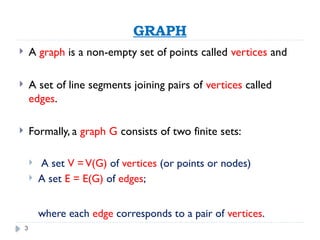
A graphis a non-empty set of points called vertices and
A set of line segments joining pairs of vertices called
edges.
Formally, a graph G consists of two finite sets:
A set V =V(G) of vertices (or points or nodes)
A set E = E(G) of edges;
where each edge corresponds to a pair of vertices.
4.
4
EXAMPLE
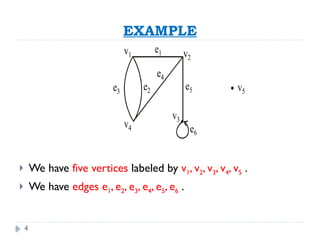
We havefive vertices labeled by v1, v2, v3, v4, v5 .
We have edges e1, e2, e3, e4, e5, e6 .
e3 e2
e1
e5
e4
v1 v2
v3
e6
v5
v4
5.
5
e1 edgeis for vertices v1 and v2 .
e2 and e3 are end points v1 and v4.
e4 has end points v2 and v4 .
e5 has end points v2 and v3 .
e6 is a loop .
6.
6
SOME TERMINOLOGY
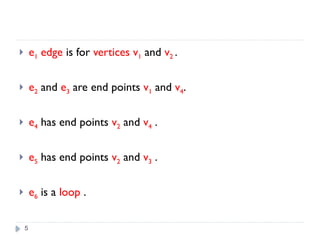
Anedge connects either one or two vertices called its
endpoints (edge e1 connects vertices v1 and v2 described
as {v1, v2} i.e v1 and v2 are the endpoints of an edge e1).
e3 e2
e1
e5
e4
v1 v2
v3
e6
v5
v4
7.
7
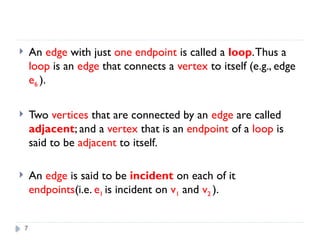
An edgewith just one endpoint is called a loop.Thus a
loop is an edge that connects a vertex to itself (e.g., edge
e6 ).
Two vertices that are connected by an edge are called
adjacent; and a vertex that is an endpoint of a loop is
said to be adjacent to itself.
An edge is said to be incident on each of it
endpoints(i.e. e1 is incident on v1 and v2 ).
8.
8
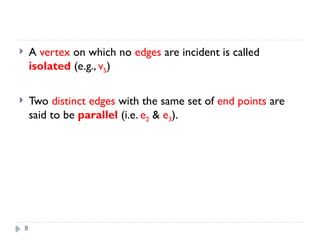
A vertexon which no edges are incident is called
isolated (e.g., v5)
Two distinct edges with the same set of end points are
said to be parallel (i.e. e2 & e3).
9.
9
EXAMPLE
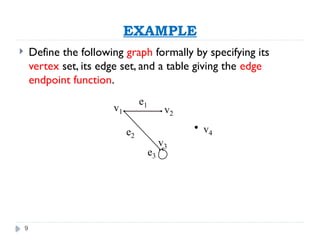
Define thefollowing graph formally by specifying its
vertex set, its edge set, and a table giving the edge
endpoint function.
v1 v2
v3
e1
e2
e3
v4
10.
10
SOLUTION
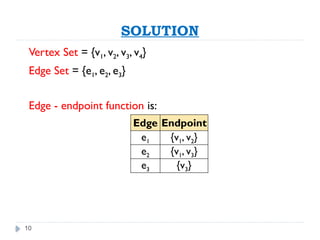
Vertex Set ={v1, v2, v3, v4}
Edge Set = {e1, e2, e3}
Edge - endpoint function is:
Edge Endpoint
e1 {v1, v2}
e2 {v1, v3}
e3 {v3}
11.
11
EXAMPLE
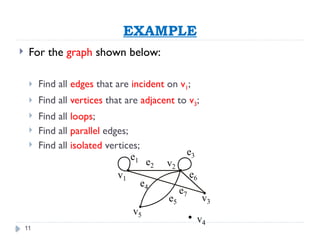
For thegraph shown below:
Find all edges that are incident on v1;
Find all vertices that are adjacent to v3;
Find all loops;
Find all parallel edges;
Find all isolated vertices;
e1 e2
e3
e4
e5
e6
e7
v1
v2
v3
v4
v5
12.
12
SOLUTION
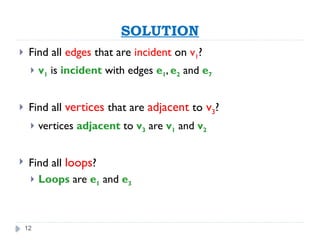
Find alledges that are incident on v1?
v1 is incident with edges e1, e2 and e7
Find all vertices that are adjacent to v3?
vertices adjacent to v3 are v1 and v2
Find all loops?
Loops are e1 and e3
13.
13
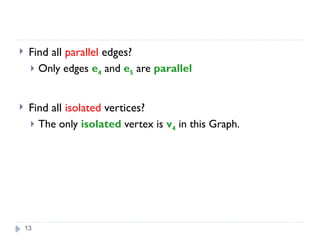
Find allparallel edges?
Only edges e4 and e5 are parallel
Find all isolated vertices?
The only isolated vertex is v4 in this Graph.
14.
14
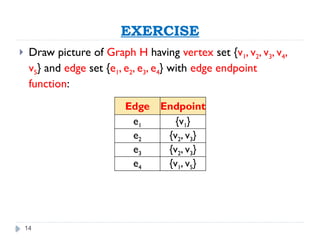
EXERCISE
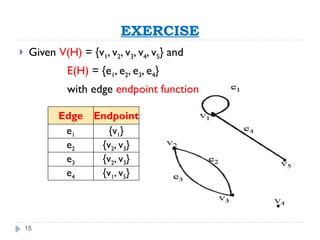
Draw pictureof Graph H having vertex set {v1, v2, v3, v4,
v5} and edge set {e1, e2, e3, e4} with edge endpoint
function:
Edge Endpoint
e1 {v1}
e2 {v2, v3}
e3 {v2, v3}
e4 {v1, v5}
15.
15
EXERCISE
Given V(H)= {v1, v2, v3, v4, v5} and
E(H) = {e1, e2, e3, e4}
with edge endpoint function
Edge Endpoint
e1 {v1}
e2 {v2, v3}
e3 {v2, v3}
e4 {v1, v5}
16.
16
SIMPLE GRAPH
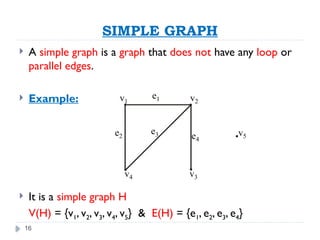
Asimple graph is a graph that does not have any loop or
parallel edges.
Example:
It is a simple graph H
V(H) = {v1, v2, v3, v4, v5} & E(H) = {e1, e2, e3, e4}
e1
e2
e3 e4
v5
v1 v2
v3
v4
17.
17
EXERCISE
Draw allsimple graphs with the four vertices {u, v, w, x}
and two edges, one of which is {u, v}.
Solution:
We are given four vertices {u, v, w, x} and one edge
is {u, v}.
Since we are interested in simple graph so we cannot
take {u, v} again.
18.
18
There areC(4,2) = 6 ways of choosing two vertices from
4 vertices.
These edges may be listed as:
{u, v}, {u, w}, {u, x}, {v, w}, {v, x}, {w, x}
One edge of the graph is specified to be {u, v}, so any of
the remaining five from this list may be chosen to be the
second edge.
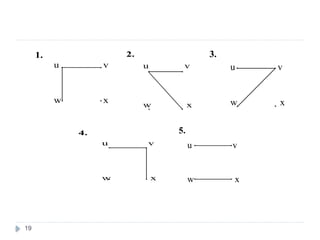
This required graphs are:
20
DEGREE OF AVERTEX
Let G be a graph and v a vertex of G.The degree of v,
denoted deg(v), equals the number of edges that are
incident on v, with an edge that is a loop counted twice.
The total degree of G is the sum of the degrees of all
the vertices of G.
The degree of a loop is counted twice.
21.
21
EXAMPLE
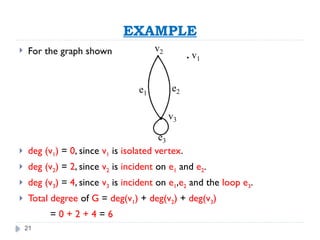
For thegraph shown
deg (v1) = 0, since v1 is isolated vertex.
deg (v2) = 2, since v2 is incident on e1 and e2.
deg (v3) = 4, since v3 is incident on e1,e2 and the loop e3.
Total degree of G = deg(v1) + deg(v2) + deg(v3)
= 0 + 2 + 4 = 6
e1
e2
v2
v3
e3
. v1
22.
22
NOTE
The totaldegree of G, which is 6, equals twice the
number of edges of G, which is 3.
This is always the case the total degree of graph is always
twice the number of edges in that graph.This is actually
the theorem called Handshaking Theorem.
23.
23
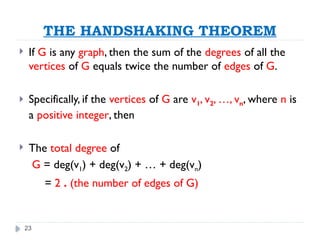
THE HANDSHAKING THEOREM
If G is any graph, then the sum of the degrees of all the
vertices of G equals twice the number of edges of G.
Specifically, if the vertices of G are v1, v2, …, vn, where n is
a positive integer, then
The total degree of
G = deg(v1) + deg(v2) + … + deg(vn)
= 2 . (the number of edges of G)
25
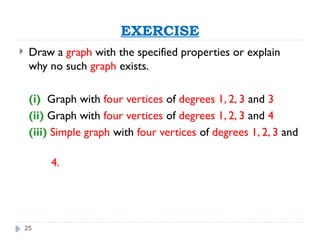
EXERCISE
Draw agraph with the specified properties or explain
why no such graph exists.
(i) Graph with four vertices of degrees 1, 2, 3 and 3
(ii) Graph with four vertices of degrees 1, 2, 3 and 4
(iii) Simple graph with four vertices of degrees 1, 2, 3 and
4.
26.
26
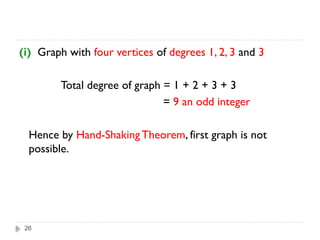
(i) Graph withfour vertices of degrees 1, 2, 3 and 3
Total degree of graph = 1 + 2 + 3 + 3
= 9 an odd integer
Hence by Hand-Shaking Theorem, first graph is not
possible.
27.
27
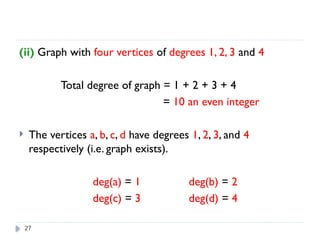
(ii) Graph withfour vertices of degrees 1, 2, 3 and 4
Total degree of graph = 1 + 2 + 3 + 4
= 10 an even integer
The vertices a, b, c, d have degrees 1, 2, 3, and 4
respectively (i.e. graph exists).
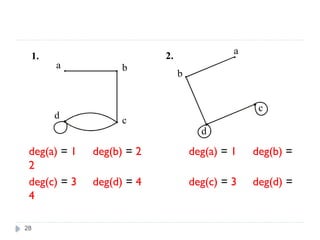
deg(a) = 1 deg(b) = 2
deg(c) = 3 deg(d) = 4
28.
28
deg(a) = 1deg(b) = 2 deg(a) = 1 deg(b) =
2
deg(c) = 3 deg(d) = 4 deg(c) = 3 deg(d) =
4
a b
c
d
1.
a
b
c
d
2.
29.
29
(iii) Simple graphwith four vertices of degrees 1, 2, 3 and 4.
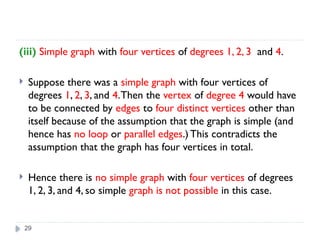
Suppose there was a simple graph with four vertices of
degrees 1, 2, 3, and 4.Then the vertex of degree 4 would have
to be connected by edges to four distinct vertices other than
itself because of the assumption that the graph is simple (and
hence has no loop or parallel edges.)This contradicts the
assumption that the graph has four vertices in total.
Hence there is no simple graph with four vertices of degrees
1, 2, 3, and 4, so simple graph is not possible in this case.
30.
30
EXERCISE
Suppose agraph has vertices of degrees 1, 1, 4, 4 and 6.
How many edges does the graph have?
SOLUTION:
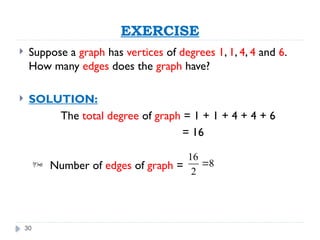
The total degree of graph = 1 + 1 + 4 + 4 + 6
= 16
Number of edges of graph =
16
8
2
31.
31
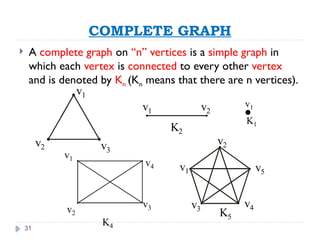
COMPLETE GRAPH
Acomplete graph on “n” vertices is a simple graph in
which each vertex is connected to every other vertex
and is denoted by Kn (Kn means that there are n vertices).
K1
v1
v1 v2
K2
v1
v2 v3
v1
v2
v3
v4
K4
v1
v2
v3
v4
v5
K5
32.
32
REGULAR GRAPH
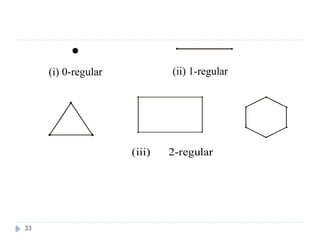
Agraph G is regular graph of degree k or k-regular if
every vertex of G has degree k.
In other words, a graph is regular if every vertex has the
same degree.
Following are some regular graphs.
34
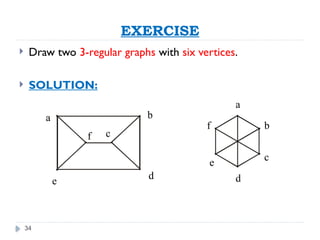
EXERCISE
Draw two3-regular graphs with six vertices.
SOLUTION:
a b
c
d
e
f
a
b
c
d
e
f
35.
35
BIPARTITE GRAPH
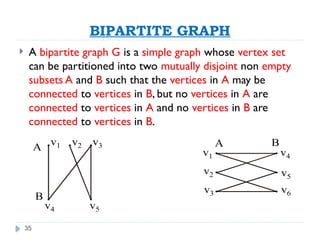
Abipartite graph G is a simple graph whose vertex set
can be partitioned into two mutually disjoint non empty
subsets A and B such that the vertices in A may be
connected to vertices in B, but no vertices in A are
connected to vertices in A and no vertices in B are
connected to vertices in B.
A B
v1
v2
v3
v4
v5
v6
A
B
v1 v2 v3
v4 v5
36.
36
MATRIX REPRESENTATIONS OF
GRAPHS
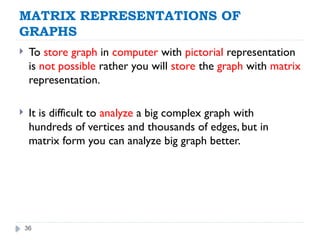
To store graph in computer with pictorial representation
is not possible rather you will store the graph with matrix
representation.
It is difficult to analyze a big complex graph with
hundreds of vertices and thousands of edges, but in
matrix form you can analyze big graph better.
37.
37
MATRIX
An m n matrix A over a set S is a rectangular array of elements
of S arranged into m rows and n columns:
jth
column of A
Briefly, it is written as: A = [aij ] mn
11 12 1 1
21 22 2 2
1 2
1 2
j n
j n
i i ij in
m m mj mn
a a a a
a a a a
A
a a a a
a a a a
38.
38
EXAMPLE
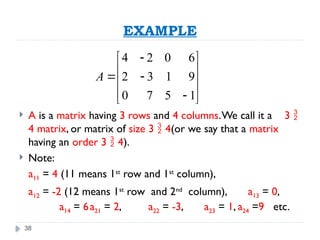
A isa matrix having 3 rows and 4 columns.We call it a 3
4 matrix, or matrix of size 3 4(or we say that a matrix
having an order 3 4).
Note:
a11 = 4 (11 means 1st
row and 1st
column),
a12 = -2 (12 means 1st
row and 2nd
column), a13 = 0,
a14 = 6a21 = 2, a22 = -3, a23 = 1, a24 =9 etc.
4 2 0 6
2 3 1 9
0 7 5 1
A
39.
39
SQUARE MATRIX
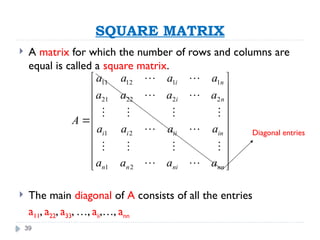
Amatrix for which the number of rows and columns are
equal is called a square matrix.
The main diagonal of A consists of all the entries
a11, a22, a33, …, aii,…, ann
11 12 1 1
21 22 2 2
1 2
1 2
i n
i n
i i ii in
n n ni nn
a a a a
a a a a
A
a a a a
a a a a
Diagonal entries
40.
40
TRANSPOSE OF AMATRIX
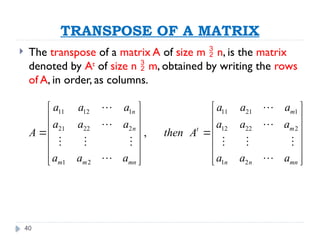
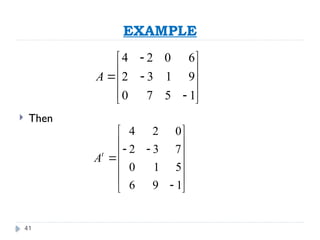
The transpose of a matrix A of size m n, is the matrix
denoted by At
of size n m, obtained by writing the rows
of A, in order, as columns.
11 12 1 11 21 1
21 22 2 12 22 2
1 2 1 2
,
n m
n m
t
m m mn n n mn
a a a a a a
a a a a a a
A then A
a a a a a a
42
SYMMETRIC MATRIX
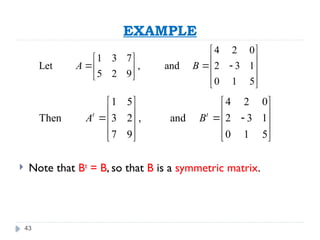
Asquare matrix A = [aij] of size n n is called symmetric
if, and only if, At
= A i.e., for all i, j = 1, 2, …, n, aij = aji
43.
43
EXAMPLE
Note thatBt
= B, so that B is a symmetric matrix.
4 2 0
1 3 7
Let , and 2 3 1
5 2 9
0 1 5
A B
1 5 4 2 0
Then 3 2 , and 2 3 1
7 9 0 1 5
t t
A B
44.
44
MATRIX MULTIPLICATION
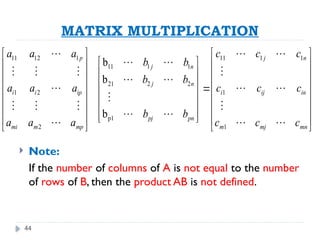
Note:
Ifthe number of columns of A is not equal to the number
of rows of B, then the product AB is not defined.
11 12 1 11 1 1
11 1 1
21 2 2
1 2 1
p1
2 1
b
b
b
p j n
j n
j n
i i ip i ij in
pj pn
mi m mp m mj mn
a a a c c c
b b
b b
a a a c c c
b b
a a a c c c
45.
45
EXAMPLE
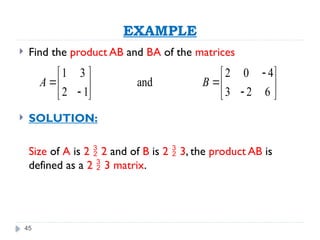
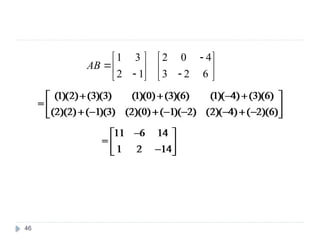
Find theproduct AB and BA of the matrices
SOLUTION:
Size of A is 2 2 and of B is 2 3, the product AB is
defined as a 2 3 matrix.
1 3 2 0 4
and
2 1 3 2 6
A B
47
ADJACENCY MATRIX OFA GRAPH
Let G be a graph with ordered vertices v1, v2,..., vn.The
adjacency matrix of G is the matrix A = [aij] over the set
of non-negative integers such that
aij = the number of edges connecting vi and vj
for all i, j = 1, 2, …, n.
OR
The adjancy matrix say A= [aij] is also defined as
,
1 { }
0
i j
ij
if v v is anedgeof G
a
otherwise
48.
48
EXAMPLE
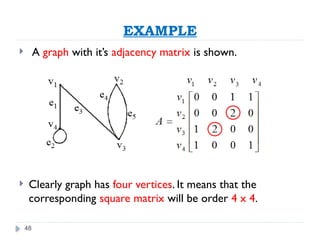
A graphwith it’s adjacency matrix is shown.
Clearly graph has four vertices. It means that the
corresponding square matrix will be order 4 x 4.
49.
49
EXERCISE
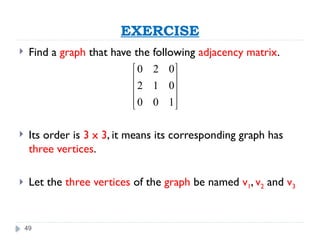
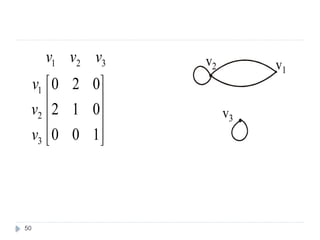
Find agraph that have the following adjacency matrix.
Its order is 3 x 3, it means its corresponding graph has
three vertices.
Let the three vertices of the graph be named v1, v2 and v3
0 2 0
2 1 0
0 0 1
51
DIRECTED GRAPH
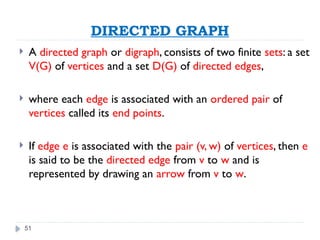
Adirected graph or digraph, consists of two finite sets: a set
V(G) of vertices and a set D(G) of directed edges,
where each edge is associated with an ordered pair of
vertices called its end points.
If edge e is associated with the pair (v, w) of vertices, then e
is said to be the directed edge from v to w and is
represented by drawing an arrow from v to w.
53
ADJACENCY MATRIX OFA
DIRECTED GRAPH
Let G be a graph with ordered vertices
v1, v2, …, vn.
The adjacency matrix of G is the matrix A = [aij] over the
set of non-negative integers such that
aij = the number of arrows from vi to vj
for all i, j = 1, 2, …, n.
54.
54
EXAMPLE
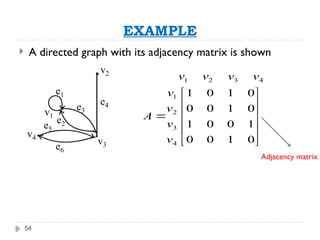
A directedgraph with its adjacency matrix is shown
0
1
0
0
1
0
0
1
0
1
0
0
0
1
0
1
4
3
2
1
4
3
2
1
v
v
v
v
A
v
v
v
v
e1
v1
e2
v4
e6
e5
e3
v2
e4
v3
Adjacency matrix
55.
55
EXERCISE
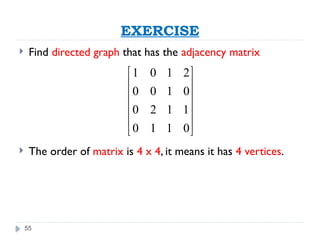
Find directedgraph that has the adjacency matrix
The order of matrix is 4 x 4, it means it has 4 vertices.
1 0 1 2
0 0 1 0
0 2 1 1
0 1 1 0
56.
56
SOLUTION
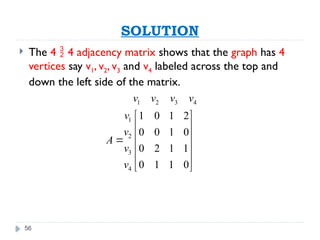
The 4 4 adjacency matrix shows that the graph has 4
vertices say v1, v2, v3 and v4 labeled across the top and
down the left side of the matrix.
1 2 3 4
1
2
3
4
1 0 1 2
0 0 1 0
0 2 1 1
0 1 1 0
v v v v
v
v
A
v
v
57.
57
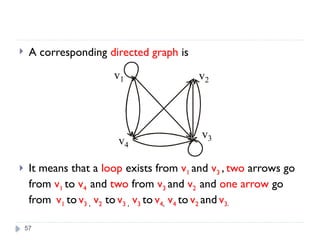
A correspondingdirected graph is
It means that a loop exists from v1 and v3 , two arrows go
from v1 to v4 and two from v3 and v2 and one arrow go
from v1 to v3 , v2 to v3 , v3 to v4, v4 to v2 and v3.
v1
v4
v2
v3
58.
58
INCIDENCE MATRIX OFA SIMPLE
GRAPH
Let G be a graph with vertices v1, v2, …, vn and edges e1,
e2, …, en.
The incidence matrix of G is the matrix M = [mij] of size
n m defined by:
1 if the vertex is incident on the edge
0 otherwise
i j
ij
v e
m
60
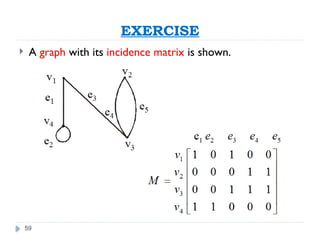
REMARK
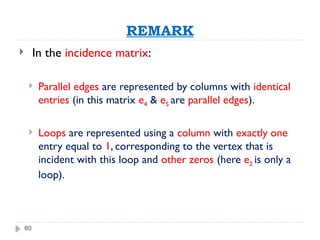
In theincidence matrix:
Parallel edges are represented by columns with identical
entries (in this matrix e4 & e5 are parallel edges).
Loops are represented using a column with exactly one
entry equal to 1, corresponding to the vertex that is
incident with this loop and other zeros (here e2 is only a
loop).
![37
MATRIX
An m n matrix A over a set S is a rectangular array of elements
of S arranged into m rows and n columns:
jth
column of A
Briefly, it is written as: A = [aij ] mn
11 12 1 1
21 22 2 2
1 2
1 2
j n
j n
i i ij in
m m mj mn
a a a a
a a a a
A
a a a a
a a a a
](https://image.slidesharecdn.com/lecture22-250812164303-200c33c7/85/Tree-introduction-and-Applications-Lecture-22-pptx-37-320.jpg)
![42
SYMMETRIC MATRIX
A square matrix A = [aij] of size n n is called symmetric
if, and only if, At
= A i.e., for all i, j = 1, 2, …, n, aij = aji](https://image.slidesharecdn.com/lecture22-250812164303-200c33c7/85/Tree-introduction-and-Applications-Lecture-22-pptx-42-320.jpg)
![47
ADJACENCY MATRIX OF A GRAPH
Let G be a graph with ordered vertices v1, v2,..., vn.The
adjacency matrix of G is the matrix A = [aij] over the set
of non-negative integers such that
aij = the number of edges connecting vi and vj
for all i, j = 1, 2, …, n.
OR
The adjancy matrix say A= [aij] is also defined as
,
1 { }
0
i j
ij
if v v is anedgeof G
a
otherwise
](https://image.slidesharecdn.com/lecture22-250812164303-200c33c7/85/Tree-introduction-and-Applications-Lecture-22-pptx-47-320.jpg)
![53
ADJACENCY MATRIX OF A
DIRECTED GRAPH
Let G be a graph with ordered vertices
v1, v2, …, vn.
The adjacency matrix of G is the matrix A = [aij] over the
set of non-negative integers such that
aij = the number of arrows from vi to vj
for all i, j = 1, 2, …, n.](https://image.slidesharecdn.com/lecture22-250812164303-200c33c7/85/Tree-introduction-and-Applications-Lecture-22-pptx-53-320.jpg)
![58
INCIDENCE MATRIX OF A SIMPLE
GRAPH
Let G be a graph with vertices v1, v2, …, vn and edges e1,
e2, …, en.
The incidence matrix of G is the matrix M = [mij] of size
n m defined by:
1 if the vertex is incident on the edge
0 otherwise
i j
ij
v e
m
](https://image.slidesharecdn.com/lecture22-250812164303-200c33c7/85/Tree-introduction-and-Applications-Lecture-22-pptx-58-320.jpg)