Syed Muhammad Ali Zahid
Department of Entomology
University College of Agriculture
University of Sargodha
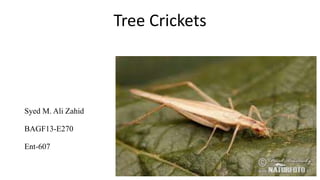
Tree Crickets
Syed M. Ali Zahid
BAGF13-E270
Ent-607
Taxonomy
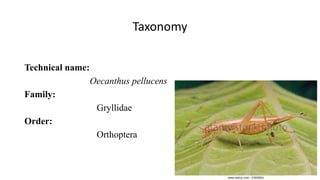
Technical name:
Oecanthus pellucens
Family:
Gryllidae
Order:
Orthoptera
Distribution
• They are distributed worldwide
• Most common in central and western Asia, northern Africa, southern
and central Europe.
• It occurs on vegetation, usually up to the height of 1 m where it walks
on stalks, leaves and flowers
• These are polyphagous in nature
Habitat
• Their typical habitat are sunny meadows with high vegetation
• Dry warm and nutrient-poor areas
• Such as grasslands, sand dunes and brownfield lands.
Identification
• They are yellowish brown or straw-colored
• Their body is very elongated and selender-
like
• Wings usually protrude out slightly above
the abdomen, but can be shorter or longer
• Females are short winged and the wings of
the males are larger than those of females
Conti….
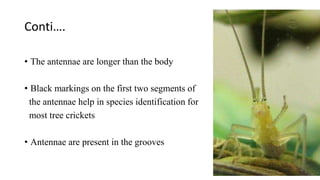
• The antennae are longer than the body
• Black markings on the first two segments of
the antennae help in species identification for
most tree crickets
• Antennae are present in the grooves
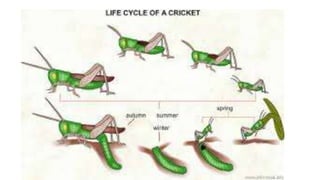
Life cycle
• After mating, the female lays eggs in
plant stems.
• Till June, the nymphs live in the tissue
and leaves of the plant.
• A few days after the last molt the male
begins to sing.
Biology
• Length of adult male is up to 10–13 millimetres
• Female is slightly larger than the male, about 11–14 millimetres long
• They can be encountered from July through October.
• This cricket is mainly nocturnal
Conti….
• The ovipositor of the
female is long and
slightly curved.
• The females are
recognizable by the
club-shaped end of the
ovipositor
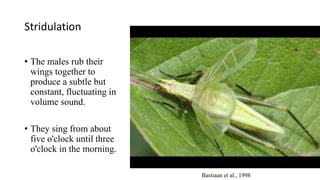
Stridulation
• The males rub their
wings together to
produce a subtle but
constant, fluctuating in
volume sound.
• They sing from about
five o'clock until three
o'clock in the morning.
Bastiaan et al., 1998
Damage & Control
• These crickets are omnivorous and usually feed on leaves or delicate
flower parts such as pollen and petals
• But also on animal foods such as aphids, spiders and insect larvae
• These insects don’t damage our field crops and don’t cause any
economic loss to humans
• That’s why, there is no need to control these crickets
Reference
• Bastiaan M. Drees & John A. Jackman (1998). ”Tree cricket”. A Field
Guide to Common Texas Insects. Lanham, MD: Gulf
Publishing.ISBN 0-87719-263-4.
• "Newsletter 32, Autumn 2015" (PDF). Grasshoppers and Related
Species Recording Scheme of Britain and Ireland. p. 8. Retrieved 3
November 2015.
• Distribution and Infiltration of the Tree Cricket Oecanthus pellucens
(Scopoli, 1763) to Unoriginal Conditions in Slovakia. Bull. Soc. Nat.
luxemb. 102 (2001). p. 103-108.

Tree crickets

  • 1.
    Syed Muhammad AliZahid Department of Entomology University College of Agriculture University of Sargodha
  • 2.
    Tree Crickets Syed M.Ali Zahid BAGF13-E270 Ent-607
  • 3.
  • 4.
    Distribution • They aredistributed worldwide • Most common in central and western Asia, northern Africa, southern and central Europe. • It occurs on vegetation, usually up to the height of 1 m where it walks on stalks, leaves and flowers • These are polyphagous in nature
  • 5.
    Habitat • Their typicalhabitat are sunny meadows with high vegetation • Dry warm and nutrient-poor areas • Such as grasslands, sand dunes and brownfield lands.
  • 6.
    Identification • They areyellowish brown or straw-colored • Their body is very elongated and selender- like • Wings usually protrude out slightly above the abdomen, but can be shorter or longer • Females are short winged and the wings of the males are larger than those of females
  • 7.
    Conti…. • The antennaeare longer than the body • Black markings on the first two segments of the antennae help in species identification for most tree crickets • Antennae are present in the grooves
  • 8.
    Life cycle • Aftermating, the female lays eggs in plant stems. • Till June, the nymphs live in the tissue and leaves of the plant. • A few days after the last molt the male begins to sing.
  • 10.
    Biology • Length ofadult male is up to 10–13 millimetres • Female is slightly larger than the male, about 11–14 millimetres long • They can be encountered from July through October. • This cricket is mainly nocturnal
  • 11.
    Conti…. • The ovipositorof the female is long and slightly curved. • The females are recognizable by the club-shaped end of the ovipositor
  • 12.
    Stridulation • The malesrub their wings together to produce a subtle but constant, fluctuating in volume sound. • They sing from about five o'clock until three o'clock in the morning. Bastiaan et al., 1998
  • 13.
    Damage & Control •These crickets are omnivorous and usually feed on leaves or delicate flower parts such as pollen and petals • But also on animal foods such as aphids, spiders and insect larvae • These insects don’t damage our field crops and don’t cause any economic loss to humans • That’s why, there is no need to control these crickets
  • 14.
    Reference • Bastiaan M.Drees & John A. Jackman (1998). ”Tree cricket”. A Field Guide to Common Texas Insects. Lanham, MD: Gulf Publishing.ISBN 0-87719-263-4. • "Newsletter 32, Autumn 2015" (PDF). Grasshoppers and Related Species Recording Scheme of Britain and Ireland. p. 8. Retrieved 3 November 2015. • Distribution and Infiltration of the Tree Cricket Oecanthus pellucens (Scopoli, 1763) to Unoriginal Conditions in Slovakia. Bull. Soc. Nat. luxemb. 102 (2001). p. 103-108.