Transportation Operations inTransportation Operations in
Action: Financing OperationsAction: Financing Operations
Institute of Transportation Engineers
2009 Technical Conference and Exhibit
Dr. Margaret M. Cusack, PMP
Congestion: Solution = ITSCongestion: Solution = ITS
 Incident detection & rapid clearance
 HELP Programs
 Advanced Traveler Information Systems (ATIS)
 Automated Traffic Management Systems (ATMS)
 Congestion management/congestion pricing
 Managed lanes/HOV/HOT
– Limited access, eligibility requirements, etc.
 ORT
 Forecast models
The real reason for ITS:The real reason for ITS:
CRASH PREVENTIONCRASH PREVENTION
 6,420,000 auto accidents in the United States in
2005.
 The financial cost of these crashes is more than
230 Billion dollars.
 2.9 million people were injured and 42,636 people
killed.
 About 115 people die every day in vehicle crashes
in the United States -- one death every 13 minutes.
Context: What makes ITSContext: What makes ITS
hard to plan for and fund?hard to plan for and fund?
 For transportation
agencies it is a foreign
concept that there is a
type of project that
does not end.
 Transportation and
infrastructure
financing is typically
rigid and habitual.
 Software development
expertise, and
communications
design – both required
elements of ITS
systems – are typically
not found in a
department of
transportation.
SCALESCALE
Federal ITS Programs
Statewide/Regional ITS Programs
Local ITS Programs
– New York
– Los Angeles
– Salt Lake City
– Atlanta
– Etc………….
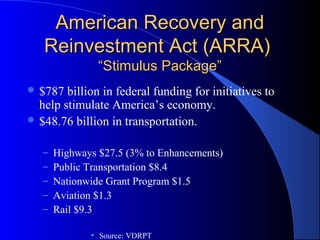
American Recovery andAmerican Recovery and
Reinvestment Act (ARRA)Reinvestment Act (ARRA)
“Stimulus Package”“Stimulus Package”
 $787 billion in federal funding for initiatives to
help stimulate America’s economy.
 $48.76 billion in transportation.
– Highways $27.5 (3% to Enhancements)
– Public Transportation $8.4
– Nationwide Grant Program $1.5
– Aviation $1.3
– Rail $9.3
• Source: VDRPT
Tuesday, March 3, 2009Tuesday, March 3, 2009
President Barack Obama, joined by Vice
President Joe Biden and U.S. Transportation
Secretary Ray LaHood, (at the USDOT in
Washington) today marked the release of $26.6
billion from the American Recovery and
Reinvestment Act (ARRA) to states and local
transportation authorities to repair and build
highways, roads and bridges.
TIGER TeamTIGER Team
At the ceremony the President unveiled new
logos for government-wide projects completed
under the ARRA and the Transportation
Investments Generating Economic Recovery
(TIGER) logo for transportation projects
completed under the ARRA.
TIGER TeamTIGER Team
 According to Calvin Scovel, USDOT Inspector
General, the TIGER Team is dealing with a large
infusion of money, which must be distributed
quickly and using only existing staff resources.
 This will force the department (USDOT) to limit
its focus on its mission of transportation safety.
• http://www.transportgooru.com
Transportation funds:Transportation funds:
Not just for USDOT…..Not just for USDOT…..
 142M to Coast Guard for alteration or removal of
obstructive bridges
 150M to FEMA for Public Transportation (rail)
Security; and 150M for Port Security
 180M to Bureau of Land Management for roads,
bridges, trails, etc…
 165M to US Fish & Wildlife for construction and
repair of roads, bridges, etc….
 589M to National Park Service for critical
infrastructure projects ……
 USGS, BIA, Dept. of Agriculture…..
A good question:A good question:
(found on www.recovery.gov)(found on www.recovery.gov)
Q: I heard I'd be able to track recovery
funds. Why can't I do that?
A: You aren't able to track funds yet because we
have not yet started receiving information from
Federal agencies on how they are going to allocate
the money. It takes a little bit of time for them to
make sure your money is going to be spent wisely.
…. You will have access to data as soon as we begin
receiving it from agencies.
USDOTUSDOT
$1.5B through September 30, 2011
– 20 to 300M grants
– Significant impact on the Nation; a
metropolitan area; or a region
$27.5B through September 30, 2010
– Projects funded at 50%
– Projects that have to be completed in 3 years
– Isn’t that past the 2010 deadline????
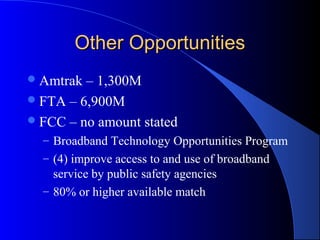
Other OpportunitiesOther Opportunities
Amtrak – 1,300M
FTA – 6,900M
FCC – no amount stated
– Broadband Technology Opportunities Program
– (4) improve access to and use of broadband
service by public safety agencies
– 80% or higher available match
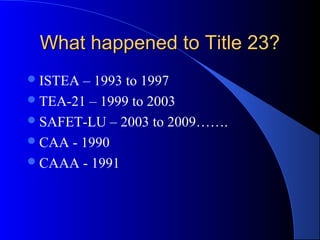
What happened to Title 23?What happened to Title 23?
ISTEA – 1993 to 1997
TEA-21 – 1999 to 2003
SAFET-LU – 2003 to 2009…….
CAA - 1990
CAAA - 1991
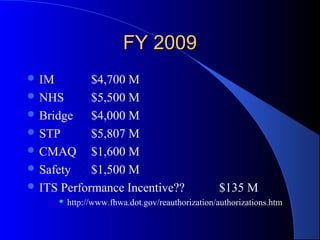
FY 2009FY 2009
 IM $4,700 M
 NHS $5,500 M
 Bridge $4,000 M
 STP $5,807 M
 CMAQ $1,600 M
 Safety $1,500 M
 ITS Performance Incentive?? $135 M
 http://www.fhwa.dot.gov/reauthorization/authorizations.htm
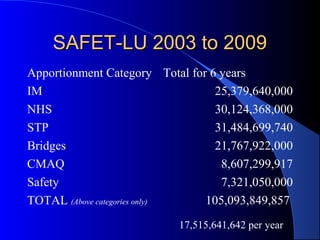
SAFET-LU 2003 to 2009SAFET-LU 2003 to 2009
Apportionment Category Total for 6 years
IM 25,379,640,000
NHS 30,124,368,000
STP 31,484,699,740
Bridges 21,767,922,000
CMAQ 8,607,299,917
Safety 7,321,050,000
TOTAL (Above categories only) 105,093,849,857
17,515,641,642 per year
Title 23 FundingTitle 23 Funding
If it will be re-authorized, at what levels?
Does the stimulus package diminish the
perception of a need for funding?
The ARRA does not authorize spending in
many important areas
The ARRA does not even mention ITS
ARRA model vs. ISTEA modelARRA model vs. ISTEA model
ARRA = Federal agency staff determines
allocation
– By program?
– By project?
Surface Transportation Legislation =
State Governments determine programming
policies for funding, following established
programming processes
Onward and UpwardOnward and Upward
We have elevated the traveler’s
expectations to the point where ceasing the
operations activities we now have
developed would be unheard of.
Only embellishment and improvement to
ITS programs will be accepted.
State GovernmentsState Governments
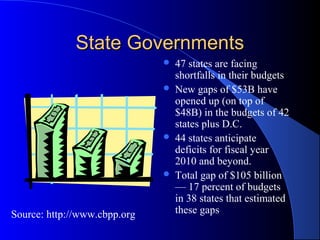
 47 states are facing
shortfalls in their budgets
 New gaps of $53B have
opened up (on top of
$48B) in the budgets of 42
states plus D.C.
 44 states anticipate
deficits for fiscal year
2010 and beyond.
 Total gap of $105 billion
— 17 percent of budgets
in 38 states that estimated
these gapsSource: http://www.cbpp.org
City GovernmentsCity Governments
 New York: Estimates
a budget gap of $1.2
billion in 2010. Budget
gap projection for
2011 is now $4.8
billion.
 San Diego: The total
budget for Fiscal Year
2009 is $3.13 billion
(no gap reported).
Horse goes before the cartHorse goes before the cart
 Have a defensible plan for building the ITS
infrastructure.
– Traffic flow studies
– Identify target areas or corridors
– Cost benefit analysis of implementation
– Communications plan
– Maintenance and replacement plan
– Central software (ATIS/ATMS) acquisition and
development plan
Best approach for funding ITSBest approach for funding ITS
 Have project listed on the
TIP/STIP
 Convert (divert!) typical
highway funding into
multi-year program for
ITS implementation
– STP Flex/CMAQ?
 Collaborate with County
and City governments on
regional ITS solutions
Patience is a virtuePatience is a virtue
 Learn the funding cycles (Is you agency on a
fiscal year? Calendar year?)
 Learn the names and garner the support of those
who write the checks (equivalent to accounts
payable), pay the bills, manage the programs, and
know their way around the funding cycles
 Learn your own accounting system (PIN numbers,
funding categories, coding, etc….)
Be aware of political processBe aware of political process
 Elections can be show stoppers
 Approvals just after an election can be good for
stability (four years to carry out an
implementation)
 Work hard for cross-jurisdictional projects
– State DOT and State Police
– State DOT and Tolling Authority
– State DOT and County of City government
– Highway and transit
Monitor ongoing maintenanceMonitor ongoing maintenance
and construction projectsand construction projects
Integrating ITS elements into planned
construction projects is typically a fraction
of project costs
One person can monitor all planned
construction projects as part of their duties
Bury fiber whenever possible
Maintenance contracts can also be
monitored for additions to your ITS
network
ConclusionConclusion
 There is a lot of Federal money out there right
now, strike while the iron is HOT!!!
 It will be spent rapidly
 If you can’t get your stand alone ITS project
funded on this cycle, find projects that are
receiving funding on your priority corridors and
collaborate
 Have your plans summarized at different levels
 Publish your plans in news letters or white papers

Transportation Operations In Action

  • 1.
    Transportation Operations inTransportationOperations in Action: Financing OperationsAction: Financing Operations Institute of Transportation Engineers 2009 Technical Conference and Exhibit Dr. Margaret M. Cusack, PMP
  • 2.
    Congestion: Solution =ITSCongestion: Solution = ITS  Incident detection & rapid clearance  HELP Programs  Advanced Traveler Information Systems (ATIS)  Automated Traffic Management Systems (ATMS)  Congestion management/congestion pricing  Managed lanes/HOV/HOT – Limited access, eligibility requirements, etc.  ORT  Forecast models
  • 3.
    The real reasonfor ITS:The real reason for ITS: CRASH PREVENTIONCRASH PREVENTION  6,420,000 auto accidents in the United States in 2005.  The financial cost of these crashes is more than 230 Billion dollars.  2.9 million people were injured and 42,636 people killed.  About 115 people die every day in vehicle crashes in the United States -- one death every 13 minutes.
  • 4.
    Context: What makesITSContext: What makes ITS hard to plan for and fund?hard to plan for and fund?  For transportation agencies it is a foreign concept that there is a type of project that does not end.  Transportation and infrastructure financing is typically rigid and habitual.  Software development expertise, and communications design – both required elements of ITS systems – are typically not found in a department of transportation.
  • 5.
    SCALESCALE Federal ITS Programs Statewide/RegionalITS Programs Local ITS Programs – New York – Los Angeles – Salt Lake City – Atlanta – Etc………….
  • 6.
    American Recovery andAmericanRecovery and Reinvestment Act (ARRA)Reinvestment Act (ARRA) “Stimulus Package”“Stimulus Package”  $787 billion in federal funding for initiatives to help stimulate America’s economy.  $48.76 billion in transportation. – Highways $27.5 (3% to Enhancements) – Public Transportation $8.4 – Nationwide Grant Program $1.5 – Aviation $1.3 – Rail $9.3 • Source: VDRPT
  • 7.
    Tuesday, March 3,2009Tuesday, March 3, 2009 President Barack Obama, joined by Vice President Joe Biden and U.S. Transportation Secretary Ray LaHood, (at the USDOT in Washington) today marked the release of $26.6 billion from the American Recovery and Reinvestment Act (ARRA) to states and local transportation authorities to repair and build highways, roads and bridges.
  • 8.
    TIGER TeamTIGER Team Atthe ceremony the President unveiled new logos for government-wide projects completed under the ARRA and the Transportation Investments Generating Economic Recovery (TIGER) logo for transportation projects completed under the ARRA.
  • 9.
    TIGER TeamTIGER Team According to Calvin Scovel, USDOT Inspector General, the TIGER Team is dealing with a large infusion of money, which must be distributed quickly and using only existing staff resources.  This will force the department (USDOT) to limit its focus on its mission of transportation safety. • http://www.transportgooru.com
  • 10.
    Transportation funds:Transportation funds: Notjust for USDOT…..Not just for USDOT…..  142M to Coast Guard for alteration or removal of obstructive bridges  150M to FEMA for Public Transportation (rail) Security; and 150M for Port Security  180M to Bureau of Land Management for roads, bridges, trails, etc…  165M to US Fish & Wildlife for construction and repair of roads, bridges, etc….  589M to National Park Service for critical infrastructure projects ……  USGS, BIA, Dept. of Agriculture…..
  • 11.
    A good question:Agood question: (found on www.recovery.gov)(found on www.recovery.gov) Q: I heard I'd be able to track recovery funds. Why can't I do that? A: You aren't able to track funds yet because we have not yet started receiving information from Federal agencies on how they are going to allocate the money. It takes a little bit of time for them to make sure your money is going to be spent wisely. …. You will have access to data as soon as we begin receiving it from agencies.
  • 12.
    USDOTUSDOT $1.5B through September30, 2011 – 20 to 300M grants – Significant impact on the Nation; a metropolitan area; or a region $27.5B through September 30, 2010 – Projects funded at 50% – Projects that have to be completed in 3 years – Isn’t that past the 2010 deadline????
  • 13.
    Other OpportunitiesOther Opportunities Amtrak– 1,300M FTA – 6,900M FCC – no amount stated – Broadband Technology Opportunities Program – (4) improve access to and use of broadband service by public safety agencies – 80% or higher available match
  • 14.
    What happened toTitle 23?What happened to Title 23? ISTEA – 1993 to 1997 TEA-21 – 1999 to 2003 SAFET-LU – 2003 to 2009……. CAA - 1990 CAAA - 1991
  • 15.
    FY 2009FY 2009 IM $4,700 M  NHS $5,500 M  Bridge $4,000 M  STP $5,807 M  CMAQ $1,600 M  Safety $1,500 M  ITS Performance Incentive?? $135 M  http://www.fhwa.dot.gov/reauthorization/authorizations.htm
  • 16.
    SAFET-LU 2003 to2009SAFET-LU 2003 to 2009 Apportionment Category Total for 6 years IM 25,379,640,000 NHS 30,124,368,000 STP 31,484,699,740 Bridges 21,767,922,000 CMAQ 8,607,299,917 Safety 7,321,050,000 TOTAL (Above categories only) 105,093,849,857 17,515,641,642 per year
  • 17.
    Title 23 FundingTitle23 Funding If it will be re-authorized, at what levels? Does the stimulus package diminish the perception of a need for funding? The ARRA does not authorize spending in many important areas The ARRA does not even mention ITS
  • 18.
    ARRA model vs.ISTEA modelARRA model vs. ISTEA model ARRA = Federal agency staff determines allocation – By program? – By project? Surface Transportation Legislation = State Governments determine programming policies for funding, following established programming processes
  • 19.
    Onward and UpwardOnwardand Upward We have elevated the traveler’s expectations to the point where ceasing the operations activities we now have developed would be unheard of. Only embellishment and improvement to ITS programs will be accepted.
  • 20.
    State GovernmentsState Governments 47 states are facing shortfalls in their budgets  New gaps of $53B have opened up (on top of $48B) in the budgets of 42 states plus D.C.  44 states anticipate deficits for fiscal year 2010 and beyond.  Total gap of $105 billion — 17 percent of budgets in 38 states that estimated these gapsSource: http://www.cbpp.org
  • 21.
    City GovernmentsCity Governments New York: Estimates a budget gap of $1.2 billion in 2010. Budget gap projection for 2011 is now $4.8 billion.  San Diego: The total budget for Fiscal Year 2009 is $3.13 billion (no gap reported).
  • 22.
    Horse goes beforethe cartHorse goes before the cart  Have a defensible plan for building the ITS infrastructure. – Traffic flow studies – Identify target areas or corridors – Cost benefit analysis of implementation – Communications plan – Maintenance and replacement plan – Central software (ATIS/ATMS) acquisition and development plan
  • 23.
    Best approach forfunding ITSBest approach for funding ITS  Have project listed on the TIP/STIP  Convert (divert!) typical highway funding into multi-year program for ITS implementation – STP Flex/CMAQ?  Collaborate with County and City governments on regional ITS solutions
  • 24.
    Patience is avirtuePatience is a virtue  Learn the funding cycles (Is you agency on a fiscal year? Calendar year?)  Learn the names and garner the support of those who write the checks (equivalent to accounts payable), pay the bills, manage the programs, and know their way around the funding cycles  Learn your own accounting system (PIN numbers, funding categories, coding, etc….)
  • 25.
    Be aware ofpolitical processBe aware of political process  Elections can be show stoppers  Approvals just after an election can be good for stability (four years to carry out an implementation)  Work hard for cross-jurisdictional projects – State DOT and State Police – State DOT and Tolling Authority – State DOT and County of City government – Highway and transit
  • 26.
    Monitor ongoing maintenanceMonitorongoing maintenance and construction projectsand construction projects Integrating ITS elements into planned construction projects is typically a fraction of project costs One person can monitor all planned construction projects as part of their duties Bury fiber whenever possible Maintenance contracts can also be monitored for additions to your ITS network
  • 27.
    ConclusionConclusion  There isa lot of Federal money out there right now, strike while the iron is HOT!!!  It will be spent rapidly  If you can’t get your stand alone ITS project funded on this cycle, find projects that are receiving funding on your priority corridors and collaborate  Have your plans summarized at different levels  Publish your plans in news letters or white papers