Transport Layer Security
(TLS/SSL, HTTPS)
0
Content
• What is TLS/SSL?
• How does TLS Work?
• The importance of HTTPS
• Benefits of Using HTTPS with TLS/SSL
• Advantage of TLS/SSL
• Disadvantage of TLS/SSL
• Common use cases for TLS/SSL
• TLS/SSL vulnerabilities and attacks
• Best practices for implementation and maintenance
• Conclusion
.
How Does TLS Work?
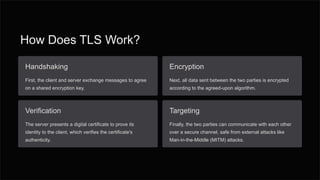
Handshaking
First, the client and server exchange messages to agree
on a shared encryption key.
Encryption
Next, all data sent between the two parties is encrypted
according to the agreed-upon algorithm.
Verification
The server presents a digital certificate to prove its
identity to the client, which verifies the certificate's
authenticity.
Targeting
Finally, the two parties can communicate with each other
over a secure channel, safe from external attacks like
Man-in-the-Middle (MITM) attacks.
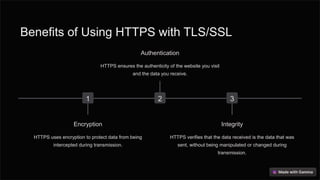
Benefits of Using HTTPS with TLS/SSL
1
Encryption
HTTPS uses encryption to protect data from being
intercepted during transmission.
2
Authentication
HTTPS ensures the authenticity of the website you visit
and the data you receive.
3
Integrity
HTTPS verifies that the data received is the data that was
sent, without being manipulated or changed during
transmission.
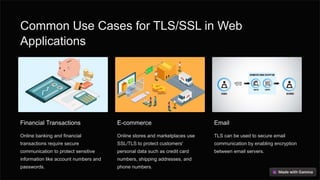
Common Use Cases for TLS/SSL in Web
Applications
Financial Transactions
Online banking and financial
transactions require secure
communication to protect sensitive
information like account numbers and
passwords.
E-commerce
Online stores and marketplaces use
SSL/TLS to protect customers'
personal data such as credit card
numbers, shipping addresses, and
phone numbers.
Email
TLS can be used to secure email
communication by enabling encryption
between email servers.
Conclusion
Transport Layer Security (TLS) plays a crucial role in ensuring secure
communication over the internet. With the adoption of HTTPS becoming
more widespread and TLS protocols evolving, online users can trust that
their data is protected from external threats when communicating over the
web.

Transport layer security computer network.pptx

  • 1.
  • 2.
    0 Content • What isTLS/SSL? • How does TLS Work? • The importance of HTTPS • Benefits of Using HTTPS with TLS/SSL • Advantage of TLS/SSL • Disadvantage of TLS/SSL • Common use cases for TLS/SSL • TLS/SSL vulnerabilities and attacks • Best practices for implementation and maintenance • Conclusion .
  • 4.
    How Does TLSWork? Handshaking First, the client and server exchange messages to agree on a shared encryption key. Encryption Next, all data sent between the two parties is encrypted according to the agreed-upon algorithm. Verification The server presents a digital certificate to prove its identity to the client, which verifies the certificate's authenticity. Targeting Finally, the two parties can communicate with each other over a secure channel, safe from external attacks like Man-in-the-Middle (MITM) attacks.
  • 6.
    Benefits of UsingHTTPS with TLS/SSL 1 Encryption HTTPS uses encryption to protect data from being intercepted during transmission. 2 Authentication HTTPS ensures the authenticity of the website you visit and the data you receive. 3 Integrity HTTPS verifies that the data received is the data that was sent, without being manipulated or changed during transmission.
  • 9.
    Common Use Casesfor TLS/SSL in Web Applications Financial Transactions Online banking and financial transactions require secure communication to protect sensitive information like account numbers and passwords. E-commerce Online stores and marketplaces use SSL/TLS to protect customers' personal data such as credit card numbers, shipping addresses, and phone numbers. Email TLS can be used to secure email communication by enabling encryption between email servers.
  • 12.
    Conclusion Transport Layer Security(TLS) plays a crucial role in ensuring secure communication over the internet. With the adoption of HTTPS becoming more widespread and TLS protocols evolving, online users can trust that their data is protected from external threats when communicating over the web.