Construction details of the transformer
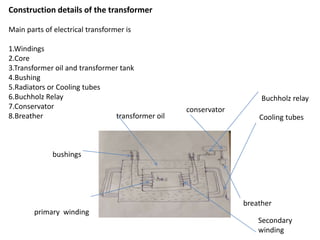
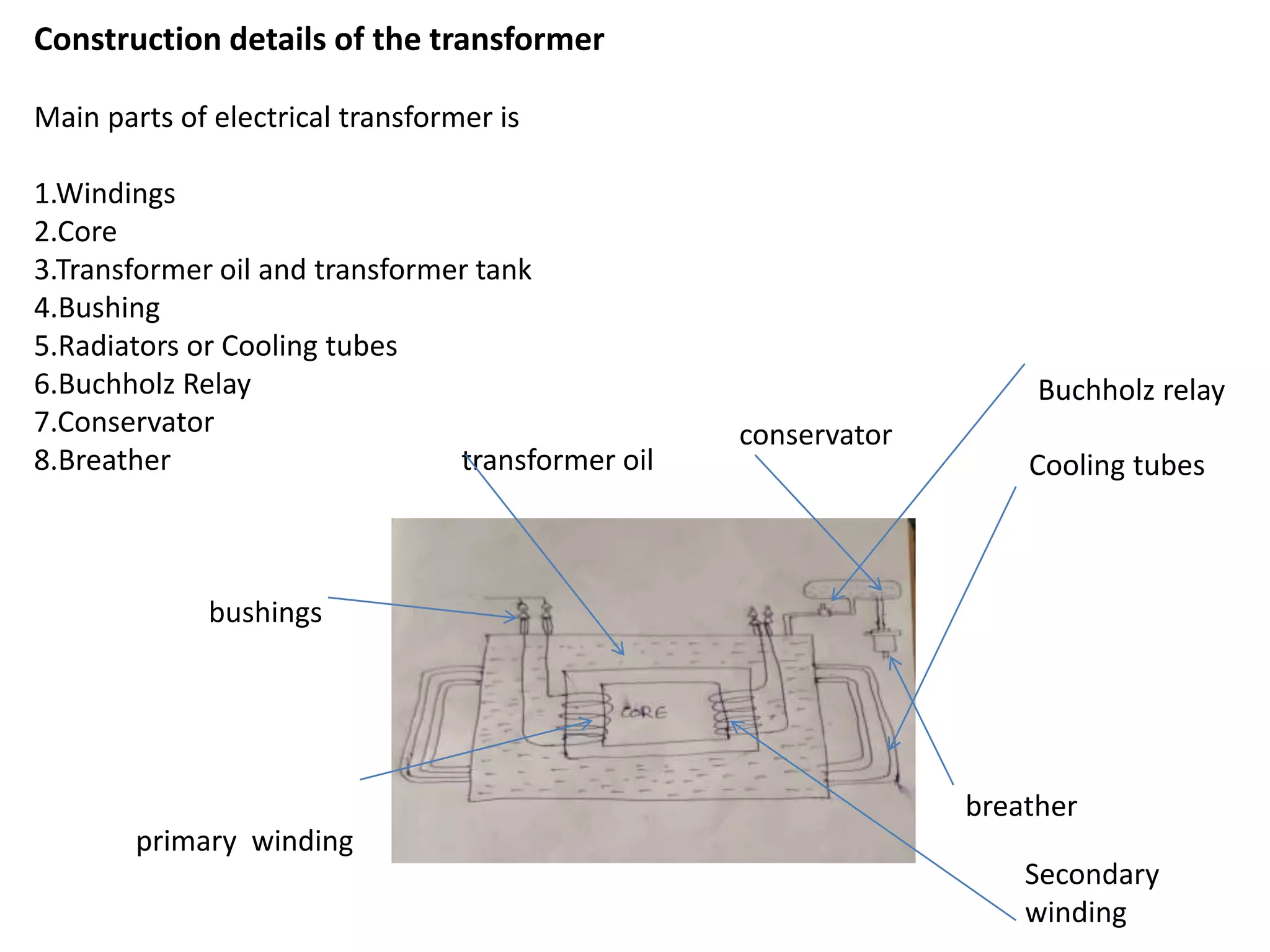
Main parts of electrical transformer is
1.Windings
2.Core
3.Transformer oil and transformer tank
4.Bushing
5.Radiators or Cooling tubes
6.Buchholz Relay
7.Conservator
8.Breather transformer oil
bushings
primary winding
Cooling tubes
conservator
breather
Secondary
winding
Buchholz relay
winding is going to connect supply voltage that winding is
called as primary winding
2.Seconday winding
winding which is connected to the load that winding is called
as primary winding
Windings
basically two types of windings.
1. primary winding
Important note
The winding connected to the high voltage circuit is called as high voltage winding
The winding connected to the low voltage circuit is called as low voltage winding
Transformer Core:
The transformer core is mainly used for to path for magnetic flux
• Transformer core is made with laminated silicon steel and soft iron
• Silicon steel laminations to provides low path for magnetic flux . It reduces the
eddy current losses due to laminations .
• The thickness of the laminations varies from 0.35mm to 0.5 mm
Transformer oil and Transformer tank
• The transformer oil act as a insulation medium between core and windings .Its
also act as cooling agent for core and windings. It absorb heat in the core And
winding
• Transformer tank is used to give protection core and windings. transformer
tanks consists of transformer oil, core, and windings
Conservator
Conservator is a tank . which is designed for storing the insulating oil in case
of temperature increases.
If the temperature increasing then the insulating oil of transformer is expands
so we need conservator.
Breather
Breather is used to absorb moisture from transformer oil. It consist of silica gel
The silica gel is a very good absorber of moisture . the color of silica gel is in
blue but it absorbs moisture it becomes pink.
Buchholz Relay
Buchholz relay is used to protect the transformer against internal faults . It gas
operating devices. It placed in between the transformer tank and conservator.
Cooling tubes
The cooling tubes are used to remove the heat from the transformer oil and
tank through this cooling tubes
Cooling agents used in cooling tubes are oil and gas which are passed in side
transformer to remove heat
Two type of cooling method
1.Natural cooling method
2forced cooling method
Working principle of Transformer
Transformer works on the principle of the faraday law of electromagnetic
induction and mutual induction
Working
AC supply is connected to primary winding of the transformer , current starts
Flowing through the primary winding. Current through the primary winding
produces alternating flux (ᶲ) in the core. This alternating flux links with the
secondary winding so it induced Emf in secondary winding according faraday
law of electromagnetic induction.
Important note:
The flux produced in the core not only links secondary winding but also links
with the primary winding and it produced a self –induced emf in the primary
winding .this induced emf opposes the applied voltage as per lenz’s law this
emf is sometime called back emf

Transformer2

  • 1.
    Construction details ofthe transformer Main parts of electrical transformer is 1.Windings 2.Core 3.Transformer oil and transformer tank 4.Bushing 5.Radiators or Cooling tubes 6.Buchholz Relay 7.Conservator 8.Breather transformer oil bushings primary winding Cooling tubes conservator breather Secondary winding Buchholz relay
  • 2.
    winding is goingto connect supply voltage that winding is called as primary winding 2.Seconday winding winding which is connected to the load that winding is called as primary winding Windings basically two types of windings. 1. primary winding Important note The winding connected to the high voltage circuit is called as high voltage winding The winding connected to the low voltage circuit is called as low voltage winding
  • 3.
    Transformer Core: The transformercore is mainly used for to path for magnetic flux • Transformer core is made with laminated silicon steel and soft iron • Silicon steel laminations to provides low path for magnetic flux . It reduces the eddy current losses due to laminations . • The thickness of the laminations varies from 0.35mm to 0.5 mm Transformer oil and Transformer tank • The transformer oil act as a insulation medium between core and windings .Its also act as cooling agent for core and windings. It absorb heat in the core And winding • Transformer tank is used to give protection core and windings. transformer tanks consists of transformer oil, core, and windings
  • 4.
    Conservator Conservator is atank . which is designed for storing the insulating oil in case of temperature increases. If the temperature increasing then the insulating oil of transformer is expands so we need conservator. Breather Breather is used to absorb moisture from transformer oil. It consist of silica gel The silica gel is a very good absorber of moisture . the color of silica gel is in blue but it absorbs moisture it becomes pink. Buchholz Relay Buchholz relay is used to protect the transformer against internal faults . It gas operating devices. It placed in between the transformer tank and conservator. Cooling tubes The cooling tubes are used to remove the heat from the transformer oil and tank through this cooling tubes Cooling agents used in cooling tubes are oil and gas which are passed in side transformer to remove heat Two type of cooling method 1.Natural cooling method 2forced cooling method
  • 5.
    Working principle ofTransformer Transformer works on the principle of the faraday law of electromagnetic induction and mutual induction Working AC supply is connected to primary winding of the transformer , current starts Flowing through the primary winding. Current through the primary winding produces alternating flux (ᶲ) in the core. This alternating flux links with the secondary winding so it induced Emf in secondary winding according faraday law of electromagnetic induction. Important note: The flux produced in the core not only links secondary winding but also links with the primary winding and it produced a self –induced emf in the primary winding .this induced emf opposes the applied voltage as per lenz’s law this emf is sometime called back emf