#TTE2016
#TTE2016
“Transform or be disrupted”
Can the traditional Tour Operators survive?
Marco Ryan
#TTE2016
Social me: feel free to tweet & connect
@marcoryan
www.marcoryan.com
uk.linkedin.com/in/marcoryan
www.marcoryanphotography.com
#TTE2016
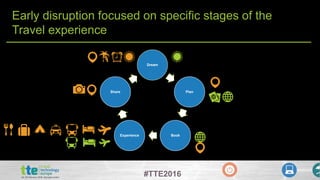
Early disruption focused on specific stages of the
Travel experience
Dream
Plan
BookExperience
Share
#TTE2016
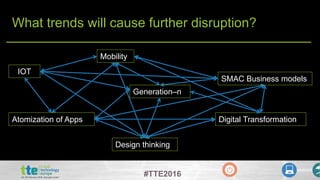
What trends will cause further disruption?
Generation–n
IOT
Atomization of Apps Digital Transformation
SMAC Business models
Mobility
Design thinking
#TTE2016
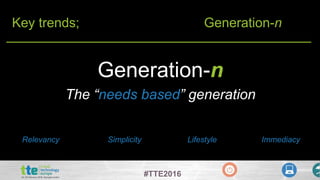
Key trends; Generation-n
Generation-n
The “needs based” generation
Relevancy Simplicity Lifestyle Immediacy
#TTE2016
What “needs” are tour operators fulfilling?
Convenience?
Price?
Value?
Trust?
Scale?
Flexibility?
Are they still a match for the
changing needs of their
customers?
#TTE2016
Key trends: Internet of Things (IOT)
SO WHAT?
 Data now becomes an Asset, Analytics a
hygiene factor
 New business models based around solutions
& Partnering
 Drive increasing Customer expectations
around friction fee Experience
EXAMPLES
 Virgin Atlantic, Milton Keynes Council, RR,
BGas, Fitness First, Disney, John Deere
#TTE2016
Key Trends: Atomization Of Apps
SO WHAT?
 Increases revenue opportunities for new
Solutions/services
 Provides more micro-measurement opportunity
 Customers increasingly less tolerant of App
boundaries and poor integration.
 Increased complexity of Customer Ownership
 Challenges IT and Mobile Roadmaps
EXAMPLES
 Spotify, WeChat
#TTE2016
Key Trends: Design Thinking
SO WHAT?
 Emotional responses build loyalty. Design
thinking ensures products and services drive
high loyalty.
 Often Require cultural shift and sometimes
leads to organizational change
 Products are often simpler, more focused but
always more relevant
EXAMPLES
 Nest, Square, Disney, GE, IBM, Apple
Return to
your
original
use group
and testing
for
feedback
Test
Build a
representa
tion of
your ideas
to how
others
Prototype
Brainstorm
and come
up with
creative
solutions
Ideate
Construct
a point of
view that
is based
on use
needs and
insights
Define
Learn
about the
audience
for whom
you are
designing
Empathize
#TTE2016
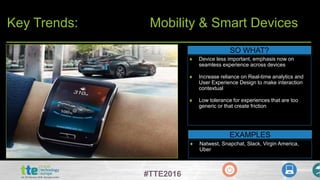
Key Trends: Mobility & Smart Devices
SO WHAT?
 Device less important, emphasis now on
seamless experience across devices
 Increase reliance on Real-time analytics and
User Experience Design to make interaction
contextual
 Low tolerance for experiences that are too
generic or that create friction
EXAMPLES
 Natwest, Snapchat, Slack, Virgin America,
Uber
#TTE2016
Key Trends: Digital Transformation
SO WHAT?
 Needs CEO leadership to succeed
 Culture change is critical as Digital needs to be
pervasive across organization
 Fundamentally different from Digitization
 For many organizations failure to transform will
 Sometimes difficult to “change the wings of the
aircraft in flight”
EXAMPLES
 Axel Springer, Delta, Air New Zealand, Thomas
Cook
#TTE2016
Key Trends: The Rise Of SMAC
SO WHAT?
EXAMPLES
 Increasingly a “hygiene Factor” for digital
organizations
 Individually important, but when combined can
be both disruptive and differentiating.
 Implications for Data Protection and Cyber
Security
 Finally enables 1:1 marketing to be cost
effective
 Netflix
Social Mobile
Analytics Cloud
#TTE2016
Key Trends: Artificial Intelligence
SO WHAT?
 Can process unstructured data (e.g. Social
media)
 Success measured by ROI, Impact, new models
not on traditional IT measures
 Levels of investment requires partnering and
new ecosystems focused on solutions not on
traditional corporate boundaries
EXAMPLES
 IBM, Amazon, Microsoft.
#TTE2016
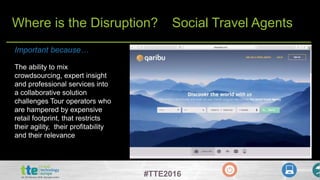
Where is the Disruption? Social Travel Agents
The ability to mix
crowdsourcing, expert insight
and professional services into
a collaborative solution
challenges Tour operators who
are hampered by expensive
retail footprint, that restricts
their agility, their profitability
and their relevance
Important because…
#TTE2016
Where is the Disruption? The Sharing Economy
New products and services are
being rapidly extended on
existing disruptive platforms
where the principle is about
sharing rather than owning at a
pace that the Tour Operator
cannot match
Important because…
#TTE2016
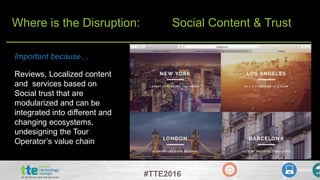
Where is the Disruption: Social Content & Trust
Reviews, Localized content
and services based on
Social trust that are
modularized and can be
integrated into different and
changing ecosystems,
undesigning the Tour
Operator’s value chain
Important because…
#TTE2016
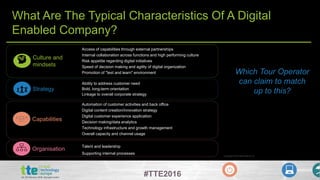
What Are The Typical Characteristics Of A Digital
Enabled Company?
Talent and leadership
Supporting internal processes
Organisation
Internal collaboration across functions and high performing culture
Risk appetite regarding digital initiatives
Speed of decision making and agility of digital organization
Access of capabilities through external partnerships
Promotion of "test and learn" environment
Culture and
mindsets
Bold, long-term orientation
Ability to address customer need
Linkage to overall corporate strategy
Strategy
Digital content creation/innovation strategy
Digital customer experience application
Decision making/data analytics
Technology infrastructure and growth management
Automation of customer activities and back office
Overall capacity and channel usage
Capabilities
Which Tour Operator
can claim to match
up to this?
Copyright 2016 McKinsey & Co
#TTE2016
Tour Operators are evolving … but slowly
Tour Operator 1.0
• All About manual and analogue
processes
• Product led
• Focused on Operations
• Little or no digital initiatives
Tour Operator 2.0
• Silo’d organization
• Legacy IT being addressed
• Operationally efficient
• Fragmented Digital initiatives
• Basic CRM
• Main Focus on AR revenue
• Beginning to adapt
• Some new products and services
Tour Operator 3.0
• SMAC compliant technology
• New Organization model driving
cross-functional projects
• Operationally efficient, but with
increasing focus on Lifetime
Customer Value
• Clear digital Roadmap and
coordinated digital plans
• Single View of the customer
• Data and Analytics driving insight
and performance
• Agile to changing Customer needs
• Design thinking driving new
products
Tour Operator 4.0
• Fully connected for all stakeholders
• “Smart” Culture of real-time
operations & insight led actions
across all functions
• Friction free experience between
channels ,devices and locations
• New Organization model
• Operationally efficient, Commercially
mature
• Digital core competency across
organization
• Single View of the customer
• Customer needs at heart of a new
ecosystem of digital partnerships
• Deep understanding of Customer
Lifetime value
“Legacy/basic”
“Agile /Digital”
“Smart Tour Operator”
“Adapting /Digitizing”
#TTE2016
What strengths and weaknesses do Tour
Operators typically exhibit?
• Legacy Systems
• Poor data management
• Analog culture & largely Product focus
• Non-digital leadership in Board and C-
Suite
• Listed companies
• “Rumsfeldian” denial about disruption
• Belief that their historical strengths are
enough to deter disruption
Historical strengths and yet also historical weaknesses
#TTE2016
Analog
Traditional
channel Silo‘d
Digitising
Multi-channel
monologue
Digital
Omni-channel
dialogue
Tour Operators & The Digital Tipping Point
#TTE2016
What Should Transformation Mean To Tour
Operators
TALENT: Bring in digital talent at all levels, especially for succession
planning at the top. Shareholders and investors must hold the
board more accountable to digital progress
DATA: Treat data like a Balance Sheet Asset. Invest,. Use, audit and
understand its value
TECHNOLOGY: Partnership, open & scalable systems are key
CULTURE: Challenge the Silos and “Product /Yield” mindset
DIGITAL: It is not a function or a team, it is your future. Make it pervasive.
DESIGN THINKING: Lead with Customer Experience and Needs. Products should be
simpler and more relevant to Customer
COLLABORATE: Get your head out of the sand and look for new disruptive
partnerships
#TTE2016
Conclusion – Can Tour Operators Survive?
... but we are at a tipping point. Tour Operators must
• Increase digital boldness in the boardroom
• Create a “Data/Analytics first” culture
• Instill Design thinking as a core behavior
• Really – DEEPLY – understand customer needs
• Dramatically change their technical & product agility
(especially around customer data)
• Pursue innovative and disruptive partnerships
YES
and
NO
… or be disrupted
#TTE2016
Thank you
@marcoryan
www.marcoryan.com
uk.linkedin.com/in/marcoryan
www.marcoryanphotography.com

Transform or be disrupted. WillTour Operators survive

  • 1.
    #TTE2016 #TTE2016 “Transform or bedisrupted” Can the traditional Tour Operators survive? Marco Ryan
  • 2.
    #TTE2016 Social me: feelfree to tweet & connect @marcoryan www.marcoryan.com uk.linkedin.com/in/marcoryan www.marcoryanphotography.com
  • 3.
    #TTE2016 Early disruption focusedon specific stages of the Travel experience Dream Plan BookExperience Share
  • 4.
    #TTE2016 What trends willcause further disruption? Generation–n IOT Atomization of Apps Digital Transformation SMAC Business models Mobility Design thinking
  • 5.
    #TTE2016 Key trends; Generation-n Generation-n The“needs based” generation Relevancy Simplicity Lifestyle Immediacy
  • 6.
    #TTE2016 What “needs” aretour operators fulfilling? Convenience? Price? Value? Trust? Scale? Flexibility? Are they still a match for the changing needs of their customers?
  • 7.
    #TTE2016 Key trends: Internetof Things (IOT) SO WHAT?  Data now becomes an Asset, Analytics a hygiene factor  New business models based around solutions & Partnering  Drive increasing Customer expectations around friction fee Experience EXAMPLES  Virgin Atlantic, Milton Keynes Council, RR, BGas, Fitness First, Disney, John Deere
  • 8.
    #TTE2016 Key Trends: AtomizationOf Apps SO WHAT?  Increases revenue opportunities for new Solutions/services  Provides more micro-measurement opportunity  Customers increasingly less tolerant of App boundaries and poor integration.  Increased complexity of Customer Ownership  Challenges IT and Mobile Roadmaps EXAMPLES  Spotify, WeChat
  • 9.
    #TTE2016 Key Trends: DesignThinking SO WHAT?  Emotional responses build loyalty. Design thinking ensures products and services drive high loyalty.  Often Require cultural shift and sometimes leads to organizational change  Products are often simpler, more focused but always more relevant EXAMPLES  Nest, Square, Disney, GE, IBM, Apple Return to your original use group and testing for feedback Test Build a representa tion of your ideas to how others Prototype Brainstorm and come up with creative solutions Ideate Construct a point of view that is based on use needs and insights Define Learn about the audience for whom you are designing Empathize
  • 10.
    #TTE2016 Key Trends: Mobility& Smart Devices SO WHAT?  Device less important, emphasis now on seamless experience across devices  Increase reliance on Real-time analytics and User Experience Design to make interaction contextual  Low tolerance for experiences that are too generic or that create friction EXAMPLES  Natwest, Snapchat, Slack, Virgin America, Uber
  • 11.
    #TTE2016 Key Trends: DigitalTransformation SO WHAT?  Needs CEO leadership to succeed  Culture change is critical as Digital needs to be pervasive across organization  Fundamentally different from Digitization  For many organizations failure to transform will  Sometimes difficult to “change the wings of the aircraft in flight” EXAMPLES  Axel Springer, Delta, Air New Zealand, Thomas Cook
  • 12.
    #TTE2016 Key Trends: TheRise Of SMAC SO WHAT? EXAMPLES  Increasingly a “hygiene Factor” for digital organizations  Individually important, but when combined can be both disruptive and differentiating.  Implications for Data Protection and Cyber Security  Finally enables 1:1 marketing to be cost effective  Netflix Social Mobile Analytics Cloud
  • 13.
    #TTE2016 Key Trends: ArtificialIntelligence SO WHAT?  Can process unstructured data (e.g. Social media)  Success measured by ROI, Impact, new models not on traditional IT measures  Levels of investment requires partnering and new ecosystems focused on solutions not on traditional corporate boundaries EXAMPLES  IBM, Amazon, Microsoft.
  • 14.
    #TTE2016 Where is theDisruption? Social Travel Agents The ability to mix crowdsourcing, expert insight and professional services into a collaborative solution challenges Tour operators who are hampered by expensive retail footprint, that restricts their agility, their profitability and their relevance Important because…
  • 15.
    #TTE2016 Where is theDisruption? The Sharing Economy New products and services are being rapidly extended on existing disruptive platforms where the principle is about sharing rather than owning at a pace that the Tour Operator cannot match Important because…
  • 16.
    #TTE2016 Where is theDisruption: Social Content & Trust Reviews, Localized content and services based on Social trust that are modularized and can be integrated into different and changing ecosystems, undesigning the Tour Operator’s value chain Important because…
  • 17.
    #TTE2016 What Are TheTypical Characteristics Of A Digital Enabled Company? Talent and leadership Supporting internal processes Organisation Internal collaboration across functions and high performing culture Risk appetite regarding digital initiatives Speed of decision making and agility of digital organization Access of capabilities through external partnerships Promotion of "test and learn" environment Culture and mindsets Bold, long-term orientation Ability to address customer need Linkage to overall corporate strategy Strategy Digital content creation/innovation strategy Digital customer experience application Decision making/data analytics Technology infrastructure and growth management Automation of customer activities and back office Overall capacity and channel usage Capabilities Which Tour Operator can claim to match up to this? Copyright 2016 McKinsey & Co
  • 18.
    #TTE2016 Tour Operators areevolving … but slowly Tour Operator 1.0 • All About manual and analogue processes • Product led • Focused on Operations • Little or no digital initiatives Tour Operator 2.0 • Silo’d organization • Legacy IT being addressed • Operationally efficient • Fragmented Digital initiatives • Basic CRM • Main Focus on AR revenue • Beginning to adapt • Some new products and services Tour Operator 3.0 • SMAC compliant technology • New Organization model driving cross-functional projects • Operationally efficient, but with increasing focus on Lifetime Customer Value • Clear digital Roadmap and coordinated digital plans • Single View of the customer • Data and Analytics driving insight and performance • Agile to changing Customer needs • Design thinking driving new products Tour Operator 4.0 • Fully connected for all stakeholders • “Smart” Culture of real-time operations & insight led actions across all functions • Friction free experience between channels ,devices and locations • New Organization model • Operationally efficient, Commercially mature • Digital core competency across organization • Single View of the customer • Customer needs at heart of a new ecosystem of digital partnerships • Deep understanding of Customer Lifetime value “Legacy/basic” “Agile /Digital” “Smart Tour Operator” “Adapting /Digitizing”
  • 19.
    #TTE2016 What strengths andweaknesses do Tour Operators typically exhibit? • Legacy Systems • Poor data management • Analog culture & largely Product focus • Non-digital leadership in Board and C- Suite • Listed companies • “Rumsfeldian” denial about disruption • Belief that their historical strengths are enough to deter disruption Historical strengths and yet also historical weaknesses
  • 20.
  • 21.
    #TTE2016 What Should TransformationMean To Tour Operators TALENT: Bring in digital talent at all levels, especially for succession planning at the top. Shareholders and investors must hold the board more accountable to digital progress DATA: Treat data like a Balance Sheet Asset. Invest,. Use, audit and understand its value TECHNOLOGY: Partnership, open & scalable systems are key CULTURE: Challenge the Silos and “Product /Yield” mindset DIGITAL: It is not a function or a team, it is your future. Make it pervasive. DESIGN THINKING: Lead with Customer Experience and Needs. Products should be simpler and more relevant to Customer COLLABORATE: Get your head out of the sand and look for new disruptive partnerships
  • 22.
    #TTE2016 Conclusion – CanTour Operators Survive? ... but we are at a tipping point. Tour Operators must • Increase digital boldness in the boardroom • Create a “Data/Analytics first” culture • Instill Design thinking as a core behavior • Really – DEEPLY – understand customer needs • Dramatically change their technical & product agility (especially around customer data) • Pursue innovative and disruptive partnerships YES and NO … or be disrupted
  • 23.

Editor's Notes

  • #9 What is it Stand alone apps becoming less popular Although Apps wont disappear, they will be super distributed across platforms (whilst retaining brand identity) e.g. Spotify. Atomized apps become modules that can be focused on enhancing contextual use, rather simply being native to a particular device
  • #10 Methodology that ensures that peoples interactions with technologies and other complex systems are simple, intuitive, and pleasurable. Focuses on users experiences especially their emotional ones. Emphasizes the need to prototype and learn and tolerates failure Focuses on needs, touch points rather than transactions
  • #11 WHAT IT IS Realization that relevant information that is provided irrespective of device or location is more important than the device. Shift from Mobile as a device to mobility as a solution. Increasing need to drive relevance through micro-interactions – gestures, movement, location, touch – and the need to be able to adjust experience to fit.
  • #12 WHAT IT IS Fundamental transformation of Organization around Digital Principles Creating an organization that is more agile, more analytical, more relevant to changing customer needs An organization that has new products, services, business models, processes and culture that is more efficient and more sustainable in a less predictable future. Increased Operational and Commercial performance.
  • #13 WHAT IT IS Social Media, Analytics & Cloud SMAC creates an ecosystem that allows a business to improve its operations and get closer to the customer with minimal overhead and maximum reach. Increasingly important as explosion of Structured and Unstructured date from IOT, Mobile, Browsing, Social Media and loyalty programs creates new Business opportunities Millennials behavior and expectations driven by use of Social Media.
  • #14 KEY TRENDS Cognitive computing refers to systems that learn at scale, reason with purpose and interact with humans naturally. Rather than being explicitly programmed, they learn and reason from their interactions with us and from their experiences with their environment. Cognitive Computing and Machine – to Machine Learning – is the power behind IOT and Big Data being able to be relevant/commercial.
  • #21  So now that we understand the subtle but significant differences between omnichannel and multichannel, lets take a look at how all our initiatives and all our projects fit into this idea of increasing our digital maturity and evolving into a true omnichannel business I think that there is a difference between organisations that digitise and those that transform around a digital agenda. Digitising is really about putting a lick of digital paint over analogue issues. Good indicators of a company that is digitising rather than digital is that lots of projects are started but never completed, lots of different digital teams doing their own thing independently of each other, under investing in Agile IT , CRM or Analytics. Multichannel business are typical of businesses at the end of this digitsing S Curve. On the red – or digital curve – there is a clear statement of digital transformation. So let look our Voyager Android transformation against this model