Erotic Transference
What is Erotic
Transference?
• Erotic transference is a term used to describe
the feelings of love and the fantasies of a sexual
or sensual nature that a client experiences
about their therapist. Erotic counter-
transference is about the therapist's feelings
about their client.
Attitudes to Erotic Transference
WHILE IT IS SOMETHING OF A CLICHÉ THAT
CLIENTS FALL IN LOVE WITH THEIR THERAPISTS,
THE FACT IS THAT THIS DOES HAPPEN WITH
SOME REGULARITY
OF COURSE, THERAPISTS CALL THESE FEELINGS
TRANSFERENCE, BUT THE CLIENT OFTEN
EXPERIENCES THEM AS GENUINE FEELINGS OF
LOVE AND LONGING.
FURTHERMORE, THERAPISTS BESOTTED
WITH LOVE FOR A CLIENT OFTEN THINK
THEIR OWN REACTIONS ARE FAR MORE
THAN MERE COUNTERTRANSFERENCE.
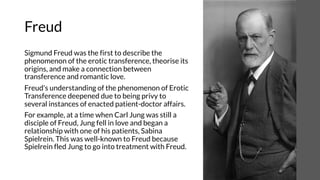
Freud
Sigmund Freud was the first to describe the
phenomenon of the erotic transference, theorise its
origins, and make a connection between
transference and romantic love.
Freud's understanding of the phenomenon of Erotic
Transference deepened due to being privy to
several instances of enacted patient-doctor affairs.
For example, at a time when Carl Jung was still a
disciple of Freud, Jung fell in love and began a
relationship with one of his patients, Sabina
Spielrein. This was well-known to Freud because
Spielrein fled Jung to go into treatment with Freud.
Where does it come from?
Over time, Freud formulated a theory about the
relationship between the erotic transference and the
experience of love, recognising that feelings of love,
whether in treatment or in real life, draw on earlier life
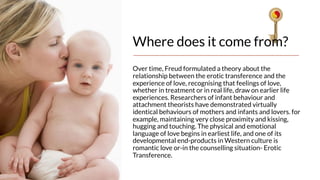
experiences. Researchers of infant behaviour and
attachment theorists have demonstrated virtually
identical behaviours of mothers and infants and lovers. for
example, maintaining very close proximity and kissing,
hugging and touching. The physical and emotional
language of love begins in earliest life, and one of its
developmental end-products in Western culture is
romantic love or-in the counselling situation- Erotic
Transference.
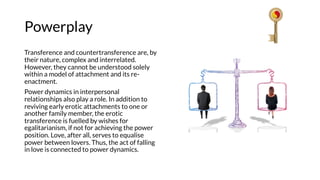
Powerplay
Transference and countertransference are, by
their nature, complex and interrelated.
However, they cannot be understood solely
within a model of attachment and its re-
enactment.
Power dynamics in interpersonal
relationships also play a role. In addition to
reviving early erotic attachments to one or
another family member, the erotic
transference is fuelled by wishes for
egalitarianism, if not for achieving the power
position. Love, after all, serves to equalise
power between lovers. Thus, the act of falling
in love is connected to power dynamics.
To engage or not to
engage
Erotic transference is always layered: it is composed of
different strands, not all of which are erotic. As therapists
we will miss its complex dynamics if we fail to look at the
hidden yearnings for asserting power or claiming
protection for weakness.
It is not a negative to be avoided completely. The client's
capacity to form a transference relationship to the
therapist is a key factor in facilitating change. Developing,
recognising and working through an erotic transference
can be central to the psychotherapeutic process. Working
with immediacy and candour is essential.
What to do?
Inform clients about the
phenomenon at the
beginning of the therapy.
Carry out regular reviews
in which the potential for
Erotic Transference is
monitored.
Maintain consistent
professional boundaries
and refrain from personal
disclosures that could
encourage idealisation.
Refrain from making the
client feel special.
Be clear that the
relationship can only ever
be professional.
If the potential for Erotic
Transference becomes
apparent, discuss it with
the client in order to work
out the best way of
tackling it.
Take it to supervision and
seek external consultation
if it persists.
Take responsibility for any
actions that contributed to
the idealisation.
Refrain from acting
defensively by blame,
rejection and sudden rigid
boundaries, or terminating
the therapy without the
agreed notice period.

Erotic Transference.pdf

  • 1.
  • 2.
    What is Erotic Transference? •Erotic transference is a term used to describe the feelings of love and the fantasies of a sexual or sensual nature that a client experiences about their therapist. Erotic counter- transference is about the therapist's feelings about their client.
  • 3.
    Attitudes to EroticTransference WHILE IT IS SOMETHING OF A CLICHÉ THAT CLIENTS FALL IN LOVE WITH THEIR THERAPISTS, THE FACT IS THAT THIS DOES HAPPEN WITH SOME REGULARITY OF COURSE, THERAPISTS CALL THESE FEELINGS TRANSFERENCE, BUT THE CLIENT OFTEN EXPERIENCES THEM AS GENUINE FEELINGS OF LOVE AND LONGING. FURTHERMORE, THERAPISTS BESOTTED WITH LOVE FOR A CLIENT OFTEN THINK THEIR OWN REACTIONS ARE FAR MORE THAN MERE COUNTERTRANSFERENCE.
  • 4.
    Freud Sigmund Freud wasthe first to describe the phenomenon of the erotic transference, theorise its origins, and make a connection between transference and romantic love. Freud's understanding of the phenomenon of Erotic Transference deepened due to being privy to several instances of enacted patient-doctor affairs. For example, at a time when Carl Jung was still a disciple of Freud, Jung fell in love and began a relationship with one of his patients, Sabina Spielrein. This was well-known to Freud because Spielrein fled Jung to go into treatment with Freud.
  • 5.
    Where does itcome from? Over time, Freud formulated a theory about the relationship between the erotic transference and the experience of love, recognising that feelings of love, whether in treatment or in real life, draw on earlier life experiences. Researchers of infant behaviour and attachment theorists have demonstrated virtually identical behaviours of mothers and infants and lovers. for example, maintaining very close proximity and kissing, hugging and touching. The physical and emotional language of love begins in earliest life, and one of its developmental end-products in Western culture is romantic love or-in the counselling situation- Erotic Transference.
  • 6.
    Powerplay Transference and countertransferenceare, by their nature, complex and interrelated. However, they cannot be understood solely within a model of attachment and its re- enactment. Power dynamics in interpersonal relationships also play a role. In addition to reviving early erotic attachments to one or another family member, the erotic transference is fuelled by wishes for egalitarianism, if not for achieving the power position. Love, after all, serves to equalise power between lovers. Thus, the act of falling in love is connected to power dynamics.
  • 7.
    To engage ornot to engage Erotic transference is always layered: it is composed of different strands, not all of which are erotic. As therapists we will miss its complex dynamics if we fail to look at the hidden yearnings for asserting power or claiming protection for weakness. It is not a negative to be avoided completely. The client's capacity to form a transference relationship to the therapist is a key factor in facilitating change. Developing, recognising and working through an erotic transference can be central to the psychotherapeutic process. Working with immediacy and candour is essential.
  • 8.
    What to do? Informclients about the phenomenon at the beginning of the therapy. Carry out regular reviews in which the potential for Erotic Transference is monitored. Maintain consistent professional boundaries and refrain from personal disclosures that could encourage idealisation. Refrain from making the client feel special. Be clear that the relationship can only ever be professional. If the potential for Erotic Transference becomes apparent, discuss it with the client in order to work out the best way of tackling it. Take it to supervision and seek external consultation if it persists. Take responsibility for any actions that contributed to the idealisation. Refrain from acting defensively by blame, rejection and sudden rigid boundaries, or terminating the therapy without the agreed notice period.