Contents:
 Transducer
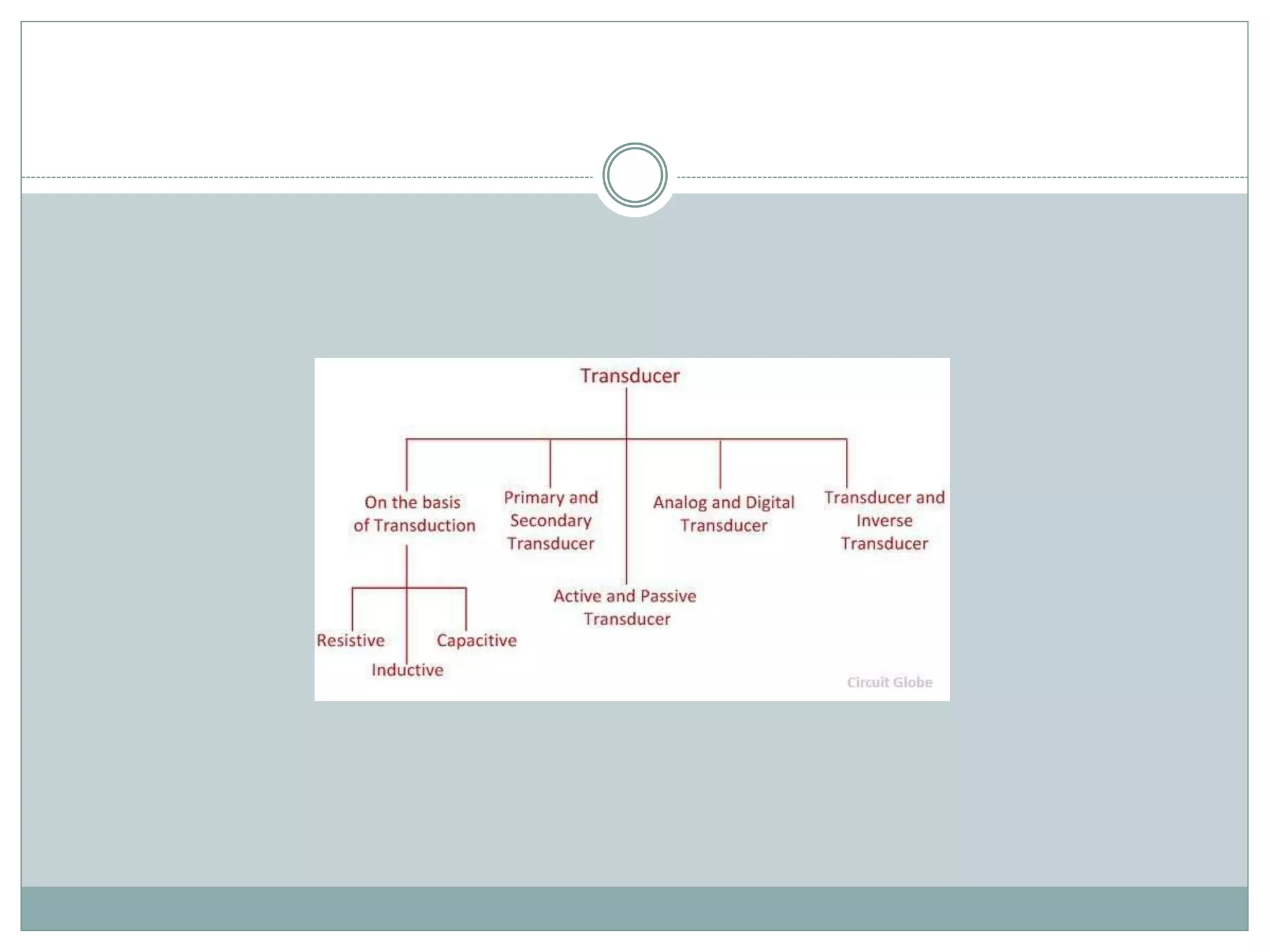
 Pictorial representation
 Types (active and passive)
 Classification
 Characteristics
 Applications
Transducer.
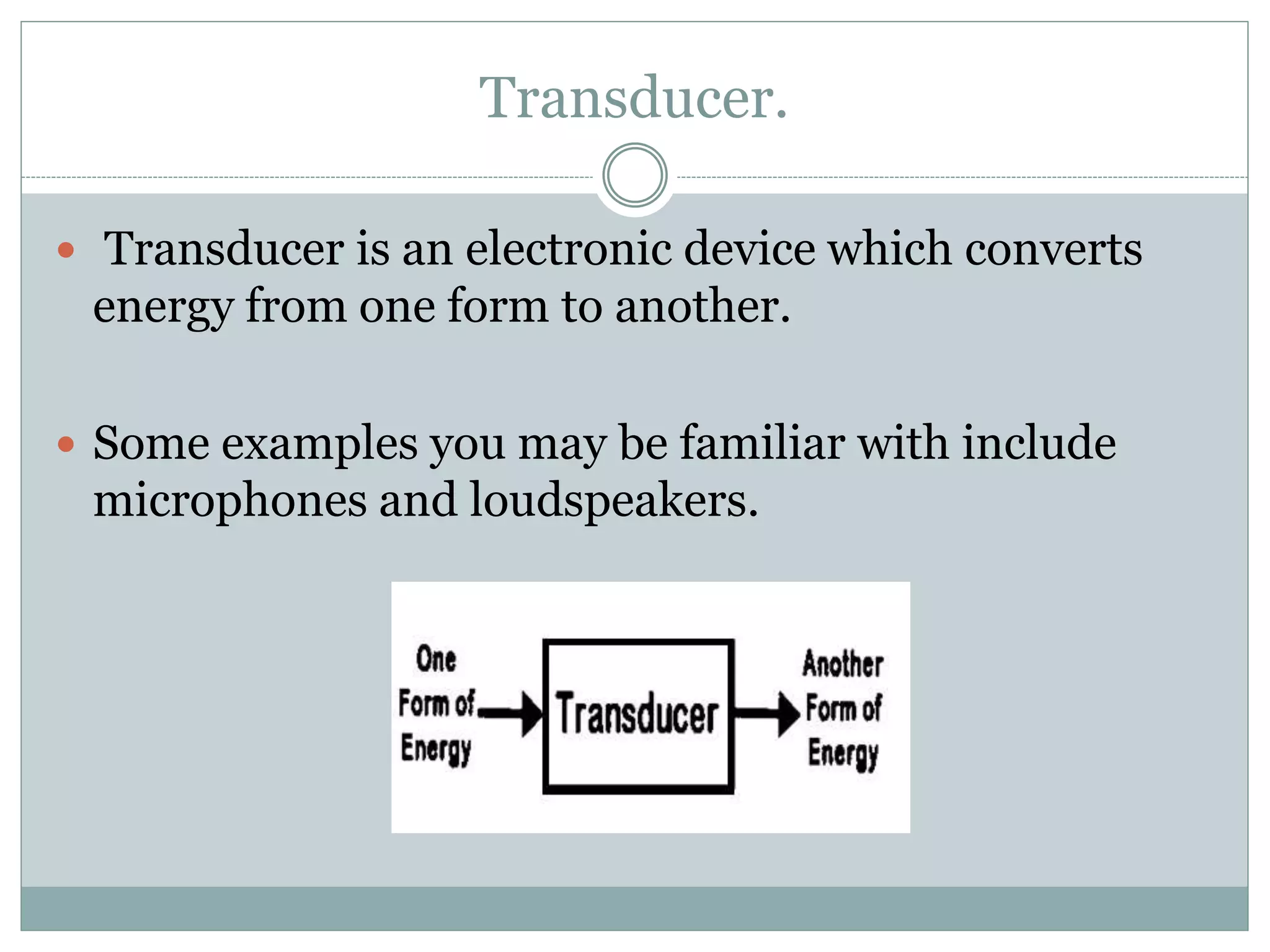
 Transducer is an electronic device which converts
energy from one form to another.
 Some examples you may be familiar with include
microphones and loudspeakers.
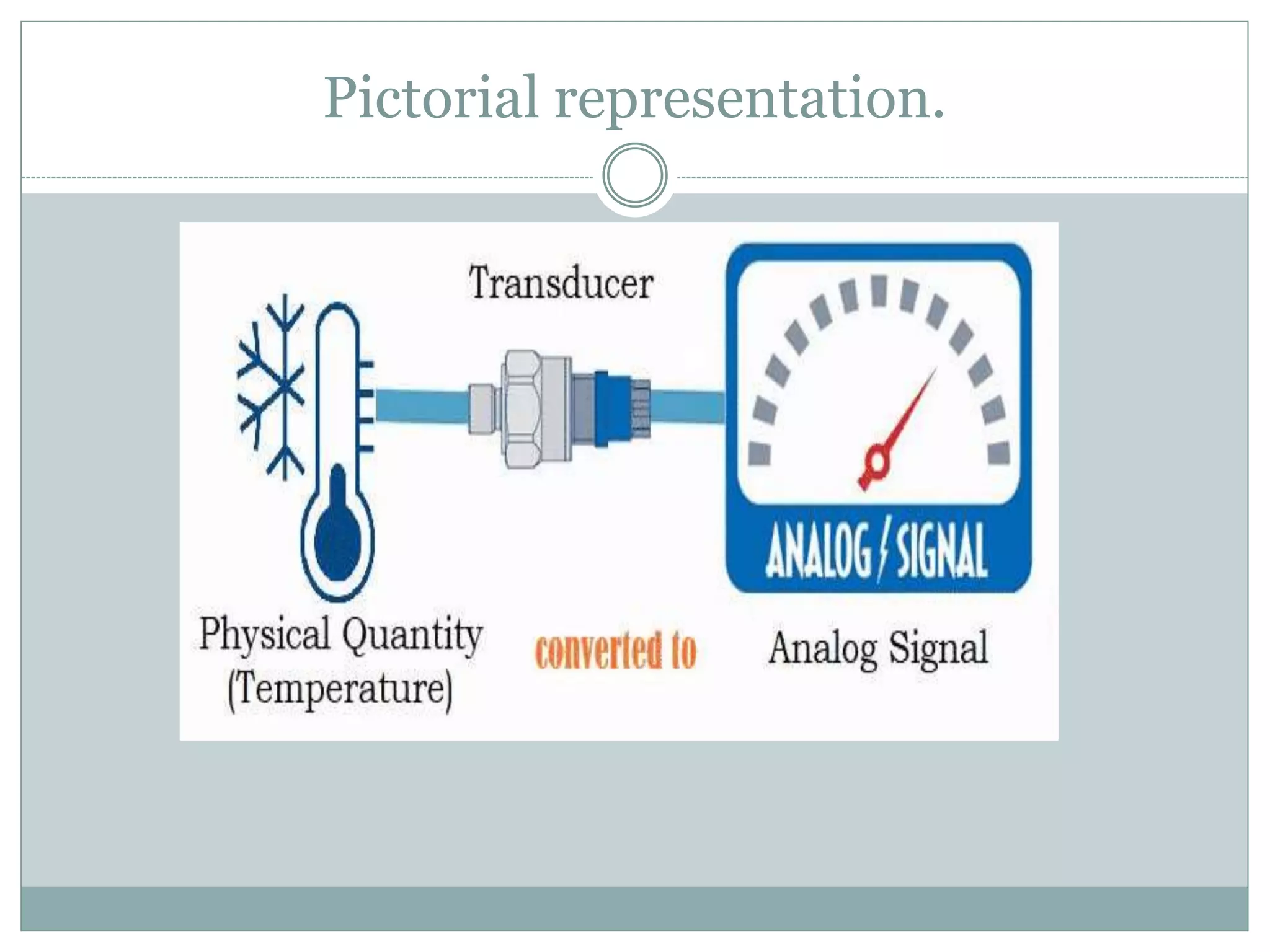
Pictorial representation.
Types:
 Active transducer
 Passive transducer.
Active transducer.
 Active transducers are those which do not require
any power source for their operation. They work on
the energy conversion principle.
 They produce an electrical signal proportional to the
input (physical quantity).
 For example, a thermocouple is an active
transducer.
Passive transducer
 Transducers which require an external power source
for their operation is called as a passive transducer.
 They produce an output signal in the form of some
variation in resistance, capacitance or any other
electrical parameter, which than has to be converted
to an equivalent current or voltage signal
Classification.
 The transducer is classified by the transduction
medium. The transduction medium may be resistive,
inductive or capacitive depends on the conversion
process that how input transducer converts the input
signal into resistance, inductance and capacitance
respectively.
Characteristics.
characteristics of a transducer is a set of performance
criteria that are established through static calibration
1. Accuracy: The ability of the instrument to measure
the accurate value is known as accuracy.
In other words, Accuracy is obtained by taking small
readings. The small reading reduces the error of the
calculation.
 Repeatability: the o/p of the transducer must be the
exactly the same under same environmental
condition when the same quamtity is applied at the
input repeatedly.
 Sensitivity: transducer must be sensitive enough to
produce detectable o/p.
 size: transducer should have smallest possible size
and shape with minimum weight and volume.
 Dynmaic error: for a transducer the operating range
should be wide so that it can be used over a wide
range of measurement condition
Applications:
 It is used for detecting the movement of muscles
which is called acceleromyograph.
 The transducer measures the load on the engines.
 It is used as a sensor for knowing the engine knock.
 The transducers measure the pressure of the gas and
liquid by converting it into an electrical signal.
 It converts the temperature of the devices into an
electrical signal or mechanical work.
 The transducer is used in the ultrasound machine. It
receives the sound waves of the patient by emitting
their sound waves and pass the signal to the CPU.
 The transducer is used in the speaker for converting
the electrical signal into acoustic sound.
 It is used in the antenna for converting the
electromagnetic waves into an electrical signal.
THANK YOU
 Submitted by-
 Anshul Pandey
(19/BEE/011)

Transducer and its classification 34.pptx

  • 1.
    Contents:  Transducer  Pictorialrepresentation  Types (active and passive)  Classification  Characteristics  Applications
  • 2.
    Transducer.  Transducer isan electronic device which converts energy from one form to another.  Some examples you may be familiar with include microphones and loudspeakers.
  • 3.
  • 4.
  • 5.
    Active transducer.  Activetransducers are those which do not require any power source for their operation. They work on the energy conversion principle.  They produce an electrical signal proportional to the input (physical quantity).  For example, a thermocouple is an active transducer.
  • 6.
    Passive transducer  Transducerswhich require an external power source for their operation is called as a passive transducer.  They produce an output signal in the form of some variation in resistance, capacitance or any other electrical parameter, which than has to be converted to an equivalent current or voltage signal
  • 7.
    Classification.  The transduceris classified by the transduction medium. The transduction medium may be resistive, inductive or capacitive depends on the conversion process that how input transducer converts the input signal into resistance, inductance and capacitance respectively.
  • 9.
    Characteristics. characteristics of atransducer is a set of performance criteria that are established through static calibration 1. Accuracy: The ability of the instrument to measure the accurate value is known as accuracy. In other words, Accuracy is obtained by taking small readings. The small reading reduces the error of the calculation.
  • 10.
     Repeatability: theo/p of the transducer must be the exactly the same under same environmental condition when the same quamtity is applied at the input repeatedly.  Sensitivity: transducer must be sensitive enough to produce detectable o/p.  size: transducer should have smallest possible size and shape with minimum weight and volume.
  • 11.
     Dynmaic error:for a transducer the operating range should be wide so that it can be used over a wide range of measurement condition
  • 12.
    Applications:  It isused for detecting the movement of muscles which is called acceleromyograph.  The transducer measures the load on the engines.  It is used as a sensor for knowing the engine knock.  The transducers measure the pressure of the gas and liquid by converting it into an electrical signal.  It converts the temperature of the devices into an electrical signal or mechanical work.
  • 13.
     The transduceris used in the ultrasound machine. It receives the sound waves of the patient by emitting their sound waves and pass the signal to the CPU.  The transducer is used in the speaker for converting the electrical signal into acoustic sound.  It is used in the antenna for converting the electromagnetic waves into an electrical signal.
  • 14.
    THANK YOU  Submittedby-  Anshul Pandey (19/BEE/011)