Transactional J(2)EE Applications  with Spring Transactional POJO Programming  Guy Pardon (guy@atomikos.com)
Contents Part 1: Spring Essentials Part 2: Transactions in Spring Part 3: JTA Use Cases
Part 1 Spring Essentials
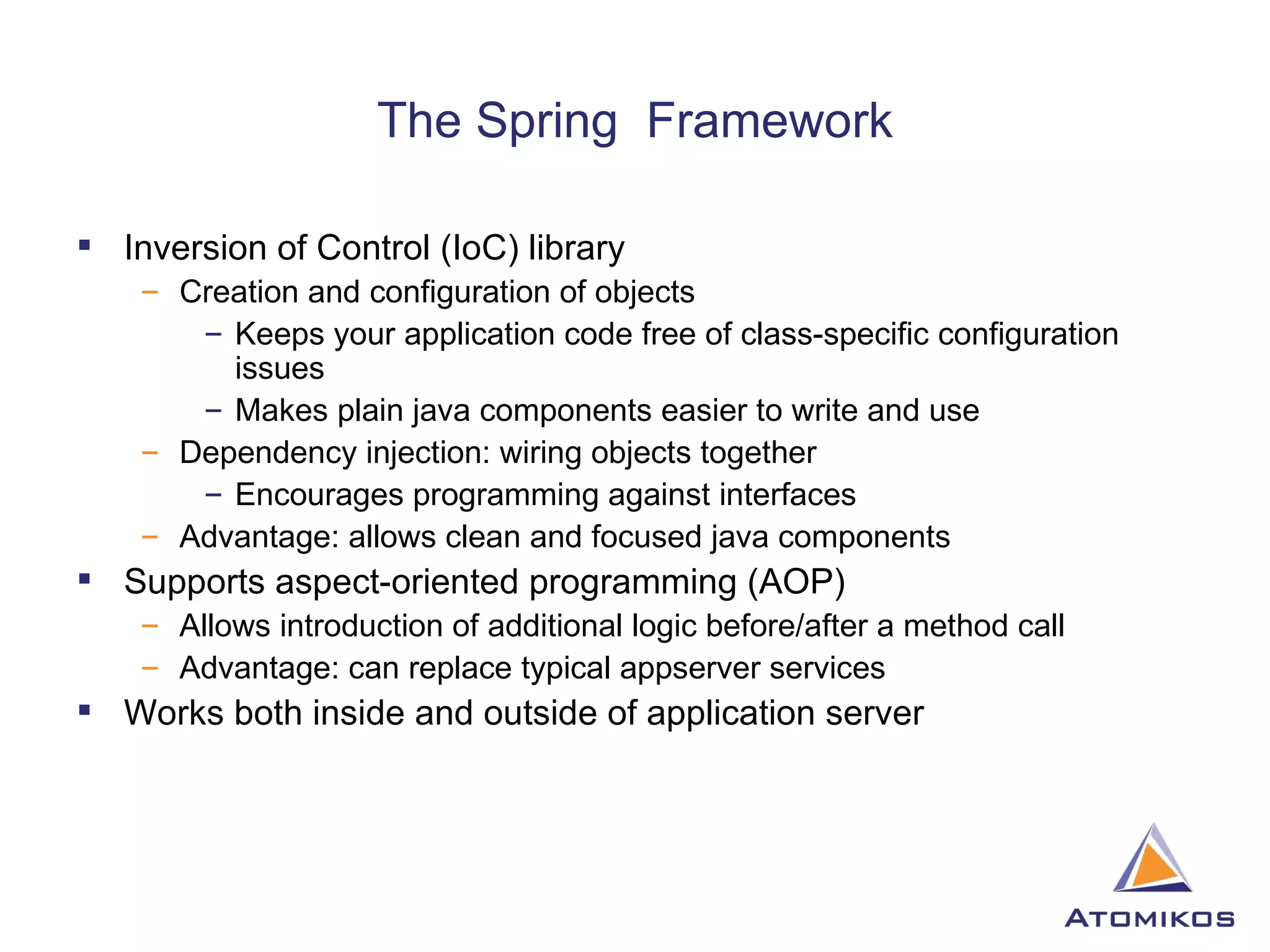
The Spring  Framework Inversion of Control (IoC) library Creation and configuration of objects Keeps your application code free of class-specific configuration issues Makes plain java components easier to write and use Dependency injection: wiring objects together Encourages programming against interfaces Advantage: allows clean and focused java components Supports aspect-oriented programming (AOP) Allows introduction of additional logic before/after a method call Advantage: can replace typical appserver services Works both inside and outside of application server
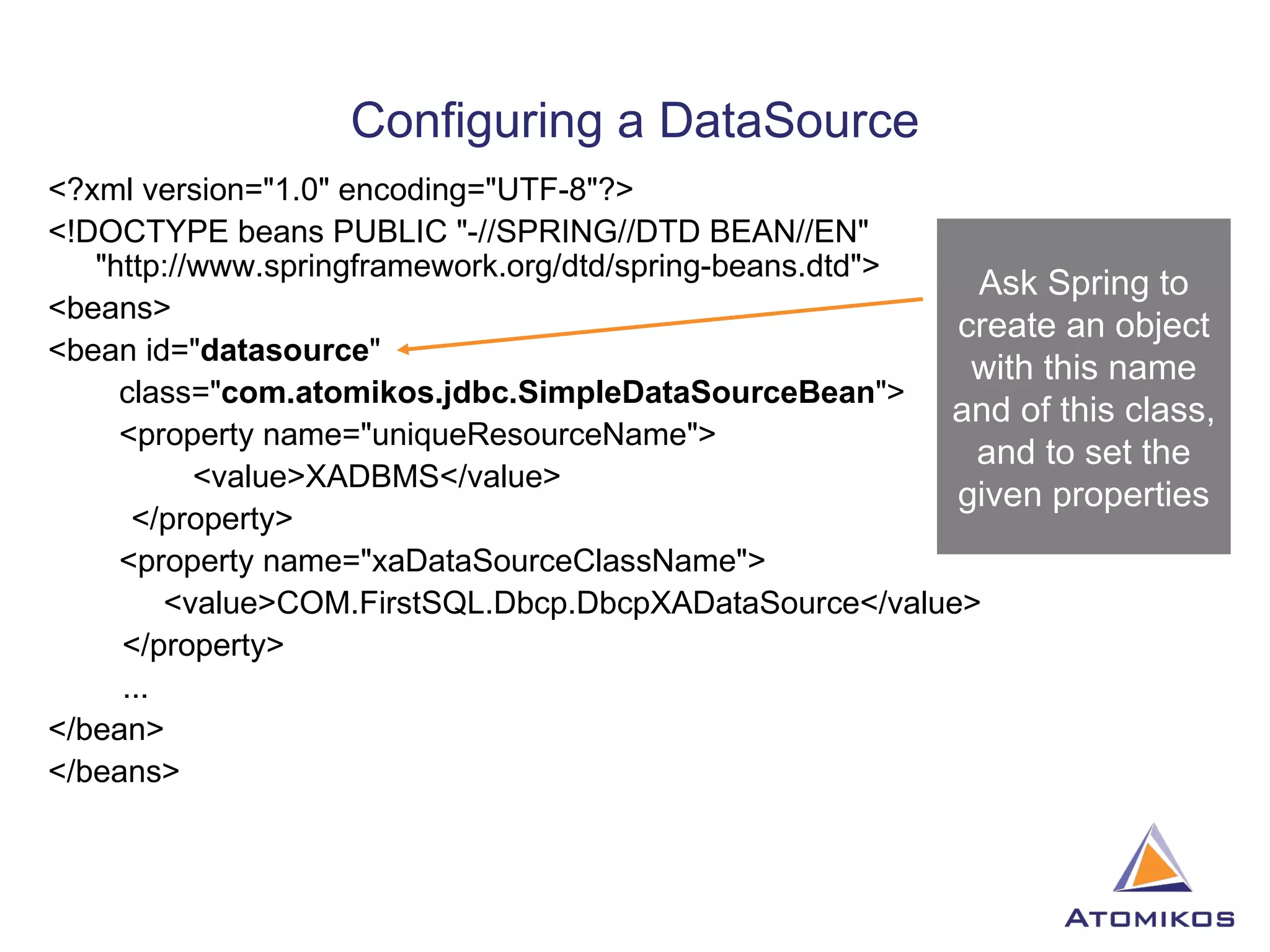
Configuring a DataSource <?xml version=&quot;1.0&quot; encoding=&quot;UTF-8&quot;?> <!DOCTYPE beans PUBLIC &quot;-//SPRING//DTD BEAN//EN&quot; &quot;http://www.springframework.org/dtd/spring-beans.dtd&quot;> <beans> <bean id=&quot; datasource &quot; class=&quot; com.atomikos.jdbc.SimpleDataSourceBean &quot;> <property name=&quot;uniqueResourceName&quot;>   <value>XADBMS</value>   </property> <property name=&quot;xaDataSourceClassName&quot;> <value>COM.FirstSQL.Dbcp.DbcpXADataSource</value>   </property>   ... </bean> </beans> Ask Spring to create an object with this name and of this class, and to set the given properties
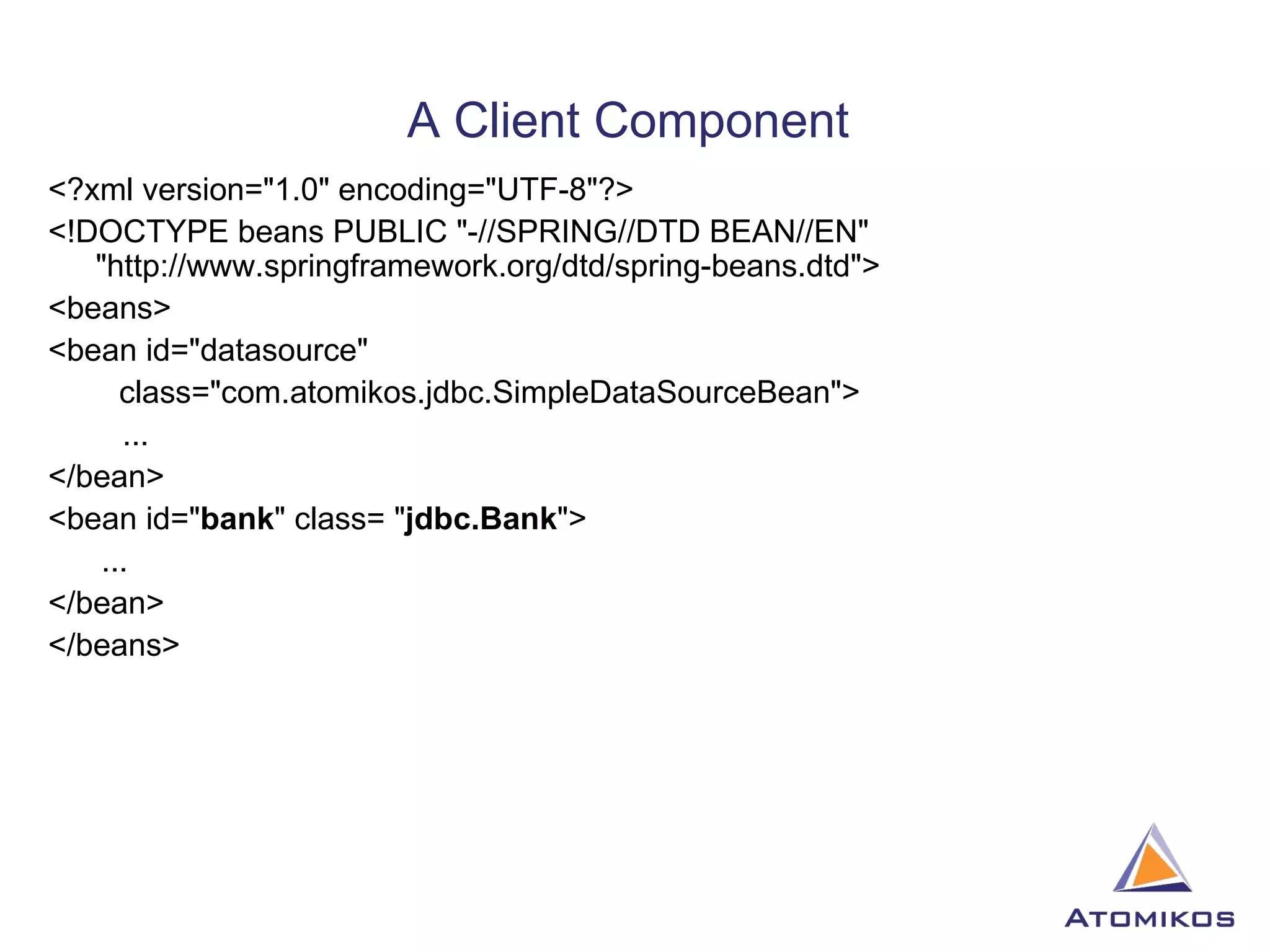
<?xml version=&quot;1.0&quot; encoding=&quot;UTF-8&quot;?> <!DOCTYPE beans PUBLIC &quot;-//SPRING//DTD BEAN//EN&quot; &quot;http://www.springframework.org/dtd/spring-beans.dtd&quot;> <beans> <bean id=&quot;datasource&quot; class=&quot;com.atomikos.jdbc.SimpleDataSourceBean&quot;>   ... </bean> <bean id=&quot; bank &quot; class= &quot; jdbc.Bank &quot;> ... </bean> </beans> A Client Component
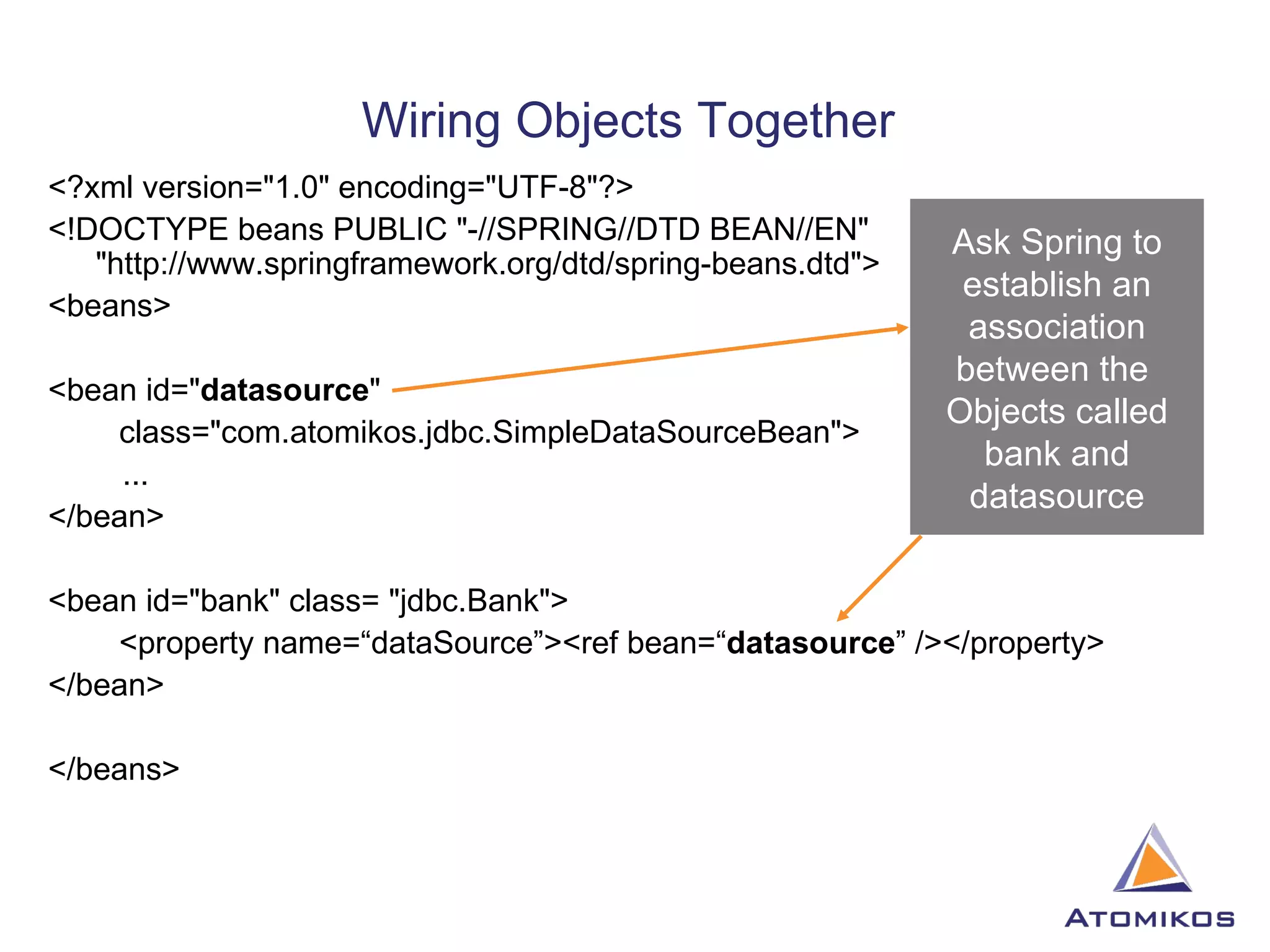
Wiring Objects Together  <?xml version=&quot;1.0&quot; encoding=&quot;UTF-8&quot;?> <!DOCTYPE beans PUBLIC &quot;-//SPRING//DTD BEAN//EN&quot; &quot;http://www.springframework.org/dtd/spring-beans.dtd&quot;> <beans> <bean id=&quot; datasource &quot; class=&quot;com.atomikos.jdbc.SimpleDataSourceBean&quot;>   ... </bean> <bean id=&quot;bank&quot; class= &quot;jdbc.Bank&quot;> <property name=“dataSource”><ref bean=“ datasource ” /></property> </bean> </beans> Ask Spring to establish an association between the  Objects called bank and datasource
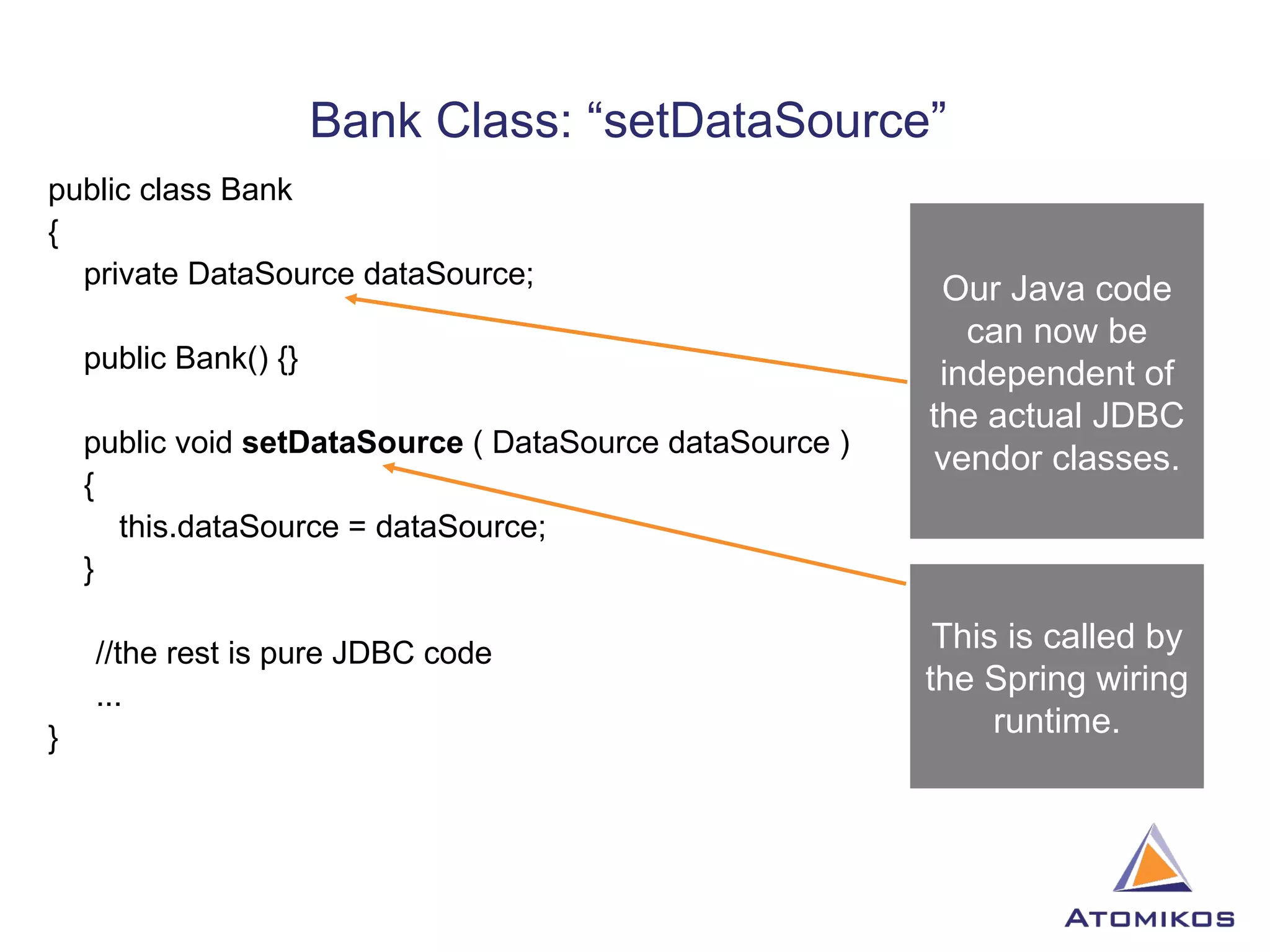
Bank Class: “setDataSource”  public class Bank  { private DataSource dataSource; public Bank() {} public void  setDataSource  ( DataSource dataSource ) { this.dataSource = dataSource; } //the rest is pure JDBC code ... } Our Java code can now be independent of the actual JDBC vendor classes. This is called by the Spring wiring runtime.
Applications: Configuration No Longer Hard-Coded public class Main { public static void main ( String[] args ) throws Exception { InputStream is = new FileInputStream(&quot;config.xml&quot;); XmlBeanFactory factory = new XmlBeanFactory(is); Bank bank = ( Bank ) factory.getBean ( &quot;bank&quot; );   //the bank object is already configured and  ready to use!!! bank.withdraw ( 10 , 100 ); ... } } Just ask the Spring BeanFactory to use our XML configuration file. We can ask Spring to return configured objects by their name (id)
Spring Benefits Configuration is XML Can be changed without recompilation Configuration is centralized in files  Easy to find and maintain Your Java code is pure and clean Easier to write and maintain More focused on what it needs to do Your Java code has less dependencies Concrete class names are factored out We can control the wiring We can insert proxies that add services You source code does not need to know Enables J2EE without appserver
Transactions in Spring? Can we use Spring to manage transactions? Can we use the datasource multiple times and then still rollback in case of a failure? Can we rollback across multiple connectors? The rest of this presentation will discuss that
Part 2 Transaction Support in Spring
Spring and Transactions Similar to EJB: Declarative or programmatic demarcation Several attributes for declarative transactions Different from EJB: Flexibility to choose the underlying transaction strategy JDBC, JTA, JDO, Hibernate, ... This means that you don’t necessarily need an application server to have transactions (J2EE without appserver)!
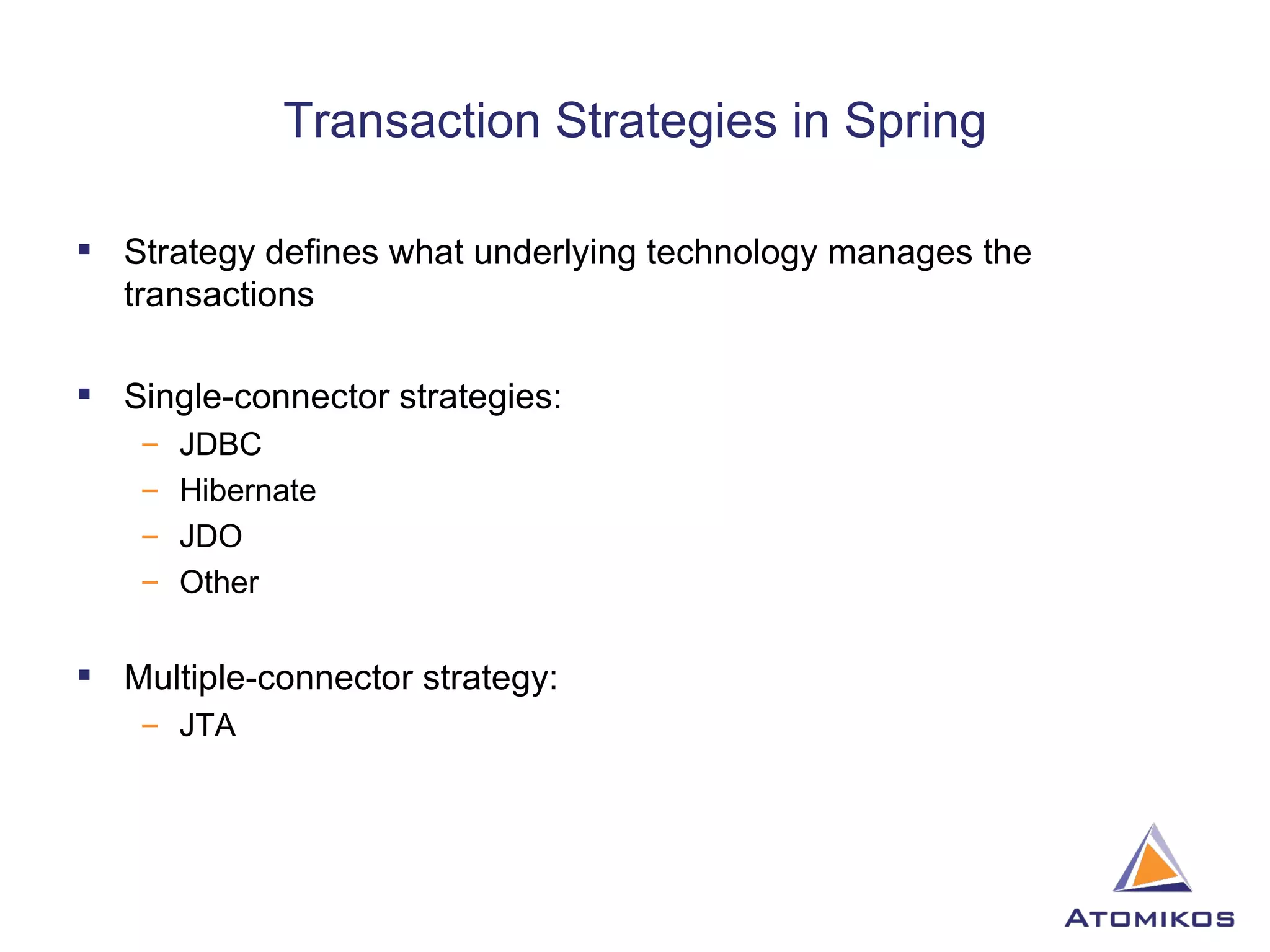
Transaction Strategies in Spring Strategy defines what underlying technology manages the transactions Single-connector strategies: JDBC Hibernate JDO Other Multiple-connector strategy: JTA
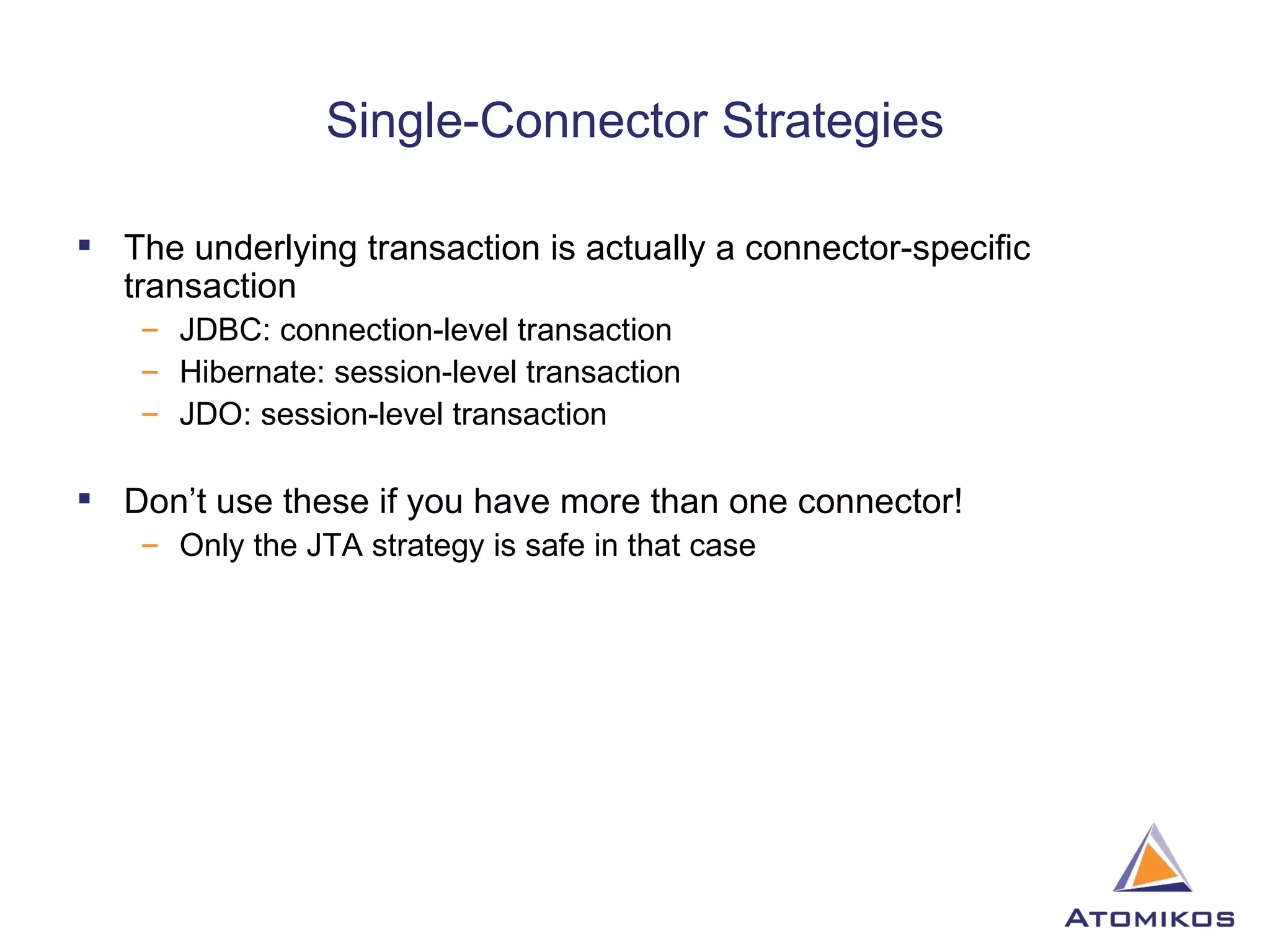
Single-Connector Strategies The underlying transaction is actually a connector-specific transaction JDBC: connection-level transaction Hibernate: session-level transaction JDO: session-level transaction Don’t use these if you have more than one connector! Only the JTA strategy is safe in that case
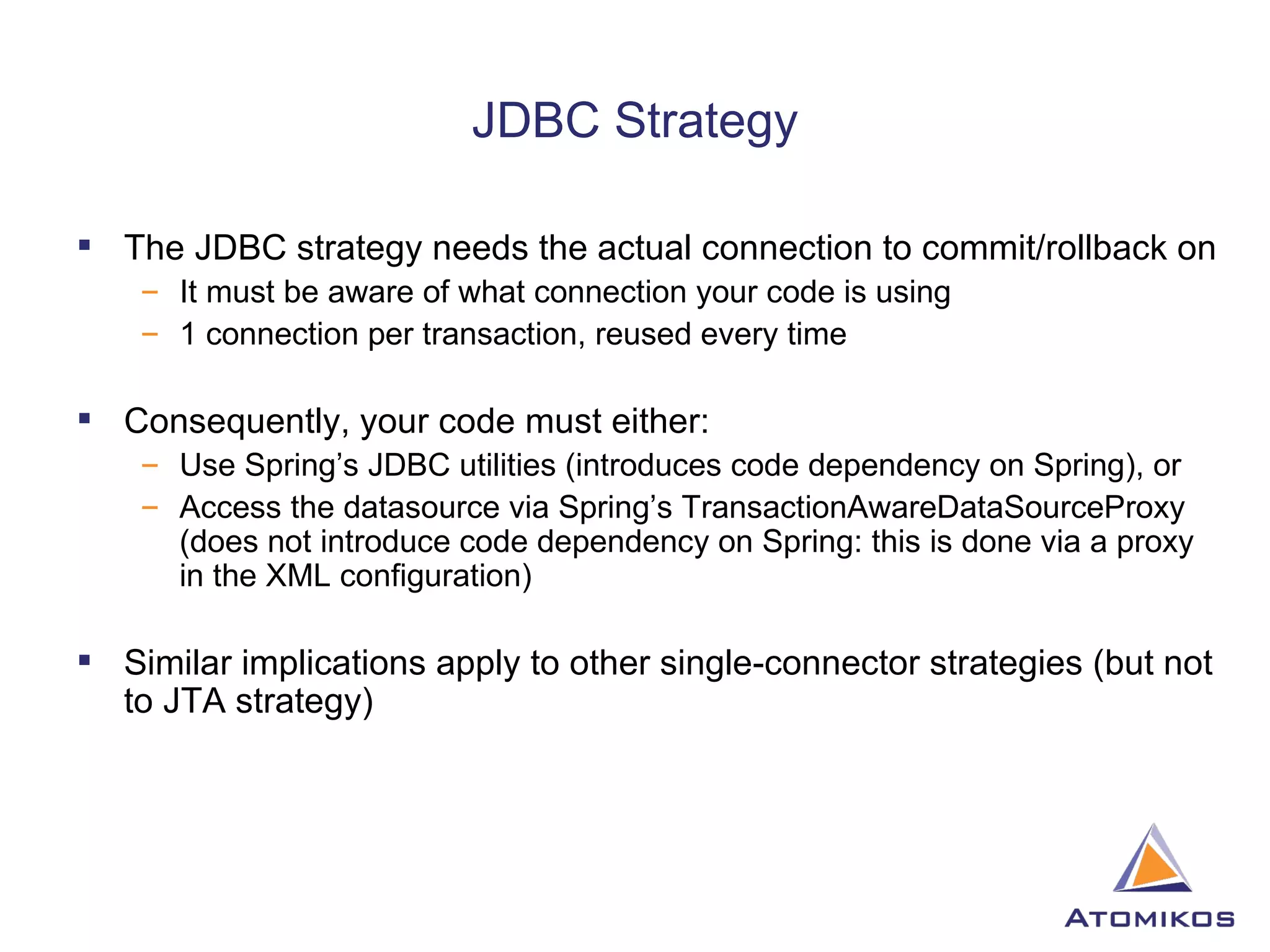
JDBC Strategy The JDBC strategy needs the actual connection to commit/rollback on It must be aware of what connection your code is using 1 connection per transaction, reused every time Consequently, your code must either: Use Spring’s JDBC utilities (introduces code dependency on Spring), or Access the datasource via Spring’s TransactionAwareDataSourceProxy (does not introduce code dependency on Spring: this is done via a proxy in the XML configuration) Similar implications apply to other single-connector strategies (but not to JTA strategy)
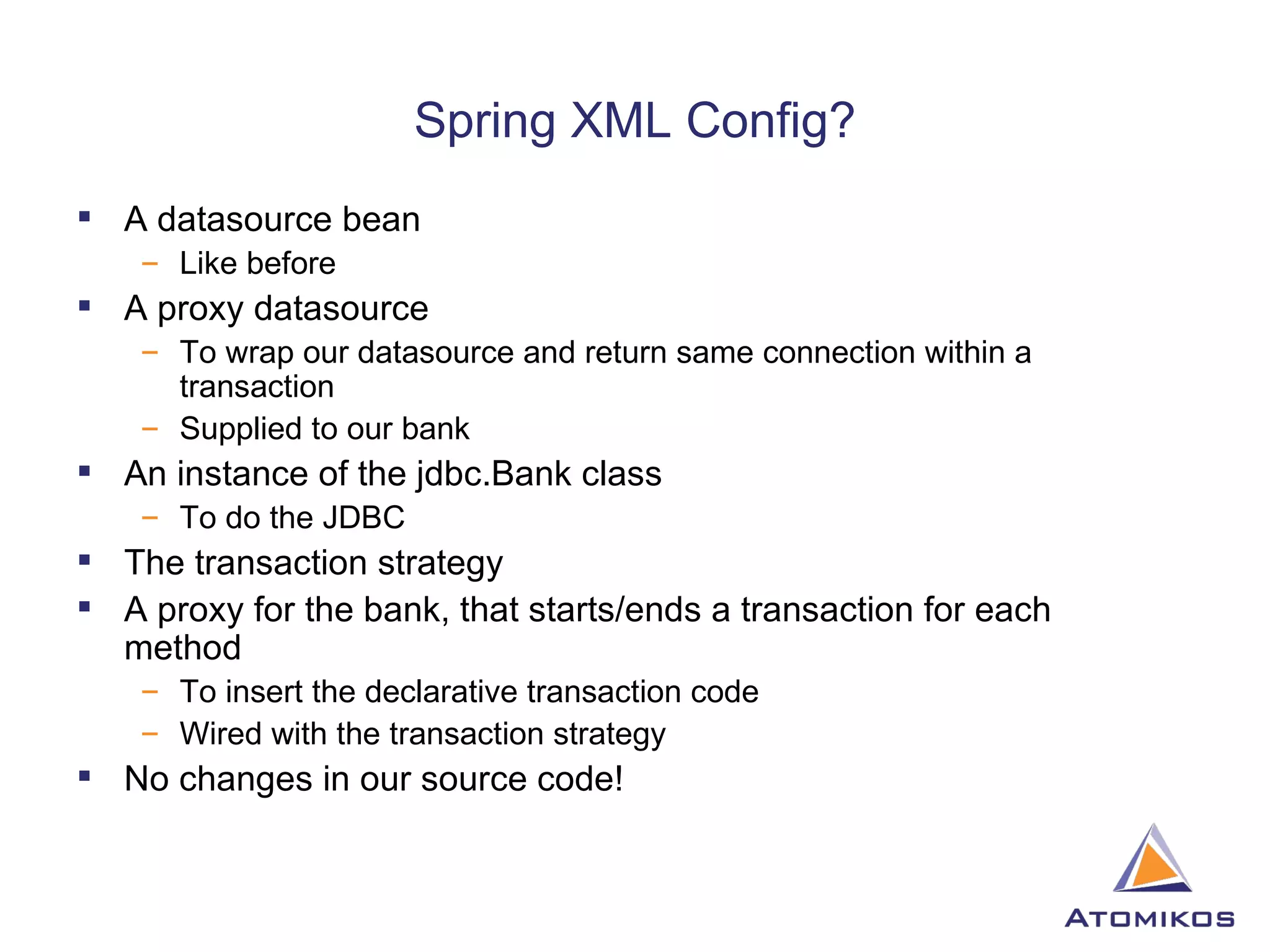
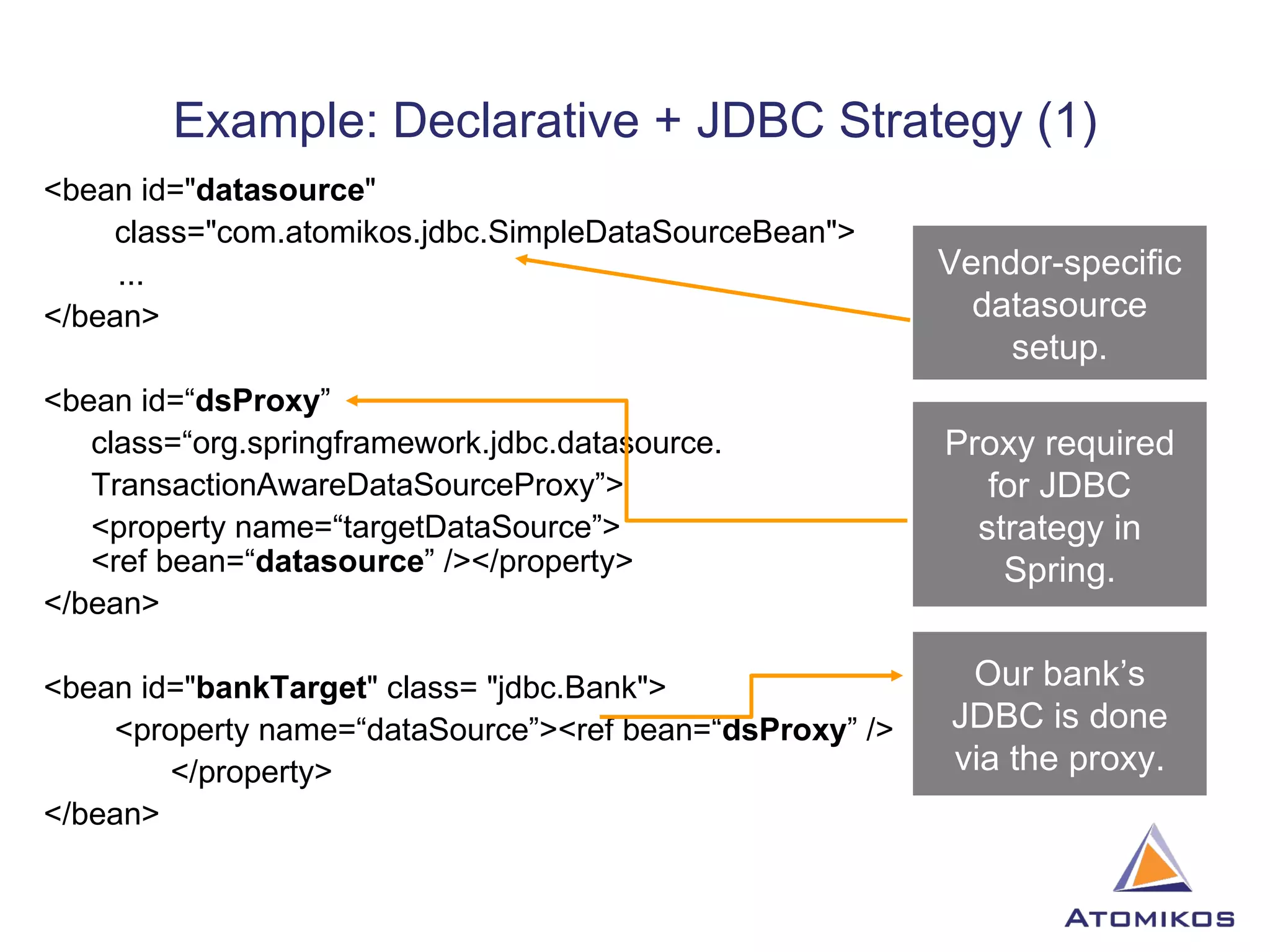
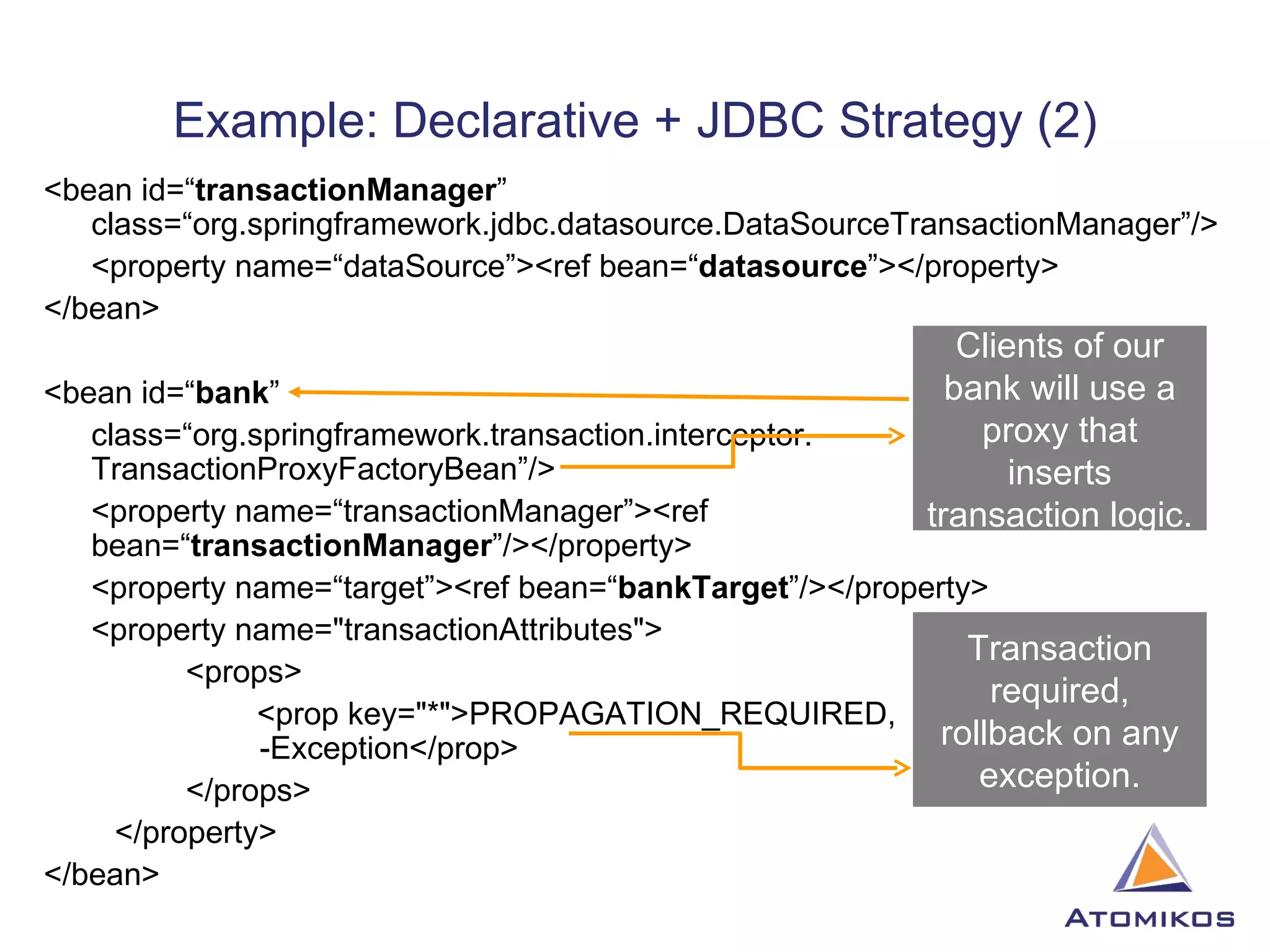
Spring XML Config? A datasource bean Like before A proxy datasource To wrap our datasource and return same connection within a transaction Supplied to our bank An instance of the jdbc.Bank class To do the JDBC The transaction strategy A proxy for the bank, that starts/ends a transaction for each method To insert the declarative transaction code Wired with the transaction strategy No changes in our source code!
Example: Declarative + JDBC Strategy (1) <bean id=&quot; datasource &quot; class=&quot;com.atomikos.jdbc.SimpleDataSourceBean&quot;>   ... </bean> <bean id=“ dsProxy ”  class=“org.springframework.jdbc.datasource. TransactionAwareDataSourceProxy”> <property name=“targetDataSource”> <ref bean=“ datasource ” /></property> </bean> <bean id=&quot; bankTarget &quot; class= &quot;jdbc.Bank&quot;> <property name=“dataSource”><ref bean=“ dsProxy ” /> </property> </bean> Vendor-specific datasource setup. Proxy required for JDBC strategy in Spring. Our bank’s JDBC is done via the proxy.
Example: Declarative + JDBC Strategy (2) <bean id=“ transactionManager ” class=“org.springframework.jdbc.datasource.DataSourceTransactionManager”/> <property name=“dataSource”><ref bean=“ datasource ”></property> </bean> <bean id=“ bank ”  class=“org.springframework.transaction.interceptor. TransactionProxyFactoryBean”/> <property name=“transactionManager”><ref bean=“ transactionManager ”/></property> <property name=“target”><ref bean=“ bankTarget ”/></property> <property name=&quot;transactionAttributes&quot;> <props> <prop key=&quot;*&quot;>PROPAGATION_REQUIRED,    -Exception</prop> </props> </property> </bean> Clients of our bank will use a proxy that inserts transaction logic. Transaction required, rollback on any exception.
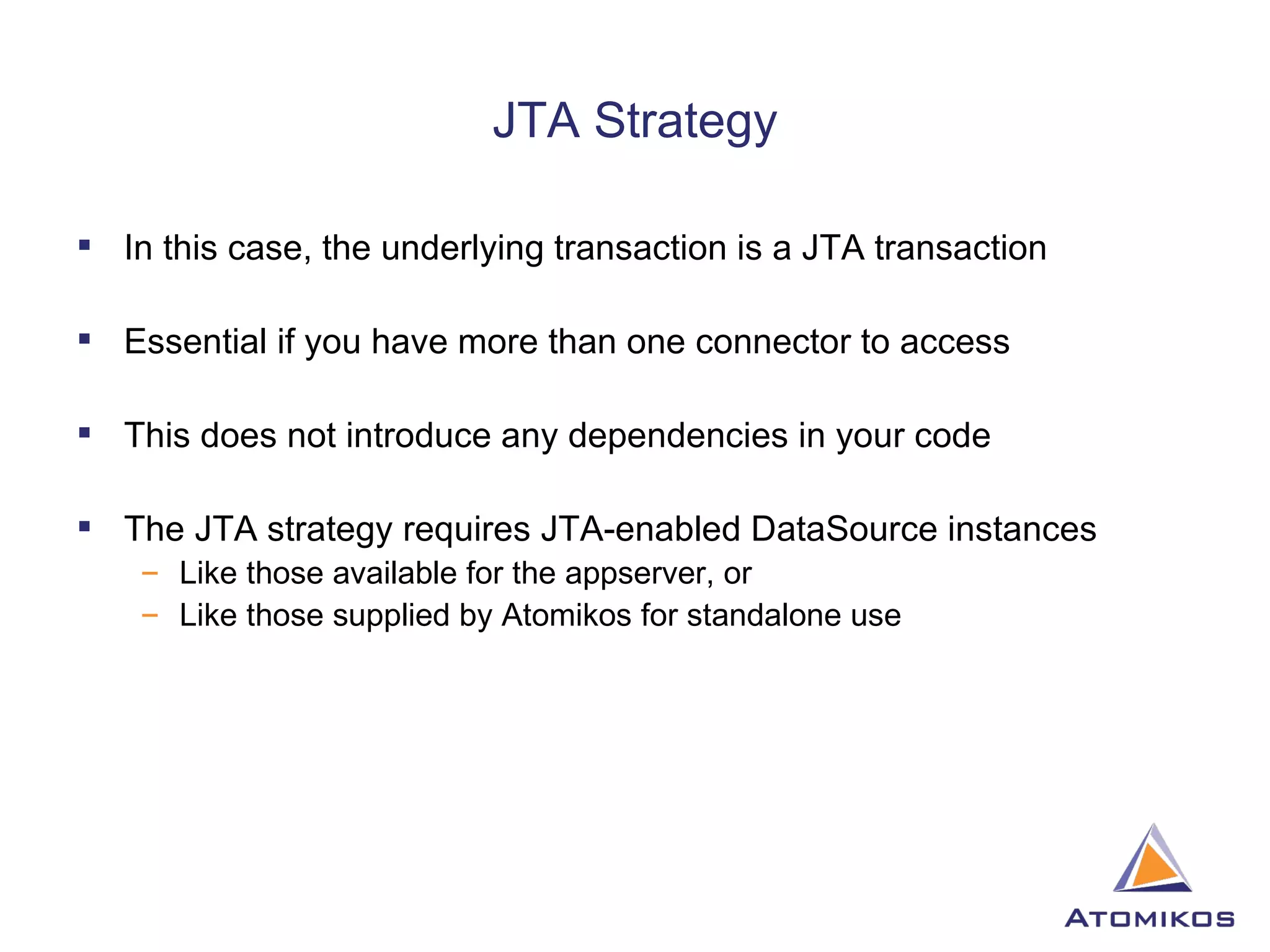
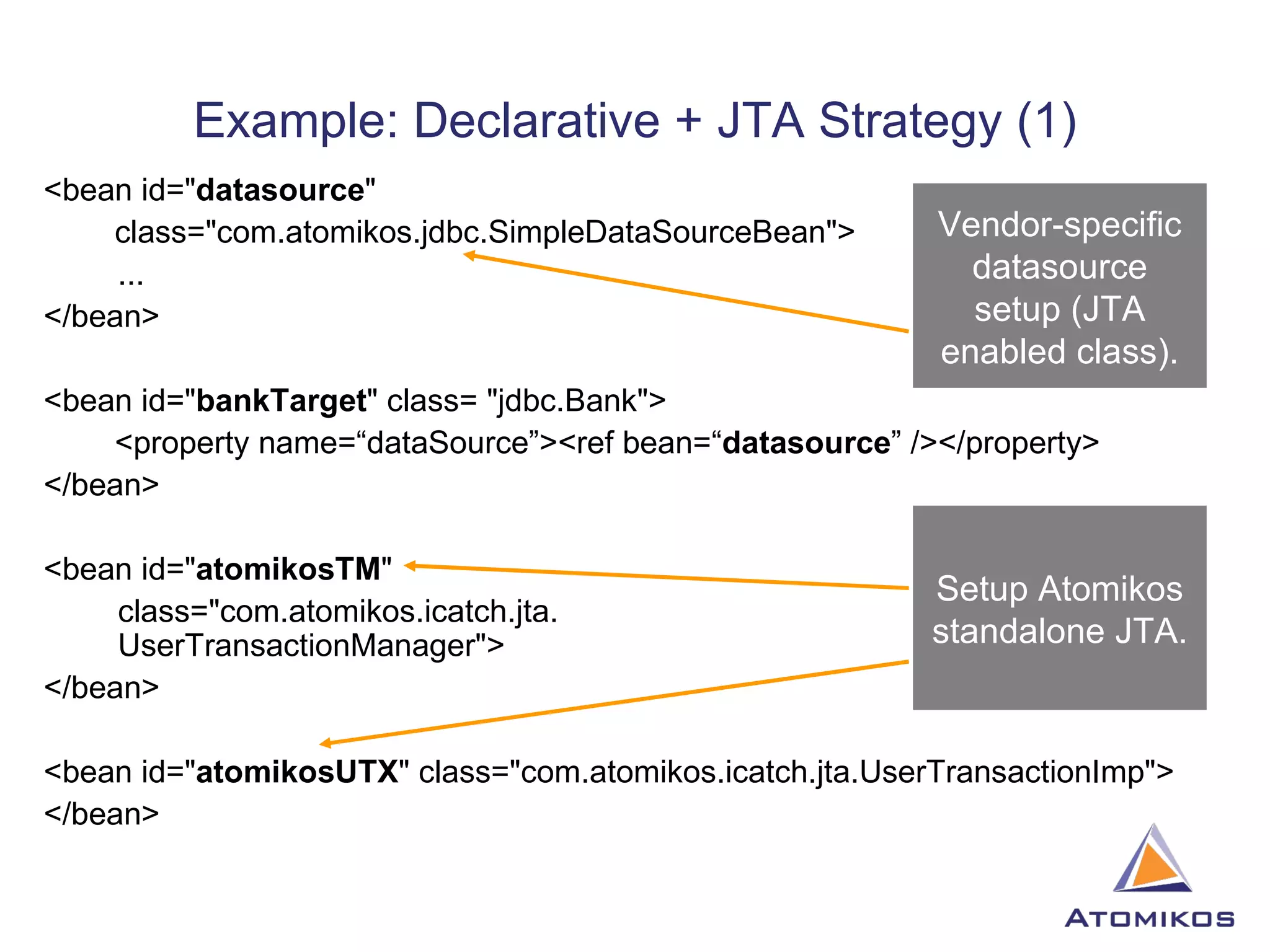
JTA Strategy In this case, the underlying transaction is a JTA transaction Essential if you have more than one connector to access This does not introduce any dependencies in your code The JTA strategy requires JTA-enabled DataSource instances Like those available for the appserver, or Like those supplied by Atomikos for standalone use
Example: Declarative + JTA Strategy (1) <bean id=&quot; datasource &quot; class=&quot;com.atomikos.jdbc.SimpleDataSourceBean&quot;>   ... </bean> <bean id=&quot; bankTarget &quot; class= &quot;jdbc.Bank&quot;> <property name=“dataSource”><ref bean=“ datasource ” /></property> </bean> <bean id=&quot; atomikosTM &quot;    class=&quot;com.atomikos.icatch.jta.   UserTransactionManager&quot;> </bean> <bean id=&quot; atomikosUTX &quot; class=&quot;com.atomikos.icatch.jta.UserTransactionImp&quot;> </bean> Vendor-specific datasource setup (JTA enabled class). Setup Atomikos standalone JTA.
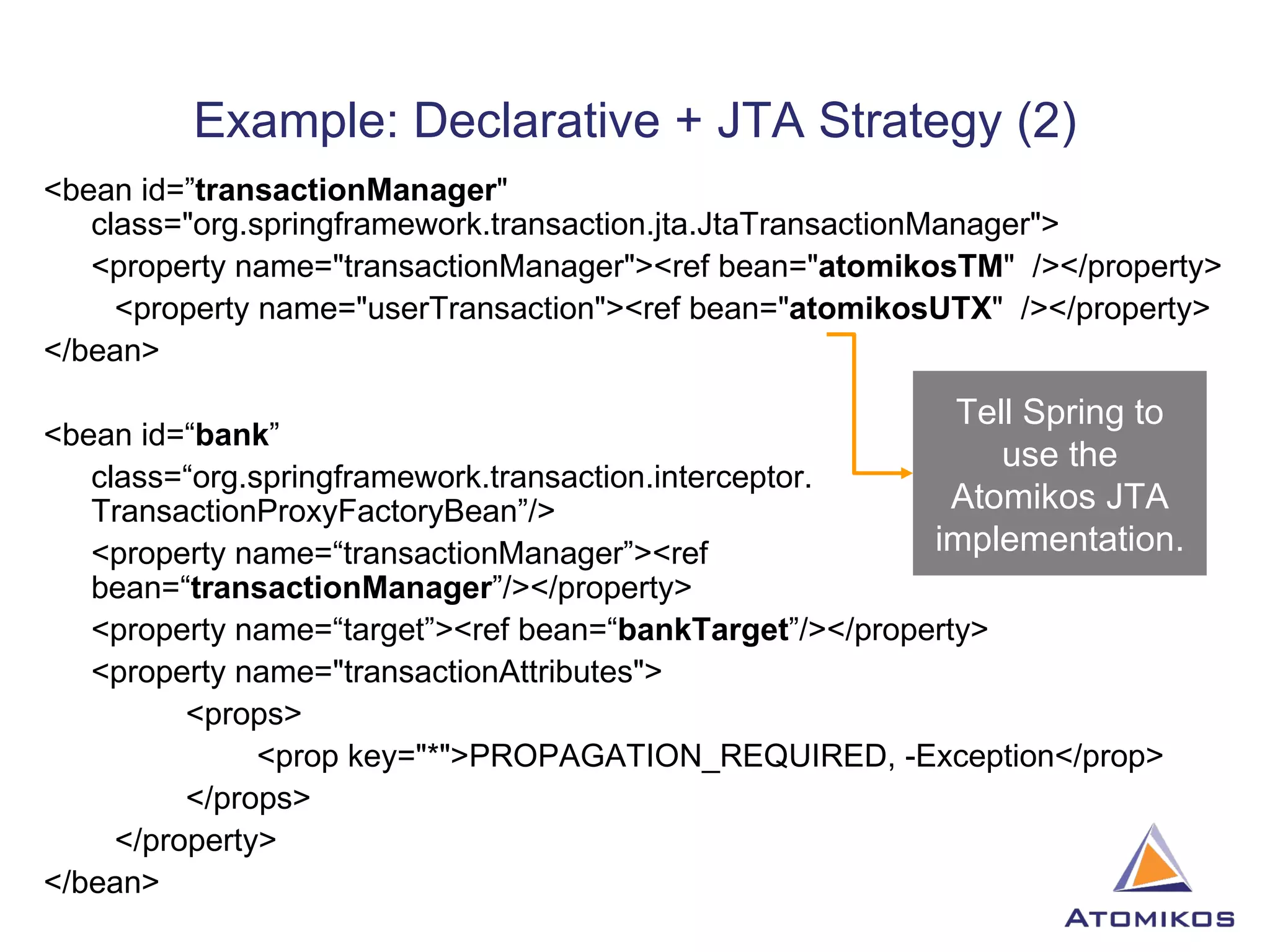
Example: Declarative + JTA Strategy (2) <bean id=” transactionManager &quot; class=&quot;org.springframework.transaction.jta.JtaTransactionManager&quot;> <property name=&quot;transactionManager&quot;><ref bean=&quot; atomikosTM &quot;  /></property> <property name=&quot;userTransaction&quot;><ref bean=&quot; atomikosUTX &quot;  /></property> </bean> <bean id=“ bank ”  class=“org.springframework.transaction.interceptor. TransactionProxyFactoryBean”/> <property name=“transactionManager”><ref bean=“ transactionManager ”/></property> <property name=“target”><ref bean=“ bankTarget ”/></property> <property name=&quot;transactionAttributes&quot;> <props> <prop key=&quot;*&quot;>PROPAGATION_REQUIRED, -Exception</prop> </props> </property> </bean> Tell Spring to use the Atomikos JTA implementation.
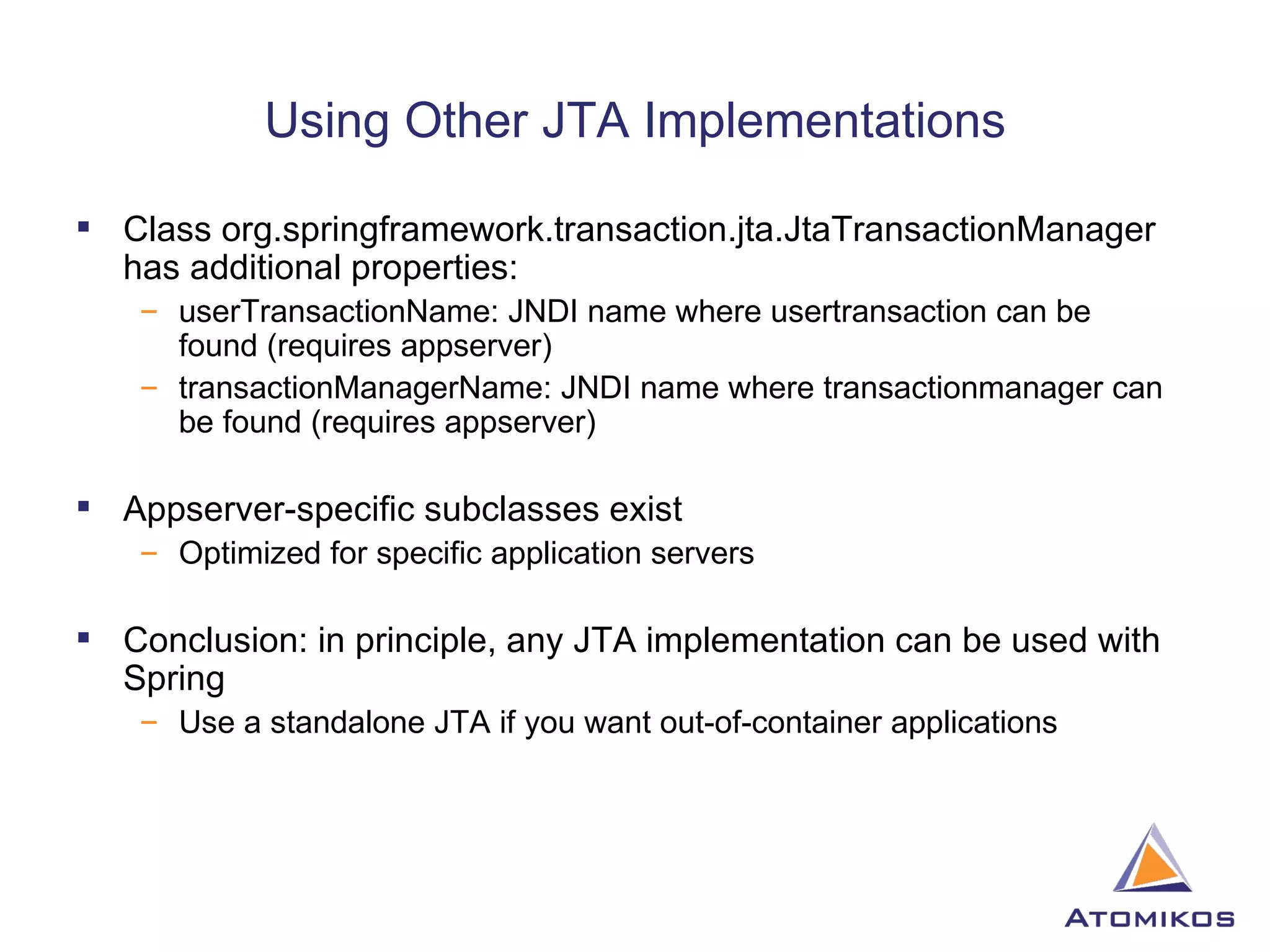
Using Other JTA Implementations Class org.springframework.transaction.jta.JtaTransactionManager has additional properties: userTransactionName: JNDI name where usertransaction can be found (requires appserver) transactionManagerName: JNDI name where transactionmanager can be found (requires appserver) Appserver-specific subclasses exist Optimized for specific application servers Conclusion: in principle, any JTA implementation can be used with Spring Use a standalone JTA if you want out-of-container applications
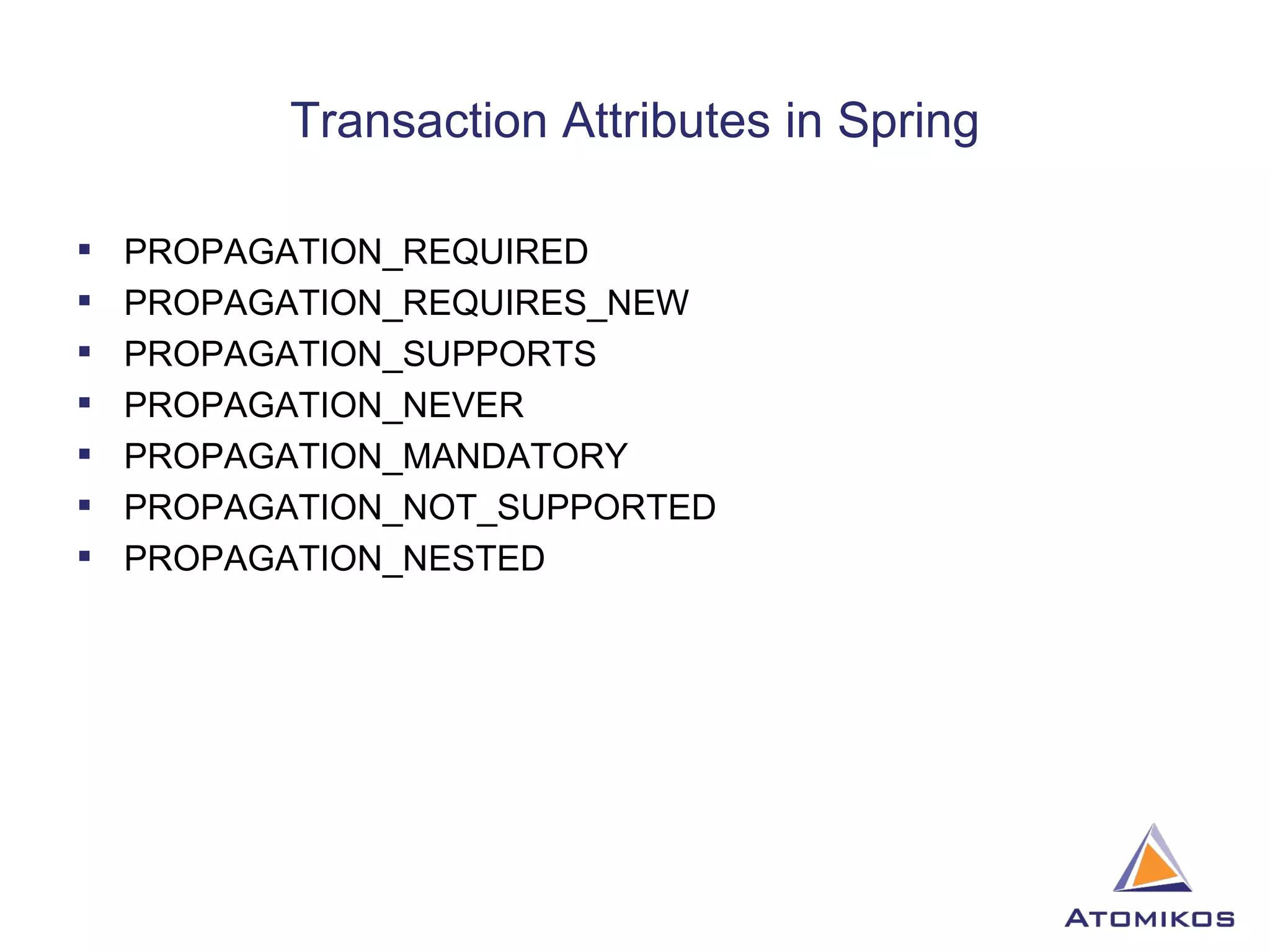
Transaction Attributes in Spring PROPAGATION_REQUIRED PROPAGATION_REQUIRES_NEW PROPAGATION_SUPPORTS PROPAGATION_NEVER PROPAGATION_MANDATORY PROPAGATION_NOT_SUPPORTED PROPAGATION_NESTED
Part 3 JTA Use Cases
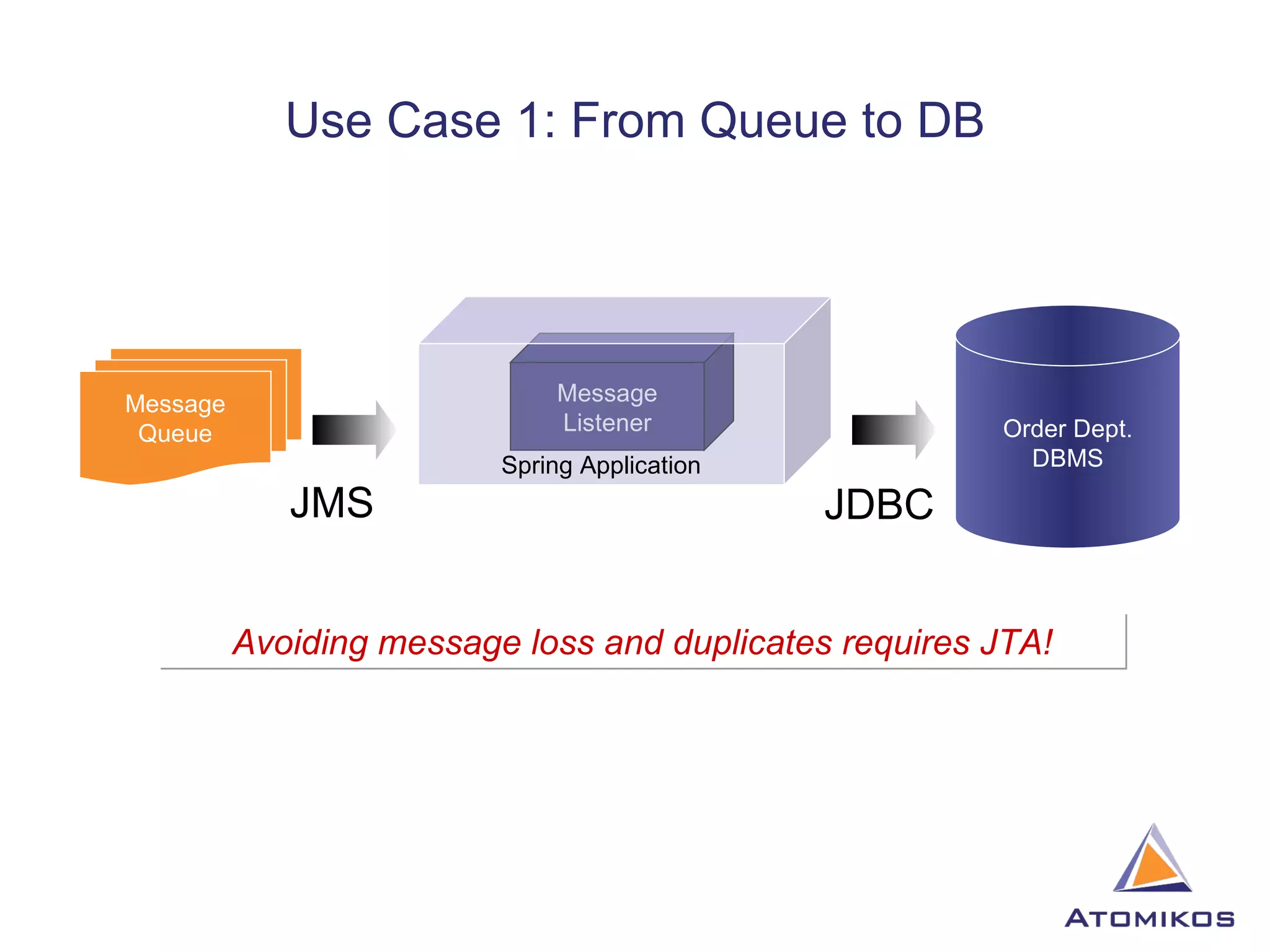
Use Case 1: From Queue to DB Avoiding message loss and duplicates requires JTA! JMS JDBC Message Queue Message Listener Order Dept. DBMS Spring Application
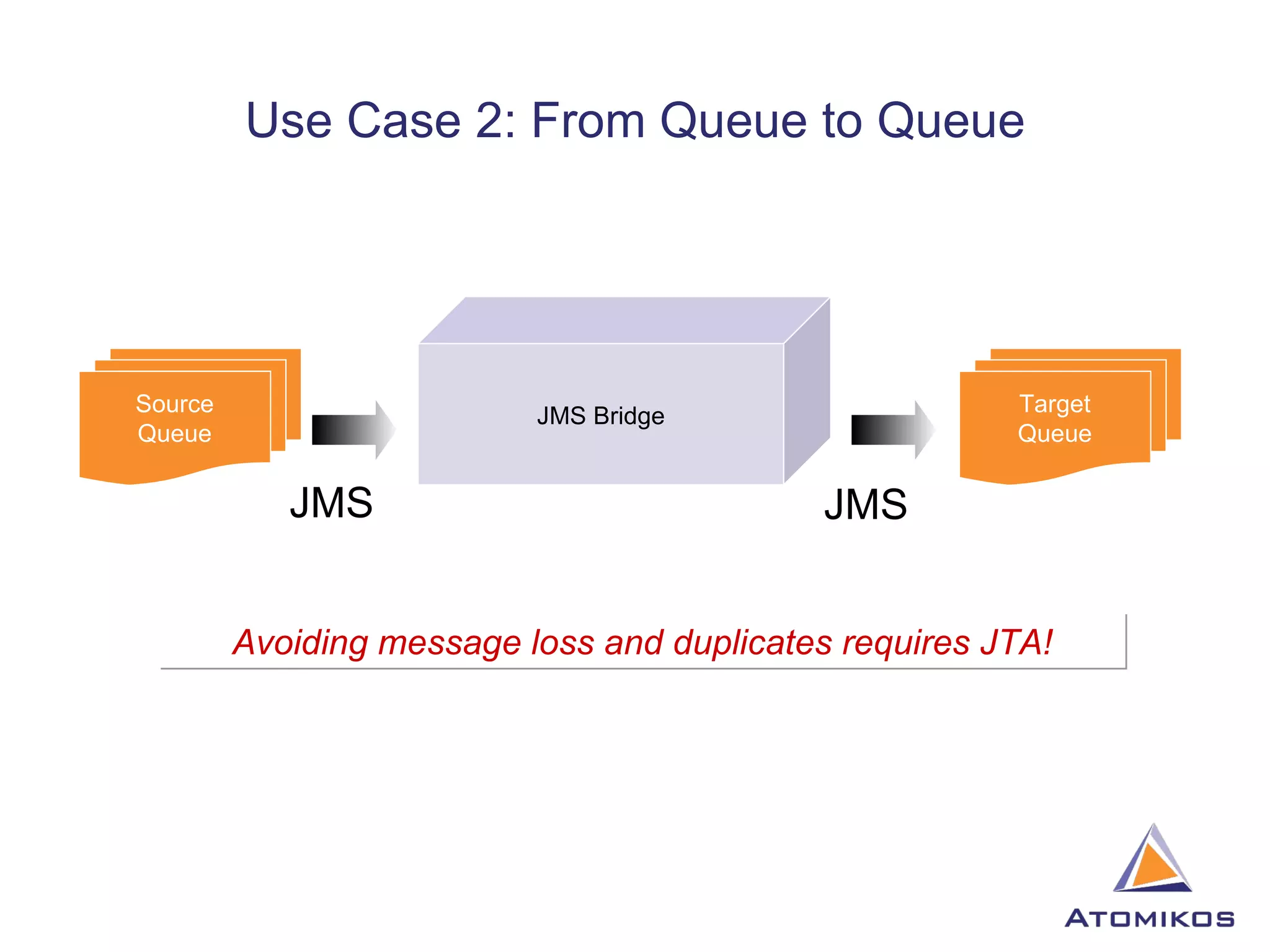
Use Case 2: From Queue to Queue JMS Bridge Avoiding message loss and duplicates requires JTA! JMS JMS Source Queue Target Queue
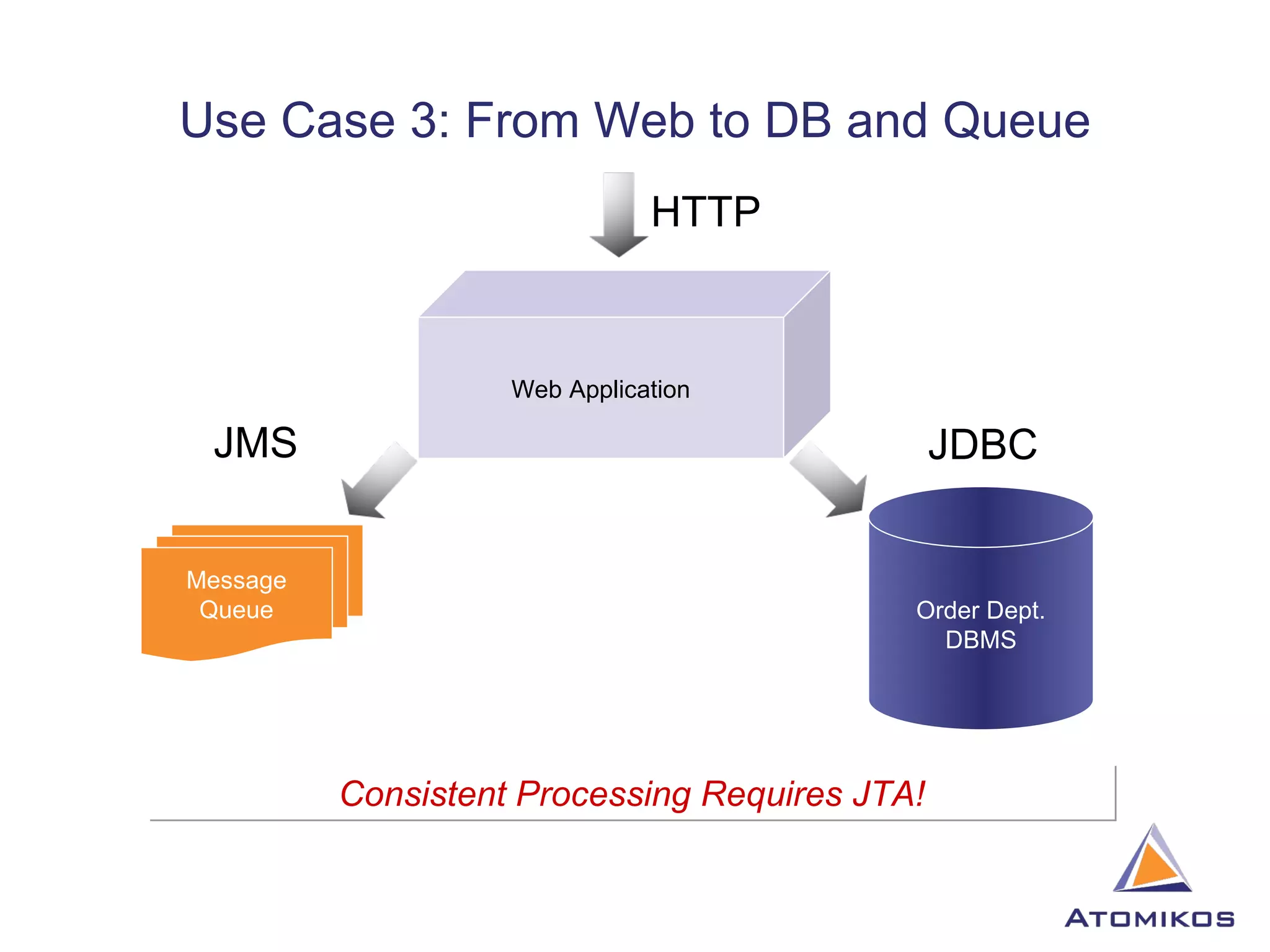
Use Case 3: From Web to DB and Queue Web Application Consistent Processing Requires JTA! JMS JDBC Message Queue Order Dept. DBMS HTTP
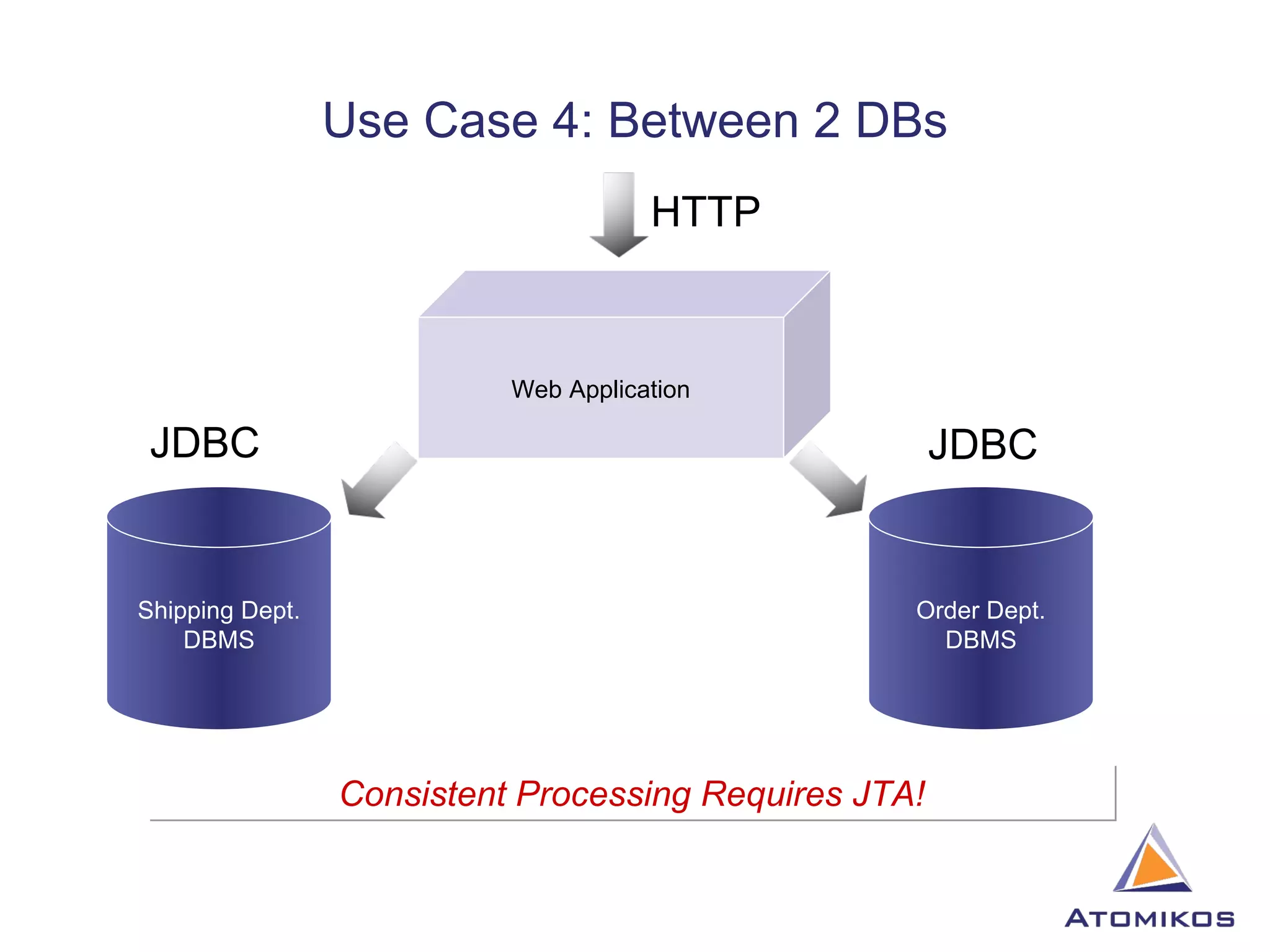
Use Case 4: Between 2 DBs Web Application Consistent Processing Requires JTA! JDBC JDBC Order Dept. DBMS HTTP Shipping Dept. DBMS
Conclusion: Spring Improves J2EE Enables J2EE without application server Components are freed of the EJB harness CMT is still possible Managed security is also possible Less hardware resources needed End of the deployment descriptor nightmare Easier to develop, maintain, test and install Overall project cost is much lower, without loss of reliability
More Information? Read more in this article:  http://www.atomikos.com/Publications/J2eeWithoutApplicationServer Download Atomikos TransactionsEssentials http://www.atomikos.com/Main/TransactionsEssentials   Transaction management for Spring and JSE A jar file that enables JTA in all your applications Includes connection pooling (JDBC/JMS)  Includes message-driven JMS support for Spring Downloadable from  http://www.atomikos.com Contact me at  [email_address]

Developing Transactional JEE Apps With Spring

  • 1.
    Transactional J(2)EE Applications with Spring Transactional POJO Programming Guy Pardon (guy@atomikos.com)
  • 2.
    Contents Part 1:Spring Essentials Part 2: Transactions in Spring Part 3: JTA Use Cases
  • 3.
    Part 1 SpringEssentials
  • 4.
    The Spring Framework Inversion of Control (IoC) library Creation and configuration of objects Keeps your application code free of class-specific configuration issues Makes plain java components easier to write and use Dependency injection: wiring objects together Encourages programming against interfaces Advantage: allows clean and focused java components Supports aspect-oriented programming (AOP) Allows introduction of additional logic before/after a method call Advantage: can replace typical appserver services Works both inside and outside of application server
  • 5.
    Configuring a DataSource<?xml version=&quot;1.0&quot; encoding=&quot;UTF-8&quot;?> <!DOCTYPE beans PUBLIC &quot;-//SPRING//DTD BEAN//EN&quot; &quot;http://www.springframework.org/dtd/spring-beans.dtd&quot;> <beans> <bean id=&quot; datasource &quot; class=&quot; com.atomikos.jdbc.SimpleDataSourceBean &quot;> <property name=&quot;uniqueResourceName&quot;> <value>XADBMS</value> </property> <property name=&quot;xaDataSourceClassName&quot;> <value>COM.FirstSQL.Dbcp.DbcpXADataSource</value> </property> ... </bean> </beans> Ask Spring to create an object with this name and of this class, and to set the given properties
  • 6.
    <?xml version=&quot;1.0&quot; encoding=&quot;UTF-8&quot;?><!DOCTYPE beans PUBLIC &quot;-//SPRING//DTD BEAN//EN&quot; &quot;http://www.springframework.org/dtd/spring-beans.dtd&quot;> <beans> <bean id=&quot;datasource&quot; class=&quot;com.atomikos.jdbc.SimpleDataSourceBean&quot;> ... </bean> <bean id=&quot; bank &quot; class= &quot; jdbc.Bank &quot;> ... </bean> </beans> A Client Component
  • 7.
    Wiring Objects Together <?xml version=&quot;1.0&quot; encoding=&quot;UTF-8&quot;?> <!DOCTYPE beans PUBLIC &quot;-//SPRING//DTD BEAN//EN&quot; &quot;http://www.springframework.org/dtd/spring-beans.dtd&quot;> <beans> <bean id=&quot; datasource &quot; class=&quot;com.atomikos.jdbc.SimpleDataSourceBean&quot;> ... </bean> <bean id=&quot;bank&quot; class= &quot;jdbc.Bank&quot;> <property name=“dataSource”><ref bean=“ datasource ” /></property> </bean> </beans> Ask Spring to establish an association between the Objects called bank and datasource
  • 8.
    Bank Class: “setDataSource” public class Bank { private DataSource dataSource; public Bank() {} public void setDataSource ( DataSource dataSource ) { this.dataSource = dataSource; } //the rest is pure JDBC code ... } Our Java code can now be independent of the actual JDBC vendor classes. This is called by the Spring wiring runtime.
  • 9.
    Applications: Configuration NoLonger Hard-Coded public class Main { public static void main ( String[] args ) throws Exception { InputStream is = new FileInputStream(&quot;config.xml&quot;); XmlBeanFactory factory = new XmlBeanFactory(is); Bank bank = ( Bank ) factory.getBean ( &quot;bank&quot; ); //the bank object is already configured and ready to use!!! bank.withdraw ( 10 , 100 ); ... } } Just ask the Spring BeanFactory to use our XML configuration file. We can ask Spring to return configured objects by their name (id)
  • 10.
    Spring Benefits Configurationis XML Can be changed without recompilation Configuration is centralized in files Easy to find and maintain Your Java code is pure and clean Easier to write and maintain More focused on what it needs to do Your Java code has less dependencies Concrete class names are factored out We can control the wiring We can insert proxies that add services You source code does not need to know Enables J2EE without appserver
  • 11.
    Transactions in Spring?Can we use Spring to manage transactions? Can we use the datasource multiple times and then still rollback in case of a failure? Can we rollback across multiple connectors? The rest of this presentation will discuss that
  • 12.
    Part 2 TransactionSupport in Spring
  • 13.
    Spring and TransactionsSimilar to EJB: Declarative or programmatic demarcation Several attributes for declarative transactions Different from EJB: Flexibility to choose the underlying transaction strategy JDBC, JTA, JDO, Hibernate, ... This means that you don’t necessarily need an application server to have transactions (J2EE without appserver)!
  • 14.
    Transaction Strategies inSpring Strategy defines what underlying technology manages the transactions Single-connector strategies: JDBC Hibernate JDO Other Multiple-connector strategy: JTA
  • 15.
    Single-Connector Strategies Theunderlying transaction is actually a connector-specific transaction JDBC: connection-level transaction Hibernate: session-level transaction JDO: session-level transaction Don’t use these if you have more than one connector! Only the JTA strategy is safe in that case
  • 16.
    JDBC Strategy TheJDBC strategy needs the actual connection to commit/rollback on It must be aware of what connection your code is using 1 connection per transaction, reused every time Consequently, your code must either: Use Spring’s JDBC utilities (introduces code dependency on Spring), or Access the datasource via Spring’s TransactionAwareDataSourceProxy (does not introduce code dependency on Spring: this is done via a proxy in the XML configuration) Similar implications apply to other single-connector strategies (but not to JTA strategy)
  • 17.
    Spring XML Config?A datasource bean Like before A proxy datasource To wrap our datasource and return same connection within a transaction Supplied to our bank An instance of the jdbc.Bank class To do the JDBC The transaction strategy A proxy for the bank, that starts/ends a transaction for each method To insert the declarative transaction code Wired with the transaction strategy No changes in our source code!
  • 18.
    Example: Declarative +JDBC Strategy (1) <bean id=&quot; datasource &quot; class=&quot;com.atomikos.jdbc.SimpleDataSourceBean&quot;> ... </bean> <bean id=“ dsProxy ” class=“org.springframework.jdbc.datasource. TransactionAwareDataSourceProxy”> <property name=“targetDataSource”> <ref bean=“ datasource ” /></property> </bean> <bean id=&quot; bankTarget &quot; class= &quot;jdbc.Bank&quot;> <property name=“dataSource”><ref bean=“ dsProxy ” /> </property> </bean> Vendor-specific datasource setup. Proxy required for JDBC strategy in Spring. Our bank’s JDBC is done via the proxy.
  • 19.
    Example: Declarative +JDBC Strategy (2) <bean id=“ transactionManager ” class=“org.springframework.jdbc.datasource.DataSourceTransactionManager”/> <property name=“dataSource”><ref bean=“ datasource ”></property> </bean> <bean id=“ bank ” class=“org.springframework.transaction.interceptor. TransactionProxyFactoryBean”/> <property name=“transactionManager”><ref bean=“ transactionManager ”/></property> <property name=“target”><ref bean=“ bankTarget ”/></property> <property name=&quot;transactionAttributes&quot;> <props> <prop key=&quot;*&quot;>PROPAGATION_REQUIRED, -Exception</prop> </props> </property> </bean> Clients of our bank will use a proxy that inserts transaction logic. Transaction required, rollback on any exception.
  • 20.
    JTA Strategy Inthis case, the underlying transaction is a JTA transaction Essential if you have more than one connector to access This does not introduce any dependencies in your code The JTA strategy requires JTA-enabled DataSource instances Like those available for the appserver, or Like those supplied by Atomikos for standalone use
  • 21.
    Example: Declarative +JTA Strategy (1) <bean id=&quot; datasource &quot; class=&quot;com.atomikos.jdbc.SimpleDataSourceBean&quot;> ... </bean> <bean id=&quot; bankTarget &quot; class= &quot;jdbc.Bank&quot;> <property name=“dataSource”><ref bean=“ datasource ” /></property> </bean> <bean id=&quot; atomikosTM &quot; class=&quot;com.atomikos.icatch.jta. UserTransactionManager&quot;> </bean> <bean id=&quot; atomikosUTX &quot; class=&quot;com.atomikos.icatch.jta.UserTransactionImp&quot;> </bean> Vendor-specific datasource setup (JTA enabled class). Setup Atomikos standalone JTA.
  • 22.
    Example: Declarative +JTA Strategy (2) <bean id=” transactionManager &quot; class=&quot;org.springframework.transaction.jta.JtaTransactionManager&quot;> <property name=&quot;transactionManager&quot;><ref bean=&quot; atomikosTM &quot; /></property> <property name=&quot;userTransaction&quot;><ref bean=&quot; atomikosUTX &quot; /></property> </bean> <bean id=“ bank ” class=“org.springframework.transaction.interceptor. TransactionProxyFactoryBean”/> <property name=“transactionManager”><ref bean=“ transactionManager ”/></property> <property name=“target”><ref bean=“ bankTarget ”/></property> <property name=&quot;transactionAttributes&quot;> <props> <prop key=&quot;*&quot;>PROPAGATION_REQUIRED, -Exception</prop> </props> </property> </bean> Tell Spring to use the Atomikos JTA implementation.
  • 23.
    Using Other JTAImplementations Class org.springframework.transaction.jta.JtaTransactionManager has additional properties: userTransactionName: JNDI name where usertransaction can be found (requires appserver) transactionManagerName: JNDI name where transactionmanager can be found (requires appserver) Appserver-specific subclasses exist Optimized for specific application servers Conclusion: in principle, any JTA implementation can be used with Spring Use a standalone JTA if you want out-of-container applications
  • 24.
    Transaction Attributes inSpring PROPAGATION_REQUIRED PROPAGATION_REQUIRES_NEW PROPAGATION_SUPPORTS PROPAGATION_NEVER PROPAGATION_MANDATORY PROPAGATION_NOT_SUPPORTED PROPAGATION_NESTED
  • 25.
    Part 3 JTAUse Cases
  • 26.
    Use Case 1:From Queue to DB Avoiding message loss and duplicates requires JTA! JMS JDBC Message Queue Message Listener Order Dept. DBMS Spring Application
  • 27.
    Use Case 2:From Queue to Queue JMS Bridge Avoiding message loss and duplicates requires JTA! JMS JMS Source Queue Target Queue
  • 28.
    Use Case 3:From Web to DB and Queue Web Application Consistent Processing Requires JTA! JMS JDBC Message Queue Order Dept. DBMS HTTP
  • 29.
    Use Case 4:Between 2 DBs Web Application Consistent Processing Requires JTA! JDBC JDBC Order Dept. DBMS HTTP Shipping Dept. DBMS
  • 30.
    Conclusion: Spring ImprovesJ2EE Enables J2EE without application server Components are freed of the EJB harness CMT is still possible Managed security is also possible Less hardware resources needed End of the deployment descriptor nightmare Easier to develop, maintain, test and install Overall project cost is much lower, without loss of reliability
  • 31.
    More Information? Readmore in this article: http://www.atomikos.com/Publications/J2eeWithoutApplicationServer Download Atomikos TransactionsEssentials http://www.atomikos.com/Main/TransactionsEssentials Transaction management for Spring and JSE A jar file that enables JTA in all your applications Includes connection pooling (JDBC/JMS) Includes message-driven JMS support for Spring Downloadable from http://www.atomikos.com Contact me at [email_address]