Definition of KAIZEN
Kaizen”refers to a Japanese word , “kai -” which means “change”
and “- zen” which means “good.
“change for the better”
Purpose of KAIZEN
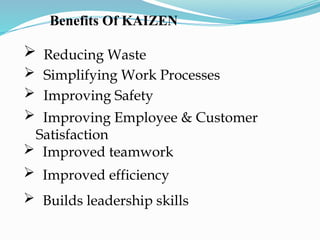
To decrease waste by eliminating overproduction, improving
quality, improving efficiency, reducing idle time, and avoiding
unnecessary activities.
All these refers to cost savings, and can turn potential losses into
profits.
A business philosophy or system to make positive changes on a
regular basis, as to improve productivity, Quality, safety etc. &
minimize waste.
3.
History of KAIZEN
KAIZEN originally began after World War II (1945)
within the Japanese automobile Company Toyota.
Masaaki Imai founded the Kaizen Institute Consulting
Group (KICG) in 1985 to help introduce western
businesses to Kaizen Concepts and tools.
4.
7 Types ofWastes
Over-Production. Producing more than required.
eg.Valve body
Inventory. All raw materials, work in progress and the
finished stock that you hold.
Defects. Product or service that does not meet your
customer’s requirements.
Motion. (Personal / Equipment Movement)
Over-processing. adding more value than the customer
requirements.
Waiting. Waiting for work to arrive, cycles to finish,
information or to be told what to do
Transportation. The movement of product from one location
to another
5.
Steps to CompleteKAIZEN
1. Identify the Problem
2. Analyze the Problem
3. Define the Solution
4. Implement the Solution
5. Observe the results
6. Standardize beneficial solutions