TRAINING ON
CONFIDENTIALITY
Marie Jeanne Embolo Abena
MHA690: Health Care Capstone
Instructor: Rockie McDaniel
OCTOBER 17, 2015
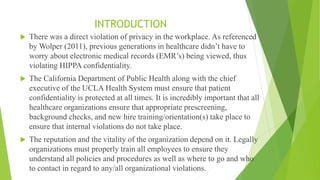
INTRODUCTION
 There was a direct violation of privacy in the workplace. As referenced
by Wolper (2011), previous generations in healthcare didn’t have to
worry about electronic medical records (EMR’s) being viewed, thus
violating HIPPA confidentiality.
 The California Department of Public Health along with the chief
executive of the UCLA Health System must ensure that patient
confidentiality is protected at all times. It is incredibly important that all
healthcare organizations ensure that appropriate prescreening,
background checks, and new hire training/orientation(s) take place to
ensure that internal violations do not take place.
 The reputation and the vitality of the organization depend on it. Legally
organizations must properly train all employees to ensure they
understand all policies and procedures as well as where to go and who
to contact in regard to any/all organizational violations.
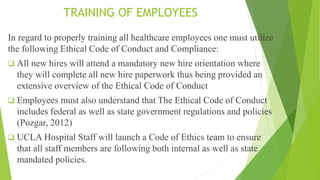
TRAINING OF EMPLOYEES
In regard to properly training all healthcare employees one must utilize
the following Ethical Code of Conduct and Compliance:
 All new hires will attend a mandatory new hire orientation where
they will complete all new hire paperwork thus being provided an
extensive overview of the Ethical Code of Conduct
 Employees must also understand that The Ethical Code of Conduct
includes federal as well as state government regulations and policies
(Pozgar, 2012)
 UCLA Hospital Staff will launch a Code of Ethics team to ensure
that all staff members are following both internal as well as state
mandated policies.
TRAINING OF EMPLOYEES Cont’d
 Continuous training of all staff members in any level
 After each seminar/training there will be a brief exam to
ensure that the Staff member(s) understood the subject
matter
 Staff members are encouraged to share their ideas as well
as voice any concerns that they may have.
 Employer’s handbook on confidentiality in every meeting
and must be employer’s own file.
 Use of non negotiable policies and procedures. Adhere
strictly to HIPPA guidelines & Policies. Thus protecting
privacy (Kongstvedt, 2007)
References
http://voicethread.com/#home. Retrieved February 16, 2015. Kongstvedt, P.R. (2007).
Essentials of managed health care (5th ed.).
MA: Jones and Bartlett Publishers. ISBN: 139780763739836. Pozgar, G. D. (2012).
Wolper, L.F. (2011). Health care administration: Managing organized delivery systems (5th
ed.). Boston: Jones and Bartlett.
Thank you

Training on confidentiality

  • 1.
    TRAINING ON CONFIDENTIALITY Marie JeanneEmbolo Abena MHA690: Health Care Capstone Instructor: Rockie McDaniel OCTOBER 17, 2015
  • 2.
    INTRODUCTION  There wasa direct violation of privacy in the workplace. As referenced by Wolper (2011), previous generations in healthcare didn’t have to worry about electronic medical records (EMR’s) being viewed, thus violating HIPPA confidentiality.  The California Department of Public Health along with the chief executive of the UCLA Health System must ensure that patient confidentiality is protected at all times. It is incredibly important that all healthcare organizations ensure that appropriate prescreening, background checks, and new hire training/orientation(s) take place to ensure that internal violations do not take place.  The reputation and the vitality of the organization depend on it. Legally organizations must properly train all employees to ensure they understand all policies and procedures as well as where to go and who to contact in regard to any/all organizational violations.
  • 3.
    TRAINING OF EMPLOYEES Inregard to properly training all healthcare employees one must utilize the following Ethical Code of Conduct and Compliance:  All new hires will attend a mandatory new hire orientation where they will complete all new hire paperwork thus being provided an extensive overview of the Ethical Code of Conduct  Employees must also understand that The Ethical Code of Conduct includes federal as well as state government regulations and policies (Pozgar, 2012)  UCLA Hospital Staff will launch a Code of Ethics team to ensure that all staff members are following both internal as well as state mandated policies.
  • 4.
    TRAINING OF EMPLOYEESCont’d  Continuous training of all staff members in any level  After each seminar/training there will be a brief exam to ensure that the Staff member(s) understood the subject matter  Staff members are encouraged to share their ideas as well as voice any concerns that they may have.  Employer’s handbook on confidentiality in every meeting and must be employer’s own file.  Use of non negotiable policies and procedures. Adhere strictly to HIPPA guidelines & Policies. Thus protecting privacy (Kongstvedt, 2007)
  • 5.
    References http://voicethread.com/#home. Retrieved February16, 2015. Kongstvedt, P.R. (2007). Essentials of managed health care (5th ed.). MA: Jones and Bartlett Publishers. ISBN: 139780763739836. Pozgar, G. D. (2012). Wolper, L.F. (2011). Health care administration: Managing organized delivery systems (5th ed.). Boston: Jones and Bartlett.
  • 6.

Editor's Notes

  • #4 UCLA Hospital Staff will launch a Code of Ethics team to ensure that all staff members are following both internal as well as state mandated policies. The ethical team will be made up of staff members at various levels and in various positions. This gives the organization the best view into what is really going on within the organization. The team will meet monthly to discuss things that are going on, changes that may need to be made, as well as any issues that may have arose within the last quarter. They will maintain communication through phone/email when and if any issues arise. Another critical factor in achieving success within the Ethical Code of Conduct would be to ensure that there is ongoing and continual training given to all staff members at every level. An educated staff is a strong staff, one that will remain cognizant of what is going on within their organization along with changes that need to be made. Training within the organization will take place monthly. There are a variety of trainings and seminars that will take place. Staff members will be notified of options so that they are able to ensure there is something that works for their schedule.
  • #5 After each seminar/training there will be a brief exam to ensure that the Staff member(s) understood the subject matter. All mandatory seminars and trainings are paid and required. Please note that seminars and trainings involving Ethical Code of Conduct training do not count towards CEU'S. Although some may see this as an additional monetary cost to the organization, in the long run this could save the organization from closing their doors due to malpractice lawsuits Staff members are encouraged to share their ideas as well as voice any concerns that they may have. It is the opinion of the staff members that there are various points of view at every level. In order to remain cohesive and ethically sound, the staff must continue to work together to achieve this goal. During meetings the staff should be given an employer handbook that address confidentiality and the employees should sign a copy for their personal file. The meeting should incorporate games as well as a lecture; people and employees sharing real life example on how they felt when their confidentiality was not respected or how they would feel if their personal information was shared with others. Non-negotiable policies and procedures: -Adhere strictly to HIPPA guidelines & Policies. Thus protecting privacy -Truly provide patient centered care -Maintaining professional yet compassionate physician/patient relationship -Provide personalized service to customer/patient -Work Safety remains a top priority (OSHA) -When in doubt contact appropriate individual -Promote a positive/healthy work environment -No Tolerance Policy: bribes, kickbacks, inappropriate referrals -Stay away from conflicts of interest -ALL antitrust laws must be followed Treat ALL those associated with UCLA Hospital in an Ethical Manner -Colleagues -Patients/Consumers -Local Community -Medical suppliers