Revised National Tuberculosis Control Programme (RNTCP)


                                                          Central TB Division
                                                          Directorate General of Health Services
                                                          Ministry of Health and Family Welfare
                                                          Nirman Bhawan
                                                          New Delhi-110 108
Revised National Tuberculosis Control Programme (RNTCP)


                              Central TB Division
                    Directorate General of Health Services
                    Ministry of Health and Family Welfare
                                Nirman Bhawan
                              New Delhi-110 011
                              (December 2010)


       This module was prepared by a team from the Central TB Division,
                   Indian Medical Association and WHO-India
About This Module

Healthcare services in India are provided by multiple and diverse providers in the
government, private, non-governmental organisation (NGO) and corporate sectors. Each
sector has strengths as well as weaknesses. Tuberculosis (TB) patients are managed by
several healthcare providers under these different sectors and the responsibility of providing
quality patient care to achieve TB control is therefore, with all these sectors. Effective
control of TB will be possible if all these sectors come together and work towards a common
goal. The Central TB Division (CTD) at the Ministry of Health and Family Welfare, Govt. of
India has been interacting with all sectors of healthcare since the early days of the Revised
National Tuberculosis Control Programme (RNTCP). There are commendable examples
of collaboration among various health sectors, like private, NGOs, corporate and other
government organisations such as ESI, Railways, etc. These collaborations have contributed
significantly towards the implementation of World Health Organization (WHO) recommended
Directly Observed Treatment, Short-course (DOTS) strategy by these different healthcare
sectors.


There was demand from medical practitioners outside the public health sector, and also a
felt need, for a concise module on RNTCP that would facilitate their effective involvement
in the programme. This module, produced by CTD, is in response to the field realities
and is the result of various interactions with, and feedback from, all concerned sectors,
including the Indian Medical Association (IMA). It tries to provide medical practitioners with
updated information on RNTCP that will equip them to adopt and practice the diagnostic
and treatment policies of RNTCP. It is expected to facilitate development of effective and
sustainable partnerships among the public, private, NGO and corporate sectors to ensure
delivery of quality services under RNTCP.


At the end of this modular training, the participants will be able to:
   Get a glimpse of the global and Indian TB scenario
   Understand the principles of RNTCP
   Correctly identify patients suspected of having TB


                                                         About This Module                  iii
    Ensure quality sputum microscopy for TB suspects
    Categorise TB patients correctly as per RNTCP policies
    Understand the rationale of treatment (regimens, doses, side effects)
    Understand the mechanism of DOTS
    Understand the recording and reporting mechanisms
    Understand ‘Referral for Treatment’ and ‘Transfer of Patients’ protocols
    Provide monthly reports
    Understand the management of drugs and other supplies in RNTCP
    Understand monitoring and supervision in RNTCP.


The training module includes a package of standardised printed material, standardized
power point slides, case studies, exercises and pre-test questions.


iv               Training Module for Medical Practitioners
Facilitators’ Guide


Prior to Training
   Pre-test questionnaire to be circulated to the participants during registration
   Request DTO to get copies of local RNTCP key staff contact details which includes the names
    and telephone numbers of the DTO, DTC, MOTC, STS, STLS, TBHVs, DMC list and TU list
   Ensure that all the background material are available prior to trainings
   Ensure availability of sufficient copies of ‘Training Module for Medical Practitioners’
   Standardized training slides
   A CD contains- training slides, CME slides including scientific basis of DOTS, RNTCP
    Technical and Operational Guidelines
   Standardized IEC/PPM kit (diagnostic algorithm, RNTCP at a glance, desk reference etc.
   Ensure that a communication of the trainings has gone well in advance to all trainees
    and all key district RNTCP staff and IMA leaders


During the Training
   At the time of registration, distribute the pre-test questionnaire
   Introduction/ice breaking session by local IMA leader and DTO- 10 minutes. Project slides
    under ‘slides for Chapters 1 and 2’ of the medical practitioners training presentation
    that has been provided in the accompanying CD
   Read Chapter 3 and Chapter 4 involving all trainees in a group. Each trainee, by turn, is
    asked to come to the front and lead the reading for a few minutes
   At the time of reading Chapter 3 and Chapter 4, familiarize the trainees on laboratory
    form and treatment card


                                                         Facilitators’ Guide                  v
Facilitators’ Guide
    At the end of Chapter 3, ensure that all trainees do Exercise 1, Part B individually. At the
     end of Chapter 4, get Exercises 2A and 2B done in the plenary (with the whole group)
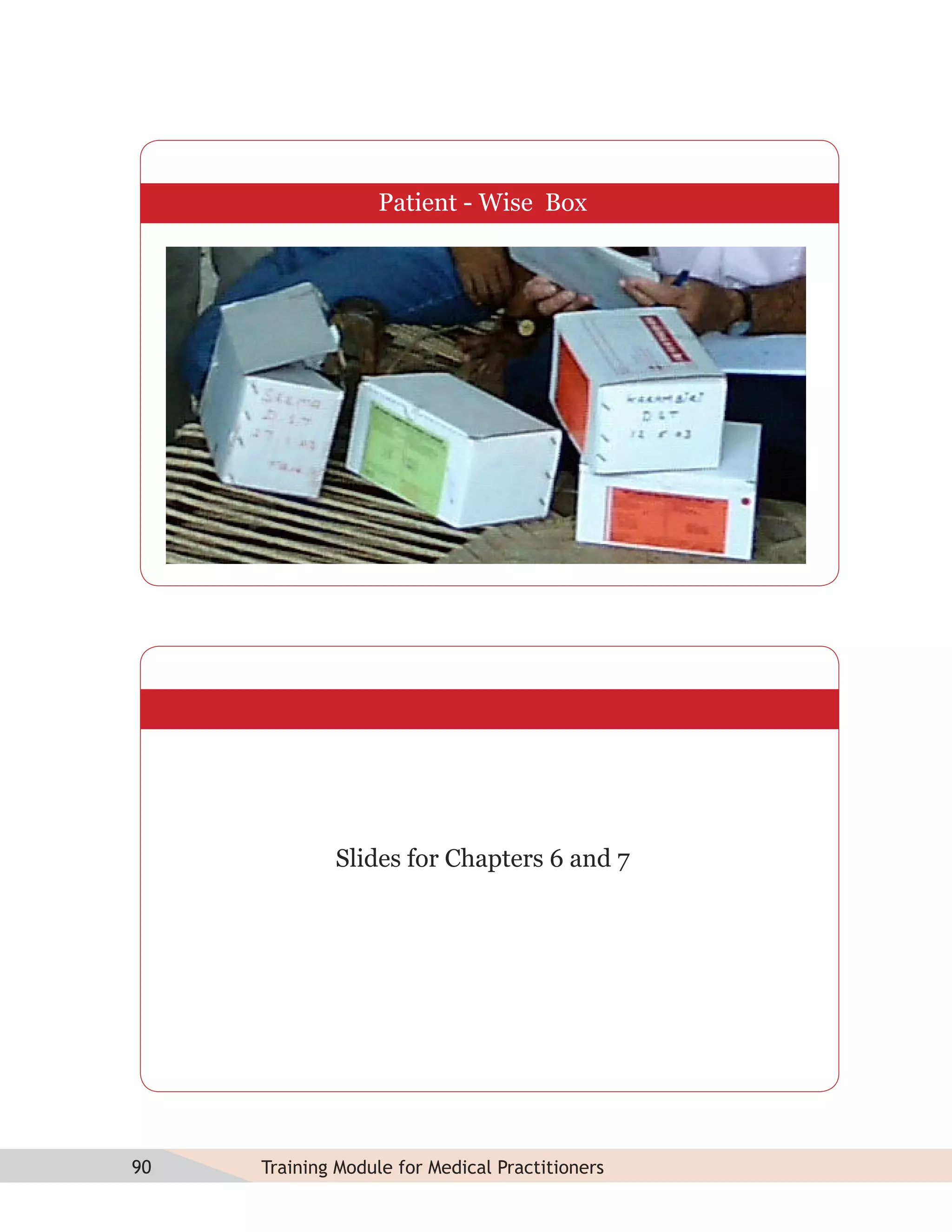
    While covering Chapter 4, demonstrate adult and pediatric patient wise boxes, allowing
     each trainee to examine the box, the pouches and the strips
    Project ‘Slides for Chapters 2,3 and 4’ of the medical practitioners training presentation
     to recapitulate key learning from Chapters 2, 3 and 4
    Project ‘Slides for Additional Information on MDR-TB and PPM schemes’
    Project ‘Slides on International Standards of TB Care’
    Project ‘Slides on Rational use of Anti-TB drugs including Fuoroquinolones’
    Post-test questionnaire to be given to the trainees.


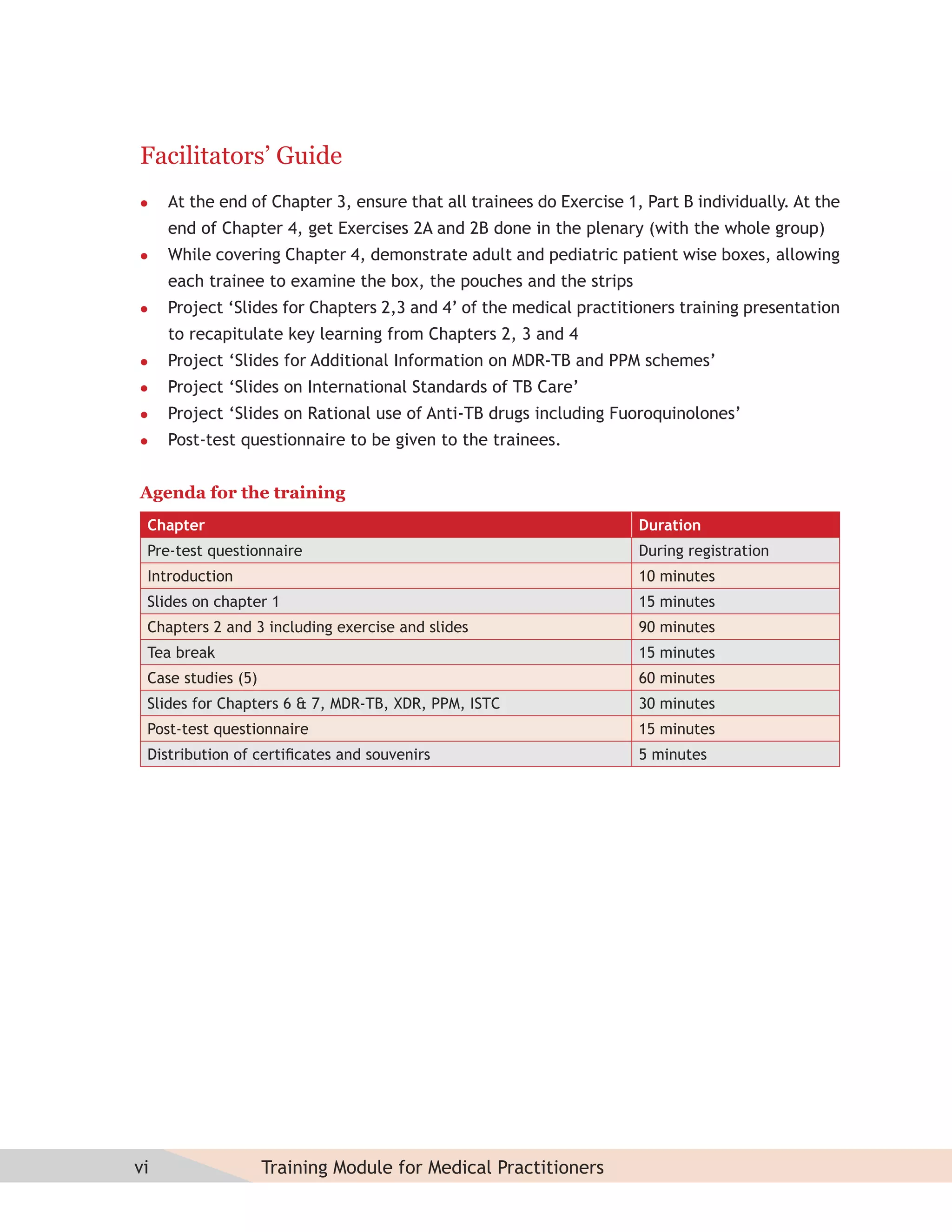
Agenda for the training
 Chapter                                                             Duration
 Pre-test questionnaire                                              During registration
 Introduction                                                        10 minutes
 Slides on chapter 1                                                 15 minutes
 Chapters 2 and 3 including exercise and slides                      90 minutes
 Tea break                                                           15 minutes
 Case studies (5)                                                    60 minutes
 Slides for Chapters 6 & 7, MDR-TB, XDR, PPM, ISTC                   30 minutes
 Post-test questionnaire                                             15 minutes
 Distribution of certificates and souvenirs                           5 minutes


vi                  Training Module for Medical Practitioners
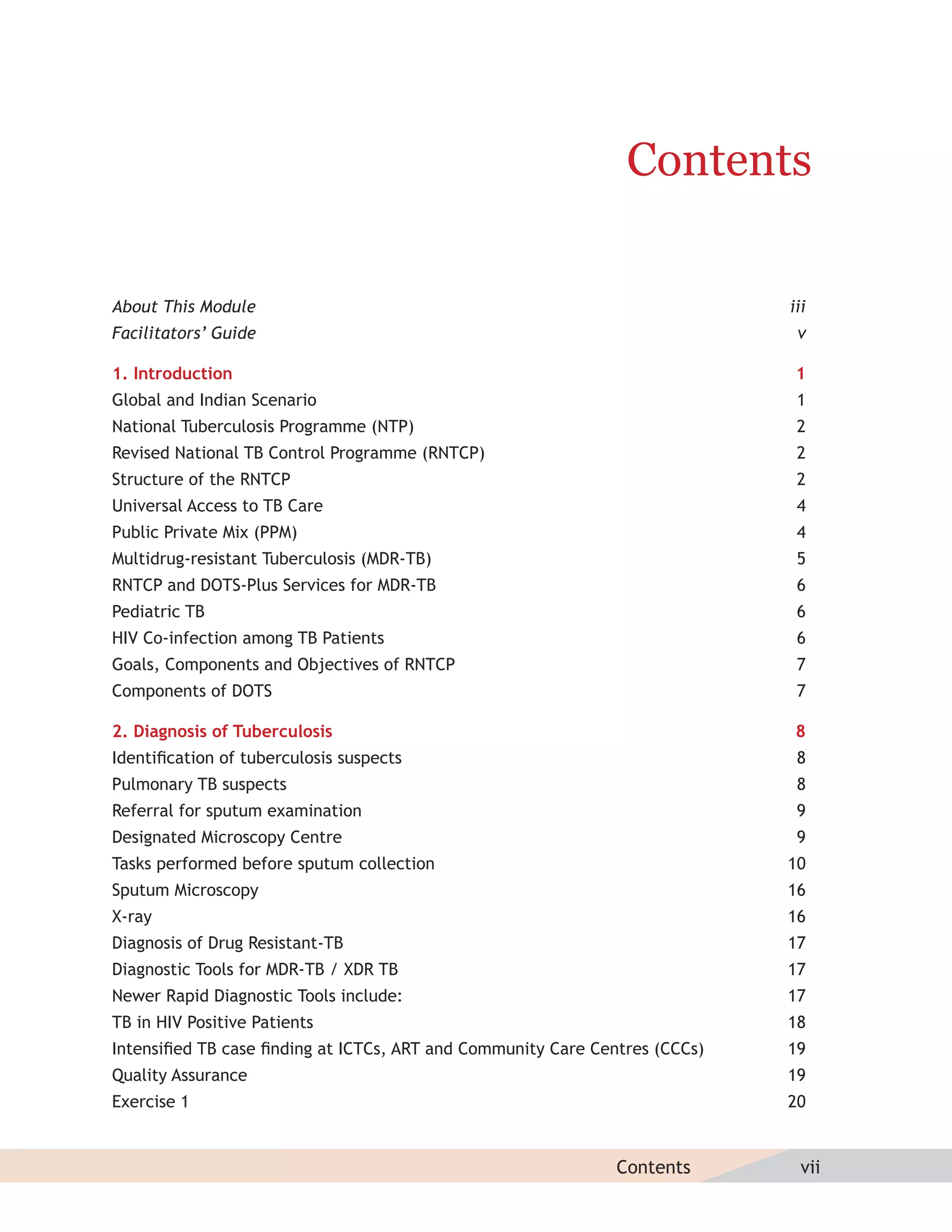
Contents

About This Module                                                           iii
Facilitators’ Guide                                                          v

1. Introduction                                                              1
Global and Indian Scenario                                                   1
National Tuberculosis Programme (NTP)                                        2
Revised National TB Control Programme (RNTCP)                                2
Structure of the RNTCP                                                       2
Universal Access to TB Care                                                  4
Public Private Mix (PPM)                                                     4
Multidrug-resistant Tuberculosis (MDR-TB)                                    5
RNTCP and DOTS-Plus Services for MDR-TB                                      6
Pediatric TB                                                                 6
HIV Co-infection among TB Patients                                           6
Goals, Components and Objectives of RNTCP                                    7
Components of DOTS                                                           7

2. Diagnosis of Tuberculosis                                                 8
Identification of tuberculosis suspects                                       8
Pulmonary TB suspects                                                        8
Referral for sputum examination                                              9
Designated Microscopy Centre                                                 9
Tasks performed before sputum collection                                    10
Sputum Microscopy                                                           16
X-ray                                                                       16
Diagnosis of Drug Resistant-TB                                              17
Diagnostic Tools for MDR-TB / XDR TB                                        17
Newer Rapid Diagnostic Tools include:                                       17
TB in HIV Positive Patients                                                 18
Intensified TB case finding at ICTCs, ART and Community Care Centres (CCCs)   19
Quality Assurance                                                           19
Exercise 1                                                                  20


                                                              Contents        vii
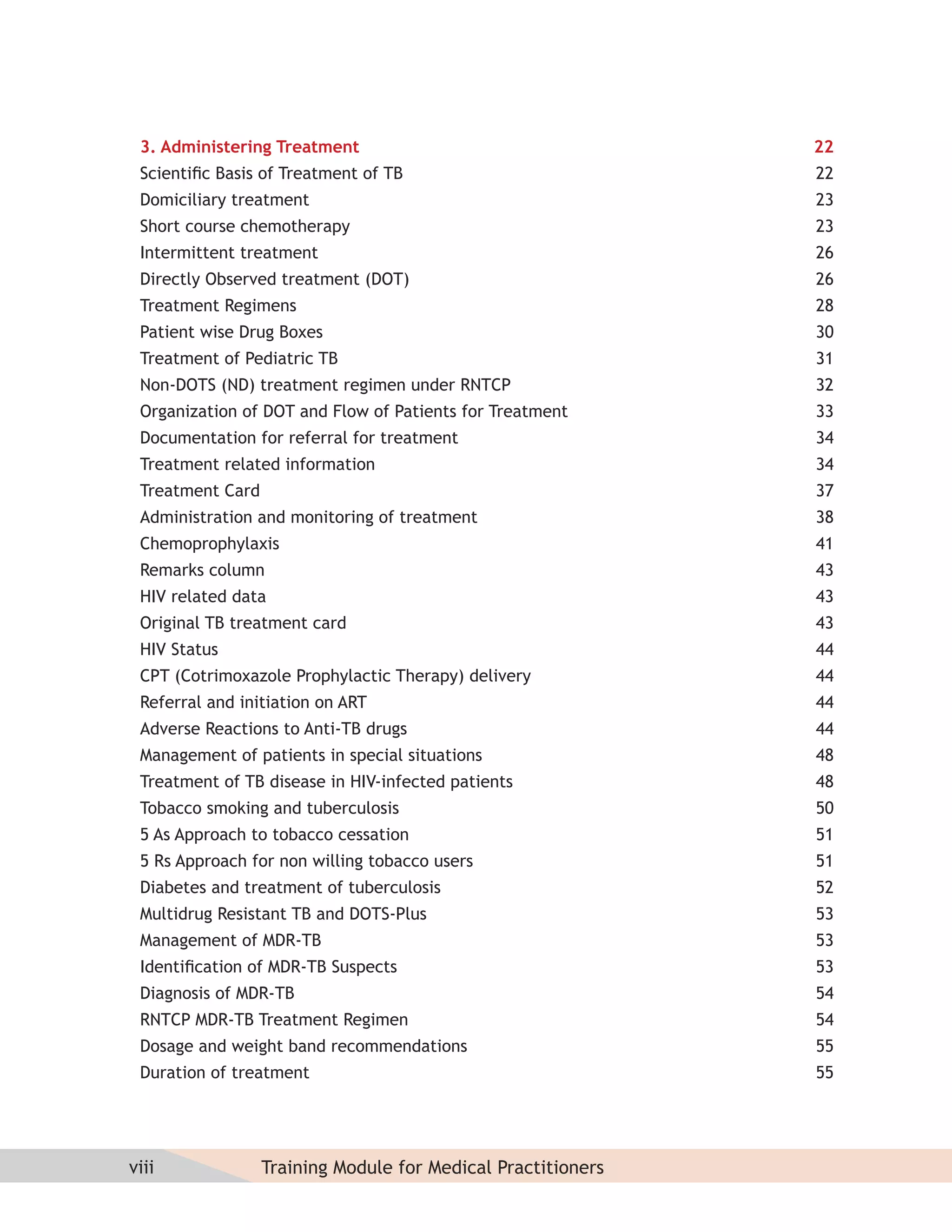
3. Administering Treatment                                   22
 Scientific Basis of Treatment of TB                           22
 Domiciliary treatment                                        23
 Short course chemotherapy                                    23
 Intermittent treatment                                       26
 Directly Observed treatment (DOT)                            26
 Treatment Regimens                                           28
 Patient wise Drug Boxes                                      30
 Treatment of Pediatric TB                                    31
 Non-DOTS (ND) treatment regimen under RNTCP                  32
 Organization of DOT and Flow of Patients for Treatment       33
 Documentation for referral for treatment                     34
 Treatment related information                                34
 Treatment Card                                               37
 Administration and monitoring of treatment                   38
 Chemoprophylaxis                                             41
 Remarks column                                               43
 HIV related data                                             43
 Original TB treatment card                                   43
 HIV Status                                                   44
 CPT (Cotrimoxazole Prophylactic Therapy) delivery            44
 Referral and initiation on ART                               44
 Adverse Reactions to Anti-TB drugs                           44
 Management of patients in special situations                 48
 Treatment of TB disease in HIV-infected patients             48
 Tobacco smoking and tuberculosis                             50
 5 As Approach to tobacco cessation                           51
 5 Rs Approach for non willing tobacco users                  51
 Diabetes and treatment of tuberculosis                       52
 Multidrug Resistant TB and DOTS-Plus                         53
 Management of MDR-TB                                         53
 Identification of MDR-TB Suspects                             53
 Diagnosis of MDR-TB                                          54
 RNTCP MDR-TB Treatment Regimen                               54
 Dosage and weight band recommendations                       55
 Duration of treatment                                        55


viii              Training Module for Medical Practitioners
Follow-up schedule                                                   55
Treatment adherence and support                                      55
Action for patients who interrupt treatment                          56
Exercise                                                             57

4. Supervision and Monitoring                                       58

Appendices                                                          61
Appendix 1
Infection Control in Hospital Settings                               63


Appendix 2
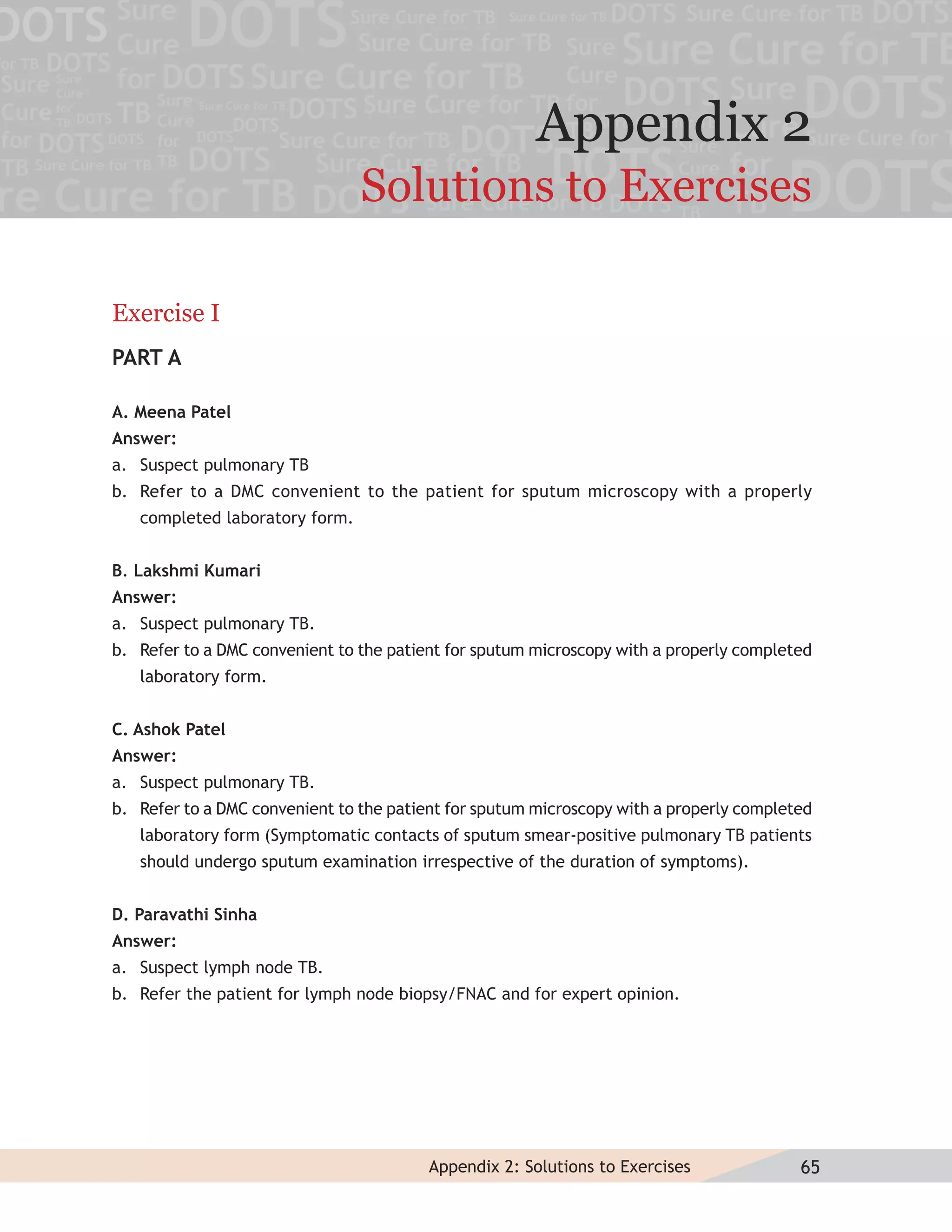
Solutions to Exercises                                               65


Appendix 3
Zeihl Neelsen Staining                                               67

Appendix 4
References                                                           68

Appendix 5
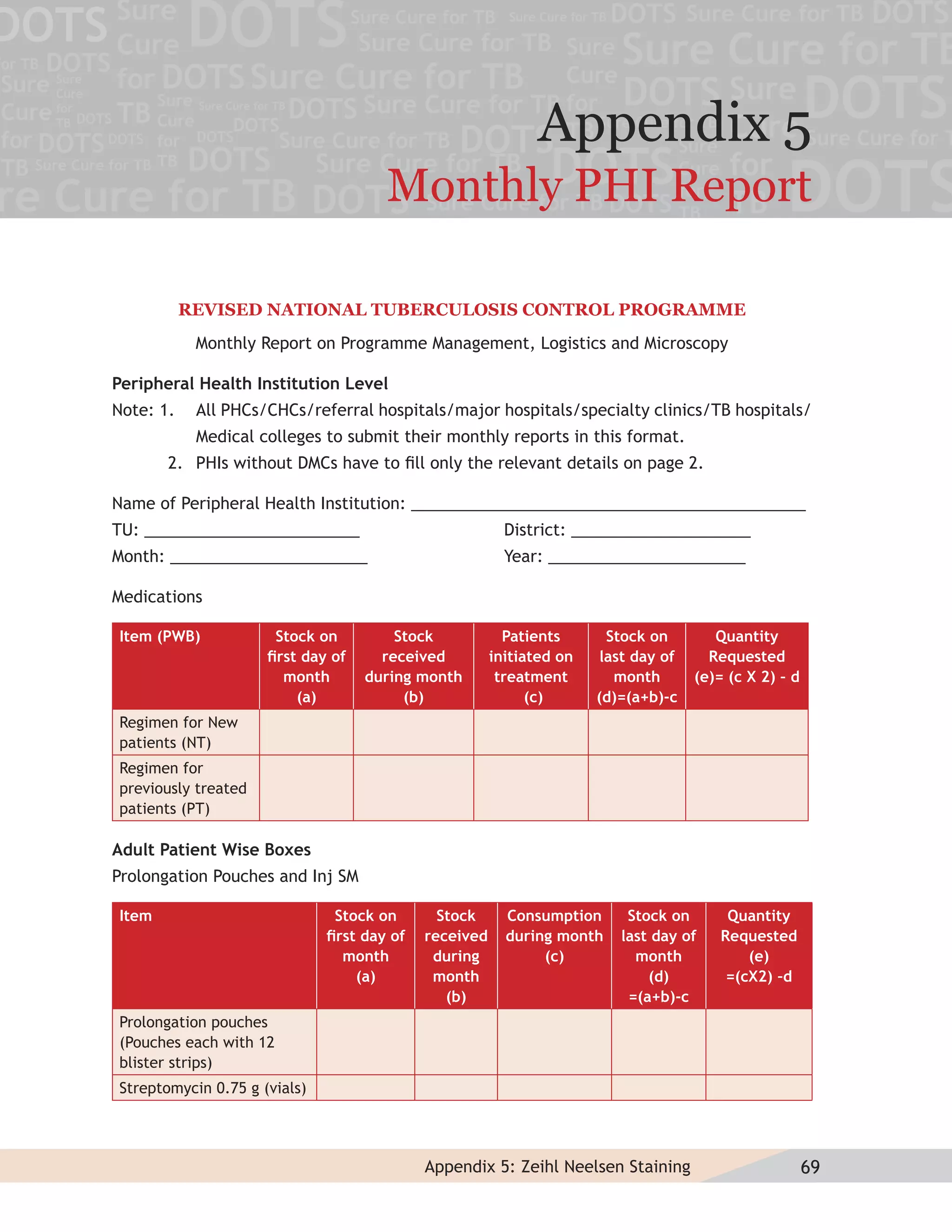
Monthly PHI Report                                                   69


Appendix 6
Summary: International Standards for Tuberculosis Cure               73


Appendix 7
Presentation Handouts                                                80


Appendix 8
MoU and Application Format                                          105


Notes                                                               108


                                                         Contents     ix
1
                                                          Introduction

Tuberculosis is an infectious disease caused by Mycobacterium tuberculosis. Pulmonary
tuberculosis is the most common form of TB (more than 85% of all TB cases), while extra
pulmonary tuberculosis can affect almost any organ in the body. Transmission occurs by the
airborne spread of infectious droplets and droplet nuclei containing the tubercle bacilli. The
source of infection is a person with sputum smear-positive pulmonary TB. Transmission often
occurs indoors, where droplets and droplet nuclei can stay in the air for a long time.


Global and Indian Scenario
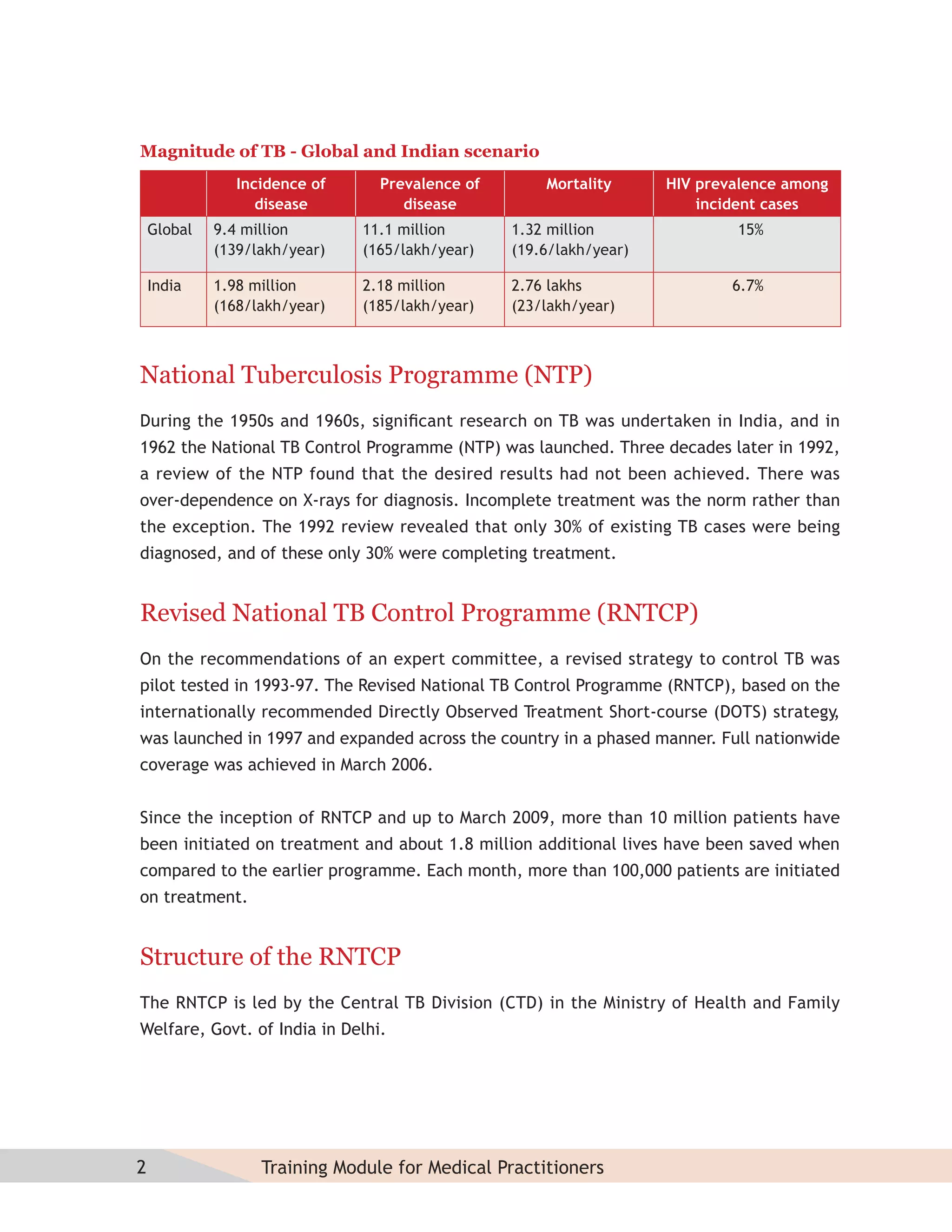
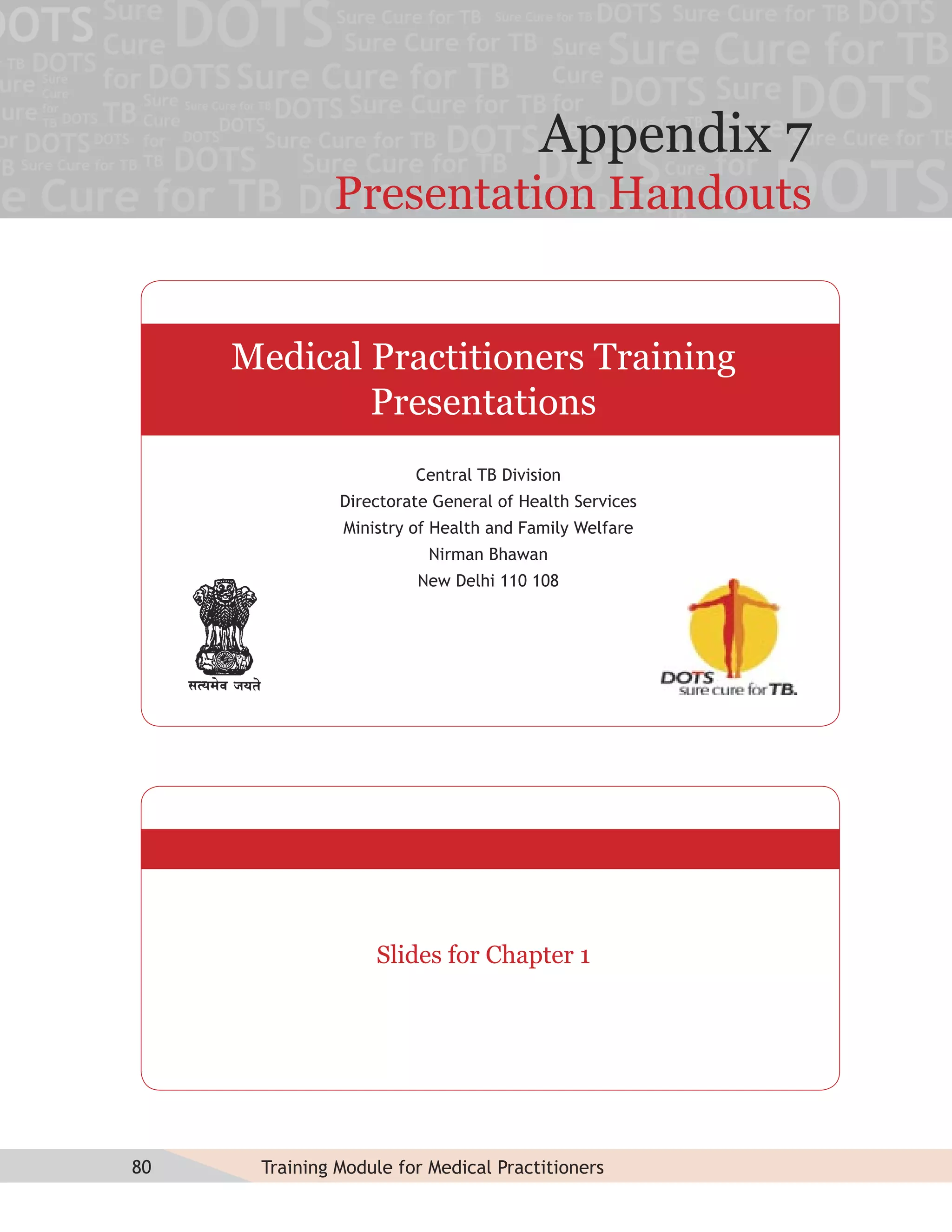
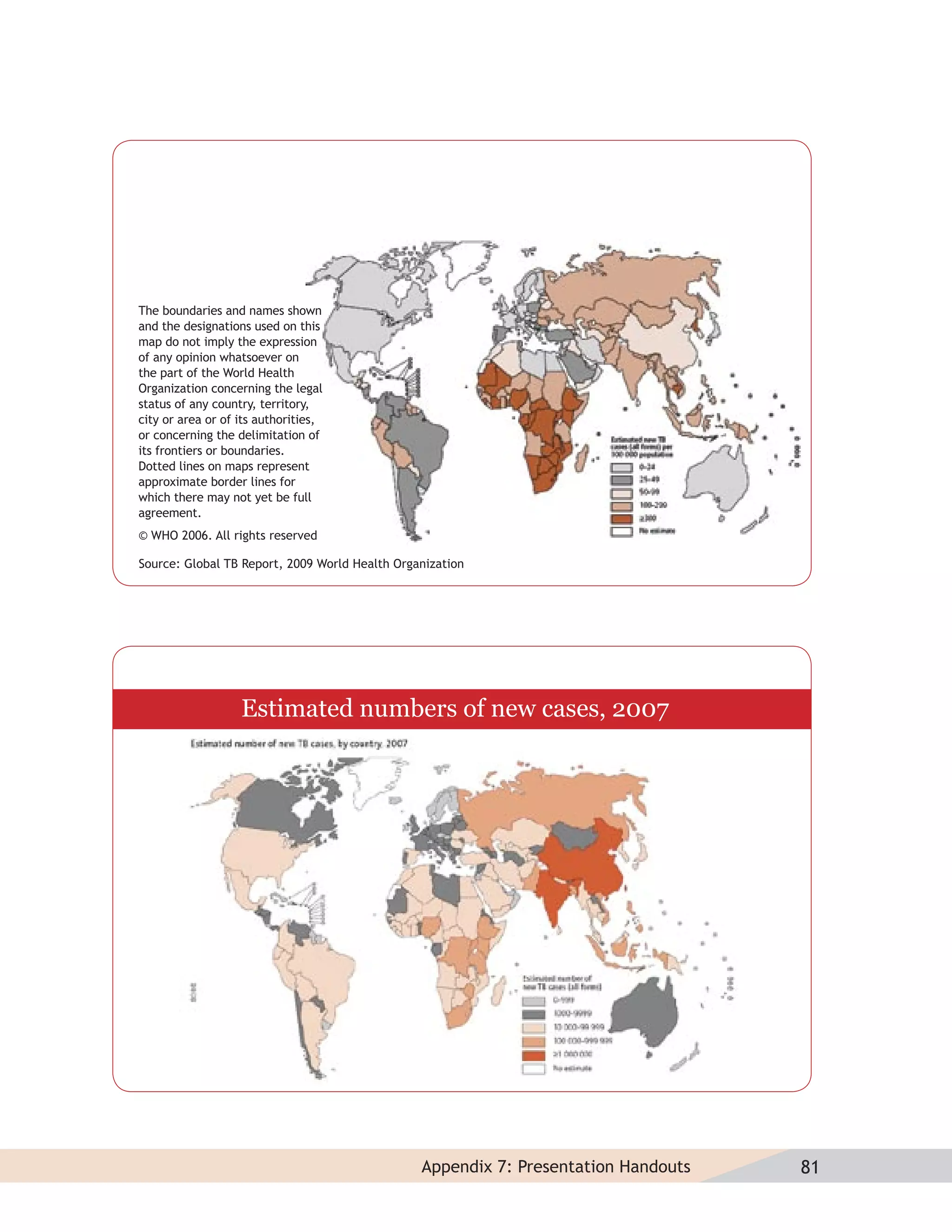
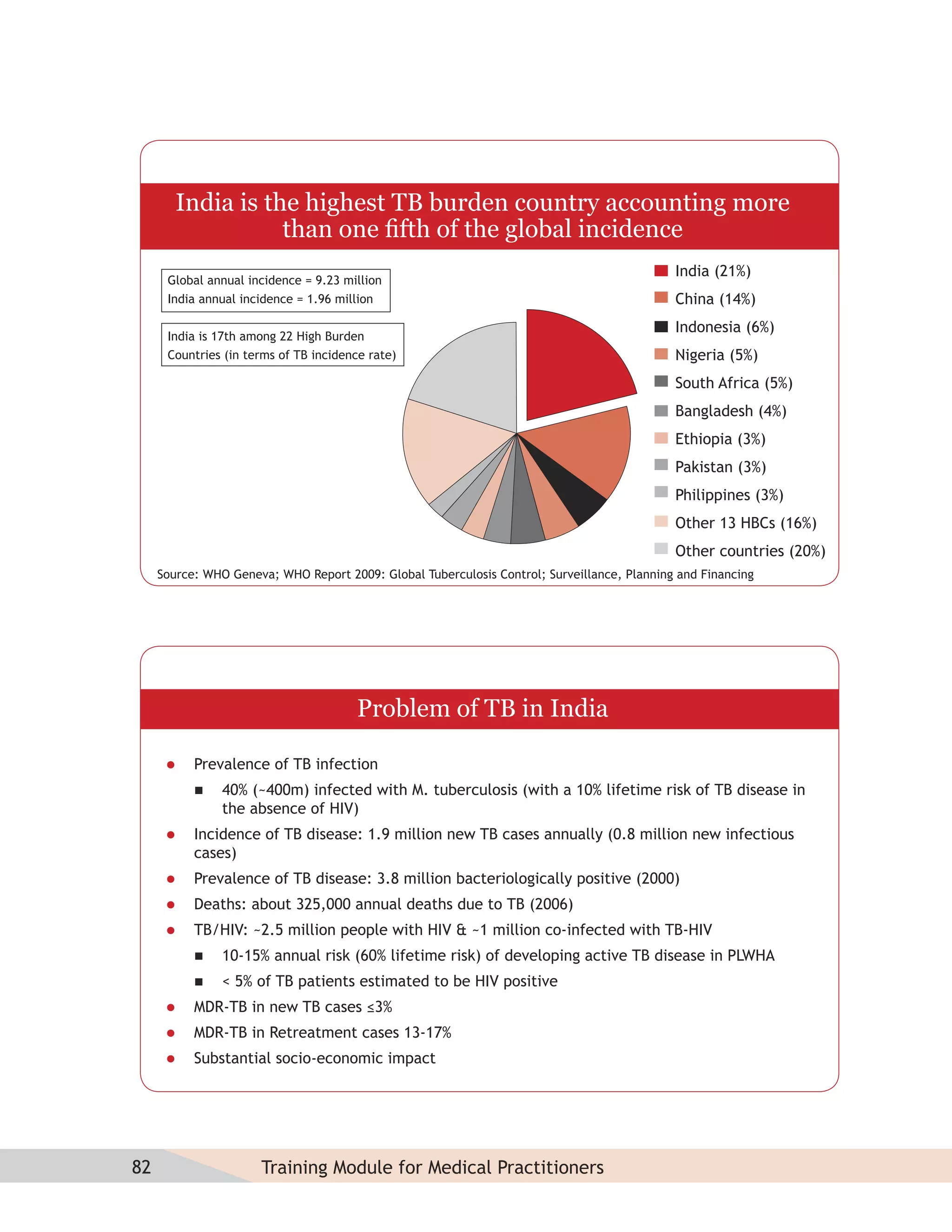
In 2007, there were globally an estimated 9.4 million new cases of TB, of which ~4 million
were sputum smear-positive, and ~78% were in 22 high burden countries. One fi fth of the
global TB incidence is in India, with 1.9 million new cases occurring every year and 0.87
million of these being infectious smear-positive cases. In India, an estimated 2.76 lakh
deaths occur from TB every year
                              .


TB is a serious public health problem causing immense morbidity, mortality and distress to
individuals, families and communities. TB kills more adults in India than any other infectious
disease. The disease incidence peaks in people belonging to the most economically
productive age group of 15-60 years. The link between TB and HIV is quite signifi cant with
WHO estimating that 6-7% of TB patients are also coinfected with HIV.


            EVERY DAY IN INDIA,
    more than 900 people die of TB (˜2 deaths every 3 minutes)


                                                               Introduction                  1
Magnitude of TB - Global and Indian scenario
                Incidence of     Prevalence of       Mortality      HIV prevalence among
                   disease          disease                             incident cases
    Global   9.4 million       11.1 million      1.32 million               15%
             (139/lakh/year)   (165/lakh/year)   (19.6/lakh/year)

    India    1.98 million      2.18 million      2.76 lakhs                 6.7%
             (168/lakh/year)   (185/lakh/year)   (23/lakh/year)


National Tuberculosis Programme (NTP)
During the 1950s and 1960s, significant research on TB was undertaken in India, and in
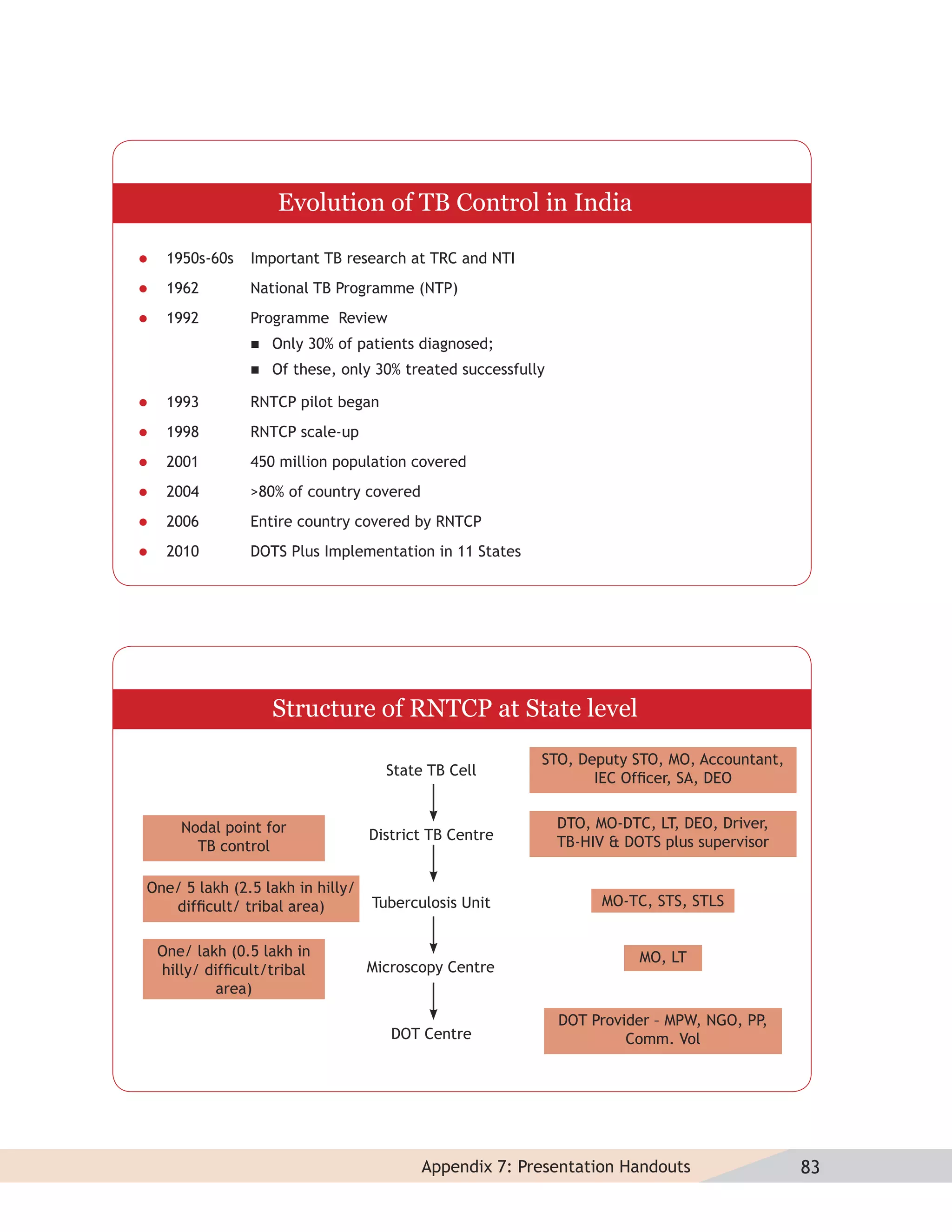
1962 the National TB Control Programme (NTP) was launched. Three decades later in 1992,
a review of the NTP found that the desired results had not been achieved. There was
over-dependence on X-rays for diagnosis. Incomplete treatment was the norm rather than
the exception. The 1992 review revealed that only 30% of existing TB cases were being
diagnosed, and of these only 30% were completing treatment.


Revised National TB Control Programme (RNTCP)
On the recommendations of an expert committee, a revised strategy to control TB was
pilot tested in 1993-97. The Revised National TB Control Programme (RNTCP), based on the
internationally recommended Directly Observed Treatment Short-course (DOTS) strategy,
was launched in 1997 and expanded across the country in a phased manner. Full nationwide
coverage was achieved in March 2006.


Since the inception of RNTCP and up to March 2009, more than 10 million patients have
been initiated on treatment and about 1.8 million additional lives have been saved when
compared to the earlier programme. Each month, more than 100,000 patients are initiated
on treatment.


Structure of the RNTCP
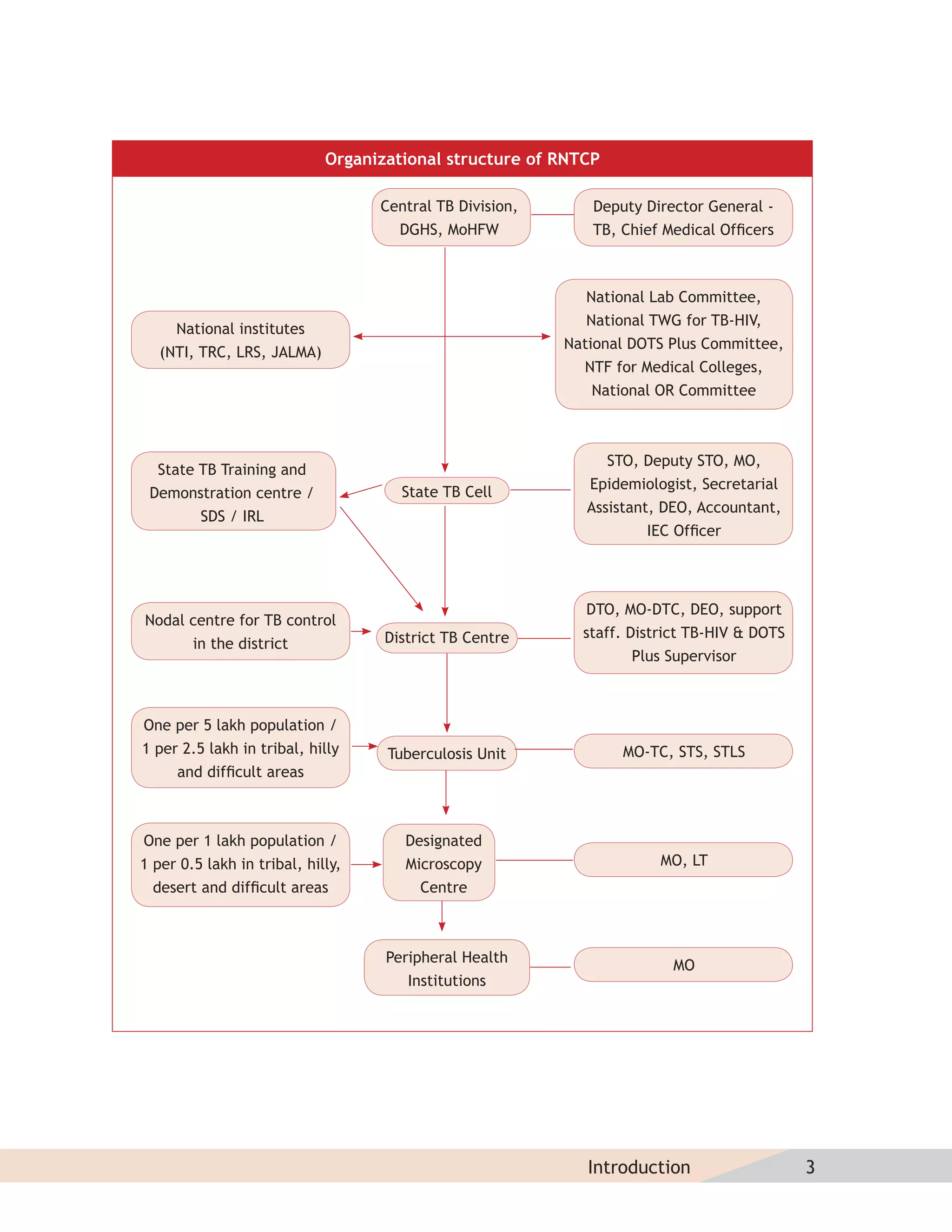
The RNTCP is led by the Central TB Division (CTD) in the Ministry of Health and Family
Welfare, Govt. of India in Delhi.


2                  Training Module for Medical Practitioners
Organizational structure of RNTCP

                                   Central TB Division,      Deputy Director General -
                                     DGHS, MoHFW             TB, Chief Medical Officers


                                                             National Lab Committee,
                                                             National TWG for TB-HIV,
     National institutes
                                                          National DOTS Plus Committee,
   (NTI, TRC, LRS, JALMA)
                                                            NTF for Medical Colleges,
                                                              National OR Committee


                                                                STO, Deputy STO, MO,
  State TB Training and
                                                             Epidemiologist, Secretarial
 Demonstration centre /               State TB Cell
                                                             Assistant, DEO, Accountant,
        SDS / IRL
                                                                      IEC Officer


                                                            DTO, MO-DTC, DEO, support
Nodal centre for TB control
                                    District TB Centre      staff. District TB-HIV & DOTS
      in the district
                                                                    Plus Supervisor


One per 5 lakh population /
1 per 2.5 lakh in tribal, hilly     Tuberculosis Unit             MO-TC, STS, STLS
     and difficult areas


One per 1 lakh population /            Designated
1 per 0.5 lakh in tribal, hilly,       Microscopy                      MO, LT
  desert and difficult areas              Centre


                                    Peripheral Health
                                                                         MO
                                       Institutions


                                                             Introduction                   3
Universal Access to TB Care
All TB patients in the community need to have access to early, good quality diagnosis and
treatment services in a manner that is affordable and convenient to the patient in time,
place and person. All affected communities must have full access to TB prevention, care and
treatment; including women, children, elders, migrants, homeless people, alcohol and other
drug users, prison inmates, people living with HIV and other clinical risk factors, and those
with other life-threatening diseases. PPM is a critical path for achieving universal access.


Public Private Mix (PPM)
India has one of the largest private health care sectors in the world. This sector is often the
first point of contact for a significant number of TB suspects and patients.


Other sectors like non-governmental organisations (NGO), corporate sector etc. also cater to
                                                                        ,
a considerable percentage of TB patients. Because of their flexibility and easy accessibility,
these service providers have gained credibility and are popular among patients. The
strengths of these sectors can be utilised to supplement the government’s efforts to control
TB. Standard quality of care and free drugs can be provided through effective public-private
collaboration under RNTCP
                        .


Experiences from pilot projects in the country and elsewhere show that partnerships
between government, private, corporate and NGO health care sectors can increase TB
case detection rates and improve patient adherence. Such partnerships reduce diagnostic
delays and cost to the patients, who get quality RNTCP services from the provider of their
choice. RNTCP has made a concerted effort to develop partnerships with all health care
sectors. Guidelines for collaboration with NGOs (2001) and private practitioners (2002) were
developed in consultation with experts from related sectors and are widely disseminated.


These guidelines have been revised in 2008. There are different schemes for participation of
private practitioners (PPs) and NGOs in RNTCP. Information and documents on these revised
schemes are available with DTOs and at the RNTCP website www.tbcindia.org.


T health providers participating in the programme, the RNTCP provides:
 o
   Technical training
   Laboratory consumables
   Registers and forms


4               Training Module for Medical Practitioners
   Health education materials, and
   Free drugs in patient-wise boxes


There are different roles which the partners of RNTCP can take up. These include:
   Referral for diagnosis (sputum collection and transportation centres)
   Diagnosis
   Referral for treatment
   Treatment initiation
   Provision of Directly observed treatment (DOT)
   Health education and related activities
   Management and supervision of diagnostic and treatment activities at the sub-district
    level


A health provider can get involved in a single activity or in multiple activities depending on
the provider’s capacity interest and the requirements of the programme.
                       ,


All partners have to ensure that each patient with a history of cough for more than two
weeks undergoes sputum smear examination for TB and patients diagnosed to have TB
receive treatment as per RNTCP guidelines. It is also essential that all patients put on DOTS,
receive treatment under direct observation.


Multidrug-resistant Tuberculosis (MDR-TB)
MDR-TB is defined as tuberculosis disease where the bacilli is resistant to isoniazid (H)
and rifampicin (R), with or without resistance to other drugs. Irregular consumption and
frequent interruption in taking treatment for TB is the most common cause of acquiring
multidrug resistance. In India, MDR-TB amongst new cases are estimated at 2- 3% and
amongst re-treatment cases at 14-17%. Extensively Drug Resistant TB (XDR–TB) is a subset
of MDR-TB where the bacilli, in addition to being resistant to R and H, are also resistant
to fluoroquinolones and any one of the second-line injectable drugs (namely Kanamycin,
Capreomycin or Amikacin). Although XDR-TB has been reported in India, its magnitude
remains undetermined as yet due to the lack of laboratories being capable of conducting
quality assured second line drug susceptibility testing.


In India, a great concern is the potential threat of drug resistant TB (DR-TB) with the
existing unregulated availability and injudicious use of first and second line anti-TB drugs
in the country.


                                                               Introduction                  5
RNTCP and DOTS-Plus Services for MDR-TB
RNTCP reaffirms that the prevention of MDR-TB is a priority task which can be achieved
only through the implementation of a good quality DOTS programme. Available information
suggests that prevalence of MDR-TB is relatively low in India. However, this translates into
a large absolute number of cases, estimated at over 99,000 in 2008. The country is slowly
gearing up to manage tens of thousands of MDR-TB patients annually by 2012-13.


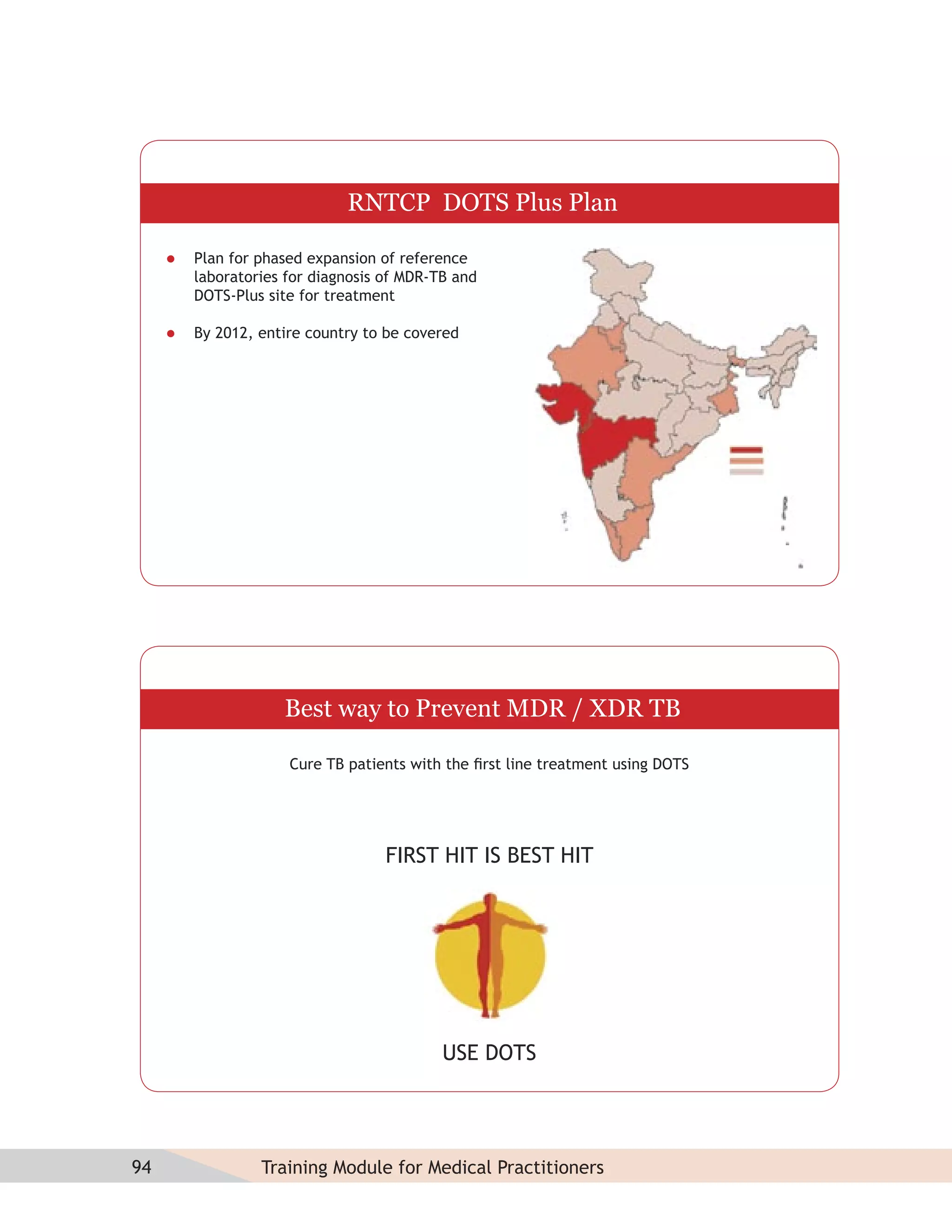
RNTCP reached a landmark achievement with the launching of RNTCP DOTS-Plus services
for the management of MDR-TB patients in the states of Gujarat and Maharashtra in 2007.
Specific guidelines have been formulated for the implementation of DOTS-Plus activities in a
phased manner across the country. RNTCP aims to establish a network of accredited, quality
assured culture and drug susceptibility testing laboratories across the country by 2012-13.


Pediatric TB
Children in the first five years of their life are likely to suffer from serious and fatal forms
of TB, more so, if not vaccinated with BCG. Globally, it is estimated that about 1.1 million
new cases are reported and 1,30,000 deaths occur annually due to TB among children.
Reliable data on incidence and prevalence of the disease is not available due to difficulties
in diagnosis of pediatric TB under field conditions. However, limited data available reveals
that prevalence of TB among children in the age group 0-14 years is estimated to be 0.3% of
radiological cases and 0.15% of bacteriological cases.


HIV Co-infection among TB Patients
In India, it is estimated that 2.31 million individuals are living with HIV infection, which
equates to approximately 0.34% of the adult population of the country. Based on available
country data of 2007, it is estimated that 4.9% of new adult TB patients in India are HIV
positive. Hence, the TB epidemic in India continues to be predominantly driven by the pool
of HIV negative TB infected individuals.


Tuberculosis is the most common opportunistic infection amongst HIV-infected individuals. It
is a major cause of mortality among patients with HIV and poses a risk throughout the course
of HIV disease, even after successful initiation of antiretroviral therapy (ART). In India,
55-60% of AIDS cases reported had TB, and TB is one of the leading causes of death in People
living with HIV/AIDS (PLHA).


6               Training Module for Medical Practitioners
Goals, Components and Objectives of RNTCP
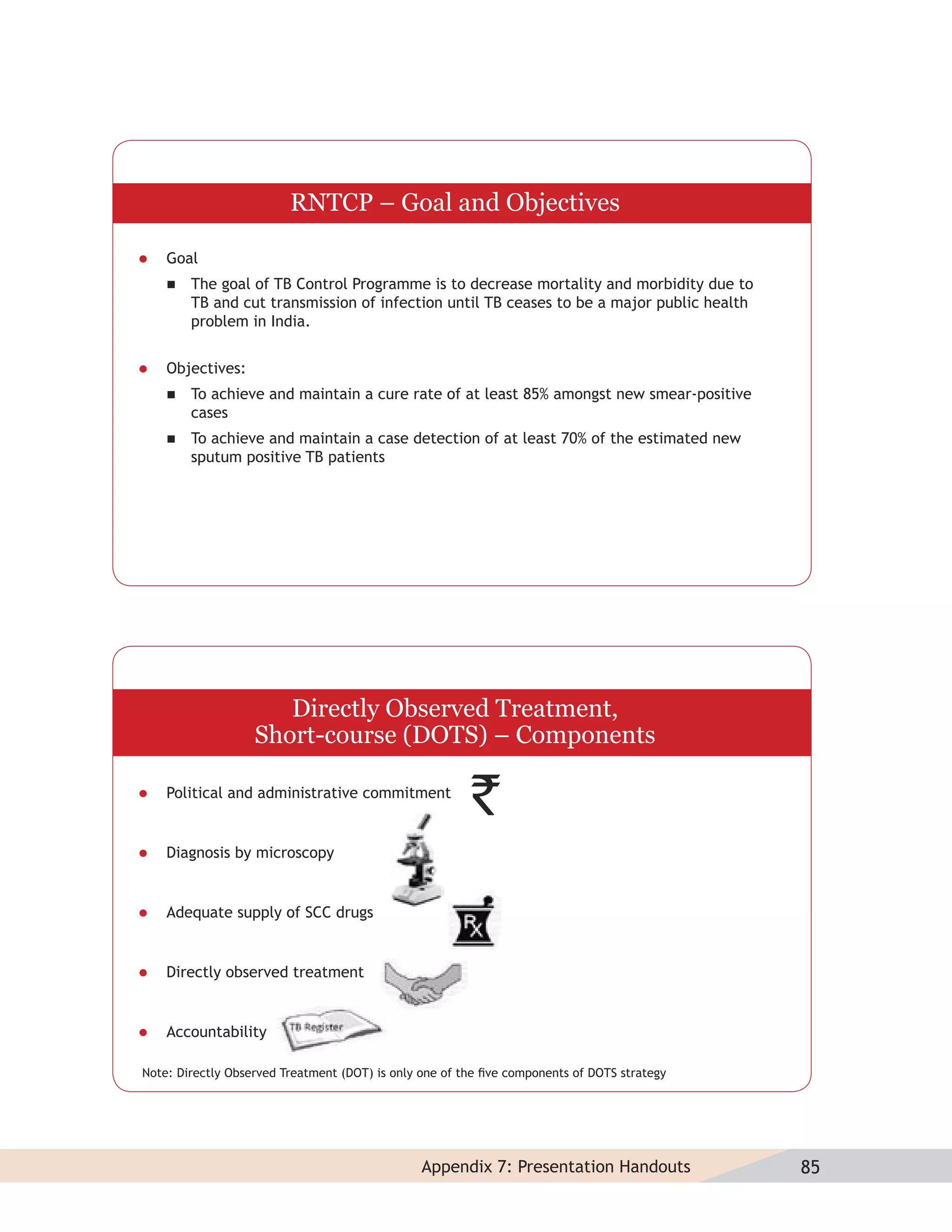
The goal of RNTCP is to decrease mortality and morbidity due to TB and cut transmission
of infection until TB ceases to be a major public health problem. It aims to control TB
by detecting and curing sputum smear-positive patients thereby interrupting the chain of
transmission. The objectives of RNTCP are to achieve and maintain a cure rate of at least
85% among new sputum smear-positive cases and to achieve and maintain detection of at
least 70% of such cases in the population. The only effective means to achieve the goal of
RNTCP is the application of DOTS strategy.


Internationally WHO recommends the Stop TB Strategy for TB control which includes the
DOTS strategy The components of the Stop TB Strategy are given below.
             .


Components of DOTS
DOTS is a systematic strategy having 5 components
   Political and administrative commitment
   Good quality diagnosis, primarily by sputum smear microscopy
   Uninterrupted supply of good quality drugs
   Directly observed treatment (DOT)
   Systematic monitoring and accountability


                                        Points to Remember

       TB continues to be the leading killer disease for Indian adults amongst all infectious
        diseases
       One fifth of the world’s TB incident cases are in India
       More than 80% of TB patients have pulmonary TB
       In developing countries, more than 75% of TB patients are in the economically productive
        age group of 15-45 years
       The DTO has the overall responsibility of implementing the programme at the district
        level
       Involvement of all sectors of health care is necessary for the control of TB in India


                                                                      Introduction                 7
2
                        Diagnosis of Tuberculosis

Identification of Tuberculosis Suspects
The most common symptom of pulmonary TB is persistent cough, usually with expectoration.
Persistent cough may be accompanied by other symptoms such as weight loss, tiredness, fever
with evening rise, night sweats, chest pain, shortness of breath, anorexia and haemoptysis.


Pulmonary TB Suspects
Pulmonary smear-positive tuberculosis patients expel tubercle bacilli into the air while
coughing/sneezing. Contacts of undiagnosed/untreated pulmonary smear-positive patients
become infected when they inhale these tubercle bacilli.


A pulmonary TB suspect is defined as:
   An individual having cough of 2 weeks or more
   Contacts of smear-positive TB patients having cough of any duration
   Suspected/confirmed extra-pulmonary TB having cough of any duration
   HIV positive patient having cough of any duration


    Persons having cough of 2 weeks or more, with or without other symptoms, are referred to as
            pulmonary TB suspect. They should have 2 sputum samples examined for AFB.


A patient with extra-pulmonary TB may have general symptoms like weight loss, fever with
evening rise and night sweats. Other symptoms depend on the organ affected.


Examples of these symptoms are, swelling of a lymph node in TB lymphadenitis, pain and
swelling of a joint in TB arthritis, neck stiffness and disorientation in a case of TB meningitis.
Patients with EP TB who also have cough of any duration, should have sputum samples
examined. If the smear result is positive, the patient is classified as pulmonary TB and his/
her treatment regimen will be that of a case of smear-positive pulmonary TB.


8                Training Module for Medical Practitioners
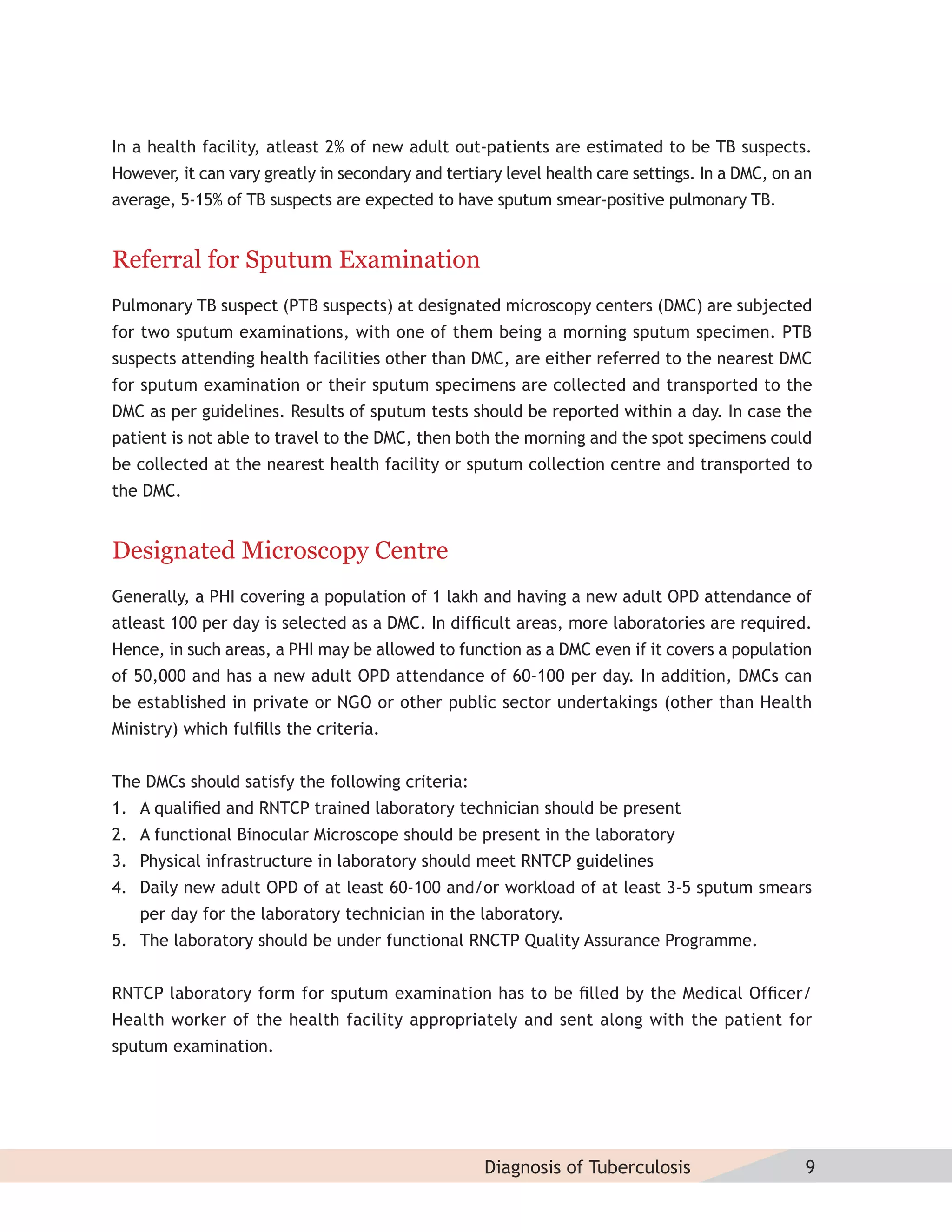
In a health facility, atleast 2% of new adult out-patients are estimated to be TB suspects.
However, it can vary greatly in secondary and tertiary level health care settings. In a DMC, on an
average, 5-15% of TB suspects are expected to have sputum smear-positive pulmonary TB.


Referral for Sputum Examination
Pulmonary TB suspect (PTB suspects) at designated microscopy centers (DMC) are subjected
for two sputum examinations, with one of them being a morning sputum specimen. PTB
suspects attending health facilities other than DMC, are either referred to the nearest DMC
for sputum examination or their sputum specimens are collected and transported to the
DMC as per guidelines. Results of sputum tests should be reported within a day. In case the
patient is not able to travel to the DMC, then both the morning and the spot specimens could
be collected at the nearest health facility or sputum collection centre and transported to
the DMC.


Designated Microscopy Centre
Generally, a PHI covering a population of 1 lakh and having a new adult OPD attendance of
atleast 100 per day is selected as a DMC. In difficult areas, more laboratories are required.
Hence, in such areas, a PHI may be allowed to function as a DMC even if it covers a population
of 50,000 and has a new adult OPD attendance of 60-100 per day. In addition, DMCs can
be established in private or NGO or other public sector undertakings (other than Health
Ministry) which fulfills the criteria.


The DMCs should satisfy the following criteria:
1. A qualified and RNTCP trained laboratory technician should be present
2. A functional Binocular Microscope should be present in the laboratory
3. Physical infrastructure in laboratory should meet RNTCP guidelines
4. Daily new adult OPD of at least 60-100 and/or workload of at least 3-5 sputum smears
   per day for the laboratory technician in the laboratory.
5. The laboratory should be under functional RNCTP Quality Assurance Programme.


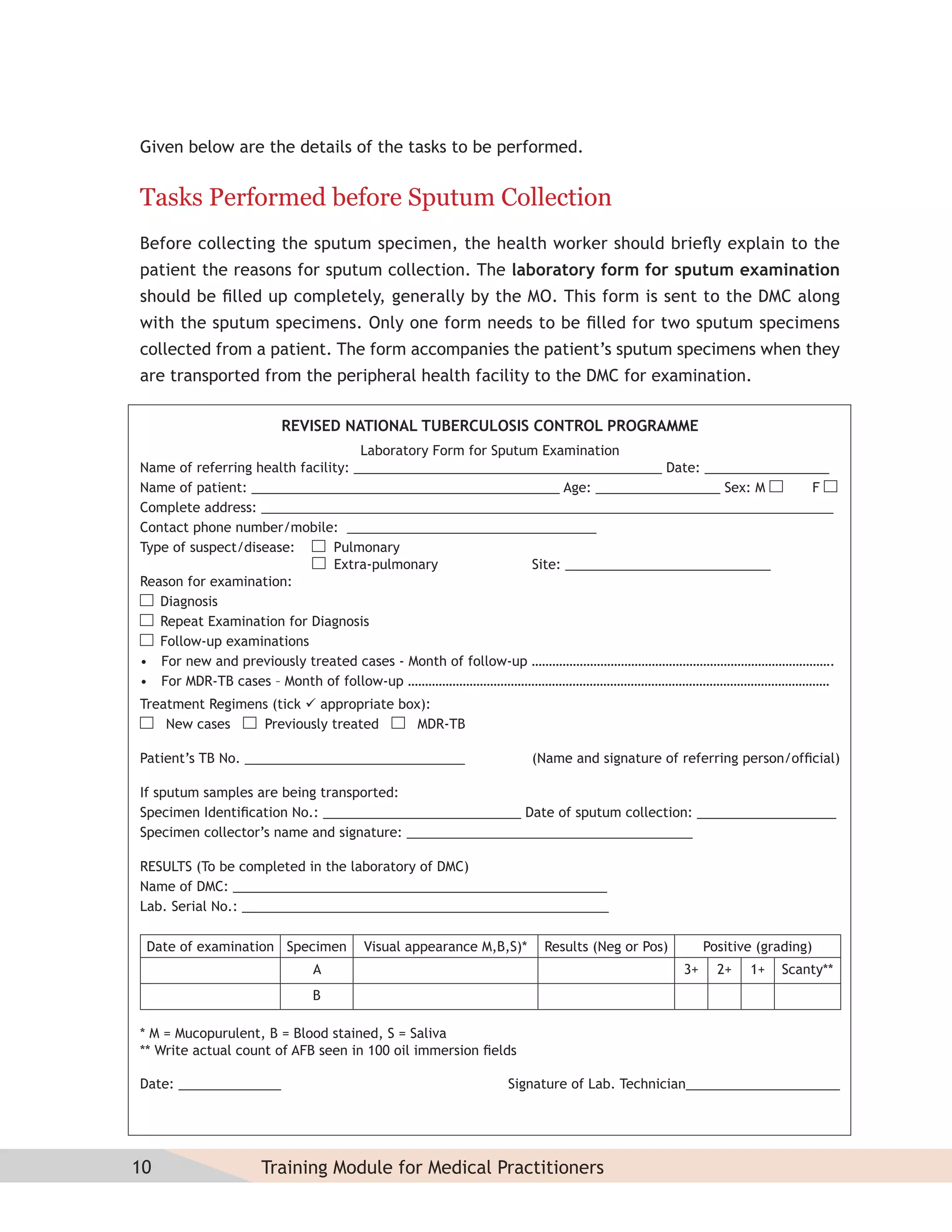
RNTCP laboratory form for sputum examination has to be filled by the Medical Officer/
Health worker of the health facility appropriately and sent along with the patient for
sputum examination.


                                                    Diagnosis of Tuberculosis                    9
Given below are the details of the tasks to be performed.


Tasks Performed before Sputum Collection
Before collecting the sputum specimen, the health worker should briefly explain to the
patient the reasons for sputum collection. The laboratory form for sputum examination
should be filled up completely, generally by the MO. This form is sent to the DMC along
with the sputum specimens. Only one form needs to be filled for two sputum specimens
collected from a patient. The form accompanies the patient’s sputum specimens when they
are transported from the peripheral health facility to the DMC for examination.

                       REVISED NATIONAL TUBERCULOSIS CONTROL PROGRAMME
                                    Laboratory Form for Sputum Examination
Name of referring health facility: __________________________________________ Date: _________________
Name of patient: __________________________________________ Age: _________________ Sex: M          F
Complete address: ______________________________________________________________________________
Contact phone number/mobile: __________________________________
Type of suspect/disease:       Pulmonary
                               Extra-pulmonary               Site: ____________________________
Reason for examination:
   Diagnosis
   Repeat Examination for Diagnosis
   Follow-up examinations
• For new and previously treated cases - Month of follow-up …………………………………………………………………………….
• For MDR-TB cases – Month of follow-up ……………………………………………………………………………………………………………
Treatment Regimens (tick  appropriate box):
    New cases    Previously treated       MDR-TB

Patient’s TB No. ______________________________                (Name and signature of referring person/official)

If sputum samples are being transported:
Specimen Identification No.: ___________________________ Date of sputum collection: ___________________
Specimen collector’s name and signature: _______________________________________

RESULTS (To be completed in the laboratory of DMC)
Name of DMC: ___________________________________________________
Lab. Serial No.: __________________________________________________

 Date of examination Specimen      Visual appearance M,B,S)*    Results (Neg or Pos)        Positive (grading)
                           A                                                           3+     2+   1+   Scanty**
                           B

* M = Mucopurulent, B = Blood stained, S = Saliva
** Write actual count of AFB seen in 100 oil immersion fields

Date: ______________                                      Signature of Lab. Technician_____________________


10                 Training Module for Medical Practitioners
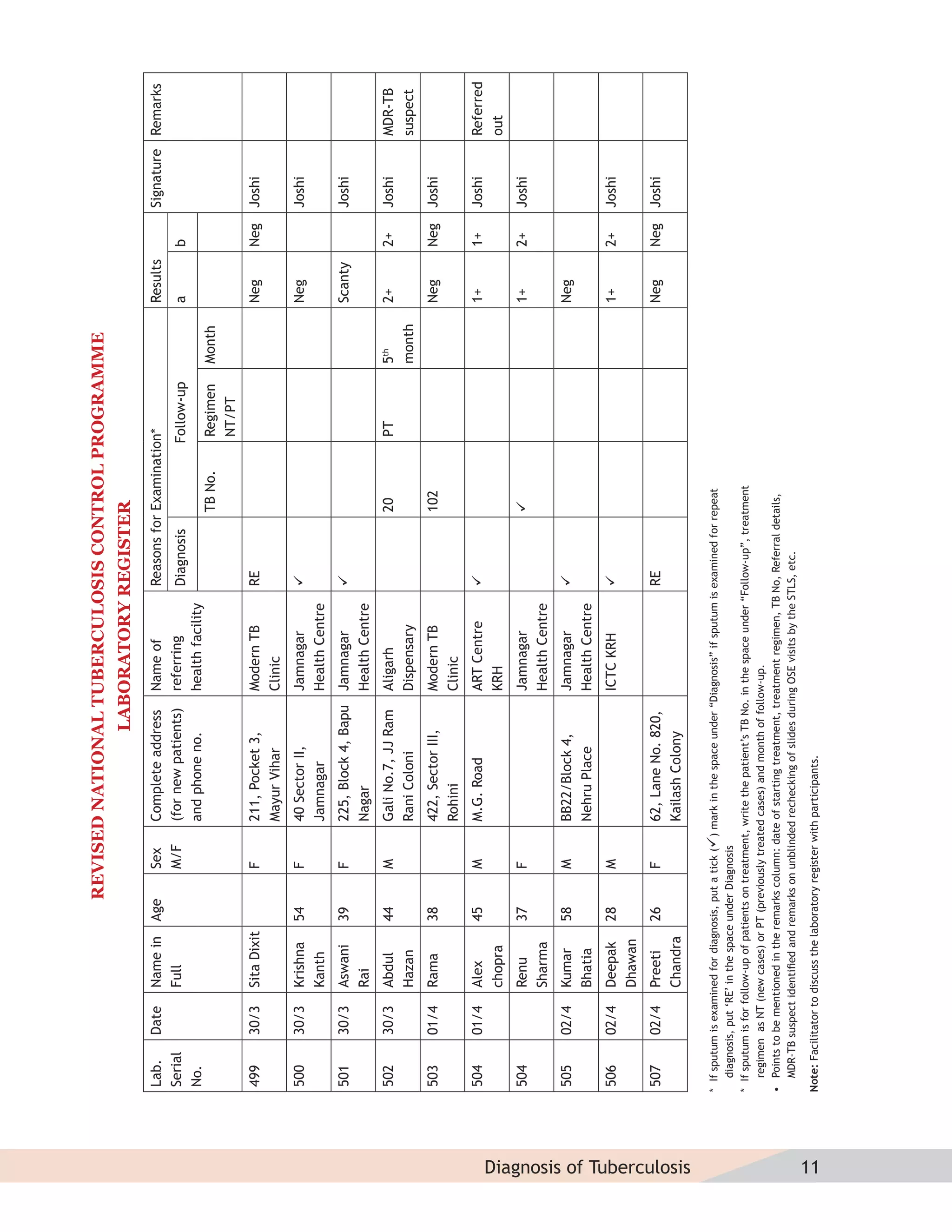
REVISED NATIONAL TUBERCULOSIS CONTROL PROGRAMME
                                                                                                      LABORATORY REGISTER
                             Lab.       Date     Name in       Age         Sex      Complete address         Name of              Reasons for Examination*                    Results         Signature Remarks
                             Serial              Full                      M/F      (for new patients)       referring            Diagnosis               Follow-up           a         b
                             No.                                                    and phone no.            health facility
                                                                                                                                                 TB No.   Regimen     Month
                                                                                                                                                          NT/PT
                             499        30/3     Sita Dixit                F        211, Pocket 3,           Modern TB            RE                                          Neg       Neg   Joshi
                                                                                    Mayur Vihar              Clinic
                             500        30/3     Krishna       54          F        40 Sector II,            Jamnagar                                                        Neg             Joshi
                                                 Kanth                              Jamnagar                 Health Centre
                             501        30/3     Aswani        39          F        225, Block 4, Bapu Jamnagar                                                              Scanty          Joshi
                                                 Rai                                Nagar              Health Centre
                             502        30/3     Abdul         44          M        Gali No.7, JJ Ram        Aligarh                             20       PT          5th     2+        2+    Joshi    MDR-TB
                                                 Hazan                              Rani Coloni              Dispensary                                               month                            suspect
                             503        01/4     Rama          38                   422, Sector III,         Modern TB                           102                          Neg       Neg   Joshi
                                                                                    Rohini                   Clinic
                             504        01/4     Alex          45          M        M.G. Road                ART Centre                                                      1+        1+    Joshi    Referred
                                                 chopra                                                      KRH                                                                                       out
                             504                 Renu          37          F                                 Jamnagar                                                        1+        2+    Joshi
                                                 Sharma                                                      Health Centre
                             505        02/4     Kumar         58          M        BB22/Block 4,            Jamnagar                                                        Neg
                                                 Bhatia                             Nehru Place              Health Centre
                             506        02/4     Deepak        28          M                                 ICTC KRH                                                        1+        2+    Joshi
                                                 Dhawan
                             507        02/4     Preeti        26          F        62, Lane No. 820,                             RE                                          Neg       Neg   Joshi
                                                 Chandra                            Kailash Colony


Diagnosis of Tuberculosis
                            * If sputum is examined for diagnosis, put a tick () mark in the space under “Diagnosis” if sputum is examined for repeat
                               diagnosis, put ‘RE’ in the space under Diagnosis
                            * If sputum is for follow-up of patients on treatment, write the patient’s TB No. in the space under “Follow-up”, treatment
                               regimen as NT (new cases) or PT (previously treated cases) and month of follow-up.
                            • Points to be mentioned in the remarks column: date of starting treatment, treatment regimen, TB No, Referral details,
                               MDR-TB suspect identified and remarks on unblinded rechecking of slides during OSE visits by the STLS, etc.


11
                            Note: Facilitator to discuss the laboratory register with participants.
One specimen positive out of the two is enough to declare a patient as smear-positive TB.
Smear-positive TB is further classified as a new or re-treatment case based on their previous
treatment history, and an appropriate therapy is prescribed.


Patients in whom both specimens are smear-negative should be prescribed symptomatic
treatment and broad-spectrum antibiotics such as Co-trimoxazole for 10-14 days.


 Antibiotics such as fluoroquinolones (ciprofloxacin, ofloxacin, levofloxacin etc.), rifampicin
         or streptomycin, which are active against tuberculosis, should never be used.


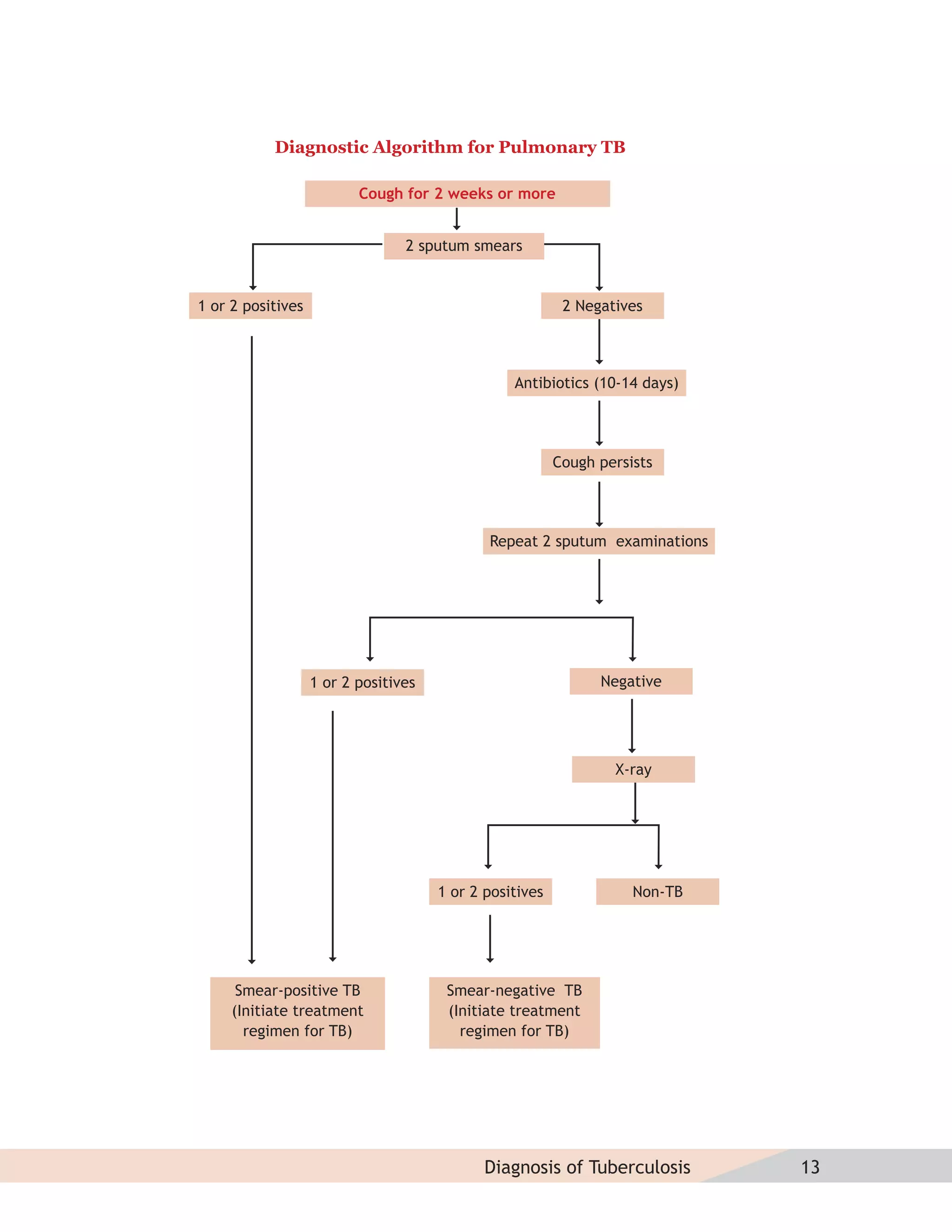
Most patients are likely to improve with antibiotics if they are not suffering from TB. If
the symptoms persist after a course of broad spectrum antibiotics, repeat sputum smear
examination (2 samples) must be done for such patients. If one or more smears are positive,
the patient is diagnosed as having smear-positive pulmonary TB. If none of the repeat sputum
specimens is positive, a chest X-ray is taken. If the findings of the X-ray are consistent with
active pulmonary TB, and the medical practitioner decides to treat the patient with anti-TB
drugs, the patient will be diagnosed as having pulmonary smear- negative TB.


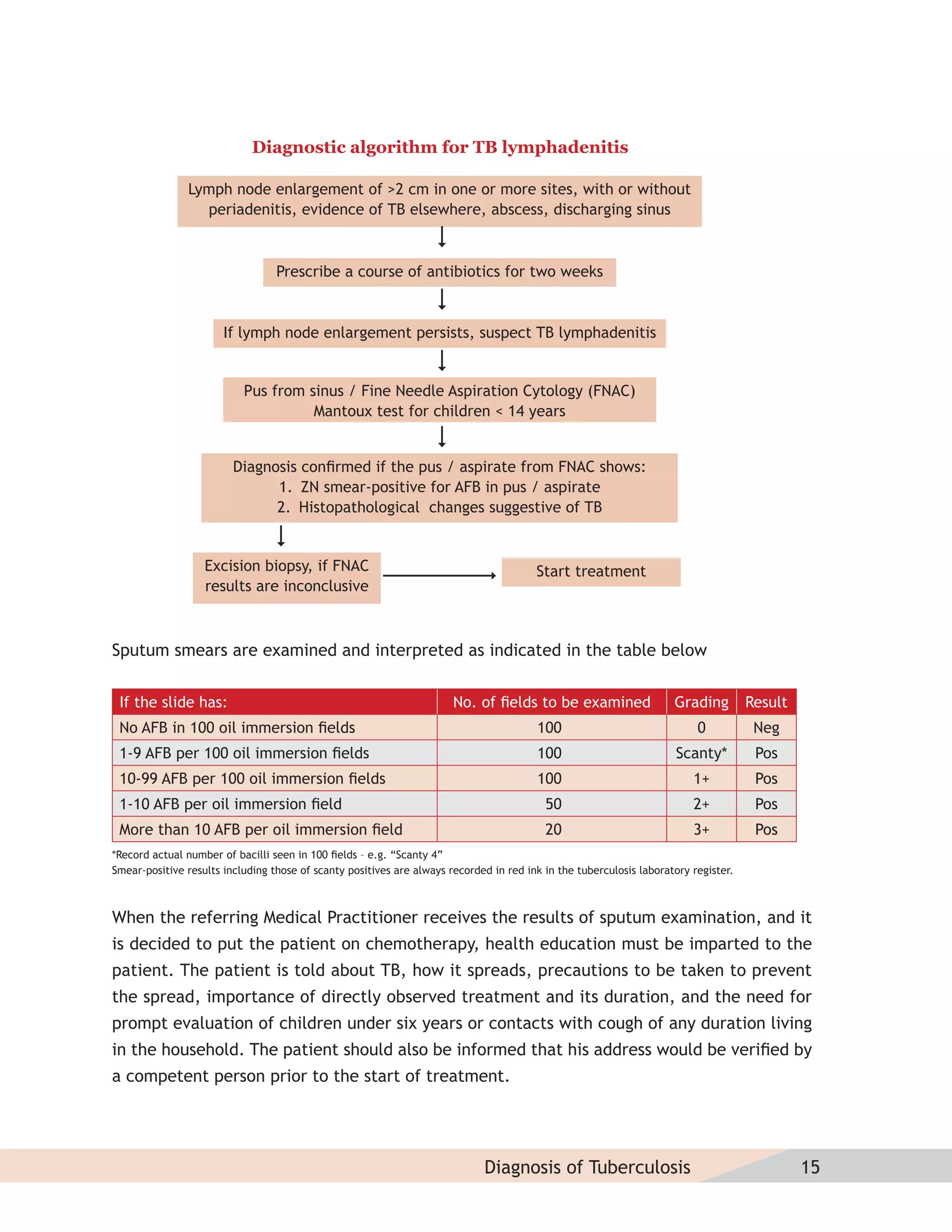
Patients with suspected EP TB should be referred to a competent medical practitioner
for expert opinion. Diagnosis of such patients may be made using appropriate diagnostic
procedures (such as FNAC/Biopsy) as well as clinical methods.


Diagnosis of TB by chest X-ray alone is unreliable because no radiological pattern is
pathognomic of pulmonary TB. Unless the prescribed algorithm given below is followed, a
large number of patients who do not have TB will be falsely diagnosed and treated.


12              Training Module for Medical Practitioners
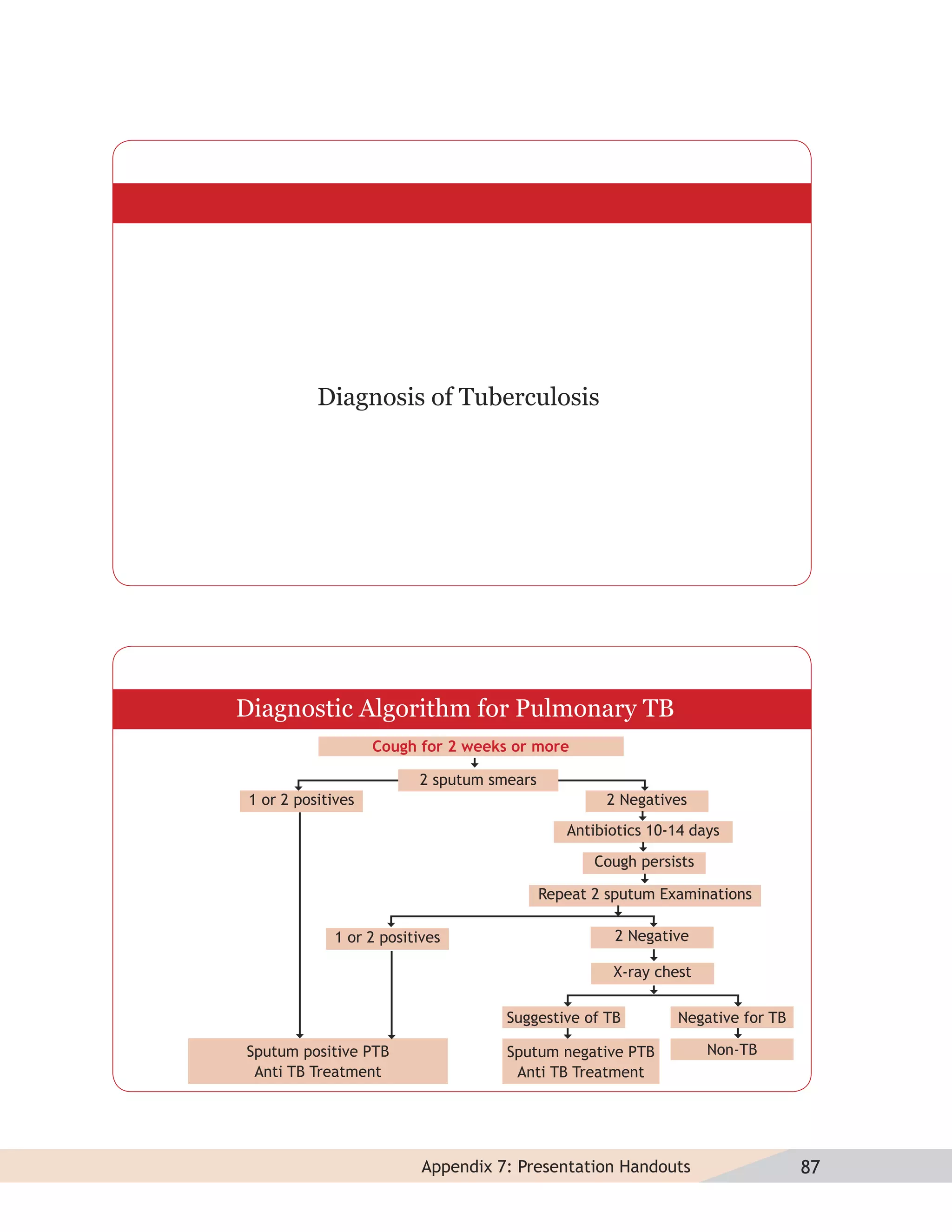
Diagnostic Algorithm for Pulmonary TB

                          Cough for 2 weeks or more


                                 2 sputum smears


1 or 2 positives                                          2 Negatives


                                                 Antibiotics (10-14 days)


                                                         Cough persists


                                             Repeat 2 sputum examinations


                   1 or 2 positives                            Negative


                                                                 X-ray


                                      1 or 2 positives              Non-TB


      Smear-positive TB                Smear-negative TB
     (Initiate treatment               (Initiate treatment
       regimen for TB)                   regimen for TB)


                                             Diagnosis of Tuberculosis       13
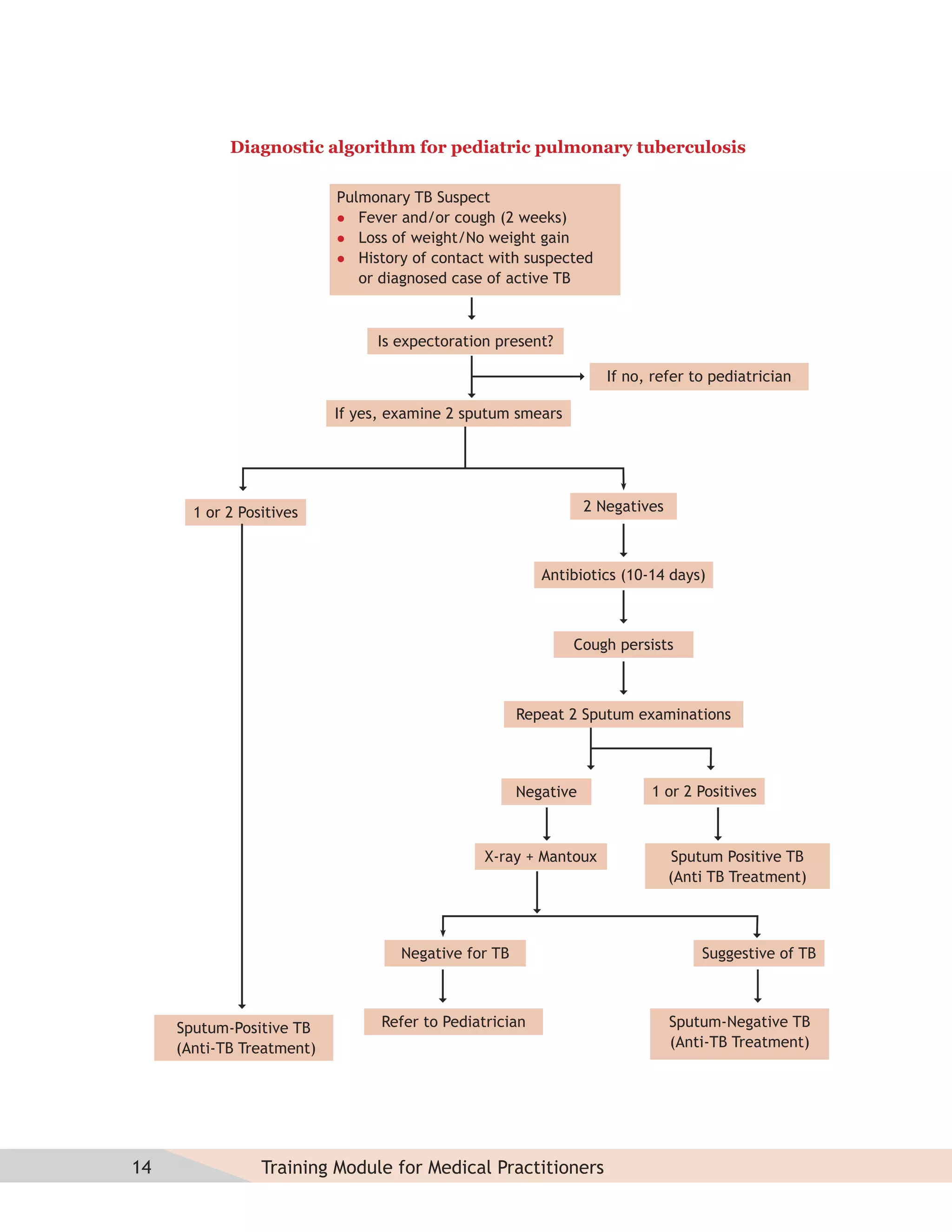
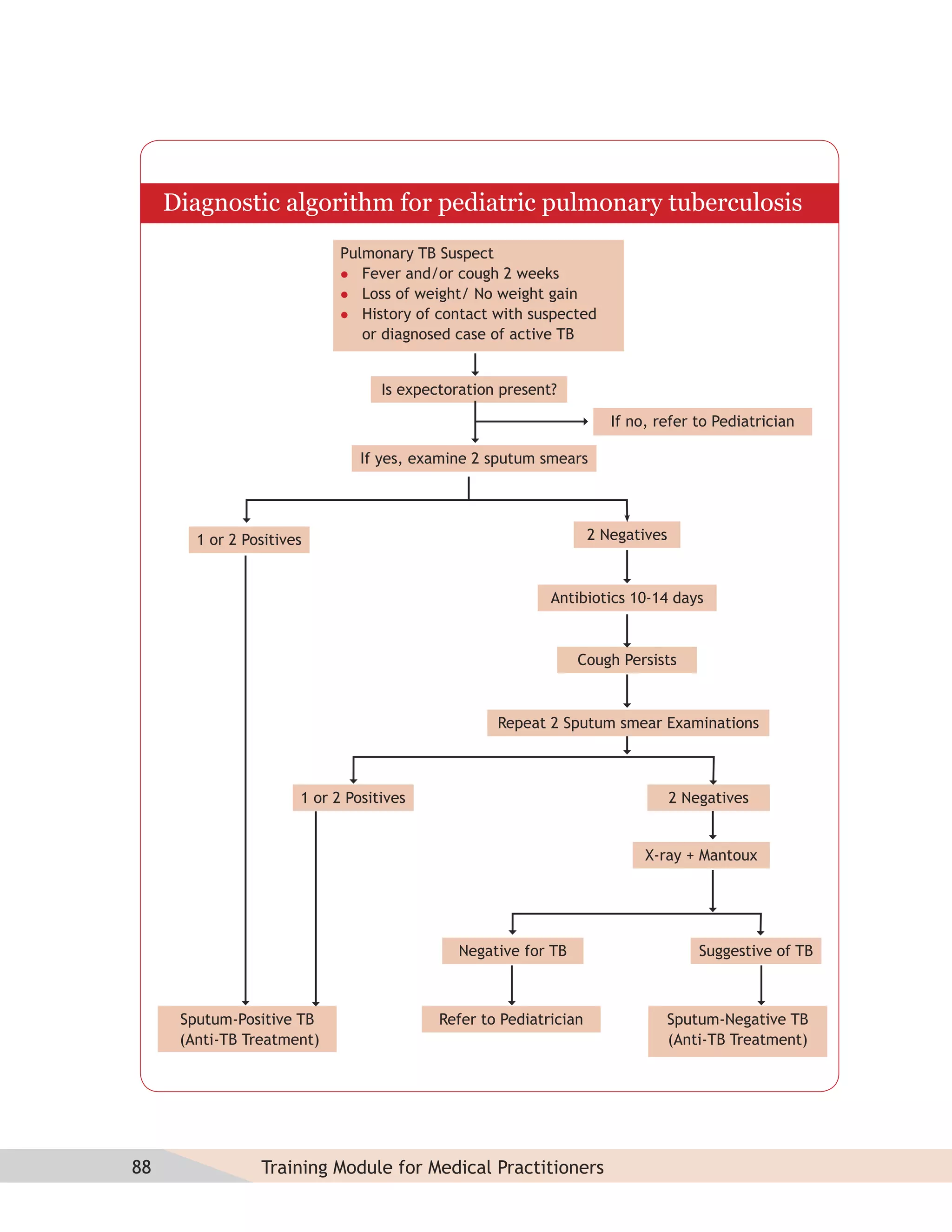
Diagnostic algorithm for pediatric pulmonary tuberculosis

                           Pulmonary TB Suspect
                            Fever and/or cough (2 weeks)
                            Loss of weight/No weight gain
                            History of contact with suspected
                              or diagnosed case of active TB


                                Is expectoration present?

                                                                    If no, refer to pediatrician

                           If yes, examine 2 sputum smears


       1 or 2 Positives                                          2 Negatives


                                                         Antibiotics (10-14 days)


                                                             Cough persists


                                                      Repeat 2 Sputum examinations


                                                      Negative            1 or 2 Positives


                                                X-ray + Mantoux                 Sputum Positive TB
                                                                               (Anti TB Treatment)


                                    Negative for TB                                Suggestive of TB


     Sputum-Positive TB          Refer to Pediatrician                         Sputum-Negative TB
     (Anti-TB Treatment)                                                       (Anti-TB Treatment)


14               Training Module for Medical Practitioners
Diagnostic algorithm for TB lymphadenitis

               Lymph node enlargement of >2 cm in one or more sites, with or without
                 periadenitis, evidence of TB elsewhere, abscess, discharging sinus


                                  Prescribe a course of antibiotics for two weeks


                       If lymph node enlargement persists, suspect TB lymphadenitis


                           Pus from sinus / Fine Needle Aspiration Cytology (FNAC)
                                     Mantoux test for children < 14 years


                         Diagnosis confirmed if the pus / aspirate from FNAC shows:
                               1. ZN smear-positive for AFB in pus / aspirate
                               2. Histopathological changes suggestive of TB


                   Excision biopsy, if FNAC                                             Start treatment
                   results are inconclusive


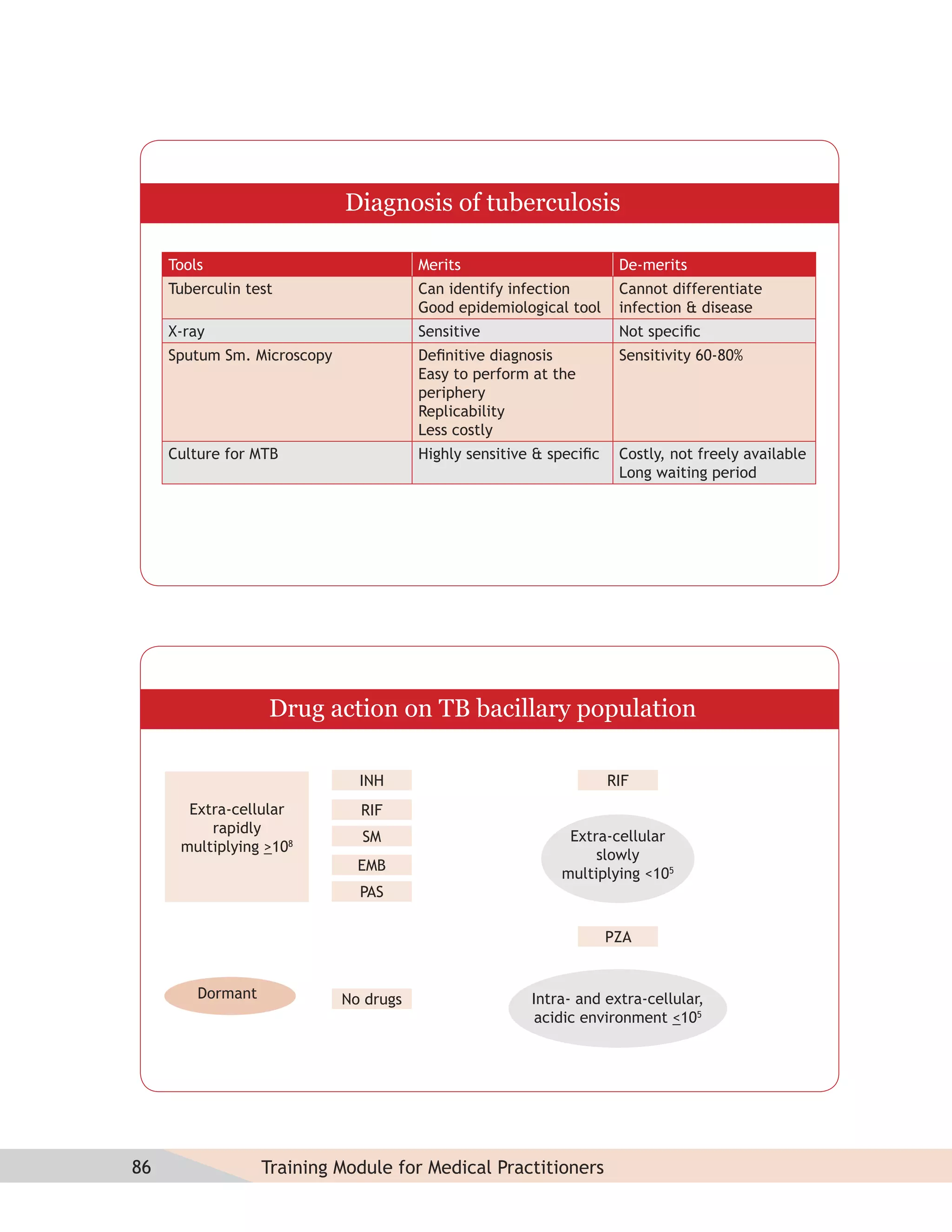
Sputum smears are examined and interpreted as indicated in the table below


 If the slide has:                                                     No. of fields to be examined                   Grading         Result
 No AFB in 100 oil immersion fields                                                      100                               0           Neg
 1-9 AFB per 100 oil immersion fields                                                    100                          Scanty*          Pos
 10-99 AFB per 100 oil immersion fields                                                  100                              1+           Pos
 1-10 AFB per oil immersion field                                                          50                             2+           Pos
 More than 10 AFB per oil immersion field                                                  20                             3+           Pos
*Record actual number of bacilli seen in 100 fields – e.g. “Scanty 4”
Smear-positive results including those of scanty positives are always recorded in red ink in the tuberculosis laboratory register.


When the referring Medical Practitioner receives the results of sputum examination, and it
is decided to put the patient on chemotherapy, health education must be imparted to the
patient. The patient is told about TB, how it spreads, precautions to be taken to prevent
the spread, importance of directly observed treatment and its duration, and the need for
prompt evaluation of children under six years or contacts with cough of any duration living
in the household. The patient should also be informed that his address would be verified by
a competent person prior to the start of treatment.


                                                                             Diagnosis of Tuberculosis                                        15
Tools for diagnosis of Pulmonary TB in adults:
    Sputum smear microscopy
    Chest X-ray
    Sputum culture and DST for diagnosis of Drug Resistant TB
    Newer rapid diagnostic tools for detection of MDR TB
    Newer tools under evaluation for diagnosis of MDR/XDR TB


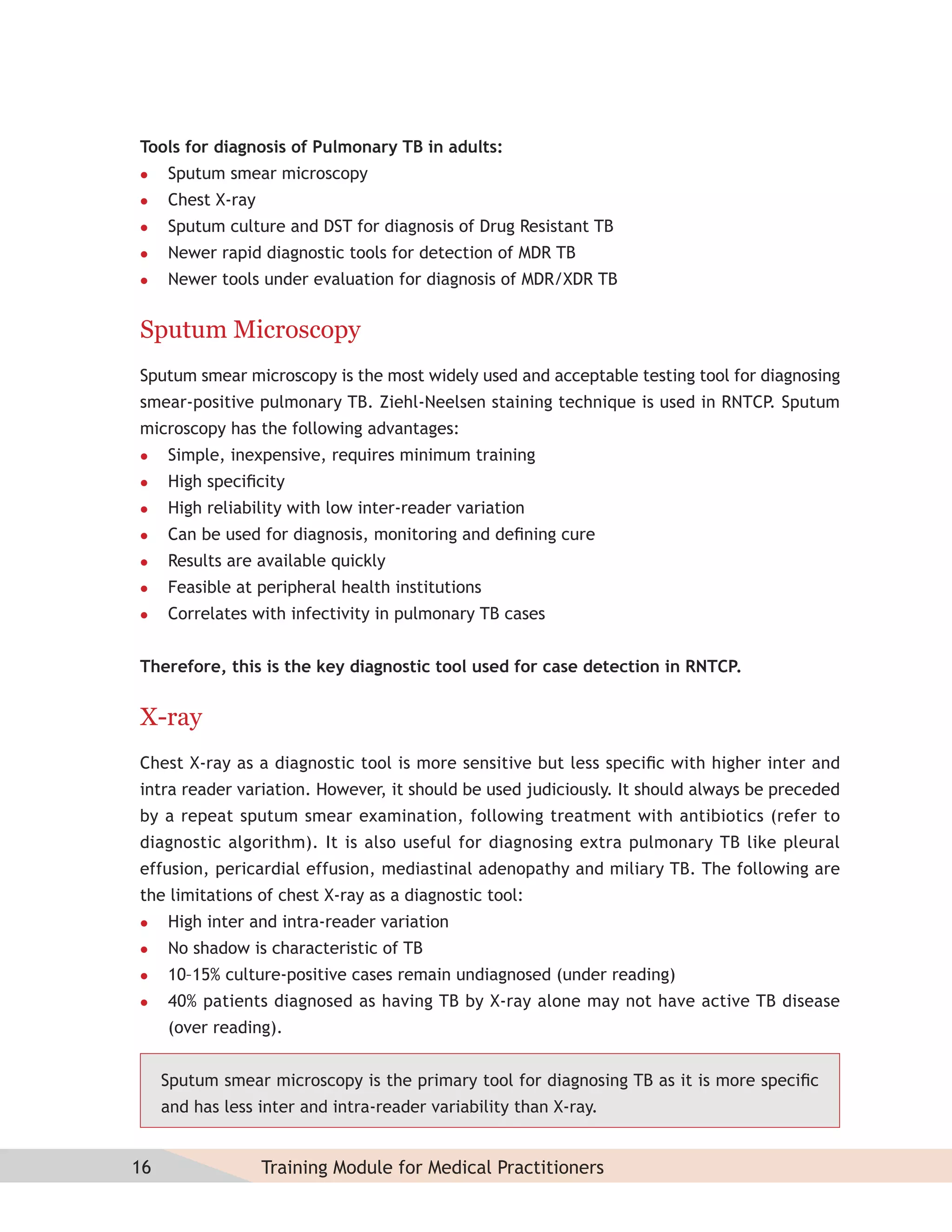
Sputum Microscopy
Sputum smear microscopy is the most widely used and acceptable testing tool for diagnosing
smear-positive pulmonary TB. Ziehl-Neelsen staining technique is used in RNTCP. Sputum
microscopy has the following advantages:
    Simple, inexpensive, requires minimum training
    High specificity
    High reliability with low inter-reader variation
    Can be used for diagnosis, monitoring and defining cure
    Results are available quickly
    Feasible at peripheral health institutions
    Correlates with infectivity in pulmonary TB cases


Therefore, this is the key diagnostic tool used for case detection in RNTCP.


X-ray
Chest X-ray as a diagnostic tool is more sensitive but less specific with higher inter and
intra reader variation. However, it should be used judiciously. It should always be preceded
by a repeat sputum smear examination, following treatment with antibiotics (refer to
diagnostic algorithm). It is also useful for diagnosing extra pulmonary TB like pleural
effusion, pericardial effusion, mediastinal adenopathy and miliary TB. The following are
the limitations of chest X-ray as a diagnostic tool:
    High inter and intra-reader variation
    No shadow is characteristic of TB
    10–15% culture-positive cases remain undiagnosed (under reading)
    40% patients diagnosed as having TB by X-ray alone may not have active TB disease
     (over reading).


     Sputum smear microscopy is the primary tool for diagnosing TB as it is more specific
     and has less inter and intra-reader variability than X-ray.


16                 Training Module for Medical Practitioners
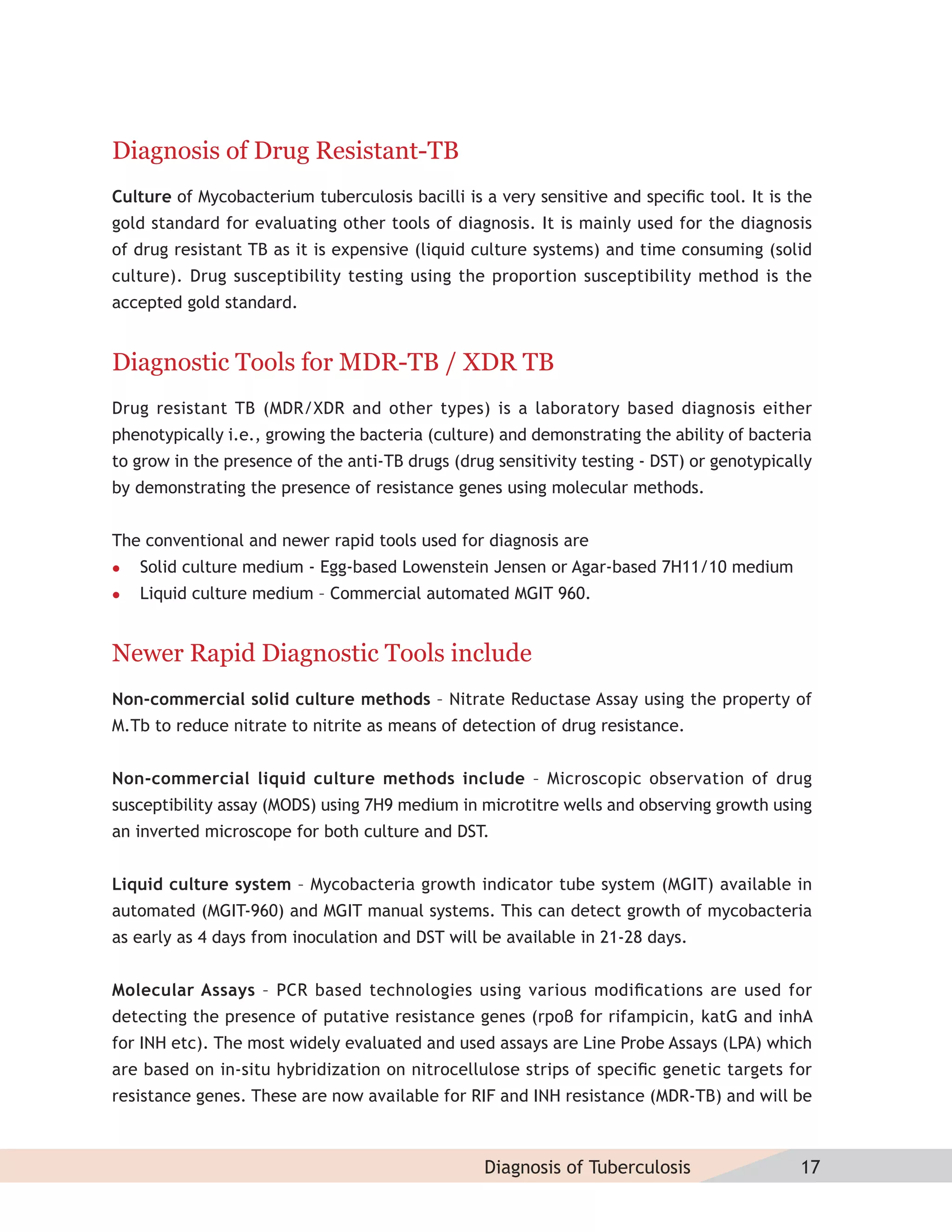
Diagnosis of Drug Resistant-TB
Culture of Mycobacterium tuberculosis bacilli is a very sensitive and specific tool. It is the
gold standard for evaluating other tools of diagnosis. It is mainly used for the diagnosis
of drug resistant TB as it is expensive (liquid culture systems) and time consuming (solid
culture). Drug susceptibility testing using the proportion susceptibility method is the
accepted gold standard.


Diagnostic Tools for MDR-TB / XDR TB
Drug resistant TB (MDR/XDR and other types) is a laboratory based diagnosis either
phenotypically i.e., growing the bacteria (culture) and demonstrating the ability of bacteria
to grow in the presence of the anti-TB drugs (drug sensitivity testing - DST) or genotypically
by demonstrating the presence of resistance genes using molecular methods.


The conventional and newer rapid tools used for diagnosis are
   Solid culture medium - Egg-based Lowenstein Jensen or Agar-based 7H11/10 medium
   Liquid culture medium – Commercial automated MGIT 960.


Newer Rapid Diagnostic Tools include
Non-commercial solid culture methods – Nitrate Reductase Assay using the property of
M.Tb to reduce nitrate to nitrite as means of detection of drug resistance.


Non-commercial liquid culture methods include – Microscopic observation of drug
susceptibility assay (MODS) using 7H9 medium in microtitre wells and observing growth using
an inverted microscope for both culture and DST.


Liquid culture system – Mycobacteria growth indicator tube system (MGIT) available in
automated (MGIT-960) and MGIT manual systems. This can detect growth of mycobacteria
as early as 4 days from inoculation and DST will be available in 21-28 days.


Molecular Assays – PCR based technologies using various modifications are used for
detecting the presence of putative resistance genes (rpoβ for rifampicin, katG and inhA
for INH etc). The most widely evaluated and used assays are Line Probe Assays (LPA) which
are based on in-situ hybridization on nitrocellulose strips of specific genetic targets for
resistance genes. These are now available for RIF and INH resistance (MDR-TB) and will be


                                                  Diagnosis of Tuberculosis                 17
shortly available for XDR-TB (resistance to aminoglycosides, polypeptides, fluoroquinolones
and ethambutol).


Newer tools under evaluation include, Cepheid GeneXpert – a completely closed
automated system using real-time PCR which has a sensitivity of 70-90% even for smear
negative cases and can also detect the presence of rifampicin resistance.


TB in HIV Positive Patients
Pulmonary TB (PTB) is most common form of TB disease. HIV positive and HIV negative
patients with active pulmonary TB generally manifest similar clinical features, namely
cough, fever, night sweats, haemoptysis and weight loss. The presentation may sometimes
vary with the degree of immune suppression. In patients with mild immune suppression,
the clinical picture often resembles usual adult post-primary pulmonary TB i.e., the sputum
smear is frequently positive for acid-fast bacilli (AFB), and the chest X-ray (CXR) typically
may show unilateral or bilateral upper lobe infiltrates, cavitations, pulmonary fibrotic
changes, and/or volume loss.


In severely immune suppressed patients, the overall risk of TB is even higher, but it
is more difficult to distinguish TB from other serious chest diseases. In persons with
advanced HIV infection, disseminated and extrapulmonary TB (EPTB) are more common
than in early HIV infection and may be as common as pulmonary TB. The most common
forms of EPTB seen are lymphadenitis, pleural effusion, pericarditis, miliary disease and
meningitis. In PTB, the features of the disease are frequently atypical, resembling those
of primary TB as historically seen in children. Smear-negative TB is as common as smear-
positive TB. The chest X-ray pattern in advanced HIV infection may show any pattern. Hilar
lymphadenopathy is frequently observed and interstitial infiltrates tend to be common,
especially in the lower zones; features such as cavitation or fibrosis are less common.
Infiltrates may be unilateral or bilateral, and are seen more often in the lower lobes than
in the upper lobes


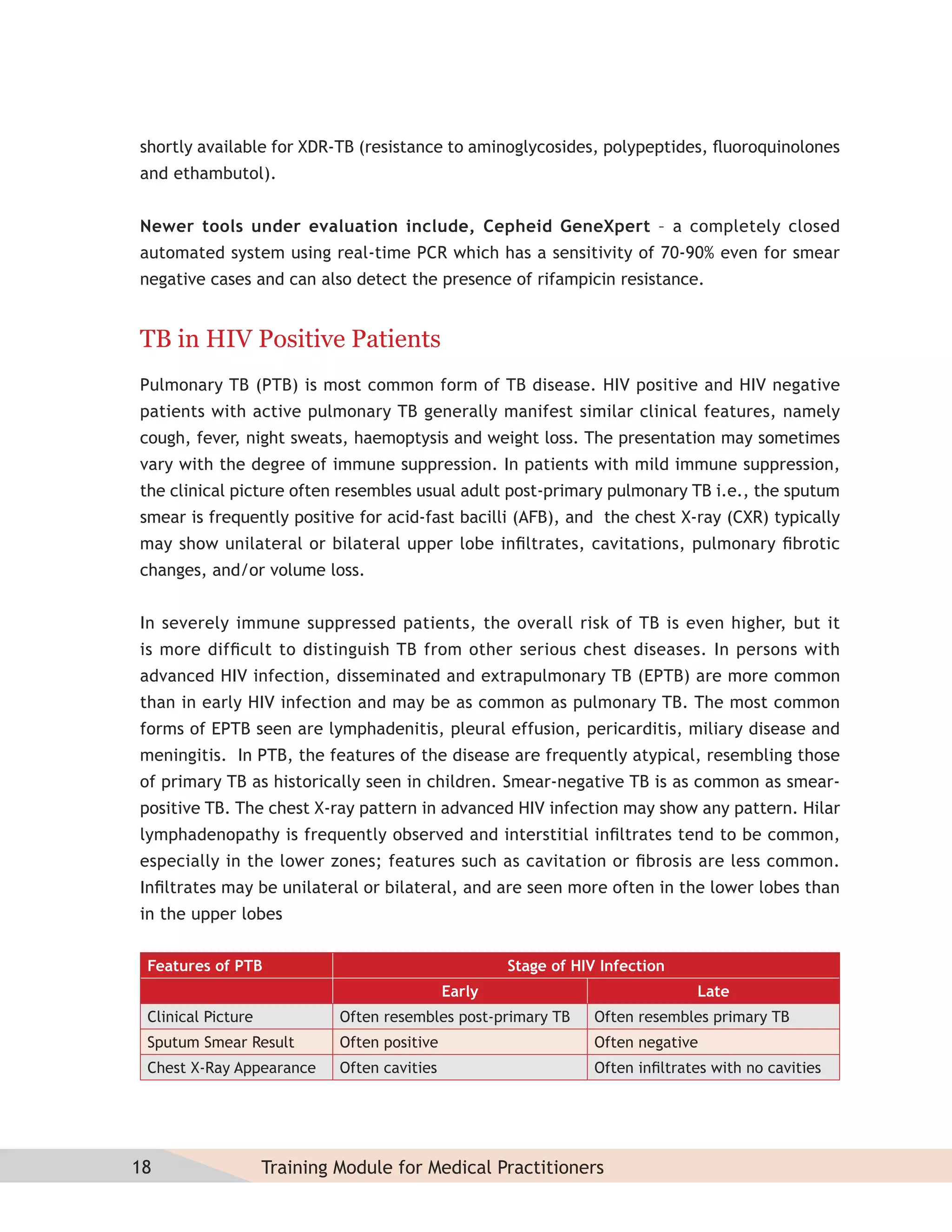
 Features of PTB                                      Stage of HIV Infection
                                              Early                              Late
 Clinical Picture            Often resembles post-primary TB      Often resembles primary TB
 Sputum Smear Result         Often positive                       Often negative
 Chest X-Ray Appearance      Often cavities                       Often infiltrates with no cavities


18                  Training Module for Medical Practitioners
The advent of HIV has made the diagnosis of TB more difficult, and false diagnosis of TB
probably occurs frequently among patients affected by other HIV-related illnesses. These
false-positive diagnosis in most cases, however account for a very small proportion of all
forms of TB notified and thus do not negate the huge increase observed in TB notifications
in HIV-endemic areas.


Intensified TB Case Finding at ICTCs, ART and
Community Care Centres (CCCs)
Intensified TB case finding should be established in ICTCs, ART Centres & CCCs. Intensified
case finding means screening for symptoms and signs of TB in places where HIV-infected
people are concentrated, followed by diagnosis and prompt treatment; which increases
chances of survival, improves quality of life and reduces transmission of TB.


All ICTC clients should be screened by the ICTC counselors for the presence of symptoms of
TB disease (at pre, post and follow-up counseling). All clients who have symptoms or signs
of TB disease, irrespective of their HIV status, should be referred to the nearest facility
providing RNTCP diagnostic and treatment services.


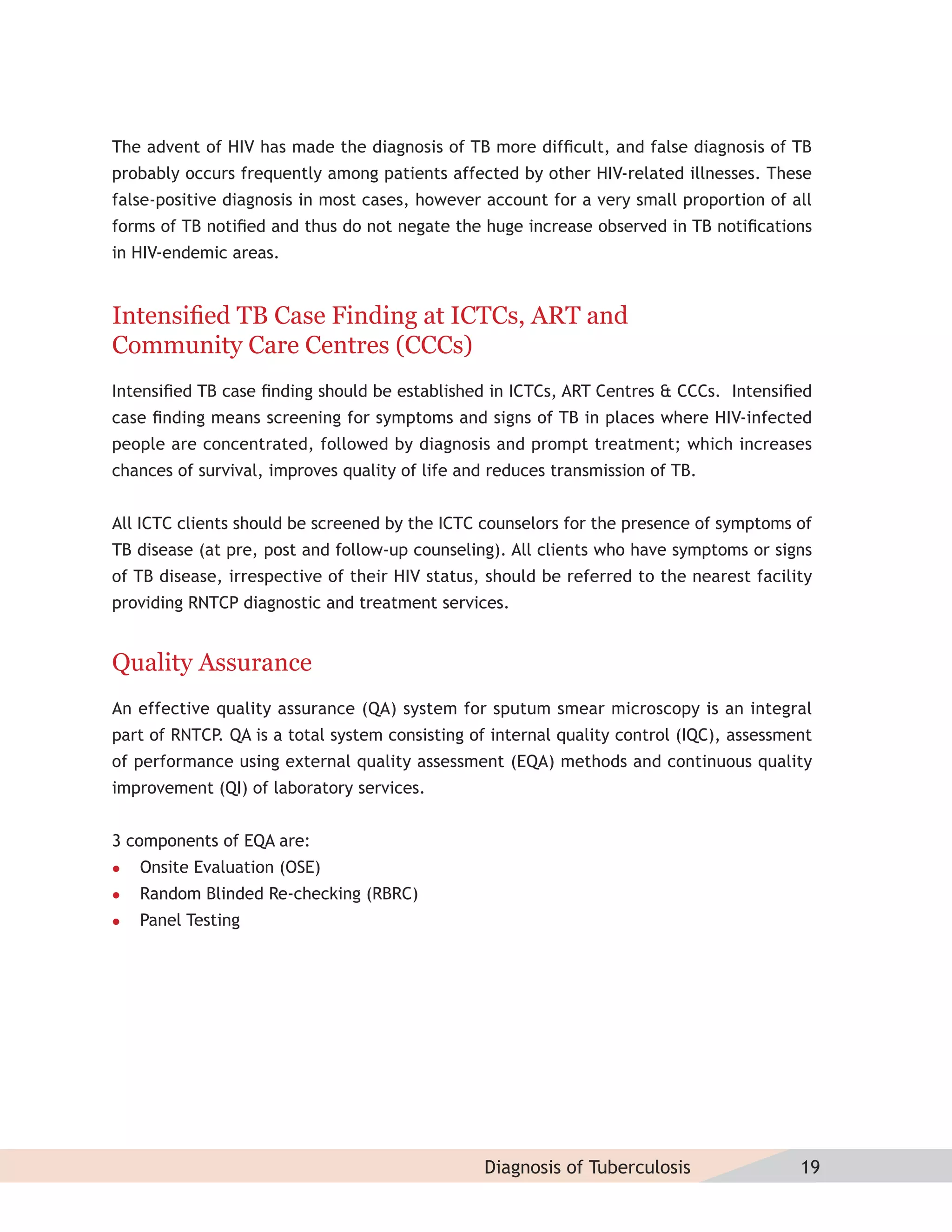
Quality Assurance
An effective quality assurance (QA) system for sputum smear microscopy is an integral
part of RNTCP. QA is a total system consisting of internal quality control (IQC), assessment
of performance using external quality assessment (EQA) methods and continuous quality
improvement (QI) of laboratory services.


3 components of EQA are:
   Onsite Evaluation (OSE)
   Random Blinded Re-checking (RBRC)
   Panel Testing


                                                 Diagnosis of Tuberculosis                19
Points to Remember

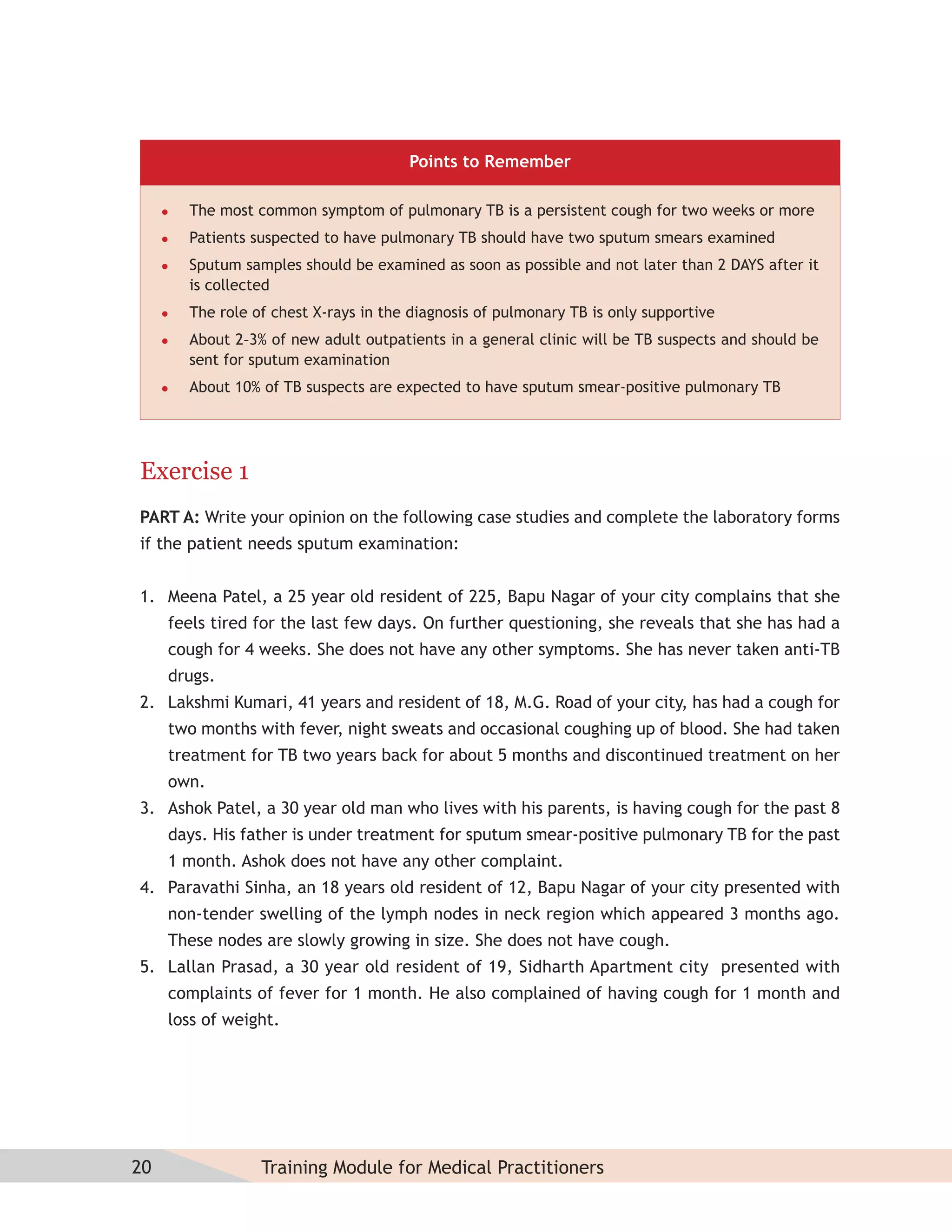
        The most common symptom of pulmonary TB is a persistent cough for two weeks or more
        Patients suspected to have pulmonary TB should have two sputum smears examined
        Sputum samples should be examined as soon as possible and not later than 2 DAYS after it
         is collected
        The role of chest X-rays in the diagnosis of pulmonary TB is only supportive
        About 2–3% of new adult outpatients in a general clinic will be TB suspects and should be
         sent for sputum examination
        About 10% of TB suspects are expected to have sputum smear-positive pulmonary TB


Exercise 1
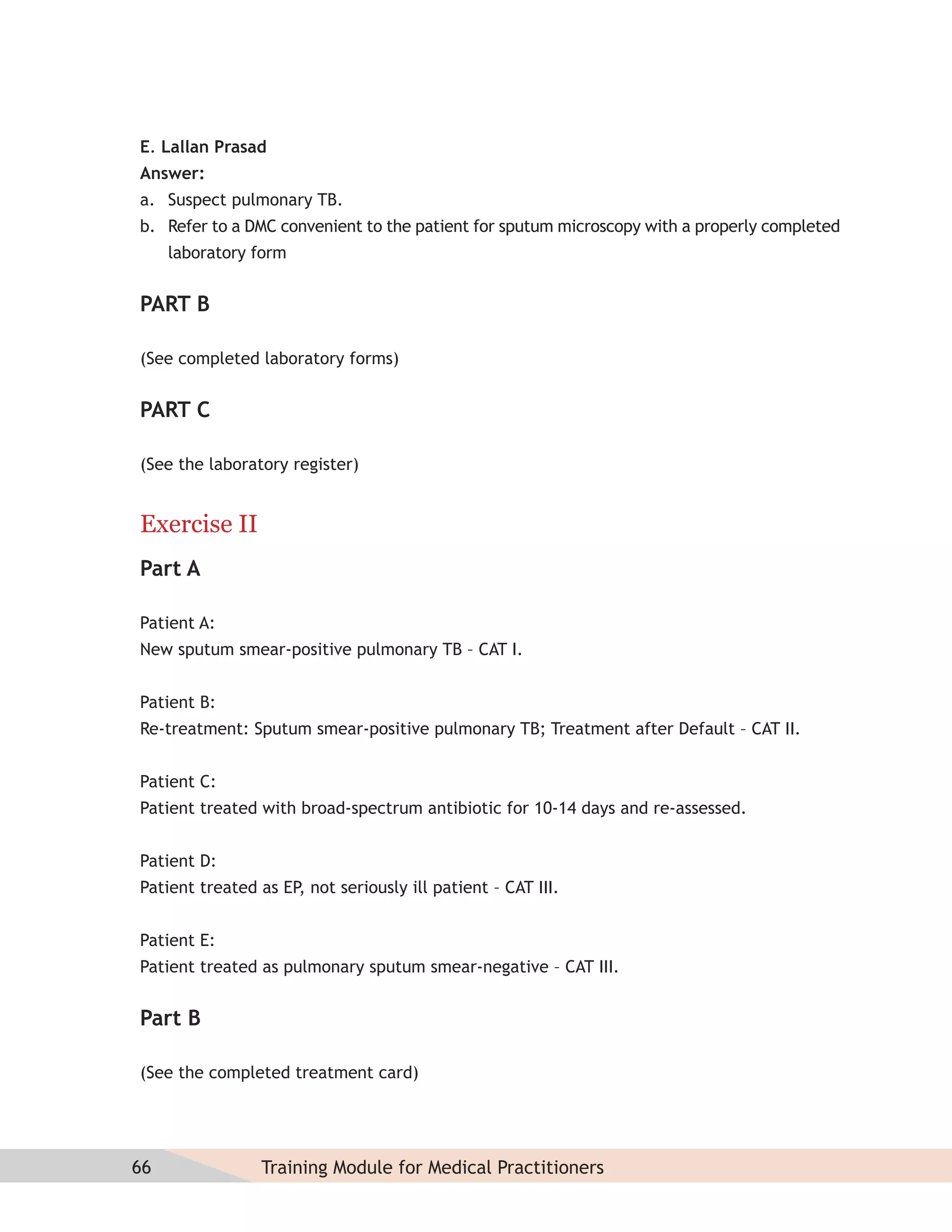
PART A: Write your opinion on the following case studies and complete the laboratory forms
if the patient needs sputum examination:


1. Meena Patel, a 25 year old resident of 225, Bapu Nagar of your city complains that she
     feels tired for the last few days. On further questioning, she reveals that she has had a
     cough for 4 weeks. She does not have any other symptoms. She has never taken anti-TB
     drugs.
2. Lakshmi Kumari, 41 years and resident of 18, M.G. Road of your city, has had a cough for
     two months with fever, night sweats and occasional coughing up of blood. She had taken
     treatment for TB two years back for about 5 months and discontinued treatment on her
     own.
3. Ashok Patel, a 30 year old man who lives with his parents, is having cough for the past 8
     days. His father is under treatment for sputum smear-positive pulmonary TB for the past
     1 month. Ashok does not have any other complaint.
4. Paravathi Sinha, an 18 years old resident of 12, Bapu Nagar of your city presented with
     non-tender swelling of the lymph nodes in neck region which appeared 3 months ago.
     These nodes are slowly growing in size. She does not have cough.
5. Lallan Prasad, a 30 year old resident of 19, Sidharth Apartment city presented with
     complaints of fever for 1 month. He also complained of having cough for 1 month and
     loss of weight.


20                 Training Module for Medical Practitioners
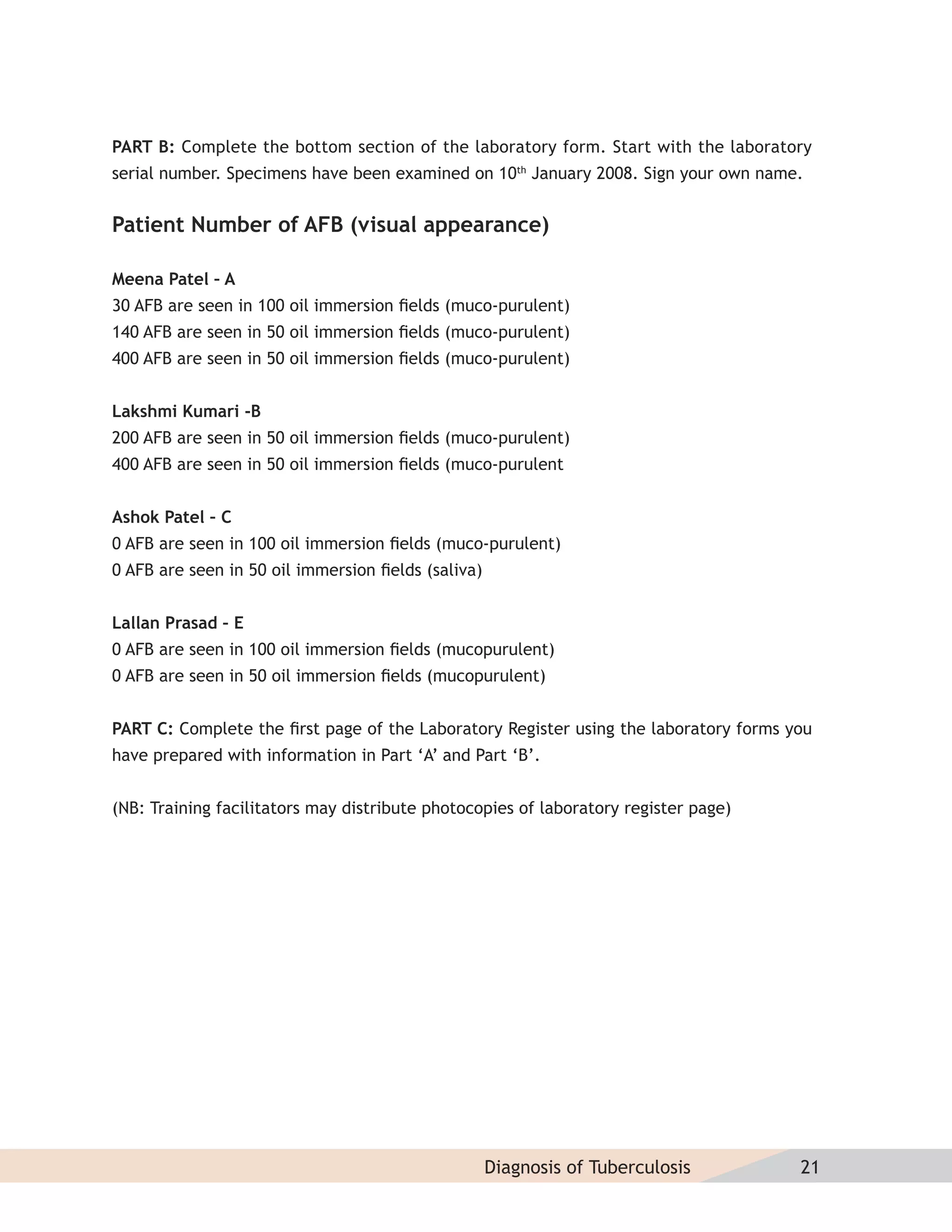
PART B: Complete the bottom section of the laboratory form. Start with the laboratory
serial number. Specimens have been examined on 10th January 2008. Sign your own name.


Patient Number of AFB (visual appearance)

Meena Patel – A
30 AFB are seen in 100 oil immersion fields (muco-purulent)
140 AFB are seen in 50 oil immersion fields (muco-purulent)
400 AFB are seen in 50 oil immersion fields (muco-purulent)


Lakshmi Kumari -B
200 AFB are seen in 50 oil immersion fields (muco-purulent)
400 AFB are seen in 50 oil immersion fields (muco-purulent


Ashok Patel – C
0 AFB are seen in 100 oil immersion fields (muco-purulent)
0 AFB are seen in 50 oil immersion fields (saliva)


Lallan Prasad – E
0 AFB are seen in 100 oil immersion fields (mucopurulent)
0 AFB are seen in 50 oil immersion fields (mucopurulent)


PART C: Complete the first page of the Laboratory Register using the laboratory forms you
have prepared with information in Part ‘A’ and Part ‘B’.


(NB: Training facilitators may distribute photocopies of laboratory register page)


                                                    Diagnosis of Tuberculosis         21
3
                        Administering Treatment

Diagnosis of TB in itself has little purpose unless it is followed by effective treatment.


The goal of anti-TB treatment is to ensure cure, while preventing the emergence of drug
resistance. A patient with TB should be put on treatment within one week of diagnosis.


The following is required before starting treatment:
    History of patient, including history of any previous treatment for TB
    Sputum smear examination results from an approved DMC
    Chest X-ray report if the case warrants radiographic examination
    Other supporting investigation reports, if any


The disease classification, type of case, sputum result, severity of illness and history of previous
treatment are the factors that determine the regimen used for treating a TB patient.


         RNTCP uses short course chemotherapy given intermittently - thrice weekly under
         Direct Observation for both pulmonary and extra pulmonary tuberculosis patients.


Scientific Basis of Treatment of TB

The strategies adopted in the treatment of TB are based on both scientific and operational
research.


The following four components are discussed in brief.
1. Domiciliary treatment
2. Short course chemotherapy
3. Intermittent regimen
4. Direct observation of treatment


22               Training Module for Medical Practitioners
Domiciliary Treatment
Domiciliary chemotherapy has been proved to be as effective as sanatoria treatment.
Studies in India have shown that smear-positive TB patients treated on a domiciliary basis
have achieved high cure rates as good as those when treated at sanatorium, besides having
other social benefits of being at home.


Short Course Chemotherapy
Short course chemotherapy regimens have made it possible to treat and cure TB patients in
as short a period as six to eight months. Reduction in the duration of treatment regimens
was possible because of the introduction of Rifampicin and Pyrazinamide. Treatment
regimens of six months duration either given daily, or on intermittent basis have been
found to be equally effective and achieve high cure rates, prevent emergence of drug
resistance and minimize relapses. The shorter duration has contributed to improvement in
the treatment adherence. Intermittent short course chemotherapy regimens of 6-8 months
are recommended internationally for all forms of extra-pulmonary TB.


Basis of chemotherapy

(a) Bacteriological basis
i. Existence of naturally occurring drug resistant mutants
In an untreated smear-positive pulmonary tuberculosis patient, there are naturally occurring
drug resistant mutants to different drugs at different frequencies. The larger the bacterial
population, higher is the probability that resistant mutant strains are present. The number
of bacilli are lower in smear-negative and extra pulmonary lesions. The number of viable
bacilli commonly found inside the cavities sized about 2 centimeters in diameter on an
average, is likely to be in excess of 100 million (108). As a thumb rule, the frequency of
occurrence of drug resistant mutants would be roughly ~1 in 106 to isoniazid (H), ~1 in 106
to streptomycin (S) and ~1 in 108 to rifampicin (R). Based on these frequencies, the chances
of naturally occurring organisms that is resistant to both H and R would be roughly ~1 in
1014, which is virtually negligible.


There would be appreciable numbers of mutants, resistant to any single drug before the start
of the treatment, that are capable of multiplying and will not be affected by a single drug,
e.g. isoniazid. This accounts for frequent failures observed with monotherapy of patients


                                                Administering Treatment                   23
harbouring large number of bacilli. Thus, if two or more drugs are given concurrently, in the
initial Intensive Phase when the bacterial load is high, the chances of survival and selection
of drug resistant organism to any drug would be very small as mutants resistant to one drug
are as a rule susceptible to other and vice versa. This is the basis for the use of multi-drug
therapy in the treatment of tuberculosis.


Role of intensive phase
The objective of combining four drugs in the intensive phase (IP) is to achieve rapid killing of
actively multiplying bacillary population. This phase will eliminate naturally occurring drug
resistant mutants and prevent the further emergence of drug resistant mutants. An optimal
minimum duration of two months in new cases is essential for achieving smear conversion of
90% and above, thereby significantly reducing the infectiousness of the patient.


Role of continuation phase
Continuation phase (CP) with fewer drugs for a comparatively longer time will ensure
elimination of persisters which are responsible for relapses. The optimum duration of
continuation phase is four months in new cases.


ii. Existence of sub-bacillary population
In a given lesion of TB, there are 4 bacterial sub-populations having different metabolic
rates depending on their surrounding environment. They are acted upon with different
intensity by the different anti-TB drugs. The bacillary population and different drugs acting
on them are shown in the figure below.


                                          H                     R
                              A
                                          R
                                          S                     B
                      Extra-cellular      E       Extra-cellular intermittently
                         rapidly          T
                                                        multiplying <105
                     multiplying >108

                                                                Z


                                                                C
                      D
                                                 Intra- and extra-cellular, acidic
                   Dormant        No drugs
                                                 environment slowly multiplying
                    Bacilli


24              Training Module for Medical Practitioners
The bacillary sub populations B and C are referred as semi-dormant or persisters which are
difficult to eliminate and are the source of relapse.


Anti-TB drugs have the following three actions:
a. Early bactericidal activity
b. Sterilizing activity
c. Ability to prevent emergence of drug resistance


Isoniazid (H): Isoniazid is a potent drug, exerting early bactericidal activity, prevents
emergence of drug resistant mutants to any companion drug and has low rates of adverse
drug reactions.


Rifampicin (R): Rifampicin is a potent bactericidal and sterilizing drug acting on semi-
dormant bacilli which multiply intermittently, thereby causing relapse.


Pyrazinamide (Z): Pyrazinamide is a bactericidal and sterilizing drug effective in eliminating
the semi-dormant bacilli multiplying slowly in an acidic environment.


Ethambutol (E): Ethambutol is an effective bacteriostatic drug helpful in preventing
emergence of resistance to other companion drugs.


Streptomycin (S): Streptomycin is a bactericidal drug known to reduce septicaemia and
toxicity.


The ranking of the drugs with respect to their type of activity is indicated in the following
table.


 Drugs              Early bactericidal     Sterilizing activity   Prevention of emergence of
                                                                       drug resistance
 Isoniazid                ++++                     ++                        ++++
 Rifampicin                +++                    ++++                       +++
 Streptomycin              +++                      -                         ++
 Pyrazinamide              ++                      +++                        +
 Ethambutol                 +                       -                         ++


                                                  Administering Treatment                   25
Pharmacological basis of treatment
It is established that in the treatment of tuberculosis, it is of importance to achieve peak
serum levels of all the drugs simultaneously, so that maximum bactericidal effect is obtained.
This is achieved by administration of all drugs at the same time. This also renders operational
convenience of advising the patients to consume all the drugs at the same time.


Intermittent Treatment
Intermittent regimens should only be used in a programme of directly observed treatment
(DOT). The formulation of intermittent regimens in the treatment of TB is based on the
principle of existence of lag period. “In vitro experiments demonstrated that, after a culture
of M. tuberculosis is exposed to certain drugs for some time, it takes several days before
new growth occurs”. Thus, there is no need to maintain blood levels of drugs for 24 hours in
the treatment of tuberculosis. The ability of the drugs to continue to exert its antimicrobial
activity even after their withdrawal is called lag period. This renders the intermittent regimen
possible. Intermittent dosing increases the efficacy of treatment by allowing organisms to
re-enter the active metabolic phase in which the bactericidal drugs are more effective.


Advantages of intermittent regimen are:
    As effective as daily treatment
    Facilitates DOT
    Reduction in total quantity of drugs consumed
    Fewer adverse reactions


Directly Observed Treatment (DOT)
Studies in India and many other countries have consistently shown that at least one third of
patients do not consume medicines regularly. DOT is a supportive mechanism that ensures
the best possible results in treatment of TB. Here, a DOT Provider helps the patient in taking
the treatment, thereby ensuring adherence. Many patients who do not receive directly
observed treatment stop taking drugs once they feel better. It is neither possible to predict
who these patients will be nor to prevent non-adherence through health education. Studies
have shown that there will be poor treatment outcome and high death rates in the absence
of DOT, even when regular supply of drugs is ensured. Hence, by providing DOT, RNTCP
ensures that patients receive the right drugs, in the right doses, at the right intervals and
for the right duration.


26               Training Module for Medical Practitioners
Definitions: The Revised National Tuberculosis Control Programme
 Case definitions                        Type of cases                            Treatment outcomes
 Pulmonary Tuberculosis,                New                                      Cured
 Smear-Positive                         A TB patient who has never               Initially sputum smear-positive patient who
 TB in a patient with atleast           had treatment for TB or has              has completed treatment and had negative
 one smear-positive for AFB             taken anti-TB drugs for less             sputum smears on two occasions, one of
 out of the two initial sputum          than one month                           which was at the end of the treatment
 smear examination by direct
                                        Relapse                                  Treatment completed
 microscopy
                                        A TB patient who was declared            Initially sputum smear-positive patient who
 Pulmonary Tuberculosis,                cured or treatment completed             has completed treatment with negative
 Smear Negative                         by a physician and who reports           smears at end of the intensive phase/two
 A patient with symptoms                back to the health facility and          months in the continuation phase, but none
 suggestive of TB with                  is now found to be sputum                at the end of the treatment is declared as
 two smear examination                  smear-positive                           treatment completed. Or Initially sputum
 negative for AFB, with                                                          smear negative patient who has received
                                        Transferred in: A TB patient             full course of treatment and has not
 evidence of pulmonary TB
                                        who has been received for                become smear-positive at the end of the
 by microbiological methods
                                        treatment in a Tuberculosis              treatment or
 (culture positive or by
                                        Unit, after starting treatment
 other approved molecular
                                        in another TB unit where s/he            Extra pulmonary TB patient who has
 methods) or Chest X-
                                        has been registered.                     received full course of treatment and has
 ray is classified as having
                                                                                 not become smear-positive during or at the
 smear negative pulmonary               Treatment after default: A               end of treatment
 tuberculosis                           patient, who has received
 Extra Pulmonary                        treatment for TB for a month             Died
 Tuberculosis*                          or more from any source                  Patient who died during the course of
 Tuberculosis in any organ              and returns for treatment                treatment regardless of any cause
 other than lungs (eg. pleura,          after having defaulted i.e.,
 lymph nodes, intestine,                not taken anti-TB drugs                  Failure
 genitor-urinary tract, joint           consecutively for two months             Any TB patient who is smear-positive at
 and bones, meninges of the             or more and found to be                  five months or more after initiation of the
 brain etc).                            smear-positive                           treatment and not put on MDR-TB treatment

 The diagnosis should be                Treatment failure Any TB                 Defaulted
 based on strong clinical               patient who is smear-positive            A Patient after treatment initiation has
 evidence with the following            at 5 months or more after                interrupted treatment consecutively for >2
 investigations                         initiation of treatment.                 months

     Smear/Culture from                                                         Transferred out
                                        Chronic A patient who
      extrapulmonary sites                                                       A patient who has been transferred to
                                        remains smear-positive after
     Histopathological                 completing regimen for                   another TU and whose treatment outcome
      examination or                    previously treated but not               is still not available.
     Radiological examination          initiated on MDR-TB treatment
      or                                                                         Switched over to MDR-TB Treatment
                                        Others A patient who does not            A patient who has been diagnosed as having
     Biochemical and
                                        fit into the any of the types             MDR-TB by an RNTCP accredited laboratory,
      cytological examination
                                        mentioned above. The reasons             prior to being declared as “Failure”, and
      including FNAC
                                        for labeling a patient under this        is placed on the RNTCP MDR-TB treatment
                                        type must be specified in the             regimen
                                        Treatment card and TB Register#
* Pleurisy is classified as extra pulmonary tuberculosis,
* A patient diagnosed with both smear-positive pulmonary and extra pulmonary TB should be classified as pulmonary TB
# Others can come both under new and previously treated.


                                                                        Administering Treatment                            27
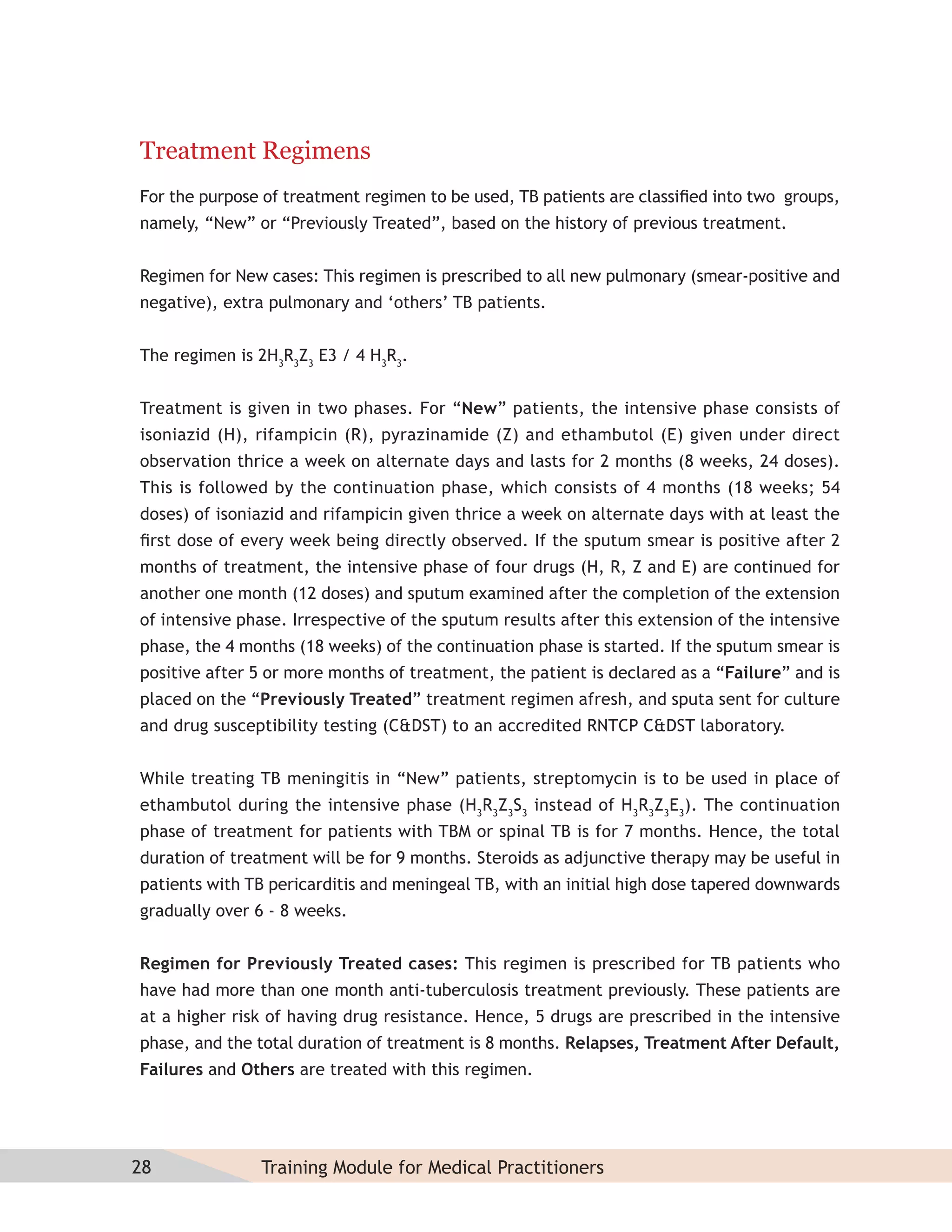
Treatment Regimens
For the purpose of treatment regimen to be used, TB patients are classified into two groups,
namely, “New” or “Previously Treated”, based on the history of previous treatment.


Regimen for New cases: This regimen is prescribed to all new pulmonary (smear-positive and
negative), extra pulmonary and ‘others’ TB patients.


The regimen is 2H3R3Z3 E3 / 4 H3R3.


Treatment is given in two phases. For “New” patients, the intensive phase consists of
isoniazid (H), rifampicin (R), pyrazinamide (Z) and ethambutol (E) given under direct
observation thrice a week on alternate days and lasts for 2 months (8 weeks, 24 doses).
This is followed by the continuation phase, which consists of 4 months (18 weeks; 54
doses) of isoniazid and rifampicin given thrice a week on alternate days with at least the
first dose of every week being directly observed. If the sputum smear is positive after 2
months of treatment, the intensive phase of four drugs (H, R, Z and E) are continued for
another one month (12 doses) and sputum examined after the completion of the extension
of intensive phase. Irrespective of the sputum results after this extension of the intensive
phase, the 4 months (18 weeks) of the continuation phase is started. If the sputum smear is
positive after 5 or more months of treatment, the patient is declared as a “Failure” and is
placed on the “Previously Treated” treatment regimen afresh, and sputa sent for culture
and drug susceptibility testing (C&DST) to an accredited RNTCP C&DST laboratory.


While treating TB meningitis in “New” patients, streptomycin is to be used in place of
ethambutol during the intensive phase (H3R3Z3S3 instead of H3R3Z3E3). The continuation
phase of treatment for patients with TBM or spinal TB is for 7 months. Hence, the total
duration of treatment will be for 9 months. Steroids as adjunctive therapy may be useful in
patients with TB pericarditis and meningeal TB, with an initial high dose tapered downwards
gradually over 6 - 8 weeks.


Regimen for Previously Treated cases: This regimen is prescribed for TB patients who
have had more than one month anti-tuberculosis treatment previously. These patients are
at a higher risk of having drug resistance. Hence, 5 drugs are prescribed in the intensive
phase, and the total duration of treatment is 8 months. Relapses, Treatment After Default,
Failures and Others are treated with this regimen.


28             Training Module for Medical Practitioners
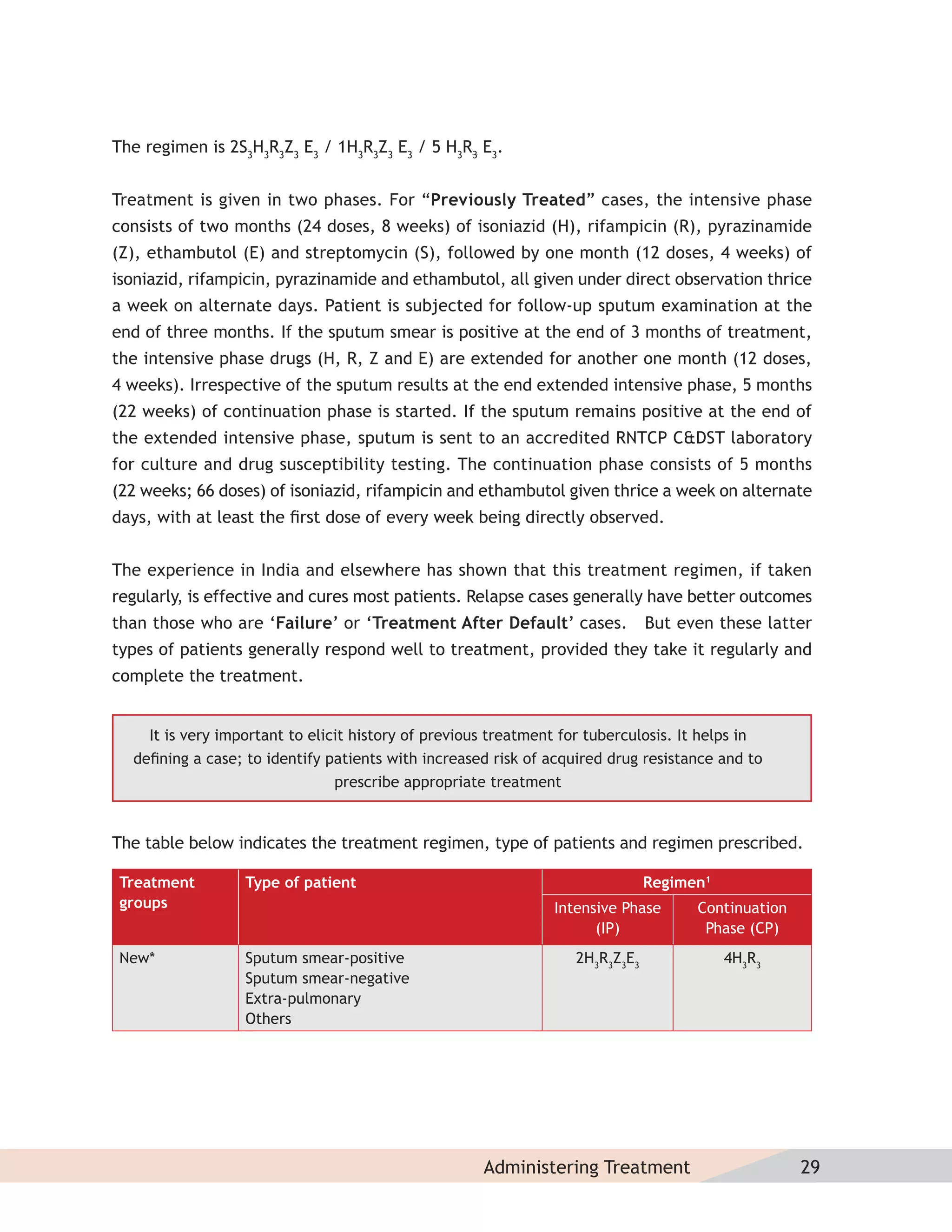
The regimen is 2S3H3R3Z3 E3 / 1H3R3Z3 E3 / 5 H3R3 E3.


Treatment is given in two phases. For “Previously Treated” cases, the intensive phase
consists of two months (24 doses, 8 weeks) of isoniazid (H), rifampicin (R), pyrazinamide
(Z), ethambutol (E) and streptomycin (S), followed by one month (12 doses, 4 weeks) of
isoniazid, rifampicin, pyrazinamide and ethambutol, all given under direct observation thrice
a week on alternate days. Patient is subjected for follow-up sputum examination at the
end of three months. If the sputum smear is positive at the end of 3 months of treatment,
the intensive phase drugs (H, R, Z and E) are extended for another one month (12 doses,
4 weeks). Irrespective of the sputum results at the end extended intensive phase, 5 months
(22 weeks) of continuation phase is started. If the sputum remains positive at the end of
the extended intensive phase, sputum is sent to an accredited RNTCP C&DST laboratory
for culture and drug susceptibility testing. The continuation phase consists of 5 months
(22 weeks; 66 doses) of isoniazid, rifampicin and ethambutol given thrice a week on alternate
days, with at least the first dose of every week being directly observed.


The experience in India and elsewhere has shown that this treatment regimen, if taken
regularly, is effective and cures most patients. Relapse cases generally have better outcomes
than those who are ‘Failure’ or ‘Treatment After Default’ cases.              But even these latter
types of patients generally respond well to treatment, provided they take it regularly and
complete the treatment.


    It is very important to elicit history of previous treatment for tuberculosis. It helps in
  defining a case; to identify patients with increased risk of acquired drug resistance and to
                                prescribe appropriate treatment


The table below indicates the treatment regimen, type of patients and regimen prescribed.

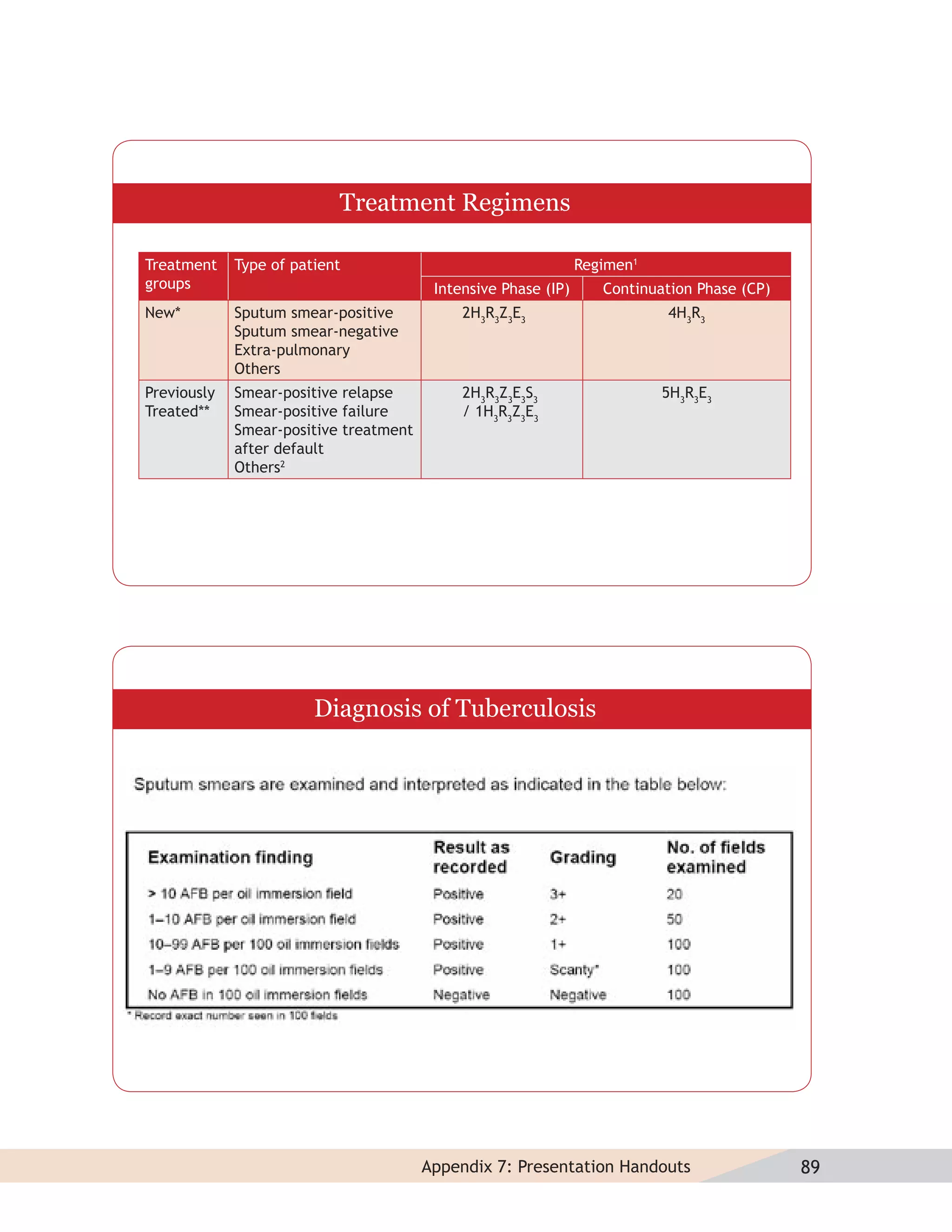
 Treatment        Type of patient                                             Regimen1
 groups                                                        Intensive Phase      Continuation
                                                                     (IP)            Phase (CP)
 New*             Sputum smear-positive                           2H3R3Z3E3              4H3R3
                  Sputum smear-negative
                  Extra-pulmonary
                  Others


                                                     Administering Treatment                       29
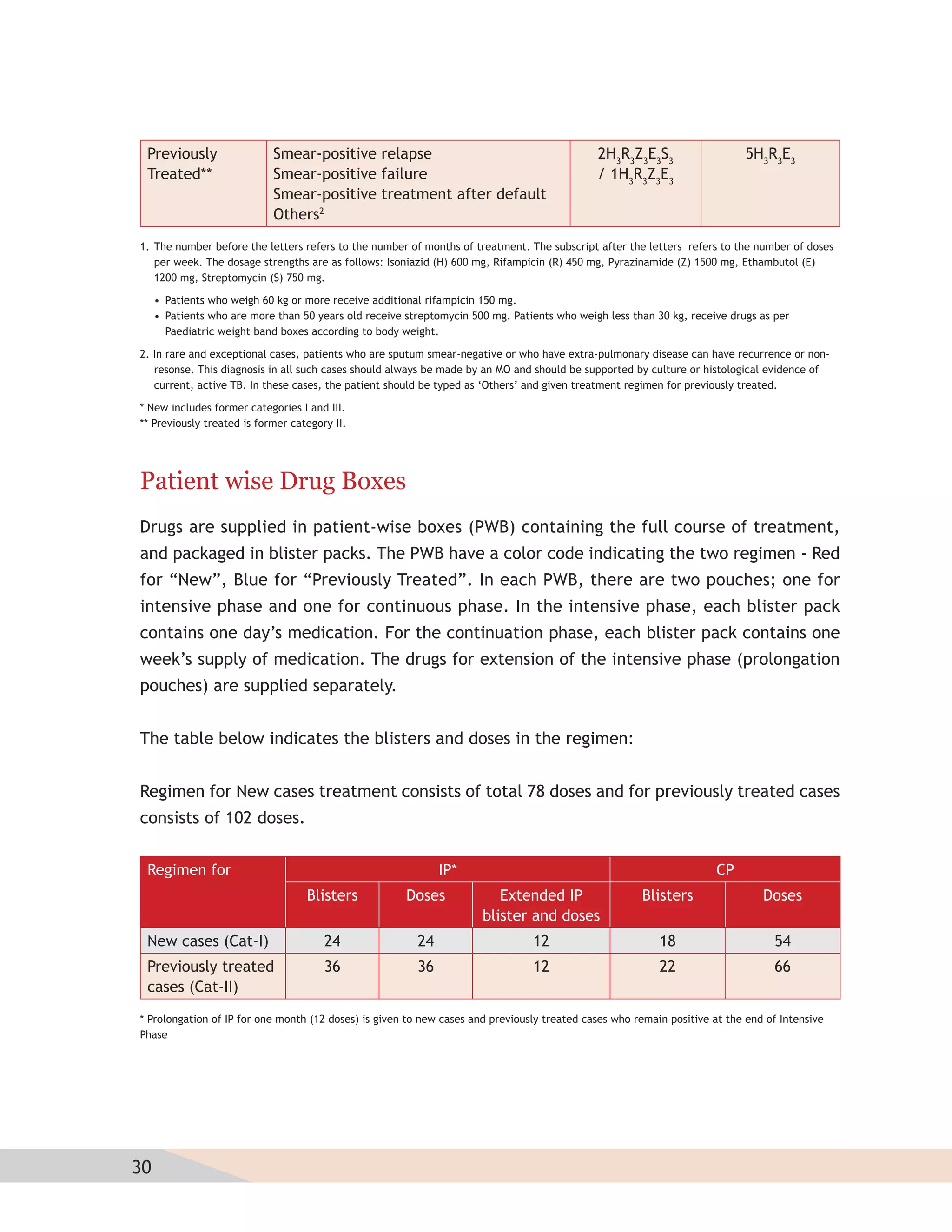
Previously                 Smear-positive relapse                                           2H3R3Z3E3S3                   5H3R3E3
 Treated**                  Smear-positive failure                                           / 1H3R3Z3E3
                            Smear-positive treatment after default
                            Others2
1. The number before the letters refers to the number of months of treatment. The subscript after the letters refers to the number of doses
   per week. The dosage strengths are as follows: Isoniazid (H) 600 mg, Rifampicin (R) 450 mg, Pyrazinamide (Z) 1500 mg, Ethambutol (E)
   1200 mg, Streptomycin (S) 750 mg.

     • Patients who weigh 60 kg or more receive additional rifampicin 150 mg.
     • Patients who are more than 50 years old receive streptomycin 500 mg. Patients who weigh less than 30 kg, receive drugs as per
       Paediatric weight band boxes according to body weight.

2. In rare and exceptional cases, patients who are sputum smear-negative or who have extra-pulmonary disease can have recurrence or non-
   resonse. This diagnosis in all such cases should always be made by an MO and should be supported by culture or histological evidence of
   current, active TB. In these cases, the patient should be typed as ‘Others’ and given treatment regimen for previously treated.

* New includes former categories I and III.
** Previously treated is former category II.


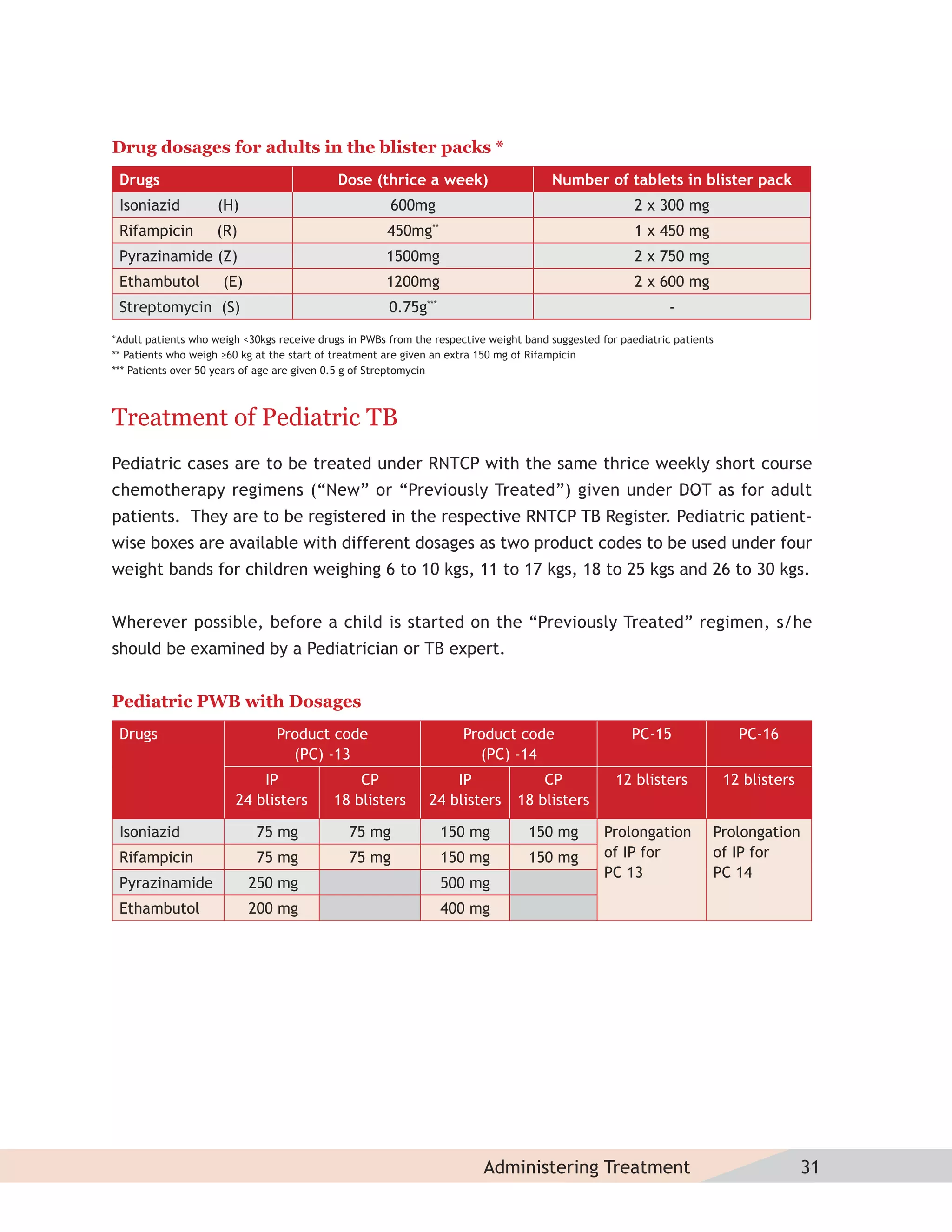
Patient wise Drug Boxes
Drugs are supplied in patient-wise boxes (PWB) containing the full course of treatment,
and packaged in blister packs. The PWB have a color code indicating the two regimen - Red
for “New”, Blue for “Previously Treated”. In each PWB, there are two pouches; one for
intensive phase and one for continuous phase. In the intensive phase, each blister pack
contains one day’s medication. For the continuation phase, each blister pack contains one
week’s supply of medication. The drugs for extension of the intensive phase (prolongation
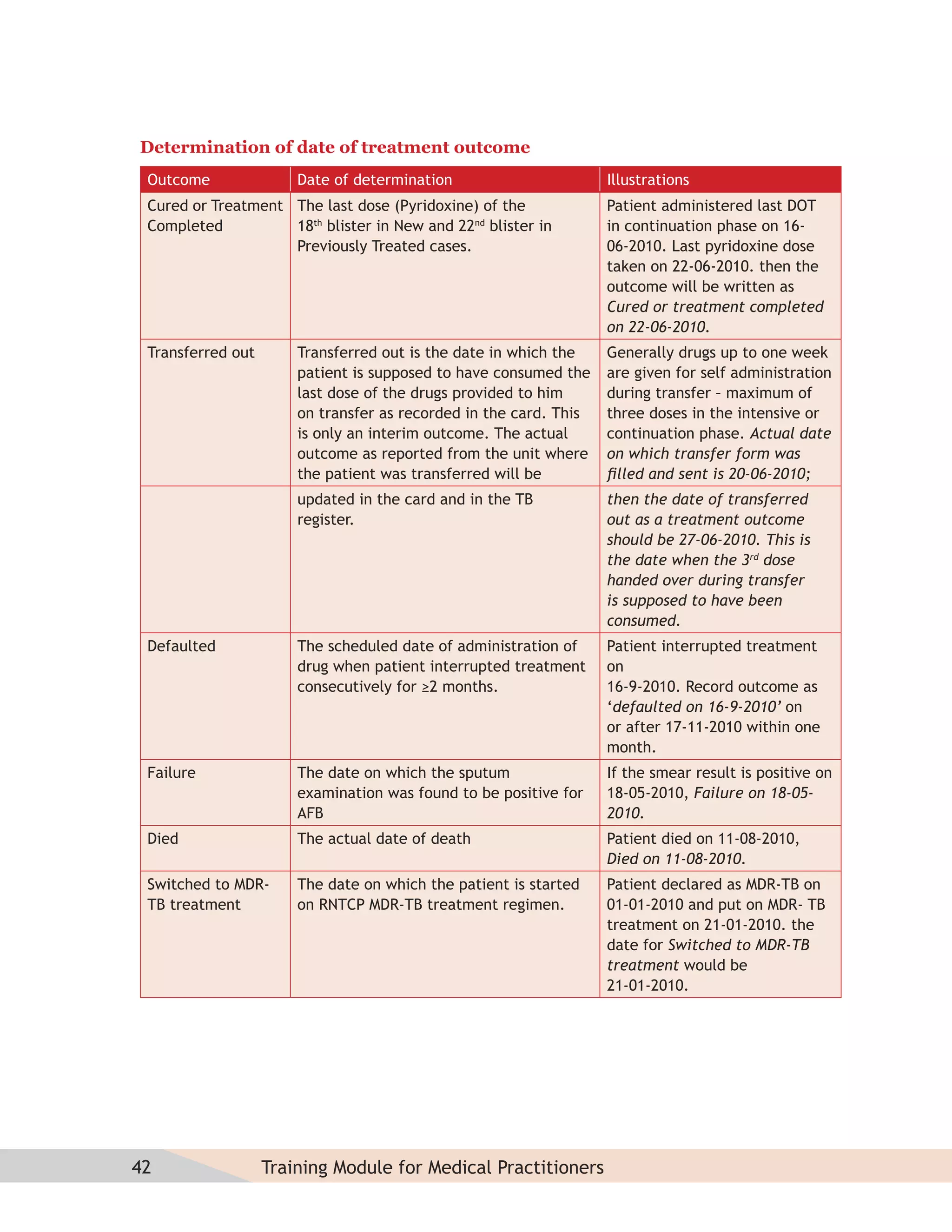
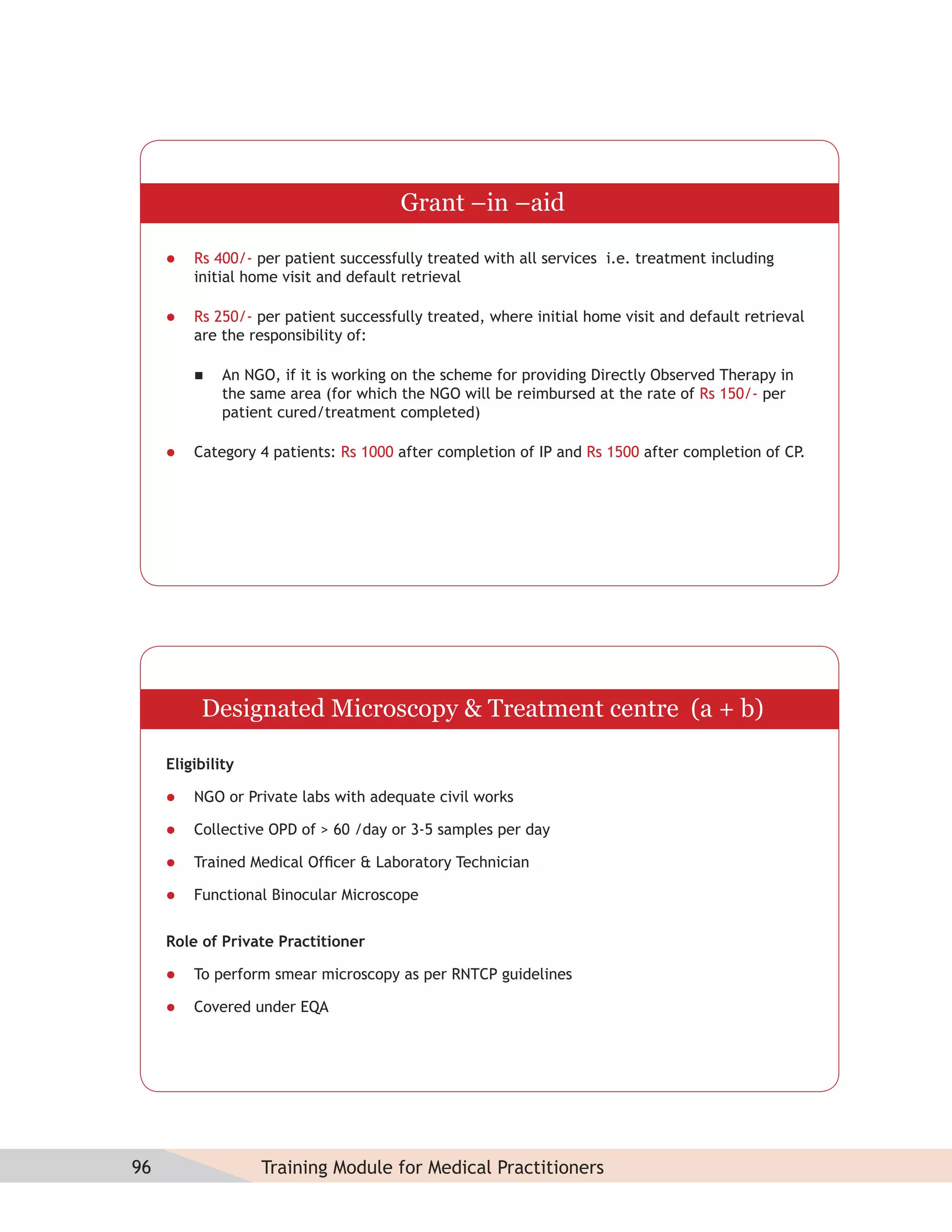
pouches) are supplied separately.


The table below indicates the blisters and doses in the regimen:


Regimen for New cases treatment consists of total 78 doses and for previously treated cases
consists of 102 doses.


 Regimen for                                                  IP*                                                     CP
                                   Blisters            Doses             Extended IP                  Blisters                 Doses
                                                                      blister and doses
 New cases (Cat-I)                     24                24                     12                        18                     54
 Previously treated                    36                36                     12                        22                     66
 cases (Cat-II)
* Prolongation of IP for one month (12 doses) is given to new cases and previously treated cases who remain positive at the end of Intensive
Phase


30                        Training Module for Medical Practitioners
Drug dosages for adults in the blister packs *
 Drugs                                       Dose (thrice a week)                      Number of tablets in blister pack
 Isoniazid           (H)                               600mg                                            2 x 300 mg
 Rifampicin         (R)                               450mg**                                           1 x 450 mg
 Pyrazinamide (Z)                                     1500mg                                            2 x 750 mg
 Ethambutol           (E)                             1200mg                                            2 x 600 mg
 Streptomycin (S)                                      0.75g   ***
                                                                                                               -
*Adult patients who weigh <30kgs receive drugs in PWBs from the respective weight band suggested for paediatric patients
** Patients who weigh ≥60 kg at the start of treatment are given an extra 150 mg of Rifampicin
*** Patients over 50 years of age are given 0.5 g of Streptomycin


Treatment of Pediatric TB
Pediatric cases are to be treated under RNTCP with the same thrice weekly short course
chemotherapy regimens (“New” or “Previously Treated”) given under DOT as for adult
patients. They are to be registered in the respective RNTCP TB Register. Pediatric patient-
wise boxes are available with different dosages as two product codes to be used under four
weight bands for children weighing 6 to 10 kgs, 11 to 17 kgs, 18 to 25 kgs and 26 to 30 kgs.


Wherever possible, before a child is started on the “Previously Treated” regimen, s/he
should be examined by a Pediatrician or TB expert.


Pediatric PWB with Dosages
 Drugs                          Product code                           Product code                    PC-15                 PC-16
                                  (PC) -13                               (PC) -14
                            IP                  CP                 IP               CP              12 blisters            12 blisters
                        24 blisters         18 blisters        24 blisters      18 blisters

 Isoniazid                  75 mg              75 mg                 150 mg        150 mg         Prolongation         Prolongation
 Rifampicin                 75 mg              75 mg                 150 mg        150 mg         of IP for            of IP for
                                                                                                  PC 13                PC 14
 Pyrazinamide               250 mg                                   500 mg
 Ethambutol                 200 mg                                   400 mg


                                                                          Administering Treatment                                        31
Pediatric patient wise boxes for new cases according to weight band
 Weight band                                      For New cases                             Prolongation
                                            IP                         CP                       of IP
 6-10 Kg                                               PC 13                                   PC 15
 11-17 Kg                                              PC 14                                   PC 16
 18-25 Kg                                          PC 13 + PC 14                            PC 15 + PC 16
 26-30 Kg*                                         PC 14 + PC 14                            PC 16 + PC 16
* For children weighing >30 kgs, adult PWB are to be used
** For patients falling in b/w weight bands should be put on lower wt band


Pediatric patient wise boxes for previously treated cases according to weight
band
 Weight                                          For previously treated cases                               Prolongation
                                       IP                                              CP                       of IP
 6-10 Kg                    (PC 13+ PC 15) +                            (PC 13 + 54 Tab E 200 mg) +            PC 15
                           (24 vials Inj. SM *)                              (PC 15 without Z)
 11-17 Kg                    (PC 14 + PC 16) +                               (PC 14 + 54 E 400 mg) +           PC 16
                            (24 vials Inj. SM *)                                (PC 16 without Z )
 18-25 Kg        (PC 13 + PC 14 + PC 15 + PC 16) + (PC 13 + PC 14 + 54 Tab E 600 mg) + PC 15 + PC 16
                        (24 vials Inj. SM *)            (PC 15+ PC 16 without Z )
 26-30 kg               (PC 14 x 2)+ (PC 16 x 2)                       (PC 14 x 2+ 54 Tab E 800 mg)          PC 16 x 2
                          + (24 vials Inj. SM*)                          + (2 x PC 16 without Z )
* Injection streptomycin 15mg/Kg body weight


           DOTS is the recommended strategy for treatment in adults and children
           All pediatric TB patients should be registered under RNTCP


Non-DOTS (ND) treatment regimen under RNTCP
In rare and exceptional situations, non-DOTS treatment (with a self-administered non-
rifampicin containing regimen) may be needed in a few TB cases. Examples include:
    Those with adverse reactions to rifampicin and/or pyrazinamide
    “New” patients who refuse DOTS despite all efforts


To facilitate registration of patients started on non-DOTS regimens, a Tuberculosis Treatment
Card should be filled. A maximum of 1% of patients may get non-DOTS treatment in an RNTCP


32                      Training Module for Medical Practitioners
area. The justification for initiating patient on non-DOTS treatment should be specified in
the “Remarks” column of the treatment card and TB register.


This is a treatment regimen of 12-month duration, comprising 2 months of SHE and 10
months of HE (2SHE / 10HE).


Dosages administered per day in the regimen are:
Isoniazid           -     300 mg
Ethambutol          -     800 mg
Streptomycin        -     750 mg (500 mg for those >50 years of age).


Those who weigh less than 30 kgs receive dosages calculated as per body-weight.


Organization of DOT and Flow of Patients for Treatment
After receipt of the sputum results, the MO of the Peripheral Health Institution (PHI) takes
the following measures:
   Establishment of diagnosis of tuberculosis and decision on type of patient and treatment
    regimen
   Motivation of patients :
    •   Explanation about the disease and assured cure.
    •   Modalities of treatment-dosage schedule, duration, follow-up, common side-effects
        and methods to prevent them
    •   Importance of directly observed treatment (DOT)
    •   Need for screening of children and symptomatic contacts
   Identification of suitable DOT Centre and DOT Provider - accessible and acceptable to
    the patient and accountable to health system
   Opening of Tuberculosis Treatment Card (in duplicate) and the TB Identity Card
   Arrangement for shifting patient-wise box to the DOT Centre along with the duplicate TB
    Treatment Card, TB Identity Card and sputum containers for collection of early morning
    samples for follow-up examinations.


For the purpose of identifying an ideal DOT provider and an appropriate DOT Centre, a DOT
Directory should be maintained at PHI level. This directory should contain a locality-wise
list of DOT Centres / DOT Providers in the area. It should be updated regularly. DOT can be
provided by anyone other than the member of patient’s family. It is the responsibility of the


                                                 Administering Treatment                   33
Government field staff (PHWs / MPWs) to organize and ensure DOT for the patient. They would
also monitor and supervise the community DOT Providers in their respective sub centres.


If the patient is to be given DOT by a Peripheral Health Worker (PHW) / Community DOT
Provider, a duplicate treatment card will be prepared and given to the PHW. The MO of the
PHI will give the patient-wise box containing drugs for the entire duration of treatment to
the PHW and records the same in the drug stock register maintained at the PHI.


The PHW visits the house of the patient as soon as possible for confirmation of the residential
address and has a detailed dialogue with the patient and other members of the family.
Patient should be started on treatment within a week. Emphasis is given to the points
similar to the ones mentioned above for the MO-PHI. This opportunity should also be used
for screening of contacts. The initial home visit should be recorded in the treatment card
in the space provided. A convenient location for drug administration and a suitable DOT
provider is decided mutually by the PHW and the patient.


Documentation for Referral for Treatment
If the patient resides outside the jurisdiction of the referring institution, a copy of the
‘Referral for Treatment’ Form must be sent to the facility where the patient will begin
treatment. A “Referral for Treatment” Register should be maintained in DMCs / DOT Centre
of bigger hospitals, including that of medical colleges, that are referring large numbers of
patients to other health facilities for treatment (after diagnosis). Information regarding
referral of a patient should be noted in the “Referral for Treatment” Register as well as the
“Remarks” column of the Tuberculosis Laboratory Register.


      Peripheral health worker should visit patient’s residence before the commencement of
            treatment. However this should not result in delay in treatment initiation.


Treatment Related Information
DOT and its necessity: It is important for the patient to take the drugs under observation.
The real purpose of direct observation is to develop a human bond with the patient and not
to mechanically watch the patient swallow the drugs. Patients, if given self administered


34              Training Module for Medical Practitioners
Flow of Patients for Treatment


                                   Referred to DMC with request for sputum
                TB Suspects
                                   examination by MO – PHI/PP/NGO/Others


                                      Registers in lab register
                    DMC               LT collects 2 sputums
                                      Sends result to referring physician


                                      History of previous treatment
             Referring Physician      Prescribes appropriate regimen
                                      Treatment card is opened


                                      Organizes DOT
                                      Identifies DOT provider
                   MO PHI             Sends PWB with duplicate treatment card
                                       to DOT Provider
                                      Refers to ICTC


                                      Address verification
                                      Motivation
                    PHW
                                      Contact tracing
                                      Arranges for DOT
                                      Updates original treatment card at PHI


                                      DOT provider provides the DOT
                 DOT Centre           Records drug collection
                                      Sends for follow-up examination


                                      Collects the treatment card
                                      Records treatment outcome
                   MO-PHI             Updated Treatment card is submitted to
                                       the TU after completion of treatment


                                        Administering Treatment                  35
treatment are likely to take it irregularly or discontinue the treatment upon relief of
symptoms. Early Disappearance of symptoms is not a sign of cure. It is very important for
the patient to know the duration of treatment and understand the necessity of taking all
prescribed drugs regularly. It is dangerous to take only part of the prescribed drugs because
in such cases the disease may become incurable.


A place mutually convenient to the patient and the provider can be chosen for provision of
DOT. The necessity of direct observation of every dose of drugs taken during the intensive
phase and the first dose of the weekly blister pack during the continuation phase should be
emphasized to the patient. The patient is also explained about the importance of sputum
smear conversion at the end of 2(3) months and at the completion of treatment. Patient
should be made aware that treatment services are provided free of cost.


Role of rest, special diet and isolation: Patient and family members are made to understand
that once the treatment is started, patient ceases to spread the infection and there is no
need to isolate him in terms of accommodation, use of utensils and clothes. At the same
time, health staff should be careful enough not to over emphasize on special diet and rest.
They can be told to take the food they can afford and rest only if constrained by physical
weakness. Patient should be impressed that it is the treatment alone which cures.


Cough hygiene and sputum disposal: Patient should be educated in exercising the cough
hygiene - not resorting to indiscriminate coughing and spitting and covering the mouth while
coughing or sneezing.


Provision of transfer facility during treatment: In case the patient wishes to shift or
migrate to other TU / district / state after the initiation of the treatment, she/he should be
informed that there is a provision of transfer facility for treatment. Any such event should
be duly informed to the treating medical officer for completing the formalities for transfer
and necessary arrangement for further treatment.


Referral for HIV counselling and testing: All the patients diagnosed as TB cases should be
encouraged and referred to the nearest ICTC for HIV testing.


Co-morbid conditions; for example, diabetes, renal failure, patient on immuno-
suppressive drugs: History regarding the conditions mentioned above and any treatment for
the same has to be elicited as these conditions and treatment for the same may adversely


36              Training Module for Medical Practitioners
interfere with the TB Treatment, Patients are to be referred to the respective speciality and
managed appropriately depending upon the co-morbid conditions.


Adherence to follow-up schedules: The patients should be impressed upon the necessity of
complying with periodic follow-up sputum examination schedule as advised. This will help
in objective assessment of response to the treatment. Conversion to smear negativity is a
fore-runner of successful treatment.


Sensitization on adverse reactions: In case patients experience any unusual symptoms
after initiation/during treatment, they should be instructed to approach the medical officer
and report the same. On their own, they should not take a decision either to stop or to
continue the drugs.


Smoking: It should be impressed upon the patient that smoking of tobacco will adversely
affect the treatment outcome. Patients should be protected from passive smoking. The
environment of the patient has to be smoke free at home/office and at clinic. Smoking
status of the TB patient should be checked at every interaction. The Medical Officer has
to help the patient with simple tips to quit smoking. However, if this does not yield any
positive result, he should be referred to the smoking cessation clinic.


Alcohol abuse: History of addiction to alcohol should be elicited. If found alcoholic, the
patient should be advised to strictly refrain from alcohol as it would increase the chances of
patient developing hepatitis (Jaundice), irregularity in drug intake and adverse treatment
outcome. The patients should be encouraged to give up alcohol with the help of frequent
motivation, family and social support.


Importance of screening symptomatic contacts and children below 6 years: Patients
should be encouraged to bring symptomatic adult contacts and all children aged six years
and below for screening at health facility. This will facilitate early detection of cases among
them and appropriate treatment. Eligible children will be administered chemoprophylaxis.


Treatment Card
Each patient who begins treatment for TB must have a tuberculosis treatment card. The
information on the patient’s treatment card should be accurate, reliable, relevant, up to date
and legible as this would be the source of information for filling up of the TB register. This card


                                                    Administering Treatment                     37
contains important information about the patient, including the following details:


 General                      Data related to DOT               Treatment related information
 information
    Name of the            TB unit with code               Disease classification and type
     patient                TB number with year             Details of sputum examination for
    Age and sex            Name of the PHI                  diagnosis and follow-up
    Complete address       Name and designation of         Details of X-ray and investigations for
     and phone number        DOT provider                     diagnosis of EPTB
     of the patient         DOT centre                      History of previous anti-TB treatment
    Occupation             Initial home visit by whom      Treatment regimen
    Name, address           (Name and Designation)          Drug intake in intensive and continuation
     and phone number        with date                        phase
     of the contact                                          Retrieval actions for missed doses
     person                                                  Chemoprophylaxis for contacts aged
                                                              ≤ 6 years
                                                             HIV related data
                                                             Treatment outcome with date
                                                             Remarks


The Tuberculosis Treatment Card is maintained at the health facility where the patient is
initiated on treatment. For patients receiving treatment in a DOT centre other than the
place of treatment initiation, a duplicate treatment card is prepared and maintained at the
DOT centre by the DOT provider. The original treatment card at the PHI is to be updated at
least once in a fortnight.


Administration and monitoring of treatment
Recording of drug administration and monitoring

There are two sections meant for recording the drug administration. One is for the intensive
phase of treatment on the front of the card and the other, for the continuation phase on
the reverse side.


Intensive phase
Month and year: Month and year of initiating the intensive phase is recorded.


Date of initiation of treatment: The date of initiation of treatment regimen prescribed
is ticked (√) on the appropriate box under the date against the month. Subsequently, the
dates on which the drugs were consumed under observation are also ticked. In this phase,


38              Training Module for Medical Practitioners
the patient comes three times a week on alternate days. Daily blisters are given either on
Mondays, Wednesdays and Fridays or alternatively Tuesdays, Thursdays and Saturdays.


The date/day (for example 10th April) on which patient fails to attend for DOT is denoted by
a circle (0) in the appropriate box. In case the patient attends to collect the drug the next
day (for example on 11th April), the drugs missed are administered on that day and continues
to take the drugs as per scheduled (for example on 12th April).

Month/year     1     2     3    4       5    6    7     8     9    10    11    12   13    14
April 10       √           √            √    S          √                √     √     S


On the other hand, if the dose is entirely missed and the patient does not report to the
health facility even on the next day, then the dose is given on the next scheduled day. It
should be ensured that all doses in the intensive phase should be administered before the
continuation phase is initiated. For example, if the patient was scheduled to come on 17th
April but does not turn up on 17th or even on 18th but reports on 19th; the dose due on 17th is
given on 19th and so on and so forth.

Month/year    15    16    17    18      19   20   21   22    23    24    25    26   27    28
April 10       √                        √    S          √          √           √     S


Only under exceptional circumstances, unsupervised drug administration can be allowed
for a limited number of doses. For instance, if a patient is being discharged from hospital
after initiation of treatment, s/he will have to be provided with 3 doses of treatment so
that her/his treatment does not get interrupted during her/his transfer to a nearby PHI. In
such circumstances, the entry for unsupervised doses should be recorded by encircling the
tick mark on the Tuberculosis Treatment Card and the reason for the same should be stated
in the Remarks column of the treatment card.


Continuation phase
Drug administration in the continuation phase is recorded on the reverse side of the
treatment card. Treatment regimen prescribed for the patient is ticked appropriately in the
box provided. Number of tablets of the drugs prescribed in the regimen is also recorded in
the boxes provided above the drugs.


During the continuation phase of treatment, patients collect the weekly blisters once a
week on a designated day. First dose of the weekly blister is administered under direct


                                                  Administering Treatment                      39
observation and the remaining doses in the weekly blister are given to the patient for
self- administration. The month and the year in which the patient will be collecting drugs
during the continuation phase are written under the Month and Year column in the table on
the reverse of the Tuberculosis Treatment Card. An ‘X’ is recorded in the appropriate box
(according to the dates of the month 1–31 as the case may be) to indicate the day the drugs
were consumed under direct observation. A line is drawn through the remaining days of the
week (after the X) to indicate that drugs for the remaining period of the week have
been given (recorded as X------------------------) for self administration.


If the patient misses a weekly drug collection in the continuation phase completely, a circle
is recorded on the day of the missed collection. On the day of the subsequent visit, the
treatment is given and recorded, leaving the boxes blank as shown below:

 Month/year 1     2    3   4    5   6    7    8   9    10   11   12   13   14   15   16   17   18
 June 10     S    X                           S                                 S    X


Monitoring of drug administration can be done by comparing the stock of drugs available in
the patient-wise boxes with the dosages given and marked in the Tuberculosis Treatment
Card. Any observed variation should be looked into and remedial measures taken.


NON-DOTS treatment (in intensive as well as continuation phases)
Date when drugs were collected by the patient is indicated by writing ‘C’ and drawing a
horizontal line (C-----------) to indicate the period for which drugs were supplied for self-
administration. Usually drugs will be provided for a month.


Follow-up schedule for sputum examination
The most important method of monitoring the smear-positive PTB cases are by the
follow-up sputum smear examinations which are carried out at the end of the intensive
phase, the extended intensive phase (if applicable), two months into the continuation
phase and at the end of treatment. These results determine the conversion rate from
smear-positive to smear-negative at the end of intensive phase of treatment, and the
cure rate at the end of the treatment. The follow-up sputum smear examination at the
end of treatment is very important for evaluating the results of treatment outcome (to
determine the cure rate).


Two sputum samples are to be collected, one as early morning and the other as spot sample.


40               Training Module for Medical Practitioners
The follow-up schedule for sputum collection and smear examination is provided in the
table below.
                                        End of IP                                       Extended IP *                             2 months into CP                               End of treatment


                                                                                                                                                                                             Collect the sputum
                                                                                                                                                                                             and Result by end
                                                                                           Collect sputum #


                                                                                                                                            Collect sputum #


                                                                                                                                                                                             of the treatment
                      Give sputum cup


                                                                      Give sputum cup


                                                                                                                          Give sputum cup


                                                                                                                                                                           Give sputum cup
                                         #
                                         Collect sputum


                                                          Result by


                                                                                                              Result by


                                                                                                                                                               Result by
Category


 New **                 22                 23              24           34                   35                36           8                 9                 10           17              18
 Previously             34                 35              36           46                   47                48           8                 9                 10           21              22
 Treated
* The Intensive Phase is extended by four weeks (12 doses) in initially smear-positive PTB patients who continue to be positive at the end of
the2 months of IP.
# Early morning and spot specimens will be collected on this day.
** The numbers during the IP represent doses, whereas during the CP they represent weekly blister packs


Follow-up of sputum smear examinations of patients put on the RNTCP Non-DOTS regimen
should be done at the end of 2, 6 and 12 months. It must be ensured that the patients
undergo the follow-up sputum smear examination as scheduled and the last follow-up
sputum examination is done before the completion of the last dose of treatment.


Chemoprophylaxis
Preventive chemotherapy with isoniazid (H) is administered to all the children aged 6
years and below who are in contact with smear-positive pulmonary TB case. The number
of such children residing in the household should be enquired during the initial home visit.
The parents are advised to bring their children to the Health Centre for screening for the
evidence of TB. They are examined and investigated to rule out TB disease. If found to be
suffering from the disease, they should be treated appropriately. Children found eligible for
chemoprophylaxis after ruling out TB are to be administered preventive chemotherapy with
INH 5mg/kg body weight daily for 6 months.

The number of children below 6 years of age, the number screened for TB and the number
put on chemoprophylaxis should be mentioned on the reverse of the treatment card
(see below).

      Nos. of children below 6 Yrs                                           Nos. screened for TB                                             Nos. put on chemoprophylaxis


                                                                                                                   Administering Treatment                                                                        41
Determination of date of treatment outcome
 Outcome               Date of determination                       Illustrations
 Cured or Treatment The last dose (Pyridoxine) of the              Patient administered last DOT
 Completed          18th blister in New and 22nd blister in        in continuation phase on 16-
                    Previously Treated cases.                      06-2010. Last pyridoxine dose
                                                                   taken on 22-06-2010. then the
                                                                   outcome will be written as
                                                                   Cured or treatment completed
                                                                   on 22-06-2010.
 Transferred out       Transferred out is the date in which the    Generally drugs up to one week
                       patient is supposed to have consumed the    are given for self administration
                       last dose of the drugs provided to him      during transfer – maximum of
                       on transfer as recorded in the card. This   three doses in the intensive or
                       is only an interim outcome. The actual      continuation phase. Actual date
                       outcome as reported from the unit where     on which transfer form was
                       the patient was transferred will be         filled and sent is 20-06-2010;
                       updated in the card and in the TB           then the date of transferred
                       register.                                   out as a treatment outcome
                                                                   should be 27-06-2010. This is
                                                                   the date when the 3rd dose
                                                                   handed over during transfer
                                                                   is supposed to have been
                                                                   consumed.
 Defaulted             The scheduled date of administration of     Patient interrupted treatment
                       drug when patient interrupted treatment     on
                       consecutively for ≥2 months.                16-9-2010. Record outcome as
                                                                   ‘defaulted on 16-9-2010’ on
                                                                   or after 17-11-2010 within one
                                                                   month.
 Failure               The date on which the sputum                If the smear result is positive on
                       examination was found to be positive for    18-05-2010, Failure on 18-05-
                       AFB                                         2010.
 Died                  The actual date of death                    Patient died on 11-08-2010,
                                                                   Died on 11-08-2010.
 Switched to MDR-      The date on which the patient is started    Patient declared as MDR-TB on
 TB treatment          on RNTCP MDR-TB treatment regimen.          01-01-2010 and put on MDR- TB
                                                                   treatment on 21-01-2010. the
                                                                   date for Switched to MDR-TB
                                                                   treatment would be
                                                                   21-01-2010.


42                 Training Module for Medical Practitioners
A patient will have only one outcome. The outcome which occurs first is considered and
recorded in treatment card and subsequently in the TB register.


Remarks Column
The following information has to be recorded in the remarks column
    Adverse drug reactions, if any
    Reasons for unsupervised dose(s)
    Reason for discontinuation of drug collection (e.g., patient transferred to another district)
    Details of hospitalization if any during the treatment
    Information on dispatch of sputum for culture of sensitivity tests
    Any other relevant information about the patient such as smoking, diabetes mellitus,
     pregnancy status etc.,


HIV Related Data
This box is meant for recording information regarding the HIV status of the patient, and if
positive, details of CPT and ART being administered.


Original TB Treatment Card
Information on HIV status, CPT delivery and ART referral and initiation of the TB patient are
to be documented on the original TB treatment card and kept confidential within the health
system. This should not be disclosed to the community DOT provider.


    Additional Treatments
    HIV Status: Unknown     1.       Positive           Negative    (Date) _____________
    CPT delivered on (date) 2. (1)              (2)          (3)        (4)        (5)
    Pt referred to ART centre (date) : ________________________________________
    Initiated on ART:        No             Yes       (date) _________________________


                                                           Administering Treatment               43
HIV Status
i. HIV testing is a voluntary procedure and not mandatory. Patients not willing for HIV
     testing or sharing their HIV test result should not be forced to undergo testing or disclose
     their HIV status.
ii. If HIV status of the patient is known, tick the appropriate box (‘Pos’ or ‘Neg’) and record
     the date of test along with PID Number if available. If the HIV status is not known, don’t
     tick any box initially.
iii. Patients already on HIV care should not be required to show proof of HIV test result.
iv. If the HIV status is ascertained during the course of TB treatment, the latest information
     should be updated on the card.
v. If HIV status of the patient remains unknown at the end of treatment, tick the appropriate
     box (‘unknown’), at the time of declaring treatment outcome for the patient.


CPT (Cotrimoxazole Prophylactic Therapy) Delivery
i. All known HIV-infected TB patients are to be provided access to CPT.
ii. If CPT provided from the PHI, record dates of each monthly delivery in the space
     provided.
iii. In case the TB patient is already on CPT before the initiation of TB treatment, record
     most recent date of CPT pickup.


Referral and initiation on ART
1. All known HIV-infected TB patients are to be referred for ART to the nearest ART Centre.
     For referred clients, record the date of referral.
2. If patient initiated on ART, tick the “yes” box, and the date of initiation of ART. ART
     Registration Number should be recorded on the treatment card.
3. In case the TB patient is already on ART before the initiation of TB treatment, tick yes,
     and record approximate date of initiation.


Adverse Reactions to Anti-TB Drugs
Adverse Drug Reactions (ADR) observed during treatment for tuberculosis are comparatively less
in the intermittent chemotherapy than what is encountered in daily regimens. DOT providers
should be aware of the commonly occurring adverse reactions so that they can identify it


44                Training Module for Medical Practitioners
Revised National Tuberculosis Control Programme
                          State: Karnataka       City/District with code: Mysore          TB Unit with code:_________________________ Patient TB No./Year: 4299
                          Name: Raju                       Sex:       M             F     Age: 52        Occupation: _____________________________________________
                          Complete Address & Telephone number: ___________________________________________________________________________________
                          Name, Address & Phone No. of contact Person: Krishna Rao, sarpanch
                          Name and designation of DOT provider & Phone. No : _____________________________________________________________PHI: _________________________________
                          Name of DOT Centre: _________________________________________________                 Signature of MO with date: ____________________________________________________
                          Initial home visit by: ________________________________________________________ Ph.No.:____________________________________Date: ______________________
                          H/O of Previous ATT with duration: __________________________________________________________________________________________________________________


                             Disease Classification                      Type of Patient                        Month                      Date       DMC   Lab. No.   Smear Result        Patient Weight

                              Pulmonary                   New                   Relapse                        Pretreatment               4/4         A      128            2+
                              Extra Pulmonary site                                                             End of IP/Extended IP      29/5               246            1+
                                                          Transfer in           Treatment Failure
                           ____________________
                                                          TAD                   Others Specify)________        2 Months X CP              26/7               210           NEG
                                                                                                               End Treatment              30/9        S      506           NEG


                          INTENSIVE PHASE - Prescribed regimen and dosages. Tick () appropriate treatment regimen below:


                             Regimen for new cases                                                                       Regimen for Previously Treated


                           Month/
                                       1     2   3   4    5       6   7     8      9      10   11   12    13   14   15    16   17   18   19     20    21   22   23    24   25    26   27    28   29   30   31
                           year
                           April 97                               S                                    S               0                   S                                 S              
                           May 97               S                               0          S                                  S                                  S          0          


Administering Treatment
                           June 97


45
promptly and refer the patient to the medical officer for further management. Any adverse
reactions reported during treatment is recorded in the remarks column of the treatment card.
Orange / red discoloration of the body fluids especially urine which is commonly encountered,
is not an adverse reaction and patient should be made aware of this.


Symptom-based approach to evaluation of possible side effects of anti-TB drugs
 Symptom              Drug             Action to be taken    Action to be taken by MO
                      (abbreviation)   by HW
 Gastrointestinal     Any oral         Reassure patient.     Maintain hydration
 (vomiting or         medication       Give drugs with        Consider treatment with anti-
 epigastric                            less water and over     emetics (e.g. domperidone)
 discomfort)                           a longer period         and proton pump inhibitors (eg.
                                       of time (e.g. 20        Omeprazole)
                                       minutes). Do not
                                       give drugs on an
                                       empty stomach.
                                       If the above fails,
                                       refer to MO.
 Itching/Rashes       Isoniazid (and   Reassure patient      Itching without rash or a mild rash
                      other drugs      If severe, stop all    Continue treatment and give
                      also)            drugs and refer          antihistamines
                                       patient to MO         Itching with moderate to severe
                                                             rash
                                                              Stop all drugs till symptoms
                                                                subside
                                                              Treat with antihistamines
                                                              Patients with mucosal
                                                                involvement, fever and
                                                                hypotension will require
                                                                treatment with corticosteroids
                                                              When the reaction subsides
                                                                reintroduce drugs one-by-one in
                                                                this order
                                                                 1. INH. 2. Rifa. 3. Pyra. 4. Etham
                                                              Re-introduce each drug in a small
                                                                dose and gradually increase over
                                                                3 days before introducing the next
                                                                drug.
 Tingling/            Isoniazid        Refer to MO              Give pyridoxine 100 mg/day orally
 burning/                                                        or parenterally until symptoms
 numbness in the                                                 subside.
 hands and feet                                                 Patients not responding to
                                                                 pyridoxine will require treatment
                                                                 with amitryptiline


46                  Training Module for Medical Practitioners
Joint pains          Pyrazinamide      Reassure that it          Give NSAIDs like paracetamol,
                                       is a self limiting         Aspirin or Ibuprofen and in severe
                                       condition.                 cases Indomethacin for a week to
                                       Encourage patients         10 days
                                       to increase intake        In severe cases, estimate serum
                                       of liquids.                uric acid levels
                                       If severe, refer          If uric acid levels are significantly
                                       patient to MO for          raised, treat with NSAIDs and
                                       evaluation                 colchicine. Allopurinol is not
                                                                  effective.
                                                                 In severe cases with normal
                                                                  or slightly elevated uric acid,
                                                                  consider reduction of the dose of
                                                                  Pyrazinamide.
Impaired vision      Ethambutol        STOP Ethambutol,          Refer to ophthalmologist for
                                       refer patient for          evaluation
                                       evaluation                Impaired vision usually returns
                                                                  to normal within a few weeks of
                                                                  stopping ethambutol.
Ringing in the       Streptomycin      STOP Streptomycin,        Refer to otorhinolaryngologist for
ears, Loss                             refer patient for          opinion
of hearing,                            evaluation                As hearing loss is usually not
dizziness and                                                     reversible, do not restart
loss of balance                                                   Streptomycin

Hepatitis:           Isoniazid,        STOP all anti TB          Rule out other causes of hepatitis
Anorexia nausea      Rifampicin or     drugs, Refer patient      Do not restart treatment till
/Vomiting/           Pyrazinamide      for evaluation             symptoms resolve and liver
Jaundice                                                          enzymes return to baseline levels
                                                                 If liver enzymes cannot be
                                                                  performed, wait for 2 weeks
                                                                  after jaundice has disappeared to
                                                                  restart treatment
                                                                 Restart treatment with one drug
                                                                  at a time starting with 1. INH
                                                                  2. Pyra 3. Rifa
                                                                 In patients with severe
                                                                  disease in whom treatment
                                                                  cannot be stopped, use a non
                                                                  hepatotoxic regimen consisting of
                                                                  Streptomycin and Ethambutol


              In cases of jaundice, all anti-TB drugs should be stopped immediately and
                                 the patient referred for evaluation.


                                                     Administering Treatment                             47
Management of Patients in Special Situations
 Situation                 Management
 Hospitalization           Some of the indications for hospitalization:-
                           Extremely ill patients.
                           Patients with frequent haemoptysis, pneumothorax or massive pleural
                           effusion leading to breathlessness
                           Cases requiring surgical intervention.
 Tuberculous meningitis    Patient should be referred to the hospital. Streptomycin is to replace
                           ethambutol in IP. The continuation phase should be extended by 3
                           months in both new and previously treated cases. Steroids should be
                           given initially and gradually tapered over 6–8 weeks.
 Treatment of TB           Streptomycin is absolutely contraindicated during entire pregnancy.
 during pregnancy and      Breast feeding can be continued even when mother is on treatment for
 postnatal period          TB but mother should continue to practice cough hygiene. Child should
                           be administered preventive chemoprophylaxis as per guidelines.
 Treatment in patients     Rifampicin, isoniazid and pyrazinamide can be safely given as they are
 with renal failure        excreted in entero-hepatic circulation. Dosage of streptomycin and
                           ethambutol, should be adjusted according to the creatinine clearance.
 Women on oral             Rifampicin decreases the efficiency of oral contraceptives by increasing
 contraceptive pills       their metabolism. Increase in dosage of the oral contraceptive or switch
                           over to alternate methods of contraception is advisable


Treatment of TB Disease in HIV-infected Patients
Early diagnosis and effective treatment of TB among HIV-infected patients are critical for
controlling the disease, minimizing the adverse impact of TB on the course of HIV, and
interrupting the transmission of TB in the community. Delays in the diagnosis of TB have
been associated with worse outcomes. Hence, initiation of treatment is very important soon
after the diagnosis of TB among HIV-infected persons. Treatment of TB is same as that in
HIV-negative TB patients. Patients are to be treated with the RNTCP “New” or “Previously
Treated” regimen according to the patient’s history of previous anti-TB treatment.


In addition to TB treatment under RNTCP all HIV-infected TB patients must be provided access
                                       ,
to care and support for HIV disease, including ART. ART reduces TB case fatality rates and the
risk of recurrent TB. ICTC counsellors and treating physicians should counsel patients on the
importance of ART and on the free availability of treatment with ART and evaluation.


HIV-infected TB patients should be promptly referred to the nearest ART centre by the
treating physicians and ICTC counsellors. This visit to the ART centre, should preferably occur


48                 Training Module for Medical Practitioners
at least two weeks after initiation of TB treatment, to ensure reduction in the potential of
TB transmission from these patients prior to the visit to the centres being visited by large
numbers of HIV-infected persons. TB patients referred to ART centres should be carefully
educated on cough hygiene.


For details on ART eligibility, reference ART guidelines (available at www.nacoindia.org).
NACO recommends that ART be given to:
   All patients with extrapulmonary TB (stage 4); and
   All those with pulmonary TB (stage 3) with CD4 count < 350 cells/mm3.


Cotrimaxazole preventative therapy (CPT): Cotrimaxazole preventative therapy has been
shown to reduce mortality among HIV-infected TB patients, and is recommended by NACP
for all HIV-infected patients. All HIV-infected TB patients should therefore be provided CPT.
All the ART Centres should have minimum provisions of meeting the CPT requirements of
atleast for a month for the benefit of those patients who are able to return to the ART
centre on a monthly basis.


In states implementing RNTCP/NACP Intensified TB/HIV package, CPT should be made
available for HIV-infected TB patients at all peripheral health institutions in the districts
having a Medical Officer and an institutional DOT centre. The CPT should be procured,
packed and supplied in monthly pouches at the state level. The local distribution is to be
supervised by RNTCP staff in coordination with NACP. In this mechanism, CPT is delivered
by the peripheral health institute staff, and not community DOT providers, to maintain
confidentiality regarding HIV status within the health-care system.


Treatment of TB in HIV positive patients on second line ART/ alternate First Line with
Protease Inhibitors (PI) based regimen


The effectiveness of second-line antiretroviral therapy depends on the introduction of
protease inhibitors (PIs) in the new regimen. However, there are significant drug interactions
with the PIs and rifampicin. Consequently, the treatment options are limited for TB patients
who require PI-based therapy or develop TB while on PIs. PIs should not be used with
rifampicin-containing regimens due to hepatic enzyme inducing capacity of rifampicin,
which risks rendering PI levels sub-therapeutic.


                                                   Administering Treatment                 49
Another rifamycin, Rifabutin is a less potent inducer of CYP 3A4 liver enzyme as compared to
rifampicin, while being equally safe and effective for treatment of TB. It can be administered
in the presence of PI-containing ART regimen without compromising the efficacy of ART
or Anti TB treatment. In the presence of the boosting drug like Ritonavir (PI), rifabutin
metabolism is also altered, and less rifabutin is needed than would be without ritonavir.


Therefore, in patients taking lopinavir/ritonavir (LPV/r) based ART regimens, NACP and
RNTCP have recommended the substitution of Rifabutin for rifampicin for the duration
of TB treatment. The dosage of Rifabutin during the administration of second line ART
regimen containing LPV/r shall be 150 mg Rifabutin, dosed thrice-weekly for all patients
>30 kg weight.


Rifabutin will be supplied through the respective State TB Cell on an individual basis.


Tobacco Smoking and Tuberculosis
The diagnosis of TB disease is an opportune moment for imparting behaviour change in the
patients’ smoking habit, with patients more likely to accept the behaviour change needed
for improving their health. Tobacco smoking may lead to delayed sputum conversion in
sputum smear-positive PTB cases, lower treatment success rates and higher rates of relapse
of TB disease and death.


Hence, the past and present history of tobacco smoking (cigarette / beedi / pipe / cigar /
hukka) should be elicited from each TB case at the time of initiating treatment. Smoking
cessation advice to current smokers should become an integral part of TB case management.
Such interventions may help improve outcomes of anti-TB treatment and reduce transmission
of infection in the short term, and improve the quality of life of TB cases by preventing
chronic respiratory and other disease associated with smoking in the long term. Tobacco
cessation advice has been demonstrated to be successful in TB cases even in the absence of
costly Nicotine Replacement Therapy.


Patients who smoke should be motivated to make an informed decision to stop smoking.
All cases should be informed personally about the harmful effects of smoking on health in
general and the potential for poorer outcomes of anti-TB treatment with continued smoking.
The potential benefits of stopping smoking to the health of the individual should be suitably
communicated. The patient’s past experience with cessation and relapse of smoking may be


50               Training Module for Medical Practitioners
discussed in an understanding atmosphere. Patients may be told that they can be successful
even if they have not been able to quit smoking during earlier attempts. During the
conversation, the patients are asked to identify situations and moods that trigger smoking
(working/getting out of bed/having a cup of coffee/pleasant moments/while dealing with
personal or professional problems/group smoking). They are encouraged to devise their own
ways to respond to the circumstances that encourage smoking.


Patients should also be advised not to smoke in the presence of others, since increased
frequency of coughing due to smoking increases the risk of TB infection among their household
and other contacts. That smoking is prohibited in public places according to ‘Prohibition of
Smoking in Public Places Rules, 2008’ may be clearly communicated to them.


5 As Approach to Tobacco Cessation
This is a form of counseling. Before saying anything to motivate the patient to quit tobacco
use, the health professional needs to identify the tobacco user and find out the stage of
readiness to change that the patient is in, by asking a few questions.


1. Ask the patient if he/she is a tobacco user.
2. Briefly advise against continuing tobacco use and link the current condition/ailment
   to continued tobacco use, where possible. E.g. “Quitting smoking/tobacco use would
   improve your health and will aid in early recovery”.
3. Then assess readiness to quit by asking the patient whether he or she is ready to quit at
   this time. E.g. “How recently have you thought about quitting tobacco?”
   If the patient appears ready to change (quit), next steps are:
4. Assist the tobacco user in making a quit plan.
5. Arrange for follow-up by setting the next contact.


5 Rs Approach for Non willing Tobacco Users
If the tobacco user is not yet thinking about quitting tobacco use (pre contemplation),
the doctor will have to promote greater awareness of the relevance to the patient of the
advice to quit, the risks of use and rewards (benefits) of quitting. Many tobacco users are
largely unaware of the potential harm that tobacco use can do to them. If the patient is not
ready to quit, the doctor must not push the patient. People usually need time to change
(incremental nature of change).


                                                  Administering Treatment                  51
If the patient is at least thinking about (contemplating) quitting, the doctor can find out the
patients’ roadblocks (barriers) to quitting and help the patient see ways to overcome these.
This process may be enough to help the patient get ready to quit (without pushing).


At the next visit, this process should be repeated so that the information about relevance, risks
of continuing and rewards of quitting can sink in a little more and some roadblocks removed.


As you can see, the doctor must try to make the tobacco user think about quitting. This
is important because there are so many other forces acting that are difficult to control,
physiological compulsions to use tobacco, learned habits, social pressures, accessibility etc.
Engaging the mind of the tobacco user, bolstering it with new knowledge and a sense of caring
by the person counseling can help motivate him/her to change. Follow-up is important to help
keep the tobacco user on track until he or she is confident about remaining tobacco free.


Diabetes and Treatment of Tuberculosis
There is conflicting evidence on the role of diabetes, its control and response to TB
treatment. Some studies suggest that there is no co-relation between the two, whereas
others suggest that sputum conversion is delayed and treatment outcomes are poorer in
diabetics who are poorly controlled during their treatment for TB.


However, in general, the treatment for TB in patients with diabetes is the same as for those
who are non-diabetic. In a few cases, rifampicin may induce early phase hyperglycemia due
to augmented intestinal absorption. Although relapse rates themselves are unchanged, in
diabetics who relapse, the prognosis is poorer.


Principles of management of co-existent TB and diabetes comprise:
1) Proper care and hospitalization in patients with poor diabetic control;
2) Ideally insulin should be used to control blood sugar during anti-TB treatment. However
     oral hypoglycaemics can be used if the patient is well stabilized on them;
3) Drug interactions with rifampicin need to be kept in view and recognised if they occur;
4) Glycaemic equilibrium is essential with goals of maintaining fasting blood sugar
     <100 mg % and glycosylated HB <6%
5) Monitoring for adverse effects, particularly of hepatic and nervous systems should be
     done as it may lead to peripheral neuropathy; and
6) Use of potentially neuropathic agents in patients with peripheral neuropathy demands
     special consideration and administration of pyridoxine.


52               Training Module for Medical Practitioners
Multidrug Resistant TB and DOTS-Plus
Prevention of MDR-TB

The management of MDR-TB is very complex, and hence preventing its development by
effective implementation of the DOTS strategy under RNTCP is crucial.


Selection of appropriate treatment regimen for patients by the medical officer, after
eliciting history of previous treatment, is very important. The diagnosed patients should
be explained why it is essential to reveal previous TB treatment and to take drugs under
direct observation. Similarly, DOT Providers should be educated and convinced about the
importance of Directly Observed Treatment (DOT). DOTS has been documented to not only
prevent the emergence of multidrug resistant TB, but also to decrease its prevalence in the
community.


       Prevention of MDR-TB is given priority under RNTCP rather than its treatment


Management of MDR-TB
National guidelines and plans for scaling up the management of MDR-TB have been developed
under RNTCP. In the interim, while RNTCP DOTS Plus services are being expanded across the
country, all health care providers in the public and private sector managing MDR-TB cases,
need to adhere to the national guidelines.


MDR-TB management has to be preferably undertaken only at selected health institutions
with experience, expertise and availability of required diagnostic and treatment facilities.


Identification of MDR-TB Suspects
The following are the criteria to label a patient as MDR-TB suspect.

   A new smear-positive patient remaining smear-positive at the end of fifth month.
   A new smear-negative patient becoming smear-positive at the end of fifth month.
   A patient treated with regimen for previously treated remaining positive at fourth month
   Smear-positive contacts of an established/confirmed MDR-TB case


                                                 Administering Treatment                  53
MDR-TB suspects may include additional groups as the program expands in future. Check
the status with the local program manager.


Diagnosis of MDR-TB
For patients in whom drug resistance is suspected, diagnosis of MDR-TB should be done through
culture and drug susceptibility testing from a quality-assured laboratory. On being diagnosed
as an MDR-TB case, the patient will be referred to a designated state level DOTS-Plus site.
These sites are specialized centres which are limited in number. At least one such center is
expected to be in each state which has ready access to an RNTCP accredited culture and
DST laboratory. The DOTS-Plus site will be supported by qualified staff available to manage
patients using the second-line RNTCP MDR-TB regimen given under daily DOT and standardized
follow-up protocols. There will be a mechanism to deliver ambulatory DOT after an initial
short period of up to one week of in-patient care to stabilize the patient on second line drug
regimen. Logistics and standardized information will be made available in such places.


RNTCP MDR-TB Treatment Regimen
The RNTCP is using a standardised treatment regimen (STR), comprising of 6 drugs
(kanamycin [Km], levofloxacin(lvx), ethionamide [Eto], pyrazinamide [Z], ethambutol [E]
and cycloserine [Cs]) during 6-9 months of an Intensive Phase, and 4 drugs (lvx, Eto, E and
Cs) during the 18 months of the Continuation Phase. p-aminosalicylic acid (PAS) is included in
the regimen as a substitute drug if any of the drugs (bactericidal—kanamycin/ethionamide)
cannot be tolerated. Dosages of drugs are based upon three weight bands.


 Drug                  16-25 Kg            26-45 Kg              > 45 Kg
 Km                     500 mg             500 mg                 750 mg
 LVX                    200 mg             500 mg                 750 mg
 Eto                    375 mg             500 mg                 750 mg
 E                      400 mg             800 mg                1000 mg
 Z                      500 mg            1250 mg                1500 mg
 Cs                     250 mg             500 mg                 750 mg
 PAS                        5g                10 g                   12 g
 Pyridoxine              50 mg             100 mg                 100 mg


54              Training Module for Medical Practitioners
Dosage and Weight band Recommendations
All drugs should be given in a single daily dosage under DOT by a DOT Provider. All patients will
receive drugs under direct observation on 6 days of the week. On the 7th day (Sunday), the oral
drugs will be administered unsupervised and kanamycin will be omitted. If intolerance occurs to
the drugs, ethionamide, cycloserine and PAS may be split into two dosages and the morning dose
administered under DOT. The evening dose will then be subsequently self-administered. The
empty blister packs of the self-administered doses will be checked the next morning during DOT.
100mg of pyridoxine is administered to all patients on the RNTCP MDR-TB treatment regimen.
If a patient gains at least 5kgs of weight during treatment and crosses the weight-bands range,
the DOTS–Plus site committee may consider moving the patient to the higher weight-band
drug dosages. The new higher dosages are provided whenever the patient is due for the next
3-monthly supply of drugs in the normal course of treatment and not as soon as change of weight
is noted.


Duration of Treatment
Intensive Phase (IP) should be given at least 6 months. It is extended up to seven/eight/
nine months in patients who have a positive culture result taken in fourth/fifth/sixth month
of treatment correspondingly. Continuation Phase (CP) is given for 18 months following
the IP.


Follow-up Schedule
Smear examination should be conducted monthly during the IP and at least quarterly during
the CP. Culture examination should be done at least at 4, 6, 12, 18 and 24 months of
treatment.


Treatment Adherence and Support
Patients initiated on treatment and their family members should be intensively counselled
prior to treatment initiation and during follow-up visits.


To reduce the risk of development of resistance to second-line anti-TB drugs and to promote
optimal treatment outcomes, all efforts should be made to administer treatment under
direct observation (DOT) over the entire course of treatment.


                                                   Administering Treatment                     55
Health care facilities/practitioners managing MDR-TB patients should maintain a systematic
record of treatment regimen, doses, duration, side-effects, result of the investigations and
treatment outcome for all patients initiated on second line treatment.


    MDR TB is a laboratory diagnosis
    Cat IV - MDR TB treatment is daily supervised treatment and not intermittent
    DOTS plus treatment can be initiated only by plus site committee and not by DTO/individual
     doctor


Action for Patients Who Interrupt Treatment
One of the principles of RNTCP is that the responsibility of curing the patient lies with the
programme and not with the patient. Providers may be too far from where the patients
reside or may have inconvenient timings. Patients also tend to discontinue treatment
when they improve symptomatically, thinking that they are cured of the disease. There
can be other socio-economic causes for discontinuation of treatment. Proper counselling is
essential to motivate patients to take the prescribed medications regularly and as per the
treatment schedule. The treating practitioner should take the necessary steps to prevent
and help retrieve patients who interrupt treatment. The concerned supervisory staff at the
sub-district level (TU) should be informed immediately, if efforts by the DOT provider prove
to be futile. If a patient interrupts treatment at any stage during the course of treatment,
visits to his/her home should be made to bring them back under treatment. This should
be done by the concerned DOT provider, or other health staff, no later than the day after
the patient was due to come for treatment in the IP and within a week of the missed dose
in the CP. Treatment of patients retrieved depends on the type of patient, duration of
treatment taken, length of interruption and the patients’ sputum status. Decision on further
management may be taken as per the RNTCP protocol available at DTC.


56              Training Module for Medical Practitioners
Exercise 2
Part A: Categorise those patients in Exercise I who needed anti-TB treatment.


Part B: Meena Patel was started on treatment on 16th June. Her initial weight was 41kg.
She missed the scheduled 12 dose and also the 15 and 16 doses in the Intensive Phase 7
dose was missed, but taken on the subsequent day. The 9 dose was taken unsupervised
for which a home visit was made. However, the patient was found to be out of station. The
as she was unable to come to DOT centre for personal reasons. She did not come in the 5th
week of the Continuation Phase and completely missed the doses of that week. All follow-up
sputum examinations were negative, i.e., at end of Intensive Phase – laboratory no. 209, dated
13/08/03 (weight 45 kg), at the end of 4th month – laboratory no 407, dated 18/10/03 (weight
47kg) and at the end of treatment – laboratory no. 630, dated 29/12/03 (weight 49kg).


                                                 Administering Treatment                    57
4
                Supervision and Monitoring

Formal supervision and monitoring will be carried out by RNTCP staff. As far as RNTCP
is concerned, referring units, microscopy centres and DOT centres in the private, non-
government or corporate sector are treated at par with the equivalent government health
facilities.


Supervision: Supervisory staff such as the STS and STLS should visit all participating PHIs
at least once a month. In addition, the MO-TC and the DTO would also visit all sites on a
periodic basis. The purpose of these visits is to provide technical support, identify problems
faced by the individual provider and to help solve them. This type of supportive supervision
from RNTCP would help to improve the quality of the programme.


It is important that the medical practitioner supervises her/his own personnel who are
involved in various aspects of the programme in order to ensure that they are carrying out
their tasks correctly. Stores should be periodically supervised to ensure adequate supply,
and to avoid expiry of, or damage to, drugs and other materials. Patients should also be
interviewed to ascertain that they are being treated as per RNTCP guidelines and have
understood the health education information given to them.


Monitoring: There are two important ways to monitor the progress of TB patients on
treatment. These are:
1. To monitor the results of sputum smear examinations at regular intervals during
    treatment (as explained earlier in this book)
2. To monitor the consumption and collection of drugs by the patient to ensure that these
    are taken and collected as per protocol (also explained earlier).


The best way to monitor the progress of treatment of pulmonary smear-positive patients is
to check for the smear conversion of their sputum. It is expected that at least 80% of new
smear-positive patients will convert (become sputum smear-negative) by the end of two
months of treatment. At the end of three months, more than 90% of such patients could be
expected to have converted.


  58                Training Module for Medical Practitioners
   TB continues to be the leading killer disease for Indian adults amongst all infectious
    diseases.
   Supervision and monitoring are usually the responsibility of the RNTCP staff.
   Interview your patients regularly.
   Monitoring of treatment is best done by regular follow-up sputum examination.


                                                  Administering Treatment                    59
Appendices
Appendix 1
                                        Infection Control in
                                          Hospital Settings

When individuals with Pulmonary TB cough or sneeze, they generate infectious particles.
Cough induction, or bronchoscopy, also generate infectious, aerosolized particles. These
infectious particles spread throughout a room or a building by air currents and can be
inhaled by another individual which can lead to TB infection. In order to prevent nosocomial
transmission of TB infection, it is important to address airborne infection control in
health facilities. Airborne infection control activities can be grouped under three levels:
Administrative, Environmental and Personal.


Administrative Controls
Objective: To reduce risk of exposure, infection, and disease through policy and
practice.
   All patients should be screened as soon as possible for prompt identification of pulmonary
    TB suspects.
   Pulmonary TB suspects and cases should be placed in a well ventilated, separate waiting
    area such as a sheltered, open air space.
   The diagnosis and management of these persons should be speeded up so that they
    spend as little time as possible at the facility.
   Sputum collection should be undertaken in an open area.
   Patients who are immunocompromised, or at increased risk of getting TB (Eg. HIV
    positive, diabetes, etc.) should be segregated from pulmonary TB suspects and smear-
    positive patients including drug resistant TB patients.
   All health facilities should have an airborne infection control plan which should be part
    of the general infection control plan of the health facility.
   All staff should be trained on TB and the infection control plan of the health facility.


                           Appendix 1: Infection Control in Hospital Settings                  63
Environmental Controls
Objective: To reduce concentration of infectious bacilli in air in areas where
contamination of air is likely.
    Maximise natural ventilation in areas of health facility which are frequented by TB
     suspects/patients, by simple measures such as opening of doors and windows,
     replacement of glass panes with wired mesh, etc. Ventilation is especially important in
     the patient waiting area, out/in-patient clinics/wards, laboratory, etc.
    If the health facility is air-conditioned, ensure that the air-conditioning equipment circulates
     adequate fresh air, and not just re-circulates the air existing inside the building.
    Consider supplementing natural ventilation by use of equipment for forced ventilation,
     eg. exhaust fans, etc.
    Instruct TB suspects/patients on respiratory hygiene/cough etiquette. Covering cough
     by palm, elbow, cloth, etc. reduces generation of airborne infectious particles.
    The laboratory technician should be trained in disposal of bio-medical waste at the DMC.
    Additional equipment such as UV lights are not required unless the health facility is
     providing in-patient care to drug-resistant TB cases. In such situations, careful planning
     will be required for maintenance of the equipment and protection of humans from
     over-exposure to UV lights.


Personal Measures
    The patient should be trained on cough hygiene. Patient should be encouraged to cover
     the cough or wear masks while receiving care in the hospital.
    Protective mask for health workers may be needed in rare situations in settings such as
     the bronchoscopy room.


64                Training Module for Medical Practitioners
Appendix 2
                                Solutions to Exercises

Exercise I
PART A

A. Meena Patel
Answer:
a. Suspect pulmonary TB
b. Refer to a DMC convenient to the patient for sputum microscopy with a properly
   completed laboratory form.


B. Lakshmi Kumari
Answer:
a. Suspect pulmonary TB.
b. Refer to a DMC convenient to the patient for sputum microscopy with a properly completed
   laboratory form.


C. Ashok Patel
Answer:
a. Suspect pulmonary TB.
b. Refer to a DMC convenient to the patient for sputum microscopy with a properly completed
   laboratory form (Symptomatic contacts of sputum smear-positive pulmonary TB patients
   should undergo sputum examination irrespective of the duration of symptoms).


D. Paravathi Sinha
Answer:
a. Suspect lymph node TB.
b. Refer the patient for lymph node biopsy/FNAC and for expert opinion.


                                         Appendix 2: Solutions to Exercises              65
E. Lallan Prasad
Answer:
a. Suspect pulmonary TB.
b. Refer to a DMC convenient to the patient for sputum microscopy with a properly completed
     laboratory form


PART B

(See completed laboratory forms)


PART C

(See the laboratory register)


Exercise II
Part A

Patient A:
New sputum smear-positive pulmonary TB – CAT I.


Patient B:
Re-treatment: Sputum smear-positive pulmonary TB; Treatment after Default – CAT II.


Patient C:
Patient treated with broad-spectrum antibiotic for 10-14 days and re-assessed.


Patient D:
Patient treated as EP, not seriously ill patient – CAT III.


Patient E:
Patient treated as pulmonary sputum smear-negative – CAT III.


Part B

(See the completed treatment card)


66               Training Module for Medical Practitioners
Appendix 3
                                 Zeihl Neelsen Staining

1. Select a new unscratched slide and label it with the laboratory serial number using a
   diamond marking pencil.
2. Make a smear from the yellow muco-purulent portion of the sputum sample using a
   broomstick. A good smear is spread evenly, is about 2 cm x 2 cm in size and is neither
   too thick nor too thin. The optimum thickness of the smear can be assessed by placing
   the smear on printed matter. The print should be just readable through the smear.
3. Allow the slide to dry in air for 15 to 30 minutes.
4. Fix the slide by passing it over a flame 3 to 5 times, for 3 to 4 seconds each time.
5. Pour 1% filtered carbol fuchsin to cover the entire slide.
6. Gently heat the slide with the carbol fuchsin on it, until vapours rise. Do not allow it
   to boil.
7. Leave carbol fuchsin on the slide for five minutes.
8. Gently rinse the slide with tap-water until all the free carbol fuchsin stain is washed
   away. At this point, the smear on the slide looks red in colour.
9. Pour 25% sulphuric acid onto the slide.
10. Let the slide stand for 2 to 4 minutes.
11. Rinse gently with tap-water, then tilt the slide to drain off the water.
12. A properly decolourised slide will appear light pink in colour. If the slide is still
   red, reapply sulphuric acid for 1 to 3 minutes and rinse gently with tap-water.
   Wipe the back of the slide clean with a swab dipped in sulphuric acid.
13. Pour 0.1% methylene blue onto the slide.
14. Leave the methylene blue on the slide for 30 seconds.
15. Rinse gently with tap-water.
16. Allow the slide to dry.
17. Examine the slide under the microscope using the x40 lens to select a suitable
   area and then examine this area under the x100 lens using a drop of immersion oil.
18. Record the results in the laboratory form and also in the laboratory register.
19. Store all positive and negative slides serially in the same slide box until instructed by
   the supervisor.
20. Disinfect all the contaminated material before discarding.


                                           Appendix 3: Zeihl Neelsen Staining               67
Appendix 4
References

1. Managing the Revised National Tuberculosis Control Programme in Your Area- A Training
     Course, Modules (1-9), Central TB Division
2. Technical and Operational Guidelines for Tuberculosis Control, Central TB Division
3. TB India 2009- RNTCP Status Report, Central TB Division.
4. Joint Tuberculosis Programme Review, India, September 2003, World Health Organization
5. Toman’s Tuberculosis, Second Edition.
6. TB- A Clinical Manual for South-East Asia, World Health Organization, 1997
7. Key Concepts of RNTCP, Central TB Division
8. Treatment Guidelines for TB in HIV Infected, NACO and Central TB Division
9. Global Tuberculosis Control, Surveillance, Planning, Financing, WHO Report 2009


68               Training Module for Medical Practitioners
Appendix 5
                                      Monthly PHI Report

           REVISED NATIONAL TUBERCULOSIS CONTROL PROGRAMME
            Monthly Report on Programme Management, Logistics and Microscopy

Peripheral Health Institution Level
Note: 1.    All PHCs/CHCs/referral hospitals/major hospitals/specialty clinics/TB hospitals/
            Medical colleges to submit their monthly reports in this format.
       2. PHIs without DMCs have to fill only the relevant details on page 2.

Name of Peripheral Health Institution: ____________________________________________
TU: ________________________                             District: ____________________
Month: ______________________                            Year: ______________________

Medications

Item (PWB)            Stock on         Stock             Patients       Stock on        Quantity
                     first day of     received          initiated on    last day of     Requested
                       month       during month         treatment        month       (e)= (c X 2) – d
                         (a)            (b)                  (c)      (d)=(a+b)-c
Regimen for New
patients (NT)
Regimen for
previously treated
patients (PT)

Adult Patient Wise Boxes
Prolongation Pouches and Inj SM

Item                           Stock on       Stock      Consumption      Stock on        Quantity
                              first day of   received     during month    last day of     Requested
                                month        during           (c)          month             (e)
                                  (a)        month                           (d)          =(cX2) –d
                                               (b)                        =(a+b)-c
Prolongation pouches
(Pouches each with 12
blister strips)
Streptomycin 0.75 g (vials)


                                            Appendix 5: Zeihl Neelsen Staining                          69
RNTCP Loose Drugs

 Item                          Stock on       Stock     Consumption         Stock on       Quantity
                              first day of   received    during month       last day of    Requested
                                month        during          (c)             month            (e)
                                  (a)        month                             (d)         =(cX2)-d
                                               (b)                          =(a+b)-c
 Tab INH 300 mg
 Tab INH 100 mg
 Cap Rifampicin 150 mg
 Tab Ethambutol 800 mg


Supervisory activities

 Supervisory Visit by                  DTO/2nd       MO-TC      DOTS Plus & TB-          STS   STLS
                                       MO-DTC                    HIV Supervisor
 Number of visits in last 1 month


IEC

 Number of TB Patient Provider meetings held
 Number of Community meetings organized


Referral Activities (To be filled in by all PHIs from OPD Register)
 a.   Number of new adult outpatient visits
 b.   Out of (a), number of TB suspects referred for sputum examination


Microscopy Activities (To be filled in by only PHIs which are a DMC from Laboratory Register)
 c.     Number of TB suspects whose sputum was examined for diagnosis
 d.     Out of (c), number of sputum smear-positive patients diagnosed
 e.     Number of TB suspects subjected to repeat sputum examination for diagnosis
 f.     Out of (e), number of sputum smear-positive patients diagnosed
 g.     Total number of sputum smear-positive patients diagnosed (d + f)


70                 Training Module for Medical Practitioners
Treatment Initiation (To be filled in by only PHIs which are a DMC from Laboratory Register
and Referral for Treatment Register)
 h. Of the smear-positive patients diagnosed (g), number put on DOTS
 i.   Of the number of smear-positive patients diagnosed (g), number put on RNTCP
      Non-DOTS (ND1 and ND2)
 J    Of the smear-positive patients diagnosed (g), the number referred for treatment to
      other TUs within the district
 k. Of the smear-positive patients diagnosed (g), the number referred for treatment
    outside the district


MDR-TB case finding activity (To be filled in by only PHIs which are a DMC from Laboratory
Register)
 Number of MDR-TB suspects identified


Laboratory Consumables
(To be filled in by only PHIs which are a DMC)

 Item                                  Unit of           Stock on         Stock        Consumption     Stock     Quantity
                                     Measurement         first day       received          during      on last   requested
                                                         of month        during           month       day of
                                                                         month                        month
 Sputum containers*                  Nos.
 Universal containers for            Nos
 C & DST
 Slides                              Nos.
 Carbol Fuchsin                      Litres
 (1% solution)
 Methylene Blue                      Litres
 (0.1% solution)
 Sulphuric Acid                      Litres
 (25% solution)
 Phenolic solution                   Litres
 (for disinfection-~40% pure
 solution)
 Immersion oil/Liquid                mL
 Paraffin (Heavy)
 Methylated Spirit                   Litres
* PHIs that are not a DMC, but have been supplied with sputum containers, should complete this row.


                                                      Appendix 5: Zeihl Neelsen Staining                        71
Equipment in place (To be filled in by only PHIs which are a DMC)
 Item                              Number in place             In working condition
 Binocular microscopes


Name of officer reporting (in capital letters) : _________________________________


Signature: _________________________________


Date: _________________________________


72              Training Module for Medical Practitioners
Appendix 6
           Summary: International
    Standards for Tuberculosis Cure

The purpose of the International Standards for Tuberculosis Care is to describe a widely
accepted level of care that all practitioners, public and private, should seek to achieve
in managing patients who have, or are suspected of having, tuberculosis. The standards
are intended to facilitate the effective engagement of all care providers in delivering
high quality care for patients of all ages, including those with sputum smear-positive and
sputum smear-negative tuberculosis, extrapulmonary tuberculosis, tuberculosis caused by
drug-resistant (Dr) Mycobacterium tuberculosis complex (M. tuberculosis) organisms, and
tuberculosis combined with HIV infection and other co-morbidities.


The basic principles of care for persons with, or suspected of having, tuberculosis are the
same worldwide: a diagnosis should be established promptly and accurately; standardized
treatment regimens of proven efficacy should be used, together with appropriate treatment
support and supervision; the response to treatment should be monitored; and the essential
public health responsibilities must be carried out. Prompt, accurate diagnosis and effective
treatment are not only essential for good patient care, they are the key elements in the
public health response to tuberculosis and are the cornerstones of tuberculosis control.
Thus, all providers who undertake evaluation and treatment of patients with tuberculosis
must recognize that, not only are they delivering care to an individual, they are assuming
an important public health function that entails a high level of responsibility to the
community, as well as to the individual patient.


Although government program providers are not exempt from adherence to the standards
in the ISTC, non-program providers are the main target audience. It should be emphasized,
however, that national and local tuberculosis control programs may need to develop
policies and procedures that enable non-program providers to adhere to the ISTC. Such
accommodations may be necessary, for example, to facilitate treatment supervision and
contact investigations, as described in the ISTC.


In addition to health care providers and government tuberculosis programs, both patients
and communities are part of the intended audience. Patients are increasingly aware of and


       Appendix 6: Summary: International Standards for Tuberculosis Cure                  73
expect that their care will measure up to a high standard. Having generally agreed upon
standards will empower patients to evaluate the quality of care they are being provided.
Good care for individuals with tuberculosis is also in the best interest of the community.


The standards in the ISTC are intended to be complementary to local and national tuberculosis
control policies that are consistent with World Health Organization recommendations.
They are not intended to replace local guidelines and were written to accommodate local
differences in practice. They focus on the contribution that good clinical care of individual
patients with or suspected of having tuberculosis makes to population-based tuberculosis
control. A balanced approach emphasizing both individual patient care and public health
principles of disease control is essential to reduce the suffering and economic losses from
tuberculosis.


The ISTC should be viewed as a living document that will be revised as technology,
resources, and circumstances change. As written, the standards in the ISTC are presented
within a context of what is generally considered to be feasible now or in the near future.


The ISTC is also intended to serve as a companion to and support for the Patients’ Charter
for Tuberculosis Care (PCTC). The PCTC specifies patients’ rights and responsibilities and
will serve as a set of standards from the point of view of the patient, defining what the
patient should expect from the provider and what the provider should expect from the
patient.


Standards for Diagnosis
Standard 1.       All persons with otherwise unexplained productive cough lasting two-three
                  weeks or more should be evaluated for tuberculosis.


Standard 2.       All patients (adults, adolescents, and children who are capable of
                  producing sputum) suspected of having pulmonary tuberculosis should have
                  at least two sputum specimens submitted for microscopic examination in
                  a quality-assured laboratory. When possible, at least one early morning
                  specimen should be obtained.


Standard 3.       For all patients (adults, adolescents, and children) suspected of having
                  extrapulmonary tuberculosis, appropriate specimens from the suspected


74              Training Module for Medical Practitioners
sites of involvement should be obtained for microscopy, culture, and histo-
                pathological examination.


Standard 4.     All persons with chest radiographic findings suggestive of tuberculosis should
                have sputum specimens submitted for microbiological examination.


Standard 5.     The diagnosis of sputum smear-negative pulmonary tuberculosis should
                be based on the following criteria: at least two negative sputum smears
                (including at least one early morning specimen); chest radiographic
                findings consistent with tuberculosis; and lack of response to a trial of
                broad-spectrum antimicrobial agents. (Note: because the fluoroquinolones
                are active against M. tuberculosis complex and, thus, may cause transient
                improvement in persons with tuberculosis, they should be avoided.) For
                such patients, sputum cultures should be obtained. In persons who are
                seriously ill or have known or suspected HIV infection, the diagnostic
                evaluation should be expedited and if clinical evidence strongly suggests
                tuberculosis, a course of antituberculosis treatment should be initiated.


Standard 6.     In all children suspected of having intrathoracic (i.e., pulmonary, pleural, and
                mediastinal or hilar lymph node) tuberculosis, bacteriological confirmation
                should be sought through examination of sputum (by expectoration, gastric
                washings, or induced sputum) for smear microscopy and culture. In the
                event of negative bacteriological results, a diagnosis of tuberculosis should
                be based on the presence of abnormalities consistent with tuberculosis on
                chest radiography, a history of exposure to an infectious case, evidence of
                tuberculosis infection (positive tuberculin skin test or interferon-gamma
                release assay), and clinical findings suggestive of tuberculosis. For children
                suspected of having extrapulmonary tuberculosis, appropriate specimens
                from the suspected sites of involvement should be obtained for microscopy
                and for culture and histopathological examination.


Standards for Treatment
Standard 7.     Any practitioner treating a patient for tuberculosis is assuming an
                important public health responsibility to prevent ongoing transmission
                of the infection and the development of drug resistance. To fulfill this


      Appendix 6: Summary: International Standards for Tuberculosis Cure                      75
responsibility the practitioner must not only prescribe an appropriate
                regimen, but also utilize local public health services and other agencies,
                when necessary, to assess the adherence of the patient and to address
                poor adherence when it occurs.


Standard 8.     All patients (including those with HIV infection) who have not been
                treated previously should receive an internationally accepted first-
                line treatment regimen using drugs of known bioavailability. The initial
                phase should consist of two months of isoniazid (InH), rifampicin (rIF),
                pyrazinamide (PZA), and ethambutol (EMb). The continuation phase
                should consist of isoniazid and rifampicin given for four months. The
                doses of antituberculosis drugs used should conform to international
                recommendations. Fixed dose combinations (FDCs) of two (isoniazid and
                rifampicin), three (isoniazid, rifampicin, and pyrazinamide) and four
                (isoniazid, rifampicin, pyrazinamide, and ethambutol) drugs are highly
                recommended.


Standard 9.     To assess and foster adherence, a patient-centered approach to
                administration of drug treatment, based on the patient’s needs and mutual
                respect between the patient and the provider, should be developed for all
                patients. Supervision and support should be individualized and should draw
                on the full range of recommended interventions and available support
                services, including patient counseling and education. A central element of
                the patient-centered strategy is the use of measures to assess and promote
                adherence to the treatment regimen and to address poor adherence when
                it occurs. These measures should be tailored to the individual patient’s
                circumstances and be mutually acceptable to the patient and the provider.
                Such measures may include direct observation of medication ingestion
                (Directly Observed Treatment or DOT) and identification and training of
                a treatment supporter (for tuberculosis and, if appropriate, for HIV) who
                is acceptable and accountable to the patient and to the health system.
                Appropriate incentives and enablers, including financial support, may also
                serve to enhance treatment adherence.


Standard 10.    Response to therapy in patients with pulmonary tuberculosis should
                be monitored by follow-up sputum microscopy (two specimens) at the


76             Training Module for Medical Practitioners
time of completion of the initial phase of treatment (two months). If
               the sputum smear is positive at completion of the initial phase, sputum
               smears should be examined again at 3 months and, if positive, culture
               and drug susceptibility testing should be performed. In patients with
               extrapulmonary tuberculosis and in children, the response to treatment
               is best assessed clinically.


Standard 11.   An assessment of the likelihood of drug resistance, based on history of
               prior treatment, exposure to a possible source case having drug-resistant
               organisms, and the community prevalence of drug resistance, should be
               obtained for all patients. Drug susceptibility testing should be performed
               at the start of therapy for all previously treated patients. Patients who
               remain sputum smear-positive at completion of 3 months of treatment
               and patients who have failed, defaulted from, or relapsed following one or
               more courses of treatment should always be assessed for drug resistance.
               For patients in whom drug resistance is considered to be likely, culture and
               testing for susceptibility/resistance to at least isoniazid and rifampicin
               should be performed promptly. Patient counseling and education should
               begin immediately to minimize the potential for transmission. Infection
               control measures appropriate to the setting should be applied.


Standard 12.   Patients with or highly likely to have tuberculosis caused by drug-resistant
               (especially MDR/XDR) organisms should be treated with specialized
               regimens containing second-line antituberculosis drugs. The regimen
               chosen may be standardized or based on suspected or confirmed drug
               susceptibility patterns. At least four drugs to which the organisms are
               known or presumed to be susceptible, including an injectable agent, should
               be used and treatment should be given for at least 18–24 months beyond
               culture conversion. Patient-centered measures, including observation of
               treatment, are required to ensure adherence. Consultation with a provider
               experienced in treatment of patients with MDR/XDR tuberculosis should
               be obtained.


Standard 13.   A written record of all medications given, bacteriologic response, and ad-
               verse reactions should be maintained for all patients.


                                                                 Appendix                77
Standards for Addressing HIV Infection and other Co-morbid
Conditions
Standard 14.    HIV testing and counseling should be recommended to all patients with,
                or suspected of having, tuberculosis. Testing is of special importance as
                part of routine management of all patients in areas with a high prevalence
                of HIV infection in the general population, in patients with symptoms
                and/or signs of HIV-related conditions, and in patients having a history
                suggestive of high risk of HIV exposure. Because of the close relationship
                of tuberculosis and HIV infection, in areas of high HIV prevalence
                integrated approaches to prevention and treatment of both infections are
                recommended.


Standard 15.    All patients with tuberculosis and HIV infection should be evaluated
                to determine if antiretroviral therapy is indicated during the course of
                treatment for tuberculosis. Appropriate arrangements for access to
                antiretroviral drugs should be made for patients who meet indications for
                treatment. However, initiation of treatment for tuberculosis should not be
                delayed. Patients with tuberculosis and HIV infection should also receive
                cotrimoxazole as prophylaxis for other infections.


Standard 16.    Persons with HIV infection who, after careful evaluation, do not have
                active tuberculosis should be treated for presumed latent tuberculosis
                infection with isoniazid for 6-9 months.


Standard 17.    All providers should conduct a thorough assessment for co-morbid conditions
                that could affect tuberculosis treatment response or outcome. At the time
                the treatment plan is developed, the provider should identify additional
                services that would support an optimal outcome for each patient and
                incorporate these services into an individualized plan of care. This plan
                should include assessment of and referrals for treatment of other illnesses
                with particular attention to those known to affect treatment outcome, for
                instance care for diabetes mellitus, drug and alcohol treatment programs,
                tobacco smoking cessation programs, and other psychosocial support
                services, or to such services as antenatal or well baby care.


78             Training Module for Medical Practitioners
Standards for Public Health
Standard 18.    All providers of care for patients with tuberculosis should ensure that per-
                sons who are in close contact with patients who have infectious tuberculosis
                are evaluated and managed in line with international recommendations.
                The determination of priorities for contact investigation is based on the
                likelihood that a contact: 1) has undiagnosed tuberculosis; 2) is at high
                risk of developing tuberculosis if infected; 3) is at risk of having severe
                tuberculosis if the disease develops; and 4) is at high risk of having been
                infected by the index case. The highest priority contacts for evaluation
                are:
                   Persons with symptoms suggestive of tuberculosis
                   Children aged <5 years
                   Contacts with known or suspected immunocompromise, particularly
                    HIV infection
                   Contacts of patients with MDR/XDR tuberculosis
                Other close contacts are a lower priority group.


Standard 19.    Children <5 years of age and persons of any age with HIV infection who
                are close contacts of an infectious index patient and who, after careful
                evaluation, do not have active tuberculosis, should be treated for
                presumed latent tuberculosis infection with isoniazid.


Standard 20.    Each healthcare facility caring for patients who have, or are suspected
                of having, infectious tuberculosis should develop and implement an
                appropriate tuberculosis infection control plan.


Standard 21.    All providers must report both new and re-treatment tuberculosis cases
                and their treatment outcomes to local public health authorities, in
                conformance with applicable legal requirements and policies.


      Appendix 6: Summary: International Standards for Tuberculosis Cure                  79
Appendix 7
              Presentation Handouts


     Medical Practitioners Training
             Presentations
                        Central TB Division
               Directorate General of Health Services
               Ministry of Health and Family Welfare
                          Nirman Bhawan
                        New Delhi 110 108


                   Slides for Chapter 1


80    Training Module for Medical Practitioners
The boundaries and names shown
and the designations used on this
map do not imply the expression
of any opinion whatsoever on
the part of the World Health
Organization concerning the legal
status of any country, territory,
city or area or of its authorities,
or concerning the delimitation of
its frontiers or boundaries.
Dotted lines on maps represent
approximate border lines for
which there may not yet be full
agreement.
© WHO 2006. All rights reserved

Source: Global TB Report, 2009 World Health Organization


                   Estimated numbers of new cases, 2007


                                                Appendix 7: Presentation Handouts   81
India is the highest TB burden country accounting more
                     than one fifth of the global incidence
                                                                                             India (21%)
      Global annual incidence = 9.23 million
      India annual incidence = 1.96 million                                                  China (14%)
                                                                                             Indonesia (6%)
      India is 17th among 22 High Burden
      Countries (in terms of TB incidence rate)                                              Nigeria (5%)
                                                                                             South Africa (5%)
                                                                                             Bangladesh (4%)
                                                                                             Ethiopia (3%)
                                                                                             Pakistan (3%)
                                                                                             Philippines (3%)
                                                                                             Other 13 HBCs (16%)
                                                                                             Other countries (20%)
     Source: WHO Geneva; WHO Report 2009: Global Tuberculosis Control; Surveillance, Planning and Financing


                                       Problem of TB in India

          Prevalence of TB infection
               40% (~400m) infected with M. tuberculosis (with a 10% lifetime risk of TB disease in
                the absence of HIV)
          Incidence of TB disease: 1.9 million new TB cases annually (0.8 million new infectious
           cases)
          Prevalence of TB disease: 3.8 million bacteriologically positive (2000)
          Deaths: about 325,000 annual deaths due to TB (2006)
          TB/HIV: ~2.5 million people with HIV & ~1 million co-infected with TB-HIV
               10-15% annual risk (60% lifetime risk) of developing active TB disease in PLWHA
               < 5% of TB patients estimated to be HIV positive
          MDR-TB in new TB cases ≤3%
          MDR-TB in Retreatment cases 13-17%
          Substantial socio-economic impact


82                    Training Module for Medical Practitioners
Evolution of TB Control in India

    1950s-60s   Important TB research at TRC and NTI
    1962        National TB Programme (NTP)
    1992        Programme Review
                    Only 30% of patients diagnosed;
                    Of these, only 30% treated successfully

    1993        RNTCP pilot began
    1998        RNTCP scale-up
    2001        450 million population covered
    2004        >80% of country covered
    2006        Entire country covered by RNTCP
    2010        DOTS Plus Implementation in 11 States


                     Structure of RNTCP at State level
                                                           STO, Deputy STO, MO, Accountant,
                                     State TB Cell                IEC Officer, SA, DEO


       Nodal point for                                         DTO, MO-DTC, LT, DEO, Driver,
                                  District TB Centre           TB-HIV & DOTS plus supervisor
         TB control

One/ 5 lakh (2.5 lakh in hilly/
   difficult/ tribal area)          Tuberculosis Unit                 MO-TC, STS, STLS


    One/ lakh (0.5 lakh in                                                MO, LT
    hilly/ difficult/tribal        Microscopy Centre
             area)

                                                               DOT Provider – MPW, NGO, PP,
                                      DOT Centre                        Comm. Vol


                                           Appendix 7: Presentation Handouts                   83
Slides for Chapters 2, 3 and 4


      Goal, Components and Scientific Basic


84   Training Module for Medical Practitioners
RNTCP – Goal and Objectives

   Goal
       The goal of TB Control Programme is to decrease mortality and morbidity due to
        TB and cut transmission of infection until TB ceases to be a major public health
        problem in India.


   Objectives:
       To achieve and maintain a cure rate of at least 85% amongst new smear-positive
        cases
       To achieve and maintain a case detection of at least 70% of the estimated new
        sputum positive TB patients


                      Directly Observed Treatment,
                   Short-course (DOTS) – Components

   Political and administrative commitment


   Diagnosis by microscopy


   Adequate supply of SCC drugs


   Directly observed treatment


   Accountability

Note: Directly Observed Treatment (DOT) is only one of the five components of DOTS strategy


                                               Appendix 7: Presentation Handouts             85
Diagnosis of tuberculosis

     Tools                              Merits                        De-merits
     Tuberculin test                    Can identify infection        Cannot differentiate
                                        Good epidemiological tool     infection & disease
     X-ray                              Sensitive                     Not specific
     Sputum Sm. Microscopy              Definitive diagnosis           Sensitivity 60-80%
                                        Easy to perform at the
                                        periphery
                                        Replicability
                                        Less costly
     Culture for MTB                    Highly sensitive & specific    Costly, not freely available
                                                                      Long waiting period


                   Drug action on TB bacillary population

                               INH                                   RIF
       Extra-cellular          RIF
          rapidly
                               SM                            Extra-cellular
      multiplying >108
                                                                 slowly
                               EMB
                                                            multiplying <105
                               PAS

                                                                     PZA


         Dormant             No drugs                   Intra- and extra-cellular,
                                                         acidic environment <105


86                 Training Module for Medical Practitioners
Diagnosis of Tuberculosis


Diagnostic Algorithm for Pulmonary TB
                    Cough for 2 weeks or more

                          2 sputum smears
 1 or 2 positives                                   2 Negatives
                                               Antibiotics 10-14 days

                                                   Cough persists

                                            Repeat 2 sputum Examinations

              1 or 2 positives                        2 Negative

                                                     X-ray chest

                                     Suggestive of TB          Negative for TB

Sputum positive PTB                  Sputum negative PTB            Non-TB
 Anti TB Treatment                    Anti TB Treatment


                           Appendix 7: Presentation Handouts                     87
Diagnostic algorithm for pediatric pulmonary tuberculosis
                             Pulmonary TB Suspect
                              Fever and/or cough 2 weeks
                              Loss of weight/ No weight gain
                              History of contact with suspected
                                or diagnosed case of active TB


                                   Is expectoration present?

                                                                      If no, refer to Pediatrician

                                If yes, examine 2 sputum smears


        1 or 2 Positives                                           2 Negatives


                                                           Antibiotics 10-14 days


                                                                Cough Persists


                                                   Repeat 2 Sputum smear Examinations


                       1 or 2 Positives                                          2 Negatives


                                                                           X-ray + Mantoux


                                              Negative for TB                        Suggestive of TB


      Sputum-Positive TB                   Refer to Pediatrician              Sputum-Negative TB
      (Anti-TB Treatment)                                                     (Anti-TB Treatment)


88               Training Module for Medical Practitioners
Treatment Regimens

Treatment    Type of patient                                    Regimen1
groups                                   Intensive Phase (IP)      Continuation Phase (CP)
New*         Sputum smear-positive           2H3R3Z3E3                     4H3R3
             Sputum smear-negative
             Extra-pulmonary
             Others
Previously   Smear-positive relapse          2H3R3Z3E3S3                   5H3R3E3
Treated**    Smear-positive failure          / 1H3R3Z3E3
             Smear-positive treatment
             after default
             Others2


                        Diagnosis of Tuberculosis


                                        Appendix 7: Presentation Handouts                    89
Patient - Wise Box


             Slides for Chapters 6 and 7


90   Training Module for Medical Practitioners
Reporting & Reporting Formats

   TUBERCULOSIS LAB REGISTER
    Kept at DMC

   TUBERCULOSIS TREATMENT CARD
    Kept at PHI & duplicate also with DOTS Provider

   TUBERCULOSIS REGISTER
    Maintained by STS & kept at TU. Every patient has a unique TB Register No. given
    by STS

   LABORATORY FORM
    To be used for Sputum Examination, one for two Sputum Examinations

   PATIENT IDENTITY CARD
    Issued to all Patients


                             Logistic Management

   The Senior Treatment Supervisor (STS) and the Senior Tuberculosis Laboratory Supervisor
    (STLS) of the respective TUs should be appraised of any impending shortages of material
    (PWB and lab reagents) so as to prevent any disturbance in running the Programme.

   There is always Reserve Stock of Drugs Available at every PHI, TU & District

   The prompt supply of the drugs to the DOTS Centre as and when required is ensured
    under RNTCP (when patient is initiated on treatment).


                                        Appendix 7: Presentation Handouts                     91
Slides for additional information on MDR-TB
                             & PPM schemes


                                         Terminology

     Multidrug-Resistant TB (MDR-TB):
     Resistance to at least Isoniazid (INH) and Rifampin (RIF)

     Extensively Drug-resistant TB (XDR-TB):
     MDR-TB plus resistance to a fluoroquinolone and at least one of three injectables
     (Amikacin, Kanamycin, or Capreomycin)


92                Training Module for Medical Practitioners
Addressing Drug Resistant TB

   Prevention by implementing quality DOTS

   Drug resistant TB is a laboratory diagnosis
       A network of quality assured culture and DST reference laboratories are being
        planned

   Treatment
       With second line drugs using standardized regimen (24-27 months), supervised
        treatment, bacteriological & clinical follow-up and reporting of outcomes.
       200 times costly than 1st line drugs, more toxic and less effective


             Standardised Treatment Regimen for the
                     treatment of MDR-TB
RNTCP CATEGORY IV REGIMEN:

Intensive phase                                   6 (9) Km Lvx Eto Cs Z E (daily)
Continuation phase                                18 Lvx Eto Cs E (Daily)


Prefixed numbers indicate months


                                         Appendix 7: Presentation Handouts              93
RNTCP DOTS Plus Plan

        Plan for phased expansion of reference
         laboratories for diagnosis of MDR-TB and
         DOTS-Plus site for treatment

        By 2012, entire country to be covered


                     Best way to Prevent MDR / XDR TB

                      Cure TB patients with the first line treatment using DOTS


                                    FIRST HIT IS BEST HIT


                                            USE DOTS


94                Training Module for Medical Practitioners
RNTCP PP Schemes


                     Scheme for treatment adherence

   All private practitioners can be involved as DOT Centres

   Eligibility criterion

       PP has to undergo 6 hours of intensive training in Training Module for Medical
        Practitioners


                                        Appendix 7: Presentation Handouts                95
Grant –in –aid

        Rs 400/- per patient successfully treated with all services i.e. treatment including
         initial home visit and default retrieval

        Rs 250/- per patient successfully treated, where initial home visit and default retrieval
         are the responsibility of:

             An NGO, if it is working on the scheme for providing Directly Observed Therapy in
              the same area (for which the NGO will be reimbursed at the rate of Rs 150/- per
              patient cured/treatment completed)

        Category 4 patients: Rs 1000 after completion of IP and Rs 1500 after completion of CP.


          Designated Microscopy & Treatment centre (a + b)

     Eligibility

        NGO or Private labs with adequate civil works

        Collective OPD of > 60 /day or 3-5 samples per day

        Trained Medical Officer & Laboratory Technician

        Functional Binocular Microscope


     Role of Private Practitioner

        To perform smear microscopy as per RNTCP guidelines

        Covered under EQA


96                 Training Module for Medical Practitioners
Role of RNTCP (DTO/STO)

   Training of concerned staff and provision of lab consumables
   Ensure quality assurance, supervise and monitor


Annual grant-in-aid of Rs. 1,50,000
   If the DMC wishes to start a Treatment centre then it may be allowed but only
   Honorarium will be paid. No further administrative costs will be given


Rs 25 per slide if only private lab (without any treatment centre is available)


                  Slides for International Standards


                                        Appendix 7: Presentation Handouts          97
International Commitment:

        Pursuing quality DOTS expansion & enhancement

        Addressing TB/HIV and MDR-TB

        Contributing to health system strengthening

        Engaging ALL care providers

        Empowering patients and communities

        Enabling and promoting research


                     International Standards for TB Care

     Developed by the TBCTA

        IUATLD, ATS, CDC, WHO, KNCV TB Foundation,
         Professional Associations etc

        Describes 21 standards for Diagnosis,
         Treatment and PH aspects of TB Care

        On www.tbcindia.org website


98                Training Module for Medical Practitioners
Standards for diagnosis


Standards for treatment


        Appendix 7: Presentation Handouts   99
Standards for addressing HIV Infection and
             other Co-morbid conditions


               Standards for Public Health


100    Training Module for Medical Practitioners
International Commitment

International Standards for TB Care
Eg: Standard - 7

Any practitioner treating a patient for TB is assuming
an important public health responsibility.

The practitioner must not only prescribe an
appropriate regimen, but also be capable of assessing
the adherence of the patient.


                                     Thank You


                                         Appendix 7: Presentation Handouts   101
Rational use of Drugs and
                                  Fluoroquinolones
                                                             Central TB Division
                                                Directorate General of Health Services
                                                Ministry of Health and Family Welfare
                                                                  Nirman Bhawan
                                                             New Delhi 110 108


                         1st and 2nd line TB drug market by country
       First-line Drug (Public Market)                  First-line Drug (Private Market)
       Second-line Drug (Public Market)                 Second-line Drug (Private Market)

        High Burden
               Brazil 4.9 5.0
              China*               20.0                          25.0
               India             24.25                                         61.2                                          8.4

           Indonesia 5.75          8.96     2.7                     2.16
                                                                     0.059
          Philippines                           28.9                           0.013
                                                                 1.7                                 In 2006, RNTCP bought only about
        South Africa     18.3                             0.94
                                                                  0.85                             US $ 25 M worth of 1st Line drugs and
        High Income                                                                                did not buy any SLDs. Under what
              France 3.6 4.0                                                                       conditions are the remaining drugs in
              Japan      11.3             2.0                                                       purple and orange colour used??
                  UK     4.0 4.5

                  US            16.2            4.0
                        $0          $10           $20       $30          $40           $50   $60         $70       $80      $90       $100

      Ref: Global alliance for TB drug development, May 2007.
           Pathway to patients: Charting the dynamics of the global TB Drug Market.


102                          Training Module for Medical Practitioners
Irrational prescriptions of drugs and diagnostics


    Levofloxacin!! For TB
    suspect

    TB Elisa!! Prescribed for
    diagnosis of PTB


                         Fluoroquinolone resistance
    Only 4 (1.8%) out of 216 MDR-TB patients detected in the state wide DRS survey in
     Gujarat (2005-06) had XDR-TB

    But, as many as 60 (28%) out of these 216 MDR-TB patients had ofloxacin resistance


                                        Appendix 7: Presentation Handouts                103
Rational use of fluoroquinolones

         “Empiric fluoroquinolone monotherapy has been associated with delays in the initiation
          of appropriate anti-tuberculosis therapy, and also resistance in M. tuberculosis.”
          Int J Tuberc Lung Dis 2004;8(12):1396–400.

         Chennai Consensus Statement (Sep. 2007): “The fluoroquin`olone group of
          drugs………….. their use should be restricted only to the treatment of confirmed MDR-TB
          cases.”

         National Task Force for Medical Colleges (2006): “Fluoroquinolones as a class are
          critical for the successful treatment of MDR-TB, and should not be used in any first-line
          regimen.”


                                    Thank You


104                Training Module for Medical Practitioners
Appendix 8
              MoU and Application Format
To,
The Chairperson,
District / Corporation Health Society,
……………………………
Date:

Subject: Application for the NGO / PP Schemes under RNTCP

Respected Madam/Sir,
I/We have gone through the Revised Schemes for NGOs and Private providers under Revised
National TB Control Program. I/We are herewith applying for the following scheme:


(Please tick the appropriate scheme. If a NGO/PP opts for more than one scheme, tick
accordingly. Strike out whichever is not applicable).


i.      TB Advocacy, Communication, and Social Mobilization Scheme
ii.     Sputum Collection Centre/s Scheme
iii.    Sputum Pickup and Transportation Scheme
iv.     Designated Microscopy Centre Scheme
v.      Laboratory Technician Scheme
vi.     Culture-DST Scheme
vii.    Treatment Adherence Scheme
viii. Urban Slum Scheme
ix.     Scheme for Tuberculosis Unit
x.      TB-HIV Scheme


The MoU and required documents, if any, is herewith attached.


Signature:
(Mr / Ms / Dr ……………………………………….)
Designation:
Name of PP / NGO:

Address:


                                         Appendix 7: Presentation Handouts          105
Revised National Tuberculosis Control Programme
 Memorandum of Understanding (MoU) for the participation of
  Non-Governmental Organisations (NGOs)/Private Providers

 1. Parties
 This is to certify that ______________           _______________________
 [Name of NGO/Private Provider] hence forth referred to as NGO/PP, has been enrolled as
 an NGO/Private Provider in the District of ______________________ [Name of District] for
 performance of the following activities in accordance with
 RNTCP policy; under the schemes listed below:


 (Please tick the appropriate scheme. If a NGO/PP opts for more than one scheme, tick
 accordingly on a single MoU. Strike out whichever is not applicable).


 i.     TB advocacy, communication, and social mobilization scheme
 ii.    Sputum collection centre/s Scheme
 iii.   Sputum pickup and transportation Scheme
 iv.    Designated Microscopy Centre Scheme
 v.     Laboratory Technician Scheme
 vi.    Culture-DST Scheme
 vii.   Treatment Adherence Scheme
 viii. Urban Slum Scheme
 ix.    Scheme for Tuberculosis Unit
 x.     TB-HIV Scheme


 2. Period of Cooperation:
 The NGO/Private Provider agrees to perform all activities outlined in the RNTCP NGO/
 Private Provider schemes. The duration of cooperation will be from ___/___/_____ (dd/
 mm/yyyy) to ___/____/____ (dd/mm/yyyy). In case of poor performance and non-diligence,
 the contract can be terminated by the DHS at any time without prior notice.


106              Training Module for Medical Practitioners
3. Terms, conditions and specific services during the period of the MoU.

A. The District/State Health Society shall (please strike out which ever is not applicable)
   i. Provide financial and material support to the NGO/Private Provider for carrying out
        the activities as mentioned in the NGO/Private Provider scheme
   ii. Provide relevant technical guidelines and updates (manuals, circulars, etc.)
   iii. Provide RNTCP medicines and laboratory consumables for use as per RNTCP policy as
        outlined the scheme
   iv. Periodically review the activities being undertaken by the NGO/Private Provider
B. The NGO/Private Provider will: -
   i. Perform all activities as mentioned under the scheme for which MoU is signed.
   ii. Submit utilization certificate indicating expenditure during the quarter and available
        unspent balance to the respective State/District Health Society on quarterly basis.
   iii. Maintain adequate documentation of as per RNTCP policy which is mentioned under
        the scheme.
   iv. Get commodity assistance as per the scheme.
C. Grant-in-Aid
   Funds – Rs. ………………………………………………………………………. will be released bi-annually by
   the respective health society in the name of the NGO/Private Provider.

The NGO/Private Provider will submit utilization certificate indicating expenditure during
the particular quarter and available unspent balance to the respective State/District Health
Society on quarterly basis. The subsequent release will depend on the unspent balance and
committed liability (if any).

In case services of NGO are discontinued, unspent balance, if any will be refunded.


Necessary approval from the Central TB Division/ State Health Society has been obtained:
Yes/ No/ Not applicable.


Enclosures: Copy of the NGO/Private Provider schemes.


________________________                           _________________________
Signature of STO/DTO:                              Signature of authorised signatory:
(On behalf of the                                  (on behalf of the NGO
respective SHS/DHS)                                /Private Provider)
Seal:                                              Seal:


                                   Appendix 8: MoU and Application Format                 107
Notes

___________________________________________
___________________________________________
___________________________________________
___________________________________________
___________________________________________
___________________________________________
___________________________________________
___________________________________________
___________________________________________
___________________________________________
___________________________________________
___________________________________________
___________________________________________
___________________________________________
___________________________________________
___________________________________________
___________________________________________
___________________________________________
___________________________________________
___________________________________________
___________________________________________
___________________________________________
___________________________________________
___________________________________________
___________________________________________
___________________________________________
___________________________________________
___________________________________________
___________________________________________
___________________________________________
___________________________________________
___________________________________________
___________________________________________
___________________________________________
___________________________________________
Duplicate

To,
The Chairperson,
District / Corporation Health Society,
……………………………
Date:


Subject: Application for the NGO / PP Schemes under RNTCP


Respected Madam/Sir,
I/We have gone through the Revised Schemes for NGOs and Private providers under Revised
National TB Control Program. I/We are herewith applying for the following scheme:


(Please tick the appropriate scheme. If a NGO/PP opts for more than one scheme, tick
accordingly. Strike out whichever is not applicable).


i.      TB advocacy, communication, and social mobilization scheme
ii.     Sputum collection centre/s Scheme
iii.    Sputum pickup and transportation Scheme
iv.     Designated Microscopy Centre Scheme
v.      Laboratory Technician Scheme
vi.     Culture-DST Scheme
vii.    Treatment Adherence Scheme
viii. Urban Slum Scheme
ix.     Scheme for Tuberculosis Unit
x.      TB-HIV Scheme


The MoU and required documents, if any, is herewith attached.


Signature:
(Mr / Ms / Dr ……………………………………….)
Designation
Name of PP / NGO:

Address:
Duplicate

          Revised National Tuberculosis Control Programme
Memorandum of Understanding (MoU) for the participation of
 Non-Governmental Organisations (NGOs)/Private Providers

1. Parties
This is to certify that ______________           _______________________
[Name of NGO/Private Provider] hence forth referred to as NGO/PP, has been enrolled as
an NGO/Private Provider in the District of ______________________ [Name of District] for
performance of the following activities in accordance with
RNTCP policy; under the schemes listed below:


(Please tick the appropriate scheme. If a NGO/PP opts for more than one scheme, tick
accordingly on a single MoU. Strike out whichever is not applicable).


i.     TB advocacy, communication, and social mobilization scheme
ii.    Sputum collection centre/s Scheme
iii.   Sputum pickup and transportation Scheme
iv.    Designated Microscopy Centre Scheme
v.     Laboratory Technician Scheme
vi.    Culture-DST Scheme
vii.   Treatment Adherence Scheme
viii. Urban Slum Scheme
ix.    Scheme for Tuberculosis Unit
x.     TB-HIV Scheme


2. Period of Cooperation:
The NGO/Private Provider agrees to perform all activities outlined in the RNTCP NGO/
Private Provider schemes. The duration of cooperation will be from ___/___/_____ (dd/
mm/yyyy) to ___/____/____ (dd/mm/yyyy). In case of poor performance and non-diligence,
the contract can be terminated by the DHS at any time without prior notice.
3. Terms, conditions and specific services during the period of the MoU.

A. The District/State Health Society shall (please strike out which ever is not applicable)
   i. Provide financial and material support to the NGO/Private Provider for carrying out
        the activities as mentioned in the NGO/Private Provider scheme
   ii. Provide relevant technical guidelines and updates (manuals, circulars, etc.)
   iii. Provide RNTCP medicines and laboratory consumables for use as per RNTCP policy as
        outlined the scheme
   iv. Periodically review the activities being undertaken by the NGO/Private Provider
B. The NGO/Private Provider will: -
   i. Perform all activities as mentioned under the scheme for which MoU is signed.
   ii. Submit utilization certificate indicating expenditure during the quarter and available
        unspent balance to the respective State/District Health Society on quarterly basis.
   iii. Maintain adequate documentation of as per RNTCP policy which is mentioned under
        the scheme.
   iv. Get commodity assistance as per the scheme.
C. Grant-in-Aid
   Funds – Rs. ………………………………………………………………………. will be released bi-annually by
   the respective health society in the name of the NGO/Private Provider.

The NGO/Private Provider will submit utilization certificate indicating expenditure during
the particular quarter and available unspent balance to the respective State/District Health
Society on quarterly basis. The subsequent release will depend on the unspent balance and
committed liability (if any).

In case services of NGO are discontinued, unspent balance, if any will be refunded.


Necessary approval from the Central TB Division/ State Health Society has been obtained:
Yes/ No/ Not applicable.


Enclosures: Copy of the NGO/Private Provider schemes.


________________________                           _________________________
Signature of STO/DTO:                              Signature of authorised signatory:
(On behalf of the                                  (On behalf of the NGO
respective SHS/DHS)                                /Private Provider)
Seal:                                              Seal:
Appendix 8: MoU and Application Format   113

Training module for medical practitioners

  • 1.
    Revised National TuberculosisControl Programme (RNTCP) Central TB Division Directorate General of Health Services Ministry of Health and Family Welfare Nirman Bhawan New Delhi-110 108
  • 3.
    Revised National TuberculosisControl Programme (RNTCP) Central TB Division Directorate General of Health Services Ministry of Health and Family Welfare Nirman Bhawan New Delhi-110 011 (December 2010) This module was prepared by a team from the Central TB Division, Indian Medical Association and WHO-India
  • 5.
    About This Module Healthcareservices in India are provided by multiple and diverse providers in the government, private, non-governmental organisation (NGO) and corporate sectors. Each sector has strengths as well as weaknesses. Tuberculosis (TB) patients are managed by several healthcare providers under these different sectors and the responsibility of providing quality patient care to achieve TB control is therefore, with all these sectors. Effective control of TB will be possible if all these sectors come together and work towards a common goal. The Central TB Division (CTD) at the Ministry of Health and Family Welfare, Govt. of India has been interacting with all sectors of healthcare since the early days of the Revised National Tuberculosis Control Programme (RNTCP). There are commendable examples of collaboration among various health sectors, like private, NGOs, corporate and other government organisations such as ESI, Railways, etc. These collaborations have contributed significantly towards the implementation of World Health Organization (WHO) recommended Directly Observed Treatment, Short-course (DOTS) strategy by these different healthcare sectors. There was demand from medical practitioners outside the public health sector, and also a felt need, for a concise module on RNTCP that would facilitate their effective involvement in the programme. This module, produced by CTD, is in response to the field realities and is the result of various interactions with, and feedback from, all concerned sectors, including the Indian Medical Association (IMA). It tries to provide medical practitioners with updated information on RNTCP that will equip them to adopt and practice the diagnostic and treatment policies of RNTCP. It is expected to facilitate development of effective and sustainable partnerships among the public, private, NGO and corporate sectors to ensure delivery of quality services under RNTCP. At the end of this modular training, the participants will be able to:  Get a glimpse of the global and Indian TB scenario  Understand the principles of RNTCP  Correctly identify patients suspected of having TB About This Module iii
  • 6.
    Ensure quality sputum microscopy for TB suspects  Categorise TB patients correctly as per RNTCP policies  Understand the rationale of treatment (regimens, doses, side effects)  Understand the mechanism of DOTS  Understand the recording and reporting mechanisms  Understand ‘Referral for Treatment’ and ‘Transfer of Patients’ protocols  Provide monthly reports  Understand the management of drugs and other supplies in RNTCP  Understand monitoring and supervision in RNTCP. The training module includes a package of standardised printed material, standardized power point slides, case studies, exercises and pre-test questions. iv Training Module for Medical Practitioners
  • 7.
    Facilitators’ Guide Prior toTraining  Pre-test questionnaire to be circulated to the participants during registration  Request DTO to get copies of local RNTCP key staff contact details which includes the names and telephone numbers of the DTO, DTC, MOTC, STS, STLS, TBHVs, DMC list and TU list  Ensure that all the background material are available prior to trainings  Ensure availability of sufficient copies of ‘Training Module for Medical Practitioners’  Standardized training slides  A CD contains- training slides, CME slides including scientific basis of DOTS, RNTCP Technical and Operational Guidelines  Standardized IEC/PPM kit (diagnostic algorithm, RNTCP at a glance, desk reference etc.  Ensure that a communication of the trainings has gone well in advance to all trainees and all key district RNTCP staff and IMA leaders During the Training  At the time of registration, distribute the pre-test questionnaire  Introduction/ice breaking session by local IMA leader and DTO- 10 minutes. Project slides under ‘slides for Chapters 1 and 2’ of the medical practitioners training presentation that has been provided in the accompanying CD  Read Chapter 3 and Chapter 4 involving all trainees in a group. Each trainee, by turn, is asked to come to the front and lead the reading for a few minutes  At the time of reading Chapter 3 and Chapter 4, familiarize the trainees on laboratory form and treatment card Facilitators’ Guide v
  • 8.
    Facilitators’ Guide  At the end of Chapter 3, ensure that all trainees do Exercise 1, Part B individually. At the end of Chapter 4, get Exercises 2A and 2B done in the plenary (with the whole group)  While covering Chapter 4, demonstrate adult and pediatric patient wise boxes, allowing each trainee to examine the box, the pouches and the strips  Project ‘Slides for Chapters 2,3 and 4’ of the medical practitioners training presentation to recapitulate key learning from Chapters 2, 3 and 4  Project ‘Slides for Additional Information on MDR-TB and PPM schemes’  Project ‘Slides on International Standards of TB Care’  Project ‘Slides on Rational use of Anti-TB drugs including Fuoroquinolones’  Post-test questionnaire to be given to the trainees. Agenda for the training Chapter Duration Pre-test questionnaire During registration Introduction 10 minutes Slides on chapter 1 15 minutes Chapters 2 and 3 including exercise and slides 90 minutes Tea break 15 minutes Case studies (5) 60 minutes Slides for Chapters 6 & 7, MDR-TB, XDR, PPM, ISTC 30 minutes Post-test questionnaire 15 minutes Distribution of certificates and souvenirs 5 minutes vi Training Module for Medical Practitioners
  • 9.
    Contents About This Module iii Facilitators’ Guide v 1. Introduction 1 Global and Indian Scenario 1 National Tuberculosis Programme (NTP) 2 Revised National TB Control Programme (RNTCP) 2 Structure of the RNTCP 2 Universal Access to TB Care 4 Public Private Mix (PPM) 4 Multidrug-resistant Tuberculosis (MDR-TB) 5 RNTCP and DOTS-Plus Services for MDR-TB 6 Pediatric TB 6 HIV Co-infection among TB Patients 6 Goals, Components and Objectives of RNTCP 7 Components of DOTS 7 2. Diagnosis of Tuberculosis 8 Identification of tuberculosis suspects 8 Pulmonary TB suspects 8 Referral for sputum examination 9 Designated Microscopy Centre 9 Tasks performed before sputum collection 10 Sputum Microscopy 16 X-ray 16 Diagnosis of Drug Resistant-TB 17 Diagnostic Tools for MDR-TB / XDR TB 17 Newer Rapid Diagnostic Tools include: 17 TB in HIV Positive Patients 18 Intensified TB case finding at ICTCs, ART and Community Care Centres (CCCs) 19 Quality Assurance 19 Exercise 1 20 Contents vii
  • 10.
    3. Administering Treatment 22 Scientific Basis of Treatment of TB 22 Domiciliary treatment 23 Short course chemotherapy 23 Intermittent treatment 26 Directly Observed treatment (DOT) 26 Treatment Regimens 28 Patient wise Drug Boxes 30 Treatment of Pediatric TB 31 Non-DOTS (ND) treatment regimen under RNTCP 32 Organization of DOT and Flow of Patients for Treatment 33 Documentation for referral for treatment 34 Treatment related information 34 Treatment Card 37 Administration and monitoring of treatment 38 Chemoprophylaxis 41 Remarks column 43 HIV related data 43 Original TB treatment card 43 HIV Status 44 CPT (Cotrimoxazole Prophylactic Therapy) delivery 44 Referral and initiation on ART 44 Adverse Reactions to Anti-TB drugs 44 Management of patients in special situations 48 Treatment of TB disease in HIV-infected patients 48 Tobacco smoking and tuberculosis 50 5 As Approach to tobacco cessation 51 5 Rs Approach for non willing tobacco users 51 Diabetes and treatment of tuberculosis 52 Multidrug Resistant TB and DOTS-Plus 53 Management of MDR-TB 53 Identification of MDR-TB Suspects 53 Diagnosis of MDR-TB 54 RNTCP MDR-TB Treatment Regimen 54 Dosage and weight band recommendations 55 Duration of treatment 55 viii Training Module for Medical Practitioners
  • 11.
    Follow-up schedule 55 Treatment adherence and support 55 Action for patients who interrupt treatment 56 Exercise 57 4. Supervision and Monitoring 58 Appendices 61 Appendix 1 Infection Control in Hospital Settings 63 Appendix 2 Solutions to Exercises 65 Appendix 3 Zeihl Neelsen Staining 67 Appendix 4 References 68 Appendix 5 Monthly PHI Report 69 Appendix 6 Summary: International Standards for Tuberculosis Cure 73 Appendix 7 Presentation Handouts 80 Appendix 8 MoU and Application Format 105 Notes 108 Contents ix
  • 13.
    1 Introduction Tuberculosis is an infectious disease caused by Mycobacterium tuberculosis. Pulmonary tuberculosis is the most common form of TB (more than 85% of all TB cases), while extra pulmonary tuberculosis can affect almost any organ in the body. Transmission occurs by the airborne spread of infectious droplets and droplet nuclei containing the tubercle bacilli. The source of infection is a person with sputum smear-positive pulmonary TB. Transmission often occurs indoors, where droplets and droplet nuclei can stay in the air for a long time. Global and Indian Scenario In 2007, there were globally an estimated 9.4 million new cases of TB, of which ~4 million were sputum smear-positive, and ~78% were in 22 high burden countries. One fi fth of the global TB incidence is in India, with 1.9 million new cases occurring every year and 0.87 million of these being infectious smear-positive cases. In India, an estimated 2.76 lakh deaths occur from TB every year . TB is a serious public health problem causing immense morbidity, mortality and distress to individuals, families and communities. TB kills more adults in India than any other infectious disease. The disease incidence peaks in people belonging to the most economically productive age group of 15-60 years. The link between TB and HIV is quite signifi cant with WHO estimating that 6-7% of TB patients are also coinfected with HIV. EVERY DAY IN INDIA, more than 900 people die of TB (˜2 deaths every 3 minutes) Introduction 1
  • 14.
    Magnitude of TB- Global and Indian scenario Incidence of Prevalence of Mortality HIV prevalence among disease disease incident cases Global 9.4 million 11.1 million 1.32 million 15% (139/lakh/year) (165/lakh/year) (19.6/lakh/year) India 1.98 million 2.18 million 2.76 lakhs 6.7% (168/lakh/year) (185/lakh/year) (23/lakh/year) National Tuberculosis Programme (NTP) During the 1950s and 1960s, significant research on TB was undertaken in India, and in 1962 the National TB Control Programme (NTP) was launched. Three decades later in 1992, a review of the NTP found that the desired results had not been achieved. There was over-dependence on X-rays for diagnosis. Incomplete treatment was the norm rather than the exception. The 1992 review revealed that only 30% of existing TB cases were being diagnosed, and of these only 30% were completing treatment. Revised National TB Control Programme (RNTCP) On the recommendations of an expert committee, a revised strategy to control TB was pilot tested in 1993-97. The Revised National TB Control Programme (RNTCP), based on the internationally recommended Directly Observed Treatment Short-course (DOTS) strategy, was launched in 1997 and expanded across the country in a phased manner. Full nationwide coverage was achieved in March 2006. Since the inception of RNTCP and up to March 2009, more than 10 million patients have been initiated on treatment and about 1.8 million additional lives have been saved when compared to the earlier programme. Each month, more than 100,000 patients are initiated on treatment. Structure of the RNTCP The RNTCP is led by the Central TB Division (CTD) in the Ministry of Health and Family Welfare, Govt. of India in Delhi. 2 Training Module for Medical Practitioners
  • 15.
    Organizational structure ofRNTCP Central TB Division, Deputy Director General - DGHS, MoHFW TB, Chief Medical Officers National Lab Committee, National TWG for TB-HIV, National institutes National DOTS Plus Committee, (NTI, TRC, LRS, JALMA) NTF for Medical Colleges, National OR Committee STO, Deputy STO, MO, State TB Training and Epidemiologist, Secretarial Demonstration centre / State TB Cell Assistant, DEO, Accountant, SDS / IRL IEC Officer DTO, MO-DTC, DEO, support Nodal centre for TB control District TB Centre staff. District TB-HIV & DOTS in the district Plus Supervisor One per 5 lakh population / 1 per 2.5 lakh in tribal, hilly Tuberculosis Unit MO-TC, STS, STLS and difficult areas One per 1 lakh population / Designated 1 per 0.5 lakh in tribal, hilly, Microscopy MO, LT desert and difficult areas Centre Peripheral Health MO Institutions Introduction 3
  • 16.
    Universal Access toTB Care All TB patients in the community need to have access to early, good quality diagnosis and treatment services in a manner that is affordable and convenient to the patient in time, place and person. All affected communities must have full access to TB prevention, care and treatment; including women, children, elders, migrants, homeless people, alcohol and other drug users, prison inmates, people living with HIV and other clinical risk factors, and those with other life-threatening diseases. PPM is a critical path for achieving universal access. Public Private Mix (PPM) India has one of the largest private health care sectors in the world. This sector is often the first point of contact for a significant number of TB suspects and patients. Other sectors like non-governmental organisations (NGO), corporate sector etc. also cater to , a considerable percentage of TB patients. Because of their flexibility and easy accessibility, these service providers have gained credibility and are popular among patients. The strengths of these sectors can be utilised to supplement the government’s efforts to control TB. Standard quality of care and free drugs can be provided through effective public-private collaboration under RNTCP . Experiences from pilot projects in the country and elsewhere show that partnerships between government, private, corporate and NGO health care sectors can increase TB case detection rates and improve patient adherence. Such partnerships reduce diagnostic delays and cost to the patients, who get quality RNTCP services from the provider of their choice. RNTCP has made a concerted effort to develop partnerships with all health care sectors. Guidelines for collaboration with NGOs (2001) and private practitioners (2002) were developed in consultation with experts from related sectors and are widely disseminated. These guidelines have been revised in 2008. There are different schemes for participation of private practitioners (PPs) and NGOs in RNTCP. Information and documents on these revised schemes are available with DTOs and at the RNTCP website www.tbcindia.org. T health providers participating in the programme, the RNTCP provides: o  Technical training  Laboratory consumables  Registers and forms 4 Training Module for Medical Practitioners
  • 17.
    Health education materials, and  Free drugs in patient-wise boxes There are different roles which the partners of RNTCP can take up. These include:  Referral for diagnosis (sputum collection and transportation centres)  Diagnosis  Referral for treatment  Treatment initiation  Provision of Directly observed treatment (DOT)  Health education and related activities  Management and supervision of diagnostic and treatment activities at the sub-district level A health provider can get involved in a single activity or in multiple activities depending on the provider’s capacity interest and the requirements of the programme. , All partners have to ensure that each patient with a history of cough for more than two weeks undergoes sputum smear examination for TB and patients diagnosed to have TB receive treatment as per RNTCP guidelines. It is also essential that all patients put on DOTS, receive treatment under direct observation. Multidrug-resistant Tuberculosis (MDR-TB) MDR-TB is defined as tuberculosis disease where the bacilli is resistant to isoniazid (H) and rifampicin (R), with or without resistance to other drugs. Irregular consumption and frequent interruption in taking treatment for TB is the most common cause of acquiring multidrug resistance. In India, MDR-TB amongst new cases are estimated at 2- 3% and amongst re-treatment cases at 14-17%. Extensively Drug Resistant TB (XDR–TB) is a subset of MDR-TB where the bacilli, in addition to being resistant to R and H, are also resistant to fluoroquinolones and any one of the second-line injectable drugs (namely Kanamycin, Capreomycin or Amikacin). Although XDR-TB has been reported in India, its magnitude remains undetermined as yet due to the lack of laboratories being capable of conducting quality assured second line drug susceptibility testing. In India, a great concern is the potential threat of drug resistant TB (DR-TB) with the existing unregulated availability and injudicious use of first and second line anti-TB drugs in the country. Introduction 5
  • 18.
    RNTCP and DOTS-PlusServices for MDR-TB RNTCP reaffirms that the prevention of MDR-TB is a priority task which can be achieved only through the implementation of a good quality DOTS programme. Available information suggests that prevalence of MDR-TB is relatively low in India. However, this translates into a large absolute number of cases, estimated at over 99,000 in 2008. The country is slowly gearing up to manage tens of thousands of MDR-TB patients annually by 2012-13. RNTCP reached a landmark achievement with the launching of RNTCP DOTS-Plus services for the management of MDR-TB patients in the states of Gujarat and Maharashtra in 2007. Specific guidelines have been formulated for the implementation of DOTS-Plus activities in a phased manner across the country. RNTCP aims to establish a network of accredited, quality assured culture and drug susceptibility testing laboratories across the country by 2012-13. Pediatric TB Children in the first five years of their life are likely to suffer from serious and fatal forms of TB, more so, if not vaccinated with BCG. Globally, it is estimated that about 1.1 million new cases are reported and 1,30,000 deaths occur annually due to TB among children. Reliable data on incidence and prevalence of the disease is not available due to difficulties in diagnosis of pediatric TB under field conditions. However, limited data available reveals that prevalence of TB among children in the age group 0-14 years is estimated to be 0.3% of radiological cases and 0.15% of bacteriological cases. HIV Co-infection among TB Patients In India, it is estimated that 2.31 million individuals are living with HIV infection, which equates to approximately 0.34% of the adult population of the country. Based on available country data of 2007, it is estimated that 4.9% of new adult TB patients in India are HIV positive. Hence, the TB epidemic in India continues to be predominantly driven by the pool of HIV negative TB infected individuals. Tuberculosis is the most common opportunistic infection amongst HIV-infected individuals. It is a major cause of mortality among patients with HIV and poses a risk throughout the course of HIV disease, even after successful initiation of antiretroviral therapy (ART). In India, 55-60% of AIDS cases reported had TB, and TB is one of the leading causes of death in People living with HIV/AIDS (PLHA). 6 Training Module for Medical Practitioners
  • 19.
    Goals, Components andObjectives of RNTCP The goal of RNTCP is to decrease mortality and morbidity due to TB and cut transmission of infection until TB ceases to be a major public health problem. It aims to control TB by detecting and curing sputum smear-positive patients thereby interrupting the chain of transmission. The objectives of RNTCP are to achieve and maintain a cure rate of at least 85% among new sputum smear-positive cases and to achieve and maintain detection of at least 70% of such cases in the population. The only effective means to achieve the goal of RNTCP is the application of DOTS strategy. Internationally WHO recommends the Stop TB Strategy for TB control which includes the DOTS strategy The components of the Stop TB Strategy are given below. . Components of DOTS DOTS is a systematic strategy having 5 components  Political and administrative commitment  Good quality diagnosis, primarily by sputum smear microscopy  Uninterrupted supply of good quality drugs  Directly observed treatment (DOT)  Systematic monitoring and accountability Points to Remember  TB continues to be the leading killer disease for Indian adults amongst all infectious diseases  One fifth of the world’s TB incident cases are in India  More than 80% of TB patients have pulmonary TB  In developing countries, more than 75% of TB patients are in the economically productive age group of 15-45 years  The DTO has the overall responsibility of implementing the programme at the district level  Involvement of all sectors of health care is necessary for the control of TB in India Introduction 7
  • 20.
    2 Diagnosis of Tuberculosis Identification of Tuberculosis Suspects The most common symptom of pulmonary TB is persistent cough, usually with expectoration. Persistent cough may be accompanied by other symptoms such as weight loss, tiredness, fever with evening rise, night sweats, chest pain, shortness of breath, anorexia and haemoptysis. Pulmonary TB Suspects Pulmonary smear-positive tuberculosis patients expel tubercle bacilli into the air while coughing/sneezing. Contacts of undiagnosed/untreated pulmonary smear-positive patients become infected when they inhale these tubercle bacilli. A pulmonary TB suspect is defined as:  An individual having cough of 2 weeks or more  Contacts of smear-positive TB patients having cough of any duration  Suspected/confirmed extra-pulmonary TB having cough of any duration  HIV positive patient having cough of any duration Persons having cough of 2 weeks or more, with or without other symptoms, are referred to as pulmonary TB suspect. They should have 2 sputum samples examined for AFB. A patient with extra-pulmonary TB may have general symptoms like weight loss, fever with evening rise and night sweats. Other symptoms depend on the organ affected. Examples of these symptoms are, swelling of a lymph node in TB lymphadenitis, pain and swelling of a joint in TB arthritis, neck stiffness and disorientation in a case of TB meningitis. Patients with EP TB who also have cough of any duration, should have sputum samples examined. If the smear result is positive, the patient is classified as pulmonary TB and his/ her treatment regimen will be that of a case of smear-positive pulmonary TB. 8 Training Module for Medical Practitioners
  • 21.
    In a healthfacility, atleast 2% of new adult out-patients are estimated to be TB suspects. However, it can vary greatly in secondary and tertiary level health care settings. In a DMC, on an average, 5-15% of TB suspects are expected to have sputum smear-positive pulmonary TB. Referral for Sputum Examination Pulmonary TB suspect (PTB suspects) at designated microscopy centers (DMC) are subjected for two sputum examinations, with one of them being a morning sputum specimen. PTB suspects attending health facilities other than DMC, are either referred to the nearest DMC for sputum examination or their sputum specimens are collected and transported to the DMC as per guidelines. Results of sputum tests should be reported within a day. In case the patient is not able to travel to the DMC, then both the morning and the spot specimens could be collected at the nearest health facility or sputum collection centre and transported to the DMC. Designated Microscopy Centre Generally, a PHI covering a population of 1 lakh and having a new adult OPD attendance of atleast 100 per day is selected as a DMC. In difficult areas, more laboratories are required. Hence, in such areas, a PHI may be allowed to function as a DMC even if it covers a population of 50,000 and has a new adult OPD attendance of 60-100 per day. In addition, DMCs can be established in private or NGO or other public sector undertakings (other than Health Ministry) which fulfills the criteria. The DMCs should satisfy the following criteria: 1. A qualified and RNTCP trained laboratory technician should be present 2. A functional Binocular Microscope should be present in the laboratory 3. Physical infrastructure in laboratory should meet RNTCP guidelines 4. Daily new adult OPD of at least 60-100 and/or workload of at least 3-5 sputum smears per day for the laboratory technician in the laboratory. 5. The laboratory should be under functional RNCTP Quality Assurance Programme. RNTCP laboratory form for sputum examination has to be filled by the Medical Officer/ Health worker of the health facility appropriately and sent along with the patient for sputum examination. Diagnosis of Tuberculosis 9
  • 22.
    Given below arethe details of the tasks to be performed. Tasks Performed before Sputum Collection Before collecting the sputum specimen, the health worker should briefly explain to the patient the reasons for sputum collection. The laboratory form for sputum examination should be filled up completely, generally by the MO. This form is sent to the DMC along with the sputum specimens. Only one form needs to be filled for two sputum specimens collected from a patient. The form accompanies the patient’s sputum specimens when they are transported from the peripheral health facility to the DMC for examination. REVISED NATIONAL TUBERCULOSIS CONTROL PROGRAMME Laboratory Form for Sputum Examination Name of referring health facility: __________________________________________ Date: _________________ Name of patient: __________________________________________ Age: _________________ Sex: M F Complete address: ______________________________________________________________________________ Contact phone number/mobile: __________________________________ Type of suspect/disease: Pulmonary Extra-pulmonary Site: ____________________________ Reason for examination: Diagnosis Repeat Examination for Diagnosis Follow-up examinations • For new and previously treated cases - Month of follow-up ……………………………………………………………………………. • For MDR-TB cases – Month of follow-up …………………………………………………………………………………………………………… Treatment Regimens (tick  appropriate box): New cases Previously treated MDR-TB Patient’s TB No. ______________________________ (Name and signature of referring person/official) If sputum samples are being transported: Specimen Identification No.: ___________________________ Date of sputum collection: ___________________ Specimen collector’s name and signature: _______________________________________ RESULTS (To be completed in the laboratory of DMC) Name of DMC: ___________________________________________________ Lab. Serial No.: __________________________________________________ Date of examination Specimen Visual appearance M,B,S)* Results (Neg or Pos) Positive (grading) A 3+ 2+ 1+ Scanty** B * M = Mucopurulent, B = Blood stained, S = Saliva ** Write actual count of AFB seen in 100 oil immersion fields Date: ______________ Signature of Lab. Technician_____________________ 10 Training Module for Medical Practitioners
  • 23.
    REVISED NATIONAL TUBERCULOSISCONTROL PROGRAMME LABORATORY REGISTER Lab. Date Name in Age Sex Complete address Name of Reasons for Examination* Results Signature Remarks Serial Full M/F (for new patients) referring Diagnosis Follow-up a b No. and phone no. health facility TB No. Regimen Month NT/PT 499 30/3 Sita Dixit F 211, Pocket 3, Modern TB RE Neg Neg Joshi Mayur Vihar Clinic 500 30/3 Krishna 54 F 40 Sector II, Jamnagar  Neg Joshi Kanth Jamnagar Health Centre 501 30/3 Aswani 39 F 225, Block 4, Bapu Jamnagar  Scanty Joshi Rai Nagar Health Centre 502 30/3 Abdul 44 M Gali No.7, JJ Ram Aligarh 20 PT 5th 2+ 2+ Joshi MDR-TB Hazan Rani Coloni Dispensary month suspect 503 01/4 Rama 38 422, Sector III, Modern TB 102 Neg Neg Joshi Rohini Clinic 504 01/4 Alex 45 M M.G. Road ART Centre  1+ 1+ Joshi Referred chopra KRH out 504 Renu 37 F Jamnagar  1+ 2+ Joshi Sharma Health Centre 505 02/4 Kumar 58 M BB22/Block 4, Jamnagar  Neg Bhatia Nehru Place Health Centre 506 02/4 Deepak 28 M ICTC KRH  1+ 2+ Joshi Dhawan 507 02/4 Preeti 26 F 62, Lane No. 820, RE Neg Neg Joshi Chandra Kailash Colony Diagnosis of Tuberculosis * If sputum is examined for diagnosis, put a tick () mark in the space under “Diagnosis” if sputum is examined for repeat diagnosis, put ‘RE’ in the space under Diagnosis * If sputum is for follow-up of patients on treatment, write the patient’s TB No. in the space under “Follow-up”, treatment regimen as NT (new cases) or PT (previously treated cases) and month of follow-up. • Points to be mentioned in the remarks column: date of starting treatment, treatment regimen, TB No, Referral details, MDR-TB suspect identified and remarks on unblinded rechecking of slides during OSE visits by the STLS, etc. 11 Note: Facilitator to discuss the laboratory register with participants.
  • 24.
    One specimen positiveout of the two is enough to declare a patient as smear-positive TB. Smear-positive TB is further classified as a new or re-treatment case based on their previous treatment history, and an appropriate therapy is prescribed. Patients in whom both specimens are smear-negative should be prescribed symptomatic treatment and broad-spectrum antibiotics such as Co-trimoxazole for 10-14 days. Antibiotics such as fluoroquinolones (ciprofloxacin, ofloxacin, levofloxacin etc.), rifampicin or streptomycin, which are active against tuberculosis, should never be used. Most patients are likely to improve with antibiotics if they are not suffering from TB. If the symptoms persist after a course of broad spectrum antibiotics, repeat sputum smear examination (2 samples) must be done for such patients. If one or more smears are positive, the patient is diagnosed as having smear-positive pulmonary TB. If none of the repeat sputum specimens is positive, a chest X-ray is taken. If the findings of the X-ray are consistent with active pulmonary TB, and the medical practitioner decides to treat the patient with anti-TB drugs, the patient will be diagnosed as having pulmonary smear- negative TB. Patients with suspected EP TB should be referred to a competent medical practitioner for expert opinion. Diagnosis of such patients may be made using appropriate diagnostic procedures (such as FNAC/Biopsy) as well as clinical methods. Diagnosis of TB by chest X-ray alone is unreliable because no radiological pattern is pathognomic of pulmonary TB. Unless the prescribed algorithm given below is followed, a large number of patients who do not have TB will be falsely diagnosed and treated. 12 Training Module for Medical Practitioners
  • 25.
    Diagnostic Algorithm forPulmonary TB Cough for 2 weeks or more 2 sputum smears 1 or 2 positives 2 Negatives Antibiotics (10-14 days) Cough persists Repeat 2 sputum examinations 1 or 2 positives Negative X-ray 1 or 2 positives Non-TB Smear-positive TB Smear-negative TB (Initiate treatment (Initiate treatment regimen for TB) regimen for TB) Diagnosis of Tuberculosis 13
  • 26.
    Diagnostic algorithm forpediatric pulmonary tuberculosis Pulmonary TB Suspect  Fever and/or cough (2 weeks)  Loss of weight/No weight gain  History of contact with suspected or diagnosed case of active TB Is expectoration present? If no, refer to pediatrician If yes, examine 2 sputum smears 1 or 2 Positives 2 Negatives Antibiotics (10-14 days) Cough persists Repeat 2 Sputum examinations Negative 1 or 2 Positives X-ray + Mantoux Sputum Positive TB (Anti TB Treatment) Negative for TB Suggestive of TB Sputum-Positive TB Refer to Pediatrician Sputum-Negative TB (Anti-TB Treatment) (Anti-TB Treatment) 14 Training Module for Medical Practitioners
  • 27.
    Diagnostic algorithm forTB lymphadenitis Lymph node enlargement of >2 cm in one or more sites, with or without periadenitis, evidence of TB elsewhere, abscess, discharging sinus Prescribe a course of antibiotics for two weeks If lymph node enlargement persists, suspect TB lymphadenitis Pus from sinus / Fine Needle Aspiration Cytology (FNAC) Mantoux test for children < 14 years Diagnosis confirmed if the pus / aspirate from FNAC shows: 1. ZN smear-positive for AFB in pus / aspirate 2. Histopathological changes suggestive of TB Excision biopsy, if FNAC Start treatment results are inconclusive Sputum smears are examined and interpreted as indicated in the table below If the slide has: No. of fields to be examined Grading Result No AFB in 100 oil immersion fields 100 0 Neg 1-9 AFB per 100 oil immersion fields 100 Scanty* Pos 10-99 AFB per 100 oil immersion fields 100 1+ Pos 1-10 AFB per oil immersion field 50 2+ Pos More than 10 AFB per oil immersion field 20 3+ Pos *Record actual number of bacilli seen in 100 fields – e.g. “Scanty 4” Smear-positive results including those of scanty positives are always recorded in red ink in the tuberculosis laboratory register. When the referring Medical Practitioner receives the results of sputum examination, and it is decided to put the patient on chemotherapy, health education must be imparted to the patient. The patient is told about TB, how it spreads, precautions to be taken to prevent the spread, importance of directly observed treatment and its duration, and the need for prompt evaluation of children under six years or contacts with cough of any duration living in the household. The patient should also be informed that his address would be verified by a competent person prior to the start of treatment. Diagnosis of Tuberculosis 15
  • 28.
    Tools for diagnosisof Pulmonary TB in adults:  Sputum smear microscopy  Chest X-ray  Sputum culture and DST for diagnosis of Drug Resistant TB  Newer rapid diagnostic tools for detection of MDR TB  Newer tools under evaluation for diagnosis of MDR/XDR TB Sputum Microscopy Sputum smear microscopy is the most widely used and acceptable testing tool for diagnosing smear-positive pulmonary TB. Ziehl-Neelsen staining technique is used in RNTCP. Sputum microscopy has the following advantages:  Simple, inexpensive, requires minimum training  High specificity  High reliability with low inter-reader variation  Can be used for diagnosis, monitoring and defining cure  Results are available quickly  Feasible at peripheral health institutions  Correlates with infectivity in pulmonary TB cases Therefore, this is the key diagnostic tool used for case detection in RNTCP. X-ray Chest X-ray as a diagnostic tool is more sensitive but less specific with higher inter and intra reader variation. However, it should be used judiciously. It should always be preceded by a repeat sputum smear examination, following treatment with antibiotics (refer to diagnostic algorithm). It is also useful for diagnosing extra pulmonary TB like pleural effusion, pericardial effusion, mediastinal adenopathy and miliary TB. The following are the limitations of chest X-ray as a diagnostic tool:  High inter and intra-reader variation  No shadow is characteristic of TB  10–15% culture-positive cases remain undiagnosed (under reading)  40% patients diagnosed as having TB by X-ray alone may not have active TB disease (over reading). Sputum smear microscopy is the primary tool for diagnosing TB as it is more specific and has less inter and intra-reader variability than X-ray. 16 Training Module for Medical Practitioners
  • 29.
    Diagnosis of DrugResistant-TB Culture of Mycobacterium tuberculosis bacilli is a very sensitive and specific tool. It is the gold standard for evaluating other tools of diagnosis. It is mainly used for the diagnosis of drug resistant TB as it is expensive (liquid culture systems) and time consuming (solid culture). Drug susceptibility testing using the proportion susceptibility method is the accepted gold standard. Diagnostic Tools for MDR-TB / XDR TB Drug resistant TB (MDR/XDR and other types) is a laboratory based diagnosis either phenotypically i.e., growing the bacteria (culture) and demonstrating the ability of bacteria to grow in the presence of the anti-TB drugs (drug sensitivity testing - DST) or genotypically by demonstrating the presence of resistance genes using molecular methods. The conventional and newer rapid tools used for diagnosis are  Solid culture medium - Egg-based Lowenstein Jensen or Agar-based 7H11/10 medium  Liquid culture medium – Commercial automated MGIT 960. Newer Rapid Diagnostic Tools include Non-commercial solid culture methods – Nitrate Reductase Assay using the property of M.Tb to reduce nitrate to nitrite as means of detection of drug resistance. Non-commercial liquid culture methods include – Microscopic observation of drug susceptibility assay (MODS) using 7H9 medium in microtitre wells and observing growth using an inverted microscope for both culture and DST. Liquid culture system – Mycobacteria growth indicator tube system (MGIT) available in automated (MGIT-960) and MGIT manual systems. This can detect growth of mycobacteria as early as 4 days from inoculation and DST will be available in 21-28 days. Molecular Assays – PCR based technologies using various modifications are used for detecting the presence of putative resistance genes (rpoβ for rifampicin, katG and inhA for INH etc). The most widely evaluated and used assays are Line Probe Assays (LPA) which are based on in-situ hybridization on nitrocellulose strips of specific genetic targets for resistance genes. These are now available for RIF and INH resistance (MDR-TB) and will be Diagnosis of Tuberculosis 17
  • 30.
    shortly available forXDR-TB (resistance to aminoglycosides, polypeptides, fluoroquinolones and ethambutol). Newer tools under evaluation include, Cepheid GeneXpert – a completely closed automated system using real-time PCR which has a sensitivity of 70-90% even for smear negative cases and can also detect the presence of rifampicin resistance. TB in HIV Positive Patients Pulmonary TB (PTB) is most common form of TB disease. HIV positive and HIV negative patients with active pulmonary TB generally manifest similar clinical features, namely cough, fever, night sweats, haemoptysis and weight loss. The presentation may sometimes vary with the degree of immune suppression. In patients with mild immune suppression, the clinical picture often resembles usual adult post-primary pulmonary TB i.e., the sputum smear is frequently positive for acid-fast bacilli (AFB), and the chest X-ray (CXR) typically may show unilateral or bilateral upper lobe infiltrates, cavitations, pulmonary fibrotic changes, and/or volume loss. In severely immune suppressed patients, the overall risk of TB is even higher, but it is more difficult to distinguish TB from other serious chest diseases. In persons with advanced HIV infection, disseminated and extrapulmonary TB (EPTB) are more common than in early HIV infection and may be as common as pulmonary TB. The most common forms of EPTB seen are lymphadenitis, pleural effusion, pericarditis, miliary disease and meningitis. In PTB, the features of the disease are frequently atypical, resembling those of primary TB as historically seen in children. Smear-negative TB is as common as smear- positive TB. The chest X-ray pattern in advanced HIV infection may show any pattern. Hilar lymphadenopathy is frequently observed and interstitial infiltrates tend to be common, especially in the lower zones; features such as cavitation or fibrosis are less common. Infiltrates may be unilateral or bilateral, and are seen more often in the lower lobes than in the upper lobes Features of PTB Stage of HIV Infection Early Late Clinical Picture Often resembles post-primary TB Often resembles primary TB Sputum Smear Result Often positive Often negative Chest X-Ray Appearance Often cavities Often infiltrates with no cavities 18 Training Module for Medical Practitioners
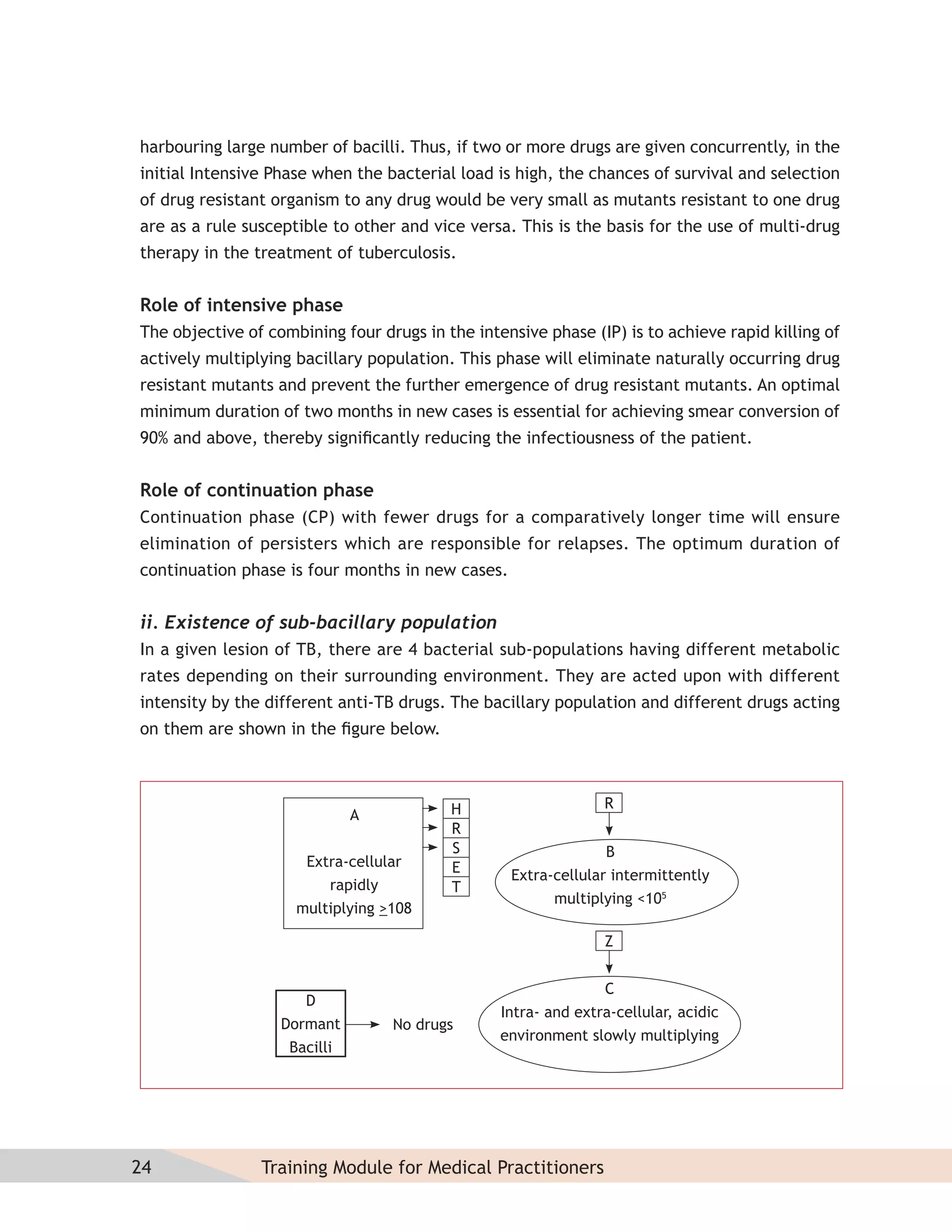
  • 31.
    The advent ofHIV has made the diagnosis of TB more difficult, and false diagnosis of TB probably occurs frequently among patients affected by other HIV-related illnesses. These false-positive diagnosis in most cases, however account for a very small proportion of all forms of TB notified and thus do not negate the huge increase observed in TB notifications in HIV-endemic areas. Intensified TB Case Finding at ICTCs, ART and Community Care Centres (CCCs) Intensified TB case finding should be established in ICTCs, ART Centres & CCCs. Intensified case finding means screening for symptoms and signs of TB in places where HIV-infected people are concentrated, followed by diagnosis and prompt treatment; which increases chances of survival, improves quality of life and reduces transmission of TB. All ICTC clients should be screened by the ICTC counselors for the presence of symptoms of TB disease (at pre, post and follow-up counseling). All clients who have symptoms or signs of TB disease, irrespective of their HIV status, should be referred to the nearest facility providing RNTCP diagnostic and treatment services. Quality Assurance An effective quality assurance (QA) system for sputum smear microscopy is an integral part of RNTCP. QA is a total system consisting of internal quality control (IQC), assessment of performance using external quality assessment (EQA) methods and continuous quality improvement (QI) of laboratory services. 3 components of EQA are:  Onsite Evaluation (OSE)  Random Blinded Re-checking (RBRC)  Panel Testing Diagnosis of Tuberculosis 19
  • 32.
    Points to Remember  The most common symptom of pulmonary TB is a persistent cough for two weeks or more  Patients suspected to have pulmonary TB should have two sputum smears examined  Sputum samples should be examined as soon as possible and not later than 2 DAYS after it is collected  The role of chest X-rays in the diagnosis of pulmonary TB is only supportive  About 2–3% of new adult outpatients in a general clinic will be TB suspects and should be sent for sputum examination  About 10% of TB suspects are expected to have sputum smear-positive pulmonary TB Exercise 1 PART A: Write your opinion on the following case studies and complete the laboratory forms if the patient needs sputum examination: 1. Meena Patel, a 25 year old resident of 225, Bapu Nagar of your city complains that she feels tired for the last few days. On further questioning, she reveals that she has had a cough for 4 weeks. She does not have any other symptoms. She has never taken anti-TB drugs. 2. Lakshmi Kumari, 41 years and resident of 18, M.G. Road of your city, has had a cough for two months with fever, night sweats and occasional coughing up of blood. She had taken treatment for TB two years back for about 5 months and discontinued treatment on her own. 3. Ashok Patel, a 30 year old man who lives with his parents, is having cough for the past 8 days. His father is under treatment for sputum smear-positive pulmonary TB for the past 1 month. Ashok does not have any other complaint. 4. Paravathi Sinha, an 18 years old resident of 12, Bapu Nagar of your city presented with non-tender swelling of the lymph nodes in neck region which appeared 3 months ago. These nodes are slowly growing in size. She does not have cough. 5. Lallan Prasad, a 30 year old resident of 19, Sidharth Apartment city presented with complaints of fever for 1 month. He also complained of having cough for 1 month and loss of weight. 20 Training Module for Medical Practitioners
  • 33.
    PART B: Completethe bottom section of the laboratory form. Start with the laboratory serial number. Specimens have been examined on 10th January 2008. Sign your own name. Patient Number of AFB (visual appearance) Meena Patel – A 30 AFB are seen in 100 oil immersion fields (muco-purulent) 140 AFB are seen in 50 oil immersion fields (muco-purulent) 400 AFB are seen in 50 oil immersion fields (muco-purulent) Lakshmi Kumari -B 200 AFB are seen in 50 oil immersion fields (muco-purulent) 400 AFB are seen in 50 oil immersion fields (muco-purulent Ashok Patel – C 0 AFB are seen in 100 oil immersion fields (muco-purulent) 0 AFB are seen in 50 oil immersion fields (saliva) Lallan Prasad – E 0 AFB are seen in 100 oil immersion fields (mucopurulent) 0 AFB are seen in 50 oil immersion fields (mucopurulent) PART C: Complete the first page of the Laboratory Register using the laboratory forms you have prepared with information in Part ‘A’ and Part ‘B’. (NB: Training facilitators may distribute photocopies of laboratory register page) Diagnosis of Tuberculosis 21
  • 34.
    3 Administering Treatment Diagnosis of TB in itself has little purpose unless it is followed by effective treatment. The goal of anti-TB treatment is to ensure cure, while preventing the emergence of drug resistance. A patient with TB should be put on treatment within one week of diagnosis. The following is required before starting treatment:  History of patient, including history of any previous treatment for TB  Sputum smear examination results from an approved DMC  Chest X-ray report if the case warrants radiographic examination  Other supporting investigation reports, if any The disease classification, type of case, sputum result, severity of illness and history of previous treatment are the factors that determine the regimen used for treating a TB patient. RNTCP uses short course chemotherapy given intermittently - thrice weekly under Direct Observation for both pulmonary and extra pulmonary tuberculosis patients. Scientific Basis of Treatment of TB The strategies adopted in the treatment of TB are based on both scientific and operational research. The following four components are discussed in brief. 1. Domiciliary treatment 2. Short course chemotherapy 3. Intermittent regimen 4. Direct observation of treatment 22 Training Module for Medical Practitioners
  • 35.
    Domiciliary Treatment Domiciliary chemotherapyhas been proved to be as effective as sanatoria treatment. Studies in India have shown that smear-positive TB patients treated on a domiciliary basis have achieved high cure rates as good as those when treated at sanatorium, besides having other social benefits of being at home. Short Course Chemotherapy Short course chemotherapy regimens have made it possible to treat and cure TB patients in as short a period as six to eight months. Reduction in the duration of treatment regimens was possible because of the introduction of Rifampicin and Pyrazinamide. Treatment regimens of six months duration either given daily, or on intermittent basis have been found to be equally effective and achieve high cure rates, prevent emergence of drug resistance and minimize relapses. The shorter duration has contributed to improvement in the treatment adherence. Intermittent short course chemotherapy regimens of 6-8 months are recommended internationally for all forms of extra-pulmonary TB. Basis of chemotherapy (a) Bacteriological basis i. Existence of naturally occurring drug resistant mutants In an untreated smear-positive pulmonary tuberculosis patient, there are naturally occurring drug resistant mutants to different drugs at different frequencies. The larger the bacterial population, higher is the probability that resistant mutant strains are present. The number of bacilli are lower in smear-negative and extra pulmonary lesions. The number of viable bacilli commonly found inside the cavities sized about 2 centimeters in diameter on an average, is likely to be in excess of 100 million (108). As a thumb rule, the frequency of occurrence of drug resistant mutants would be roughly ~1 in 106 to isoniazid (H), ~1 in 106 to streptomycin (S) and ~1 in 108 to rifampicin (R). Based on these frequencies, the chances of naturally occurring organisms that is resistant to both H and R would be roughly ~1 in 1014, which is virtually negligible. There would be appreciable numbers of mutants, resistant to any single drug before the start of the treatment, that are capable of multiplying and will not be affected by a single drug, e.g. isoniazid. This accounts for frequent failures observed with monotherapy of patients Administering Treatment 23
  • 36.
    harbouring large numberof bacilli. Thus, if two or more drugs are given concurrently, in the initial Intensive Phase when the bacterial load is high, the chances of survival and selection of drug resistant organism to any drug would be very small as mutants resistant to one drug are as a rule susceptible to other and vice versa. This is the basis for the use of multi-drug therapy in the treatment of tuberculosis. Role of intensive phase The objective of combining four drugs in the intensive phase (IP) is to achieve rapid killing of actively multiplying bacillary population. This phase will eliminate naturally occurring drug resistant mutants and prevent the further emergence of drug resistant mutants. An optimal minimum duration of two months in new cases is essential for achieving smear conversion of 90% and above, thereby significantly reducing the infectiousness of the patient. Role of continuation phase Continuation phase (CP) with fewer drugs for a comparatively longer time will ensure elimination of persisters which are responsible for relapses. The optimum duration of continuation phase is four months in new cases. ii. Existence of sub-bacillary population In a given lesion of TB, there are 4 bacterial sub-populations having different metabolic rates depending on their surrounding environment. They are acted upon with different intensity by the different anti-TB drugs. The bacillary population and different drugs acting on them are shown in the figure below. H R A R S B Extra-cellular E Extra-cellular intermittently rapidly T multiplying <105 multiplying >108 Z C D Intra- and extra-cellular, acidic Dormant No drugs environment slowly multiplying Bacilli 24 Training Module for Medical Practitioners
  • 37.
    The bacillary subpopulations B and C are referred as semi-dormant or persisters which are difficult to eliminate and are the source of relapse. Anti-TB drugs have the following three actions: a. Early bactericidal activity b. Sterilizing activity c. Ability to prevent emergence of drug resistance Isoniazid (H): Isoniazid is a potent drug, exerting early bactericidal activity, prevents emergence of drug resistant mutants to any companion drug and has low rates of adverse drug reactions. Rifampicin (R): Rifampicin is a potent bactericidal and sterilizing drug acting on semi- dormant bacilli which multiply intermittently, thereby causing relapse. Pyrazinamide (Z): Pyrazinamide is a bactericidal and sterilizing drug effective in eliminating the semi-dormant bacilli multiplying slowly in an acidic environment. Ethambutol (E): Ethambutol is an effective bacteriostatic drug helpful in preventing emergence of resistance to other companion drugs. Streptomycin (S): Streptomycin is a bactericidal drug known to reduce septicaemia and toxicity. The ranking of the drugs with respect to their type of activity is indicated in the following table. Drugs Early bactericidal Sterilizing activity Prevention of emergence of drug resistance Isoniazid ++++ ++ ++++ Rifampicin +++ ++++ +++ Streptomycin +++ - ++ Pyrazinamide ++ +++ + Ethambutol + - ++ Administering Treatment 25
  • 38.
    Pharmacological basis oftreatment It is established that in the treatment of tuberculosis, it is of importance to achieve peak serum levels of all the drugs simultaneously, so that maximum bactericidal effect is obtained. This is achieved by administration of all drugs at the same time. This also renders operational convenience of advising the patients to consume all the drugs at the same time. Intermittent Treatment Intermittent regimens should only be used in a programme of directly observed treatment (DOT). The formulation of intermittent regimens in the treatment of TB is based on the principle of existence of lag period. “In vitro experiments demonstrated that, after a culture of M. tuberculosis is exposed to certain drugs for some time, it takes several days before new growth occurs”. Thus, there is no need to maintain blood levels of drugs for 24 hours in the treatment of tuberculosis. The ability of the drugs to continue to exert its antimicrobial activity even after their withdrawal is called lag period. This renders the intermittent regimen possible. Intermittent dosing increases the efficacy of treatment by allowing organisms to re-enter the active metabolic phase in which the bactericidal drugs are more effective. Advantages of intermittent regimen are:  As effective as daily treatment  Facilitates DOT  Reduction in total quantity of drugs consumed  Fewer adverse reactions Directly Observed Treatment (DOT) Studies in India and many other countries have consistently shown that at least one third of patients do not consume medicines regularly. DOT is a supportive mechanism that ensures the best possible results in treatment of TB. Here, a DOT Provider helps the patient in taking the treatment, thereby ensuring adherence. Many patients who do not receive directly observed treatment stop taking drugs once they feel better. It is neither possible to predict who these patients will be nor to prevent non-adherence through health education. Studies have shown that there will be poor treatment outcome and high death rates in the absence of DOT, even when regular supply of drugs is ensured. Hence, by providing DOT, RNTCP ensures that patients receive the right drugs, in the right doses, at the right intervals and for the right duration. 26 Training Module for Medical Practitioners
  • 39.
    Definitions: The RevisedNational Tuberculosis Control Programme Case definitions Type of cases Treatment outcomes Pulmonary Tuberculosis, New Cured Smear-Positive A TB patient who has never Initially sputum smear-positive patient who TB in a patient with atleast had treatment for TB or has has completed treatment and had negative one smear-positive for AFB taken anti-TB drugs for less sputum smears on two occasions, one of out of the two initial sputum than one month which was at the end of the treatment smear examination by direct Relapse Treatment completed microscopy A TB patient who was declared Initially sputum smear-positive patient who Pulmonary Tuberculosis, cured or treatment completed has completed treatment with negative Smear Negative by a physician and who reports smears at end of the intensive phase/two A patient with symptoms back to the health facility and months in the continuation phase, but none suggestive of TB with is now found to be sputum at the end of the treatment is declared as two smear examination smear-positive treatment completed. Or Initially sputum negative for AFB, with smear negative patient who has received Transferred in: A TB patient full course of treatment and has not evidence of pulmonary TB who has been received for become smear-positive at the end of the by microbiological methods treatment in a Tuberculosis treatment or (culture positive or by Unit, after starting treatment other approved molecular in another TB unit where s/he Extra pulmonary TB patient who has methods) or Chest X- has been registered. received full course of treatment and has ray is classified as having not become smear-positive during or at the smear negative pulmonary Treatment after default: A end of treatment tuberculosis patient, who has received Extra Pulmonary treatment for TB for a month Died Tuberculosis* or more from any source Patient who died during the course of Tuberculosis in any organ and returns for treatment treatment regardless of any cause other than lungs (eg. pleura, after having defaulted i.e., lymph nodes, intestine, not taken anti-TB drugs Failure genitor-urinary tract, joint consecutively for two months Any TB patient who is smear-positive at and bones, meninges of the or more and found to be five months or more after initiation of the brain etc). smear-positive treatment and not put on MDR-TB treatment The diagnosis should be Treatment failure Any TB Defaulted based on strong clinical patient who is smear-positive A Patient after treatment initiation has evidence with the following at 5 months or more after interrupted treatment consecutively for >2 investigations initiation of treatment. months  Smear/Culture from Transferred out Chronic A patient who extrapulmonary sites A patient who has been transferred to remains smear-positive after  Histopathological completing regimen for another TU and whose treatment outcome examination or previously treated but not is still not available.  Radiological examination initiated on MDR-TB treatment or Switched over to MDR-TB Treatment Others A patient who does not A patient who has been diagnosed as having  Biochemical and fit into the any of the types MDR-TB by an RNTCP accredited laboratory, cytological examination mentioned above. The reasons prior to being declared as “Failure”, and including FNAC for labeling a patient under this is placed on the RNTCP MDR-TB treatment type must be specified in the regimen Treatment card and TB Register# * Pleurisy is classified as extra pulmonary tuberculosis, * A patient diagnosed with both smear-positive pulmonary and extra pulmonary TB should be classified as pulmonary TB # Others can come both under new and previously treated. Administering Treatment 27
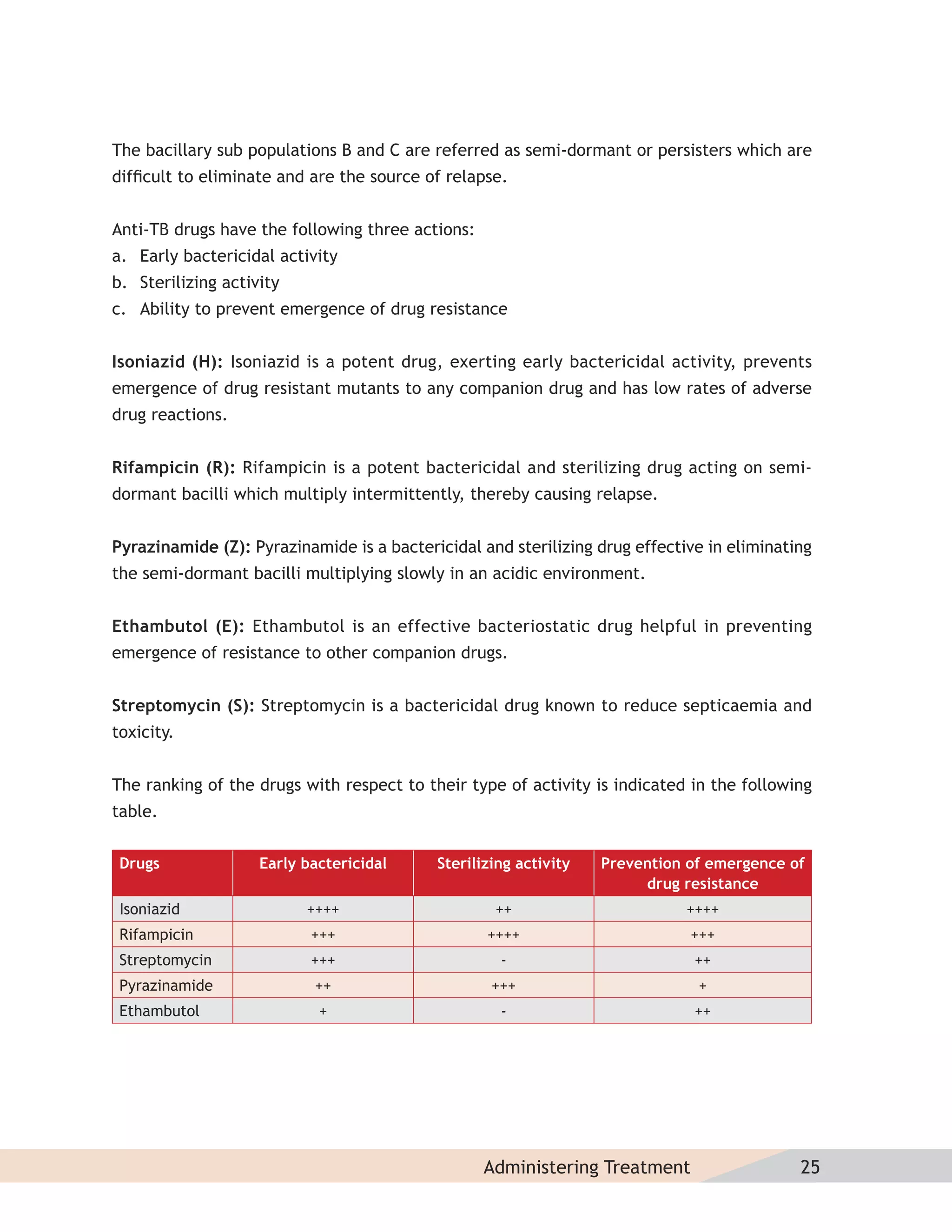
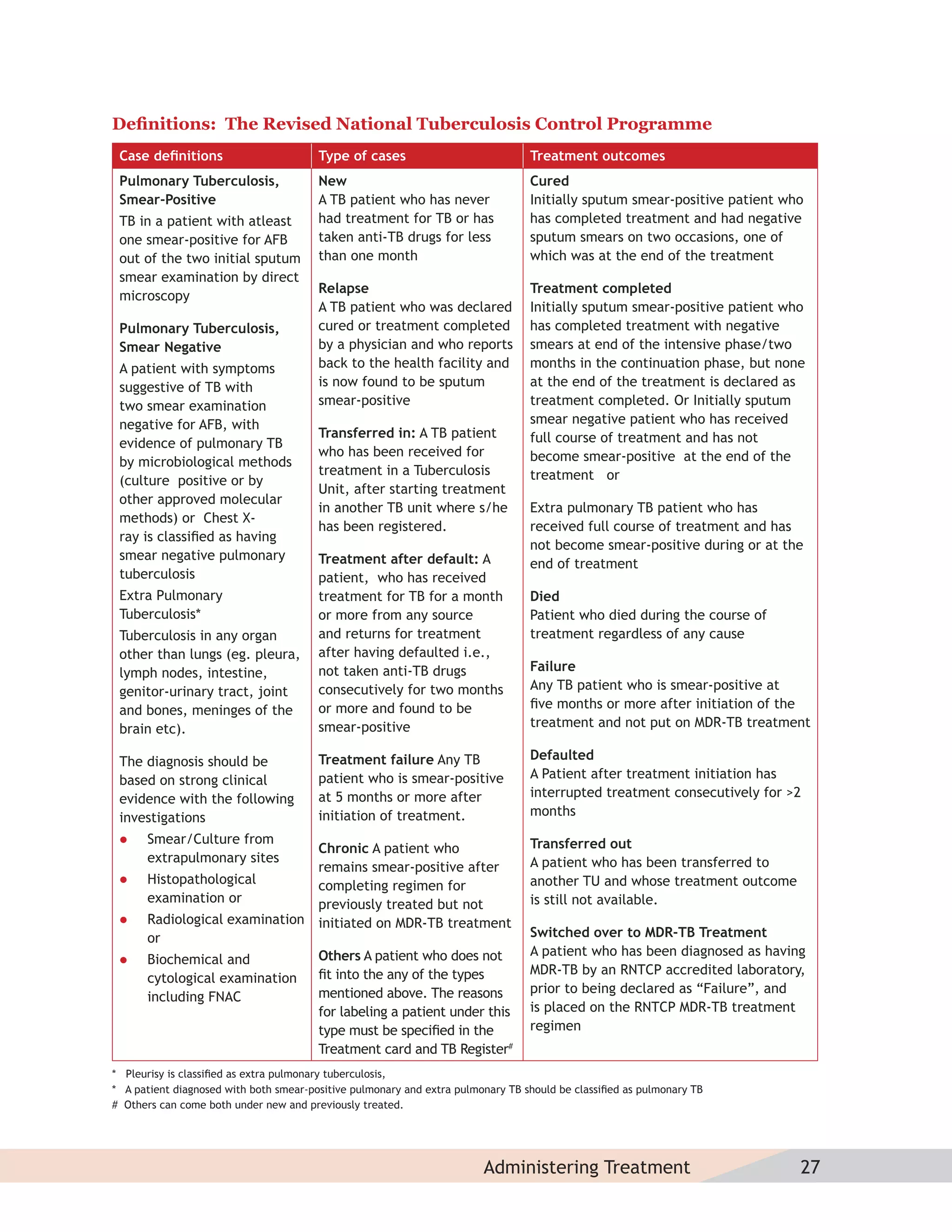
  • 40.
    Treatment Regimens For thepurpose of treatment regimen to be used, TB patients are classified into two groups, namely, “New” or “Previously Treated”, based on the history of previous treatment. Regimen for New cases: This regimen is prescribed to all new pulmonary (smear-positive and negative), extra pulmonary and ‘others’ TB patients. The regimen is 2H3R3Z3 E3 / 4 H3R3. Treatment is given in two phases. For “New” patients, the intensive phase consists of isoniazid (H), rifampicin (R), pyrazinamide (Z) and ethambutol (E) given under direct observation thrice a week on alternate days and lasts for 2 months (8 weeks, 24 doses). This is followed by the continuation phase, which consists of 4 months (18 weeks; 54 doses) of isoniazid and rifampicin given thrice a week on alternate days with at least the first dose of every week being directly observed. If the sputum smear is positive after 2 months of treatment, the intensive phase of four drugs (H, R, Z and E) are continued for another one month (12 doses) and sputum examined after the completion of the extension of intensive phase. Irrespective of the sputum results after this extension of the intensive phase, the 4 months (18 weeks) of the continuation phase is started. If the sputum smear is positive after 5 or more months of treatment, the patient is declared as a “Failure” and is placed on the “Previously Treated” treatment regimen afresh, and sputa sent for culture and drug susceptibility testing (C&DST) to an accredited RNTCP C&DST laboratory. While treating TB meningitis in “New” patients, streptomycin is to be used in place of ethambutol during the intensive phase (H3R3Z3S3 instead of H3R3Z3E3). The continuation phase of treatment for patients with TBM or spinal TB is for 7 months. Hence, the total duration of treatment will be for 9 months. Steroids as adjunctive therapy may be useful in patients with TB pericarditis and meningeal TB, with an initial high dose tapered downwards gradually over 6 - 8 weeks. Regimen for Previously Treated cases: This regimen is prescribed for TB patients who have had more than one month anti-tuberculosis treatment previously. These patients are at a higher risk of having drug resistance. Hence, 5 drugs are prescribed in the intensive phase, and the total duration of treatment is 8 months. Relapses, Treatment After Default, Failures and Others are treated with this regimen. 28 Training Module for Medical Practitioners
  • 41.
    The regimen is2S3H3R3Z3 E3 / 1H3R3Z3 E3 / 5 H3R3 E3. Treatment is given in two phases. For “Previously Treated” cases, the intensive phase consists of two months (24 doses, 8 weeks) of isoniazid (H), rifampicin (R), pyrazinamide (Z), ethambutol (E) and streptomycin (S), followed by one month (12 doses, 4 weeks) of isoniazid, rifampicin, pyrazinamide and ethambutol, all given under direct observation thrice a week on alternate days. Patient is subjected for follow-up sputum examination at the end of three months. If the sputum smear is positive at the end of 3 months of treatment, the intensive phase drugs (H, R, Z and E) are extended for another one month (12 doses, 4 weeks). Irrespective of the sputum results at the end extended intensive phase, 5 months (22 weeks) of continuation phase is started. If the sputum remains positive at the end of the extended intensive phase, sputum is sent to an accredited RNTCP C&DST laboratory for culture and drug susceptibility testing. The continuation phase consists of 5 months (22 weeks; 66 doses) of isoniazid, rifampicin and ethambutol given thrice a week on alternate days, with at least the first dose of every week being directly observed. The experience in India and elsewhere has shown that this treatment regimen, if taken regularly, is effective and cures most patients. Relapse cases generally have better outcomes than those who are ‘Failure’ or ‘Treatment After Default’ cases. But even these latter types of patients generally respond well to treatment, provided they take it regularly and complete the treatment. It is very important to elicit history of previous treatment for tuberculosis. It helps in defining a case; to identify patients with increased risk of acquired drug resistance and to prescribe appropriate treatment The table below indicates the treatment regimen, type of patients and regimen prescribed. Treatment Type of patient Regimen1 groups Intensive Phase Continuation (IP) Phase (CP) New* Sputum smear-positive 2H3R3Z3E3 4H3R3 Sputum smear-negative Extra-pulmonary Others Administering Treatment 29
  • 42.
    Previously Smear-positive relapse 2H3R3Z3E3S3 5H3R3E3 Treated** Smear-positive failure / 1H3R3Z3E3 Smear-positive treatment after default Others2 1. The number before the letters refers to the number of months of treatment. The subscript after the letters refers to the number of doses per week. The dosage strengths are as follows: Isoniazid (H) 600 mg, Rifampicin (R) 450 mg, Pyrazinamide (Z) 1500 mg, Ethambutol (E) 1200 mg, Streptomycin (S) 750 mg. • Patients who weigh 60 kg or more receive additional rifampicin 150 mg. • Patients who are more than 50 years old receive streptomycin 500 mg. Patients who weigh less than 30 kg, receive drugs as per Paediatric weight band boxes according to body weight. 2. In rare and exceptional cases, patients who are sputum smear-negative or who have extra-pulmonary disease can have recurrence or non- resonse. This diagnosis in all such cases should always be made by an MO and should be supported by culture or histological evidence of current, active TB. In these cases, the patient should be typed as ‘Others’ and given treatment regimen for previously treated. * New includes former categories I and III. ** Previously treated is former category II. Patient wise Drug Boxes Drugs are supplied in patient-wise boxes (PWB) containing the full course of treatment, and packaged in blister packs. The PWB have a color code indicating the two regimen - Red for “New”, Blue for “Previously Treated”. In each PWB, there are two pouches; one for intensive phase and one for continuous phase. In the intensive phase, each blister pack contains one day’s medication. For the continuation phase, each blister pack contains one week’s supply of medication. The drugs for extension of the intensive phase (prolongation pouches) are supplied separately. The table below indicates the blisters and doses in the regimen: Regimen for New cases treatment consists of total 78 doses and for previously treated cases consists of 102 doses. Regimen for IP* CP Blisters Doses Extended IP Blisters Doses blister and doses New cases (Cat-I) 24 24 12 18 54 Previously treated 36 36 12 22 66 cases (Cat-II) * Prolongation of IP for one month (12 doses) is given to new cases and previously treated cases who remain positive at the end of Intensive Phase 30 Training Module for Medical Practitioners
  • 43.
    Drug dosages foradults in the blister packs * Drugs Dose (thrice a week) Number of tablets in blister pack Isoniazid (H) 600mg 2 x 300 mg Rifampicin (R) 450mg** 1 x 450 mg Pyrazinamide (Z) 1500mg 2 x 750 mg Ethambutol (E) 1200mg 2 x 600 mg Streptomycin (S) 0.75g *** - *Adult patients who weigh <30kgs receive drugs in PWBs from the respective weight band suggested for paediatric patients ** Patients who weigh ≥60 kg at the start of treatment are given an extra 150 mg of Rifampicin *** Patients over 50 years of age are given 0.5 g of Streptomycin Treatment of Pediatric TB Pediatric cases are to be treated under RNTCP with the same thrice weekly short course chemotherapy regimens (“New” or “Previously Treated”) given under DOT as for adult patients. They are to be registered in the respective RNTCP TB Register. Pediatric patient- wise boxes are available with different dosages as two product codes to be used under four weight bands for children weighing 6 to 10 kgs, 11 to 17 kgs, 18 to 25 kgs and 26 to 30 kgs. Wherever possible, before a child is started on the “Previously Treated” regimen, s/he should be examined by a Pediatrician or TB expert. Pediatric PWB with Dosages Drugs Product code Product code PC-15 PC-16 (PC) -13 (PC) -14 IP CP IP CP 12 blisters 12 blisters 24 blisters 18 blisters 24 blisters 18 blisters Isoniazid 75 mg 75 mg 150 mg 150 mg Prolongation Prolongation Rifampicin 75 mg 75 mg 150 mg 150 mg of IP for of IP for PC 13 PC 14 Pyrazinamide 250 mg 500 mg Ethambutol 200 mg 400 mg Administering Treatment 31
  • 44.
    Pediatric patient wiseboxes for new cases according to weight band Weight band For New cases Prolongation IP CP of IP 6-10 Kg PC 13 PC 15 11-17 Kg PC 14 PC 16 18-25 Kg PC 13 + PC 14 PC 15 + PC 16 26-30 Kg* PC 14 + PC 14 PC 16 + PC 16 * For children weighing >30 kgs, adult PWB are to be used ** For patients falling in b/w weight bands should be put on lower wt band Pediatric patient wise boxes for previously treated cases according to weight band Weight For previously treated cases Prolongation IP CP of IP 6-10 Kg (PC 13+ PC 15) + (PC 13 + 54 Tab E 200 mg) + PC 15 (24 vials Inj. SM *) (PC 15 without Z) 11-17 Kg (PC 14 + PC 16) + (PC 14 + 54 E 400 mg) + PC 16 (24 vials Inj. SM *) (PC 16 without Z ) 18-25 Kg (PC 13 + PC 14 + PC 15 + PC 16) + (PC 13 + PC 14 + 54 Tab E 600 mg) + PC 15 + PC 16 (24 vials Inj. SM *) (PC 15+ PC 16 without Z ) 26-30 kg (PC 14 x 2)+ (PC 16 x 2) (PC 14 x 2+ 54 Tab E 800 mg) PC 16 x 2 + (24 vials Inj. SM*) + (2 x PC 16 without Z ) * Injection streptomycin 15mg/Kg body weight  DOTS is the recommended strategy for treatment in adults and children  All pediatric TB patients should be registered under RNTCP Non-DOTS (ND) treatment regimen under RNTCP In rare and exceptional situations, non-DOTS treatment (with a self-administered non- rifampicin containing regimen) may be needed in a few TB cases. Examples include:  Those with adverse reactions to rifampicin and/or pyrazinamide  “New” patients who refuse DOTS despite all efforts To facilitate registration of patients started on non-DOTS regimens, a Tuberculosis Treatment Card should be filled. A maximum of 1% of patients may get non-DOTS treatment in an RNTCP 32 Training Module for Medical Practitioners
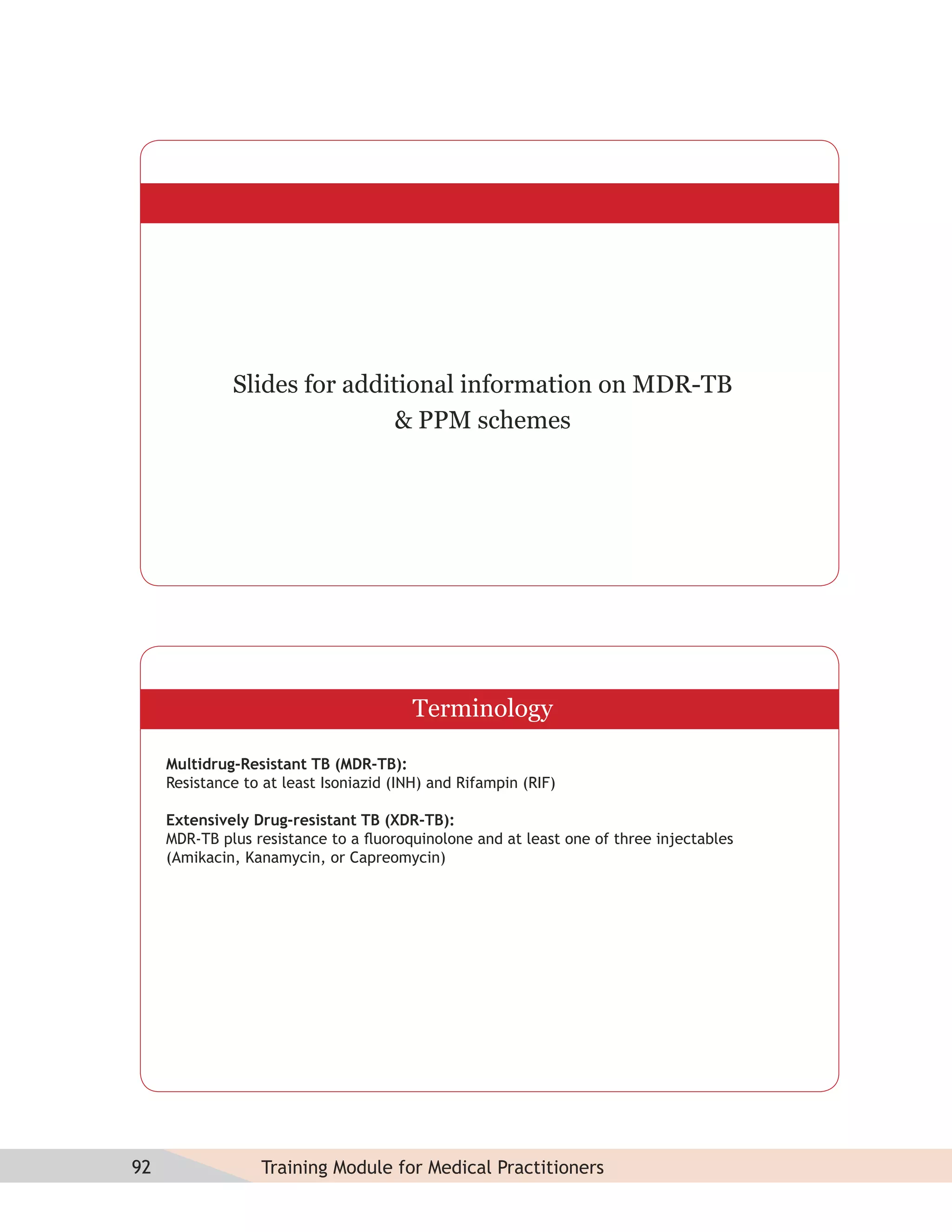
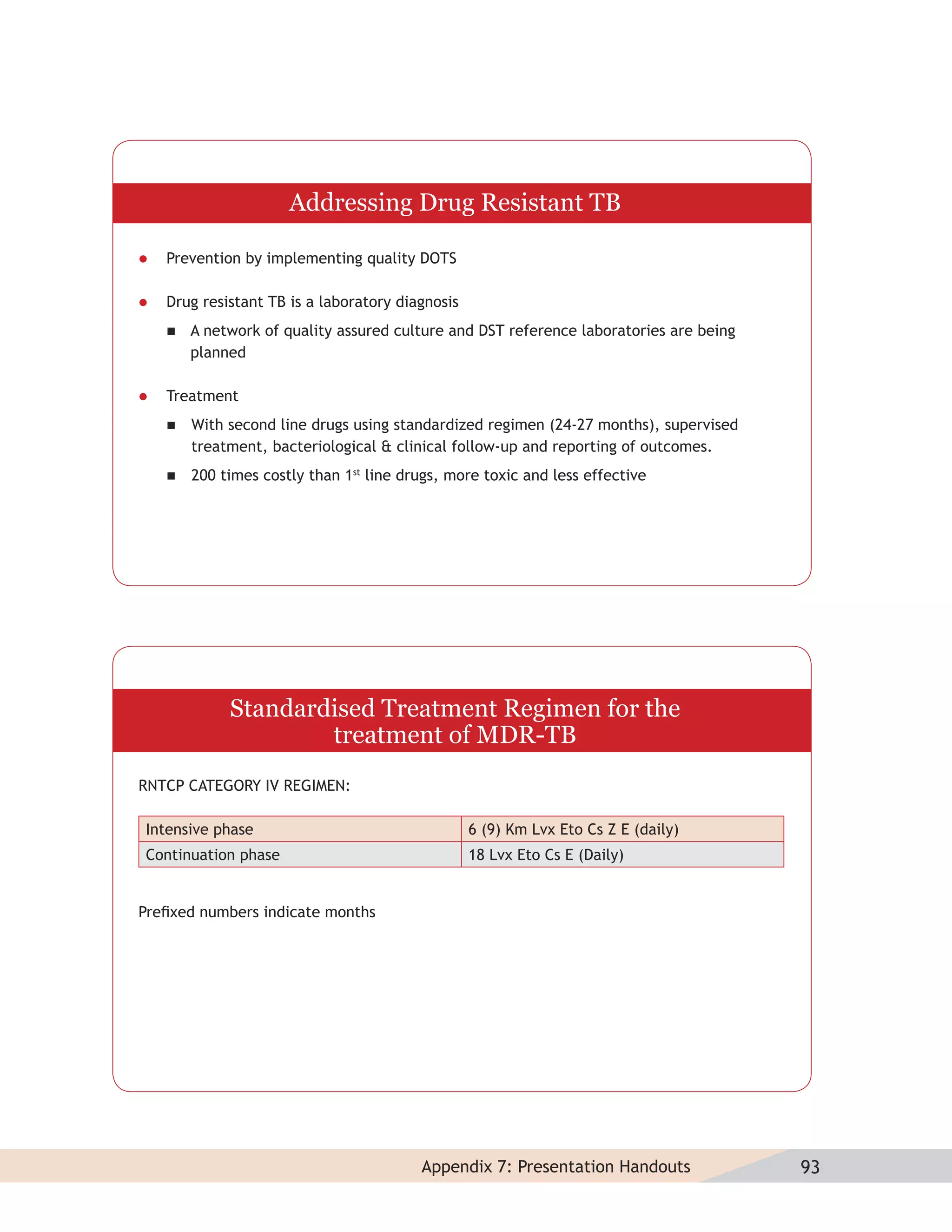
  • 45.
    area. The justificationfor initiating patient on non-DOTS treatment should be specified in the “Remarks” column of the treatment card and TB register. This is a treatment regimen of 12-month duration, comprising 2 months of SHE and 10 months of HE (2SHE / 10HE). Dosages administered per day in the regimen are: Isoniazid - 300 mg Ethambutol - 800 mg Streptomycin - 750 mg (500 mg for those >50 years of age). Those who weigh less than 30 kgs receive dosages calculated as per body-weight. Organization of DOT and Flow of Patients for Treatment After receipt of the sputum results, the MO of the Peripheral Health Institution (PHI) takes the following measures:  Establishment of diagnosis of tuberculosis and decision on type of patient and treatment regimen  Motivation of patients : • Explanation about the disease and assured cure. • Modalities of treatment-dosage schedule, duration, follow-up, common side-effects and methods to prevent them • Importance of directly observed treatment (DOT) • Need for screening of children and symptomatic contacts  Identification of suitable DOT Centre and DOT Provider - accessible and acceptable to the patient and accountable to health system  Opening of Tuberculosis Treatment Card (in duplicate) and the TB Identity Card  Arrangement for shifting patient-wise box to the DOT Centre along with the duplicate TB Treatment Card, TB Identity Card and sputum containers for collection of early morning samples for follow-up examinations. For the purpose of identifying an ideal DOT provider and an appropriate DOT Centre, a DOT Directory should be maintained at PHI level. This directory should contain a locality-wise list of DOT Centres / DOT Providers in the area. It should be updated regularly. DOT can be provided by anyone other than the member of patient’s family. It is the responsibility of the Administering Treatment 33
  • 46.
    Government field staff(PHWs / MPWs) to organize and ensure DOT for the patient. They would also monitor and supervise the community DOT Providers in their respective sub centres. If the patient is to be given DOT by a Peripheral Health Worker (PHW) / Community DOT Provider, a duplicate treatment card will be prepared and given to the PHW. The MO of the PHI will give the patient-wise box containing drugs for the entire duration of treatment to the PHW and records the same in the drug stock register maintained at the PHI. The PHW visits the house of the patient as soon as possible for confirmation of the residential address and has a detailed dialogue with the patient and other members of the family. Patient should be started on treatment within a week. Emphasis is given to the points similar to the ones mentioned above for the MO-PHI. This opportunity should also be used for screening of contacts. The initial home visit should be recorded in the treatment card in the space provided. A convenient location for drug administration and a suitable DOT provider is decided mutually by the PHW and the patient. Documentation for Referral for Treatment If the patient resides outside the jurisdiction of the referring institution, a copy of the ‘Referral for Treatment’ Form must be sent to the facility where the patient will begin treatment. A “Referral for Treatment” Register should be maintained in DMCs / DOT Centre of bigger hospitals, including that of medical colleges, that are referring large numbers of patients to other health facilities for treatment (after diagnosis). Information regarding referral of a patient should be noted in the “Referral for Treatment” Register as well as the “Remarks” column of the Tuberculosis Laboratory Register. Peripheral health worker should visit patient’s residence before the commencement of treatment. However this should not result in delay in treatment initiation. Treatment Related Information DOT and its necessity: It is important for the patient to take the drugs under observation. The real purpose of direct observation is to develop a human bond with the patient and not to mechanically watch the patient swallow the drugs. Patients, if given self administered 34 Training Module for Medical Practitioners
  • 47.
    Flow of Patientsfor Treatment Referred to DMC with request for sputum TB Suspects examination by MO – PHI/PP/NGO/Others  Registers in lab register DMC  LT collects 2 sputums  Sends result to referring physician  History of previous treatment Referring Physician  Prescribes appropriate regimen  Treatment card is opened  Organizes DOT  Identifies DOT provider MO PHI  Sends PWB with duplicate treatment card to DOT Provider  Refers to ICTC  Address verification  Motivation PHW  Contact tracing  Arranges for DOT  Updates original treatment card at PHI  DOT provider provides the DOT DOT Centre  Records drug collection  Sends for follow-up examination  Collects the treatment card  Records treatment outcome MO-PHI  Updated Treatment card is submitted to the TU after completion of treatment Administering Treatment 35
  • 48.
    treatment are likelyto take it irregularly or discontinue the treatment upon relief of symptoms. Early Disappearance of symptoms is not a sign of cure. It is very important for the patient to know the duration of treatment and understand the necessity of taking all prescribed drugs regularly. It is dangerous to take only part of the prescribed drugs because in such cases the disease may become incurable. A place mutually convenient to the patient and the provider can be chosen for provision of DOT. The necessity of direct observation of every dose of drugs taken during the intensive phase and the first dose of the weekly blister pack during the continuation phase should be emphasized to the patient. The patient is also explained about the importance of sputum smear conversion at the end of 2(3) months and at the completion of treatment. Patient should be made aware that treatment services are provided free of cost. Role of rest, special diet and isolation: Patient and family members are made to understand that once the treatment is started, patient ceases to spread the infection and there is no need to isolate him in terms of accommodation, use of utensils and clothes. At the same time, health staff should be careful enough not to over emphasize on special diet and rest. They can be told to take the food they can afford and rest only if constrained by physical weakness. Patient should be impressed that it is the treatment alone which cures. Cough hygiene and sputum disposal: Patient should be educated in exercising the cough hygiene - not resorting to indiscriminate coughing and spitting and covering the mouth while coughing or sneezing. Provision of transfer facility during treatment: In case the patient wishes to shift or migrate to other TU / district / state after the initiation of the treatment, she/he should be informed that there is a provision of transfer facility for treatment. Any such event should be duly informed to the treating medical officer for completing the formalities for transfer and necessary arrangement for further treatment. Referral for HIV counselling and testing: All the patients diagnosed as TB cases should be encouraged and referred to the nearest ICTC for HIV testing. Co-morbid conditions; for example, diabetes, renal failure, patient on immuno- suppressive drugs: History regarding the conditions mentioned above and any treatment for the same has to be elicited as these conditions and treatment for the same may adversely 36 Training Module for Medical Practitioners
  • 49.
    interfere with theTB Treatment, Patients are to be referred to the respective speciality and managed appropriately depending upon the co-morbid conditions. Adherence to follow-up schedules: The patients should be impressed upon the necessity of complying with periodic follow-up sputum examination schedule as advised. This will help in objective assessment of response to the treatment. Conversion to smear negativity is a fore-runner of successful treatment. Sensitization on adverse reactions: In case patients experience any unusual symptoms after initiation/during treatment, they should be instructed to approach the medical officer and report the same. On their own, they should not take a decision either to stop or to continue the drugs. Smoking: It should be impressed upon the patient that smoking of tobacco will adversely affect the treatment outcome. Patients should be protected from passive smoking. The environment of the patient has to be smoke free at home/office and at clinic. Smoking status of the TB patient should be checked at every interaction. The Medical Officer has to help the patient with simple tips to quit smoking. However, if this does not yield any positive result, he should be referred to the smoking cessation clinic. Alcohol abuse: History of addiction to alcohol should be elicited. If found alcoholic, the patient should be advised to strictly refrain from alcohol as it would increase the chances of patient developing hepatitis (Jaundice), irregularity in drug intake and adverse treatment outcome. The patients should be encouraged to give up alcohol with the help of frequent motivation, family and social support. Importance of screening symptomatic contacts and children below 6 years: Patients should be encouraged to bring symptomatic adult contacts and all children aged six years and below for screening at health facility. This will facilitate early detection of cases among them and appropriate treatment. Eligible children will be administered chemoprophylaxis. Treatment Card Each patient who begins treatment for TB must have a tuberculosis treatment card. The information on the patient’s treatment card should be accurate, reliable, relevant, up to date and legible as this would be the source of information for filling up of the TB register. This card Administering Treatment 37
  • 50.
    contains important informationabout the patient, including the following details: General Data related to DOT Treatment related information information  Name of the  TB unit with code  Disease classification and type patient  TB number with year  Details of sputum examination for  Age and sex  Name of the PHI diagnosis and follow-up  Complete address  Name and designation of  Details of X-ray and investigations for and phone number DOT provider diagnosis of EPTB of the patient  DOT centre  History of previous anti-TB treatment  Occupation  Initial home visit by whom  Treatment regimen  Name, address (Name and Designation)  Drug intake in intensive and continuation and phone number with date phase of the contact  Retrieval actions for missed doses person  Chemoprophylaxis for contacts aged ≤ 6 years  HIV related data  Treatment outcome with date  Remarks The Tuberculosis Treatment Card is maintained at the health facility where the patient is initiated on treatment. For patients receiving treatment in a DOT centre other than the place of treatment initiation, a duplicate treatment card is prepared and maintained at the DOT centre by the DOT provider. The original treatment card at the PHI is to be updated at least once in a fortnight. Administration and monitoring of treatment Recording of drug administration and monitoring There are two sections meant for recording the drug administration. One is for the intensive phase of treatment on the front of the card and the other, for the continuation phase on the reverse side. Intensive phase Month and year: Month and year of initiating the intensive phase is recorded. Date of initiation of treatment: The date of initiation of treatment regimen prescribed is ticked (√) on the appropriate box under the date against the month. Subsequently, the dates on which the drugs were consumed under observation are also ticked. In this phase, 38 Training Module for Medical Practitioners
  • 51.
    the patient comesthree times a week on alternate days. Daily blisters are given either on Mondays, Wednesdays and Fridays or alternatively Tuesdays, Thursdays and Saturdays. The date/day (for example 10th April) on which patient fails to attend for DOT is denoted by a circle (0) in the appropriate box. In case the patient attends to collect the drug the next day (for example on 11th April), the drugs missed are administered on that day and continues to take the drugs as per scheduled (for example on 12th April). Month/year 1 2 3 4 5 6 7 8 9 10 11 12 13 14 April 10 √ √ √ S √ √ √ S On the other hand, if the dose is entirely missed and the patient does not report to the health facility even on the next day, then the dose is given on the next scheduled day. It should be ensured that all doses in the intensive phase should be administered before the continuation phase is initiated. For example, if the patient was scheduled to come on 17th April but does not turn up on 17th or even on 18th but reports on 19th; the dose due on 17th is given on 19th and so on and so forth. Month/year 15 16 17 18 19 20 21 22 23 24 25 26 27 28 April 10 √ √ S √ √ √ S Only under exceptional circumstances, unsupervised drug administration can be allowed for a limited number of doses. For instance, if a patient is being discharged from hospital after initiation of treatment, s/he will have to be provided with 3 doses of treatment so that her/his treatment does not get interrupted during her/his transfer to a nearby PHI. In such circumstances, the entry for unsupervised doses should be recorded by encircling the tick mark on the Tuberculosis Treatment Card and the reason for the same should be stated in the Remarks column of the treatment card. Continuation phase Drug administration in the continuation phase is recorded on the reverse side of the treatment card. Treatment regimen prescribed for the patient is ticked appropriately in the box provided. Number of tablets of the drugs prescribed in the regimen is also recorded in the boxes provided above the drugs. During the continuation phase of treatment, patients collect the weekly blisters once a week on a designated day. First dose of the weekly blister is administered under direct Administering Treatment 39
  • 52.
    observation and theremaining doses in the weekly blister are given to the patient for self- administration. The month and the year in which the patient will be collecting drugs during the continuation phase are written under the Month and Year column in the table on the reverse of the Tuberculosis Treatment Card. An ‘X’ is recorded in the appropriate box (according to the dates of the month 1–31 as the case may be) to indicate the day the drugs were consumed under direct observation. A line is drawn through the remaining days of the week (after the X) to indicate that drugs for the remaining period of the week have been given (recorded as X------------------------) for self administration. If the patient misses a weekly drug collection in the continuation phase completely, a circle is recorded on the day of the missed collection. On the day of the subsequent visit, the treatment is given and recorded, leaving the boxes blank as shown below: Month/year 1 2 3 4 5 6 7 8 9 10 11 12 13 14 15 16 17 18 June 10 S X S S X Monitoring of drug administration can be done by comparing the stock of drugs available in the patient-wise boxes with the dosages given and marked in the Tuberculosis Treatment Card. Any observed variation should be looked into and remedial measures taken. NON-DOTS treatment (in intensive as well as continuation phases) Date when drugs were collected by the patient is indicated by writing ‘C’ and drawing a horizontal line (C-----------) to indicate the period for which drugs were supplied for self- administration. Usually drugs will be provided for a month. Follow-up schedule for sputum examination The most important method of monitoring the smear-positive PTB cases are by the follow-up sputum smear examinations which are carried out at the end of the intensive phase, the extended intensive phase (if applicable), two months into the continuation phase and at the end of treatment. These results determine the conversion rate from smear-positive to smear-negative at the end of intensive phase of treatment, and the cure rate at the end of the treatment. The follow-up sputum smear examination at the end of treatment is very important for evaluating the results of treatment outcome (to determine the cure rate). Two sputum samples are to be collected, one as early morning and the other as spot sample. 40 Training Module for Medical Practitioners
  • 53.
    The follow-up schedulefor sputum collection and smear examination is provided in the table below. End of IP Extended IP * 2 months into CP End of treatment Collect the sputum and Result by end Collect sputum # Collect sputum # of the treatment Give sputum cup Give sputum cup Give sputum cup Give sputum cup # Collect sputum Result by Result by Result by Category New ** 22 23 24 34 35 36 8 9 10 17 18 Previously 34 35 36 46 47 48 8 9 10 21 22 Treated * The Intensive Phase is extended by four weeks (12 doses) in initially smear-positive PTB patients who continue to be positive at the end of the2 months of IP. # Early morning and spot specimens will be collected on this day. ** The numbers during the IP represent doses, whereas during the CP they represent weekly blister packs Follow-up of sputum smear examinations of patients put on the RNTCP Non-DOTS regimen should be done at the end of 2, 6 and 12 months. It must be ensured that the patients undergo the follow-up sputum smear examination as scheduled and the last follow-up sputum examination is done before the completion of the last dose of treatment. Chemoprophylaxis Preventive chemotherapy with isoniazid (H) is administered to all the children aged 6 years and below who are in contact with smear-positive pulmonary TB case. The number of such children residing in the household should be enquired during the initial home visit. The parents are advised to bring their children to the Health Centre for screening for the evidence of TB. They are examined and investigated to rule out TB disease. If found to be suffering from the disease, they should be treated appropriately. Children found eligible for chemoprophylaxis after ruling out TB are to be administered preventive chemotherapy with INH 5mg/kg body weight daily for 6 months. The number of children below 6 years of age, the number screened for TB and the number put on chemoprophylaxis should be mentioned on the reverse of the treatment card (see below). Nos. of children below 6 Yrs Nos. screened for TB Nos. put on chemoprophylaxis Administering Treatment 41
  • 54.
    Determination of dateof treatment outcome Outcome Date of determination Illustrations Cured or Treatment The last dose (Pyridoxine) of the Patient administered last DOT Completed 18th blister in New and 22nd blister in in continuation phase on 16- Previously Treated cases. 06-2010. Last pyridoxine dose taken on 22-06-2010. then the outcome will be written as Cured or treatment completed on 22-06-2010. Transferred out Transferred out is the date in which the Generally drugs up to one week patient is supposed to have consumed the are given for self administration last dose of the drugs provided to him during transfer – maximum of on transfer as recorded in the card. This three doses in the intensive or is only an interim outcome. The actual continuation phase. Actual date outcome as reported from the unit where on which transfer form was the patient was transferred will be filled and sent is 20-06-2010; updated in the card and in the TB then the date of transferred register. out as a treatment outcome should be 27-06-2010. This is the date when the 3rd dose handed over during transfer is supposed to have been consumed. Defaulted The scheduled date of administration of Patient interrupted treatment drug when patient interrupted treatment on consecutively for ≥2 months. 16-9-2010. Record outcome as ‘defaulted on 16-9-2010’ on or after 17-11-2010 within one month. Failure The date on which the sputum If the smear result is positive on examination was found to be positive for 18-05-2010, Failure on 18-05- AFB 2010. Died The actual date of death Patient died on 11-08-2010, Died on 11-08-2010. Switched to MDR- The date on which the patient is started Patient declared as MDR-TB on TB treatment on RNTCP MDR-TB treatment regimen. 01-01-2010 and put on MDR- TB treatment on 21-01-2010. the date for Switched to MDR-TB treatment would be 21-01-2010. 42 Training Module for Medical Practitioners
  • 55.
    A patient willhave only one outcome. The outcome which occurs first is considered and recorded in treatment card and subsequently in the TB register. Remarks Column The following information has to be recorded in the remarks column  Adverse drug reactions, if any  Reasons for unsupervised dose(s)  Reason for discontinuation of drug collection (e.g., patient transferred to another district)  Details of hospitalization if any during the treatment  Information on dispatch of sputum for culture of sensitivity tests  Any other relevant information about the patient such as smoking, diabetes mellitus, pregnancy status etc., HIV Related Data This box is meant for recording information regarding the HIV status of the patient, and if positive, details of CPT and ART being administered. Original TB Treatment Card Information on HIV status, CPT delivery and ART referral and initiation of the TB patient are to be documented on the original TB treatment card and kept confidential within the health system. This should not be disclosed to the community DOT provider. Additional Treatments HIV Status: Unknown 1. Positive Negative (Date) _____________ CPT delivered on (date) 2. (1) (2) (3) (4) (5) Pt referred to ART centre (date) : ________________________________________ Initiated on ART: No Yes (date) _________________________ Administering Treatment 43
  • 56.
    HIV Status i. HIVtesting is a voluntary procedure and not mandatory. Patients not willing for HIV testing or sharing their HIV test result should not be forced to undergo testing or disclose their HIV status. ii. If HIV status of the patient is known, tick the appropriate box (‘Pos’ or ‘Neg’) and record the date of test along with PID Number if available. If the HIV status is not known, don’t tick any box initially. iii. Patients already on HIV care should not be required to show proof of HIV test result. iv. If the HIV status is ascertained during the course of TB treatment, the latest information should be updated on the card. v. If HIV status of the patient remains unknown at the end of treatment, tick the appropriate box (‘unknown’), at the time of declaring treatment outcome for the patient. CPT (Cotrimoxazole Prophylactic Therapy) Delivery i. All known HIV-infected TB patients are to be provided access to CPT. ii. If CPT provided from the PHI, record dates of each monthly delivery in the space provided. iii. In case the TB patient is already on CPT before the initiation of TB treatment, record most recent date of CPT pickup. Referral and initiation on ART 1. All known HIV-infected TB patients are to be referred for ART to the nearest ART Centre. For referred clients, record the date of referral. 2. If patient initiated on ART, tick the “yes” box, and the date of initiation of ART. ART Registration Number should be recorded on the treatment card. 3. In case the TB patient is already on ART before the initiation of TB treatment, tick yes, and record approximate date of initiation. Adverse Reactions to Anti-TB Drugs Adverse Drug Reactions (ADR) observed during treatment for tuberculosis are comparatively less in the intermittent chemotherapy than what is encountered in daily regimens. DOT providers should be aware of the commonly occurring adverse reactions so that they can identify it 44 Training Module for Medical Practitioners
  • 57.
    Revised National TuberculosisControl Programme State: Karnataka City/District with code: Mysore TB Unit with code:_________________________ Patient TB No./Year: 4299 Name: Raju Sex: M F Age: 52 Occupation: _____________________________________________ Complete Address & Telephone number: ___________________________________________________________________________________ Name, Address & Phone No. of contact Person: Krishna Rao, sarpanch Name and designation of DOT provider & Phone. No : _____________________________________________________________PHI: _________________________________ Name of DOT Centre: _________________________________________________ Signature of MO with date: ____________________________________________________ Initial home visit by: ________________________________________________________ Ph.No.:____________________________________Date: ______________________ H/O of Previous ATT with duration: __________________________________________________________________________________________________________________ Disease Classification Type of Patient Month Date DMC Lab. No. Smear Result Patient Weight Pulmonary New Relapse Pretreatment 4/4 A 128 2+ Extra Pulmonary site End of IP/Extended IP 29/5 246 1+ Transfer in Treatment Failure ____________________ TAD Others Specify)________ 2 Months X CP 26/7 210 NEG End Treatment 30/9 S 506 NEG INTENSIVE PHASE - Prescribed regimen and dosages. Tick () appropriate treatment regimen below: Regimen for new cases Regimen for Previously Treated Month/ 1 2 3 4 5 6 7 8 9 10 11 12 13 14 15 16 17 18 19 20 21 22 23 24 25 26 27 28 29 30 31 year April 97 S    S  0   S    S   May 97  S   0  S    S    S 0  Administering Treatment June 97 45
  • 58.
    promptly and referthe patient to the medical officer for further management. Any adverse reactions reported during treatment is recorded in the remarks column of the treatment card. Orange / red discoloration of the body fluids especially urine which is commonly encountered, is not an adverse reaction and patient should be made aware of this. Symptom-based approach to evaluation of possible side effects of anti-TB drugs Symptom Drug Action to be taken Action to be taken by MO (abbreviation) by HW Gastrointestinal Any oral Reassure patient. Maintain hydration (vomiting or medication Give drugs with  Consider treatment with anti- epigastric less water and over emetics (e.g. domperidone) discomfort) a longer period and proton pump inhibitors (eg. of time (e.g. 20 Omeprazole) minutes). Do not give drugs on an empty stomach. If the above fails, refer to MO. Itching/Rashes Isoniazid (and Reassure patient Itching without rash or a mild rash other drugs If severe, stop all  Continue treatment and give also) drugs and refer antihistamines patient to MO Itching with moderate to severe rash  Stop all drugs till symptoms subside  Treat with antihistamines  Patients with mucosal involvement, fever and hypotension will require treatment with corticosteroids  When the reaction subsides reintroduce drugs one-by-one in this order 1. INH. 2. Rifa. 3. Pyra. 4. Etham  Re-introduce each drug in a small dose and gradually increase over 3 days before introducing the next drug. Tingling/ Isoniazid Refer to MO  Give pyridoxine 100 mg/day orally burning/ or parenterally until symptoms numbness in the subside. hands and feet  Patients not responding to pyridoxine will require treatment with amitryptiline 46 Training Module for Medical Practitioners
  • 59.
    Joint pains Pyrazinamide Reassure that it  Give NSAIDs like paracetamol, is a self limiting Aspirin or Ibuprofen and in severe condition. cases Indomethacin for a week to Encourage patients 10 days to increase intake  In severe cases, estimate serum of liquids. uric acid levels If severe, refer  If uric acid levels are significantly patient to MO for raised, treat with NSAIDs and evaluation colchicine. Allopurinol is not effective.  In severe cases with normal or slightly elevated uric acid, consider reduction of the dose of Pyrazinamide. Impaired vision Ethambutol STOP Ethambutol,  Refer to ophthalmologist for refer patient for evaluation evaluation  Impaired vision usually returns to normal within a few weeks of stopping ethambutol. Ringing in the Streptomycin STOP Streptomycin,  Refer to otorhinolaryngologist for ears, Loss refer patient for opinion of hearing, evaluation  As hearing loss is usually not dizziness and reversible, do not restart loss of balance Streptomycin Hepatitis: Isoniazid, STOP all anti TB  Rule out other causes of hepatitis Anorexia nausea Rifampicin or drugs, Refer patient  Do not restart treatment till /Vomiting/ Pyrazinamide for evaluation symptoms resolve and liver Jaundice enzymes return to baseline levels  If liver enzymes cannot be performed, wait for 2 weeks after jaundice has disappeared to restart treatment  Restart treatment with one drug at a time starting with 1. INH 2. Pyra 3. Rifa  In patients with severe disease in whom treatment cannot be stopped, use a non hepatotoxic regimen consisting of Streptomycin and Ethambutol In cases of jaundice, all anti-TB drugs should be stopped immediately and the patient referred for evaluation. Administering Treatment 47
  • 60.
    Management of Patientsin Special Situations Situation Management Hospitalization Some of the indications for hospitalization:- Extremely ill patients. Patients with frequent haemoptysis, pneumothorax or massive pleural effusion leading to breathlessness Cases requiring surgical intervention. Tuberculous meningitis Patient should be referred to the hospital. Streptomycin is to replace ethambutol in IP. The continuation phase should be extended by 3 months in both new and previously treated cases. Steroids should be given initially and gradually tapered over 6–8 weeks. Treatment of TB Streptomycin is absolutely contraindicated during entire pregnancy. during pregnancy and Breast feeding can be continued even when mother is on treatment for postnatal period TB but mother should continue to practice cough hygiene. Child should be administered preventive chemoprophylaxis as per guidelines. Treatment in patients Rifampicin, isoniazid and pyrazinamide can be safely given as they are with renal failure excreted in entero-hepatic circulation. Dosage of streptomycin and ethambutol, should be adjusted according to the creatinine clearance. Women on oral Rifampicin decreases the efficiency of oral contraceptives by increasing contraceptive pills their metabolism. Increase in dosage of the oral contraceptive or switch over to alternate methods of contraception is advisable Treatment of TB Disease in HIV-infected Patients Early diagnosis and effective treatment of TB among HIV-infected patients are critical for controlling the disease, minimizing the adverse impact of TB on the course of HIV, and interrupting the transmission of TB in the community. Delays in the diagnosis of TB have been associated with worse outcomes. Hence, initiation of treatment is very important soon after the diagnosis of TB among HIV-infected persons. Treatment of TB is same as that in HIV-negative TB patients. Patients are to be treated with the RNTCP “New” or “Previously Treated” regimen according to the patient’s history of previous anti-TB treatment. In addition to TB treatment under RNTCP all HIV-infected TB patients must be provided access , to care and support for HIV disease, including ART. ART reduces TB case fatality rates and the risk of recurrent TB. ICTC counsellors and treating physicians should counsel patients on the importance of ART and on the free availability of treatment with ART and evaluation. HIV-infected TB patients should be promptly referred to the nearest ART centre by the treating physicians and ICTC counsellors. This visit to the ART centre, should preferably occur 48 Training Module for Medical Practitioners
  • 61.
    at least twoweeks after initiation of TB treatment, to ensure reduction in the potential of TB transmission from these patients prior to the visit to the centres being visited by large numbers of HIV-infected persons. TB patients referred to ART centres should be carefully educated on cough hygiene. For details on ART eligibility, reference ART guidelines (available at www.nacoindia.org). NACO recommends that ART be given to:  All patients with extrapulmonary TB (stage 4); and  All those with pulmonary TB (stage 3) with CD4 count < 350 cells/mm3. Cotrimaxazole preventative therapy (CPT): Cotrimaxazole preventative therapy has been shown to reduce mortality among HIV-infected TB patients, and is recommended by NACP for all HIV-infected patients. All HIV-infected TB patients should therefore be provided CPT. All the ART Centres should have minimum provisions of meeting the CPT requirements of atleast for a month for the benefit of those patients who are able to return to the ART centre on a monthly basis. In states implementing RNTCP/NACP Intensified TB/HIV package, CPT should be made available for HIV-infected TB patients at all peripheral health institutions in the districts having a Medical Officer and an institutional DOT centre. The CPT should be procured, packed and supplied in monthly pouches at the state level. The local distribution is to be supervised by RNTCP staff in coordination with NACP. In this mechanism, CPT is delivered by the peripheral health institute staff, and not community DOT providers, to maintain confidentiality regarding HIV status within the health-care system. Treatment of TB in HIV positive patients on second line ART/ alternate First Line with Protease Inhibitors (PI) based regimen The effectiveness of second-line antiretroviral therapy depends on the introduction of protease inhibitors (PIs) in the new regimen. However, there are significant drug interactions with the PIs and rifampicin. Consequently, the treatment options are limited for TB patients who require PI-based therapy or develop TB while on PIs. PIs should not be used with rifampicin-containing regimens due to hepatic enzyme inducing capacity of rifampicin, which risks rendering PI levels sub-therapeutic. Administering Treatment 49
  • 62.
    Another rifamycin, Rifabutinis a less potent inducer of CYP 3A4 liver enzyme as compared to rifampicin, while being equally safe and effective for treatment of TB. It can be administered in the presence of PI-containing ART regimen without compromising the efficacy of ART or Anti TB treatment. In the presence of the boosting drug like Ritonavir (PI), rifabutin metabolism is also altered, and less rifabutin is needed than would be without ritonavir. Therefore, in patients taking lopinavir/ritonavir (LPV/r) based ART regimens, NACP and RNTCP have recommended the substitution of Rifabutin for rifampicin for the duration of TB treatment. The dosage of Rifabutin during the administration of second line ART regimen containing LPV/r shall be 150 mg Rifabutin, dosed thrice-weekly for all patients >30 kg weight. Rifabutin will be supplied through the respective State TB Cell on an individual basis. Tobacco Smoking and Tuberculosis The diagnosis of TB disease is an opportune moment for imparting behaviour change in the patients’ smoking habit, with patients more likely to accept the behaviour change needed for improving their health. Tobacco smoking may lead to delayed sputum conversion in sputum smear-positive PTB cases, lower treatment success rates and higher rates of relapse of TB disease and death. Hence, the past and present history of tobacco smoking (cigarette / beedi / pipe / cigar / hukka) should be elicited from each TB case at the time of initiating treatment. Smoking cessation advice to current smokers should become an integral part of TB case management. Such interventions may help improve outcomes of anti-TB treatment and reduce transmission of infection in the short term, and improve the quality of life of TB cases by preventing chronic respiratory and other disease associated with smoking in the long term. Tobacco cessation advice has been demonstrated to be successful in TB cases even in the absence of costly Nicotine Replacement Therapy. Patients who smoke should be motivated to make an informed decision to stop smoking. All cases should be informed personally about the harmful effects of smoking on health in general and the potential for poorer outcomes of anti-TB treatment with continued smoking. The potential benefits of stopping smoking to the health of the individual should be suitably communicated. The patient’s past experience with cessation and relapse of smoking may be 50 Training Module for Medical Practitioners
  • 63.
    discussed in anunderstanding atmosphere. Patients may be told that they can be successful even if they have not been able to quit smoking during earlier attempts. During the conversation, the patients are asked to identify situations and moods that trigger smoking (working/getting out of bed/having a cup of coffee/pleasant moments/while dealing with personal or professional problems/group smoking). They are encouraged to devise their own ways to respond to the circumstances that encourage smoking. Patients should also be advised not to smoke in the presence of others, since increased frequency of coughing due to smoking increases the risk of TB infection among their household and other contacts. That smoking is prohibited in public places according to ‘Prohibition of Smoking in Public Places Rules, 2008’ may be clearly communicated to them. 5 As Approach to Tobacco Cessation This is a form of counseling. Before saying anything to motivate the patient to quit tobacco use, the health professional needs to identify the tobacco user and find out the stage of readiness to change that the patient is in, by asking a few questions. 1. Ask the patient if he/she is a tobacco user. 2. Briefly advise against continuing tobacco use and link the current condition/ailment to continued tobacco use, where possible. E.g. “Quitting smoking/tobacco use would improve your health and will aid in early recovery”. 3. Then assess readiness to quit by asking the patient whether he or she is ready to quit at this time. E.g. “How recently have you thought about quitting tobacco?” If the patient appears ready to change (quit), next steps are: 4. Assist the tobacco user in making a quit plan. 5. Arrange for follow-up by setting the next contact. 5 Rs Approach for Non willing Tobacco Users If the tobacco user is not yet thinking about quitting tobacco use (pre contemplation), the doctor will have to promote greater awareness of the relevance to the patient of the advice to quit, the risks of use and rewards (benefits) of quitting. Many tobacco users are largely unaware of the potential harm that tobacco use can do to them. If the patient is not ready to quit, the doctor must not push the patient. People usually need time to change (incremental nature of change). Administering Treatment 51
  • 64.
    If the patientis at least thinking about (contemplating) quitting, the doctor can find out the patients’ roadblocks (barriers) to quitting and help the patient see ways to overcome these. This process may be enough to help the patient get ready to quit (without pushing). At the next visit, this process should be repeated so that the information about relevance, risks of continuing and rewards of quitting can sink in a little more and some roadblocks removed. As you can see, the doctor must try to make the tobacco user think about quitting. This is important because there are so many other forces acting that are difficult to control, physiological compulsions to use tobacco, learned habits, social pressures, accessibility etc. Engaging the mind of the tobacco user, bolstering it with new knowledge and a sense of caring by the person counseling can help motivate him/her to change. Follow-up is important to help keep the tobacco user on track until he or she is confident about remaining tobacco free. Diabetes and Treatment of Tuberculosis There is conflicting evidence on the role of diabetes, its control and response to TB treatment. Some studies suggest that there is no co-relation between the two, whereas others suggest that sputum conversion is delayed and treatment outcomes are poorer in diabetics who are poorly controlled during their treatment for TB. However, in general, the treatment for TB in patients with diabetes is the same as for those who are non-diabetic. In a few cases, rifampicin may induce early phase hyperglycemia due to augmented intestinal absorption. Although relapse rates themselves are unchanged, in diabetics who relapse, the prognosis is poorer. Principles of management of co-existent TB and diabetes comprise: 1) Proper care and hospitalization in patients with poor diabetic control; 2) Ideally insulin should be used to control blood sugar during anti-TB treatment. However oral hypoglycaemics can be used if the patient is well stabilized on them; 3) Drug interactions with rifampicin need to be kept in view and recognised if they occur; 4) Glycaemic equilibrium is essential with goals of maintaining fasting blood sugar <100 mg % and glycosylated HB <6% 5) Monitoring for adverse effects, particularly of hepatic and nervous systems should be done as it may lead to peripheral neuropathy; and 6) Use of potentially neuropathic agents in patients with peripheral neuropathy demands special consideration and administration of pyridoxine. 52 Training Module for Medical Practitioners
  • 65.
    Multidrug Resistant TBand DOTS-Plus Prevention of MDR-TB The management of MDR-TB is very complex, and hence preventing its development by effective implementation of the DOTS strategy under RNTCP is crucial. Selection of appropriate treatment regimen for patients by the medical officer, after eliciting history of previous treatment, is very important. The diagnosed patients should be explained why it is essential to reveal previous TB treatment and to take drugs under direct observation. Similarly, DOT Providers should be educated and convinced about the importance of Directly Observed Treatment (DOT). DOTS has been documented to not only prevent the emergence of multidrug resistant TB, but also to decrease its prevalence in the community. Prevention of MDR-TB is given priority under RNTCP rather than its treatment Management of MDR-TB National guidelines and plans for scaling up the management of MDR-TB have been developed under RNTCP. In the interim, while RNTCP DOTS Plus services are being expanded across the country, all health care providers in the public and private sector managing MDR-TB cases, need to adhere to the national guidelines. MDR-TB management has to be preferably undertaken only at selected health institutions with experience, expertise and availability of required diagnostic and treatment facilities. Identification of MDR-TB Suspects The following are the criteria to label a patient as MDR-TB suspect.  A new smear-positive patient remaining smear-positive at the end of fifth month.  A new smear-negative patient becoming smear-positive at the end of fifth month.  A patient treated with regimen for previously treated remaining positive at fourth month  Smear-positive contacts of an established/confirmed MDR-TB case Administering Treatment 53
  • 66.
    MDR-TB suspects mayinclude additional groups as the program expands in future. Check the status with the local program manager. Diagnosis of MDR-TB For patients in whom drug resistance is suspected, diagnosis of MDR-TB should be done through culture and drug susceptibility testing from a quality-assured laboratory. On being diagnosed as an MDR-TB case, the patient will be referred to a designated state level DOTS-Plus site. These sites are specialized centres which are limited in number. At least one such center is expected to be in each state which has ready access to an RNTCP accredited culture and DST laboratory. The DOTS-Plus site will be supported by qualified staff available to manage patients using the second-line RNTCP MDR-TB regimen given under daily DOT and standardized follow-up protocols. There will be a mechanism to deliver ambulatory DOT after an initial short period of up to one week of in-patient care to stabilize the patient on second line drug regimen. Logistics and standardized information will be made available in such places. RNTCP MDR-TB Treatment Regimen The RNTCP is using a standardised treatment regimen (STR), comprising of 6 drugs (kanamycin [Km], levofloxacin(lvx), ethionamide [Eto], pyrazinamide [Z], ethambutol [E] and cycloserine [Cs]) during 6-9 months of an Intensive Phase, and 4 drugs (lvx, Eto, E and Cs) during the 18 months of the Continuation Phase. p-aminosalicylic acid (PAS) is included in the regimen as a substitute drug if any of the drugs (bactericidal—kanamycin/ethionamide) cannot be tolerated. Dosages of drugs are based upon three weight bands. Drug 16-25 Kg 26-45 Kg > 45 Kg Km 500 mg 500 mg 750 mg LVX 200 mg 500 mg 750 mg Eto 375 mg 500 mg 750 mg E 400 mg 800 mg 1000 mg Z 500 mg 1250 mg 1500 mg Cs 250 mg 500 mg 750 mg PAS 5g 10 g 12 g Pyridoxine 50 mg 100 mg 100 mg 54 Training Module for Medical Practitioners
  • 67.
    Dosage and Weightband Recommendations All drugs should be given in a single daily dosage under DOT by a DOT Provider. All patients will receive drugs under direct observation on 6 days of the week. On the 7th day (Sunday), the oral drugs will be administered unsupervised and kanamycin will be omitted. If intolerance occurs to the drugs, ethionamide, cycloserine and PAS may be split into two dosages and the morning dose administered under DOT. The evening dose will then be subsequently self-administered. The empty blister packs of the self-administered doses will be checked the next morning during DOT. 100mg of pyridoxine is administered to all patients on the RNTCP MDR-TB treatment regimen. If a patient gains at least 5kgs of weight during treatment and crosses the weight-bands range, the DOTS–Plus site committee may consider moving the patient to the higher weight-band drug dosages. The new higher dosages are provided whenever the patient is due for the next 3-monthly supply of drugs in the normal course of treatment and not as soon as change of weight is noted. Duration of Treatment Intensive Phase (IP) should be given at least 6 months. It is extended up to seven/eight/ nine months in patients who have a positive culture result taken in fourth/fifth/sixth month of treatment correspondingly. Continuation Phase (CP) is given for 18 months following the IP. Follow-up Schedule Smear examination should be conducted monthly during the IP and at least quarterly during the CP. Culture examination should be done at least at 4, 6, 12, 18 and 24 months of treatment. Treatment Adherence and Support Patients initiated on treatment and their family members should be intensively counselled prior to treatment initiation and during follow-up visits. To reduce the risk of development of resistance to second-line anti-TB drugs and to promote optimal treatment outcomes, all efforts should be made to administer treatment under direct observation (DOT) over the entire course of treatment. Administering Treatment 55
  • 68.
    Health care facilities/practitionersmanaging MDR-TB patients should maintain a systematic record of treatment regimen, doses, duration, side-effects, result of the investigations and treatment outcome for all patients initiated on second line treatment.  MDR TB is a laboratory diagnosis  Cat IV - MDR TB treatment is daily supervised treatment and not intermittent  DOTS plus treatment can be initiated only by plus site committee and not by DTO/individual doctor Action for Patients Who Interrupt Treatment One of the principles of RNTCP is that the responsibility of curing the patient lies with the programme and not with the patient. Providers may be too far from where the patients reside or may have inconvenient timings. Patients also tend to discontinue treatment when they improve symptomatically, thinking that they are cured of the disease. There can be other socio-economic causes for discontinuation of treatment. Proper counselling is essential to motivate patients to take the prescribed medications regularly and as per the treatment schedule. The treating practitioner should take the necessary steps to prevent and help retrieve patients who interrupt treatment. The concerned supervisory staff at the sub-district level (TU) should be informed immediately, if efforts by the DOT provider prove to be futile. If a patient interrupts treatment at any stage during the course of treatment, visits to his/her home should be made to bring them back under treatment. This should be done by the concerned DOT provider, or other health staff, no later than the day after the patient was due to come for treatment in the IP and within a week of the missed dose in the CP. Treatment of patients retrieved depends on the type of patient, duration of treatment taken, length of interruption and the patients’ sputum status. Decision on further management may be taken as per the RNTCP protocol available at DTC. 56 Training Module for Medical Practitioners
  • 69.
    Exercise 2 Part A:Categorise those patients in Exercise I who needed anti-TB treatment. Part B: Meena Patel was started on treatment on 16th June. Her initial weight was 41kg. She missed the scheduled 12 dose and also the 15 and 16 doses in the Intensive Phase 7 dose was missed, but taken on the subsequent day. The 9 dose was taken unsupervised for which a home visit was made. However, the patient was found to be out of station. The as she was unable to come to DOT centre for personal reasons. She did not come in the 5th week of the Continuation Phase and completely missed the doses of that week. All follow-up sputum examinations were negative, i.e., at end of Intensive Phase – laboratory no. 209, dated 13/08/03 (weight 45 kg), at the end of 4th month – laboratory no 407, dated 18/10/03 (weight 47kg) and at the end of treatment – laboratory no. 630, dated 29/12/03 (weight 49kg). Administering Treatment 57
  • 70.
    4 Supervision and Monitoring Formal supervision and monitoring will be carried out by RNTCP staff. As far as RNTCP is concerned, referring units, microscopy centres and DOT centres in the private, non- government or corporate sector are treated at par with the equivalent government health facilities. Supervision: Supervisory staff such as the STS and STLS should visit all participating PHIs at least once a month. In addition, the MO-TC and the DTO would also visit all sites on a periodic basis. The purpose of these visits is to provide technical support, identify problems faced by the individual provider and to help solve them. This type of supportive supervision from RNTCP would help to improve the quality of the programme. It is important that the medical practitioner supervises her/his own personnel who are involved in various aspects of the programme in order to ensure that they are carrying out their tasks correctly. Stores should be periodically supervised to ensure adequate supply, and to avoid expiry of, or damage to, drugs and other materials. Patients should also be interviewed to ascertain that they are being treated as per RNTCP guidelines and have understood the health education information given to them. Monitoring: There are two important ways to monitor the progress of TB patients on treatment. These are: 1. To monitor the results of sputum smear examinations at regular intervals during treatment (as explained earlier in this book) 2. To monitor the consumption and collection of drugs by the patient to ensure that these are taken and collected as per protocol (also explained earlier). The best way to monitor the progress of treatment of pulmonary smear-positive patients is to check for the smear conversion of their sputum. It is expected that at least 80% of new smear-positive patients will convert (become sputum smear-negative) by the end of two months of treatment. At the end of three months, more than 90% of such patients could be expected to have converted. 58 Training Module for Medical Practitioners
  • 71.
    TB continues to be the leading killer disease for Indian adults amongst all infectious diseases.  Supervision and monitoring are usually the responsibility of the RNTCP staff.  Interview your patients regularly.  Monitoring of treatment is best done by regular follow-up sputum examination. Administering Treatment 59
  • 73.
  • 75.
    Appendix 1 Infection Control in Hospital Settings When individuals with Pulmonary TB cough or sneeze, they generate infectious particles. Cough induction, or bronchoscopy, also generate infectious, aerosolized particles. These infectious particles spread throughout a room or a building by air currents and can be inhaled by another individual which can lead to TB infection. In order to prevent nosocomial transmission of TB infection, it is important to address airborne infection control in health facilities. Airborne infection control activities can be grouped under three levels: Administrative, Environmental and Personal. Administrative Controls Objective: To reduce risk of exposure, infection, and disease through policy and practice.  All patients should be screened as soon as possible for prompt identification of pulmonary TB suspects.  Pulmonary TB suspects and cases should be placed in a well ventilated, separate waiting area such as a sheltered, open air space.  The diagnosis and management of these persons should be speeded up so that they spend as little time as possible at the facility.  Sputum collection should be undertaken in an open area.  Patients who are immunocompromised, or at increased risk of getting TB (Eg. HIV positive, diabetes, etc.) should be segregated from pulmonary TB suspects and smear- positive patients including drug resistant TB patients.  All health facilities should have an airborne infection control plan which should be part of the general infection control plan of the health facility.  All staff should be trained on TB and the infection control plan of the health facility. Appendix 1: Infection Control in Hospital Settings 63
  • 76.
    Environmental Controls Objective: Toreduce concentration of infectious bacilli in air in areas where contamination of air is likely.  Maximise natural ventilation in areas of health facility which are frequented by TB suspects/patients, by simple measures such as opening of doors and windows, replacement of glass panes with wired mesh, etc. Ventilation is especially important in the patient waiting area, out/in-patient clinics/wards, laboratory, etc.  If the health facility is air-conditioned, ensure that the air-conditioning equipment circulates adequate fresh air, and not just re-circulates the air existing inside the building.  Consider supplementing natural ventilation by use of equipment for forced ventilation, eg. exhaust fans, etc.  Instruct TB suspects/patients on respiratory hygiene/cough etiquette. Covering cough by palm, elbow, cloth, etc. reduces generation of airborne infectious particles.  The laboratory technician should be trained in disposal of bio-medical waste at the DMC.  Additional equipment such as UV lights are not required unless the health facility is providing in-patient care to drug-resistant TB cases. In such situations, careful planning will be required for maintenance of the equipment and protection of humans from over-exposure to UV lights. Personal Measures  The patient should be trained on cough hygiene. Patient should be encouraged to cover the cough or wear masks while receiving care in the hospital.  Protective mask for health workers may be needed in rare situations in settings such as the bronchoscopy room. 64 Training Module for Medical Practitioners
  • 77.
    Appendix 2 Solutions to Exercises Exercise I PART A A. Meena Patel Answer: a. Suspect pulmonary TB b. Refer to a DMC convenient to the patient for sputum microscopy with a properly completed laboratory form. B. Lakshmi Kumari Answer: a. Suspect pulmonary TB. b. Refer to a DMC convenient to the patient for sputum microscopy with a properly completed laboratory form. C. Ashok Patel Answer: a. Suspect pulmonary TB. b. Refer to a DMC convenient to the patient for sputum microscopy with a properly completed laboratory form (Symptomatic contacts of sputum smear-positive pulmonary TB patients should undergo sputum examination irrespective of the duration of symptoms). D. Paravathi Sinha Answer: a. Suspect lymph node TB. b. Refer the patient for lymph node biopsy/FNAC and for expert opinion. Appendix 2: Solutions to Exercises 65
  • 78.
    E. Lallan Prasad Answer: a.Suspect pulmonary TB. b. Refer to a DMC convenient to the patient for sputum microscopy with a properly completed laboratory form PART B (See completed laboratory forms) PART C (See the laboratory register) Exercise II Part A Patient A: New sputum smear-positive pulmonary TB – CAT I. Patient B: Re-treatment: Sputum smear-positive pulmonary TB; Treatment after Default – CAT II. Patient C: Patient treated with broad-spectrum antibiotic for 10-14 days and re-assessed. Patient D: Patient treated as EP, not seriously ill patient – CAT III. Patient E: Patient treated as pulmonary sputum smear-negative – CAT III. Part B (See the completed treatment card) 66 Training Module for Medical Practitioners
  • 79.
    Appendix 3 Zeihl Neelsen Staining 1. Select a new unscratched slide and label it with the laboratory serial number using a diamond marking pencil. 2. Make a smear from the yellow muco-purulent portion of the sputum sample using a broomstick. A good smear is spread evenly, is about 2 cm x 2 cm in size and is neither too thick nor too thin. The optimum thickness of the smear can be assessed by placing the smear on printed matter. The print should be just readable through the smear. 3. Allow the slide to dry in air for 15 to 30 minutes. 4. Fix the slide by passing it over a flame 3 to 5 times, for 3 to 4 seconds each time. 5. Pour 1% filtered carbol fuchsin to cover the entire slide. 6. Gently heat the slide with the carbol fuchsin on it, until vapours rise. Do not allow it to boil. 7. Leave carbol fuchsin on the slide for five minutes. 8. Gently rinse the slide with tap-water until all the free carbol fuchsin stain is washed away. At this point, the smear on the slide looks red in colour. 9. Pour 25% sulphuric acid onto the slide. 10. Let the slide stand for 2 to 4 minutes. 11. Rinse gently with tap-water, then tilt the slide to drain off the water. 12. A properly decolourised slide will appear light pink in colour. If the slide is still red, reapply sulphuric acid for 1 to 3 minutes and rinse gently with tap-water. Wipe the back of the slide clean with a swab dipped in sulphuric acid. 13. Pour 0.1% methylene blue onto the slide. 14. Leave the methylene blue on the slide for 30 seconds. 15. Rinse gently with tap-water. 16. Allow the slide to dry. 17. Examine the slide under the microscope using the x40 lens to select a suitable area and then examine this area under the x100 lens using a drop of immersion oil. 18. Record the results in the laboratory form and also in the laboratory register. 19. Store all positive and negative slides serially in the same slide box until instructed by the supervisor. 20. Disinfect all the contaminated material before discarding. Appendix 3: Zeihl Neelsen Staining 67
  • 80.
    Appendix 4 References 1. Managingthe Revised National Tuberculosis Control Programme in Your Area- A Training Course, Modules (1-9), Central TB Division 2. Technical and Operational Guidelines for Tuberculosis Control, Central TB Division 3. TB India 2009- RNTCP Status Report, Central TB Division. 4. Joint Tuberculosis Programme Review, India, September 2003, World Health Organization 5. Toman’s Tuberculosis, Second Edition. 6. TB- A Clinical Manual for South-East Asia, World Health Organization, 1997 7. Key Concepts of RNTCP, Central TB Division 8. Treatment Guidelines for TB in HIV Infected, NACO and Central TB Division 9. Global Tuberculosis Control, Surveillance, Planning, Financing, WHO Report 2009 68 Training Module for Medical Practitioners
  • 81.
    Appendix 5 Monthly PHI Report REVISED NATIONAL TUBERCULOSIS CONTROL PROGRAMME Monthly Report on Programme Management, Logistics and Microscopy Peripheral Health Institution Level Note: 1. All PHCs/CHCs/referral hospitals/major hospitals/specialty clinics/TB hospitals/ Medical colleges to submit their monthly reports in this format. 2. PHIs without DMCs have to fill only the relevant details on page 2. Name of Peripheral Health Institution: ____________________________________________ TU: ________________________ District: ____________________ Month: ______________________ Year: ______________________ Medications Item (PWB) Stock on Stock Patients Stock on Quantity first day of received initiated on last day of Requested month during month treatment month (e)= (c X 2) – d (a) (b) (c) (d)=(a+b)-c Regimen for New patients (NT) Regimen for previously treated patients (PT) Adult Patient Wise Boxes Prolongation Pouches and Inj SM Item Stock on Stock Consumption Stock on Quantity first day of received during month last day of Requested month during (c) month (e) (a) month (d) =(cX2) –d (b) =(a+b)-c Prolongation pouches (Pouches each with 12 blister strips) Streptomycin 0.75 g (vials) Appendix 5: Zeihl Neelsen Staining 69
  • 82.
    RNTCP Loose Drugs Item Stock on Stock Consumption Stock on Quantity first day of received during month last day of Requested month during (c) month (e) (a) month (d) =(cX2)-d (b) =(a+b)-c Tab INH 300 mg Tab INH 100 mg Cap Rifampicin 150 mg Tab Ethambutol 800 mg Supervisory activities Supervisory Visit by DTO/2nd MO-TC DOTS Plus & TB- STS STLS MO-DTC HIV Supervisor Number of visits in last 1 month IEC Number of TB Patient Provider meetings held Number of Community meetings organized Referral Activities (To be filled in by all PHIs from OPD Register) a. Number of new adult outpatient visits b. Out of (a), number of TB suspects referred for sputum examination Microscopy Activities (To be filled in by only PHIs which are a DMC from Laboratory Register) c. Number of TB suspects whose sputum was examined for diagnosis d. Out of (c), number of sputum smear-positive patients diagnosed e. Number of TB suspects subjected to repeat sputum examination for diagnosis f. Out of (e), number of sputum smear-positive patients diagnosed g. Total number of sputum smear-positive patients diagnosed (d + f) 70 Training Module for Medical Practitioners
  • 83.
    Treatment Initiation (Tobe filled in by only PHIs which are a DMC from Laboratory Register and Referral for Treatment Register) h. Of the smear-positive patients diagnosed (g), number put on DOTS i. Of the number of smear-positive patients diagnosed (g), number put on RNTCP Non-DOTS (ND1 and ND2) J Of the smear-positive patients diagnosed (g), the number referred for treatment to other TUs within the district k. Of the smear-positive patients diagnosed (g), the number referred for treatment outside the district MDR-TB case finding activity (To be filled in by only PHIs which are a DMC from Laboratory Register) Number of MDR-TB suspects identified Laboratory Consumables (To be filled in by only PHIs which are a DMC) Item Unit of Stock on Stock Consumption Stock Quantity Measurement first day received during on last requested of month during month day of month month Sputum containers* Nos. Universal containers for Nos C & DST Slides Nos. Carbol Fuchsin Litres (1% solution) Methylene Blue Litres (0.1% solution) Sulphuric Acid Litres (25% solution) Phenolic solution Litres (for disinfection-~40% pure solution) Immersion oil/Liquid mL Paraffin (Heavy) Methylated Spirit Litres * PHIs that are not a DMC, but have been supplied with sputum containers, should complete this row. Appendix 5: Zeihl Neelsen Staining 71
  • 84.
    Equipment in place(To be filled in by only PHIs which are a DMC) Item Number in place In working condition Binocular microscopes Name of officer reporting (in capital letters) : _________________________________ Signature: _________________________________ Date: _________________________________ 72 Training Module for Medical Practitioners
  • 85.
    Appendix 6 Summary: International Standards for Tuberculosis Cure The purpose of the International Standards for Tuberculosis Care is to describe a widely accepted level of care that all practitioners, public and private, should seek to achieve in managing patients who have, or are suspected of having, tuberculosis. The standards are intended to facilitate the effective engagement of all care providers in delivering high quality care for patients of all ages, including those with sputum smear-positive and sputum smear-negative tuberculosis, extrapulmonary tuberculosis, tuberculosis caused by drug-resistant (Dr) Mycobacterium tuberculosis complex (M. tuberculosis) organisms, and tuberculosis combined with HIV infection and other co-morbidities. The basic principles of care for persons with, or suspected of having, tuberculosis are the same worldwide: a diagnosis should be established promptly and accurately; standardized treatment regimens of proven efficacy should be used, together with appropriate treatment support and supervision; the response to treatment should be monitored; and the essential public health responsibilities must be carried out. Prompt, accurate diagnosis and effective treatment are not only essential for good patient care, they are the key elements in the public health response to tuberculosis and are the cornerstones of tuberculosis control. Thus, all providers who undertake evaluation and treatment of patients with tuberculosis must recognize that, not only are they delivering care to an individual, they are assuming an important public health function that entails a high level of responsibility to the community, as well as to the individual patient. Although government program providers are not exempt from adherence to the standards in the ISTC, non-program providers are the main target audience. It should be emphasized, however, that national and local tuberculosis control programs may need to develop policies and procedures that enable non-program providers to adhere to the ISTC. Such accommodations may be necessary, for example, to facilitate treatment supervision and contact investigations, as described in the ISTC. In addition to health care providers and government tuberculosis programs, both patients and communities are part of the intended audience. Patients are increasingly aware of and Appendix 6: Summary: International Standards for Tuberculosis Cure 73
  • 86.
    expect that theircare will measure up to a high standard. Having generally agreed upon standards will empower patients to evaluate the quality of care they are being provided. Good care for individuals with tuberculosis is also in the best interest of the community. The standards in the ISTC are intended to be complementary to local and national tuberculosis control policies that are consistent with World Health Organization recommendations. They are not intended to replace local guidelines and were written to accommodate local differences in practice. They focus on the contribution that good clinical care of individual patients with or suspected of having tuberculosis makes to population-based tuberculosis control. A balanced approach emphasizing both individual patient care and public health principles of disease control is essential to reduce the suffering and economic losses from tuberculosis. The ISTC should be viewed as a living document that will be revised as technology, resources, and circumstances change. As written, the standards in the ISTC are presented within a context of what is generally considered to be feasible now or in the near future. The ISTC is also intended to serve as a companion to and support for the Patients’ Charter for Tuberculosis Care (PCTC). The PCTC specifies patients’ rights and responsibilities and will serve as a set of standards from the point of view of the patient, defining what the patient should expect from the provider and what the provider should expect from the patient. Standards for Diagnosis Standard 1. All persons with otherwise unexplained productive cough lasting two-three weeks or more should be evaluated for tuberculosis. Standard 2. All patients (adults, adolescents, and children who are capable of producing sputum) suspected of having pulmonary tuberculosis should have at least two sputum specimens submitted for microscopic examination in a quality-assured laboratory. When possible, at least one early morning specimen should be obtained. Standard 3. For all patients (adults, adolescents, and children) suspected of having extrapulmonary tuberculosis, appropriate specimens from the suspected 74 Training Module for Medical Practitioners
  • 87.
    sites of involvementshould be obtained for microscopy, culture, and histo- pathological examination. Standard 4. All persons with chest radiographic findings suggestive of tuberculosis should have sputum specimens submitted for microbiological examination. Standard 5. The diagnosis of sputum smear-negative pulmonary tuberculosis should be based on the following criteria: at least two negative sputum smears (including at least one early morning specimen); chest radiographic findings consistent with tuberculosis; and lack of response to a trial of broad-spectrum antimicrobial agents. (Note: because the fluoroquinolones are active against M. tuberculosis complex and, thus, may cause transient improvement in persons with tuberculosis, they should be avoided.) For such patients, sputum cultures should be obtained. In persons who are seriously ill or have known or suspected HIV infection, the diagnostic evaluation should be expedited and if clinical evidence strongly suggests tuberculosis, a course of antituberculosis treatment should be initiated. Standard 6. In all children suspected of having intrathoracic (i.e., pulmonary, pleural, and mediastinal or hilar lymph node) tuberculosis, bacteriological confirmation should be sought through examination of sputum (by expectoration, gastric washings, or induced sputum) for smear microscopy and culture. In the event of negative bacteriological results, a diagnosis of tuberculosis should be based on the presence of abnormalities consistent with tuberculosis on chest radiography, a history of exposure to an infectious case, evidence of tuberculosis infection (positive tuberculin skin test or interferon-gamma release assay), and clinical findings suggestive of tuberculosis. For children suspected of having extrapulmonary tuberculosis, appropriate specimens from the suspected sites of involvement should be obtained for microscopy and for culture and histopathological examination. Standards for Treatment Standard 7. Any practitioner treating a patient for tuberculosis is assuming an important public health responsibility to prevent ongoing transmission of the infection and the development of drug resistance. To fulfill this Appendix 6: Summary: International Standards for Tuberculosis Cure 75
  • 88.
    responsibility the practitionermust not only prescribe an appropriate regimen, but also utilize local public health services and other agencies, when necessary, to assess the adherence of the patient and to address poor adherence when it occurs. Standard 8. All patients (including those with HIV infection) who have not been treated previously should receive an internationally accepted first- line treatment regimen using drugs of known bioavailability. The initial phase should consist of two months of isoniazid (InH), rifampicin (rIF), pyrazinamide (PZA), and ethambutol (EMb). The continuation phase should consist of isoniazid and rifampicin given for four months. The doses of antituberculosis drugs used should conform to international recommendations. Fixed dose combinations (FDCs) of two (isoniazid and rifampicin), three (isoniazid, rifampicin, and pyrazinamide) and four (isoniazid, rifampicin, pyrazinamide, and ethambutol) drugs are highly recommended. Standard 9. To assess and foster adherence, a patient-centered approach to administration of drug treatment, based on the patient’s needs and mutual respect between the patient and the provider, should be developed for all patients. Supervision and support should be individualized and should draw on the full range of recommended interventions and available support services, including patient counseling and education. A central element of the patient-centered strategy is the use of measures to assess and promote adherence to the treatment regimen and to address poor adherence when it occurs. These measures should be tailored to the individual patient’s circumstances and be mutually acceptable to the patient and the provider. Such measures may include direct observation of medication ingestion (Directly Observed Treatment or DOT) and identification and training of a treatment supporter (for tuberculosis and, if appropriate, for HIV) who is acceptable and accountable to the patient and to the health system. Appropriate incentives and enablers, including financial support, may also serve to enhance treatment adherence. Standard 10. Response to therapy in patients with pulmonary tuberculosis should be monitored by follow-up sputum microscopy (two specimens) at the 76 Training Module for Medical Practitioners
  • 89.
    time of completionof the initial phase of treatment (two months). If the sputum smear is positive at completion of the initial phase, sputum smears should be examined again at 3 months and, if positive, culture and drug susceptibility testing should be performed. In patients with extrapulmonary tuberculosis and in children, the response to treatment is best assessed clinically. Standard 11. An assessment of the likelihood of drug resistance, based on history of prior treatment, exposure to a possible source case having drug-resistant organisms, and the community prevalence of drug resistance, should be obtained for all patients. Drug susceptibility testing should be performed at the start of therapy for all previously treated patients. Patients who remain sputum smear-positive at completion of 3 months of treatment and patients who have failed, defaulted from, or relapsed following one or more courses of treatment should always be assessed for drug resistance. For patients in whom drug resistance is considered to be likely, culture and testing for susceptibility/resistance to at least isoniazid and rifampicin should be performed promptly. Patient counseling and education should begin immediately to minimize the potential for transmission. Infection control measures appropriate to the setting should be applied. Standard 12. Patients with or highly likely to have tuberculosis caused by drug-resistant (especially MDR/XDR) organisms should be treated with specialized regimens containing second-line antituberculosis drugs. The regimen chosen may be standardized or based on suspected or confirmed drug susceptibility patterns. At least four drugs to which the organisms are known or presumed to be susceptible, including an injectable agent, should be used and treatment should be given for at least 18–24 months beyond culture conversion. Patient-centered measures, including observation of treatment, are required to ensure adherence. Consultation with a provider experienced in treatment of patients with MDR/XDR tuberculosis should be obtained. Standard 13. A written record of all medications given, bacteriologic response, and ad- verse reactions should be maintained for all patients. Appendix 77
  • 90.
    Standards for AddressingHIV Infection and other Co-morbid Conditions Standard 14. HIV testing and counseling should be recommended to all patients with, or suspected of having, tuberculosis. Testing is of special importance as part of routine management of all patients in areas with a high prevalence of HIV infection in the general population, in patients with symptoms and/or signs of HIV-related conditions, and in patients having a history suggestive of high risk of HIV exposure. Because of the close relationship of tuberculosis and HIV infection, in areas of high HIV prevalence integrated approaches to prevention and treatment of both infections are recommended. Standard 15. All patients with tuberculosis and HIV infection should be evaluated to determine if antiretroviral therapy is indicated during the course of treatment for tuberculosis. Appropriate arrangements for access to antiretroviral drugs should be made for patients who meet indications for treatment. However, initiation of treatment for tuberculosis should not be delayed. Patients with tuberculosis and HIV infection should also receive cotrimoxazole as prophylaxis for other infections. Standard 16. Persons with HIV infection who, after careful evaluation, do not have active tuberculosis should be treated for presumed latent tuberculosis infection with isoniazid for 6-9 months. Standard 17. All providers should conduct a thorough assessment for co-morbid conditions that could affect tuberculosis treatment response or outcome. At the time the treatment plan is developed, the provider should identify additional services that would support an optimal outcome for each patient and incorporate these services into an individualized plan of care. This plan should include assessment of and referrals for treatment of other illnesses with particular attention to those known to affect treatment outcome, for instance care for diabetes mellitus, drug and alcohol treatment programs, tobacco smoking cessation programs, and other psychosocial support services, or to such services as antenatal or well baby care. 78 Training Module for Medical Practitioners
  • 91.
    Standards for PublicHealth Standard 18. All providers of care for patients with tuberculosis should ensure that per- sons who are in close contact with patients who have infectious tuberculosis are evaluated and managed in line with international recommendations. The determination of priorities for contact investigation is based on the likelihood that a contact: 1) has undiagnosed tuberculosis; 2) is at high risk of developing tuberculosis if infected; 3) is at risk of having severe tuberculosis if the disease develops; and 4) is at high risk of having been infected by the index case. The highest priority contacts for evaluation are:  Persons with symptoms suggestive of tuberculosis  Children aged <5 years  Contacts with known or suspected immunocompromise, particularly HIV infection  Contacts of patients with MDR/XDR tuberculosis Other close contacts are a lower priority group. Standard 19. Children <5 years of age and persons of any age with HIV infection who are close contacts of an infectious index patient and who, after careful evaluation, do not have active tuberculosis, should be treated for presumed latent tuberculosis infection with isoniazid. Standard 20. Each healthcare facility caring for patients who have, or are suspected of having, infectious tuberculosis should develop and implement an appropriate tuberculosis infection control plan. Standard 21. All providers must report both new and re-treatment tuberculosis cases and their treatment outcomes to local public health authorities, in conformance with applicable legal requirements and policies. Appendix 6: Summary: International Standards for Tuberculosis Cure 79
  • 92.
    Appendix 7 Presentation Handouts Medical Practitioners Training Presentations Central TB Division Directorate General of Health Services Ministry of Health and Family Welfare Nirman Bhawan New Delhi 110 108 Slides for Chapter 1 80 Training Module for Medical Practitioners
  • 93.
    The boundaries andnames shown and the designations used on this map do not imply the expression of any opinion whatsoever on the part of the World Health Organization concerning the legal status of any country, territory, city or area or of its authorities, or concerning the delimitation of its frontiers or boundaries. Dotted lines on maps represent approximate border lines for which there may not yet be full agreement. © WHO 2006. All rights reserved Source: Global TB Report, 2009 World Health Organization Estimated numbers of new cases, 2007 Appendix 7: Presentation Handouts 81
  • 94.
    India is thehighest TB burden country accounting more than one fifth of the global incidence India (21%) Global annual incidence = 9.23 million India annual incidence = 1.96 million China (14%) Indonesia (6%) India is 17th among 22 High Burden Countries (in terms of TB incidence rate) Nigeria (5%) South Africa (5%) Bangladesh (4%) Ethiopia (3%) Pakistan (3%) Philippines (3%) Other 13 HBCs (16%) Other countries (20%) Source: WHO Geneva; WHO Report 2009: Global Tuberculosis Control; Surveillance, Planning and Financing Problem of TB in India  Prevalence of TB infection  40% (~400m) infected with M. tuberculosis (with a 10% lifetime risk of TB disease in the absence of HIV)  Incidence of TB disease: 1.9 million new TB cases annually (0.8 million new infectious cases)  Prevalence of TB disease: 3.8 million bacteriologically positive (2000)  Deaths: about 325,000 annual deaths due to TB (2006)  TB/HIV: ~2.5 million people with HIV & ~1 million co-infected with TB-HIV  10-15% annual risk (60% lifetime risk) of developing active TB disease in PLWHA  < 5% of TB patients estimated to be HIV positive  MDR-TB in new TB cases ≤3%  MDR-TB in Retreatment cases 13-17%  Substantial socio-economic impact 82 Training Module for Medical Practitioners
  • 95.
    Evolution of TBControl in India  1950s-60s Important TB research at TRC and NTI  1962 National TB Programme (NTP)  1992 Programme Review  Only 30% of patients diagnosed;  Of these, only 30% treated successfully  1993 RNTCP pilot began  1998 RNTCP scale-up  2001 450 million population covered  2004 >80% of country covered  2006 Entire country covered by RNTCP  2010 DOTS Plus Implementation in 11 States Structure of RNTCP at State level STO, Deputy STO, MO, Accountant, State TB Cell IEC Officer, SA, DEO Nodal point for DTO, MO-DTC, LT, DEO, Driver, District TB Centre TB-HIV & DOTS plus supervisor TB control One/ 5 lakh (2.5 lakh in hilly/ difficult/ tribal area) Tuberculosis Unit MO-TC, STS, STLS One/ lakh (0.5 lakh in MO, LT hilly/ difficult/tribal Microscopy Centre area) DOT Provider – MPW, NGO, PP, DOT Centre Comm. Vol Appendix 7: Presentation Handouts 83
  • 96.
    Slides for Chapters2, 3 and 4 Goal, Components and Scientific Basic 84 Training Module for Medical Practitioners
  • 97.
    RNTCP – Goaland Objectives  Goal  The goal of TB Control Programme is to decrease mortality and morbidity due to TB and cut transmission of infection until TB ceases to be a major public health problem in India.  Objectives:  To achieve and maintain a cure rate of at least 85% amongst new smear-positive cases  To achieve and maintain a case detection of at least 70% of the estimated new sputum positive TB patients Directly Observed Treatment, Short-course (DOTS) – Components  Political and administrative commitment  Diagnosis by microscopy  Adequate supply of SCC drugs  Directly observed treatment  Accountability Note: Directly Observed Treatment (DOT) is only one of the five components of DOTS strategy Appendix 7: Presentation Handouts 85
  • 98.
    Diagnosis of tuberculosis Tools Merits De-merits Tuberculin test Can identify infection Cannot differentiate Good epidemiological tool infection & disease X-ray Sensitive Not specific Sputum Sm. Microscopy Definitive diagnosis Sensitivity 60-80% Easy to perform at the periphery Replicability Less costly Culture for MTB Highly sensitive & specific Costly, not freely available Long waiting period Drug action on TB bacillary population INH RIF Extra-cellular RIF rapidly SM Extra-cellular multiplying >108 slowly EMB multiplying <105 PAS PZA Dormant No drugs Intra- and extra-cellular, acidic environment <105 86 Training Module for Medical Practitioners
  • 99.
    Diagnosis of Tuberculosis DiagnosticAlgorithm for Pulmonary TB Cough for 2 weeks or more 2 sputum smears 1 or 2 positives 2 Negatives Antibiotics 10-14 days Cough persists Repeat 2 sputum Examinations 1 or 2 positives 2 Negative X-ray chest Suggestive of TB Negative for TB Sputum positive PTB Sputum negative PTB Non-TB Anti TB Treatment Anti TB Treatment Appendix 7: Presentation Handouts 87
  • 100.
    Diagnostic algorithm forpediatric pulmonary tuberculosis Pulmonary TB Suspect  Fever and/or cough 2 weeks  Loss of weight/ No weight gain  History of contact with suspected or diagnosed case of active TB Is expectoration present? If no, refer to Pediatrician If yes, examine 2 sputum smears 1 or 2 Positives 2 Negatives Antibiotics 10-14 days Cough Persists Repeat 2 Sputum smear Examinations 1 or 2 Positives 2 Negatives X-ray + Mantoux Negative for TB Suggestive of TB Sputum-Positive TB Refer to Pediatrician Sputum-Negative TB (Anti-TB Treatment) (Anti-TB Treatment) 88 Training Module for Medical Practitioners
  • 101.
    Treatment Regimens Treatment Type of patient Regimen1 groups Intensive Phase (IP) Continuation Phase (CP) New* Sputum smear-positive 2H3R3Z3E3 4H3R3 Sputum smear-negative Extra-pulmonary Others Previously Smear-positive relapse 2H3R3Z3E3S3 5H3R3E3 Treated** Smear-positive failure / 1H3R3Z3E3 Smear-positive treatment after default Others2 Diagnosis of Tuberculosis Appendix 7: Presentation Handouts 89
  • 102.
    Patient - WiseBox Slides for Chapters 6 and 7 90 Training Module for Medical Practitioners
  • 103.
    Reporting & ReportingFormats  TUBERCULOSIS LAB REGISTER Kept at DMC  TUBERCULOSIS TREATMENT CARD Kept at PHI & duplicate also with DOTS Provider  TUBERCULOSIS REGISTER Maintained by STS & kept at TU. Every patient has a unique TB Register No. given by STS  LABORATORY FORM To be used for Sputum Examination, one for two Sputum Examinations  PATIENT IDENTITY CARD Issued to all Patients Logistic Management  The Senior Treatment Supervisor (STS) and the Senior Tuberculosis Laboratory Supervisor (STLS) of the respective TUs should be appraised of any impending shortages of material (PWB and lab reagents) so as to prevent any disturbance in running the Programme.  There is always Reserve Stock of Drugs Available at every PHI, TU & District  The prompt supply of the drugs to the DOTS Centre as and when required is ensured under RNTCP (when patient is initiated on treatment). Appendix 7: Presentation Handouts 91
  • 104.
    Slides for additionalinformation on MDR-TB & PPM schemes Terminology Multidrug-Resistant TB (MDR-TB): Resistance to at least Isoniazid (INH) and Rifampin (RIF) Extensively Drug-resistant TB (XDR-TB): MDR-TB plus resistance to a fluoroquinolone and at least one of three injectables (Amikacin, Kanamycin, or Capreomycin) 92 Training Module for Medical Practitioners
  • 105.
    Addressing Drug ResistantTB  Prevention by implementing quality DOTS  Drug resistant TB is a laboratory diagnosis  A network of quality assured culture and DST reference laboratories are being planned  Treatment  With second line drugs using standardized regimen (24-27 months), supervised treatment, bacteriological & clinical follow-up and reporting of outcomes.  200 times costly than 1st line drugs, more toxic and less effective Standardised Treatment Regimen for the treatment of MDR-TB RNTCP CATEGORY IV REGIMEN: Intensive phase 6 (9) Km Lvx Eto Cs Z E (daily) Continuation phase 18 Lvx Eto Cs E (Daily) Prefixed numbers indicate months Appendix 7: Presentation Handouts 93
  • 106.
    RNTCP DOTS PlusPlan  Plan for phased expansion of reference laboratories for diagnosis of MDR-TB and DOTS-Plus site for treatment  By 2012, entire country to be covered Best way to Prevent MDR / XDR TB Cure TB patients with the first line treatment using DOTS FIRST HIT IS BEST HIT USE DOTS 94 Training Module for Medical Practitioners
  • 107.
    RNTCP PP Schemes Scheme for treatment adherence  All private practitioners can be involved as DOT Centres  Eligibility criterion  PP has to undergo 6 hours of intensive training in Training Module for Medical Practitioners Appendix 7: Presentation Handouts 95
  • 108.
    Grant –in –aid  Rs 400/- per patient successfully treated with all services i.e. treatment including initial home visit and default retrieval  Rs 250/- per patient successfully treated, where initial home visit and default retrieval are the responsibility of:  An NGO, if it is working on the scheme for providing Directly Observed Therapy in the same area (for which the NGO will be reimbursed at the rate of Rs 150/- per patient cured/treatment completed)  Category 4 patients: Rs 1000 after completion of IP and Rs 1500 after completion of CP. Designated Microscopy & Treatment centre (a + b) Eligibility  NGO or Private labs with adequate civil works  Collective OPD of > 60 /day or 3-5 samples per day  Trained Medical Officer & Laboratory Technician  Functional Binocular Microscope Role of Private Practitioner  To perform smear microscopy as per RNTCP guidelines  Covered under EQA 96 Training Module for Medical Practitioners
  • 109.
    Role of RNTCP(DTO/STO)  Training of concerned staff and provision of lab consumables  Ensure quality assurance, supervise and monitor Annual grant-in-aid of Rs. 1,50,000 If the DMC wishes to start a Treatment centre then it may be allowed but only Honorarium will be paid. No further administrative costs will be given Rs 25 per slide if only private lab (without any treatment centre is available) Slides for International Standards Appendix 7: Presentation Handouts 97
  • 110.
    International Commitment:  Pursuing quality DOTS expansion & enhancement  Addressing TB/HIV and MDR-TB  Contributing to health system strengthening  Engaging ALL care providers  Empowering patients and communities  Enabling and promoting research International Standards for TB Care Developed by the TBCTA  IUATLD, ATS, CDC, WHO, KNCV TB Foundation, Professional Associations etc  Describes 21 standards for Diagnosis, Treatment and PH aspects of TB Care  On www.tbcindia.org website 98 Training Module for Medical Practitioners
  • 111.
    Standards for diagnosis Standardsfor treatment Appendix 7: Presentation Handouts 99
  • 112.
    Standards for addressingHIV Infection and other Co-morbid conditions Standards for Public Health 100 Training Module for Medical Practitioners
  • 113.
    International Commitment International Standardsfor TB Care Eg: Standard - 7 Any practitioner treating a patient for TB is assuming an important public health responsibility. The practitioner must not only prescribe an appropriate regimen, but also be capable of assessing the adherence of the patient. Thank You Appendix 7: Presentation Handouts 101
  • 114.
    Rational use ofDrugs and Fluoroquinolones Central TB Division Directorate General of Health Services Ministry of Health and Family Welfare Nirman Bhawan New Delhi 110 108 1st and 2nd line TB drug market by country  First-line Drug (Public Market)  First-line Drug (Private Market)  Second-line Drug (Public Market)  Second-line Drug (Private Market) High Burden Brazil 4.9 5.0 China* 20.0 25.0 India 24.25 61.2 8.4 Indonesia 5.75 8.96 2.7 2.16 0.059 Philippines 28.9 0.013 1.7 In 2006, RNTCP bought only about South Africa 18.3 0.94 0.85 US $ 25 M worth of 1st Line drugs and High Income did not buy any SLDs. Under what France 3.6 4.0 conditions are the remaining drugs in Japan 11.3 2.0 purple and orange colour used?? UK 4.0 4.5 US 16.2 4.0 $0 $10 $20 $30 $40 $50 $60 $70 $80 $90 $100 Ref: Global alliance for TB drug development, May 2007. Pathway to patients: Charting the dynamics of the global TB Drug Market. 102 Training Module for Medical Practitioners
  • 115.
    Irrational prescriptions ofdrugs and diagnostics Levofloxacin!! For TB suspect TB Elisa!! Prescribed for diagnosis of PTB Fluoroquinolone resistance  Only 4 (1.8%) out of 216 MDR-TB patients detected in the state wide DRS survey in Gujarat (2005-06) had XDR-TB  But, as many as 60 (28%) out of these 216 MDR-TB patients had ofloxacin resistance Appendix 7: Presentation Handouts 103
  • 116.
    Rational use offluoroquinolones  “Empiric fluoroquinolone monotherapy has been associated with delays in the initiation of appropriate anti-tuberculosis therapy, and also resistance in M. tuberculosis.” Int J Tuberc Lung Dis 2004;8(12):1396–400.  Chennai Consensus Statement (Sep. 2007): “The fluoroquin`olone group of drugs………….. their use should be restricted only to the treatment of confirmed MDR-TB cases.”  National Task Force for Medical Colleges (2006): “Fluoroquinolones as a class are critical for the successful treatment of MDR-TB, and should not be used in any first-line regimen.” Thank You 104 Training Module for Medical Practitioners
  • 117.
    Appendix 8 MoU and Application Format To, The Chairperson, District / Corporation Health Society, …………………………… Date: Subject: Application for the NGO / PP Schemes under RNTCP Respected Madam/Sir, I/We have gone through the Revised Schemes for NGOs and Private providers under Revised National TB Control Program. I/We are herewith applying for the following scheme: (Please tick the appropriate scheme. If a NGO/PP opts for more than one scheme, tick accordingly. Strike out whichever is not applicable). i. TB Advocacy, Communication, and Social Mobilization Scheme ii. Sputum Collection Centre/s Scheme iii. Sputum Pickup and Transportation Scheme iv. Designated Microscopy Centre Scheme v. Laboratory Technician Scheme vi. Culture-DST Scheme vii. Treatment Adherence Scheme viii. Urban Slum Scheme ix. Scheme for Tuberculosis Unit x. TB-HIV Scheme The MoU and required documents, if any, is herewith attached. Signature: (Mr / Ms / Dr ……………………………………….) Designation: Name of PP / NGO: Address: Appendix 7: Presentation Handouts 105
  • 118.
    Revised National TuberculosisControl Programme Memorandum of Understanding (MoU) for the participation of Non-Governmental Organisations (NGOs)/Private Providers 1. Parties This is to certify that ______________ _______________________ [Name of NGO/Private Provider] hence forth referred to as NGO/PP, has been enrolled as an NGO/Private Provider in the District of ______________________ [Name of District] for performance of the following activities in accordance with RNTCP policy; under the schemes listed below: (Please tick the appropriate scheme. If a NGO/PP opts for more than one scheme, tick accordingly on a single MoU. Strike out whichever is not applicable). i. TB advocacy, communication, and social mobilization scheme ii. Sputum collection centre/s Scheme iii. Sputum pickup and transportation Scheme iv. Designated Microscopy Centre Scheme v. Laboratory Technician Scheme vi. Culture-DST Scheme vii. Treatment Adherence Scheme viii. Urban Slum Scheme ix. Scheme for Tuberculosis Unit x. TB-HIV Scheme 2. Period of Cooperation: The NGO/Private Provider agrees to perform all activities outlined in the RNTCP NGO/ Private Provider schemes. The duration of cooperation will be from ___/___/_____ (dd/ mm/yyyy) to ___/____/____ (dd/mm/yyyy). In case of poor performance and non-diligence, the contract can be terminated by the DHS at any time without prior notice. 106 Training Module for Medical Practitioners
  • 119.
    3. Terms, conditionsand specific services during the period of the MoU. A. The District/State Health Society shall (please strike out which ever is not applicable) i. Provide financial and material support to the NGO/Private Provider for carrying out the activities as mentioned in the NGO/Private Provider scheme ii. Provide relevant technical guidelines and updates (manuals, circulars, etc.) iii. Provide RNTCP medicines and laboratory consumables for use as per RNTCP policy as outlined the scheme iv. Periodically review the activities being undertaken by the NGO/Private Provider B. The NGO/Private Provider will: - i. Perform all activities as mentioned under the scheme for which MoU is signed. ii. Submit utilization certificate indicating expenditure during the quarter and available unspent balance to the respective State/District Health Society on quarterly basis. iii. Maintain adequate documentation of as per RNTCP policy which is mentioned under the scheme. iv. Get commodity assistance as per the scheme. C. Grant-in-Aid Funds – Rs. ………………………………………………………………………. will be released bi-annually by the respective health society in the name of the NGO/Private Provider. The NGO/Private Provider will submit utilization certificate indicating expenditure during the particular quarter and available unspent balance to the respective State/District Health Society on quarterly basis. The subsequent release will depend on the unspent balance and committed liability (if any). In case services of NGO are discontinued, unspent balance, if any will be refunded. Necessary approval from the Central TB Division/ State Health Society has been obtained: Yes/ No/ Not applicable. Enclosures: Copy of the NGO/Private Provider schemes. ________________________ _________________________ Signature of STO/DTO: Signature of authorised signatory: (On behalf of the (on behalf of the NGO respective SHS/DHS) /Private Provider) Seal: Seal: Appendix 8: MoU and Application Format 107
  • 120.
    Notes ___________________________________________ ___________________________________________ ___________________________________________ ___________________________________________ ___________________________________________ ___________________________________________ ___________________________________________ ___________________________________________ ___________________________________________ ___________________________________________ ___________________________________________ ___________________________________________ ___________________________________________ ___________________________________________ ___________________________________________ ___________________________________________ ___________________________________________ ___________________________________________ ___________________________________________ ___________________________________________ ___________________________________________ ___________________________________________ ___________________________________________ ___________________________________________ ___________________________________________ ___________________________________________ ___________________________________________ ___________________________________________ ___________________________________________ ___________________________________________ ___________________________________________ ___________________________________________ ___________________________________________ ___________________________________________ ___________________________________________
  • 121.
    Duplicate To, The Chairperson, District /Corporation Health Society, …………………………… Date: Subject: Application for the NGO / PP Schemes under RNTCP Respected Madam/Sir, I/We have gone through the Revised Schemes for NGOs and Private providers under Revised National TB Control Program. I/We are herewith applying for the following scheme: (Please tick the appropriate scheme. If a NGO/PP opts for more than one scheme, tick accordingly. Strike out whichever is not applicable). i. TB advocacy, communication, and social mobilization scheme ii. Sputum collection centre/s Scheme iii. Sputum pickup and transportation Scheme iv. Designated Microscopy Centre Scheme v. Laboratory Technician Scheme vi. Culture-DST Scheme vii. Treatment Adherence Scheme viii. Urban Slum Scheme ix. Scheme for Tuberculosis Unit x. TB-HIV Scheme The MoU and required documents, if any, is herewith attached. Signature: (Mr / Ms / Dr ……………………………………….) Designation Name of PP / NGO: Address:
  • 123.
    Duplicate Revised National Tuberculosis Control Programme Memorandum of Understanding (MoU) for the participation of Non-Governmental Organisations (NGOs)/Private Providers 1. Parties This is to certify that ______________ _______________________ [Name of NGO/Private Provider] hence forth referred to as NGO/PP, has been enrolled as an NGO/Private Provider in the District of ______________________ [Name of District] for performance of the following activities in accordance with RNTCP policy; under the schemes listed below: (Please tick the appropriate scheme. If a NGO/PP opts for more than one scheme, tick accordingly on a single MoU. Strike out whichever is not applicable). i. TB advocacy, communication, and social mobilization scheme ii. Sputum collection centre/s Scheme iii. Sputum pickup and transportation Scheme iv. Designated Microscopy Centre Scheme v. Laboratory Technician Scheme vi. Culture-DST Scheme vii. Treatment Adherence Scheme viii. Urban Slum Scheme ix. Scheme for Tuberculosis Unit x. TB-HIV Scheme 2. Period of Cooperation: The NGO/Private Provider agrees to perform all activities outlined in the RNTCP NGO/ Private Provider schemes. The duration of cooperation will be from ___/___/_____ (dd/ mm/yyyy) to ___/____/____ (dd/mm/yyyy). In case of poor performance and non-diligence, the contract can be terminated by the DHS at any time without prior notice.
  • 124.
    3. Terms, conditionsand specific services during the period of the MoU. A. The District/State Health Society shall (please strike out which ever is not applicable) i. Provide financial and material support to the NGO/Private Provider for carrying out the activities as mentioned in the NGO/Private Provider scheme ii. Provide relevant technical guidelines and updates (manuals, circulars, etc.) iii. Provide RNTCP medicines and laboratory consumables for use as per RNTCP policy as outlined the scheme iv. Periodically review the activities being undertaken by the NGO/Private Provider B. The NGO/Private Provider will: - i. Perform all activities as mentioned under the scheme for which MoU is signed. ii. Submit utilization certificate indicating expenditure during the quarter and available unspent balance to the respective State/District Health Society on quarterly basis. iii. Maintain adequate documentation of as per RNTCP policy which is mentioned under the scheme. iv. Get commodity assistance as per the scheme. C. Grant-in-Aid Funds – Rs. ………………………………………………………………………. will be released bi-annually by the respective health society in the name of the NGO/Private Provider. The NGO/Private Provider will submit utilization certificate indicating expenditure during the particular quarter and available unspent balance to the respective State/District Health Society on quarterly basis. The subsequent release will depend on the unspent balance and committed liability (if any). In case services of NGO are discontinued, unspent balance, if any will be refunded. Necessary approval from the Central TB Division/ State Health Society has been obtained: Yes/ No/ Not applicable. Enclosures: Copy of the NGO/Private Provider schemes. ________________________ _________________________ Signature of STO/DTO: Signature of authorised signatory: (On behalf of the (On behalf of the NGO respective SHS/DHS) /Private Provider) Seal: Seal:
  • 128.
    Appendix 8: MoUand Application Format 113