CRYSTALASSOCIATED
ARTHROPATHIES
Crystalline particles in joint disease
• Intrinsic
• Monosodium urate monohydrate (Gout)
• Calcium pyrophosphate dihydrate (Pseudogout)
• Calcium phosphates
• • Basic—hydroxyapatite, octacalcium phosphate, tricalcium phosphate
• • Acidic—brushite, monetite
• Calcium oxalate
• Lipids
• Cholesterol
• Lipid liquid crystals
• Charcot–Leyden (phospholipase) crystals
• Cystine
• Xanthine, hypoxanthine
• Protein precipitates (e.g. cryoglobulins)
• Extrinsic
• Synthetic corticosteroids
• Plant thorns (semicrystalloid cellulose), especially blackthorn, rose, dried palm
fronds
• Sea urchin spines (crystalline calcium carbonate)
• Methylmethacrylate
COMMON DISEASES
• Gout
• Monosodium urate monohydrate
• Pseudogout or Chondrocalcinosis
• Calcium pyrophosphate dihydrate
• Basic calcium phosphate
• Hydroxyapatite
• Calcium oxalate
GOUT
GOUT
• Metabolic disease
• ↑ Body pool of urate
• Hyperuricemia
• Monosodium urate monohydrate deposition
• Joints
• Connective tissue
• Kidney interstitium
• Uric acid nephrolithiasis
GOUT
• Affects:-
• Middle aged to elderly males
• Postmenopausal women
• Precipitants:-
• Purine rich foods
• Alcohol intake
• Trauma, surgery
• Hypouricemic drugs
• Serious illness – MI, stroke
GOUT RISK FACTORS
• Primary:-
• Hyperuricemia
• Male sex
• Hypertension
• Obesity
• Insulin resistance
• Metabolic syndrome
• Alcohol
• Purine rich diet
• ↓ uric acid excretion
• Secondary:-
• Diuretics
• CKD
• Osteoarthritis
• Chronic renal failure
• Lead poisoning (rare)
• Ciclosporin (rare)
• Myeloproliferative disorders (rare)
GOUT PHASES
1) Asymptomatic hyperuricemia
2) Acute gout
• Single peripheral joint – 50% podagra (big toe)
• Midtarsal, ankle, knee, small hand joints, wrist, elbow
• Swollen, red, hot, shiny, tender joint
3) Intercritical gout
• Repeated attacks
• Turns chronic by 10 years
4) Chronic tophaceous gout
• Tophi – large crystal deposits
• Irregular firm nodule
• Joint deformity & damage
• Associated – Uric acid stones, c/c urate nephropathy
GOUT
• Diagnosis:-
• Synovial fluid aspirate / tophi
• Birefringent crystals – polarized light
• Radiological:-
• Soft tissue swelling
• Cystic changes
• Erosion of articular surfaces
• Sclerotic margins
GOUT TREATMENT
• ↓ inflammation:-
• NSAIDs
• Colchicine low dose
• Joint aspiration
• Steroids – intra-articular, systemic
• Icepacks
• Long term:-
• Lifestyle modification
• Avoid alcohol
• Avoid purine rich foods
• Weight reduction
• Urate lowering
• Allopurinol, febuxostat
• Uricosuric + Fluid intake + Alkalinization
• Probenecid , sulfinpyrazone
PSEUDOGOUT
ALIAS
CHONDROCALCINOSIS
ALIAS
CPPD DEPOSITION
DISEASE
CPPD DEPOSITION
• Elderly-
• 65-75 years = 10-15%
• >85 years = 30-50%
• Cause – uncertain
• ↑ ATP degradation to adenosine+pyrophosphate
• ↑ Extracellular pyrophosphate transport (genetic mutation)
• Calcium pyrophosphate formed and deposited
• Crystals phagocytosed (monocytes, macrophages, neutrophils)
• Inflammation
• Destruction
CPPD DEPOSITION
• Associated with –
• Aging
• Disease-associated
• Primary hyperparathyroidism
• Hemochromatosis
• Hypophosphatasia
• Hypomagnesemia
• Chronic gout
• Postmeniscectomy
• Gitelman's syndrome
• Epiphyseal dysplasias
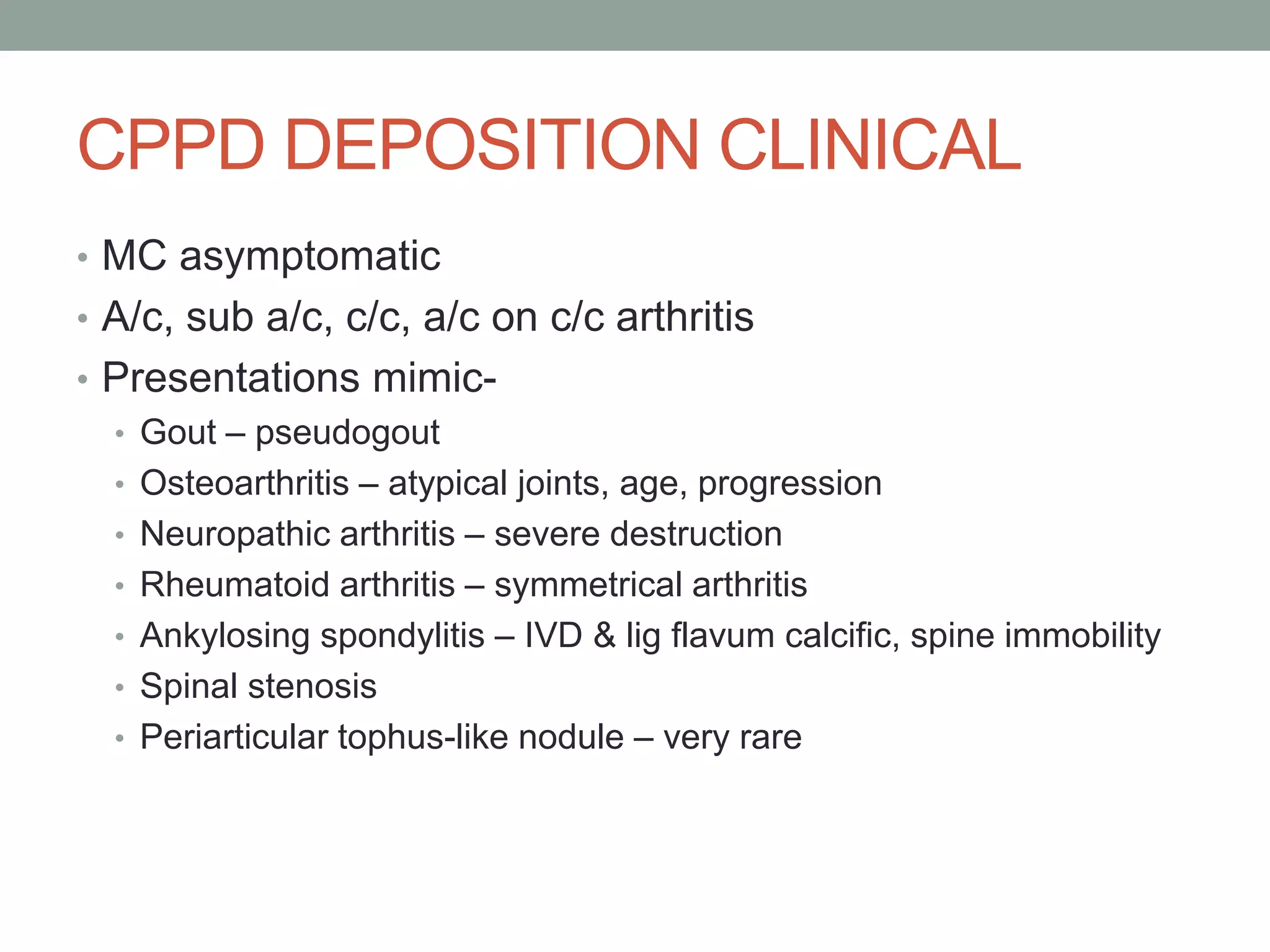
CPPD DEPOSITION CLINICAL
• MC asymptomatic
• A/c, sub a/c, c/c, a/c on c/c arthritis
• Presentations mimic-
• Gout – pseudogout
• Osteoarthritis – atypical joints, age, progression
• Neuropathic arthritis – severe destruction
• Rheumatoid arthritis – symmetrical arthritis
• Ankylosing spondylitis – IVD & lig flavum calcific, spine immobility
• Spinal stenosis
• Periarticular tophus-like nodule – very rare
CPPD DEPOSITION
• Joints involved-
• MC knee
• Wrist, shoulder, ankle, elbow, hand joints
• Rarely TMJ, ligamentum flavum
• Usually polyarticular
• Mimic many others
• Low grade fever
• Precipitated by-
• Trauma
• Rapid ↓ serum calcium levels
CPPD DEPOSITION
• Synovial fluid-
• TC = 1000s to 100,000/mm3
• Definitive –
• Rhomboid, square, rod-like crystals
• Weak birefringent
• Inside tissue fragments, clots, neutrophils
• Radiographic-
• Chondrocalcinosis
• Punctate / linear opacities in cartilaginous tissue
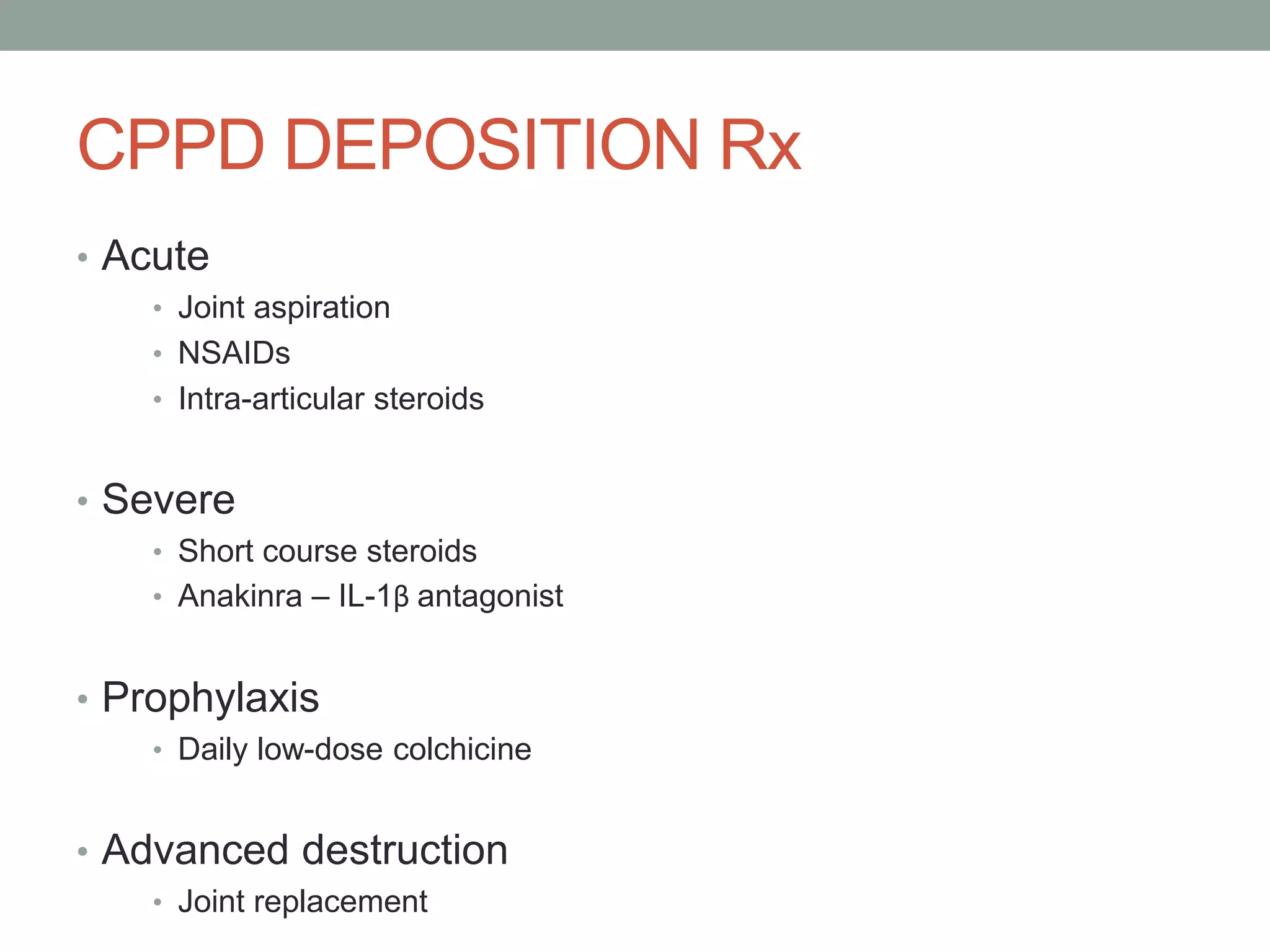
CPPD DEPOSITION Rx
• Acute
• Joint aspiration
• NSAIDs
• Intra-articular steroids
• Severe
• Short course steroids
• Anakinra – IL-1β antagonist
• Prophylaxis
• Daily low-dose colchicine
• Advanced destruction
• Joint replacement
CALCIUM APATITE
DEPOSITION DISEASE
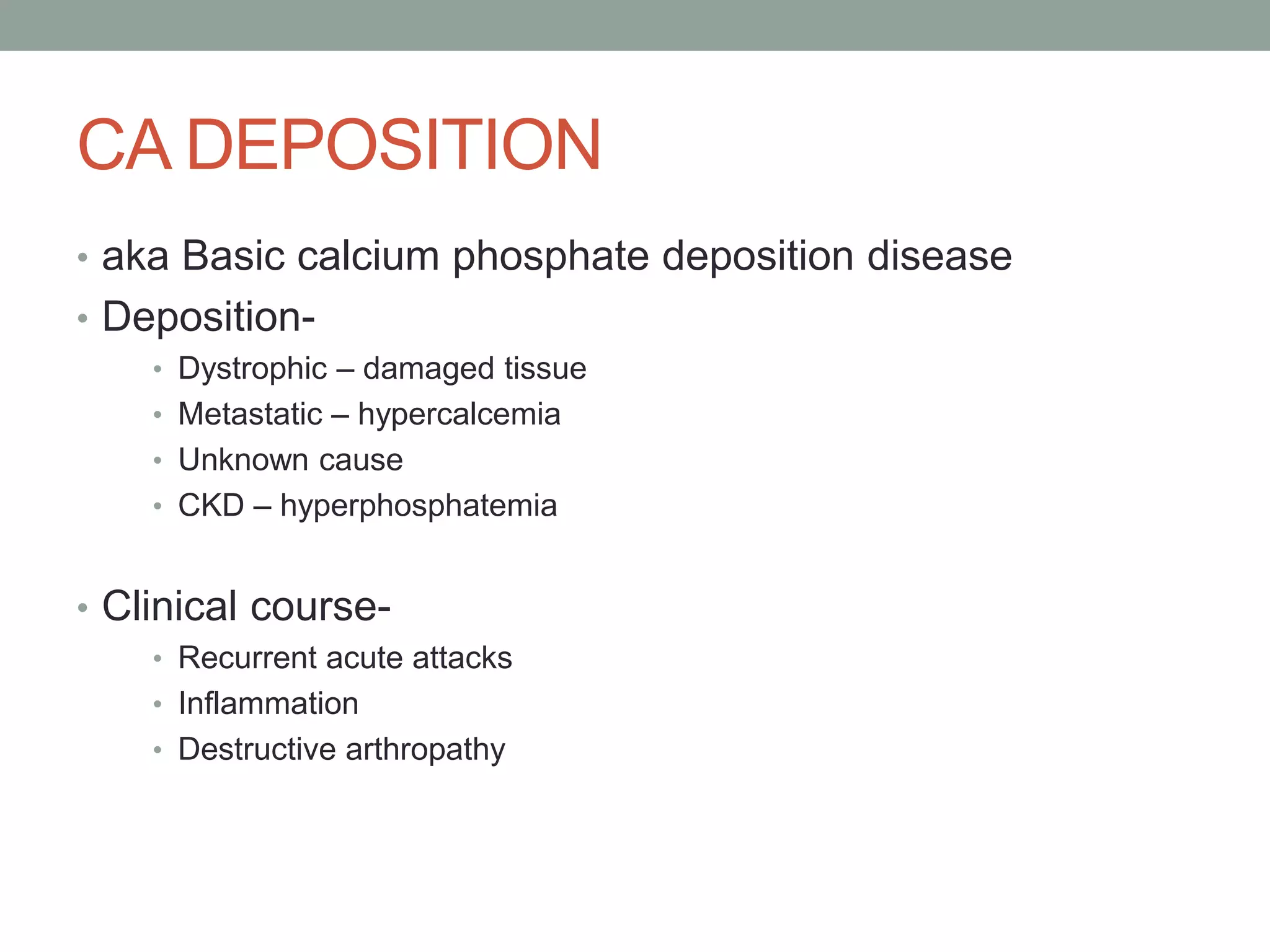
CA DEPOSITION
• aka Basic calcium phosphate deposition disease
• Deposition-
• Dystrophic – damaged tissue
• Metastatic – hypercalcemia
• Unknown cause
• CKD – hyperphosphatemia
• Clinical course-
• Recurrent acute attacks
• Inflammation
• Destructive arthropathy
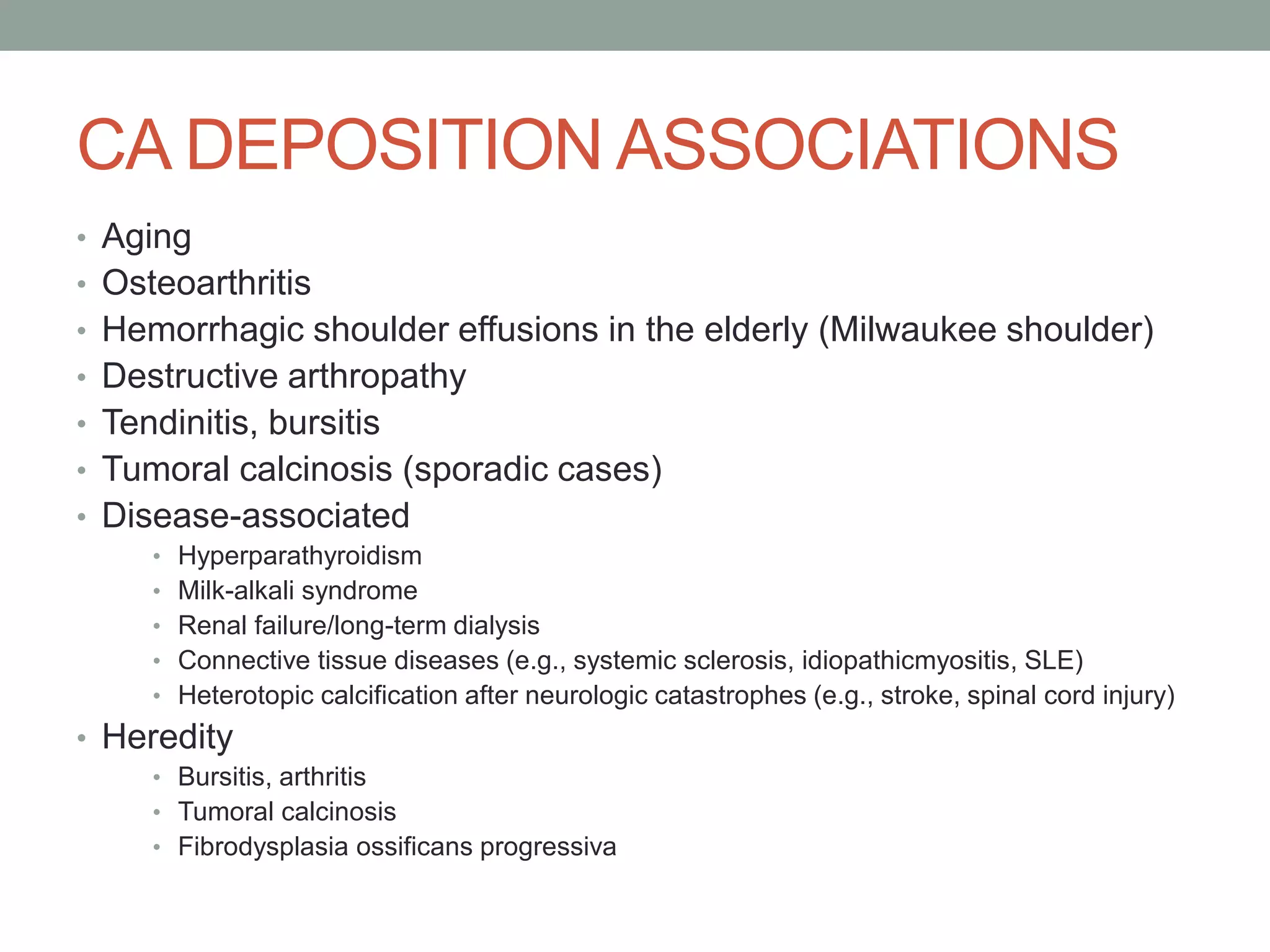
CA DEPOSITION ASSOCIATIONS
• Aging
• Osteoarthritis
• Hemorrhagic shoulder effusions in the elderly (Milwaukee shoulder)
• Destructive arthropathy
• Tendinitis, bursitis
• Tumoral calcinosis (sporadic cases)
• Disease-associated
• Hyperparathyroidism
• Milk-alkali syndrome
• Renal failure/long-term dialysis
• Connective tissue diseases (e.g., systemic sclerosis, idiopathicmyositis, SLE)
• Heterotopic calcification after neurologic catastrophes (e.g., stroke, spinal cord injury)
• Heredity
• Bursitis, arthritis
• Tumoral calcinosis
• Fibrodysplasia ossificans progressiva
CA DEPOSITION
• Periarticular/articular deposits
• Acute reversible inflammation
• +/- chronic damage
• Joint capsule, tendon, bursa, articular surface
• Knee, shoulder, hip fingers
• Presentations-
• Asymptomatic radiographic changes
• Acute synovitis, bursitis, tendinitis
• Chronic destructive arthropathy
CA DEPOSITION
• Synovial fluid-
• Low TC <2000/mm3
• But dramatic symptoms
• Crystal clumps
• Individual crystals – electron micro, X-ray diffraction, IR spectroscopy
• Crystal clumps –
• 1-20 micrometre
• Intra/extracellular
• Nonbirefringent
• Wright’s stain – purplish
• Alizarin red – bright red
• Radiographic-
• Intra/peri-articular calcification
• +/- erosive/destructive/hypertrophic changes
CA DEPOSITION Rx
• Acute attacks-
• May self limit by days to several weeks
• Joint aspiration
• NSAIDs
• Colchicine
• Intra/periarticular depot steroid
• Renal failure-
• Phosphate lowering agents
• Severe destruction-
• Joint replacement
CALCIUM OXALATE
DEPOSITION DISEASE
COD DISEASE
• Primary oxalosis-
• Rare hereditary disorder
• Enzyme defects
• Hyperoxalemia – Ca oxalate crystal deposition
• Nephrocalcinosis, renal failure, arthritis, periarthritis
• Death by 20 years of age
• Secondary-
• Complication of ESRD
• Pt on haemo/peritoneal dialysis
• Ascorbic acid supplements
• Visceral organs, blood vessels, bones, cartilages
• Arthritis in CKD
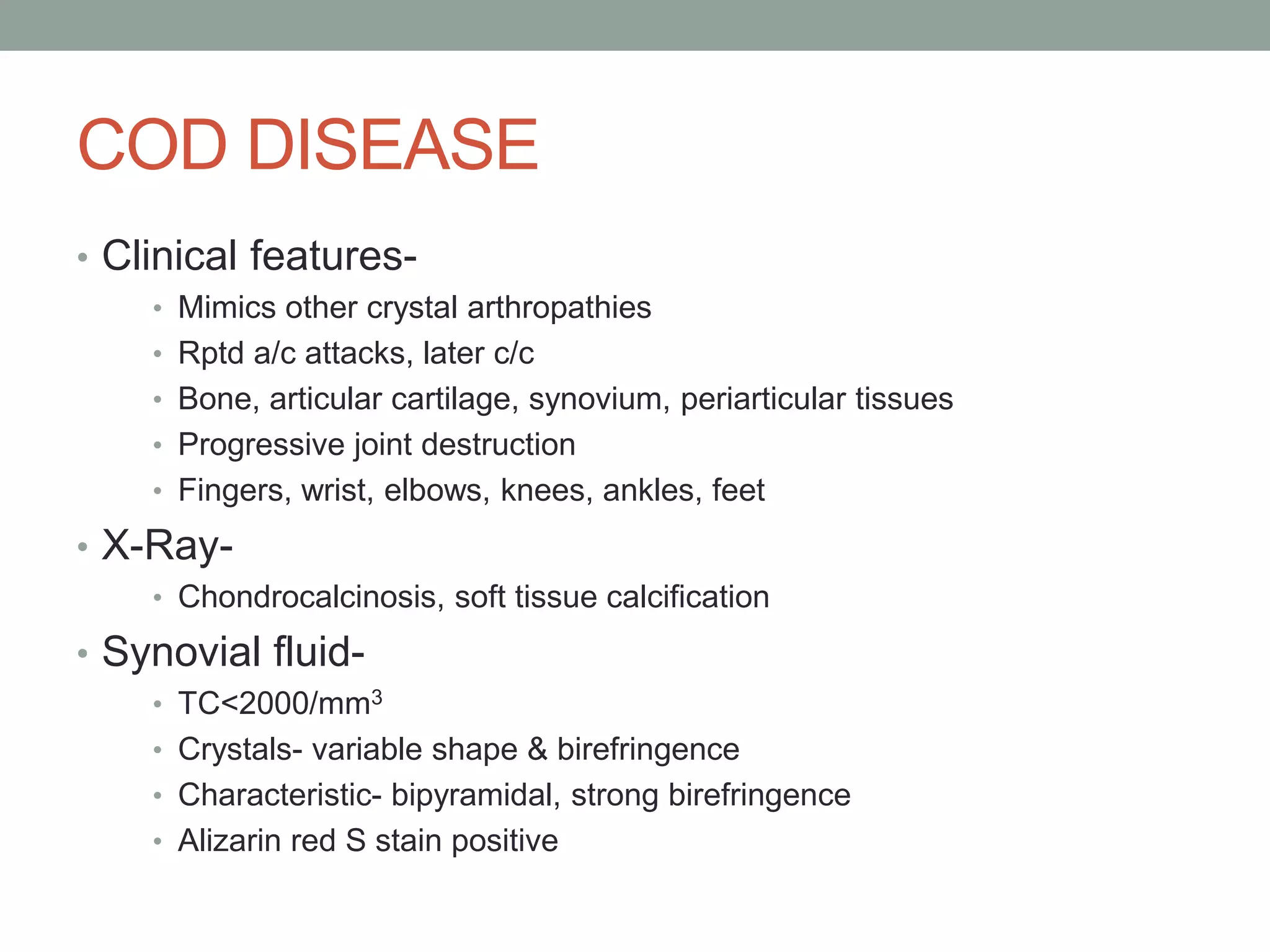
COD DISEASE
• Clinical features-
• Mimics other crystal arthropathies
• Rptd a/c attacks, later c/c
• Bone, articular cartilage, synovium, periarticular tissues
• Progressive joint destruction
• Fingers, wrist, elbows, knees, ankles, feet
• X-Ray-
• Chondrocalcinosis, soft tissue calcification
• Synovial fluid-
• TC<2000/mm3
• Crystals- variable shape & birefringence
• Characteristic- bipyramidal, strong birefringence
• Alizarin red S stain positive
COD DISEASE
• Treatment-
• Medical mildly effective
• Joint replacement in end-stage
• Liver transplant for Primary oxalosis
Crystal associated arthropathies

Crystal associated arthropathies

  • 1.
  • 2.
    Crystalline particles injoint disease • Intrinsic • Monosodium urate monohydrate (Gout) • Calcium pyrophosphate dihydrate (Pseudogout) • Calcium phosphates • • Basic—hydroxyapatite, octacalcium phosphate, tricalcium phosphate • • Acidic—brushite, monetite • Calcium oxalate • Lipids • Cholesterol • Lipid liquid crystals • Charcot–Leyden (phospholipase) crystals • Cystine • Xanthine, hypoxanthine • Protein precipitates (e.g. cryoglobulins) • Extrinsic • Synthetic corticosteroids • Plant thorns (semicrystalloid cellulose), especially blackthorn, rose, dried palm fronds • Sea urchin spines (crystalline calcium carbonate) • Methylmethacrylate
  • 3.
    COMMON DISEASES • Gout •Monosodium urate monohydrate • Pseudogout or Chondrocalcinosis • Calcium pyrophosphate dihydrate • Basic calcium phosphate • Hydroxyapatite • Calcium oxalate
  • 4.
  • 5.
    GOUT • Metabolic disease •↑ Body pool of urate • Hyperuricemia • Monosodium urate monohydrate deposition • Joints • Connective tissue • Kidney interstitium • Uric acid nephrolithiasis
  • 6.
    GOUT • Affects:- • Middleaged to elderly males • Postmenopausal women • Precipitants:- • Purine rich foods • Alcohol intake • Trauma, surgery • Hypouricemic drugs • Serious illness – MI, stroke
  • 7.
    GOUT RISK FACTORS •Primary:- • Hyperuricemia • Male sex • Hypertension • Obesity • Insulin resistance • Metabolic syndrome • Alcohol • Purine rich diet • ↓ uric acid excretion • Secondary:- • Diuretics • CKD • Osteoarthritis • Chronic renal failure • Lead poisoning (rare) • Ciclosporin (rare) • Myeloproliferative disorders (rare)
  • 8.
    GOUT PHASES 1) Asymptomatichyperuricemia 2) Acute gout • Single peripheral joint – 50% podagra (big toe) • Midtarsal, ankle, knee, small hand joints, wrist, elbow • Swollen, red, hot, shiny, tender joint 3) Intercritical gout • Repeated attacks • Turns chronic by 10 years 4) Chronic tophaceous gout • Tophi – large crystal deposits • Irregular firm nodule • Joint deformity & damage • Associated – Uric acid stones, c/c urate nephropathy
  • 10.
    GOUT • Diagnosis:- • Synovialfluid aspirate / tophi • Birefringent crystals – polarized light • Radiological:- • Soft tissue swelling • Cystic changes • Erosion of articular surfaces • Sclerotic margins
  • 11.
    GOUT TREATMENT • ↓inflammation:- • NSAIDs • Colchicine low dose • Joint aspiration • Steroids – intra-articular, systemic • Icepacks • Long term:- • Lifestyle modification • Avoid alcohol • Avoid purine rich foods • Weight reduction • Urate lowering • Allopurinol, febuxostat • Uricosuric + Fluid intake + Alkalinization • Probenecid , sulfinpyrazone
  • 12.
  • 13.
    CPPD DEPOSITION • Elderly- •65-75 years = 10-15% • >85 years = 30-50% • Cause – uncertain • ↑ ATP degradation to adenosine+pyrophosphate • ↑ Extracellular pyrophosphate transport (genetic mutation) • Calcium pyrophosphate formed and deposited • Crystals phagocytosed (monocytes, macrophages, neutrophils) • Inflammation • Destruction
  • 14.
    CPPD DEPOSITION • Associatedwith – • Aging • Disease-associated • Primary hyperparathyroidism • Hemochromatosis • Hypophosphatasia • Hypomagnesemia • Chronic gout • Postmeniscectomy • Gitelman's syndrome • Epiphyseal dysplasias
  • 15.
    CPPD DEPOSITION CLINICAL •MC asymptomatic • A/c, sub a/c, c/c, a/c on c/c arthritis • Presentations mimic- • Gout – pseudogout • Osteoarthritis – atypical joints, age, progression • Neuropathic arthritis – severe destruction • Rheumatoid arthritis – symmetrical arthritis • Ankylosing spondylitis – IVD & lig flavum calcific, spine immobility • Spinal stenosis • Periarticular tophus-like nodule – very rare
  • 16.
    CPPD DEPOSITION • Jointsinvolved- • MC knee • Wrist, shoulder, ankle, elbow, hand joints • Rarely TMJ, ligamentum flavum • Usually polyarticular • Mimic many others • Low grade fever • Precipitated by- • Trauma • Rapid ↓ serum calcium levels
  • 17.
    CPPD DEPOSITION • Synovialfluid- • TC = 1000s to 100,000/mm3 • Definitive – • Rhomboid, square, rod-like crystals • Weak birefringent • Inside tissue fragments, clots, neutrophils • Radiographic- • Chondrocalcinosis • Punctate / linear opacities in cartilaginous tissue
  • 18.
    CPPD DEPOSITION Rx •Acute • Joint aspiration • NSAIDs • Intra-articular steroids • Severe • Short course steroids • Anakinra – IL-1β antagonist • Prophylaxis • Daily low-dose colchicine • Advanced destruction • Joint replacement
  • 19.
  • 20.
    CA DEPOSITION • akaBasic calcium phosphate deposition disease • Deposition- • Dystrophic – damaged tissue • Metastatic – hypercalcemia • Unknown cause • CKD – hyperphosphatemia • Clinical course- • Recurrent acute attacks • Inflammation • Destructive arthropathy
  • 21.
    CA DEPOSITION ASSOCIATIONS •Aging • Osteoarthritis • Hemorrhagic shoulder effusions in the elderly (Milwaukee shoulder) • Destructive arthropathy • Tendinitis, bursitis • Tumoral calcinosis (sporadic cases) • Disease-associated • Hyperparathyroidism • Milk-alkali syndrome • Renal failure/long-term dialysis • Connective tissue diseases (e.g., systemic sclerosis, idiopathicmyositis, SLE) • Heterotopic calcification after neurologic catastrophes (e.g., stroke, spinal cord injury) • Heredity • Bursitis, arthritis • Tumoral calcinosis • Fibrodysplasia ossificans progressiva
  • 22.
    CA DEPOSITION • Periarticular/articulardeposits • Acute reversible inflammation • +/- chronic damage • Joint capsule, tendon, bursa, articular surface • Knee, shoulder, hip fingers • Presentations- • Asymptomatic radiographic changes • Acute synovitis, bursitis, tendinitis • Chronic destructive arthropathy
  • 23.
    CA DEPOSITION • Synovialfluid- • Low TC <2000/mm3 • But dramatic symptoms • Crystal clumps • Individual crystals – electron micro, X-ray diffraction, IR spectroscopy • Crystal clumps – • 1-20 micrometre • Intra/extracellular • Nonbirefringent • Wright’s stain – purplish • Alizarin red – bright red • Radiographic- • Intra/peri-articular calcification • +/- erosive/destructive/hypertrophic changes
  • 24.
    CA DEPOSITION Rx •Acute attacks- • May self limit by days to several weeks • Joint aspiration • NSAIDs • Colchicine • Intra/periarticular depot steroid • Renal failure- • Phosphate lowering agents • Severe destruction- • Joint replacement
  • 25.
  • 26.
    COD DISEASE • Primaryoxalosis- • Rare hereditary disorder • Enzyme defects • Hyperoxalemia – Ca oxalate crystal deposition • Nephrocalcinosis, renal failure, arthritis, periarthritis • Death by 20 years of age • Secondary- • Complication of ESRD • Pt on haemo/peritoneal dialysis • Ascorbic acid supplements • Visceral organs, blood vessels, bones, cartilages • Arthritis in CKD
  • 27.
    COD DISEASE • Clinicalfeatures- • Mimics other crystal arthropathies • Rptd a/c attacks, later c/c • Bone, articular cartilage, synovium, periarticular tissues • Progressive joint destruction • Fingers, wrist, elbows, knees, ankles, feet • X-Ray- • Chondrocalcinosis, soft tissue calcification • Synovial fluid- • TC<2000/mm3 • Crystals- variable shape & birefringence • Characteristic- bipyramidal, strong birefringence • Alizarin red S stain positive
  • 28.
    COD DISEASE • Treatment- •Medical mildly effective • Joint replacement in end-stage • Liver transplant for Primary oxalosis