Training
&
Development
Mamun Muztaba
Management Counsellor, BIM
Cell # 01716-653626
E-mail:
mamunmuztaba.bim@gmail.com
“Give a man a fish, and
you have given him a meal.
Teach a man to fish, and
you have given him a livelihood.”
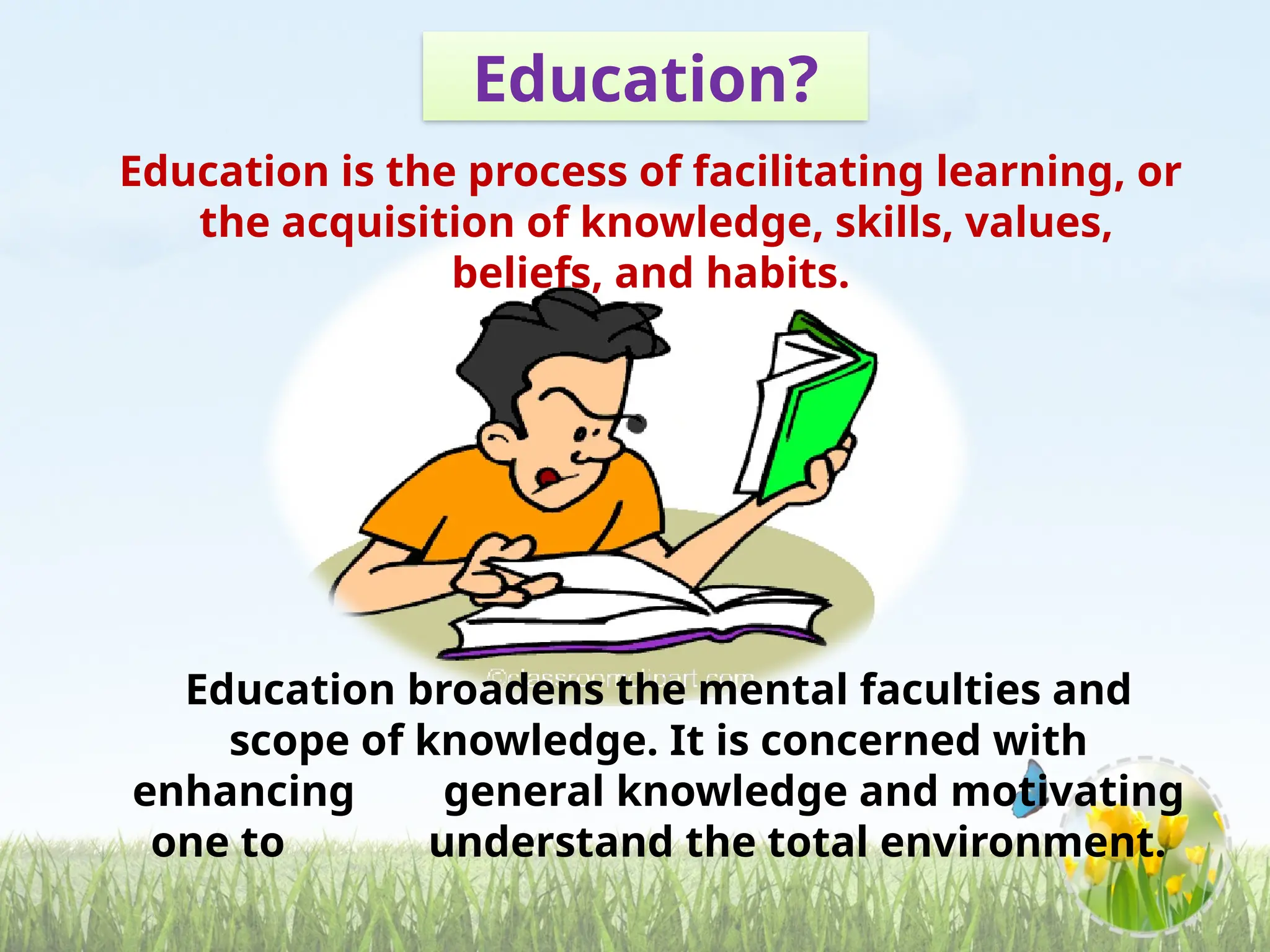
Education broadens the mental faculties and
scope of knowledge. It is concerned with
enhancing general knowledge and motivating
one to understand the total environment.
Education?
Education is the process of facilitating learning, or
the acquisition of knowledge, skills, values,
beliefs, and habits.
Required
• Skills
• Knowledge
• Attitudes
Training?
Existing
• Skills
• Knowledge
• Attitudes
Training refers to a planned effort by a company to facilitate employees’
learning of job related competencies.
These competencies include knowledge, skills, or behaviors that are
critical for successful job performance.
Training is defined as any attempt to improve employee performance
on a currently held job or one related to it.
This usually means changes in specific knowledge's, skills, attitudes
or behaviors.
Training?
Development: enhances the capabilities of an
employee to be ready to perform possible
future jobs.
The systematic use of scientific and technical
knowledge to meet specific objectives or
requirements.
Learning is the act of acquiring new, or modifying
and reinforcing, existing knowledge, behaviors, skills,
values, or preferences and may involve synthesizing
different types of information.
Measurable and relatively permanent
change in behavior through experience,
instruction, or study.
Learning?
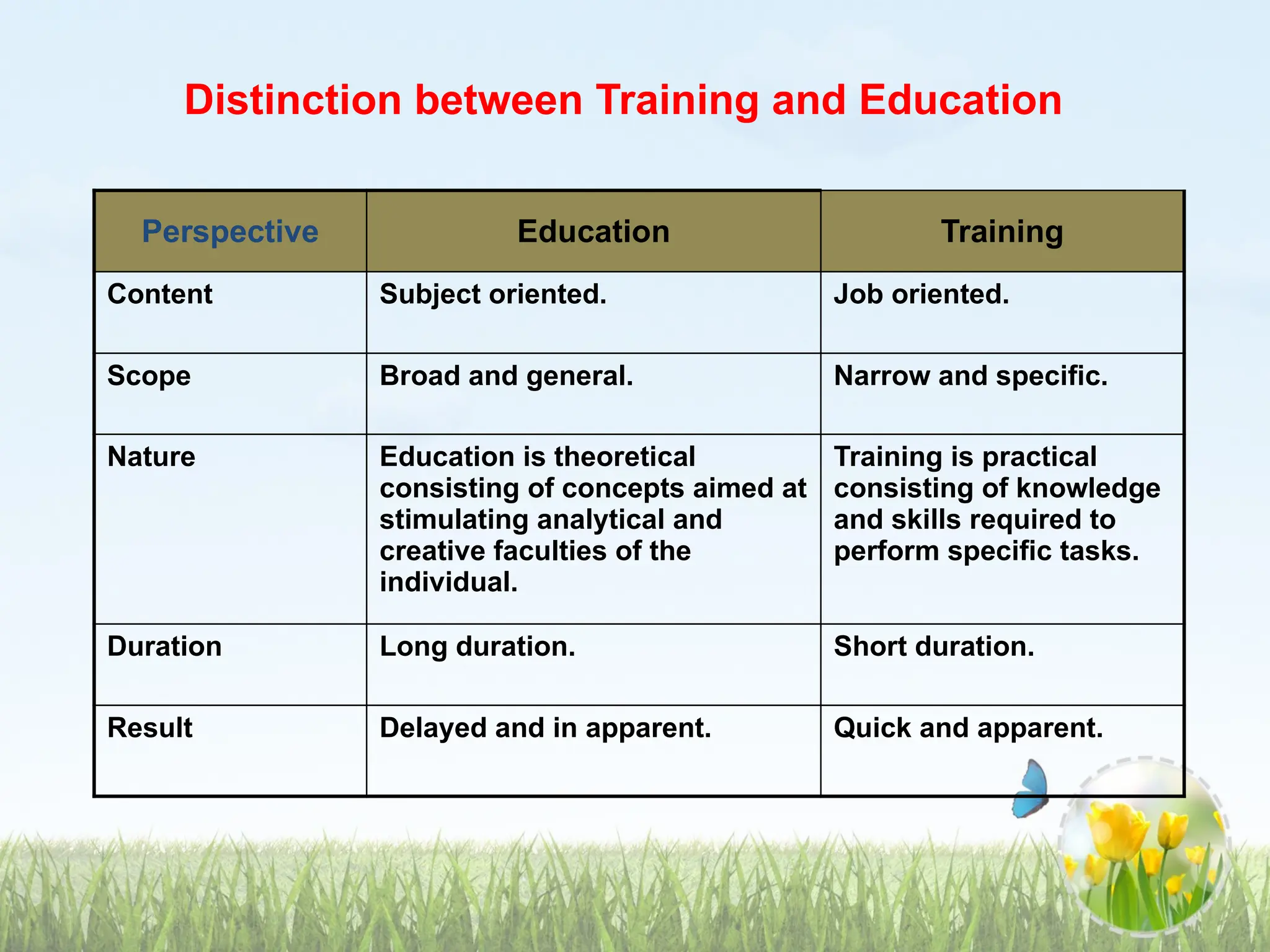
Perspective Education Training
Content Subject oriented. Job oriented.
Scope Broad and general. Narrow and specific.
Nature Education is theoretical
consisting of concepts aimed at
stimulating analytical and
creative faculties of the
individual.
Training is practical
consisting of knowledge
and skills required to
perform specific tasks.
Duration Long duration. Short duration.
Result Delayed and in apparent. Quick and apparent.
Distinction between Training and Education
Perspective Training Development
Purpose Training is the act of
increasing the knowledge,
skills, and attitudes of an
employee for doing a
particular job.
Development refers to
learning opportunities
designed to improve the
overall personality of an
individual.
Contents Technical and mechanical
operations.
Conceptual and philosophical
concepts.
Focus The focus of training is on the
immediate period to help fix
any current deficits in
employees’ skills.
The focus of development is
on the long term to help
employees prepare for future
work demands or career
goals.
Participant
s
Training is meant for
operatives (non-managerial
personnel).
Development is meant for
executives (managerial
personnel).
Distinction Between Training & Development
• 1. Higher Productivity
• 2. Better Quality of Work
• 3. Less Learning Period
• 4. Cost Reduction
• 5. Reduced Supervision
• 6. Low Accident Rate
• 7. High Morale
• 8. Personal Growth
• 9. Improved Organizational Climate
IMPORTANCE OF TRAINING
TRAINING PROCESS
Identifying Training Needs
Setting Training Objectives
Preparing Training Plan
Implementing Training Plan
Program Facilities Methods Trainers
Evaluation of Results
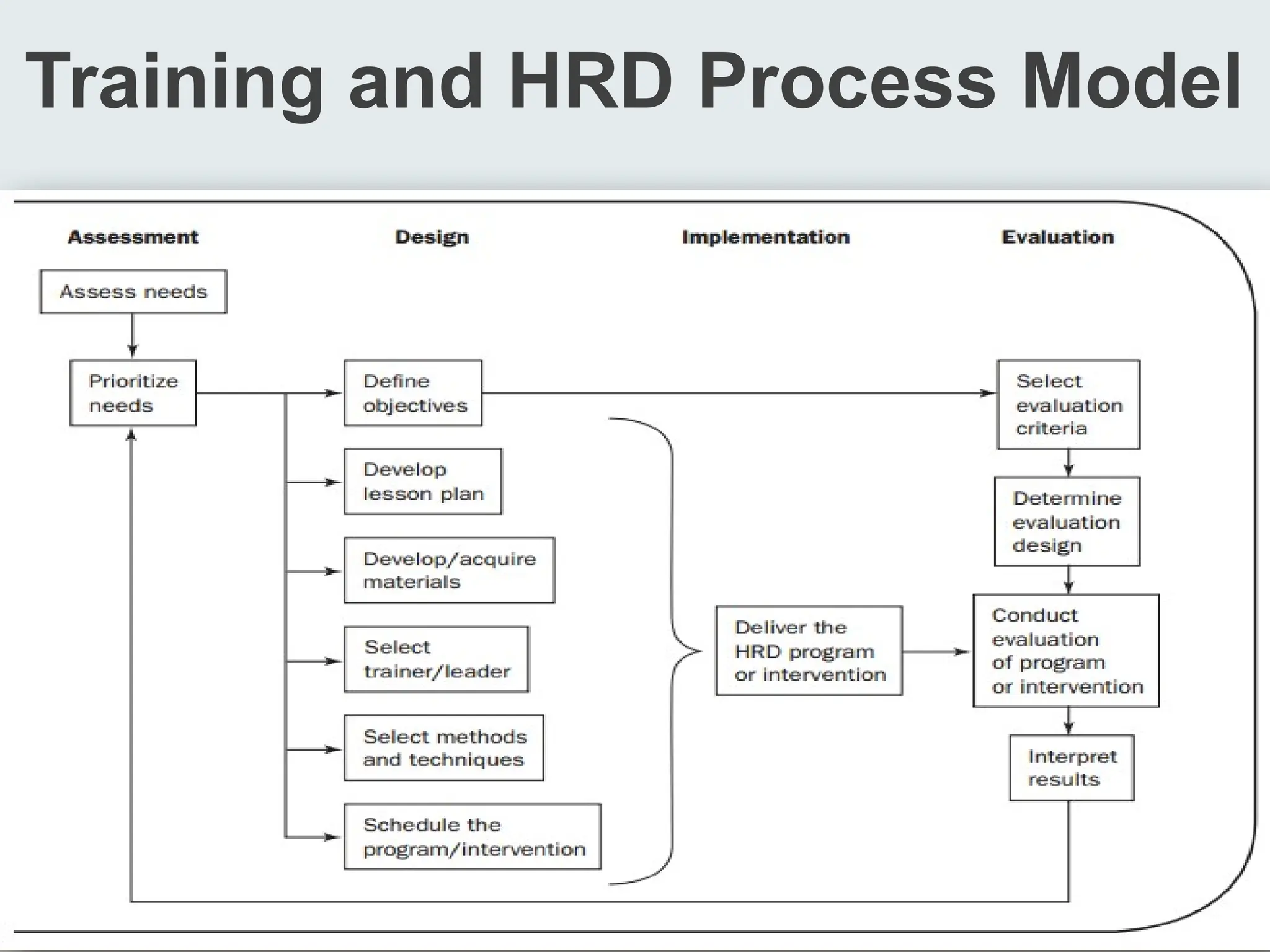
Training and HRD Process Model
Training Cycle
Training
On the Job Off the Job
1. Induction or Orientation
Training
2. Job Training
3. Safety Training
4. Promotional / Development
Training
5. Refresher Training
6. Remedial Training
7. Internship Training
1. Foundation Training
2. Safety Training
3. Promotional/
Development Training
4. Refresher Training
5. Remedial Training
Understanding
Adult Learning
“Anyone who stops learning is old, whether at twenty
or eighty. Anyone who keeps learning stays young.”
― Henry Ford
“I hear and I forget, I see I remember, I do I
understand”
― Confucius
“Intellectual growth should commence at birth and
cease only at death.”
― Albert Einstein
Understanding Adult Learning
Process
The field of adult learning was pioneered by Malcolm Shepherd
Knowles. He identified the following 6 characteristics of adult
learners (more familiarly known as adult learning Principles):
1. Autonomous and self-directed
2. Experiences and knowledge
3. Goal-oriented
4. Relevancy-oriented
5. Practical
6. Need to be shown respect
Traditional Method of Teaching
TEACHER
s
s
s
s
The Didactic "Teacher  Student
Method
Student
Small and unimportant
Little knowledge about the topic
Must keep quiet during lecture
Has no experience to share
Teacher
Very big and important
Ignores students’
experience
Full of knowledge
 The didactic Teacher-Student Method is often not an effective
training model for adults for two reasons.
1. It disregards a very important resource - the students'
knowledge and experience.
2. Adults learn better and remember what they learned when
they:
 Hear information
 See demonstrations and illustrations
 Discuss information and ideas
 Practice techniques
Traditional Method of Teaching
P
P
P
P
P
P
T
Adult (Participatory) Training
The Trainer
A facilitator
A good communicator
Works at the same level
as the participants
Respects participants'
ideas and experiences
Supportive of the
learning process
 An organizer of learning
experiences
The Participants
Members of a
communication network
Feel at ease
Participate actively
Share experiences
Ask questions, make
mistakes, and take risks as
part of the training process
Use the trainer as a
resource, guide and mentor
Adult Education Principle Implications for the training plan
Adults learn best when they perceive
learning as relevant to their needs.
 Provide "real life" situations and emphasize
the application of learning to real problems.
 Identify learners' needs and what is important
to them.
Adults have unique learning styles.
They learn in different ways, at
different rates, and from different
experiences.
 Use a variety of training techniques.
 Establish an atmosphere of respect and
understanding of differences.
Participants bring relevant and
important knowledge and experiences
to the workshop.
 Provide opportunities for sharing information.
 Discuss and analyze participants' experiences.
 Use participants as a resource and encourage
them to participate and share their
experiences.
Pedagogy Vs Andragogy
Pedagogy
•It is the method of teaching
children.
•Learners are dependent.
•Learners have less or no
experience to share, hence
teaching becomes didactic.
•Learners learn whatever the
curriculum offers.
•Teachers are required to
direct the learner.
•Learning is curriculum
oriented
Andragogy
It is the method of teaching adults
Learners are independent.
Learners are experienced, hence
teaching involves, discussion,
problem solving etc.
The content has to be modified
according to the learners’ need.
The learners are self-motivated.
Learners need teachers to guide
them.
Learning is goal oriented.
Training, education, development & learning.pptx

Training, education, development & learning.pptx

  • 1.
    Training & Development Mamun Muztaba Management Counsellor,BIM Cell # 01716-653626 E-mail: mamunmuztaba.bim@gmail.com
  • 2.
    “Give a mana fish, and you have given him a meal. Teach a man to fish, and you have given him a livelihood.”
  • 3.
    Education broadens themental faculties and scope of knowledge. It is concerned with enhancing general knowledge and motivating one to understand the total environment. Education? Education is the process of facilitating learning, or the acquisition of knowledge, skills, values, beliefs, and habits.
  • 4.
    Required • Skills • Knowledge •Attitudes Training? Existing • Skills • Knowledge • Attitudes
  • 5.
    Training refers toa planned effort by a company to facilitate employees’ learning of job related competencies. These competencies include knowledge, skills, or behaviors that are critical for successful job performance. Training is defined as any attempt to improve employee performance on a currently held job or one related to it. This usually means changes in specific knowledge's, skills, attitudes or behaviors. Training?
  • 6.
    Development: enhances thecapabilities of an employee to be ready to perform possible future jobs. The systematic use of scientific and technical knowledge to meet specific objectives or requirements.
  • 7.
    Learning is theact of acquiring new, or modifying and reinforcing, existing knowledge, behaviors, skills, values, or preferences and may involve synthesizing different types of information. Measurable and relatively permanent change in behavior through experience, instruction, or study. Learning?
  • 8.
    Perspective Education Training ContentSubject oriented. Job oriented. Scope Broad and general. Narrow and specific. Nature Education is theoretical consisting of concepts aimed at stimulating analytical and creative faculties of the individual. Training is practical consisting of knowledge and skills required to perform specific tasks. Duration Long duration. Short duration. Result Delayed and in apparent. Quick and apparent. Distinction between Training and Education
  • 9.
    Perspective Training Development PurposeTraining is the act of increasing the knowledge, skills, and attitudes of an employee for doing a particular job. Development refers to learning opportunities designed to improve the overall personality of an individual. Contents Technical and mechanical operations. Conceptual and philosophical concepts. Focus The focus of training is on the immediate period to help fix any current deficits in employees’ skills. The focus of development is on the long term to help employees prepare for future work demands or career goals. Participant s Training is meant for operatives (non-managerial personnel). Development is meant for executives (managerial personnel). Distinction Between Training & Development
  • 10.
    • 1. HigherProductivity • 2. Better Quality of Work • 3. Less Learning Period • 4. Cost Reduction • 5. Reduced Supervision • 6. Low Accident Rate • 7. High Morale • 8. Personal Growth • 9. Improved Organizational Climate IMPORTANCE OF TRAINING
  • 11.
    TRAINING PROCESS Identifying TrainingNeeds Setting Training Objectives Preparing Training Plan Implementing Training Plan Program Facilities Methods Trainers Evaluation of Results
  • 12.
    Training and HRDProcess Model
  • 13.
  • 14.
    Training On the JobOff the Job 1. Induction or Orientation Training 2. Job Training 3. Safety Training 4. Promotional / Development Training 5. Refresher Training 6. Remedial Training 7. Internship Training 1. Foundation Training 2. Safety Training 3. Promotional/ Development Training 4. Refresher Training 5. Remedial Training
  • 15.
  • 16.
    “Anyone who stopslearning is old, whether at twenty or eighty. Anyone who keeps learning stays young.” ― Henry Ford “I hear and I forget, I see I remember, I do I understand” ― Confucius “Intellectual growth should commence at birth and cease only at death.” ― Albert Einstein
  • 17.
    Understanding Adult Learning Process Thefield of adult learning was pioneered by Malcolm Shepherd Knowles. He identified the following 6 characteristics of adult learners (more familiarly known as adult learning Principles): 1. Autonomous and self-directed 2. Experiences and knowledge 3. Goal-oriented 4. Relevancy-oriented 5. Practical 6. Need to be shown respect
  • 18.
    Traditional Method ofTeaching TEACHER s s s s The Didactic "Teacher  Student Method Student Small and unimportant Little knowledge about the topic Must keep quiet during lecture Has no experience to share Teacher Very big and important Ignores students’ experience Full of knowledge
  • 19.
     The didacticTeacher-Student Method is often not an effective training model for adults for two reasons. 1. It disregards a very important resource - the students' knowledge and experience. 2. Adults learn better and remember what they learned when they:  Hear information  See demonstrations and illustrations  Discuss information and ideas  Practice techniques Traditional Method of Teaching
  • 20.
    P P P P P P T Adult (Participatory) Training TheTrainer A facilitator A good communicator Works at the same level as the participants Respects participants' ideas and experiences Supportive of the learning process  An organizer of learning experiences The Participants Members of a communication network Feel at ease Participate actively Share experiences Ask questions, make mistakes, and take risks as part of the training process Use the trainer as a resource, guide and mentor
  • 21.
    Adult Education PrincipleImplications for the training plan Adults learn best when they perceive learning as relevant to their needs.  Provide "real life" situations and emphasize the application of learning to real problems.  Identify learners' needs and what is important to them. Adults have unique learning styles. They learn in different ways, at different rates, and from different experiences.  Use a variety of training techniques.  Establish an atmosphere of respect and understanding of differences. Participants bring relevant and important knowledge and experiences to the workshop.  Provide opportunities for sharing information.  Discuss and analyze participants' experiences.  Use participants as a resource and encourage them to participate and share their experiences.
  • 22.
    Pedagogy Vs Andragogy Pedagogy •Itis the method of teaching children. •Learners are dependent. •Learners have less or no experience to share, hence teaching becomes didactic. •Learners learn whatever the curriculum offers. •Teachers are required to direct the learner. •Learning is curriculum oriented Andragogy It is the method of teaching adults Learners are independent. Learners are experienced, hence teaching involves, discussion, problem solving etc. The content has to be modified according to the learners’ need. The learners are self-motivated. Learners need teachers to guide them. Learning is goal oriented.