A
PRESENTATION ON
HYDRAULIC PUMP:DESIGN AND SELECTION
B.Tech (Agril. Engg.)
Presentation By
Aarushi Chandrakar
Student ID - 20203293
Course Code – EFM-5424
BHARTIYA COLLEGE OFAGRICULTURAL ENGINEERING, DURG,C.G.
AFFILATED TO- INDIRA GANDHI KRISHIVISHWAVIDYALAYA, RAIPUR,C.G.
HYDRAULIC PUMP
• Hydraulic pumps are the devices which converts the mechanical energy into
hydraulic energy.
• Mechanical rotations are provided to the pump with the help of an electric
motor , which creates a partial vacuum in the inlet of the pump and allows
the fluid into the pump through inlet pipe .
• The entered fluid is being pushed by the pump into the various components of
hydraulic system or machine.
SELECTION OF HYDRAULIC PUMP
• The selection of hydraulic pump depends on following parameters-
1. Based on Types.
2. Based on Factors.
BASED ON TYPES
Hydraulic Pump
Vane Pump
Gear Pump
Axial Piston
GEAR PUMP
• In gear pumps it is the meshing of the gears pushing against the pump housing wall, in
piston pumps it is the piston pushing in the piston silo against a valve plate.
• Gear pumps are the most commonly used hydraulic pumps.
• They are less mechanically complicated and are cheaper to manufacture. Gear pump
housings come in a variety of materials from cast aluminum to 316 L stainless steel.
VANE PUMP
• One great advantage of a vane pump provides is that it runs quieter than
either gear pumps or piston pumps.
• Also, vane pumps exceed gear pumps in pressures up to ≤ 4000 psi.
• Of the three pump types vane pumps tend to be the most dirt sensitive.
• For some mobile applications where noise is an application consideration
vane pumps are making a resurgence in use.
AXIAL PISTON
• These pumps are capable of routinely achieving continuous running
pressures > 5000 psi (345 bar).
• Some units are now approaching 7500 psi (520 bar). The higher pressures,
speeds and absence of large reservoirs are a weight saving strategy.
• These systems run at slower speeds and pressures from 1500 to 2000 psi.
BASED ON FACTORS
• The factors which are considered for pump selection are:
1. Capacity.
2. Pressure
3. Driving Speed.
4. Efficiency.
5. Fluid Type.
6. Pump Placement.
PUMP DESIGN
• Pumps convert mechanical power to fluid power.
• Hydraulic pumps which are mainly used are gear type, roller vane type or
axial piston variable flow type.
• The pressures developed by three main types of hydraulic pumps are as
follows:
• 1. Fixed gear/vane pump : Pressure up to 10.3 MPa
• 2. Pressure balanced gear/vane pump : 13.8-24.1 MPa
• 3. Pinion type pump : 27.6-34.5 MPa
The common speed of operation of pumps ranges from 3000 to 5000 rpm.
FLUID POWER OF PUMP
SHAFT POWER OF PUMP
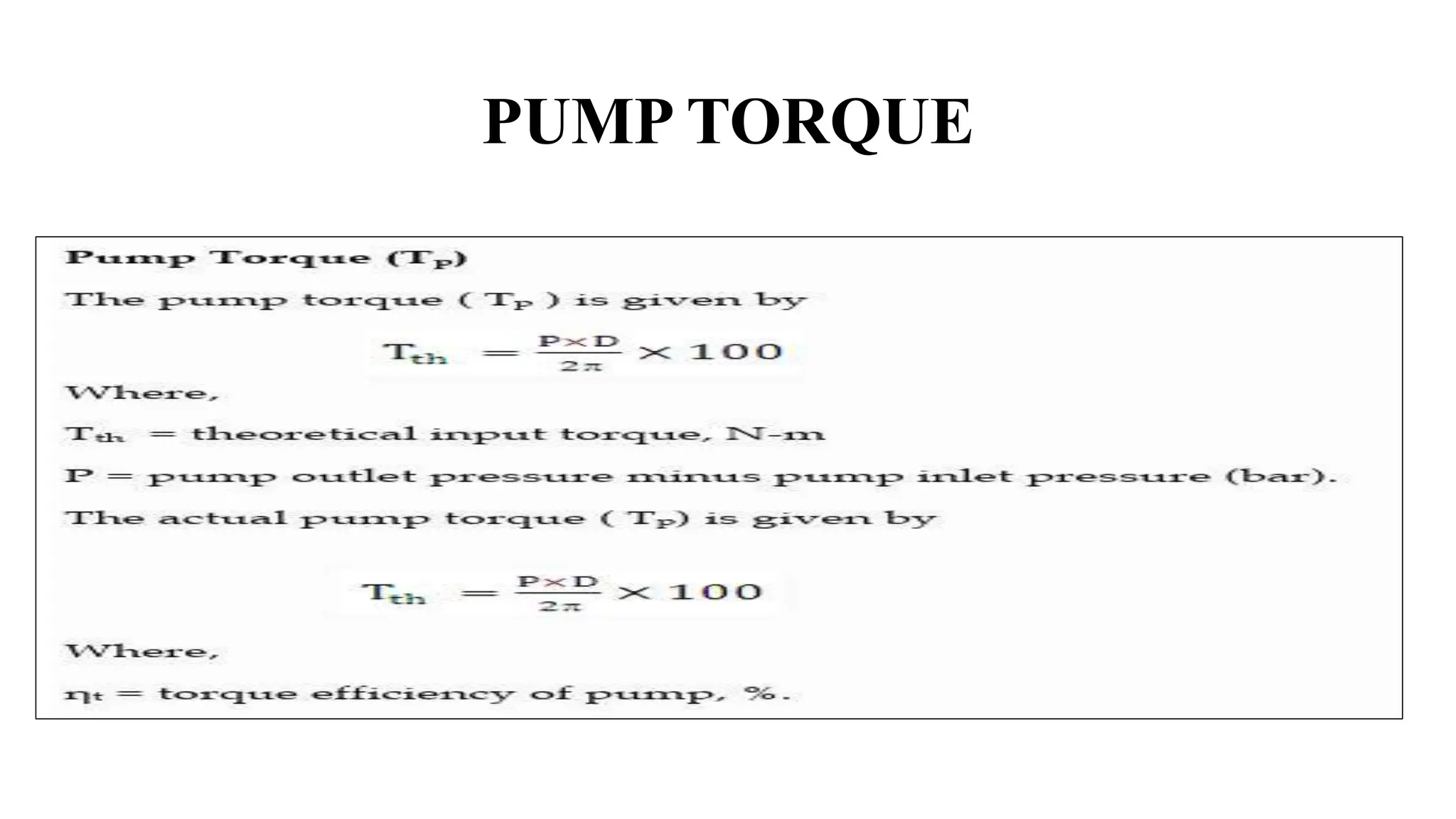
PUMP TORQUE
INPUT OR SHAFT POWER
HYDRAULIC POWER OF PUMP
OVERALL EFFICIENCY OF PUMP
tractor HYDRAULIC PUMP SELECTION AND DESIGN.pptx

tractor HYDRAULIC PUMP SELECTION AND DESIGN.pptx

  • 1.
    A PRESENTATION ON HYDRAULIC PUMP:DESIGNAND SELECTION B.Tech (Agril. Engg.) Presentation By Aarushi Chandrakar Student ID - 20203293 Course Code – EFM-5424 BHARTIYA COLLEGE OFAGRICULTURAL ENGINEERING, DURG,C.G. AFFILATED TO- INDIRA GANDHI KRISHIVISHWAVIDYALAYA, RAIPUR,C.G.
  • 2.
    HYDRAULIC PUMP • Hydraulicpumps are the devices which converts the mechanical energy into hydraulic energy. • Mechanical rotations are provided to the pump with the help of an electric motor , which creates a partial vacuum in the inlet of the pump and allows the fluid into the pump through inlet pipe . • The entered fluid is being pushed by the pump into the various components of hydraulic system or machine.
  • 3.
    SELECTION OF HYDRAULICPUMP • The selection of hydraulic pump depends on following parameters- 1. Based on Types. 2. Based on Factors.
  • 4.
    BASED ON TYPES HydraulicPump Vane Pump Gear Pump Axial Piston
  • 5.
    GEAR PUMP • Ingear pumps it is the meshing of the gears pushing against the pump housing wall, in piston pumps it is the piston pushing in the piston silo against a valve plate. • Gear pumps are the most commonly used hydraulic pumps. • They are less mechanically complicated and are cheaper to manufacture. Gear pump housings come in a variety of materials from cast aluminum to 316 L stainless steel.
  • 6.
    VANE PUMP • Onegreat advantage of a vane pump provides is that it runs quieter than either gear pumps or piston pumps. • Also, vane pumps exceed gear pumps in pressures up to ≤ 4000 psi. • Of the three pump types vane pumps tend to be the most dirt sensitive. • For some mobile applications where noise is an application consideration vane pumps are making a resurgence in use.
  • 7.
    AXIAL PISTON • Thesepumps are capable of routinely achieving continuous running pressures > 5000 psi (345 bar). • Some units are now approaching 7500 psi (520 bar). The higher pressures, speeds and absence of large reservoirs are a weight saving strategy. • These systems run at slower speeds and pressures from 1500 to 2000 psi.
  • 8.
    BASED ON FACTORS •The factors which are considered for pump selection are: 1. Capacity. 2. Pressure 3. Driving Speed. 4. Efficiency. 5. Fluid Type. 6. Pump Placement.
  • 9.
    PUMP DESIGN • Pumpsconvert mechanical power to fluid power. • Hydraulic pumps which are mainly used are gear type, roller vane type or axial piston variable flow type. • The pressures developed by three main types of hydraulic pumps are as follows: • 1. Fixed gear/vane pump : Pressure up to 10.3 MPa • 2. Pressure balanced gear/vane pump : 13.8-24.1 MPa • 3. Pinion type pump : 27.6-34.5 MPa The common speed of operation of pumps ranges from 3000 to 5000 rpm.
  • 10.
  • 11.
  • 12.
  • 13.
  • 14.
  • 15.