Dr Karen Smith
K.L.Smith@greenwich.ac.uk
     University of Greenwich


                               1
   “Any activity in which students are in a
    different country (the host country) to that in
    which the institution providing the education
    is based (the home country)” (GATE in McBurnie & Pollock, 2001).
   Also known as:
    ◦   Collaborative international provision
    ◦   Franchised provision
    ◦   Cross-border education            ‘More international
    ◦   Off-shore education              students are now
                                            working towards UK
                                            degrees overseas than
                                            at home’ OBHE 2011


                                                                       2
   Flying faculty ‘typically combines intensive sessions
    of block teaching from offshore academics, who
    fly-in from the “home” country and are supported
    by local tutor seminars and offshore tutors through
    the virtual learning environment’ (Smith 2009, 112).

   Grown over last twenty years      (Stella 2006)


   As has research in this area:
    ◦ Quality assurance
    ◦ Adaptations
    ◦ Institutional preparation and support


                                                            3
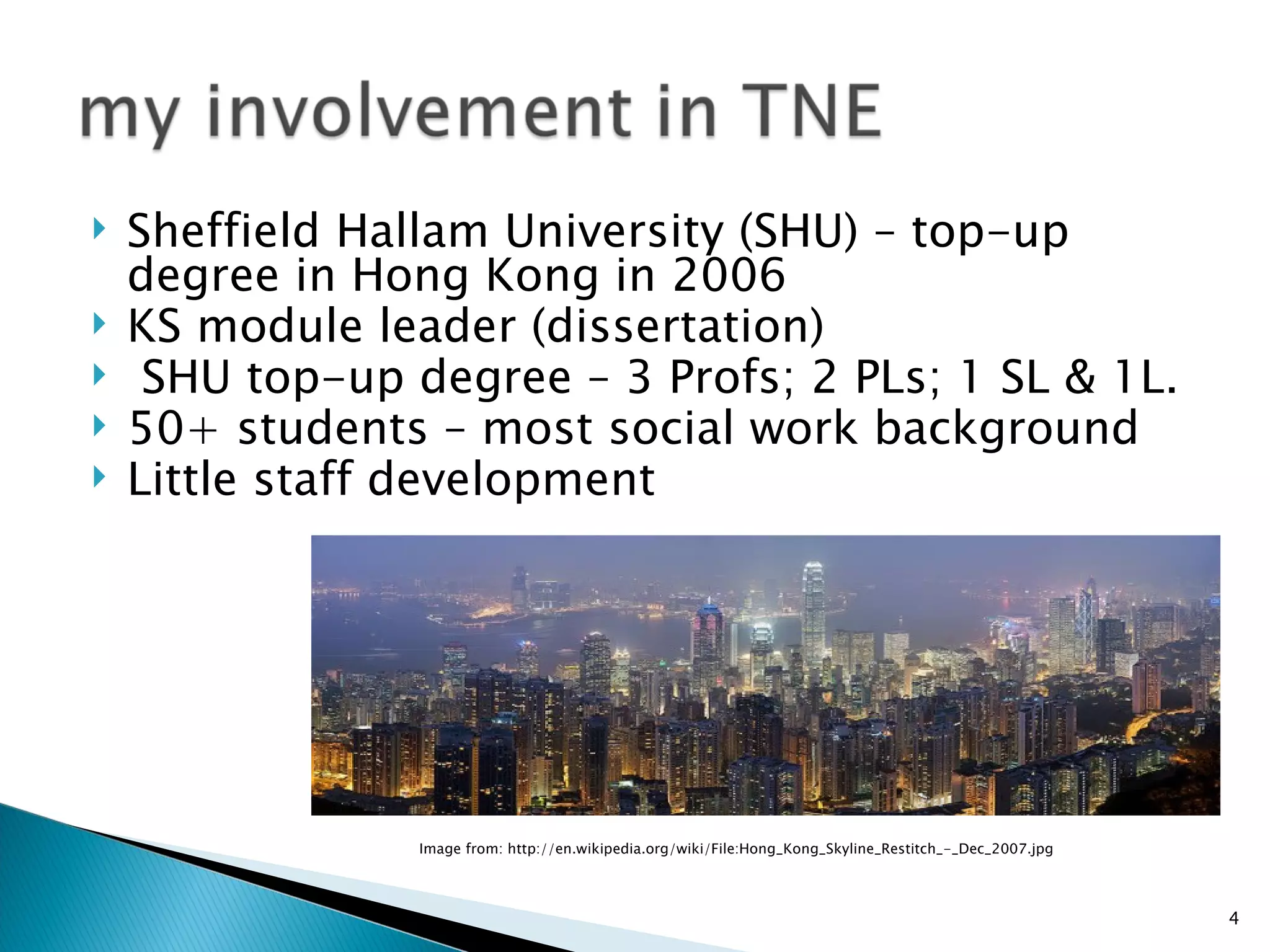
   Sheffield Hallam University (SHU) – top-up
    degree in Hong Kong in 2006
   KS module leader (dissertation)
    SHU top-up degree – 3 Profs; 2 PLs; 1 SL & 1L.
   50+ students – most social work background
   Little staff development


                 Image from: http://en.wikipedia.org/wiki/File:Hong_Kong_Skyline_Restitch_-_Dec_2007.jpg


                                                                                                           4
5
What brings you here?


                        6
7
   Uses the Biographical Narrative Interpretive
    Method [BNIM] (Wengraf, 2001)
   Captures lived situations and experiences
    through narrative interviewing

   ‘Typical case’ sampling,


                                                   8
   Logistics (heat, tiredness, accommodation)
   Teaching patterns (intensive delivery,
    workload at home)
   Gender differences and racism
   Assessment and equity
   Relationships with local tutors
   University infrastructural support


                                                 9
   Fresh ideas for teaching in the UK
   Better understanding on the whole
    programme
   Career progression
   New research areas
   Opportunities for collaboration and
    consultancy
   Expanded world views
   Empathy


                                          10
   Did you get any particular support from the
    institution?
    ◦   Not a thing (interview 1)
    ◦   Hmm, no, not really at that time (interview 2)
    ◦   Hmm, not really, not that I can remember         (interview 3)

    ◦   No (interview 4)
    ◦   No, no (interview 5)

   What did they say they wanted?


                                                                         12
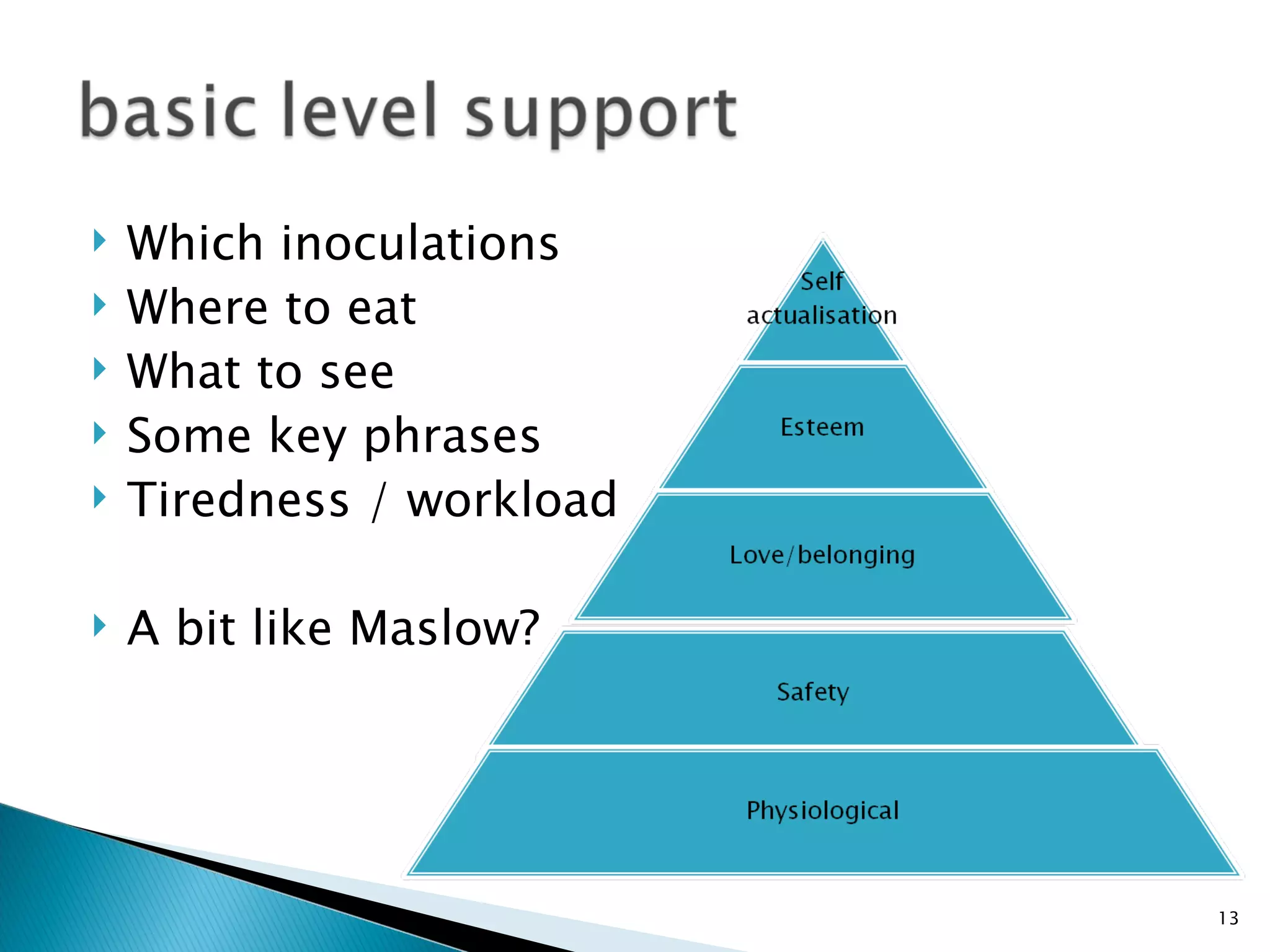
   Which inoculations
   Where to eat
   What to see
   Some key phrases
   Tiredness / workload

   A bit like Maslow?


                           13
   Obvious challenges
   Real opportunities
    ◦ Transformational learning?

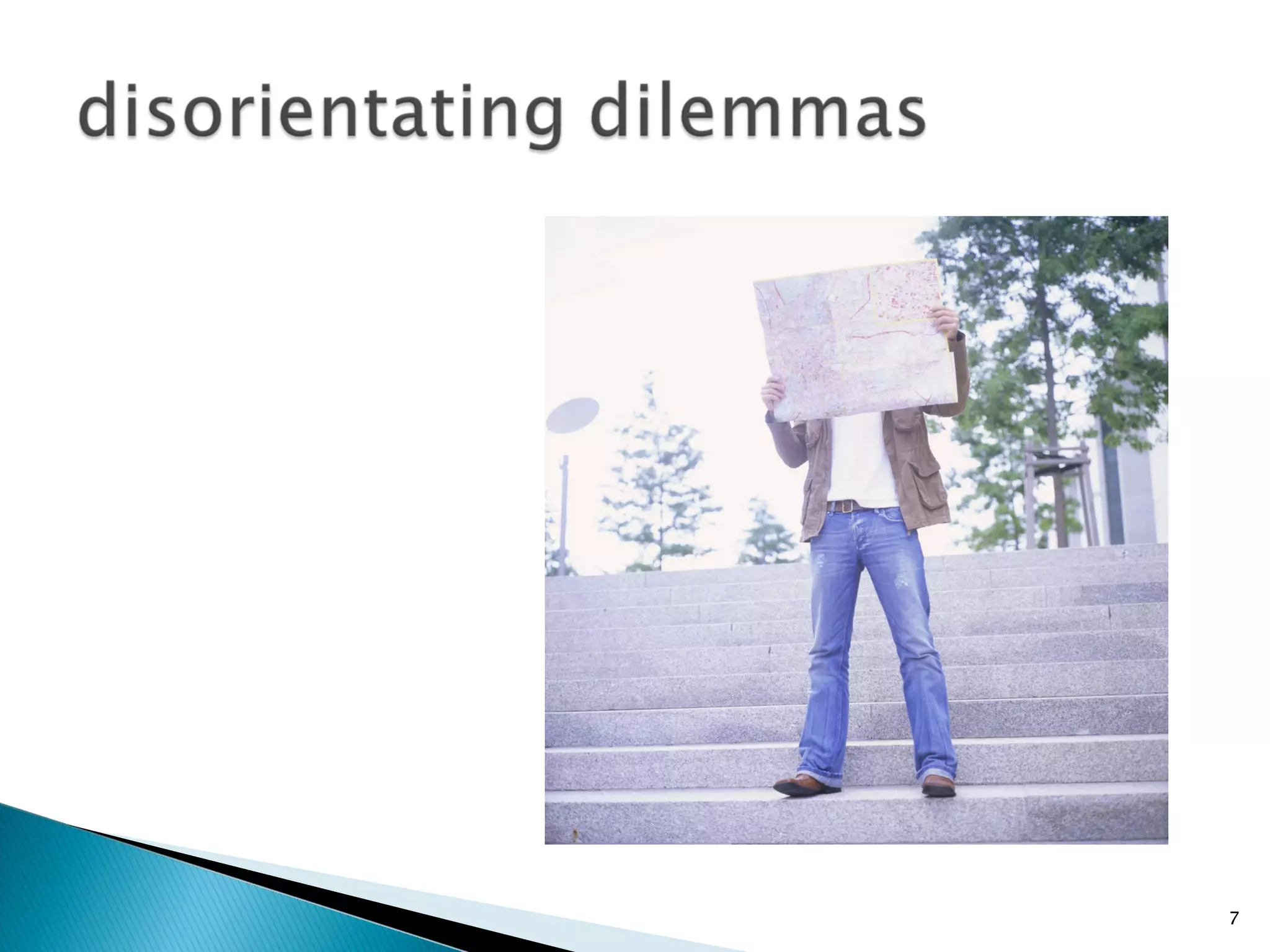
   Due to the ‘culture shock’ or ‘disorientating
    dilemma’
   Do we need pre-departure support at all?


                                                    14
   New staff paired with a more experienced mentor,
    share experience of routine events (e.g. Gribble &
    Ziguras, 2003).

   More use could be made of structured
    conversations between educational developers and
    transnational teachers (Haigh, 2005; Crabtree &
    Sapp, 2004).

   Project funds could be set aside to support small-
    scale research projects (Zuber-Skerritt, 1997).

                           What else could be done?
                                                         15
   Smith, K. 2014. Exploring flying faculty teaching
    experiences: motivations, challenges and
    opportunities, Studies in Higher Education,
    available online at:
    http://www.tandfonline.com/doi/abs/10.1080/030750

   Smith, K. 2013. Overseas flying faculty teaching as
    a trigger for transformative professional
    development, International Journal for Academic
    Development, available online at:
    http://www.tandfonline.com/doi/abs/10.1080/136014


                                                    16

Track D K Smith

  • 1.
  • 2.
    “Any activity in which students are in a different country (the host country) to that in which the institution providing the education is based (the home country)” (GATE in McBurnie & Pollock, 2001).  Also known as: ◦ Collaborative international provision ◦ Franchised provision ◦ Cross-border education ‘More international ◦ Off-shore education students are now working towards UK degrees overseas than at home’ OBHE 2011 2
  • 3.
    Flying faculty ‘typically combines intensive sessions of block teaching from offshore academics, who fly-in from the “home” country and are supported by local tutor seminars and offshore tutors through the virtual learning environment’ (Smith 2009, 112).  Grown over last twenty years (Stella 2006)  As has research in this area: ◦ Quality assurance ◦ Adaptations ◦ Institutional preparation and support 3
  • 4.
    Sheffield Hallam University (SHU) – top-up degree in Hong Kong in 2006  KS module leader (dissertation)  SHU top-up degree – 3 Profs; 2 PLs; 1 SL & 1L.  50+ students – most social work background  Little staff development Image from: http://en.wikipedia.org/wiki/File:Hong_Kong_Skyline_Restitch_-_Dec_2007.jpg 4
  • 5.
  • 6.
  • 7.
  • 8.
    Uses the Biographical Narrative Interpretive Method [BNIM] (Wengraf, 2001)  Captures lived situations and experiences through narrative interviewing  ‘Typical case’ sampling, 8
  • 9.
    Logistics (heat, tiredness, accommodation)  Teaching patterns (intensive delivery, workload at home)  Gender differences and racism  Assessment and equity  Relationships with local tutors  University infrastructural support 9
  • 10.
    Fresh ideas for teaching in the UK  Better understanding on the whole programme  Career progression  New research areas  Opportunities for collaboration and consultancy  Expanded world views  Empathy 10
  • 12.
    Did you get any particular support from the institution? ◦ Not a thing (interview 1) ◦ Hmm, no, not really at that time (interview 2) ◦ Hmm, not really, not that I can remember (interview 3) ◦ No (interview 4) ◦ No, no (interview 5)  What did they say they wanted? 12
  • 13.
    Which inoculations  Where to eat  What to see  Some key phrases  Tiredness / workload  A bit like Maslow? 13
  • 14.
    Obvious challenges  Real opportunities ◦ Transformational learning?  Due to the ‘culture shock’ or ‘disorientating dilemma’  Do we need pre-departure support at all? 14
  • 15.
    New staff paired with a more experienced mentor, share experience of routine events (e.g. Gribble & Ziguras, 2003).  More use could be made of structured conversations between educational developers and transnational teachers (Haigh, 2005; Crabtree & Sapp, 2004).  Project funds could be set aside to support small- scale research projects (Zuber-Skerritt, 1997).  What else could be done? 15
  • 16.
    Smith, K. 2014. Exploring flying faculty teaching experiences: motivations, challenges and opportunities, Studies in Higher Education, available online at: http://www.tandfonline.com/doi/abs/10.1080/030750  Smith, K. 2013. Overseas flying faculty teaching as a trigger for transformative professional development, International Journal for Academic Development, available online at: http://www.tandfonline.com/doi/abs/10.1080/136014 16