A Vision for
the Elementary
Learning
EnvironmentGuidelinesforbuildingplanning&design.
Tacoma Public Schools
September 2014
Table of Contents
Foreword									4
Part1	 Our Story						7
Looking into the future / We accept the challenge / Change begins with
community
Part2	Our Vision						17
Our vision for the built environment / Guiding principles / Rethinking the role
of community / Learning is safe and secure / Learning starts with physiology /
Learning is connecting with nature / Learning is inspiring / Learning is building
lifelong habits / The learning environment today / New methodologies of teaching
/ Learning on your own path / Learning is right-sized / The expanded classroom
/ Learning is connected / Learning is active and interdisciplinary / Learning is
particular / Learning is serious and playful / Learning requires a positive culture /
Final thoughts on vision
Part3	 Our Process	 				61
Let’s work together / Building to last for 50 years / Community Asset Mapping /
Benchmarking performance / Daylight analysis / Building for the future / Driving
forces / Scenario modeling / Wall flexibility study / Building for our learning
culture / Flexible program framework / Flexible space types / General learning /
Specialized learning / Large Group configuration
Conclusion	 								118
Resources									120
Photo credits								121
Acknowledgments								122
4
What is the vision for the district? We know
that learning happens outside of the school day,
outside of the seven hours and 180 days that
a child is in school. And if learning happens far
more outside school than within it, then how do
we align our efforts and our language to build a
culture that wraps around our kids so they are
learning all day, every day, and throughout the
year? That is the ultimate challenge for which
there is no answer.
Where does the visioning document fit in? The
visioning document isn’t an answer. It’s a list of
the best questions we have that should be asked
relentlessly by all people who are committed to
partnering with us, including community-based
organizations, the business community, and
parents.
Where do we start? We start with guiding
principles and questions. How do we create
an environment where kids are continuously
challenged, relentlessly supported, and engaged
in a way that’s safe and healthy? How do we
ensure that we are challenging all of our students
and keeping them engaged? How do we ensure
that all of our kids are healthy and supported?
How do we ensure that we are keeping our kids
safe socially, emotionally and academically? We
must start with these questions and relentlessly
ask them again and again. As long as we continue
asking the questions, we will be fine. The moment
that we stop asking these questions or think that
we have the answers, then we know that we are
wrong. And we must accept that the answers will
change, and we will hopefully know more.
What are the critical questions that a designer
must ask? As an educator, I ask myself how I
engage and support my students. For the facility,
how do you do that? Step back and ask yourself
what it means to be a student. Am I a student?
Are a child’s parents, grandparents, aunts, and
uncles students, too? How do we ensure that
we build healthy environments? Healthy means
more than just green or sustainable; it means
an environment that is welcoming. It also means
using our knowledge of colors to affect mood
such as brightening spaces darkened by our
climate here in the Pacific Northwest. How does
the environment challenge our students? When
we talk about environment, what do we mean? Is
the environment the block that we select and call
the school? Or is it all that we can walk to, drive
to, and even access online? You must relentlessly
ask questions. There are no single or right
answers.
How do we engage students with the built
environment? What does it mean to engage four
or five hundred students in the most meaningful
way? How do you create an environment
that allows a child to be present physically,
emotionally and even spiritually? Our kids
know more now than ever before. They have an
unprecedented level of access to information,
and that scares people. We cannot contain the
information any more than we can control our
children. We must ask ourselves how we can build
environments that influence them, not control
them.
Foreword
An alternative to the traditional ed spec
A conversation with Dr. Josh Garcia
Meta-cognition matters. It is the moment when a
child is able to step outside of herself and reflect
upon what she just learned and experienced.
It is the moment when she realizes that the
community, her environment, is changing the
way that she is thinking, and as a result, she
deliberately chooses a path and follows it.
Kids are becoming more aware. That excites
me. 	
How can the built environment stop and make
students pause for a split second and adjust their
thinking or their actions? That is what I mean
when I say spiritually. The definition changes
every time our students learn. The definition is
evolutional, and that’s the tension we face when
building our environment. Culture is a living,
breathing organism.
In the same way that you describe engaging
students, the vision must engage readers. Is
that right? We know that the brain works from
comprehension to analysis to interpretation to
meta-cognition. Comprehension builds upon
itself every day. With the visioning document,
we are building a new level of comprehension so
that others may analyze it. Some will agree with
parts, some will disagree with others, and in so
doing, new interpretations will be created. Every
time that we build a new building, we build a new
interpretation because we will have learned more.
We have the opportunity to write a tool that
truly sustains itself for the next decade if the
questions are right and the process is articulated
in a manner that allows the reader to either
consciously address the questions or consciously
determine that the questions should be ignored.
You don’t come to Tacoma and copy. You come to
Tacoma and learn. When you ask: what does that
mean, what does that mean for my community,
you create your own interpretation.
Part 1
Our story
The audience of this document is the community
in the broadest sense, as opposed to a more
narrow understanding which is typical of
educational specifications where the audience
is only the designer. A document that is valuable
to educators, the community and the designer
allows each to inform the others, so that
through dialogue, a better understanding of
the relationship between the built and learning
environments becomes possible. We begin the
document with our particular point of view, what
we consider our successes and weaknesses, what
we are trying to do, and our vision for a path to
get there.
8 Our Story
We are serious
about innovation.
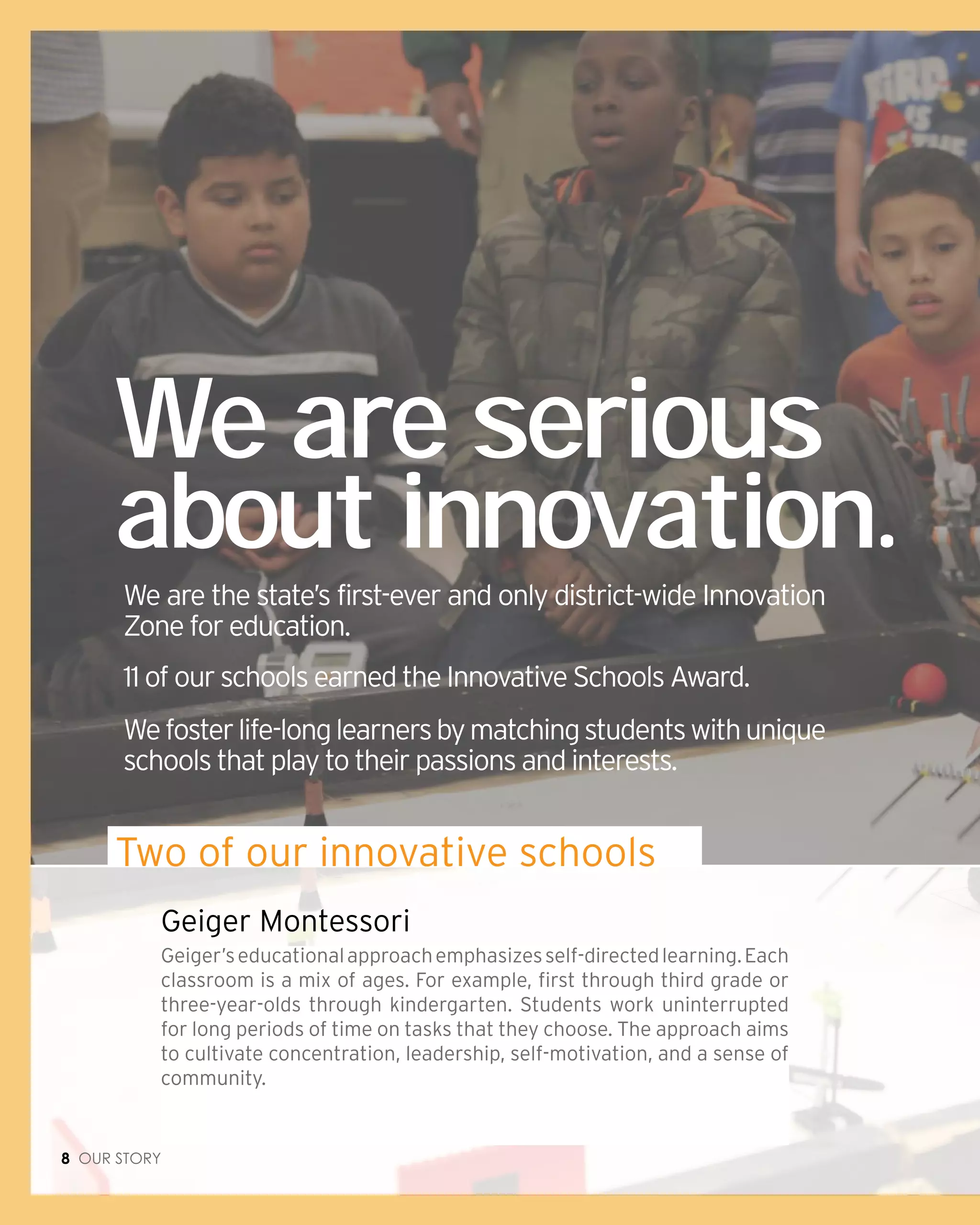
We are the state’s first-ever and only district-wide Innovation
Zone for education.
11 of our schools earned the Innovative Schools Award.
Wefosterlife-longlearnersbymatchingstudentswithunique
schools that play to their passions and interests.
Two of our innovative schools
Geiger’seducationalapproachemphasizesself-directedlearning.Each
classroom is a mix of ages. For example, first through third grade or
three-year-olds through kindergarten. Students work uninterrupted
for long periods of time on tasks that they choose. The approach aims
to cultivate concentration, leadership, self-motivation, and a sense of
community.
Geiger Montessori
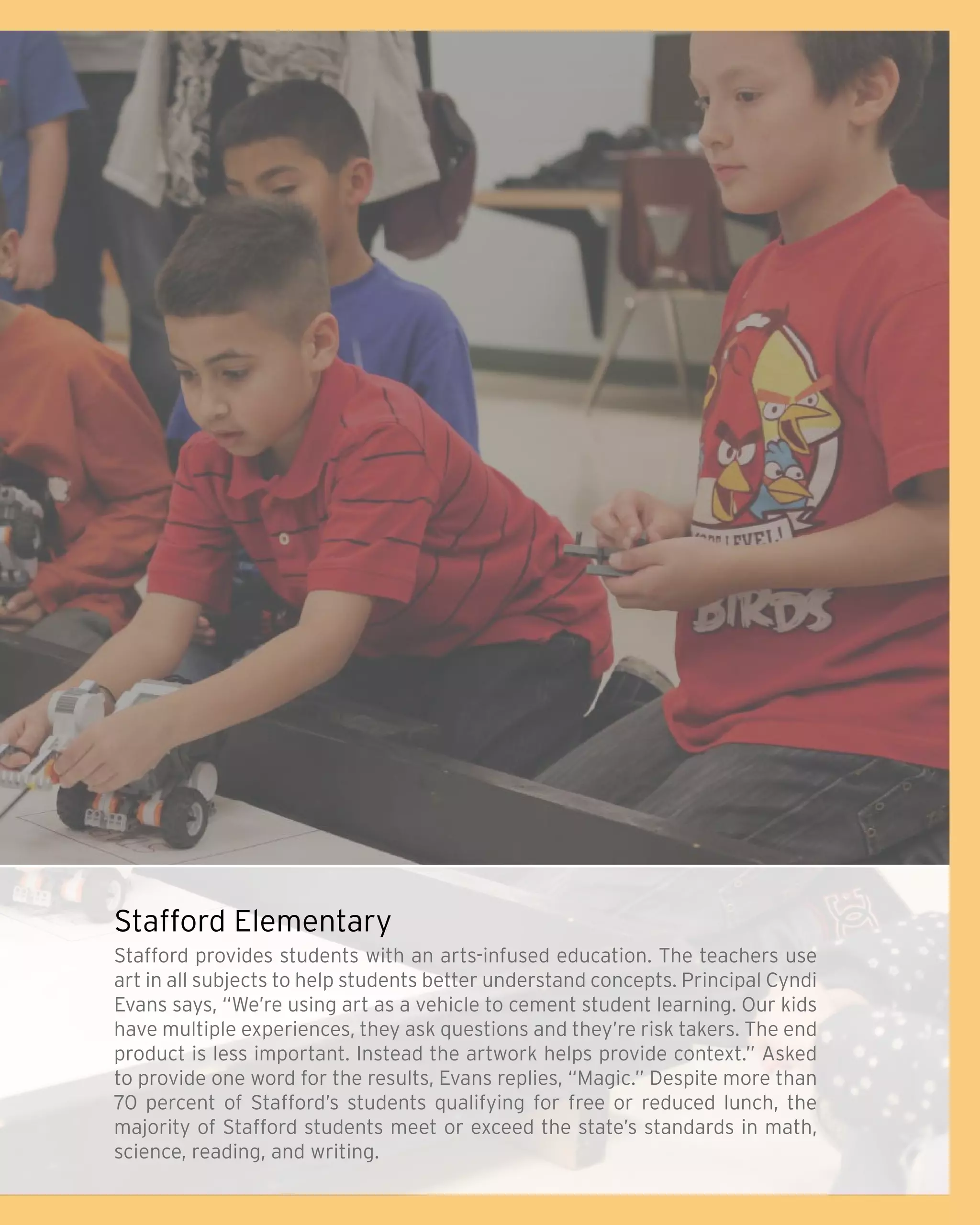
Stafford provides students with an arts-infused education. The teachers use
art in all subjects to help students better understand concepts. Principal Cyndi
Evans says, “We’re using art as a vehicle to cement student learning. Our kids
have multiple experiences, they ask questions and they’re risk takers. The end
product is less important. Instead the artwork helps provide context.” Asked
to provide one word for the results, Evans replies, “Magic.” Despite more than
70 percent of Stafford’s students qualifying for free or reduced lunch, the
majority of Stafford students meet or exceed the state’s standards in math,
science, reading, and writing.
Stafford Elementary
10 Our Story
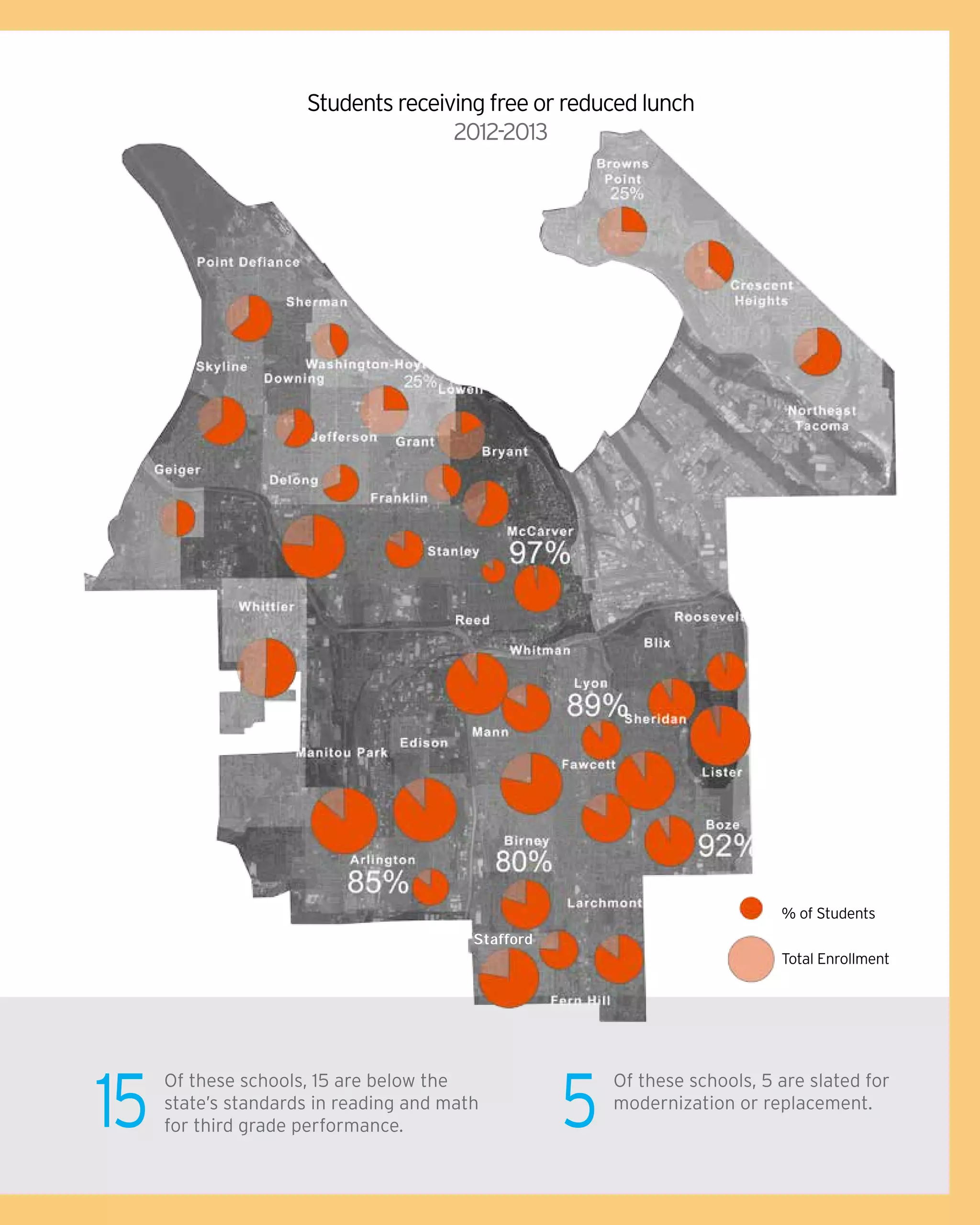
What the data tells us
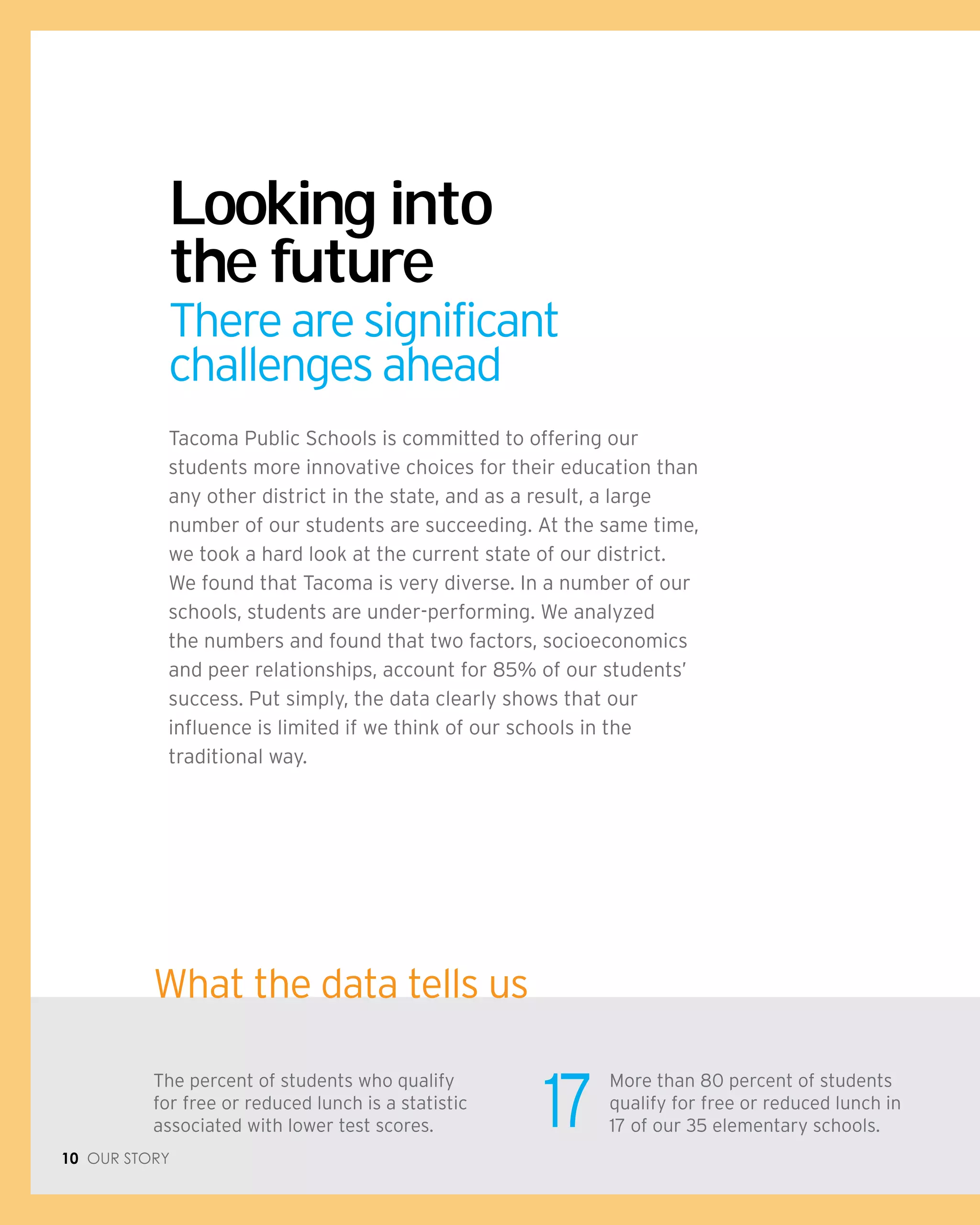
More than 80 percent of students
qualify for free or reduced lunch in
17 of our 35 elementary schools.
The percent of students who qualify
for free or reduced lunch is a statistic
associated with lower test scores. 17
Tacoma Public Schools is committed to offering our
students more innovative choices for their education than
any other district in the state, and as a result, a large
number of our students are succeeding. At the same time,
we took a hard look at the current state of our district.
We found that Tacoma is very diverse. In a number of our
schools, students are under-performing. We analyzed
the numbers and found that two factors, socioeconomics
and peer relationships, account for 85% of our students’
success. Put simply, the data clearly shows that our
influence is limited if we think of our schools in the
traditional way.
Looking into
the future
There are significant
challenges ahead
Students receiving free or reduced lunch
2012-2013
% of Students
Total Enrollment
15 5
Of these schools, 15 are below the
state’s standards in reading and math
for third grade performance.
Of these schools, 5 are slated for
modernization or replacement.
Stafford
12 Our Story
Inequity is not acceptable. We are committed to
providing a learning environment that allows every
student to succeed. We have successes, but we need to
do more. We are providing more support to the schools
that need it most. But resources are only part of the
answer; significant change requires supporting our built
environment as well. As we modernize and replace ten of
our elementary schools over the coming years, we have
the opportunity to build a better future for our children.
We accept
the challenge
Schools must become
agents for change
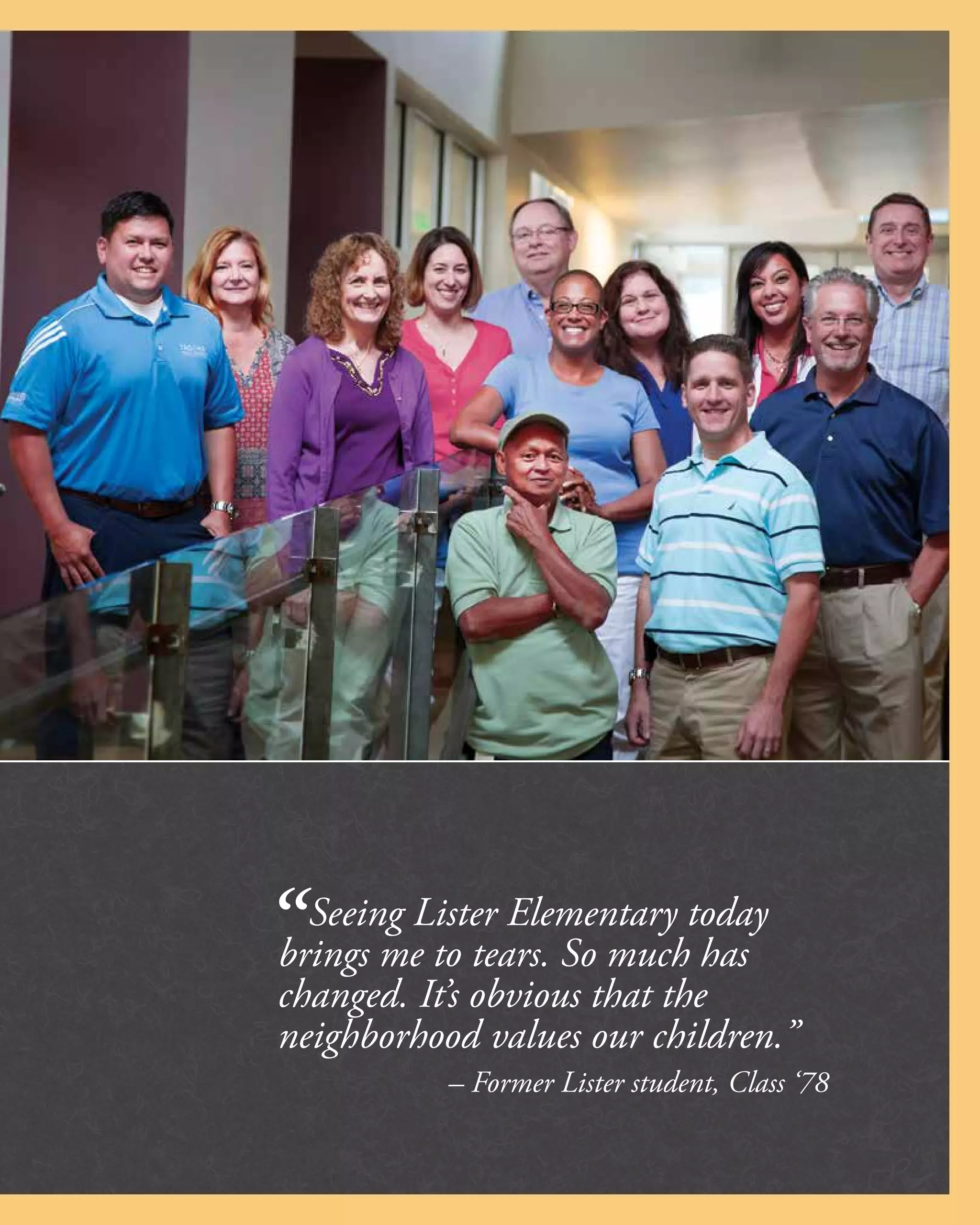
Seeing Lister Elementary today
brings me to tears. So much has
changed. It’s obvious that the
neighborhood values our children.”
– Former Lister student, Class ‘78
“
14 Our Story
In order to bring about serious change, work must
happen at the levels that influence socioeconomics and
peer relationships. The school may begin to work on
these deeper levels by rethinking the concept of school,
empowering our community partners, and establishing
a positive culture. If organizations already exist that
are doing this kind of work, then we must open up a
discussion, provide access to our resources, and make
them stronger.
Change begins
with community
Empower our community
through partnerships
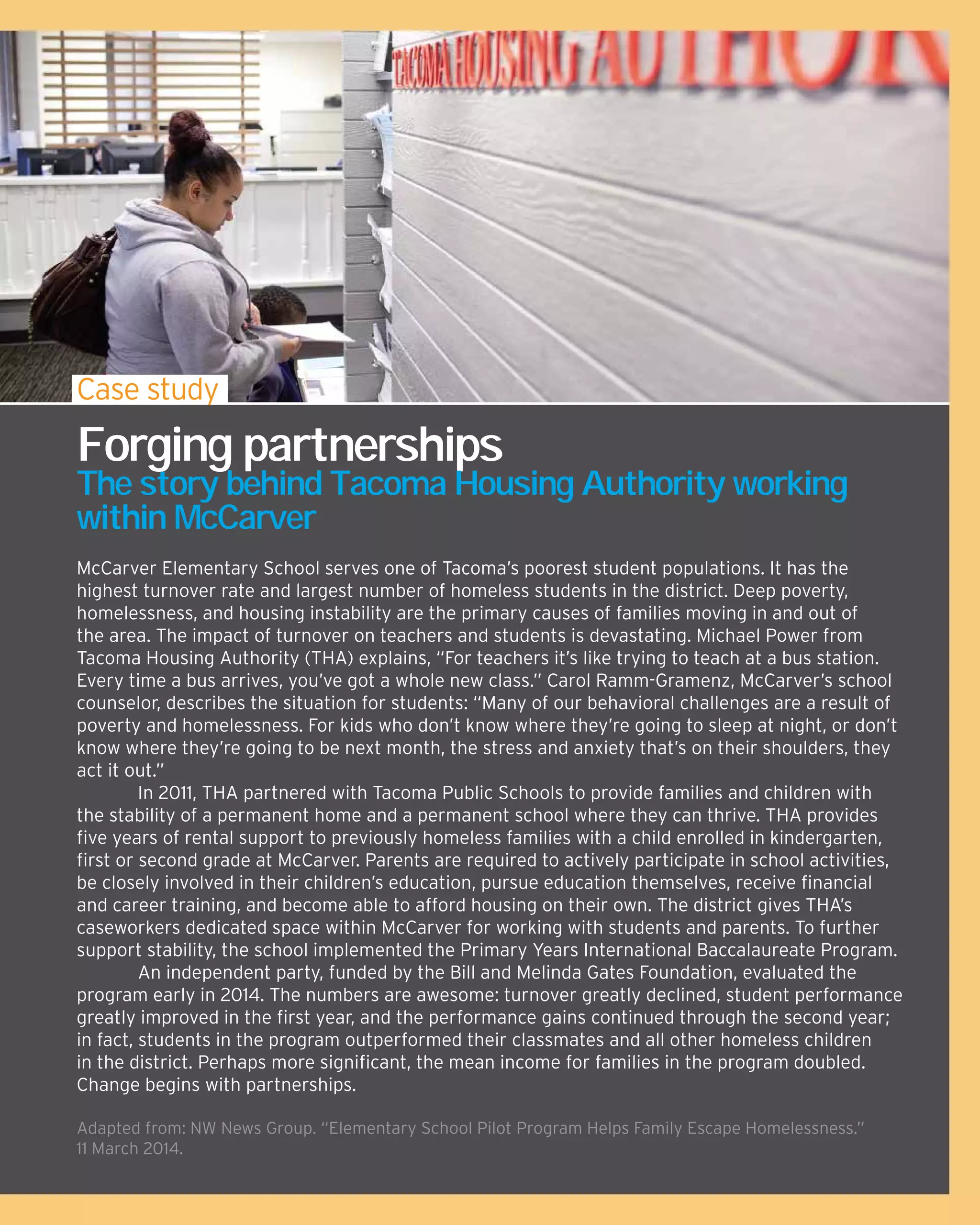
McCarver Elementary School serves one of Tacoma’s poorest student populations. It has the
highest turnover rate and largest number of homeless students in the district. Deep poverty,
homelessness, and housing instability are the primary causes of families moving in and out of
the area. The impact of turnover on teachers and students is devastating. Michael Power from
Tacoma Housing Authority (THA) explains, “For teachers it’s like trying to teach at a bus station.
Every time a bus arrives, you’ve got a whole new class.” Carol Ramm-Gramenz, McCarver’s school
counselor, describes the situation for students: “Many of our behavioral challenges are a result of
poverty and homelessness. For kids who don’t know where they’re going to sleep at night, or don’t
know where they’re going to be next month, the stress and anxiety that’s on their shoulders, they
act it out.”
	 In 2011, THA partnered with Tacoma Public Schools to provide families and children with
the stability of a permanent home and a permanent school where they can thrive. THA provides
five years of rental support to previously homeless families with a child enrolled in kindergarten,
first or second grade at McCarver. Parents are required to actively participate in school activities,
be closely involved in their children’s education, pursue education themselves, receive financial
and career training, and become able to afford housing on their own. The district gives THA’s
caseworkers dedicated space within McCarver for working with students and parents. To further
support stability, the school implemented the Primary Years International Baccalaureate Program.
	 An independent party, funded by the Bill and Melinda Gates Foundation, evaluated the
program early in 2014. The numbers are awesome: turnover greatly declined, student performance
greatly improved in the first year, and the performance gains continued through the second year;
in fact, students in the program outperformed their classmates and all other homeless children
in the district. Perhaps more significant, the mean income for families in the program doubled.
Change begins with partnerships.
Adapted from: NW News Group. “Elementary School Pilot Program Helps Family Escape Homelessness.”
11 March 2014.
Case study
Forging partnerships
The story behind Tacoma Housing Authority working
within McCarver
Part 2
Our vision
The more a school is built around present
conditions, the less it will adapt to unknown
conditions in the future. The traditional
educational specification creates a rigorously
programmed school. In our experience, most
rigorously programmed schools are often
obsolete upon opening. We share with you our
district vision as an alternative to the traditional
educational specification. Our vision expresses
an environment where students are continuously
challenged, relentlessly supported, and engaged
in a way that’s safe and healthy. Vision is generic,
and generic is adaptive.
Our position.
Our voice.
Safety isn’t a metal detector in every entrance. Safety is our
relationships. It’s a student having a positive connection with a
teacher and the courage to say, “Something isn’t right.” How do
we create a positive culture?
Josh Garcia
Deputy Superintendent
Students have the ability to research and study, design and test,
fabricate, and then take it outside to get really dirty. Project-
based learning culminates in the alignment of all of these design
potentials and activators. It’s full circle learning.
Stephen Murakami
Director of Planning and Construction
Interview
Page 26
Interview
Page 51
18 Our vision
Meet the district
If we build beautiful buildings with lots of open spaces and
flexibility that support really dynamic teaching and learning,
then it is up to us to teach our teachers how to use these spaces.
That’s the key. Whatever we build, we must help our people use
it.
Christine Hinds
Director of Elementary Education
Promoting collaboration between teachers starts with the feeling
of the space. Like a cafe, it should feel comfortable and familiar.
Teachers should immediately recognize it as a space for relaxing,
enjoying the company of others, or just getting work done.
Ryan Prosser
Educational Facilitator
Interview
Page 109
Interview
Page 57
20 Our vision
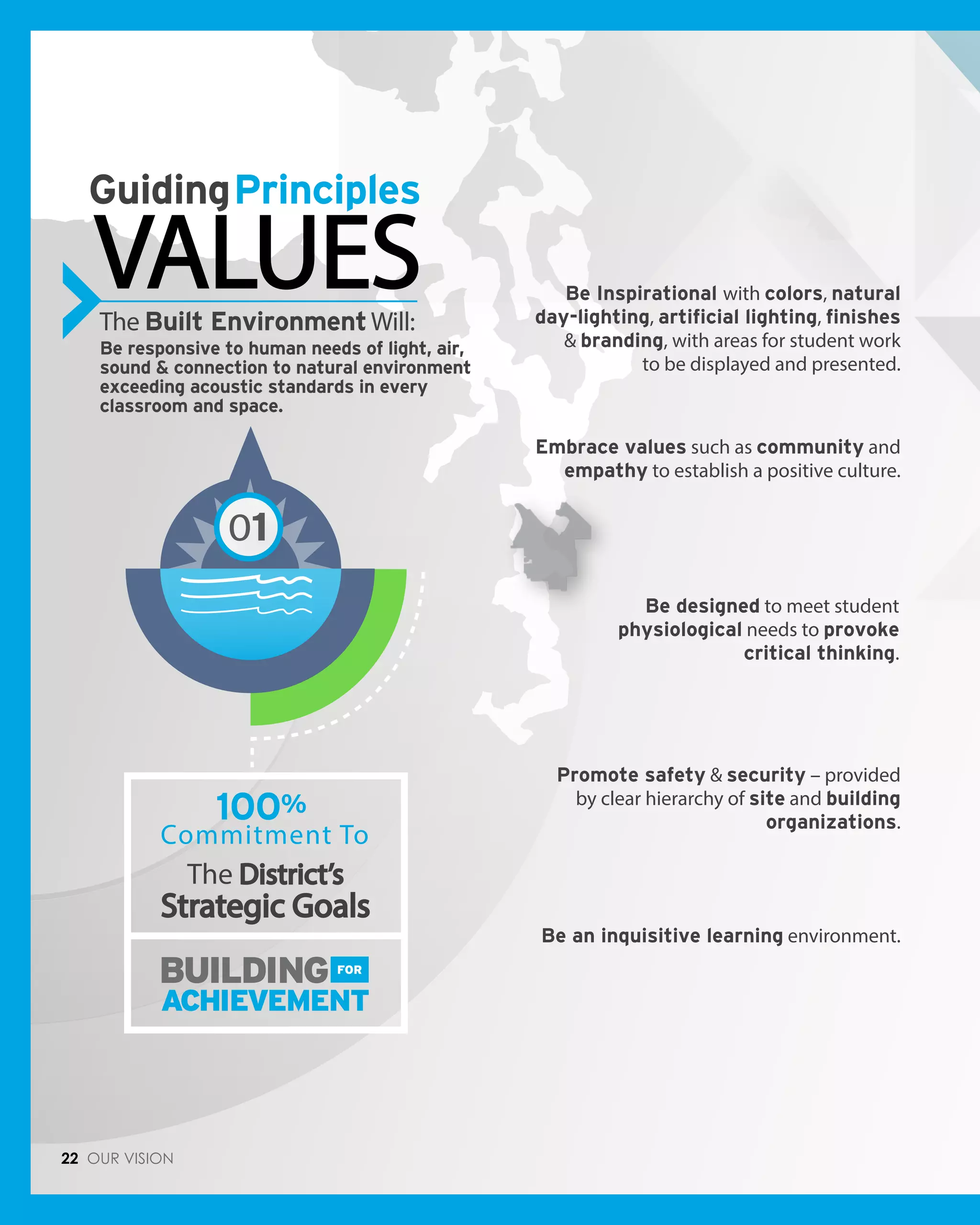
Our vision for the
built environment
Follow the
Guiding Principles
What are the needs of a 21st century learner?
In November 2013, Tacoma Public Schools invited thought
leaders across varying disciplines to answer this question
during an intensive two-day brainstorming workshop.
Attendees included district leadership, department
directors, principals, teachers, students, and our industry
partners, including architectural design teams, educational
consultants, and leadership from surrounding school
districts. In relationship to the culture of our district
and the particular communities served, we identified
the essential qualities of the 21st century learner and
the built environment that fosters them. The Guiding
Principles represent our vision for the elementary learning
environment. We hope they are a tool that will sustain
building planning and design for the coming decade.
22 Our vision
24 Our vision
.
.
.
26 Our vision
What does it mean to involve the
community? Let’s return to the elements
of culture: safety, health, engagement,
challenge and support. Let’s return to
twenty-four hours every day of the year, to
the total environment that includes what
happens outside of the school. The learning
culture is more than the school; it is the total
environment. Too often we build schools in
isolation of the culture.
How do we build within the culture? Think
about Community Asset Mapping. What
is outside of the school? If we want to
engage people, including the 95 year-old,
then we should be asking what is not in the
community. Those missing elements, they
are the ones that will engage people to come
here. What are the needs of the community?
At what point do we draw boundaries?
Although I speak to the depth of community,
of its complexity, you must draw lines
at some point. Human beings need
comprehension; they require it. Living in
a world with too many unknowns is not
healthy.
By asking the critical questions, we find
existing and deficient assets. Tension
arises naturally through the process. In the
design, we ask ourselves: what resources
already exist? How do we resist duplicating
environments? At the same time, there is an
opportunity to explore new environments. If
I say we need a garden, then I must also ask:
do we really need a garden?
Are there gardens that already exist? If so,
have a conversation with those people over
there. Ask them if they are willing to work
differently, or if they are willing to partner.
The definition of school changes according
to these interpretations: assets, deficiencies
and relationships. We are only able to
understand the school once that happens.
Our comprehension of the community
changes our understanding of the school; it
creates a new definition.
You are asking the designer to shape the
culture. When working with an existing
school and an established way of doing
things, what are the tools for doing this
kind of work? Look at your process for
building relationships. How do you anticipate
the resistance, and what is your plan to
address it? The best response to resistance is
going towards it, going towards the pressure.
Part of ensuring safety and creating a
healthy and positive culture is bringing
the community into the school. In order
for a community to support a school, they
must understand it first. There must be
transparency; they must know what it
looks like inside and be involved in the
daily affairs. If they understand it, they
will protect it. So how do we get to that
point? We don’t have the answer. And the
answer for one community may not be right
for another. So ask yourself: how do we start
to get there?
Interview
Rethinking the role of community
A conversation with Dr. Josh Garcia
Give the community a reason to be there.
If culture is knowledge, then how do we share
knowledge? What are those key spaces? We
value libraries, museums and theaters. As
a school administrator, I tell myself: I need
safety, I cannot have people in there all day
every day, and I need to lock those spaces
down. So think about it differently. Use
two entrances. What are we missing in the
community? If we engage the community,
such as creating a library where people are
allowed to come in from the outside, then
partner with the local public library systems;
ask them to run it, and it’s no longer the
responsibility of the administrator. Why have
two libraries?
You also speak of creating a positive
culture. Safety isn’t a metal detector in
every entrance. Safety is our relationships.
It’s a student having a positive connection
with a teacher and the courage to say,
“Something isn’t right.” How do we create
a positive culture? We say that we value
collaboration. If the outside of our school
looks like a prison, then what message are
we sending to our community partners? If we
value collaboration in the classroom, what
message are we sending by only offering
individual desks? We tell parents that their
involvement matters. Yet when we ask them
to sit with us and talk, we offer them terribly
uncomfortable furniture.
Is this what you mean by going towards
the pressure? It’s counterintuitive, but the
safest school may be the one that is most
open, accessible and transparent.
28 Our vision
Learning is
safe and secure
Foster a community
that cares
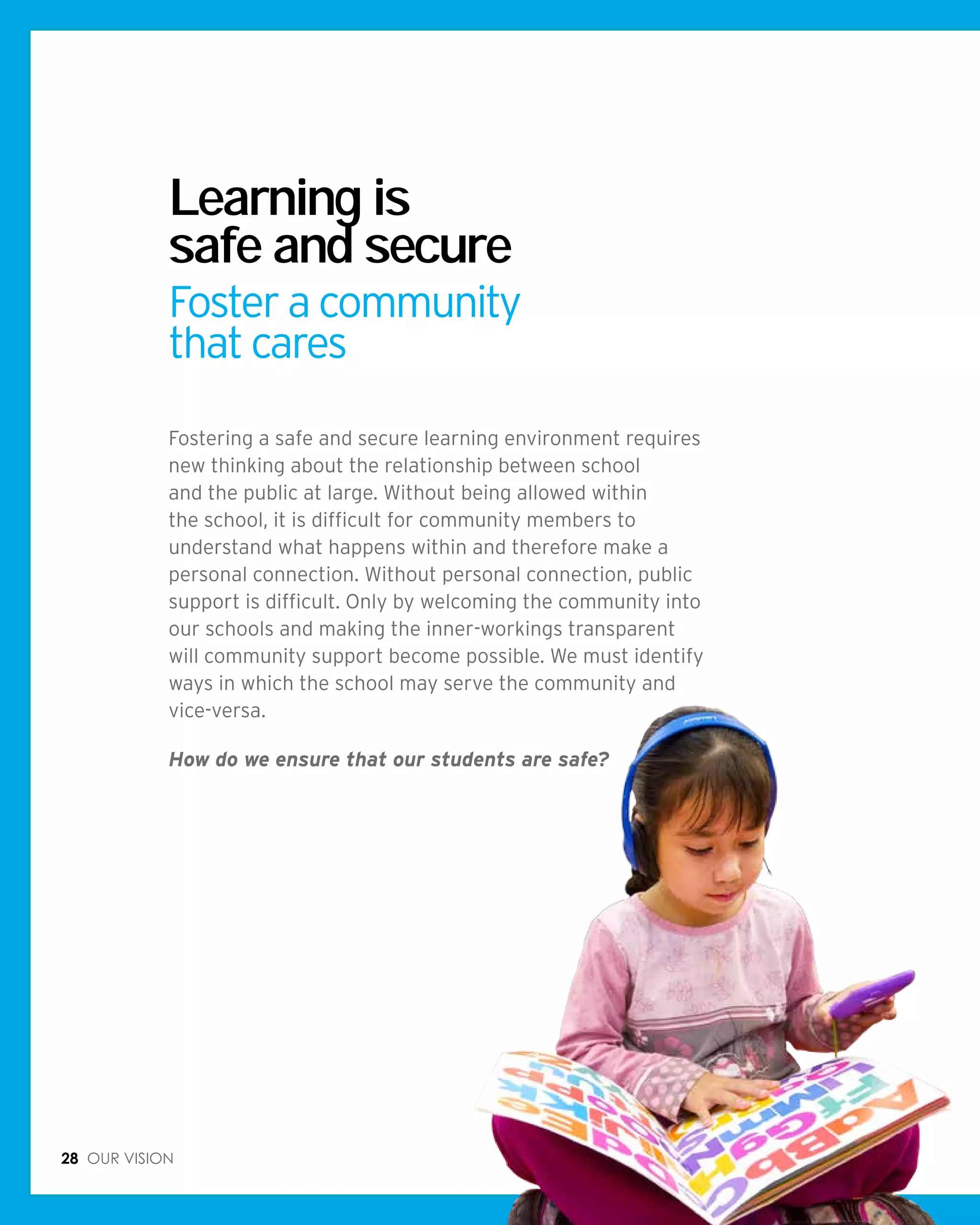
Fostering a safe and secure learning environment requires
new thinking about the relationship between school
and the public at large. Without being allowed within
the school, it is difficult for community members to
understand what happens within and therefore make a
personal connection. Without personal connection, public
support is difficult. Only by welcoming the community into
our schools and making the inner-workings transparent
will community support become possible. We must identify
ways in which the school may serve the community and
vice-versa.
How do we ensure that our students are safe?
Transparency and security
Address the four zones
Zone 1 Up to the curb
For example, consider the zone up to the curb. In order to develop strategies appropriate to this
zone, you must first understand traffic patterns, access points and safe walking routes. While
adequate emergency access and site egress are mandatory requirements, alternative routes are
equally important. Secondary access routes are critical during bottlenecks; design for worst-case
scenarios, such as an emergency event during school pick-up. Know the Safe Routes to School. If
they don’t yet exist, propose developing them. Your design must respond to the broader context
and patterns of use.
	 Invite local police and fire to participate in the safety discussion. They know the
neighborhood thoroughly and are a great resource for developing site access strategies. Ask your
Design Advisory Committee about the Safe Routes to School.
Zone 2
Curb to the building
Site perimeter security includes
landscaping, lighting, walks,
service areas, parking, public
zones, private zones, student
use areas, busing, signage,
cameras, out buildings,
overhangs and covered areas.
Zone 3
Building exterior
Building perimeter security
includes doors, windows,
signage, hardware, security
entry devices, cameras, roof
access, vandalism potentials,
line of sight, and lighting.
Zone 4
Building interior
Building interior security
includes vestibules, hardware,
transparency, sightlines, areas
of refuge, classroom layout,
vertical circulation, hard
and soft zoning, cameras,
security entry devices, PA
and phone systems, restroom
configurations and placement.
Transparency is an important part of providing a positive learning environment and
promoting community use. It is also a strategy for security. Transparency makes it
easy to identify threats early, thereby increasing available time for closing blinds,
locking doors, using emergency communications, moving children to an area of
refuge, or fleeing through a secondary exit. Removing windows limits an offender’s
ability to see in, yet it also limits a teacher’s ability to see out; a teacher may
not know an offender is present until it is too late. As classrooms become more
transparent, areas of refuge must be rethought. If the learning suite is protected
from the school by a security door, then it becomes an area of refuge. How do we
design strategies that balance transparency with security?
Develop safety and security strategies that strengthen and bolster
each of the school’s four zones.
30 Our vision
When we think about a child’s environment, we must
consider their total environment, including home,
neighborhood, and school. Ideally, each environment
is a positive one; unfortunately, this is not always the
case. Environmental threats like unstable homes and
unsafe neighborhoods can lead to malnutrition and
poor sleep. Remember that for some students, basic
needs are not always met outside of school. School
becomes a place of refuge, yet there are too many
examples of ones that are not healthy. The built
environment must provide for a child’s basic
needs first.
How will we ensure that our students
are healthy?
Learning starts
with physiology
Provide for and exceed a
child’s basic needs
Air
Sound
Light
Be responsive to each student’s needs
Because a child’s body is still maturing, their organs
and immune system are more sensitive than an
adults. A child’s lungs are more sensitive to airborne
contaminants due to higher rates of metabolism and
physical activity. A child spends more time on the
floor and rarely washes their hands before eating.
Elementary school is a critical time when students
are developing the ability to hear and comprehend
speech. Comprehension depends heavily upon
filling in missing words and correctly identifying
consonants. Because children possess a smaller
vocabulary, their ability to comprehend speech
despite partial hearing is limited. Learning
disabilities, learning English as a second language,
and temporary hearing loss from illnesss worsen the
situation. We must get acoustics right.
•	 Use safe, non-toxic materials
•	 Make surfaces that are easy to clean
•	 Exceed indoor air quality
requirements
•	 Allow the built environment
to become a teaching tool for
developing good habits
•	 Minimize background noise from
the outdoors, adjacent classrooms
hallways, and HVAC systems
•	 Control reverberation and self-noise
•	 Review construction details and
verify assemblies
•	 Provide classroom amplification
systems
Consider the profound influence of natural light. It is the most influential factor in
the maintenance of circadian rhythms and the body’s natural clock. Daylight is linked
to cortisol levels which influences a child’s ability to focus. Daylight is necessary for
physical growth, a factor compounded by the amount of time a child spends in school.
The influence extends further. In 1999, Lesher and Mahone conducted a comprehensive
study analyzing test scores of more than 21,000 students across three districts in
California, Colorado and Washington. The results showed a direct correlation between
amount of daylight and student performance. Consider the following: Students in
classrooms with the most daylight improved 20% faster on math and 26% faster on
reading tests. The rate of improvement was 15-23% faster in classrooms with the most
window area and 19-20% faster in those with skylights.
Adapted from: Heschong-Mahone Group. Daylighting in Schools. 1999.
Children are particularly sensitive to deficient environments.
And they are particularly responsive to exceptional ones.
Design healthy environments
Exceed acoustics standards
32 Our vision
Learning is
connecting with nature
Make the outdoors
abundant
Nature is a critical part of the learning environment
that exists both beyond the building and within it. The
site presents the opportunity to be in nature, and more
importantly, the opportunity to establish an immediate
awareness of and connection to the natural world.
	 Being outside is not only important, it is a
necessary condition for learning. According to John
Medina, author of Brain Rules, being active while outdoors
provides the optimal condition for a child’s cognitive
development. When speaking before school designers,
Medina makes two important points. First, exercise is
critical, particularly with children. The human brain is
most active during exercise; additionally, lack of exercise
impairs cognitive function. Ideally, students should be
active at least once every hour. Second, being outside
matters. The human brain performs best when it is
outdoors. Put simply, recess and PE are not enough. You
must build opportunities for students to be active and
outside for the maximum amount of time possible.
How will we ensure that our students are engaged?
Adapted from: John Medina. Brain Rules. 2008.
Children need to connect to nature
Engage the site’s natural assets
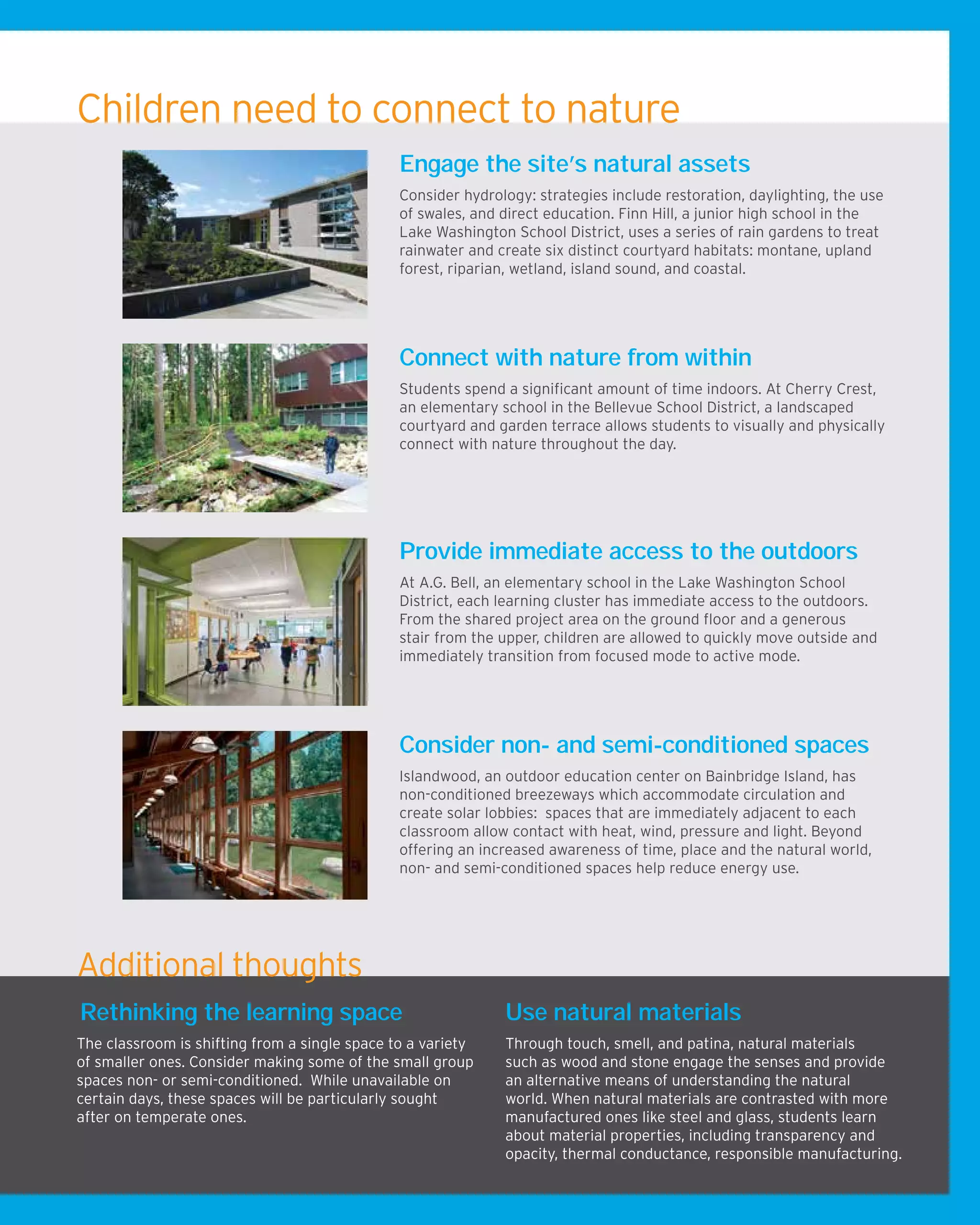
Consider hydrology: strategies include restoration, daylighting, the use
of swales, and direct education. Finn Hill, a junior high school in the
Lake Washington School District, uses a series of rain gardens to treat
rainwater and create six distinct courtyard habitats: montane, upland
forest, riparian, wetland, island sound, and coastal.
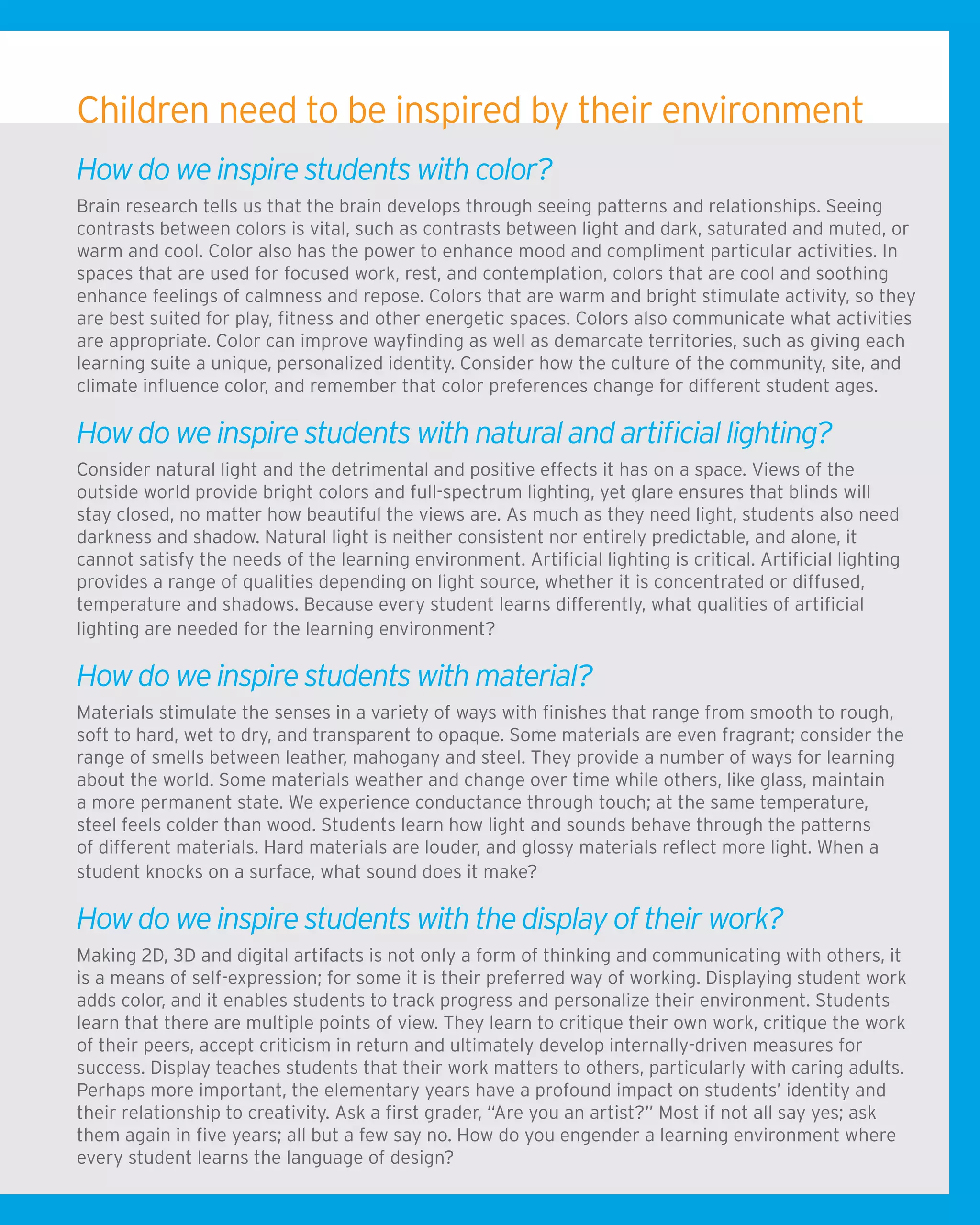
Connect with nature from within
Students spend a significant amount of time indoors. At Cherry Crest,
an elementary school in the Bellevue School District, a landscaped
courtyard and garden terrace allows students to visually and physically
connect with nature throughout the day.
Rethinking the learning space
The classroom is shifting from a single space to a variety
of smaller ones. Consider making some of the small group
spaces non- or semi-conditioned. While unavailable on
certain days, these spaces will be particularly sought
after on temperate ones.
Use natural materials
Through touch, smell, and patina, natural materials
such as wood and stone engage the senses and provide
an alternative means of understanding the natural
world. When natural materials are contrasted with more
manufactured ones like steel and glass, students learn
about material properties, including transparency and
opacity, thermal conductance, responsible manufacturing.
and aging.
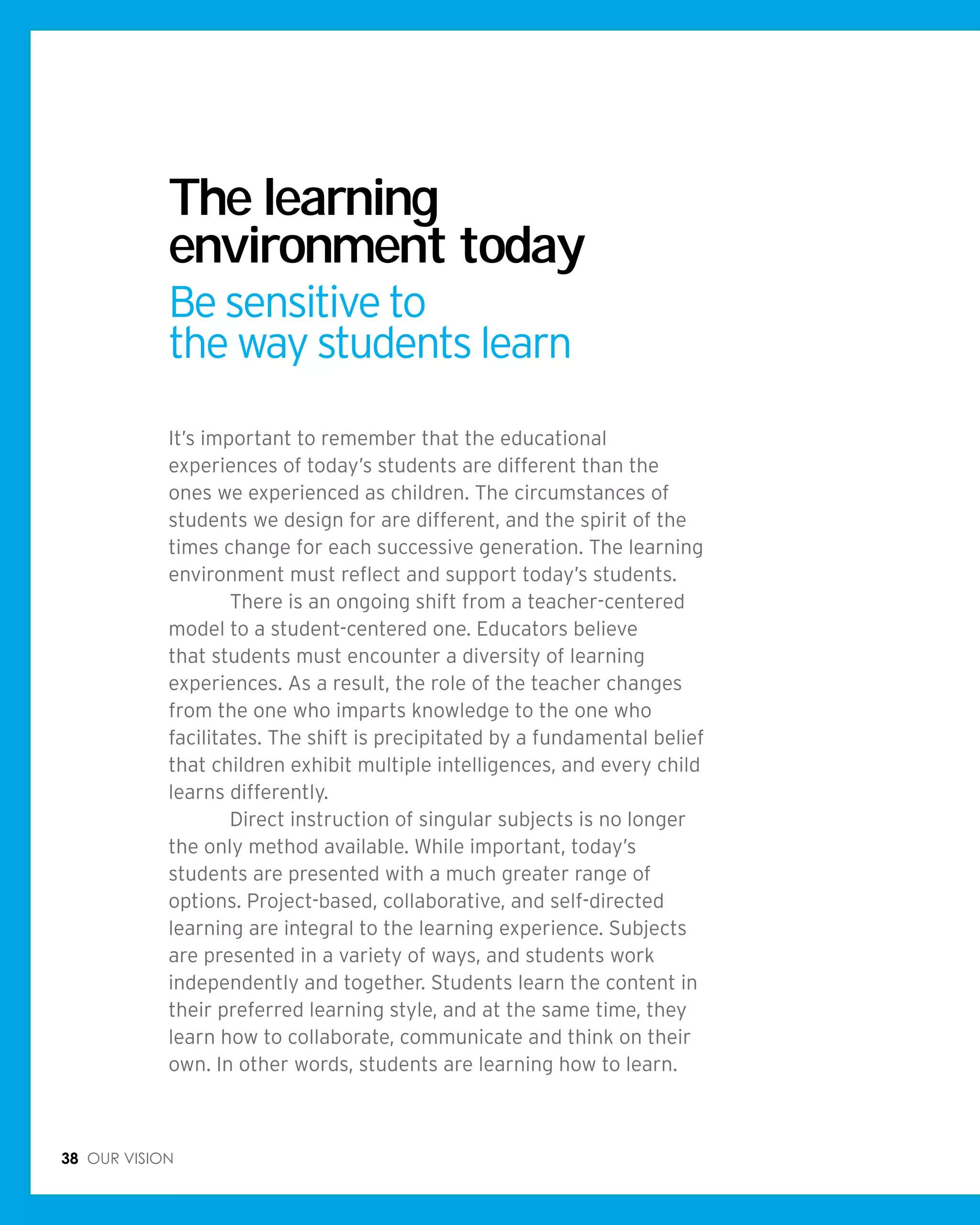
Consider non- and semi-conditioned spaces
Islandwood, an outdoor education center on Bainbridge Island, has
non-conditioned breezeways which accommodate circulation and
create solar lobbies: spaces that are immediately adjacent to each
classroom allow contact with heat, wind, pressure and light. Beyond
offering an increased awareness of time, place and the natural world,
non- and semi-conditioned spaces help reduce energy use.
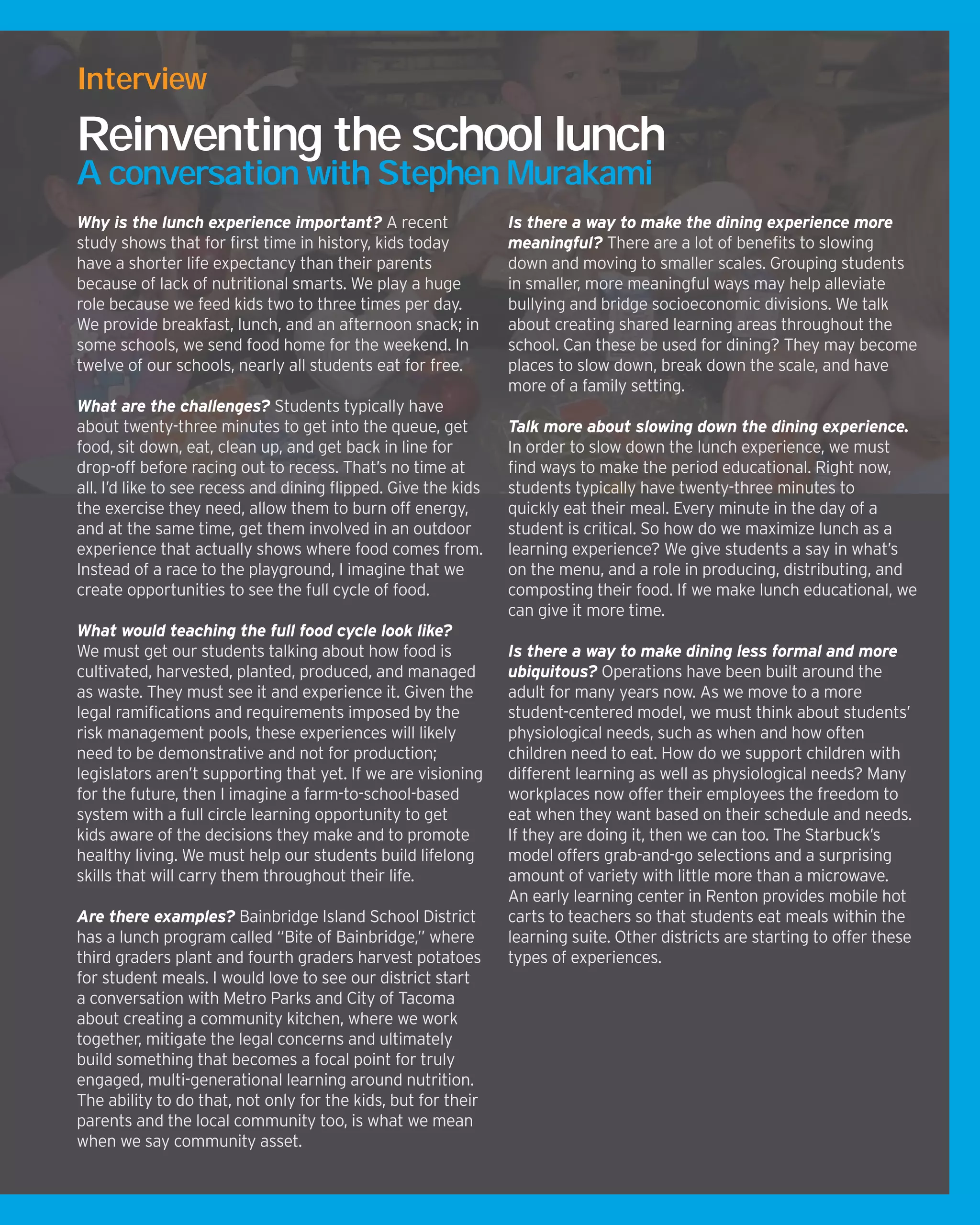
Provide immediate access to the outdoors
At A.G. Bell, an elementary school in the Lake Washington School
District, each learning cluster has immediate access to the outdoors.
From the shared project area on the ground floor and a generous
stair from the upper, children are allowed to quickly move outside and
immediately transition from focused mode to active mode.
Additional thoughts
34 Our vision
Learning is
inspiring
Engage students with
color, light and display
Colors, natural and artificial lighting, materials and student
work form much of the sensory education that underlie
the learning environment. Brain research tells us that the
senses are the gateway to the mind, and through them, we
develop our intellect, build memories, and make meaning. The
research also says that students retain, retrieve, and learn
best within environments that are sensually rich. Because
we engage the built environment through our senses, it has
a profound impact on our psychological and physiological
wellbeing. Given the impact on mood and behavior, the
built environment will either enhance or impair the learning
environment. Consider the bland and chaotic sensory
environments of schools past with their locker-lined corridors,
fluorescent lighting, shade-drawn classrooms, cacophonous
cafeterias, and concrete schoolyards. Over- and under-
stimulating spaces make for poor learning environments. 	
	 At that same time, spaces that are intentionally
designed to balance these stimuli are shown to reduce
students’ stress, improve their attention span and ability
to focus, alter their perception of time, and reduce both
absenteeism and vandalism. We must expand our design
thinking beyond sight and sound; a healthy learning
environment includes the smells and tastes of life, too.
How do we create environments that are rich in all five
senses and allow our students to integrate them together?
Children need to be inspired by their environment
How do we inspire students with color?
Brain research tells us that the brain develops through seeing patterns and relationships. Seeing
contrasts between colors is vital, such as contrasts between light and dark, saturated and muted, or
warm and cool. Color also has the power to enhance mood and compliment particular activities. In
spaces that are used for focused work, rest, and contemplation, colors that are cool and soothing
enhance feelings of calmness and repose. Colors that are warm and bright stimulate activity, so they
are best suited for play, fitness and other energetic spaces. Colors also communicate what activities
are appropriate. Color can improve wayfinding as well as demarcate territories, such as giving each
learning suite a unique, personalized identity. Consider how the culture of the community, site, and
climate influence color, and remember that color preferences change for different student ages.
How do we inspire students with natural and artificial lighting?
Consider natural light and the detrimental and positive effects it has on a space. Views of the
outside world provide bright colors and full-spectrum lighting, yet glare ensures that blinds will
stay closed, no matter how beautiful the views are. As much as they need light, students also need
darkness and shadow. Natural light is neither consistent nor entirely predictable, and alone, it
cannot satisfy the needs of the learning environment. Artificial lighting is critical. Artificial lighting
provides a range of qualities depending on light source, whether it is concentrated or diffused,
temperature and shadows. Because every student learns differently, what qualities of artificial
lighting are needed for the learning environment?
How do we inspire students with material?
Materials stimulate the senses in a variety of ways with finishes that range from smooth to rough,
soft to hard, wet to dry, and transparent to opaque. Some materials are even fragrant; consider the
range of smells between leather, mahogany and steel. They provide a number of ways for learning
about the world. Some materials weather and change over time while others, like glass, maintain
a more permanent state. We experience conductance through touch; at the same temperature,
steel feels colder than wood. Students learn how light and sounds behave through the patterns
of different materials. Hard materials are louder, and glossy materials reflect more light. When a
student knocks on a surface, what sound does it make?
How do we inspire students with the display of their work?
Making 2D, 3D and digital artifacts is not only a form of thinking and communicating with others, it
is a means of self-expression; for some it is their preferred way of working. Displaying student work
adds color, and it enables students to track progress and personalize their environment. Students
learn that there are multiple points of view. They learn to critique their own work, critique the work
of their peers, accept criticism in return and ultimately develop internally-driven measures for
success. Display teaches students that their work matters to others, particularly with caring adults.
Perhaps more important, the elementary years have a profound impact on students’ identity and
their relationship to creativity. Ask a first grader, “Are you an artist?” Most if not all say yes; ask
them again in five years; all but a few say no. How do you engender a learning environment where
every student learns the language of design?
36 Our vision
Learning is
healthy
Learning lifelong habits
for healthy living
Our schools’ role in promoting lifelong habits such as diet,
cooking, fitness, and self-care is significant. Providing
healthy environments is not enough; we must think about
the culture and habits of mind that our environments
engender. Done well, dining plays an important role in
providing sensory-rich experiences: food has different
textures, smells, sounds, and temperatures. Ask the hard
questions. Do we provide opportunities for learning about
the full cycle of food? Do we provide opportunities for
learning how to cook food that is tasty and nutritious?
How do we build rituals that celebrate the communal
aspects of eating? While current practices may exclude
such offerings, design the school to allow for them in the
future.
How do we build environments that foster healthy
living?
Why is the lunch experience important? A recent
study shows that for first time in history, kids today
have a shorter life expectancy than their parents
because of lack of nutritional smarts. We play a huge
role because we feed kids two to three times per day.
We provide breakfast, lunch, and an afternoon snack; in
some schools, we send food home for the weekend. In
twelve of our schools, nearly all students eat for free.
What are the challenges? Students typically have
about twenty-three minutes to get into the queue, get
food, sit down, eat, clean up, and get back in line for
drop-off before racing out to recess. That’s no time at
all. I’d like to see recess and dining flipped. Give the kids
the exercise they need, allow them to burn off energy,
and at the same time, get them involved in an outdoor
experience that actually shows where food comes from.
Instead of a race to the playground, I imagine that we
create opportunities to see the full cycle of food.
What would teaching the full food cycle look like?
We must get our students talking about how food is
cultivated, harvested, planted, produced, and managed
as waste. They must see it and experience it. Given the
legal ramifications and requirements imposed by the
risk management pools, these experiences will likely
need to be demonstrative and not for production;
legislators aren’t supporting that yet. If we are visioning
for the future, then I imagine a farm-to-school-based
system with a full circle learning opportunity to get
kids aware of the decisions they make and to promote
healthy living. We must help our students build lifelong
skills that will carry them throughout their life.
Are there examples? Bainbridge Island School District
has a lunch program called “Bite of Bainbridge,” where
third graders plant and fourth graders harvest potatoes
for student meals. I would love to see our district start
a conversation with Metro Parks and City of Tacoma
about creating a community kitchen, where we work
together, mitigate the legal concerns and ultimately
build something that becomes a focal point for truly
engaged, multi-generational learning around nutrition.
The ability to do that, not only for the kids, but for their
parents and the local community too, is what we mean
when we say community asset.
Is there a way to make the dining experience more
meaningful? There are a lot of benefits to slowing
down and moving to smaller scales. Grouping students
in smaller, more meaningful ways may help alleviate
bullying and bridge socioeconomic divisions. We talk
about creating shared learning areas throughout the
school. Can these be used for dining? They may become
places to slow down, break down the scale, and have
more of a family setting.
Talk more about slowing down the dining experience.
In order to slow down the lunch experience, we must
find ways to make the period educational. Right now,
students typically have twenty-three minutes to
quickly eat their meal. Every minute in the day of a
student is critical. So how do we maximize lunch as a
learning experience? We give students a say in what’s
on the menu, and a role in producing, distributing, and
composting their food. If we make lunch educational, we
can give it more time.
Is there a way to make dining less formal and more
ubiquitous? Operations have been built around the
adult for many years now. As we move to a more
student-centered model, we must think about students’
physiological needs, such as when and how often
children need to eat. How do we support children with
different learning as well as physiological needs? Many
workplaces now offer their employees the freedom to
eat when they want based on their schedule and needs.
If they are doing it, then we can too. The Starbuck’s
model offers grab-and-go selections and a surprising
amount of variety with little more than a microwave.
An early learning center in Renton provides mobile hot
carts to teachers so that students eat meals within the
learning suite. Other districts are starting to offer these
types of experiences.
Interview
Reinventing the school lunch
A conversation with Stephen Murakami
38 Our vision
It’s important to remember that the educational
experiences of today’s students are different than the
ones we experienced as children. The circumstances of
students we design for are different, and the spirit of the
times change for each successive generation. The learning
environment must reflect and support today’s students.
	 There is an ongoing shift from a teacher-centered
model to a student-centered one. Educators believe
that students must encounter a diversity of learning
experiences. As a result, the role of the teacher changes
from the one who imparts knowledge to the one who
facilitates. The shift is precipitated by a fundamental belief
that children exhibit multiple intelligences, and every child
learns differently.
	 Direct instruction of singular subjects is no longer
the only method available. While important, today’s
students are presented with a much greater range of
options. Project-based, collaborative, and self-directed
learning are integral to the learning experience. Subjects
are presented in a variety of ways, and students work
independently and together. Students learn the content in
their preferred learning style, and at the same time, they
learn how to collaborate, communicate and think on their
own. In other words, students are learning how to learn.
The learning
environment today
Be sensitive to
the way students learn
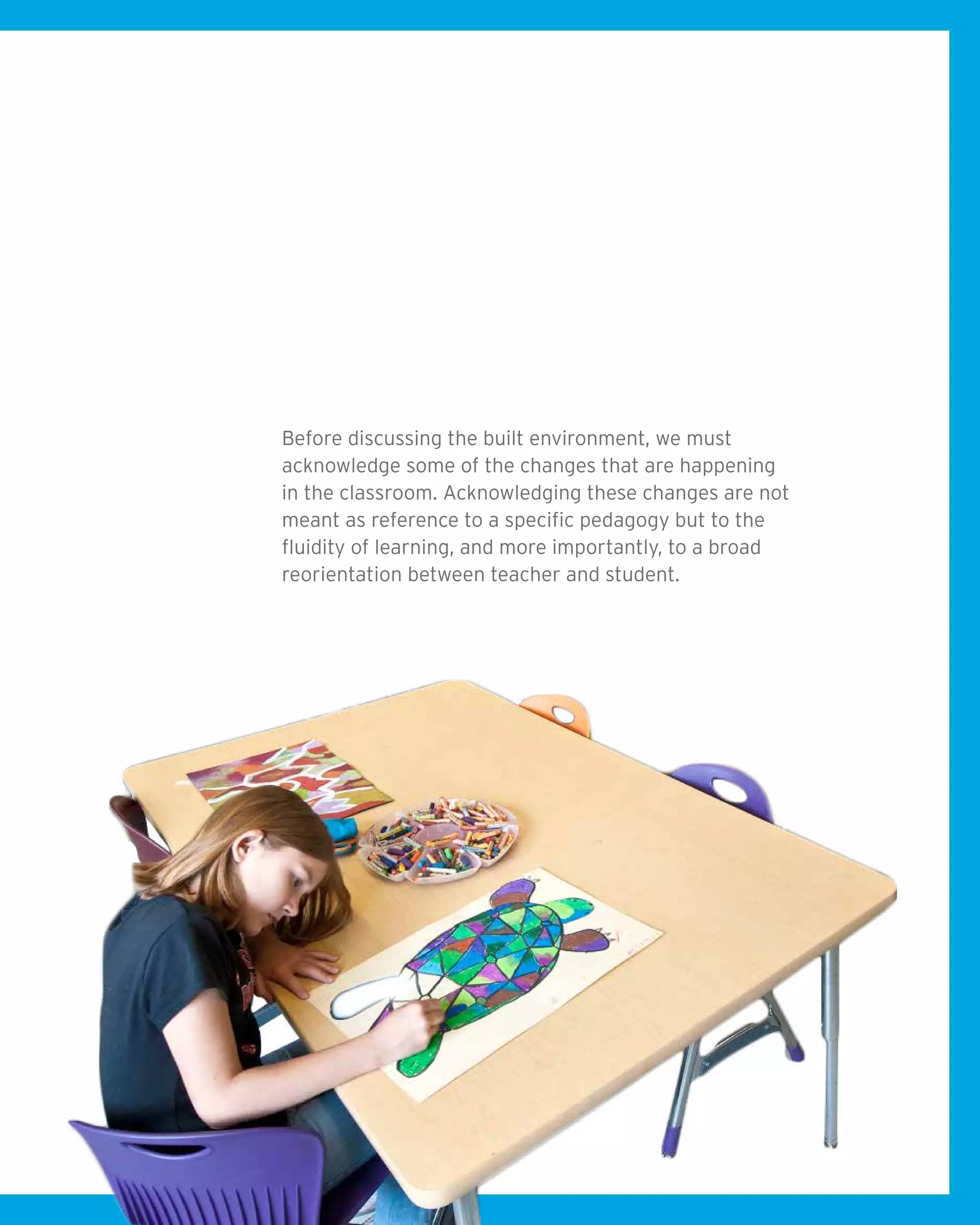
Before discussing the built environment, we must
acknowledge some of the changes that are happening
in the classroom. Acknowledging these changes are not
meant as reference to a specific pedagogy but to the
fluidity of learning, and more importantly, to a broad
reorientation between teacher and student.
40 Our vision
Imagine an inquiry-based environment where the curriculum is
framed as a project. Consider a fourth-grade class divided into
groups and tasked with marketing a new snowboard. To complete
the project, students learn physics, material properties, and
communication skills. A project may be a driving question that
students cannot answer with prior knowledge alone. They must
construct knowledge while working alone and in groups. They
draw upon and make connections between multiple subjects.
	 The importance of working alone and together cannot be
overstated. Working independently in self-directed study, students
learn to make decisions, solve problems, and ultimately form
their own positions. Working together with collaborative learning,
students learn how to share their position with others and how
to evaluate the position of others. Again, they learn to see the
world from multiple points of view. By focusing on investigation
and decision-making, the responsibility of learning rests with the
students. Working this way shapes students’ knowledge, skills, and
attitudes; students learn how to think, and more important, they
learn to reflect on the things they are doing.
	 These changes do not discount the teacher; they do the
opposite. As facilitator and mentor, the role of the teacher is more
important than ever. Curriculum design, instructional scaffolding,
and maintaining intimate connections with every child’s learning
style and path are but a few of the challenges presented by these
changes.
New methodologies
of teaching
Become familiar with
the way we teach
42 Our vision
Fostering and supporting life-long learners is the end goal
for every student, yet the way we get there is different
for every child. Not every student learns the same way,
and we must create an environment for all learners.
We support a variety of learning styles by providing
each student with multiple methods of presentation,
multiple options for participation and multiple means of
expression. The importance of variety is two-fold: students
stretch themselves in their dominant modes while being
exposed to and developing non-dominant ones at the
same time.
Learning on
your own path
Foster multiple
intelligences
We began our visioning of the built environment by looking ten years in the future and
imagining a typical day for a typical elementary student. We considered the learner’s total
environment, including family life, social and emotional challenges, and interests. We paid
special attention to the type and duration of learning styles throughout the day. At the
end, we “introduced” our imagined student to the group.
exercise
What we found For consideration
Personalization
Every learner had unique interests and needs.
Group Learning
Learners spent a significant portion of their day
in small (2-4 person) and large (6-8 person) group
settings.
Extended School Day
Students spent a significant portion of their day on
the school campus (11.5 hours average). Students
ate three meals a day on campus. School provided
more family wraparound services such as adult
education and community functions. Before and
after school programs were tightly integrated into
the school day.
Classroom
Consider tuning the core learning spaces more
toward student-centered learning in small and
large groups rather than direct instruction.
Shared Learning Spaces
Consider making shared learning spaces with the
capacity to do more: more meals, more services,
more types of users.
A day in the life
44 Our vision
As education shifts from a teacher-centered model to a
student-centered one, the classroom must support a variety
of learning typologies including active, self-directed, and
project-based learning in addition to standard instruction.
In the same day, a class will collaborate in small groups in
the morning, watch a presentation in late morning, study
in a self-directed fashion in the afternoon and play a class-
wide game at the end of the day, all within the same space.
	 In this way, the classroom performs like a design
studio. It supports a variety of group sizes in a variety of
configurations. It supports a variety of working styles, from
reading and writing, to online research and messy, hands-on
projects. In addition to variety, the classroom must be easily
and quickly reconfigured by both students and teachers
alike. Support a student-centered model by making agile
classrooms.
How will we ensure that our students are continuously
challenged?
Learning is
right-sized
Support a variety
of learning styles
Project introduction
Presentation
In the morning, the teacher introduces students to the project.
Every student has at least one elbow partner for turn and
talks.
Project preparation
Small group
After the presentation, students rearrange the classroom
for small group work. They discuss parameters, formulate
questions, prepare and gather resources for the project. The
teacher quickly visits each of the groups and offers feedback.
Project work
Self-directed and small group
Students rearrange the classroom into unique, smaller spaces
and make configurations that support their preferred style of
learning. Some students work on the project alone. Others,
who struggle with self-directed work, continue working in
small groups. The teacher has the ability to quickly visit all of
the individuals and groups. The flexible arrangement supports
classroom management and minimizes behavior issues.
Project debate
Large group
After project work, students make their thinking visible
through chalk talks. They present their work, question one
another and discuss what they are learning. Students form
caucuses in preparation for a class-wide debate. Once debate
starts, students continue rearranging the space. Groupings are
dynamic; students’ positions shift, and the furniture responds
in kind.
The multimodal classroom
Make the classroom agile. Furnishings and systems
enable rapid reconfiguration of space.
46 Our vision
What we liked
Transparency
Core learning and shared learning spaces are connected by
full-length, transparent, and operable walls.
Outdoor Connection
All spaces have views to nature, and there is a direct connection
between the shared learning space and the outdoors.
Safety
A high degree of visibility and a layered zoning strategy enhance safety and security.
The classroom is opening up. The self-contained room once dominated by
standard instruction has become part of a larger series of spaces. Several
classrooms, group spaces and shared activity areas join to form a fluid, cohesive
unit. In addition to standard instruction, students work quietly by themselves
or in groups of changing size. Shared learning spaces provide opportunities for
longer-term projects, and work with paraeducators. The expanded classroom
enables teachers to deal effectively with all types of learners in the same space.
	 At A.G. Bell in the Lake Washington School District, the shared learning
area and classrooms are connected by full-length, transparent, and operable
walls. Open, the walls give the classrooms immediate access to the shared
learning area; closed, they provide transparency while maintaining acoustical
separation. Equipped with small group space, a kitchen and teacher planning
area, and bathrooms, the learning suites function more autonomously. All
spaces have views to nature, and there is a direct connection between the
shared learning space and the outdoors.
The expanded
classroom
The learning environment
at A.G. Bell Elementary School
Environments we like
THRESHOLD
CUSTODIAL
BOYS SMALL
GROUP
SHARED LEARNING SPACE
GIRLS
WET
LAPTOP
STORAGE
TEACHER
PLANNING
DEVELOPED
OUTDOOR
AREA
CORE LEARNING
CORE LEARNING
CORE LEARNING
CORE LEARNING
30+
10
5
25
25
25
25
Above A view of the shared
learning area at AG Bell. Notice
how the shared learning space
is connected to the classrooms
and outdoor learning areas
by transparent, operable
walls. Left A diagram of the
learning suite’s configuration.
Bathrooms and flex spaces
create a threshold and secure
connection between the
learning suite and the rest of
the school.
48 Our vision
Learning is
connected
Supportteachersworking
together
Supporting a variety of learning styles changes the way
teachers work together. Teachers work with a number of
paraeducators, student teachers, and special education
counterparts. Counterparts may share the classroom, use the
shared learning space or work in a designated area. Further
still, team teaching is one of the ways in which educators are
approaching the student-centered model. Team teaching allows
students to work with different personalities and teaching
styles, providing additional opportunities for self-directed, and
small group learning.
	 As teachers work in teams and the classroom expands,
the relationship between learning spaces becomes important.
Consider the reconfiguration of a series of smaller spaces into
a larger one. Joining classrooms supports team teaching, self-
directed learning and small group work. Joining the classroom
and shared learning space supports longer-term projects.
Consider using high levels of transparency. Visibility provides
supervision as more spaces get used and students spread out.
Transparent walls provide visual connection with acoustical
separation. A group of students doing contemplative learning
and another doing collaborative learning can be connected
while working separately. We must make learning pervasive and
visible.
How will we ensure that our students are relentlessly
supported and continuously challenged?
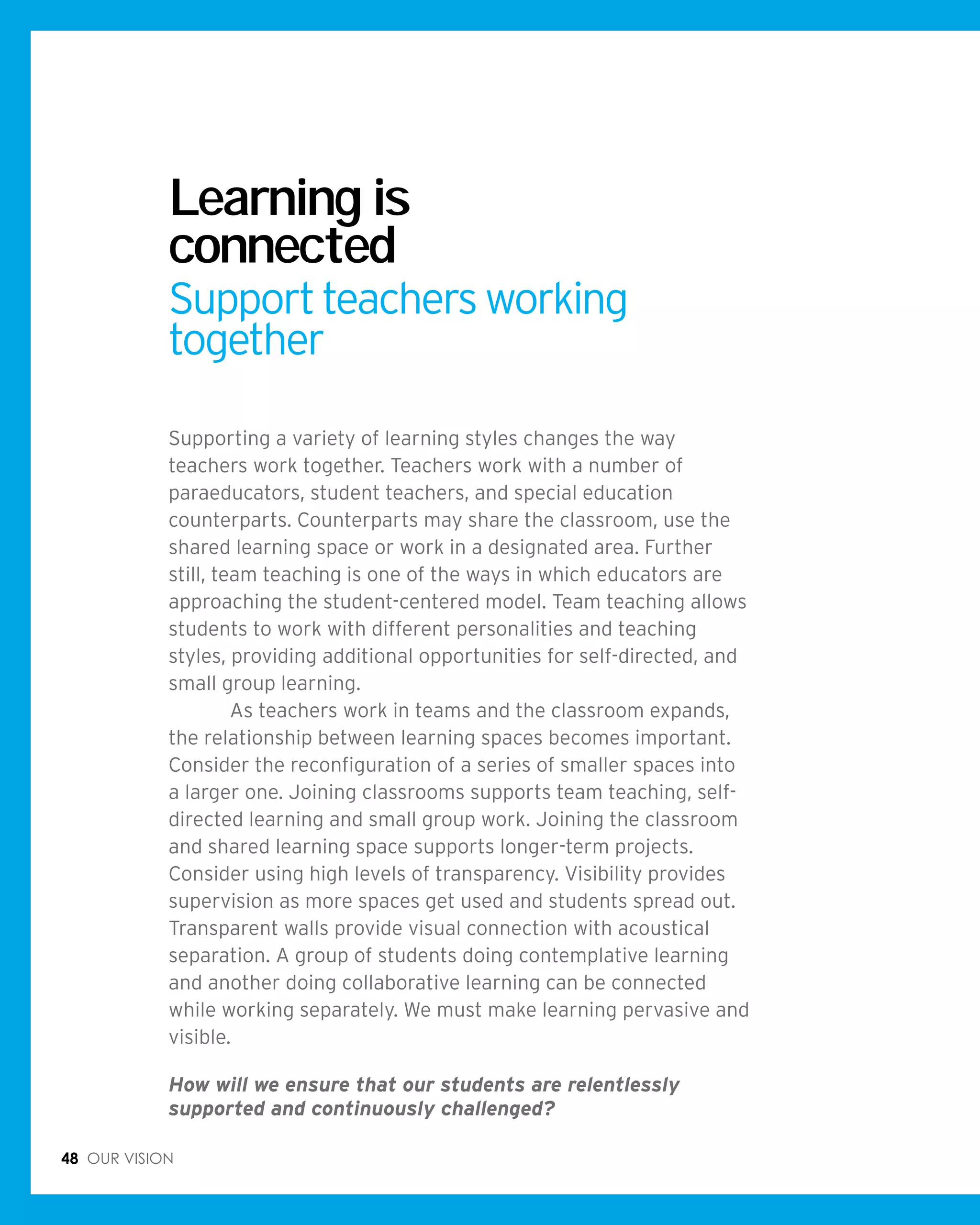
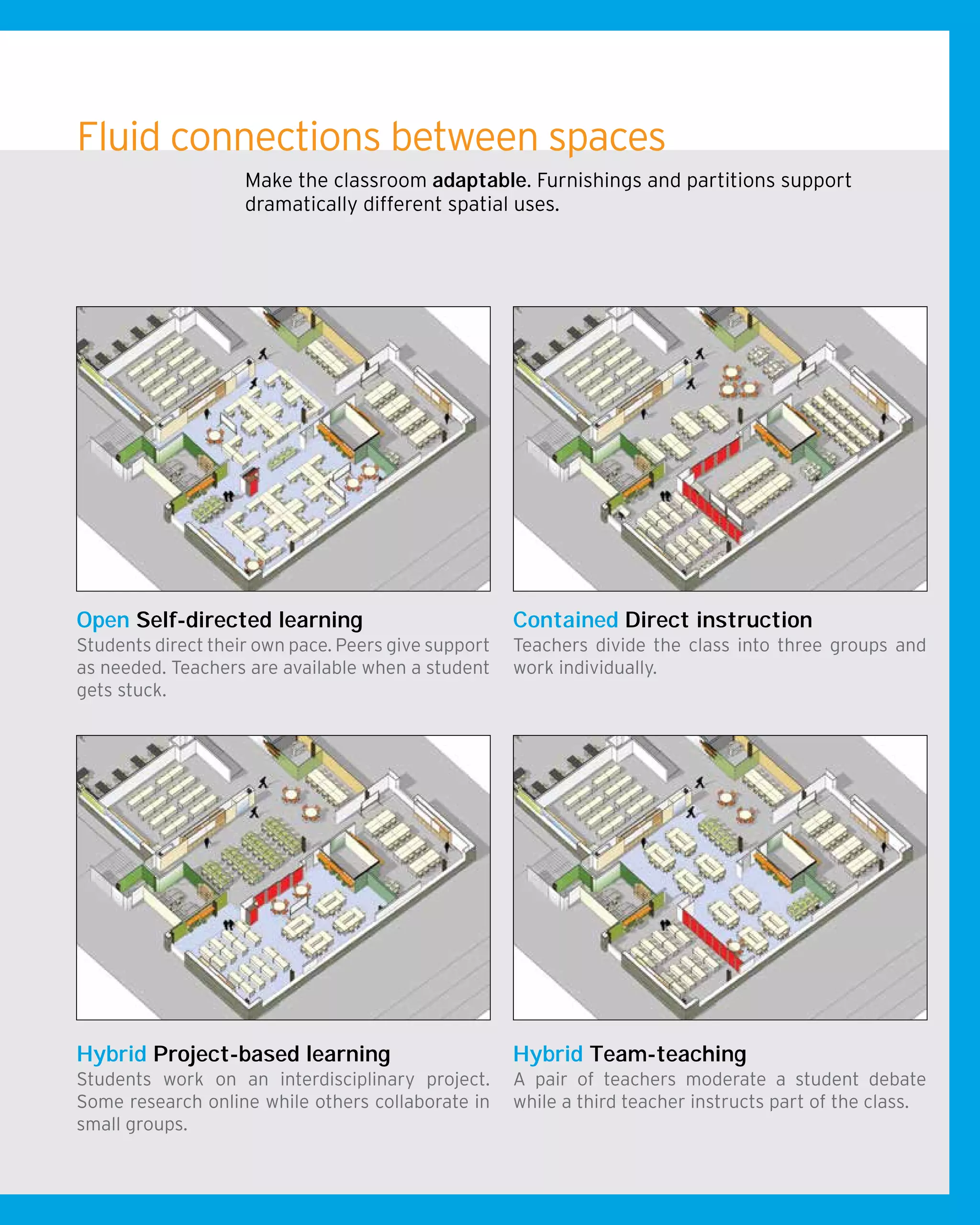
Fluid connections between spaces
Students direct their own pace. Peers give support
as needed. Teachers are available when a student
gets stuck.
Students work on an interdisciplinary project.
Some research online while others collaborate in
small groups.
Teachers divide the class into three groups and
work individually.
A pair of teachers moderate a student debate
while a third teacher instructs part of the class.
Open Self-directed learning
Hybrid Project-based learning
Contained Direct instruction
Hybrid Team-teaching
Make the classroom adaptable. Furnishings and partitions support
dramatically different spatial uses.
50 Our vision
The snowboard project mentioned earlier does more than
highlight the qualities of an inquiry-based environment.
It suggests the possibilities of embracing creativity. By
pairing art with science, students work with different
types of thinking, and they learn to move fluidly between
them. Working in one mode not only informs the other, it
makes creativity possible. Students learn to see the world
from multiple points of view. Presented with the right tools
and information, students are able to make discoveries.
They learn to actively form their own thoughts, feelings
and impressions in response to the tools at hand. When
students are given a degree of choice, the work becomes
more meaningful, and the learning becomes more robust.
Learning is active and
interdisciplinary
Make spaces for creativity
and discovery
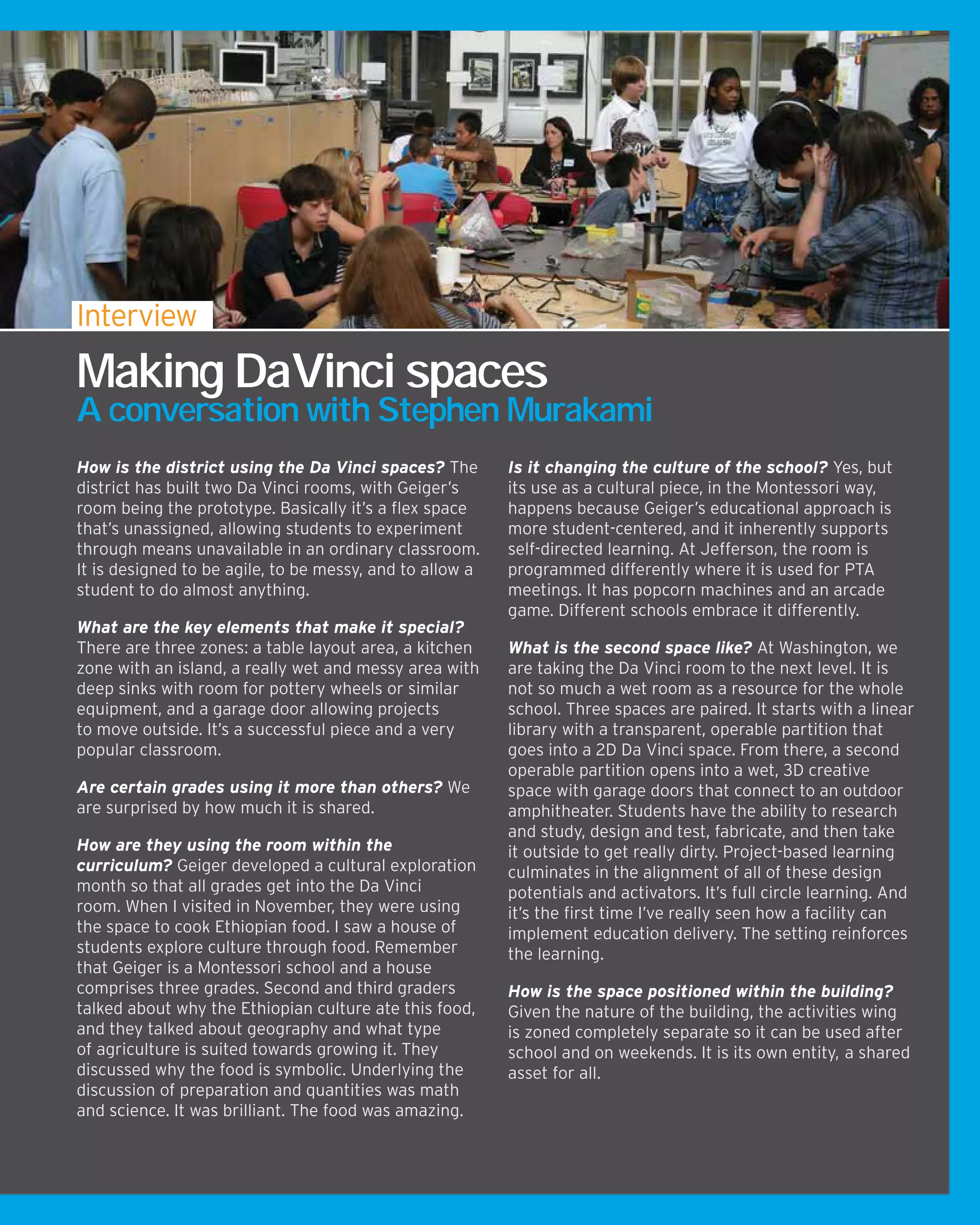
How is the district using the Da Vinci spaces? The
district has built two Da Vinci rooms, with Geiger’s
room being the prototype. Basically it’s a flex space
that’s unassigned, allowing students to experiment
through means unavailable in an ordinary classroom.
It is designed to be agile, to be messy, and to allow a
student to do almost anything.
What are the key elements that make it special?
There are three zones: a table layout area, a kitchen
zone with an island, a really wet and messy area with
deep sinks with room for pottery wheels or similar
equipment, and a garage door allowing projects
to move outside. It’s a successful piece and a very
popular classroom.
Are certain grades using it more than others? We
are surprised by how much it is shared.
How are they using the room within the
curriculum? Geiger developed a cultural exploration
month so that all grades get into the Da Vinci
room. When I visited in November, they were using
the space to cook Ethiopian food. I saw a house of
students explore culture through food. Remember
that Geiger is a Montessori school and a house
comprises three grades. Second and third graders
talked about why the Ethiopian culture ate this food,
and they talked about geography and what type
of agriculture is suited towards growing it. They
discussed why the food is symbolic. Underlying the
discussion of preparation and quantities was math
and science. It was brilliant. The food was amazing.
Is it changing the culture of the school? Yes, but
its use as a cultural piece, in the Montessori way,
happens because Geiger’s educational approach is
more student-centered, and it inherently supports
self-directed learning. At Jefferson, the room is
programmed differently where it is used for PTA
meetings. It has popcorn machines and an arcade
game. Different schools embrace it differently.
What is the second space like? At Washington, we
are taking the Da Vinci room to the next level. It is
not so much a wet room as a resource for the whole
school. Three spaces are paired. It starts with a linear
library with a transparent, operable partition that
goes into a 2D Da Vinci space. From there, a second
operable partition opens into a wet, 3D creative
space with garage doors that connect to an outdoor
amphitheater. Students have the ability to research
and study, design and test, fabricate, and then take
it outside to get really dirty. Project-based learning
culminates in the alignment of all of these design
potentials and activators. It’s full circle learning. And
it’s the first time I’ve really seen how a facility can
implement education delivery. The setting reinforces
the learning.
How is the space positioned within the building?
Given the nature of the building, the activities wing
is zoned completely separate so it can be used after
school and on weekends. It is its own entity, a shared
asset for all.
Interview
Making DaVinci spaces
A conversation with Stephen Murakami
52 Our vision
We must support a diversity of learners by providing
them with a variety of environments and allowing them
to choose places most appropriate to their learning
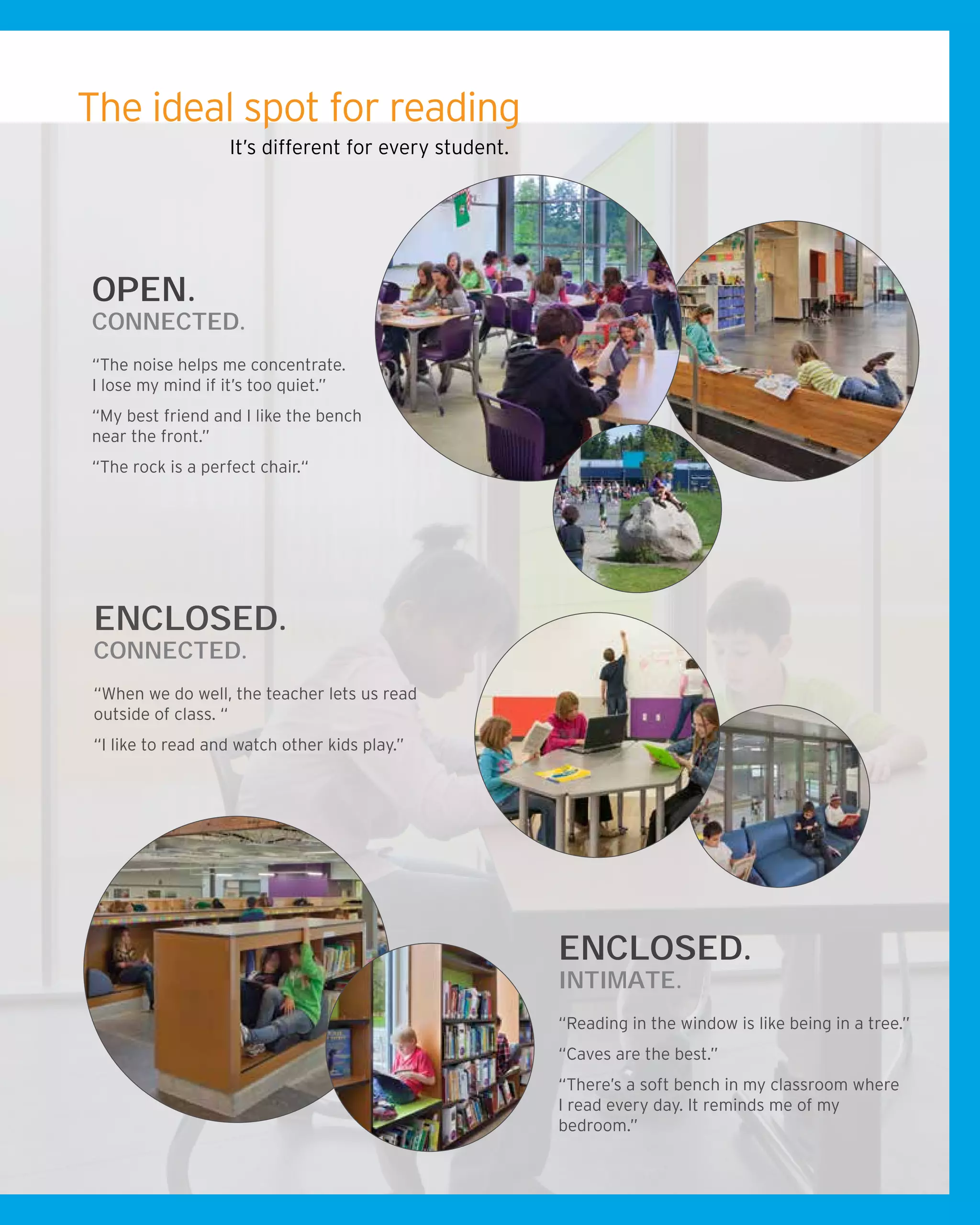
style and task at hand. Consider places for reading: one
student chooses a soft, quiet window-seat overlooking the
outdoors, another chooses a noisy cafe table surrounded
by others, and another chooses a dark, enclosed nook
overlooking the cafeteria. Give students a variety of
choices, ranging from more light to less, more noise to
less, more enclosure to less, and more connectedness to
less.
	 Further still, providing a variety of spaces also
encourages students to actively form their own point of
view, and to learn about and reflect on their personal
choices. Remember that students are learning about
themselves and the world through their environment.
Given a variety of locations, teachers are able to shift
locations of regular activities. Through working in and
exploring a variety of environments, students learn that
steel is cool and wood is warm, corridors are great for
channeling voices, and shadows are longer in the morning
than at noon. Give students the opportunity to use
different intelligences throughout the day.
Learning is
particular
Support a variety of learning
environments
Enclosed.
Intimate.
“Reading in the window is like being in a tree.”
“Caves are the best.”
“There’s a soft bench in my classroom where
I read every day. It reminds me of my
bedroom.”
Enclosed.
connected.
“When we do well, the teacher lets us read
outside of class. “
“I like to read and watch other kids play.”
Open.
Connected.
“The noise helps me concentrate.
I lose my mind if it’s too quiet.”
“My best friend and I like the bench
near the front.”
“The rock is a perfect chair.“
The ideal spot for reading
It’s different for every student.
54 Our vision
What we liked
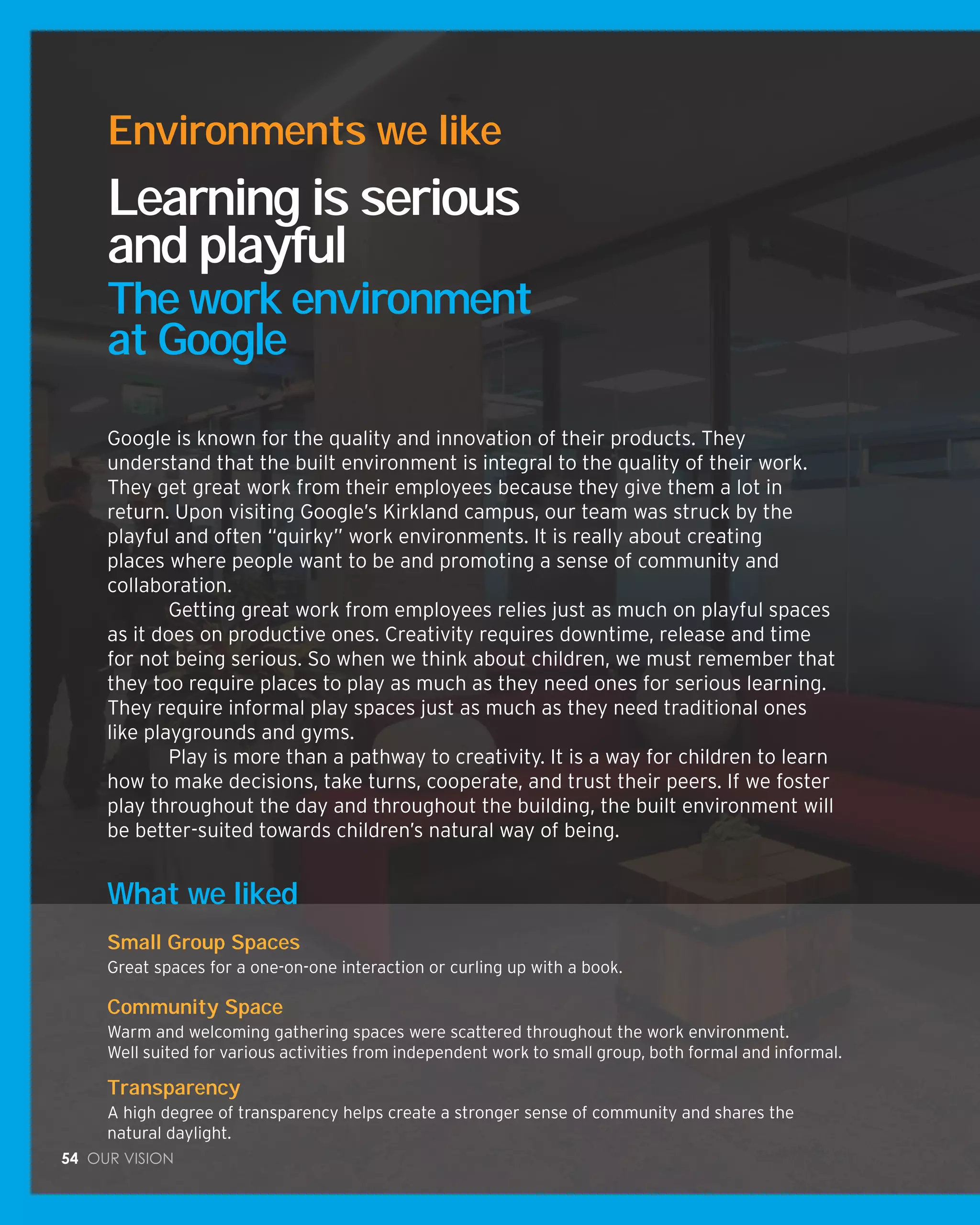
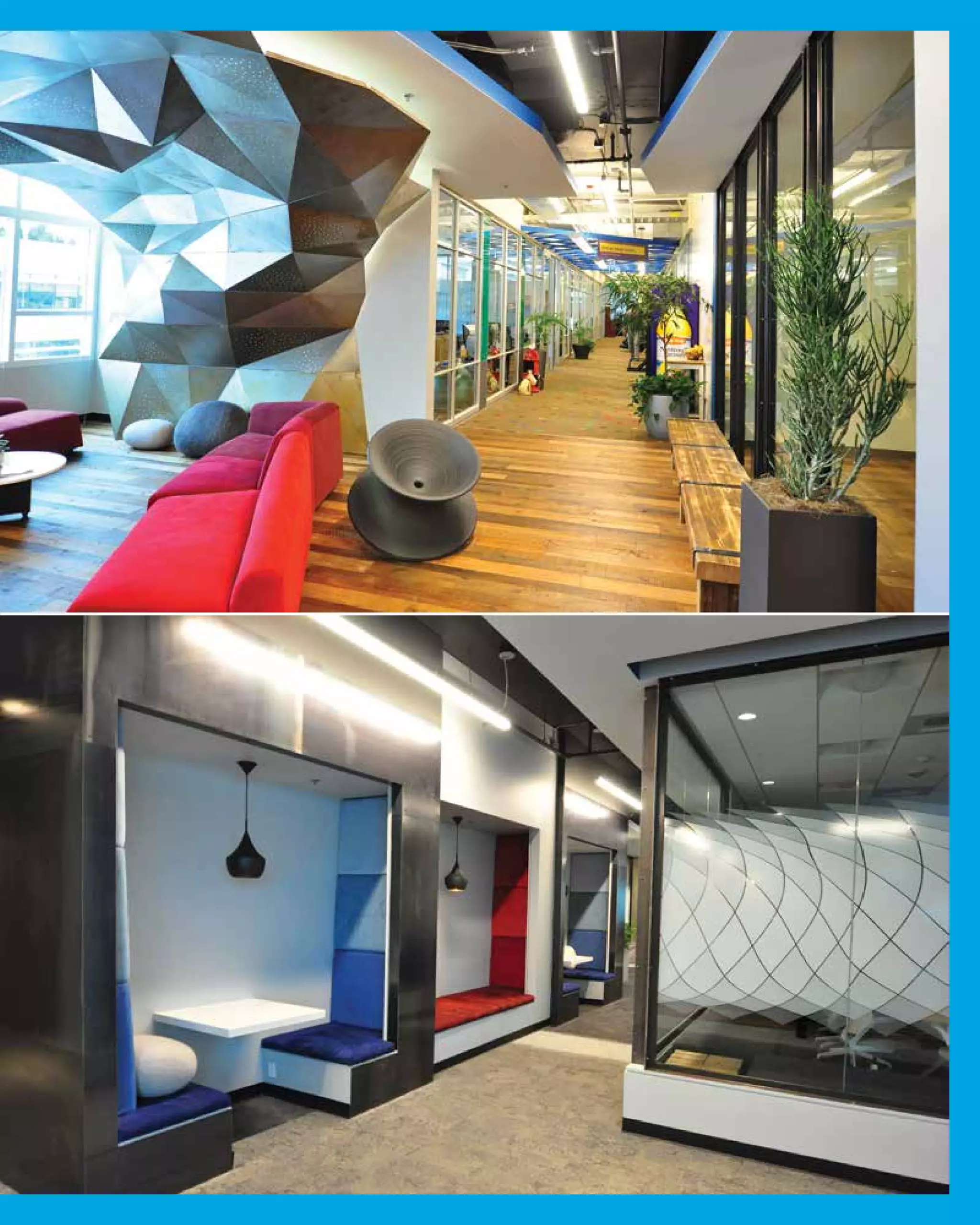
Small Group Spaces
Great spaces for a one-on-one interaction or curling up with a book.
Community Space
Warm and welcoming gathering spaces were scattered throughout the work environment.
Well suited for various activities from independent work to small group, both formal and informal.
Transparency
A high degree of transparency helps create a stronger sense of community and shares the
natural daylight.
Google is known for the quality and innovation of their products. They
understand that the built environment is integral to the quality of their work.
They get great work from their employees because they give them a lot in
return. Upon visiting Google’s Kirkland campus, our team was struck by the
playful and often “quirky” work environments. It is really about creating
places where people want to be and promoting a sense of community and
collaboration.
	 Getting great work from employees relies just as much on playful spaces
as it does on productive ones. Creativity requires downtime, release and time
for not being serious. So when we think about children, we must remember that
they too require places to play as much as they need ones for serious learning.
They require informal play spaces just as much as they need traditional ones
like playgrounds and gyms.
	 Play is more than a pathway to creativity. It is a way for children to learn
how to make decisions, take turns, cooperate, and trust their peers. If we foster
play throughout the day and throughout the building, the built environment will
be better-suited towards children’s natural way of being.
Learning is serious
and playful
The work environment
at Google
Environments we like
56 Our vision
Learning requires
a positive culture
Foster collaboration
among teachers
The teacher must play a variety of roles as we shift towards
a student-centered learning environment. As the curriculum
changes, collaboration between teachers becomes more
important than ever. Interdisciplinary and project-based
learning, for example, require creativity, constant iteration
and critical feedback from peers. Working this way requires
great spaces for teachers beyond the classroom; we must
provide alternatives to working alone in an isolated space.
We must build spaces where teachers will collaborate and
create, as well as concentrate and prepare. At the same time,
we must foster a professional community throughout the
school. The inhabitable space in-between, from classroom
portals to corridors, is just as important to collaboration as
formal spaces. And given the challenging nature of the work,
teachers require ample downtime. Give them spaces to get
away, relax and recharge.
How will we create environments that foster
collaboration?
How should the building support a culture of
collaboration between teachers? In the school
where I first taught, everyone met in the staff lounge
because planning space was limited. In the second,
each grade level met in a particular classroom. The
building has a major impact on how teachers work
together. Ultimately, promoting collaboration between
teachers starts with the feeling of the space. Like a
cafe, it should feel comfortable and familiar. Teachers
should immediately recognize it as a space for relaxing,
enjoying the company of others, or just getting work
done. Make resources available. At the end of the day, it
needs to be a nice space to work in. So make it inviting,
not utilitarian. If the space feels like little care was put
into it, then it won’t be used.
Beyond teacher planning spaces, are there other
opportunities within the school? Consider the typical
workroom that feels more like a storage room. At the
UW Cultural Center, the workroom is reimagined as a
leadership space. It still houses the copier, paper, and
typical resources. However it feels like a great space to
build banners and make posters. Because it is open, you
see what’s going on, and it feels available to everyone. It
becomes a resource for teachers and students alike.
Should spaces for teacher collaboration be
centralized or distributed? Proximity to the classroom
is key. With a thirty-minute lunch, a lounge that requires
a five-minute walk gives you only twenty minutes to
relax, socialize or work. Time is valuable to teachers. If
a space is convenient, then it is more likely to be used. If
a space is truly special, then teachers are more inclined
to use it. However at the end of the day, convenience
matters most. With that said, are we losing resources
if we move to a decentralized model? While spaces for
smaller planning and team meetings are great, we still
need a main space for larger meetings and larger group
work. You must understand the culture to find the right
balance.
If we are visioning and really thinking big, then what
might that balance look like? Ideally, there is a large
space for whole group collaboration and smaller ones
for daily informal and spontaneous interaction. Google
solves the problem in an interesting way. We saw
some really cool spaces when we toured their Kirkland
campus. There are really small spaces, almost broom
closet size, for skype-ing abroad. There are reading
nooks, where you face another person, almost like a
couch. There are lots of booths that are large enough
for four to five people. Some are open; others have
sliding doors with frosted glass so they can be open or
private. And there are spaces for larger gathering and
recreation. Providing a variety of spaces encourages
people to get together and meet up.
Are educators open to moving away from the model
of “one teacher, one classroom” to a learning
suite where a team of teachers own a series of
spaces? In addition to having a district vision, we need
teachers who appreciate collaboration. Personally,
I am all for teaching this way. It is exciting to see
learning environments that promote a high degree
of collaboration. We saw several examples during
our building tours. I was particularly impressed by
the central space of Valley View Middle School [in
Snohomish School District]. While some educators are
resistant to this type of teaching, the overall perception
is changing: we want more spaces that support
collaboration.
What features are critical to making these types of
spaces a success? Visibility. It must be easy to see out.
Consider behavior management. If you need a student
to leave the classroom and calm down, then you have
the ability to send them into a different learning space.
A hallway evokes feelings of being punished. This only
works if it is easy to see out. At the same time, when I
send a group of students out into the shared learning
area, I want to know that they are doing their work.
In terms of sharing resources and staying connected
with your teaching team, is there an ideal number
of core learning spaces within a single suite? If it
is important that teachers meet on a regular basis,
then eight is definitely too high. While three works, it
is on the low end. Between four and six is good, but
personally, I feel that five works very well. Suites may
include teachers from different teams representing
each of the content areas, such as language arts, social
studies, science, math, and an elective. Or suites may
include teachers from the same team, such as all of the
language arts teachers together.
Interview
Professional learning environments
A conversation with Ryan Prosser
58 Our vision
The power of
innovative schools
An environment where
every student succeeds
More students are succeeding because of our innovative
practices. We develop our portfolio of offerings by looking at
the district as a whole, by considering what is available for
all students, at all grade levels. Innovation is not about trying
new things just because; innovation is matching students
with unique schools that play to their passions and interests.
And when we succeed, students are more engaged; when
students are more engaged, learning is deeper. Learning
includes each of five modes: to think, to create, to discover,
to impart, to exchange. Equally important, students are
developing the way in which they relate to self, others, and
the world.
	 By exercising choice, personalizing space and finding
their own particular point of view, students develop their
relationship to self. They develop their relationship with
others by learning alongside peers and other children,
both younger and older, as well as adults of all ages
and backgrounds. By learning with and being in nature,
the neighborhood, and building, students develop their
relationship to world.
Part 3
Our process
Here in Tacoma, we do things differently than
other districts, and we ask you to do the same.
Our relationship is a partnership, and partnerships
require process-driven design. In order to build
an environment where students are continuously
challenged, relentlessly supported, and engaged
in a way that’s safe and healthy, we expect you to
include a particular set of directives within your
process.
62 Our process
We build
great schools.
64 Our process
Let’s work
together
A partnership to build
innovative schools
In the last section, we asked a series of questions while
communicating our vision for the learning environment.
Our vision is the beginning of a much longer conversation,
one that will continue through workshops, charettes,
observations, and other encounters with the district, the
Design Advisory Committee, staff, teachers, students, and
our community partners. Ask open-ended questions and
listen to our voice. Based on our answers, we expect new
interpretations of our learning environment. Teach us, and
learn from us about the relationship between curriculum
and the building. Transforming education starts with
partnership. Partner with us, and we will design innovative
schools together.
Building to last
for 50 years
Design with our
working directives
We looked critically at the past processes used to build our
schools as well as those of surrounding districts. We found
a series of powerful processes that we ask you to follow in
order to ensure that we build great schools. We hope that
you will make them your own, and as such, make them
better. In no way are we dictating your design process;
we simply ask that you include the following working
directives within your planning and design.
66 Our process
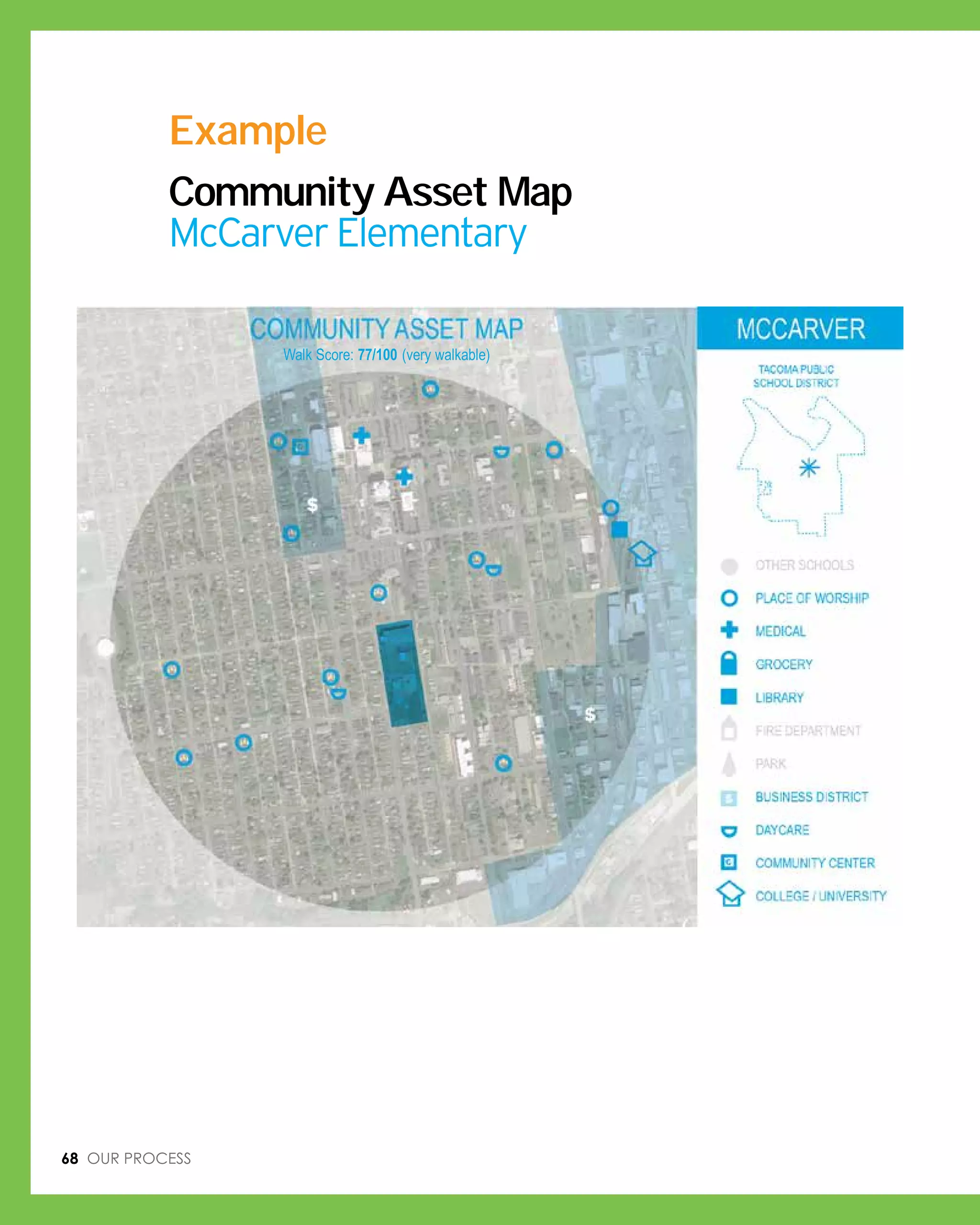
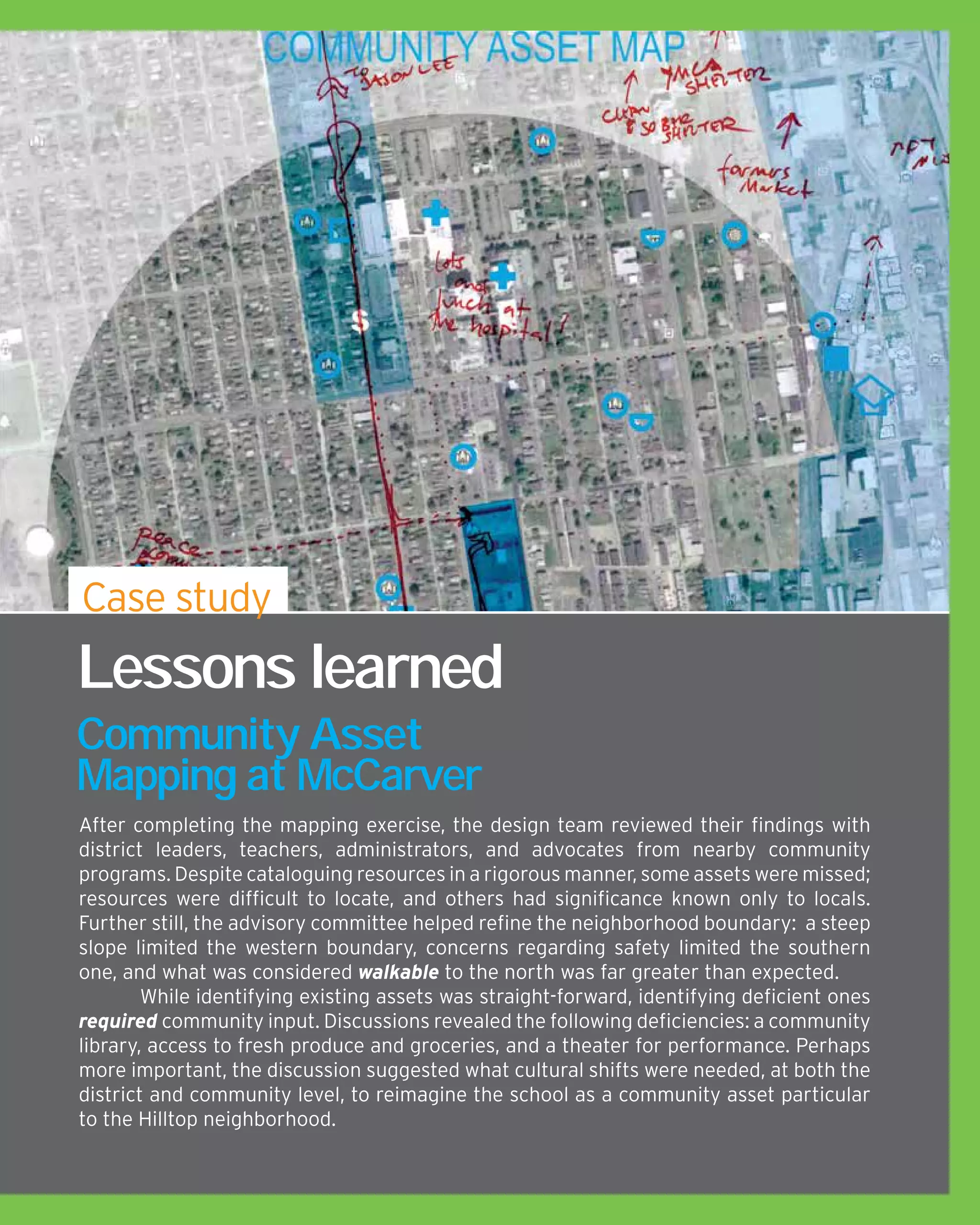
Community Asset
Mapping
Community Asset Mapping is a proven process towards
identifying existing and deficient assets. We must leverage
existing assets instead of replicating them and get our
students out into the community. Leveraging nearby and
adjacent amenities not only saves construction dollars
and frees up potential program space, it reinforces
the importance of our community partners within the
neighborhood. Examples include adjacent playgrounds,
parks, play fields, recreational facilities, libraries, churches,
galleries, and performance spaces.
	 At the same time, deficient assets create
opportunities for the school to become a real community
amenity. Our goal is giving our partners and the greater
community unprecedented access to what is typically the
largest civic investment in the neighborhood, our schools.
Directive
Identify existing and deficient assets by performing a thorough investigation of the community and
gathering input from the design advisory committee. Invite the community to be a part of the mapping
process. Consider holding meetings at their sites. Invite them to give design input. Most important, ask
the critical questions, such as
1.	 How do you define the community boundary and catchment area?
2.	 What assets exist within the community that may be leveraged by the school?
3.	 What are the learning spaces in the neighborhood that can be used as classrooms?
4.	 What assets are deficient within the community?
5.	 Is it possible for the school to provide or support these deficiencies?
6.	 Who are our partners currently?
7.	 Who should be our partners that we are not partnering with already?
Intent
Map the following
Implementation
Work with your Design Advisory Committee (DAC) to identify and map all current and notably absent
amenities located within the school’s catchment area. Items to be mapped are to include but are not
limited to the following:
Community Asset Maps should be completed early in the Pre-Design / Schematic Design phases
in order to appropriately address the design issues revealed by mapping.
	 Additionally, the district is providing additional building square footage (1000 SF) to support
existing or desired community partners or academic programs. The design team, in concert with the
Design Advisory Committee, shall submit a formal request to the Capitol Projects director in order to
finalize the project scope.
1.	 Schools				
2.	 Early childhood centers and
pre-schools	
3.	 Community based organizations
4.	 Community centers and support centers
5.	 Community organizations that lack a
physical location
6.	 Hospitals and clinics
7.	 Fire stations
8.	 Libraries
9.	 Places of worship
10.	 Colleges and universities
11.	 Parks
12.	 Transit centers	
13.	 Bus stops
14.	 Walking and biking trails
15.	 Museums and other civic amenities
16.	 Natural features
(Greenways, water bodies)
17.	 Retail districts
18.	 Business community
19.	 Corporate partners
20.	Future or proposed amenities
(currently under construction, planned
communities, neighborhood plans)
21.	 Other
Walk Score: 77/100 (very walkable)
68 Our process
Example
Community Asset Map
McCarver Elementary
After completing the mapping exercise, the design team reviewed their findings with
district leaders, teachers, administrators, and advocates from nearby community
programs. Despite cataloguing resources in a rigorous manner, some assets were missed;
resources were difficult to locate, and others had significance known only to locals.
Further still, the advisory committee helped refine the neighborhood boundary: a steep
slope limited the western boundary, concerns regarding safety limited the southern
one, and what was considered walkable to the north was far greater than expected.
	 While identifying existing assets was straight-forward, identifying deficient ones
required community input. Discussions revealed the following deficiencies: a community
library, access to fresh produce and groceries, and a theater for performance. Perhaps
more important, the discussion suggested what cultural shifts were needed, at both the
district and community level, to reimagine the school as a community asset particular
to the Hilltop neighborhood.
Lessons learned
Community Asset
Mapping at McCarver
Case study
70 Our process
Our relationship is a partnership. With every project, you
help us become a better district. Benchmarking helps us
expand our understanding of performance beyond the
immediate design to include a longer time frame. Working
together, we will gather data for both student and building
performance today and then compare that data to our
new and remodeled schools. The process will help develop
best practices and standards for performance.
Benchmarking
performance
Directive
You must collect the following data prior to the start of design and construction in order to:
1.	 Establish accountability
2.	 Establish appropriate project goals for both student and building performance
3.	 Understand the unique conditions of each school
4.	 Understand the student needs for each school
5.	 Understand each school in the context of our other schools
6.	 Understand unintended consequences of previous decision making and operational choices
Collect the data in coordination with the district. For existing schools, complete a pre-occupany survey. The
district will provide you with a formatted report. From the report, develop and submit performance criteria.
Intent
Implementation
Collect the following
School name
School address
Date of construction	
Building gross SF
Is the building historic?		
Total site area			
Total enrollment	
Total # of staff
General School Information
What is the age of the existing facility?
What is the current energy use intensity (EUI)?
Electricity EUI
Fuel EUI
Total EUI
What is the annual water usage?
What are the typical hours of daily operation?
How many buildings?
Provide descriptions for the building systems:
Heating
Cooling
Sanitary/Septic
Irrigation system
What is the heating set point?
What is the cooling set point?
What is the building cleaning routine?
Frequency
At what time do they clean the building?
How long does it take for each cleaning?
What type of kitchen?
How many meals are served daily?
Building Performance Data
Annual # of student sick days
Annual # of staff sick days
Annual incidence of vandalism
Annual incidence of disciplinary action
% teacher turnover
% student turnover
% of students receiving free and reduced lunch
# of special education
# of ELL
# of annual lockdowns
# of security incident reports
Transportation distribution for students
(bus, walk, bike, car)
Student Performance Data
72 Our process
Daylight analysis
We know that access to daylight has a significant effect on
student performance. We must provide quality daylight
to all of our learning and community spaces. We believe
that this will improve the performance of our students and
staff while also reducing the energy use of the building.
Directive
Establishing lighting criteria, designing daylight strategies and confirming the results with rigorous
simulation throughout the project will ensure that all of our learning and community spaces will
have access quality daylight and the building’s energy performance.
1.	 Building orientation
2.	 Floor plate geometry
3.	 Window orientation
4.	 Window height
5.	 Section depth
6.	 Glass area ratio
Intent
Considerations
1.	 7. Fenestration patterns from two or more sides
2.	 8. Interior furnishings
3.	 9. Blinds and shades
4.	 10. Fixed building shading
5.	 11. Review practicality of maintenance routines
11. with high story glazing
Document lighting objectives and visual comfort criteria as established with the district and the
Design Advisory Committee. At the end of both Schematic Design and Design Documentation, you
must provide the district with daylight analysis reports, graphs and renderings that demonstrate
the daylighting performance of the particular design.
Documentation requirements
DAYLIGHT ANALYSIS REPORT: SAMPLE PROCESS
Geometry
74 Our process
The following description provides a frame of reference for what a typical daylight
analysis report may include; in no way is it meant to be exhaustive or prescriptive.
It is up to you to determine lighting objectives and visual comfort criteria while
working together with the district and the Design Advisory Committee.
Select typical spaces for the daylighting analysis
based upon daylighting strategies, orientation, room
size, etc. If a space will benefit from a daylighting
analysis, then include it. For example, consider
classrooms with different orientations as different
spaces. Also, identify spaces that will benefit from
top lighting. Model the selected spaces with a
daylighting and energy analysis tool such as IES’s
Virtual Environment.
Simulate the modeled spaces with a daylighting
tool such as Radiance and/or Daysim. The right
variety of sky types, dates and times will provide a
basis for comparison between different daylighting
strategies. For a starting point, consider simulating
solar noon on the autumn equinox for both sunny
and overcast skies. Spatial Daylight Autonomy
calculations may be used as well.
Shading Iterations
Glass Properties Artificial Lighting and Energy Analysis
Identify shading strategies early. Glare is integral
to visual comfort and achieving successful
daylighting. Shading strategies must be modeled
in addition to building geometry. Early studies of
sunny skies will reveal where shading is needed.
Based on the results, develop appropriate shading
strategies, whether dynamic, fixed or interior, and
model again. The critical ratio between daylight
at the exterior edge and the interior edge of a
space is a good indicator of daylight distribution.
In a typical situation, 1:5 is optimum and 1:10 is the
maximum ratio for good uniformity of daylight.
Daylighting analysis is an iterative process. As the
design progresses, simulations are an invaluable
tool for testing and feedback. Simulation is not
a one-time process; successive design iterations
require successive simulations. Situations
warranting a new iteration include adding skylights
or interior light shelf, raising the ceiling height,
adding a north monitor, sloping the ceiling, and
adding interior shading device.
Daylighting performance varies dramatically across
different glass types, so select glass properties based
on the lighting objectives. Consider using two glazing
types, one for daylight windows (clerestory) and
another for view windows. If multiple glass types are
considered, then model each separately.
Typically lighting fixtures are not included in the
daylighting studies. Perform an energy analysis
that simulates the impact of daylighting on heating
and cooling. Provide the electrical team with your
dimming criteria to ensure potential cost savings.
Consider commissioning all lighting controls.
Simulation
DAYLIGHT ANALYSIS REPORT: SAMPLE DELIVERABLES
Deliverables
A typical report includes a series of graphs and renderings that demonstrate the
daylighting performance of a particular design. The following images are examples
of what a report may include.
1. Graph illuminance values (foot-candles) of the 	 	
workplane surface for the complete depth
of each space. Graph iterations of different
strategies as a way to make recommendations.
2. Render the floor plan with footcandles for
each space.
3. Render the 3D model also showing footcandles
for each space.
fc
ft
76 Our process
Building for
the future
Programming is a powerful process. It makes designing
the school’s learning environment possible, and it will
anticipate the district’s expectations moving forward.
At the same time, programming’s weakness is paying too
much attention to the immediate needs of our immediate
users, and not enough attention to the future ones. The
result is a building that is too favorable to the present and
maladaptive to the future. The following pages provide
a number of tools that will assist you in the process-driven
design of our schools. It is not meant as an exhaustive
list; on the contrary, it is a point of departure and an
opportunity for making conscious decisions. We expect
that you will complete them and make them better.
78 Our process
Driving forces
Before you begin the design, it is important that you
investigate the driving forces that will shape the future
environment. In education, driving forces may include
changes in technology, in pedagogy, in regulations (both
state and federal), competition with other schools, and
even the definition of the student. If education continues
becoming more pervasive and ubiquitous, the age of
students may change from 2-14 to 2-98, and the school
day may change from 8am to 3pm for weekdays to 24
hours every day of the year. For the facility, driving forces
may include changes in technology, in the economy, in
the community, and in district use. For example, the old
high school is now the central administration building.
Additionally, you should identify likely scenarios, such
as population growth and densification.
In order to understand what challenges the new Tacoma Public Schools must be
equipped to handle, we need to consider the environment in which it will operate. What
are the elements that comprise our current social and educational landscape and what
are the factors that will shape the future environment? This exercise was intended
to stimulate dialogue about the current climate, internal and external influences,
emerging trends, and unforeseeable factors. Yet perhaps most importantly, we asked
“Who is our customer, and what are their needs?”
Unforeseeably
changing conditions
Imagining the year 2019
Exercise
Social Trends
Integrated tech focus
Digital natives
It comes to you: age of convenience
Partnerships with business
Microsoft high
Technology Factors
Bring your own device
Multiple devices
24/7 info and resources
Political Factors
New governor/president
Joint & shared use (city/school)
Transparency
Customer Needs
Sell services to compete
What motivates & inspires you?
Personalized & customized
Specialized uses (arts, sports, etc.)
Process places
Economic Climate
Boeing not here
Competitive Trends
Charters
Online learning
(relevant in 5 years?)
Uncertainties
Security
Stranger danger
What are euromodels
anticipating in 20 years?
80 Our process
We must accept that there will be unknown conditions
in the future. Remember the adage, “Whatever you plan
for doesn’t happen; whatever you don’t plan for does.”
We cannot accommodate unknown conditions with
programming alone. Scenario modeling is a process that
reaches into the future (up to twenty years) and imagines
multiple and divergent plans instead of a single pathway.
Scenario
modeling
Directive
At a minimum, re-think the following components when creating scenarios:
Create scenarios
Educational model
Re-think the current educational model and create test fit scenarios that explore new patterns
for teaching and learning.
Learning environment
Re-think the learning suite. How does the learning environment support a continued shift from
instruction to discovery? What does learning based on multiple intelligences and increased
student choice look like?
Community connections
Re-think community connections.
Information resources
Re-think Information resources. What is the role of the library? No longer a hushed repository
of books, how does a “library” space best provide access to multiple resources? How can it
support collaborative research? Should library functions be dispersed and support immediate
access to information throughout the school and in the learning suite?
Blended learning
Re-think blended learning. What if direct instruction is delivered online or at home? Can the
school transform into a virtual environment?
Lifelong fitness
Re-think lifelong fitness. Should fitness space for elementary age children look more like a
health club and less like a gym for basketball? How does simulation and gaming effect how
children exercise?
Lunch experience
Re-think the school lunch experience. Consider new initiatives in healthy eating, such as
farm-to-table and the edible schoolyard as examples. How do schools integrate nutrition with
learning? What if food is accessible to students 24/7 and throughout the building?
82 Our process
Panther Lake
Elementary
Three scenarios were used in the design of Panther
Lake, an elementary school in the Federal Way Public
Schools district. Each scenario accommodates a different
organizational model. While good, we ask you go farther.
You should account for driving forces beyond changes in
people and organization alone.
Example
Scenario one
Current PreK-5 model
Panther Lake Elementary School
Federal Way Public Schools
84 Our process
Scenario two
Open PreK-5 model
Scenario three
K-8 model
Panther Lake Elementary School
Federal Way Public Schools
86 Our process
Wall flexibility
Urban theorist Kevin Lynch declares that we must attend
to the future, that we cannot coerce it. He suggests future
preservation as a necessary counterpoint to the historic
kind. Is not enough to design a building that lasts for 50
years or more; the design must be capable of offering new
options for use as well. By designing with flexible walls, we
preserve the school’s ability to adjust and even change
directions.
Directive
Our schools need to be as flexible as possible to allow for the buildings to adapt over time. In order to build
flexibility into our schools, we must design our buildings with careful consideration of how these adaptations
may occur throughout the building’s lifespan. We require that the design team carefully consider and
identify walls based on their ability to change, from highly inflexible to highly flexible. We name these walls
as follows: 5-year, 20-year, and 50-year walls. 	
In order to implement flexible walls, you must get buy-in early from all of the engineering disciplines. Coordinate
with your mechanical, electrical, and structural teams to strategically locate critical infrastructure, such as
water, power, and data, and keep them away from the 5-year walls.
The design team must submit a plan view of the proposed building that clearly highlights wall types and
primary structural elements coordinated with and signed by all relevant engineering disciplines. Submit
preliminary documentation upon completing Schematic Design, final documentation upon completing Design
Development, and a plan sheet in the record drawings upon completing Contract Administration.
Intent
Criteria
5-year walls are the most flexible type with little or no infrastructure. They are easy to remove or modify.
Building this type of wall requires careful coordination; they cannot contain elements that make them difficult
or expensive to reconfigure.
5-year walls
20-year walls may change once or twice throughout the lifetime of the building and require a significant effort
to move, reconfigure, or modify. Included are walls with a medium-degree of infrastructure, such as gas or
water, as well as walls that are expected to be removed if the building expands.
20-year walls
Comprised mainly of infrastructure, 50-year walls are the least flexible type. In most circumstances, they will
never move or be removed throughout the lifetime of the building. Walls of this type include structural walls,
walls with significant building infrastructure, and fire-rated walls.
50-year walls
Implementation
88 Our process
Wall flexibility
Panther Lake Elementary
Example
90 Our process
Building for our
learning culture
This is not your typical
educational specification
The typical school program is a list of highly specialized
spaces with very specific requirements that are seemingly
inflexible and can be very difficult to modify over the
life of the building. In our experience, highly specialized
spaces are underutilized; they work well for one activity
and perform poorly for most others. In order to provide a
learning environment that meets every student’s needs,
it is imperative that we do more with less. We must create
spaces that support a variety of uses. If a small group space
within a learning suite is able to function equally well for
special needs pullout, teacher collaboration, volunteer
instruction and student work, then we have succeeded
in radically transforming the space. Moreover, the spaces
we design must not only serve the current education
framework but future ones as well. Often it is expensive and
difficult to change spaces that are highly specialized; as a
result, they resist change and become less used over time.
We must design our spaces so that future users are able to
modify them with the least effort possible.
For today, we design our program to do more with less;
for tomorrow, we design our program so it is easily
changed.
92 Our process
Flexible
program framework
An innovative learning
environment for every school
Tacoma Public Schools offers students more innovative
choices for their education than any other district in the
state. Providing more innovative choices ensures that
our students are continuously challenged and engaged,
that they will find a passion for learning. The Montessori
Method, IB, STEM and expressive arts are a few examples
of the specialized paths that we offer. Because every school
offers a unique portfolio of offerings, you must ask, “What
are these offerings? What types and qualities of space are
needed to provide them?” Partner with us to understand
the nature of your school’s particular learning environment.
	 We give you a flexible framework for program that
will allow you to interpret and thus tailor the learning
environment for every school. Tacoma Public Schools
has attempted to distill the elementary school into four
primary elements: general learning, specialized learning,
administration and student support, and building support.
By giving you the freedom to configure these large
elements of program, we give you the opportunity to make
conscious decisions. Throughout the process, we must
work together to ensure that all parties are continuously
challenged and relentlessly supported.
New elementary program
19 classrooms
General learning QTY SF NSF
Core Learning 18 900 16,200
Shared Learning 3 900 2,700
Small Flex 3 300 900
Small Group 3 150 450
Core Learning (PreK) 1 1,100 1,100
Subtotal 21,350
Specialized learning QTY SF NSF
Specialized Program 4 1,200 4,800
Large Group 1 7,000 7,000
Library and Information Resources 1 1,800 1,800
Library workroom/storage 1 360 360
Subtotal 13,960
Administration and student support QTY SF NSF
Principal office 1 200 200
Small Group (support office) 7 150 1,050
Secretary's area 1 250 250
Health room and nurse office 1 300 300
Health room toilet room 1 100 100
Small Flex (conference room) 1 300 300
Large Flex (staff lounge) 1 600 600
Large Flex (staff workroom) 1 600 600
Subtotal 3,400
Building support
Kitchen and kitchen storage 1 1,000 1000
Custodian office 1 250 250
Outdoor storage 2 50 100
Janitor closets 4 50 200
Subtotal 1,550
Discretionary program area QTY SF NSF
Discretionary program area 1 1,000 1,000
Subtotal 1,000
Total net square feet 41,260
Circulation 14.0% 5,776
Student toilet rooms 1,600
Mechanical and electrical rooms
(includes library data room)
Wall space 15.0% 6,189
Subtotal 15,365
Total building area 56,625
Covered play
Total building area with covered play 58,675
475 students
1,800
Covered play 0.5 4,100 2,050
94 Our process
At once particular, we also give you a framework for making
a learning environment that is both agile and adaptive. The
learning environment will inevitably undergo technological,
spatial, and academic change over its expected minimum
life span of 50 years. Spaces that are too specialized rarely
work well for anything other than that specialized activity;
ultimately these types of spaces lie dormant for much of
the day.
	 The district has attempted to distill the typical
specialized spaces into eight flexible space types with the
capacity to accommodate a variety of configurations and
uses. Multiplicity of use creates complexity through
a greater diversity of relationships and interactions between
space types. It also keeps utilization rates high. By distilling
spaces back to their essential characteristics, we make it
possible to change use in the future. Familiarize yourself
with the flexible space types. They are the building blocks
for configuring the large program elements.
Flexible
space types
Building blocks for
the program framework
5
SMALL GROUP
150 SF
Self-directed work
Small group work
Classroom pullout
Special needs pullout
Private office
Intimate meeting
Small storage
Parent room
Volunteer home base
SMALL FLEX
300 SF
Small group work
Project/build work
Classroom pullout
Special needs pullout
Instruction
Itinerant services
Conference room
Teacher collaboration
Storage
Community room
Clubs/tutoring
large flex
600 SF
Project/build work
Instruction
Special needs instruction
Community room
Staff lounge
Staff workroom
core
learning
900 SF
Self-directed work
Small group work
Project/build work
Typical classroom
Special needs
instruction
Shared Learning /
SpecialiZed Program
900 sf / 1200 SF
Shared learning
Specialized program:
Science
Wet lab
Da Vinci room
Art
Music
Drama
Teaching kitchen
Language
Technology/video studio
Community room
Large GROUP
7000 SF
Student dining
Large group work
Meetings
Presentations
Performances
Athletics
Physical education
Health and fitness
Community use
Library and
Information
resources
1800 SF
Self-directed work
Small group work
Large group work
Instruction
Meetings
Presentations
Genius bar
ENTIRE SCHOOL
10
15
30
25
50
96 Our process
Services: Video, voice communication, power, and data located for
maximum flexibility.
FFE: Movable furniture and fixtures, lockable file storage, small
meeting table, guest chair, varied furniture settings.
Access: Easy access and visibility from shared learning spaces.
Considerations: Accessible after hours, lockable room.
Adjacencies: Dispersing Small Group spaces throughout the school
accommodates changes in future use. Private offices for General
Support are potentially dispersed or centralized. Ownership of Small
Group spaces will range from permanent, to temporary or shared.
Placing two Small Group spaces together allows future combination
into a Small Flex space.
Notes: Consider that use as storage may compromise transparency
of these spaces. Providing natural daylight to these spaces helps
accommodate future flexibility.
Small group (5)
150 sf
Space types
Occupants
Up to 5
User Groups
Students
Staff
Volunteers
Potential Uses
Self-directed work
Small group work
Classroom pullout
Special needs pullout
Private office
Intimate meeting
Small storage
Parent room
Volunteer home base
Characteristics
Intimate
Formal and informal
Flexible furnishings
Technology equipped
Transparent or opaque
Private or semi-private
Acoustical separation
98 Our process
Services: Video, voice communication, power, and data located
for maximum flexibility, sink and/or kitchenette as appropriate,
projection or digital display.
FFE: Movable furniture and fixtures, small meeting table, guest
chairs, movable display, tackable and projection surfaces.
Access: Easy access and visibility from shared learning spaces.
Considerations: Use physical walls or flexible furniture to
define spaces. Functions vary with unique needs depending
on configuration of the learning suites and student support
requirements.
Adjacencies: Dispersing Small Flex spaces throughout the school
accommodates changes in future use. Spaces for students and
teacher collaboration are best located near learning suites with
observation of shared learning areas and otherwise unsupervised
student spaces. Ownership of Small Flex spaces will range from
permanent, to temporary or shared.
Small Flex (10)
300 sf
Space types
Occupants
Up to 10
User Groups
Students
Staff
Volunteers
Potential Use:
Small group work
Project/build work
Classroom pullout
Special needs pullout
Instruction
Itinerant services
Conference room
Workroom
Teacher collaboration
Storage
Community room
Clubs/tutoring
Characteristics:
Formal or informal
Flexible furnishings
Tackable surfaces
Technology equipped
Transparent
Full to partial acoustical
separation
Services: Video, voice communication, power and data located for
maximum flexibility, 2-way communication system with intercom,
wireless network access, sink and/or kitchenette as appropriate,
projection or digital display.
FFE: Movable student workstations, tables and equipment,
movable storage units.
Access: Easy access and visibility from shared learning spaces.
Considerations: Use physical walls or flexible furniture to
define spaces. Functions vary with unique needs depending
on configuration of the learning suites and student support
requirements. Use flexible walls when connecting to adjacent
shared learning spaces. Consider acoustical privacy.
Adjacencies: Consider placing two Large Flex spaces together
for future combination into a Specialized Instruction space.
Ownership of Large Flex spaces will range from permanent to
shared.
Large Flex (15)
600 sf
Space types
Occupants
Up to 15
User Groups
Students
Staff
Volunteers
Potential Use:
Project/build work
Instruction
Special needs instruction
Community room
Characteristics:
Formal or informal
Flexible furnishings
Tackable surfaces
Technology equipped
Transparent
Full to partial acoustical
separation
100 Our process
Services: Video, voice communication, power and data located for
maximum flexibility. Zoned lighting controls for various activities,
2-way communication system with intercom, synchronized clock
system, wireless network access, audio enhancements to allow full
group or small group work, projection or digital display, one sink and
bubbler.
FFE: Flexible furniture and fixtures to allow various configurations,
easily changeable displays and tackable surface, some limited
storage of books and materials
Access: Connectivity, transparent and physical, between two of
these spaces and with the shared learning space will provide greater
flexibility for team teaching, collaboration and temporary classroom
expansion for project work.
Considerations: Consider operable windows, thermostat (zone)
control, durable and cleanable surface materials, daylighting and
views. Make adaptable for multiple teaching modalities including
Core Learning (25)
900 sf
Space types
Occupants
Up to 25
User Groups
Students
Staff
Volunteers
Potential Use:
Self-directed work
Small group work
Project/build work
Typical classroom
Special needs instruction
Characteristics:
Formal to informal
Flexible furnishings
Tackable surfaces
Heavily technology equipped
Transparent
Full to partial acoustical
separation
individual, team and collaboration; adaptable for multiple
learning typologies including presentation, self-directed work,
small group work, project/build work; supportive of direct and
indirect instruction; agile for quick reconfiguration; abundant
infrastructure will promote flexibility and maximum use.
Adjacencies: Place classrooms with a direct connection to shared
learning space and clear access to the outdoors. Ownership
of Core Learning ranges from an individual, team to group of
teachers.
Notes: If the district moves to a reduced teacher-student ratio,
then 25-student Core Learning will be replaced by 17-student ones
with the same features and services. Placing two 25-student Core
Learning together allows future subdivision into three 17-student
spaces.
102 Our process
Activities: Shared Learning provides an informal area for classroom
break-out activities, small groups, self-directed learning, project
creation and work with paraeducators. Specialized Program supports
learning activities unavailable in the classroom, teaming and cross-
curricular learning.
Services: Video, voice communication, power and data located for
maximum flexibility, zoned lighting controls, 2-way communication
system with intercom, synchronized clock system, wireless network
access, projection or digital display, and writable and tackable wall
surfaces. Kitchenette, sinks, and exhaust hoods as appropriate.
FFE: Movable student workstations, tables and equipment, movable
storage units.
Access: Easy access and a visible connection between shared
instruction and core instruction encourage indirect supervision of
student activities. Easy access and a visible connection between
specialized instruction and school-wide areas promote connectivity
Shared Learning and
Specialized Program (30)
900 sf / 1200 sf
Space types
Occupants
Up to 30
User Groups
Students
Potential Use:
Shared learning
Community room
Specialized program:
Science
Wet lab
Da Vinci room
Art
Music
Drama
Teaching kitchen
Language
Technology/video studio
and use. Provide direct access to an outdoor learning space with
extra wide openings.
Considerations: Provide a flexible space for messy project
creation, experiential learning and/or curricula needing specific
equipment, access to water and kitchenette, additional mechanical
and electrical services, more durable finishes and acoustical
separation from other learning environments. Specialized Program
requires a flexible location of “teaching wall,” audio enhancements
as necessary to for both full and multiple small group student
work, sinks, day-lighting controls, ceiling grid (or exposed to
structure) to allow for hanging display of student work. As a music
room, provide acoustic tuning and separation.
Adjacencies: Placed within a group of core instruction spaces,
Shared Learning becomes a protected, familiar space for a small
community of students. These spaces are owned by the adjacent
teachers. Specialized Program is shared by the whole school;
locate them for easy access by all students. Consider placing
music/drama adjacent to the dining space within Large Group.
Characteristics:
Formal to informal
Flexible and varied furnishings
Tackable surfaces
Durable finishes
(non-carpeted)
Technology equipped
Transparent to common
activity spaces
Full to partial acoustical
separation
Flexible infrastructure
for future changes
104 Our process
Services: Video, voice communication, power and data located for
maximum flexibility, zoned lighting controls, 2-way communication
system with intercom, synchronized clock system, wireless network
access, and projection or digital display.
FFE: Movable student workstations, tables and equipment, movable
storage units, adequate storage for books and materials, and soft
seating.
Access: Easy access to the learning suites and public entry is
desirable.
Considerations: Provide easy access to resources and research
materials. Provide technology rich and collaborative environment.
Create inviting spaces appropriate for research, reading and study.
Focus on supporting learning. Provide variety of space for large group
instruction and small group collaboration. Consider allowing food and
drinks.
Library and Information
Resources (50)
1800 sf
Space types
Occupants
Up to 50
User Groups
Students
Staff
Volunteers
Potential Use:
Self-directed work
Small group work
Large group work
Research
Reading
Information resources
Instruction
Meetings
Presentations
Genius bar
Characteristics:
Formal to informal
Flexible furnishings
Technology equipped
Transparent to opaque
Some space with
acoustical separation
Adjacencies: Library resources may be centralized or distributed
throughout the school.
106 Our process
Services: Video, voice communication, power and data located for
maximum flexibility, zoned lighting controls, 2-way communication
system with intercom, synchronized clock system, wireless network
access, drinking fountains, scoreboard, PA system, assisted listening
system, large format projection.
FFE: Easily moveable and/or stackable furniture to allow for multi-
use of space, abundant display and tackable surface, divider curtains
or operable partitions for subdivision, athletics equipment.
Access: Easy access to the learning suites, storage, restrooms and
direct access to the outdoors.
Considerations: Safety/supervision, durability, student-focused,
restaurant/café atmosphere, provide acoustical treatments for
noise mitigation, good views and natural light, open floor area to
accommodate seating, adjustable lighting and sound amplification
systems; after-hours access for student, staff, and community use;
special internal acoustical considerations for formal performances;
Large Group (Entire school)
7000 sf
Space types
Occupants
Entire school
User Groups
Students
Staff
Volunteers
Potential Use:
Student dining
Large group work
Meetings
Presentations
Performances
Athletics
Physical education
Health and fitness
Community use
Characteristics:
Formal to informal
Flexible furnishings
Minimal technology
Dividing curtain(s)
Transparent to opaque
Full to partial acoustical
separation
proscenium or thrust stage within performing area, performance
is to be flexible. Provide adequate storage for spectator seating.
Allow spaces to be subdivided to provide concurrent activities
including dining, fitness, and music.
Adjacencies: To facilitate access to food services, place the dining
space adjacent to the school’s kitchen. To allow for pre-game/
event food service, place the gymnasium adjacent to or near the
dining space. Zoned for public use.
Notes: The Large Group space will be divided into fitness and
dining for the significant duration of use. Each should have
separate access and have full acoustical separation from the other.
The fitness space should be designed as a teaching station to
support instruction.
108 Our process
General learning
Accommodate multiple
learning styles
Consider the learning suite’s counterpoint. It is the
organizing model that arranges a series of nearly identical
classrooms along a connecting corridor. The model assumes
that all activities and learning styles can be accommodated
within a model. Assigned to a designated location, teachers
find it difficult to socialize and use space outside of their
four walls. The arrangement makes collaborative work
difficult; there are few opportunities and spaces for different
group sizes and spreading out. Finally, the lack of variety
limits the ability to accommodate future change.
	 By comparison, the learning suite contains a variety
of spaces jointly owned by a group of teachers, thereby
accommodating multiple learning and teaching modalities.
Teachers determine the utilization of each space as a
group. Because each space is equipped for a variety of
uses, the learning suite provides flexibility as program and
organization models change through the years. Sharing
resources locally increases utilization, limiting travel
distances for teachers and students alike, and promotes
collaboration. The configuration of the learning suite relates
to the degree to which teachers share responsibilities.
What are the district’s expectations for
educational delivery? The district is moving away
from the instructional method where the teacher
is always in front, always the director of learning.
We believe that the more children think about their
thinking, the better they learn. We must create
opportunities where children engage directly with
each other, where they talk about learning and
their ideas. The key word is flexibility. While direct
instruction is still needed, students need to work
in small groups. They need access to resources for
working on projects. They need spaces to work alone.
It’s awesome to walk into a classroom during silent
reading and see kids totally engaged under desks,
sprawled on pillows, and in different cubbies. Kids
love to take their friend and their book and go into
a cubby and do their thing. We need that kind of
flexibility in our learning spaces.
Using easily-reconfigured furniture is one way
of creating flexibility. What else matters? While
flexibility and openness matter, there is a balance
that needs to happen. We still need areas where the
teacher instructs the whole class, areas with little
distraction. Understandably, teachers are wary of
spaces that are too open, with too much activity
happening on the periphery, because they are
distracting. They must be able to balance open, active
areas with visually and auditory calm spaces.
How important is flexibility and openness? Some
educators believe that our children cannot handle
really open, creative, flexible environments, especially
those kids with high needs. We cannot design around
perceived limitations. When we visit other schools,
the difference is clear. When we walk into a learning
environment that is more flexible, the learning
continues without interruption. In the more box-like
classrooms, we open the door and learning stops. We
cannot build boxes within boxes any longer.
In general, some schools struggle with the
transition to a more student-centered model,
particularly at the younger ages. Where is the
district? I worked in an elementary school where one
classroom wing had shared open areas in the hallway,
and the other did not (for lack of funding). In the
hallway with open areas, there were vastly different
types of learning. Remember, the quality of teaching
was the same. By simply allowing little groups to
move into the hallway instead of keeping them in
the classroom, the level of student involvement
completely changed. Children are more adaptable and
creative than we believe. It’s the adults who struggle.
If we build beautiful buildings with lots of open spaces
and flexibility that support really dynamic teaching
and learning, then it is up to us to teach our teachers
how to use these spaces. That’s the key. Whatever we
build, we must help our people use it. We must ask
ourselves, “What skills are required of our teachers to
really maximize the space?”
When would a teacher ask students to move
out into shared areas? Supervised group work is
common during a typical reading period: a small
group works at the teacher’s table, a number of kids
read in pairs, and a paraeducator or parent volunteer
takes another group and works on specific skills.
After direct instruction of math problem for example,
kids work in table groups. They talk about the
problem and share their thinking. In a third example,
students spread out to work on shorter long-term
projects. Shared areas outside the classroom are
used not so much for independent work; they create
a setting for small groups.
How reversible should the school be? Should the
school be allowed to return to what was? Don’t let
the building go back to what we know. I do not want
us going back to the traditional hallway. I would not
want to limit ourselves to that box.
Interview
Flexibility and openness
A conversation with Christine Hinds
110 Our process
Ready for highly collaborative learning
In today’s educational framework, Core Learning handles most of the learning, with
Shared Learning and Specialized Program spaces providing additional support. In
tomorrow’s educational framework, a move to a more collaborative model is likely.
In this scenario, the whole suite handles most of the learning, with Shared Learning
spaces for self-directed and project-based work, Large Flex spaces for pullout, and only
a few Core Learning for more focused instruction. How do you design the learning suite
so that it supports today’s educational framework as well as those of the future?
5
25
25 25
10
25
25
25
30
Learning Suite Size 6750 SF
SMALL GROUP
150 SF
SMALL Flex
300 SF
Core learning
900 SF
shared learning
900 SFx1 x1 x6 x1
5
10
25 30
5
25
25
50
10
50
25
Easily reconfigured for larger Shared Learning spaces
112 Our process
Ready for smaller Core Learning
25
25
25
30
25
25
25105
Our teaching methodologies require that teachers become and remain closely
connected with every student. Design Core Learning spaces to be easily reconfigured
if teacher-student ratios become smaller in the future. For example, two 900-SF Core
Learning spaces may become three 600-SF ones. Configure the Shared Learning space
in a way that best supports the learning environment. It is setup to be one, two or more
spaces. For example, the space is divided into two labs, a wet area for messy projects
and a dry one for research.
Learning Suite Size 6750 SF
SMALL GROUP
150 SF
SMALL Flex
300 SF
Core learning
900 SF
shared learning
900 SFx1 x1 x6 x1
5
10
25 30
17
17
17
17
30
1717
17
17
17105
Easily reconfigured for smaller teacher-student ratios
114 Our process
Specialized learning
Provide a unique
portfolio of offerings
The unique offerings for each school are different.
Consider the following example pathways. Continuously
engage students by combining three of the four
Specialized Program spaces into the super Da Vinci room
that Stephen Murakmi describes. Or relentlessly support
a high needs community by dividing Specialized Program
spaces into smaller Large Flex spaces for Learning
Resource Centers, a Learning Assistance Program, a
Therapeutic Learning Center and English as a Second
Language space. Or make the conscious decision to use
Specialized Program spaces within the learning suites,
thereby making them more capable and autonomous.
Specialized Program spaces may be consolidated,
distributed or better still, take on new patterns as different
interpretations change the definition. These spaces in
particular present a significant opportunity for tailoring
the learning environment.
What types and qualities of Specialized Program spaces
will best challenge, support, and engage the students
in a way that’s safe and healthy?
What is the role of the library going forward? The
library is no longer a mere portal of information;
it supports what you do with that information.
Inquiry-based design is no longer about getting the
information but driving meaning and applying it.
Seeing this as a library of the future, there is a portal
for information, and a place where we can research
and gather knowledge. But there’s a second part, a
place where we derive meaning, where knowledge
gets applied. That’s the part that excites me.
Why is knowledge application so important? With
the resurgence of science and math, and thoughts
around STEM, we need more spaces that offer true
hands-on opportunities, spaces that allow students
to not just internalize information but apply it in a
meaningful way. That’s where engagement happens,
where passion is created. We must accept the outlook
that we can really create better critical thinkers.
Why not give each learning suite its own Da Vinci
space? I’d love to see all of our Shared Learning
areas become Da Vinci rooms. That would be my goal.
Technology is no longer an event to travel to and
participate in. We must get to a point where these
centers for wet, messy, hands-on, engaged, and fun
activities are dispersed throughout the facility, so
they emerge naturally throughout every day.
Is the exception that you go in for direct
instruction? That would be amazing, a thing of
beauty to see that.
If all Shared Learning spaces become Da Vinci
labs, is there still a benefit of having school-
wide activity spaces? Absolutely. First, there is an
opportunity to get higher level sciences down to the
lower grades. Educators are telling us that want to
see exposure to the hard sciences happen earlier. The
conversation started with the middle school, where
seventh and eighth graders get into chemistry and
work with fume hoods. Now it’s moved to pushing
these opportunities to the elementary level, such as
giving fifth graders access.
Is the district supporting the move? I am hearing
the leadership say make those opportunities
available. Even if the current educational model isn’t
there yet, start placing the necessary infrastructure.
While Geiger is occupied as PreK-5, it’s built for K-8.
It’s ready to go for full science; it has air and gas, it is
plumbed and ready.
In addition to science, what else? We think of every
school as providing a unique portfolio of offerings. No
longer are we thinking about neighborhood schools,
with specific tracks from elementary to middle to
high school. The designer must ask, “What are these
offerings?” We take every opportunity to tailor
learning to specific students. The conversation is not
comprehensive models but what should our portfolio
of offerings be. IB, STEM and expressive arts are just
a few of the specialized paths we offer. Arlington is a
pilot school that wraps traditional curriculum around
a fusion of arts and technology. Specialized Program
spaces make these pathways happen.
What about technology? We are talking about
computer labs, again. Whereas the conversation
once centered on portable computing, mobile
tablets, making tech everywhere, it’s moved back to
specialized computing. Taking learning to the next
level requires higher computing power. We want to
start running programs that are more advanced, ones
that cannot run on a tablet.
Are you imagining video production, music
recording and the like? While not specifically, it’s
becoming more prevalent at the middle school level,
so it cannot be far off for our elementary schools.
Grant has some production facilities. It’s definitely
coming.
Interview
Making Specialized Program spaces
A conversation with Stephen Murakami
116 Our process
Large Group
configuration
Fitness, performance
and dining
The Large Group space is an informal, malleable element
which can be used for any number of activities. It serves
as a social hub, it supports wellness and social wellbeing
through food, it makes health and fitness more accessible
and less intimidating, it supports musical and dramatic
performance, and it is an asset for the community. While
the flexible program framework gives you the freedom
to tailor most of the program, we ask that you follow a
specific configuration for the Large Group space. Placing
fitness, dining and performance oriented spaces adjacent
to one another works best in our experience from the
standpoint of flexibility, community use and learning. If
you consciously decide to forgo our recommendation,
then you must present a case for doing so.
Large Group
Planned configuration
Dividing fitness, dining and music/drama by operable partitions with acoustical
separation allows each space to function separately when the partitions are
closed or together as a large performance hall when the partitions are open.
Fitness
Visually Connected
Dining
Music/Drama
118
Conclusion
The ideas presented in the book are not necessarily new.
However by telling them differently, in our own voice, we
have attempted to evoke new interpretations. If we have
succeeded in our efforts, then we will have elicited a series
of questions that are the beginning of a rich process for
the building planning and design of elementary learning
environments.
	 Early in the book, we set a challenge to provide
a learning environment so that every student achieves
success. We believe in a learning environment where kids
are continuously challenged, relentless supported, and
engaged in a way that’s safe and healthy. We believe in a
learning culture that wraps around our kids so they are
learning all day, every day and throughout the year. We
believe in a learning environment that works on all levels
including the home and neighborhood as well as the
school. We believe in innovation.
	 The schools we build are just one piece in creating
student success. However if we have succeeded in
telling our vision, then we will have communicated our
fundamental belief that the built environment has a
profound effect on the way students learn. So while the
facility is not enough by itself, without it, social change
becomes far more difficult.
For the designers we have chosen to work with, know that
we select you because we believe that you bring far more
than your ability to design elementary schools. We believe
in your ability to be an advocate, to seek out and forge
community partnerships. We believe in your ability to be a
partner in the fullest sense of the word, that you will allow
yourself to be challenged, and that you will challenge us
in kind. Dr. Josh Garcia says it best, “You don’t come to
Tacoma and copy. You come to Tacoma and learn.” What
will you learn in Tacoma?
120
Resources
Contact Tacoma Public Schools’ Planning and
Construction department for available resources,
including preliminary community assets maps for all
of the projects identified in the 2013 Bond, maps of
student performance across all schools, data for student
performance across a longer timeframe, our metric for
identifying a school’s need for additional resources, a list
of community based organizations and partnerships, and
worksheets for completing the directives.
Appendix
Photo credits
8	 Photo by Harrisonburg City Public Schools
13 	 Photo by Tacoma Public Schools
15	 Photo by Tacoma Housing Authority
18 	 Photo by Tacoma Public Schools
21 	 Photo by Tacoma Public Schools
22	 Photo by Tacoma Public Schools
24	 Photo by Tacoma Public Schools
28 	 Photo by Tacoma Public Schools
30 	 Photo by Tacoma Public Schools
33	 Finn Hill Junior High by Mahlum Architects,
	 photo by Cascade Design Collaborative
33	 Cherry Crest Elementary by NAC|Architecture, photo by DLR Group
33	 AG Bell Elementary, project and photo by DLR Group
33	 Islandwood by Mithun, photo by Mithun
37 	 Photo by Tacoma Public Schools
39 	 Photo by DLR Group
41 	 Photo by Tacoma Public Schools
43	 Workshop by DLR Group
46 	 Photo by DLR Group
47	 Photo by DLR Group
51 	 High Tech High Chula Vista by Studio E Architects, photo unknown
53 	 All photos by DLR Group
54 	 All photos by DLR Group
57 	 Photo by DLR Group
59 	 Photo by Tacoma Public Schools
62 	 Photo by DLR Group
77 	 Photo by Tacoma Public Schools
79	 Workshop by DLR Group
91 	 Photo by Tacoma Public Schools
122
Tacoma Public Schools
Stephen Murakami with Christy Barrie, Ryan Booth,
Michael Farmer, Matt Finch, Stacy Flores, Josh Garcia,
Christine Hinds, Casey Madison, Bonnie Meyer, Diane
Platt, Paul Popovich, Matt Robbins, and Ryan Prosser.
DLR Group
Anton Blewett and Todd Ferking with Noah Greenberg,
Lisa Johnson, Megan Mackenzie, and Craig Mason.
Osborne Marsh
Graphic design of cover and Guiding Principles.
Acknowledgements
Academic Excellence
Partnerships
Early Learning
Safety

A Vision For Elementary Learning - Tacoma School District

  • 1.
    A Vision for theElementary Learning EnvironmentGuidelinesforbuildingplanning&design. Tacoma Public Schools September 2014
  • 3.
    Table of Contents Foreword 4 Part1 Our Story 7 Looking into the future / We accept the challenge / Change begins with community Part2 Our Vision 17 Our vision for the built environment / Guiding principles / Rethinking the role of community / Learning is safe and secure / Learning starts with physiology / Learning is connecting with nature / Learning is inspiring / Learning is building lifelong habits / The learning environment today / New methodologies of teaching / Learning on your own path / Learning is right-sized / The expanded classroom / Learning is connected / Learning is active and interdisciplinary / Learning is particular / Learning is serious and playful / Learning requires a positive culture / Final thoughts on vision Part3 Our Process 61 Let’s work together / Building to last for 50 years / Community Asset Mapping / Benchmarking performance / Daylight analysis / Building for the future / Driving forces / Scenario modeling / Wall flexibility study / Building for our learning culture / Flexible program framework / Flexible space types / General learning / Specialized learning / Large Group configuration Conclusion 118 Resources 120 Photo credits 121 Acknowledgments 122
  • 4.
    4 What is thevision for the district? We know that learning happens outside of the school day, outside of the seven hours and 180 days that a child is in school. And if learning happens far more outside school than within it, then how do we align our efforts and our language to build a culture that wraps around our kids so they are learning all day, every day, and throughout the year? That is the ultimate challenge for which there is no answer. Where does the visioning document fit in? The visioning document isn’t an answer. It’s a list of the best questions we have that should be asked relentlessly by all people who are committed to partnering with us, including community-based organizations, the business community, and parents. Where do we start? We start with guiding principles and questions. How do we create an environment where kids are continuously challenged, relentlessly supported, and engaged in a way that’s safe and healthy? How do we ensure that we are challenging all of our students and keeping them engaged? How do we ensure that all of our kids are healthy and supported? How do we ensure that we are keeping our kids safe socially, emotionally and academically? We must start with these questions and relentlessly ask them again and again. As long as we continue asking the questions, we will be fine. The moment that we stop asking these questions or think that we have the answers, then we know that we are wrong. And we must accept that the answers will change, and we will hopefully know more. What are the critical questions that a designer must ask? As an educator, I ask myself how I engage and support my students. For the facility, how do you do that? Step back and ask yourself what it means to be a student. Am I a student? Are a child’s parents, grandparents, aunts, and uncles students, too? How do we ensure that we build healthy environments? Healthy means more than just green or sustainable; it means an environment that is welcoming. It also means using our knowledge of colors to affect mood such as brightening spaces darkened by our climate here in the Pacific Northwest. How does the environment challenge our students? When we talk about environment, what do we mean? Is the environment the block that we select and call the school? Or is it all that we can walk to, drive to, and even access online? You must relentlessly ask questions. There are no single or right answers. How do we engage students with the built environment? What does it mean to engage four or five hundred students in the most meaningful way? How do you create an environment that allows a child to be present physically, emotionally and even spiritually? Our kids know more now than ever before. They have an unprecedented level of access to information, and that scares people. We cannot contain the information any more than we can control our children. We must ask ourselves how we can build environments that influence them, not control them. Foreword An alternative to the traditional ed spec A conversation with Dr. Josh Garcia
  • 5.
    Meta-cognition matters. Itis the moment when a child is able to step outside of herself and reflect upon what she just learned and experienced. It is the moment when she realizes that the community, her environment, is changing the way that she is thinking, and as a result, she deliberately chooses a path and follows it. Kids are becoming more aware. That excites me. How can the built environment stop and make students pause for a split second and adjust their thinking or their actions? That is what I mean when I say spiritually. The definition changes every time our students learn. The definition is evolutional, and that’s the tension we face when building our environment. Culture is a living, breathing organism. In the same way that you describe engaging students, the vision must engage readers. Is that right? We know that the brain works from comprehension to analysis to interpretation to meta-cognition. Comprehension builds upon itself every day. With the visioning document, we are building a new level of comprehension so that others may analyze it. Some will agree with parts, some will disagree with others, and in so doing, new interpretations will be created. Every time that we build a new building, we build a new interpretation because we will have learned more. We have the opportunity to write a tool that truly sustains itself for the next decade if the questions are right and the process is articulated in a manner that allows the reader to either consciously address the questions or consciously determine that the questions should be ignored. You don’t come to Tacoma and copy. You come to Tacoma and learn. When you ask: what does that mean, what does that mean for my community, you create your own interpretation.
  • 7.
    Part 1 Our story Theaudience of this document is the community in the broadest sense, as opposed to a more narrow understanding which is typical of educational specifications where the audience is only the designer. A document that is valuable to educators, the community and the designer allows each to inform the others, so that through dialogue, a better understanding of the relationship between the built and learning environments becomes possible. We begin the document with our particular point of view, what we consider our successes and weaknesses, what we are trying to do, and our vision for a path to get there.
  • 8.
    8 Our Story Weare serious about innovation. We are the state’s first-ever and only district-wide Innovation Zone for education. 11 of our schools earned the Innovative Schools Award. Wefosterlife-longlearnersbymatchingstudentswithunique schools that play to their passions and interests. Two of our innovative schools Geiger’seducationalapproachemphasizesself-directedlearning.Each classroom is a mix of ages. For example, first through third grade or three-year-olds through kindergarten. Students work uninterrupted for long periods of time on tasks that they choose. The approach aims to cultivate concentration, leadership, self-motivation, and a sense of community. Geiger Montessori
  • 9.
    Stafford provides studentswith an arts-infused education. The teachers use art in all subjects to help students better understand concepts. Principal Cyndi Evans says, “We’re using art as a vehicle to cement student learning. Our kids have multiple experiences, they ask questions and they’re risk takers. The end product is less important. Instead the artwork helps provide context.” Asked to provide one word for the results, Evans replies, “Magic.” Despite more than 70 percent of Stafford’s students qualifying for free or reduced lunch, the majority of Stafford students meet or exceed the state’s standards in math, science, reading, and writing. Stafford Elementary
  • 10.
    10 Our Story Whatthe data tells us More than 80 percent of students qualify for free or reduced lunch in 17 of our 35 elementary schools. The percent of students who qualify for free or reduced lunch is a statistic associated with lower test scores. 17 Tacoma Public Schools is committed to offering our students more innovative choices for their education than any other district in the state, and as a result, a large number of our students are succeeding. At the same time, we took a hard look at the current state of our district. We found that Tacoma is very diverse. In a number of our schools, students are under-performing. We analyzed the numbers and found that two factors, socioeconomics and peer relationships, account for 85% of our students’ success. Put simply, the data clearly shows that our influence is limited if we think of our schools in the traditional way. Looking into the future There are significant challenges ahead
  • 11.
    Students receiving freeor reduced lunch 2012-2013 % of Students Total Enrollment 15 5 Of these schools, 15 are below the state’s standards in reading and math for third grade performance. Of these schools, 5 are slated for modernization or replacement. Stafford
  • 12.
    12 Our Story Inequityis not acceptable. We are committed to providing a learning environment that allows every student to succeed. We have successes, but we need to do more. We are providing more support to the schools that need it most. But resources are only part of the answer; significant change requires supporting our built environment as well. As we modernize and replace ten of our elementary schools over the coming years, we have the opportunity to build a better future for our children. We accept the challenge Schools must become agents for change
  • 13.
    Seeing Lister Elementarytoday brings me to tears. So much has changed. It’s obvious that the neighborhood values our children.” – Former Lister student, Class ‘78 “
  • 14.
    14 Our Story Inorder to bring about serious change, work must happen at the levels that influence socioeconomics and peer relationships. The school may begin to work on these deeper levels by rethinking the concept of school, empowering our community partners, and establishing a positive culture. If organizations already exist that are doing this kind of work, then we must open up a discussion, provide access to our resources, and make them stronger. Change begins with community Empower our community through partnerships
  • 15.
    McCarver Elementary Schoolserves one of Tacoma’s poorest student populations. It has the highest turnover rate and largest number of homeless students in the district. Deep poverty, homelessness, and housing instability are the primary causes of families moving in and out of the area. The impact of turnover on teachers and students is devastating. Michael Power from Tacoma Housing Authority (THA) explains, “For teachers it’s like trying to teach at a bus station. Every time a bus arrives, you’ve got a whole new class.” Carol Ramm-Gramenz, McCarver’s school counselor, describes the situation for students: “Many of our behavioral challenges are a result of poverty and homelessness. For kids who don’t know where they’re going to sleep at night, or don’t know where they’re going to be next month, the stress and anxiety that’s on their shoulders, they act it out.” In 2011, THA partnered with Tacoma Public Schools to provide families and children with the stability of a permanent home and a permanent school where they can thrive. THA provides five years of rental support to previously homeless families with a child enrolled in kindergarten, first or second grade at McCarver. Parents are required to actively participate in school activities, be closely involved in their children’s education, pursue education themselves, receive financial and career training, and become able to afford housing on their own. The district gives THA’s caseworkers dedicated space within McCarver for working with students and parents. To further support stability, the school implemented the Primary Years International Baccalaureate Program. An independent party, funded by the Bill and Melinda Gates Foundation, evaluated the program early in 2014. The numbers are awesome: turnover greatly declined, student performance greatly improved in the first year, and the performance gains continued through the second year; in fact, students in the program outperformed their classmates and all other homeless children in the district. Perhaps more significant, the mean income for families in the program doubled. Change begins with partnerships. Adapted from: NW News Group. “Elementary School Pilot Program Helps Family Escape Homelessness.” 11 March 2014. Case study Forging partnerships The story behind Tacoma Housing Authority working within McCarver
  • 17.
    Part 2 Our vision Themore a school is built around present conditions, the less it will adapt to unknown conditions in the future. The traditional educational specification creates a rigorously programmed school. In our experience, most rigorously programmed schools are often obsolete upon opening. We share with you our district vision as an alternative to the traditional educational specification. Our vision expresses an environment where students are continuously challenged, relentlessly supported, and engaged in a way that’s safe and healthy. Vision is generic, and generic is adaptive.
  • 18.
    Our position. Our voice. Safetyisn’t a metal detector in every entrance. Safety is our relationships. It’s a student having a positive connection with a teacher and the courage to say, “Something isn’t right.” How do we create a positive culture? Josh Garcia Deputy Superintendent Students have the ability to research and study, design and test, fabricate, and then take it outside to get really dirty. Project- based learning culminates in the alignment of all of these design potentials and activators. It’s full circle learning. Stephen Murakami Director of Planning and Construction Interview Page 26 Interview Page 51 18 Our vision Meet the district
  • 19.
    If we buildbeautiful buildings with lots of open spaces and flexibility that support really dynamic teaching and learning, then it is up to us to teach our teachers how to use these spaces. That’s the key. Whatever we build, we must help our people use it. Christine Hinds Director of Elementary Education Promoting collaboration between teachers starts with the feeling of the space. Like a cafe, it should feel comfortable and familiar. Teachers should immediately recognize it as a space for relaxing, enjoying the company of others, or just getting work done. Ryan Prosser Educational Facilitator Interview Page 109 Interview Page 57
  • 20.
    20 Our vision Ourvision for the built environment Follow the Guiding Principles What are the needs of a 21st century learner? In November 2013, Tacoma Public Schools invited thought leaders across varying disciplines to answer this question during an intensive two-day brainstorming workshop. Attendees included district leadership, department directors, principals, teachers, students, and our industry partners, including architectural design teams, educational consultants, and leadership from surrounding school districts. In relationship to the culture of our district and the particular communities served, we identified the essential qualities of the 21st century learner and the built environment that fosters them. The Guiding Principles represent our vision for the elementary learning environment. We hope they are a tool that will sustain building planning and design for the coming decade.
  • 22.
  • 24.
  • 26.
    26 Our vision Whatdoes it mean to involve the community? Let’s return to the elements of culture: safety, health, engagement, challenge and support. Let’s return to twenty-four hours every day of the year, to the total environment that includes what happens outside of the school. The learning culture is more than the school; it is the total environment. Too often we build schools in isolation of the culture. How do we build within the culture? Think about Community Asset Mapping. What is outside of the school? If we want to engage people, including the 95 year-old, then we should be asking what is not in the community. Those missing elements, they are the ones that will engage people to come here. What are the needs of the community? At what point do we draw boundaries? Although I speak to the depth of community, of its complexity, you must draw lines at some point. Human beings need comprehension; they require it. Living in a world with too many unknowns is not healthy. By asking the critical questions, we find existing and deficient assets. Tension arises naturally through the process. In the design, we ask ourselves: what resources already exist? How do we resist duplicating environments? At the same time, there is an opportunity to explore new environments. If I say we need a garden, then I must also ask: do we really need a garden? Are there gardens that already exist? If so, have a conversation with those people over there. Ask them if they are willing to work differently, or if they are willing to partner. The definition of school changes according to these interpretations: assets, deficiencies and relationships. We are only able to understand the school once that happens. Our comprehension of the community changes our understanding of the school; it creates a new definition. You are asking the designer to shape the culture. When working with an existing school and an established way of doing things, what are the tools for doing this kind of work? Look at your process for building relationships. How do you anticipate the resistance, and what is your plan to address it? The best response to resistance is going towards it, going towards the pressure. Part of ensuring safety and creating a healthy and positive culture is bringing the community into the school. In order for a community to support a school, they must understand it first. There must be transparency; they must know what it looks like inside and be involved in the daily affairs. If they understand it, they will protect it. So how do we get to that point? We don’t have the answer. And the answer for one community may not be right for another. So ask yourself: how do we start to get there? Interview Rethinking the role of community A conversation with Dr. Josh Garcia
  • 27.
    Give the communitya reason to be there. If culture is knowledge, then how do we share knowledge? What are those key spaces? We value libraries, museums and theaters. As a school administrator, I tell myself: I need safety, I cannot have people in there all day every day, and I need to lock those spaces down. So think about it differently. Use two entrances. What are we missing in the community? If we engage the community, such as creating a library where people are allowed to come in from the outside, then partner with the local public library systems; ask them to run it, and it’s no longer the responsibility of the administrator. Why have two libraries? You also speak of creating a positive culture. Safety isn’t a metal detector in every entrance. Safety is our relationships. It’s a student having a positive connection with a teacher and the courage to say, “Something isn’t right.” How do we create a positive culture? We say that we value collaboration. If the outside of our school looks like a prison, then what message are we sending to our community partners? If we value collaboration in the classroom, what message are we sending by only offering individual desks? We tell parents that their involvement matters. Yet when we ask them to sit with us and talk, we offer them terribly uncomfortable furniture. Is this what you mean by going towards the pressure? It’s counterintuitive, but the safest school may be the one that is most open, accessible and transparent.
  • 28.
    28 Our vision Learningis safe and secure Foster a community that cares Fostering a safe and secure learning environment requires new thinking about the relationship between school and the public at large. Without being allowed within the school, it is difficult for community members to understand what happens within and therefore make a personal connection. Without personal connection, public support is difficult. Only by welcoming the community into our schools and making the inner-workings transparent will community support become possible. We must identify ways in which the school may serve the community and vice-versa. How do we ensure that our students are safe?
  • 29.
    Transparency and security Addressthe four zones Zone 1 Up to the curb For example, consider the zone up to the curb. In order to develop strategies appropriate to this zone, you must first understand traffic patterns, access points and safe walking routes. While adequate emergency access and site egress are mandatory requirements, alternative routes are equally important. Secondary access routes are critical during bottlenecks; design for worst-case scenarios, such as an emergency event during school pick-up. Know the Safe Routes to School. If they don’t yet exist, propose developing them. Your design must respond to the broader context and patterns of use. Invite local police and fire to participate in the safety discussion. They know the neighborhood thoroughly and are a great resource for developing site access strategies. Ask your Design Advisory Committee about the Safe Routes to School. Zone 2 Curb to the building Site perimeter security includes landscaping, lighting, walks, service areas, parking, public zones, private zones, student use areas, busing, signage, cameras, out buildings, overhangs and covered areas. Zone 3 Building exterior Building perimeter security includes doors, windows, signage, hardware, security entry devices, cameras, roof access, vandalism potentials, line of sight, and lighting. Zone 4 Building interior Building interior security includes vestibules, hardware, transparency, sightlines, areas of refuge, classroom layout, vertical circulation, hard and soft zoning, cameras, security entry devices, PA and phone systems, restroom configurations and placement. Transparency is an important part of providing a positive learning environment and promoting community use. It is also a strategy for security. Transparency makes it easy to identify threats early, thereby increasing available time for closing blinds, locking doors, using emergency communications, moving children to an area of refuge, or fleeing through a secondary exit. Removing windows limits an offender’s ability to see in, yet it also limits a teacher’s ability to see out; a teacher may not know an offender is present until it is too late. As classrooms become more transparent, areas of refuge must be rethought. If the learning suite is protected from the school by a security door, then it becomes an area of refuge. How do we design strategies that balance transparency with security? Develop safety and security strategies that strengthen and bolster each of the school’s four zones.
  • 30.
    30 Our vision Whenwe think about a child’s environment, we must consider their total environment, including home, neighborhood, and school. Ideally, each environment is a positive one; unfortunately, this is not always the case. Environmental threats like unstable homes and unsafe neighborhoods can lead to malnutrition and poor sleep. Remember that for some students, basic needs are not always met outside of school. School becomes a place of refuge, yet there are too many examples of ones that are not healthy. The built environment must provide for a child’s basic needs first. How will we ensure that our students are healthy? Learning starts with physiology Provide for and exceed a child’s basic needs
  • 31.
    Air Sound Light Be responsive toeach student’s needs Because a child’s body is still maturing, their organs and immune system are more sensitive than an adults. A child’s lungs are more sensitive to airborne contaminants due to higher rates of metabolism and physical activity. A child spends more time on the floor and rarely washes their hands before eating. Elementary school is a critical time when students are developing the ability to hear and comprehend speech. Comprehension depends heavily upon filling in missing words and correctly identifying consonants. Because children possess a smaller vocabulary, their ability to comprehend speech despite partial hearing is limited. Learning disabilities, learning English as a second language, and temporary hearing loss from illnesss worsen the situation. We must get acoustics right. • Use safe, non-toxic materials • Make surfaces that are easy to clean • Exceed indoor air quality requirements • Allow the built environment to become a teaching tool for developing good habits • Minimize background noise from the outdoors, adjacent classrooms hallways, and HVAC systems • Control reverberation and self-noise • Review construction details and verify assemblies • Provide classroom amplification systems Consider the profound influence of natural light. It is the most influential factor in the maintenance of circadian rhythms and the body’s natural clock. Daylight is linked to cortisol levels which influences a child’s ability to focus. Daylight is necessary for physical growth, a factor compounded by the amount of time a child spends in school. The influence extends further. In 1999, Lesher and Mahone conducted a comprehensive study analyzing test scores of more than 21,000 students across three districts in California, Colorado and Washington. The results showed a direct correlation between amount of daylight and student performance. Consider the following: Students in classrooms with the most daylight improved 20% faster on math and 26% faster on reading tests. The rate of improvement was 15-23% faster in classrooms with the most window area and 19-20% faster in those with skylights. Adapted from: Heschong-Mahone Group. Daylighting in Schools. 1999. Children are particularly sensitive to deficient environments. And they are particularly responsive to exceptional ones. Design healthy environments Exceed acoustics standards
  • 32.
    32 Our vision Learningis connecting with nature Make the outdoors abundant Nature is a critical part of the learning environment that exists both beyond the building and within it. The site presents the opportunity to be in nature, and more importantly, the opportunity to establish an immediate awareness of and connection to the natural world. Being outside is not only important, it is a necessary condition for learning. According to John Medina, author of Brain Rules, being active while outdoors provides the optimal condition for a child’s cognitive development. When speaking before school designers, Medina makes two important points. First, exercise is critical, particularly with children. The human brain is most active during exercise; additionally, lack of exercise impairs cognitive function. Ideally, students should be active at least once every hour. Second, being outside matters. The human brain performs best when it is outdoors. Put simply, recess and PE are not enough. You must build opportunities for students to be active and outside for the maximum amount of time possible. How will we ensure that our students are engaged? Adapted from: John Medina. Brain Rules. 2008.
  • 33.
    Children need toconnect to nature Engage the site’s natural assets Consider hydrology: strategies include restoration, daylighting, the use of swales, and direct education. Finn Hill, a junior high school in the Lake Washington School District, uses a series of rain gardens to treat rainwater and create six distinct courtyard habitats: montane, upland forest, riparian, wetland, island sound, and coastal. Connect with nature from within Students spend a significant amount of time indoors. At Cherry Crest, an elementary school in the Bellevue School District, a landscaped courtyard and garden terrace allows students to visually and physically connect with nature throughout the day. Rethinking the learning space The classroom is shifting from a single space to a variety of smaller ones. Consider making some of the small group spaces non- or semi-conditioned. While unavailable on certain days, these spaces will be particularly sought after on temperate ones. Use natural materials Through touch, smell, and patina, natural materials such as wood and stone engage the senses and provide an alternative means of understanding the natural world. When natural materials are contrasted with more manufactured ones like steel and glass, students learn about material properties, including transparency and opacity, thermal conductance, responsible manufacturing. and aging. Consider non- and semi-conditioned spaces Islandwood, an outdoor education center on Bainbridge Island, has non-conditioned breezeways which accommodate circulation and create solar lobbies: spaces that are immediately adjacent to each classroom allow contact with heat, wind, pressure and light. Beyond offering an increased awareness of time, place and the natural world, non- and semi-conditioned spaces help reduce energy use. Provide immediate access to the outdoors At A.G. Bell, an elementary school in the Lake Washington School District, each learning cluster has immediate access to the outdoors. From the shared project area on the ground floor and a generous stair from the upper, children are allowed to quickly move outside and immediately transition from focused mode to active mode. Additional thoughts
  • 34.
    34 Our vision Learningis inspiring Engage students with color, light and display Colors, natural and artificial lighting, materials and student work form much of the sensory education that underlie the learning environment. Brain research tells us that the senses are the gateway to the mind, and through them, we develop our intellect, build memories, and make meaning. The research also says that students retain, retrieve, and learn best within environments that are sensually rich. Because we engage the built environment through our senses, it has a profound impact on our psychological and physiological wellbeing. Given the impact on mood and behavior, the built environment will either enhance or impair the learning environment. Consider the bland and chaotic sensory environments of schools past with their locker-lined corridors, fluorescent lighting, shade-drawn classrooms, cacophonous cafeterias, and concrete schoolyards. Over- and under- stimulating spaces make for poor learning environments. At that same time, spaces that are intentionally designed to balance these stimuli are shown to reduce students’ stress, improve their attention span and ability to focus, alter their perception of time, and reduce both absenteeism and vandalism. We must expand our design thinking beyond sight and sound; a healthy learning environment includes the smells and tastes of life, too. How do we create environments that are rich in all five senses and allow our students to integrate them together?
  • 35.
    Children need tobe inspired by their environment How do we inspire students with color? Brain research tells us that the brain develops through seeing patterns and relationships. Seeing contrasts between colors is vital, such as contrasts between light and dark, saturated and muted, or warm and cool. Color also has the power to enhance mood and compliment particular activities. In spaces that are used for focused work, rest, and contemplation, colors that are cool and soothing enhance feelings of calmness and repose. Colors that are warm and bright stimulate activity, so they are best suited for play, fitness and other energetic spaces. Colors also communicate what activities are appropriate. Color can improve wayfinding as well as demarcate territories, such as giving each learning suite a unique, personalized identity. Consider how the culture of the community, site, and climate influence color, and remember that color preferences change for different student ages. How do we inspire students with natural and artificial lighting? Consider natural light and the detrimental and positive effects it has on a space. Views of the outside world provide bright colors and full-spectrum lighting, yet glare ensures that blinds will stay closed, no matter how beautiful the views are. As much as they need light, students also need darkness and shadow. Natural light is neither consistent nor entirely predictable, and alone, it cannot satisfy the needs of the learning environment. Artificial lighting is critical. Artificial lighting provides a range of qualities depending on light source, whether it is concentrated or diffused, temperature and shadows. Because every student learns differently, what qualities of artificial lighting are needed for the learning environment? How do we inspire students with material? Materials stimulate the senses in a variety of ways with finishes that range from smooth to rough, soft to hard, wet to dry, and transparent to opaque. Some materials are even fragrant; consider the range of smells between leather, mahogany and steel. They provide a number of ways for learning about the world. Some materials weather and change over time while others, like glass, maintain a more permanent state. We experience conductance through touch; at the same temperature, steel feels colder than wood. Students learn how light and sounds behave through the patterns of different materials. Hard materials are louder, and glossy materials reflect more light. When a student knocks on a surface, what sound does it make? How do we inspire students with the display of their work? Making 2D, 3D and digital artifacts is not only a form of thinking and communicating with others, it is a means of self-expression; for some it is their preferred way of working. Displaying student work adds color, and it enables students to track progress and personalize their environment. Students learn that there are multiple points of view. They learn to critique their own work, critique the work of their peers, accept criticism in return and ultimately develop internally-driven measures for success. Display teaches students that their work matters to others, particularly with caring adults. Perhaps more important, the elementary years have a profound impact on students’ identity and their relationship to creativity. Ask a first grader, “Are you an artist?” Most if not all say yes; ask them again in five years; all but a few say no. How do you engender a learning environment where every student learns the language of design?
  • 36.
    36 Our vision Learningis healthy Learning lifelong habits for healthy living Our schools’ role in promoting lifelong habits such as diet, cooking, fitness, and self-care is significant. Providing healthy environments is not enough; we must think about the culture and habits of mind that our environments engender. Done well, dining plays an important role in providing sensory-rich experiences: food has different textures, smells, sounds, and temperatures. Ask the hard questions. Do we provide opportunities for learning about the full cycle of food? Do we provide opportunities for learning how to cook food that is tasty and nutritious? How do we build rituals that celebrate the communal aspects of eating? While current practices may exclude such offerings, design the school to allow for them in the future. How do we build environments that foster healthy living?
  • 37.
    Why is thelunch experience important? A recent study shows that for first time in history, kids today have a shorter life expectancy than their parents because of lack of nutritional smarts. We play a huge role because we feed kids two to three times per day. We provide breakfast, lunch, and an afternoon snack; in some schools, we send food home for the weekend. In twelve of our schools, nearly all students eat for free. What are the challenges? Students typically have about twenty-three minutes to get into the queue, get food, sit down, eat, clean up, and get back in line for drop-off before racing out to recess. That’s no time at all. I’d like to see recess and dining flipped. Give the kids the exercise they need, allow them to burn off energy, and at the same time, get them involved in an outdoor experience that actually shows where food comes from. Instead of a race to the playground, I imagine that we create opportunities to see the full cycle of food. What would teaching the full food cycle look like? We must get our students talking about how food is cultivated, harvested, planted, produced, and managed as waste. They must see it and experience it. Given the legal ramifications and requirements imposed by the risk management pools, these experiences will likely need to be demonstrative and not for production; legislators aren’t supporting that yet. If we are visioning for the future, then I imagine a farm-to-school-based system with a full circle learning opportunity to get kids aware of the decisions they make and to promote healthy living. We must help our students build lifelong skills that will carry them throughout their life. Are there examples? Bainbridge Island School District has a lunch program called “Bite of Bainbridge,” where third graders plant and fourth graders harvest potatoes for student meals. I would love to see our district start a conversation with Metro Parks and City of Tacoma about creating a community kitchen, where we work together, mitigate the legal concerns and ultimately build something that becomes a focal point for truly engaged, multi-generational learning around nutrition. The ability to do that, not only for the kids, but for their parents and the local community too, is what we mean when we say community asset. Is there a way to make the dining experience more meaningful? There are a lot of benefits to slowing down and moving to smaller scales. Grouping students in smaller, more meaningful ways may help alleviate bullying and bridge socioeconomic divisions. We talk about creating shared learning areas throughout the school. Can these be used for dining? They may become places to slow down, break down the scale, and have more of a family setting. Talk more about slowing down the dining experience. In order to slow down the lunch experience, we must find ways to make the period educational. Right now, students typically have twenty-three minutes to quickly eat their meal. Every minute in the day of a student is critical. So how do we maximize lunch as a learning experience? We give students a say in what’s on the menu, and a role in producing, distributing, and composting their food. If we make lunch educational, we can give it more time. Is there a way to make dining less formal and more ubiquitous? Operations have been built around the adult for many years now. As we move to a more student-centered model, we must think about students’ physiological needs, such as when and how often children need to eat. How do we support children with different learning as well as physiological needs? Many workplaces now offer their employees the freedom to eat when they want based on their schedule and needs. If they are doing it, then we can too. The Starbuck’s model offers grab-and-go selections and a surprising amount of variety with little more than a microwave. An early learning center in Renton provides mobile hot carts to teachers so that students eat meals within the learning suite. Other districts are starting to offer these types of experiences. Interview Reinventing the school lunch A conversation with Stephen Murakami
  • 38.
    38 Our vision It’simportant to remember that the educational experiences of today’s students are different than the ones we experienced as children. The circumstances of students we design for are different, and the spirit of the times change for each successive generation. The learning environment must reflect and support today’s students. There is an ongoing shift from a teacher-centered model to a student-centered one. Educators believe that students must encounter a diversity of learning experiences. As a result, the role of the teacher changes from the one who imparts knowledge to the one who facilitates. The shift is precipitated by a fundamental belief that children exhibit multiple intelligences, and every child learns differently. Direct instruction of singular subjects is no longer the only method available. While important, today’s students are presented with a much greater range of options. Project-based, collaborative, and self-directed learning are integral to the learning experience. Subjects are presented in a variety of ways, and students work independently and together. Students learn the content in their preferred learning style, and at the same time, they learn how to collaborate, communicate and think on their own. In other words, students are learning how to learn. The learning environment today Be sensitive to the way students learn
  • 39.
    Before discussing thebuilt environment, we must acknowledge some of the changes that are happening in the classroom. Acknowledging these changes are not meant as reference to a specific pedagogy but to the fluidity of learning, and more importantly, to a broad reorientation between teacher and student.
  • 40.
    40 Our vision Imaginean inquiry-based environment where the curriculum is framed as a project. Consider a fourth-grade class divided into groups and tasked with marketing a new snowboard. To complete the project, students learn physics, material properties, and communication skills. A project may be a driving question that students cannot answer with prior knowledge alone. They must construct knowledge while working alone and in groups. They draw upon and make connections between multiple subjects. The importance of working alone and together cannot be overstated. Working independently in self-directed study, students learn to make decisions, solve problems, and ultimately form their own positions. Working together with collaborative learning, students learn how to share their position with others and how to evaluate the position of others. Again, they learn to see the world from multiple points of view. By focusing on investigation and decision-making, the responsibility of learning rests with the students. Working this way shapes students’ knowledge, skills, and attitudes; students learn how to think, and more important, they learn to reflect on the things they are doing. These changes do not discount the teacher; they do the opposite. As facilitator and mentor, the role of the teacher is more important than ever. Curriculum design, instructional scaffolding, and maintaining intimate connections with every child’s learning style and path are but a few of the challenges presented by these changes. New methodologies of teaching Become familiar with the way we teach
  • 42.
    42 Our vision Fosteringand supporting life-long learners is the end goal for every student, yet the way we get there is different for every child. Not every student learns the same way, and we must create an environment for all learners. We support a variety of learning styles by providing each student with multiple methods of presentation, multiple options for participation and multiple means of expression. The importance of variety is two-fold: students stretch themselves in their dominant modes while being exposed to and developing non-dominant ones at the same time. Learning on your own path Foster multiple intelligences
  • 43.
    We began ourvisioning of the built environment by looking ten years in the future and imagining a typical day for a typical elementary student. We considered the learner’s total environment, including family life, social and emotional challenges, and interests. We paid special attention to the type and duration of learning styles throughout the day. At the end, we “introduced” our imagined student to the group. exercise What we found For consideration Personalization Every learner had unique interests and needs. Group Learning Learners spent a significant portion of their day in small (2-4 person) and large (6-8 person) group settings. Extended School Day Students spent a significant portion of their day on the school campus (11.5 hours average). Students ate three meals a day on campus. School provided more family wraparound services such as adult education and community functions. Before and after school programs were tightly integrated into the school day. Classroom Consider tuning the core learning spaces more toward student-centered learning in small and large groups rather than direct instruction. Shared Learning Spaces Consider making shared learning spaces with the capacity to do more: more meals, more services, more types of users. A day in the life
  • 44.
    44 Our vision Aseducation shifts from a teacher-centered model to a student-centered one, the classroom must support a variety of learning typologies including active, self-directed, and project-based learning in addition to standard instruction. In the same day, a class will collaborate in small groups in the morning, watch a presentation in late morning, study in a self-directed fashion in the afternoon and play a class- wide game at the end of the day, all within the same space. In this way, the classroom performs like a design studio. It supports a variety of group sizes in a variety of configurations. It supports a variety of working styles, from reading and writing, to online research and messy, hands-on projects. In addition to variety, the classroom must be easily and quickly reconfigured by both students and teachers alike. Support a student-centered model by making agile classrooms. How will we ensure that our students are continuously challenged? Learning is right-sized Support a variety of learning styles
  • 45.
    Project introduction Presentation In themorning, the teacher introduces students to the project. Every student has at least one elbow partner for turn and talks. Project preparation Small group After the presentation, students rearrange the classroom for small group work. They discuss parameters, formulate questions, prepare and gather resources for the project. The teacher quickly visits each of the groups and offers feedback. Project work Self-directed and small group Students rearrange the classroom into unique, smaller spaces and make configurations that support their preferred style of learning. Some students work on the project alone. Others, who struggle with self-directed work, continue working in small groups. The teacher has the ability to quickly visit all of the individuals and groups. The flexible arrangement supports classroom management and minimizes behavior issues. Project debate Large group After project work, students make their thinking visible through chalk talks. They present their work, question one another and discuss what they are learning. Students form caucuses in preparation for a class-wide debate. Once debate starts, students continue rearranging the space. Groupings are dynamic; students’ positions shift, and the furniture responds in kind. The multimodal classroom Make the classroom agile. Furnishings and systems enable rapid reconfiguration of space.
  • 46.
    46 Our vision Whatwe liked Transparency Core learning and shared learning spaces are connected by full-length, transparent, and operable walls. Outdoor Connection All spaces have views to nature, and there is a direct connection between the shared learning space and the outdoors. Safety A high degree of visibility and a layered zoning strategy enhance safety and security. The classroom is opening up. The self-contained room once dominated by standard instruction has become part of a larger series of spaces. Several classrooms, group spaces and shared activity areas join to form a fluid, cohesive unit. In addition to standard instruction, students work quietly by themselves or in groups of changing size. Shared learning spaces provide opportunities for longer-term projects, and work with paraeducators. The expanded classroom enables teachers to deal effectively with all types of learners in the same space. At A.G. Bell in the Lake Washington School District, the shared learning area and classrooms are connected by full-length, transparent, and operable walls. Open, the walls give the classrooms immediate access to the shared learning area; closed, they provide transparency while maintaining acoustical separation. Equipped with small group space, a kitchen and teacher planning area, and bathrooms, the learning suites function more autonomously. All spaces have views to nature, and there is a direct connection between the shared learning space and the outdoors. The expanded classroom The learning environment at A.G. Bell Elementary School Environments we like
  • 47.
    THRESHOLD CUSTODIAL BOYS SMALL GROUP SHARED LEARNINGSPACE GIRLS WET LAPTOP STORAGE TEACHER PLANNING DEVELOPED OUTDOOR AREA CORE LEARNING CORE LEARNING CORE LEARNING CORE LEARNING 30+ 10 5 25 25 25 25 Above A view of the shared learning area at AG Bell. Notice how the shared learning space is connected to the classrooms and outdoor learning areas by transparent, operable walls. Left A diagram of the learning suite’s configuration. Bathrooms and flex spaces create a threshold and secure connection between the learning suite and the rest of the school.
  • 48.
    48 Our vision Learningis connected Supportteachersworking together Supporting a variety of learning styles changes the way teachers work together. Teachers work with a number of paraeducators, student teachers, and special education counterparts. Counterparts may share the classroom, use the shared learning space or work in a designated area. Further still, team teaching is one of the ways in which educators are approaching the student-centered model. Team teaching allows students to work with different personalities and teaching styles, providing additional opportunities for self-directed, and small group learning. As teachers work in teams and the classroom expands, the relationship between learning spaces becomes important. Consider the reconfiguration of a series of smaller spaces into a larger one. Joining classrooms supports team teaching, self- directed learning and small group work. Joining the classroom and shared learning space supports longer-term projects. Consider using high levels of transparency. Visibility provides supervision as more spaces get used and students spread out. Transparent walls provide visual connection with acoustical separation. A group of students doing contemplative learning and another doing collaborative learning can be connected while working separately. We must make learning pervasive and visible. How will we ensure that our students are relentlessly supported and continuously challenged?
  • 49.
    Fluid connections betweenspaces Students direct their own pace. Peers give support as needed. Teachers are available when a student gets stuck. Students work on an interdisciplinary project. Some research online while others collaborate in small groups. Teachers divide the class into three groups and work individually. A pair of teachers moderate a student debate while a third teacher instructs part of the class. Open Self-directed learning Hybrid Project-based learning Contained Direct instruction Hybrid Team-teaching Make the classroom adaptable. Furnishings and partitions support dramatically different spatial uses.
  • 50.
    50 Our vision Thesnowboard project mentioned earlier does more than highlight the qualities of an inquiry-based environment. It suggests the possibilities of embracing creativity. By pairing art with science, students work with different types of thinking, and they learn to move fluidly between them. Working in one mode not only informs the other, it makes creativity possible. Students learn to see the world from multiple points of view. Presented with the right tools and information, students are able to make discoveries. They learn to actively form their own thoughts, feelings and impressions in response to the tools at hand. When students are given a degree of choice, the work becomes more meaningful, and the learning becomes more robust. Learning is active and interdisciplinary Make spaces for creativity and discovery
  • 51.
    How is thedistrict using the Da Vinci spaces? The district has built two Da Vinci rooms, with Geiger’s room being the prototype. Basically it’s a flex space that’s unassigned, allowing students to experiment through means unavailable in an ordinary classroom. It is designed to be agile, to be messy, and to allow a student to do almost anything. What are the key elements that make it special? There are three zones: a table layout area, a kitchen zone with an island, a really wet and messy area with deep sinks with room for pottery wheels or similar equipment, and a garage door allowing projects to move outside. It’s a successful piece and a very popular classroom. Are certain grades using it more than others? We are surprised by how much it is shared. How are they using the room within the curriculum? Geiger developed a cultural exploration month so that all grades get into the Da Vinci room. When I visited in November, they were using the space to cook Ethiopian food. I saw a house of students explore culture through food. Remember that Geiger is a Montessori school and a house comprises three grades. Second and third graders talked about why the Ethiopian culture ate this food, and they talked about geography and what type of agriculture is suited towards growing it. They discussed why the food is symbolic. Underlying the discussion of preparation and quantities was math and science. It was brilliant. The food was amazing. Is it changing the culture of the school? Yes, but its use as a cultural piece, in the Montessori way, happens because Geiger’s educational approach is more student-centered, and it inherently supports self-directed learning. At Jefferson, the room is programmed differently where it is used for PTA meetings. It has popcorn machines and an arcade game. Different schools embrace it differently. What is the second space like? At Washington, we are taking the Da Vinci room to the next level. It is not so much a wet room as a resource for the whole school. Three spaces are paired. It starts with a linear library with a transparent, operable partition that goes into a 2D Da Vinci space. From there, a second operable partition opens into a wet, 3D creative space with garage doors that connect to an outdoor amphitheater. Students have the ability to research and study, design and test, fabricate, and then take it outside to get really dirty. Project-based learning culminates in the alignment of all of these design potentials and activators. It’s full circle learning. And it’s the first time I’ve really seen how a facility can implement education delivery. The setting reinforces the learning. How is the space positioned within the building? Given the nature of the building, the activities wing is zoned completely separate so it can be used after school and on weekends. It is its own entity, a shared asset for all. Interview Making DaVinci spaces A conversation with Stephen Murakami
  • 52.
    52 Our vision Wemust support a diversity of learners by providing them with a variety of environments and allowing them to choose places most appropriate to their learning style and task at hand. Consider places for reading: one student chooses a soft, quiet window-seat overlooking the outdoors, another chooses a noisy cafe table surrounded by others, and another chooses a dark, enclosed nook overlooking the cafeteria. Give students a variety of choices, ranging from more light to less, more noise to less, more enclosure to less, and more connectedness to less. Further still, providing a variety of spaces also encourages students to actively form their own point of view, and to learn about and reflect on their personal choices. Remember that students are learning about themselves and the world through their environment. Given a variety of locations, teachers are able to shift locations of regular activities. Through working in and exploring a variety of environments, students learn that steel is cool and wood is warm, corridors are great for channeling voices, and shadows are longer in the morning than at noon. Give students the opportunity to use different intelligences throughout the day. Learning is particular Support a variety of learning environments
  • 53.
    Enclosed. Intimate. “Reading in thewindow is like being in a tree.” “Caves are the best.” “There’s a soft bench in my classroom where I read every day. It reminds me of my bedroom.” Enclosed. connected. “When we do well, the teacher lets us read outside of class. “ “I like to read and watch other kids play.” Open. Connected. “The noise helps me concentrate. I lose my mind if it’s too quiet.” “My best friend and I like the bench near the front.” “The rock is a perfect chair.“ The ideal spot for reading It’s different for every student.
  • 54.
    54 Our vision Whatwe liked Small Group Spaces Great spaces for a one-on-one interaction or curling up with a book. Community Space Warm and welcoming gathering spaces were scattered throughout the work environment. Well suited for various activities from independent work to small group, both formal and informal. Transparency A high degree of transparency helps create a stronger sense of community and shares the natural daylight. Google is known for the quality and innovation of their products. They understand that the built environment is integral to the quality of their work. They get great work from their employees because they give them a lot in return. Upon visiting Google’s Kirkland campus, our team was struck by the playful and often “quirky” work environments. It is really about creating places where people want to be and promoting a sense of community and collaboration. Getting great work from employees relies just as much on playful spaces as it does on productive ones. Creativity requires downtime, release and time for not being serious. So when we think about children, we must remember that they too require places to play as much as they need ones for serious learning. They require informal play spaces just as much as they need traditional ones like playgrounds and gyms. Play is more than a pathway to creativity. It is a way for children to learn how to make decisions, take turns, cooperate, and trust their peers. If we foster play throughout the day and throughout the building, the built environment will be better-suited towards children’s natural way of being. Learning is serious and playful The work environment at Google Environments we like
  • 56.
    56 Our vision Learningrequires a positive culture Foster collaboration among teachers The teacher must play a variety of roles as we shift towards a student-centered learning environment. As the curriculum changes, collaboration between teachers becomes more important than ever. Interdisciplinary and project-based learning, for example, require creativity, constant iteration and critical feedback from peers. Working this way requires great spaces for teachers beyond the classroom; we must provide alternatives to working alone in an isolated space. We must build spaces where teachers will collaborate and create, as well as concentrate and prepare. At the same time, we must foster a professional community throughout the school. The inhabitable space in-between, from classroom portals to corridors, is just as important to collaboration as formal spaces. And given the challenging nature of the work, teachers require ample downtime. Give them spaces to get away, relax and recharge. How will we create environments that foster collaboration?
  • 57.
    How should thebuilding support a culture of collaboration between teachers? In the school where I first taught, everyone met in the staff lounge because planning space was limited. In the second, each grade level met in a particular classroom. The building has a major impact on how teachers work together. Ultimately, promoting collaboration between teachers starts with the feeling of the space. Like a cafe, it should feel comfortable and familiar. Teachers should immediately recognize it as a space for relaxing, enjoying the company of others, or just getting work done. Make resources available. At the end of the day, it needs to be a nice space to work in. So make it inviting, not utilitarian. If the space feels like little care was put into it, then it won’t be used. Beyond teacher planning spaces, are there other opportunities within the school? Consider the typical workroom that feels more like a storage room. At the UW Cultural Center, the workroom is reimagined as a leadership space. It still houses the copier, paper, and typical resources. However it feels like a great space to build banners and make posters. Because it is open, you see what’s going on, and it feels available to everyone. It becomes a resource for teachers and students alike. Should spaces for teacher collaboration be centralized or distributed? Proximity to the classroom is key. With a thirty-minute lunch, a lounge that requires a five-minute walk gives you only twenty minutes to relax, socialize or work. Time is valuable to teachers. If a space is convenient, then it is more likely to be used. If a space is truly special, then teachers are more inclined to use it. However at the end of the day, convenience matters most. With that said, are we losing resources if we move to a decentralized model? While spaces for smaller planning and team meetings are great, we still need a main space for larger meetings and larger group work. You must understand the culture to find the right balance. If we are visioning and really thinking big, then what might that balance look like? Ideally, there is a large space for whole group collaboration and smaller ones for daily informal and spontaneous interaction. Google solves the problem in an interesting way. We saw some really cool spaces when we toured their Kirkland campus. There are really small spaces, almost broom closet size, for skype-ing abroad. There are reading nooks, where you face another person, almost like a couch. There are lots of booths that are large enough for four to five people. Some are open; others have sliding doors with frosted glass so they can be open or private. And there are spaces for larger gathering and recreation. Providing a variety of spaces encourages people to get together and meet up. Are educators open to moving away from the model of “one teacher, one classroom” to a learning suite where a team of teachers own a series of spaces? In addition to having a district vision, we need teachers who appreciate collaboration. Personally, I am all for teaching this way. It is exciting to see learning environments that promote a high degree of collaboration. We saw several examples during our building tours. I was particularly impressed by the central space of Valley View Middle School [in Snohomish School District]. While some educators are resistant to this type of teaching, the overall perception is changing: we want more spaces that support collaboration. What features are critical to making these types of spaces a success? Visibility. It must be easy to see out. Consider behavior management. If you need a student to leave the classroom and calm down, then you have the ability to send them into a different learning space. A hallway evokes feelings of being punished. This only works if it is easy to see out. At the same time, when I send a group of students out into the shared learning area, I want to know that they are doing their work. In terms of sharing resources and staying connected with your teaching team, is there an ideal number of core learning spaces within a single suite? If it is important that teachers meet on a regular basis, then eight is definitely too high. While three works, it is on the low end. Between four and six is good, but personally, I feel that five works very well. Suites may include teachers from different teams representing each of the content areas, such as language arts, social studies, science, math, and an elective. Or suites may include teachers from the same team, such as all of the language arts teachers together. Interview Professional learning environments A conversation with Ryan Prosser
  • 58.
    58 Our vision Thepower of innovative schools An environment where every student succeeds More students are succeeding because of our innovative practices. We develop our portfolio of offerings by looking at the district as a whole, by considering what is available for all students, at all grade levels. Innovation is not about trying new things just because; innovation is matching students with unique schools that play to their passions and interests. And when we succeed, students are more engaged; when students are more engaged, learning is deeper. Learning includes each of five modes: to think, to create, to discover, to impart, to exchange. Equally important, students are developing the way in which they relate to self, others, and the world. By exercising choice, personalizing space and finding their own particular point of view, students develop their relationship to self. They develop their relationship with others by learning alongside peers and other children, both younger and older, as well as adults of all ages and backgrounds. By learning with and being in nature, the neighborhood, and building, students develop their relationship to world.
  • 61.
    Part 3 Our process Herein Tacoma, we do things differently than other districts, and we ask you to do the same. Our relationship is a partnership, and partnerships require process-driven design. In order to build an environment where students are continuously challenged, relentlessly supported, and engaged in a way that’s safe and healthy, we expect you to include a particular set of directives within your process.
  • 62.
    62 Our process Webuild great schools.
  • 64.
    64 Our process Let’swork together A partnership to build innovative schools In the last section, we asked a series of questions while communicating our vision for the learning environment. Our vision is the beginning of a much longer conversation, one that will continue through workshops, charettes, observations, and other encounters with the district, the Design Advisory Committee, staff, teachers, students, and our community partners. Ask open-ended questions and listen to our voice. Based on our answers, we expect new interpretations of our learning environment. Teach us, and learn from us about the relationship between curriculum and the building. Transforming education starts with partnership. Partner with us, and we will design innovative schools together.
  • 65.
    Building to last for50 years Design with our working directives We looked critically at the past processes used to build our schools as well as those of surrounding districts. We found a series of powerful processes that we ask you to follow in order to ensure that we build great schools. We hope that you will make them your own, and as such, make them better. In no way are we dictating your design process; we simply ask that you include the following working directives within your planning and design.
  • 66.
    66 Our process CommunityAsset Mapping Community Asset Mapping is a proven process towards identifying existing and deficient assets. We must leverage existing assets instead of replicating them and get our students out into the community. Leveraging nearby and adjacent amenities not only saves construction dollars and frees up potential program space, it reinforces the importance of our community partners within the neighborhood. Examples include adjacent playgrounds, parks, play fields, recreational facilities, libraries, churches, galleries, and performance spaces. At the same time, deficient assets create opportunities for the school to become a real community amenity. Our goal is giving our partners and the greater community unprecedented access to what is typically the largest civic investment in the neighborhood, our schools. Directive
  • 67.
    Identify existing anddeficient assets by performing a thorough investigation of the community and gathering input from the design advisory committee. Invite the community to be a part of the mapping process. Consider holding meetings at their sites. Invite them to give design input. Most important, ask the critical questions, such as 1. How do you define the community boundary and catchment area? 2. What assets exist within the community that may be leveraged by the school? 3. What are the learning spaces in the neighborhood that can be used as classrooms? 4. What assets are deficient within the community? 5. Is it possible for the school to provide or support these deficiencies? 6. Who are our partners currently? 7. Who should be our partners that we are not partnering with already? Intent Map the following Implementation Work with your Design Advisory Committee (DAC) to identify and map all current and notably absent amenities located within the school’s catchment area. Items to be mapped are to include but are not limited to the following: Community Asset Maps should be completed early in the Pre-Design / Schematic Design phases in order to appropriately address the design issues revealed by mapping. Additionally, the district is providing additional building square footage (1000 SF) to support existing or desired community partners or academic programs. The design team, in concert with the Design Advisory Committee, shall submit a formal request to the Capitol Projects director in order to finalize the project scope. 1. Schools 2. Early childhood centers and pre-schools 3. Community based organizations 4. Community centers and support centers 5. Community organizations that lack a physical location 6. Hospitals and clinics 7. Fire stations 8. Libraries 9. Places of worship 10. Colleges and universities 11. Parks 12. Transit centers 13. Bus stops 14. Walking and biking trails 15. Museums and other civic amenities 16. Natural features (Greenways, water bodies) 17. Retail districts 18. Business community 19. Corporate partners 20. Future or proposed amenities (currently under construction, planned communities, neighborhood plans) 21. Other
  • 68.
    Walk Score: 77/100(very walkable) 68 Our process Example Community Asset Map McCarver Elementary
  • 69.
    After completing themapping exercise, the design team reviewed their findings with district leaders, teachers, administrators, and advocates from nearby community programs. Despite cataloguing resources in a rigorous manner, some assets were missed; resources were difficult to locate, and others had significance known only to locals. Further still, the advisory committee helped refine the neighborhood boundary: a steep slope limited the western boundary, concerns regarding safety limited the southern one, and what was considered walkable to the north was far greater than expected. While identifying existing assets was straight-forward, identifying deficient ones required community input. Discussions revealed the following deficiencies: a community library, access to fresh produce and groceries, and a theater for performance. Perhaps more important, the discussion suggested what cultural shifts were needed, at both the district and community level, to reimagine the school as a community asset particular to the Hilltop neighborhood. Lessons learned Community Asset Mapping at McCarver Case study
  • 70.
    70 Our process Ourrelationship is a partnership. With every project, you help us become a better district. Benchmarking helps us expand our understanding of performance beyond the immediate design to include a longer time frame. Working together, we will gather data for both student and building performance today and then compare that data to our new and remodeled schools. The process will help develop best practices and standards for performance. Benchmarking performance Directive
  • 71.
    You must collectthe following data prior to the start of design and construction in order to: 1. Establish accountability 2. Establish appropriate project goals for both student and building performance 3. Understand the unique conditions of each school 4. Understand the student needs for each school 5. Understand each school in the context of our other schools 6. Understand unintended consequences of previous decision making and operational choices Collect the data in coordination with the district. For existing schools, complete a pre-occupany survey. The district will provide you with a formatted report. From the report, develop and submit performance criteria. Intent Implementation Collect the following School name School address Date of construction Building gross SF Is the building historic? Total site area Total enrollment Total # of staff General School Information What is the age of the existing facility? What is the current energy use intensity (EUI)? Electricity EUI Fuel EUI Total EUI What is the annual water usage? What are the typical hours of daily operation? How many buildings? Provide descriptions for the building systems: Heating Cooling Sanitary/Septic Irrigation system What is the heating set point? What is the cooling set point? What is the building cleaning routine? Frequency At what time do they clean the building? How long does it take for each cleaning? What type of kitchen? How many meals are served daily? Building Performance Data Annual # of student sick days Annual # of staff sick days Annual incidence of vandalism Annual incidence of disciplinary action % teacher turnover % student turnover % of students receiving free and reduced lunch # of special education # of ELL # of annual lockdowns # of security incident reports Transportation distribution for students (bus, walk, bike, car) Student Performance Data
  • 72.
    72 Our process Daylightanalysis We know that access to daylight has a significant effect on student performance. We must provide quality daylight to all of our learning and community spaces. We believe that this will improve the performance of our students and staff while also reducing the energy use of the building. Directive
  • 73.
    Establishing lighting criteria,designing daylight strategies and confirming the results with rigorous simulation throughout the project will ensure that all of our learning and community spaces will have access quality daylight and the building’s energy performance. 1. Building orientation 2. Floor plate geometry 3. Window orientation 4. Window height 5. Section depth 6. Glass area ratio Intent Considerations 1. 7. Fenestration patterns from two or more sides 2. 8. Interior furnishings 3. 9. Blinds and shades 4. 10. Fixed building shading 5. 11. Review practicality of maintenance routines 11. with high story glazing Document lighting objectives and visual comfort criteria as established with the district and the Design Advisory Committee. At the end of both Schematic Design and Design Documentation, you must provide the district with daylight analysis reports, graphs and renderings that demonstrate the daylighting performance of the particular design. Documentation requirements
  • 74.
    DAYLIGHT ANALYSIS REPORT:SAMPLE PROCESS Geometry 74 Our process The following description provides a frame of reference for what a typical daylight analysis report may include; in no way is it meant to be exhaustive or prescriptive. It is up to you to determine lighting objectives and visual comfort criteria while working together with the district and the Design Advisory Committee. Select typical spaces for the daylighting analysis based upon daylighting strategies, orientation, room size, etc. If a space will benefit from a daylighting analysis, then include it. For example, consider classrooms with different orientations as different spaces. Also, identify spaces that will benefit from top lighting. Model the selected spaces with a daylighting and energy analysis tool such as IES’s Virtual Environment. Simulate the modeled spaces with a daylighting tool such as Radiance and/or Daysim. The right variety of sky types, dates and times will provide a basis for comparison between different daylighting strategies. For a starting point, consider simulating solar noon on the autumn equinox for both sunny and overcast skies. Spatial Daylight Autonomy calculations may be used as well. Shading Iterations Glass Properties Artificial Lighting and Energy Analysis Identify shading strategies early. Glare is integral to visual comfort and achieving successful daylighting. Shading strategies must be modeled in addition to building geometry. Early studies of sunny skies will reveal where shading is needed. Based on the results, develop appropriate shading strategies, whether dynamic, fixed or interior, and model again. The critical ratio between daylight at the exterior edge and the interior edge of a space is a good indicator of daylight distribution. In a typical situation, 1:5 is optimum and 1:10 is the maximum ratio for good uniformity of daylight. Daylighting analysis is an iterative process. As the design progresses, simulations are an invaluable tool for testing and feedback. Simulation is not a one-time process; successive design iterations require successive simulations. Situations warranting a new iteration include adding skylights or interior light shelf, raising the ceiling height, adding a north monitor, sloping the ceiling, and adding interior shading device. Daylighting performance varies dramatically across different glass types, so select glass properties based on the lighting objectives. Consider using two glazing types, one for daylight windows (clerestory) and another for view windows. If multiple glass types are considered, then model each separately. Typically lighting fixtures are not included in the daylighting studies. Perform an energy analysis that simulates the impact of daylighting on heating and cooling. Provide the electrical team with your dimming criteria to ensure potential cost savings. Consider commissioning all lighting controls. Simulation
  • 75.
    DAYLIGHT ANALYSIS REPORT:SAMPLE DELIVERABLES Deliverables A typical report includes a series of graphs and renderings that demonstrate the daylighting performance of a particular design. The following images are examples of what a report may include. 1. Graph illuminance values (foot-candles) of the workplane surface for the complete depth of each space. Graph iterations of different strategies as a way to make recommendations. 2. Render the floor plan with footcandles for each space. 3. Render the 3D model also showing footcandles for each space. fc ft
  • 76.
    76 Our process Buildingfor the future Programming is a powerful process. It makes designing the school’s learning environment possible, and it will anticipate the district’s expectations moving forward. At the same time, programming’s weakness is paying too much attention to the immediate needs of our immediate users, and not enough attention to the future ones. The result is a building that is too favorable to the present and maladaptive to the future. The following pages provide a number of tools that will assist you in the process-driven design of our schools. It is not meant as an exhaustive list; on the contrary, it is a point of departure and an opportunity for making conscious decisions. We expect that you will complete them and make them better.
  • 78.
    78 Our process Drivingforces Before you begin the design, it is important that you investigate the driving forces that will shape the future environment. In education, driving forces may include changes in technology, in pedagogy, in regulations (both state and federal), competition with other schools, and even the definition of the student. If education continues becoming more pervasive and ubiquitous, the age of students may change from 2-14 to 2-98, and the school day may change from 8am to 3pm for weekdays to 24 hours every day of the year. For the facility, driving forces may include changes in technology, in the economy, in the community, and in district use. For example, the old high school is now the central administration building. Additionally, you should identify likely scenarios, such as population growth and densification.
  • 79.
    In order tounderstand what challenges the new Tacoma Public Schools must be equipped to handle, we need to consider the environment in which it will operate. What are the elements that comprise our current social and educational landscape and what are the factors that will shape the future environment? This exercise was intended to stimulate dialogue about the current climate, internal and external influences, emerging trends, and unforeseeable factors. Yet perhaps most importantly, we asked “Who is our customer, and what are their needs?” Unforeseeably changing conditions Imagining the year 2019 Exercise Social Trends Integrated tech focus Digital natives It comes to you: age of convenience Partnerships with business Microsoft high Technology Factors Bring your own device Multiple devices 24/7 info and resources Political Factors New governor/president Joint & shared use (city/school) Transparency Customer Needs Sell services to compete What motivates & inspires you? Personalized & customized Specialized uses (arts, sports, etc.) Process places Economic Climate Boeing not here Competitive Trends Charters Online learning (relevant in 5 years?) Uncertainties Security Stranger danger What are euromodels anticipating in 20 years?
  • 80.
    80 Our process Wemust accept that there will be unknown conditions in the future. Remember the adage, “Whatever you plan for doesn’t happen; whatever you don’t plan for does.” We cannot accommodate unknown conditions with programming alone. Scenario modeling is a process that reaches into the future (up to twenty years) and imagines multiple and divergent plans instead of a single pathway. Scenario modeling Directive
  • 81.
    At a minimum,re-think the following components when creating scenarios: Create scenarios Educational model Re-think the current educational model and create test fit scenarios that explore new patterns for teaching and learning. Learning environment Re-think the learning suite. How does the learning environment support a continued shift from instruction to discovery? What does learning based on multiple intelligences and increased student choice look like? Community connections Re-think community connections. Information resources Re-think Information resources. What is the role of the library? No longer a hushed repository of books, how does a “library” space best provide access to multiple resources? How can it support collaborative research? Should library functions be dispersed and support immediate access to information throughout the school and in the learning suite? Blended learning Re-think blended learning. What if direct instruction is delivered online or at home? Can the school transform into a virtual environment? Lifelong fitness Re-think lifelong fitness. Should fitness space for elementary age children look more like a health club and less like a gym for basketball? How does simulation and gaming effect how children exercise? Lunch experience Re-think the school lunch experience. Consider new initiatives in healthy eating, such as farm-to-table and the edible schoolyard as examples. How do schools integrate nutrition with learning? What if food is accessible to students 24/7 and throughout the building?
  • 82.
    82 Our process PantherLake Elementary Three scenarios were used in the design of Panther Lake, an elementary school in the Federal Way Public Schools district. Each scenario accommodates a different organizational model. While good, we ask you go farther. You should account for driving forces beyond changes in people and organization alone. Example
  • 83.
    Scenario one Current PreK-5model Panther Lake Elementary School Federal Way Public Schools
  • 84.
    84 Our process Scenariotwo Open PreK-5 model
  • 85.
    Scenario three K-8 model PantherLake Elementary School Federal Way Public Schools
  • 86.
    86 Our process Wallflexibility Urban theorist Kevin Lynch declares that we must attend to the future, that we cannot coerce it. He suggests future preservation as a necessary counterpoint to the historic kind. Is not enough to design a building that lasts for 50 years or more; the design must be capable of offering new options for use as well. By designing with flexible walls, we preserve the school’s ability to adjust and even change directions. Directive
  • 87.
    Our schools needto be as flexible as possible to allow for the buildings to adapt over time. In order to build flexibility into our schools, we must design our buildings with careful consideration of how these adaptations may occur throughout the building’s lifespan. We require that the design team carefully consider and identify walls based on their ability to change, from highly inflexible to highly flexible. We name these walls as follows: 5-year, 20-year, and 50-year walls. In order to implement flexible walls, you must get buy-in early from all of the engineering disciplines. Coordinate with your mechanical, electrical, and structural teams to strategically locate critical infrastructure, such as water, power, and data, and keep them away from the 5-year walls. The design team must submit a plan view of the proposed building that clearly highlights wall types and primary structural elements coordinated with and signed by all relevant engineering disciplines. Submit preliminary documentation upon completing Schematic Design, final documentation upon completing Design Development, and a plan sheet in the record drawings upon completing Contract Administration. Intent Criteria 5-year walls are the most flexible type with little or no infrastructure. They are easy to remove or modify. Building this type of wall requires careful coordination; they cannot contain elements that make them difficult or expensive to reconfigure. 5-year walls 20-year walls may change once or twice throughout the lifetime of the building and require a significant effort to move, reconfigure, or modify. Included are walls with a medium-degree of infrastructure, such as gas or water, as well as walls that are expected to be removed if the building expands. 20-year walls Comprised mainly of infrastructure, 50-year walls are the least flexible type. In most circumstances, they will never move or be removed throughout the lifetime of the building. Walls of this type include structural walls, walls with significant building infrastructure, and fire-rated walls. 50-year walls Implementation
  • 88.
    88 Our process Wallflexibility Panther Lake Elementary Example
  • 90.
    90 Our process Buildingfor our learning culture This is not your typical educational specification The typical school program is a list of highly specialized spaces with very specific requirements that are seemingly inflexible and can be very difficult to modify over the life of the building. In our experience, highly specialized spaces are underutilized; they work well for one activity and perform poorly for most others. In order to provide a learning environment that meets every student’s needs, it is imperative that we do more with less. We must create spaces that support a variety of uses. If a small group space within a learning suite is able to function equally well for special needs pullout, teacher collaboration, volunteer instruction and student work, then we have succeeded in radically transforming the space. Moreover, the spaces we design must not only serve the current education framework but future ones as well. Often it is expensive and difficult to change spaces that are highly specialized; as a result, they resist change and become less used over time. We must design our spaces so that future users are able to modify them with the least effort possible. For today, we design our program to do more with less; for tomorrow, we design our program so it is easily changed.
  • 92.
    92 Our process Flexible programframework An innovative learning environment for every school Tacoma Public Schools offers students more innovative choices for their education than any other district in the state. Providing more innovative choices ensures that our students are continuously challenged and engaged, that they will find a passion for learning. The Montessori Method, IB, STEM and expressive arts are a few examples of the specialized paths that we offer. Because every school offers a unique portfolio of offerings, you must ask, “What are these offerings? What types and qualities of space are needed to provide them?” Partner with us to understand the nature of your school’s particular learning environment. We give you a flexible framework for program that will allow you to interpret and thus tailor the learning environment for every school. Tacoma Public Schools has attempted to distill the elementary school into four primary elements: general learning, specialized learning, administration and student support, and building support. By giving you the freedom to configure these large elements of program, we give you the opportunity to make conscious decisions. Throughout the process, we must work together to ensure that all parties are continuously challenged and relentlessly supported.
  • 93.
    New elementary program 19classrooms General learning QTY SF NSF Core Learning 18 900 16,200 Shared Learning 3 900 2,700 Small Flex 3 300 900 Small Group 3 150 450 Core Learning (PreK) 1 1,100 1,100 Subtotal 21,350 Specialized learning QTY SF NSF Specialized Program 4 1,200 4,800 Large Group 1 7,000 7,000 Library and Information Resources 1 1,800 1,800 Library workroom/storage 1 360 360 Subtotal 13,960 Administration and student support QTY SF NSF Principal office 1 200 200 Small Group (support office) 7 150 1,050 Secretary's area 1 250 250 Health room and nurse office 1 300 300 Health room toilet room 1 100 100 Small Flex (conference room) 1 300 300 Large Flex (staff lounge) 1 600 600 Large Flex (staff workroom) 1 600 600 Subtotal 3,400 Building support Kitchen and kitchen storage 1 1,000 1000 Custodian office 1 250 250 Outdoor storage 2 50 100 Janitor closets 4 50 200 Subtotal 1,550 Discretionary program area QTY SF NSF Discretionary program area 1 1,000 1,000 Subtotal 1,000 Total net square feet 41,260 Circulation 14.0% 5,776 Student toilet rooms 1,600 Mechanical and electrical rooms (includes library data room) Wall space 15.0% 6,189 Subtotal 15,365 Total building area 56,625 Covered play Total building area with covered play 58,675 475 students 1,800 Covered play 0.5 4,100 2,050
  • 94.
    94 Our process Atonce particular, we also give you a framework for making a learning environment that is both agile and adaptive. The learning environment will inevitably undergo technological, spatial, and academic change over its expected minimum life span of 50 years. Spaces that are too specialized rarely work well for anything other than that specialized activity; ultimately these types of spaces lie dormant for much of the day. The district has attempted to distill the typical specialized spaces into eight flexible space types with the capacity to accommodate a variety of configurations and uses. Multiplicity of use creates complexity through a greater diversity of relationships and interactions between space types. It also keeps utilization rates high. By distilling spaces back to their essential characteristics, we make it possible to change use in the future. Familiarize yourself with the flexible space types. They are the building blocks for configuring the large program elements. Flexible space types Building blocks for the program framework
  • 95.
    5 SMALL GROUP 150 SF Self-directedwork Small group work Classroom pullout Special needs pullout Private office Intimate meeting Small storage Parent room Volunteer home base SMALL FLEX 300 SF Small group work Project/build work Classroom pullout Special needs pullout Instruction Itinerant services Conference room Teacher collaboration Storage Community room Clubs/tutoring large flex 600 SF Project/build work Instruction Special needs instruction Community room Staff lounge Staff workroom core learning 900 SF Self-directed work Small group work Project/build work Typical classroom Special needs instruction Shared Learning / SpecialiZed Program 900 sf / 1200 SF Shared learning Specialized program: Science Wet lab Da Vinci room Art Music Drama Teaching kitchen Language Technology/video studio Community room Large GROUP 7000 SF Student dining Large group work Meetings Presentations Performances Athletics Physical education Health and fitness Community use Library and Information resources 1800 SF Self-directed work Small group work Large group work Instruction Meetings Presentations Genius bar ENTIRE SCHOOL 10 15 30 25 50
  • 96.
  • 97.
    Services: Video, voicecommunication, power, and data located for maximum flexibility. FFE: Movable furniture and fixtures, lockable file storage, small meeting table, guest chair, varied furniture settings. Access: Easy access and visibility from shared learning spaces. Considerations: Accessible after hours, lockable room. Adjacencies: Dispersing Small Group spaces throughout the school accommodates changes in future use. Private offices for General Support are potentially dispersed or centralized. Ownership of Small Group spaces will range from permanent, to temporary or shared. Placing two Small Group spaces together allows future combination into a Small Flex space. Notes: Consider that use as storage may compromise transparency of these spaces. Providing natural daylight to these spaces helps accommodate future flexibility. Small group (5) 150 sf Space types Occupants Up to 5 User Groups Students Staff Volunteers Potential Uses Self-directed work Small group work Classroom pullout Special needs pullout Private office Intimate meeting Small storage Parent room Volunteer home base Characteristics Intimate Formal and informal Flexible furnishings Technology equipped Transparent or opaque Private or semi-private Acoustical separation
  • 98.
    98 Our process Services:Video, voice communication, power, and data located for maximum flexibility, sink and/or kitchenette as appropriate, projection or digital display. FFE: Movable furniture and fixtures, small meeting table, guest chairs, movable display, tackable and projection surfaces. Access: Easy access and visibility from shared learning spaces. Considerations: Use physical walls or flexible furniture to define spaces. Functions vary with unique needs depending on configuration of the learning suites and student support requirements. Adjacencies: Dispersing Small Flex spaces throughout the school accommodates changes in future use. Spaces for students and teacher collaboration are best located near learning suites with observation of shared learning areas and otherwise unsupervised student spaces. Ownership of Small Flex spaces will range from permanent, to temporary or shared. Small Flex (10) 300 sf Space types Occupants Up to 10 User Groups Students Staff Volunteers Potential Use: Small group work Project/build work Classroom pullout Special needs pullout Instruction Itinerant services Conference room Workroom Teacher collaboration Storage Community room Clubs/tutoring Characteristics: Formal or informal Flexible furnishings Tackable surfaces Technology equipped Transparent Full to partial acoustical separation
  • 99.
    Services: Video, voicecommunication, power and data located for maximum flexibility, 2-way communication system with intercom, wireless network access, sink and/or kitchenette as appropriate, projection or digital display. FFE: Movable student workstations, tables and equipment, movable storage units. Access: Easy access and visibility from shared learning spaces. Considerations: Use physical walls or flexible furniture to define spaces. Functions vary with unique needs depending on configuration of the learning suites and student support requirements. Use flexible walls when connecting to adjacent shared learning spaces. Consider acoustical privacy. Adjacencies: Consider placing two Large Flex spaces together for future combination into a Specialized Instruction space. Ownership of Large Flex spaces will range from permanent to shared. Large Flex (15) 600 sf Space types Occupants Up to 15 User Groups Students Staff Volunteers Potential Use: Project/build work Instruction Special needs instruction Community room Characteristics: Formal or informal Flexible furnishings Tackable surfaces Technology equipped Transparent Full to partial acoustical separation
  • 100.
    100 Our process Services:Video, voice communication, power and data located for maximum flexibility. Zoned lighting controls for various activities, 2-way communication system with intercom, synchronized clock system, wireless network access, audio enhancements to allow full group or small group work, projection or digital display, one sink and bubbler. FFE: Flexible furniture and fixtures to allow various configurations, easily changeable displays and tackable surface, some limited storage of books and materials Access: Connectivity, transparent and physical, between two of these spaces and with the shared learning space will provide greater flexibility for team teaching, collaboration and temporary classroom expansion for project work. Considerations: Consider operable windows, thermostat (zone) control, durable and cleanable surface materials, daylighting and views. Make adaptable for multiple teaching modalities including Core Learning (25) 900 sf Space types Occupants Up to 25 User Groups Students Staff Volunteers Potential Use: Self-directed work Small group work Project/build work Typical classroom Special needs instruction Characteristics: Formal to informal Flexible furnishings Tackable surfaces Heavily technology equipped Transparent Full to partial acoustical separation
  • 101.
    individual, team andcollaboration; adaptable for multiple learning typologies including presentation, self-directed work, small group work, project/build work; supportive of direct and indirect instruction; agile for quick reconfiguration; abundant infrastructure will promote flexibility and maximum use. Adjacencies: Place classrooms with a direct connection to shared learning space and clear access to the outdoors. Ownership of Core Learning ranges from an individual, team to group of teachers. Notes: If the district moves to a reduced teacher-student ratio, then 25-student Core Learning will be replaced by 17-student ones with the same features and services. Placing two 25-student Core Learning together allows future subdivision into three 17-student spaces.
  • 102.
    102 Our process Activities:Shared Learning provides an informal area for classroom break-out activities, small groups, self-directed learning, project creation and work with paraeducators. Specialized Program supports learning activities unavailable in the classroom, teaming and cross- curricular learning. Services: Video, voice communication, power and data located for maximum flexibility, zoned lighting controls, 2-way communication system with intercom, synchronized clock system, wireless network access, projection or digital display, and writable and tackable wall surfaces. Kitchenette, sinks, and exhaust hoods as appropriate. FFE: Movable student workstations, tables and equipment, movable storage units. Access: Easy access and a visible connection between shared instruction and core instruction encourage indirect supervision of student activities. Easy access and a visible connection between specialized instruction and school-wide areas promote connectivity Shared Learning and Specialized Program (30) 900 sf / 1200 sf Space types Occupants Up to 30 User Groups Students Potential Use: Shared learning Community room Specialized program: Science Wet lab Da Vinci room Art Music Drama Teaching kitchen Language Technology/video studio
  • 103.
    and use. Providedirect access to an outdoor learning space with extra wide openings. Considerations: Provide a flexible space for messy project creation, experiential learning and/or curricula needing specific equipment, access to water and kitchenette, additional mechanical and electrical services, more durable finishes and acoustical separation from other learning environments. Specialized Program requires a flexible location of “teaching wall,” audio enhancements as necessary to for both full and multiple small group student work, sinks, day-lighting controls, ceiling grid (or exposed to structure) to allow for hanging display of student work. As a music room, provide acoustic tuning and separation. Adjacencies: Placed within a group of core instruction spaces, Shared Learning becomes a protected, familiar space for a small community of students. These spaces are owned by the adjacent teachers. Specialized Program is shared by the whole school; locate them for easy access by all students. Consider placing music/drama adjacent to the dining space within Large Group. Characteristics: Formal to informal Flexible and varied furnishings Tackable surfaces Durable finishes (non-carpeted) Technology equipped Transparent to common activity spaces Full to partial acoustical separation Flexible infrastructure for future changes
  • 104.
    104 Our process Services:Video, voice communication, power and data located for maximum flexibility, zoned lighting controls, 2-way communication system with intercom, synchronized clock system, wireless network access, and projection or digital display. FFE: Movable student workstations, tables and equipment, movable storage units, adequate storage for books and materials, and soft seating. Access: Easy access to the learning suites and public entry is desirable. Considerations: Provide easy access to resources and research materials. Provide technology rich and collaborative environment. Create inviting spaces appropriate for research, reading and study. Focus on supporting learning. Provide variety of space for large group instruction and small group collaboration. Consider allowing food and drinks. Library and Information Resources (50) 1800 sf Space types Occupants Up to 50 User Groups Students Staff Volunteers Potential Use: Self-directed work Small group work Large group work Research Reading Information resources Instruction Meetings Presentations Genius bar Characteristics: Formal to informal Flexible furnishings Technology equipped Transparent to opaque Some space with acoustical separation
  • 105.
    Adjacencies: Library resourcesmay be centralized or distributed throughout the school.
  • 106.
    106 Our process Services:Video, voice communication, power and data located for maximum flexibility, zoned lighting controls, 2-way communication system with intercom, synchronized clock system, wireless network access, drinking fountains, scoreboard, PA system, assisted listening system, large format projection. FFE: Easily moveable and/or stackable furniture to allow for multi- use of space, abundant display and tackable surface, divider curtains or operable partitions for subdivision, athletics equipment. Access: Easy access to the learning suites, storage, restrooms and direct access to the outdoors. Considerations: Safety/supervision, durability, student-focused, restaurant/café atmosphere, provide acoustical treatments for noise mitigation, good views and natural light, open floor area to accommodate seating, adjustable lighting and sound amplification systems; after-hours access for student, staff, and community use; special internal acoustical considerations for formal performances; Large Group (Entire school) 7000 sf Space types Occupants Entire school User Groups Students Staff Volunteers Potential Use: Student dining Large group work Meetings Presentations Performances Athletics Physical education Health and fitness Community use Characteristics: Formal to informal Flexible furnishings Minimal technology Dividing curtain(s) Transparent to opaque Full to partial acoustical separation
  • 107.
    proscenium or thruststage within performing area, performance is to be flexible. Provide adequate storage for spectator seating. Allow spaces to be subdivided to provide concurrent activities including dining, fitness, and music. Adjacencies: To facilitate access to food services, place the dining space adjacent to the school’s kitchen. To allow for pre-game/ event food service, place the gymnasium adjacent to or near the dining space. Zoned for public use. Notes: The Large Group space will be divided into fitness and dining for the significant duration of use. Each should have separate access and have full acoustical separation from the other. The fitness space should be designed as a teaching station to support instruction.
  • 108.
    108 Our process Generallearning Accommodate multiple learning styles Consider the learning suite’s counterpoint. It is the organizing model that arranges a series of nearly identical classrooms along a connecting corridor. The model assumes that all activities and learning styles can be accommodated within a model. Assigned to a designated location, teachers find it difficult to socialize and use space outside of their four walls. The arrangement makes collaborative work difficult; there are few opportunities and spaces for different group sizes and spreading out. Finally, the lack of variety limits the ability to accommodate future change. By comparison, the learning suite contains a variety of spaces jointly owned by a group of teachers, thereby accommodating multiple learning and teaching modalities. Teachers determine the utilization of each space as a group. Because each space is equipped for a variety of uses, the learning suite provides flexibility as program and organization models change through the years. Sharing resources locally increases utilization, limiting travel distances for teachers and students alike, and promotes collaboration. The configuration of the learning suite relates to the degree to which teachers share responsibilities.
  • 109.
    What are thedistrict’s expectations for educational delivery? The district is moving away from the instructional method where the teacher is always in front, always the director of learning. We believe that the more children think about their thinking, the better they learn. We must create opportunities where children engage directly with each other, where they talk about learning and their ideas. The key word is flexibility. While direct instruction is still needed, students need to work in small groups. They need access to resources for working on projects. They need spaces to work alone. It’s awesome to walk into a classroom during silent reading and see kids totally engaged under desks, sprawled on pillows, and in different cubbies. Kids love to take their friend and their book and go into a cubby and do their thing. We need that kind of flexibility in our learning spaces. Using easily-reconfigured furniture is one way of creating flexibility. What else matters? While flexibility and openness matter, there is a balance that needs to happen. We still need areas where the teacher instructs the whole class, areas with little distraction. Understandably, teachers are wary of spaces that are too open, with too much activity happening on the periphery, because they are distracting. They must be able to balance open, active areas with visually and auditory calm spaces. How important is flexibility and openness? Some educators believe that our children cannot handle really open, creative, flexible environments, especially those kids with high needs. We cannot design around perceived limitations. When we visit other schools, the difference is clear. When we walk into a learning environment that is more flexible, the learning continues without interruption. In the more box-like classrooms, we open the door and learning stops. We cannot build boxes within boxes any longer. In general, some schools struggle with the transition to a more student-centered model, particularly at the younger ages. Where is the district? I worked in an elementary school where one classroom wing had shared open areas in the hallway, and the other did not (for lack of funding). In the hallway with open areas, there were vastly different types of learning. Remember, the quality of teaching was the same. By simply allowing little groups to move into the hallway instead of keeping them in the classroom, the level of student involvement completely changed. Children are more adaptable and creative than we believe. It’s the adults who struggle. If we build beautiful buildings with lots of open spaces and flexibility that support really dynamic teaching and learning, then it is up to us to teach our teachers how to use these spaces. That’s the key. Whatever we build, we must help our people use it. We must ask ourselves, “What skills are required of our teachers to really maximize the space?” When would a teacher ask students to move out into shared areas? Supervised group work is common during a typical reading period: a small group works at the teacher’s table, a number of kids read in pairs, and a paraeducator or parent volunteer takes another group and works on specific skills. After direct instruction of math problem for example, kids work in table groups. They talk about the problem and share their thinking. In a third example, students spread out to work on shorter long-term projects. Shared areas outside the classroom are used not so much for independent work; they create a setting for small groups. How reversible should the school be? Should the school be allowed to return to what was? Don’t let the building go back to what we know. I do not want us going back to the traditional hallway. I would not want to limit ourselves to that box. Interview Flexibility and openness A conversation with Christine Hinds
  • 110.
    110 Our process Readyfor highly collaborative learning In today’s educational framework, Core Learning handles most of the learning, with Shared Learning and Specialized Program spaces providing additional support. In tomorrow’s educational framework, a move to a more collaborative model is likely. In this scenario, the whole suite handles most of the learning, with Shared Learning spaces for self-directed and project-based work, Large Flex spaces for pullout, and only a few Core Learning for more focused instruction. How do you design the learning suite so that it supports today’s educational framework as well as those of the future? 5 25 25 25 10 25 25 25 30
  • 111.
    Learning Suite Size6750 SF SMALL GROUP 150 SF SMALL Flex 300 SF Core learning 900 SF shared learning 900 SFx1 x1 x6 x1 5 10 25 30 5 25 25 50 10 50 25 Easily reconfigured for larger Shared Learning spaces
  • 112.
    112 Our process Readyfor smaller Core Learning 25 25 25 30 25 25 25105 Our teaching methodologies require that teachers become and remain closely connected with every student. Design Core Learning spaces to be easily reconfigured if teacher-student ratios become smaller in the future. For example, two 900-SF Core Learning spaces may become three 600-SF ones. Configure the Shared Learning space in a way that best supports the learning environment. It is setup to be one, two or more spaces. For example, the space is divided into two labs, a wet area for messy projects and a dry one for research.
  • 113.
    Learning Suite Size6750 SF SMALL GROUP 150 SF SMALL Flex 300 SF Core learning 900 SF shared learning 900 SFx1 x1 x6 x1 5 10 25 30 17 17 17 17 30 1717 17 17 17105 Easily reconfigured for smaller teacher-student ratios
  • 114.
    114 Our process Specializedlearning Provide a unique portfolio of offerings The unique offerings for each school are different. Consider the following example pathways. Continuously engage students by combining three of the four Specialized Program spaces into the super Da Vinci room that Stephen Murakmi describes. Or relentlessly support a high needs community by dividing Specialized Program spaces into smaller Large Flex spaces for Learning Resource Centers, a Learning Assistance Program, a Therapeutic Learning Center and English as a Second Language space. Or make the conscious decision to use Specialized Program spaces within the learning suites, thereby making them more capable and autonomous. Specialized Program spaces may be consolidated, distributed or better still, take on new patterns as different interpretations change the definition. These spaces in particular present a significant opportunity for tailoring the learning environment. What types and qualities of Specialized Program spaces will best challenge, support, and engage the students in a way that’s safe and healthy?
  • 115.
    What is therole of the library going forward? The library is no longer a mere portal of information; it supports what you do with that information. Inquiry-based design is no longer about getting the information but driving meaning and applying it. Seeing this as a library of the future, there is a portal for information, and a place where we can research and gather knowledge. But there’s a second part, a place where we derive meaning, where knowledge gets applied. That’s the part that excites me. Why is knowledge application so important? With the resurgence of science and math, and thoughts around STEM, we need more spaces that offer true hands-on opportunities, spaces that allow students to not just internalize information but apply it in a meaningful way. That’s where engagement happens, where passion is created. We must accept the outlook that we can really create better critical thinkers. Why not give each learning suite its own Da Vinci space? I’d love to see all of our Shared Learning areas become Da Vinci rooms. That would be my goal. Technology is no longer an event to travel to and participate in. We must get to a point where these centers for wet, messy, hands-on, engaged, and fun activities are dispersed throughout the facility, so they emerge naturally throughout every day. Is the exception that you go in for direct instruction? That would be amazing, a thing of beauty to see that. If all Shared Learning spaces become Da Vinci labs, is there still a benefit of having school- wide activity spaces? Absolutely. First, there is an opportunity to get higher level sciences down to the lower grades. Educators are telling us that want to see exposure to the hard sciences happen earlier. The conversation started with the middle school, where seventh and eighth graders get into chemistry and work with fume hoods. Now it’s moved to pushing these opportunities to the elementary level, such as giving fifth graders access. Is the district supporting the move? I am hearing the leadership say make those opportunities available. Even if the current educational model isn’t there yet, start placing the necessary infrastructure. While Geiger is occupied as PreK-5, it’s built for K-8. It’s ready to go for full science; it has air and gas, it is plumbed and ready. In addition to science, what else? We think of every school as providing a unique portfolio of offerings. No longer are we thinking about neighborhood schools, with specific tracks from elementary to middle to high school. The designer must ask, “What are these offerings?” We take every opportunity to tailor learning to specific students. The conversation is not comprehensive models but what should our portfolio of offerings be. IB, STEM and expressive arts are just a few of the specialized paths we offer. Arlington is a pilot school that wraps traditional curriculum around a fusion of arts and technology. Specialized Program spaces make these pathways happen. What about technology? We are talking about computer labs, again. Whereas the conversation once centered on portable computing, mobile tablets, making tech everywhere, it’s moved back to specialized computing. Taking learning to the next level requires higher computing power. We want to start running programs that are more advanced, ones that cannot run on a tablet. Are you imagining video production, music recording and the like? While not specifically, it’s becoming more prevalent at the middle school level, so it cannot be far off for our elementary schools. Grant has some production facilities. It’s definitely coming. Interview Making Specialized Program spaces A conversation with Stephen Murakami
  • 116.
    116 Our process LargeGroup configuration Fitness, performance and dining The Large Group space is an informal, malleable element which can be used for any number of activities. It serves as a social hub, it supports wellness and social wellbeing through food, it makes health and fitness more accessible and less intimidating, it supports musical and dramatic performance, and it is an asset for the community. While the flexible program framework gives you the freedom to tailor most of the program, we ask that you follow a specific configuration for the Large Group space. Placing fitness, dining and performance oriented spaces adjacent to one another works best in our experience from the standpoint of flexibility, community use and learning. If you consciously decide to forgo our recommendation, then you must present a case for doing so.
  • 117.
    Large Group Planned configuration Dividingfitness, dining and music/drama by operable partitions with acoustical separation allows each space to function separately when the partitions are closed or together as a large performance hall when the partitions are open. Fitness Visually Connected Dining Music/Drama
  • 118.
    118 Conclusion The ideas presentedin the book are not necessarily new. However by telling them differently, in our own voice, we have attempted to evoke new interpretations. If we have succeeded in our efforts, then we will have elicited a series of questions that are the beginning of a rich process for the building planning and design of elementary learning environments. Early in the book, we set a challenge to provide a learning environment so that every student achieves success. We believe in a learning environment where kids are continuously challenged, relentless supported, and engaged in a way that’s safe and healthy. We believe in a learning culture that wraps around our kids so they are learning all day, every day and throughout the year. We believe in a learning environment that works on all levels including the home and neighborhood as well as the school. We believe in innovation. The schools we build are just one piece in creating student success. However if we have succeeded in telling our vision, then we will have communicated our fundamental belief that the built environment has a profound effect on the way students learn. So while the facility is not enough by itself, without it, social change becomes far more difficult.
  • 119.
    For the designerswe have chosen to work with, know that we select you because we believe that you bring far more than your ability to design elementary schools. We believe in your ability to be an advocate, to seek out and forge community partnerships. We believe in your ability to be a partner in the fullest sense of the word, that you will allow yourself to be challenged, and that you will challenge us in kind. Dr. Josh Garcia says it best, “You don’t come to Tacoma and copy. You come to Tacoma and learn.” What will you learn in Tacoma?
  • 120.
    120 Resources Contact Tacoma PublicSchools’ Planning and Construction department for available resources, including preliminary community assets maps for all of the projects identified in the 2013 Bond, maps of student performance across all schools, data for student performance across a longer timeframe, our metric for identifying a school’s need for additional resources, a list of community based organizations and partnerships, and worksheets for completing the directives. Appendix
  • 121.
    Photo credits 8 Photoby Harrisonburg City Public Schools 13 Photo by Tacoma Public Schools 15 Photo by Tacoma Housing Authority 18 Photo by Tacoma Public Schools 21 Photo by Tacoma Public Schools 22 Photo by Tacoma Public Schools 24 Photo by Tacoma Public Schools 28 Photo by Tacoma Public Schools 30 Photo by Tacoma Public Schools 33 Finn Hill Junior High by Mahlum Architects, photo by Cascade Design Collaborative 33 Cherry Crest Elementary by NAC|Architecture, photo by DLR Group 33 AG Bell Elementary, project and photo by DLR Group 33 Islandwood by Mithun, photo by Mithun 37 Photo by Tacoma Public Schools 39 Photo by DLR Group 41 Photo by Tacoma Public Schools 43 Workshop by DLR Group 46 Photo by DLR Group 47 Photo by DLR Group 51 High Tech High Chula Vista by Studio E Architects, photo unknown 53 All photos by DLR Group 54 All photos by DLR Group 57 Photo by DLR Group 59 Photo by Tacoma Public Schools 62 Photo by DLR Group 77 Photo by Tacoma Public Schools 79 Workshop by DLR Group 91 Photo by Tacoma Public Schools
  • 122.
    122 Tacoma Public Schools StephenMurakami with Christy Barrie, Ryan Booth, Michael Farmer, Matt Finch, Stacy Flores, Josh Garcia, Christine Hinds, Casey Madison, Bonnie Meyer, Diane Platt, Paul Popovich, Matt Robbins, and Ryan Prosser. DLR Group Anton Blewett and Todd Ferking with Noah Greenberg, Lisa Johnson, Megan Mackenzie, and Craig Mason. Osborne Marsh Graphic design of cover and Guiding Principles. Acknowledgements
  • 124.