TPMA
FOCUS
What is the TPMA?
"Creating Insight through
Shared Knowledge"
Founded in March 2001,
the Toronto Product Man-
agement Association is
a non-profit organization
formed to create an en-
vironment that facilitates
learning, mentoring, & net-
working opportunities.
Visit: www.TPMA.ca
THIS EDITION:
Snapshot		 2
ProductCamp 2013	 2
Product goes Splat	 3
Rev, Reset, Relaunch	 5
Three Positives	 8
Crowd Quotables	 8
Things Gone Awry	 9
CoolTools		 10
Issue #12: 2Q 2013
Toronto Product
ManagementAssociation
KEY DATES:
Learnings from Startup
Product Management
- Tue, Apr 30th
6:30pm
- Metro Hall, 55 John St.
Using Marketing
Automation Platforms
- Tue, May 28th
6:30pm
- Metro Hall, 55 John St.
Summer Social !!!
- Tue, Jun 11th
6:30pm
- Metro Hall, 55 John St.
Artwork: Billy F. Alexander
When
Product Goes
SPLAT!
TPMA
ProductCamp Toronto Returns!
On Saturday, July 20, 2013 par-
ticipants from around the Greater
Toronto Area will gather for the 6th an-
nual ProductCamp Toronto to learn from,
teach to, and network with professionals
involved in Product Management, Mar-
keting, and Development.
The first ProductCamp was held on a
Saturday in March, 2008 in Mountain
View, California. News about the uncon-
ference format with no registration fee,
no agenda and no selling spread quickly
and about 170 people showed up to dis-
cuss topics of interest to product manag-
ers, product marketers and other related
roles.
Launched in 2008, the Toronto event
was an early pioneer in the Product-
Camp community and the first of its kind
in Canada. Since then, ProductCamps
have been growing in popularity and are
now held all across the United States,
Canada and around the world. Partici-
pants in Pro-
d u c t C a m p s
are helping to
support a col-
laborative, us-
er-organized
“ u n - c o n f e r -
ence”, focused
on software
product mar-
keting and
product man-
agement.
At a Product-
Camp, there
are no passive
“attendees”. In-
stead, every-
one is referred
to as a “par-
ticipant” and expected to contribute in
some way whether that is presenting or
facilitating a session, coordinating spon-
sors, managing the venue, volunteering
for setup and teardown, or sitting on a
discussion panel. Information sharing is
expected and encouraged. Everyone is
urged to share information and experi-
ences, both live and after the event, via
blogging, photo sharing, social book-
marking, tweeting, and wiki postings.
This open encouragement is in deliber-
ate contrast to the “off-the-record” and
“no recording” rules at many conferences.
ProductCamp Toronto 2013 is being
held on Saturday July 20, 2013 at the
Ted Rogers School of Management,
Ryerson University (55 Dundas Street
West, Toronto, ON). Registrations and
additional information is online at www.
productcamptoronto.wordpress.com .
--- Lee Garrison
SNAPSHOT
Charles Dimov
President
@cdimov
Splat edition seems a bit alarmist.
Hopefully it caught your attention.,
Maybe it even made you think about the
time you had to live through a troubling
time with your own product. Perhaps
you are just grateful that it has not hap-
pened to you...yet. Either way, as prod-
uct and marketing managers we need to
be prepared, and the articles come from
local talent who have been through it,
and survived. Learn well.
A program that boomed with success
was the TPMA mentorship program.
June marks the close of this year’s pro-
gram. Thanks to so many who engaged
with heart, and to those willing to give of
their precious time, to help with wisdom
and sage advice. But keep heart, as we
will start again in September.
June also brings our annual Summer
Social, where I hope to share a drink
with you. It is a chance for guests and
members to get together, network, share
a story and take a moment to reflect on
the season. Best are the many plans
that start with, “Charles, you know what
you need to do for next year is ... ... ...”
That will bring us to July, with another
fun-filled ProductCamp Toronto. Tell
your friends, coworkers and colleagues.
ProductCamp is where we discuss the
latest concepts, tools, techniques and
tips. This is the one event you really can-
not miss.
See you there!
TPMA
When your product goes SPLAT!
(continued on page 4)
Our responsibility as product managers
requires us to contend with more than
just successful executions of product
plans. In unforeseen circumstances,
such as those created by our competi-
tors, it may require us to challenge our
capabilities and the integrity of our entire
development ecosystem.
Operating with the belief that our design,
development or deployment systems are
inherently competitive and not subject to
the infallibility of failure, we overlook our
role as the owners of its success.
In the era of intense competition during
the hyper growth of the consumer com-
puter space, the development of techni-
cal specifications were often led by the
design ideal of theoretical capabilities.
One such example involved the intro-
duction of 3D visualization to the digital
gaming space.
In the fall of 1996, a leading provider
of gaming hardware and my employer,
released a new semiconductor archi-
tecture that included the fundamental
components of 3D graphics capabilities.
These included perspective correction,
texture filtering, mip-mapping, Gouraud
shading, Z-buffering and alpha-blending
to immerse game players in a highly re-
alistic 3D world.
Perspective correct texturing was a cru-
cial capability that made possible the
claim of generating true 3D visualization.
Perspective correction accounts for the
vertices' positions in 3D space, rather
than simply interpolating a 2D triangle.
This achieves the correct visual effect,
but it is slower to calculate.
Instead of interpolating the texture co-
ordinates directly, the coordinates are
divided by their depth (relative to the
viewer), and the reciprocal of the depth
value is also interpolated and used to re-
cover the perspective-correct coordinate.
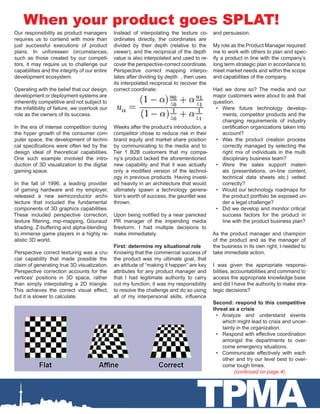
Perspective correct mapping interpo-
lates after dividing by depth , then uses
its interpolated reciprocal to recover the
correct coordinate:
Weeks after the product’s introduction, a
competitor chose to reduce risk in their
brand equity and market share position
by communicating to the media and to
Tier 1 B2B customers that my compa-
ny’s product lacked the aforementioned
new capability and that it was actually
only a modified version of the technol-
ogy in previous products. Having invest-
ed heavily in an architecture that would
ultimately spawn a technology genera-
tion’s worth of success, the gauntlet was
thrown.
Upon being notified by a near panicked
PR manager of the impending media
firestorm, I had multiple decisions to
make immediately.
First: determine my situational role
Knowing that the commercial success of
the product was my ultimate goal, that
an attitude of “making it happen” are key
attributes for any product manager and
that I had legitimate authority to carry
out my function, it was my responsibility
to resolve the challenge and do so using
all of my interpersonal skills, influence
and persuasion.
My role as the Product Manager required
me to work with others to plan and spec-
ify a product in line with the company’s
long term strategic plan in accordance to
meet market needs and within the scope
and capabilities of the company.
Had we done so? The media and our
major customers were about to ask that
question.
•	 Were future technology develop-
ments, competitor products and the
changing requirements of industry
certification organizations taken into
account?
•	 Was the product creation process
correctly managed by selecting the
right mix of individuals in the multi
disciplinary business team?
•	 Were the sales support materi-
als (presentations, on-line content,
technical data sheets etc.) vetted
correctly?
•	 Would our technology roadmaps for
the product portfolio be exposed un-
der a legal challenge?
•	 Did we develop and monitor critical
success factors for the product in
line with the product business plan?
As the product manager and champion
of the product and as the manager of
the business in its own right, I needed to
take immediate action.
I was given the appropriate responsi-
bilities, accountabilities and command to
access the appropriate knowledge base
and did I have the authority to make stra-
tegic decisions?
Second: respond to this competitive
threat as a crisis
•	 Analyze and understand events
which might lead to crisis and uncer-
tainty in the organization.
•	 Respond with effective coordination
amongst the departments to over-
come emergency situations.
•	 Communicate effectively with each
other and try our level best to over-
come tough times.
TPMA
When Product goes SPLAT(from pg 3)
•	 At the time of crisis the management
should be in regular touch with the
employees, external clients, stake
holders as well as media.
Critical Actions Required:
1.	 The creation of a task force that
included the most senior people
whose decisions comprised the ac-
complishments in the development
and release of the product.
2.	 Analysis of the events which led to
this crisis and the management of
potential uncertainty in the organiza-
tion that could not be allowed.
3.	 A critical assessment of the Product
Management process.
Product Initiation Phase:
Did the Product Management, En-
gineering and Operations submit a
joint request for a new product that
met the definition of 3D for gaming
applications?
Feasibility Phase:
Was the technical evaluation by the
Engineering team successful and
approved?
Design and Plan Phase:
Was the documentation, such as the
MRD, Technical Specifications and
Design Specifications, vetted by oth-
er groups, including Operations, QA,
and Customer Care, in order to gen-
erate function specific procedures?
Development Phase:
Did other functional groups continue
preparatory work for the Testing and
Introduction Phases, including Cus-
tomer Care, Training, Vendor and
Client management?
Testing Phase:
Was the decision gate based on the
QA Test Results, Operations Test
Results, Field Verification, Change
Requests and Business Needs?
Product Launch Phase:
Was the coordination of the deploy-
ment enabled by Operations with
supporting organizations and pro-
cesses to maintain the product?
Operation Phase:
Was the organization managing
the product, tracking problems and
bugs, and responding to customer
and media issues regarding the
product in a timely and cost effec-
tive manner?
4.	 Coordination of all departments to
overcome the emergency situation.
Including the key engineering, qual-
ity assurance, purchasing, manu-
facturing, technology analysts, mar-
keting communications, media and
investor relations, legal counsel, fi-
nance and executive staff that were
responsible for the creation and de-
ployment of the product.
5.	 Management of focal communica-
tions with every team member and
the centralization of all content.
6.	 A corporate communication strategy
that spoke with one voice and that
distributed information without bias
The Goal
Meeting of three key objectives and cor-
porate priorities that were the defining
landscape upon which all company de-
cisions were made.
1.	 Our company, mission and brand
were inseparable - we were the in-
dustry leader, its greatest supporter
and the innovator that others fol-
lowed.
2.	 Providing immediate and sustain-
able value to our customers and
treating each one with respect de-
fined us. This drove continual optimi-
zation and best practices throughout
the organization.
3.	 Integrity mattered.
Day 1:
Upon notification of the competitor’s
negative messaging, a short email was
sent to the C-level office. It read, in part
“Competitor X has today published infor-
mation claiming that our newly launched
product’s capabilities do not provide the
technical definition of 3D visualization. A
team is being assembled immediately
(continued on page 6)
SOFTWARE
SCORECARD
What’s stopping you from getting
Amazing Software out the door?
Find out with the
macadamian.com
Innovation
Compelling Design
Usability
Quality
Agility
Speed
Innovation
Compelling Design
Usability
Quality
Agility
Speed
TPMA
Review, Reset, Relaunch
My first sales job ever was standing
in the cold, my father at my side,
selling Christmas trees for the local Cub
Scout troop. It was a good gig, even if it
didn’t pay and the ends of my toes near-
ly froze off by the end of the night.
As we would get closer to Christmas
there would always be a few trees that
just would not sell. Their trunks would be
bent or there would be a broken branch
or two or a big bare section of the tree.
Sooner or later, after many attempts
to find the trees a home, they would
be set in the “reject pile”.
This is when I was taught by my
father, that there was no such
thing as a dead product. It was
often just about packaging. When
there was a lull in the customer
traffic, my father would ask me to
go to the “reject pile” and pull out a
tree so we could see what we could
do with it. Often those crooked 7 foot
trees could be turned into a perfect 4
foot tree and a bunch of pine bows for
decorating the mantle.
Turning “rejected” products into new rev-
enue streams is not always an easy task.
It requires a long hard look at all of the
elements of the marketing mix to see
what has gone wrong, and then some
innovative rethinking to set things right.
Product needs a Makeover?
There are many signs that a current
product is a candidate for a relaunch,
Sales below target by over 25%
When sales are under expectations by
5% to 25%, the variations can often be
explained by stagnant market conditions
or slow pick up of the sales organization.
This can be considered a normal but
slow introduction ramp, and can often
be corrected by a simple promotional
push /campaign.
But when sales are more than 30% off
targets for more than 4-6 months, more
than likely you have a candidate for a
relaunch.
Product failures up 20%
Every product has a burn in period in the
field. Installers and users have to gain
experience and if the product is signifi-
cantly different or the features are com-
plex, there will be field errors and tickets.
But, if these tickets continue to climb in
occurrence or severity, you have a prob-
lem that needs more than time
t o solve.
R e - m e m -
ber to listen to social media
feedback here as well. Your PR expert
can help you monitor the ongoing chat-
ter of your customers. This can give you
tremendous insights into the problems
they are having with your product. Use
social media to its advantage. Show
your customers you care and are listen-
ing to their concerns. Transparency is
very important here. Remember, even if
they don’t like your current product, they
can still like doing business with you if
you treat them with respect and care.
Sales force avoiding the product.
Sales organizations are often called
“coin operated”, which means that if there
is an easy dollar to be made selling this
product, then sales people will find out
about it and organically the sales will
grow.
When a product begins to get the rep-
utation as a hard sell, or a lemon with
lots of after sales issues, then the sales
force will know and will avoid the product.
Regular post sales polling of the sales
force is the best way to confirm your sus-
picions. The challenge is separating out
the noise from the real problems.
Marketing challenged finding differ-
entiated messaging
This is the earliest sign that your product
could become a future reject.
I strongly believe that a good product
sells itself. The differentiation is clear,
the value to the customer is obvious.
Products don’t need to be pushed,
they just need to be demo’d or
shown to the right prospects.
But if your product marketing team
has a challenge finding a differen-
tiated value statement then some-
thing is amiss. If a product is being
released onto the market it needs
to solve a real business problem
that is identifiable and resonates
with the customer. It also needs to
solve this business problem better than
your competition. The differentiation
should be sustainable and quantifiable.
Time for a Relaunch Plan
It’s always difficult to admit your prod-
uct launch failed. But the sign of a good
product manager is one that comes for-
ward early with the relaunch plan in hand
and aggressively pursues the needed
changes.
Back to Basics
Understanding what went wrong and
how to fix it is about going back to basics.
Rely on your four P analysis.
Product issues:
•	 Product software bugs
•	 Product hardware malfunctions
•	 Design / useability issues
•	 Reliabiltiy
•	 If it’s a product reliability issue,
then you have to replan the prod-
uct roadmap to allow for sufficient
time and resources to fix the prob-
lem and completely retest. Not just
a simple unit test, but a complete
end to end system test to ensure
(continued on page 6)
Art by: Billy F. Alexander
TPMA
Review, Reset, Relaunch (from pg 5)
there remain no issues, even
small ones, when the product is
rereleased.
Price issues:
•	 Pricing models can lead to a failed
product in the market
•	 Research competitive pricing
•	 Research buying behaviours and
budgets (capex vs opex for ex-
ample)
•	 Consider upfront vs trailing rev-
enue models
•	 Consider financing and terms
Place issues:
•	 Consider sales enablement and
training (perhaps your sales force
wasn’t well enough versed in the
product)
•	 Consider technical training
•	 Consider user training and docu-
mentation
Promotion/messaging issues:
•	 Understand the business problem
you are solving
•	 Understand how you solve it bet-
ter than your competition
•	 Prove it – build undeniable proof
points
•	 Rebuild your messaging architec-
ture
•	 Conduct your 3 C analysis (Cus-
tomer needs, Company Capabili-
ties, Competitive positioning)
•	 Look for the messaging
whitespace – find the differenti-
ated white space where you can
prove your product is better than
the competition
•	 Consider a relaunch campaign
with a full integrated marketing
plan. Events, Analysts, Press, So-
cial Media
Trust, Trust, Trust
Admitting to yourself and your manage-
ment that you need to relaunch your
product is a hard thing to do, but even
more difficult, but the most necessary is
admitting to your sales channels and to
the customers that you have a problem.
Re-Building trust with Customers:
A sound communications plan is para-
mount to saving the brand, especially if
this product failure is a headline grabber.
•	 It’s about rebuilding the trust with
your customers and your channel.
•	 You need to be ahead of the story
and set the tone and agenda.
•	 It has to come from the top. And
it has to be volunteered. It can’t
come too late, or only done when
forced into a corner.
•	 If there is product liability involved,
your lawyers may be all over you.
You need to listen to them, but you
need to do the right thing. It has
to feel like the right thing, it has to
look like the right thing.
•	 You really need a PR professional
on your side to help manage this if
its newsworthy
Rebuilding trust with channels:
Regaining the trust of your channels and
rebuilding their faith in the product is the
biggest challenge.
There are three T’s of building trust:
1.	 Truth
-Know the truth about what went
wrong. Only by knowing the
truth can you have confidence
that the actions taken will cor-
rect the problem.
2.	 Transparency
-Share the problem and build
an action plan with your chan-
nels.
-Listen to how this problem af-
fected their business. Make
sure they feel heard and are
understood. Help them recov-
er even if it hurts.
-Letting your channel talk to the de-
velopers/designers.
-Gain their buy-in to the new vision.
Do not sell this plan to them, let
them be part of it, gain their input.
3.	 Time
-Like all relationships that have
soured the wounds will take time
to heal. Give them time. Don’t rush
out with a new launch until you
know they are back on board.
Ready for Relaunch
So you have managed to keep communi-
cations open with your customers. They
like how you have handled the problem.
Your channels are now bought into the
new product. They have participated in
the plan, they have seen how you have
gone above and beyond to ensure this
next release is what it needs to be.
It’s time to go back out to the market. It’s
time to execute that relaunch plan. It’s
time to tell them why your new product
is better than ever and what you have
learned from the exercise and how it has
made your product and your company
better than ever.
I think the most important thing to real-
ize is that you have many “normal” touch
points with the customer on a daily basis,
but only rarely do you get the amplifica-
tion of a relaunch where your customer
and channel partners are really paying
attention to how you do business.
See the relaunch as a brand opportunity
to show your customers and channels
what a great company you are and they
will become more loyal than ever.
About the Author
Wayne Seifried has over
15 years of product mar-
keting, product mgt and
sales enablement leader-
ship experience at both
fortune 500 and startup companies in
the technology market. He is a frequent
speaker at industry events on Go To
Market and Product Marketing and En-
terprise Communication Trends. Wayne
is currently doing private consulting and
volunteering in the innovation commu-
nity in Toronto.
. TPMA Mentoring
Program - Take III
This season’s mentoring program has been off to an
amazing start, and will wind down in June. Thank you to all 56
participants. We hope you all learned and developed
from the experience.
Though we have not started the third
program yet, we will run the program in
September 2013 through to June 2014.
To partake in next year’s program, express
your interest in an email to:
	 email: mentorship@tpma.ca
	 NOTE: NOT a Job Referral Service!
TPMA
TPMA is very pleased to welcome Miax
Project Services back as a Corporate
Sponsor. Over the years Miax has been
a strong supporter of the TPMA, and
Jinha Chung, CEO of Miax Inc, has been
actively involved in the product manage-
ment community.
Miax Project Services provides full turn-
key project management solutions to
clients in high tech. Miax helps clients
complete projects on time and on bud-
get by providing them with professionally
trained project managers, business ana-
lysts, and subject matter experts.
Our partnership is a great opportunity to
strengthen and grow a relationship be-
tween our two organisations. The TPMA
and Miax are both committed to helping
product managers and their respective
companies improve their effectiveness
at providing services and bringing cre-
ative new product offerings to market.
Not only will Miax Project Services spon-
sor the TPMA, they will also sponsor To-
ronto ProductCamp 2013 in July of this
year.
Welcome back to Miax Project Services
as a very supportive and well respected
Corporate Sponsor.
Visit: www.miax.ca
and your presence at 2pm is requested.”
At 2pm with the entire team assembled,
the crisis management plan was pre-
sented at the outset and ownership was
assigned. As the product owner, the suc-
cess or failure of our corporate response
was mine and I was empowered with the
authority to do so.
Executing unbiased communications
was paramount. Initiating a response to
a crisis within a large organization makes
impossible the ability to monitor every
executable. Only known facts could be
stated and an acknowledgement that all
assumptions had potential for error was
made. A central communication centre
was simultaneously created.
Best practices would be used to create
our crisis response plan and all resourc-
es were applied to prove our correct un-
derstanding of the competitor’s claim.
Day 2:
With the objective of confirming all con-
clusions by day’s end, each company
function owner was required to present
findings and unknowns. Throughout, the
product management team deferred all
responsibility and assumed the role of
information gatherer and disseminator.
A cease and desist was drafted, ap-
proved and delivered to the competitor.
Sales and marketing scouts accumu-
lated and catalogued every known in-
stance of threat to our company’s brand.
Upon conclusion of all presentations and
with executive management present,
the company’s position and marketing
response were defined and approved.
Day 3:
All accounts and media were personally
contacted and information disproving
the competitor’s claims was dissemi-
nated. In addition, other factual errors by
the competitor were identified for inves-
tigation. A team was created to analyze
all competitive specifications, product
marketing and industry recognition.
A cease and desist, with this addition-
al information, was delivered to the
competitor and made public.
Day 4:
An engineering based FAQ where all
competitor claims were addressed in
granular detail, was posted online and
distributed freely. Additional product
marketing information, including new
and independent test reports and edito-
rial reviews, were included.
A statement was released on the impor-
tance of delivering value to every single
customer and with integrity and respect.
Day 5:
All claims by the competitor were re-
tracted and clarifications were issued.
The competitor`s challenge had been
addressed successfully.
When things go SPLAT, a Product Man-
ager must make key decisions. The
most strategic being the need to reaf-
firm personal commitment to meet the
responsibilities with which the company
has entrusted the product team. Suc-
cess means making that trust work.
When Product goes SPLAT(from pg 4)
TPMA Welcomes Miax
as a Corporate Sponsor!
About the Author
Andrew Schmied has 17
years of experience leading
corporate strategy, market-
ing and business develop-
ment for tech. innovators
in Asia, North America and
Europe. He has launched 25+ award
winning products and built businesses
units, startups and ecosystems for in-
dustry leaders such as ATI Technologies,
Advanced Micro Devices and Lucidlogix.
ProductCamp Toronto 2013
Lined up. Ready to go. Now we just need that special
spark to start it all off! That spark is YOU!
ProductCamp provides a spark of creativity, an
opportunity to network with professionals in your
field, and delivers on some amazing seminars,
presentations, and group discussions. Keep up to
date, and get involved.
When: 	 Saturday July 20th, 2013 - @ 9:00am
Where: 	 Ryerson University, 55 Dundas St. W
		 Ted Rogers School of Mgt, 7th
Floor
Price:	 Your Participation -- $FREE	
Registration Required: ProductCamp@tpma.ca
Website: ProductCampToronto.wordpress.com
TPMA
In a November 2011 Forbes article titled
“Think your job is bad, try one of these,”
product management was highlighted
as the third least liked job. Marketing
management was not far behind at the
tenth least liked job. Clearly there is con-
siderable ambiguity, rapid fire change of
pace and priorities, and high pressure
associated with these roles.
With pressures like these, the prospects
of a product that goes SPLAT, and day
to day urgencies - it is easy to see how
a cloud of gloom may hang heavily over
the product / marketing managers head.
On that thought, it seems a natural fit to
include a short column on positive psy-
chology tips, you can use to keep from
getting glum about your role. Our first of
this series addresses writing your 3 posi-
tives for your day. Try it, it works!
Daily we receive advice on coping with
life’s negative events. However, can
we deliberately enhance the impact
of the positive events we experience?
Research tells us that we tend not to
respond to these “good things” in ways
that maximize their positive influence on
our lives. Instead, we often ruminate on
the “bad things” almost skimming past
the good ones. Paying attention to the
good things that happen in our lives and
career can actually help improve your
mental and physical health, strengthen
your resilience and help you find more
Happiness with 3 Positives
About the Author
Kristina Dragnea is a
Masters candidate in
counseling psychology,
with the aim of licensing
as a psychologist. She
is experienced in mind-
fulness-based methods
of cognitive behavioral
therapy and positive psychotherapy.
Contact: krisdra@yahoo.com
creative solutions to problems.
A simple way of gaining awareness of
the positive events you experience, and
strengthening the impact they have on
you is to write them down each day.
Write down three positive occurrences a
day to start and once you get comfort-
able with this practice you may find your
list expanding, giving your own positive
outlook a boost. By default, this will also
help you reduce your focus on the nega-
tive events in career and life. Empirical
research has shown writing down just
three positive occurrences each day will
shift your focus to the positive events
and improve the overall sense of happi-
ness you feel. In fact people who docu-
mented positive moments were shown
to be 21% happier and 31% less likely
to be depressed than those who did not.
Check out works by Barbara Fredrick-
son on positivity, and Mihaly Csikszent-
mihalyi on flow for further information.
Wisdom from the Crowd
Quotes directly from YOU
Question: What is the most impor-
tant thing you learned from a fail-
ure or disaster in one of your prod-
ucts/companies?
"You should expect over the career that
you will fail in a project, and the impor-
tant thing is learn from that failure and
not repeat the same mistakes"
--- Michael Campbell
"In technology and software you can’t
expect to use yesterday’s strategies for
tomorrow’s problems. You have to have
the courage to kill your own ideas, if
need be."	 --- Deepak Bhangu
“One of the most important things I
learned is to keep to timelines and set-
ting expectations from what is being
planned to what can be delivered”
--- Anson Kokkat
“A failure can mean a lot of things and
teaches you to do things the right way”
--- Patty Pallisco
“If we are building a big platform always
make sure to keep milestones manage-
able by dividing the big deliverable into
set of small deliverables, keeping the
team morale high each time we cross a
milestone.
Every journey begins with that one small
step and is a set of multiple small steps”	
			 --- Niki Coons
“Focus on the time to market and launch
the product meeting the basic needs of
the customers and accept that there will
be ongoing improvements made based
on customer feedback. Nothing can be
perfect in the first go.”
--- Tara dos Remedios
“If you don’t take risk you can’t learn”
--- Sandeep Gupta
TPMA
MANY product recalls have splashed
across the news in recent memory.
•	 In 2007, Menu Foods recalled
60 million plus cans of pet food
when a contaminant was found
originating from the manufactur-
ing facility in China, resulting in
pets falling ill and millions in re-
call costs.
•	 Bridgestone/Firestone tire tread
separation issue resulted in
the recall of 6.5 million tires in
2000.
•	 1982 Tylenol scare: attributed
to product tampering and re-
sulted in seven deaths and a
wholesale change in product
packaging.
It does not matter if your product is man-
ufactured or coded within your control,
outside of your immediate influence,
or otherwise. If a catastrophic defect
injures, causes property damage or fi-
nancial losses, it is critical that your in-
surance broker understands your mech-
anisms help protect you in these events.
A broker will work to ensure you are cov-
ered if a deficiency is found.
General Liability Insurance
Commercial General Liability (CGL) is
the portion of your business insurance
that responds to injury or damage to
third parties resulting from your actions,
the actions of your employees, or the ac-
tions of your product(s).
Third parties are those who are not em-
ployed by the firm making your product.
These can be your direct customer, or
your customer’s customer, or the gener-
al public if your product is resold as part
of other products and/or services.
Product’s Liability Insurance
The CGL includes a component called
Products Liability Insurance. In essence,
this is the section that outlines the cov-
erage provided to defend and/or pay for
damages your product causes in the way
of injury or property damage or losses to
third parties (i.e. code defects).
This section defends and compensates
So Things have gone awry ...for claims for which a company may be
held legally liable resulting from the alle-
gation against the product. However, this
is not a warranty or guarantee of your
product’s abilities.
Injury & Property Damage
What your product is or does has a bear-
ing on the extent of risk it poses to the
end user(s). As you can likely imagine,
bodily injury claims can range from the
innocuous -- chipped teeth (foreign ob-
ject in a food product) or burnt hands
(poor fitting lids or cups) -- to the cata-
strophic -- death (safety products, fires/
explosions, or misuse of pharmaceuti-
cals). Property damage losses can in-
clude fire (faulty wiring) or crashes (un-
der engineered product).
Many claims are not foreseeable. To
start, identify the intended end-user.
Your knowledge of your demographic
lets you map out worst case scenarios
that could come from the product’s use.
Insurer Reach
Your insurance company is there to pro-
tect you in the event of third party injury
damage or loss, and needs to be where
your product is or will be going. How-
ever, not all insurance companies are
prepared nor able to support you if you
launch abroad. Some countries require
local policies as a global insurance pro-
gram is not recognized by the local regu-
lators.
By understanding your business, your
broker can ensure you are properly cov-
ered by carriers capable of matching
your global reach today and in the future.
Recall Insurance
You have found a problem with your
product that may result in third party inju-
ry, damage or losses. As the Good Cor-
porate Citizen, you advise your buyers
that there is a problem and that the prod-
uct needs to be immediately taken out of
circulation and repaired or replaced.
Recalls are most commonly associated
with automobiles. However, there are
many examples of product recalls involv-
ing food products (for human or animal
consumption), toys, and software up-
dates. Recalls may not have anything to
do with how your product was designed
– it could be a result from a supplier of a
part or sub-assembly.
There can be significant costs associat-
ed with confirming which batch of prod-
ucts manufactured are subject to the
recall. This includes communicating the
recall notice through public media chan-
nels; and inspection, disposal, transpor-
tation costs you and/or your vendors in-
cur once you have gathered up all of the
recalled products.
Limits to Buy
There are a number of ways to deter-
mine how much insurance you need. In-
dustry peers may be able to advise you
as to what is appropriate. Your insurance
broker can benchmark your company
against similar clients and make sug-
gestions. However, you may be required
to provide specific limits based on your
contracts with suppliers or end-user(s).
You will need to balance how much in-
surance you can afford to purchase, how
much you want, and your view of the risk
your product potentially poses.
Getting an Opinion
An insurance broker familiar with your
industry is critical because the broker
will help define the coverage your com-
pany needs based on experience. It is
important that the broker has the same
geographic reach that your product has
and represents insurance companies
that will provide the necessary support
should you need the insurance firm’s de-
fense.
The right partner now means peace of
mind as your product debuts to national
or international acclaim.
About the Author
Lou Fisch CIP CRM is
Partner & Vice President
at HKMB HUB Interna-
tional, Canada’s largest
insurance brokerage. He
welcomes all of your in-
surance inquiries at 416-
597-4009 or lou.fisch@
hubinternational.com .
TPMA
COOLTOOLS: Evernote
Gathering notes from client or
prospect meetings can be
challenging to say the least. Paper
notes, conversations and white-
board drawings are often difficult
to store and consistently review.
Evernote as a productivity tool can
greatly help with automation of
these common Product Manage-
ment tasks, among many others.
Evernote is a cloud-based app
which allows you to capture any-
thing, access it anywhere and,
includes simple and powerful
searching through the notes, pic-
tures and audio recordings which
you have captured.
Use your tablet or mobile device
while in a meeting; capture customer
notes, take a picture of a workflow or
whiteboard drawing, record a conversa-
tion and easily add notes to it. Add tags
or pin places to any note.
It’s simple and slick interface are easy
to work with, and by installing the tab-
let/mobile and PC or OS X versions, by
the time you get back to the office, your
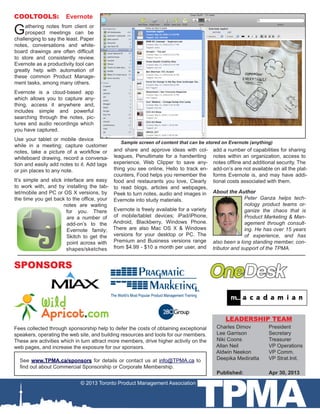
notes are waiting
for you. There
are a number of
add-on’s to the
Evernote family;
Skitch to get the
point across with
shapes/sketches
and share and approve ideas with col-
leagues, Penultimate for a handwriting
experience, Web Clipper to save any-
thing you see online, Hello to track en-
counters, Food helps you remember the
food and restaurants you love, Clearly
to read blogs, articles and webpages,
Peek to turn notes, audio and images in
Evernote into study materials.
Evernote is freely available for a variety
of mobile/tablet devices; iPad/iPhone,
Android, Blackberry, Windows Phone.
There are also Mac OS X & Windows
versions for your desktop or PC. The
Premium and Business versions range
from $4.99 - $10 a month per user, and
Fees collected through sponsorship help to defer the costs of obtaining exceptional
speakers, operating the web site, and building resources and tools for our members.
These are activities which in turn attract more members, drive higher activity on the
web pages, and increase the exposure for our sponsors.
© 2013 Toronto Product Management Association
See www.TPMA.ca/sponsors for details or contact us at info@TPMA.ca to
find out about Commercial Sponsorship or Corporate Membership.
SPONSORS
add a number of capabilities for sharing
notes within an organization, access to
notes offline and additional security. The
add-on’s are not available on all the plat-
forms Evernote is, and may have addi-
tional costs associated with them.
Charles Dimov	 President
Lee Garrison		 Secretary
Niki Coons		 Treasurer
Allan Neil		 VP Operations
Aldwin Neekon	 VP Comm.
Deepika Mediratta 	 VP Strat.Init.
Published: 		 Apr 30, 2013
LEADERSHIP TEAM
Sample screen of content that can be stored on Evernote (anything)
About the Author
Peter Ganza helps tech-
nology product teams or-
ganize the chaos that is
Product Marketing & Man-
agement through consult-
ing. He has over 15 years
of experience, and has
also been a long standing member, con-
tributor and support of the TPMA.

Tpma focus issue 12 (2 q2013)

  • 1.
    TPMA FOCUS What is theTPMA? "Creating Insight through Shared Knowledge" Founded in March 2001, the Toronto Product Man- agement Association is a non-profit organization formed to create an en- vironment that facilitates learning, mentoring, & net- working opportunities. Visit: www.TPMA.ca THIS EDITION: Snapshot 2 ProductCamp 2013 2 Product goes Splat 3 Rev, Reset, Relaunch 5 Three Positives 8 Crowd Quotables 8 Things Gone Awry 9 CoolTools 10 Issue #12: 2Q 2013 Toronto Product ManagementAssociation KEY DATES: Learnings from Startup Product Management - Tue, Apr 30th 6:30pm - Metro Hall, 55 John St. Using Marketing Automation Platforms - Tue, May 28th 6:30pm - Metro Hall, 55 John St. Summer Social !!! - Tue, Jun 11th 6:30pm - Metro Hall, 55 John St. Artwork: Billy F. Alexander When Product Goes SPLAT!
  • 2.
    TPMA ProductCamp Toronto Returns! OnSaturday, July 20, 2013 par- ticipants from around the Greater Toronto Area will gather for the 6th an- nual ProductCamp Toronto to learn from, teach to, and network with professionals involved in Product Management, Mar- keting, and Development. The first ProductCamp was held on a Saturday in March, 2008 in Mountain View, California. News about the uncon- ference format with no registration fee, no agenda and no selling spread quickly and about 170 people showed up to dis- cuss topics of interest to product manag- ers, product marketers and other related roles. Launched in 2008, the Toronto event was an early pioneer in the Product- Camp community and the first of its kind in Canada. Since then, ProductCamps have been growing in popularity and are now held all across the United States, Canada and around the world. Partici- pants in Pro- d u c t C a m p s are helping to support a col- laborative, us- er-organized “ u n - c o n f e r - ence”, focused on software product mar- keting and product man- agement. At a Product- Camp, there are no passive “attendees”. In- stead, every- one is referred to as a “par- ticipant” and expected to contribute in some way whether that is presenting or facilitating a session, coordinating spon- sors, managing the venue, volunteering for setup and teardown, or sitting on a discussion panel. Information sharing is expected and encouraged. Everyone is urged to share information and experi- ences, both live and after the event, via blogging, photo sharing, social book- marking, tweeting, and wiki postings. This open encouragement is in deliber- ate contrast to the “off-the-record” and “no recording” rules at many conferences. ProductCamp Toronto 2013 is being held on Saturday July 20, 2013 at the Ted Rogers School of Management, Ryerson University (55 Dundas Street West, Toronto, ON). Registrations and additional information is online at www. productcamptoronto.wordpress.com . --- Lee Garrison SNAPSHOT Charles Dimov President @cdimov Splat edition seems a bit alarmist. Hopefully it caught your attention., Maybe it even made you think about the time you had to live through a troubling time with your own product. Perhaps you are just grateful that it has not hap- pened to you...yet. Either way, as prod- uct and marketing managers we need to be prepared, and the articles come from local talent who have been through it, and survived. Learn well. A program that boomed with success was the TPMA mentorship program. June marks the close of this year’s pro- gram. Thanks to so many who engaged with heart, and to those willing to give of their precious time, to help with wisdom and sage advice. But keep heart, as we will start again in September. June also brings our annual Summer Social, where I hope to share a drink with you. It is a chance for guests and members to get together, network, share a story and take a moment to reflect on the season. Best are the many plans that start with, “Charles, you know what you need to do for next year is ... ... ...” That will bring us to July, with another fun-filled ProductCamp Toronto. Tell your friends, coworkers and colleagues. ProductCamp is where we discuss the latest concepts, tools, techniques and tips. This is the one event you really can- not miss. See you there!
  • 3.
    TPMA When your productgoes SPLAT! (continued on page 4) Our responsibility as product managers requires us to contend with more than just successful executions of product plans. In unforeseen circumstances, such as those created by our competi- tors, it may require us to challenge our capabilities and the integrity of our entire development ecosystem. Operating with the belief that our design, development or deployment systems are inherently competitive and not subject to the infallibility of failure, we overlook our role as the owners of its success. In the era of intense competition during the hyper growth of the consumer com- puter space, the development of techni- cal specifications were often led by the design ideal of theoretical capabilities. One such example involved the intro- duction of 3D visualization to the digital gaming space. In the fall of 1996, a leading provider of gaming hardware and my employer, released a new semiconductor archi- tecture that included the fundamental components of 3D graphics capabilities. These included perspective correction, texture filtering, mip-mapping, Gouraud shading, Z-buffering and alpha-blending to immerse game players in a highly re- alistic 3D world. Perspective correct texturing was a cru- cial capability that made possible the claim of generating true 3D visualization. Perspective correction accounts for the vertices' positions in 3D space, rather than simply interpolating a 2D triangle. This achieves the correct visual effect, but it is slower to calculate. Instead of interpolating the texture co- ordinates directly, the coordinates are divided by their depth (relative to the viewer), and the reciprocal of the depth value is also interpolated and used to re- cover the perspective-correct coordinate. Perspective correct mapping interpo- lates after dividing by depth , then uses its interpolated reciprocal to recover the correct coordinate: Weeks after the product’s introduction, a competitor chose to reduce risk in their brand equity and market share position by communicating to the media and to Tier 1 B2B customers that my compa- ny’s product lacked the aforementioned new capability and that it was actually only a modified version of the technol- ogy in previous products. Having invest- ed heavily in an architecture that would ultimately spawn a technology genera- tion’s worth of success, the gauntlet was thrown. Upon being notified by a near panicked PR manager of the impending media firestorm, I had multiple decisions to make immediately. First: determine my situational role Knowing that the commercial success of the product was my ultimate goal, that an attitude of “making it happen” are key attributes for any product manager and that I had legitimate authority to carry out my function, it was my responsibility to resolve the challenge and do so using all of my interpersonal skills, influence and persuasion. My role as the Product Manager required me to work with others to plan and spec- ify a product in line with the company’s long term strategic plan in accordance to meet market needs and within the scope and capabilities of the company. Had we done so? The media and our major customers were about to ask that question. • Were future technology develop- ments, competitor products and the changing requirements of industry certification organizations taken into account? • Was the product creation process correctly managed by selecting the right mix of individuals in the multi disciplinary business team? • Were the sales support materi- als (presentations, on-line content, technical data sheets etc.) vetted correctly? • Would our technology roadmaps for the product portfolio be exposed un- der a legal challenge? • Did we develop and monitor critical success factors for the product in line with the product business plan? As the product manager and champion of the product and as the manager of the business in its own right, I needed to take immediate action. I was given the appropriate responsi- bilities, accountabilities and command to access the appropriate knowledge base and did I have the authority to make stra- tegic decisions? Second: respond to this competitive threat as a crisis • Analyze and understand events which might lead to crisis and uncer- tainty in the organization. • Respond with effective coordination amongst the departments to over- come emergency situations. • Communicate effectively with each other and try our level best to over- come tough times.
  • 4.
    TPMA When Product goesSPLAT(from pg 3) • At the time of crisis the management should be in regular touch with the employees, external clients, stake holders as well as media. Critical Actions Required: 1. The creation of a task force that included the most senior people whose decisions comprised the ac- complishments in the development and release of the product. 2. Analysis of the events which led to this crisis and the management of potential uncertainty in the organiza- tion that could not be allowed. 3. A critical assessment of the Product Management process. Product Initiation Phase: Did the Product Management, En- gineering and Operations submit a joint request for a new product that met the definition of 3D for gaming applications? Feasibility Phase: Was the technical evaluation by the Engineering team successful and approved? Design and Plan Phase: Was the documentation, such as the MRD, Technical Specifications and Design Specifications, vetted by oth- er groups, including Operations, QA, and Customer Care, in order to gen- erate function specific procedures? Development Phase: Did other functional groups continue preparatory work for the Testing and Introduction Phases, including Cus- tomer Care, Training, Vendor and Client management? Testing Phase: Was the decision gate based on the QA Test Results, Operations Test Results, Field Verification, Change Requests and Business Needs? Product Launch Phase: Was the coordination of the deploy- ment enabled by Operations with supporting organizations and pro- cesses to maintain the product? Operation Phase: Was the organization managing the product, tracking problems and bugs, and responding to customer and media issues regarding the product in a timely and cost effec- tive manner? 4. Coordination of all departments to overcome the emergency situation. Including the key engineering, qual- ity assurance, purchasing, manu- facturing, technology analysts, mar- keting communications, media and investor relations, legal counsel, fi- nance and executive staff that were responsible for the creation and de- ployment of the product. 5. Management of focal communica- tions with every team member and the centralization of all content. 6. A corporate communication strategy that spoke with one voice and that distributed information without bias The Goal Meeting of three key objectives and cor- porate priorities that were the defining landscape upon which all company de- cisions were made. 1. Our company, mission and brand were inseparable - we were the in- dustry leader, its greatest supporter and the innovator that others fol- lowed. 2. Providing immediate and sustain- able value to our customers and treating each one with respect de- fined us. This drove continual optimi- zation and best practices throughout the organization. 3. Integrity mattered. Day 1: Upon notification of the competitor’s negative messaging, a short email was sent to the C-level office. It read, in part “Competitor X has today published infor- mation claiming that our newly launched product’s capabilities do not provide the technical definition of 3D visualization. A team is being assembled immediately (continued on page 6) SOFTWARE SCORECARD What’s stopping you from getting Amazing Software out the door? Find out with the macadamian.com Innovation Compelling Design Usability Quality Agility Speed Innovation Compelling Design Usability Quality Agility Speed
  • 5.
    TPMA Review, Reset, Relaunch Myfirst sales job ever was standing in the cold, my father at my side, selling Christmas trees for the local Cub Scout troop. It was a good gig, even if it didn’t pay and the ends of my toes near- ly froze off by the end of the night. As we would get closer to Christmas there would always be a few trees that just would not sell. Their trunks would be bent or there would be a broken branch or two or a big bare section of the tree. Sooner or later, after many attempts to find the trees a home, they would be set in the “reject pile”. This is when I was taught by my father, that there was no such thing as a dead product. It was often just about packaging. When there was a lull in the customer traffic, my father would ask me to go to the “reject pile” and pull out a tree so we could see what we could do with it. Often those crooked 7 foot trees could be turned into a perfect 4 foot tree and a bunch of pine bows for decorating the mantle. Turning “rejected” products into new rev- enue streams is not always an easy task. It requires a long hard look at all of the elements of the marketing mix to see what has gone wrong, and then some innovative rethinking to set things right. Product needs a Makeover? There are many signs that a current product is a candidate for a relaunch, Sales below target by over 25% When sales are under expectations by 5% to 25%, the variations can often be explained by stagnant market conditions or slow pick up of the sales organization. This can be considered a normal but slow introduction ramp, and can often be corrected by a simple promotional push /campaign. But when sales are more than 30% off targets for more than 4-6 months, more than likely you have a candidate for a relaunch. Product failures up 20% Every product has a burn in period in the field. Installers and users have to gain experience and if the product is signifi- cantly different or the features are com- plex, there will be field errors and tickets. But, if these tickets continue to climb in occurrence or severity, you have a prob- lem that needs more than time t o solve. R e - m e m - ber to listen to social media feedback here as well. Your PR expert can help you monitor the ongoing chat- ter of your customers. This can give you tremendous insights into the problems they are having with your product. Use social media to its advantage. Show your customers you care and are listen- ing to their concerns. Transparency is very important here. Remember, even if they don’t like your current product, they can still like doing business with you if you treat them with respect and care. Sales force avoiding the product. Sales organizations are often called “coin operated”, which means that if there is an easy dollar to be made selling this product, then sales people will find out about it and organically the sales will grow. When a product begins to get the rep- utation as a hard sell, or a lemon with lots of after sales issues, then the sales force will know and will avoid the product. Regular post sales polling of the sales force is the best way to confirm your sus- picions. The challenge is separating out the noise from the real problems. Marketing challenged finding differ- entiated messaging This is the earliest sign that your product could become a future reject. I strongly believe that a good product sells itself. The differentiation is clear, the value to the customer is obvious. Products don’t need to be pushed, they just need to be demo’d or shown to the right prospects. But if your product marketing team has a challenge finding a differen- tiated value statement then some- thing is amiss. If a product is being released onto the market it needs to solve a real business problem that is identifiable and resonates with the customer. It also needs to solve this business problem better than your competition. The differentiation should be sustainable and quantifiable. Time for a Relaunch Plan It’s always difficult to admit your prod- uct launch failed. But the sign of a good product manager is one that comes for- ward early with the relaunch plan in hand and aggressively pursues the needed changes. Back to Basics Understanding what went wrong and how to fix it is about going back to basics. Rely on your four P analysis. Product issues: • Product software bugs • Product hardware malfunctions • Design / useability issues • Reliabiltiy • If it’s a product reliability issue, then you have to replan the prod- uct roadmap to allow for sufficient time and resources to fix the prob- lem and completely retest. Not just a simple unit test, but a complete end to end system test to ensure (continued on page 6) Art by: Billy F. Alexander
  • 6.
    TPMA Review, Reset, Relaunch(from pg 5) there remain no issues, even small ones, when the product is rereleased. Price issues: • Pricing models can lead to a failed product in the market • Research competitive pricing • Research buying behaviours and budgets (capex vs opex for ex- ample) • Consider upfront vs trailing rev- enue models • Consider financing and terms Place issues: • Consider sales enablement and training (perhaps your sales force wasn’t well enough versed in the product) • Consider technical training • Consider user training and docu- mentation Promotion/messaging issues: • Understand the business problem you are solving • Understand how you solve it bet- ter than your competition • Prove it – build undeniable proof points • Rebuild your messaging architec- ture • Conduct your 3 C analysis (Cus- tomer needs, Company Capabili- ties, Competitive positioning) • Look for the messaging whitespace – find the differenti- ated white space where you can prove your product is better than the competition • Consider a relaunch campaign with a full integrated marketing plan. Events, Analysts, Press, So- cial Media Trust, Trust, Trust Admitting to yourself and your manage- ment that you need to relaunch your product is a hard thing to do, but even more difficult, but the most necessary is admitting to your sales channels and to the customers that you have a problem. Re-Building trust with Customers: A sound communications plan is para- mount to saving the brand, especially if this product failure is a headline grabber. • It’s about rebuilding the trust with your customers and your channel. • You need to be ahead of the story and set the tone and agenda. • It has to come from the top. And it has to be volunteered. It can’t come too late, or only done when forced into a corner. • If there is product liability involved, your lawyers may be all over you. You need to listen to them, but you need to do the right thing. It has to feel like the right thing, it has to look like the right thing. • You really need a PR professional on your side to help manage this if its newsworthy Rebuilding trust with channels: Regaining the trust of your channels and rebuilding their faith in the product is the biggest challenge. There are three T’s of building trust: 1. Truth -Know the truth about what went wrong. Only by knowing the truth can you have confidence that the actions taken will cor- rect the problem. 2. Transparency -Share the problem and build an action plan with your chan- nels. -Listen to how this problem af- fected their business. Make sure they feel heard and are understood. Help them recov- er even if it hurts. -Letting your channel talk to the de- velopers/designers. -Gain their buy-in to the new vision. Do not sell this plan to them, let them be part of it, gain their input. 3. Time -Like all relationships that have soured the wounds will take time to heal. Give them time. Don’t rush out with a new launch until you know they are back on board. Ready for Relaunch So you have managed to keep communi- cations open with your customers. They like how you have handled the problem. Your channels are now bought into the new product. They have participated in the plan, they have seen how you have gone above and beyond to ensure this next release is what it needs to be. It’s time to go back out to the market. It’s time to execute that relaunch plan. It’s time to tell them why your new product is better than ever and what you have learned from the exercise and how it has made your product and your company better than ever. I think the most important thing to real- ize is that you have many “normal” touch points with the customer on a daily basis, but only rarely do you get the amplifica- tion of a relaunch where your customer and channel partners are really paying attention to how you do business. See the relaunch as a brand opportunity to show your customers and channels what a great company you are and they will become more loyal than ever. About the Author Wayne Seifried has over 15 years of product mar- keting, product mgt and sales enablement leader- ship experience at both fortune 500 and startup companies in the technology market. He is a frequent speaker at industry events on Go To Market and Product Marketing and En- terprise Communication Trends. Wayne is currently doing private consulting and volunteering in the innovation commu- nity in Toronto.
  • 7.
    . TPMA Mentoring Program- Take III This season’s mentoring program has been off to an amazing start, and will wind down in June. Thank you to all 56 participants. We hope you all learned and developed from the experience. Though we have not started the third program yet, we will run the program in September 2013 through to June 2014. To partake in next year’s program, express your interest in an email to: email: mentorship@tpma.ca NOTE: NOT a Job Referral Service! TPMA TPMA is very pleased to welcome Miax Project Services back as a Corporate Sponsor. Over the years Miax has been a strong supporter of the TPMA, and Jinha Chung, CEO of Miax Inc, has been actively involved in the product manage- ment community. Miax Project Services provides full turn- key project management solutions to clients in high tech. Miax helps clients complete projects on time and on bud- get by providing them with professionally trained project managers, business ana- lysts, and subject matter experts. Our partnership is a great opportunity to strengthen and grow a relationship be- tween our two organisations. The TPMA and Miax are both committed to helping product managers and their respective companies improve their effectiveness at providing services and bringing cre- ative new product offerings to market. Not only will Miax Project Services spon- sor the TPMA, they will also sponsor To- ronto ProductCamp 2013 in July of this year. Welcome back to Miax Project Services as a very supportive and well respected Corporate Sponsor. Visit: www.miax.ca and your presence at 2pm is requested.” At 2pm with the entire team assembled, the crisis management plan was pre- sented at the outset and ownership was assigned. As the product owner, the suc- cess or failure of our corporate response was mine and I was empowered with the authority to do so. Executing unbiased communications was paramount. Initiating a response to a crisis within a large organization makes impossible the ability to monitor every executable. Only known facts could be stated and an acknowledgement that all assumptions had potential for error was made. A central communication centre was simultaneously created. Best practices would be used to create our crisis response plan and all resourc- es were applied to prove our correct un- derstanding of the competitor’s claim. Day 2: With the objective of confirming all con- clusions by day’s end, each company function owner was required to present findings and unknowns. Throughout, the product management team deferred all responsibility and assumed the role of information gatherer and disseminator. A cease and desist was drafted, ap- proved and delivered to the competitor. Sales and marketing scouts accumu- lated and catalogued every known in- stance of threat to our company’s brand. Upon conclusion of all presentations and with executive management present, the company’s position and marketing response were defined and approved. Day 3: All accounts and media were personally contacted and information disproving the competitor’s claims was dissemi- nated. In addition, other factual errors by the competitor were identified for inves- tigation. A team was created to analyze all competitive specifications, product marketing and industry recognition. A cease and desist, with this addition- al information, was delivered to the competitor and made public. Day 4: An engineering based FAQ where all competitor claims were addressed in granular detail, was posted online and distributed freely. Additional product marketing information, including new and independent test reports and edito- rial reviews, were included. A statement was released on the impor- tance of delivering value to every single customer and with integrity and respect. Day 5: All claims by the competitor were re- tracted and clarifications were issued. The competitor`s challenge had been addressed successfully. When things go SPLAT, a Product Man- ager must make key decisions. The most strategic being the need to reaf- firm personal commitment to meet the responsibilities with which the company has entrusted the product team. Suc- cess means making that trust work. When Product goes SPLAT(from pg 4) TPMA Welcomes Miax as a Corporate Sponsor! About the Author Andrew Schmied has 17 years of experience leading corporate strategy, market- ing and business develop- ment for tech. innovators in Asia, North America and Europe. He has launched 25+ award winning products and built businesses units, startups and ecosystems for in- dustry leaders such as ATI Technologies, Advanced Micro Devices and Lucidlogix.
  • 8.
    ProductCamp Toronto 2013 Linedup. Ready to go. Now we just need that special spark to start it all off! That spark is YOU! ProductCamp provides a spark of creativity, an opportunity to network with professionals in your field, and delivers on some amazing seminars, presentations, and group discussions. Keep up to date, and get involved. When: Saturday July 20th, 2013 - @ 9:00am Where: Ryerson University, 55 Dundas St. W Ted Rogers School of Mgt, 7th Floor Price: Your Participation -- $FREE Registration Required: ProductCamp@tpma.ca Website: ProductCampToronto.wordpress.com TPMA In a November 2011 Forbes article titled “Think your job is bad, try one of these,” product management was highlighted as the third least liked job. Marketing management was not far behind at the tenth least liked job. Clearly there is con- siderable ambiguity, rapid fire change of pace and priorities, and high pressure associated with these roles. With pressures like these, the prospects of a product that goes SPLAT, and day to day urgencies - it is easy to see how a cloud of gloom may hang heavily over the product / marketing managers head. On that thought, it seems a natural fit to include a short column on positive psy- chology tips, you can use to keep from getting glum about your role. Our first of this series addresses writing your 3 posi- tives for your day. Try it, it works! Daily we receive advice on coping with life’s negative events. However, can we deliberately enhance the impact of the positive events we experience? Research tells us that we tend not to respond to these “good things” in ways that maximize their positive influence on our lives. Instead, we often ruminate on the “bad things” almost skimming past the good ones. Paying attention to the good things that happen in our lives and career can actually help improve your mental and physical health, strengthen your resilience and help you find more Happiness with 3 Positives About the Author Kristina Dragnea is a Masters candidate in counseling psychology, with the aim of licensing as a psychologist. She is experienced in mind- fulness-based methods of cognitive behavioral therapy and positive psychotherapy. Contact: krisdra@yahoo.com creative solutions to problems. A simple way of gaining awareness of the positive events you experience, and strengthening the impact they have on you is to write them down each day. Write down three positive occurrences a day to start and once you get comfort- able with this practice you may find your list expanding, giving your own positive outlook a boost. By default, this will also help you reduce your focus on the nega- tive events in career and life. Empirical research has shown writing down just three positive occurrences each day will shift your focus to the positive events and improve the overall sense of happi- ness you feel. In fact people who docu- mented positive moments were shown to be 21% happier and 31% less likely to be depressed than those who did not. Check out works by Barbara Fredrick- son on positivity, and Mihaly Csikszent- mihalyi on flow for further information. Wisdom from the Crowd Quotes directly from YOU Question: What is the most impor- tant thing you learned from a fail- ure or disaster in one of your prod- ucts/companies? "You should expect over the career that you will fail in a project, and the impor- tant thing is learn from that failure and not repeat the same mistakes" --- Michael Campbell "In technology and software you can’t expect to use yesterday’s strategies for tomorrow’s problems. You have to have the courage to kill your own ideas, if need be." --- Deepak Bhangu “One of the most important things I learned is to keep to timelines and set- ting expectations from what is being planned to what can be delivered” --- Anson Kokkat “A failure can mean a lot of things and teaches you to do things the right way” --- Patty Pallisco “If we are building a big platform always make sure to keep milestones manage- able by dividing the big deliverable into set of small deliverables, keeping the team morale high each time we cross a milestone. Every journey begins with that one small step and is a set of multiple small steps” --- Niki Coons “Focus on the time to market and launch the product meeting the basic needs of the customers and accept that there will be ongoing improvements made based on customer feedback. Nothing can be perfect in the first go.” --- Tara dos Remedios “If you don’t take risk you can’t learn” --- Sandeep Gupta
  • 9.
    TPMA MANY product recallshave splashed across the news in recent memory. • In 2007, Menu Foods recalled 60 million plus cans of pet food when a contaminant was found originating from the manufactur- ing facility in China, resulting in pets falling ill and millions in re- call costs. • Bridgestone/Firestone tire tread separation issue resulted in the recall of 6.5 million tires in 2000. • 1982 Tylenol scare: attributed to product tampering and re- sulted in seven deaths and a wholesale change in product packaging. It does not matter if your product is man- ufactured or coded within your control, outside of your immediate influence, or otherwise. If a catastrophic defect injures, causes property damage or fi- nancial losses, it is critical that your in- surance broker understands your mech- anisms help protect you in these events. A broker will work to ensure you are cov- ered if a deficiency is found. General Liability Insurance Commercial General Liability (CGL) is the portion of your business insurance that responds to injury or damage to third parties resulting from your actions, the actions of your employees, or the ac- tions of your product(s). Third parties are those who are not em- ployed by the firm making your product. These can be your direct customer, or your customer’s customer, or the gener- al public if your product is resold as part of other products and/or services. Product’s Liability Insurance The CGL includes a component called Products Liability Insurance. In essence, this is the section that outlines the cov- erage provided to defend and/or pay for damages your product causes in the way of injury or property damage or losses to third parties (i.e. code defects). This section defends and compensates So Things have gone awry ...for claims for which a company may be held legally liable resulting from the alle- gation against the product. However, this is not a warranty or guarantee of your product’s abilities. Injury & Property Damage What your product is or does has a bear- ing on the extent of risk it poses to the end user(s). As you can likely imagine, bodily injury claims can range from the innocuous -- chipped teeth (foreign ob- ject in a food product) or burnt hands (poor fitting lids or cups) -- to the cata- strophic -- death (safety products, fires/ explosions, or misuse of pharmaceuti- cals). Property damage losses can in- clude fire (faulty wiring) or crashes (un- der engineered product). Many claims are not foreseeable. To start, identify the intended end-user. Your knowledge of your demographic lets you map out worst case scenarios that could come from the product’s use. Insurer Reach Your insurance company is there to pro- tect you in the event of third party injury damage or loss, and needs to be where your product is or will be going. How- ever, not all insurance companies are prepared nor able to support you if you launch abroad. Some countries require local policies as a global insurance pro- gram is not recognized by the local regu- lators. By understanding your business, your broker can ensure you are properly cov- ered by carriers capable of matching your global reach today and in the future. Recall Insurance You have found a problem with your product that may result in third party inju- ry, damage or losses. As the Good Cor- porate Citizen, you advise your buyers that there is a problem and that the prod- uct needs to be immediately taken out of circulation and repaired or replaced. Recalls are most commonly associated with automobiles. However, there are many examples of product recalls involv- ing food products (for human or animal consumption), toys, and software up- dates. Recalls may not have anything to do with how your product was designed – it could be a result from a supplier of a part or sub-assembly. There can be significant costs associat- ed with confirming which batch of prod- ucts manufactured are subject to the recall. This includes communicating the recall notice through public media chan- nels; and inspection, disposal, transpor- tation costs you and/or your vendors in- cur once you have gathered up all of the recalled products. Limits to Buy There are a number of ways to deter- mine how much insurance you need. In- dustry peers may be able to advise you as to what is appropriate. Your insurance broker can benchmark your company against similar clients and make sug- gestions. However, you may be required to provide specific limits based on your contracts with suppliers or end-user(s). You will need to balance how much in- surance you can afford to purchase, how much you want, and your view of the risk your product potentially poses. Getting an Opinion An insurance broker familiar with your industry is critical because the broker will help define the coverage your com- pany needs based on experience. It is important that the broker has the same geographic reach that your product has and represents insurance companies that will provide the necessary support should you need the insurance firm’s de- fense. The right partner now means peace of mind as your product debuts to national or international acclaim. About the Author Lou Fisch CIP CRM is Partner & Vice President at HKMB HUB Interna- tional, Canada’s largest insurance brokerage. He welcomes all of your in- surance inquiries at 416- 597-4009 or lou.fisch@ hubinternational.com .
  • 10.
    TPMA COOLTOOLS: Evernote Gathering notesfrom client or prospect meetings can be challenging to say the least. Paper notes, conversations and white- board drawings are often difficult to store and consistently review. Evernote as a productivity tool can greatly help with automation of these common Product Manage- ment tasks, among many others. Evernote is a cloud-based app which allows you to capture any- thing, access it anywhere and, includes simple and powerful searching through the notes, pic- tures and audio recordings which you have captured. Use your tablet or mobile device while in a meeting; capture customer notes, take a picture of a workflow or whiteboard drawing, record a conversa- tion and easily add notes to it. Add tags or pin places to any note. It’s simple and slick interface are easy to work with, and by installing the tab- let/mobile and PC or OS X versions, by the time you get back to the office, your notes are waiting for you. There are a number of add-on’s to the Evernote family; Skitch to get the point across with shapes/sketches and share and approve ideas with col- leagues, Penultimate for a handwriting experience, Web Clipper to save any- thing you see online, Hello to track en- counters, Food helps you remember the food and restaurants you love, Clearly to read blogs, articles and webpages, Peek to turn notes, audio and images in Evernote into study materials. Evernote is freely available for a variety of mobile/tablet devices; iPad/iPhone, Android, Blackberry, Windows Phone. There are also Mac OS X & Windows versions for your desktop or PC. The Premium and Business versions range from $4.99 - $10 a month per user, and Fees collected through sponsorship help to defer the costs of obtaining exceptional speakers, operating the web site, and building resources and tools for our members. These are activities which in turn attract more members, drive higher activity on the web pages, and increase the exposure for our sponsors. © 2013 Toronto Product Management Association See www.TPMA.ca/sponsors for details or contact us at info@TPMA.ca to find out about Commercial Sponsorship or Corporate Membership. SPONSORS add a number of capabilities for sharing notes within an organization, access to notes offline and additional security. The add-on’s are not available on all the plat- forms Evernote is, and may have addi- tional costs associated with them. Charles Dimov President Lee Garrison Secretary Niki Coons Treasurer Allan Neil VP Operations Aldwin Neekon VP Comm. Deepika Mediratta VP Strat.Init. Published: Apr 30, 2013 LEADERSHIP TEAM Sample screen of content that can be stored on Evernote (anything) About the Author Peter Ganza helps tech- nology product teams or- ganize the chaos that is Product Marketing & Man- agement through consult- ing. He has over 15 years of experience, and has also been a long standing member, con- tributor and support of the TPMA.