HRSD’s Smart Sewer Project
Using Wireless Technology to Protect
Public Health and Area Waterways

December 2013
About HRSD
• Created by public referendum in 1940 to address
pollution in Hampton Roads
• The region’s first grassroots environmental
organization
• Provides wastewater treatment services to 17 cities
and counties in southeast Virginia
–
–
–
–

Service area: 3,100 square miles
Population: 1.6 million
Collection system: 500 miles of pipes, 104 pump stations
Treatment plants: 9 major in Hampton Roads,4 small
facilities on the Middle Peninsula
– Combined capacity: 249 million gallons per day (MGD)

• Funded by the fees paid by ratepayers
• Vision: Future generations will inherit clean
waterways and be able to keep them clean
2
The Need For Smart Sewers

• HRSD, whose system is among the largest in the
nation, must enhance its ability to remotely
operate and control its pump stations and
treatment plants
• Collection and transmission of data from more
than 120 sites across the service area is required
to reduce the likelihood of sanitary sewer
overflows during storms
• HRSD’s antiquated analog network cannot meet
current data transmission needs and regulatory
requirements
• One of 51 US EPA mandated projects
3
Key Project Elements

• Wireless antennae to transmit/receive data from
the 3100 square mile area served by HRSD
• Remote directional antennae at pump stations to
connect to an HRSD plant
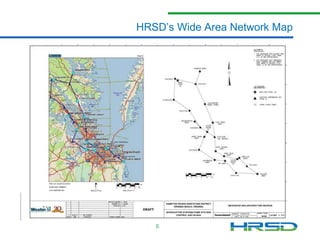
• Radio Microwave Wide Area Network (WAN) for
data transport between treatment plants and 3
operations centers
• 23 wireless communication towers throughout
the service area are required
 HRSD will lease space on 11 existing towers
 12 new towers will be located at HRSD’s
treatment plants and operations centers
4
HRSD’s Wide Area Network Map

5
Cost Mitigation
• Lease space on existing towers where possible
• Construct towers on HRSD property when:
– Existing towers are not in right locations or do not meet
engineering requirements
– Towers are required at plants and Operations Centers

• Enter public/private partnership with Milestone
Communications for construction and operation of
HRSD of towers
– Projected savings: $2 million - $3 million
– Opportunity to further offset costs to ratepayers through
colocation of wireless carriers on HRSD’s towers and
properties

6
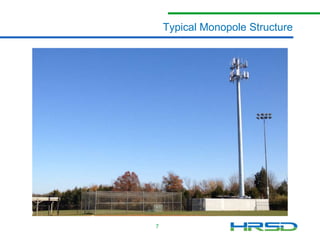
Typical Monopole Structure

7
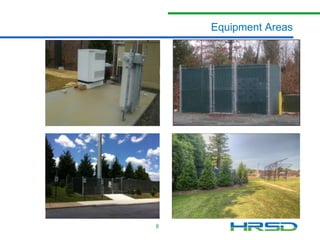
Equipment Areas

8
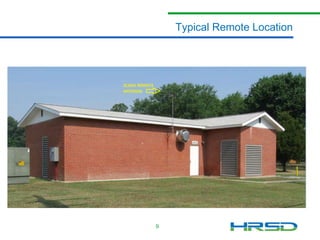
Typical Remote Location

9
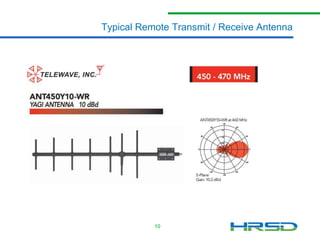
Typical Remote Transmit / Receive Antenna

10
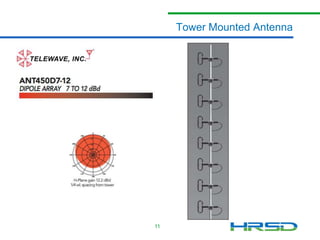
Tower Mounted Antenna

11
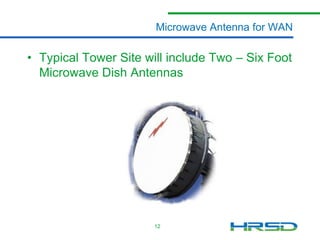
Microwave Antenna for WAN

• Typical Tower Site will include Two – 6’ Foot
Microwave Dish Antennas

12
Milestone Resume

13
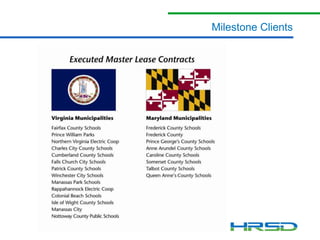
Milestone Clients
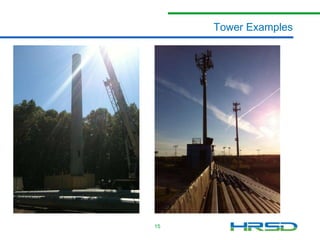
Tower Examples

15
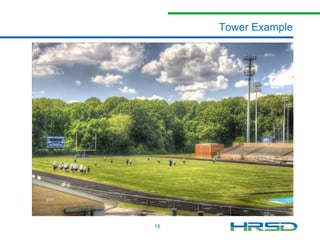
Tower Example

16

Towers for HRSD

  • 1.
    HRSD’s Smart SewerProject Using Wireless Technology to Protect Public Health and Area Waterways December 2013
  • 2.
    About HRSD • Createdby public referendum in 1940 to address pollution in Hampton Roads • The region’s first grassroots environmental organization • Provides wastewater treatment services to 17 cities and counties in southeast Virginia – – – – Service area: 3,100 square miles Population: 1.6 million Collection system: 500 miles of pipes, 104 pump stations Treatment plants: 9 major in Hampton Roads,4 small facilities on the Middle Peninsula – Combined capacity: 249 million gallons per day (MGD) • Funded by the fees paid by ratepayers • Vision: Future generations will inherit clean waterways and be able to keep them clean 2
  • 3.
    The Need ForSmart Sewers • HRSD, whose system is among the largest in the nation, must enhance its ability to remotely operate and control its pump stations and treatment plants • Collection and transmission of data from more than 120 sites across the service area is required to reduce the likelihood of sanitary sewer overflows during storms • HRSD’s antiquated analog network cannot meet current data transmission needs and regulatory requirements • One of 51 US EPA mandated projects 3
  • 4.
    Key Project Elements •Wireless antennae to transmit/receive data from the 3100 square mile area served by HRSD • Remote directional antennae at pump stations to connect to an HRSD plant • Radio Microwave Wide Area Network (WAN) for data transport between treatment plants and 3 operations centers • 23 wireless communication towers throughout the service area are required  HRSD will lease space on 11 existing towers  12 new towers will be located at HRSD’s treatment plants and operations centers 4
  • 5.
    HRSD’s Wide AreaNetwork Map 5
  • 6.
    Cost Mitigation • Leasespace on existing towers where possible • Construct towers on HRSD property when: – Existing towers are not in right locations or do not meet engineering requirements – Towers are required at plants and Operations Centers • Enter public/private partnership with Milestone Communications for construction and operation of HRSD of towers – Projected savings: $2 million - $3 million – Opportunity to further offset costs to ratepayers through colocation of wireless carriers on HRSD’s towers and properties 6
  • 7.
  • 8.
  • 9.
  • 10.
    Typical Remote Transmit/ Receive Antenna 10
  • 11.
  • 12.
    Microwave Antenna forWAN • Typical Tower Site will include Two – 6’ Foot Microwave Dish Antennas 12
  • 13.
  • 14.
  • 15.
  • 16.

Editor's Notes

  • #5 Approximately 23 towers totalControl stations are Main Office, North Shore Ops, and Middle Peninsula West Point Operations
  • #7 Approximately 23 towers totalControl stations are Main Office, North Shore Ops, and Middle Peninsula West Point Operations