

COMMUNICATIONS & MEDIA


  Seven steps to
better customer
    experience
 management
 Improving customer management
        to drive profitable growth


                    kpmg.com
© 2011 KPMG LLP a Delaware limited liability partnership and the U.S. member firm of the KPMG network of independent member firms affiliated
Introduction


                                                                                             with KPMG International Cooperative (“KPMG International”), a Swiss entity. All rights reserved. Printed in the U.S.A. The KPMG name, logo and
                                                                                            “cutting through complexity” are registered trademarks or trademarks of KPMG International. 23183NSS
     It costs many times more to acquire a new customer than retain
     an existing one. However, not all customers are created equal.
     Some require more attention than others, some need guidance
     from time to time, and some simply do not wish to be disturbed.
     By gaining insights on needs, preferences, and behavior,
     customer journeys can be optimized at critical touch points.
     Consistently delivering positive experiences establishes relationships.
     Strong relationships help build loyalty and drive growth.


     Customer experience management               They also help generate incremental
     (CEM) focuses on creating differentiated     sales through recommendations on
     experiences at touch points that             social and professional networks.


                                                                                                               ,
     customers choose to interact with
                                                  In today’s business climate,
     the company. Focusing on CEM as
                                                  rapid innovation and fierce competition
     a strategy helps service delivery
                                                  makes it harder for telecommunications
     capabilities align and adapt to behavioral
                                                  companies to outpace rivals on a
     shifts of the target audience. Benefits
                                                  product basis alone. With new features
     realized go well beyond improvements
                                                  quickly copied and introduced to
     in customer satisfaction and churn.
                                                  market, the quality of the customer
     Loyal customers buy more and share
                                                  experience becomes paramount as it
     experiences with friends and family.
Seven steps to better customer experience management | 3


                                                                                                                                                © 2011 KPMG LLP a Delaware limited liability partnership and the U.S. member firm of the KPMG network of independent member firms affiliated
                                                                                                                                                with KPMG International Cooperative (“KPMG International”), a Swiss entity. All rights reserved. Printed in the U.S.A. The KPMG name, logo and
                                                                                                                                               “cutting through complexity” are registered trademarks or trademarks of KPMG International. 23183NSS
is an intangible that can be imitated but      statisticians. Responsibility for the           “Positive customer
not commoditized. In some instances,           end-to-end customer journey is
the quality of experience can even help        distributed across multiple business            experience can build its
justify premium pricing.                       functions, often times causing messaging        own momentum, creating
                                               and service delivery consistency to be
Managing customer experience can
                                               a challenge.                                    an ‘ecosystem of goodwill’
be a tall order. Every touch point,
from advertising campaigns to post-            The issue is becoming more acute as data        that costs relatively little to
purchase support, can affect customer          about customers accumulates throughout          maintain, but can deliver a
perception and loyalty. To influence those     the customer life cycle. In addition,
interactions, organizations often need to      as companies grow, whether organically          loyal fan base and tangible
go through a significant transformation        or through acquisition, new systems,            bottom-line returns. ”
of their own, adapting their systems,          applications, and processes are
processes, and infrastructure to put           often only partially integrated with
the customer at the center. The effort is      legacy infrastructure, leading to data
worth the investment. Positive customer        fragmentation, inconsistent taxonomies,


                                                                                                                                                                  ,
experience can build its own momentum,         and inaccurate reporting. Ownership
creating an ‘ecosystem of goodwill’ that       for the customer experience tends to
costs relatively little to maintain, but can   be fragmented, nestled within product
deliver a loyal fan base that generates        organizations, marketing departments,
tangible bottom-line returns.                  and sales groups, often with little
                                               cohesion among them.
This paper offers seven ideas to help
companies in the communications                Until now, the solution has been to
and media industry drive growth and            spend heavily on sales and customer
profitability using customer experience        analytics. But this, too, can cause
as a service differentiator.                   problems. Many marketing initiatives
                                               are evaluated on a one-off basis.
Why managing customer experience is
                                               The net impact is multiple teams
hard to do
                                               reporting results on the same
Although many departments and
                                               campaign, or worse, perceived
functions have systems to track
                                               improvements are artificial, driven by
customer data, and measure customer
                                               changes in metric calculations.
satisfaction, few organizations have a
holistic, enterprise-wide view of              Given its importance, communications
customer experience. Voice of the              and media companies are keen to rethink
Customer programs can determine                strategy, assign leadership, and define
Net Promoter scores but are typically          governance for customer experience
not action oriented. Business intelligence     management, not only to gain a better
tools provide insights on the dynamic          understanding of customer needs and
nature of customer behavior but not            buying behaviors but to translate the
without IT support and interpretation from     insights into better, more tailored, service.
4 | Seven steps to better customer experience management


Seven steps to better customer


                                                                                              © 2011 KPMG LLP a Delaware limited liability partnership and the U.S. member firm of the KPMG network of independent member firms affiliated
                                                                                              with KPMG International Cooperative (“KPMG International”), a Swiss entity. All rights reserved. Printed in the U.S.A. The KPMG name, logo and
experience management
Based on our experience with clients in the communications and media sector, there are
seven key steps that organizations can take to improve their ability to capture, analyze,
and respond to customer data and improve the customer experience.


                                                                                             “cutting through complexity” are registered trademarks or trademarks of KPMG International. 23183NSS
Step 1:
Understand the needs, wants, and preferences of your target audience


Preference research, consisting of both          Key points to consider
qualitative and quantitative studies,
                                                 •	 Has the needs and preferences of your
can help organizations gain insights on
                                                    target audience changed over time?
customer shopping, pricing, product
usage, and service support preferences.          •	 What are the growth categories in your
This critical first step is not about creating      industry? What share of growth does
a new segmentation scheme.                          your company capture?
Instead, the focus is on gaining insights
                                                 •	 Other than price, how do you
on (1) how prospects hear about new
                                                    differentiate your products and


                                                                                                                ,
products; (2) the factors that influence
                                                    services?
who, what, and where they shop;
(3) onboarding needs and expectations;           •	 How well aligned is your product and
(4) how they like to get help when issues           service road map with market trends?
arise; and (5) perceived value at specific
                                                 •	 How successful are your renewal,
price points given new technologies and
                                                    up-sell, and cross-sell campaigns?
market trends.
The last point suggests that while a
customer may pay premium prices for
certain service features, they bargain
shop for others. So knowing where
key customers place their priorities is
essential to positioning in a meaningful
way. For example, while the convenience
of one bill and savings related to
consolidating voice, video, and Internet
service still drive purchase decisions,
the value of the bundle is fast diminishing
as more households switch to wireless or
third-party VoIP providers for voice.
Seven steps to better customer experience management | 5


                                                                                                                                             © 2011 KPMG LLP a Delaware limited liability partnership and the U.S. member firm of the KPMG network of independent member firms affiliated
                                                                                                                                             with KPMG International Cooperative (“KPMG International”), a Swiss entity. All rights reserved. Printed in the U.S.A. The KPMG name, logo and
                                                                                                                                            “cutting through complexity” are registered trademarks or trademarks of KPMG International. 23183NSS
Step 2:
Establish economic frameworks to understand and prioritize impact of
marketing, sales, and service decisions

Comprehensive economic frameworks             New product focus shifted to growth           Key points to consider
drive everything from market opportunity      categories only. Highly targeted
                                                                                            •	 How do you decide which markets to
assessments, product pricing/cost             acquisition and up-sell/cross-sell
                                                                                               enter, grow, harvest, and exit?
analysis, marketing spend, channel mix,       campaigns followed.
support strategy, and customer policies,                                                    •	 How well do you understand
                                              Over the next 12 months, the company
among others. With focus on customer                                                           performance within your distributed
                                              not only cut marketing expenditures by
experience management, tradeoffs are                                                           sale model?
                                              more than 40 percent, but also, churn
required at each touch point. The challenge
                                              improved, average revenue per customer        •	 How do you determine which
is to balance cost to acquire and cost
                                              increased, and it actually boosted sales by      products and services represent


                                                                                                                                                               ,
to serve against customer tenure and
                                              10 percent, thanks to greater performance        growth categories?
profitability.
                                              discipline.
                                                                                            •	 How much pricing volatility is there
In mature markets, companies are
                                                                                               in the current product and service
constantly implementing differentiated
                                                                                               portfolio?
strategies and tactics. At one
telecommunications firm, the marketing                                                      •	 What is the cost to serve customers
budget was cut by about 40 percent.                                                            using current online and offline support
However, there was no relief on the target                                                     tactics?
sales numbers. Rather than betting big
on a new marketing campaign to increase
yield on existing tactics, big-ticket
expenditures, such as golf sponsorships
and TV advertising, were cut. But the
team realized that much deeper changes
were needed to hit their numbers at the
reduced budget level. After much debate
between Marketing, Sales, and Product,
the company dramatically reshaped
its marketing footprint, pulling out of
underperforming areas and going from
a nationwide presence to locations in
just 10 key markets. They then allocated
budget based on market size,
sales momentum, supplier strength,
and other criteria. At the same time,
they revamped their indirect channel
programs and moved from a residual
payout to pay-for-performance model.
6 | Seven steps to better customer experience management


                                                                                                                                           © 2011 KPMG LLP a Delaware limited liability partnership and the U.S. member firm of the KPMG network of independent member firms affiliated
                                                                                                                                           with KPMG International Cooperative (“KPMG International”), a Swiss entity. All rights reserved. Printed in the U.S.A. The KPMG name, logo and
                                                                                                                                          “cutting through complexity” are registered trademarks or trademarks of KPMG International. 23183NSS
Step 3:
Track customer behavior, distill patterns, and adapt to accommodate shifts

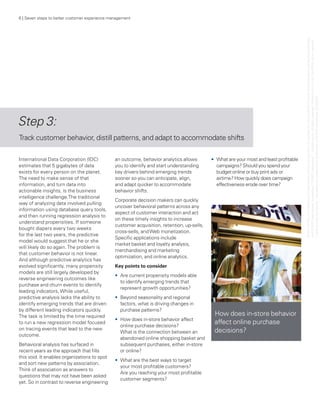
International Data Corporation (IDC)            an outcome, behavior analytics allows        •	 What are your most and least profitable
estimates that 5 gigabytes of data              you to identify and start understanding         campaigns? Should you spend your
exists for every person on the planet.          key drivers behind emerging trends              budget online or buy print ads or
The need to make sense of that                  sooner so you can anticipate, align,            airtime? How quickly does campaign
information, and turn data into                 and adapt quicker to accommodate                effectiveness erode over time?
actionable insights, is the business            behavior shifts.
intelligence challenge.The traditional
                                                Corporate decision makers can quickly
way of analyzing data involved pulling
                                                uncover behavioral patterns across any
information using database query tools,
                                                aspect of customer interaction and act


                                                                                                                                                             ,
and then running regression analysis to
                                                on these timely insights to increase
understand propensities. If someone
                                                customer acquisition, retention, up-sells,
bought diapers every two weeks
                                                cross-sells, and Web monetization.
for the last two years, the predictive
                                                Specific applications include
model would suggest that he or she
                                                market basket and loyalty analysis,
will likely do so again. The problem is
                                                merchandising and marketing
that customer behavior is not linear.
                                                optimization, and online analytics.
And although predictive analytics has
evolved significantly, many propensity          Key points to consider
models are still largely developed by
                                                •	 Are current propensity models able
reverse engineering outcomes like
                                                   to identify emerging trends that
purchase and churn events to identify
                                                   represent growth opportunities?
leading indicators. While useful,
predictive analysis lacks the ability to        •	 Beyond seasonality and regional
identify emerging trends that are driven           factors, what is driving changes in
by different leading indicators quickly.           purchase patterns?
The task is limited by the time required                                                      How does in-store behavior
                                                •	 How does in-store behavior affect
to run a new regression model focused
                                                   online purchase decisions?
                                                                                              affect online purchase
on tracing events that lead to the new                                                        decisions?
                                                   What is the connection between an
outcome.
                                                   abandoned online shopping basket and
Behavioral analysis has surfaced in                subsequent purchases, either in-store
recent years as the approach that fills            or online?
this void. It enables organizations to spot
                                                •	 What are the best ways to target
and sort new patterns by association.
                                                   your most profitable customers?
Think of association as answers to
                                                   Are you reaching your most profitable
questions that may not have been asked
                                                   customer segments?
yet. So in contrast to reverse engineering
Seven steps to better customer experience management | 7


                                                                                                                                             © 2011 KPMG LLP a Delaware limited liability partnership and the U.S. member firm of the KPMG network of independent member firms affiliated
                                                                                                                                             with KPMG International Cooperative (“KPMG International”), a Swiss entity. All rights reserved. Printed in the U.S.A. The KPMG name, logo and
                                                                                                                                            “cutting through complexity” are registered trademarks or trademarks of KPMG International. 23183NSS
Step 4:
Develop lead nurturing and customer management plans for target audiences

Every interaction informs the next             Similarly, customer management plans         Key points to consider
interaction. Over time the information         can be developed to address events that
                                                                                            •	 How are past customer and prospect
yields actionable insights for sales           occur during the service and customer
                                                                                               lists managed and leveraged by sales
and service engagement. Strong lead            life cycle. Event triggers and responses
                                                                                               acquisition programs? How effective
nurturing and customer management              can be tiered by segment, risk, and value.
                                                                                               are your win-back campaigns?
programs are built around insights about       A customer who spends $5 per month,
interests/needs and preferred contact          for instance, will trigger certain           •	 How many times a year does your
preferences. For instance, downloading a       responses, such as sound bytes and              company communicate with the
white paper or podcast on a new product        e-mail notifications, while a customer          customer? How many times a year


                                                                                                                                                               ,
or service might indicate that a prospect      who spends triple that amount may               does your company market to a
is looking for preliminary insight, but is     receive a dedicated customer service            prospect?
not yet ready to buy. The company can          number and a single point of contact for
                                                                                            •	 What is the optimal contact strategy
respond to those inputs by directing           issue resolution. Knowing the average
                                                                                               for renewing and up/cross-selling
additional related material toward the         lead time and the typical progression
                                                                                               customers?
consumer over the coming weeks and             of trigger events can help product
months. A request for a free trial or          and marketing managers gauge the             •	 What are your customers, most
demo, on the other hand, might signal a        effectiveness of current campaign               preferred communications channels?
greater degree of interest, one that might     strategy and refine accordingly.
                                                                                            •	 What are the most critical touch points
merit a sales call or other more personal
                                                                                               in your sales and service life cycle?
communication.
It’s important to define a structured plan
for different stages of lead generation.
If a prospect says “no” today, the lead
should not be disposed of. Information
picked up in that interaction can still form
the basis for subsequent contact.
Even cold leads need their respective
decision pathways. For instance,
the prospect may still be under contract
or may be waiting for prices to go down.
That information is then compiled into
the lead nurturing plan to be acted upon
later as the prospect’s needs change.
8 | Seven steps to better customer experience management


                                                                                                                                                © 2011 KPMG LLP a Delaware limited liability partnership and the U.S. member firm of the KPMG network of independent member firms affiliated
                                                                                                                                                with KPMG International Cooperative (“KPMG International”), a Swiss entity. All rights reserved. Printed in the U.S.A. The KPMG name, logo and
                                                                                                                                               “cutting through complexity” are registered trademarks or trademarks of KPMG International. 23183NSS
Step 5:
Develop a customer-centric information architecture

Gaining a single view of the customer            will be gradual. While the path generally       Key points to consider
is critical, yet hard to obtain, particularly    starts with call center and Web initiatives,
                                                                                                 •	 How quickly can new information about
since many large organizations tend to           the journey eventually touches customer
                                                                                                    a customer disseminate through your
have information about the customer              databases and data warehouses,
                                                                                                    enterprise?
distributed across multiple systems.             knowledge bases, search technologies,
The problem is complicated by the fact           mobile applications, online portals,            •	 Was your information architecture
that information captured about the              online communities and social media,               designed for products and systems,
customer typically only describes the            marketing campaign management,                     or customers?
responsible party on the account.                customer service systems, product
                                                                                                 •	 How does your information architecture


                                                                                                                                                                  ,
The account may be a household where             and service configurators, simulations and
                                                                                                    account for relationship hierarchy?
there are multiple family members or             visualizations, as well as manufacturing,
a business where there are multiple              inventory, billing, shipping and delivery,      •	 How do you categorize customer data?
employees. For some distributed                  and replenishment of the supply chain,             By life cycle events, interactions,
businesses, headquarters may be                  even in-vehicle and handheld systems.              or products?
the responsible party for the account.           None of these areas remains untouched.
                                                                                                 •	 Are your marketing and customer
Designing and deploying a customer-
                                                 Application design and development is              databases integrated? If so, what is the
centric information architecture
                                                 not a sequential process. Neither is the           unique identifier?
involves understanding the entity
                                                 shift to a customer-centric information
type, creating the entity relationship
                                                 architecture. The change process is
structure, linking events to the structure,
                                                 recursive and iterative. Many activities
and then populating the entity
                                                 can take place in parallel. Just about all of
structure with relevant data over time.
                                                 them will be done many times, over and
Another compelling reason to create a            over again.
customer-centric information architecture
is because customer-facing applications
demand it. Design and development of
customer applications is not the same              The problem is complicated
as design of applications that run the
business. In many ways, what we’re
                                                   by the fact that information
really talking about here is the shift of your     captured about the customer
organization’s information systems from            typically describes the
a product-centric focus to a customer-
centric focus. For most communications
                                                   responsible party on
and media companies, the move to a                 the account.
customer-centric information environment
Seven steps to better customer experience management | 9


                                                                                                                                              © 2011 KPMG LLP a Delaware limited liability partnership and the U.S. member firm of the KPMG network of independent member firms affiliated
                                                                                                                                              with KPMG International Cooperative (“KPMG International”), a Swiss entity. All rights reserved. Printed in the U.S.A. The KPMG name, logo and
                                                                                                                                             “cutting through complexity” are registered trademarks or trademarks of KPMG International. 23183NSS
Step 6:
Deploy workflow-based tools to marketing, sales, and service
stakeholder groups

Today’s multichannel environment creates       Better connectivity and transparency         Key points to consider
many more sources of potential customer        can also create better reporting tools,
                                                                                            •	 How well coordinated are handoffs
interaction. Social and commercial             such as dashboards, and easier
                                                                                               between marketing, sales, and service
networks, for instance, offer important        monitoring, through enhanced
                                                                                               functions?
clues into the potential for up-selling,       performance measurement capabilities.
switching providers, and increasing            For companies wrestling with legacy          •	 How well does your company manage
revenue. Eliciting this information requires   architectures and fragmented databases,         customer escalations? How long does
that companies develop the ability to          SaaS and cloud computing can be a way           it typically take to resolve? How many
monitor customer behavior by channel           to leapfrog over to a more integrated data      are not resolved?


                                                                                                                                                                ,
and integrate that information across the      and workflow management platform.
                                                                                            •	 How are lead nurturing and customer
organization.
                                                                                               management plans monitored?
Workflow tools provide a way for sales,
                                                                                            •	 What tools are in place to facilitate
marketing, and support functions to
                                                                                               workflow across business functions?
perform key tasks more collaboratively
and transparently. These technologies can                                                   •	 How much visibility and control do
ease bottlenecks, reduce paperwork,                                                            customers have on service issues
and improve communication between and                                                          through online portals?
among departments. The real-time nature
of these systems allows information,
such as a new lead, to be flagged and
qualified. Once vetted, that lead, and the
entire customer record, including notes,
can be fed to the sales team.
Similarly, negative customer satisfaction
feedback can trigger workflows.
Depending on the issue, response may be
an automated e-mail or an outbound call by
a service quality agent.


Social and commercial networks, for
instance, offer important clues into
the potential for up-selling, switching
providers, and increasing revenue.
10 | Seven steps to better customer experience management


                                                                                                                                            © 2011 KPMG LLP a Delaware limited liability partnership and the U.S. member firm of the KPMG network of independent member firms affiliated
                                                                                                                                            with KPMG International Cooperative (“KPMG International”), a Swiss entity. All rights reserved. Printed in the U.S.A. The KPMG name, logo and
                                                                                                                                           “cutting through complexity” are registered trademarks or trademarks of KPMG International. 23183NSS
Step 7:
Create a customer experience map to optimize touch points

The customer experience map charts              Organizations often develop multiple           •	 What percentage of work flows ends
the journey from first contact with             experience maps covering customer-                up on jeopardy paths?
a product or company through the                facing touch point categories, such as
                                                                                               •	 How do you measure the effectiveness
relationship life cycle. The goal is to         shopping, onboarding, bill payment,
                                                                                                  of customer experience delivery?
align process, policy, technology,              and service support. A prospective
and organization with needs and                 customer might be in the market for a          •	 Can your company drive growth
preferences of the target audience.             new smartphone, for instance. To acquaint         using customer experience as a
A map can help define functional                herself with current offerings, she might         differentiator?
requirements to support the launch              start with Internet browsing, then head to
                                                                                               The quality of the customer experience


                                                                                                                                                              ,
of a new product or service. It can             a retail outlet to compare products and talk
                                                                                               has a direct bearing on sales, profit,
also help identify gaps in existing             one-on-one with a sales representative.
                                                                                               and overall market position. For many
processes.                                      With that information, the customer
                                                                                               companies, improving it will involve
                                                might then return home, consult with a
It’s important to note that a customer                                                         changes in how data is captured,
                                                few friends, and shop online for the best
experience map is not a workflow                                                               shared, and leveraged and will require
                                                deal. Using customer experience maps,
diagram. Although process flows are                                                            structural improvements in how staff
                                                organizations can design and coordinate
underlying components, they are used                                                           across functions work together.
                                                experiences across each touch point to
primarily to assess strength of existing                                                       While defining and refining the
                                                deliver consistent messaging and calls to
capabilities and to identify dependencies                                                      customer experience is an ongoing
                                                action.
between business functions.                                                                    process, there is growing urgency to
Strength is tested with customer use            Key points to consider                         act. The communications and media
cases that represent jeopardy path                                                             companies that lead in this area can have
                                                •	 Who owns customer experience within
scenarios. For instance, one use case                                                          a significant competitive advantage over
                                                   your company? If ownership is shared,
for a VoIP phone service provider tests                                                        slower-acting peers.
                                                   who drives customer experience
how well the current process addresses
                                                   tradeoff decisions?
prospects who do not have broadband
at home and/or a data plan on their             •	 As business processes are defined,
mobile device. In this same example,               what customer experience factors
a dependency on the VoIP provider’s                are incorporated into the planning?
broadband service partner might be                 Are they included in go-to-market gate
weak if that partner’s broadband footprint         requirements?
is limited. All this to address a simple
question:“Can I get your service?”
Seven steps to better customer experience management | 11


 © 2011 KPMG LLP a Delaware limited liability partnership and the U.S. member firm of the KPMG network of independent member firms affiliated
                   ,
 with KPMG International Cooperative (“KPMG International”), a Swiss entity. All rights reserved. Printed in the U.S.A. The KPMG name, logo and
“cutting through complexity” are registered trademarks or trademarks of KPMG International. 23183NSS
For more information on customer experience management
initiatives, please contact any of the following individuals:

Tony Castellanos
Partner
U.S. Communications & Media Sector Leader
KPMG LLP
212-954-6840
acastellanos@kpmg.com

Miriam Hernandez-Kakol
Principal
Communications & Media
KPMG LLP
973-912-6227
mhernandezkakol@kpmg.com

David Huang
Senior Manager
Communications & Media
KPMG LLP
973-912-6576
davidhuang@kpmg.com


The information contained herein is of a general nature and is not intended to address the circumstances of any particular individual or
entity. Although we endeavor to provide accurate and timely information, there can be no guarantee that such information is accurate
as of the date it is received or that it will continue to be accurate in the future. No one should act upon such information without
appropriate professional advice after a thorough examination of the particular situation.

© 2011 KPMG LLP a Delaware limited liability partnership and the U.S. member firm of the KPMG network of independent member
                    ,
firms affiliated with KPMG International Cooperative (“KPMG International”), a Swiss entity. All rights reserved. Printed in the U.S.A.
The KPMG name, logo and “cutting through complexity” are registered trademarks or trademarks of KPMG International. 23183NSS

Towards better customer experience management

  • 1.
    COMMUNICATIONS & MEDIA Seven steps to better customer experience management Improving customer management to drive profitable growth kpmg.com
  • 2.
    © 2011 KPMGLLP a Delaware limited liability partnership and the U.S. member firm of the KPMG network of independent member firms affiliated Introduction with KPMG International Cooperative (“KPMG International”), a Swiss entity. All rights reserved. Printed in the U.S.A. The KPMG name, logo and “cutting through complexity” are registered trademarks or trademarks of KPMG International. 23183NSS It costs many times more to acquire a new customer than retain an existing one. However, not all customers are created equal. Some require more attention than others, some need guidance from time to time, and some simply do not wish to be disturbed. By gaining insights on needs, preferences, and behavior, customer journeys can be optimized at critical touch points. Consistently delivering positive experiences establishes relationships. Strong relationships help build loyalty and drive growth. Customer experience management They also help generate incremental (CEM) focuses on creating differentiated sales through recommendations on experiences at touch points that social and professional networks. , customers choose to interact with In today’s business climate, the company. Focusing on CEM as rapid innovation and fierce competition a strategy helps service delivery makes it harder for telecommunications capabilities align and adapt to behavioral companies to outpace rivals on a shifts of the target audience. Benefits product basis alone. With new features realized go well beyond improvements quickly copied and introduced to in customer satisfaction and churn. market, the quality of the customer Loyal customers buy more and share experience becomes paramount as it experiences with friends and family.
  • 3.
    Seven steps tobetter customer experience management | 3 © 2011 KPMG LLP a Delaware limited liability partnership and the U.S. member firm of the KPMG network of independent member firms affiliated with KPMG International Cooperative (“KPMG International”), a Swiss entity. All rights reserved. Printed in the U.S.A. The KPMG name, logo and “cutting through complexity” are registered trademarks or trademarks of KPMG International. 23183NSS is an intangible that can be imitated but statisticians. Responsibility for the “Positive customer not commoditized. In some instances, end-to-end customer journey is the quality of experience can even help distributed across multiple business experience can build its justify premium pricing. functions, often times causing messaging own momentum, creating and service delivery consistency to be Managing customer experience can a challenge. an ‘ecosystem of goodwill’ be a tall order. Every touch point, from advertising campaigns to post- The issue is becoming more acute as data that costs relatively little to purchase support, can affect customer about customers accumulates throughout maintain, but can deliver a perception and loyalty. To influence those the customer life cycle. In addition, interactions, organizations often need to as companies grow, whether organically loyal fan base and tangible go through a significant transformation or through acquisition, new systems, bottom-line returns. ” of their own, adapting their systems, applications, and processes are processes, and infrastructure to put often only partially integrated with the customer at the center. The effort is legacy infrastructure, leading to data worth the investment. Positive customer fragmentation, inconsistent taxonomies, , experience can build its own momentum, and inaccurate reporting. Ownership creating an ‘ecosystem of goodwill’ that for the customer experience tends to costs relatively little to maintain, but can be fragmented, nestled within product deliver a loyal fan base that generates organizations, marketing departments, tangible bottom-line returns. and sales groups, often with little cohesion among them. This paper offers seven ideas to help companies in the communications Until now, the solution has been to and media industry drive growth and spend heavily on sales and customer profitability using customer experience analytics. But this, too, can cause as a service differentiator. problems. Many marketing initiatives are evaluated on a one-off basis. Why managing customer experience is The net impact is multiple teams hard to do reporting results on the same Although many departments and campaign, or worse, perceived functions have systems to track improvements are artificial, driven by customer data, and measure customer changes in metric calculations. satisfaction, few organizations have a holistic, enterprise-wide view of Given its importance, communications customer experience. Voice of the and media companies are keen to rethink Customer programs can determine strategy, assign leadership, and define Net Promoter scores but are typically governance for customer experience not action oriented. Business intelligence management, not only to gain a better tools provide insights on the dynamic understanding of customer needs and nature of customer behavior but not buying behaviors but to translate the without IT support and interpretation from insights into better, more tailored, service.
  • 4.
    4 | Sevensteps to better customer experience management Seven steps to better customer © 2011 KPMG LLP a Delaware limited liability partnership and the U.S. member firm of the KPMG network of independent member firms affiliated with KPMG International Cooperative (“KPMG International”), a Swiss entity. All rights reserved. Printed in the U.S.A. The KPMG name, logo and experience management Based on our experience with clients in the communications and media sector, there are seven key steps that organizations can take to improve their ability to capture, analyze, and respond to customer data and improve the customer experience. “cutting through complexity” are registered trademarks or trademarks of KPMG International. 23183NSS Step 1: Understand the needs, wants, and preferences of your target audience Preference research, consisting of both Key points to consider qualitative and quantitative studies, • Has the needs and preferences of your can help organizations gain insights on target audience changed over time? customer shopping, pricing, product usage, and service support preferences. • What are the growth categories in your This critical first step is not about creating industry? What share of growth does a new segmentation scheme. your company capture? Instead, the focus is on gaining insights • Other than price, how do you on (1) how prospects hear about new differentiate your products and , products; (2) the factors that influence services? who, what, and where they shop; (3) onboarding needs and expectations; • How well aligned is your product and (4) how they like to get help when issues service road map with market trends? arise; and (5) perceived value at specific • How successful are your renewal, price points given new technologies and up-sell, and cross-sell campaigns? market trends. The last point suggests that while a customer may pay premium prices for certain service features, they bargain shop for others. So knowing where key customers place their priorities is essential to positioning in a meaningful way. For example, while the convenience of one bill and savings related to consolidating voice, video, and Internet service still drive purchase decisions, the value of the bundle is fast diminishing as more households switch to wireless or third-party VoIP providers for voice.
  • 5.
    Seven steps tobetter customer experience management | 5 © 2011 KPMG LLP a Delaware limited liability partnership and the U.S. member firm of the KPMG network of independent member firms affiliated with KPMG International Cooperative (“KPMG International”), a Swiss entity. All rights reserved. Printed in the U.S.A. The KPMG name, logo and “cutting through complexity” are registered trademarks or trademarks of KPMG International. 23183NSS Step 2: Establish economic frameworks to understand and prioritize impact of marketing, sales, and service decisions Comprehensive economic frameworks New product focus shifted to growth Key points to consider drive everything from market opportunity categories only. Highly targeted • How do you decide which markets to assessments, product pricing/cost acquisition and up-sell/cross-sell enter, grow, harvest, and exit? analysis, marketing spend, channel mix, campaigns followed. support strategy, and customer policies, • How well do you understand Over the next 12 months, the company among others. With focus on customer performance within your distributed not only cut marketing expenditures by experience management, tradeoffs are sale model? more than 40 percent, but also, churn required at each touch point. The challenge improved, average revenue per customer • How do you determine which is to balance cost to acquire and cost increased, and it actually boosted sales by products and services represent , to serve against customer tenure and 10 percent, thanks to greater performance growth categories? profitability. discipline. • How much pricing volatility is there In mature markets, companies are in the current product and service constantly implementing differentiated portfolio? strategies and tactics. At one telecommunications firm, the marketing • What is the cost to serve customers budget was cut by about 40 percent. using current online and offline support However, there was no relief on the target tactics? sales numbers. Rather than betting big on a new marketing campaign to increase yield on existing tactics, big-ticket expenditures, such as golf sponsorships and TV advertising, were cut. But the team realized that much deeper changes were needed to hit their numbers at the reduced budget level. After much debate between Marketing, Sales, and Product, the company dramatically reshaped its marketing footprint, pulling out of underperforming areas and going from a nationwide presence to locations in just 10 key markets. They then allocated budget based on market size, sales momentum, supplier strength, and other criteria. At the same time, they revamped their indirect channel programs and moved from a residual payout to pay-for-performance model.
  • 6.
    6 | Sevensteps to better customer experience management © 2011 KPMG LLP a Delaware limited liability partnership and the U.S. member firm of the KPMG network of independent member firms affiliated with KPMG International Cooperative (“KPMG International”), a Swiss entity. All rights reserved. Printed in the U.S.A. The KPMG name, logo and “cutting through complexity” are registered trademarks or trademarks of KPMG International. 23183NSS Step 3: Track customer behavior, distill patterns, and adapt to accommodate shifts International Data Corporation (IDC) an outcome, behavior analytics allows • What are your most and least profitable estimates that 5 gigabytes of data you to identify and start understanding campaigns? Should you spend your exists for every person on the planet. key drivers behind emerging trends budget online or buy print ads or The need to make sense of that sooner so you can anticipate, align, airtime? How quickly does campaign information, and turn data into and adapt quicker to accommodate effectiveness erode over time? actionable insights, is the business behavior shifts. intelligence challenge.The traditional Corporate decision makers can quickly way of analyzing data involved pulling uncover behavioral patterns across any information using database query tools, aspect of customer interaction and act , and then running regression analysis to on these timely insights to increase understand propensities. If someone customer acquisition, retention, up-sells, bought diapers every two weeks cross-sells, and Web monetization. for the last two years, the predictive Specific applications include model would suggest that he or she market basket and loyalty analysis, will likely do so again. The problem is merchandising and marketing that customer behavior is not linear. optimization, and online analytics. And although predictive analytics has evolved significantly, many propensity Key points to consider models are still largely developed by • Are current propensity models able reverse engineering outcomes like to identify emerging trends that purchase and churn events to identify represent growth opportunities? leading indicators. While useful, predictive analysis lacks the ability to • Beyond seasonality and regional identify emerging trends that are driven factors, what is driving changes in by different leading indicators quickly. purchase patterns? The task is limited by the time required How does in-store behavior • How does in-store behavior affect to run a new regression model focused online purchase decisions? affect online purchase on tracing events that lead to the new decisions? What is the connection between an outcome. abandoned online shopping basket and Behavioral analysis has surfaced in subsequent purchases, either in-store recent years as the approach that fills or online? this void. It enables organizations to spot • What are the best ways to target and sort new patterns by association. your most profitable customers? Think of association as answers to Are you reaching your most profitable questions that may not have been asked customer segments? yet. So in contrast to reverse engineering
  • 7.
    Seven steps tobetter customer experience management | 7 © 2011 KPMG LLP a Delaware limited liability partnership and the U.S. member firm of the KPMG network of independent member firms affiliated with KPMG International Cooperative (“KPMG International”), a Swiss entity. All rights reserved. Printed in the U.S.A. The KPMG name, logo and “cutting through complexity” are registered trademarks or trademarks of KPMG International. 23183NSS Step 4: Develop lead nurturing and customer management plans for target audiences Every interaction informs the next Similarly, customer management plans Key points to consider interaction. Over time the information can be developed to address events that • How are past customer and prospect yields actionable insights for sales occur during the service and customer lists managed and leveraged by sales and service engagement. Strong lead life cycle. Event triggers and responses acquisition programs? How effective nurturing and customer management can be tiered by segment, risk, and value. are your win-back campaigns? programs are built around insights about A customer who spends $5 per month, interests/needs and preferred contact for instance, will trigger certain • How many times a year does your preferences. For instance, downloading a responses, such as sound bytes and company communicate with the white paper or podcast on a new product e-mail notifications, while a customer customer? How many times a year , or service might indicate that a prospect who spends triple that amount may does your company market to a is looking for preliminary insight, but is receive a dedicated customer service prospect? not yet ready to buy. The company can number and a single point of contact for • What is the optimal contact strategy respond to those inputs by directing issue resolution. Knowing the average for renewing and up/cross-selling additional related material toward the lead time and the typical progression customers? consumer over the coming weeks and of trigger events can help product months. A request for a free trial or and marketing managers gauge the • What are your customers, most demo, on the other hand, might signal a effectiveness of current campaign preferred communications channels? greater degree of interest, one that might strategy and refine accordingly. • What are the most critical touch points merit a sales call or other more personal in your sales and service life cycle? communication. It’s important to define a structured plan for different stages of lead generation. If a prospect says “no” today, the lead should not be disposed of. Information picked up in that interaction can still form the basis for subsequent contact. Even cold leads need their respective decision pathways. For instance, the prospect may still be under contract or may be waiting for prices to go down. That information is then compiled into the lead nurturing plan to be acted upon later as the prospect’s needs change.
  • 8.
    8 | Sevensteps to better customer experience management © 2011 KPMG LLP a Delaware limited liability partnership and the U.S. member firm of the KPMG network of independent member firms affiliated with KPMG International Cooperative (“KPMG International”), a Swiss entity. All rights reserved. Printed in the U.S.A. The KPMG name, logo and “cutting through complexity” are registered trademarks or trademarks of KPMG International. 23183NSS Step 5: Develop a customer-centric information architecture Gaining a single view of the customer will be gradual. While the path generally Key points to consider is critical, yet hard to obtain, particularly starts with call center and Web initiatives, • How quickly can new information about since many large organizations tend to the journey eventually touches customer a customer disseminate through your have information about the customer databases and data warehouses, enterprise? distributed across multiple systems. knowledge bases, search technologies, The problem is complicated by the fact mobile applications, online portals, • Was your information architecture that information captured about the online communities and social media, designed for products and systems, customer typically only describes the marketing campaign management, or customers? responsible party on the account. customer service systems, product • How does your information architecture , The account may be a household where and service configurators, simulations and account for relationship hierarchy? there are multiple family members or visualizations, as well as manufacturing, a business where there are multiple inventory, billing, shipping and delivery, • How do you categorize customer data? employees. For some distributed and replenishment of the supply chain, By life cycle events, interactions, businesses, headquarters may be even in-vehicle and handheld systems. or products? the responsible party for the account. None of these areas remains untouched. • Are your marketing and customer Designing and deploying a customer- Application design and development is databases integrated? If so, what is the centric information architecture not a sequential process. Neither is the unique identifier? involves understanding the entity shift to a customer-centric information type, creating the entity relationship architecture. The change process is structure, linking events to the structure, recursive and iterative. Many activities and then populating the entity can take place in parallel. Just about all of structure with relevant data over time. them will be done many times, over and Another compelling reason to create a over again. customer-centric information architecture is because customer-facing applications demand it. Design and development of customer applications is not the same The problem is complicated as design of applications that run the business. In many ways, what we’re by the fact that information really talking about here is the shift of your captured about the customer organization’s information systems from typically describes the a product-centric focus to a customer- centric focus. For most communications responsible party on and media companies, the move to a the account. customer-centric information environment
  • 9.
    Seven steps tobetter customer experience management | 9 © 2011 KPMG LLP a Delaware limited liability partnership and the U.S. member firm of the KPMG network of independent member firms affiliated with KPMG International Cooperative (“KPMG International”), a Swiss entity. All rights reserved. Printed in the U.S.A. The KPMG name, logo and “cutting through complexity” are registered trademarks or trademarks of KPMG International. 23183NSS Step 6: Deploy workflow-based tools to marketing, sales, and service stakeholder groups Today’s multichannel environment creates Better connectivity and transparency Key points to consider many more sources of potential customer can also create better reporting tools, • How well coordinated are handoffs interaction. Social and commercial such as dashboards, and easier between marketing, sales, and service networks, for instance, offer important monitoring, through enhanced functions? clues into the potential for up-selling, performance measurement capabilities. switching providers, and increasing For companies wrestling with legacy • How well does your company manage revenue. Eliciting this information requires architectures and fragmented databases, customer escalations? How long does that companies develop the ability to SaaS and cloud computing can be a way it typically take to resolve? How many monitor customer behavior by channel to leapfrog over to a more integrated data are not resolved? , and integrate that information across the and workflow management platform. • How are lead nurturing and customer organization. management plans monitored? Workflow tools provide a way for sales, • What tools are in place to facilitate marketing, and support functions to workflow across business functions? perform key tasks more collaboratively and transparently. These technologies can • How much visibility and control do ease bottlenecks, reduce paperwork, customers have on service issues and improve communication between and through online portals? among departments. The real-time nature of these systems allows information, such as a new lead, to be flagged and qualified. Once vetted, that lead, and the entire customer record, including notes, can be fed to the sales team. Similarly, negative customer satisfaction feedback can trigger workflows. Depending on the issue, response may be an automated e-mail or an outbound call by a service quality agent. Social and commercial networks, for instance, offer important clues into the potential for up-selling, switching providers, and increasing revenue.
  • 10.
    10 | Sevensteps to better customer experience management © 2011 KPMG LLP a Delaware limited liability partnership and the U.S. member firm of the KPMG network of independent member firms affiliated with KPMG International Cooperative (“KPMG International”), a Swiss entity. All rights reserved. Printed in the U.S.A. The KPMG name, logo and “cutting through complexity” are registered trademarks or trademarks of KPMG International. 23183NSS Step 7: Create a customer experience map to optimize touch points The customer experience map charts Organizations often develop multiple • What percentage of work flows ends the journey from first contact with experience maps covering customer- up on jeopardy paths? a product or company through the facing touch point categories, such as • How do you measure the effectiveness relationship life cycle. The goal is to shopping, onboarding, bill payment, of customer experience delivery? align process, policy, technology, and service support. A prospective and organization with needs and customer might be in the market for a • Can your company drive growth preferences of the target audience. new smartphone, for instance. To acquaint using customer experience as a A map can help define functional herself with current offerings, she might differentiator? requirements to support the launch start with Internet browsing, then head to The quality of the customer experience , of a new product or service. It can a retail outlet to compare products and talk has a direct bearing on sales, profit, also help identify gaps in existing one-on-one with a sales representative. and overall market position. For many processes. With that information, the customer companies, improving it will involve might then return home, consult with a It’s important to note that a customer changes in how data is captured, few friends, and shop online for the best experience map is not a workflow shared, and leveraged and will require deal. Using customer experience maps, diagram. Although process flows are structural improvements in how staff organizations can design and coordinate underlying components, they are used across functions work together. experiences across each touch point to primarily to assess strength of existing While defining and refining the deliver consistent messaging and calls to capabilities and to identify dependencies customer experience is an ongoing action. between business functions. process, there is growing urgency to Strength is tested with customer use Key points to consider act. The communications and media cases that represent jeopardy path companies that lead in this area can have • Who owns customer experience within scenarios. For instance, one use case a significant competitive advantage over your company? If ownership is shared, for a VoIP phone service provider tests slower-acting peers. who drives customer experience how well the current process addresses tradeoff decisions? prospects who do not have broadband at home and/or a data plan on their • As business processes are defined, mobile device. In this same example, what customer experience factors a dependency on the VoIP provider’s are incorporated into the planning? broadband service partner might be Are they included in go-to-market gate weak if that partner’s broadband footprint requirements? is limited. All this to address a simple question:“Can I get your service?”
  • 11.
    Seven steps tobetter customer experience management | 11 © 2011 KPMG LLP a Delaware limited liability partnership and the U.S. member firm of the KPMG network of independent member firms affiliated , with KPMG International Cooperative (“KPMG International”), a Swiss entity. All rights reserved. Printed in the U.S.A. The KPMG name, logo and “cutting through complexity” are registered trademarks or trademarks of KPMG International. 23183NSS
  • 12.
    For more informationon customer experience management initiatives, please contact any of the following individuals: Tony Castellanos Partner U.S. Communications & Media Sector Leader KPMG LLP 212-954-6840 acastellanos@kpmg.com Miriam Hernandez-Kakol Principal Communications & Media KPMG LLP 973-912-6227 mhernandezkakol@kpmg.com David Huang Senior Manager Communications & Media KPMG LLP 973-912-6576 davidhuang@kpmg.com The information contained herein is of a general nature and is not intended to address the circumstances of any particular individual or entity. Although we endeavor to provide accurate and timely information, there can be no guarantee that such information is accurate as of the date it is received or that it will continue to be accurate in the future. No one should act upon such information without appropriate professional advice after a thorough examination of the particular situation. © 2011 KPMG LLP a Delaware limited liability partnership and the U.S. member firm of the KPMG network of independent member , firms affiliated with KPMG International Cooperative (“KPMG International”), a Swiss entity. All rights reserved. Printed in the U.S.A. The KPMG name, logo and “cutting through complexity” are registered trademarks or trademarks of KPMG International. 23183NSS