Dr Elisabeth Meur
WCHS, Addis Abeba
6-03-2016
Panel
The Role of Academia in the Humanitarian
Sector 1
THE SELECTION OF CONCEPTS FOR THE
ENCYCLOPEDIA OF HUMANITARIAN ACTION
PROJECT: A CONTENT ANALYSIS OF
HUMANITARIAN STRATEGIES AND REPORTS
2
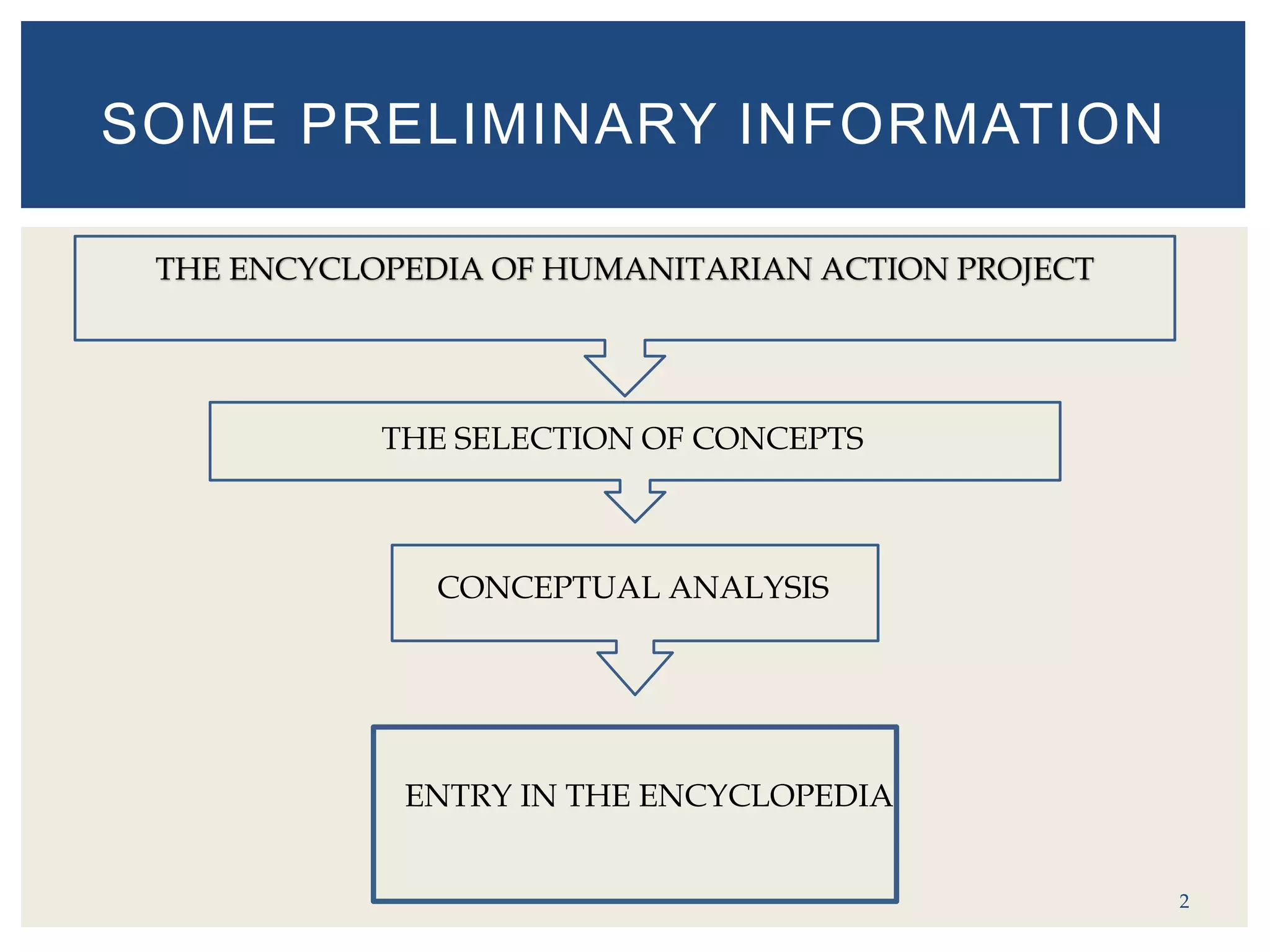
SOME PRELIMINARY INFORMATION
THE ENCYCLOPEDIA OF HUMANITARIAN ACTION PROJECT
THE SELECTION OF CONCEPTS
CONCEPTUAL ANALYSIS
ENTRY IN THE ENCYCLOPEDIA
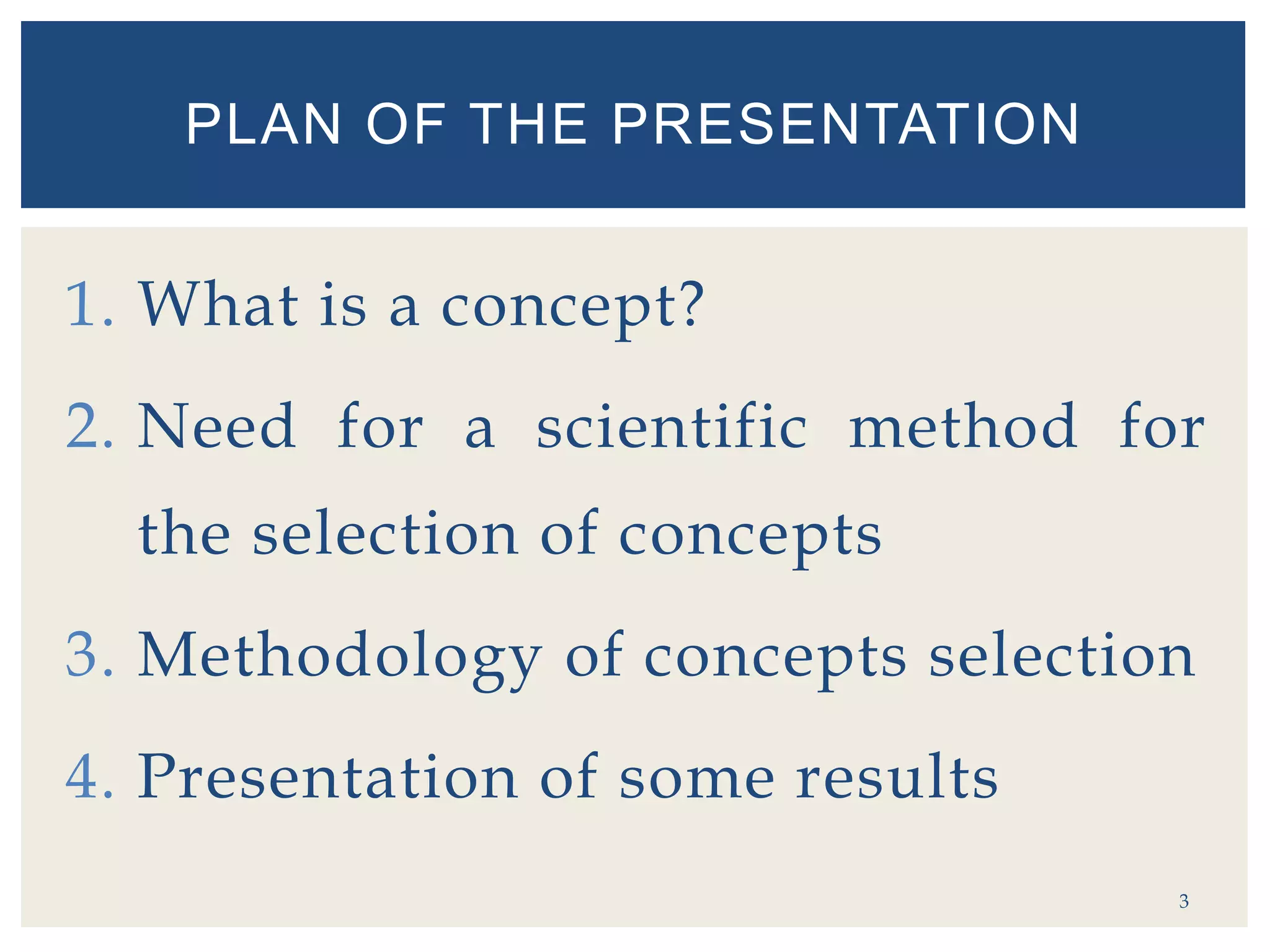
1. What is a concept?
2. Need for a scientific method for
the selection of concepts
3. Methodology of concepts selection
4. Presentation of some results
3
PLAN OF THE PRESENTATION
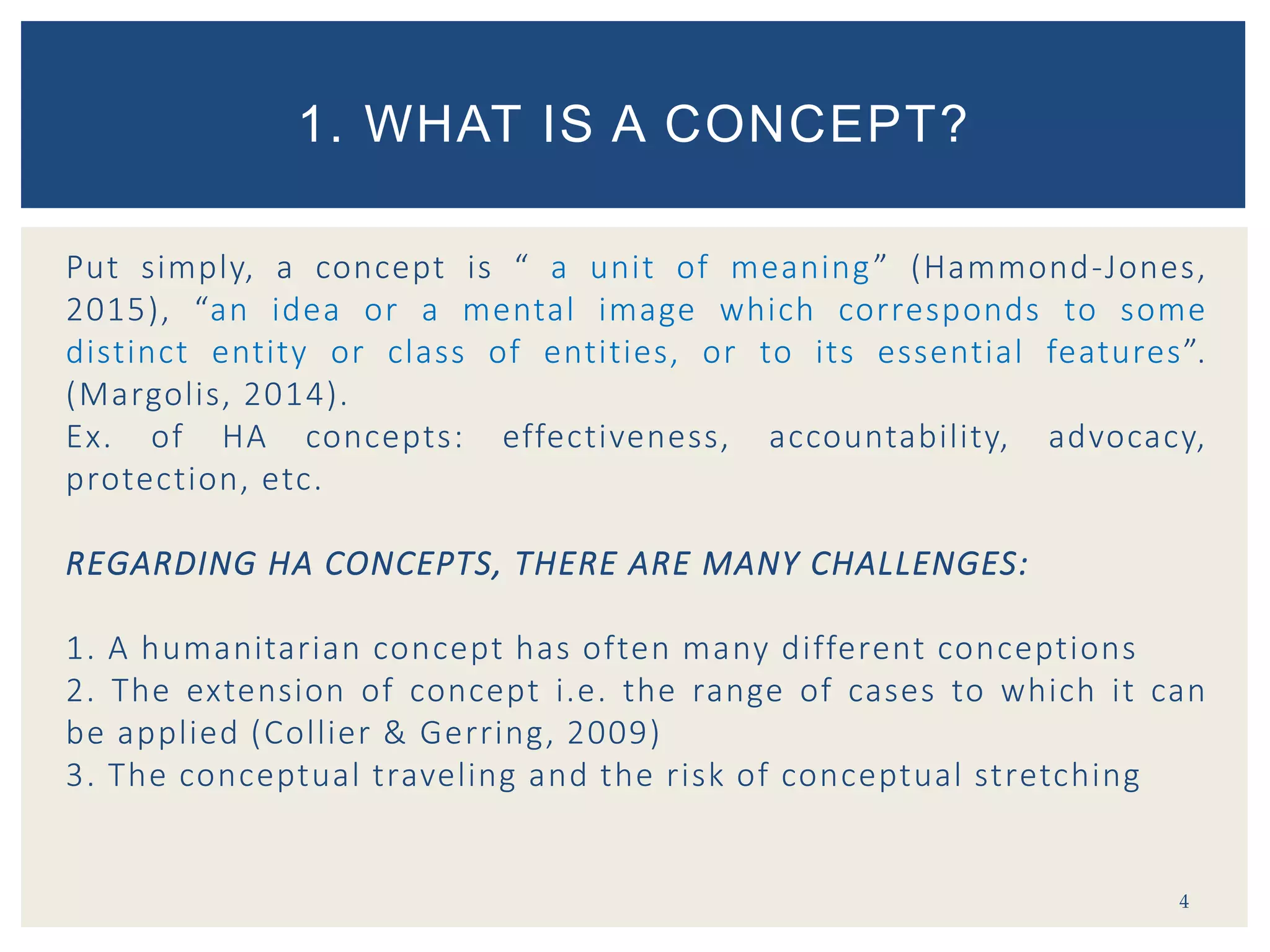
Put simply, a concept is “ a unit of meaning” (Hammond-Jones,
2015), “an idea or a mental image which corresponds to some
distinct entity or class of entities, or to its essential features”.
(Margolis, 2014).
Ex. of HA concepts: effectiveness, accountability, advocacy,
protection, etc.
REGARDING HA CONCEPTS, THERE ARE MANY CHALLENGES:
1. A humanitarian concept has often many different conceptions
2. The extension of concept i.e. the range of cases to which it can
be applied (Collier & Gerring, 2009)
3. The conceptual traveling and the risk of conceptual stretching
4
1. WHAT IS A CONCEPT?
OBSERVATION:
 Amongst the 47 documents reviewed, the selection of concepts
is at best poorly justified and sometimes not justified at all.
››› Intuitive, «arbitrary» selection of concepts BUT the selection of
concepts is in itself a strategic and political choice!
ISSUES:
 The selection of concepts cannot be discussed or criticized
 There is no agreement on key notions
Need for a transparent and scientific method for the selection of
concepts
5
2. NEED FOR A SCIENTIFIC METHOD FOR
THE SELECTION OF CONCEPTS
AIM:
Using a rigorous scientific method for the selection of concepts allowing
us to focus on the main operational terms of today’s humanitarian action.
A TWO STEP PROCESS:
 1st Step: the selection of sources
 2nd Step: the selection of concepts
METHOD OF CONCEPTS SELECTION:
Quantitative content analysis
ADVANTAGES:
 Objective
 Reproducible
 Iterative process 6
3. METHODOLOGY FOR THE
SELECTION OF CONCEPTS
DEFINING CATEGORIES OF SOURCES
→ Guiding principles:
 representativeness of sources regarding the humanitarian system
 operational relevance of selected sources
 accessibility and comparability of sources
SOURCES CONSIDERED:
1. States (departments in charge of the humanitarian policy)
2. NGOs (both international and national NGOs that have as core
mission humanitarian aid)
3. The Red Cross system (including ICRC, IFRC and its national societies)
4. UN agencies and intergovernmental organizations (with humanitarian
aid as primary mission)
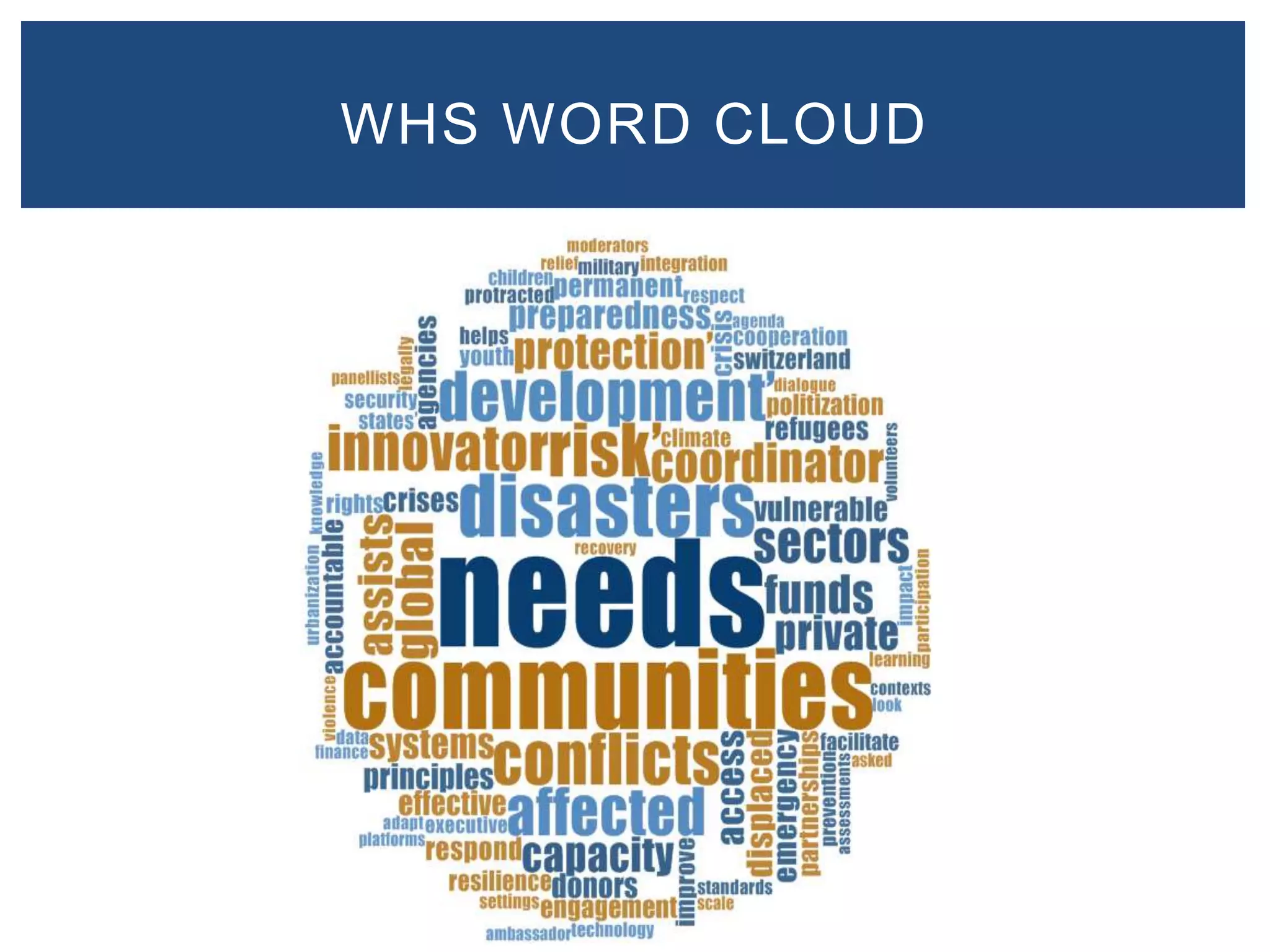
5. WHS (regional consultations reports and global consultation report)
7
1ST STEP: SELECTION OF SOURCES
 Latest humanitarian strategies, strategic plan and/or annual
reports.
 For the WHS, regional consultations reports and the global
consultation report (2014-2015)
8
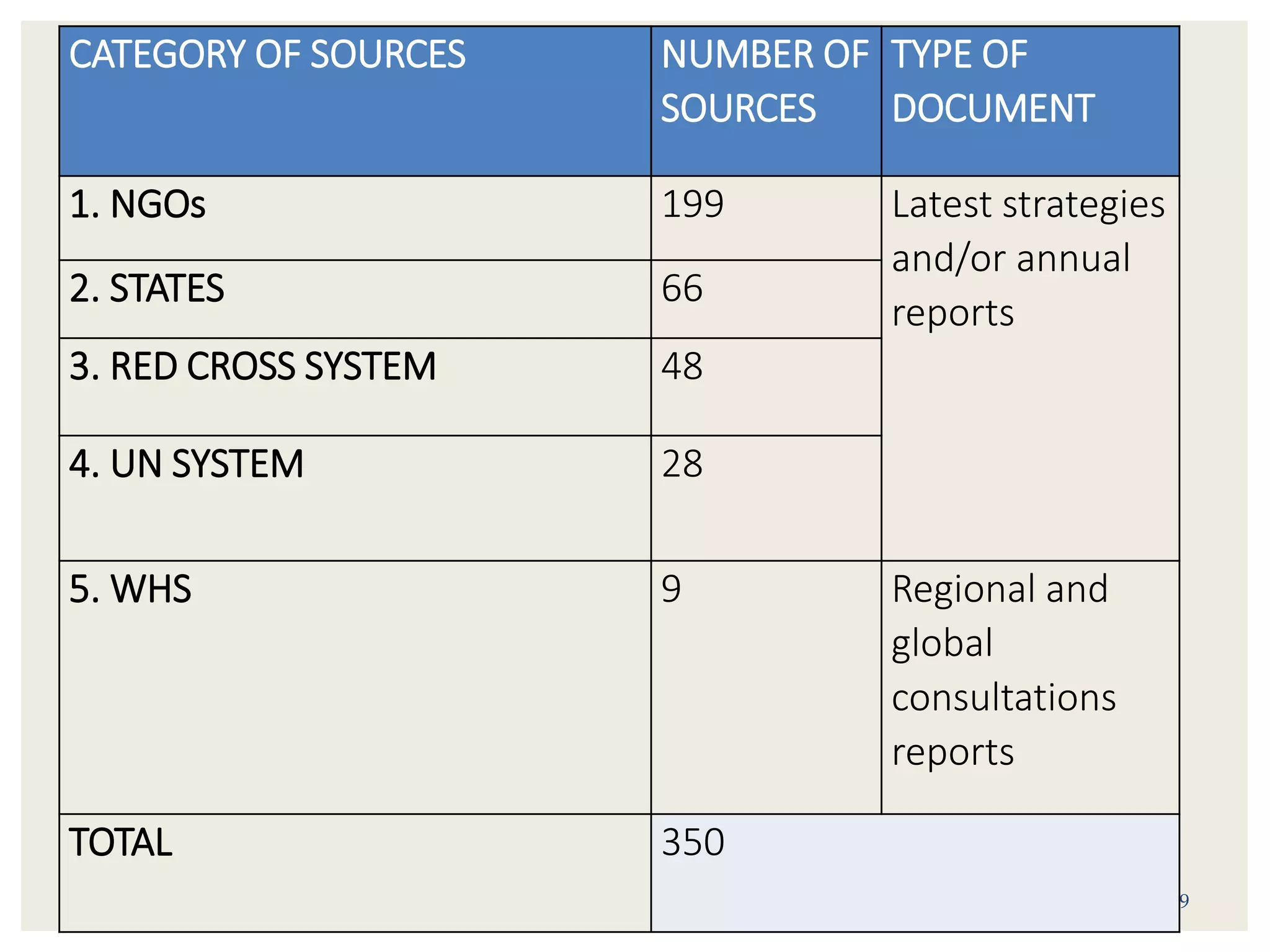
TYPE OF DOCUMENT SELECTED
CATEGORY OF SOURCES NUMBER OF
SOURCES
TYPE OF
DOCUMENT
1. NGOs 199 Latest strategies
and/or annual
reports
2. STATES 66
3. RED CROSS SYSTEM 48
4. UN SYSTEM 28
5. WHS 9 Regional and
global
consultations
reports
TOTAL 350
9
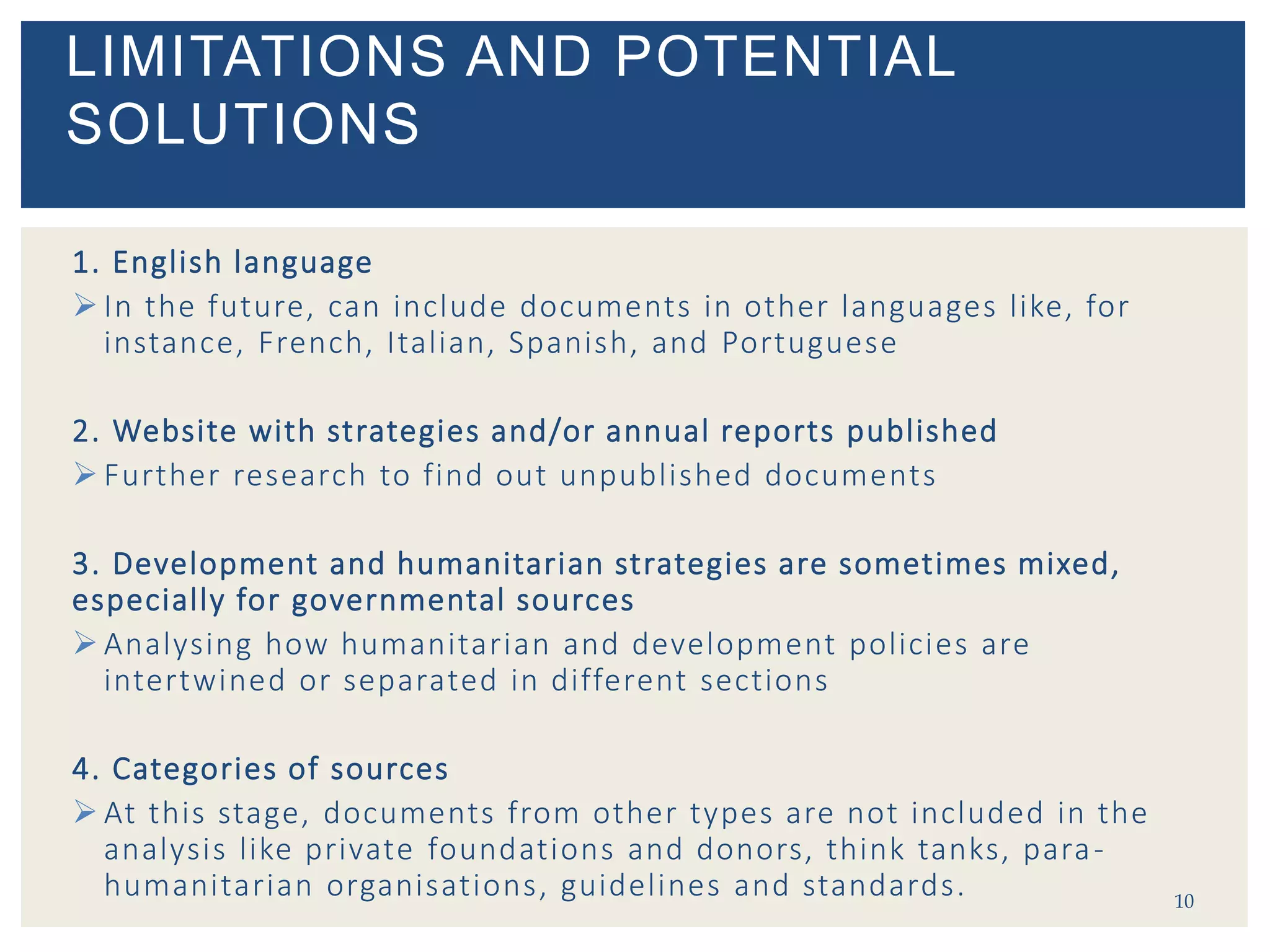
1. English language
 In the future, can include documents in other languages like, for
instance, French, Italian, Spanish, and Portuguese
2. Website with strategies and/or annual reports published
 Further research to find out unpublished documents
3. Development and humanitarian strategies are sometimes mixed,
especially for governmental sources
 Analysing how humanitarian and development policies are
intertwined or separated in different sections
4. Categories of sources
 At this stage, documents from other types are not included in the
analysis like private foundations and donors, think tanks, para-
humanitarian organisations, guidelines and standards. 10
LIMITATIONS AND POTENTIAL
SOLUTIONS
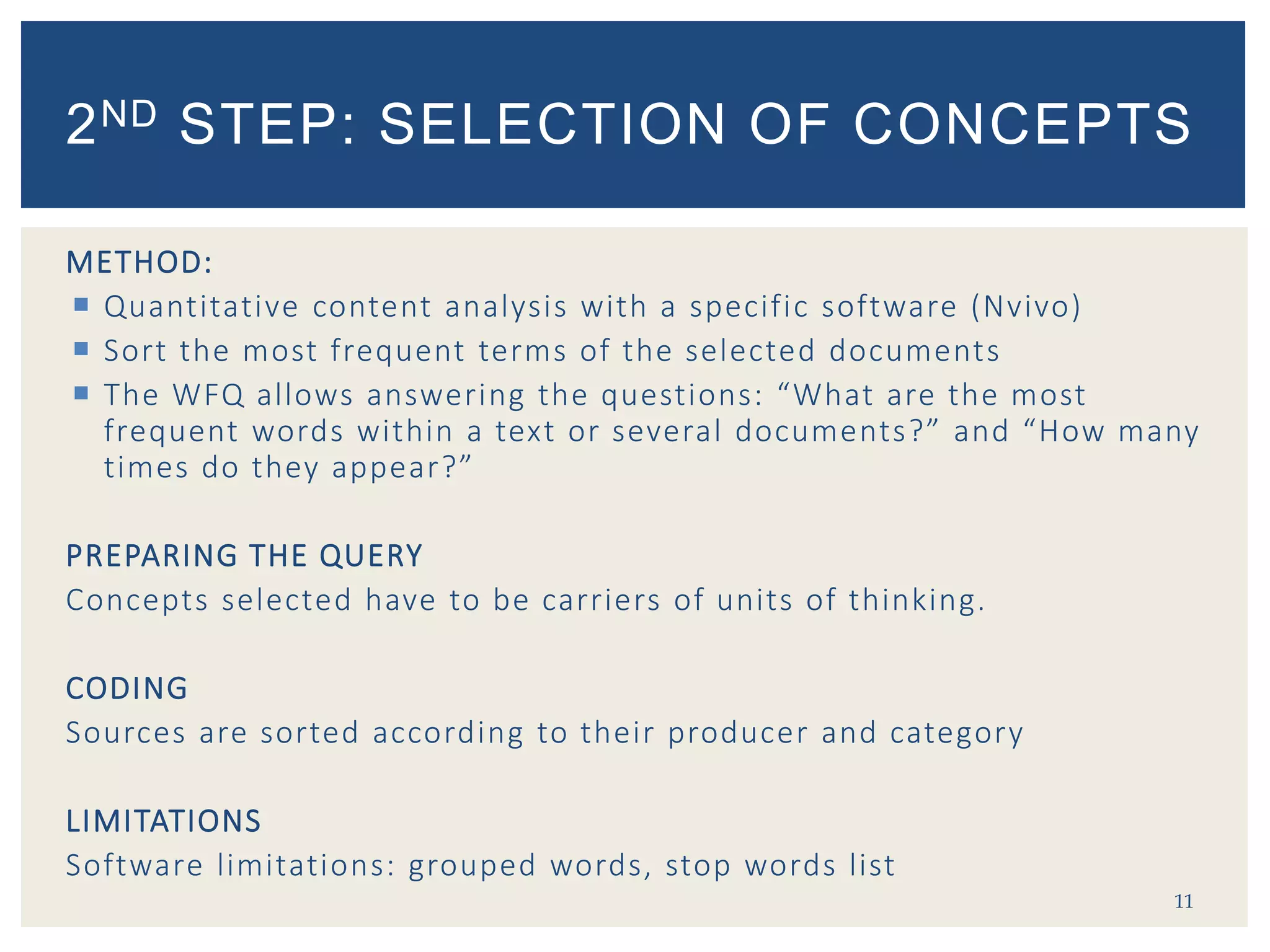
METHOD:
 Quantitative content analysis with a specific software (Nvivo)
 Sort the most frequent terms of the selected documents
 The WFQ allows answering the questions: “What are the most
frequent words within a text or several documents?” and “How many
times do they appear?”
PREPARING THE QUERY
Concepts selected have to be carriers of units of thinking.
CODING
Sources are sorted according to their producer and category
LIMITATIONS
Software limitations: grouped words, stop words list
11
2ND STEP: SELECTION OF CONCEPTS
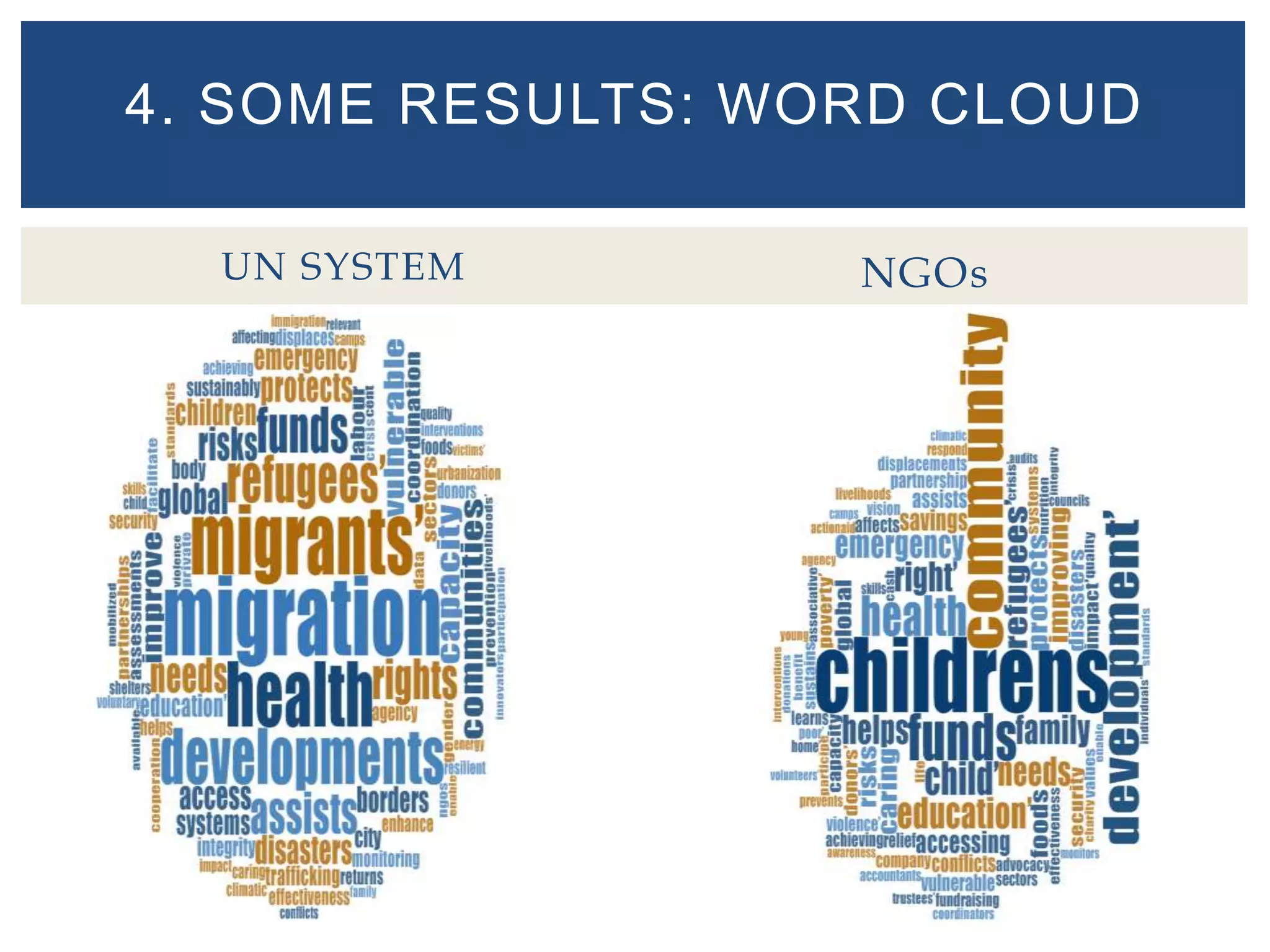
UN SYSTEM NGOs
12
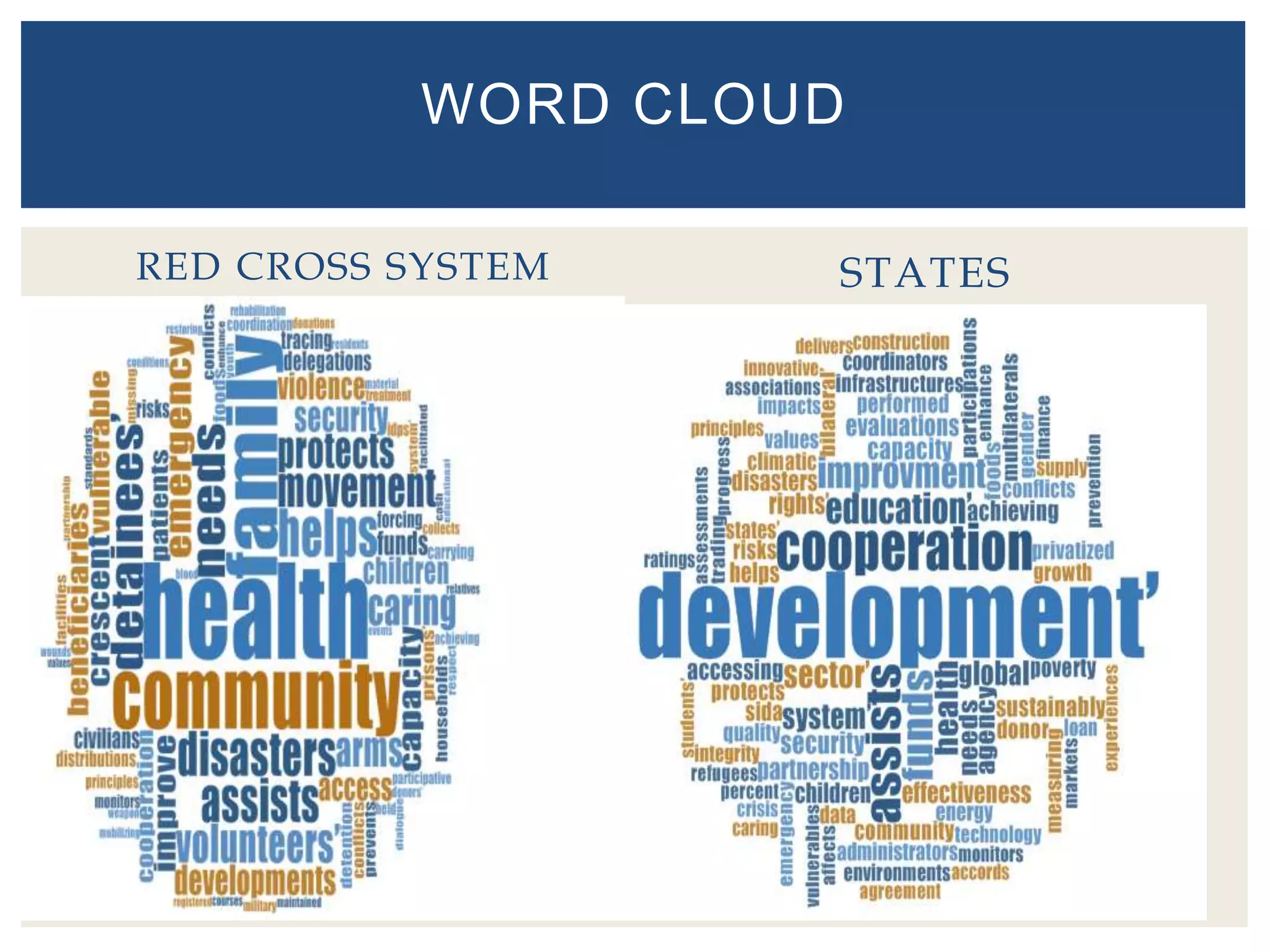
4. SOME RESULTS: WORD CLOUD
RED CROSS SYSTEM STATES
13
WORD CLOUD
14
WHS WORD CLOUD
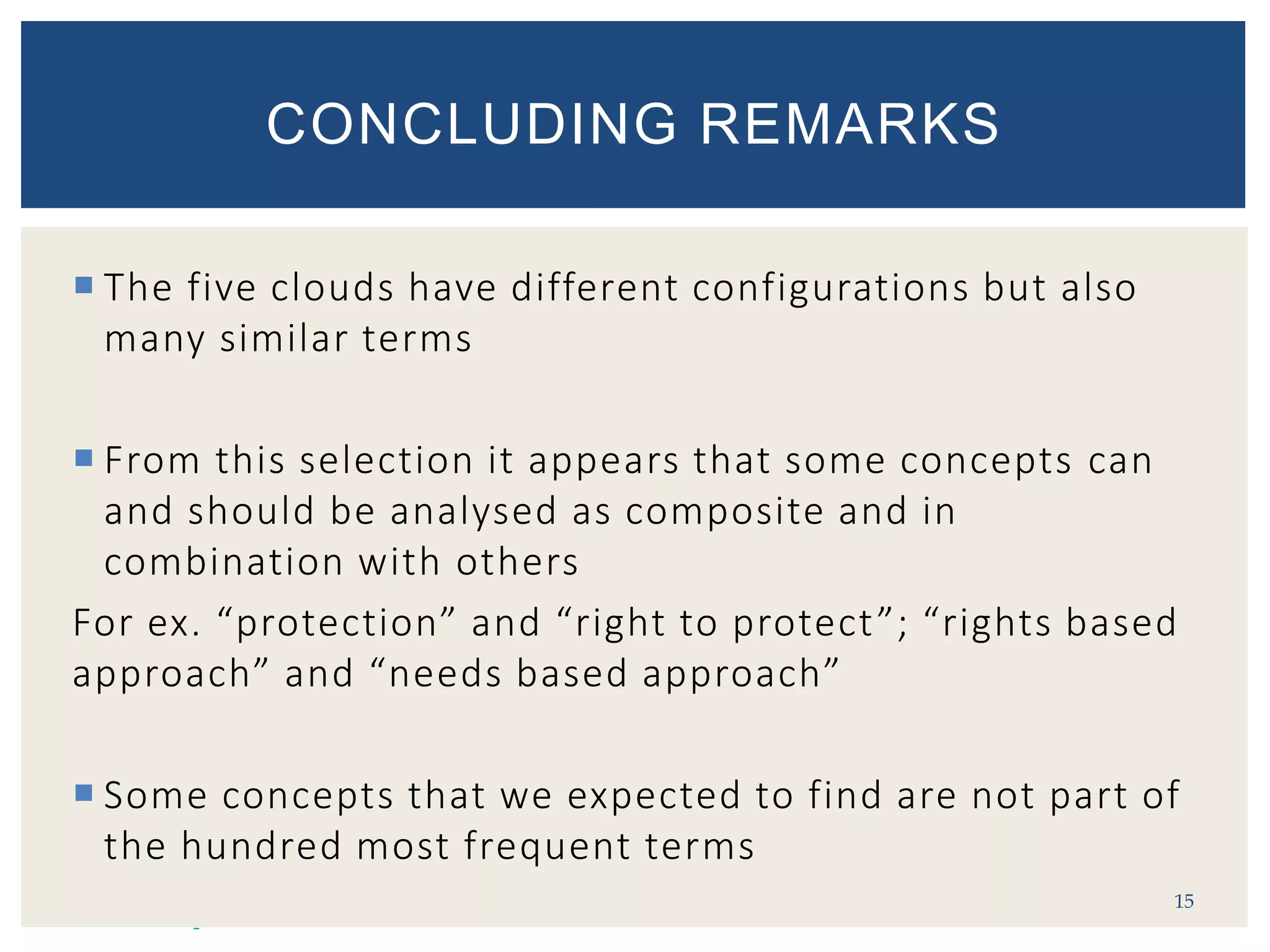
 The five clouds have different configurations but also
many similar terms
 From this selection it appears that some concepts can
and should be analysed as composite and in
combination with others
For ex. “protection” and “right to protect”; “rights based
approach” and “needs based approach”
 Some concepts that we expected to find are not part of
the hundred most frequent terms
-
15
CONCLUDING REMARKS
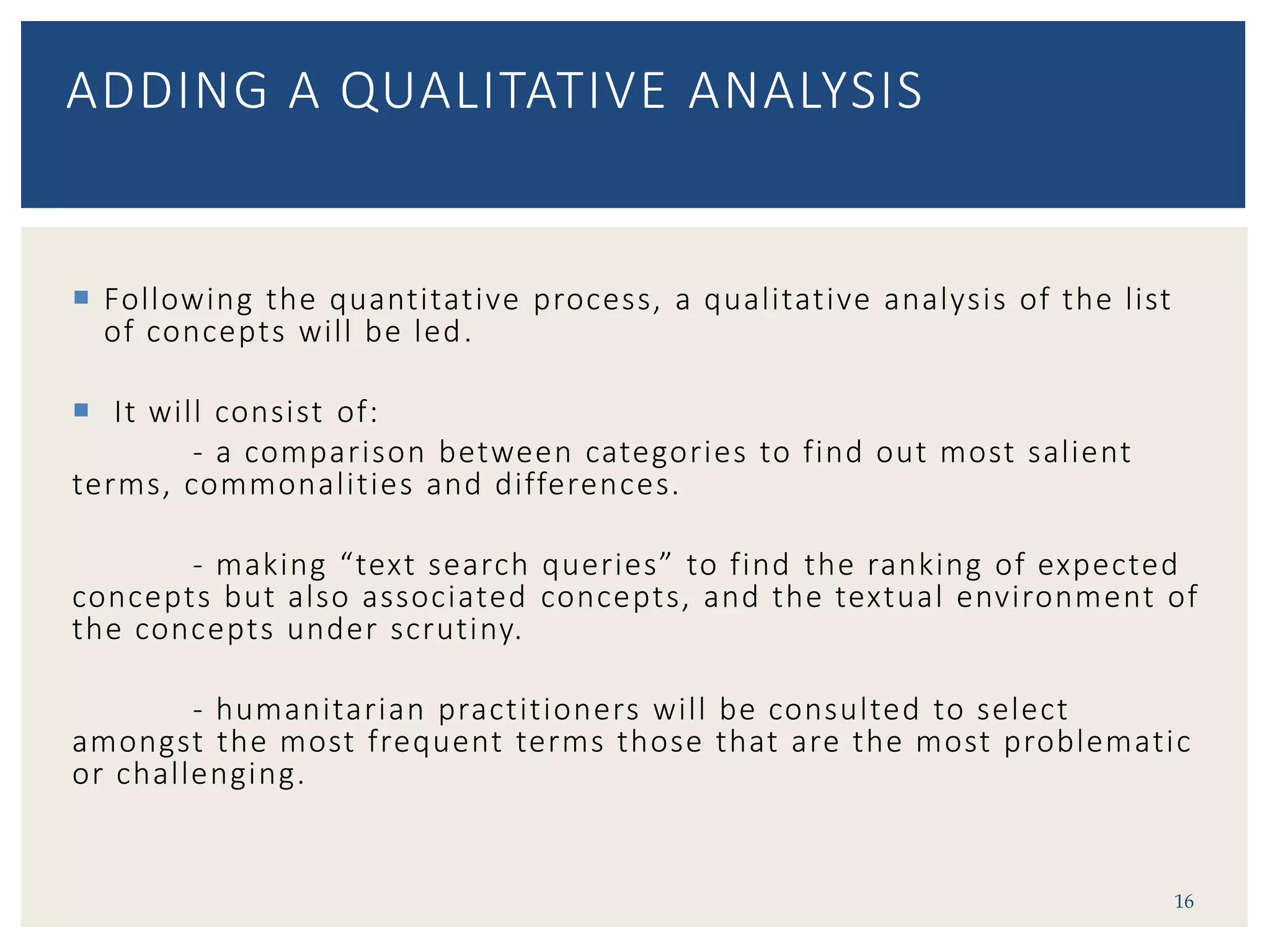
 Following the quantitative process, a qualitative analysis of the list
of concepts will be led.
 It will consist of:
- a comparison between categories to find out most salient
terms, commonalities and differences.
- making “text search queries” to find the ranking of expected
concepts but also associated concepts, and the textual environment of
the concepts under scrutiny.
- humanitarian practitioners will be consulted to select
amongst the most frequent terms those that are the most problematic
or challenging.
16
ADDING A QUALITATIVE ANALYSIS
17
THANK YOU

Towards a conceptual framework of humanitarian action

  • 1.
    Dr Elisabeth Meur WCHS,Addis Abeba 6-03-2016 Panel The Role of Academia in the Humanitarian Sector 1 THE SELECTION OF CONCEPTS FOR THE ENCYCLOPEDIA OF HUMANITARIAN ACTION PROJECT: A CONTENT ANALYSIS OF HUMANITARIAN STRATEGIES AND REPORTS
  • 2.
    2 SOME PRELIMINARY INFORMATION THEENCYCLOPEDIA OF HUMANITARIAN ACTION PROJECT THE SELECTION OF CONCEPTS CONCEPTUAL ANALYSIS ENTRY IN THE ENCYCLOPEDIA
  • 3.
    1. What isa concept? 2. Need for a scientific method for the selection of concepts 3. Methodology of concepts selection 4. Presentation of some results 3 PLAN OF THE PRESENTATION
  • 4.
    Put simply, aconcept is “ a unit of meaning” (Hammond-Jones, 2015), “an idea or a mental image which corresponds to some distinct entity or class of entities, or to its essential features”. (Margolis, 2014). Ex. of HA concepts: effectiveness, accountability, advocacy, protection, etc. REGARDING HA CONCEPTS, THERE ARE MANY CHALLENGES: 1. A humanitarian concept has often many different conceptions 2. The extension of concept i.e. the range of cases to which it can be applied (Collier & Gerring, 2009) 3. The conceptual traveling and the risk of conceptual stretching 4 1. WHAT IS A CONCEPT?
  • 5.
    OBSERVATION:  Amongst the47 documents reviewed, the selection of concepts is at best poorly justified and sometimes not justified at all. ››› Intuitive, «arbitrary» selection of concepts BUT the selection of concepts is in itself a strategic and political choice! ISSUES:  The selection of concepts cannot be discussed or criticized  There is no agreement on key notions Need for a transparent and scientific method for the selection of concepts 5 2. NEED FOR A SCIENTIFIC METHOD FOR THE SELECTION OF CONCEPTS
  • 6.
    AIM: Using a rigorousscientific method for the selection of concepts allowing us to focus on the main operational terms of today’s humanitarian action. A TWO STEP PROCESS:  1st Step: the selection of sources  2nd Step: the selection of concepts METHOD OF CONCEPTS SELECTION: Quantitative content analysis ADVANTAGES:  Objective  Reproducible  Iterative process 6 3. METHODOLOGY FOR THE SELECTION OF CONCEPTS
  • 7.
    DEFINING CATEGORIES OFSOURCES → Guiding principles:  representativeness of sources regarding the humanitarian system  operational relevance of selected sources  accessibility and comparability of sources SOURCES CONSIDERED: 1. States (departments in charge of the humanitarian policy) 2. NGOs (both international and national NGOs that have as core mission humanitarian aid) 3. The Red Cross system (including ICRC, IFRC and its national societies) 4. UN agencies and intergovernmental organizations (with humanitarian aid as primary mission) 5. WHS (regional consultations reports and global consultation report) 7 1ST STEP: SELECTION OF SOURCES
  • 8.
     Latest humanitarianstrategies, strategic plan and/or annual reports.  For the WHS, regional consultations reports and the global consultation report (2014-2015) 8 TYPE OF DOCUMENT SELECTED
  • 9.
    CATEGORY OF SOURCESNUMBER OF SOURCES TYPE OF DOCUMENT 1. NGOs 199 Latest strategies and/or annual reports 2. STATES 66 3. RED CROSS SYSTEM 48 4. UN SYSTEM 28 5. WHS 9 Regional and global consultations reports TOTAL 350 9
  • 10.
    1. English language In the future, can include documents in other languages like, for instance, French, Italian, Spanish, and Portuguese 2. Website with strategies and/or annual reports published  Further research to find out unpublished documents 3. Development and humanitarian strategies are sometimes mixed, especially for governmental sources  Analysing how humanitarian and development policies are intertwined or separated in different sections 4. Categories of sources  At this stage, documents from other types are not included in the analysis like private foundations and donors, think tanks, para- humanitarian organisations, guidelines and standards. 10 LIMITATIONS AND POTENTIAL SOLUTIONS
  • 11.
    METHOD:  Quantitative contentanalysis with a specific software (Nvivo)  Sort the most frequent terms of the selected documents  The WFQ allows answering the questions: “What are the most frequent words within a text or several documents?” and “How many times do they appear?” PREPARING THE QUERY Concepts selected have to be carriers of units of thinking. CODING Sources are sorted according to their producer and category LIMITATIONS Software limitations: grouped words, stop words list 11 2ND STEP: SELECTION OF CONCEPTS
  • 12.
    UN SYSTEM NGOs 12 4.SOME RESULTS: WORD CLOUD
  • 13.
    RED CROSS SYSTEMSTATES 13 WORD CLOUD
  • 14.
  • 15.
     The fiveclouds have different configurations but also many similar terms  From this selection it appears that some concepts can and should be analysed as composite and in combination with others For ex. “protection” and “right to protect”; “rights based approach” and “needs based approach”  Some concepts that we expected to find are not part of the hundred most frequent terms - 15 CONCLUDING REMARKS
  • 16.
     Following thequantitative process, a qualitative analysis of the list of concepts will be led.  It will consist of: - a comparison between categories to find out most salient terms, commonalities and differences. - making “text search queries” to find the ranking of expected concepts but also associated concepts, and the textual environment of the concepts under scrutiny. - humanitarian practitioners will be consulted to select amongst the most frequent terms those that are the most problematic or challenging. 16 ADDING A QUALITATIVE ANALYSIS
  • 17.