2016 Information Session
 This presentation was prepared by the ICoCA
Secretariat to inform Members about the
proposed Procedures and their implications,
ahead of the 2016 General Assembly.
 The presentation was delivered via a series of
webinars and in person to Industry groups.
 Participants were encouraged to ask questions;
the discussion is summarized on the ICoCA
website.
 ICoCA Members will be asked to vote on these
procedures at the Assembly, on 29 September.
Specific
principles
regarding
conduct of
personnel
Specific
commitments
regarding
company
management
Independent
governance
and oversight
mechanism:
ICoCA
 Multi-stakeholder initiative
◦ 3 pillars: government, civil society,
industry
◦ 12 Board members
◦ General Assembly
◦ Secretariat in Geneva
“The Association shall be responsible
for certifying under the Code that a
company’s systems and policies meet
the Code’s principles and the
standards derived from the Code and
that a company is undergoing
monitoring, auditing, and verification,
including in the field.”
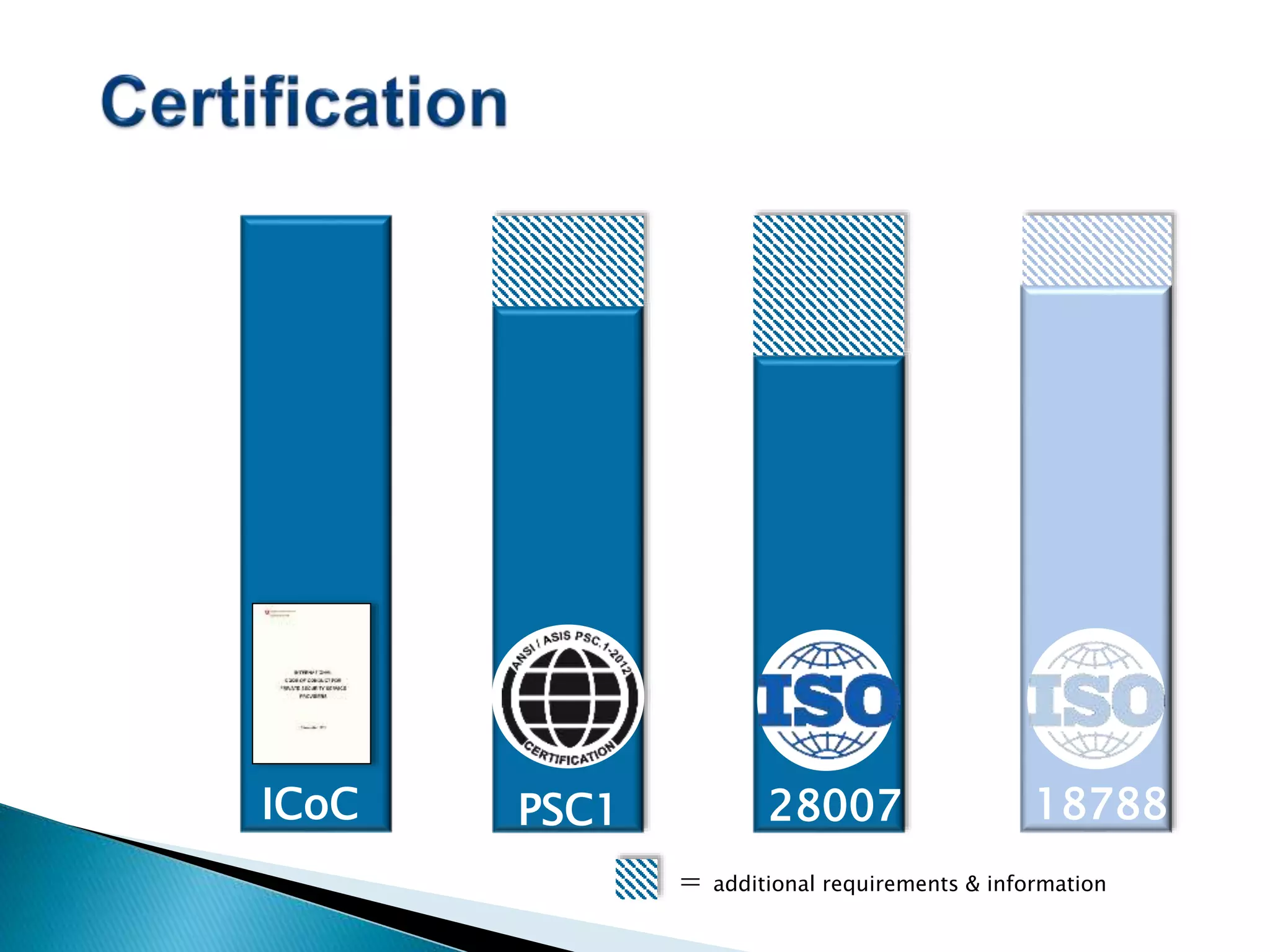
PSC1 28007 18788
= additional requirements & information
ICoC
“…companies who have obtained
third-party certification to a
Board-recognized standard are
encouraged to seek ICoCA
Certification by submitting proof
of their 3rd party certification and
their additional information
packages to the Secretariat. ”
 ICoCA Certification for all Members
◦ Extension of deadline to 2018
 Increased oversight of and transparency with
certification bodies regarding the Code
◦ Training & guidance
◦ Recognition of certification bodies
 Pilot on accessibility to ICoCA Certification
 Proposed amendments to Certification
Procedure
SecretariatCertification
reports
Public
sources
Civil society
Affected
communities
Governments
Member
companies
Clients
Submitted
complaints
Secretariat:
Oversees annual
company self-
assessment
Member company:
Completes and
submits self-
assessment report
Secretariat:
Identifies potential
compliance concerns
and engages in a
dialogue
Member company:
Implements corrective
measures
 Annual
 Electronic
 Secure & confidential
 Qualitative
 Starting early 2017
1
Identified need
•Based on
information
collected
•Requested by a
Member
2
Regular plan for
field-based reviews
OR
immediate field-
based review
•Initiated by the
Executive Director
•Submitted to
Monitoring
Committee for
consultation
•Implemented
unless the Board
decides otherwise
•Conducted by the
Secretariat
•Based on standard
planning and
operating process
ICoCA
Secretariat
Member
company
 addressing compliance concerns
 improving performance
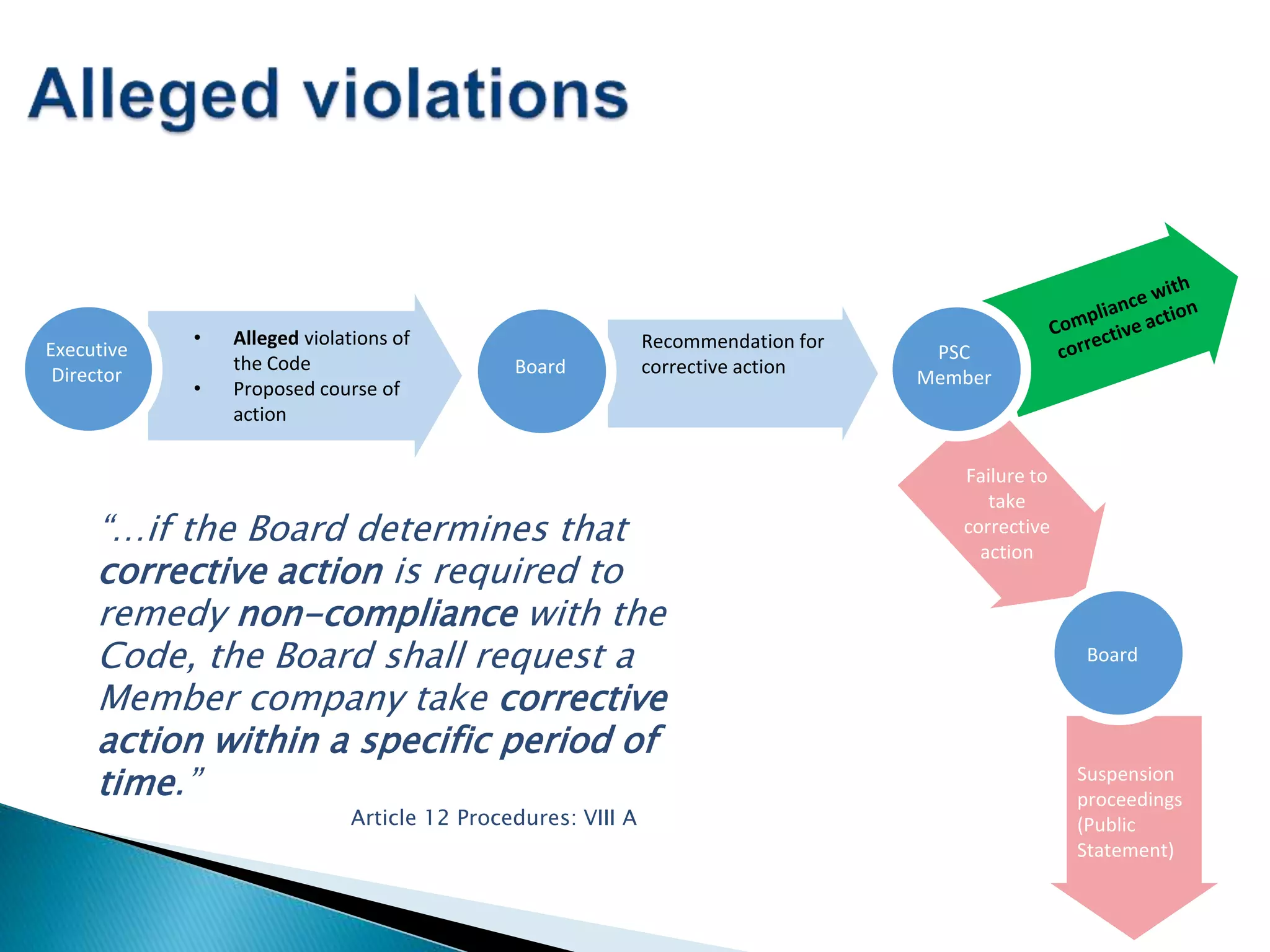
Recommendation for
corrective actionBoard
Executive
Director
Failure to
take
corrective
action
PSC
Member
Board
• Alleged violations of
the Code
• Proposed course of
action
Suspension
proceedings
(Public
Statement)
“…if the Board determines that
corrective action is required to
remedy non-compliance with the
Code, the Board shall request a
Member company take corrective
action within a specific period of
time.”
Article 12 Procedures: VIII A
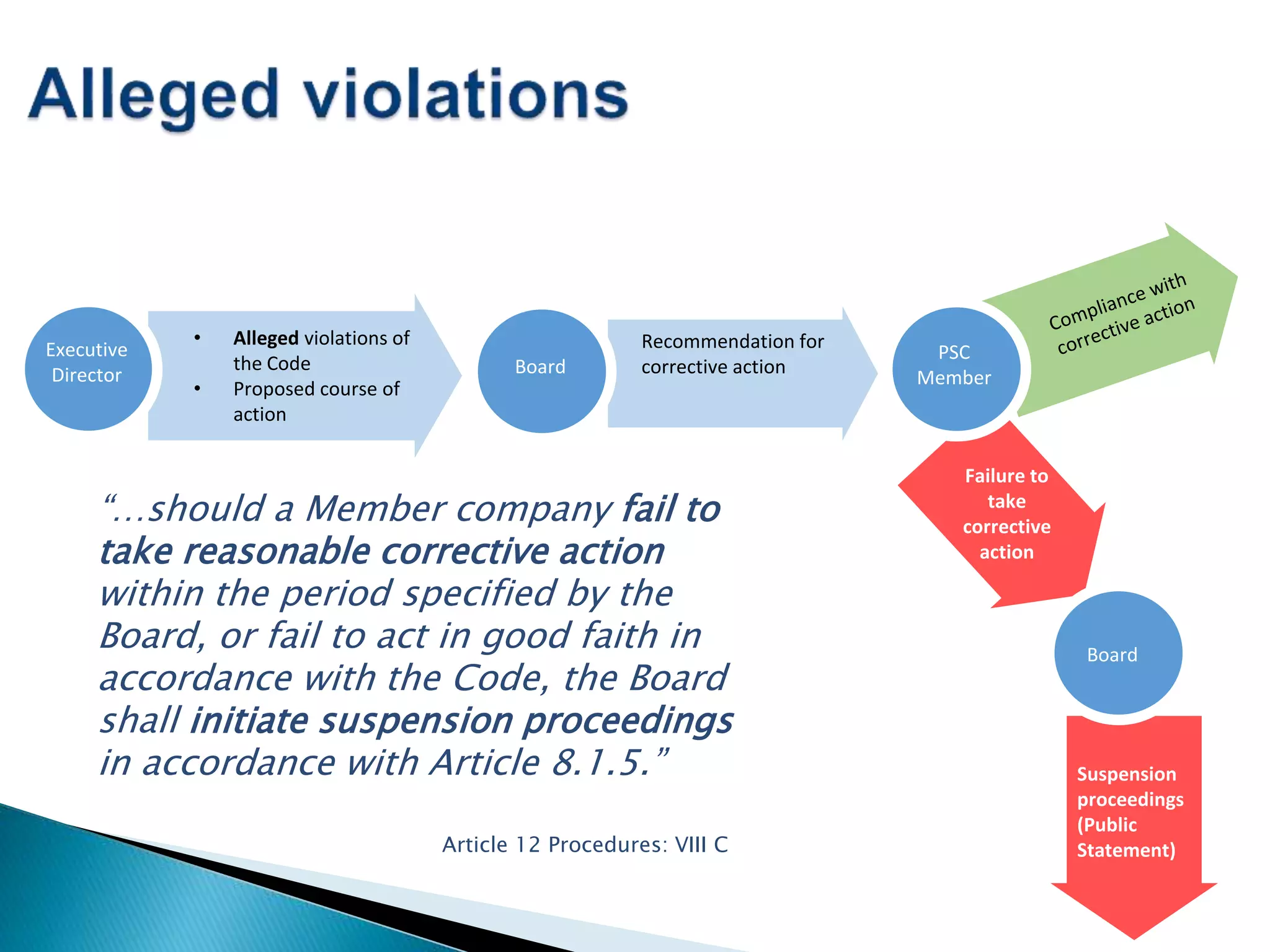
“…should a Member company fail to
take reasonable corrective action
within the period specified by the
Board, or fail to act in good faith in
accordance with the Code, the Board
shall initiate suspension proceedings
in accordance with Article 8.1.5.”
Article 12 Procedures: VIII C
Recommendation for
corrective actionBoard
Executive
Director
Failure to
take
corrective
action
PSC
Member
Board
• Alleged violations of
the Code
• Proposed course of
action
Suspension
proceedings
(Public
Statement)
 Company self-assessment reporting starting
in early 2017
 Building a monitoring network
 Feedback to Members
Support
development of
effective company
grievance
processes
Address and
support access to
remedy
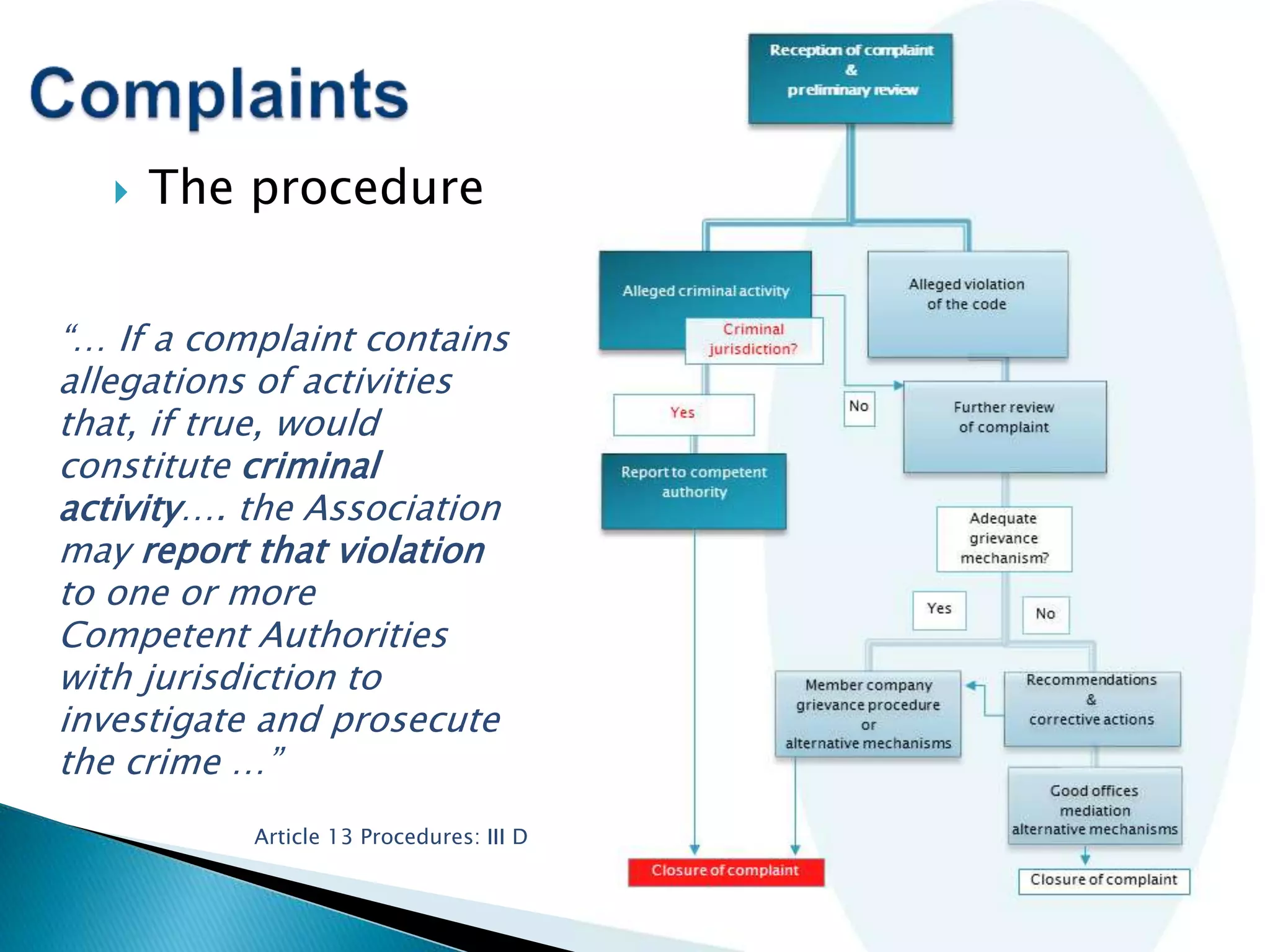
 The procedure
“… If a complaint contains
allegations of activities
that, if true, would
constitute criminal
activity…. the Association
may report that violation
to one or more
Competent Authorities
with jurisdiction to
investigate and prosecute
the crime …”
Article 13 Procedures: III D
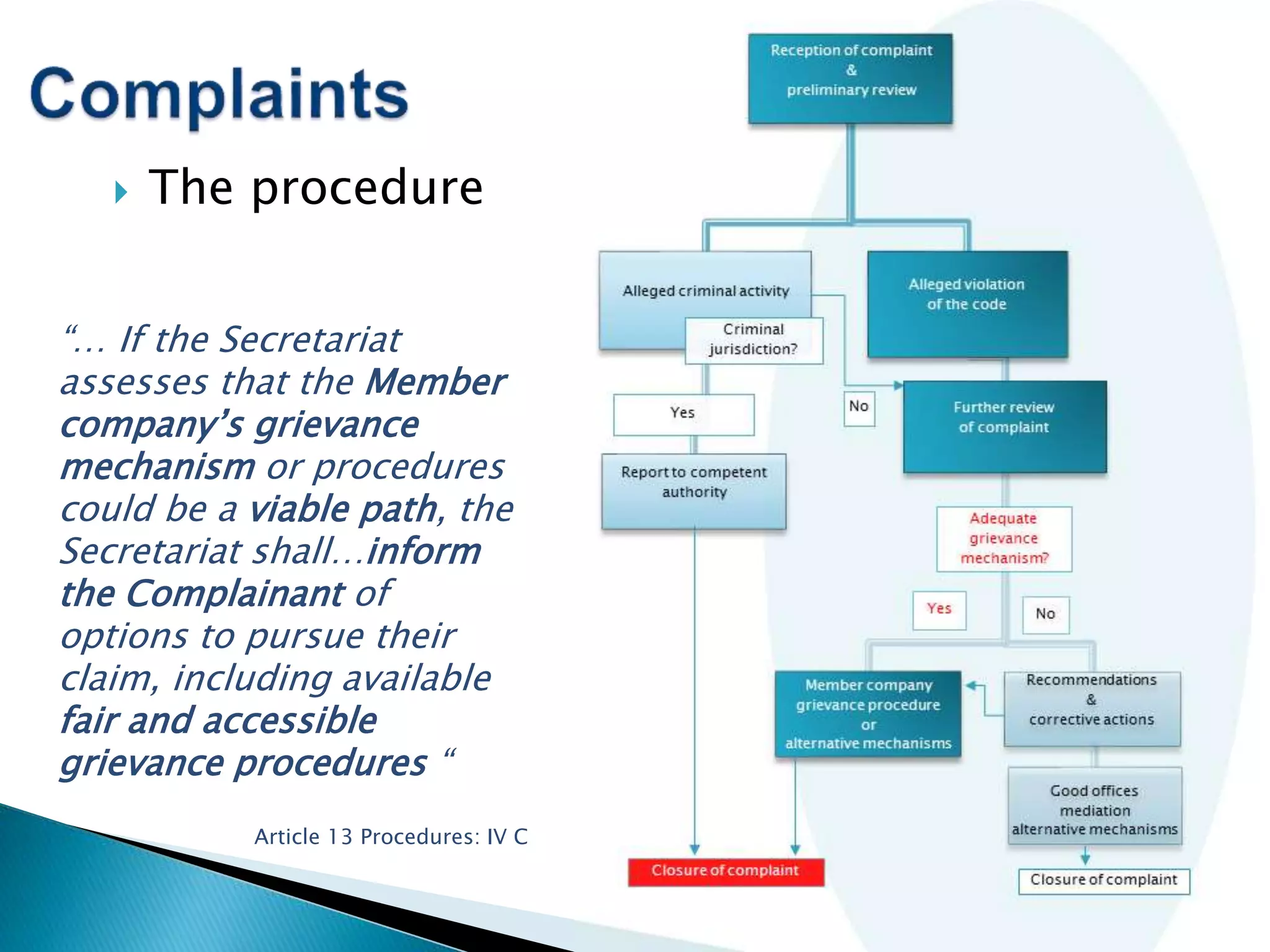
 The procedure
“… If the Secretariat
assesses that the Member
company’s grievance
mechanism or procedures
could be a viable path, the
Secretariat shall…inform
the Complainant of
options to pursue their
claim, including available
fair and accessible
grievance procedures “
Article 13 Procedures: IV C
 The procedure
“… [if] a company’s
grievance mechanism
does not meet the
requirements… or that
good reason exists why
the complaint is
inappropriate to be
handled by a company-
level grievance
procedure…”
Article 13 Procedures: IV D
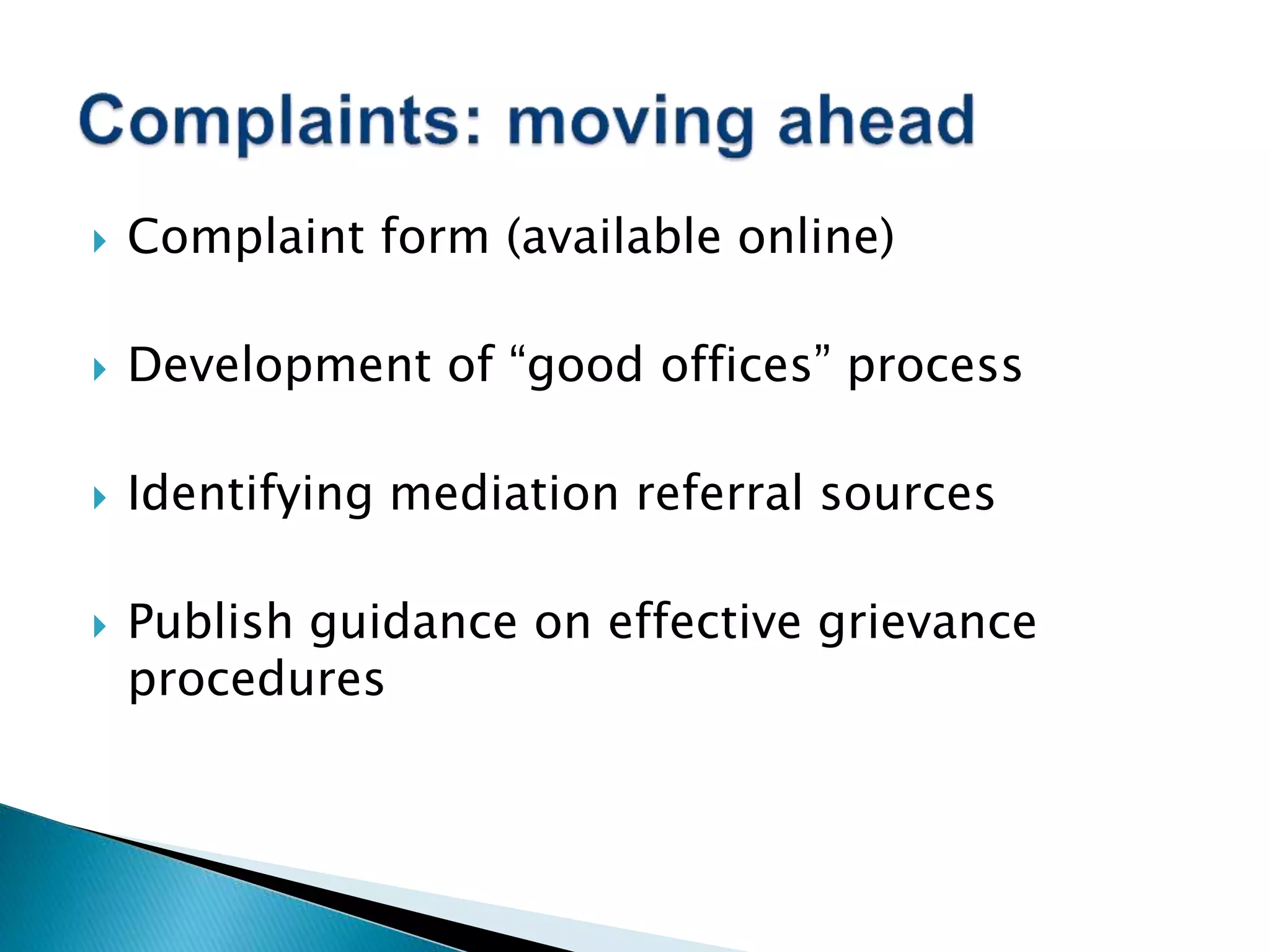
 Complaint form (available online)
 Development of “good offices” process
 Identifying mediation referral sources
 Publish guidance on effective grievance
procedures
 2016 AGA
 Implement certification
 Implement monitoring
◦ Self-assessment reporting starting in early 2017
◦ Building a monitoring network
◦ Feedback to Members
 Implement complaints process
 Promotion of ICoCA value
◦ Clients
◦ Governments
Questions?
www.icoca.ch

ICoCA Information Session 2016

  • 1.
  • 2.
     This presentationwas prepared by the ICoCA Secretariat to inform Members about the proposed Procedures and their implications, ahead of the 2016 General Assembly.  The presentation was delivered via a series of webinars and in person to Industry groups.  Participants were encouraged to ask questions; the discussion is summarized on the ICoCA website.  ICoCA Members will be asked to vote on these procedures at the Assembly, on 29 September.
  • 3.
  • 4.
     Multi-stakeholder initiative ◦3 pillars: government, civil society, industry ◦ 12 Board members ◦ General Assembly ◦ Secretariat in Geneva
  • 13.
    “The Association shallbe responsible for certifying under the Code that a company’s systems and policies meet the Code’s principles and the standards derived from the Code and that a company is undergoing monitoring, auditing, and verification, including in the field.”
  • 14.
    PSC1 28007 18788 =additional requirements & information ICoC
  • 15.
    “…companies who haveobtained third-party certification to a Board-recognized standard are encouraged to seek ICoCA Certification by submitting proof of their 3rd party certification and their additional information packages to the Secretariat. ”
  • 16.
     ICoCA Certificationfor all Members ◦ Extension of deadline to 2018  Increased oversight of and transparency with certification bodies regarding the Code ◦ Training & guidance ◦ Recognition of certification bodies  Pilot on accessibility to ICoCA Certification  Proposed amendments to Certification Procedure
  • 19.
  • 21.
    Secretariat: Oversees annual company self- assessment Membercompany: Completes and submits self- assessment report Secretariat: Identifies potential compliance concerns and engages in a dialogue Member company: Implements corrective measures  Annual  Electronic  Secure & confidential  Qualitative  Starting early 2017
  • 23.
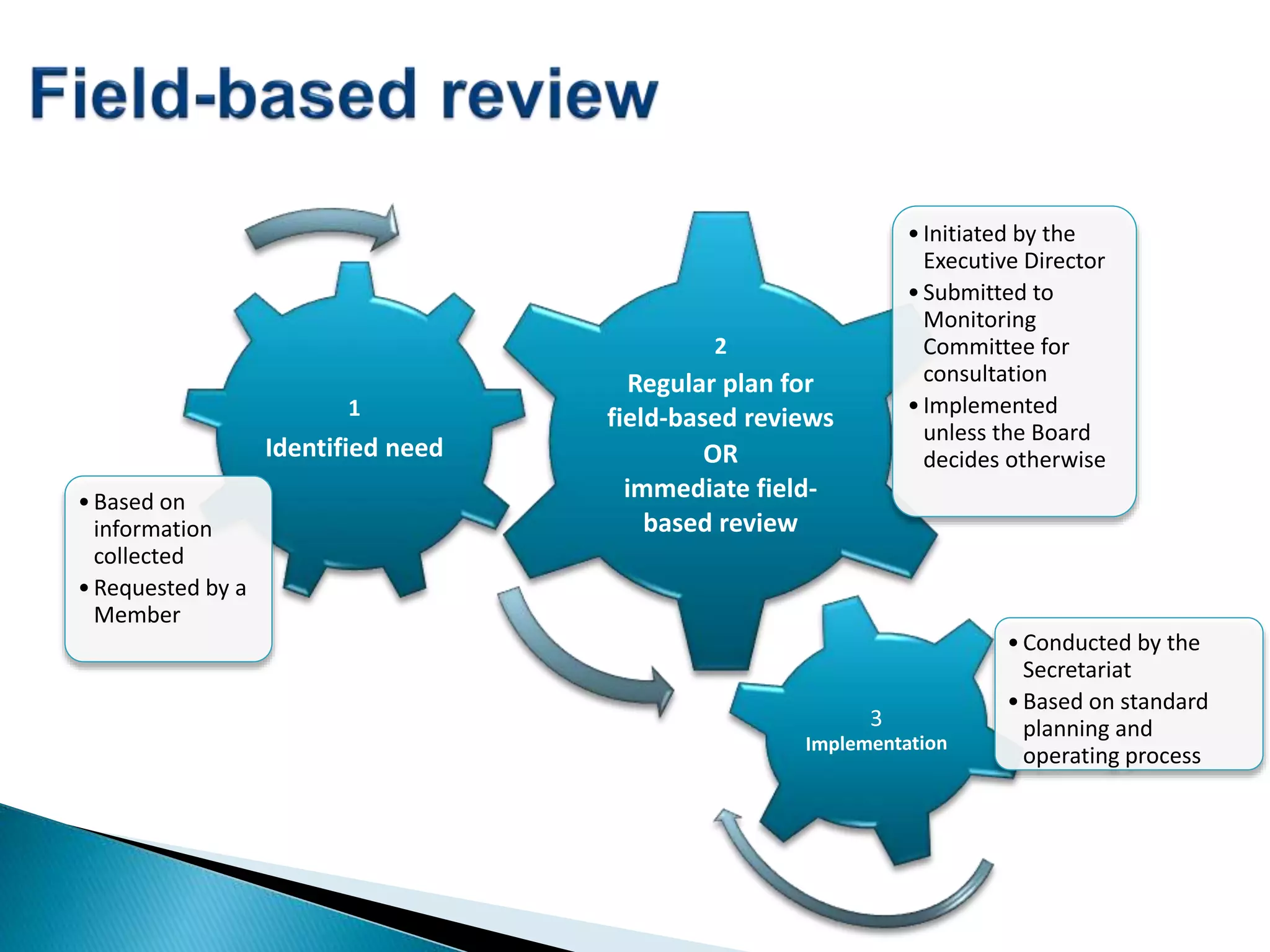
    1 Identified need •Based on information collected •Requestedby a Member 2 Regular plan for field-based reviews OR immediate field- based review •Initiated by the Executive Director •Submitted to Monitoring Committee for consultation •Implemented unless the Board decides otherwise •Conducted by the Secretariat •Based on standard planning and operating process
  • 25.
  • 26.
    Recommendation for corrective actionBoard Executive Director Failureto take corrective action PSC Member Board • Alleged violations of the Code • Proposed course of action Suspension proceedings (Public Statement) “…if the Board determines that corrective action is required to remedy non-compliance with the Code, the Board shall request a Member company take corrective action within a specific period of time.” Article 12 Procedures: VIII A
  • 27.
    “…should a Membercompany fail to take reasonable corrective action within the period specified by the Board, or fail to act in good faith in accordance with the Code, the Board shall initiate suspension proceedings in accordance with Article 8.1.5.” Article 12 Procedures: VIII C Recommendation for corrective actionBoard Executive Director Failure to take corrective action PSC Member Board • Alleged violations of the Code • Proposed course of action Suspension proceedings (Public Statement)
  • 28.
     Company self-assessmentreporting starting in early 2017  Building a monitoring network  Feedback to Members
  • 30.
  • 31.
     The procedure “…If a complaint contains allegations of activities that, if true, would constitute criminal activity…. the Association may report that violation to one or more Competent Authorities with jurisdiction to investigate and prosecute the crime …” Article 13 Procedures: III D
  • 32.
     The procedure “…If the Secretariat assesses that the Member company’s grievance mechanism or procedures could be a viable path, the Secretariat shall…inform the Complainant of options to pursue their claim, including available fair and accessible grievance procedures “ Article 13 Procedures: IV C
  • 33.
     The procedure “…[if] a company’s grievance mechanism does not meet the requirements… or that good reason exists why the complaint is inappropriate to be handled by a company- level grievance procedure…” Article 13 Procedures: IV D
  • 34.
     Complaint form(available online)  Development of “good offices” process  Identifying mediation referral sources  Publish guidance on effective grievance procedures
  • 35.
     2016 AGA Implement certification  Implement monitoring ◦ Self-assessment reporting starting in early 2017 ◦ Building a monitoring network ◦ Feedback to Members  Implement complaints process  Promotion of ICoCA value ◦ Clients ◦ Governments
  • 36.

Editor's Notes

  • #4 The International Code of Conduct for Private Security Providers (ICoC) was developed in 2010, resulting from a multi-stakeholder process launched by Switzerland. The code sets out specific principles: regarding the conduct of personnel, Human Rights, international humanitarian law commitments. Specific commitments: regarding management of personnel. The Code called for creation of an independent governance and oversight mechanism .
  • #5 Multi-stakeholder governance and oversight mechanism for the ICoC Members are: Private Security Service Providers Civil Society Organizations (CSOs) Governments ICoCA also places an emphasis on the role of Observers (e.g., non-state corporate and NGO clients, academics, others) ICoCA established via adoption of Articles of Association in September 2013 Swiss non-profit association Mandate is to administer, implement, maintain, and enforce the ICoC Funded by industry dues and government contributions Multi-stakeholder, 12-member Board of Directors, equal representation from the 3 pillars of membership
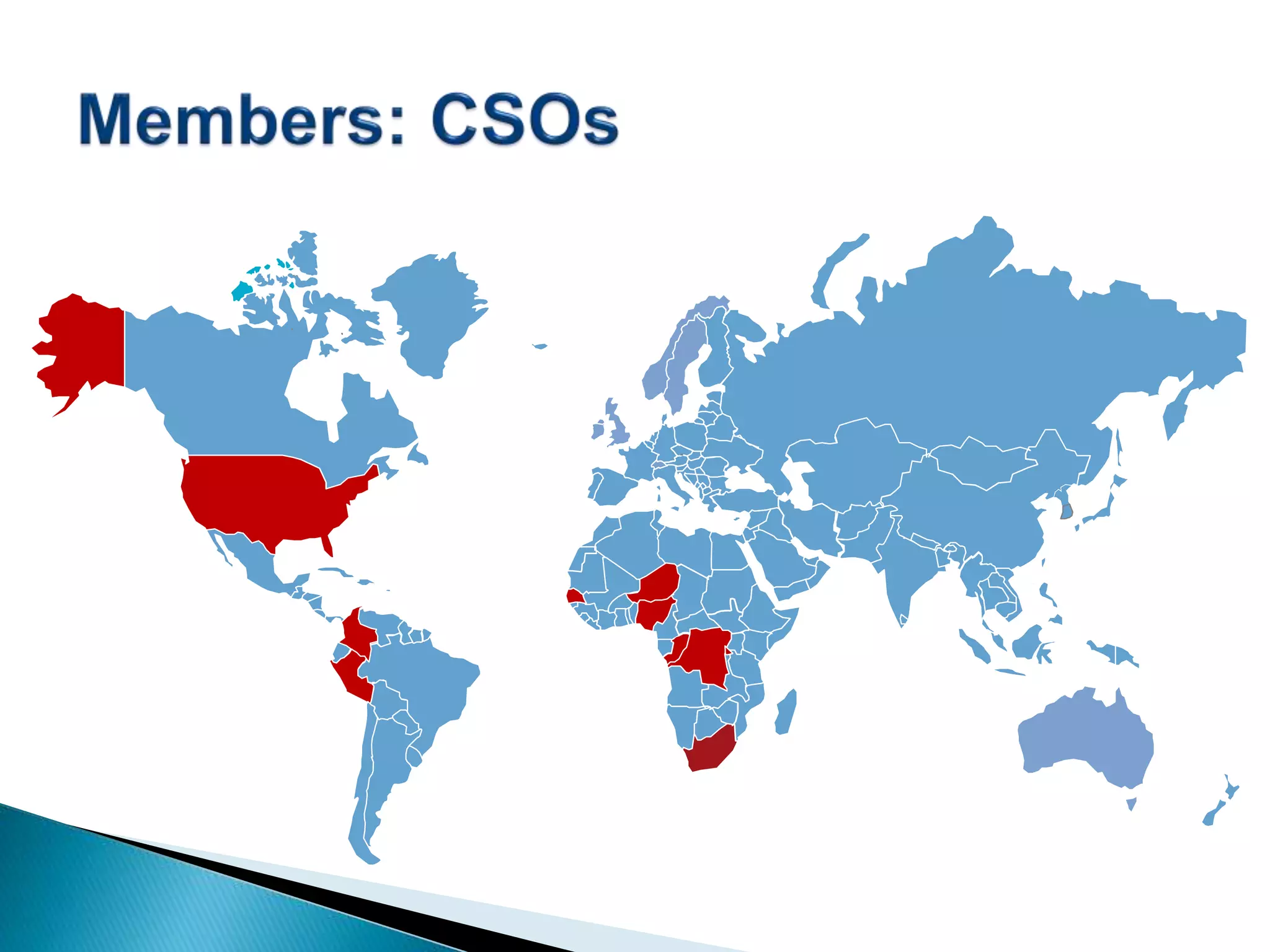
  • #6 Currently there are 6 Govt members: US, UK, Switzerland, Sweden, Norway, Australia
  • #7 16 CSOs: number of international, regional, national CSOs, with interest in human rights, governance, development. strong presence in Latin America and Africa
  • #8 Currently 100 PSCs, with several under review Across the globe, including large multinational operations and smaller, local companies.
  • #9 Membership screening process: Industry Members must meet criteria which include: Commitment to adhere to ICoC, its procedures, obtain certification, pay dues….
  • #10 Information about the company’s good standing and legality…
  • #11 Written plan on how to meet commitments….
  • #12 Applicant must also meet the definition of a Private Security Company (as defined in ICoC).
  • #13 Signatories: Initially, companies were able to "sign" the International Code of Conduct, however those companies that signed the Code but have not applied for Membership, and agreed to assessment, are not recognized .
  • #14 Certification is a requirement for memberships. Certification Committee composed of at least one Director from each pillar, with equal representation by each pillar Prospective standard evaluated on basis of the content of the standard and the process, measured against the Code. ICoCA currently recognizes two third-party certification standards: PSC.1 & ISO 28007…
  • #15 To date: PSC1 and ISO 28007 evaluated, found to partially fulfill the requirements for ICoCA certification: The certification procedure for companies who have accreditation under these standards involves providing additional information to the Association where there may be gaps between the standard and Code. Such information generally includes: Company policies and procedures on subcontracting, anti-discrimination, a safe and healthy work environment, rules of force, and the selection, vetting and training of personnel (See PSC1 and ISO 28007) In process: recognition of ISO 18788. Currently under analysis by the Secretariat Will be available for public comment at the end of September Anticipated recognition before the end of 2016
  • #16 Third-party certified companies are encouraged to see ICoCA certification by submitting proof and additional information
  • #17 Extension of the deaRelationship & greater cooperation with CBs, including Guidance and training Oversight and recognition – aim is to make sure CBs are able to identify areas of performance and compliance with human rights and humanitarian law principles under the Code. In 2017, Secretariat will conduct a pilot to better understand accessibility to ICoCA certification While the Certification procedure was ratified at the 2015 AGA, amendments to the procedure are expected and will generally reflect (1) the extension of the deadline to September 2018 and the relationship the Association aims to develop with the CBs. dline until September 2018
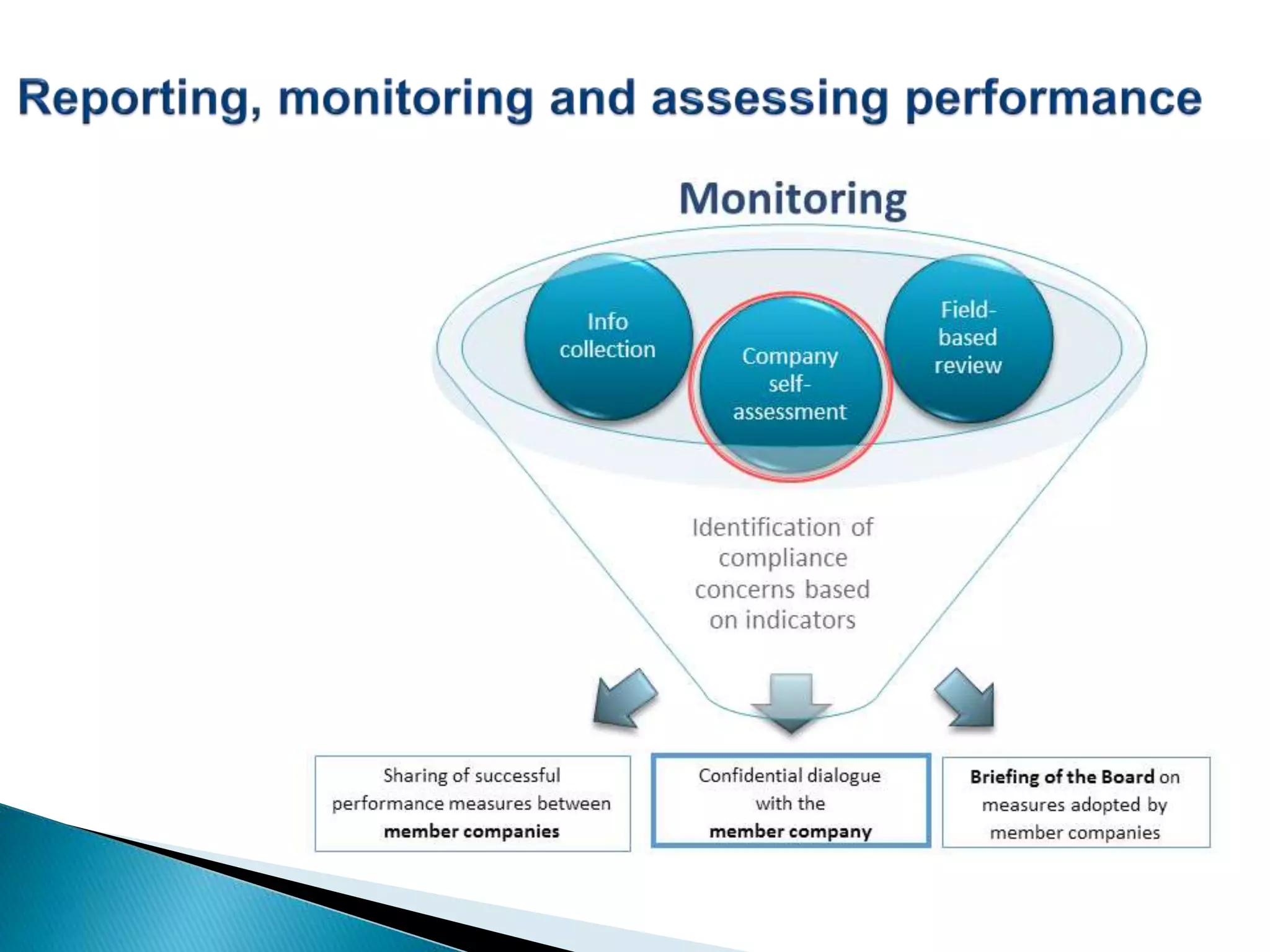
  • #18 Article 12 Procedures developed and agreed to by the Board, circulated, and up for ratification at the September General Assembly. Key function of the ICoCA aimed at ensuring that Member companies act in accordance with the Code Goal is to provide guidance and assistance in improving performance and monitoring non-compliance Following slides aim to demonstrate how the Secretariat will conduct monitoring, the key activities and function, and the relationship between the Secretariat, Member companies and the Board of Directors
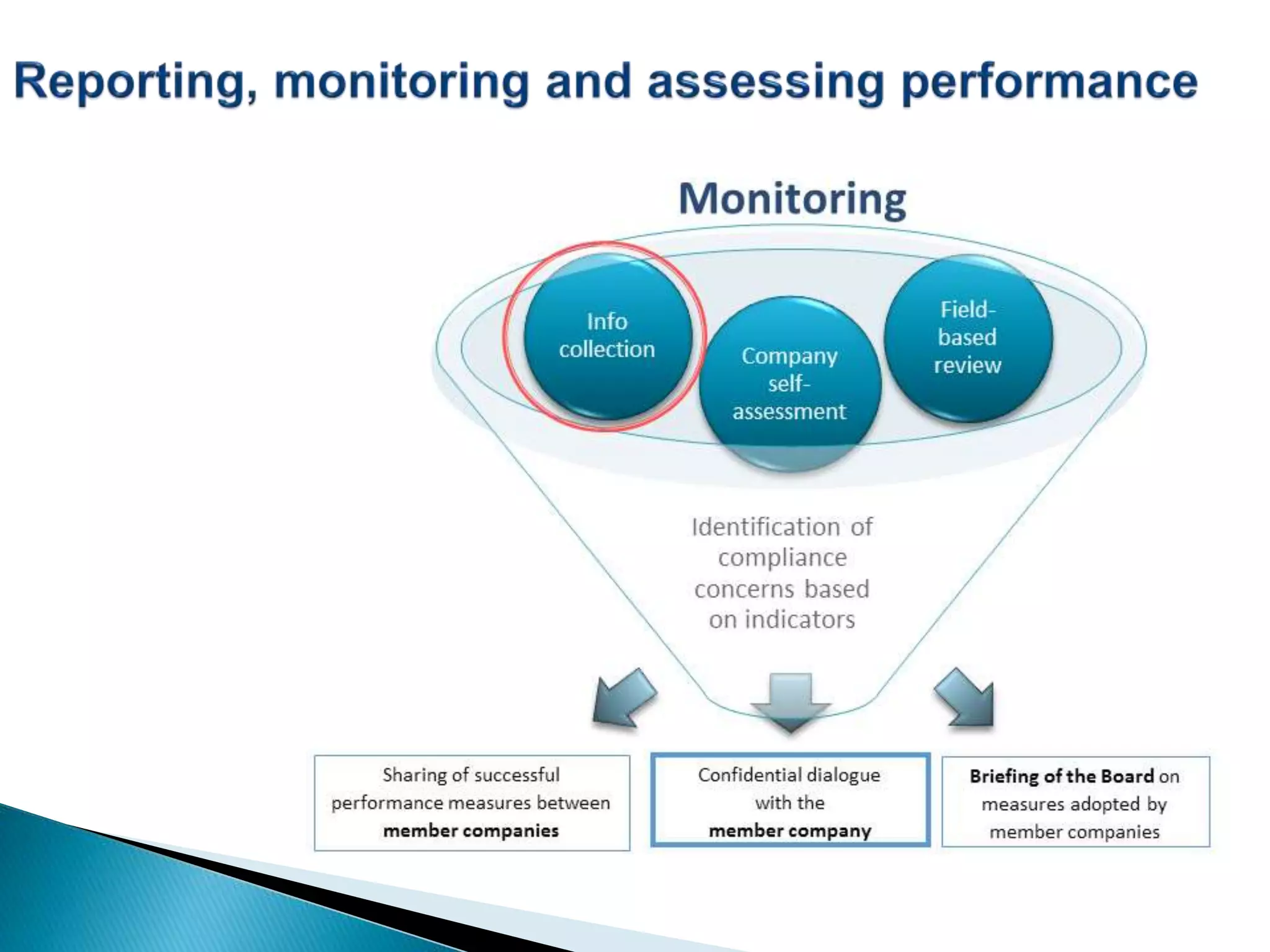
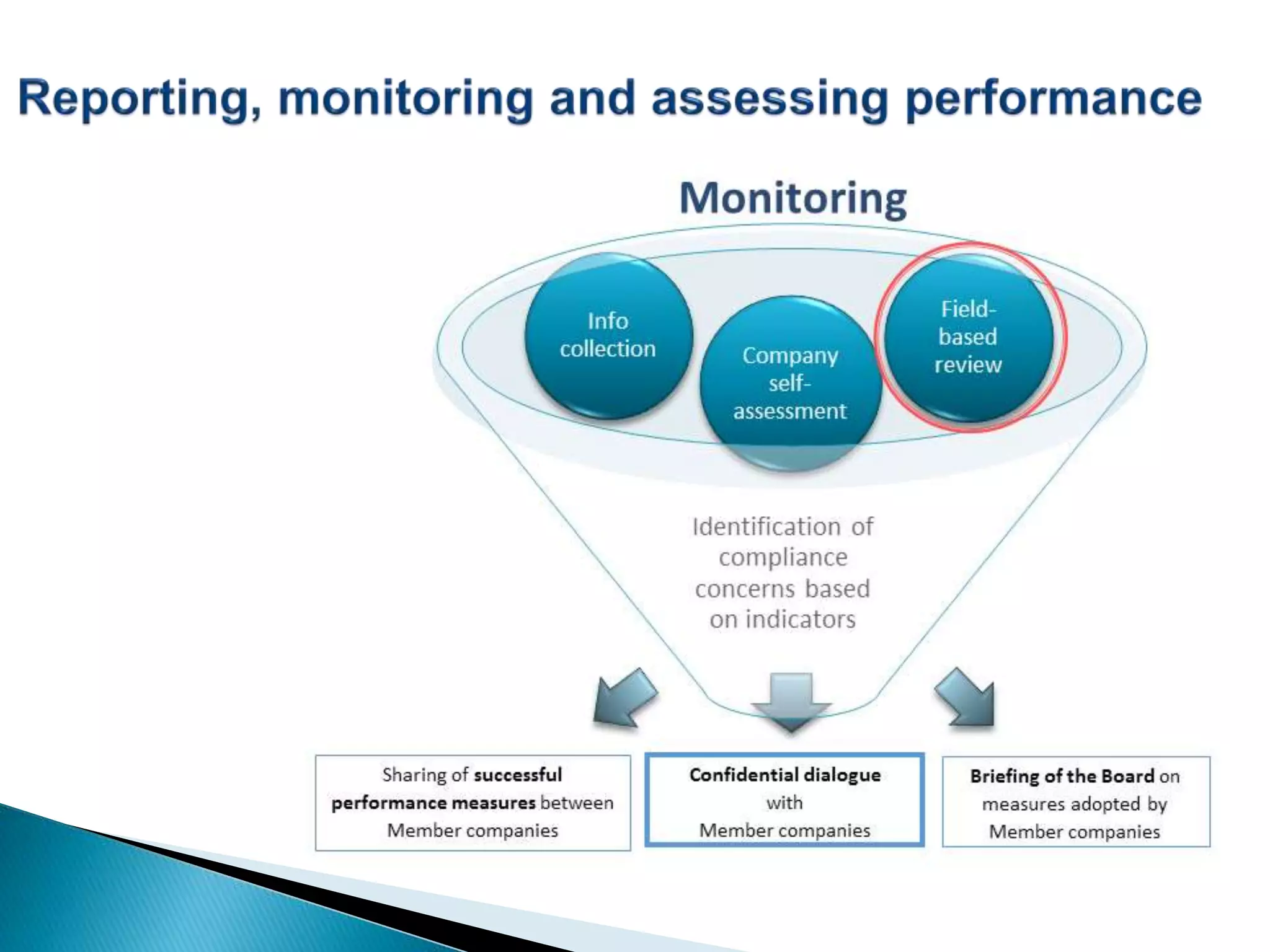
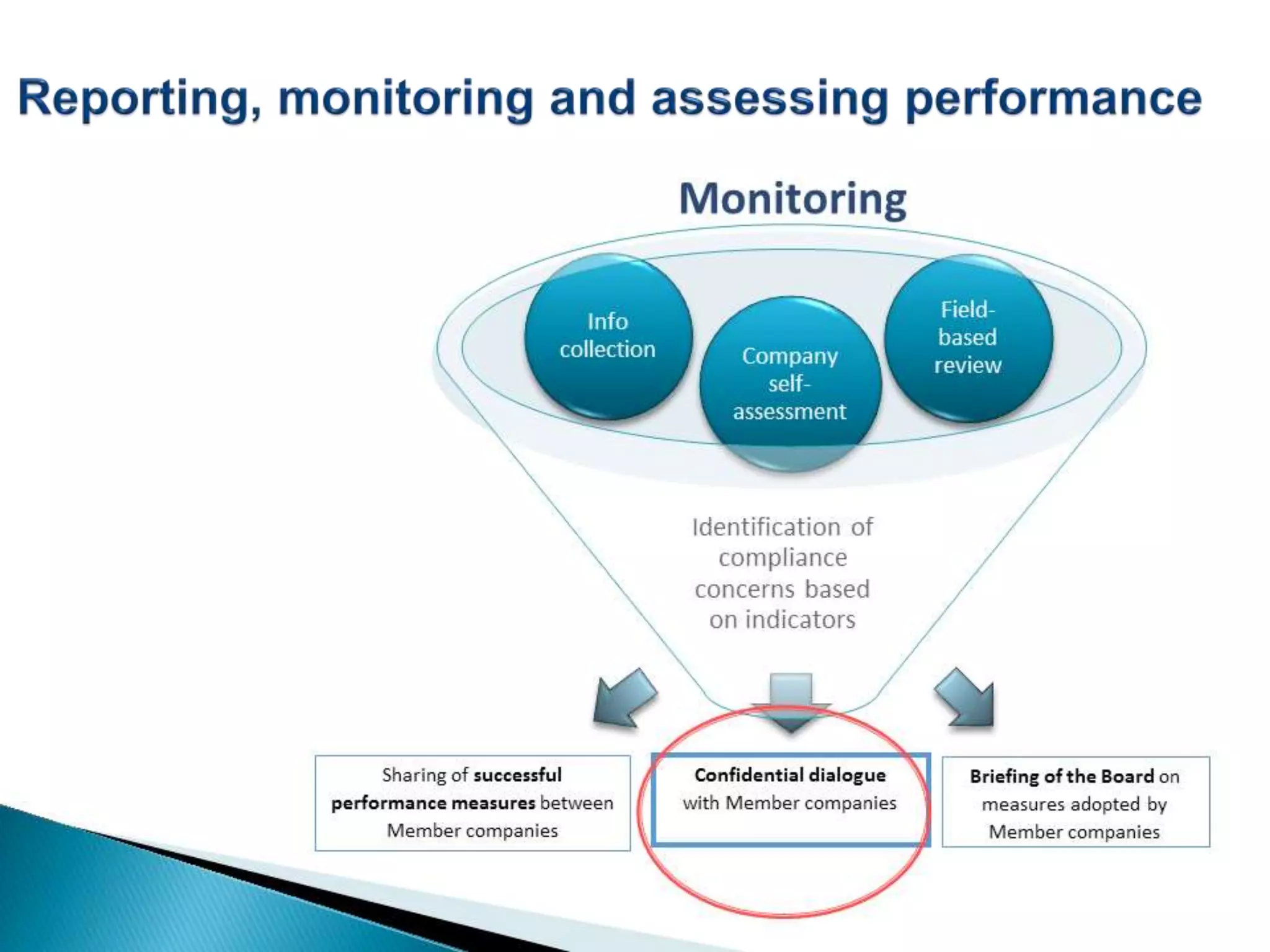
  • #19 Three principle activities of the Secretariat: Monitoring: information collection and analysis Company self-assessment reporting Field-based reviews Three key modalities and outcomes of monitoring: Confidential dialogue Without breaching the confidential dialogue, sharing of successful performance measures or “best practices” between Member companies where that information is transferrable Without breaching the confidential dialogue, briefing of the Board on corrective measures recommended to and adopted by Member companies Performance and compliance indicators (guides analysis!) Publicly available set of objective criteria based on human rights and humanitarian law principles that will assist the Association in measuring performance and compliance with Code standards. Ultimately developed for all Code paragraphs and made public to Members. Assists Companies in understanding what steps may need to be taken to comply with the Code. Assists monitors in knowing where Code compliance issues may be prevalent; and Guides the Secretariat in identifying compliance concerns and providing practical guidance for improved performance.
  • #20 Activity 1: Monitoring: information collection and analysis Ongoing process whereby the Secretariat receives information about Member company activities from numerous sources and reviews information Public and non-public sources from a variety of stakeholders Principally all those affected by Company operations Information collected is reviewed and analyzed against the Code and indicators
  • #21 Activity 2: Company self-assessment reporting
  • #22 Activity 2: Company self-assessment reporting Annual reporting cycle aimed at encouraging Member companies to be transparent about Code implementation and related challenges or successes. Secure, confidential and electronic Questions will assess compliance and performance with Code standards addressing conduct of personnel and will align with the indicators Distributed by and submitted to the Secretariat Will allow the Secretariat to engage with Companies and provide specific, guidance on improved performance. Secretariat reviews their reports, identifies any compliance concerns and makes recommendation for improved compliance and enhanced performance. Member implements correctives measures and shares lessons learned.
  • #23 Activity 3: Field based review
  • #24 Identified need based on information received through monitoring or requested by a member Initiated by the Executive Director as part of a regular plan or urgent need for a Field-Based Review Monitoring Committee comprised of equal representation of each pillar of the Board Field-Based Review moved forward unless the Board decides otherwise Implemented by a team of the Secretariat, based on a standing operating procedures After Review reporting with recommendations for corrective action
  • #25 Three outcomes of these activities: Confidential dialogue Without breaching the confidential dialogue, sharing of successful performance measures or “best practices” between Member companies where that information is transferrable Without breaching the confidential dialogue, briefing of the Board on corrective measures recommended to and adopted by Member companies
  • #26 Confidential dialogue The aim of this dialogue is to find workable solutions to address any compliance concerns, and to improve Member company performance.
  • #27 Non-compliance – retaining membership If the Secretariat is not satisfied with the Member’s response and willingness to comply to the with the Code, the Executive Director will present to the Board the allegation of violation, and a proposed course of action The Board will adopt the course of action or make recommendations to the Member regarding corrective action Member company takes corrective action and the retains membership
  • #28 Non-compliance – losing membership If the Member doesn’t comply or act in good faith, the Board may then start suspension proceedings, and may also release a public statement to explain why the Member has been suspended.
  • #30 Article 13 Complaints Procedures developed and agreed to by the Board, circulated, and up for ratification at the September General Assembly.
  • #31 Two main functions of the Secretariat: Support the development of an effective Member company grievance processes (For Members!) Address and support access to a remedy (For Complainants!)
  • #32 If the grievance involves criminal activity AND it has taken place within a competent criminal jurisdiction; the matter will be reported to the relevant authority for follow up.
  • #33 If the grievance can be dealt with by an internal grievance mechanism or an alternative grievance mechanism… it will be referred to this mechanism
  • #34 If there is no adequate mechanism, or for some reason that mechanism is not appropriate: ICoCA recommendations for corrective action to the Member company, or uses its good Offices, external mediation or alternative mechanism to handle the complaint.
  • #35 Complaint form (available online) Development of “good offices” process Identifying mediation referral sources Publish guidance on effective grievance procedures
  • #36 2016 AGA: members will vote on these procedures, will allow the secretariat to move forward into an operational phase. Also vote for (Members should have received an email explaining how to register your vote in advance) Implement certification: start with pilot certification, based on 3rd party accreditation; encourage PSCs to submit proof of their accreditation Implement monitoring Self-assessment reporting starting in early 2017 Building a monitoring network Feedback to Members Implement complaints process - assist Members with implementing their own Grievance processes, - Establish our Promotion of ICoCA value Raise the profile of the Association. You can expect to see us more activley visible. Promote ICoCA To Clients of PSC complanies (especially extractive industries, engineering operations, Governments Encourage them to seek out PSCs who are ICoCA members, Promote ICoCA as a badge of best practice & reliabilty.