
Group Members : Dharshmi Priya
Kali Selvi
Tharshini a/p Rathumani
Ruben Raj s/o Kiron
Jessy Wilson
Lecturer’s Name : MR Sivaram
Subject : Business Law
Topic : Free Consent
Illegal and Void Contract
Discharge of Contract
OUTLINE
 Voidable Contracts (Free Consent)
 Illegal & Void Contracts
 Discharge of Contracts
 1. Discuss a case laws on consent
 2. Discuss about sections/situations/illustrations/on void
and illegal contracts.
 3. Discuss differences ‘void contract’ and ‘voidable
contract’.
 4. Briefly discuss about how to discharge from a contract
Voidable Contracts
 Section 10 of Contracts Act 1950:
‘agreements are contracts if they are made by
the free consent of both parties’.
 Consent is said to be free when it is not caused
by one or more of the followings:
 Coercion
 Undue influence
 Fraud
 Misrepresentative
 Mistake
COERCION
 Section 15 of the Contracts Act 1950 :
“committing, or threatening to commit any act
forbidden by the Penal Code, or the unlawful
detaining or threatening to detain, any property, to
the prejudice of any person whatsoever, with the
intention of causing any person to enter into the
agreement”.
 Case Law:
 Kannahaya Lal vs National Bank of India (cotton mill)
 Kesarmal s/o Letchman Das v Valiappa Chettiar
Undue Influence
 Section 16 of the Contracts Act 1950:
‘relationship exists between parties and one party is
in a dominant position over the other and he uses
that position to take unfair advantage over the
other’
Undue Influence (cont..)
 ILLUSTRATION
 A, a man weakened by disease or age, is induced, by B’s
influence over him as his medical attendant, to agree to
pay B an unreasonable sum for his professional services. B
employs undue influence.
 Case Law:
 Polygram Records s/b v The Search (Mr Eric)
 Malaysia French Bank Berhad v. Abdullah bin
Mohd Yusof (P dominate & take unfair advantage)
FRAUD
 Section 17 of the Contract Act 1950:
‘to include certain acts which are committed with
intent to induce/deceive another party to enter
into a contract’.
 Example:through suggestion, active concealment of
fact, blank promise deceive act and fraudulent acts
according to the law. In other words, a fraud exists if
the person who is making the statement itself does
not belief it to be true.
FRAUD (cont..)
 Illustration:
 A sells his horse to B which A knows to be
unsound. However, A tells B that the horse is
sound. This is fraud in A.
 If A does not tell B that the horse is sound, then
this is not fraud is A.
 Case Law:
 Wong Cheong Kong Sdn Bhd v Predential
Assurance Sdn Bhd (involves assumed fraudulent
insurance claim)
MISREPRESENTATIVE
 Section 18 of the Contract Act 1950
‘misrepresentation’ refers to certain false
statement made by the representation and which
induces the other party to enter into a contract’.
 difference between misrepresentation and
fraud is that in fraud the person making the
representation does not himself believe the
representation to be true.
MISREPRESENTATIVE (cont)
 Case Law
 Keates v. Lord Cardogen (ruinious conritioned
house, defendant keeps silence)
 Bisset v. Wilkinson (2,000 sheep's, the statement
was merely an honest opinion)
MISTAKE
 Section 21 of the Contract Act 1950:
“Where both parties to an agreement are under
value a mistake as to a matter of fact essential to
the agreement, the agreement is void”.
 ILLUSTRATION:
 A agrees to buy from B a certain horse. It turns
out that the horse was dead at the time of the
bargain, though neither party was aware of the
facts. The agreement is void.
MISTAKE (cont..)
 Case Law
 Chan Yoke Lain v Pacific & Orient Insurance Co
SDN BHD (mistake in the signature, Plaintiff’s
claim dismissed).
ILLEGAL AND VOID CONTRACTS
 Contract may be illegal:
 By way of statute
 On the grounds of public policy.
 Where a contract is illegal, the consequences are as
follows:
 The contract is void and therefore neither party can sue
upon it;
 Money paid or property transferred under the contract is
normally not recoverable
 Related transactions will also be void
ILLEGAL AND VOID CONTRACTS
(cont..)
 Certain can are expressly declared void by statue.
 The most notable example are wagering
contracts.(Rendered void by the Gaming Act 1845)
and restrictive trading agreements; (Controlled by the
Restrictive Trade Practices Act 1976)
 Categories of contract which are void at common law
on the grounds of public policy
 Contracts to aus the jurisdiction of the courts
 Contracts prejudicial to the status or marriage
 Contracts in restraint of trade (RET)
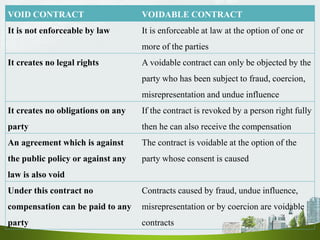
VOID CONTRACT VOIDABLE CONTRACT
It is not enforceable by law It is enforceable at law at the option of one or
more of the parties
It creates no legal rights A voidable contract can only be objected by the
party who has been subject to fraud, coercion,
misrepresentation and undue influence
It creates no obligations on any
party
If the contract is revoked by a person right fully
then he can also receive the compensation
An agreement which is against
the public policy or against any
law is also void
The contract is voidable at the option of the
party whose consent is caused
Under this contract no
compensation can be paid to any
party
Contracts caused by fraud, undue influence,
misrepresentation or by coercion are voidable
contracts
DICHARGE OF CONTRACTS
 Definition :
‘Termination of a contractual obligation on court
orders (through an order of discharge) or mutual
agreement or caused by breach of contract,
frustration of contract, performance of contract.’
 Discharge by performance,
 Discharge by frustration ,
 Discharge by breach of contract.
DISCHARGE BY PERFORMANCE
 Section 38(1) of Contract Acts:
performance of a contract must be exact and precise
and should be in accordance with what parties had
promised.
 ILLUSTRATION:
 Thus, if Ali promises to deliver goods to Muthu on 3 January 2009 on
payment of RM3000, Ali is bound to deliver the goods to Muthu on that day
and Muthu is bound to pay the RM3000. Performance may be form a third
party and not necessarily from the promisor.
 Case Law:
 RE Krishnan Rengasamy, ex.p. Arab Malaysian Credit Bhd, (not done within
the stipulates time Section 42)
DISCHARGE BY FRUSTRATION
 Section 57 (2) of Contract Act 1950
‘a contract to do an act which after the contract
is made, becomes impossible, or by reason of
some event which the promisor could not
prevent., unlawful , becomes void when the act
becomes impossible or unlawful’.
 Case Law:
 Taylor v. Caldwell (concerts was accidently burnt)
 Berney v Tronoh Mines Ltd. (Outbreak of war)
DISCHARGE BY BREACH
 Section 40 of Contract Act 1950
‘when a party to a contract has refused to
perform or disabled himself from performing his
promise in its entirety, the innocent party may
put an end to the contract’.
THANK YOU

Business Law

  • 1.
    Group Members :Dharshmi Priya Kali Selvi Tharshini a/p Rathumani Ruben Raj s/o Kiron Jessy Wilson Lecturer’s Name : MR Sivaram Subject : Business Law Topic : Free Consent Illegal and Void Contract Discharge of Contract
  • 2.
    OUTLINE  Voidable Contracts(Free Consent)  Illegal & Void Contracts  Discharge of Contracts  1. Discuss a case laws on consent  2. Discuss about sections/situations/illustrations/on void and illegal contracts.  3. Discuss differences ‘void contract’ and ‘voidable contract’.  4. Briefly discuss about how to discharge from a contract
  • 3.
    Voidable Contracts  Section10 of Contracts Act 1950: ‘agreements are contracts if they are made by the free consent of both parties’.  Consent is said to be free when it is not caused by one or more of the followings:  Coercion  Undue influence  Fraud  Misrepresentative  Mistake
  • 4.
    COERCION  Section 15of the Contracts Act 1950 : “committing, or threatening to commit any act forbidden by the Penal Code, or the unlawful detaining or threatening to detain, any property, to the prejudice of any person whatsoever, with the intention of causing any person to enter into the agreement”.  Case Law:  Kannahaya Lal vs National Bank of India (cotton mill)  Kesarmal s/o Letchman Das v Valiappa Chettiar
  • 5.
    Undue Influence  Section16 of the Contracts Act 1950: ‘relationship exists between parties and one party is in a dominant position over the other and he uses that position to take unfair advantage over the other’
  • 6.
    Undue Influence (cont..) ILLUSTRATION  A, a man weakened by disease or age, is induced, by B’s influence over him as his medical attendant, to agree to pay B an unreasonable sum for his professional services. B employs undue influence.  Case Law:  Polygram Records s/b v The Search (Mr Eric)  Malaysia French Bank Berhad v. Abdullah bin Mohd Yusof (P dominate & take unfair advantage)
  • 7.
    FRAUD  Section 17of the Contract Act 1950: ‘to include certain acts which are committed with intent to induce/deceive another party to enter into a contract’.  Example:through suggestion, active concealment of fact, blank promise deceive act and fraudulent acts according to the law. In other words, a fraud exists if the person who is making the statement itself does not belief it to be true.
  • 8.
    FRAUD (cont..)  Illustration: A sells his horse to B which A knows to be unsound. However, A tells B that the horse is sound. This is fraud in A.  If A does not tell B that the horse is sound, then this is not fraud is A.  Case Law:  Wong Cheong Kong Sdn Bhd v Predential Assurance Sdn Bhd (involves assumed fraudulent insurance claim)
  • 9.
    MISREPRESENTATIVE  Section 18of the Contract Act 1950 ‘misrepresentation’ refers to certain false statement made by the representation and which induces the other party to enter into a contract’.  difference between misrepresentation and fraud is that in fraud the person making the representation does not himself believe the representation to be true.
  • 10.
    MISREPRESENTATIVE (cont)  CaseLaw  Keates v. Lord Cardogen (ruinious conritioned house, defendant keeps silence)  Bisset v. Wilkinson (2,000 sheep's, the statement was merely an honest opinion)
  • 11.
    MISTAKE  Section 21of the Contract Act 1950: “Where both parties to an agreement are under value a mistake as to a matter of fact essential to the agreement, the agreement is void”.  ILLUSTRATION:  A agrees to buy from B a certain horse. It turns out that the horse was dead at the time of the bargain, though neither party was aware of the facts. The agreement is void.
  • 12.
    MISTAKE (cont..)  CaseLaw  Chan Yoke Lain v Pacific & Orient Insurance Co SDN BHD (mistake in the signature, Plaintiff’s claim dismissed).
  • 13.
    ILLEGAL AND VOIDCONTRACTS  Contract may be illegal:  By way of statute  On the grounds of public policy.  Where a contract is illegal, the consequences are as follows:  The contract is void and therefore neither party can sue upon it;  Money paid or property transferred under the contract is normally not recoverable  Related transactions will also be void
  • 14.
    ILLEGAL AND VOIDCONTRACTS (cont..)  Certain can are expressly declared void by statue.  The most notable example are wagering contracts.(Rendered void by the Gaming Act 1845) and restrictive trading agreements; (Controlled by the Restrictive Trade Practices Act 1976)  Categories of contract which are void at common law on the grounds of public policy  Contracts to aus the jurisdiction of the courts  Contracts prejudicial to the status or marriage  Contracts in restraint of trade (RET)
  • 15.
    VOID CONTRACT VOIDABLECONTRACT It is not enforceable by law It is enforceable at law at the option of one or more of the parties It creates no legal rights A voidable contract can only be objected by the party who has been subject to fraud, coercion, misrepresentation and undue influence It creates no obligations on any party If the contract is revoked by a person right fully then he can also receive the compensation An agreement which is against the public policy or against any law is also void The contract is voidable at the option of the party whose consent is caused Under this contract no compensation can be paid to any party Contracts caused by fraud, undue influence, misrepresentation or by coercion are voidable contracts
  • 16.
    DICHARGE OF CONTRACTS Definition : ‘Termination of a contractual obligation on court orders (through an order of discharge) or mutual agreement or caused by breach of contract, frustration of contract, performance of contract.’  Discharge by performance,  Discharge by frustration ,  Discharge by breach of contract.
  • 17.
    DISCHARGE BY PERFORMANCE Section 38(1) of Contract Acts: performance of a contract must be exact and precise and should be in accordance with what parties had promised.  ILLUSTRATION:  Thus, if Ali promises to deliver goods to Muthu on 3 January 2009 on payment of RM3000, Ali is bound to deliver the goods to Muthu on that day and Muthu is bound to pay the RM3000. Performance may be form a third party and not necessarily from the promisor.  Case Law:  RE Krishnan Rengasamy, ex.p. Arab Malaysian Credit Bhd, (not done within the stipulates time Section 42)
  • 18.
    DISCHARGE BY FRUSTRATION Section 57 (2) of Contract Act 1950 ‘a contract to do an act which after the contract is made, becomes impossible, or by reason of some event which the promisor could not prevent., unlawful , becomes void when the act becomes impossible or unlawful’.  Case Law:  Taylor v. Caldwell (concerts was accidently burnt)  Berney v Tronoh Mines Ltd. (Outbreak of war)
  • 19.
    DISCHARGE BY BREACH Section 40 of Contract Act 1950 ‘when a party to a contract has refused to perform or disabled himself from performing his promise in its entirety, the innocent party may put an end to the contract’.
  • 20.