1
Tort notes - Types of damages
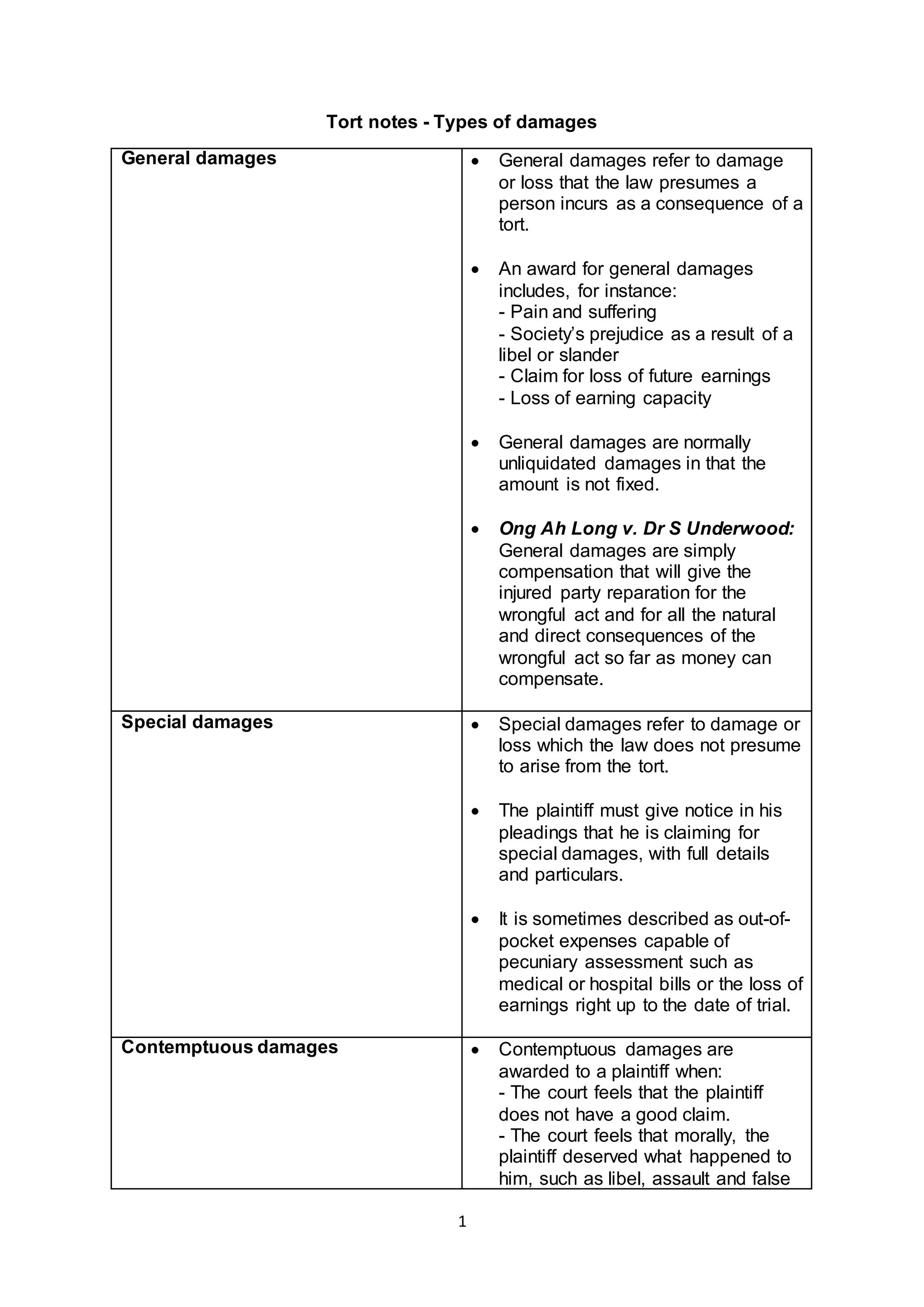
General damages  General damages refer to damage
or loss that the law presumes a
person incurs as a consequence of a
tort.
 An award for general damages
includes, for instance:
- Pain and suffering
- Society’s prejudice as a result of a
libel or slander
- Claim for loss of future earnings
- Loss of earning capacity
 General damages are normally
unliquidated damages in that the
amount is not fixed.
 Ong Ah Long v. Dr S Underwood:
General damages are simply
compensation that will give the
injured party reparation for the
wrongful act and for all the natural
and direct consequences of the
wrongful act so far as money can
compensate.
Special damages  Special damages refer to damage or
loss which the law does not presume
to arise from the tort.
 The plaintiff must give notice in his
pleadings that he is claiming for
special damages, with full details
and particulars.
 It is sometimes described as out-of-
pocket expenses capable of
pecuniary assessment such as
medical or hospital bills or the loss of
earnings right up to the date of trial.
Contemptuous damages  Contemptuous damages are
awarded to a plaintiff when:
- The court feels that the plaintiff
does not have a good claim.
- The court feels that morally, the
plaintiff deserved what happened to
him, such as libel, assault and false
2
imprisonment.
 The judge has discretion to instruct
the plaintiff to bear the cost of both
parties.
 Can be awarded for all types of torts.
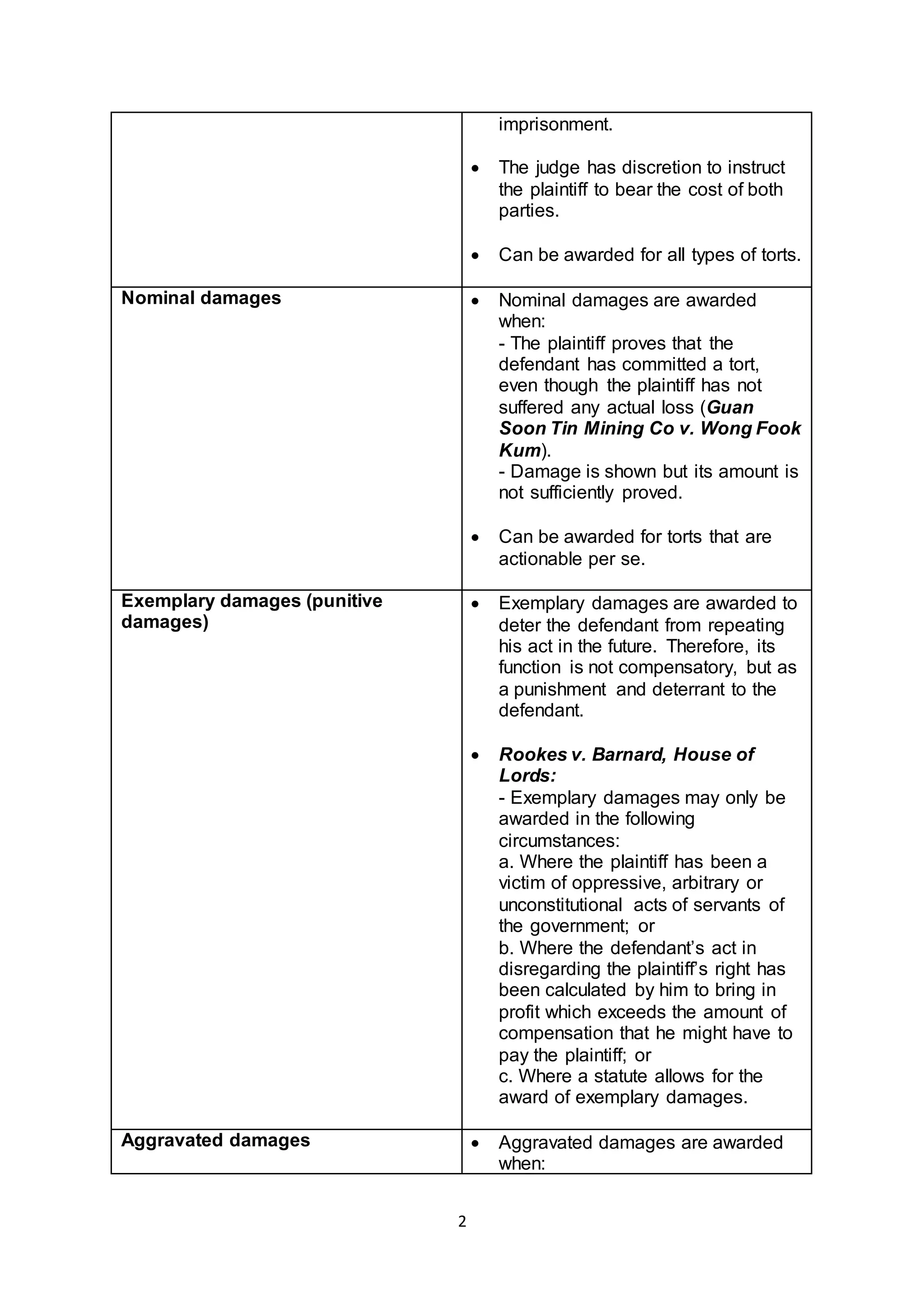
Nominal damages  Nominal damages are awarded
when:
- The plaintiff proves that the
defendant has committed a tort,
even though the plaintiff has not
suffered any actual loss (Guan
Soon Tin Mining Co v. Wong Fook
Kum).
- Damage is shown but its amount is
not sufficiently proved.
 Can be awarded for torts that are
actionable per se.
Exemplary damages (punitive
damages)
 Exemplary damages are awarded to
deter the defendant from repeating
his act in the future. Therefore, its
function is not compensatory, but as
a punishment and deterrant to the
defendant.
 Rookes v. Barnard, House of
Lords:
- Exemplary damages may only be
awarded in the following
circumstances:
a. Where the plaintiff has been a
victim of oppressive, arbitrary or
unconstitutional acts of servants of
the government; or
b. Where the defendant’s act in
disregarding the plaintiff’s right has
been calculated by him to bring in
profit which exceeds the amount of
compensation that he might have to
pay the plaintiff; or
c. Where a statute allows for the
award of exemplary damages.
Aggravated damages  Aggravated damages are awarded
when:
3
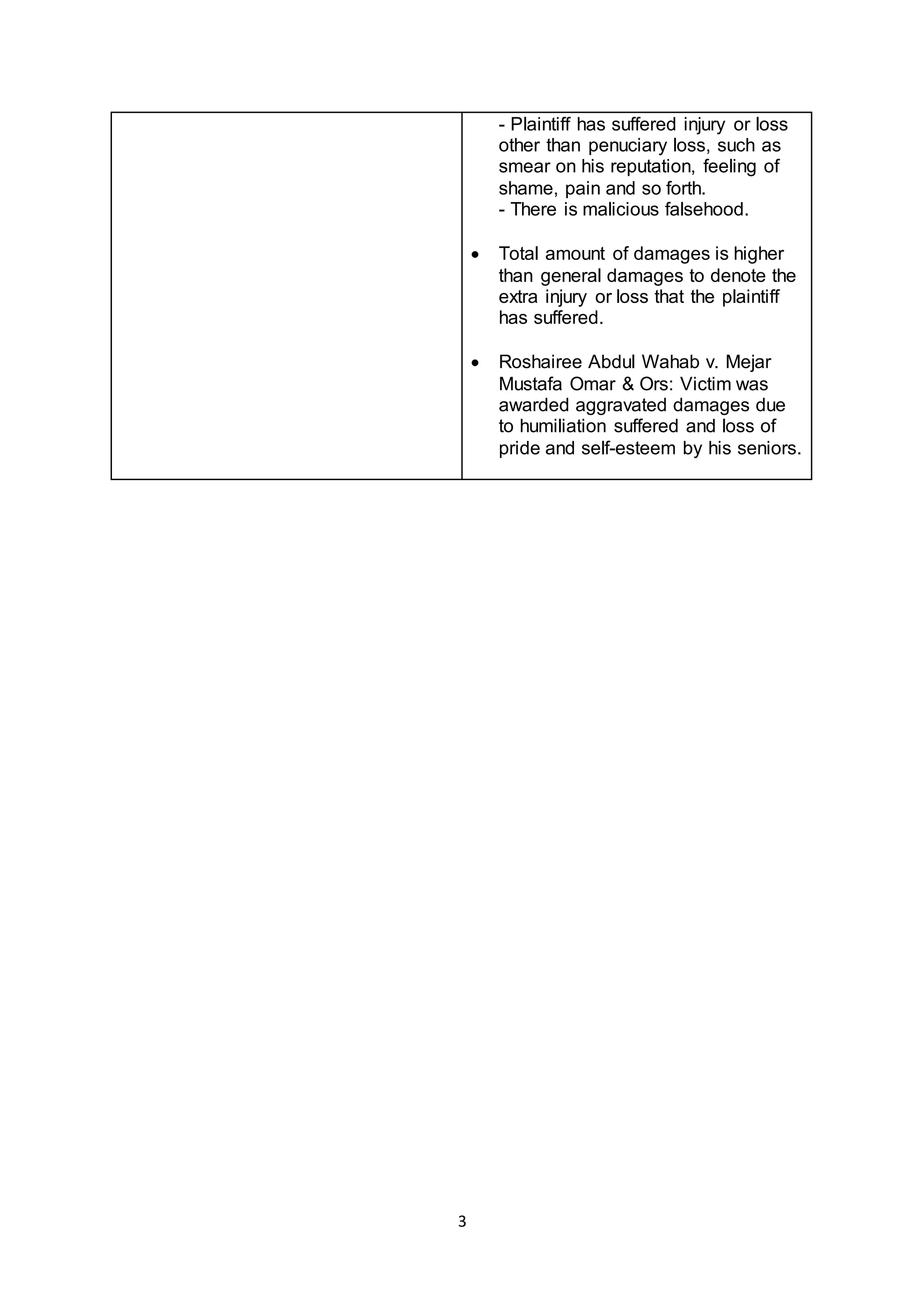
- Plaintiff has suffered injury or loss
other than penuciary loss, such as
smear on his reputation, feeling of
shame, pain and so forth.
- There is malicious falsehood.
 Total amount of damages is higher
than general damages to denote the
extra injury or loss that the plaintiff
has suffered.
 Roshairee Abdul Wahab v. Mejar
Mustafa Omar & Ors: Victim was
awarded aggravated damages due
to humiliation suffered and loss of
pride and self-esteem by his seniors.

Tort notes - Types of damages

  • 1.
    1 Tort notes -Types of damages General damages  General damages refer to damage or loss that the law presumes a person incurs as a consequence of a tort.  An award for general damages includes, for instance: - Pain and suffering - Society’s prejudice as a result of a libel or slander - Claim for loss of future earnings - Loss of earning capacity  General damages are normally unliquidated damages in that the amount is not fixed.  Ong Ah Long v. Dr S Underwood: General damages are simply compensation that will give the injured party reparation for the wrongful act and for all the natural and direct consequences of the wrongful act so far as money can compensate. Special damages  Special damages refer to damage or loss which the law does not presume to arise from the tort.  The plaintiff must give notice in his pleadings that he is claiming for special damages, with full details and particulars.  It is sometimes described as out-of- pocket expenses capable of pecuniary assessment such as medical or hospital bills or the loss of earnings right up to the date of trial. Contemptuous damages  Contemptuous damages are awarded to a plaintiff when: - The court feels that the plaintiff does not have a good claim. - The court feels that morally, the plaintiff deserved what happened to him, such as libel, assault and false
  • 2.
    2 imprisonment.  The judgehas discretion to instruct the plaintiff to bear the cost of both parties.  Can be awarded for all types of torts. Nominal damages  Nominal damages are awarded when: - The plaintiff proves that the defendant has committed a tort, even though the plaintiff has not suffered any actual loss (Guan Soon Tin Mining Co v. Wong Fook Kum). - Damage is shown but its amount is not sufficiently proved.  Can be awarded for torts that are actionable per se. Exemplary damages (punitive damages)  Exemplary damages are awarded to deter the defendant from repeating his act in the future. Therefore, its function is not compensatory, but as a punishment and deterrant to the defendant.  Rookes v. Barnard, House of Lords: - Exemplary damages may only be awarded in the following circumstances: a. Where the plaintiff has been a victim of oppressive, arbitrary or unconstitutional acts of servants of the government; or b. Where the defendant’s act in disregarding the plaintiff’s right has been calculated by him to bring in profit which exceeds the amount of compensation that he might have to pay the plaintiff; or c. Where a statute allows for the award of exemplary damages. Aggravated damages  Aggravated damages are awarded when:
  • 3.
    3 - Plaintiff hassuffered injury or loss other than penuciary loss, such as smear on his reputation, feeling of shame, pain and so forth. - There is malicious falsehood.  Total amount of damages is higher than general damages to denote the extra injury or loss that the plaintiff has suffered.  Roshairee Abdul Wahab v. Mejar Mustafa Omar & Ors: Victim was awarded aggravated damages due to humiliation suffered and loss of pride and self-esteem by his seniors.