Dr. Aditi Shams
Topic: Selected Industry Overview
Topic Outline
Jute and Jute Manufactures
Fish, Shrimp, Prawns
Leather and Leather Products
Home Textile
Agro-Products
Pharmaceuticals
Plastic and Plastic Products
2
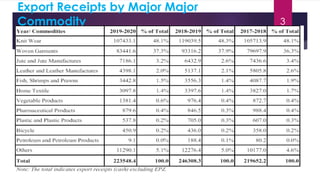
Export Receipts by Major Major
Commodity 3
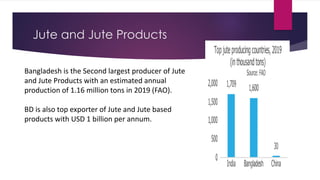
Jute and Jute Products
Bangladesh is the Second largest producer of Jute
and Jute Products with an estimated annual
production of 1.16 million tons in 2019 (FAO).
BD is also top exporter of Jute and Jute based
products with USD 1 billion per annum.
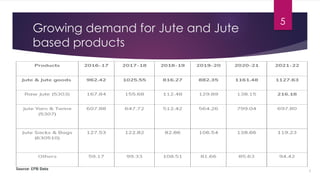
Growing demand for Jute and Jute
based products
5
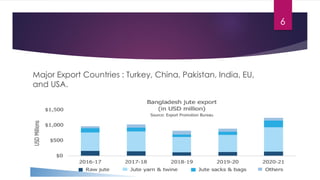
Major Export Countries : Turkey, China, Pakistan, India, EU,
and USA.
6
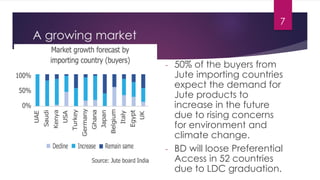
A growing market
- 50% of the buyers from
Jute importing countries
expect the demand for
Jute products to
increase in the future
due to rising concerns
for environment and
climate change.
- BD will loose Preferential
Access in 52 countries
due to LDC graduation.
7
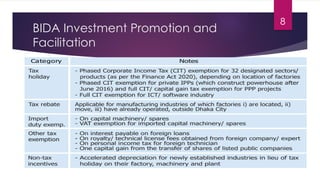
BIDA Investment Promotion and
Facilitation
8
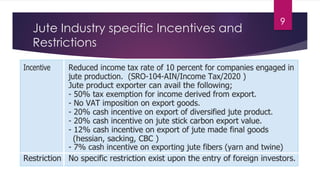
Jute Industry specific Incentives and
Restrictions
9
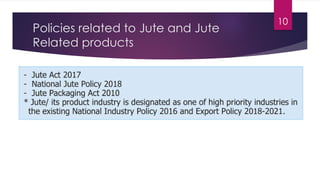
Policies related to Jute and Jute
Related products
10
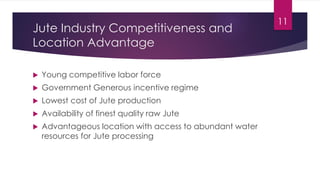
Jute Industry Competitiveness and
Location Advantage
 Young competitive labor force
 Government Generous incentive regime
 Lowest cost of Jute production
 Availability of finest quality raw Jute
 Advantageous location with access to abundant water
resources for Jute processing
11
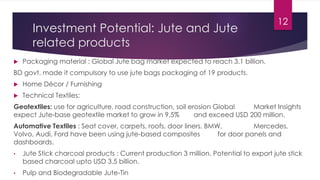
Investment Potential: Jute and Jute
related products
 Packaging material : Global Jute bag market expected to reach 3.1 billion.
BD govt. made it compulsory to use jute bags packaging of 19 products.
 Home Décor / Furnishing
 Technical Textiles:
Geotextiles: use for agriculture, road construction, soil erosion Global Market Insights
expect Jute-base geotextile market to grow in 9.5% and exceed USD 200 million.
Automative Textiles : Seat cover, carpets, roofs, door liners. BMW, Mercedes,
Volvo, Audi, Ford have been using jute-based composites for door panels and
dashboards.
• Jute Stick charcoal products : Current production 3 million. Potential to export jute stick
based charcoal upto USD 3.5 billion.
• Pulp and Biodegradable Jute-Tin
12
13
Fish, Shrimp and
Prawn Industry
14
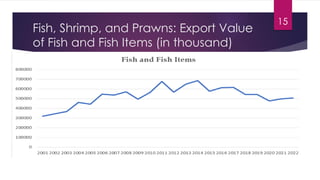
Fish, Shrimp, and Prawns: Export Value
of Fish and Fish Items (in thousand)
15
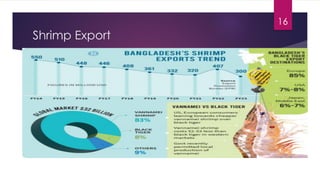
Shrimp Export
16
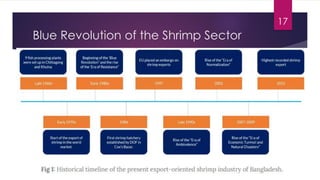
Blue Revolution of the Shrimp Sector
17
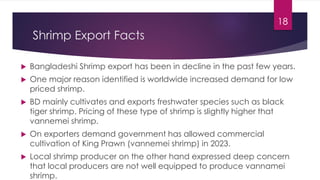
Shrimp Export Facts
 Bangladeshi Shrimp export has been in decline in the past few years.
 One major reason identified is worldwide increased demand for low
priced shrimp.
 BD mainly cultivates and exports freshwater species such as black
tiger shrimp. Pricing of these type of shrimp is slightly higher that
vannemei shrimp.
 On exporters demand government has allowed commercial
cultivation of King Prawn (vannemei shrimp) in 2023.
 Local shrimp producer on the other hand expressed deep concern
that local producers are not well equipped to produce vannamei
shrimp.
18
Problems of Shrimp Export
 Increased competition from cheaper alternatives such as the white-leg (Vannamei) shrimp. This
species of shrimp originates from the eastern side of the Pacific Ocean and the farming practice
for the shrimp first started in Florida in 1973. Commercial production of shrimp has drastically
increased in recent years with India, Vietnam, and Thailand among others, becoming its top
suppliers to the global market. Despite this dramatic rise, Bangladesh has yet to start commercial
production of this shrimp species. At present, the price of Baghda shrimp in the global market is
around $2-3 per pound higher compared to Vannamei shrimp.
 Allegations of export malpractices- In recent years, Bangladesh has been increasingly under
scrutiny for injecting silicone, gum, water, rice starch, and other substances into black tiger
shrimps, which comprises 71.4% of the total shrimp export basket of the country. These
malpractices are often carried out by informal middlemen in order to increase the size and
weight of the shrimp to make it appear healthier which will in return fetch them a higher price in
the global market. This altogether has tainted the image of Bangladeshi shrimp products
resulting in lower export figures.
19
Problems of Shrimp Export
 Declining quality and production volumes- Currently, 98% of shrimp production is done under
extensive farming while only 2% is done under semi-intensive farming. Extensive farming results in
lower yield per hectare as the stocking density is lower. Furthermore, due to the lack of proper
handling of the shrimp after harvest along the long informal supply chain, the quality of the
shrimp falters by the time it reaches the markets and, therefore, has to be often sold off cheaply.
Another reason is the pandemic which had a detrimental effect on the global shrimp market,
causing disruption in supply chains.
20
Constraints in Shrimp Sector
Development (Dept. of Fisheries)
 deteriorating tendencies in parts of the production chain, including reduced availability
of wild fries and an increased incidence of shrimp farm diseases;
 social problems related to a highly skewed distribution of the profits made in the sector,
and high levels of crime and human right violations in shrimp polders;
 production resources are controlled by a few elite members of the community;
 expansion of shrimp farming into areas that are not ideal for shrimp production and
conflicts with other land uses.
 uncertain developments of the world economy and corresponding shrimp prices; •
difficulties in meeting tightening international standards; and
 a poor industry image due to perceptions of environmental destruction, social injustice
and in equity and poor quality control leading to rejections at ports of destination.
21
Constraints in Shrimp Sector
Development….cont….
 Operational
 lack of co-ordination mechanism for the stimulus and control of an industry which is spread over
many agencies;
 inadequate enforcement of existing rules and regulations;
 lack of transparent shrimp land zoning procedure which leads to development of shrimp farming
in unsuitable areas and local conflicts;
 difficulty in developing and enforcing national standards to ensure compliance with emerging
international standards (lack of a reliable quality control against product contamination and the
failure of the government’s quality assurance enforcement system);
 lack of monitoring data and information; and
 an inadequate mechanism for equitable distribution of profit through taxation.
22
Cash incentives on Frozen Shrimp and
Fish Export
 company applying for cash assistance in the frozen shrimp and other
fish export sector must be a member of the Bangladesh Frozen Foods
Exporters Association (BFFEA) or a member of the Bangladesh Marine
Fisheries Association (BMFA) for the export of frozen shrimp and other
fish harvested and processed from the deep sea.
 the BFFEA and the BMFA certificates must be submitted along with the
application form for cash assistance against the export of frozen shrimp
and other fish.
 The concerned exporting company should be a fish exporting
company duly licensed by the Department of Fisheries.
23
What can Bangladesh do ?
 The black tiger shrimp that accounts for such a huge portion of the country’s shrimp export
can be introduced to the world as a national treasure which will help fetch a premium price
for the product. In 2021, the Department of Fisheries (DOF) applied for the Geographical
Indicator (GI) certificate for black tiger (monodon) shrimp, which will recognize it as a
national treasure of Bangladesh. Even though many other several Asian countries grow black
tiger shrimp, the characteristics, texture, aroma, and taste cannot be replicated and this
validates the proposal of a GI certificate for the black tiger shrimp. Through GI certification,
Bangladesh will receive legal protection and the right to produce the product. It will further
receive premium prices in the export market and prices are often witnessed to go up by 30
percent after GI certification.
24
 Recalibrating the shrimp industry of Bangladesh to enter the Vannamei market. In order to
ameliorate the ailing shrimp industry, Bangladesh can introduce the commercialization of the
non-native Vannamei production in the country. In this regard, India’s footsteps can be
followed. Until 2009, Monodon was the most widely cultured shrimp in the country, but soon
after, the Indian government approved the experimental trial of Vannamei production due to
constant difficulty in sourcing specific pathogen-free (SPF) shrimp broomsticks.
Commercialization of Vannamei production commenced in 2012. Currently, India has 176,000
hectares of area under shrimp cultivation, out of which 91 % accounts for Vannamei
production, 8% for Monodon, and only 1% for Macro brachium Rosenbergii. [11] The growth of
shrimp farming after the introduction of Vannamei has been no less than phenomenal. Shrimp
production shot up to 805,000 MT in 2019 compared to the 150,000 MT annual production prior
to the introduction of Vannamei shrimp.
25
 Finally, after 15 years of pressure from shrimp exporters to allow the production of Vannamei
shrimp in the country, the Bangladesh government approved two pilot projects in 2020, that
would carry out Vannamei production on a trial basis in order to measure the success rate. Under
the supervision of the Department of Fisheries and Bangladesh Fish Research Institute, Sushila, a
non-governmental organization in Khulna along with MU Seafood and Agri-Business Enterprise in
Chattogram commenced production of the non-native shrimp. 1 million Vannamei post-larvae
were imported from Thailand in 2021 to start the trail. According to the Director of Bangladesh
Frozen Foods Exporters Association, Das, Vannamei production rate under a controlled
environment has been 8,901 kg per hectare, whereas Monodon production rate on average is
800-1000 kg/ hectare, with traditional and extensive farms being as low as 200-300 kg/ hectare.
[13] Currently, the shrimp industry is awaiting the government’s approval to start commercial
production of the species which will require another three to four years before production can
commence.
26
What steps can BD take to prove itself
a valuable player in global market?
1. At present, the shrimp supply chain is highly inefficient with several
intermediaries in place who do not maintain quality and proper storage
procedures during transportation. Therefore, training of these middlemen
and traders is required and supply chain infrastructure needs to be
improved along with the installation of proper cold storage facilities and ice
factories.
2. Due to the highly fragmented value chain, traceability and proper
documentation of all aspects of the value chain is currently an issue.
Therefore, formalization and the creation of an efficient framework are
required.
27
 The bargaining position of farmers needs to be improved so that they
can enjoy a higher portion of the profit from which they can reinvest
back into their shrimp farms. Subsequently, training for farmers in best
Aquaculture Practices (BAP) should be ensured.
 Proper graded quality of input such as shrimp feed and larvae needs to
be ensured. Currently, the production of feed does meet the demand
for feed which has led to a shortage in the market and higher cost of
production for farmers due to the increased feed prices resulting from
the shortage.
28
 In order to further ameliorate production, proper pond culture techniques, optimization
of stocking density, and water quality management is required. Currently, shrimp
cultivation in the country is done under mostly extensive farming methods (98%), and
under this method, the traditional farming system is used, where rice farms were
converted to shallow shrimp ponds. This farming method uses low stocking density, and
a proper bio-security and water management system with separate inlets and outlets
are not ensured which results in a lower survival rate. This in turn leads to a lower
production rate. Therefore, more farms need to be brought under semi-intensive and
intensive farming styles which will require higher technology integration, more
homogenous farm sizes, and higher inputs. In order for Vannamei production, more
controlled environments will be necessary which will be the way forward.
 Policy support and sustainable certification initiatives should be introduced.
 Access to low-cost loan facilities.
29

Topic_Jute and Fish Industry Overview.pdf

  • 1.
    Dr. Aditi Shams Topic:Selected Industry Overview
  • 2.
    Topic Outline Jute andJute Manufactures Fish, Shrimp, Prawns Leather and Leather Products Home Textile Agro-Products Pharmaceuticals Plastic and Plastic Products 2
  • 3.
    Export Receipts byMajor Major Commodity 3
  • 4.
    Jute and JuteProducts Bangladesh is the Second largest producer of Jute and Jute Products with an estimated annual production of 1.16 million tons in 2019 (FAO). BD is also top exporter of Jute and Jute based products with USD 1 billion per annum.
  • 5.
    Growing demand forJute and Jute based products 5
  • 6.
    Major Export Countries: Turkey, China, Pakistan, India, EU, and USA. 6
  • 7.
    A growing market -50% of the buyers from Jute importing countries expect the demand for Jute products to increase in the future due to rising concerns for environment and climate change. - BD will loose Preferential Access in 52 countries due to LDC graduation. 7
  • 8.
    BIDA Investment Promotionand Facilitation 8
  • 9.
    Jute Industry specificIncentives and Restrictions 9
  • 10.
    Policies related toJute and Jute Related products 10
  • 11.
    Jute Industry Competitivenessand Location Advantage  Young competitive labor force  Government Generous incentive regime  Lowest cost of Jute production  Availability of finest quality raw Jute  Advantageous location with access to abundant water resources for Jute processing 11
  • 12.
    Investment Potential: Juteand Jute related products  Packaging material : Global Jute bag market expected to reach 3.1 billion. BD govt. made it compulsory to use jute bags packaging of 19 products.  Home Décor / Furnishing  Technical Textiles: Geotextiles: use for agriculture, road construction, soil erosion Global Market Insights expect Jute-base geotextile market to grow in 9.5% and exceed USD 200 million. Automative Textiles : Seat cover, carpets, roofs, door liners. BMW, Mercedes, Volvo, Audi, Ford have been using jute-based composites for door panels and dashboards. • Jute Stick charcoal products : Current production 3 million. Potential to export jute stick based charcoal upto USD 3.5 billion. • Pulp and Biodegradable Jute-Tin 12
  • 13.
  • 14.
  • 15.
    Fish, Shrimp, andPrawns: Export Value of Fish and Fish Items (in thousand) 15
  • 16.
  • 17.
    Blue Revolution ofthe Shrimp Sector 17
  • 18.
    Shrimp Export Facts Bangladeshi Shrimp export has been in decline in the past few years.  One major reason identified is worldwide increased demand for low priced shrimp.  BD mainly cultivates and exports freshwater species such as black tiger shrimp. Pricing of these type of shrimp is slightly higher that vannemei shrimp.  On exporters demand government has allowed commercial cultivation of King Prawn (vannemei shrimp) in 2023.  Local shrimp producer on the other hand expressed deep concern that local producers are not well equipped to produce vannamei shrimp. 18
  • 19.
    Problems of ShrimpExport  Increased competition from cheaper alternatives such as the white-leg (Vannamei) shrimp. This species of shrimp originates from the eastern side of the Pacific Ocean and the farming practice for the shrimp first started in Florida in 1973. Commercial production of shrimp has drastically increased in recent years with India, Vietnam, and Thailand among others, becoming its top suppliers to the global market. Despite this dramatic rise, Bangladesh has yet to start commercial production of this shrimp species. At present, the price of Baghda shrimp in the global market is around $2-3 per pound higher compared to Vannamei shrimp.  Allegations of export malpractices- In recent years, Bangladesh has been increasingly under scrutiny for injecting silicone, gum, water, rice starch, and other substances into black tiger shrimps, which comprises 71.4% of the total shrimp export basket of the country. These malpractices are often carried out by informal middlemen in order to increase the size and weight of the shrimp to make it appear healthier which will in return fetch them a higher price in the global market. This altogether has tainted the image of Bangladeshi shrimp products resulting in lower export figures. 19
  • 20.
    Problems of ShrimpExport  Declining quality and production volumes- Currently, 98% of shrimp production is done under extensive farming while only 2% is done under semi-intensive farming. Extensive farming results in lower yield per hectare as the stocking density is lower. Furthermore, due to the lack of proper handling of the shrimp after harvest along the long informal supply chain, the quality of the shrimp falters by the time it reaches the markets and, therefore, has to be often sold off cheaply. Another reason is the pandemic which had a detrimental effect on the global shrimp market, causing disruption in supply chains. 20
  • 21.
    Constraints in ShrimpSector Development (Dept. of Fisheries)  deteriorating tendencies in parts of the production chain, including reduced availability of wild fries and an increased incidence of shrimp farm diseases;  social problems related to a highly skewed distribution of the profits made in the sector, and high levels of crime and human right violations in shrimp polders;  production resources are controlled by a few elite members of the community;  expansion of shrimp farming into areas that are not ideal for shrimp production and conflicts with other land uses.  uncertain developments of the world economy and corresponding shrimp prices; • difficulties in meeting tightening international standards; and  a poor industry image due to perceptions of environmental destruction, social injustice and in equity and poor quality control leading to rejections at ports of destination. 21
  • 22.
    Constraints in ShrimpSector Development….cont….  Operational  lack of co-ordination mechanism for the stimulus and control of an industry which is spread over many agencies;  inadequate enforcement of existing rules and regulations;  lack of transparent shrimp land zoning procedure which leads to development of shrimp farming in unsuitable areas and local conflicts;  difficulty in developing and enforcing national standards to ensure compliance with emerging international standards (lack of a reliable quality control against product contamination and the failure of the government’s quality assurance enforcement system);  lack of monitoring data and information; and  an inadequate mechanism for equitable distribution of profit through taxation. 22
  • 23.
    Cash incentives onFrozen Shrimp and Fish Export  company applying for cash assistance in the frozen shrimp and other fish export sector must be a member of the Bangladesh Frozen Foods Exporters Association (BFFEA) or a member of the Bangladesh Marine Fisheries Association (BMFA) for the export of frozen shrimp and other fish harvested and processed from the deep sea.  the BFFEA and the BMFA certificates must be submitted along with the application form for cash assistance against the export of frozen shrimp and other fish.  The concerned exporting company should be a fish exporting company duly licensed by the Department of Fisheries. 23
  • 24.
    What can Bangladeshdo ?  The black tiger shrimp that accounts for such a huge portion of the country’s shrimp export can be introduced to the world as a national treasure which will help fetch a premium price for the product. In 2021, the Department of Fisheries (DOF) applied for the Geographical Indicator (GI) certificate for black tiger (monodon) shrimp, which will recognize it as a national treasure of Bangladesh. Even though many other several Asian countries grow black tiger shrimp, the characteristics, texture, aroma, and taste cannot be replicated and this validates the proposal of a GI certificate for the black tiger shrimp. Through GI certification, Bangladesh will receive legal protection and the right to produce the product. It will further receive premium prices in the export market and prices are often witnessed to go up by 30 percent after GI certification. 24
  • 25.
     Recalibrating theshrimp industry of Bangladesh to enter the Vannamei market. In order to ameliorate the ailing shrimp industry, Bangladesh can introduce the commercialization of the non-native Vannamei production in the country. In this regard, India’s footsteps can be followed. Until 2009, Monodon was the most widely cultured shrimp in the country, but soon after, the Indian government approved the experimental trial of Vannamei production due to constant difficulty in sourcing specific pathogen-free (SPF) shrimp broomsticks. Commercialization of Vannamei production commenced in 2012. Currently, India has 176,000 hectares of area under shrimp cultivation, out of which 91 % accounts for Vannamei production, 8% for Monodon, and only 1% for Macro brachium Rosenbergii. [11] The growth of shrimp farming after the introduction of Vannamei has been no less than phenomenal. Shrimp production shot up to 805,000 MT in 2019 compared to the 150,000 MT annual production prior to the introduction of Vannamei shrimp. 25
  • 26.
     Finally, after15 years of pressure from shrimp exporters to allow the production of Vannamei shrimp in the country, the Bangladesh government approved two pilot projects in 2020, that would carry out Vannamei production on a trial basis in order to measure the success rate. Under the supervision of the Department of Fisheries and Bangladesh Fish Research Institute, Sushila, a non-governmental organization in Khulna along with MU Seafood and Agri-Business Enterprise in Chattogram commenced production of the non-native shrimp. 1 million Vannamei post-larvae were imported from Thailand in 2021 to start the trail. According to the Director of Bangladesh Frozen Foods Exporters Association, Das, Vannamei production rate under a controlled environment has been 8,901 kg per hectare, whereas Monodon production rate on average is 800-1000 kg/ hectare, with traditional and extensive farms being as low as 200-300 kg/ hectare. [13] Currently, the shrimp industry is awaiting the government’s approval to start commercial production of the species which will require another three to four years before production can commence. 26
  • 27.
    What steps canBD take to prove itself a valuable player in global market? 1. At present, the shrimp supply chain is highly inefficient with several intermediaries in place who do not maintain quality and proper storage procedures during transportation. Therefore, training of these middlemen and traders is required and supply chain infrastructure needs to be improved along with the installation of proper cold storage facilities and ice factories. 2. Due to the highly fragmented value chain, traceability and proper documentation of all aspects of the value chain is currently an issue. Therefore, formalization and the creation of an efficient framework are required. 27
  • 28.
     The bargainingposition of farmers needs to be improved so that they can enjoy a higher portion of the profit from which they can reinvest back into their shrimp farms. Subsequently, training for farmers in best Aquaculture Practices (BAP) should be ensured.  Proper graded quality of input such as shrimp feed and larvae needs to be ensured. Currently, the production of feed does meet the demand for feed which has led to a shortage in the market and higher cost of production for farmers due to the increased feed prices resulting from the shortage. 28
  • 29.
     In orderto further ameliorate production, proper pond culture techniques, optimization of stocking density, and water quality management is required. Currently, shrimp cultivation in the country is done under mostly extensive farming methods (98%), and under this method, the traditional farming system is used, where rice farms were converted to shallow shrimp ponds. This farming method uses low stocking density, and a proper bio-security and water management system with separate inlets and outlets are not ensured which results in a lower survival rate. This in turn leads to a lower production rate. Therefore, more farms need to be brought under semi-intensive and intensive farming styles which will require higher technology integration, more homogenous farm sizes, and higher inputs. In order for Vannamei production, more controlled environments will be necessary which will be the way forward.  Policy support and sustainable certification initiatives should be introduced.  Access to low-cost loan facilities. 29