Electromagnetism
Email; arnoldvalaro@gmail.com
Electromagnetism
This is the type of a magnet that is
made from electricity.
There is a relationship between
electricity and magnetism.
Note; current carrying conductor
has magnetism around it.
Rules in Electromagnets
To determine the current or
field lines directions, use;
a. Maxwell’s cork screw rule
b. Right hand grip rule.
a. Maxwell’s cork screw rule
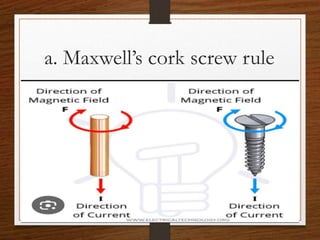
The direction of the screw
indicate direction of current
while the direction of force of
the thumb is the field lines of
force
a. Maxwell’s cork screw rule
b. Right hand grip rule
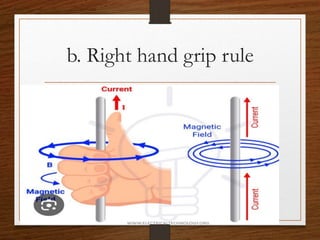
The direction of the thumb
indicate the current direction
while the rest of the fingers
points at the direction of the
magnetic field.
b. Right hand grip rule
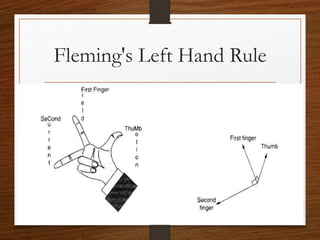
Fleming's Left Hand Rule
The thumb indication
direction of force, first finger
indicates magnetic field lines
force and the second finger
indicates current direction.
Fleming's Left Hand Rule
Current Conductor
The current carrying
conductor has magnetic field
around it.
This makes it experiences
some force when it passes
through magnets.
Current Conductor
To determine the direction of
force, Flemings left hand rule
is applied.
Next slide explains how this
rule is applied.
Fleming Left Hand Rule
a. Determine current direction
in the following diagrams;
Fleming Left Hand Rule
a. Determine direction of force
in the following diagrams;
Fleming Left Hand Rule
a. Determine magnetic poles in
the following diagrams;
Electromagnetic Induction
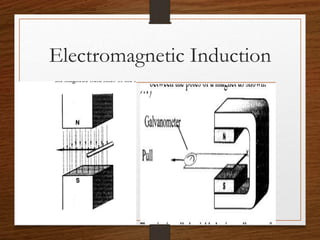
If current carrying conductor
cuts magnetic field e.m.f is
produced.
The principal is known as
electromagnetic induction.
Electromagnetic Induction
The amount of e.m.f depends
on;
1. Strength of magnet
2. Number of turns
3. Rate/speed
Laws of Electromagnetic
Induction
The Laws of Electromagnetic
Induction are;
1. Faraday’s law
2. Lenz’s law
1. Faraday’s law
This states that the magnitude
of the induced e.m.f in a
conductor is directly
proportional to speed of
motion a magnet.
2.Lenz’s law
This states that the induced e.m.f
is always acts to opposite to the
cause.
This means that induced current
flows in direction such that
opposes the change producing it.
Uses Electromagnets
Electromagnets are used in;
1. Electric motor
2. Loud speaker
3. Generator
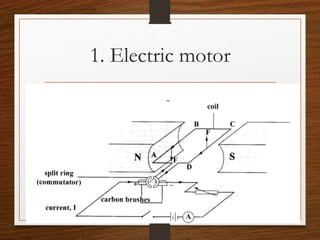
1. Electric motor
1. Electric motor
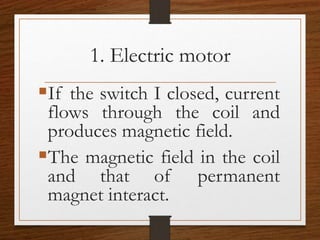
If the switch I closed, current
flows through the coil and
produces magnetic field.
The magnetic field in the coil
and that of permanent
magnet interact.
1. Electric motor
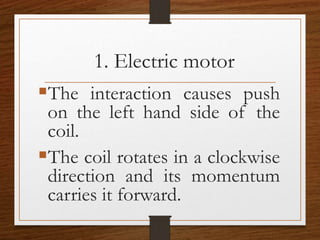
The interaction causes push
on the left hand side of the
coil.
The coil rotates in a clockwise
direction and its momentum
carries it forward.
1. Electric motor
The motor keeps on rotating
hence the motor effect.
The rotation can be reversed
by reversing current direction
.
2. Loud speaker
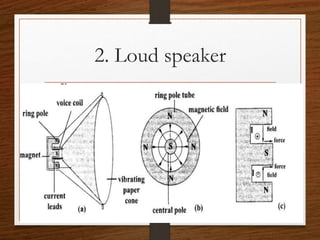
2. Loud speaker
If electric current is passed
through the coil, its
magnetic fields interferes
with that of magnet.
2. Loud speaker
This makes paper cone
vibrates and sound waves are
given out.
This is how moving coil loud
speaker produces sound
3. Generator
There are 2 types of
generators;
a. AC generator
b. DC generator
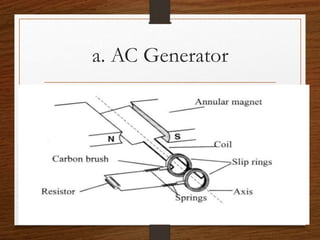
a. AC Generator
a. AC Generator
This is made up of a coil that
rotates around a magnet.
The coil rotates around
between the poles of magnet.
a. AC Generator
The coil cuts the magnetic field
hence inducing e.m.f /current.
The ac current is taken to
external circuit through
brushes.
a. AC Generator
The basic structure of ac
generator includes a coil and
two slip rings.
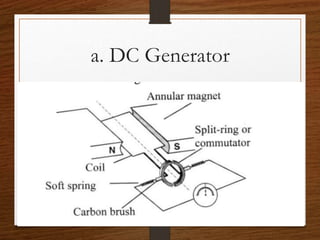
a. DC Generator
b. AC Generator
This is also made up of a coil
that rotates around a magnet.
The coil rotates around
between the poles of magnet.
b. AC Generator
The coil cuts the magnetic field
hence inducing e.m.f /current.
The dc current is taken to
external circuit through
brushes.
b. AC Generator
The basic structure of dc
generator includes a coil and
slip rings are replaced by split
ring commutator.
4.Moving Coil Microphone
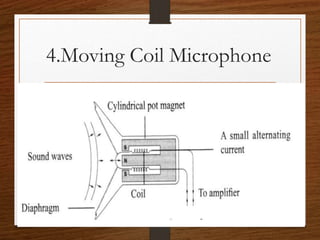
This is the moving coil
microphone is a device for
changing sound energy into
electrical energy.
4.Moving Coil Microphone
It has a diaphragm with alight
coil connected to it.
The coil is placed in between
two poles of magnet of a strong
cylindrical .
4.Moving Coil Microphone
If a person speaks through a
microphone, sound energy sets
diaphragm into vibrations.
This moves the coil back and
forth between magnetic poles.
4.Moving Coil Microphone
The process induces alternating
current that is amplified(made
larger) in the loud speaker.

TOPIC OF ELECTROMAGNETISM.PHYSICS NOTES FORM 4