1. Introduction
Theword “Polymer” is derived from two Greek words, “Poly” that means
many and “Meros” which means units or parts.
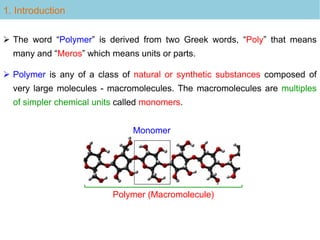
Polymer is any of a class of natural or synthetic substances composed of
very large molecules - macromolecules. The macromolecules are multiples
of simpler chemical units called monomers.
Monomer
Polymer (Macromolecule)
3.
1. Introduction
Mostnatural polymers are derived from plants and animals. For example, the
solid parts of all plants are made up of polymers.
Since the conclusion of World War II, the field of materials has been virtually
revolutionized by the advent of synthetic polymers. The synthetics can be
produced inexpensively, and their properties are superior to their natural
counterparts.
[https://www.britannica.com/science/polymer]
4.
2. Polymer structures
[MaterialsScience and Engineering: An Introduction]
Schematic representation of covalent
bonding in a molecule of methane (CH4)
2.1. Hydrocarbon molecules
Most polymers are organic in origin. Many organic materials are
hydrocarbons; that is, they are composed of hydrogen and carbon.
Furthermore, the intramolecular bonds are covalent;
A single covalent bond exists when each of the two bonding atoms
contributes one electron. Each carbon atom has four electrons that may
participate in covalent bonding, whereas every hydrogen atom has only one
bonding electron.
Ethane (C2H6)
5.
2. Polymer structures
Doublebond
(ethylene)
Triple bond ethyne (acetylene)
Hydrocarbons that have double or triple covalent bonds are termed
unsaturated because each carbon atom is not bonded to the maximum
(four) other atoms. For a saturated hydrocarbon, all bonds are single
covalent bonds.
There are hydrocarbons having double or triple covalent bonds in which two
bonding carbon atoms contribute two and three electrons, respectively.
[Materials Science and Engineering: An Introduction]
Methane, saturated hydrocarbon Ethylene, unsaturated hydrocarbon
6.
2. Polymer structures
[MaterialsScience and Engineering: An Introduction]
Low boiling point
Weak
interractions
between
molecules
(van der Waals)
Increasing boiling point
Some of the simple hydrocarbons belong to the paraffin family (CnH2n+2)
including methane (CH4), ethane (C2H6), propane (C3H8)...
Acyclic or open chain
hydrocarbons
2. Polymer structures
There are numerous other organic groups which may be involved in polymer
structures, where R and R’ represent organic groups such as CH3, C2H5, and C6H5
(methyl, ethyl, and phenyl).
[Materials Science and Engineering: An Introduction]
9.
2. Polymer structures
2.2.Polymer molecules
The polymer molecules are gigantic in comparison to the hydrocarbon molecules;
because of their size, they are often referred to as macromolecules.
[Materials Science and Engineering: An Introduction]
Repeat units for some common polymeric materials.
Poly(vinyl chloride)
(PVC)
Polypropylene
(PP)
Polystyrene (PS) Phenol-formaldehyde
(Bakelite)
Polyethylene (PE)
(a) Linear polymer
(b)Branched polymer
(c) Crosslinked polymer
(d) Network polymer
Molecular structure of polymers
2. Polymer structures
A polymer is highly crosslinked.
Linear chains are joined one to another by covalent
bonds.
Side-branch chains are connected to the main
ones.
Repeat units are joined together end to end in single
chains.
12.
2. Polymer structures
A homopolymer is a chain of chemically linked one type of repeated units
(monomers), whereas a copolymer chain can be chemically built of two or
more types of repeated units (monomers).
Homopolymer Copolymer
Repeated unit 1
Repeated Unit 2
A single polymer chain that has numerous random kinks and coils produced
by chain bond rotations.
[Materials Science and Engineering: An Introduction]
2. Polymer structures
Amorphus and semi-crystalline polymers.
Amorphus polymer
In the amorphous polymer, an ordering of the polymer chains is random.
In the semi-crystalline polymer, there are both amorphous regions and
highly crystalline domains. In the crystalline regions, the polymer chains
are organized and tightly packed.
Semi-crystalline
polymer
Amorphus
region
Crystalline
region
For linear and branched polymers
15.
Summary
Hydrocarbon molecules
Smallmolecules;
Carbon and hydrogen atoms bond
together by covalent bond;
Saturated and unsaturated
hydrocarbons
Acyclic, cyclic, and aromatic
hydrocarbons;
Polymer molecules
Very large molecules
(macromolecules);
Molecular structure: Linear,
branched, crosslinked, and network
polymers;
Polymer chain has numerous
random kinks and coils;
Amorphus and semi-crystalline
polymers;
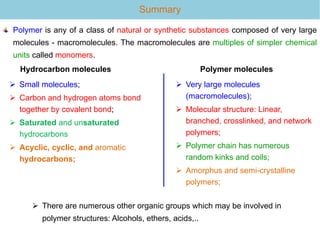
Polymer is any of a class of natural or synthetic substances composed of very large
molecules - macromolecules. The macromolecules are multiples of simpler chemical
units called monomers.
There are numerous other organic groups which may be involved in
polymer structures: Alcohols, ethers, acids,..
16.
3. Polymer properties
3.1.Mechanical properties
The mechanical properties of polymers are specified with many parameters including
Young’s modulus (modulus of elasticity), yield strength, and tensile strength.
For many polymeric materials, the simple stress–strain test is used to characterize
some of these mechanical parameters. Three typically different types of stress–strain
behavior are found for polymeric materials.
A brittle polymer
A plastic polymer
A elastic polymer
[Materials Science and Engineering: An Introduction]
TS : Tensile strength
𝜎𝑦: Yield strength
Schematic stress–strain curve for a
plastic polymer
stress–strain behavior for different
types of polymers
17.
3. Polymer properties
Polymers are, in many respects, mechanically dissimilar to metals:
The modulus for highly elastic polymeric materials may be as low as 7 MPa, but
may run as high as 4 GPa for some of the very stiff polymers; modulus values for
metals are much larger and range between 48 and 410 GPa.
Maximum tensile strengths for polymers are about 100 MPa - for some metal
alloys 4100 MPa. Whereas metals rarely elongate plastically to more than 100%,
some highly elastic polymers may experience elongations to greater than 1000%.
[https://msestudent.com/stress-strain-and-the-stress-strain-curve/]
18.
The mechanicalcharacteristics of polymers are highly sensitive to the rate of
deformation (strain rate), the temperature, and the chemical nature of the
environment (the presence of water, oxygen, organic solvents, etc.)
Stress–stretch curves of gels for
several extension rates [Adv. Mater.
2016, 28, 4678–4683]
The influence of temperature on
the stress–strain characteristics
of poly(methyl methacrylate).
[Materials Science and Engineering: An Introduction]
3. Polymer properties
19.
3. Polymer properties
3.2.General physical properties
Low density relative to metals and ceramics;
Low mechanical properties;
Poor temperature resistance;
Resistant to chemicals and corrosion;
Thermal and electrical insulators;
20.
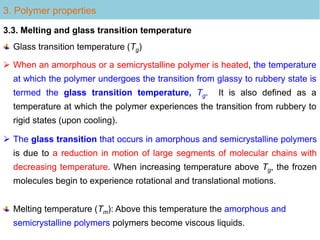
The glasstransition that occurs in amorphous and semicrystalline polymers
is due to a reduction in motion of large segments of molecular chains with
decreasing temperature. When increasing temperature above Tg, the frozen
molecules begin to experience rotational and translational motions.
3. Polymer properties
3.3. Melting and glass transition temperature
When an amorphous or a semicrystalline polymer is heated, the temperature
at which the polymer undergoes the transition from glassy to rubbery state is
termed the glass transition temperature, Tg. It is also defined as a
temperature at which the polymer experiences the transition from rubbery to
rigid states (upon cooling).
Glass transition temperature (Tg)
Melting temperature (Tm): Above this temperature the amorphous and
semicrystalline polymers polymers become viscous liquids.
21.
3. Polymer properties
Schematicrepresentation of the change of
specific volume of a polymer with
temperature [Plastics Technology Handbook]
Schematic representation of the
change of Young’s modulus of a
polymer with temperature
[https://www.youtube.com/watch?v=5lH_Xt2KUjA]
Amorphous
polymer
Semicrystalline
polymer
Perfectly
crystalline
material
Tg and Tm values of a polymer determine the temperature range in which
it can be employed.
4. Classification ofpolymers
Addition polymers
These polymers are formed by the
repeated addition of monomer
molecules. The polymer is formed by
polymerization of monomers with
double or triple bonds (unsaturated
compounds).
Repeating units
Ethylene Polyethylene (PE)
Condensation polymers
These polymers are formed by the
combination of monomers, with the
elimination of small molecules like
water, hydrogen, ammonia, etc.
[https://www.toppr.com/guides/chemistry/polymers/classification-of-polymers/]
4.4. Based on mode of polymerization
26.
5. Plastics -Synthetic polymers
Thermoplastics Thermosetting plastics
Thermoplastics are usually formed by
addition polymerization;
Thermosetting plastics are often formed
by condensation polymerization.
Usually becomes soften on heating
and stiffen on cooling;
It does not become soft on heating.
They are usually soft, weak, and less
brittle in nature;
They are usually hard, strong, and more
brittle in nature;
They can be recycled; They cannot be recycled;
Thermoplastics are linear or branched
polymers;
Thermosetting plastics are crosslinked
or network polymers.
Linear polymer Branched polymer Crosslinked polymer Network polymer
Plastics can be divided into thermoplastics and thermosetting plastics.
27.
Room-temperature mechanicalcharacteristics of some common plastics
[Materials Science and Engineering: An Introduction]
5. Plastics - Synthetic polymers
Thermoset
5. Plastics -Synthetic polymers
[https://slideplayer.com/slide/8752012/]
Applications of thermosetting plastics
30.
6. Thermoplastics
6.1. Somecommonly used thermoplastics
Amorphous thermoplastics
Polymethyl methacrylate (PMMA)
Polystyrene (PS)
Polycarbonate (PC)
Polyvinyl chloride (PVC)
Aacrylonitrile butadiene styrene (ABS)
Semicrystalline thermoplastics
Polyethelyne (PE)
Polypropylene (PP)
Polybutylene terephthalate (PBT)
Polyethylene terephthalate (PET)
Polyetheretherketone (PEEK)
Pros:
Better dimensional stability than
semicrystalline plastics, during process;
Excellent resistance to hot water and steam;
Good stiffness and strength;
Cons:
Sensitive to stress cracking;
Lower chemical resistance and higher
friction than semicrystalline materials;
Pros:
Very good stiffness and strength, good
toughness;
Very low coefficient of friction;
Extremely well in applications involving
wear, bearings, and structural loads;
Excellent chemical resistance;
Cons:
More shrinkage ratio, results in
dimensional instability, during process;
[https://www.essentracomponents.com/en-gb/news/product-resources/the-difference-between-amorphous-and-semi-crystalline-plastics]
31.
6. Thermoplastics
TheSPI code is a set of symbols placed on plastics to identify the polymer type. It
was developed by the Society of the Plastics Industry in 1988, and is used
internationally. The primary purpose of the codes is to allow efficient seperation of
different polymer types for recycling.
https://www.youtube.com/watch?v=jJlqyTb-oy0
32.
List ofcommercial thermoplastics
6. Thermoplastics
6. Thermoplastics
6.3. Thermoplasticadditives
Substances called additives are intentionally introduced to enhance or modify many of
these properties of thermoplastics, and thus render their more serviceable. Typical
additives include filler materials, plasticizers, stabilizers, colorants, and flame retardants.
Filler
Filler materials are usually added to thermoplastics to improve their properties
such as tensile and compressive strengths, abrasion resistance, toughness,
dimensional and thermal stability,…
Materials used as particulate fillers include wood flour (finely powdered sawdust),
glass, clay, talc, limestone, and even some synthetic polymers. Particle sizes range
all the way from 10 nm to macroscopic dimensions.
Thermoplastics containing fillers may also be classified as composite materials.
Often the fillers are inexpensive materials that replace some volume of the more
expensive polymer, reducing the cost of the final product.
[Materials Science and Engineering: An Introduction]
35.
Plasticizers
Additives thatcan enhance the flexibility, ductility, and toughness of thermoplastics are
called plasticizers. Their presence also produces reductions in hardness and stiffness.
Plasticizers are generally liquids having low vapor pressures and low molecular
weights. The small plasticizer molecules occupy positions between the large
polymer chains, effectively increasing the interchain distance with a reduction in the
secondary intermolecular bonding.
Plasticizers are commonly used in materials that are intrinsically brittle at room
temperature, such as poly(vinyl chloride) and some of the acetate copolymers.
6. Thermoplastics
[Materials Science and Engineering: An Introduction]
36.
Stabilizers
Somepolymeric materials, under normal environmental conditions, are subject to
rapid deterioration, generally in terms of mechanical integrity. Additives that
counteract deteriorative processes are called stabilizers.
One common form of deterioration results from exposure to light [in particular
ultraviolet (UV) radiation]. Ultraviolet radiation interacts with and causes a
severance of some of the covalent bonds along the molecular chains.
Another important type of deterioration is oxidation. It is a consequence of the
chemical interaction between oxygen [as either diatomic oxygen (O2) or ozone (O3)]
and the polymer molecules.
6. Thermoplastics
[Materials Science and Engineering: An Introduction]
37.
6. Thermoplastics
Colorants
Colorants impart a specific color to a polymer; they may be added in the form of
dyes or pigments. The molecules in a dye actually dissolve in the polymer.
Pigments are filler materials that do not dissolve, but remain as a separate phase;
normally they have a small particle size and a refractive index near that of the parent
polymer. Others may impart opacity as well as color to the polymer.
[Materials Science and Engineering: An Introduction]
38.
6. Thermoplastics
FlameRetardants
The flammability resistance of the remaining combustible polymers may be
enhanced by additives called flame retardants.
These retardants may function by interfering with the combustion process through
the gas phase, or by initiating a different combustion reaction that generates less
heat, thereby reducing the temperature; this causes a slowing or cessation of burning.
[Materials Science and Engineering: An Introduction]
6. Thermoplastics
Injectionmolding: Injection molding is the most widely used technique for fabricating
thermoplastic materials.
The correct amount of pelletized material is fed from a feed hopper into a cylinder
by the motion of a plunger or ram. This charge is pushed forward into a heating
chamber
The thermoplastic material melts to form a viscous liquid. Next, the molten plastic is
impelled, again by ram motion, through a nozzle into the enclosed mold cavity;
pressure is maintained until the molding has solidified.
Finally, the mold is opened, the piece is ejected, the mold is closed, and the entire
cycle is repeated.
Schematic diagram of an injection
molding apparatus.
Extrusion takesplace as this molten mass is forced through a die orifice.
Solidification of the extruded length is expedited by blowers, a water spray, or bath.
The technique is especially adapted to producing continuous lengths having constant
cross-sectional geometries - for example, rods, tubes, hose channels, sheets, and
filaments.
6. Thermoplastics
Extrusion molding: The extrusion process is the molding of a viscous thermoplastic
under pressure through an open-ended die.
Schematic diagram of an extruder
6. Thermoplastics
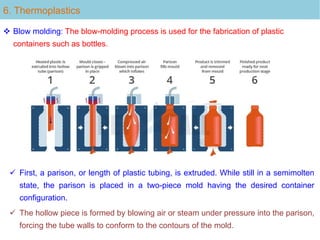
Blowmolding: The blow-molding process is used for the fabrication of plastic
containers such as bottles.
First, a parison, or length of plastic tubing, is extruded. While still in a semimolten
state, the parison is placed in a two-piece mold having the desired container
configuration.
The hollow piece is formed by blowing air or steam under pressure into the parison,
forcing the tube walls to conform to the contours of the mold.

![1. Introduction
Most natural polymers are derived from plants and animals. For example, the
solid parts of all plants are made up of polymers.
Since the conclusion of World War II, the field of materials has been virtually
revolutionized by the advent of synthetic polymers. The synthetics can be
produced inexpensively, and their properties are superior to their natural
counterparts.
[https://www.britannica.com/science/polymer]](https://image.slidesharecdn.com/topic6-250402144754-2b75523d/85/Topic-6-POLYMERIC-MATERIALS-grrrrtttty-3-320.jpg)
![2. Polymer structures
[Materials Science and Engineering: An Introduction]
Schematic representation of covalent
bonding in a molecule of methane (CH4)
2.1. Hydrocarbon molecules
Most polymers are organic in origin. Many organic materials are
hydrocarbons; that is, they are composed of hydrogen and carbon.
Furthermore, the intramolecular bonds are covalent;
A single covalent bond exists when each of the two bonding atoms
contributes one electron. Each carbon atom has four electrons that may
participate in covalent bonding, whereas every hydrogen atom has only one
bonding electron.
Ethane (C2H6)](https://image.slidesharecdn.com/topic6-250402144754-2b75523d/85/Topic-6-POLYMERIC-MATERIALS-grrrrtttty-4-320.jpg)
![2. Polymer structures
Double bond
(ethylene)
Triple bond ethyne (acetylene)
Hydrocarbons that have double or triple covalent bonds are termed
unsaturated because each carbon atom is not bonded to the maximum
(four) other atoms. For a saturated hydrocarbon, all bonds are single
covalent bonds.
There are hydrocarbons having double or triple covalent bonds in which two
bonding carbon atoms contribute two and three electrons, respectively.
[Materials Science and Engineering: An Introduction]
Methane, saturated hydrocarbon Ethylene, unsaturated hydrocarbon](https://image.slidesharecdn.com/topic6-250402144754-2b75523d/85/Topic-6-POLYMERIC-MATERIALS-grrrrtttty-5-320.jpg)
![2. Polymer structures
[Materials Science and Engineering: An Introduction]
Low boiling point
Weak
interractions
between
molecules
(van der Waals)
Increasing boiling point
Some of the simple hydrocarbons belong to the paraffin family (CnH2n+2)
including methane (CH4), ethane (C2H6), propane (C3H8)...
Acyclic or open chain
hydrocarbons](https://image.slidesharecdn.com/topic6-250402144754-2b75523d/85/Topic-6-POLYMERIC-MATERIALS-grrrrtttty-6-320.jpg)

![2. Polymer structures
There are numerous other organic groups which may be involved in polymer
structures, where R and R’ represent organic groups such as CH3, C2H5, and C6H5
(methyl, ethyl, and phenyl).
[Materials Science and Engineering: An Introduction]](https://image.slidesharecdn.com/topic6-250402144754-2b75523d/85/Topic-6-POLYMERIC-MATERIALS-grrrrtttty-8-320.jpg)
![2. Polymer structures
2.2. Polymer molecules
The polymer molecules are gigantic in comparison to the hydrocarbon molecules;
because of their size, they are often referred to as macromolecules.
[Materials Science and Engineering: An Introduction]
Repeat units for some common polymeric materials.
Poly(vinyl chloride)
(PVC)
Polypropylene
(PP)
Polystyrene (PS) Phenol-formaldehyde
(Bakelite)
Polyethylene (PE)](https://image.slidesharecdn.com/topic6-250402144754-2b75523d/85/Topic-6-POLYMERIC-MATERIALS-grrrrtttty-9-320.jpg)
![2. Polymer structures
2.2. Polymer molecules
[Materials Science and Engineering: An Introduction]](https://image.slidesharecdn.com/topic6-250402144754-2b75523d/85/Topic-6-POLYMERIC-MATERIALS-grrrrtttty-10-320.jpg)

![2. Polymer structures
A homopolymer is a chain of chemically linked one type of repeated units
(monomers), whereas a copolymer chain can be chemically built of two or
more types of repeated units (monomers).
Homopolymer Copolymer
Repeated unit 1
Repeated Unit 2
A single polymer chain that has numerous random kinks and coils produced
by chain bond rotations.
[Materials Science and Engineering: An Introduction]](https://image.slidesharecdn.com/topic6-250402144754-2b75523d/85/Topic-6-POLYMERIC-MATERIALS-grrrrtttty-12-320.jpg)
![[DOI:10.3390/ijms10125135]
2. Polymer structures
Average length of polymers (molecules).
Schematic comparing the relevant length scales in materials science.](https://image.slidesharecdn.com/topic6-250402144754-2b75523d/85/Topic-6-POLYMERIC-MATERIALS-grrrrtttty-13-320.jpg)

![3. Polymer properties
3.1. Mechanical properties
The mechanical properties of polymers are specified with many parameters including
Young’s modulus (modulus of elasticity), yield strength, and tensile strength.
For many polymeric materials, the simple stress–strain test is used to characterize
some of these mechanical parameters. Three typically different types of stress–strain
behavior are found for polymeric materials.
A brittle polymer
A plastic polymer
A elastic polymer
[Materials Science and Engineering: An Introduction]
TS : Tensile strength
𝜎𝑦: Yield strength
Schematic stress–strain curve for a
plastic polymer
stress–strain behavior for different
types of polymers](https://image.slidesharecdn.com/topic6-250402144754-2b75523d/85/Topic-6-POLYMERIC-MATERIALS-grrrrtttty-16-320.jpg)
![3. Polymer properties
Polymers are, in many respects, mechanically dissimilar to metals:
The modulus for highly elastic polymeric materials may be as low as 7 MPa, but
may run as high as 4 GPa for some of the very stiff polymers; modulus values for
metals are much larger and range between 48 and 410 GPa.
Maximum tensile strengths for polymers are about 100 MPa - for some metal
alloys 4100 MPa. Whereas metals rarely elongate plastically to more than 100%,
some highly elastic polymers may experience elongations to greater than 1000%.
[https://msestudent.com/stress-strain-and-the-stress-strain-curve/]](https://image.slidesharecdn.com/topic6-250402144754-2b75523d/85/Topic-6-POLYMERIC-MATERIALS-grrrrtttty-17-320.jpg)
![ The mechanical characteristics of polymers are highly sensitive to the rate of
deformation (strain rate), the temperature, and the chemical nature of the
environment (the presence of water, oxygen, organic solvents, etc.)
Stress–stretch curves of gels for
several extension rates [Adv. Mater.
2016, 28, 4678–4683]
The influence of temperature on
the stress–strain characteristics
of poly(methyl methacrylate).
[Materials Science and Engineering: An Introduction]
3. Polymer properties](https://image.slidesharecdn.com/topic6-250402144754-2b75523d/85/Topic-6-POLYMERIC-MATERIALS-grrrrtttty-18-320.jpg)

![3. Polymer properties
Schematic representation of the change of
specific volume of a polymer with
temperature [Plastics Technology Handbook]
Schematic representation of the
change of Young’s modulus of a
polymer with temperature
[https://www.youtube.com/watch?v=5lH_Xt2KUjA]
Amorphous
polymer
Semicrystalline
polymer
Perfectly
crystalline
material
Tg and Tm values of a polymer determine the temperature range in which
it can be employed.](https://image.slidesharecdn.com/topic6-250402144754-2b75523d/85/Topic-6-POLYMERIC-MATERIALS-grrrrtttty-21-320.jpg)

![Classification of polymers
Natural
polymers
Semi-
synthetic
polymers
synthetic
polymers
Based on origin
Linear
polymers
Branched
chain
polymers
Crosslinked/
Network
polymers
Based on
molecular
structure
Elastomers
Fibers
Thermoplastics
Thermosetting
plastics
Based on
molecular forces
Addition
polymers
Condensation
polymers
Based on
mode of
polymerization
[Molecules 2017, 22, 790; doi:10.3390/molecules22050790]
5. Plastics - Synthetic polymers
Plastics](https://image.slidesharecdn.com/topic6-250402144754-2b75523d/85/Topic-6-POLYMERIC-MATERIALS-grrrrtttty-23-320.jpg)
![ Plastics, a group of synthetic polymers, are usually derived from petroleum
oil.
5. Plastics - Synthetic polymers
A representation of some polymers derived from raw materials such as crude oil.
[Adapted, by permission, from Anthony L. Andrady, Plastics and the Environment, © 2003 John Wiley & Sons, Inc.]](https://image.slidesharecdn.com/topic6-250402144754-2b75523d/85/Topic-6-POLYMERIC-MATERIALS-grrrrtttty-24-320.jpg)
![4. Classification of polymers
Addition polymers
These polymers are formed by the
repeated addition of monomer
molecules. The polymer is formed by
polymerization of monomers with
double or triple bonds (unsaturated
compounds).
Repeating units
Ethylene Polyethylene (PE)
Condensation polymers
These polymers are formed by the
combination of monomers, with the
elimination of small molecules like
water, hydrogen, ammonia, etc.
[https://www.toppr.com/guides/chemistry/polymers/classification-of-polymers/]
4.4. Based on mode of polymerization](https://image.slidesharecdn.com/topic6-250402144754-2b75523d/85/Topic-6-POLYMERIC-MATERIALS-grrrrtttty-25-320.jpg)

![ Room-temperature mechanical characteristics of some common plastics
[Materials Science and Engineering: An Introduction]
5. Plastics - Synthetic polymers
Thermoset](https://image.slidesharecdn.com/topic6-250402144754-2b75523d/85/Topic-6-POLYMERIC-MATERIALS-grrrrtttty-27-320.jpg)
![[https://slideplayer.com/slide/8752012/]
Some applications of thermoplastics
5. Plastics - Synthetic polymers](https://image.slidesharecdn.com/topic6-250402144754-2b75523d/85/Topic-6-POLYMERIC-MATERIALS-grrrrtttty-28-320.jpg)
![5. Plastics - Synthetic polymers
[https://slideplayer.com/slide/8752012/]
Applications of thermosetting plastics](https://image.slidesharecdn.com/topic6-250402144754-2b75523d/85/Topic-6-POLYMERIC-MATERIALS-grrrrtttty-29-320.jpg)
![6. Thermoplastics
6.1. Some commonly used thermoplastics
Amorphous thermoplastics
Polymethyl methacrylate (PMMA)
Polystyrene (PS)
Polycarbonate (PC)
Polyvinyl chloride (PVC)
Aacrylonitrile butadiene styrene (ABS)
Semicrystalline thermoplastics
Polyethelyne (PE)
Polypropylene (PP)
Polybutylene terephthalate (PBT)
Polyethylene terephthalate (PET)
Polyetheretherketone (PEEK)
Pros:
Better dimensional stability than
semicrystalline plastics, during process;
Excellent resistance to hot water and steam;
Good stiffness and strength;
Cons:
Sensitive to stress cracking;
Lower chemical resistance and higher
friction than semicrystalline materials;
Pros:
Very good stiffness and strength, good
toughness;
Very low coefficient of friction;
Extremely well in applications involving
wear, bearings, and structural loads;
Excellent chemical resistance;
Cons:
More shrinkage ratio, results in
dimensional instability, during process;
[https://www.essentracomponents.com/en-gb/news/product-resources/the-difference-between-amorphous-and-semi-crystalline-plastics]](https://image.slidesharecdn.com/topic6-250402144754-2b75523d/85/Topic-6-POLYMERIC-MATERIALS-grrrrtttty-30-320.jpg)


![6. Thermoplastics
6. Thermoplastics
6.2. Tg and Tm of some common thermoplastics
[Plastics Technology Handbook]](https://image.slidesharecdn.com/topic6-250402144754-2b75523d/85/Topic-6-POLYMERIC-MATERIALS-grrrrtttty-33-320.jpg)
![6. Thermoplastics
6.3. Thermoplastic additives
Substances called additives are intentionally introduced to enhance or modify many of
these properties of thermoplastics, and thus render their more serviceable. Typical
additives include filler materials, plasticizers, stabilizers, colorants, and flame retardants.
Filler
Filler materials are usually added to thermoplastics to improve their properties
such as tensile and compressive strengths, abrasion resistance, toughness,
dimensional and thermal stability,…
Materials used as particulate fillers include wood flour (finely powdered sawdust),
glass, clay, talc, limestone, and even some synthetic polymers. Particle sizes range
all the way from 10 nm to macroscopic dimensions.
Thermoplastics containing fillers may also be classified as composite materials.
Often the fillers are inexpensive materials that replace some volume of the more
expensive polymer, reducing the cost of the final product.
[Materials Science and Engineering: An Introduction]](https://image.slidesharecdn.com/topic6-250402144754-2b75523d/85/Topic-6-POLYMERIC-MATERIALS-grrrrtttty-34-320.jpg)
![ Plasticizers
Additives that can enhance the flexibility, ductility, and toughness of thermoplastics are
called plasticizers. Their presence also produces reductions in hardness and stiffness.
Plasticizers are generally liquids having low vapor pressures and low molecular
weights. The small plasticizer molecules occupy positions between the large
polymer chains, effectively increasing the interchain distance with a reduction in the
secondary intermolecular bonding.
Plasticizers are commonly used in materials that are intrinsically brittle at room
temperature, such as poly(vinyl chloride) and some of the acetate copolymers.
6. Thermoplastics
[Materials Science and Engineering: An Introduction]](https://image.slidesharecdn.com/topic6-250402144754-2b75523d/85/Topic-6-POLYMERIC-MATERIALS-grrrrtttty-35-320.jpg)
![ Stabilizers
Some polymeric materials, under normal environmental conditions, are subject to
rapid deterioration, generally in terms of mechanical integrity. Additives that
counteract deteriorative processes are called stabilizers.
One common form of deterioration results from exposure to light [in particular
ultraviolet (UV) radiation]. Ultraviolet radiation interacts with and causes a
severance of some of the covalent bonds along the molecular chains.
Another important type of deterioration is oxidation. It is a consequence of the
chemical interaction between oxygen [as either diatomic oxygen (O2) or ozone (O3)]
and the polymer molecules.
6. Thermoplastics
[Materials Science and Engineering: An Introduction]](https://image.slidesharecdn.com/topic6-250402144754-2b75523d/85/Topic-6-POLYMERIC-MATERIALS-grrrrtttty-36-320.jpg)
![6. Thermoplastics
Colorants
Colorants impart a specific color to a polymer; they may be added in the form of
dyes or pigments. The molecules in a dye actually dissolve in the polymer.
Pigments are filler materials that do not dissolve, but remain as a separate phase;
normally they have a small particle size and a refractive index near that of the parent
polymer. Others may impart opacity as well as color to the polymer.
[Materials Science and Engineering: An Introduction]](https://image.slidesharecdn.com/topic6-250402144754-2b75523d/85/Topic-6-POLYMERIC-MATERIALS-grrrrtttty-37-320.jpg)
![6. Thermoplastics
Flame Retardants
The flammability resistance of the remaining combustible polymers may be
enhanced by additives called flame retardants.
These retardants may function by interfering with the combustion process through
the gas phase, or by initiating a different combustion reaction that generates less
heat, thereby reducing the temperature; this causes a slowing or cessation of burning.
[Materials Science and Engineering: An Introduction]](https://image.slidesharecdn.com/topic6-250402144754-2b75523d/85/Topic-6-POLYMERIC-MATERIALS-grrrrtttty-38-320.jpg)


![Injection Molding Animation
[https://www.youtube.com/watch?v=b1U9W4iNDiQ]
6. Thermoplastics](https://image.slidesharecdn.com/topic6-250402144754-2b75523d/85/Topic-6-POLYMERIC-MATERIALS-grrrrtttty-41-320.jpg)

![6. Thermoplastics
[https://www.youtube.com/watch?v=Tp2Rdx69SSo]](https://image.slidesharecdn.com/topic6-250402144754-2b75523d/85/Topic-6-POLYMERIC-MATERIALS-grrrrtttty-43-320.jpg)
![6. Thermoplastics
[https://www.youtube.com/watch?v=NE4c1gwzPb4]](https://image.slidesharecdn.com/topic6-250402144754-2b75523d/85/Topic-6-POLYMERIC-MATERIALS-grrrrtttty-45-320.jpg)


![Chapter-5-Polymer Structure.pptx [Repaired] (2) - Copy.pptx](https://cdn.slidesharecdn.com/ss_thumbnails/chapter-5-polymerstructure-241212162459-7e1e6e86-thumbnail.jpg?width=640&height=640&fit=bounds)


![YB TUTHBHRNJYBGRVTGRYKBTGVYBYRBYTBTYBYT Lecture Notes 03 [Polymers].pdf](https://cdn.slidesharecdn.com/ss_thumbnails/chem20024lecturenotes03polymers-251208185344-1d609d9b-thumbnail.jpg?width=640&height=640&fit=bounds)


