Chapter 5
Polymer Structure
1
Adama Science and Technology University,
Materials Science and Engineering Department
Topics
:1. : Introduction
2. : Hydrocarbon Molecules
3. : Polymer Molecules
4. : The Chemistry of Polymer
Molecules
5. : Molecular Weight
6. : Molecular Shape
7. : Molecular Structure
8. : Molecular Configurations
9. : Thermoplastic and Thermosetting polymer
2
Adama Science and Technology University,
Science and Engineering Department
Materials
Cont’d…
Polymers
10. : Copolymers
11. : Polymer Crystallinity
12.: Polymer Crystals
5.13: Defects in Polymers
5.14: Diffusion in
Polymeric Materials
Adama Science and Technology University,
Materials Science and Engineering
Department
3
Cont’d…
 WHY STUDY Polymer Structures?
• A relatively large number of chemical and structural
characteristics affect the properties and behaviors of polymeric
materials. Some of these influences are as follows:
1. Degree of crystallinity of semicrystalline polymers— on density,
stiffness, strength, and ductility
2. Degree of crosslinking—on the stiffness of rubberlike materials
3. Polymer chemistry—on melting and glass-transition temperatures
Adama Science and Technology University,
Materials Science and Engineering Department 4
Adama Science and Technology University,
Materials Science and Engineering
Department
5
Learning Objectives
• After careful study of this chapter you should be able to do the
following:
 Describe a typical polymer molecule in terms of its chain structure
and, in addition, how the molecule may be generated from repeat
units.
 Draw repeat units for polyethylene, poly(vinyl chloride),
polytetrafluoroethylene (PTFE), polypropylene, and polystyrene.
 Calculate number–average and weight–average molecular weights,
and degree of polymerization for a specified polymer.
 Name and briefly describe:
(a) the four general types of polymer molecular Structure
(b) the three types of stereoisomers,
Adama Science and Technology University,
Materials Science and Engineering
Department
6
Cont’d…
(c) the two kinds of geometrical isomers,
(d) the four types of copolymers.
 Cite the differences in behavior and molecular structure
for thermoplastic and thermosetting polymers.
 Briefly describe the crystalline state in polymeric materials.
 Briefly describe/diagram the spherulitic structure for a semicrystalline
polymer.
5.1: Introduction
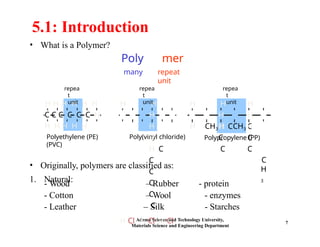
• What is a Polymer?
Polyethylene (PE) Poly(vinyl chloride)
(PVC)
• Originally, polymers are classified as:
1. Natural:
- Wood – Rubber - protein
- Cotton – Wool - enzymes
- Leather – Silk - Starches
Adama Science and Technology University,
Materials Science and Engineering Department
7
Poly
many
mer
repeat
unit
H H H H H H
C C C C C C H
H H H H H
repea
t
unit H H
H
H
H
H C
C
C
C
C
C
H Cl H Cl H Cl
repea
t
unit H H H
H H
H C C
C C
C C
C
H
3
H CH3 H CH3 H
Polypropylene (PP)
repea
t
unit
Cont’d…
2. Synthetic (manmade) –
- Plastic
- Rubber
- Fiber
5.2: Hydrocarbon Molecules
• Most polymers are organic and many organic materials
are hydrocarbons.
Saturated hydrocarbons
• Each carbon singly bonded to four other atoms
• Example: Ethane, C2H6 H
H
H
H
C C
H
H
Adama Science and Technology University,
Materials Science and Engineering
Department
8
• Double & triple bonds somewhat unstable – can form new bonds
• Double bond found in ethylene or ethene - C2H4
H H
C C
H H
• Triple bond found in acetylene or ethyne - C2H2
H
C
C
H
Isomerism
formula can have quite
different structures.
Unsaturated hydrocarbons
Adama Science and Technology University,
Materials Science and Engineering
Department
9
Cont’d…
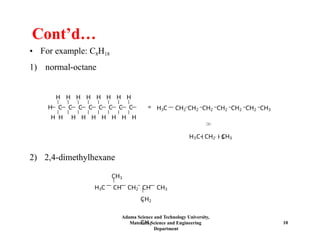
• For example: C8H18
1) normal-octane
2) 2,4-dimethylhexane
H H H H H H H H
H C C C C C C C C
H H H H H H H H H
H3C CH2 CH2 CH2 CH2 CH2 CH2 CH3

=
H3C ( CH2 ) CH3
6
CH3
H3C CH CH2 CH CH3
CH2
CH3
Adama Science and Technology University,
Materials Science and Engineering
Department
10
Adama Science and Technology University,
Materials Science and Engineering Department
11
5.3: Polymer Molecules
• The molecules in polymers are gigantic in comparison to
the hydrocarbon molecules and often referred to as
macromolecules.
• The long molecules in polymer are composed of structural
entities called repeat units.
• The term monomer refers to the small molecule from which a polymer
is synthesized.
5.4: The Chemistry Of Polymer Molecules
• The active site, or unpaired electron (denoted by . –
initiators.),is transferred to each successive end monomer to form the
chain.
• Ethylene transform to polyethylene (solid) by forming active
mer through reaction with initiator or catalytic radical (R.)
• (.) denotes unpaired electron (active site)
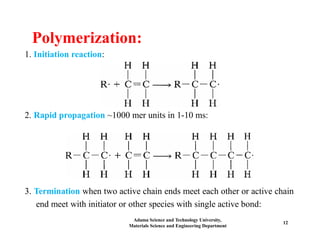
Polymerization:
1. Initiation reaction:
2. Rapid propagation ~1000 mer units in 1-10 ms:
3. Termination when two active chain ends meet each other or active chain
end meet with initiator or other species with single active bond:
Adama Science and Technology University,
Materials Science and Engineering Department
12
Cont’d…
• When all mers are the same, the molecule is called a homopolymer.
• When there is more than one type of mer present, the molecule is a
copolymer.
• Mer units that have 2 active bonds to connect with other mers are
called bifunctional
• Mer units that have 3 active bonds to connect with other mers are
called trifunctional. They form three-dimensional molecular
network structures
Adama Science and Technology University,
Materials Science and Engineering
Department
14
Cont’d…
Adama Science and Technology University,
Materials Science and Engineering Department
15
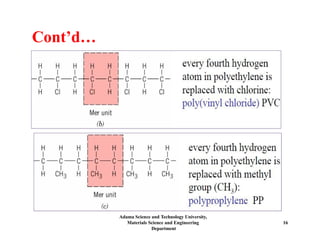
Cont’d…
Adama Science and Technology University,
Materials Science and Engineering
Department
16
Bulk or Commodity Polymers
17
Adama Science and Technology University,
Materials Science and Engineering Department
Cont’d…
Adama Science and Technology University,
Materials Science and Engineering Department 18
Cont’d . . .
Adama Science and Technology University,
Materials Science and Engineering Department
19
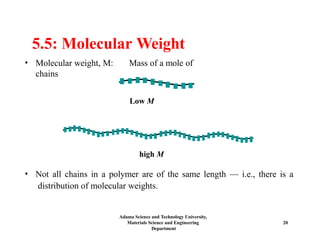
5.5: Molecular Weight
• Molecular weight, M: Mass of a mole of
chains
high M
• Not all chains in a polymer are of the same length — i.e., there is a
distribution of molecular weights.
Adama Science and Technology University,
Materials Science and Engineering
Department
20
Low M
Molecular Weight Distribution
21
M n 
total
wt of polymer
total # of
molecules
M n   xi Mi
M w   wi
Mi
is the number average molecular weight
A weight-average molecular weight
Mi = mean (middle) molecular weight
of size range i xi = number fraction of chains
in size range i
wi = weight fraction of chains in size range i
Adama Science and Technology University,
Degree of Polymerization, DP
• DP = average number of repeat units per chain
H H H H H H H
C C C
C C C
C H H H
H H H
H H
H H H
H H
H C C
( C C ) C H H
H H
H
DP = 6
DP 
Mn
for copolymers this is calculated as
follows:
m  fi mi
m
where m  average molecular weight of repeat
unit
mol. wt of repeat
unit i
Chain
fraction
Adama Science and Technology University,
Materials Science and Engineering
Department
21
5.6: Molecular Shape
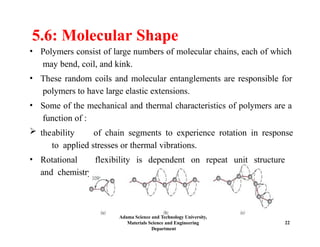
• Polymers consist of large numbers of molecular chains, each of which
may bend, coil, and kink.
• These random coils and molecular entanglements are responsible for
polymers to have large elastic extensions.
• Some of the mechanical and thermal characteristics of polymers are a
function of :
 theability of chain segments to experience rotation in response
to applied stresses or thermal vibrations.
• Rotational flexibility is dependent on repeat unit structure
and chemistry.
Adama Science and Technology University,
Materials Science and Engineering
Department
22
Chain End-to-End Distance, r
Adama Science and Technology University,
Materials Science and Engineering Department
25
26
Adama Science and Technology University,
Materials Science and Engineering
Department
• The physical characteristics of a polymer depend on:
 molecular weight
 shape and also
 on differences in the structure of the molecular chains.
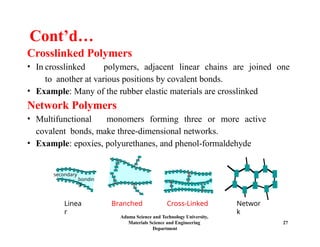
Linear Polymers
• Linear polymers are those in which the repeat units are
joined together end to end in single chains.
polystyrene,
• Example: polyethylene, poly(vinyl chloride),
poly(methyl methacrylate), nylon, and the
fluorocarbons.
Branched Polymers
• Polymers may be synthesized in which side-branch chains
are connected to the main ones.
• Example: low density polyethylene (LDPE)
5.7: Molecular Structure
Cont’d…
Crosslinked Polymers
• In crosslinked polymers, adjacent linear chains are joined one
to another at various positions by covalent bonds.
• Example: Many of the rubber elastic materials are crosslinked
Network Polymers
• Multifunctional monomers forming three or more active
covalent bonds, make three-dimensional networks.
• Example: epoxies, polyurethanes, and phenol-formaldehyde
Branched Cross-Linked
Adama Science and Technology University,
Materials Science and Engineering
Department
27
Networ
k
Linea
r
secondary
bondin
g
5.8: Molecular Configurations
• Consider the repeat unit
in which R represents an atom or side group other than hydrogen (e.g.,
Cl, CH3).
• One arrangement is possible when the R side groups of
successive repeat units are bound to alternate carbon atoms as follows:
• This is designated as a head-to-tail configuration.
Adama Science and Technology University,
Materials Science and Engineering Department
28
Cont’d…
• Its complement, the head-to-head configuration, occurs when R groups
are bound to adjacent chain atoms:
• Isomerism is also found in polymer molecules, wherein different
atomic configurations are possible for the same composition.
• Two isomeric subclasses: stereoisomerism and geometrical isomerism.
Stereoisomerism
• Stereoisomerism denotes the situation in which atoms are linked
together in the same order (head-to-tail) but differ in their spatial
arrangement.
Adama Science and Technology University,
Materials Science and Engineering
Department
27
Cont’d…
C C
H
H
H R
H
H
C C
H R
o
r
H R
C C
H
H
C
E
B
A
D
C
D
A
B
E
mirror plane
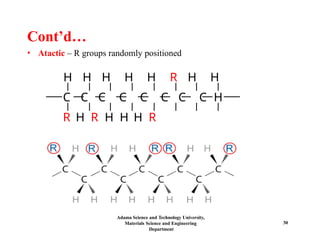
Tacticity
Tacticity – stereoregularity or spatial arrangement of R units
along chain
Stereoisomers are mirror images
– can’t superimpose
without breaking a bond
Adama Science and Technology University,
Materials Science and Engineering
Department
28
Cont’d…
same side
Isotactic
• all R groups on
of chain
Syndiotactic
• R groups alternate
sides
H R H R H R H R
H H H H
H H H
H C C C
C C C
C C
H H H R H H H R
C C C C C C C C H
R H H H R H H
Adama Science and Technology University,
Materials Science and Engineering
Department
29
Cont’d…
• Atactic – R groups randomly positioned
H H H H H R H H
C C C C C C C C H
R H R H H H R
Adama Science and Technology University,
Materials Science and Engineering
Department
30
Geometrical Isomerism
• Geometrical isomers, are possible within repeat units having a double
bond between chain carbon atoms.
• Bonded to each of the carbon atoms participating in the double bond is
a side group, which may be situated on:
i. one side of the chain (cis-) or
ii. its opposite (trans-)
C C
CH3
H
CH2 CH2
C C
CH3
CH2
H
CH2
cis
cis-isoprene (natural rubber)
H atom and CH3 group on same
side of chain
trans
trans-isoprene (gutta
percha) H atom and CH3
group on opposite sides of
chain
Adama Science and Technology University,
Materials Science and Engineering
Department
31
Figure 5.3: Classification scheme for the characteristics of polymer molecules
Adama Science and Technology University,
Materials Science and Engineering
Department
32
Adama Science and Technology University,
Materials Science and Engineering
Department
33
5.9: Thermoplastic And Thermosetting
Polymers
 Thermoplastic
 soften when heated and
harden when cooled
 Are totally reversible
 are relatively soft
 flexible linear & branched
polymers belongs to this group
 Are fabricated by the
simultaneous application of heat
and pressure
• Examples:
polystyrene,
terephthalate),
chloride).
polyethylene,
poly(ethylene
and
poly(vinyl
• Thermosetting
 are network polymers
 become
permanently during
their formation
 do not soften upon
heating
hard
 aregenerally harder
and stronger than
thermoplastics
 have better dimensional stability
• Example: vulcanized
rubbers, epoxies,
phenolics
and some
polyester resins
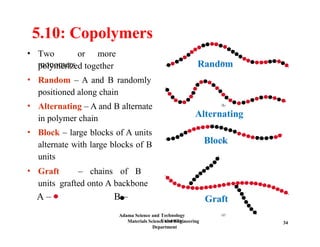
5.10: Copolymers
• Two or more
monomers
polymerized together
• Random – A and B randomly
positioned along chain
• Alternating – A and B alternate
in polymer chain
• Block – large blocks of A units
alternate with large blocks of B
units
Random
Block
Graft
Alternating
• Graft – chains of B
units grafted onto A backbone
A – B –
Technology
University,
Adama Science and
Materials Science and Engineering
Department
34
Cont’d…
• To calculate the degree of polymerization for a copolymer:
• In this expression, fj and mj are, respectively, the mole fraction
and molecular weight of repeat unit j in the polymer chain.
5.11: Polymer Crystallinity
• Polymer crystallinity is the packing of molecular chains to produce an
ordered atomic array.
• The degree of crystallinity may range from completely amorphous to
almost entirely (up to about 95%) crystalline.
• The degree of crystallinity by weight may be determined from accurate
density measurements, according to
Adama Science and Technology University,
Materials Science and Engineering
Department
35
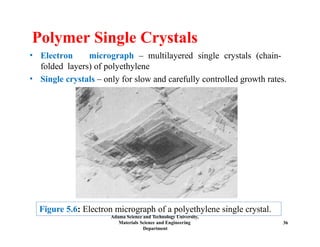
Polymer Single Crystals
• Electron micrograph – multilayered single crystals (chain-
folded layers) of polyethylene
• Single crystals – only for slow and carefully controlled growth rates.
Figure 5.6: Electron micrograph of a polyethylene single crystal.
Adama Science and Technology University,
Materials Science and Engineering
Department
36
Semi crystalline Polymers
• Many bulk polymers that are
crystallized from a melt are
semicrystalline and form a
spherulite structure
Adama Science and Technology University,
Materials Science and Engineering
Department
37
semicrystalline
form
Spherulite
chain-folded
and
amorphous
• Some
polymers
structures
• Alternating
crystallites
regions
• Spherulite
structure for
relatively rapid growth rates
Figure 3.7: Schematic representation of the
detailed structure of a spherulite.
Figure 3.8: Photomicrograph – Spherulites in Polyethylene
Cross-polarized light used
-- a maltese cross appears in each spherulite
Adama Science and Technology University,
Materials Science and Engineering
Department
38
Adama Science and Technology University,
Materials Science and Engineering
Department
39
5.13: Defects In Polymers
• Point defects have been observed in crystalline regions of polymeric
materials; these include vacancies and interstitial atoms and ions.
• Vacancies are also associated with the chain ends and branches in
the polymer chain or chain segments that emerge from the crystal.
• Impurity atoms/ions or groups of atoms/ions may be incorporated in
the molecular structure as interstitials.
• The surfaces of chain-folded layers (Figure 14.13) are considered to
be interfacial defects, as are also boundaries between two adjacent
crystalline regions.
• Screw dislocations also occur in polymer crystals
Cont’d…
45
Figure 3.9: Schematic representation of defects in polymer
Adama Science and Technology University,
Materials Science and Engineering Department
crystallites.
End of Chapter 5

Adama Science and Technology University,
Materials Science and Engineering
Department
41
Adama Science and Technology University,
Materials Science and Engineering Department
50
Questions ???
Adama Science and Technology University,
Materials Science and Engineering
Department
43
1. For a ceramic compound, what are the
characteristics of the component ions that
determine the crystal structure??
2. What point defects are possible for Al2O3 as
an impurity in MgO? How many Al3+ ions
must be added to form each of these defects?
3. In terms of bonding, explain why silicate
materials have relatively low densities.

Chapter-5-Polymer Structure.pptx [Repaired] (2) - Copy.pptx

  • 1.
    Chapter 5 Polymer Structure 1 AdamaScience and Technology University, Materials Science and Engineering Department
  • 2.
    Topics :1. : Introduction 2.: Hydrocarbon Molecules 3. : Polymer Molecules 4. : The Chemistry of Polymer Molecules 5. : Molecular Weight 6. : Molecular Shape 7. : Molecular Structure 8. : Molecular Configurations 9. : Thermoplastic and Thermosetting polymer 2 Adama Science and Technology University, Science and Engineering Department Materials
  • 3.
    Cont’d… Polymers 10. : Copolymers 11.: Polymer Crystallinity 12.: Polymer Crystals 5.13: Defects in Polymers 5.14: Diffusion in Polymeric Materials Adama Science and Technology University, Materials Science and Engineering Department 3
  • 4.
    Cont’d…  WHY STUDYPolymer Structures? • A relatively large number of chemical and structural characteristics affect the properties and behaviors of polymeric materials. Some of these influences are as follows: 1. Degree of crystallinity of semicrystalline polymers— on density, stiffness, strength, and ductility 2. Degree of crosslinking—on the stiffness of rubberlike materials 3. Polymer chemistry—on melting and glass-transition temperatures Adama Science and Technology University, Materials Science and Engineering Department 4
  • 5.
    Adama Science andTechnology University, Materials Science and Engineering Department 5 Learning Objectives • After careful study of this chapter you should be able to do the following:  Describe a typical polymer molecule in terms of its chain structure and, in addition, how the molecule may be generated from repeat units.  Draw repeat units for polyethylene, poly(vinyl chloride), polytetrafluoroethylene (PTFE), polypropylene, and polystyrene.  Calculate number–average and weight–average molecular weights, and degree of polymerization for a specified polymer.  Name and briefly describe: (a) the four general types of polymer molecular Structure (b) the three types of stereoisomers,
  • 6.
    Adama Science andTechnology University, Materials Science and Engineering Department 6 Cont’d… (c) the two kinds of geometrical isomers, (d) the four types of copolymers.  Cite the differences in behavior and molecular structure for thermoplastic and thermosetting polymers.  Briefly describe the crystalline state in polymeric materials.  Briefly describe/diagram the spherulitic structure for a semicrystalline polymer.
  • 7.
    5.1: Introduction • Whatis a Polymer? Polyethylene (PE) Poly(vinyl chloride) (PVC) • Originally, polymers are classified as: 1. Natural: - Wood – Rubber - protein - Cotton – Wool - enzymes - Leather – Silk - Starches Adama Science and Technology University, Materials Science and Engineering Department 7 Poly many mer repeat unit H H H H H H C C C C C C H H H H H H repea t unit H H H H H H C C C C C C H Cl H Cl H Cl repea t unit H H H H H H C C C C C C C H 3 H CH3 H CH3 H Polypropylene (PP) repea t unit
  • 8.
    Cont’d… 2. Synthetic (manmade)– - Plastic - Rubber - Fiber 5.2: Hydrocarbon Molecules • Most polymers are organic and many organic materials are hydrocarbons. Saturated hydrocarbons • Each carbon singly bonded to four other atoms • Example: Ethane, C2H6 H H H H C C H H Adama Science and Technology University, Materials Science and Engineering Department 8
  • 9.
    • Double &triple bonds somewhat unstable – can form new bonds • Double bond found in ethylene or ethene - C2H4 H H C C H H • Triple bond found in acetylene or ethyne - C2H2 H C C H Isomerism formula can have quite different structures. Unsaturated hydrocarbons Adama Science and Technology University, Materials Science and Engineering Department 9
  • 10.
    Cont’d… • For example:C8H18 1) normal-octane 2) 2,4-dimethylhexane H H H H H H H H H C C C C C C C C H H H H H H H H H H3C CH2 CH2 CH2 CH2 CH2 CH2 CH3  = H3C ( CH2 ) CH3 6 CH3 H3C CH CH2 CH CH3 CH2 CH3 Adama Science and Technology University, Materials Science and Engineering Department 10
  • 11.
    Adama Science andTechnology University, Materials Science and Engineering Department 11 5.3: Polymer Molecules • The molecules in polymers are gigantic in comparison to the hydrocarbon molecules and often referred to as macromolecules. • The long molecules in polymer are composed of structural entities called repeat units. • The term monomer refers to the small molecule from which a polymer is synthesized. 5.4: The Chemistry Of Polymer Molecules • The active site, or unpaired electron (denoted by . – initiators.),is transferred to each successive end monomer to form the chain. • Ethylene transform to polyethylene (solid) by forming active mer through reaction with initiator or catalytic radical (R.) • (.) denotes unpaired electron (active site)
  • 12.
    Polymerization: 1. Initiation reaction: 2.Rapid propagation ~1000 mer units in 1-10 ms: 3. Termination when two active chain ends meet each other or active chain end meet with initiator or other species with single active bond: Adama Science and Technology University, Materials Science and Engineering Department 12
  • 13.
    Cont’d… • When allmers are the same, the molecule is called a homopolymer. • When there is more than one type of mer present, the molecule is a copolymer. • Mer units that have 2 active bonds to connect with other mers are called bifunctional • Mer units that have 3 active bonds to connect with other mers are called trifunctional. They form three-dimensional molecular network structures Adama Science and Technology University, Materials Science and Engineering Department 14
  • 14.
    Cont’d… Adama Science andTechnology University, Materials Science and Engineering Department 15
  • 15.
    Cont’d… Adama Science andTechnology University, Materials Science and Engineering Department 16
  • 16.
    Bulk or CommodityPolymers 17 Adama Science and Technology University, Materials Science and Engineering Department
  • 17.
    Cont’d… Adama Science andTechnology University, Materials Science and Engineering Department 18
  • 18.
    Cont’d . .. Adama Science and Technology University, Materials Science and Engineering Department 19
  • 19.
    5.5: Molecular Weight •Molecular weight, M: Mass of a mole of chains high M • Not all chains in a polymer are of the same length — i.e., there is a distribution of molecular weights. Adama Science and Technology University, Materials Science and Engineering Department 20 Low M
  • 20.
    Molecular Weight Distribution 21 Mn  total wt of polymer total # of molecules M n   xi Mi M w   wi Mi is the number average molecular weight A weight-average molecular weight Mi = mean (middle) molecular weight of size range i xi = number fraction of chains in size range i wi = weight fraction of chains in size range i Adama Science and Technology University,
  • 21.
    Degree of Polymerization,DP • DP = average number of repeat units per chain H H H H H H H C C C C C C C H H H H H H H H H H H H H H C C ( C C ) C H H H H H DP = 6 DP  Mn for copolymers this is calculated as follows: m  fi mi m where m  average molecular weight of repeat unit mol. wt of repeat unit i Chain fraction Adama Science and Technology University, Materials Science and Engineering Department 21
  • 22.
    5.6: Molecular Shape •Polymers consist of large numbers of molecular chains, each of which may bend, coil, and kink. • These random coils and molecular entanglements are responsible for polymers to have large elastic extensions. • Some of the mechanical and thermal characteristics of polymers are a function of :  theability of chain segments to experience rotation in response to applied stresses or thermal vibrations. • Rotational flexibility is dependent on repeat unit structure and chemistry. Adama Science and Technology University, Materials Science and Engineering Department 22
  • 23.
    Chain End-to-End Distance,r Adama Science and Technology University, Materials Science and Engineering Department 25
  • 24.
    26 Adama Science andTechnology University, Materials Science and Engineering Department • The physical characteristics of a polymer depend on:  molecular weight  shape and also  on differences in the structure of the molecular chains. Linear Polymers • Linear polymers are those in which the repeat units are joined together end to end in single chains. polystyrene, • Example: polyethylene, poly(vinyl chloride), poly(methyl methacrylate), nylon, and the fluorocarbons. Branched Polymers • Polymers may be synthesized in which side-branch chains are connected to the main ones. • Example: low density polyethylene (LDPE) 5.7: Molecular Structure
  • 25.
    Cont’d… Crosslinked Polymers • Incrosslinked polymers, adjacent linear chains are joined one to another at various positions by covalent bonds. • Example: Many of the rubber elastic materials are crosslinked Network Polymers • Multifunctional monomers forming three or more active covalent bonds, make three-dimensional networks. • Example: epoxies, polyurethanes, and phenol-formaldehyde Branched Cross-Linked Adama Science and Technology University, Materials Science and Engineering Department 27 Networ k Linea r secondary bondin g
  • 26.
    5.8: Molecular Configurations •Consider the repeat unit in which R represents an atom or side group other than hydrogen (e.g., Cl, CH3). • One arrangement is possible when the R side groups of successive repeat units are bound to alternate carbon atoms as follows: • This is designated as a head-to-tail configuration. Adama Science and Technology University, Materials Science and Engineering Department 28
  • 27.
    Cont’d… • Its complement,the head-to-head configuration, occurs when R groups are bound to adjacent chain atoms: • Isomerism is also found in polymer molecules, wherein different atomic configurations are possible for the same composition. • Two isomeric subclasses: stereoisomerism and geometrical isomerism. Stereoisomerism • Stereoisomerism denotes the situation in which atoms are linked together in the same order (head-to-tail) but differ in their spatial arrangement. Adama Science and Technology University, Materials Science and Engineering Department 27
  • 28.
    Cont’d… C C H H H R H H CC H R o r H R C C H H C E B A D C D A B E mirror plane Tacticity Tacticity – stereoregularity or spatial arrangement of R units along chain Stereoisomers are mirror images – can’t superimpose without breaking a bond Adama Science and Technology University, Materials Science and Engineering Department 28
  • 29.
    Cont’d… same side Isotactic • allR groups on of chain Syndiotactic • R groups alternate sides H R H R H R H R H H H H H H H H C C C C C C C C H H H R H H H R C C C C C C C C H R H H H R H H Adama Science and Technology University, Materials Science and Engineering Department 29
  • 30.
    Cont’d… • Atactic –R groups randomly positioned H H H H H R H H C C C C C C C C H R H R H H H R Adama Science and Technology University, Materials Science and Engineering Department 30
  • 31.
    Geometrical Isomerism • Geometricalisomers, are possible within repeat units having a double bond between chain carbon atoms. • Bonded to each of the carbon atoms participating in the double bond is a side group, which may be situated on: i. one side of the chain (cis-) or ii. its opposite (trans-) C C CH3 H CH2 CH2 C C CH3 CH2 H CH2 cis cis-isoprene (natural rubber) H atom and CH3 group on same side of chain trans trans-isoprene (gutta percha) H atom and CH3 group on opposite sides of chain Adama Science and Technology University, Materials Science and Engineering Department 31
  • 32.
    Figure 5.3: Classificationscheme for the characteristics of polymer molecules Adama Science and Technology University, Materials Science and Engineering Department 32
  • 33.
    Adama Science andTechnology University, Materials Science and Engineering Department 33 5.9: Thermoplastic And Thermosetting Polymers  Thermoplastic  soften when heated and harden when cooled  Are totally reversible  are relatively soft  flexible linear & branched polymers belongs to this group  Are fabricated by the simultaneous application of heat and pressure • Examples: polystyrene, terephthalate), chloride). polyethylene, poly(ethylene and poly(vinyl • Thermosetting  are network polymers  become permanently during their formation  do not soften upon heating hard  aregenerally harder and stronger than thermoplastics  have better dimensional stability • Example: vulcanized rubbers, epoxies, phenolics and some polyester resins
  • 34.
    5.10: Copolymers • Twoor more monomers polymerized together • Random – A and B randomly positioned along chain • Alternating – A and B alternate in polymer chain • Block – large blocks of A units alternate with large blocks of B units Random Block Graft Alternating • Graft – chains of B units grafted onto A backbone A – B – Technology University, Adama Science and Materials Science and Engineering Department 34
  • 35.
    Cont’d… • To calculatethe degree of polymerization for a copolymer: • In this expression, fj and mj are, respectively, the mole fraction and molecular weight of repeat unit j in the polymer chain. 5.11: Polymer Crystallinity • Polymer crystallinity is the packing of molecular chains to produce an ordered atomic array. • The degree of crystallinity may range from completely amorphous to almost entirely (up to about 95%) crystalline. • The degree of crystallinity by weight may be determined from accurate density measurements, according to Adama Science and Technology University, Materials Science and Engineering Department 35
  • 36.
    Polymer Single Crystals •Electron micrograph – multilayered single crystals (chain- folded layers) of polyethylene • Single crystals – only for slow and carefully controlled growth rates. Figure 5.6: Electron micrograph of a polyethylene single crystal. Adama Science and Technology University, Materials Science and Engineering Department 36
  • 37.
    Semi crystalline Polymers •Many bulk polymers that are crystallized from a melt are semicrystalline and form a spherulite structure Adama Science and Technology University, Materials Science and Engineering Department 37 semicrystalline form Spherulite chain-folded and amorphous • Some polymers structures • Alternating crystallites regions • Spherulite structure for relatively rapid growth rates Figure 3.7: Schematic representation of the detailed structure of a spherulite.
  • 38.
    Figure 3.8: Photomicrograph– Spherulites in Polyethylene Cross-polarized light used -- a maltese cross appears in each spherulite Adama Science and Technology University, Materials Science and Engineering Department 38
  • 39.
    Adama Science andTechnology University, Materials Science and Engineering Department 39 5.13: Defects In Polymers • Point defects have been observed in crystalline regions of polymeric materials; these include vacancies and interstitial atoms and ions. • Vacancies are also associated with the chain ends and branches in the polymer chain or chain segments that emerge from the crystal. • Impurity atoms/ions or groups of atoms/ions may be incorporated in the molecular structure as interstitials. • The surfaces of chain-folded layers (Figure 14.13) are considered to be interfacial defects, as are also boundaries between two adjacent crystalline regions. • Screw dislocations also occur in polymer crystals
  • 40.
    Cont’d… 45 Figure 3.9: Schematicrepresentation of defects in polymer Adama Science and Technology University, Materials Science and Engineering Department crystallites.
  • 41.
    End of Chapter5  Adama Science and Technology University, Materials Science and Engineering Department 41
  • 42.
    Adama Science andTechnology University, Materials Science and Engineering Department 50 Questions ???
  • 43.
    Adama Science andTechnology University, Materials Science and Engineering Department 43 1. For a ceramic compound, what are the characteristics of the component ions that determine the crystal structure?? 2. What point defects are possible for Al2O3 as an impurity in MgO? How many Al3+ ions must be added to form each of these defects? 3. In terms of bonding, explain why silicate materials have relatively low densities.